Carbohydrates
now browsing by category
Breakfast or Late-Night Snacks — Which Should You Give Up?
Reproduced from original article:
https://articles.mercola.com/sites/articles/archive/2022/12/19/timing-of-food-intake.aspx
The original Mercola article may not remain on the original site, but I will endeavor to keep it on this site as long as I deem it to be appropriate.
Analysis by Dr. Joseph Mercola Fact Checked December 19, 2022

STORY AT-A-GLANCE
- Evidence shows that calories are burned differently when they are consumed at breakfast or late at night; breakfast is better
- More energy is stored, and less fat is burned when you eat a late-night snack, which contributes to weight management challenges
- Several factors contribute to weight loss, and being within normal weight doesn’t necessarily mean you’re healthy
- The terms “metabolically obese normal-weight” and “skinny-fat” describe individuals who are normal weight, but whose bodies operate as though they were metabolically fat
- A combination of cyclical ketosis with intermittent fasting helps support mitochondrial health and lowers your risk of several chronic diseases
It’s important to not only pay attention to what you eat, but also when you eat. In past years, experts have made numerous dietary recommendations, including eating three full meals a day, grazing throughout the day, eating a high-protein snack at night and following a low-fat diet. Despite changing recommendations, the number of overweight and obese individuals continues to climb.
According to the World Health Organization,1 the number of people who are obese nearly tripled from 1975 to 2016. In 2016, 39% of people 18 years and older were overweight. Unfortunately, in 2018 this health hazard affected 40 million children under the age of 5.
Obesity Action2 reports there’s an estimated 93 million Americans who are obese, which increases their risk for problems with mobility and a higher rate of death. Of the 22 industrialized countries worldwide, the U.S. has the highest number of citizens who are obese.3
This condition leads to high blood pressure, insulin resistance and high cholesterol and triglycerides. As body mass index rises so does the potential for developing Type 2 diabetes and high blood pressure. One counter records 751.4 million people worldwide who are obese.
Choose Breakfast, Not a Late-Night Snack
Researchers from Vanderbilt University were interested in determining whether the timing of meals has a bearing on how efficiently energy is burned.4,5 They tested the hypothesis that a circadian rhythm regulated how food would be metabolized during the day as compared to at night.
To measure this, middle-aged and older participants stayed in a respiratory chamber in two separate 56-hour interventional sessions. During each session they were offered three daily meals. In one session they were given breakfast, lunch and dinner and in the other they were given lunch, dinner and a late-night snack.
During each session the participants received the same amount of food and used the same amount of energy. At night, their respiratory exchange rates were measured. This unexpectedly revealed a difference related to the timing of meals without any relationship to physical activity or core body temperature.
It appeared that the timing of their meals had an influence on lipid oxidation (LO). Those eating a late evening snack experienced lower fat burning during the night as opposed to those who ate breakfast without a late-night snack. The amount of time the participants fasted between the last meal of the day and the first meal the next day was the same for both sessions. The researchers concluded:6
“The timing of meals during the day/night cycle therefore affects the extent to which ingested food is used versus stored. This study has important implications for eating habits, suggesting that a daily fast between the evening meal and breakfast will optimize weight management.”
Ultimately, this means that despite the number of calories eaten and calories burned being the same in both groups, those who ate at night would theoretically gain more weight than those who ate breakfast.
Weight Loss Alone Doesn’t Fix Health Problems
There are several factors that contribute to weight loss, such as sleep habits, the gut microbiome, what you eat and when you eat it. You might think that if you’re able to stay lean then you’re healthy, but weight loss alone is not a path to optimal health.
While you might look healthy on the outside, you could have some of the same health challenges as those who are overweight or obese. “Skinny fat” is a term used to describe individuals who may look thin on the outside but are metabolically fat due to a poor diet, unhealthy habits and lack of sleep.
Being overweight is a known risk factor for diabetes, yet researchers are finding that people with Type 2 diabetes who are at a normal weight have a higher mortality risk than those who are overweight or obese.7 This is known as the “obesity paradox” and it is being found in other chronic diseases as well.8
Some experts report that as many as 25% of those who are within a normal weight range have prediabetes.9 This may be the result of a focus on getting thin instead of being healthy. In other words, paying attention to what’s on the scale as opposed to getting quality sleep, reducing stress and eating a balanced diet may be leading to poor outcomes.
Researchers have been writing about metabolically obese normal-weight (MONW) individuals since as early as 1978.10 More recently, researchers have found that Type 2 diabetes in Asia is more frequently diagnosed in those who are not obese.
In a 2017 study, researchers compared insulin sensitivity, insulin secretion, intra-abdominal, muscle and liver fat, and fasting and postprandial glucose and insulin concentrations in two groups.11 MONW individuals and a control group of healthy persons were matched for age, total body fat and sex.
Compared to controls, MONW participants had nearly two times more visceral fat and four times more liver fat. While hemoglobin A1c concentrations were similar between the groups, the glucose and insulin concentrations after eating were higher in the MONW group than in the control subjects.
This led researchers to conclude that those with an MONW body type have a higher accumulation of fat in the intra-abdominal and liver areas and increasing insulin resistance with a greater insulin response to compensate for the resistance. This demonstrates that the total picture of health is related to more than just weight.
Fasting Is a Powerful Tool
Intermittent fasting is a powerful approach to facilitate better eating habits and weight loss and to reduce your risk of chronic diseases such as Type 2 diabetes,12 heart disease13 and cancer.14
Intermittent fasting doesn’t have to be difficult and it can be started gradually to help increase your potential for success. Basically, it is a cycle of eating and fasting that attempts to mimic the eating habits of our ancestors who did not have access to food 24 hours a day, 7 days a week. This helps restore your body to a more natural state.
Eating throughout the day — the opposite of intermittent fasting — means your body adapts to burning glucose as a primary fuel, which downregulates enzymes used to burn and store fat. Unfortunately, you then become progressively more insulin resistant and efforts to lose weight can be ineffective.
It is important to remember that intermittent fasting does not have to be a form of calorie restriction. In other words, the practice should make you feel good, not weak and lethargic. As your body begins to burn fat as its primary fuel, sugar cravings begin to subside and you feel full for a longer period of time.
However, it is not advisable to use intermittent fasting if your daily intake is filled with processed foods. In other words, this practice is not a cure-all for poor health and excess weight when your diet is filled with non-nutritive foods.
There are several health benefits you may experience by practicing intermittent fasting, including the reduction of insulin resistance, the promotion of leptin sensitivity, the lowering of triglycerides and the prevention or reversing of Type 2 diabetes. You’ll discover these and more in my previous article, “Top 22 Intermittent Fasting Benefits.”
Eating Keto Builds a Foundation for Cellular Health
The practice of nutritional ketosis is focused on eating high amounts of healthy fats. Aim for 70% to 85% of your total calories from healthy fat and 1 gram of protein for every kilogram of lean body mass. Focus on keeping your net carbohydrates at no more than 4% to 10% of your daily calories.
The variation in net carbs considers energy requirements that are different from person to person, depending on physical activity. There is no set amount of fat you can eat but you need to limit carbohydrates and protein for a standard ketogenic diet.
Following a ketogenic diet often increases your level of energy and helps you lose and maintain weight loss. Far greater than weight loss, it also helps support your mitochondrial health and reduces inflammation.
This may play a role in reducing chronic and neuropathic pain.15 Many aging factors are impacted by low-grade inflammation, so a ketogenic diet may help reduce your risk of premature aging and chronic diseases.16 The diet also helps reduce insulin resistance, which is associated with heart disease, cancer, diabetes and Alzheimer’s disease.
It has a positive effect on your immune system. A team from the Yale School of Medicine17 tested the theory that ketosis could protect against influenza.18 They found that infected mice that ate a keto diet were less likely to die from the virus than mice who were fed a standard diet.
Please note that while at least one of the study’s authors told news media that getting vaccinated against influenza is the optimal thing to do, there are other, better ways of fighting flu that I describe in “Will Eating Keto Help Prevent Flu?”
Fasting With Cyclical Nutritional Ketosis for Optimal Health
Using a cyclical approach to a ketogenic nutrition plan will help increase the health benefits and allow you greater flexibility in your meal planning. There are three things you need to do to follow this plan.19
- Restrict net carbohydrates (total carbs minus fiber) to 20 to 50 grams per day
- Consume 50% to 85% of your daily calories from healthy fat
- Limit protein to one-half gram of protein per pound of lean body mass
It is important to maintain these ratios until your body is burning fat for fuel. Use keto testing strips to confirm you are in ketosis and keep in mind it may take a couple of weeks to a few months until your body is effectively burning fat. Once you’re in ketosis and this starts happening, begin cycling in and out by eating a higher number of net carbs once or twice a week.
On your high-carb days, triple the amount of net carbs to maximize the biological benefit of cellular regeneration and renewal. However, I caution you to choose healthy alternatives such as digestive-resistant starches. Forgo the potato chips and bagels.
Fasting is a powerful lifestyle tool to combat obesity and insulin resistance. When you combine the power of fasting and the energy of eating keto it creates a strong foundation for optimal health.
- 1 World Health Organization
- 2 Obesity Action
- 3 Worldometer
- 4 Plos|Biology, February 27, 2020; doi.org/10.1371/journal.pbio.3000622
- 5, 6 EurekAlert! February 28, 2020
- 7 Diabetes and Metabolism Journal, 2018;42(3):179
- 8 The American Journal of Medicine, 2007;120(10):863
- 9 Daily Mail, November 20, 2014
- 10 Perspectives in Diabetes, 1998;47
- 11 American Journal of Physiology, Endocrinology and Metabolism, 2018;314:E494
- 12 BMJ Case Rep 2018. doi:10.1136/bcr-2017-221854
- 13 Frontiers in Physiology, 2016; doi.org/10.3389/fphys.2016.00350
- 14 Clinics, 2018;73(1)
- 15 Plos|One, 2009;4(12)e8349
- 16 Impact Journals:Aging, 2016;8(11):2814
- 17 New Scientist, November 15, 2019
- 18 Science Immunology, November 2019; 4(41):eaav2026
- 19 Diabetes.co.uk January 15, 2019
How the Wrong Dietary Fat Can Wreck Your Health
Reproduced from original article:
https://articles.mercola.com/sites/articles/archive/2022/12/18/omega-6-linoleic-acid.aspx
The original Mercola article may not remain on the original site, but I will endeavor to keep it on this site as long as I deem it to be appropriate.
Analysis by Dr. Joseph Mercola Fact Checked December 18, 2022
STORY AT-A-GLANCE
- Omega-6 linoleic acid (LA) is the most common fat in the American diet. Most people get 25 times more LA than they need. At most, you need about 2 grams a day, but the average American gets about 50 grams a day, thanks to the fact that most processed foods and condiments are loaded with omega-6 seed oils
- LA gets incorporated into your cell membranes where it causes inflammation. Its half-life is nearly two years, so ridding your body of stored LA completely can take up to seven years
- Eliminating LA is a marathon, not a sprint. Ineffective and potentially harmful ways of eliminating LA include extended fasting and overtaxing your body with strenuous endurance exercise
- To stop the accumulation of LA in your cells, eliminate seed oils from your diet. Cook with beef tallow, butter, ghee or coconut oil, and avoid all processed foods, restaurant foods, condiments, and animals raised on grains, such as chicken and pork
- Vitamin E, in a dose of about 2 IU – 3 IU for every gram of PUFA (not just linoleate) consumed daily may also be able to provide some protection against the inflammatory and endocrine (estrogenic, pro-cortisol) effects of linoleate and PUFA in general
- To safely encourage the elimination of LA from your body, focus on building muscle and maximizing lean muscle mass with concentric exercise, and eat a balanced diet with a ratio of 2-to-1 healthy carbs to protein
In this interview, Georgi Dinkov, an expert on linoleic acid (LA), details some of the health hazards of this exceedingly common fat in the modern diet, and how to safely rid your body of it.
Both Georgi and I are convinced excessive LA intake is one of the most important variables that can make or break your health, especially in the long term. It’s a far greater contributor to chronic and degenerative disease and mortality than sugar, and it’s the primary culprit that makes processed foods so harmful.
The historical (last 50 to 75 years) incidence curves of cancer, cardiovascular disease (CVD), diabetes and neurological disease in the general population overlap remarkably well the ever-increasing PUFA consumption rates in developed countries, suggesting PUFA is a major factor in those diseases.1,2
How Georgi Became a Biohacker
Despite having a degree in computer science, Georgi has made a name for himself as an expert biohacker. After graduating from college in 2002, he got a job as a programmer at the National Biomedical Research Foundation (NBRF).
There, he helped develop uniprot.org, a database of all known protein sequences — Protein Information Resource (PIR — pir.georgetown.edu) and UniProt (www.uniprot.org).
Surrounded by up to 60 of the brightest doctors and biochemists in the world, Georgi developed an interest in biochemistry, and started studying on the side so he could more effectively collaborate with his coworkers. He provides an amazing example of what one can learn without any formal training if they merely apply themselves.
“Between 2002 and 2005, I was part of this group as a programmer, but I basically started attending all of their lectures and classes,” he says. “Some of them were teaching at nearby universities, so I kept going.
I was a young, single person, didn’t have anything better to do, and I tried to utilize my time the best I could. Over a period of about three years, it started to click, so I started to understand what these people were talking about.
In 2005, I left, got myself a full-time job in the IT sector, and then kept reading. The reason I got into this bioenergetic area, which linoleic acid is a big part of, is because around 2009, I … became a low-carber.
Being an athlete in college, I basically happened to combine very low carb diet with very exhaustive exercise, and I got myself into a really big predicament. I started getting these very weird neurological symptoms, tingling of the extremities, headaches, sensitivity to light.”
Low-Carb Considerations
In the interview, we clear up some of the pervasive confusion surrounding low-carb diets, and why long-term chronic low-carb is not ideal. It’s a great short-term intervention for most people, especially those with insulin resistance.
This is because lowering carbs can help reset your metabolism and recover your metabolic flexibility. However, in the long term you can run into trouble — especially if you’re also doing a lot of endurance training. The main reasons for the issues caused by chronic low-carb diets (and/or stress, which mimics the effects of low-carb diets) are:
- The elevated lipolysis in a low carb-state, which results in chronically elevated circulating levels of PUFA, with the resulting inflammatory and endocrine effects (e.g. PUFA is pro-cortisol, estrogenic and also synergizes with endogenous/exogenous estrogens, and promotes their effects even in low doses).
- The downregulation of the resting metabolic rate (RMR) by lowered synthesis of T3 when eating a low-carb diet and/or fasting and/or strenuous exercise.
For more details on this, be sure to listen to the interview at normal speed. Believe me, this is an interview that nearly everyone should listen to a few times to capture the incredible clinical pearls that Georgi shared. I personally learned more during this discussion than I have from most interviews.
If you listen to the interview, you will learn that once your sugar stores are expended, you start tapping into your fat stores through a process called lipolysis. This liberated fat is then circulated around your body and supplied to the cells as fuel to compensate for the low glucose availability.
However, certain types of fat block the effects of insulin in your body, so a long-distance endurance athlete can actually end up with a blood profile similar to that of a person with Type 2 diabetes. In Georgi’s case, as an endurance athlete, his blood sugar climbed higher the less sugar he ate. This competition/antagonism between glucose and fats (mostly PUFA) as fuel for the cells was first discovered in the 1970s and named the Randle Cycle.
Why does it occur? The process in your liver that controls blood sugar is gluconeogenesis. If you stop supplying carbs to your body, the organs that need them will activate glucose creation in your body by elevating the stress hormone cortisol, which ends up being very destructive to your tissues, including skeletal muscle, liver, brain and kidneys.
In Type 2 diabetes, a state with hyperglycemia, only about 10% of the circulating glucose is of dietary origin. The rest is due to chronically elevated gluconeogenesis — which suggests that cortisol is the driver of hyperglycemia in Type 2 diabetes — and elevating cortisol chronically by doing low-carb or exhaustive exercise is likely detrimental to insulin sensitivity.
People with elevated cortisol (Cushing phenotype) have the same central obesity and loss of muscle mass (sarcopenia) as the ones seen in diabetes 2. Conversely, blocking cortisol’s effects with the drug RU486 has been demonstrated to lead to sustained fat loss WITHOUT dieting, and improved insulin sensitivity.3,4,5
Cortisol goes up during exercise, and if there’s no glucose around, cortisol rises even higher. Shakes, problem sleeping, jitteriness and neurological abnormalities are some of the symptoms of high cortisol and low glycogen stores. In Georgi’s case, his symptoms slowly vanished once he started eating a more balanced diet, with a macronutrient ratio of about one-third carbs, one-third fat and one-third protein.
Dietary Fats and Fatty Liver Disease
In his search for answers to the symptoms he experienced on a low-carb diet, he came across Dr. Peat’s website,6 aka, Dr. T.A. Peterson, an American biologist who’s been studying the role of energy in the cell, and the effects of LA. Georgi started reading Peat’s work in 2009, and eventually started doing his own experiments.
As noted by Georgi, published research has long demonstrated that LA is far from a benign macronutrient. It’s actually a highly proinflammatory mediator and has endocrine effects that mimic estrogen. Contrary to popular belief, LA is also a major culprit in nonalcoholic fatty liver disease (NAFLD), more so than fructose and other sugars.7,8
Georgi cites research9,10,11 showing people with alcoholic cirrhosis (liver disease) who ate their normal diet, which was high in omega-6 fats, experienced classic progression of cirrhosis resulting in liver failure. The group whose diet was altered to eliminate all forms of fat aside from coconut oil, a saturated fat, was able to reverse their cirrhosis, even in the presence of continued alcohol abuse. Additional animal experiments12 confirmed these results. As explained by Georgi:
“The livers of people who are eating predominantly omega-6 fatty acids very quickly get fattened up. Also, there’s cell damage of the Kupffer cells due to the many oxidation byproducts (OxLAMs) of these omega-6 fatty acids … [Meanwhile], the livers of the animals that were still alcoholic but were given the saturated fatty acids had very little oxidative damage to the cells, and they weren’t fat.
What could explain this? Well, it turns out that when you’re consuming a meal with fat, it’s composed of many different fatty acids, but we can separate them into saturated fatty acids, monounsaturated and polyunsaturated [PUFAs].
It turns out that the liver and most of the organs preferentially oxidize (burn) the saturated fatty acids, and then the monounsaturated fatty acids, while the polyunsaturated acids are predominantly stored.
The polyunsaturated fatty acids, aside from being very susceptible to spontaneous auto oxidation … combustion … are precursors to inflammatory mediators such as prostaglandins and leukotrienes. Those inflammatory mediators are basically derived from … linoleic acid. So, if you eat a lot of polyunsaturated fats, and specifically linoleic acid, you’ll have more … systemic inflammation.
Now NAFLD is already known to be an inflammatory state. You cannot get an inflammatory state from saturated fat. It does not produce those same mediators. Saturated fat will either get stored or will get oxidized properly through the process of beta oxidation to carbon dioxide, ATP and water.
But the polyunsaturated fats, they’re unstable. They can get combusted and create a lot of toxic byproducts, and the liver being the site of the primary organ of detoxification of whatever you are eating through the diet — guess what? They’re going to go mostly there.
Also, because they’re precursors to a number of different mediators, enzymes in the body will take these fatty acids, specifically linoleic acid, and then through a chain of reactions convert it to prostaglandins, leukotrienes and thromboxane.”
PUFAs Are Stored, Not Digested
An important take-home here is that PUFAs such as LA are not digested. Instead they’re stored.13 Most of the body fat in obese individuals is composed of PUFAs, not saturated fat. Saturated dietary fat is mostly burned (oxidized) and used up.
So, obese individuals are typically not eating very much saturated fat; rather, they’re exponentially overdosing on LA. Animal studies in the early 20th century demonstrated conclusively that pigs fed saturated fats (mostly coconut oil) could not get fat but became lean and muscular, while the ones fed PUFA gained mostly fat.
This led to the adoption/promotion of PUFA as animal feed since the goal there is to maximize “caloric efficiency” — i.e., get the animals as heavy as possible with a little food as possible. In other words, the pro-obesity effects of PUFA and anti-obesity effects of saturated fats are well-known in the livestock industry and are not disputed.
Considering the similarity of our metabolism/structure/tissues/organs with those of pigs, it should not be at all surprising that we keep getting fatter while consuming ever-larger amounts of PUFA.
The half-life of PUFAs such as LA, which get embedded and integrated into your cell membranes, is about 680 days. This means that to rid your body of LA will take approximately seven years, provided you don’t load more in. And you really do want to get rid of this fat, as it’s highly inflammatory and prevents your mitochondria and cellular machinery from operating properly.
Research has shown that given enough PUFAs, your cells will go into apoptosis, they basically commit suicide. “It can actually work like a radiation or chemotherapy. It is a type of chemotherapy,” Georgi says. The implications14,15 of this insight are quite profound and I look forward to exploring that with Georgi on his next interview.
PUFAs Coming Out of Storage Can Cause Trouble
A key way to eventually lower your body burden of LA is to keep your total LA intake below 2%, maybe even close to 1%. You need to stop putting more in. Exercise and fasting will help drive the LA out, but you need to be really careful if you have a lot of LA storage.
“A recent study16 found that even lean people who are running marathons, a good portion (82%!) of them are actually in acute kidney failure by the time they reach the finish line,” Georgi says. “The question is, how is this possible? It looks like these circulating fatty acids, which are mostly PUFAs coming out of storage, circulate and cause energetic problems.
Also, because of the quick peroxidation and conversion into inflammatory mediators, they’re damaging many of the organs, predominantly the kidneys.17 Why the kidneys? Anything that is not oxidized for fuel basically gets sent to the liver through the blood stream, the Phase 2 detoxification mechanism. The liver attaches glucuronic acids to these fatty acids to make them more water soluble.
It can also sulfate them. When they’re more water soluble, you pee them out. But they have to go through the kidneys, and it looks like if a sufficiently big supply of these glucoronidated sulfated PUFAs, or let’s say linoleic acid just for the sake of the argument, is flooding the kidneys, it is causing local damage there.
So, what should we do? Well, it looks like we should be taking measures to not get into excessive lipolysis. What is excessive lipolysis? It’s any situation where you’ve run out of glycogen and now the body says, ‘I don’t have the fuel,’ because you’re not eating and you’ve run out of glycogen.
Then fat is your only other fuel, plus the amino acids that are coming from cortisol. So basically, you should not be getting to a state where you’re chronically starving. Acute, let’s say like eight to 12 hours of fasting, calorie restriction, has been shown to have benefits, but anything longer than that, then you’re starting to increase baseline lipolysis.”
My Recommendations for TRE Have Changed
Georgi pointed out the dangers of an excessive time-restricted eating (TRE) window.18,19,20,21,22,23,24,25 An extreme example of TRE is the one meal a day (OMAD) protocol, where you’re fasting 20 hours or more each day. Georgi believes this is too extreme for most people, as most have large stores of LA that need to be purged safely.
I have been personally practicing and advocating a six– to eight-hour time restricted eating window. What I learned from our conversation is that this, or even longer eating restrictions and fasts, are perfectly appropriate for 95% of the population as they are insulin resistant and metabolically inflexible.
The major problem comes once you lose your insulin resistance and become metabolically flexible. At that point, this strategy becomes counterproductive as you will increase your cortisol levels, which causes chronic inflammation that can lead to tissue damage. Usually, it takes about three to six months for you to recover your metabolic flexibility.
Prior to my interview with Georgi I would have a six- to eight-hour eating window and I did this for a few years. Now I am going to shift to one day a week of 12 hours, three days of 10 hours and three days of eight hours. If you are metabolically healthy, I would encourage you to avoid very short eating windows under eight hours.
This is because chronic fasting also elevates your cortisol, just like chronic endurance exercise does. Cortisol, in turn, is involved in insulin resistance and the synthesis of fat, and promotes the storage of fat. Also, as just mentioned above, high amounts of LA can kill your cells.
“So, you don’t want to be doing this to your normal tissues, and you’re doing it to your tissues every single time you over-exert yourself to the point of either glycogen running low or you’re so stressed that your adrenaline has gotten to the point where it’s increasing lipolysis and you’re starting to shed fat.”
This is a massive piece of the puzzle that I never fully appreciated. Molecular biology and pH physiology are based on a pre-1860s scenario where you didn’t have these high levels of LA, which totally distorts the strategies. If they weren’t there, you could fast to activate autophagy and get all these benefits.
You could have a much longer TRE window. But LA is a game changer. It radically modifies the concept of what you need to do to optimize your health. Essentially, if you’ve filled up your fat stores with LA — and in most people, over 20% of their fats are LA stored in their cell membranes and the optimum is 1% to 2% — then you need to integrate that knowledge into your strategy.
How to Safely Purge LA
How can you safely reduce these stores of LA without self-sabotaging? As explained by Georgi, extensive fasting will, in this instance, backfire, as will overtaxing yourself with heavy exercise. You’ll need to accept that this is a marathon, not a sprint, and that it’s going to take years to purge your LA stores. The best strategy, Georgi says, is to build muscle and maximize lean muscle mass.
“What does that mean? Concentric exercise, stimulating the muscles to grow. We already mentioned that cortisol is a very catabolic steroid for the muscles, so [you don’t want that] chronically. Acute spikes of cortisol are unavoidable. But things such as chronic fasting or eating inflammatory foods should be avoided as much as possible, which means cutting out vegetable oils.
If you’re cooking your own food, you have the tools at your disposal to eliminate almost completely the consumption of polyunsaturated fats. If you have to fry things or cook on high temperature, use butter, ghee or beef tallow. Even coconut oil [is good], but it has a lower smoke point. All of these are very good substitutes.”
Also avoid all processed foods, restaurant foods, condiments and animal foods raised on grains, such as chicken and pork. Aside from switching the types of dietary fats you eat, Georgi recommends a diet with a 2-to-1 ratio of carbs to protein, the carbs being in the form of fruits and vegetables, not processed sugary snacks.
“Protein is thermogenic. It’s going to raise your metabolic rate. It’s important to consume it with enough carbs because one of the quickest ways to damage your kidneys is consuming a very high protein diet without sufficient amount of carbs.
Even a competitive bodybuilder can only fully utilize about 120 grams of protein a day. Everything else that a person consumes is going to get oxidized as fuel and in the process gets deaminated, which means it produces ammonia, which is very toxic. It destroys the kidneys, liver and brain.
So, eat your protein, don’t cut down on the protein, but don’t overdo it. Make sure the ratio of carbs to protein is at least two to one, and completely cut out PUFAs as much as possible, especially if you’re cooking your own food.”
Hopefully you didn’t skim this and miss the pearl at the end, to take twice as many carbs as protein. What Georgi didn’t state here, though, is that is for people who are metabolically flexible and not insulin resistant.
So, the key is not to be afraid of healthy carbs: They are your friend. If you are eating enough protein to build muscle, please make sure you also have enough carbs because, if you fail to do this, you can hurt your kidneys, liver and brain.
He also shared another pearl about resistance exercises that I wasn’t aware of. Eccentric exercise, in which you are resisting gravity on the way down, builds muscles, BUT it also damages your muscles and destroys the mitochondria. It is far better to focus on the concentric phase of exercise, as it builds more and stronger mitochondria. Concentric exercise increase mitochondrial biogenesis, and steroidogenesis in muscle.26
How PUFAs Cause Heart Disease
Saturated fats improve the structure of cells, specifically the lipid bilayer, while PUFAs like LA impair it. The reason your cholesterol and LDL levels may go up when switching to saturated fats is because you’re giving the cells the structural material needed, from which the cells can synthesize their own cholesterol as needed. Hence, extra cholesterol gets dumped into the bloodstream because it isn’t needed.
Cholesterol is carried around by LDL. So, when you’re eating saturated fat, your LDL rises, but it’s rising because the cholesterol already in the cell is not as needed anymore. It’s actually a good sign.
Conversely, when you’re eating PUFAs, your cells need more cholesterol to strengthen their structure, so your body dumps cholesterol into the cells to protect them from the onslaught of the PUFAs. Hence, it appears your cholesterol level is going down, but it’s actually having a strongly negative effect.
Additionally, the LA becomes oxidized and the LDL carrying it is now oxidized LDL, which is strongly associated with plaque. Plaque, associated with heart attacks also contains white blood cells, calcium, 7-ketocholesterol and PUFA peroxidation byproducts. Saturated fat does not contribute to plaque.
“The plaque is basically a reaction to an inflammation caused by these toxic PUFA byproducts, and PUFA itself is inflammatory. When it gets lodged into the blood vessel walls, it causes a localized inflammatory reaction. The first response of the body is to send white blood cells to protect the blood vessel wall from damage and rupture. That’s really the purpose of the plaque.
So, the body’s not trying to kill you. It’s simply trying to repair in the best possible manner, to isolate the issue. And the issue that it’s trying to isolate is the PUFA peroxidation byproducts27 and 7-ketocholesterol.28 How can you get around this? Don’t eat PUFA, or at least drastically reduce it. Go back to whatever your grandmother was eating.”
Concluding Thoughts
Like me, Georgi is convinced LA is a primary culprit in chronic diseases. And, since LA is found in most whole foods, there’s really never any need to take an omega-6 supplement. It’s virtually impossible to get too little from your diet.
I believe omega-6 supplements really ought to be removed from the market altogether, as people are getting 25 times more omega-6 than they could possibly need from their diet. At most, you need about 2 grams a day, but the average American gets about 50 grams a day, thanks to the fact that most processed foods and condiments are loaded with omega-6 seed oils.
If our diet were to be shifted away from seed oils to saturated fats, the way it was 150 years ago, we’d likely see a massive decline in chronic diseases, including cancer and heart disease.
To learn more, be sure to listen to the entire interview, as we dive into far greater detail than what I’ve summarized here. Georgi is an absolute fire hydrant when it comes to biochemical details. Also check out Georgi’s blog at www.haidut.me. You can also obtain a major sampling of Ray Peat’s work for free by going to these two sites: wiki.chadnet.org/Ray-Peat and RayPeat.com.
- 1 Ray Peat Forum April 13, 2016
- 2 Open Heart August 22, 2018
- 3 Obesity September 6, 2012; 18(12): 2295-2300
- 4 Front Pharmacol April 24, 2020
- 5 BMC Endocr Disord 2015; 15: 63
- 6 Ray Peat
- 7 Ray Peat Forum January 23, 2018
- 8 Haidut.me October 20, 2021
- 9, 17 Gastroenterology August 1995; 109(2): 547-554
- 10 J Pharmacol Exp Ther November 2001; 299(2): 638-644
- 11 Haidut.me September 12, 2019
- 12 Alcoholism: Clinical and Experimental Research 1989; 13(1): 15-19
- 13 Haidut.me October 22, 2019
- 14 Ray Peat Forum March 23, 2021
- 15 Ray Peat Forum December 4, 2019
- 16 Ray Peat Forum March 28, 2017
- 18 Haidut.me February 16, 2021
- 19 Haidut.me September 27, 2022
- 20 Haidut.me March 4, 2021
- 21 Haidut.me December 10, 2021
- 22 Haidut.me June 21, 2022
- 23 Haidut.me November 17, 2020
- 24 Haidut.me December 21, 2021
- 25 Haidut.me September 30, 2020
- 26 Muscle & Nerve 2014; 50(5): 803-811
- 27 Int J Vitam Nutr Res 2013; 83(6): 367-376
- 28 Int J Biochem Cell Biol March-April 1999; 31(3-4): 369-375
FDA Approves Absurd Pill to Delay Diabetes
Reproduced from original article:
https://articles.mercola.com/sites/articles/archive/2022/12/14/tzield-for-type-1-diabetes.aspx
The original Mercola article may not remain on the original site, but I will endeavor to keep it on this site as long as I deem it to be appropriate.
Analysis by Dr. Joseph Mercola Fact Checked December 14, 2022

STORY AT-A-GLANCE
- The U.S. Food and Drug Administration approved Tzield (teplizumab-mzwv), made by drugmakers Sanofi and Provention Bio, for use in adults and children 8 years and older who have stage 2, Type 1 diabetes
- Tzield is a monoclonal antibody injection that neither treats nor prevents Type 1 diabetes
- The treatment is intended to delay the onset of stage 3, Type 1 diabetes by only about 25 months
- The drug’s wholesale cost is $193,900 for a 14-day supply, and it comes with a risk of unknown side effects
- Tzield may cause cytokine release syndrome (CRS), an acute systemic inflammatory syndrome that includes fever and multiple organ dysfunction
- Lymphopenia, a reduced level of white blood cells, occurred in 78% of patients treated with Tzield
The U.S. Food and Drug Administration approved the first drug that delays onset of Type 1 diabetes.1 The American Diabetes Association called the approval a “historic moment”2 for those living with the condition. I call it absurdity on steroids, as this drug does not treat or prevent Type 1 diabetes. It only delays its onset for about two years.
Meanwhile, the drug’s wholesale cost is $193,900 for a 14-day supply,3 and it comes with a risk of unknown side effects. Type 1 diabetes is a serious condition, but marketing this drug as a savior of sorts is at best misleading and at worst downright dangerous.
What Is Type 1 Diabetes?
Type 1 diabetes affects close to 2 million people in the U.S.4 It’s far less common than Type 2 diabetes, and affects only about 5% to 10% of people with diabetes.5 It’s believed to be caused by an autoimmune reaction, during which the body mistakenly attacks and destroys cells in the pancreas known as beta cells. Beta cells make insulin, so in Type 1 diabetes, your pancreas doesn’t make insulin or doesn’t make enough insulin to keep you healthy.
Without insulin, which is necessary for blood sugar to enter cells to be used as energy, blood sugar builds up in the bloodstream, causing damage.6 While it’s thought that genetics play a role in Type 1 diabetes, most people diagnosed do not have a family history of the disease.7 Further, environmental factors, including viruses, may trigger the condition. It can occur at any age but is most commonly diagnosed in children and young adults.8
There are three stages of Type 1 diabetes that are formally diagnosed. Stage 1 occurs when at least one diabetes-related autoantibody has been detected via screening tests, even though blood sugar levels are still normal and no symptoms are present.9
Stage 2 is diagnosed when two or more diabetes-related autoantibodies are present and blood sugar levels have become abnormal due to loss of beta cells. No symptoms are present during stage 2. In stage 3, clinical diagnosis is typically made. Symptoms are typically present, along with significant loss of beta cells.
Type 1 diabetes develops over the course of months or years and, as mentioned, symptoms may not develop until the later stages of the disease. By this time, the symptoms, which are caused by high levels of sugar in the blood, can be severe — even life threatening. These include:10
| Extreme weakness or fatigue | Extreme thirst |
| Increased urination | Abdominal pain |
| Nausea and/or vomiting | Blurred vision |
| Irritability | Quick mood changes |
New Drug to Delay Onset of Type 1 Diabetes
The FDA approved Tzield (teplizumab-mzwv), made by drugmakers Sanofi and Provention Bio,11 for use in adults and children 8 years and older who have stage 2, Type 1 diabetes. Tzield is a monoclonal antibody injection that neither treats nor prevents Type 1 diabetes. Instead, it’s intended to delay the onset of stage 3, Type 1 diabetes. According to the FDA:12
“Tzield binds to certain immune system cells and delays progression to stage 3 type 1 diabetes. Tzield may deactivate the immune cells that attack insulin-producing cells, while increasing the proportion of cells that help moderate the immune response. Tzield is administered by intravenous infusion once daily for 14 consecutive days.”
The drug’s safety and efficacy were evaluated via a trial involving just 76 patients with stage 2, Type 1 diabetes. Participants received either Tzield or a placebo once daily via an intravenous infusion for 14 days. After a median follow-up period of 51 months, 45% of the 44 patients who received the drug went on to be diagnosed with stage 3, Type 1 diabetes, compared to 72% of the 32 patients who received a placebo.
The mid-range time that elapsed before a diagnosis of stage 3, Type 1 diabetes was 50 months for those who received Tzield, compared to 25 months for the placebo group. “This represents a statistically significant delay in the development of stage 3, type 1 diabetes,” the FDA noted.13
Tzield Associated With Serious Side Effects
Serious side effects were reported with Tzield use, however, including decreased levels of white blood cells, along with rash and headache. Warnings and precautions are warranted with use of Tzield, according to the FDA, including monitoring for symptoms of the following:
- Cytokine release syndrome
- Risk of serious infections
- Decreased levels of white blood cells called lymphocytes
- Risk of hypersensitivity reactions
Cytokine release syndrome (CRS) is an acute systemic inflammatory syndrome that includes fever and multiple organ dysfunction.14 Cytokines are a group of proteins that your body uses to control inflammation. If you have an infection or are given immunotherapy drugs, your body will release cytokines to help combat inflammation, but sometimes it releases more than it should.
If the cytokine release spirals out of control, the resulting “cytokine storm” becomes dangerous and is closely tied to sepsis.15 According to Provention Bio, “CRS occurred in TZIELD-treated patients during the treatment period and through 28 days after the last drug administration.”16
Because of this, patients are instructed to premedicate with antipyretics, antihistamines and/or antiemetics before using Tzield — and use these drugs to treat any related symptoms that develop during treatment. Provention Bio continued:17
“If severe CRS develops, consider pausing dosing for 1 day to 2 days and administering the remaining doses to complete the full 14-day course on consecutive days; or discontinue treatment. Monitor liver enzymes during treatment. Discontinue TZIELD treatment in patients who develop elevated alanine aminotransferase or aspartate aminotransferase more than 5 times the upper limit of normal (ULN) or bilirubin more than 3 times ULN.”
Regarding serious infections, Provention Bio stated that people with active serious or chronic infections should not use Tzield, and those who do should be monitored for signs and symptoms of infection during and after use. Lymphopenia, a reduced level of white blood cells often seen alongside infections like HIV, COVID-19 and tuberculosis, also occurred in 78% of patients treated with Tzield.18
The drug may also interfere with immune response to vaccination. As such, the FDA noted that “all age-appropriate vaccinations” must be administered “prior to starting Tzield.” Concurrent use of the drug and live, inactivated and mRNA vaccines must also be avoided.
Fasting May Promote Growth of Pancreatic Beta Cells
Conventional medicine currently falls short in helping those with Type 1 diabetes, but Tzield only delays its onset by about two years — at a significant monetary cost and risk of serious side effects. Other options deserve further scrutiny — options that have only positive related effects, such as intermittent fasting or time-restricted eating (TRE).
An editorial written in the BMJ19 by noted research scientist James DiNicolantonio, PharmD.,20 discusses the results of several studies that have found repeated episodes of fasting may induce cell growth of pancreatic beta cells in mouse models. The growth is associated with an increased expression of Ngn3,21 a protein involved in converting DNA into RNA critical for endocrine cells in the pancreatic islets of langerhans, the cells responsible for producing insulin.
The increase in islet beta cells induced through intermittent fasting was accompanied by a marked improvement in blood sugar control in the animal studies. These observations were of greatest interest to individuals suffering from Type 1 diabetes, as they often experience near complete inflammatory destruction of the islet beta cells.
“With respect to Type 1 diabetes,” DiNicolantonio wrote, “production of new beta cells might enable its resolution if the autoimmune attacks that destroyed the original complement of beta cells can somehow be quelled.”22
Consuming Carbs Last Benefits Type 1 Diabetes
Another option that’s free, safe and available to everyone is simply changing the order in which you eat certain foods. Among children with Type 1 diabetes, consuming carbohydrates at the end of the meal has been found to be beneficial. Twenty patients with Type 1 diabetes aged 7 to 17 years were included in a related study.23 They consumed two meals in random order. For the first meal, the protein and fat components were consumed first, followed 15 minutes later by the carbohydrates.
In the other meal, protein, fat and carbohydrates were consumed together, the way they would be in a typical meal. Mean glucose levels were 1 mmol/L lower when carbs were consumed last compared to the typical meal.
Dr. Jason Fung, a nephrologist (kidney specialist) and author of several books, explains you can get a more beneficial response, including reducing insulin and glucose, simply by frontloading protein and fats in your meal and leaving the carbs for later.24 He continued:25
“This might mean a lot of things, including you need less insulin, which might lead to less weight gain overall because we know that those high glucose levels, those high insulin levels, are going to drive weight gain.
This actually has massive implications for the way we need to structure our meals … We might be able to take less medications. We may be able to lose weight, because again that lower level of insulin is going to cause less weight gain. And what it means is that you really have to frontload your meals so that you’re taking your protein, and your fat and your vegetables right upfront and leaving the carbohydrates to the end.”
For best results, he says, wait about 10 minutes after consuming the protein and fats before you eat the carbs, similar to the way you might eat an appetizer before your next course.
More Research Is Needed for Real Type 1 Diabetes Support
It’s unfortunate that a close-to-$200,000 drug is being heralded as a breakthrough for Type 1 diabetes, especially since it only delays its onset and is so risky for overall health. What’s needed to truly help those suffering from this devastating condition is research into safe and effective modalities for prevention and treatment.
Research has demonstrated, for instance, that pregnant women with optimal vitamin D levels significantly reduce their child’s risk of developing Type 1 diabetes. As noted by Carole Baggerly, director and founder of GrassrootsHealth Nutrient Research Institute, a nonprofit public health research organization dedicated to moving public health messages regarding vitamin D from research into practice:26
“We’re working with the Diabetes Research Center to see whether, even after the child is born, as long as they don’t have full-blown type 1 diabetes, what can we do to help stop it? And it turns out that the combination of vitamin D and omega-3 really matters.”
Black cumin (nigella sativa) also deserves special mention, as studies have shown it can help prevent both Type 1 and Type 2 diabetes.27 Instead of pouring research into toxic drug treatments, studies delving into vitamin D, TRE and environmental triggers of Type 1 diabetes, among other strategies, could offer real hope for those with or at risk of Type 1 diabetes.
– Sources and References
- 1, 7, 12, 13 U.S. FDA November 17, 2022
- 2, 3, 4, 11 NBC News November 18, 2022
- 5, 6 U.S. CDC, What Is Type 1 Diabetes
- 8, 10 Emory University School of Medicine, FAQs
- 9 Emory University School of Medicine, Stages of Type 1
- 14 UpToDate, Cytokine release syndrome
- 15 Lancet. 2020 May 9;395(10235):1517-1520. doi: 10.1016/S0140-6736(20)30920-X. Epub 2020 Apr 17
- 16, 17, 18 Provention Bio November 17, 2022
- 19, 22 Open Heart, 2019; 6: e001028
- 20 Research Gate, Dr. James DiNicolantonio
- 21 Developmental Dynamics, 2008;237(11):3270
- 23 Pediatr Diabetes. 2018 Jun;19(4):809-815. doi: 10.1111/pedi.12640. Epub 2018 Mar 12
- 24 YouTube, Jason Fung, Why Food Order Matters May 22, 2022
- 25 YouTube, Jason Fung, Why Food Order Matters May 22, 2022, 7:15
- 26 Grassroots Health, D*action Project to Prevent Type 1 Diabetes
- 27 Journal of Endocrinology and Metabolism April 2011; 1(1): 1-8
How to Raise or Lower Your Dementia Risk Through Diet
Reproduced from original article:
https://articles.mercola.com/sites/articles/archive/2022/11/12/alzheimers-meal-plan.aspx
The original Mercola article may not remain on the original site, but I will endeavor to keep it on this site as long as I deem it to be appropriate.
Analysis by Dr. Joseph Mercola Fact Checked November 12, 2022

STORY AT-A-GLANCE
- A high-fat, moderate-protein, low net-carb ketogenic diet is crucial for preventing degeneration that can lead to Alzheimer’s. High-carb diets have been shown to increase your risk of dementia by 89% while high-fat diets lower it by 44%
- Other research highlights the importance of eating a diet rich in flavonols — antioxidants found in fruits, vegetables and tea. Those who got the highest amounts of flavonols had a 48% lower risk of developing Alzheimer’s than those getting the lowest amounts
- Drinking tea three times or more per week also lowers your risk of cardiovascular disease and all-cause mortality. A 50-year-old habitual tea drinker would develop heart disease and/or have a stroke 1.41 years later than someone who drinks it less frequently, and live 1.26 years longer
- Diets high in trans fats, refined sugar, grains and processed vegetable oils, as well as insufficient cholesterol, raise your risk of dementia
- Diets high in trans fats can raise your risk of dementia by 52% to 74%. The biggest dietary culprits include pastries, margarine, candy, caramels, croissants, nondairy creamers, ice cream and rice cakes
According to statistics released in 2022, Alzheimer’s disease — the most common form of dementia for which there is no effective conventional treatment or cure — affects an estimated 6 million Americans,1 up from 5.4 million in 2016.
Progression of Alzheimer’s disease varies, but often begins with short-term memory lapses that later progress to speech problems and trouble with executive functions.
Your Diet Plays a Significant Role in Dementia
While it’s never too early to start, if your memory slips frequently enough to raise even an inkling of concern, it’s time to take action. A high-fat, moderate-protein, low net-carb ketogenic diet is crucial for protecting your brain health and preventing degeneration that can lead to Alzheimer’s.
One of the most striking studies2 showing the effects of a high-fat/low-carb versus high-carb diets on brain health revealed that high-carb diets increase your risk of dementia by 89%, while high-fat diets lower it by 44%.
According to the authors, “A dietary pattern with relatively high caloric intake from carbohydrates and low caloric intake from fat and proteins may increase the risk of mild cognitive impairment or dementia in elderly persons.” Other research3,4 highlights the importance of eating a diet rich in flavonols — antioxidants found in fruits, vegetables and tea. As reported by Reuters:5
“Researchers followed 921 people without dementia for about six years, starting when they 81 years old, on average. During the study, 220 people were diagnosed with probable Alzheimer’s disease.
People who had the most flavonols in their diet were about half as likely to develop Alzheimer’s than those who consumed the least … While 15% of people who ate the most flavonol developed Alzheimer’s disease, this rose to 54% among those who consumed the least.
This difference remained even after researchers accounted for other risk factors for Alzheimer’s like diabetes, a prior heart attack or stroke, or high blood pressure …”
Overall, people in the lowest quintile got about 5.3 milligrams of flavonols per day on average, while the highest intake group got about 15.3 mg per day. Those who got the highest amounts of flavonols had a 48% lower risk of developing Alzheimer’s than those getting the lowest amounts.
Some Flavonols Are More Potent Than Others
The researchers were particularly interested in whether specific flavonols might offer better protection than others. To determine this, they tallied participants’ intake of:
- Kaempferol
- Quercetin
- Myricetin
- Isorhamnetin
Kaempferol came out a clear winner in this regard. Those with the highest consumption of kaempferol had a 51% lower risk of dementia, while the highest intakes of isorhamnetin and myricetin were linked to a 38% lower risk. Quercetin, a powerful antiviral and immune booster, did not appear to have any impact on Alzheimer’s risk.
Tea Drinkers Live Longer
In related news, a January 2020 study6 in the European Journal of Preventive Cardiology found habitual tea consumption (three times or more per week) helps lower your risk of cardiovascular disease and all-cause mortality.
Overall, the findings suggest a 50-year-old who drinks tea at least three times a week would develop heart disease and/or have a stroke 1.41 years later than someone who drinks it less frequently. Overall, they’d also live 1.26 years longer than someone who didn’t regularly drink tea. As reported by Science Daily:7
“Compared with never or non-habitual tea drinkers, habitual tea consumers had a 20% lower risk of incident heart disease and stroke, 22% lower risk of fatal heart disease and stroke, and 15% decreased risk of all-cause death.”
How a Ketogenic Diet Protects Your Brain Function
Getting back to the ketogenic diet, it has the ability to lower your dementia risk in a number of ways. For starters, a cyclical ketogenic diet will improve your insulin sensitivity, which is an important factor in Alzheimer’s.8 The link between insulin sensitivity and Alzheimer’s is so strong, the disease is sometimes referred to as Type 3 diabetes.
Even mild elevation of blood sugar is associated with an elevated risk for dementia.9 Diabetes and heart disease10 are also known to elevate your risk, and both are rooted in insulin resistance. For optimal health, you’ll want to keep your insulin level below 3 mcU/ml (fasting).
The connection between high-sugar diets and Alzheimer’s was highlighted in a decadelong study published in the journal Diabetologia in January 2018,11 which showed that the higher your blood sugar, the faster your rate of cognitive decline.
Studies have also confirmed that the greater an individual’s insulin resistance, the less sugar they have in key parts of their brain, and these areas typically correspond to the areas affected by Alzheimer’s.12,13
A cyclical ketogenic diet will also trigger your body to produce ketones, an important source of energy (fuel) for your brain14 that have been shown to help prevent brain atrophy and alleviate symptoms of Alzheimer’s.15 Ketones may even restore and renew neuron and nerve function in your brain after damage has set in.
Last but not least, a cyclical ketogenic diet helps reduce free radical damage and lower inflammation in your brain. This too is largely the result of ketones, as they generate fewer reactive oxygen species and less free radical damage than carbohydrates.
A ketone called beta hydroxybutyrate is also a major epigenetic player, stimulating radical decreases in oxidative stress by decreasing NF-kB, thus reducing inflammation and NADPH levels along with beneficial changes in DNA expression that improve your detoxification and antioxidant production.
I explain the ins and outs of implementing this kind of diet, and its many health benefits, in my “KetoFast” book. In it, I also explain why cycling through stages of feast and famine, opposed to continuously remaining in nutritional ketosis, is so important.
(For clarity, a ketogenic diet tends to be very high in both healthy fats and vegetables. There is in fact no limit to the vegetable carbs you can eat. There’s also no restriction on tea.
The only area where prudence might be needed is when it comes to fruits, as some are very high in fructose. Fructose, even from fruit, needs to be restricted in the earlier stages until you’ve successfully transitioned into burning fat as your primary fuel. For guidance on what fats to eat more of, see the Fats section of my free nutrition plan.)
Trans Fats Raise Your Risk of Alzheimer’s
While diets high in healthy fats and antioxidants can go a long way toward warding off dementia, diets high in trans fats, refined sugar and grains do the opposite. Research16 published in the October 2019 issue of Neurology found a strong link between trans fat consumption and incidence of dementia and its various subtypes, including Alzheimer’s.
The study included 1,628 Japanese seniors aged 60 and older. None had dementia at the outset of the study, which went on for 10 years. Levels of elaidic acid — a biomarker for industrial trans fat — in the participants’ blood were measured using gas chromatography/mass spectrometry.
Based on those levels, the hazard ratios for all-cause dementia, Alzheimer’s and vascular dementia were calculated using Cox proportional hazards model. As reported by the authors:17
“Higher serum elaidic acid levels were significantly associated with greater risk of developing all-cause dementia and AD [Alzheimer’s disease] after adjustment for traditional risk factors.
These associations remained significant after adjustment for dietary factors, including total energy intake and intakes of saturated and polyunsaturated fatty acids.”
This increase in risk was not slight. As reported by CNN,18 people in the highest quartile of elaidic acid levels were 74% more likely to develop dementia. Those in the second-highest quartile had a 52% higher risk.
Of the various processed foods found to contribute to elevated elaidic acid levels, pastries were the biggest contributors, followed by margarine, candy, caramels, croissants, nondairy creamers, ice cream and rice crackers.19
Oxidized Omega-6 — Another Harmful Fat to Stay Clear Of
While it’s clearly important to avoid trans fat, processed oils are the primary culprit in most Western diseases.
This is largely related to the oxidized omega-6 fat found in them, which may actually be even worse than trans fat. Now, omega-6 fat (linolenic acid) in and of itself is not the problem. Linoleic acid is also found in foods such as nuts, seeds and eggs, and is important for health. The problem is oxidized omega-6 fat, and the fact that most people eat far too much of it.
For years, I’ve stressed the importance of balancing your omega-3 to omega-6 intake to protect your health. Ideally, get an omega-3 index test done once a year to make sure you’re in a healthy range. Your omega-3 index should be above 8% and your omega 6-to-3 ratio between 0.5 and 3.0. To correct a lopsided omega-3 to omega-6 ratio, you typically need to:
1.Significantly decrease intake of damaged omega-6 by avoiding processed foods and foods cooked in vegetable oil at high temperatures. Common sources of harmful omega-6 include corn oil, canola oil, soy oil, hydrogenated or partially hydrogenated fats, margarine and shortening.
2.Increase your intake of animal-based omega-3 fats from sardines, anchovies, herring and wild-caught Alaskan salmon, or take a supplement such as krill oil, all of which provide you with DHA bound to phospholipids.
Research20,21 suggests DHA bound to phospholipids (not triglycerides, which is what you find in most fish oil supplements) may be particularly important for those with the APOE4 gene, which predisposes them to Alzheimer’s.
Low Cholesterol Can Impact Your Dementia Risk
Another dietary factor that has been shown to influence your risk for Alzheimer’s is low cholesterol. While there are many warnings about high total cholesterol, low levels can have equally serious repercussions. In fact, a number of studies have demonstrated the importance of higher cholesterol for the prevention of Alzheimer’s specifically.
According to senior research scientist Stephanie Seneff, Ph.D., insufficient fat and cholesterol in your brain play a crucial role in the Alzheimer’s disease process, detailed in her 2009 paper22 “APOE-4: The Clue to Why Low Fat Diet and Statins May Cause Alzheimer’s.” A 2014 study23 in JAMA Neurology came to a similar conclusion, stating that:
“Cholesterol, vital to neuronal structure and function, has important roles in the synthesis, deposition, and clearance of β-amyloid (Aβ) and may have a pathogenic role in Alzheimer disease (AD) … There are also important connections among apolipoprotein E (APOE), Aβ, and cholesterol.
A strong genetic risk factor for AD, the APOE ε4 allele is associated with earlier and higher deposition of Aβ. APOE is the primary transporter of cholesterol in the brain, and its isoforms differentially modulate brain cholesterol levels.”
Here, the researchers found that higher levels of HDL and lower levels of LDL were associated with a reduced risk for amyloid plaque deposits in the brain, and these findings were independent of age and presence of the APOE4 gene. Study co-author Dr. Charles DeCarli, a professor of neurology at UC Davis and director of the UC Davis Alzheimer’s Disease Center, offered the following advice, based on the results:24
“If you have an LDL above 100 or an HDL that is less than 40 … you want to make sure that you’re getting those numbers into alignment. You have to get the HDL up and the LDL down.”
That said, research25 published in 2008 found that elderly individuals who were not genetically predisposed to Alzheimer’s disease who had the highest levels of cholesterol — including the highest levels of LDL — had the best memory, so the verdict is still out on whether high LDL is a significant risk factor.
Healthy Eating Habits Protect Your Brain Function
To summarize the key dietary factors reviewed here, diets high in healthy fats, omega-3 DHA bound to phospholipids, and flavonols from fruits, vegetables and tea, will help protect against Alzheimer’s.
Dietary factors that deteriorate brain health and raise your dementia risk include diets high in refined sugar, grains, trans fats, industrially processed vegetable oils (high in damaged omega-6) and insufficient cholesterol.
- 1 Alz.org 2019 Disease Facts and Figures
- 2 J Alzheimers Dis. 2012; 32(2):329-339
- 3 Neurology January 29, 2020 DOI: 10.1212/WNL.000000000008981
- 4 UPI January 30, 2020
- 5 Reuters January 30, 2020
- 6 European Journal of Preventive Cardiology January 8, 2020 DOI: 10.1177/2047487319894685
- 7 Science Daily January 9, 2020
- 8 JAMA Neurology July 27, 2015. doi:10.1001/jamaneurol.2015.0613v
- 9 NEJM August 8, 2013; 369:540-548
- 10 Medicinenet.com March 31, 2014
- 11 Diabetologia January 25, 2018; 61: 839-848
- 12 JAMA Neurology 2015;72(9):1013-1020
- 13 Huffington Post July 29, 2015
- 14 British Journal of Nutrition 2015 Jul 14;114(1):1-14
- 15 Blogs.PLOS.org, July 16, 2016
- 16, 17 Neurology October 23, 2019, DOI: 10.1212/WNL.0000000000008464
- 18, 19 CNN October 24, 2019
- 20 FASEB Journal October 5, 2018
- 21 PR Newswire October 25, 2018
- 22 MIT.edu APOE-4: The Clue to Why Low Fat Diet and Statins May Cause Alzheimer’s by Stephanie Seneff
- 23 JAMA Neurology 2014;71(2):195-200
- 24 Medical News Today December 31, 2014
- 25 American Journal of Geriatric Psychiatry 2008 Sep;16(9):781-5
Powerful Protection for Women Against Tumors
Reproduced from original article:
https://articles.mercola.com/sites/articles/archive/2022/09/01/fasting-for-leading-diseases.aspx
The original Mercola article may not remain on the original site, but I will endeavor to keep it on this site as long as I deem it to be appropriate, and will not be bullied into removing it.
Analysis by Dr. Joseph Mercola Fact Checked September 01, 2022

STORY AT-A-GLANCE
- Research suggests time-restricted feeding (intermittent fasting) drastically reduces a woman’s risk of breast cancer, in part by lowering insulin
- Intermittent fasting releases ketones into your bloodstream, which help preserve brain function and protect against epileptic seizures, cognitive impairment and other neurodegenerative diseases
- By improving your insulin sensitivity, intermittent fasting can both prevent and reverse Type 2 diabetes, which is rooted in insulin resistance
- When intermittently fasting, it’s critical to avoid processed foods, particularly refined carbohydrates, sugar/fructose and grains. Focus on vegetable carbohydrates, healthy protein in moderate amounts and healthy fats such as butter, eggs, avocado, coconut oil, olive oil and raw nuts
- My new book, “KetoFast,” presents a modified form of water-only fasting (in combination with a cyclical ketogenic diet) that is easier to do, and provides greater benefits because you’re able to do it more frequently
According to research1 presented at the Endocrine Society’s annual meeting, March 23, 2019, intermittent fasting, where you eat all your meals for the day within a narrow window of time — in this case eight hours — drastically reduces a woman’s risk of breast cancer. According to Dr. Manasi Das, a postdoctoral fellow at the University of California, San Diego, who led the research team:2
“Improving the metabolic health of postmenopausal women with obesity may mitigate their risk for breast cancer. Time-restricted eating may be more successful than calorie restriction in controlling the negative effects of obesity, due to the hunger and irritability that makes it more difficult to stick with long-term calorie restriction.
The results suggest the anti-tumor effect of time-restricted eating is at least partially due to lower levels of insulin, suggesting this intervention may be effective in breast cancer prevention and therapy.
Exploring the ability of time-restricted eating to prevent breast cancer could provide an inexpensive but effective strategy to prevent cancer impacting a wide range of patients and represents a groundbreaking advance in breast cancer research.”
Link Between Insulin Resistance and Cancer Strengthens
The team conducted three separate experiments on mice whose ovaries had been removed to simulate a postmenopausal state. In the first, the mice were first fattened up with a high-fat diet, after which they were divided into two groups: One had access to food around the clock, while the other had eight-hour access to chow at night (the time of highest physical activity).
The control group consisted of lean mice given access to a low-fat diet 24 hours a day. Three weeks into the experiment, all of the animals were injected with breast cancer cells. Results showed time-restricted feeding, also known as intermittent fasting, reduced tumor growth in the obese mice to levels similar to those in the lean mice.
In the second experiment, they used mice that were genetically modified to develop breast cancer. As before, half of them had round-the-clock access to a high-fat diet while the other had access to food for eight hours. Here, they also assessed the impact of insulin by artificially raising insulin in some mice using an insulin pump, while lowering it in others using the drug diazoxide.
In the third experiment, mice fed a low-fat diet were either given insulin via an insulin pump or saline as a control, while mice on a high-fat diet were either given diazoxide to lower their insulin levels, or no drug as the control. As you’d suspect, higher insulin levels fueled tumor development, while lower levels inhibited cancer growth. As reported by the New York Post:3
“The results add to a growing body of evidence that indicates obesity and metabolic syndrome, a collection of risk factors that increase the chance of developing heart disease stroke and diabetes, are also risk factors for cancer, particularly postmenopausal breast cancer.”
Indeed, other studies have found intermittent fasting is a powerful anticancer strategy, and researchers are even working on getting it approved by the U.S. Food and Drug Administration as an adjunct to cancer treatment to improve long-term survival rates.
Benefits of Intermittent Fasting
Intermittent fasting, i.e., following a meal-timing schedule where you’re fasting for at least 16 hours every day and eating all of your meals within eight consecutive hours, has a long list of confirmed health benefits.
There are also other intermittent fasting plans where you dramatically cut back on your calories for a certain number of days each week, while eating normally during the remainder. The 5-to-2 intermittent fasting plan is one such example. The fasting mimicking diet, developed to match the effects of water-only fasting, is another.
Most if not all of these plans have similar benefits, which include the following.4,5,6,7 For a rundown of the science behind some of these benefits, see Chris Kresser’s article “Intermittent Fasting: The Science Behind the Trend.”8
| Releasing ketones into your bloodstream, which help preserve brain function and protect against epileptic seizures, cognitive impairment9 and other neurodegenerative diseases |
| Boosting production of brain-derived neurotrophic factor, which stimulates creation of new brain cells and triggers brain chemicals that protect against brain changes associated with Alzheimer’s and Parkinson’s disease10 |
| Increasing growth hormone by as much as 1,300 percent in women and 2,000 percent in men,11 thereby promoting muscle development and vitality |
| Lowering insulin and improving your insulin sensitivity; studies have shown intermittent fasting can both prevent and reverse Type 2 diabetes, which is rooted in insulin resistance12,13,14,15 |
| Increasing levels of the neurotransmitter norepinephrine, which helps your body break down fat to be used as fuel and benefits your metabolism16,17,18 |
| Upregulating autophagy and mitophagy,19 which will help protect against most disease, including cancer20 and neurodegeneration21 |
| Shifting stem cells from a dormant state to a state of self-renewal |
| Boosting mitochondrial energy efficiency and biosynthesis |
| Lowering oxidative stress and inflammation22 |
| Improving circulating glucose23 and lipid levels |
| Reducing blood pressure |
| Improving metabolic efficiency and body composition, modulating levels of dangerous visceral fat and significantly reducing body weight in obese individuals |
| Reproducing some of the cardiovascular benefits associated with exercise |
| Regenerating the pancreas24 and improve pancreatic function |
| Protecting against cardiovascular disease |
| Reducing low-density lipoprotein and total cholesterol |
| Improving immune function25 |
| Synchronizing your body’s biological clocks26 |
| Eliminating sugar cravings as your body adapts to burning fat instead of sugar |
| Increase longevity — There are a number of mechanisms contributing to this effect. Normalizing insulin sensitivity is a major one, but fasting also inhibits the mTOR pathway, which plays an important part in driving the aging process |
Intermittent Fasting Considerations
While intermittent fasting is likely to be beneficial for most people, here are some points to consider:
• Intermittent fasting does not have to be a form of calorie restriction — It’s a practice that should make you feel good. If your fasting strategy is making you feel weak and lethargic, re-evaluate your approach.
• Sugar cravings are temporary — Your hunger and craving for sugar will slowly dissipate as your body starts burning fat as its primary fuel. Once your body has successfully shifted into fat burning mode, it will be easier for you to fast for as long as 18 hours and still feel satiated.
• When intermittent fasting, it’s important to eat real food — While intermittent fasting may sound like a panacea against ill health and excess weight, it alone may not provide you with all of these benefits. The quality of your diet plays an important role if you’re looking for more than mere weight loss.
It’s critical to avoid processed foods, particularly refined carbohydrates, sugar/fructose and grains. Focus your diet on vegetable carbohydrates, healthy protein in moderate amounts, and healthy fats such as butter, eggs, avocado, coconut oil, olive oil and raw nuts.
What Is KetoFast?
My book, “KetoFast,” is the follow-up to my best-selling book “Fat for Fuel.” As I mention in the Q&A video above, you really need to implement the strategies laid out in “Fat for Fuel” first (which include daily intermittent fasting and cyclical nutritional ketosis), before you move on to “KetoFast.”
I wrote “KetoFast” because I strongly believe multiday water-only fasting is a profoundly effective intervention. However, while extended water fasts have been used for centuries, modern day life presents us with toxic exposures that can actually make water fasting problematic, as fasting very effectively releases toxins. Most people today are severely toxic, and the sudden release of those toxins could potentially be harmful.
So, “KetoFast” essentially presents a modified form of water fasting (in combination with a cyclical ketogenic diet) that is easier to do, and provides greater benefits because you’re able to do it more frequently. As mentioned though, it’s best to have implemented a month of six- to eight-hour daily intermittent fasting and nutritional ketosis as laid out in “Fat for Fuel” first before you get into this longer type of fasting.
Once you’re metabolically flexible and can burn fat for fuel, the combination of cyclical nutritional ketosis and cyclical fasting is phenomenal for weight loss and optimizing your health and longevity. As I’ve discussed in previous articles, I’ve done several five-day water-only fasts in the past, but with this modified strategy, I likely won’t do a longer water fast like that again, as I don’t believe it’s necessary.
In summary, the modified fasting method I describe in “KetoFast” involves daily intermittent fasting for 16 to 18 hours five to six days a week. Then, once or twice a week, you have a single 300- to 500-calorie meal that day, followed by a 24-hour water-only fast. In essence, that means you’re only eating 300- to 500 calories in 42 hours. In the book, I also make dietary recommendations to ensure you’re getting the nutrients your body needs to support your detox pathways.
In the video above, I answer a wide variety of fasting related questions from readers, covering specific nutrients and more general timing recommendations, as well as some questions about cyclical ketosis.
How to Implement Cyclical Keto and Fasting
Fasting and nutritional ketosis provide many of the same benefits, and both work best when implemented in a pulsed fashion. Together, I believe cyclical keto and intermittent fasting is a near-unbeatable combination capable of really maximizing the health benefits of both. Here is a quick summary of how to implement these two strategies as a cohesive program:
1. Implement an intermittent fasting schedule — Eat all of your meals — either breakfast and lunch, or lunch and dinner — within a six- to eight-hour window each day. Fast for the remaining 16 to 18 hours. If all of this is new to you and the idea of making changes to your diet and eating habits seems too daunting, simply start out by eating your regular diet on this timed schedule.
Once this has become routine, move on to implement the ketogenic diet (step 2), followed by the cyclical component (step 3). You can take comfort in knowing that once you reach step 3, you will be able to cycle in some of your favorite healthy carbs once again on a weekly basis.
2. Switch to a ketogenic diet until you can create measurable ketones — The three-part key is to 1) restrict net carbohydrates (total carbs minus fiber) to 20 to 50 grams per day, 2) replace the lost carbs with healthy fats so that you’re getting anywhere from 50 to 85 percent of your daily calories from fat, and 3) limit protein to one-half gram of protein per pound of lean body mass.
(To determine your lean body mass, subtract your body fat percentage from 100, then multiply that percentage by your current weight.)
Vegetables, which are loaded with fiber, can be eaten without restrictions. The primary carb sources that need to be cut out are grains and all forms of sugar, including high-fructose fruits. (Healthy net carbs will be cycled back in once you’ve entered ketosis.)
Examples of healthy fat sources include avocados, coconut oil, animal-based omega-3 from fatty fish, butter, raw nuts (macadamia and pecans are ideal as they’re high in healthy fat while being low in protein), seeds, olives and olive oil, grass fed animal products, MCT oil, raw cacao butter and organic pastured egg yolks.
Avoid all trans fats and highly refined polyunsaturated vegetable oils. Adding these harmful fats27 can cause more damage than excess carbs, so just because an item is “high in fat” does not mean you should eat it.
Maintain these ratios of net carbs, fat and protein until you’ve achieved ketosis and your body is burning fat for fuel. Keto testing strips can be used to confirm that you’re in ketosis, defined as having blood ketones in the range of 0.5 to 3.0 mmol/L. Keep in mind it can take anywhere from a couple of weeks to a few months before your body is able to effectively burn fat again.
Also remember that precision is important when it comes to these nutrient ratios. Too many net carbs will effectively prevent ketosis as your body will use any available glucose first, since it’s a much faster-burning fuel, so make sure you have some basic measuring and tracking tools on hand.
This includes a kitchen scale, measuring cups and a nutrient tracker (www.cronometer.com/mercola is a free, accurate nutrient tracker that is already set up for nutritional ketosis).
3. Once you’ve confirmed that you’re in ketosis, begin cycling in and out of keto by eating higher amounts of net carbs once or twice a week. As a general recommendation, triple the amount of net carbs on these high-carb days. Cycling in and out of nutritional ketosis will maximize the biological benefits of cellular regeneration and renewal, while minimizing the potential drawbacks of continuous keto.
While higher net carb amounts are allowed once or twice a week at this stage, I would advise you to still be mindful of what’s healthy and what’s not. Ideally, you’d forgo potato chips and bagels, and focus on adding in healthier alternatives such as digestive-resistant starches.
High net-carb foods such as potatoes, rice, bread and pasta all become more digestive-resistant when they’re cooked, cooled and then reheated, and this is one way of making such indulgences a bit healthier.
4. At this point, you’re ready to move on to the modified water-only fasting regimen described in “KetoFast” — Again, this involves daily intermittent fasting for 16 to 18 hours on days you are not KetoFasting. Then, once or twice a week, you have a single 300- to 500-calorie meal that day, followed by fasting until your next normal meal. For a six-hour eating window this means you’d only eat 300 to 500 calories in a 42-hour period.
- 1 Endocrine Society Press Release March 25, 2019
- 2, 3 New York Post March 26, 2019
- 4 American Journal of Clinical Nutrition July 2007: 86(1); 7-13
- 5 Cell Metabolism December 2, 2014: 20(6); 991-1005
- 6 Cell Metabolism June 18, 2015 DOI: dx.doi.org/10.1016/j.cmet.2015.05.012
- 7 British Journal of Diabetes & Vascular Disease March/April 2013: 13(2); 68-72
- 8 Chris Kresser March 27, 2019
- 9 Neurobiol Aging. 2012 Feb; 33(2): 425.e19–425.e27
- 10 Washington Post December 31, 2012
- 11 EurekAlert! April 3, 2011
- 12 Annual Review of Nutrition August 2017; 37: 371-393
- 13, 26 Ageing Res Rev. 2017 Oct; 39: 46–58
- 14 Cell Metabolism June 5, 2018; 27(6): 1212-1221.e3
- 15 Am J Clin Nutr. 2005 Jan;81(1):69-73
- 16 Am J Clin Nutr. 2000 Jun;71(6):1511-5
- 17 J Clin Endocrinol Metab. 2002 Jul;87(7):3373-7
- 18 Endocrinology 2016 Feb; 157(2): 679–691
- 19 Am J Physiol Cell Physiol. 2011 Feb;300(2):C308-17
- 20 Cell 2009 Jun 12;137(6):1062-75
- 21 Autophagy 2010 Aug 16; 6(6): 702–710
- 22 Free Radic Biol Med. 2007 Mar 1;42(5):665-74
- 23 Journal of Applied Physiology July 28, 2005: 99(6); 2128-2136
- 24 Cell February 23, 2017; 168(5): 775-788
- 25 Cell Stem Cell June 5, 2014
- 27 Shanahan C., Deep Nutrition. Flatiron Books, 2018
Cholesterol Does Not Cause Heart Disease
Reproduced from original article:
https://articles.mercola.com/sites/articles/archive/2022/08/09/cholesterol-myth-what-really-causes-heart-disease.aspx
The original Mercola article may not remain on the original site, but I will endeavor to keep it on this site as long as I deem it to be appropriate, and will not be bullied into removing it.
Analysis by Dr. Joseph Mercola Fact Checked August 09, 2022

STORY AT-A-GLANCE
- A 2018 scientific review presents substantial evidence that high LDL and total cholesterol are not an indication of heart disease risk, and that statin treatment is of doubtful benefit as a form of primary prevention for this reason
- Three recent that supported the cholesterol hypothesis were found to have misrepresented data and findings of previous studies to support their own conclusions
- Overall, the analysis found the association between total cholesterol and CVD is weak, absent or inverse in many studies
- Older people with high LDL do not die prematurely — they actually live the longest, outliving both those with untreated low LDL and those on statin treatment
- A 2015 meta-analysis of 11 statin drug studies found statin use postponed death by a mere 3.2 days in primary prevention trials and 4.1 days in secondary prevention trials
For the past six decades, the U.S. dietary advice has warned against eating cholesterol-rich foods, claiming dietary cholesterol promotes arterial plaque formation that leads to heart disease. We now have overwhelming evidence to the contrary, yet dogmatic thinking can be persistent, to say the least.
After decades’ worth of research failed to demonstrate a correlation between dietary cholesterol and heart disease, the 2015-2020 Dietary Guidelines for Americans1,2 finally addressed this scientific shortcoming, announcing “cholesterol is not considered a nutrient of concern for overconsumption.” Unfortunately, the 2020-2025 guidelines do not include that statement and, instead, now states:3
“The National Academies recommends that trans fat and dietary cholesterol consumption to be as low as possible without compromising the nutritional adequacy of the diet. The USDA Dietary Patterns are limited in trans fats and low in dietary cholesterol.”
While I agree that trans fats should be limited or even eliminated from your diet, it is absurd for the USDA to revert to its old recommendations, as cholesterol is NOT the cause of heart disease.
To this day, the evidence keeps mounting, showing there’s no link between cholesterol and heart disease. Similarly, the evidence supporting the use of cholesterol-lowering statin drugs to lower your risk of heart disease is slim to none, and is likely little more than the manufactured work of statin makers — at least that’s the implied conclusion of a scientific review4 published in the Expert Review of Clinical Pharmacology in 2018.
Cholesterol Myth Kept Alive by Statin Advocates?
The 2018 review5 identified significant flaws in three studies “published by statin advocates” attempting “to validate the current dogma.” The paper presents substantial evidence that total cholesterol and low-density lipoprotein (LDL) cholesterol levels are not an indication of heart disease risk, and that statin treatment is of “doubtful benefit” as a form of primary prevention for this reason. According to the authors:6
“According to the British-Austrian philosopher Karl Popper, a theory in the empirical sciences can never be proven, but it can be shown to be false. If it cannot be falsified, it is not a scientific hypothesis. In the following, we have followed Popper’s principle to see whether it is possible to falsify the cholesterol hypothesis.
We have also assessed whether the conclusions from three recent reviews by its supporters are based on an accurate and comprehensive review of the research on lipids and cardiovascular disease (CVD) …
Our search for falsifications of the cholesterol hypothesis confirms that it is unable to satisfy any of the Bradford Hill criteria for causality and that the conclusions of the authors of the three reviews are based on misleading statistics, exclusion of unsuccessful trials and by ignoring numerous contradictory observations.”
As reported by Reason.com:7
“A comprehensive new study on cholesterol, based on results from more than a million patients, could help upend decades of government advice about diet, nutrition, health, prevention, and medication …
The study … centers on statins, a class of drugs used to lower levels of LDL-C, the so-called ‘bad’ cholesterol, in the human body. According to the study, statins are pointless for most people …
The study also reports that ‘heart attack patients were shown to have lower than normal cholesterol levels of LDL-C’ and that older people with higher levels of bad cholesterol tend to live longer than those with lower levels.”
No Evidence Cholesterol Influences Heart Disease Risk
Indeed, the authors of the Expert Review of Clinical Pharmacology analysis point out that were high total cholesterol in fact a major cause of atherosclerosis, “there should be exposure-response in cholesterol-lowering drug trials.”8 In other words, patients whose total cholesterol is lowered the most should also see the greatest benefit. Alas, that’s not the case.
A review of 16 relevant cholesterol-lowering trials (studies in which exposure-response was actually calculated), showed this kind of exposure-response was not detected in 15 of them. What’s more, the researchers point out that the only study9 showing a positive exposure-response to lowered cholesterol used exercise-only as the treatment.
Patients with high total cholesterol should also be at increased risk of death from CVD, but the researchers found no evidence of this either, not-so-subtly pointing out that this is “an idea supported by fraudulent reviews of the literature.” They provide the following example of how research has been misrepresented:10
“The hypothesis that high TC [total cholesterol] causes CVD was introduced in the 1960s by the authors of the Framingham Heart Study. However, in their 30-year follow-up study published in 1987, the authors reported that ‘For each 1 mg/dl drop in TC per year, there was an eleven percent increase in coronary and total mortality’.
Three years later, the American Heart Association and the U.S. National Heart, Lung and Blood Institute published a joint summary concluding, ‘a one percent reduction in an individual’s TC results in an approximate two percent reduction in CHD risk’. The authors fraudulently referred to the Framingham publication to support this widely quoted false conclusion.”
Contradictory Findings Routinely Ignored or Misrepresented
To determine whether the three reviews under analysis had misrepresented previous findings, they scoured the three papers for quotations from 12 studies reporting results “discordant with the cholesterol hypothesis.” Only one of the three reviews had quoted articles correctly, and even then, only two of the dozen studies were quoted correctly.11
“About half of the contradictory articles were ignored. In the rest, statistically nonsignificant findings in favor of the cholesterol hypothesis were inflated, and unsupportive results were quoted as if they were supportive. Only one of the six randomized cholesterol-lowering trials with a negative outcome was cited and only in one of the reviews.”
The researchers also highlight a large meta-analysis that simply ignored “at least a dozen studies” in which no or inverse association was shown. Overall, the Expert Review of Clinical Pharmacology analysis found that “the association between total cholesterol and CVD is weak, absent or inverse in many studies.”
No Link Between LDL and Heart Disease Either
The Expert Review of Clinical Pharmacology paper12 also tears apart claims that high LDL causes atherosclerosis and/or CVD. Just as with total cholesterol, if high LDL was in fact responsible for atherosclerosis, then patients with high LDL would be diagnosed with atherosclerosis more frequently, yet they’re not, and those with the highest levels would have the greatest severity of atherosclerosis, yet they don’t.
The researchers cite studies showing “no association” between LDL and coronary calcification or degree of atherosclerosis. Ditto for LDL and CVD. In fact, a study looking at nearly 140,000 patients with acute myocardial infarction found them to have lower than normal LDL at the time of admission.
Even more telling, another study, which had originally reported similar findings, still went ahead and lowered the patients’ LDL even more. At follow-up three years later, they discovered that patients with an LDL level below 105 mg/dl (2 mmol/L) had double the mortality rate of those with higher LDL.13
Interestingly, the authors suggest this inverse relationship may be due to low LDL increasing your risk for infectious diseases and cancer, both of which are common killers.
They also review evidence showing older people with high LDL do not die prematurely — they actually live the longest, outliving both those with untreated low LDL and those on statin treatment. One such study14 — a meta-analysis of 19 studies — found 92% of individuals with high cholesterol lived longer.
Benefits of Statin Treatment Are Overblown
Lastly, the Expert Review of Clinical Pharmacology paper analyzes statin claims, showing how studies exaggerate benefits through a variety of different tactics. Again, in some cases, by simply excluding unsuccessful trials.
“Furthermore, the most important outcome — an increase of life expectancy — has never been mentioned in any cholesterol-lowering trial, but as calculated recently by Kristensen et al.,15 statin treatment does not prolong lifespan by more than an average of a few days,” the authors state.16
Indeed, the study they’re referring to, published in BMJ Open in 2015, which looked at 11 studies with a follow-up between two and 6.1 years, found “Death was postponed between -5 and 19 days in primary prevention trials and between -10 and 27 days in secondary prevention trials.” The median postponement of death in primary prevention trials was 3.2 days, and in secondary prevention trials 4.1 days!
Considering the well-documented health risks associated with statins, this is a mind-bending finding that really should upend the dogma. And yet, the dogma remains, and may even strengthen in coming days.
JAMA Editorial Calls for End to ‘Fake News’ About Statins
The cholesterol myth has been a boon to the pharmaceutical industry, as cholesterol-lowering statins — often prescribed as a primary prevention against heart attack and stroke — have become one of the most frequently used drugs on the market. In 2012-2013, 27.8% of American adults over the age of 40 reported using a statin, up from 17.9% a decade earlier.17,18 But that was six years ago, I suspect over a third of adults over the age of 40 are now using statins.
In addition to the BMJ Open study cited above, an evidence report19 by the U.S. Preventive Services Task Force, published November 2016 in JAMA, found 250 people need to take a statin for one to six years to prevent a single death from any cause; 233 had to take a statin for two to six years to prevent a single cardiovascular death specifically. To prevent a single cardiovascular event in people younger than 70, 94 individuals would have to take a statin.
As noted in a 2015 report,20 “statistical deception created the appearance that statins are safe and effective in primary and secondary prevention of cardiovascular disease.” The paper points out that by using a statistical tool known as relative risk reduction, the trivial benefits of statins appear greatly amplified.
Scientific findings such as these are the core reason why statins are given negative press. However, we may soon see a reversal in the news cycle, with negative statin articles being tagged as “fake news.”
According to a June 2019 editorial21 in JAMA Cardiology, written by cardiologist Dr. Ann Marie Navar,22 statins are the victim of “fear-based medical information,” just like vaccines, and this is what’s driving patient nonadherence. Cardiovascular Business reported:23
“We know that what people read influences their actions, Navar said, and indeed, one 2016 study in the European Heart Journal found that on a population level, statin discontinuation increased after negative news stories about statins surfaced in those communities.
In another study, more than one in three heart patients said they declined a statin prescription solely for fears of adverse effects. ‘Measles outbreaks are highly visible: a rash appears, public health agencies respond, headlines are made and the medical community responds vocally,’ Navar wrote.
‘In contrast, when a patient who has refused a statin because of concerns stoked by false information has an MI, the result is less visible. Nevertheless, cardiologists and primary care physicians observe the smoldering outbreak of statin refusal daily.'”
Cardiovascular Business summarizes Navar’s suggestions for how doctors can fight back against false information about statins and build adherence, such as handing out yearlong prescriptions with automatic refills.24
When I first wrote about the censorship of anti-vaccine material occurring on every single online platform, I warned that this censorship would not stop at vaccines. And here we’re seeing the call for censoring anti-statin information by glibly labeling it all “fake news.”
Chances are, the censoring of anti-statin information is already underway. A quick Google search for “statin side effects” garnered pages worth of links talking about minor risks, the benefits of statins, comparison articles, looking at two different brands — in other words, mostly positive news.
The scientific fact is, aside from being a “waste of time” and not doing anything to reduce mortality, statins also come with a long list of potential side effects and clinical challenges, including:
| An increased risk for diabetes |
| Decreased heart function25 |
| Nutrient depletions — Including CoQ10 and vitamin K2, both of which are important for cardiovascular and heart health |
| Impaired fertility — Importantly, statins are a Category X medication,26 meaning they cause serious birth defects,27 so they should never be used by a pregnant woman or women planning a pregnancy |
| Increased risk of cancer — Long-term statin use (10 years or longer) more than doubles women’s risk of two major types of breast cancer: invasive ductal carcinoma and invasive lobular carcinoma28 |
| Nerve damage — Research has shown statin treatment lasting longer than two years causes “definite damage to peripheral nerves”29 |
How to Assess Your Heart Disease Risk
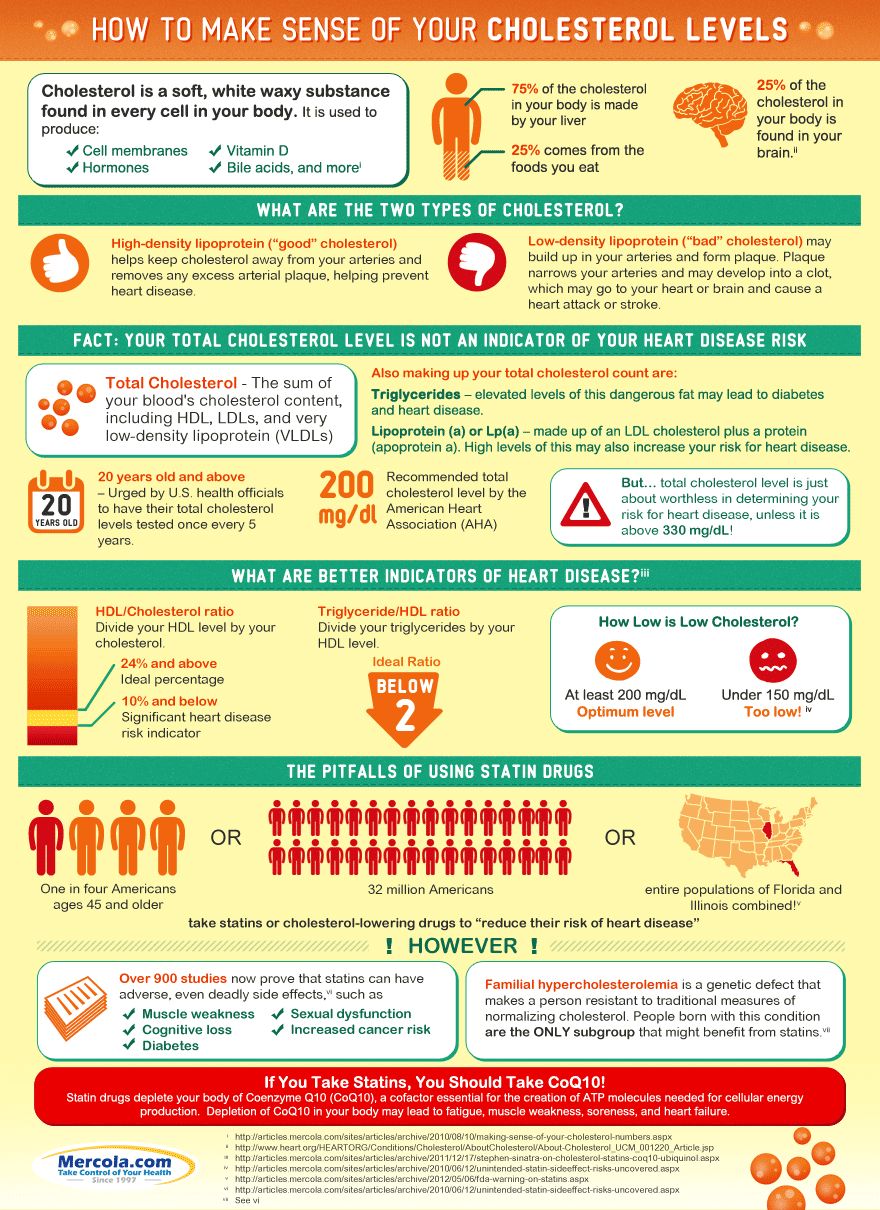
As a general rule, cholesterol-lowering drugs are not required or prudent for the majority of people — especially if both high cholesterol and longevity run in your family. Remember, the evidence overwhelmingly suggests your overall cholesterol level has little to nothing to do with your risk for heart disease.
For more information about cholesterol and what the different levels mean, take a look at the infographic above. As for evaluating your heart disease risk, the following tests will provide you with a more accurate picture of your risk:
| HDL/Cholesterol ratio — HDL percentage is a very potent heart disease risk factor. Just divide your HDL level by your total cholesterol. That percentage should ideally be above 24%. |
| Triglyceride/HDL ratio — You can also do the same thing with your triglycerides and HDL ratio. That percentage should be below 2. |
| NMR LipoProfile — Large LDL particles do not appear to be harmful. Only small dense LDL particles can potentially be a problem, as they can squeeze through the lining of your arteries. If they oxidize, they can cause damage and inflammation.
Some groups, such as the National Lipid Association, are now starting to shift the focus toward LDL particle number instead of total and LDL cholesterol to better assess your heart disease risk. Once you know your particle size numbers, you and your doctor can develop a more customized program to help manage your risk. |
| Your fasting insulin level — Heart disease is primarily rooted in insulin resistance,30 which is the result of a high-sugar diet. Sugar, not cholesterol or saturated fat, is the primary driver. Clinical trials have shown high fructose corn syrup can trigger risk factors for cardiovascular disease within as little as two weeks.31
Any meal or snack high in carbohydrates like fructose and refined grains generates a rapid rise in blood glucose and then insulin to compensate for the rise in blood sugar. The insulin released from eating too many carbs promotes fat accumulation and makes it more difficult for your body to shed excess weight. Excess fat, particularly around your belly, is one of the major contributors to heart disease. |
| Your fasting blood sugar level — Research has shown people with a fasting blood sugar level of 100 to 125 mg/dl have a nearly 300% increased higher risk of coronary heart disease than people with a level below 79 mg/dl.32,33 |
| Your iron level — Iron can be a very potent oxidative stress, so if you have excess iron levels you can damage your blood vessels and increase your risk of heart disease. Ideally, you should monitor your ferritin levels and make sure they are not much above 80 ng/ml.
The simplest way to lower them if they are elevated is to donate your blood. If that is not possible you can have a therapeutic phlebotomy and that will effectively eliminate the excess iron from your body. |
- 1 Am J Cardiol 2015 Nov 1;116(9):1479-80
- 2 Health.gov, Dietary Guidelines 2015 Overview
- 3 USDA. Dietary Guidelines for Americans 2020-2025
- 4, 5, 12 Expert Review of Clinical Pharmacology, September 10, 2018, doi.org/10.1080/17512433.2018.1519391
- 6 Expert Review of Clinical Pharmacology, September 10, 2018, doi.org/10.1080/17512433.2018.1519391, Expert Commentary
- 7 Reason.com September 22, 2018
- 8 Expert Review of Clinical Pharmacology, September 10, 2018, doi.org/10.1080/17512433.2018.1519391, 2.2 No Exposure-Response
- 9 QJM 2002 Jun;95(6):397-403
- 10, 11 Expert Review of Clinical Pharmacology, September 10, 2018, An idea supported by fraudulent reviews of the literature
- 13 Expert Review of Clinical Pharmacology, September 10, 2018, LDL-C of patients with acute myocardial infarction is lower than normal
- 14 BMJ Open 2016; 6(6): e010401
- 15 BMJ Open 2015 Sep 24;5(9):e007118
- 16 Expert Review of Clinical Pharmacology, September 10, 2018, The benefit of statin treatment is exaggerated
- 17 JAMA Cardiology 2017;2(1):56-65
- 18 CDC.gov, Prescription Cholesterol-Lowering Medication Use in Adults, 2003-2012 (PDF)
- 19 JAMA 2016;316(19):2008-2024, Discussion
- 20 Expert Rev Clin Pharmacol. 2015 Mar;8(2):201-10
- 21 JAMA Cardiology June 26, 2019 doi:10.1001/jamacardio.2019.1972
- 22 UT Southwestern Medical Center
- 23, 24 Cardiovascular Business July 1, 2019
- 25 Clinical Cardiology 2009 Dec;32(12):684-9
- 26 Drugs.com Simvastatin Pregnancy Warning
- 27 British Journal of Clinical Pharmacology 2007 Oct; 64(4): 496–509
- 28 Cancer Epidemiol Biomarkers Prev. 2013 Sep;22(9):1529-37
- 29 Neuro Endocrinol Lett. 2011;32(5):688-90
- 30 Crossfit.com July 7, 2019
- 31 American Journal of Clinical Nutrition June 2015; 101(6): 1144-1154
- 32 American Journal of Cardiology April 2002 89(5):596-9
- 33 Diabetes in Control April 22, 2002
Why Glucose Restrictions Are Essential in Treating Cancer
Reproduced from original article:
https://articles.mercola.com/sites/articles/archive/2022/07/31/metabolic-targets-for-tumor-therapy.aspx
The original Mercola article may not remain on the original site, but I will endeavor to keep it on this site as long as I deem it to be appropriate, and will not be bullied into removing it.
Analysis by Dr. Joseph Mercola Fact Checked July 31, 2022
STORY AT-A-GLANCE
- All cancer cells, regardless of tissue origin, use fermentation energy for growth. They ferment lactic acid from glucose in the cytoplasm, which also involves succinic acid fermentation using glutamine as a fermentable fuel
- Even when tumor cells appear to be making ATP and taking in oxygen, suggestive of normal respiration, their mitochondria are abnormal; hence, mitochondrial dysfunction is at the root of most cancers
- The true origin of cancer is damage to the respiratory function of your mitochondria, triggering compensatory fermentation, which is run by oncogenes. Oncogenes facilitate the entry of glucose and glutamine into the cell to replace oxidative phosphorylation
- Metastatic cancer cells are hybrid “rogue” macrophage cells — a mix of an immune system cell and a dysregulated stem cell with macrophage characteristics, which allows it to rapidly replicate and spread
- Press-pulse cancer treatment involves restricting the fermentable fuels — glucose and glutamine — in a cyclical fashion to avoid causing damage to the immune system
- A biopsy may not always be a good option as this procedure may actually cause the cancer to spread or turn a potentially benign situation into a malignant one
This article was previously published December 8, 2019, and has been updated with new information.
Thomas Seyfried, Ph.D., professor in the biology department at Boston College, is a leading expert and researcher in the field of cancer metabolism and nutritional ketosis. His book, “Cancer as a Metabolic Disease: On the Origin, Management and Prevention of Cancer” is a foundational textbook on this topic, and in August 2016, he received the Mercola.com Game Changer Award for his work.
Here, we discuss the mechanisms of cancer and the influence of mitochondrial function, which plays a crucial role in the development and treatment of this disease. His landmark cancer theory is available as a free PDF.
Many of his views are now encapsulated in his most paper,1 “Mitochondrial Substrate-Level Phosphorylation as Energy Source for Glioblastoma: Review and Hypothesis,” published online December 27, 2018. He’s also published a number of other papers2,3,4 on the metabolic underpinnings of cancer.
“The paper … is a review and hypothesis paper identifying the missing link in Otto Warburg’s central theory,” Seyfried explains. “[Warburg] defined the origin of cancer very accurately back in the 1920s, ’30s, ’40s and ’50s in his work in Germany. Basically, he argued and provided data showing that all cancer cells, regardless of tissue origin, were fermenters. They fermented lactic acid from glucose as a substrate.
Even in the presence of oxygen, these cells were fermenting. This is clearly a defect in oxidative phosphorylation. The problem is that for decades, people said Warburg was wrong — mainly because we see a lot of cancer cells take up oxygen and make adenosine triphosphate (ATP) from within the mitochondria … People began to question, ‘If cancer cells have normal respiration, why would they want to use glucose as a fermentable fuel?’
The whole concept became distorted … The cancer cells simply choose to ferment rather than respire. Now, of course, if you look under the electron microscope at majority of cancers, you’ll see that the mitochondria are defective in a number of different ways. Their structures are abnormal. The numbers are abnormal. There are many abnormalities of mitochondria seen directly under electron microscopy. Clearly, Warburg was not wrong.”
Why Biopsies Are Risky
Before we delve into the meat of how cancer actually occurs it would be good to review a diagnostic strategy that nearly all of us are offered when confronted with a cancer diagnosis. It is vital to understand that this may not be your best strategy and that for many it would be wise to avoid the biopsy.
Seyfried warns against doing biopsies, as this procedure may actually cause the cancer to spread. A tumor is basically a group of proliferating cells in a particular part of your body. For purposes of diagnosis, a small biopsy sample will often be taken to ascertain whether the tumor is benign or malignant.
The problem is that when you stab into the cancer microenvironment to remove a part of the tissue, it creates a wound in that microenvironment that in turn elicits the invasion by macrophages and other immune cells.
If you already have an acidic microenvironment, you run the risk of causing a fusion hybridization event in that microenvironment between your macrophages and cancer stem cells (as discussed below). This could turn a potentially benign situation into a malignant one, and if the tumor is malignant, stabbing into it could make a bad situation worse.
“The question is, what is the value of doing a biopsy in the first place? We take biopsies of breast tissue to get a genomic readout of the different kinds of mutations that might be in the cells. Now, if cancer is not a genetic disease and the mutations are largely irrelevant, then it makes no sense to do that in the first place. If the tumor is benign, why would you want to stab it? If the tumor is malignant, why would you ever want to stab it?
I came to this view by reading so many articles in the literature based on brain cancer, breast cancer, colon cancer, liver cancer showing how needle biopsies have led to the dissemination of these tumor cells, putting these people at risk for metastatic cancer and death,” Seyfried says.
In metabolic therapy you would not touch the tumor; you would not disturb the microenvironment. By leaving it alone, you allow the tumor to shrink and go away.
“When you start to look at this as a biological problem, many of the things that we do in cancer make no sense. We have, in brain cancer, people say, ‘You have a very low-grade tumor. Let’s go in and get it out.’ What happens is you go in and get it out, and then the following year it turns into a glioblastoma.
How did that happen? Well, you disturbed the microenvironment. You allowed these cells that are marginally aggressive to become highly aggressive. Then you lead to the demise of the patient,” Seyfried says.
“That happens significantly because it’s called secondary glioblastoma arising from therapeutic attempt to manage a low-grade tumor. The same thing can happen with all these different organs. You stab breast tumors, you stab colon tumors, you run the risk of spreading the cells …
My argument is the following: If the patient has a lump, whether it’s in the breast, in the colon, lung or wherever or a lesion of some sort, that should be the cue to do metabolic therapy.
Do metabolic therapy first. In all likelihood, it will shrink down and become less aggressive. Then the option becomes, ‘Should we debulk completely rather than doing some sort of a biopsy?’ We want to reduce the risk, because if we can catch the whole tumor completely, then we don’t run the risk of spreading it …
In our procedure, you bring the body back into a very high state of metabolic balance, and then you strategically go and degrade the tumors slowly without harming the rest of the body.
Radiation, chemo and the strategies that we’re using today don’t do this. They’re based on the gene theory of cancer that genetic mutations are causing the cell cycle to grow out of control. Well, this is not the case. Again, a lot of these toxic procedures need to be rethought, reanalyzed in my mind.”
Solving the Warburg Theory’s Dilemma
In biology, structure determines function. This is an evolutionarily conserved concept. So, how can mitochondria be structurally abnormal in tissue, yet have normal respiration? As Seyfried notes, this doesn’t make sense. Confusion has arisen in part because many study cancer in culture, and “make profound statements and comments regarding what happens in culture,” Seyfried says.
“If you look at cancer cells in culture, many of them do take in oxygen and make ATP, but at the same time, they’re fermenting. This was the conundrum. They called it the Warburg Effect. They’re fermenting, but many people at the same time thought their respiration was normal.
This was the main problem with Warburg’s theory. But Warburg clearly said in his papers [that] it’s not the fact that they take in oxygen; it’s how much ATP they can generate from oxidative phosphorylation, which is the normal respiratory capacity of the mitochondria.”
As explained by Seyfried, if you measure ATP and look at oxygen consumption in tumor cells, it appears they’re making ATP and taking in oxygen, therefore, their respiration is assumed to be normal. However, when you look at the tissues in cancer patients, the mitochondria are abnormal.
“What I and Dr. Christos Chinopoulos from Semmelweis University in Budapest, Hungary, who is the world-leading expert on mitochondrial physiology and biochemistry … realized [was] that the mitochondria of tumor cells are actually fermenting amino acids, glutamine in particular. They’re not respiring. They’re fermenting an alternative fuel, which is glutamine,” Seyfried says.
Warburg’s Cancer Theory Proves Correct
With this understanding, Warburg’s theory can be proven correct — cancer arises from damage to the mitochondria’s ability to produce energy through respiration in their electron transport chain.
The compensatory fermentation involves not only lactic acid fermentation, but also succinic acid fermentation using glutamine as a fermentable fuel. It’s been known for decades that glutamine is a main fuel for many different kinds of cancers, but most people thought it was being respired, not fermented.
Seyfried and Chinopoulos’ discovery confirms that cancer cells in fact have damaged respiration, and to survive, the cancer cells must use fermentation. The two most available fermentable fuels in the cancer microenvironment are glucose and glutamine. Hence, targeting glucose and glutamine is a crucial component of cancer treatment.
Without glucose and glutamine, the cancer cells will starve, as they cannot use ketones. The simplest approach to cancer then is to bring patients into therapeutic ketosis, and then strategically target the availability of glucose and glutamine.
“Basically, what we’re saying [is] that mitochondrial substrate-level phosphorylation is a non-oxidative metabolism mechanism inside the mitochondria that would generate significant amounts of energy without oxidative phosphorylation,” Seyfried says.
Genetic Mutations Are Not the Cause of Cancer
According to Seyfried, mitochondrial dysfunction is at the heart of nearly every type of cancer. Unfortunately, few oncologists have this understanding and many still believe cancer is the result of genetic defects. However, nuclear transfer experiments clearly show cancer cannot be a genetic disease.
“There’s been no rational scientific argument that I have seen, to discredit the multitude of evidence showing that the [genetic] mutations are not the drivers but the effects [of mitochondrial dysfunction],” Seyfried says.
“As a matter of fact, there’s new information now where people are finding so-called genetic drivers of cancer expressed and present in normal cells, normal skin and also esophagus … This is another [issue] — how you get these so-called driver mutations in normal tissues. We’re also finding some cancers that have no mutations, yet, they’re fermenting and growing out of control.
There are a number of new observations coming out that challenge the concept that cancer is a genetic disease. And once you realize that it’s not a genetic disease, then you have to seriously question the majority of therapies being used to manage the disease. This [helps] explain [why] we have 1,600 people a day dying from cancer in the United States.
Why do we have such an epidemic of suffering and death when we have been studying this disease for decades? Well, if you look at the massive amounts of scientific papers being written on cancer, you’ll often find that they’re structured around gene defects.
What I’m saying is that if cancer is not a genetic disease and the mutations are downstream epiphenomena, why would the field continue to focus on things that are mostly irrelevant to the nature of the disease? What I’m saying is very devastating, because I’m telling the majority of the people in the field that they’re basically wasting their time …
I think we can drop the death rate of this disease by about 50% in 10 years if cancer is treated as a mitochondrial metabolic disease, targeting fermentable fuels rather than using toxic therapies that are focused on downstream effects.
Radiation is designed to stop DNA replication. DNA replication requires energy. If you pull the plug on their fermentable fuels, they’re not going to be able to replicate anyway … All of the things that we’re doing to treat cancer is basically approaching the disease from a misunderstanding of the biology …
We know viruses can cause cancer. We know radiation causes cancer. We know carcinogens cause cancer. We know intermittent hypoxia causes cancer. We know systemic inflammation causes cancer. We know just getting older puts you at risk for more cancer.
We know there are inherited mutations in the genome that can cause cancer. But how are all these things linked through a common pathophysiological mechanism? The common pathophysiological mechanism is damaged through the structure and function of the mitochondria.
Every one of the issues … including inherited mutations, damage the respiration of a particular population of cells in a tissue. You look at the breast cancer gene (BRCA 1), for example. People will say, ‘Cancer must be a genetic disease because you inherit a mutation that causes the disease.’
You only get the disease if that mutation disrupts the function of the mitochondria. Fifty percent of women who carry the mutation never get cancer or breast cancer because the mutation, for some reason, did not damage the mitochondria in that person.”
So, to summarize, the true origin of cancer is damage to the respiratory function of the mitochondria, triggering compensatory fermentation, which is run by oncogenes. Oncogenes play a role by facilitating the entry of glucose and glutamine into the cell to replace oxidative phosphorylation.
Why and How Cancer Spreads
Seyfried also has a very different view on the biology of metastasis (the spread of cancer). He explains:
“We’ve looked at cancer stem cells in a number of our preclinical models … These guys grow like crazy in place. The tumor just keeps expanding, but it doesn’t spread. It doesn’t spread into the bloodstream or metastasize to various organs.
We discovered a very unusual cancer 20 years ago. It took us 10 to 15 years to figure out what it was. You can put a few of these cells anywhere in the mouse’s body and within three to four weeks, this mouse is full of metastatic cancer. It made the cover of the International Journal of Cancer, when we published this back in 2008, but we had worked on the problem for years.
We couldn’t figure out what it was that made these cells so incredibly metastatic. We found out that once we identified the biology of the cell, it turned out [it has] many characteristics in common with the macrophage, which is one of the most powerful immune cells in our body.
We said, ‘Wow. Is this unique only to this kind of cell or do metastatic cancers in humans also express characteristics of macrophages?’ We looked and we found that almost every major cancer that metastasizes has characteristics of macrophages. Then we said, ‘Well, how could this possibly happen? Is it coming from the macrophage?’
A number of scientists … have all clearly shown that there is some fusion hybridization character going on. In other words, macrophages, our wound-healing cells, they come into a microenvironment where you might find many proliferating neoplastic stem cells, but they don’t have the capacity to metastasize.
It’s only when the macrophages fuse with these stem cells that you have a dysregulated energy metabolism coming in this hybrid cell. This hybrid cell now has characteristics of both stem cells and macrophages.
The stem cell is not genetically equipped to enter and exit tissue. The macrophage, as a normal cell of your body, is genetically equipped to enter and exit tissue and live in the bloodstream. They’re very strongly immunosuppressive. These are all characteristics of metastatic cancer.”
Metastatic Cancer Is a Hybrid Cell Combination
According to Seyfried, metastatic cancer cells are essentially a hybrid, a mix of an immune system cell and a dysregulated stem cell, the latter of which could originate from a disorganized epithelial cell or something similar. In short, it’s a hybrid cell with macrophage characteristics.
Macrophages are essential for wound healing and part of our primary defense system against bacterial infections. They live both in the bloodstream and in tissues, and can go anywhere in the body. When an injury or infection occurs, they immediately move in to protect the tissue.
“The metastatic cancer cell has many of those same properties,” Seyfried explains, “But the energy and the function of the cell is completely dysregulated, so it proliferates like crazy but has the capacity to move and spread through the body, so it’s a corrupted macrophage. We call it a rogue macrophage.”
Like macrophages, metastatic cancer cells can also survive in hypoxic environments, which is why most angiogenic therapies are ineffective against metastatic cancer.
So, what do these metastatic hybrid cells need to survive? Both macrophages and immune cells are major glutamine consumers, and according to Seyfried, you can effectively kill metastatic cells by targeting glutamine.
Conventional Cancer Treatments Are Unnecessarily Deadly
However, it must be done in such a way so as to not harm the normal macrophages and the normal immune cells. In other words, it must be strategic. For this reason, Seyfried developed a “press-pulse therapy” for cancer, which allows the patient to maintain normal immune system function, while at the same time targeting the corrupted immune cells — the macrophage fusion hybrid metastatic cells — as well as inflammation.
“The therapies we are using to attempt to kill these [metastatic] cells put us at risk for having the cells survive and kill us. You can control these cells for a short period of time, but they can hunker down and enter into some sort of a slightly dormant state, but they reappear.
People say, ‘Oh, these tumor cells are so nifty and smart they can come back at you.’ The problem is you’ve never really challenged them on their very existence, which is they depend on fermentation to survive. If you don’t target their fermentation, they’re going to continue to survive and come back at you.
Many of the therapies that we use — radiation, chemo and some of these other procedures — are not really going after the heart of the problem. That oftentimes puts you at risk for the recurrence of the disease. Your body is already seriously weakened by the toxic treatments. And in the battle, you lose. If you are fortunate enough to survive … your body is still beat up.
You have now put your [body] at risk for other kinds of maladies … Why are we using such toxic therapies to kill a cell when we know what its weaknesses are? These are the paradigm changes that will have to occur as we move into the new era of managing cancer in a logical way.”
A Strategic Approach to Killing Cancer Cells
To properly address cancer, then, you need to clean up the microenvironment, because the microenvironment will strategically kill cells that are dependent on fermentation while enhancing cells that aren’t. At the same time, the microenvironment will also reduce inflammation.
“You also have to be very careful not to kill your normal and healthy immune cells, because they need glutamine too,” Seyfried says. “What we find is that when we strategically attack the tumor this way, it turns out that our immune cells are paralyzed.
The cancer cells are killed, but the normal immune cells are paralyzed. They’re not dying, they’re just not doing their job. What we do is we back off the therapy a little; allow the normal immune cells to regain their biological capacity, pick up dead corpses, heal the microenvironment, and then we go after the cancer cells again.
It’s a graded response, knowing the biology of the normal cells and the abnormal biology of the tumor cells. This is a beautiful strategy. Once people know how you can play one group of cells off another, and how you can strategically kill one group of cells without harming the other cells, it really becomes a precision mechanism for eliminating tumor cells without harming the rest of the body.
You don’t need to be poisoned and irradiated. You just have to know how to use these procedures to strategically kill the cells. Protecting normal macrophages is part of the strategic process. Killing the corrupted ones is part of the strategic process. Again, you have to put all of these together in a very logical path. Otherwise, you’re not going to get the level of success that we should be getting.”
The Press-Pulse Strategy
This strategy is what Seyfried calls “press-pulse treatment,” and essentially involves restricting the fermentable fuels — glucose and glutamine — in a cyclical fashion to avoid causing damage to normal cells and tissues. Glucose is effectively restricted through a ketogenic diet. Restricting glutamine is slightly trickier.
The press-pulse strategy was developed from the concept of press-pulse in the field of the paleobiology. A “press” was some chronic stress on populations, killing off large numbers, but not everything, because some organisms can adapt to stress. The “pulse” refers to some catastrophic event.
The simultaneous occurrence of these two unlikely events led to the mass extinction of almost all organisms that existed on the planet. This was a cyclic event over many hundreds of millions of years. The geological records show evidence for this press-pulse extinction phenomenon.
“What we simply did was take that concept and say, ‘Let’s chronically stress the tumor cells.’ They need glucose. You can probably kill a significant number of tumor cells by just stressing their glucose. That’s the press. The press is different ways to lower blood sugar. You put that chronic stress on top of the population either by restricted ketogenic diets [or] therapeutic fasting. There are a lot of ways that you can do this.
Also, emotional stress reduction. People are freaked out because they have cancer, therefore their corticoid steroids are elevated, which elevates blood sugar. Using various forms of stress management, moderate exercise — all of these will lower blood sugar and contribute to a chronic press and stress on the cancer cells.
However, you’re not going to kill all cancer cells if you just take away glucose. Because the other fuel that’s keeping the beast alive is the glutamine. We have to pulse, because we can’t use a press for glutamine targeting, because then you’re going to kill your normal immune cells or impair them, and they are needed for the eventual resolution of the disease.
What we’re going to do is we’re going to pulse various drugs. We don’t have a diet system that will target glutamine. Glutamine is everywhere. It’s the most abundant amino acid in your body … But you have to use [the drugs] very strategically; otherwise they can harm our normal immune system and then be counterproductive …
I think that once we understand how we can target effectively glutamine without harming our normal immune cells … this is the strategy that will make most of these other therapies obsolete … It’s cost-effective and non-toxic and it will work very well.
But we’re still at the very beginning of this. We need to continue to develop the doses, timing and scheduling of those drugs that are most effective in targeting glutamine that can be done without harming the rest of the cells in our body.”
If you would like to support Dr. Seyfried’s research, please consider making a donation to the “Foundation For Metabolic Cancer Therapies.” The donation tag is on the top row of the of the foundation site. This Foundation is dedicated to supporting Dr. Seyfried’s studies using metabolic therapy for cancer management with 100% of the donated funds going directly to research on metabolic therapy for cancer.
What You Eat First During Meals Can Lower Glucose by 40%
Reproduced from original article:
https://articles.mercola.com/sites/articles/archive/2022/07/04/food-order.aspx
The original Mercola article may not remain on the original site, but I will endeavor to keep it on this site as long as I deem it to be appropriate, and will not be bullied into removing it.
Analysis by Dr. Joseph Mercola Fact Checked July 04, 2022
STORY AT-A-GLANCE
- You can consume the same foods — same calories, same total carbs, same nutrients — and have drastically different metabolic effects depending on what you eat first
- Eating carbohydrates last is best and may reduce insulin and glucose levels compared to consuming them first
- In a study, total glucose decreased by 38% when protein and vegetables were consumed first, compared to a carbs-first meal
- Mean glucose levels were 1 mmol/L lower when carbs were consumed last compared to the typical meal, in which protein, fat and carbs are consumed at the same time
- The beneficial effects of food order on glucose levels were so powerful that researchers deemed them comparable to the effects of drugs targeting postprandial glucose
What you eat is quite possibly the most important strategy for optimizing your metabolic health and reducing your risk of diseases like Type 2 diabetes. However, the order in which you eat your food also matters, such that you can consume the same foods — same calories, same total carbs, same nutrients — and have drastically different metabolic effects depending on what you eat first.
In the video above, Dr. Jason Fung, a nephrologist (kidney specialist) and author of several books, including “The Diabetes Code: Prevent and Reverse Type 2 Diabetes Naturally,” explains how you can get a more beneficial response, including reducing insulin and glucose, by frontloading protein and fats in your meal and leaving the carbs for later.1
Eat Carbs Last for Better Health
It’s previously been found that consuming whey protein prior to a meal reduces postmeal glucose levels.2 Building on this, a pilot study by researchers with Weill Cornell Medical College in New York City revealed that food order also has a significant impact on postprandial (or post-meal) glucose and insulin levels.3
The study included 11 overweight or obese adults with Type 2 diabetes, who fasted for 12 hours overnight and then consumed the same meal on two separate days, one week apart. All that differed was the order of the meal.
On the first day, the subjects ate carbohydrates, consisting of ciabatta bread and orange juice, first. Fifteen minutes later, they consumed the protein component (skinless grilled chicken breast) and vegetables (a salad with Italian vinaigrette dressing and steamed broccoli with butter).
A week later, the food order was reversed, with the vegetables and protein eaten first, followed by the carbohydrates last. Better outcomes were achieved when the carbs were consumed last. Specifically, postmeal glucose levels decreased by 28.6%, 36.7% and 16.8% after 30, 60 and 120 minutes, respectively when vegetables and protein comprised the first part of the meal. Postprandial insulin levels were also significantly lower in this scenario.
The beneficial effects of food order on glucose levels were so powerful that the researchers deemed them “comparable to that observed with pharmacological agents that preferentially target postprandial glucose.”4 “Moreover, the reduced insulin excursions observed in this experimental setting suggest that this meal pattern may improve insulin sensitivity,” they suggested, adding:
“In contrast to conventional nutritional counseling in diabetes, which is largely restrictive and focuses on “how much” and “what not to eat,” this pilot study suggests that improvement in glycemia may be achieved by optimal timing of carbohydrate ingestion during a meal.”
Food Order Matters in Prediabetes
Worldwide, 463 million adults have Type 2 diabetes, a number that’s expected to increase to 700 million by 2045 and doesn’t account for the many others who have prediabetes, which increases the risk of developing Type 2 diabetes, heart disease and stroke.5 Approximately 1 in 3 U.S. adults, or 96 million, have prediabetes, more than 80% of whom don’t know they have it.6
Changing food order “presents a novel, simple behavioral strategy to reduce glycemic excursions in prediabetes,” according to a study published in the journal Diabetes, Obesity & Metabolism.7 The study involved 15 participants with prediabetes who consumed the same meal on three days in random order:
- Carbohydrate first, followed 10 minutes later by protein and vegetables (CF)
- Protein and vegetables first, followed 10 minutes later by carbohydrate (PVF)
- Vegetables first followed by protein and carbohydrate (VF)
Total glucose was decreased by 38% following the PVF meal compared with CF, while incremental glucose peaks were attenuated by more than 40% in the PVF and VF meals, compared with CF.
“The CF meal pattern demonstrated marked glycemic variability whereas glucose levels were stable in the PVF and VF meal conditions,” the researchers noted,8 explaining that simply by altering food order to consume carbohydrates last it could help to mitigate the metabolic effects of carbohydrates.9
Consuming Carbs Last Benefits Type 1 Diabetes
Even among children with Type 1 diabetes, consuming carbohydrates at the end of the meal was beneficial. Twenty patients with Type 1 diabetes aged 7 to 17 years were included in the study.10 They consumed two meals in random order. For the first meal, the protein and fat components were consumed first, followed 15 minutes later by the carbohydrates.
In the other meal, protein, fat and carbohydrates were consumed together, the way they would be in a typical meal. Mean glucose levels were 1 mmol/L lower when carbs were consumed last compared to the typical meal. Fung explained:11
“This might mean a lot of things, including you need less insulin, which might lead to less weight gain overall because we know that those high glucose levels, those high insulin levels, are going to drive weight gain.
This actually has massive implications for the way we need to structure our meals. If eating the exact same number of calories, eating the exact same food, but simply switching the order means that we can face 40% less glucose, that means we may be able to prevent the onset of Type 2 diabetes.
We might be able to take less medications. We may be able to lose weight, because again that lower level of insulin is going to cause less weight gain. And what it means is that you really have to frontload your meals so that you’re taking your protein, and your fat and your vegetables right upfront and leaving the carbohydrates to the end.”
For best results, he says, wait about 10 minutes after consuming the protein and fats before you eat the carbs, similar to the way you might eat an appetizer before your next course.
The Timing of Your Meals Also Matters
As science is increasingly showing, what you eat is not the only factor in how food affects your health. Along with food order, the timing of your meals is another important factor. Fung is a big proponent of fasting, or what I like to refer to as time-restricted eating (TRE).
The answer for Type 2 diabetes, he believes, is to stop feeding your body sugar and burn off the sugar already in your cells, and the most effective way to do this is TRE. In our past interview, he explained that metabolic treatments such as TRE are the only way to resolve diabetes:
“It really gets to the point that you cannot follow this old paradigm [of drug treatment] because you’re going to fail … Remember, the glucose goes into the cell, and insulin resistance is when the glucose doesn’t go out of the cell. So, for years we’ve used this paradigm of lock and key.
That is, the cell is sort of gated off. Outside the cell there’s blood, and when insulin comes around it turns the key, opens the gate and glucose goes in. So, if insulin is there, why is the glucose not going in? … You can measure the insulin and the insulin level is high. You can look at the insulin receptor, the gate is completely normal.
So, [conventional medicine] said something like, ‘Well, maybe there’s something gumming up the mechanism. It’s stuck in the lock so it doesn’t open properly, therefore the glucose can’t get into the cell.’ There’s a huge problem with this sort of paradigm, because if that is happening, the cell has no glucose and should be starving.
You should be losing lots of weight; you’d have a very thin liver. All your fat should just melt away, because if you think about untreated Type 1 diabetes, where you don’t have enough insulin, that’s exactly what happens. The cell literally starves and everything just wastes away … But that’s not what’s happening here.
In Type 2 diabetes you see that people are generally obese, they have large abdomens … What’s happening instead is that it’s actually an overflow syndrome. The cell can’t accept any more glucose because it’s jam packed full of glucose already. That’s the reason you have insulin resistance. Insulin is trying to move glucose into the cell but the cell is full … So, it’s really an overflow mechanism …
That’s also why your liver is full — it’s a big fatty liver. The liver is busy trying to get rid of all this glucose by turning it into fat … Now, if Type 2 diabetes and insulin resistance are the same sort of thing, it’s really about too much sugar. That’s the bottom line.
And if you understand that the whole problem is too much sugar, then the solution is not to use more insulin to jam more glucose into an already full cell. The key is to get rid of it all. So, what you want to do is: 1) Don’t put more sugar into your system, because you have too much sugar in already, and 2) Burn it off.”
Limit Your Eating Window to Six to Eight Hours Per Day
While fasting may sound intimidating, TRE is manageable as it involves limiting your eating window to six to eight hours per day instead of the more than 12 hours that most people do. TRE promotes insulin sensitivity and improves blood sugar management by increasing insulin-mediated glucose uptake rates,12 which is important for resolving Type 2 diabetes.
In another study, when 15 men at risk of Type 2 diabetes restricted their eating to even a nine-hour window, they lowered their mean fasting glucose, regardless of when the “eating window” commenced.13 A 2022 review also highlighted many of the benefits of TRE for the prevention of Type 2 diabetes, reveling that it:14
- Produces mild weight loss of 1% to 4%
- Reduces fasting insulin
- Improves insulin sensitivity in people with prediabetes or obesity
- Improves glucose tolerance
- Reduces oxidative stress
So simply by restricting your eating window to six to eight hours per day, and consuming carbs at the end of your meal, you may be able to improve your metabolic health significantly. This isn’t to say that food quality doesn’t matter, particularly when it comes to ultraprocessed foods.
Linoleic acid (LA) in seed oils — commonly known as vegetable oils — plays a major role in producing chronic diseases like diabetes.15 Linoleic acid is found in virtually every processed food, including restaurant foods, sauces and salad dressings, and even “healthy” foods like chicken and pork. So in addition to embracing TRE and optimizing food order, reducing LA is essential for diabetes prevention and management.
- 1 YouTube, Jason Fung, Why Food Order Matters May 22, 2022
- 2, 3, 4 Diabetes Care. 2015 Jul; 38(7): e98–e99
- 5 Molecules. 2019 Dec; 24(24): 4501
- 6 U.S. CDC, Prediabetes
- 7 Diabetes Obes Metab. 2019 Feb; 21(2): 377–381
- 8 Diabetes Obes Metab. 2019 Feb; 21(2): 377–381. Abstract
- 9 Diabetes Obes Metab. 2019 Feb; 21(2): 377–381. Conclusions
- 10 Pediatr Diabetes. 2018 Jun;19(4):809-815. doi: 10.1111/pedi.12640. Epub 2018 Mar 12
- 11 YouTube, Jason Fung, Why Food Order Matters May 22, 2022, 7:15
- 12 Science November 16, 2018; 362(6416): 770-775
- 13 Obesity April 19, 2019; 27(5)
- 14 J Physiol. 2022 Mar;600(5):1253-1264. doi: 10.1113/JP281101. Epub 2021 Sep 8
- 15 YouTube, Omega-6 Apocalypse 2, Chris Knobbe August 25, 2021
The Science Behind Time-Restricted Eating
Reproduced from original article:
https://articles.mercola.com/sites/articles/archive/2022/07/03/time-restricted-eating-science.aspx
The original Mercola article may not remain on the original site, but I will endeavor to keep it on this site as long as I deem it to be appropriate, and will not be bullied into removing it.
Analysis by Dr. Joseph Mercola Fact Checked July 03, 2022
STORY AT-A-GLANCE
- Time-restricted eating (TRE) is a form of intermittent fasting where you eat all of your meals for the day within a restricted window of time. Your eating window could range from two to eight hours a day, fasting for the remaining 16 to 22 hours
- Researchers found that eating all meals between 8 a.m. and 2 p.m. resulted in greater metabolic flexibility, reduced hunger and increased sense of fullness, resulting in weight loss
- In another study, an eight-hour time-restricted feeding schedule was found to produce mild caloric restriction and weight loss, without calorie counting
- Compared to controls, strength training athletes who trained while adhering to a time-restricted eating schedule saw a decrease in fat mass after eight weeks, while maintaining muscle mass and maximal strength
- A similar study found men who performed resistance training for eight weeks while eating all meals within four hours on non-workout days (four days a week) lowered their calorie intake while increasing strength and muscular endurance
This article was previously published August 9, 2019, and has been updated with new information.
Research overwhelmingly supports the notion that ditching the three square meals a day approach in favor of time-restricted feeding — a form of intermittent fasting — can do wonders for your health. Contrary to modern belief, your body isn’t designed to be fed throughout the day, and the near-continuous grazing that most engage in can have serious health consequences.
Research by Satchidananda Panda, Ph.D., suggests 90% of people eat for more than 12 hours a day, and over time this habit will wreak havoc on your metabolism and limit your ability to metabolize fat as a primary fuel.
When you eat throughout the day and never skip a meal your body adapts to burning sugar as its primary fuel, resulting in the downregulation of enzymes that utilize and burn stored fat.1,2
As a result, you become progressively more insulin resistant and start gaining weight. Efforts to lose weight also become ineffective for this very reason, since to lose body fat, your body must first be able to actually burn fat.
Many biological repair and rejuvenation processes also take place while you’re fasting, and this is another reason why all-day grazing triggers diseases while fasting prevents them.
What Is Time-Restricted Eating (TRE)?
Time-restricted eating is just what it sounds like. It’s a form of intermittent fasting where you eat all of your meals for the day within a restricted window of time, ranging from two to eight hours. That means you’re avoiding food (fasting) for 16 to 22 consecutive hours. Eating within a four- to six-hour window is likely close to metabolic ideal for most. As noted in the paper “A Time to Fast,” published in the November 2018 issue of Science:3
“Adjustment of meal size and frequency have emerged as powerful tools to ameliorate and postpone the onset of disease and delay aging, whereas periods of fasting, with or without energy intake, can have profound health benefits.
The underlying physiological processes involve periodic shifts of metabolic fuel sources, promotion of repair mechanisms, and the optimization of energy utilization for cellular and organismal health …
In general, both prolonged reduction in daily caloric intake and periodic fasting cycles have the power to delay the onset of disease and increase longevity.”
Fat-Burning Capacity Is Required for Weight Loss
As just mentioned, to shed body fat, your body must have the ability to burn fat for fuel. While it may seem like this ability should be inherent in everyone, all the time (since we know fat can be used as fuel), metabolic dysfunction triggered by an inappropriate diet and feeding schedule can prevent this. In a nutshell, to be an efficient fat-burner, you need to:
- Eat a diet with a higher fat-to-sugar ratio (i.e., more healthy fats and less net carbohydrates), and
- Restrict the timing of your meals so that you’re fasting for a greater number of hours than you’re eating
This will (over time) teach your body to burn fat for fuel again, rather than relying on fast-burning carbs, and in addition to burning dietary fats, your body will also start accessing and burning stored body fat.
While either of these strategies alone (fasting or eating a ketogenic diet) will shift your body from carb-burning to fat-burning, doing them together will yield the fastest results. To learn more about this, see “Why Intermittent Fasting Is More Effective Combined With Ketogenic Diet.”
How Time-Restricted Feeding Promotes Weight Loss
So, what’s the evidence that time-restricted eating actually promotes weight loss? Aside from a number of animal studies,4 consider the following research,5 published in the July 2019 issue of Obesity.
This study was founded on the premise that by eating earlier in the daytime, you properly align with the natural fluctuations in the circadian rhythm that regulates your metabolism. As a result, weight loss is enhanced.
The question it sought to answer was whether this benefit is mediated through increased energy expenditure or simply lower energy intake. To find out, 11 overweight participants first adhered to an early time-restricted eating schedule, eating all meals between 8 a.m. and 2 p.m. for four days.
For the next four days, they ate all meals between 8 a.m. and 8 p.m. They were also required to maintain a regular sleep schedule throughout. On the last day of each trial, energy expenditure and substrate oxidation levels were measured.
Results revealed meal-timing primarily facilitates weight loss by reducing appetite and increasing fat oxidation. Energy expenditure remained unaffected. As explained by lead author Courtney Peterson, Ph.D., associate professor of nutrition sciences at the University of Alabama at Birmingham:6
“We think the longer daily fast gives people’s bodies more time each day to dip into their fat reserves and burn fat. The body is typically maximally efficient at burning fat when people fast for at least 12-24 hours at a time.”
Overall, eating all meals earlier in the day, between 8 a.m. and 2 p.m., resulted in greater metabolic flexibility, lower ghrelin (known as the hunger hormone) levels, reduced hunger and increased sense of fullness, and this is thought to drive the weight loss.
TRE Improves Weight Loss in Obese Adults
Another study7 published in the Nutrition and Healthy Aging journal in 2018 examined how TRE — without counting calories — affects weight in obese adults. Here, they used an eight-hour restricted eating window.
Twenty-three overweight adults were instructed to eat however much food they wanted between 10 a.m. and 6 p.m. for 12 weeks. For the remainder of the day and night, they were only allowed water. Weight loss and metabolic parameters were compared to the historical records of a group of matched controls.
At the end of 12 weeks, body weight decreased by an average of 2.6% and energy intake decreased by 341 calories per day compared to controls. Systolic blood pressure also decreased by an average of 7 mm Hg.
According to the authors, their findings “suggest that 8-hour time restricted feeding produces mild caloric restriction and weight loss, without calorie counting. It may also offer clinical benefits by reducing blood pressure.”
How Restricted Feeding Affects Fat and Muscle in Fit Adults
Overweight individuals are not the only ones who stand to benefit from time-restricted feeding, as evidenced by a 2016 study8 in the Journal of Translational Medicine, which evaluated the effects of TRE on basal metabolism, strength, body composition, inflammation levels and cardiovascular risk factors in fit men. As explained by the authors:9
“Thirty-four resistance-trained males were randomly assigned to time-restricted feeding (TRF) or normal diet group (ND). TRF subjects consumed 100% of their energy needs in an 8-h period of time each day, with their caloric intake divided into three meals consumed at 1 p.m., 4 p.m., and 8 p.m.
The remaining 16 h per 24-h period made up the fasting period. Subjects in the ND group consumed 100% of their energy needs divided into three meals consumed at 8 a.m., 1 p.m., and 8 p.m. Groups were matched for kilocalories consumed and macronutrient distribution.”
Strength training consisted of a split routine with three weekly sessions on nonconsecutive days for eight weeks. All participants had engaged in continuous resistance training for at least five years before the study.10
Compared to controls, at the end of the eight-week study, the treatment group experienced a decrease in fat mass while maintaining muscle mass and maximal strength.11
Interestingly, while blood glucose and insulin decreased significantly, as expected, so did testosterone and insulin-like growth factor 1, two anabolic hormones.12 Unfortunately, no hypothesis is presented for these findings.
They also found that, aside from a reduction in triglycerides, the time-restricted feeding protocol did “not confirm previous research suggesting a positive effect of [intermittent fasting] on blood lipid profiles.”
The researchers address this in the discussion section of the study, postulating that this may be related to the fact that all of the subjects were “normolipemic athletes,” meaning their blood lipid profiles were normal to start with. Despite that, the authors conclude:
“Our results suggest that an intermittent fasting program in which all calories are consumed in an 8-h window each day, in conjunction with resistance training, could improve some health-related biomarkers, decrease fat mass, and maintain muscle mass in resistance-trained males.”
A similar study13 published in the European Journal of Sport Science found that men who performed resistance training for eight weeks while eating all meals within four hours on non-workout days (four days a week) lowered their calorie intake while still increasing strength and muscular endurance.
The Many Health Benefits of Intermittent Fasting
A large and growing body of medical research supports the use of time-restricted feeding (intermittent fasting), showing it has a wide range of biological benefits. Aside from facilitating fat loss while protecting and even promoting muscle strength, studies show various forms of fasting,14 including a variety of intermittent fasting protocols and time-restricted feeding, can:
| Promote insulin sensitivity,15,16 which is crucial for your health as insulin resistance or poor insulin sensitivity contributes to nearly all chronic diseases |
| Improve leptin sensitivity17 |
| Improve blood sugar management by increasing insulin-mediated glucose uptake rates18 |
| Lower triglyceride levels19 |
| Increase human growth hormone production (HGH) — Commonly referred to as “the fitness hormone,” HGH plays an important role in maintaining health, fitness and longevity, including promotion of muscle growth, and boosting fat loss by revving up your metabolism.
Research20,21 shows fasting can raise HGH by as much as 1,300% in women and 2,000% in men. The fact that it helps build muscle while simultaneously promoting fat loss explains why HGH helps you lose weight without sacrificing muscle mass, and why even athletes can benefit from intermittent fasting |
| Suppress inflammation and reduce oxidative damage |
| Promote multisystem regeneration22 by upregulating autophagy and mitophagy,23 natural cleansing processes necessary for optimal cellular renewal and function, and promoting regeneration of stem cells24 |
| Prevent or reverse Type 2 diabetes, as well as slow its progression |
| Improve immune function by regenerating damaged stem cells25,26 |
| Lower blood pressure27,28 |
| Reduce your risk of heart disease29 |
| Boost mitochondrial energy efficiency and biogenesis30 |
| Reduce your risk of cancer, in part by optimizing autophagy31 |
| Increase longevity32,33,34 — There are a number of mechanisms contributing to this effect. Normalizing insulin sensitivity is a major one, but fasting also inhibits the mTOR pathway,35 which plays an important part in driving the aging process |
| Regenerate the pancreas36 and improve pancreatic function |
| Improve cognitive function and protect against neurological diseases (such as dementia, Alzheimer’s disease37 and Parkinson’s disease38,39) thanks to the production of ketone bodies40 (byproducts of fatty acid breakdown, which are a healthy and preferred fuel for your brain) and brain-derived neurotrophic factor41 (BDNF, which activates brain stem cells to convert into new neurons, and triggers numerous other chemicals that promote neural health).
Animal research42 also shows intermittent fasting increases neurons resistance to excitotoxic stress |
| Eliminate sugar cravings as your body adapts to burning fat instead of sugar |
TRE Is Beneficial for Most
Contrary to longer fasts and calorie restriction, TRE is a strategy that can work for most people. Remember, you’re not actually limiting or counting calories — you can (theoretically) eat whatever you want in any amount — you’re simply restricting the time in which you eat all this food, although you will get better results by eating healthy nonprocessed foods and not consuming excessive carbs.
Weakness and lethargy, which are signs of undernourishment, should not occur. It’s a practice that should make you feel good and actually reduce your hunger over time.
Your hunger and craving for sugar will slowly dissipate as your body starts burning fat as its primary fuel. Once your body has successfully shifted into fat burning mode, it will be easier for you to fast for as long as 22 hours and still feel satiated. I typically fast for at least 18 hours a day and sometimes as much as 22 hours.
While time-restricted feeding and intermittent fasting will in theory work regardless of your diet, I do not recommend it if you’re eating a preponderance of processed foods. The quality of your diet is particularly important if you’re looking for more than mere weight loss.
It’s critical to avoid refined carbohydrates, sugar/fructose and grains. Focus your diet on vegetable carbohydrates, healthy protein in moderate amounts, and healthy fats such as butter, eggs, avocado, coconut oil, olive oil and raw nuts.
- 1 Cell February 8, 2018; 172(4): 731-743.E12
- 2 Medical News Today February 8, 2018
- 3 Science November 16, 2018; 362(6416): 770-775, Page 1
- 4 Medical News Today July 4, 2018
- 5 Obesity July 24, 2019; 27(8), Abstract
- 6 Inverse July 24, 2019
- 7, 28 Nutrition and Healthy Aging 2018; 4(4): 345–353, Abstract
- 8 Journal of Translational Medicine 2016; 14: 290
- 9 Journal of Translational Medicine 2016; 14: 290, Abstract Methods
- 10 Journal of Translational Medicine 2016; 14: 290, Methods Training
- 11 Journal of Translational Medicine 2016; 14: 290, Abstract Results
- 12 Journal of Translational Medicine 2016; 14: 290, Results and Discussion
- 13 European Journal of Sport Science 2017; 17(2): 200-207, Abstract
- 14 Science November 16, 2018; 362(6416): 770-775
- 15, 42 PNAS May 13, 2003; 100(10): 6216-6220, Abstract
- 16 Cell Metabolism June 5, 2018; 27(6): 1212-1221.e3
- 17 PLOS ONE 2014; 9(3): e92214
- 18 Journal of Applied Physiology July 28, 2005: 99(6); 2128-2136, Abstract
- 19 Medscape March 7, 2019
- 20 Intermountain Healthcare Press Release April 3, 2011
- 21 Nutrition, Metabolism & Cardiovascular Diseases November 2013; 23(11): 1050-1057
- 22 Cell Metabolism June 2015; 22(1)
- 23, 31 Clinics 2018; 73: e814s
- 24, 25 Cell Stem Cell June 5, 2014; 14(6): 810-823
- 26 USC News June 5, 2014
- 27 Journal of the American Society of Hypertension 2018; 12(1): 42-49 (PDF)
- 29 American Journal of Cardiology 2008 Oct 1;102(7):814-819
- 30 Frontiers in Physiology May 3, 2019, Caloric Restriction, Intermittent Fasting, and Mitochondrial Function
- 32 NIH.gov Press Release September 6, 2018
- 33 The Harvard Gazette November 3, 2017
- 34 Journals of Gerontology, Series A July 17, 2015; 70(9): 1097-1104
- 35 Aging 2018 Jul; 10(7): 1640–1648
- 36 Cell February 23, 2017; 168(5): 775-788
- 37 Neurobiology of Disease April 2007; 26(1): 212-220
- 38 Aging Research Reviews August 2006; 5(3): 332-353
- 39 Washington Post December 31, 2012
- 40 IUMB Life 2017; 69.5 DOI: 10.1002/iub.1627, Conclusion
- 41 Annual Review of Nutrition 2005;25:237-60
7 Conditions Masquerading As Dementia
© GreenMedInfo LLC. This work is reproduced and distributed with the permission of GreenMedInfo LLC.
Want to learn more from GreenMedInfo? Sign up for the newsletter here:
www.greenmedinfo.com/greenmed/newsletter
Reproduced from original article:
https://greenmedinfo.com/blog/7-conditions-masquerading-dementia
Posted on: Monday, May 30th 2022
Written By: GMI Reporter
This article is copyrighted by GreenMedInfo LLC, 2022

More than 40% of dementia diagnoses have been shown to be wrong. Here’s what may really be going on.
Imagine this nightmare. For the last few years your mother has had serious memory problems. She gets lost driving. She repeats the same question to you over and over again. She can’t process new information. She loses her train of thought in mid-sentence. A CT scan comes back with a diagnosis of early Alzheimer’s disease. The doctors offer a prescription with little encouragement it will work.
Do you despair?
A new program from UCLA and the Buck Institute for Research on Aging offers new hope. In the first study of its kind, researchers have proved that natural therapies can not only slow the progress of dementia but can actually reverse it.
In a paper titled “Reversal of Cognitive Decline: A novel therapeutic program“ Dr. Dale Bredesen showed how 9 out of the 10 subjects diagnosed with dementia got their minds back.[i]
Dr. Bredesen is a professor of neurology at The Mary S. Easton Center for Alzheimer’s Disease Research at UCLA, as well as a professor at the Buck Institute. The study was supported by multiple entities including the National Institutes of Health.
Cognitive decline is a major fear as we age. According to the Alzheimer’s Association “dementia is a general term for loss of memory and other mental abilities severe enough to interfere with daily life.” Alzheimer’s disease – just one of many forms of dementia – accounts for 60 to 80 percent of dementia cases. It affects about 5.4 million Americans and 30 million people around the world. By 2050, it’s expected to grow to 160 million people globally, including 13 million Americans. There is no effective treatment for Alzheimer’s and it is already the third leading cause of death in the United States.
Dr. Bredesen believes that multiple factors influence the development of dementia and Alzheimer’s. In a small study, he and his colleagues designed personalized and comprehensive protocols to reverse memory loss in 10 patients.
The results were remarkable. Nine of the 10 participants showed improvement in their memories within three to six months of starting the program.
Six patients had had to discontinue working or were struggling with their jobs at the time they joined the study. ALL were able to return to work or continue working with improved performance.
The subjects included five patients with memory loss associated with Alzheimer’s disease. The others had amnestic mild cognitive impairment, and subjective cognitive impairment.
Only one patient, diagnosed with late stage Alzheimer’s, did not improve.
Doctors used a “systems approach” in treating the patients. They developed a complex, 36-point therapeutic program that includes comprehensive changes in diet, brain stimulation, exercise, optimization of sleep, specific pharmaceuticals and vitamins, and multiple additional steps that affect brain chemistry.
In a press release Dr. Bredesen stated:
The existing Alzheimer’s drugs affect a single target, but Alzheimer’s disease is more complex. Imagine having a roof with 36 holes in it, and your drug patched one hole very well—the drug may have worked, a single “hole” may have been fixed, but you still have 35 other leaks, and so the underlying process may not be affected much.
Dr. Bredesen’s approach is based on extensive testing of each patient to determine what is affecting the signaling network in his or her brain. The protocol is then personalized for the patient. A sample protocol for one of his patients in the study included:
- eliminating all simple carbohydrates;
- eliminating gluten and processed food;
- increasing vegetables, fruits, and non-farmed fish;
- reducing stress with yoga and meditation;
- taking melatonin each night;
- increasing sleep from 4-5 hours per night to 7-8 hours per night;
- taking methylcobalamin (vitamin B12), vitamin D, CoQ10, and fish oil each day;
- optimizing oral hygiene using an electric flosser and electric toothbrush;
- hormone replacement therapy;
- fasting for a minimum of 12 hours between dinner and breakfast;
- fasting for a minimum of three hours between dinner and bedtime; and
- exercising for a minimum of 30 minutes, 4-6 days per week.
Although the downside to the program is the complexity and the number of lifestyle changes required, Dr. Bredesen noted that the only side effect of the protocol was “improved health and an optimal body mass index, a stark contrast to the side effects of many drugs.”
What can you do when faced with a diagnosis of cognitive decline, dementia, or Alzheimer’s disease?
The UCLA protocol recognizes that dementia can have many causes and those causes are often reversible.
Sharp Again Naturally (www.sharpagain.org) is a non-profit organization formed in 2012 to educate the public and the medical community about the reversible causes of dementia.
Here are seven areas Sharp Again Naturally suggests you investigate before accepting a dementia or Alzheimer’s diagnosis. These are conditions that may cause memory loss and dementia but can be reversed:
1. Nutritional imbalances and deficiencies. Deficiencies of omega 3s, vitamin B12, vitamin C, magnesium, selenium, probiotics, and other nutrients frequently cause symptoms of Alzheimer’s and dementia.
Adhering to a balanced Mediterranean-style diet is associated with slower cognitive decline. It’s also linked to a reduced risk of Alzheimer’s.
Studies also show low vitamin D levels are linked to Alzheimer’s. Low folate (vitamin B9) may also lead to cognitive decline.
Adding coconut oil may rescue a brain from Alzheimer’s. And turmeric is known to boost working memory in just one dose.
2. Artificial food colors, flavors, and sweeteners. Artificial additives of all kinds may cause dementia symptoms.
Studies show the artificial sweetener aspartame impairs cognitive function and leads to memory loss.
3. Prescription medication side effects. Drugs, especially pain medications, and psychotropic drugs can severely disrupt cognition.
Statins are particularly harmful. In one study from the University of California – San Diego, 90 percent of patients who stopped taking statin drugs reported improvement in cognitive problems in a matter of weeks. In some of the patients a diagnosis of dementia or Alzheimer’s was reversed.
Another study showed that the sleep drug Ambien increased the risk of dementia in elderly patients.
4. Inflammation from low-level infections, mold, food allergies, and Lyme Disease. Inflammation is the body’s attempt to get rid of a toxic element or organism, and so it occurs in many different situations, even root canals and urinary tract infections.
Studies suggest that mental disorders result from neuroinflammation.
5. Stress and stagnation/inactivity. Stress elevates cortisol levels, leading to inflammation, and in turn to hormone imbalances, cognitive impairment, heightened blood sugar levels, hypertension, delayed healing time, and susceptibility to disease. The body’s self healing mechanisms depend on unimpeded flow of lymph, blood, and other fluids, all of which are promoted by exercise. Inactivity, by contrast, allows cellular shutdown and blockages, taxing the whole system and interfering with healing on every level.
One study showed that in patients younger than 65 years-old, 41% of dementia diagnoses were incorrect. Misdiagnosis occurred most frequently in patients with depression or alcohol abuse.
6. Thyroid and other hormonal imbalances. Many people diagnosed with Alzheimer’s or dementia simply have low levels of T3 thyroid hormone. However, standard thyroid tests completely miss T3 levels, and Synthroid (T4) doesn’t help. It is estimated that 10 to 15% of all nursing home residents may be there because of low T3.
7. Mercury and other heavy metal poisoning. So-called silver amalgam fillings contain 50 percent mercury, and that mercury is neither stable nor inert. It off-gasses, crosses the blood-brain barrier, and destroys neurons even without contact. Removing these fillings is hazardous unless done with mercury-safe protocols.
Annual flu shots are another source of these toxins. Research shows that people who took the flu shot for five consecutive years had 10 times or 1000 percent higher risk of developing Alzheimer’s Disease than people who only had one or two flu shots due to the accumulation of mercury and aluminum in the vaccines.
Most doctors are not expert in these causes of dementia or how to treat them. Sharp Again Naturally is building a medical advisory board and a database to get the word out. It also offers help finding functional medicine specialists, naturopaths, or doctors who practice integrative medicine who are familiar with these areas.
Click here for more information on natural approaches to preventing and overcoming dementia.
Additional References
[i] Dale E. Bredesen, “Reversal of Cognitive decline: A novel therapeutic program.” AGING, September 2014, Vol. 6, No. 9.