Carbohydrates
now browsing by category
Cancer Treatment From a Metabolic Perspective
Reproduced from original article:
https://articles.mercola.com/sites/articles/archive/2023/09/24/metabolic-health.aspx
The original Mercola article may not remain on the original site, but I will endeavor to keep it on this site as long as I deem it to be appropriate.
Analysis by Dr. Joseph Mercola Fact Checked September 24, 2023
STORY AT-A-GLANCE
- Most chronic diseases affecting us today, including heart disease, dementia, obesity, diabetes and cancer are rooted in metabolic dysfunction
- October 10 is the International Metabolic Health Day. Celebrate by assessing your metabolic health and cleaning up your diet
- One of the best ways to identify metabolic flexibility and health is a fasting insulin test. Ideally, you want it to be below 3
- If you’re already eating a healthy diet, exercising, and all of your metabolic parameters look good, yet you have an insulin level of 7 or 8, stress may be the culprit, because cortisol raises insulin. Cortisol release is actually a rescue mechanism to ensure you don’t die from low blood sugar
- The Metabolic Terrain Institute of Health will be a truly integrated residential oncology hospital and metabolic research institute. Once funding has been secured, they expect to be up and running within 18 months
In this interview, Dr. Nasha Winters, a naturopathic physician who specializes in supporting patients with cancer, discusses the importance of optimizing your metabolic health because, as she notes:
“All the diseases affecting us today — cardiovascular disease, dementias and Alzheimer’s, obesity, diabetes, cancer — all of these things have a common denominator, which is metabolic [dysfunction].”
In July 2022, a study1 in the Journal of the American College of Cardiology from Tufts showed that 14 out 15 Americans, over 93% of the population, are metabolically inflexible. While this is bad news, for sure, current statistics are likely even worse.
The study used data from 2018, prior to the pandemic, which radically worsened metabolic health, so, in all likelihood, well over 95%, or 19 out of 20 people, are now metabolically unfit.
Needless to say, the health care costs associated with metabolic dysfunction will eventually bankrupt us, both individually and nationally, if we don’t begin to address metabolic health in earnest.
October 10 Is Metabolic Health Day
To raise awareness about the importance of metabolic health, Winters has launched an International Metabolic Health Day initiative to be held October 10, 2023,2 and hopefully every year hereafter. The campaign has been joined by dozens of organizations, including research organizations, hospitals, health-focused foundations and companies.
“We hope it’s the first of a grand movement,” Winters says, “and we’re very proud to be partnered with so many people like yourself in getting this information out there because we’re in trouble if we don’t. We hope within the next few weeks or months, this does become an officially adopted day internationally that we can come back to again and again.
October 10 also happens to be Mental Health Day, and we didn’t realize that, but it’s actually a beautiful merge of these two because we’re finding [that] the underpinnings of even our mental health relates to metabolic health.”
What Is Metabolic Health Really About?
As noted by Winters, conventional medicine pays lip service to metabolic health, but so many of the guidelines are misguided and miss the mark. The five conventional factors of metabolic health are blood sugar, cholesterol, triglycerides, waist circumference and blood pressure,3 but what conventional medicine considers “normal” is often far from optimal.
“The ranges that our standard of care is giving are just too lax. They’re still saying it’s normal to have a blood glucose of 100. But that’s kind of the highway to the next step of things. They’re focused more on the overall cholesterol and overall LDL, but really the issues we want to look at are more the triglycerides and the HDL.”
Most doctors and laymen are also completely unaware of how linoleic acid (LA), an omega-6 fat found in seed oils and most processed foods, decimate mitochondrial function and metabolic health.
I suspect less than 0.5% of Americans have optimally healthy LA levels, and simply getting people to dramatically reduce their LA intake could go a long way toward improving metabolic health and lowering our chronic disease burden. So, we have a way to go when it comes to educating people on how to become metabolically healthy.

Download this Article Before it Disappears
Key Metabolic Health Tests
One of the best ways to identify metabolic flexibility and health is a fasting insulin test. Ideally, you want it to be below 3. My last fasting insulin test was 1.9. I’ve been educating people on how to resolve their insulin resistance with diet and exercise for several decades now, but what do you do if you’re already eating a healthy diet, exercising, and all of your metabolic parameters look good, yet you have an insulin level of 7 or 8?
In this case, the core culprit may be stress, because when cortisol goes up, insulin rises with it. Cortisol release is actually a rescue mechanism to ensure you don’t die from low blood sugar.
To identify tease out if stress is a culprit, Winters typically starts with a complete blood count (CBC) test, because chronically depleted white blood cells is often a sign of chronic stress and high cortisol.
She also recommends getting an AM cortisol test after fasting for 12 to 16 hours. You don’t want to fast longer than that, because after 16 hours of fasting, cortisol will naturally start to rise.
“That morning cortisol and that fasted state is going to tell us a lot,” she says. “[AM cortisol of] 15 to 17 is my happy place range. There is a problem if it’s lower … If somebody has low [cortisol, i.e., below 15, fasting], that could elude they’ve been in a long-term stress response … I often see that.
I see that in folks who’ve really been through the wringer with a lot of conventional oncology therapies, for instance. It really wipes them out over time. In the beginning, cortisol will be elevated. If people are revving above the 17 mark, they’re kind of in a ‘run from the saber-tooth tiger’ [mode] on a pretty regular basis.
[Using] an adrenal stress index (ASI) test, where you’re checking [your cortisol] first thing in the morning, mid-morning, mid-afternoon and right before bed, you can see the pattern of the circadian rhythm, and a lot of people in our world today have what we call a switched circadian rhythm.
Cortisol and their insulin are actually really high at night, which makes it difficult to fall asleep and stay asleep … The other thing that can happen is the diurnal rhythm starts to spike early.
That 3 a.m. wake up call, when you’re waking with a busy brain, that’s going to shoot up your cortisol and insulin levels as well and create this dawn effect with elevations in your blood glucose and insulin levels. So we can get a little bit detective-like with this and really understand the pattern of the individual so we know where to best support them.”
Carbs Help Normalize Cortisol
Importantly, if you’ve been on a strict low-carb diet long term, you’re much more likely to have elevated cortisol. Low-carb is technically anything under 150 grams of carbs a day, but some people take it below 50 grams or even 20 grams.
Provided you’re generally healthy, you need carbs to minimize your cortisol response. I detailed the reasons for this in “Important Information About Low Carb, Cortisol and Glucose.”
As mentioned, most people are metabolically inflexible and could definitely benefit from a temporary low-carb approach. The key word there is “temporary.” Provided you don’t have cancer, once you’ve regained your metabolic flexibility, I recommend raising your carb intake to about 55% or so, and lowering your fat intake to 30% or less of your daily calories.
“If you have dealt with a cancer diagnosis and you have a different metabolic process than you do in a non-cancer environment, you may need to restrict carbs in that window,” she says.
“People like myself and the folks that I train, we know to watch for when we need to alter the diet to the individual’s needs. I recognize the differences in the metabolism of somebody who’s dealing with cancer and the metabolism of somebody who’s not. And so when you get yourself flexible in the healthy state, you have and should be able to tolerate carbohydrates.”
Should You Stay on Low-Carb, or Transition Out?
That said, certain cancer patients may benefit from staying on a low-carb diet relatively long term to avoid recurrence and/or metastasis. Winters explains:
“There is biochemical individuality, epigenetic individuality. So for instance, some of the phenotypes such as the ADIPOQ gene, the ACSL1 gene, those basically wire you to be diabetic …
In the oncology world, if we see PIK3CA 3-kinase issues, that is 100% pushed by glycolytic [metabolism] and it’s in 70% of cancer types. It also makes for a much more aggressive and progressing cancer and a much higher recurrence rate. So we’re very, very careful with folks [who have] that …
You can also retest, because over time, when you’re treating that body, it may no longer express that in its tissues. So we check that periodically … A lot of people think that it is static and forever, but you can change that with whatever therapies you’re introducing into the system. And if that changes, then you can obviously change the way you’re going to feed it or not feed it …
My husband has a lot of those SNIPS around the diabetes. Everyone in his family dies of diabetes, complications of diabetes and cancer. He loves protein. He is incredibly active. He’s incredibly fit. But if he gets too much red meat, his insulin goes sky high. So he has the genes for that.
We have this belief system that, ‘I’m not taking any carbs in [so my insulin will be low]’ but gluconeogenesis can come from even too much protein in certain phenotypes …
I would love to be a vegetarian, that’s what my palate wants, but my body says no way. And as I’m moving into perimenopause, my body needs different things. I know I need more protein now … my body then uses the gluconeogenesis of the protein to fuel me versus that of the simple carbs.”
So are there any signs to look for that might indicate it’s appropriate to add more carbs back in? Winters suggests checking your heart rate variability (HRV), “because that’s going to show you the interplay between stress and insulin.”
“If it starts to drop below 70, you’ve got some issues. You really want it above 70 to show that you’ve got optimal regulation of your nervous system and of your metabolic system. It’s a very elegant, simple [test] …
One other clue is, if you have a difficult time falling asleep, that’s a metabolic insulin issue more often than not. And if you have a hard time staying asleep, if you wake often after you’ve gone deep into sleep, that often suggests a cortisol problem.
So, that’s where we start to go, OK, your cortisol is spiking, you might need a little more carbohydrate into your evening meal to help you keep that cortisol down throughout the night.”
How to Improve Your HRV
As for how to improve your HRV, Winters offers the following suggestions:
| Eat your last meal at least two hours before bed. | Take a walk after each meal, even if it’s only for 10 minutes, to help your body process the food. |
| Optimize your sleep — Sleep in pitch darkness and eliminate all electronic devices from your bedroom. | Watch the sunrise and sunset. |
| Turn the Wi-Fi off at night. | If you’re exposed to electronic screens before sunrise or after sunset, mitigate the blue light by wearing blue blocking glasses or install blue blocker software like IRIS. |
Linoleic Acid Is a Metabolic Saboteur
In July 2023, I published a peer-reviewed paper on LA. In the process of getting it published, one of the peer-reviewers brought up a really good point. Initially, my coauthor and I suggested the reason why LA is so inflammatory is because it’s converted into arachidonic acid, which is a classic proinflammatory omega-6 fat.
As it turns out, that’s not the case, and the reviewer supplied good data showing that. Now, LA does cause inflammation, but not by way of arachidonic acid. LA has two double bonds, and these double bonds are highly perishable and susceptible to oxidative damage, and when those double bonds are damaged, they produce oxidative metabolites and toxic reactive aldehydes that damage the tissues.
So, that’s one mechanism. But there’s an even more fundamental component, and that is that PUFAs, LA in particular, are antimetabolic. The fat gets integrated into your cellular machinery and decimates your mitochondrial function through reductive stress.
Yet another mechanism is that PUFAs increase intracellular calcium concentrations, which in turn increases superoxide and nitric oxide, which when combined forms into peroxynitrite — one of the most damaging free radicals we know of. So, I believe excessive LA consumption is a primary driver of chronic disease, including cancer.
The main source of LA is processed food, which is probably why sugar got the blame, as processed foods are notoriously high in both sugar and PUFAs. Sugar is not the culprit, however. LA is. So, cutting out LA is, I believe, one of the most effective ways to improve your metabolic health.
Keep in mind that this can take years, as the half-life of LA is in your body is 650 days. That said, you’ll likely start feeling better within a few weeks or months. If you are diligent about limiting your LA intake to 5 grams or less a day (mine is below 2 grams), you could in less than three years get your LA to a healthy level.
Ambitious Goals
Winters has several ambitious goals, one of which is to develop a sophisticated commercial assay to assess mitochondrial function, because we really don’t have a good tool for that as of yet.
“We’ve got some good surrogates, but we think we’re on the right track to get something more tangible … that can really help elucidate what’s happening with the patient, to actually show us if we’re being effective with whatever therapies we’re using, and also give us an early warning sign if we need to change gears,” Winters says.
“I think that’s one of the big things, especially in the oncology world. By the time it’s big enough and loud enough to capture our attention, that can be life-taking for many people. So, we want to be ahead of that.”
Winters suspects mitochondria are nonhomogenous, in that they may be tissue specific, and some of the novel delivery systems they’re investigating can, in fact, target mitochondria in specific tissues.
“I think we’re going to get to a very intricate and specific approach here,” she says. “We’ve got a lot of interest and passion to get some answers to know how to individuate the therapies in a way that’s meaningful, and stop that confusion of ‘Why does it work in this person, not in this person, and why does this diet work here and not here?’ I think we’re going to get much closer to those answers.”
Winters is also building a research institute in Arizona, which will be funded entirely by private donations and research grants. It’ll be housed in an Arizona State University complex. They’ve also acquired a 1,200-acre piece of land an hour and a half further south, which will be the home of a regenerative farming project and the Metabolic Terrain Institute of Health, which will be both a hospital and a research center.
“It’ll be the first of its kind — a truly residential, truly integrative oncology hospital and research institute,” Winters says. “There are places where you can go and stay and get ‘alternative therapy,’ but most of them are separated out.
You cannot also get your metronomic chemo, your biopsy, your tissue assays, along with your hyperbarics, hyperthermia, mistletoe, along with dietary interventions that are specific to your [case].
You have to go to multiple places to get all of that taken care of today, and maybe even multiple countries, because we’re limited in some of the things we can access here in the United States. So, we want to have a place where people can come, do a deep dive assessment and actually start their treatment, and then be able to go back home.
We are envisioning folks staying with us two to three weeks to get the full workup, initiate the program, and then getting them sent back home to the growing number of clinicians we are training worldwide in how to support patients with this metabolic approach.
So it’s more than just a hospital or a clinic. It’s more than just a lab. It’s a movement. It’s about changing health care as we know it, and it’s about impacting oncology outcomes in a way that we’ve never been able to do before.”
Once the funding is secured, they expect to be up and running in as little as 18 months. The institute will not accept any kind of insurance. Instead, they are fundraising for patient grants so that patients who don’t have the financial means can still get the care they need.
As noted by Winters, “Right now, truly integrative oncology care is only available to those with resources, and that shouldn’t be the case.” If you feel so inclined, consider making a donation to the Metabolic Terrain Institute of Health instead of throwing your money away at Pink Ribbon fundraisers.
How to Celebrate Metabolic Health Day
So, in closing, mark your calendars, and get prepared to assess your metabolic health October 10. If you don’t have a doctor who can order the needed tests, there are many direct-to-consumer labs you can use.
Tests to start with include vitamin D, CBC, comprehensive metabolic panel (CMP) and fasting insulin. For a deeper look, add on C-reactive protein high-sensitivity (hs-CRP) to get a sense of your inflammatory response and assess your risk of coronary artery disease. What else can you do on Metabolic Health Day?
“Be conscious of what you’re putting into your body,” Winters says. “Read the labels on your food and see how much of that linoleic acid is sneaking in. See how much processed food is still hiding out in your fridge, freezer and pantry and get rid of it.
Going back to what your parents, grandparents, great-grandparents were eating is a simple strategy to start weeding things out of your life so you can really impact change in your mitochondria.”
More Information
You can learn more about Winters’ approaches in her 2017 book, “The Metabolic Approach to Cancer: Integrating Deep Nutrition, the Ketogenic Diet and Nontoxic Bio-Individualized Therapies.”
If you would like to engage her services, or more specifically, have your clinician consult with her, visit website, drnasha.com. At the bottom of the homepage, you’ll find a patient resource section with free tools. Go ahead and download the free guide describing the five steps to take when diagnosed with cancer.
Your clinician will need to go to the doctor section to sign up for a consultation. Should your doctor refuse to consider a consultation to learn about some of the options, Winters may be able to help you find a local physician that is receptive to collaboration.
Fat vs. Glucose for Weight Loss: Constructing the Ideal Menu
Reproduced from original article:
https://articles.mercola.com/sites/articles/archive/2023/09/23/ideal-menu-to-maximize-energy.aspx
The original Mercola article may not remain on the original site, but I will endeavor to keep it on this site as long as I deem it to be appropriate.
Analysis by Dr. Joseph Mercola Fact Checked September 23, 2023
STORY AT-A-GLANCE
- When the fuel from the food you eat cannot efficiently be burned and converted to energy (ATP), it’s typically diverted and stored as fat. So, the primary cause of obesity is the inability to efficiently metabolize food, typically glucose in the mitochondria, into energy
- The inefficient burning of fuel (metabolizing of food) is why people who are obese typically also struggle with other health issues, such as low energy, fatigue, an inability to maintain focus, digestive problems and poor immune function
- Mitochondrial dysfunction, psychological stress, oxidative stress (reductive stress), heavy metals, endotoxin, lack of sleep and certain nutritional deficiencies can flip your metabolism into fat burning, which then impedes the metabolism of glucose and converts the glucose into fat rather than energy
- High energy production equates to high metabolism, so part of the solution for obesity and most other conditions is to raise your metabolic rate
- A key strategy to optimize your mitochondrial energy production is to remove blocks in the electron transport chain. Endotoxin and other bacterial toxins are among the biggest culprits, as they can directly impair electron transport. Another effective blocker of mitochondrial energy production is polyunsaturated fat (PUFA)
In the “GET LEAN Eat Clean” podcast above, personal health and wellness coach Brian Gryn interviews Jay Feldman — a health coach and independent health researcher who is extremely knowledgeable in the work of the late Ray Peat — about the underlying causes of obesity and how to optimize mitochondrial energy. I am also scheduled to interview Jay in the near future.
Feldman is the founder of Jay Feldman Wellness and hosts the Energy Balance podcast. A key concept he presents is that when the fuel from your food you eat cannot be efficiently metabolized and converted to energy (ATP), it’s instead typically diverted and stored as fat. In my view, he is the best teacher of Ray Peat’s work. You can view the first seven episodes of his podcast to develop a foundational understanding of bioenergetic medicine.
Another key concept is that high energy production equates to high metabolism, so part of the solution for obesity is to raise your metabolic rate. Unlike conventional wisdom which suggests calorie restriction is associated with longevity, a high metabolic rate slows aging and helps you remain more youthful — at least biologically speaking — as you age.
Lack of Energy Is a Foundational Problem in Obesity
The inefficient burning of fuel (metabolizing of food) is why people who are obese typically also struggle with other health issues, such as low energy, fatigue, an inability to maintain focus, digestive problems and poor immune function.
As noted by Feldman, these all result from a lack of energy production in your mitochondria. So, the primary problem in obesity is that your body cannot efficiently convert the food you eat into energy. Instead, it gets converted into fat. As a result, you end up with obesity, low energy and perpetual hunger, which leads to overeating. Feldman explains:
“I … come from the bioenergetic view of health … the idea that energy, the energy that’s produced in our mitochondria, is the main driver of our health, and a lack of that energy is what leads to dysfunction …
I would say obesity is an energy problem, and endocrine problems are superimposed, happening on the energetic front. So, it’s really helpful to look at hormones … like cortisol … thyroid hormones … the reproductive hormones …
Those things are really helpful when we’re trying to get a gauge on where somebody’s at because you can’t always see what’s happening in the cells and the mitochondria. So, we can look at hormones as a proxy there, but those hormones are just signals and messengers that are being produced or inhibited in response to what’s going on in terms of the energetic state.”
Glucose Metabolism Is Easily Hindered
As noted by Feldman, your metabolism is a sensitive system, especially when it comes to glucose metabolism. Things like mitochondrial dysfunction, psychological stress, oxidative stress (reductive stress), heavy metals, endotoxin, lack of sleep and certain nutritional deficiencies can flip your metabolism into fat burning, which then impedes the metabolism of glucose and converts the glucose into fat rather than energy.
“This is why we want to be looking at food choices in terms of how they affect our energy production,” Feldman says. The conventional view is that fuel equates to energy, which is why obesity is thought of as an energy excess and all you need to do is eat less and exercise more. But that’s not accurate.
“That [view] is something I think we definitely want to work ourselves away from and instead focus on how well we’re using the food that’s coming in, and what types of foods are better used, considering our human physiology,” Feldman says. “That’s really where we want to focus, as opposed to eating less or exercising more.”
Download this Article Before it Disappears
Lack of Fat Burning Is Not the Problem
Many, myself included, used to believe that optimizing fat burning was the solution not only to obesity but most other health problems as well, but we’re now starting to realize that this is borne out of a misconception. As explained by Feldman:
“I think what’s happened is we’ve come into this with preconceived notions that people are overweight and have excess body fat, so there must be a fat burning problem. And that is an assumption that I would say is definitely not true …
There have been clear metabolic studies where they see that you can be on a low-carb diet and you can be burning more fat with lower insulin, and having more fat released from the fat stores, and still be losing less body fat because there’s also more fat coming into the fat stores.
And on the flip side, you can be on a higher carb diet, burning less body fat, and still losing more body fat because in that case you’re storing less body fat. So, we’ve just focused in on this one piece of the equation — how much fat are we burning — when it doesn’t acknowledge the whole flow in and out of of the fat stores …
I used to think that … everyone was oxidizing carbs and the problem was that we needed to become better fat burners, but when you actually look at what’s going on in these states, fat burning is part of the problem. That is what happens when things are problematic.
There is one caveat here that’s important, which is that burning carbohydrates doesn’t always mean the same thing. We can oxidize glucose through oxidative processes, meaning we go through glycolysis, and then we go through the Krebs cycle, and then we go through the electron transport chain …
The glucose gets oxidized and we end up with a decent amount of energy. When we are in a degenerated state, in addition to burning more fat, we also run through glycolysis more, and glycolysis is the first step … of glucose burning.
Because there are blocks farther down, we can’t use the glucose all the way, and that’s a problem … but that is not caused by the sugar, it’s not caused by the carbohydrates, it’s not caused by carb burning.
That’s caused by mitochondrial dysfunction caused by our ability to produce energy. So, we’re stuck in a very inefficient glucose burning along with fat burning, and that’s not a great state to be in. But that is not the same thing as fully oxidizing glucose in a healthy metabolic state.”
How Your Body Produces Energy
I like to use graphics when explaining this, so let me restate what Feldman is saying, along with a couple of images. In summary, your body can use two fuels for energy: glucose and fat. If you eat any type of sugar or complex carbohydrate, it’s metabolized to glucose. Glucose is then broken down to pyruvate.
At that point in the process, there’s a “switch,” known as the Randle Cycle. The pyruvate can either enter the glycolysis pathway and turn into lactate, or it can be metabolized into acetyl-CoA through aerobic respiration, as shown in the image below.
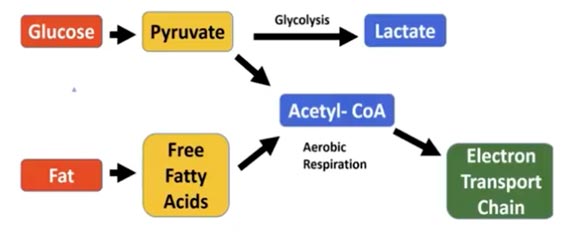
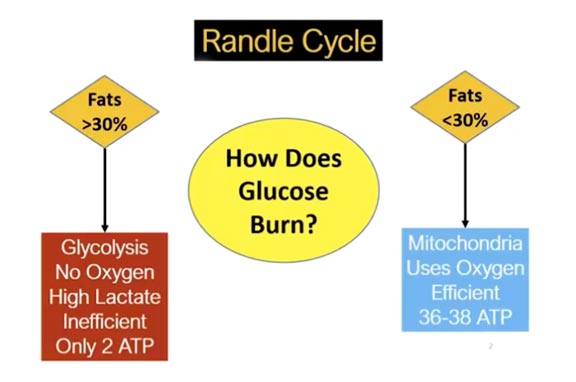
Provided your fat intake is below 30% or so (this is merely a best-guess at this point, as no one knows exactly what the threshold is), the glucose you consume will be shuttled into acetyl-CoA. When it goes to acetyl-CoA, it goes into the electron transport chain in the mitochondria.
Free fatty acids can also be metabolized into acetyl-CoA through beta-oxidation in the mitochondria, and there’s a competition that occurs there with glucose, which is why your fat intake needs to be low enough for glucose to enter this pathway.
Aerobic respiration uses oxygen in the mitochondria, whereas glycolysis, which occurs in the cytosol, does not use oxygen and is very inefficient. Glycolysis only generates two ATP molecules for each molecule of glucose, whereas aerobic respiration, which occurs in the mitochondria, generates 36 to 38 ATPs per molecule of glucose.
Ultimately, you want to burn glucose in your mitochondria. That’s the most efficient, allowing you to generate the most energy, while simultaneously producing the least amount of harmful “exhaust” in the form of reactive oxygen species (ROS).
And, again, the only way to ensure that is to keep your dietary fat content below 30% of your total calories. If you’re insulin resistant, which means you’re metabolically inflexible, that threshold may be closer to 20% or even 10%. So, if you’re insulin resistant, you’ll want to significantly lower your fat intake until your insulin resistance is resolved. Then you can increase it to 30%.
Endotoxin and PUFAs Decimate Mitochondrial Energy Production
Next, Feldman discusses a key strategy to optimize your mitochondrial energy production, which is to remove blocks in the electron transport chain so that electrons can move smoothly forward, without accumulating and backing up.
“We don’t need to focus on doing extra things to stimulate [mitochondrial energy production],” Feldman says. “Our mitochondria will work perfectly well if they have the right fuel and nutrients, and they aren’t being inhibited or blocked.”
According to Feldman, endotoxin (lipopolysaccharide or LPS) and other bacterial toxins are among the biggest culprits when it comes to things that hinder mitochondrial energy production. These toxins can directly impair electron transport through the complexes of the electron transport chain. They can also impair certain enzymes in the Krebs cycle.
The primary solution for obesity and most other conditions is to raise your metabolic rate, and a key strategy for that is to remove blocks in the electron transport chain. Endotoxin and polyunsaturated fats (PUFAs) are two key culprits that need to be eliminated.
Poor digestion is frequently associated with negative gram bacteria in your gut that produce endotoxin, and this will inhibit your ability to convert food to energy, resulting in increased body fat. So, it’s important to reduce your endotoxin load. Aside from poor digestion, excess endotoxin is also a common culprit in degenerative conditions, metabolic syndrome, diabetes and fatty liver. To reduce your endotoxin load:
- Rebalance your gut microbiome by reintroducing beneficial bacteria (probiotics and prebiotics). One of the best and least expensive ways to do this is to eat a serving of fermented vegetables each day.
- Temporarily go on a low-fiber diet and avoid fiber supplements as it can feed undesirable bacteria. Cook your vegetables thoroughly rather than eating them raw, and if your condition is serious, limit fruits for a time too.
- Eat a low-carb ketogenic diet and/or fast until the problem is resolved. As noted by Feldman, “This is one of the main places where low-carb diets, ketogenic diets, fasting, carnivore [diets] are really helpful, as they provide relief from the feeding of bacteria that are producing a lot of endotoxin.” Foods to avoid include most grains, legumes, nuts, and seeds.
- Avoid resistant starches, as they feed LPS-producing bacteria.
Once your microbiome is balanced and symptoms of poor gut function have resolved, you can slowly reintroduce whole fruits, vegetables, roots and tubers, and other foods. Another effective blocker of mitochondrial energy production is polyunsaturated fat (PUFA).
These are your processed seed oils, canola oil being among the worst of the worst. Seed oils are loaded with linoleic acid, an omega-6 PUFA, which appears to be one of the primary drivers of chronic diseases, in part due to its detrimental impact on your mitochondrial function and energy production.
The Expensive Tissue Hypothesis
After a short discussion about ancestral diets and the likelihood that such diets were generally high in carbs, Feldman and Gryn review the “expensive tissue hypothesis,” which is the idea that the less energy you waste on hard to digest, fibrous foods, the more energy is available for your brain.
“… that’s also a reason to be consuming a lot of carbohydrates and not excess protein, because the conversion from protein to glucose and then to energy is very inefficient,” Feldman says.
“It’s about 30% less efficient than just using glucose. So, if we consider the … expensive tissue hypothesis, we shouldn’t be consuming excess protein beyond our needs and trying to use that for energy, because … that leaves less energy for our immune function, our brain function, for reproductive function and and on …
Coming back to weight loss, there’s the constrained model of energy expenditure, which is very related here, which basically says that you can’t just expend more and more calories from, let’s say, exercise, without it coming at a cost.
So, if you exercise 1,000 calories’ worth and before you were burning 2,000 calories, that doesn’t mean that you just burned 3,000. What actually happens is, you start to cut into your own basal metabolic rate, and you start to cut into your bodily function.
So, your reproduction is turned down, your immune function is turned down … Extrapolated, it really also gets at the problem with the ‘eat less exercise more’ advice for weight loss.”
Endotoxin, Not Fructose, Causes Fatty Liver Disease
Feldman also debunks the argument that fructose, unlike what is being promoted by Drs, Robert Lustig, Richard Johnson and David Perlmutter, causes nonalcoholic fatty liver disease (NAFLD). He reminds listeners that both dietary fat and fructose can be converted into fat, and fructose isn’t automatically destined to end up as liver fat.
“In fact, very little fructose gets converted to fat,” he says, because “there are all sorts of of routes for it to go before it’s getting converted to fat … Fructose does go to the liver and it gets picked up by the liver immediately, whereas glucose will go out into the bloodstream and can be picked up by the muscles.
But our livers have developed to handle massive amounts of fructose. Most of the research that is looking at what happens to fructose … is going on in rats. And there are a few differences, there are a few problems there. One is that rat livers are very different from human livers in their capacity for fructose handling.
Our livers have an incredible capacity for handling fructose. Hundreds and hundreds of grams can be stored as glycogen, can be converted to glucose or lactate and sent out to be stored elsewhere, or used elsewhere, and then can also be oxidized.
So, when we consume excess fructose in a normal context, in a healthy liver, very little is going to be going to fat. It takes huge amounts of carbohydrates before you’re … producing much fat in the liver through de novo lipogenesis. And that’s because our livers have this incredible capacity for handling it …”
Feldman also remarks that many fructose studies are flawed in that they’re looking at fructose-only sources, which rarely ever exists in our food supply as it is virtually always accompanied with glucose. Results from such studies therefore do not tell you much about how natural, whole food-based fructose, say from fruit or honey, acts in the body.
“Whether you’re consuming fruit or honey or anything else, the fructose to glucose ratio is always near 1-to-1,” he says. “Sometimes there’s a slight bit more fructose [than] glucose, but even in high fructose corn syrup … it’s about 55% fructose and 45% glucose. We’re really not talking about major differences here.
And that’s important because our intestines don’t absorb pure fructose. If there’s glucose present, we absorb it very well. But if there’s no glucose present … you can’t really absorb it very well.
So, what happens is a lot of it doesn’t get absorbed in our small intestine. [It] continues down to the large intestine where it feeds bacteria. Those bacteria produce endotoxin, and that is what leads to things like fatty liver production [and] fatty liver disease.”
How to Gauge Your Metabolic Rate
According to the rate-of-living theory, the higher your metabolic rate — which means the quicker the electrons move from food toward oxygen, which is the final acceptor of electrons — the faster you’ll age because there’ll be higher oxidative stress.
However, deeper analysis reveals the exact opposite. The truth is, the higher your metabolic rate, the slower you age, because a high metabolism creates fewer ROS that can damage your tissues.
Your metabolism is high when electrons move rapidly and easily through the mitochondrial electron transport chain, which results in optimal energy production. When electrons are impeded from moving forward, they can back up, leak through the mitochondrial membrane and start moving backward, where they combine with oxygen to create excessive ROS.
So, for optimal health, you want high energy production and that means a high metabolic rate. As explained by Feldman, you can gauge your metabolic rate using your pulse and body temperature.
“If you’re not hitting 98.6 [degrees Fahrenheit] later in the day, if you’re not hitting 97.8 or 98.0°F when you’re waking up, that can be a sign of a hypometabolic state,” he says.
“If your [resting] pulse [first thing in the morning] is particularly low, if you’re not getting into the mid-70s or potentially low-80s, depending on your fitness state, that can also be a sign of a low metabolic rate.
The caveat is that the more cardiovascularly fit you are, the lower your pulse rate will be, independent of metabolic state. That’s because your stroke volume increases. The stroke volume is the amount of blood your heart pumps with each beat. So you can have fewer beats and still pump the same amount of blood … You can also look at temperature and pulse before and after a meal.
If … somebody wakes up at temperature 98.4°F. and then they have their breakfast and it drops to 97.5°F., that is a situation of a drop in stress hormones, where someone was waking up in a stress state, their sleep’s probably not optimal, they’re probably not optimal metabolically, then they’re consuming some carbohydrates and their stress hormones drop.
If you’re seeing that happen after a meal, it’s a pretty good sign that that’s what’s happening.
Another good way to do it is just seeing how many calories you can consume while maintaining your weight … If, with your activity and everything else, you should be burning 3,000 calories a day, but you’re maintaining your weight on 2,200 calories a day, that’s a sign that you’re pretty hypometabolic.”
Conversely, if you can maintain your weight when you add more calories, your metabolic rate is likely high, and the extra food will oftentimes improve your sleep, relaxation, energy and recovery.
Methylene Blue — A Useful Rescue Remedy
While there are no magic pills to fix slow metabolism or low energy production, there are some that can help. I’ve previously written about the usefulness of niacinamide, for example. Another helpful one is methylene blue. As explained by Feldman:
“As a supplement, it’s got a number of interesting effects. For one, it’s antimicrobial … but it also has some pretty interesting mitochondrial or energetic effects, where it is able to work as an electron acceptor and donor.
So, if things are not working well in the electron transport chain, the main site where we produce ATP, [if] something’s blocked, let’s say by endotoxin or polyunsaturated fats, whatever it is, methyl blue can help us bypass those issues and allow us to continue to produce energy despite those things.
It also lowers nitric oxide, which is another inhibitor of mitochondrial respiration. So, it’s got a number of benefits. I will say, like any other supplement, there’s a place for it and there’s also a place where it can be problematic, and it’s never the first thing I would go to.
We always want to work at those foundations first — get diet on point, eat consistently, get enough carbs and fats in, make sure we’re getting the nutrients we need, trying to work on our sleep hygiene, our movement …
But I do think there’s a place for methylene blue to help with either those microbial issues or for getting the metabolism going in certain instances. It also, in particular, has some benefits neurologically, because of these stimulating effects on respiration … So, yeah, I like it. Again, it’s not magic in that it is going to fix the problems, but it can be helpful along the way.”
Constructing the Ideal Diet to Maximize Energy
While it’s nearly impossible to come up with a diet that is ideal for everyone, general guidelines can be provided. After that, it’s up to you to experiment and note what works and what doesn’t. For example, some are outfitted with genes that can handle dietary fats better than others, while some may have had their gallbladder removed and can’t handle much fat at all. Following are some general principles for devising your ideal diet:
• Protein — Most adults need about 0.6 to 0.8 grams of protein per pound of lean body mass. As an example, if your body fat mass is 20%, your lean mass is 80% of your total body weight. Ideally, stick to animal-based protein such as clean seafood and low-LA animals like beef, bison, lamb and other ruminant game animals, raw grass fed dairy and organic pastured eggs.
Avoid chicken and pork as, even if pasture-raised and organically fed, they are given grains and other foods that are high in LA so they will increase your LA levels. Many plant-based proteins, including nuts and seeds (with the exception of macadamia nuts), are also high in PUFAs.
• Carbs — Avoid hard-to-digest carbs like most grains, including brown rice, and legumes, unless they’re soaked, properly cooked, sprouted or fermented. Good options include raw authentic honey, maple syrup, white rice, ripe and dried fruit, and well-cooked (preferentially pressure cooked) tubers like red potatoes, sweet potatoes and parsnip.
• Fats — Avoid seed oils, which are loaded with PUFAs like LA. Good options include butter, tallow, ghee, coconut oil and avocados.
If you’ve been on a low-carb, high-fat diet, slowly add in more carbs while simultaneously lowering your fat intake. As mentioned earlier, your fat intake probably needs to be somewhere around 30% or lower to allow for efficient glucose metabolism.
Feldman typically recommends a range of 20% to 40%, with the upper limit being for more physically active people with greater muscle mass. With fats at 30%, carbs would then be in the range of 55% to 60%, with protein making up the remaining 10% to 15%.
Increase Your Metabolism to Slow Your Aging
As mentioned earlier, high metabolism is the key to slowing down aging. And the slower you age, the more youthful and resilient you’ll be. As noted by Feldman:
“When we’re in our 20s, let’s say, or late teens, we can kind of eat whatever, our metabolic rate’s really, [we have] high libido’s, sleep is never an issue … digestion is really good; things don’t bother you. That’s the state … we want to be getting to. And I would say the key difference there is, where is our metabolic rate at?
Over time, metabolic rate slows, mitochondrial respiration slows. If you take aged mitochondria from someone who’s above the age of let’s say 60 or 70, there’s a dramatic reduction in energy production … So, the solution is to get back to that young metabolism. And I think it’s totally doable.
It’s just a matter of eating the things that are designed for optimal function, that allow for maximal energy production, [and] avoiding the things that interfere with that — avoiding the polyunsaturated fats, lowering endotoxin, having good, consistent sleep, consistent movement.
It’s a complex, right? It’s never as simple as ‘Just eat this one thing,’ or ‘just take this one pill.’ [It’s] having that perspective of trying to think of speeding things up, as opposed to slowing things down.”
In Defense of Low-Fat Eating
Reproduced from original article:
https://articles.mercola.com/sites/articles/archive/2023/09/09/limit-unhealthy-fats.aspx
The original Mercola article may not remain on the original site, but I will endeavor to keep it on this site as long as I deem it to be appropriate.
Analysis by Dr. Joseph Mercola Fact Checked September 09, 2023
STORY AT-A-GLANCE
- Ancel Keys is typically credited with starting the low-fat movement. Critics say he cherry picked data to show that the more saturated fat a population ate, the higher the rate of heart disease. However, by then, doctors had already been using low-fat diets in clinical practice for decades, with good success
- The first “Dietary Goals for the United States” were published in 1977. For the first time, government was making recommendations about what to eat to maintain good health, and they specifically recommended that people increase consumption of carbohydrates and reduce saturated fat intake
- However, while low-fat diets were pushed, Americans did not lower their fat intake. Americans did raise their carb intake after the guidelines were released, but they did not cut their fat intake. Portion sizes also went up, and sugary snacks were coming onto the scene
- In the 1930s through the late 1950s, several doctors achieved stunning successes treating chronic diseases with extremely low-fat diets. The reason low-fat diets don’t seem to work anymore is because the term “low fat” was redefined from 10% of calories or less, to 30%, which is too high to achieve metabolic benefits
- Author and health consultant Denise Minger has proposed a hypothesis that “metabolic magic” occurs on two ends of the dietary fat spectrum: at or above 65% fat, and at or below 10%. Most dietary recommendations call for 30% fat, which is where fat becomes problematic
The video above features a lecture by health consultant and author Denise Minger at the 2016 Icelandic Health Symposium. Her 2014 book, “Death by Food Pyramid,” explores the roots of our beliefs about food and provides readers with tools to navigate conflicting dietary claims, and she does so in this lecture as well.
While Minger’s presentation primarily challenges our beliefs about low-fat diets, more broadly she also encourages everyone to keep an open mind, to question everything, to avoid group-think and premature assumptions based on the illusion of consensus. This is good advice for all of us.
As you may have noticed, I’ve made several U-turns myself over the years, as I delved deeper into various metabolic issues and gained a deeper understanding about how the human body works.
Optimal health is not a one-and-done, but rather an ongoing journey. New information surfaces. Your body changes with age, and new environmental factors come into play. So, we must adapt to changing circumstances and learn to listen to our bodies.
For many years, I was convinced a long-term, high-fat diet was the way to go, and that fat burned “cleaner” than glucose. I’m now coming to understand that there’s far more to this equation than I had previously appreciated, and that carbs, fructose in particular, have been wrongly blamed for damage that actually isn’t the fault of sugar itself.
I’m presenting Minger’s lecture here as food for thought. It’s not a wholesale endorsement of her views, but an opportunity to hear the other side of the high-fat/low-fat argument.
As noted by Minger, the history we’re told is not necessarily the whole truth. It’s typically curated to create a particular narrative, and this applies to the history of dietary recommendations as well. I think you’ll really enjoy it, as she presents a rather revolutionary hypothesis that, indeed, may clear up much of the confusion surrounding high- versus low-fat.
The Prevailing History of Low-Fat Diets
Minger starts out by reviewing the history of low-fat diets because, according to her, this is where most get off track. Physiologist Ancel Keys — creator of Army K rations — is typically credited with starting the low-fat movement in the 1950s.1
According to the prevailing narrative, he cherry picked data to show that the more saturated fat a population ate, the higher the rate of heart disease. He then used his charisma and influence to convince the American Heart Association to adopt low-fat dietary guidelines and promote that for cardiovascular health.
The first “Dietary Goals for the United States” were published in 1977 by the U.S. Senate Select Committee on Nutrition and Human Needs, chaired by Sen. George McGovern.2 This report eventually grew into what today is known as the U.S. Dietary Guidelines.
For the first time, the government was making recommendations about what to eat to maintain good health, and they specifically recommended that people increase consumption of carbohydrates and reduce saturated fat intake.
However, as the low-fat recommendation took hold, obesity skyrocketed. The subsequent obesity epidemic has long been viewed as evidence that the low-fat recommendation was in error.
Did Low-Fat Diets Cause the Obesity Epidemic?
But not so fast, Minger says. While low-fat diets were in fact pushed, did Americans really follow that recommendation? Looking at macronutrient intake data, Minger points out that while Americans did raise their carb intake after the guidelines were released, they did not cut their fat intake. Portion sizes also went up, and sugary snacks were coming onto the scene.
Interestingly, though, if you look at macronutrient intake data from the early 1900s, carb intake (in terms of grams per day) at that time was quite similar to what it was in 2000.
“So, we can’t really even say that our diet was higher carb than it has ever been,” she says. “Not only that, but things look very interesting on a global level when we consider what other countries are eating.
We can see that as the percent of total calories, America actually has a very, very low, relatively speaking, intake of carbohydrate compared to a lot of other countries.
Other countries with low carbohydrate intakes, relatively speaking, include Australia, Iceland, a lot of different parts of Europe, many places that are also experiencing obesity epidemics.
And if we look at relative fat intake, we can see that America, Australia, Europe, Iceland — again many of the same areas experiencing obesity epidemics — actually have the highest intake of fat. So, bottom line here is that you do not eat a low-fat diet in the West at all. We can’t really blame anything that’s going on, on … low-fat [diets].”
Download this Article Before it Disappears
The Forgotten Timeline of the Low-Fat Movement: Dr. Kempner
Menger goes on to review how, in 1939, Walter Kempner, a medical doctor and research scientist, used low-fat diets to successfully treat a wide array of chronic disease, including kidney disease and kidney failure, high blood pressure, diabetes, heart disease, psoriasis and more.
He’s been referred to as the father of modern diet therapy, and is the creator of the Rice Diet, which was based on 250 grams to 350 grams of white rice (dry weight), unlimited fresh fruit and fruit juice, and, shockingly, unlimited white sugar. On average, his patients consumed between 100 grams to 400 grams of refined sugar a day. This diet is basically 94% carbs and only 2% fat.
The result? Patients with a range of diseases (listed above) dramatically improved, including diabetics. In a study that followed patients for up to 11 years, Kempner found that only 15% of diabetics experienced a rise in fasting blood sugar on the Rice Diet; 22% had no change; and 63% experienced a decrease, with an average drop of 101 mg/dL.
Insulin usage also decreased by 58% and 1 in 4 were able to cease taking insulin because their levels were completely normalized. A quote from a conference paper reviewing the Rice Diet reads:3
“Patients … were able to transition into a more flexible diet over time, while leading a normal, active life, without medications, indicating that the disease state [i.e., diabetes] had been permanently modified.”
The Forgotten Timeline: Drs. Morrison and Swank
In the 1940s, Dr. Lester Morrison, another pioneer of the low-fat diet, used a low-fat diet to treat heart disease in people who had already experienced a heart attack. The “Morrison Diet-Heart Study,”4 begun in 1946, found that people in the low-fat diet group had about half the mortality rate of controls after three years (14% compared to 30%).
Fat was the only macronutrient that was limited. The test group maintained daily fat intake between 20 grams and 25 grams, while eating as much sugar and refined grains as they wanted. After eight years, the low-fat group still had a lower mortality rate — 44% — compared to controls at 76%.
In the late 1940s, Dr. Roy Swank was a neurologist who not only advocated a low-fat diet, but also treated multiple sclerosis (MS) patients with it.5 He developed a theory that MS was the result of genetics combined with dietary triggers, saturated fat in particular. He put 150 MS patients on a low-fat diet (max 10 grams to 15 grams of saturated fat a day, primarily from meat and dairy). Sugar and refined grains were not limited.
Swank followed his patients for up to 50 years. Follow-up after 34 years showed that disease progression stabilized among those who adhered to the low-fat recommendation, while worsening among those who went back to eating more fat.
Mortality statistics confirmed this, showing that 31% of those who had died during the 34th year of follow-up had been eating less than 20 grams of saturated fat a day, while 80% of those who had died had been eating more than 20 grams.
The Forgotten Timeline: Drs. Pritikin and Esselstyn
Keys doesn’t enter the low-fat scene until the mid-1950s. By then, doctors had already been using low-fat diets in clinical practice for decades, with good success.
“So, Ancel Keys is not really the beginning of the low-fat movement,” Minger says. “There are a few people who have been swept under the rug of history, whom we’ve forgotten about.”
In the late 1950s, Dr. Nathan Pritikin founded a longevity center and became well-known for treating obesity and heart disease with a very low-fat diet based on vegetables, grains and fruits.
Then, in 1977, the first U.S. dietary guidelines recommending low fat came out. So, these guidelines were not necessarily the result of Keys’ alleged charisma, but did in fact have a long history of clinical successes to back them up.
Minger also reviews more recent research by Dr. Caldwell Esselstyn, a cardiac surgeon who in 2014 published the results of a five-year study using an extremely low-fat, plant-based diet on 198 patients with advanced heart disease. Of those, 177 adhered to Esselstyn’s strict diet. The rest ended up serving as an accidental control group.
Among adherents, 22% completely reversed their heart disease, and only one person — 0.6% — had a cardiac event (stroke), compared to 62% of nonadherents.
“So, can we really say that low-fat, high-carb diets categorically are bad for cardiovascular health when … very, very, very low-fat [diets] have been shown —with evidence in clinical settings — to reverse heart disease? We need to refine the way we’re looking at these things,” Minger says.
Why Don’t Low-Fat Diets Work Today?
All of this brings us to an important question. If low-fat diets were so effective in decades past, why don’t they work today? Most modern research suggests low fat isn’t effective. The answer, Minger says, is that we’ve redefined the term “low fat.”
Between 1930 and 1970, “low fat” meant fat accounted for 10% of calories or less. Since the 1980s, “low fat” has been redefined as 30% of calories, which by all accounts is more like “moderate fat,” or even “relatively high fat,” based on the average global fat consumption. Minger then presents a rather intriguing, if not revolutionary, hypothesis.
We know that when your diet is 65% or more fat, you enter a metabolic state called ketosis, which has a long list of health benefits. “What if,” Minger says, “on the other end of the spectrum there’s a mirror metabolic state that happens when you restrict fat to [10% or less]?” The image below, from her slide show, illustrates her novel hypothesis.
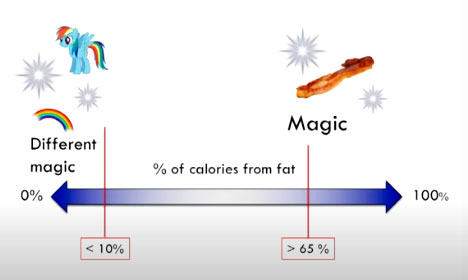
Minger has dubbed this low-fat metabolic state “carbosis,” because there’s no official name for it. She explains:
“We got ketosis on one end; we got carbosis on the other end, and my thought is that what’s in the middle is the macronutrient ‘swamp land.’ And this swamp land, unfortunately, is where most of our obesity-producing diets tend to fall.
We see that a toxic combination [of] very processed carbohydrates with industrial vegetable oils … mixed with some salt, become highly addictive, maybe cause some changes in appetite regulation …
But the important thing here is … we have USDA guidelines that fall here, American Heart Association guidelines that fall here, American Diabetes Association guidelines that fall here, American Dietetic Association guidelines that fall here.
And, most importantly, if you look at almost any ‘low-fat’ study that has been conducted in recent years, it is also going to use a fat intake of about 30% — swampland values.
Of course, it’s not going to [produce] that therapeutic effect that we saw in some of this older research. That also brings us to a new question, which is why does [fat] need to be so low in order for that magic to happen?”
Dietary Fat Reduces Insulin Sensitivity
Minger goes on to review evidence suggesting that fat can reduce insulin sensitivity. Importantly, many experiments try to extrapolate the effects of macronutrients based on processed foods loaded with unnatural ingredients like hydrogenated soybean oil. That’s not a reliable way to ascertain the effects of fats and carbs found in whole foods.
One study, however, used just two basic ingredients: potato and butter. Metabolically healthy, nondiabetic, lean adults were fed a baked potato (50 grams of carbohydrate) either alone, or with 50 grams of butter. There’s a belief that eating fat with a high-carbohydrate meal will result in a lower blood sugar spike and insulin response, and this is what they wanted to test.
“As predicted, adding the fat to the potato did lower the glucose response, but it did not dramatically, significantly lower the insulin response. In fact, adding fat to the potato caused insulin levels to stay elevated for an hour longer than eating the potato alone.
It took a longer time for that level to return to baseline … and there was actually a potentiating effect on insulin from the fat. What that means is, more insulin was needed to handle the same amount of blood sugar when fat was added to the potato … So, for some reason the insulin was not being as effective, or it was circulating abnormally …”
They then repeated the experiment using patients with untreated Type 2 diabetes. They ate either a baked potato alone, or with varying amounts of fat from butter, ranging from 5 grams to 50 grams.
Interestingly, in diabetics, adding fat did not lower the blood sugar response. The insulin response to potato alone was also lower than it was for potato with as little as 5 grams of fat. The effect leveled off at 15 grams of fat, but all insulin responses were higher with fat than with potato alone.
“So, there’s something about adding butter to a high carbohydrate meal that increases insulin levels relative to the carb food being eaten alone,” Minger says.
This could explain why the Rice Diet, which was 94% carbohydrate and only 2% fat, improved insulin levels in diabetics. Kempner himself observed that even minimal additions of fat spoiled the therapeutic effect.
Dietary Fat Reduces Blood Oxygen
There’s also evidence suggesting that dietary fat can reduce the ability of oxygen to reach different tissues, including your brain and heart. Minger cites a 1955 study in which 14 patients with angina (a form of heart disease that causes severe chest pain) fasted overnight and were then given a glass of heavy cream to drink the next morning.
They then measured the plasma lactescence,6 a marker for fat flooding the blood stream during the process of digestion. Plasma lactescence started rising after two hours of ingestion, peaking at Hour 3. And, right as plasma lactescence peaked, that’s when patients began to experience bouts of angina and abnormal EKGs.
There were 14 angina attacks among the 14 patients, but some experienced multiple attacks while others had none. During peak lactescence, there was also a reduction in oxygen carrying capacity, meaning less oxygen was reaching their hearts. On top of that, platelets and red blood cells started clumping together, so blood flow was impaired.
They then replicated the experiment using an isolated protein powder drink with dextrin and maltose that had the same calorie content as the heavy cream. And, while this drink objectively contains less healthy ingredients, after five hours, none of the patients had experienced an angina attack and none had abnormal EKG.
“So, something to think about: There might be … certain susceptibilities among certain people to be sensitive to a high saturated fat intake,” Minger says.
“I’m not going to draw conclusions right now. This is still something I’m researching. But for anybody who does have any type of heart condition, consuming a lot of saturated fat in one meal might not be the best idea.”
Conclusion
In conclusion, Minger notes:
“… we sometimes blame carbohydrates for breaking our carbohydrate metabolism … We have another option though … This is what I’m thinking: Low carbohydrate diets are amazing for managing the symptoms and expressions of insulin resistance.
If you’re diabetic, you can go on a low carbohydrate diet, normalize your blood sugar, normalize your a1c, do great on the Surface, but if you ever go back to eating carbohydrates, you will be in trouble. There is still something about the body that is broken …
For some people, [their] bodies may be permanently broken beyond repair. I’ll definitely acknowledge that. But for some people, there may be the potential to actually restore glucose control … restore metabolic flexibility, and actually heal things like diabetes.
And right now, there is more evidence that a very low-fat diet can do that than a very high fat diet can … So, it’s a matter of, what are we willing to risk? What are we willing to play around with? …
So, I would like to leave with this one thought, which is that we have been engaged in a macronutrient war for a very, very long time — decades. The first victim was fat. We decided that was bad … [E]ventually we started realizing that that strategy didn’t work so well. Then we started targeting carbohydrates …
In my opinion this is also very narrow-minded. Both of these macronutrients operate in ways that are context-dependent. Fat can make carbohydrates look bad. Carbohydrates can make fat look bad. But in reality, we have these two different worlds that, most of the time, we consider irreconcilable, mutually exclusive.
We can’t figure out why one would work and the other one would work. So we tend to choose sides and root for just one. I would like to offer the idea that maybe these two things are not in fact at odds.”
Crucial Facts About Your Metabolism
Reproduced from original article:
https://articles.mercola.com/sites/articles/archive/2023/08/20/mitochondria-glucose-metabolism.aspx
The original Mercola article may not remain on the original site, but I will endeavor to keep it on this site as long as I deem it to be appropriate.
Analysis by Dr. Joseph Mercola Fact Checked August 20, 2023
STORY AT-A-GLANCE
- Cortisol is primarily a rescue hormone. It’s a glucocorticoid, so it increases your glucose level by shredding your muscle protein to produce glucose. Cortisol also accelerates the aging process and is implicated in most chronic diseases. It also uses your brain tissue to use amino acids to make glucose which contributes to brain atrophy and subsequent depression
- Your mitochondria can only burn one fuel at a time — either fat or glucose — and there’s a stealth switch that controls which of these fuels your mitochondria will burn. This switch is known as the Randle cycle
- Ideally, you want to metabolize (burn) glucose in your mitochondria, as this only generates 0.1% reactive oxygen species (ROS). This route also generates energy most efficiently, creating 36 to 38 adenosine triphosphates (ATP) for every molecule of glucose that is metabolized. For this to occur, you need to consume less than 30% of your calories as fat
- When you consume significantly more than 30% fat, the switch changes to burn fat in your mitochondria. As a result, glucose then backs up into your bloodstream, raising your blood sugar. This is a major contributor to diabetes
- When you lose muscle, your basal metabolic rate goes down, so it’s important to maintain muscle mass, because your muscle will burn fat even when you’re resting
In this interview, repeat guest Georgi Dinkov and I will again take a deep dive into the biochemistry of human metabolism. Dinkov is a student of the late Ray Peat, a biologist, thyroid expert and pioneer in prometabolic therapy and human metabolism.
Despite having a degree in computer science and having no formal academic training in health, Dinkov essentially has acquired a Ph.D. in molecular biology. After graduating from Georgetown University in 2002, Dinkov got a job as a programmer at the National Biomedical Research Foundation (NBRF).
There, he helped develop uniprot.org, a database of all known protein sequences. Surrounded by dozens of the brightest doctors and biochemists in the world, he developed an interest in biochemistry.
Clearing Up Confusion
I have long promoted a low-carb, high-fat diet for many years and have realized many are confused on the evolution of my recommendations. As I say in the interview, 95 to 97% of the population in the U.S. is metabolically inflexible and would likely benefit from a low-carb, high-fat keto approach with intermittent fasting.
However, once you have resolved your insulin resistance, which typically takes a few months but can take longer, and can optimally burn fat for fuel, it is very clear to me that you need to cycle carbs back into your diet. There are loads of questions about how this transition occurs, the timing of the transition, and the details of the cycling that need to be answered.
No one knows the answers, as the studies have not been done, but I am fairly convinced that many people will appear to do well in the long term on a low-carb, high-fat keto program like I did. However, I also believe they would do even better if they started to include more healthy carbs in their diet like I did. That does not mean processed foods or processed sugars, or virtually all grains and legumes. The ideal carbs are ripe fruits.
You should introduce carbs slowly and only after you have shifted your fat level down to 30%. This is easily calculated by using a free online program called Cronometer. If you still struggle with diabetes or obesity, then you can get your fat level down to 15 to 20% of your total calories.
Protein level should always remain the same and does not change from 0.7 to 1 gram protein/kg of lean body weight. So, if you are 20% body fat then you would multiply your body weight by 0.8 to get your lean body mass.
In my case, it took me about three to six months to go from 100 grams of carbs to 500 grams. The results for me were quite spectacular. I was already healthy, but it clearly improved my health even further as my body fat dropped from 15% to 12%, my inflammation decreased to radically low levels as my HS-CRP went from 0.8 to 0.18 which is almost below detection levels. Finally, even though I was not prediabetic as my blood sugar was in the low 90s, it dropped by 10 points to the low 80s.
The reason I made this shift is I was overwhelmed by the amount of strong scientific support for demonstrating that the ideal fuel in your mitochondria is indeed glucose, not fat. It has to do with decreasing reductive stress in your mitochondria which is a relatively unknown concept in molecular biology.
When implementing the transition to healthy carbs you need to be careful not to eat too many carbs as excess carbs will be shunted to glycolysis and into glucose into your blood and lead to an increased blood sugar. The more muscle mass you have and the more exercise you do, the more carbs you can eat.
I suspect most people could easily transition to 200 grams of carbs. I seem to do well with about 500 grams, mostly all fruit but do have white rice and red potatoes as well. You should see my shopping cart as every week it is loaded with about 60 pounds of fruit.
The Cortisol-Glucose Link
For example, Dinkov helped me understand the crucial role cortisol plays in glucose regulation. Cortisol is primarily a rescue hormone. It’s a glucocorticoid, and as the name implies, it increases your glucose level, because if your glucose level drops too low, you will go into a hypoglycemic coma and can die.
As such, cortisol is a lifesaver. The downside is that it uses up vital protein to make glucose, so high cortisol takes a toll on your muscles. The reason anabolic steroids build muscle mass is because they’re anti-cortisol. You would’ve thought anabolic steroids would have some direct action on the muscles, but no, they primarily inhibit cortisol’s catabolic impact.
Cortisol uses muscle protein to produce glucose in your liver, so when your glucose level drops, cortisol rises and shreds muscle to produce glucose. This is one of the puzzle pieces that explains why you don’t want your glucose levels to be low over prolonged periods.
Cortisol also accelerates the aging process and is implicated in most chronic diseases. In the case of Addison’s disease (adrenal failure), the opposite is present: low cortisol. These patients are typically required to take cortisol injections on a regular basis. On the upside, this chronic cortisol deficiency tends to impart a youthfulness. In most other chronic conditions, high cortisol is part of the problem.
Download this Article Before it Disappears
High Cortisol Speeds Aging
Dinkov comments:
“Studies as far back as the 1950s and 60s demonstrated that you can produce every single phenotype of aging if you inject cortisol, or at least create a state of relative glucocorticoid excess in the animal.
You can do that either by injecting synthetic or natural glucocorticoids, or by increasing the levels of natural anti-cortisol steroids in the body. Those are progesterone and DHEA, and in males testosterone and dihydrotestosterone.
It has been shown that cortisol levels do not decline with age unless you really have adrenal failure, while the levels of all these anti-cortisol, youth-promoting hormones decline with age. By the time you’re 80, their levels are at about 20% of what they used to be when you were in your 20s.
So, really, what happens is that cortisol stays the same, but your relative state of cortisol increases because there’s nothing to oppose the cortisol that is already there. Multiple intervention studies have demonstrated that if you administer agents that oppose cortisol, block it at the receptor level, or reduce its synthesis, you can achieve really good health results and also improve the way you look.
Anabolic steroids are probably the best known example. It’s really a misnomer because they’re not anabolic. They’re actually anticatabolic. Muscle has one of the highest expressions of the glucocorticoid receptor, through which cortisol shreds the muscle. It binds the receptor and increases a number of different proteolytic fibers.”
High Cortisol Linked to Depression
Your gastrointestinal tract and brain also have high numbers of glucocorticoid receptors, so cortisol shreds brain tissue as well, causing brain atrophy and subsequent depression. Research has shown that people with depression have smaller brain volumes than people who don’t have depression.
“Within 48 hours of the glucocorticoid blocker RU-486 being administered to people with clinical treatment-resistant depression, they experienced remission. So I think it’s a very good argument that cortisol is catabolic to the brain, and clearly, if it’s catabolic to the brain, it’s probably not going to improve your mood. If anything, it’s going to worsen it.”
Again, when your blood sugar level drops, that triggers your body to increase cortisol, which is the last thing you want if you struggle with depression or other chronic disease. Really, one of your primary goals in achieving optimal health is to limit the elevation of your cortisol. It’s far more destructive than having elevated blood sugar, which most focus on.
High Cortisol Is Far Worse Than High Blood Sugar
Many wear continuous glucose monitors that check your glucose level every five to 10 minutes. But high glucose is not the real danger here. Cortisol is, and it rises when glucose drops too low. As noted by Dinkov:
“All the drugs on the market, especially the more recent ones that lower HB A1C, the glycated hemoglobin, all of them increase mortality. So, clearly, messing directly with the levels of blood glucose, it’s not something you want to do.
You may temporarily decrease the biomarker, the glycated hemoglobin, but it does not mean you’re getting healthier. [These drugs] may lower your blood glucose, but they may kill you in the long run faster than the elevated glucose would’ve done by itself.”
Metformin is one classic example. Many are using this drug to lower their blood sugar. While it’s a natural product, and considered safe, it’s basically a mitochondrial toxin that will make your health decline in the long term.
All of that said, we’re NOT saying you should ignore elevated blood glucose. Absolutely not. But elevated glucose is a symptom that is best addressed indirectly. Once you address the foundational cause, it will normalize by itself. As a personal anecdote, when I first interviewed Dinkov, 70% to 80% of my diet was fat. Now, I’m down to 27% fat and 57% carbohydrates, and I’ve lost 5 pounds and my fasting blood sugar is down by 10 points.
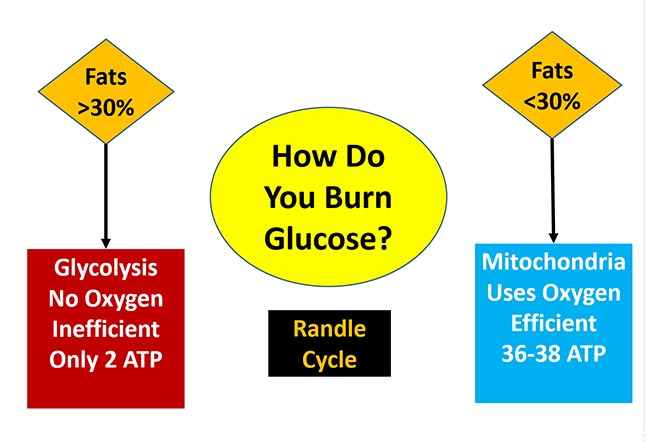
So, it’s not the carbohydrate ingestion that’s causing high blood sugar. It’s what’s happening at the mitochondrial level. To help you understand that, I created a graphic (below) because this science can get somewhat complex.
The Randle Cycle
Your mitochondria can only burn one fuel at a time — either fat or glucose. Fats are broken down in a process called beta oxidation into acetyl-CoA, which gets fed into the Krebs cycle. Carbs are broken down to pyruvate, which cannot enter the electron transport chain until it is converted to acetyl-CoA by pyruvate dehydrogenase.
The key here is that there’s a stealth switch that controls which of these fuels your mitochondria will burn. The switch has been given the name the Randle Cycle, but it is more helpful to visualize it as a railroad switch that changes the tracks of the train. The train can only travel down one track: not both. This is because only one type of fuel can be burned at a time.
In a best-case scenario, you will metabolize, or burn, glucose in your mitochondria without any reductive stress. When you do this, you will only generate 0.1% reactive oxygen species (ROS).
Not only does this route generate less ROS, but it also is incredibly efficient at energy production by creating 36 to 38 adenosine triphosphates (ATP) for every molecule of glucose that is metabolized. It will also generate metabolic water and carbon dioxide, which are also important for your health.
For this to occur, as indicated in the figure above, you will need to consume less than 30% of your calories as fat. When you consume significantly more than that amount, the switch changes to burn fat in your mitochondria and you will not be able to burn glucose until your fat decreases to less than 30% of calories.
When your fat intake is higher than 30%, pyruvate is inhibited and unable to readily convert the glucose metabolite, pyruvate, into acetyl-CoA to be shuttled into the mitochondria to burn as fuel.
Consequently, glucose can back up into your bloodstream, raising your blood sugar. What little glucose is burned for fuel is done through glycolysis, which is a primitive pathway that bacteria and cancer cells use, and it generates the powerful metabolic reductant lactate.
This can be a major contributor to diabetes. If you’re exercising, healthy and doing strict keto, overt diabetes is unlikely to develop, but more than likely you will have fasting glucose in the 90s, rather than the more optimal 80s.
Additionally, chronically oxidizing fats as your primary fuel will tend to increase your cortisol level, resulting in chronic inflammation, both of which accelerate the aging process due to excess ROS generated in the mitochondria that occurs from increased reductive stress as a result of oxidizing fat instead of sugar.
It is great that we have this glycolysis pathway, as you absolutely need it for quick fuel when you are activating your Type 2 muscle fibers. But if this is the primary way you burn glucose, you are in a catastrophic metabolic state because you’re creating loads of lactate as a waste product instead of healthy CO2 and metabolic water.
What’s more, you’re only generating two ATP for every molecule of glucose, which is 95% less energy. Lactate increases reductive stress, which causes reverse electron flow in the mitochondria and increases the ROS to 3% to 4%, which is 30 to 40 times more than when glucose is burned efficiently in the mitochondria at 0/1% ROS.
When Adding Carbs, Reduce Your Fat Intake
Ideally, it is best to lower your fat intake and replace those calories with healthy carbs like ripe fruit. You likely won’t optimize your mitochondrial function, though, until your fat level decreases to 30% of your total calories. So, hold off on making a final decision about whether this change is helping you or not until you get your fat level to 30% or lower.
This is easily calculated by using a free online program called Cronometer. If you still struggle with diabetes or obesity, then you may need to get your fat level down to 15% to 20% of your total calories.
Protein Versus Fat and Carb Requirements
Determining the ideal balance between carbs and fats is the primary challenge for most people. The level of protein is a bit simpler. It tends to be about 15% of daily calories and remains stable. A basic guideline for protein intake is somewhere between 0.7 grams and 1 gram per kilogram of lean body mass (not total weight).
The level of dietary fat you need will depend on your endocrine balance. If you’re diabetic, for example, you may need to go below 20% to avoid shutting down your glucose metabolism. Dinkov comments:
“If you look at older people, and sick people as well, they have metabolic inflexibility. So, if you give them a meal that’s comprised of equal number of calories of carbs and fats, they’re going to oxidize mostly the fats and the carbohydrates will go unmetabolized.
So, they’ll raise their blood glucose and lactate. So, you need to play with the ratio, but I’ve noticed that between 15% and 20% is probably where most people in their current health state can metabolize the fat without causing problems through the Randle Cycle.
Most diabetics are overweight … which means they have plenty of supply of fat. In fact, they have two sources of fat: one through the diet, and the second one from their fatty tissue, because there’s always some lipolysis going on, which means shredding the fatty tissue and supplying the rest of the body with the fatty acids from a fatty tissue …
In the rested state, your muscles actually prefer to oxidize mostly fat. So, if you have a decent amount of muscle mass, you can actually burn most of this fat through the baseline lipolysis by simply resting and preferably raising the amount of lean muscle mass you have. The ratio of lean muscle mass to total body weight is the primary determinant of your basal metabolic rate. So it’s very important to not lose lean muscle mass …
So, for diabetic people, it’s probably a good idea to lower the intake of fat from the diet because they already have a lot coming from their own bodies. In fact, there are many clinics around the world that treat and even cure Type 2 diabetes by putting diabetics on this really restrictive diet until they lose most of their fat and then suddenly the metabolism of glucose gets restarted.
I think this directly shows you that it wasn’t the glucose that was fattening them up and causing the problems, rather they had too much fat in their bodies. Once you get rid of that fat, no matter how you do it … the problems with metabolizing glucose disappear.”
Signs of Excessive Fat/Insufficient Carb Intake
As explained by Dinkov, one of the reasons why obese people who lose a lot of weight end up gaining it all back, even when they continue to diet and exercise, is because most of the weight lost is actually muscle mass. When you lose muscle, your basal metabolic rate decreases, meaning you need fewer calories to maintain your weight.
As a result, you must stay on an extremely low-calorie diet to maintain your weight. So, again, it’s crucial to maintain muscle mass, because your muscles will burn fat even when you’re resting. During activity, especially strenuous activity, your muscles will burn mostly glucose.
“I think the best way to gauge if you are eating too much fat is cognitive function,” Dinkov says. “If you’re eating too much fat, to the point where you’re interfering with glucose metabolism, you’ll start getting brain fog. Your thinking process will slow. You’ll start searching for words. Your reaction time and coordination time will decrease.
Sleep quality is another. Also, exercise capacity. If you’re always catching your breath and you’re feeling fatigued all the time, that is actually a great sign/symptom of elevated lactate. In fact, many different interventions that lower lactate are used as performance improving substances, such as vitamin B1 and niacinamide …
I would say eat the more fat-heavy meals earlier in the day, for breakfast and maybe lunch, and then eat the more carb-heavy meals at night, because your brain and many of the other organs will really need that.
It’s very common that if you don’t consume sufficient amount of carbs before going to bed, you will have trouble sleeping … I think one of the reasons for this is that, if you don’t consume sufficient amount of glucose, you will raise cortisol at night, and cortisol is already higher at night than it should be.
The cortisol is lowest at around 3 or 4 p.m. and starts rising with the coming darkness. Cortisol is highest at around 6 to 8 a.m. in the morning. But if you don’t consume a sufficient amount of carbs, that cortisol will be up to 40% higher.”
Clean Carbs
Of course, when we say “eat more carbs,” we don’t mean pizza and doughnuts or even ostensibly healthy grains like whole wheat. Healthy or “clean” carbs include foods like ripe fruit, raw honey and maple syrup. Tropical fruits such as papaya, watermelon, oranges and tangerines are preferable, as in addition to higher levels of fructose, they also contain flavonoids that help to digest the sugars. Ripe melon, apples, peaches, plums, pears and grapes are also good.
Now, you’ve probably heard me say that you shouldn’t eat anything at least three or four hours before bedtime to optimize autophagy. Dinkov’s research, however, dispels some of the concerns about eating (clean) carbs before bed.
“You do not want to mess with autophagy too much,” Dinkov says. “It has a lot of beneficial effects in terms of getting rid of dead or metabolically deranged tissue. However, if you do have an already present tumor, autophagy and AMPK can actually drastically increase its aggressiveness and promote metastasis.
But let’s say you do want to increase autophagy. I think it’s a bit of a myth that eating will somehow suppress autophagy and put it at a suboptimal level. Several studies demonstrate that several of the carbohydrates — including fructose and sucrose — are autophagy enhancers.
I would say, [eat healthy carbs] an hour before bed, because if you eat a meal that’s too high in carbohydrates, there’s the infamous fructose malabsorption. There’s only a certain amount of carbohydrates that your gastrointestinal tract can absorb per unit of time.
So, you need about an hour or two before the meal, if it’s composed of simple carbohydrates, to get these things into your bloodstream. At that point, you’ll probably be very relaxed and naturally inclined to fall asleep.”
That fructose and sucrose enhance autophagy is probably news to most of you. It was to me. I personally eat a teaspoon of honey before I go to bed, which seems to be enough carbs to thwart an increase in cortisol and helps me get more deep sleep. So, to summarize, Dinkov suggests eating a small amount of healthy carbs, such as fruit, about an hour or two before bed to optimize sleep and, potentially, autophagy as well.
Serotonin Is Not Your Friend
Fruits to be consumed in small amounts include pineapple and bananas, as both contain serotonin. Bananas also contain tryptophan, which is used in the synthesis of serotonin.
While most people think of serotonin as a mood-booster, it’s actually one of your worst enemies. You do not want high levels of serotonin, because it’s an antimetabolite. This means it suppresses your body’s ability to create energy in your mitochondria in the electron transport chain, so you become tired and fatigued, your metabolic rate slows and you gain weight.
“The amount of serotonin we need is really, really low,” Dinkov says. “The biggest role of serotonin is gastrointestinal motility. Any increase, even minor increase of serotonin, has been known since the 1920s to rapidly lead to fibrosis. The most successful antifibrotic drugs on the market currently are serotonin blockers.”
More Information
For more details on the topics summarized here, be sure to listen to the entire interview, and keep your eyes peeled for Part 2, which will follow shortly. Also check out Georgi’s blog at www.haidut.me or follow him on Twitter. He also has hundreds of videos on YouTube on a plethora of topics. A major sampling of Ray Peat’s work is also available for free on these two sites: wiki.chadnet.org/Ray-Peat and RayPeat.com.
A Critical Look at ‘The China Study’ and Other Food Plans
Reproduced from original article:
https://articles.mercola.com/sites/articles/archive/2023/07/22/the-china-study-and-other-nutrition-plans.aspx
The original Mercola article may not remain on the original site, but I will endeavor to keep it on this site as long as I deem it to be appropriate.
Analysis by Dr. Joseph Mercola Fact Checked July 22, 2023
STORY AT-A-GLANCE
- Although veganism has some health benefits, it is also loaded with many disadvantages and is unsuitable for many, especially if you have certain genetic polymorphisms predisposing you to poor beta-carotene conversion
- People with polymorphisms causing poor conversion of beta-carotene are at high risk for reproductive problems, skin and eye problems and poor dental health
- The blood type diet, detailed in “Eat Right 4 Your Type,” often works well for those with blood type O, as those recommendations are consistent with a healthy diet. It typically does not work well for the other blood types
- Nutrient cycling (cycling between higher and lower amounts of fat, net carbs and protein) and cycling between high and low calorie intakes (fasting and feasting) appear to be foundational criteria for optimal biological functioning
- If you’re on a ketogenic diet, it’s important to cycle high and low amounts of net carbs once your body is able to efficiently burn fat for fuel in order to optimize your metabolism. Cyclical fasting is also recommended
Editor’s Note: This article is a reprint. It was originally published July 8, 2018.
Denise Minger is perhaps most noted for her comprehensive rebuttal of “The China Study” some eight years ago. She’s heavily vested in the vegan versus omnivore battle, having cycled through vegetarianism and raw veganism, finally coming full circle to being an omnivore.
Minger took to vegetarianism when she was just 7 years old. “I was eating steak one night at dinner and almost choked on it. I developed some kind of phobia surrounding things with meat textures and went vegetarian overnight,” she explains.
Raw Veganism Took a Toll on Health
However, during the 10 years she remained a vegetarian, she began developing food allergies, including wheat and dairy allergies. “By the time I was a teenager, I was really health-conscious,” she says. “I had to get into that whole scene just to stay healthy.”
At age 15, she discovered the raw vegan movement and got on the 80/10/10 diet, promoted by Dr. Douglas Graham. The diet is based on the hypothesis that we should eat what other primates eat, particularly frugivorous chimpanzees and bonobos.
“I was reading about it online at the age of 15 without having any background in human biology, physiology or anthropology … I fell into this trap of logic, that humans are the only animals that cook our food. We’re the only animals that eat this species-inappropriate diet, [so] I went raw vegan overnight,” she says. “For one year straight, [I ate] nothing but fruits, vegetables and some nuts — all uncooked.
I did great for the first month, as most people do when they stop eating crappy foods. After that, I started losing weight and muscle. My hair was falling out. My energy levels were fluctuating like crazy.
I was in high school at the time, taking the Scholastic Assessment Test (SAT). My brain fog got so bad at one point that when I was taking the SAT, I would read the question and by the time I got to the end I couldn’t remember what the first part said …
The kicker for me, because I’ve always taken great care of my teeth, was at the end of this period of raw veganism I had 16 cavities in my mouth, after a lifetime of what had previously been perfect dental health … It was actually the dental health issue that really turned my mind around … At that point, I had to let go of the vegan philosophy. I had to start questioning things …
That’s when I came across things like the Weston A. Price Foundation, which [details] what humans have been eating that has supported health in the past. I learned about the paleo movement — different forms of health-conscious omnivory. That’s where I ended up. It was a process.”
Debunking ‘The China Study’
As mentioned, Minger produced a very comprehensive critique of “The China Study” which is the scientific justification for many vegan positions. Her analysis — which some suspected to be funded by the meat industry — was actually undertaken while recovering from an accident. At the age of 22, she was hit by a car while riding her bicycle and shattered her elbow. Her convalescence afforded her the time to work on this project.
“I got a huge book of the raw ‘China Study’ data. I love numbers. I have fun with correlations. I have fun looking at patterns. My brain gets happy. I spent about two or three months poring over the data. I needed a project, because I had nothing else to do.
I was poring over the data and that’s when I realized I needed to write a critique of the book. So much of what [author T. Colin] Campbell said was not supported by his own data. I just felt like if there’s anything I needed to do in life, it was going to be this.
I didn’t expect anyone to read it. I had a little blog. I like to say I had six readers, five of which were my mother on different computers. I didn’t realize at the time how much interest the critique would gather; how much interest there was in that book itself. I hadn’t really seen the rivalry upfront between the vegan and the paleo worlds. When I released this critique, I didn’t know it was going to be that influential,” she says.
Minger developed quite a bit of notoriety as a result of that critique, especially in the vegan community. She’s been vilified by many, including Campbell, who wrote personal rebuttals to her commentary on his work. Some have gone so far as to characterize her as someone who’s promoting processed food.
Download this Article Before it Disappears
The Case for Lowering Protein Intake
For all its drawbacks, there are benefits to veganism. The biggest one, from my perspective, is that vegans have — compared to those who eat the standard American diet — a significantly lower protein intake. I think there are valuable insights that can be drawn from that, which can be integrated into a low-carb paleo approach. Minger agrees, saying:
“For the protein issue, what I find interesting is that whenever we look at the actual China Study, for example, when you look at their food intake, it’s much different in terms of the types of animal parts they consume than what we see in America.
The protein issue is complicated, but I will say that high methionine intake — for example from muscle meat — [needs to be balanced with] glycine. You get that by eating the entire animal, the skin, tendons, connective tissue — all the stuff that Americans typically discard …
In the China Study, you don’t see them eating steaks and chicken breasts at every meal. Even the lower animal product-consuming societies, a lot of them eat insects. A lot of them eat the weird parts of the animal. I think that’s imperative for staying healthy on an omnivorous diet. Because the way we eat meat in America is pathogenic. It’s not healthy. But it’s not necessarily because animal products are bad for you …
What was amusing to me, because it was completely left out of ‘The China Study’ book, was that the healthiest populations were the seafood eaters … They had the best health outcomes. The only disease that they had more of was liver cancer. That was because they were living in humid areas where aflatoxin was more prevalent … But it wasn’t because of the animal protein. It wasn’t because of the fish.”
This makes sense considering the importance of long-chained omega-3 fats: eicosapentaenoic acid (EPA) and docosahexaenoic acid (DHA). Those who restrict themselves to a plant-based diet are only getting alpha-linolenic acid (ALA) which, while being a precursor for EPA and DHA cannot be converted at significant, therapeutic levels.
Protein Cycling
Clearly, the composition of the animal protein is a significant issue. We don’t want processed foods. We don’t want meat from factory farms that is contaminated with glyphosate (due to contaminated grain feed). But there’s also the issue of the amount. Many are simply eating far too much protein, which (when consumed in excess) activates mTOR, a pathway involved in both aging and cancer. Pulsing higher and lower amounts of protein also seems a wise strategy.
“When we look at historical groups of humans, the animal food intake was generally on the lean side. We don’t have year-round access to these big fatty animals … It’s going to be seasonal when it occurs at all,” Minger says. “I’m reminded of a study on Australian aborigines. They put people out in the wild to try to acquire foods from their environment and survive on that …
Their fat intake ended up being something like 8% to 12%, because the animals were so lean and the lean protein intake was consequently much higher. I have trouble believing that animal protein itself is going to be a problem. I think what might be a problem is this consistency thing — the idea that eating the same foods year-round, without any fluctuation in the composition of the diet, is healthy. I don’t think that’s the case …
I think things like protein cycling might be therapeutic for humans. I think that even carb cycling and going through different periods of different macronutrient intakes instead of always being low-fat or always being low-carb [is a good idea]. That’s probably what the human body is best adapted to.”
Macronutrient Cycling — An Overlooked Component
In deconstructing and assessing the low-carb, high-fat approach, Minger concluded the lack of high and low nutrient cycling was one of the main problems, especially long-term, and particularly for women. “I do one-on-one consulting with people,” she says.
“A large group that I have come in contact with are women who’ve done low-carb. Their thyroid function is tanking. They’re gaining weight. They feel terrible. Their hair is falling out. It happens with men too sometimes, but I think women, hormonally, are more sensitive to the lack of carbohydrates.”
She’s also found evidence suggesting chronic lack of carbohydrates may be having an adverse effect on your gut microbiome. In his commentary, “Sorry Low Carbers, Your Microbiome Is Just Not That Into You,”1 Jeff Leach with the Human Food Project details the likely shifts found in the gut microbiome composition of people who consume low-carbohydrate diets. Whether or not those shifts are wholly detrimental or not is still unknown, but it’s worth keeping an eye on.
Minger is equally ambivalent about long-term, chronic high-fat consumption, as some of the evidence suggests it may increase gut permeability and the transport of endotoxin from gram-negative bacteria into the bloodstream, which increases chronic inflammation and related health problems.
“On one hand, we see people switching away from the standard American diet to low-carb. Yeah, they’re going to feel great. Yeah, they’re going to lose weight. There’s going to be this initial honeymoon period, just like I had with raw veganism. My question is what happens over the course of many years on a large scale … I’m wondering what the bulk of the evidence is going to show. I don’t know if we really know that yet.”
From my perspective, I think there are compelling reasons to suspect one might run into problems, for many of the reasons Minger cites. It appears nutrient cycling (i.e., cycling between higher and lower amounts of fat, net carbs and protein), and also cycling between high and low calorie intakes (fasting and feasting), are foundational criteria for optimal biological functioning.
The challenge is to find that happy balance. When writing “Fat for Fuel: A Revolutionary Diet to Combat Cancer, Boost Brain Power, and Increase Your Energy,” I dove deep into the scientific literature looking at this aspect of health.
Cyclical Ketogenic Diet Combined With Cyclical Fasting
First of all, the late Dr. Joseph Kraft showed that using sensitive oral glucose loading and testing insulin levels that insulin resistance is pervasive. Based on a more refined definition of insulin resistance, at least 80% of the population have diabetes in situ,2,3 which means they’re insulin resistant even though their fasting glucose is normal.
This is where low-carb can be really useful, yet it alone will still not be enough for many. A lot of people need to get even more aggressive and do fasting. Once you’ve done that for a while and resolve the insulin resistance, you need to cycle net carbs (total carbs minus fiber) back in.
“Low-carbohydrate eating … is a great tool to lose weight, and lose fat around the organs. You start improving insulin sensitivity because of that weight loss, and because of the reduction in the energy surplus that many people are constantly surrounded with. But I use the analogy of a [broken] refrigerator.
Your refrigerator breaks. You can do one of two things. You can say, ‘OK, I’m never going to buy any perishable food again. Everything I’m going to buy is going to be dry goods as long as the freezer or the refrigerator is broken.’ Or, you can fix the refrigerator.
Low-carbohydrate diets are like saying, ‘Let’s not use our refrigerator anymore.’ Let’s not use our carbohydrate metabolism pathways anymore. Let’s just avoid those. It’s not actually fixing the issue. As anyone who knows who’s been low-carb, you go low-carb for a while, and then you reintroduce carbohydrates and, whoa, it’s terrible.
Your blood sugar goes crazy. You feel awful. It’s like, ‘Wow. The carbohydrates are terrible.’ No. It’s because your body is no longer working to metabolize them efficiently.”
The converse can also occur. If you suppress insulin for too long, your blood sugar will tend to rise from hepatic gluconeogenesis. If you reintroduce carbohydrates at that point, it will raise insulin and lower your blood sugar. You can also eat too much fat; since fat is high in calories, the excess calories alone can lead to weight gain. As mentioned above, protein intake also needs to be regulated to avoid mTOR activation.
Traditional paleo is frequently high-protein, high-fat, similar to the Atkins approach. But you’re not going to get all the benefits unless you restrict protein. As a general rule, I recommend limiting protein to half a gram per pound of lean body weight, to ensure you’re getting the protein you need for muscle maintenance and repair. The answer is not to cut protein out altogether. You do need some, just not the enormous amounts most Americans are used to eating.
Focus on Nutrient Density
When asked what the best animal food composition might be, Minger stresses the importance of nutrient density over any specific dosage recommendations, as the ideal amount will depend on the type of meat you’re eating. “For my own diet, I focus on organ meats and shellfish,” she says. “Those are the primary foods I eat that are of animal origin. Oysters are my favorite. Nutritionally, if you look at liver and oysters, oysters are kind of like the liver of the ocean.”
People who shun animal foods due to ethical concerns about eating something that is highly sentient can also take heart in the fact that oysters lack the central nervous system “that would make them equivalent to a cow.” “There’s a bivalve vegan movement, where people are vegan with the inclusion of certain shellfish. I think that can go a long way for people to balance out a vegan diet,” she says.
As for cooking, Minger recommends using gentle methods to avoid the creation of carcinogens associated with high-temperature cooking. These byproducts “seem to be driving the correlation between meat consumption and different cancers that we see in observational studies,” she says.
“Whenever you look at a study that actually controls for the cooking method, typically once you take away the high-heat kind of strategies for cooking your meat, the correlations with various diseases start to diminish, if not disappear completely.” Byproducts created during grilling and frying include heterocyclic amines and polyaromatic hydrocarbons that form carcinogens. So, don’t overcook your meat, and balance muscle meat (steaks) with organ meat and other animal parts.
How Minger’s Diet Has Changed Over the Years
When asked how her diet has changed over the past seven years, and what insights changed her approach to eating the most, Minger replies:
“I started out really fruit-based from my raw vegan history. I would eat a ton of fruit in the morning; smoothies … In learning more about the gut microbiome, learning about digestive-resistant starch; different forms of fiber and their effect on the body, I’ve been incorporating more legumes, lentils and potatoes that have been heated and cooled [to increase] the resistant starch content. I think that has helped a lot.
I’ve also flipped my diet in terms of staggering macronutrients throughout the day. I used to start with a lot of carbohydrate and not much else (in the form of fruit). Now, I usually start with a lot of protein and vegetables, and have my high-carb meals at the end of the day. I find that helps with sleep, energy levels [and] focus.”
It’s worth noting that legumes may not be ideal for everyone, especially if you have autoimmune issues. Minger, who does a lot of work with autoimmunity, agrees lectins can be problematic if you are susceptible to autoimmune problems, whether caused by genetics, lifestyle, antibiotic use or gut microbiome issues. “At that point, the lectin problem can be real,” she says.
“There can be a legitimate reason to avoid foods that are high in certain lectins, especially the ones that are individually triggering autoimmune responses. But for people with a healthy gut microbiome, I don’t see that being necessarily bad, because if you look at human history … the lectin content of wild foods is generally pretty high.
There’s going to be a long adaptation period for us to learn how to coexist with those lectins in our diet. I think [the larger issue] is that the modern environment is creating a really unhealthy microbiome that’s making it so some people cannot handle what should be a natural lectin load. That’s my takeaway right now, subject to revision.”
Critiquing the Blood Type Diet
In preparing for this interview, I watched some of Minger’s latest material on YouTube. One of her more recent videos was a Weston A. Price Foundation presentation in which she critiqued Dr. Peter D’Adamo’s blood type diet, detailed in his book, “Eat Right 4 Your Type.”
I tried this diet back in the ’90s and had to quit because it made me diabetic. My personal take on it is that while his recommendations for blood type O, which is about half the population, is consistent with what I believe is a healthy diet, it doesn’t seem to work well for the other blood types. According to Minger:
“The fundamental issue with everything he’s saying is that it’s all wrong. The premise of his diet — that foods have different lectins [that] interact with what’s expressed on our blood cells to cause issues within the blood, which then causes inflammation and disease — there’s absolutely no mechanistic evidence showing that we can obtain high enough levels of lectins from certain foods, and that those foods will specifically interact with our specific blood type to create these problems.
That evidence just isn’t there … [He may have had] a lab, but there are problems with the research actually being published. It certainly hasn’t been replicated by other researchers. It’s more of a, ‘This is what I found. You have to take my word for it, because I wrote a book and I have a [medical] degree.’ There’s a certain, ‘Just trust me. I’m a scientist,’ behind that. If there’s anything I don’t like, it’s that …
What fascinated me … [was that] our ABO blood group can actually influence the composition of our gut microbiome for people who are secretors — people who secrete their blood type antigens on the surface of mucous cells throughout the body, the saliva and the gut, the gut in particular.
Let’s say you’re a blood type A and you’re secreting the A antigen on different cells within the gut. There are going to be certain bacteria that use that antigen as a food source and as an attachment site.
Those specific bacteria are going to be more attracted to your microbiome. They’re going to set up camp there, in a way that they might not be doing to somebody who’s a blood type O. You’re actually going to start shifting the proportion of different bacteria because of your blood type.
Tied into this is the idea of being a secretor versus a non-secretor. Most people are secretors. They will express their blood type antigens on the surface of different cells throughout the body. About 20% of the population are non-secretors.
For this group, regardless of what their actual blood type is, they have a much higher risk of a lot of digestive diseases, a lot of different health conditions in general, related to the fact that their microbiome is fundamentally different. It’s providing a lack of attachment sites for different bacteria. So, there is an influence of blood type on different things going on in the body. It’s just not through D’Adamo’s theory.”
Awesome Omnivore
After taking a professional hiatus, Minger is now working on a few new projects, including an e-book called “Awesome Omnivore.”
The book is a how-to guide for eating animal products in a way that minimizes potential risks and maximizes nutrition, including guidance on balancing methionine and glycine, differences in A1 versus A2 dairy, how to prepare meat to reduce carcinogen exposure, how to modify your animal food consumption based on genetics, and how to combine meat with other foods to reduce the absorption of heme iron to lower your risk of intestinal cancer and other health problems related to excessive iron.
High iron increases oxidative stress and can cause serious mitochondrial dysfunction. I have a genetic condition called thalassemia, which predisposes me to high iron levels. I have to be really vigilant about keeping my iron level low for these reasons.
As explained by Minger, because the molecular structure of heme is so similar to chlorophyll, if you eat lots of green leafy vegetables with your steak, the chlorophyll will inhibit absorption of some of the iron. “That alone is going to make that meal probably, on the whole, healthier for you,” she says.
“There’s this kind of dichotomy — you have the vegetable eaters and the meat eaters. The meat eaters are not usually eating enough vegetables to offset the heme issue. But if you look at studies that actually adjust for that one variable, the link with meat’s problems tends to disappear.
It’s, again, veggies to the rescue. But it doesn’t mean that you can’t eat meat too. Anyway, the book is going to be a collection of things people can do to ensure that the meat they’re consuming, the eggs and the dairy products (if they’re doing that), are as healthy as possible.”
Plant-Based Paleo
Minger is also working on a book about plant-based paleo, designed for people who are committed to avoiding animal products, for whatever reason. The aim of this book is to provide strategies to help you stay as healthy as possible for as long as possible within the limitations of a plant-based diet.
“There are vegans who have survived a long time on their diet. It’s not impossible. The human body is incredibly adaptable. But we need to understand what’s working for those people.
We need to understand that there are a lot of genetic components that go into being able to convert plant-based nutrients into their active forms. Take beta-carotene, for example. People who have really good conversion of beta-carotene into retinol, they’re probably not going to run into reproductive issues, teeth issues, skin issues or eye issues, like I did.
But for about 45% of the population, there are mutations with the BCMO1 gene that prevent that conversion from being efficient. If you have two very common polymorphisms, your conversion rate is going to drop by almost 70%.
Another less common mutation will tank your conversion by 90%. If you’re a vegan, you’re not eating any preformed vitamin A, and if you have some of those mutations, you’re going to have problems pretty quickly. How do we work with people’s genetics? How do we work with their dietary limitations?
Supplements would be good. I’d love for people to take cod liver oil if they can get over that one issue. But you need to be really aware of your specific conditions … I have those BCMO1 mutations. My vitamin A conversion is terrible. That’s part of the reason that eating liver was a huge boon for my diet. It’s my first concentrated source of vitamin A that I had in a decade, more than a decade.”
Lifelong Learning Is Key to Staying Ahead
As nutritional science keeps moving forward, we’re bound to learn new things about what we currently think of as factual. For example, Minger touches on evidence suggesting really low-fat intake may actually improve carbohydrate metabolism.
“We have the Randle Cycle. There’s competition between free fatty acids and glucose in the bloodstream for use as fuel. I think we have enough evidence to say pretty clearly that when you combine fat and carbohydrate within the same meal, if you’re a healthy person — you’re going to see a reduced blood-glucose response, but you’re going to see the same amount of insulin secretion.
Fat doesn’t decrease the insulin needs of your body when you’re eating carbohydrate. It kind of amplifies it. There have been studies where they’ll take a potato, feed it to a diabetic, then repeat the study with butter added … The more butter added to the potato, the more insulin the diabetic needs to use to deal with that meal. There’s an interactive effect, even within the span of one meal, between fat and carbohydrate …
I don’t believe in staying at one [end of the spectrum, i.e., high-carb or high-fat] forever. Obviously, you need fat-soluble nutrients. You’re going to need some fatty foods that are highly nutritious too. At the same time, you’re going to need to cycle in more carbohydrate to deal with the long-term consequences of ketogenic diets …
I believe there’s a way to integrate everything. What it comes back to is all the warring diet communities need to let go of the ego and communicate with each other. Stop saying, ‘We own the truth.’ Start listening to the other side and be curious about why things are working for them.
For me, that’s the way I’ve learned best — by challenging what I believe. Because if what I believe can be dismantled, then it’s not a good belief to hold. You need to constantly revise your theory about the world, about nutrition, about everything. It needs to be in a state of flux.”
Important Information About Low Carb, Cortisol and Glucose
Reproduced from original article:
https://articles.mercola.com/sites/articles/archive/2023/07/02/georgi-dinkov-cortisol-part-1.aspx
The original Mercola article may not remain on the original site, but I will endeavor to keep it on this site as long as I deem it to be appropriate.
Analysis by Dr. Joseph Mercola Fact Checked July 02, 2023
STORY AT-A-GLANCE
- If your fat intake is higher than 30%, glucose will be metabolized through glycolysis and not in the mitochondria, which increases lactic acid. The fat percentage limit for most healthy people is likely around 35%, whereas diabetics and the obese may need to limit their fat intake to 15%
- Your body releases cortisol to produce endogenous glucose when your blood sugar is low. Cortisol breaks down your lean muscle, bones and brain to make amino acids that your liver then converts to glucose. Cortisol also promotes inflammation
- The best complex carbs are ripe fruits that grow in tropical conditions, such as oranges, tangerines, mango, melon, watermelon and grapes. Cooked starches such as potatoes and white rice are also good if well-cooked. Avoid resistant starches, as they promote endotoxin production in your colon
This interview features repeat guest Georgi Dinkov who is a virtual firehose of information and an expert on the work of the late Ray Peat,1,2 Ph.D., an author and pioneer in nutrition, bioenergetic medicine, environmental factors and regenerative processes.
Some of the information in this interview will challenge some of your long held views as it did mine. We all have conformational biases and I encourage you to let yours go for awhile and consider the possibility that some of this information might be true for you and others.
This is among the best interviews I’ve done in years, and we take deep dives into a wide variety of topics. The full interview is over three hours long, so I’m dividing it into two parts. This is Part 1.
This year, on a near-daily basis, I’ve been listening to Dinkov’s podcast for two to three hours at a stretch, and I sometimes repeat them two or three times, because each episode is just so chockful of information. If you want to get a deep understanding of biochemistry and bioenergetic medicine, his podcasts on his YouTube channel and blog contain a treasure trove of information that is well worth your time exploring.
The good news is that you don’t have to pay anything to learn this information. No books to purchase, no membership sites to join; it is free for the taking, at least for the time being. Georgi doesn’t have his own channel, but merely is a guest on other people’s channels, which makes him hard to deplatform.
But who knows what the future holds? If this material interests you even a bit I would encourage you to start listening while you can before it disappears. And, as mentioned, I would also strongly recommend that you listen to my podcast with Georgi multiple times as I am sure that 99.9% of listeners will not understand or fully understand this information unless you are exposed to it multiple times.
How Does Cortisol Work?
Most of us think of cortisol as the stress hormone, but that is not its primary purpose in your body, which is to make sure your glucose level never drops too low, as that could result in a hypoglycemic coma which could kill you prematurely.
Both low-carb and fasting are great interventions in the short-term for those who are overweight and metabolically inflexible, but when used chronically they can damage your metabolism and lead to health complications because they tend to cause chronic elevations in cortisol resulting in inflammation and catabolic lean muscle loss.
So, if you don’t have enough glucose in your bloodstream, your body makes glucose by secreting cortisol, which breaks down your lean muscles, bones and brain to make amino acids that then convert to glucose in your liver. In one of his recent podcasts, Dinkov explained that the primary benefit of anabolic steroids is that they’re anti-cortisol. That’s how anabolic steroids work to build muscle mass.
Cortisol also uses up stored fat in a process called lipolysis. While this may sound like a great thing, the problem is that it doesn’t get rid of the harmful visceral fat found around your internal organs that causes inflammation. It burns your good fat, the peripheral and subcutaneous fat, which is useful.
So, ultimately, chronic excess cortisol is going to cause inflammation and impair your immune function. It also increases food cravings. So, you do not want your cortisol to be elevated continuously in an effort to rescue you from hypoglycemia. Hence, a chronic low-carb diet is not a good idea for most people.
Cortisol is also one of the primary drivers of aging. It accelerates the aging process, which is something very few in the longevity community are even aware of. If it is chronically elevated, you simply will die prematurely as it is highly catabolic, meaning it will break down your body tissues. To stay healthy as you age you need to be anabolic and build healthy tissues like muscle and mitochondria. Elevated cortisol will seriously impair those efforts. Dinkov comments:
“I think there’s hardly a chronic condition where you don’t see cortisol implicated, and usually, in the majority of cases, it is elevated cortisol, not low cortisol. In fact, the only situation in which low cortisol becomes problematic is probably Addison’s disease, which is adrenal failure. And that’s very rare.
Studies as far back as the 1950s and ‘60s demonstrated that you can produce every single phenotype of aging if you inject cortisol, or at least create a state of relative glucocorticoid excess in the animal. So you can do it either by injecting synthetic or natural glucocorticoids, or you can do it by reducing the levels of the natural anti-cortisol steroids in the body.
Those are pregnenolone, progesterone and DHEA. In males, testosterone and also dihydrotestosterone. If you reduce the levels of those anti-cortisol steroids and keep the cortisol levels normal, you will still achieve the same kind of phenotype of aging. And that’s pretty much what happens to people as well.
It has been shown that cortisol levels do not decline with age unless you have adrenal failure, while the levels of all of these anti-cortisol, youth-promoting hormones decline with age. Multiple intervention studies have demonstrated that if you administer agents that oppose cortisol at the receptor level, or reduce its synthesis, you can achieve both health results and improve the way you look.”
High Cortisol Is Bad for Your Brain and Mental Health
Importantly, cortisol not only shreds lean muscle, but also brain tissue, so elevated cortisol promotes brain atrophy, which is a hallmark of both dementia and depression. Dinkov cites studies showing that administering anti-cortisol medication to people with treatment-resistant depression put them into remission within as little as 48 hours.
“So I think it’s a very good argument that cortisol is catabolic to the brain, and clearly, if it’s catabolic to the brain, it’s probably not going to improve your mood, if anything is going to worsen it,” he says.
Download this Article Before it Disappears
Important Cautions Before You Increase Carbs
So, it’s clearly important that you need to be doing everything you can to keep your cortisol levels and chronic inflammation low. But it would also be a major mistake to increase your carb intake if you are still on a high-fat diet. I did this experiment in the mid-‘80s after I read the book by Harvey and Marilyn Diamond, called “Fit for Life”.
They suggested having fruit only for breakfast, which I tried. Then I did my lab work and found my fasting triglycerides and lipoprotein profiles had exploded for the worse. I prematurely concluded that a high-fruit diet was nonsense and remained relatively low-carb, eating little to no fruit for nearly four decades.
I recently reevaluated this approach after encountering Ray Peat’s work. I now understand that I was missing important parts of the strategy. I decided to experiment with my eating and now incorporate healthy carbs, primarily from ripe fruit, a few times a day.
However, just because carbs appear to be a better fuel because they generate less reactive oxygen species in your mitochondria, one can’t indiscriminately increase carbs in your diet without paying strict attention to the amount of fat you are consuming, and just as importantly, the quantify and the type of carbs you are consuming. Failure to do may result in a decrease in your health and vitality.
The Vital Metabolic Switch You Need to Understand
This is one of the most important principles in food science that I had never learned or understood until recently. My strong guess is that this is also true for most natural medicine clinicians. That is why I created the figure below to help you visualize so you can better understand this vital concept.
Low-carb diets have helped at least tens of millions of people improve their health for a very good reason, and that is there is a stealth switch that controls what fuel your mitochondria can burn, as they can only burn one fuel at a time: either fat or glucose.
The switch has been given the name the Randle Cycle, but it is more helpful to visualize it as a railroad switch that changes the tracks of the train, and the train can only travel down one track, not both. This is because only one type of fuel can be burned at a time.
The best-case scenario is you metabolize, or burn, glucose in your mitochondria without any reductive stress (a term I will explain in my upcoming interview with Georgi Dinkov). When you do this, you will only generate 0.1% reactive oxygen species (ROS).
Not only does this route generate less ROS, but it also is incredibly efficient at energy production by creating 36 to 38 ATPs for every molecule of glucose that is metabolized. It will also generate metabolic water and carbon dioxide, which are also important for your health.
For this to occur, as indicated in the figure above, you will need to consume less than 30% of your calories as fat. When you consume significantly more than that amount, the switch changes to burn fat in your mitochondria and you will not be able to burn glucose until your fat decreases to less than 30% of calories.
Since glucose is unable to be shuttled into the mitochondria to burn, it winds up backing up into your bloodstream, raising your blood sugar. This is a major contributor to diabetes. What little glucose is burned for fuel is done by using glycolysis, which is a primitive pathway that bacteria and cancer cells use.
It is great we have this pathway as you absolutely need it for quick fuel when you are activating your type II muscle fibers. But if this is the primary way you burn glucose, you are in a catastrophic metabolic state as you are creating loads of lactic acid as a waste product instead of healthy CO2, and you are only generating 2 ATPs for every molecule of glucose, which is 95% less energy.
Lactic acid increases reductive stress, which causes reverse electron flow in the mitochondria and causes reductive stress, which increases the ROS to 3 to 4%, which is 30 to 40 times more than when glucose is burned efficiently in the mitochondria.
Why Lactic Acid and CO2 Are so Important
Remember, when you are burning glucose efficiently in your mitochondria, the glucose is converted not only to 36 to 28 ATP, but when the electrons from the glucose are ultimately handed off to oxygen, metabolic water (deuterium-free) is made and, very importantly, carbon dioxide.
This is vital to understand, as carbon dioxide is a potent stimulator of mitochondrial biogenesis, which will increase the number of mitochondria that you have so you can make even more energy.
Conversely, when you are burning glucose far less efficiently in glycolysis, you are only generating two ATP and rather than creating life-sustaining carbon dioxide, you are generating life-damaging lactic acid, which will degrade your mitochondria and make them die sooner.
Too Much Dietary Fat Impedes Glucose Metabolism
Remember, the metabolic switch happens at about 30% fat. So, if you’re eating more than 30% fat you’re going to be mostly burning fat, and glucose metabolism (oxidation) will be inhibited. If you’re obese, the cutoff for fat is likely even lower. According to Dinkov:
“I’ve noticed that between 15% and 20% [dietary fat] is probably where most people, in their current health state, can metabolize the fat without causing problems for the glucose through the Randle cycle. Especially Type 2 diabetics.
Most of them are overweight or obese, which means they have two sources of fats — one through the diet and the second one from their fatty tissue, because there’s always some lipolysis going on. So for diabetic people, it’s probably a good idea to lower the intake of fat from the diet, because they already have a lot coming from their own bodies.
There’s so many clinics around the world that treat and even cure Type 2 diabetes by putting them on a really restrictive diet until they lose most of their fat. And then suddenly, the metabolism of glucose gets restarted. I think this directly shows you that the problem with glucose wasn’t the glucose itself.
It wasn’t the glucose that was fattening them up. They had too much fat in their bodies, and once you get rid of that fat, no matter how you do it, the problems when metabolizing glucose disappear which, to me, is a great testament to the Randle Cycle.”
You also don’t want fat to be too low, say, less than 15%. Between 15% and 30% might be the sweet spot, although, as noted by Dinkov, the ideal ratio of macronutrients isn’t known. That said, he believes, based on epidemiological studies, that an approximately equal ratio of calories from fat, carbs and protein (i.e., about 33% each) appears to be optimal for long-term health.
I respectfully disagree with this, as I believe 33% protein may be too high unless you weren’t eating many calories. Eating more than 35 to 40 grams of protein at a meal is likely counterproductive, as their absorption will be impaired, and you will be left with having to remove the ammonia and nitrogen, which could damage your kidneys.
At present, I believe that obtaining 15% of your overall calories from protein is probably about right when eating between 2,000 and 3,000 calories per day. Most people don’t need more than 120 grams of protein per day. Beyond that, you start burdening your kidneys. I’ve long used the formula of 1 gram per kilo of lean body mass (not total bodyweight), which Dinkov agrees seems to be an ideal way to determine your daily protein intake.
Weight Loss Rebound Explained
The Randle Cycle also helps explain why many people who lose large amounts of weight end up rebounding and gaining it all back, even when they’re still restricting calories. Dinkov explains:
“There’s always some baseline lipolysis going on. And in the rested state, your muscles prefer to oxidize fat. So, if you have a decent amount of muscle mass, you can burn most of this fat through this baseline lipolysis. The ratio of lean muscle mass to total body weight is the primary determinant of your basal metabolic rate. So, it’s very important to not lose lean muscle mass.
I think a lot of people get themselves in a situation where, through extreme fasting or extreme exercise, they lose a lot of body weight, but they’re not paying attention to how much they’re losing of each of the two components — fat mass and lean muscle mass.
Multiple studies have shown that over long-term fasting or a long-term exhaustive exercise, people lose a lot of body weight, but about 80% of that is lean muscle mass. So, they were much leaner, but their basal metabolic rate was much lower than what they started with because they lost most of their muscle mass.
So, when they went back to their normal lives and stayed on a reduced calorie regimen, they still regained all of their weight, and they were devastated. They said how is this possible?
Well, of course, what do you expect? Your basal metabolic rate went down by 50%. So, unless you stay on this severely restricted-calorie diet, you will regain all of those pounds.
So, the main thing is, maintain muscle mass, restrict a little bit of your dietary intake, and don’t overshoot with the lipolysis. Every time you stress yourself, you’re going to increase the rate of lipolysis. And if you float too much fat into the bloodstream, you will shut down the glucose oxidation, which will contribute to the lactic acid and all the other downstream effects mentioned.”
Not All Carbs Are Created Equal
When most people hear it’s OK to eat carbs, they think it’s an invitation to eat bread, pasta and processed foods and snacks. Nothing could be further from the truth. If your fat intake is over 30% and you throw junk carbs on there, you’re going to disrupt your lipoprotein profiles and increase your risk for heart disease, because you’re not metabolizing the carbs and are contributing to endotoxin production in your large intestine.
You also need to eat the right types of carbs to avoid endotoxin production, which is a major driver of increased cortisol and inflammation. High-fructose corn syrup (HFCS) is a processed carb that you should avoid. Most process including any processed foods that use HFCS because it is so cheap.
Other carbs to avoid would be resistant starches from legumes, beans, lentils, most grains, uncooked potatoes, green bananas, and pasta. Oatmeal can also cause trouble for many. You’ll know it’s incompatible with you if you get gas and/or constipation, or if it slows your digestion. Oatmeal is also high in linoleic acid (LA), which is why I avoid it.
The best complex carbs are ripe fruits that grow in tropical conditions, such as oranges, tangerines, mango, pineapple (keep intake moderate as it contains serotonin), melon, watermelon and grapes. Cooked starches such as potatoes and white rice are also acceptable. Potatoes contain oxalates, which can be problematic, but oxalates are water-soluble, so most will be radically lowered if you boil the potatoes.
If you have small intestinal bacterial overgrowth (SIBO), you may need to avoid starches like rice and potatoes, as you have inhibited ability to break down the starch into glucose. As a result, these kinds of starches may impede your recovery.
Incorporating Exercise for Optimal Results
The older you get, the more important your muscle mass becomes. Not only are strong muscles a requirement for mobility, balance, and the ability to live independently, but having reserve muscle mass will also increase your chances of survival3 when sick or hospitalized.
Muscle is lost far more easily and quicker than it’s built, so finding ways to continuously promote and maintain your muscle mass is crucial, especially as you get older.
Age-related loss of muscle mass is known as sarcopenia, and if you don’t do anything to stop it you can expect to lose about 15% of your muscle mass between your 30s and your 80s.4 An estimated 10% to 25% of seniors under the age of 70 have sarcopenia and as many as half those over the age of 80 are impaired with it.5
While declines in muscle mass and strength are relatively well-synchronized in the 35- to 40-year-old group, strength dramatically drops off as you get into the 75-year-old and over groups, with 85-year-olds usually seeing dramatic declines in strength and function relative to the decline in muscle size.
Blood Flow Restriction Training
One of the reasons I’m so passionate about blood flow restriction (BFR) training is because it has the ability to prevent and widely treat sarcopenia like no other type of training.
There are several reasons why BFR is far superior to conventional types of resistance training in the elderly. Importantly, it allows you to use very light weights, which makes it suitable for the elderly and those who are already frail or recovering from an injury. And, since you’re using very light weights, you don’t damage the muscle and therefore don’t need to recover as long.
I am also a huge fan of walking on the beach and typically go every day for about an hour. I also use the sauna and do targeted stretching daily.
More Information
To learn more, be sure to listen to the entire interview, and keep your eyes peeled for Part 2, which will follow shortly. Also check out Georgi’s blog at www.haidut.me or follow him on Twitter. He also has hundreds of videos on YouTube on a plethora of topics. A major sampling of Ray Peat’s work is also available for free on these two sites: wiki.chadnet.org/Ray-Peat and RayPeat.com.
A Surprising Reason Why You May Need More Carbs in Your Diet
Reproduced from original article:
https://articles.mercola.com/sites/articles/archive/2023/05/21/surprising-reason-why-you-may-need-more-carbs.aspx
The original Mercola article may not remain on the original site, but I will endeavor to keep it on this site as long as I deem it to be appropriate.
Analysis by Dr. Joseph Mercola Fact Checked May 21, 2023
STORY AT-A-GLANCE
- A ketogenic diet can be very useful initially when transitioning people who are metabolically inflexible. However, continuing in ketosis long term can lead to problems, including stubborn weight gain or the inability to lose unwanted weight
- The reason for this has to do with cortisol. Your body needs glucose, and when deprived for too long, your body will release cortisol to stimulate the production of glucose by your liver. Cortisol also promotes inflammation and central obesity, so you don’t want chronically elevated cortisol levels
- Your metabolic rate is strongly affected by the type of sugar you consume. High fructose corn syrup promotes ill health while whole fruit, raw honey and pure organic cane sugar are readily metabolized without promoting weight gain
- When adding in more carbs, you also need to reduce your fat intake to avoid elevating your triglycerides
- Restricting dietary fat and/or blocking the oxidation of fat inside of the cell have strong therapeutic effects against cancer by forcing the cell out of its excessive fatty acid oxidation state
In this interview, Georgi Dinkov and I continue our discussion about diet, diving into some of the finer details that can make or break your health. Dinkov is a student of Ray Peat, who passed away around Thanksgiving 2022, leaving behind a legacy of iconoclastic wisdom on how to optimize biological health.
For example, a ketogenic diet can be very useful initially when transitioning people who are metabolically inflexible, which is about 95% of the population of the United States. So, in the short term, the vast majority of people can benefit from going keto. However, if you continue in ketosis long term, you’re going to run into problems.
Elevated Cortisol Leads to Central Obesity
As just one example, while weight loss is a typical response when going on a ketogenic diet, months later, maintaining that weight loss often becomes a struggle again. Dinkov experienced this firsthand. Once he started following Ray Peat’s recommendations, he lost the weight again and kept it off.
“My take is it’s an endocrine problem,” Dinkov says. “So if you’re struggling with weight you cannot lose, I think it’s a good idea to do a blood work [panel] for the steroids … Every single person that has been struggling with excessive weight that has emailed [me] their blood results, without exception, their cortisol is either high-normal or above the range, both the AM and the PM value.
Their thyroid is less than optimal, in fact, pretty bad for most people … They’re at the upper limit of normal. A very large number of people are basically hypothyroid … I think we are eating foods that are lowering our metabolic rate. We’re living an excessively stressful lifestyle.
That’s probably not a surprise for anybody. Many people think, well, stress is good for you. It’s good as a hormetic response in an acute situation, but not when you have chronically elevated cortisol. Every doctor will tell you if you have a chronic elevated cortisol, you will develop the so-called spectrum of Cushing syndrome …
One of the defining features of elevated cortisol is that you have central obesity. So that, to me, is really the problem. We have higher than desirable levels of stress, suboptimal diet, and we’re surrounded by a number of different endocrine disrupters which are now proven to reliably cause obesity in animal models, even in very small amounts. Most of those are found in plastics.”
How High Fructose Corn Syrup Causes Disease
One factor that makes a big difference in your metabolic rate is the type of sugar you consume. Contrary to popular belief, there’s a dramatic difference between high fructose corn syrup and cane sugar. They’re really two different foods. If the high fructose corn syrup is properly processed to remove all starch, then it’s very similar to cane sugar because it’s about 55% fructose and 45% glucose.
However, studies have shown beverages sweetened with high fructose corn syrup contain a tremendous amount of starch, which isn’t accounted for in the calories listed on the label. Once the starch is factored in, the caloric content of many sodas can easily quadruple that on the label, so you’re getting FAR more calories than you think.
Additionally, because the starch is made up of such tiny particles, they can enter your blood circulation unprocessed via your digestive system, potentially causing an allergic reaction.
They can also trigger a low-grade inflammatory reaction, which will trigger the release of histamine, nitric oxide and serotonin. As noted by Dinkov, if you’re sneezing and have itchy eyes even though it’s not allergy season, you may well be having a reaction to something you ate or drank, and high fructose corn syrup may be the culprit.
Starch particles also serve as fuel for pathogenic bacteria in your gut, and the endotoxins from these bacteria contribute to inflammatory conditions. Small intestine bacterial overgrowth (SIBO) is one example of what can happen, especially if you’re on a proton pump inhibitor, as these drugs decrease the amount of stomach acid you’re producing. Stomach acid is there not only to help with digestion but also to keep bacteria in check.
“If you’re not producing a sufficient amount of acid, you’re going to get bacteria colonizing your small intestine, either from food or creeping up from the large intestine. And that’s not a good thing. Basically … the portion of the intestine that is supposed to be clean and just focused on absorbing food is now harboring a microbiome.
And then, if you give it any kind of a food that the bacteria can process, you’re increasing the turnover [which] result in the endotoxemia that is now accepted to cause a large number of diseases, especially cardiovascular disease, obesity and neurological disease.
Alzheimer’s has been conclusively tied to chronic low-grade endotoxemia. They’re still claiming there’s a genetic component to it, but they’re now admitting that endotoxin is a causative factor in Alzheimer’s disease,” Dinkov says.
Download this Article Before it Disappears
Cane Sugar Can Be Part of a Healthy Diet
Most people who embrace natural health believe sugar is a pernicious evil, but Peat’s and Dinkov’s position is that the negative effects are primarily caused by high fructose corns syrup, and that pure cane sugar can actually be a useful strategy to counteract some of the challenges that people can get into when on a strict low-carb diet. Dinkov explains:
“Cane sugar, if it’s pure, has a very different overall systemic health effect than high fructose corn syrup … I think most of the sugar sold in the crystal form, especially organic ones, is pretty safe. Heavy metal contamination used to be a problem in sugar distillation but it looks like most of the western countries have sorted this out …
Now, some people that have an issue with sugar are saying, ‘Well, it’s just empty calories and whatnot.’ Multiple studies demonstrated that honey, which is very similar in composition to plain white sugar, does not trigger the normal hyperglycemic response that most of the other simple carbohydrates do. In fact, it improves the hyperglycemia in Type 2 diabetic patients despite being pure sugar.
I think that’s the greatest confirmation that we have that sugar is not evil. It depends how you’re getting it and in what form. One animal study demonstrated that rats, when given free access to [Mexican] Coke sweetened with cane sugar, they were eating the equivalent of 8,000 calories daily … without gaining an ounce of fat.
So sugar is not dangerous. It’s perhaps the only nutrient that we evolved to metabolize for fuel. But the other two micronutrients, even though we can metabolize them as fuel, come with a lot of strings attached …
If you’re oxidizing PUFA, then all hell breaks loose. If you’re oxidizing saturated fats, it’s far less dangerous. But in the long run it still puts you, due to the Randle cycle, into the semi-diabetic state because it decreases your insulin sensitivity.
So pure sugar is what we are meant to oxidize for fuel. If you get it from ripe fruit, great. If you can get it from [raw unadulterated] honey, probably just as good if not even better. But if not, then the pure white variety, preferably organic, that you get from the store, I think is a very good source of most of the carb calories that you intend to eat throughout the day.”
The Glucose-Cortisol Link
In my book “Fat for Fuel,” I argued that healthy saturated fats generate fewer free radical species in the electron transport chain than sugar. However, I’m starting to revise my views on this, based on Peat’s work.
The problem is that if your glucose level is low because you’re on a low-carb diet, your body is going to compensate by self-generating glucose, and that stimulus to make glucose is part of the obesity puzzle, because one of the ways in which your body produces glucose is by secreting cortisol.
And, as explained by Dinkov, if your cortisol is chronically elevated, you end up with central obesity and chronic inflammation, which clearly isn’t good. So, you’ve got to have a certain amount of glucose, and it’s best to get it from your diet rather than forcing your liver to make it, as cortisol is then also being churned out. Dinkov explains:
“If glucose is oxidized properly going through the Krebs Cycle and electron transport chain, it generates more carbon dioxide per molecule of glucose oxidized than do fats.
Now, carbon dioxide has this kind of controversial role in medicine. It used to be considered a metabolic byproduct that could potentially be dangerous. People with chronic obstructive pulmonary disease have higher than normal levels of carbon dioxide in the blood.
But then, medicine started to look into this more closely, I think, over the last 10 years, outside of Dr. Pete’s research, and said, ‘Hm. Carbon dioxide seems to have a lot of positive effects in the body.’ One of them is vasodilation.
So basically, if your metabolism is not working properly, if you’re not oxidizing glucose properly, you’re not going to produce sufficient amounts of carbon dioxide. What happens then? Vasoconstriction. And since that is actually a problem, it raises blood pressure and all kinds of other things; all hell breaks loose. The body then releases an emergency vasodilator, known as nitric oxide. And that is now acquiring a bad reputation.
Even in mainstream medical circles, they’ve started seeing that people who are taking the drug nitroglycerin, which used to be the mainstream drug for angina — chest pain — for cardiovascular disease and blood pressure.
With nitroglycerin, you’ll quickly lower blood pressure. But over time, the inflammatory nature of nitric oxide ensures that these people actually get worse. And, in fact, most people who take nitroglycerin on a long-term basis die from a heart attack or ischemic stroke.
So, if you’re not eating enough glucose, your body will make it. And, in fact, the primary evolutionary role of cortisol, the acute role, is actually preventing blood glucose from dropping too low, because that will put you into a hypoglycemic coma.
In the longer run its secondary role is to dampen down inflammation. So really, the acute, the lifesaving role of cortisol on a daily basis, is to prevent you from dropping into a coma because your blood glucose went too low.
But we don’t want that process because it’s going to get the glucose from the tissues. So, we need glucose [in our diet]. I think even the ketogenic proponents are now getting to the point of saying, ‘We cannot be always in ketosis.’ In the long term, it’s not good.”
Will Sugar Feed Cancer?
In recent years, ketogenic diets have also been hailed for their ability to prevent and treat cancer, but even this may turn out to be a misunderstanding in the end.
“I think some of the ideas around glucose feeding cancer stem from two basic misunderstandings,” Dinkov says. “One is that cancer is an evil cell, genetically mutated, and that your only chance is to kill all of those cells because they’re not going away by themselves.
First of all, that’s not true. Spontaneous remissions of cancer are known, and they vary depending on the cancer. Prostate cancer has a pretty high rate of spontaneous remission … A paper that came about five years ago … from the MD Anderson cancer center in Texas … said it’s always been the position of medicine that cancerous mutations [happen] and after that, the cell becomes metabolically deranged.
But it looks like we’ve had it backwards. It’s the metabolic derangement that happens first, and, over time, this triggers the genetic mutations, because the cell, being in an energetic deficiency, cannot properly maintain its structure. That was a huge admission …
So what we need to be doing here is not trying to kill the cancer cell, because it is not a cancer cell. It is actually a normal cell that is metabolically deranged.
If we could compare it to anything, it’d be a diabetic cell [and] diabetes is now known to be caused by hyperlipidemia — too much fat in the body, too much fat in the blood. Basically, the cells are getting stuck in oxidizing fats, due to the Randle cycle.
And then, the glucose that’s floating around in diabetes, a good portion of it — because it cannot be metabolized — is being peed out … or you’re converting it into lactic acid. This [MD Anderson] paper said the exact same thing is happening in cancer.
We are seeing an abnormal rate of fatty acid oxidation, because the cell is stuck in the cycle due to oversupply of fat.
The glucose, the ‘cancer cell’ cannot actually metabolize it, but because the cell needs its glucose for a variety of purposes — not just synthesizing energy, but also synthesizing DNA and RNA, and those two … can only be synthesized from glucose, not from fats — the cancer cell says, ‘Oh, I’m in a state of extreme deficiency of glucose. Give me more.’
So, it increases the synthesis of these glucose transporters known as GLUT1 through GLUT4. Basically, that’s why when you give a patient with cancer a little bit of radioactive sugar, it accumulates mostly into the tumor, because the tumor has a much higher capacity for uptake of sugar.
However, and this is the key difference, it has a much lower capacity for oxidizing that sugar. So, you’re going to see a lot of radioactive sugar accumulation in the tumor, but most of it will get converted to lactic acid. So this paper that came out said, ‘We need to do something that gets the cell out of its stressed state.’
And I think we already agreed that excessive oxidation of fat is a stress state. Right? We don’t want to produce lactic acid, and as long as we are over-oxidizing fat, we will be producing lactic acid, and we will be uptaking more glucose …
Several studies have come out since then … and they said, ‘OK, how can we restrict the supply of fat?’ assuming the fat is the problem. There’s only really two macronutrients that can go to the cell. Assuming cancer is a metabolic disease, and assuming a cell can only oxidize fat or sugar, then if it’s not the sugar, it’s got to be the fat. There’s nothing else.
And if it’s not the mutations, if the mutations are secondary to the metabolic derangement, it’s got to be one of these two macronutrients that we can manipulate to actually try to cure the cancer. They already tried glucose restriction … That did not cure cancer. It did have a sensitizing effect to chemotherapy, but it did not result in actual cancer remission.
So now we’re back to the other micronutrient, restricting the supply of fat. Multiple studies … I have at least 30 on my blog … have shown that restricting lipolysis by administering the beta blocker propranolol … lowers lipolysis.
The way [propranolol] lowers blood pressure is by blocking adrenaline. If you’re blocking adrenaline, you’re also lowering lipolysis, because adrenaline is the primary activator of the hormone-sensitive lipase enzyme. Basically, you’re going to be restricting the supply of fat from your own tissues to the tumor.
What else can be done? Well, that’s not the only source of fat. You’re also getting it through the diet. Other studies have tried doing low-fat diets for cancer, and are getting actually good results. Not cure, but good results. The propranolol induced full remission in the cancer.”
Summary
Dinkov also cites research in which the beta oxidation inhibitor etomoxir, prescribed for heart disease, induced full remission in neuro glioblastoma, which is thought to be incurable. So, in summary, either restricting dietary fat or blocking the oxidation of fat inside the cell appears to have strong therapeutic effects against cancer by forcing the cell out of its excessive fatty acid oxidation state.
“And, once you do that, there’s no metabolic damage preventing the cell from oxidizing glucose,” Dinkov says. “It’s all functional. If you flood the cell with fat then, basically, that’s what the cell will oxidize, because it’s overabundant relative to the glucose that is getting to the cell. If you stop that process, or at least greatly restrict it, the cell starts oxidizing glucose again.”
The Devil in the Details
Here, I’d like to share a personal story. In an effort to adopt this new knowledge, I increased my carbohydrate intake to about 250 grams to 300 grams, depending on the day and the fruit availability. When I got my blood work back, I was surprised to find my triglycerides were in the low triple digits, just over 100, which is abnormal.
Normally, I’m closer to 50. In my clinical experience, elevated triglycerides is almost always related to excessive carbohydrate intake, which seems to conflict with what Dinkov just explained. But here’s the key: When you increase carbohydrates, you also have to lower fat. If you don’t, you could end up with complications, as just happened to me. So, now I’m lowering my fat intake. Dinkov confirms my experience:
“Most of the animal studies say, ‘High sugar diet causes this. High sugar diet causes that.’ But if you look at their diets, these animals are already on a high fat diet. All they did was add more sugar on top of it. Well, of course, in a situation like that, you’re going to have an increase in the triglycerides, increase in LDL cholesterol, because the body can synthesize cholesterol from the sugars.
So, you’re going to get these biomarkers associated with cardiovascular disease to increase, but it’s actually not really a fair comparison. What you should be doing is keeping the diets isocaloric, the same. And also, not increase the total amount of calories, just replace some of that fat with sugar …
Another thing that is probably important is that since there’s always some baseline lipolysis going on, when you’re increasing the carbohydrate intake, the excess that cannot get metabolized will get converted to triglycerides and then stored.
When you are increasing the carbohydrate intake, you should be decreasing the amount of fat. If you’re not, then at least you should be taking something that stimulates the oxidation of carbohydrate so that it doesn’t result in the raising of triglycerides.
Aspirin, caffeine, especially vitamin B-3 niacinamide, all of these are known to lower triglycerides and, by now, the consensus mechanism of action is that all three of these components are increasing the oxidation of carbohydrates.
So, if you’re increasing carbohydrates and you’re getting an increase in triglycerides, two things, either you’re eating too much fat or your baseline metabolic rate is not where it should be, so you can use some metabolic stimulation from these substances.”
In addition to increasing the oxidation of glucose as fuel, aspirin, caffeine and niacinamide may also inhibit the oxidation of fatty acids, specifically linoleic acid, and the most foundational strategy that anyone could implement to improve their health is to lower their linoleic acid, the omega-6 intake. These supplements will also lower inflammation, which in turn will lower your baseline cortisol.
The metabolite of aspirin, salicylic acid, also has an inhibitory infect on the enzyme 11-beta-hydroxysteroid dehydrogenase Type 1. This enzyme synthesizes active cortisol from the inactive precursor cortisone.
“So, aspirin will actually lower your synthesis of cortisol directly, not just by lowering inflammation, but also lowering the actual synthesis of cortisol,” Dinkov explains. “A recent study demonstrated that baby aspirin, 81-100 milligrams daily, decreased fatty acid oxidation by about 30% …
Aspirin also has an anti-lipolytic effect, not as strong as niacinamide, but it’s got these three different things that are basically helping to lower both the supply of fat to the cell and excessive oxidation of fats even at these tiny dosages.”
Be mindful about the aspirin you use, though. Immediate-release aspirin made with cornstarch is the preferred version that is now hard to find. Extended-release aspirin is not recommended due to the additives they put in it. Your best option would be to use a salicylic acid or willow bark supplement.
Benefits of Vitamin E
Dinkov also reviews the benefits of other supplements, such as vitamin E, which inhibits lipolysis, improves glucose metabolism, acts as an estrogen antagonist and helps counteract much of the damage caused by linoleic acid and other polyunsaturated fats (PUFAs).
According to Dinkov, research suggests your need for vitamin E can be directly calculated by your PUFA intake. You need about 2 milligrams of vitamin E from all sources per gram of PUFA that you’re eating. So, if you’re eating 50 grams of PUFA daily — which is about 10 times what you should be getting — you need about 100 mg of total tocopherol.
Importantly, PUFAs aren’t just the omega-6s. It’s also omega-3. In the interview, Dinkov goes into detail as to why omega-3 supplements such as fish oil are mostly garbage and shouldn’t be used. I also recently wrote an article about this very topic.
Whole food, in this case, small fatty fish and wild-caught Alaskan salmon are really your best bet. It’s virtually impossible to find fish oil that’s not rancid. So, to review, when you’re calculating your PUFA intake you also need to include your omega-3s. Ideally, your daily PUFA intake would be below 10 grams.
Dinkov’s Dietary Suggestions
In closing, Dinkov reviews some of his top dietary recommendations for optimal health. No. 1 is keeping PUFA intake below 10 grams; below 5 grams would be even better. No. 2 is to avoid high fructose corn syrup when adding carbs. Stick with the simple sugars from ripe fruit, raw honey (make sure it’s not adulterated with high fructose corn syrup, as many are) and/or pure organic cane sugar.
As for the macro composition of your diet, equal amounts of fat, carbs and protein seem to be best for otherwise healthy individuals, so he recommends getting one-third or 33% of your daily calories from each. If you have metabolic problems or some kind of inflammatory disease, he recommends cutting down on fats.
Lower fat intake will also allow your body to digest protein better, as bile acids are released in response to fat, and bile interferes with the absorption of protein. Next, he recommends adding:
- Vitamin E, based on your PUFA intake (as detailed above)
- Aspirin or willow bark extract
- Niacinamide at a dose of 50 mg to a max of 100 mg, three times a day. In addition to antiobesity effects, niacinamide will also help synthesize NAD+, which has important health benefits
- Caffeine — BC powder, sold as a headache remedy, contains both aspirin and caffeine. According to Dinkov, research has shown that taking caffeine with aspirin increases the blood concentrations of both and prolongs their effects. Taking 50 mg of aspirin with 50 mg of caffeine can raise your metabolic rate by about 7% and keep it elevated for up to 12 hours
- Copper — Copper is the rate limiting factor for cytochrome c oxidase, (Complex 4). With aging, the amount of copper in that enzyme decreases while iron increases, and the less copper you have, the lower your metabolic rate. Ideally, get your copper from whole foods such as liver, oysters, shrimp or acerola cherry. If using a supplement, bisglycinate is a good option with high bioavailability
How to Apply This When Using Time-Restricted Eating (TRE)
If you’re using time-restricted eating, or considering starting, then this final side note will be important. If you’re metabolically inflexible, insulin resistant, and unable to easily switch between burning sugar and fat as your primary fuel, then a TRE program, such as that described by Dr. Mindy Pelz in my recent interview with her, may be quite beneficial, and this is true whether you’re eating a ketogenic diet or not.
However, once you regain your metabolic flexibility, which can take anywhere from a few weeks to a few months, you will need to increase your eating window. The reason for this goes back to the glucose-cortisol connection, Dinkov explains in this interview. Your body needs glucose, and if you deprive it for too long, it will produce cortisol to stimulate your liver to make it.
This increased cortisol can contribute to chronic inflammation and cellular damage. Therefore, once you are no longer insulin resistant, it is best to vary your eating window between eight and 12 hours, and avoid going lower or higher than that window. It is also best to avoid eating before sunrise or after sunset and at least three hours before bedtime.
More Information
To learn more, be sure to listen to the entire interview, as we dive into far greater detail than what I’ve summarized here. Georgi is an absolute fire hydrant when it comes to biochemical details.
Also check out Georgi’s blog at www.haidut.me or follow him on Twitter. You can also obtain a major sampling of Ray Peat’s work for free by going to these two sites: wiki.chadnet.org/Ray-Peat and RayPeat.com.
Tumor metabolism is slower than suspected, new study finds
Reproduced from original article:
https://www.naturalhealth365.com/tumor-metabolism-is-slower-than-suspected-new-study-finds.html
by: February 20, 2023
 (NaturalHealth365) For years, tumor growth in humans has been the subject of extensive research. One particular area of interest is the role of the metabolic system. Initially, it was assumed that tumors required a significant amount of energy during their growth, which could leave insufficient metabolic resources for essential organs.
According to a recent study, the belief that tumors consume a lot of energy during their growth and compete with vital organs for metabolic resources is inaccurate. The study found that the rate at which tumors convert nutrients into cellular energy is slow. One possible explanation for this sluggishness is that the tumor preserves its energy to promote growth and metastasis.
This finding challenges the effectiveness of current treatments that rely on depriving tumors of nutrients. It upends the conventional approach of “starving the tumor” and raises questions about the viability of such treatment plans.
The role of glucose in tumor growth and metastasis
The researchers discovered that while tumors have a slow rate of converting nutrients into cellular energy, they do use glucose more than other tissues. This finding suggests that dietary interventions that restrict glucose circulation may have some therapeutic potential, such as the ketogenic diet.
However, treatment strategies that solely focus on depriving tumors of nutrients may not be effective since tumors conserve their energy to promote growth and metastasis. The study found that solid tumors in colon, pancreatic, and lung cancer have a slow energy consumption rate. In contrast, metastatic cancer uses energy at a similar rate to healthy tissue. These results indicate that a more nuanced approach to cancer treatment is needed to address the metabolic demands of tumors.
Natural approaches to preventing cancer
Cancer prevention is crucial for maintaining good health, and it should be a regular part of everyone’s lifestyle. In addition to reducing the risk of cancer, adopting cancer prevention measures can also lead to better overall health. Here are some natural ways that experts recommend for preventing cancer.
- Avoid processed sugar, high fructose corn syrup, corn syrup, and products that contain them
- Eat a healthy diet, based on a low carbohydrate intake
- Choose organic foods, as much as possible
- Choose foods with cancer-protective properties
- Exercise, on a regular basis
- Maintain a healthy weight
- Don’t use tobacco
- Learn to manage stress
- Get regular sunlight exposure, but be reasonable
- Exclude highly processed foods from your diet (this includes fast food)
- Swap out toxic household cleaning products for safer, non-toxic alternatives
- Avoid products containing PFAS
It can sometimes feel like we live in a world where nearly everything has the potential to harm our health. From pollution to processed foods and sedentary lifestyles, there are numerous factors that can increase the risk of developing chronic diseases, including cancer.
However, by making some lifestyle changes, you can take control of your health and reduce your risk of developing cancer.
You are not powerless against cancer. There are things you can do, including the things listed here, that can help decrease your risk of developing cancer and improve your odds of fighting it more effectively.
Find out how to avoid the threat of cancer, own the Stop Cancer Docu-Class program created by Jonathan Landsman.
Sources for this article include:
How a Vegetarian Eating Plan Could Affect a Pregnancy
Reproduced from original article:
https://articles.mercola.com/sites/articles/archive/2023/02/13/vegetarian-eating-plan-pregnancy.aspx
The original Mercola article may not remain on the original site, but I will endeavor to keep it on this site as long as I deem it to be appropriate.
Analysis by Dr. Joseph Mercola Fact Checked February 13, 2023
STORY AT-A-GLANCE
- Heart & Soil, a company founded by Dr. Paul Saladino to help people return to the way our ancestors ate, produced a 20-minute video discussing the health benefits of eating an animal-based diet when women are pregnant or want to become pregnant
- Returning to the nutritional roots of eating fewer carbohydrates, no processed foods and an animal-based diet can help mitigate the effects of environmental toxins, such as ubiquitous plasticizers, are the core components of Heart & Soil
- Data show that infertility rates have been rising for decades in what Shanna Swan, Ph.D., calls “the 1% effect,” describing declining sperm count, testosterone and fertility and rising testicular cancer and miscarriage — all at about 1% per year
- It is crucial to note that fake meat is not meat but ultraprocessed food with genetically engineered components; the industry claims it has a smaller carbon footprint than CAFO meat, but exchanging one broken system for another is not the answer
- Ultraprocessed foods are high in toxic chemicals, lack nutrition and are high in carbohydrates, all of which negatively impact pregnancy outcomes. They also contain linoleic acid that damages insulin sensitivity and produces heart disease, dementia and obesity
In this 20-minute video, Dr. Paul Saladino, founder of Heart & Soil, a company that helps people return to the way our ancestors ate,1 discusses the relationship between a decline in fertility and the food that most men and women are eating today. The diet is often referred to as the standard American diet (SAD), which is composed of highly processed, high-carbohydrate foods.
One of the biggest health struggles in the U.S. is weight. According to the CDC,2 73.6% of adults over 20 are overweight, including obesity, even though most people are seeking to be slim and within a healthy weight range.
I have long written about the benefits of eating a cyclical ketogenic diet that focuses on a minimal carbohydrate intake, which can help attain, and maintain, a healthy weight. In addition to lowering the risk of being overweight and obese, a ketogenic diet also reduces chronic inflammation and produces far fewer reactive oxygen species.
Eliminating sugar and carbohydrates also helps reduce your risk of chronic inflammation that is at the heart of many chronic diseases, which “collectively represent the leading causes of disability and mortality worldwide.”3
While I recommend that carbohydrates comprise no more than 5% carbohydrates, according to the Centers for Disease Control and Prevention,4 the average carbohydrate intake for men is 45.9% of their diet; the average carbohydrate intake for women is 47.4% of their diet.
In her book “The Obesity Epidemic: What Caused It? How Can We Stop It?” Zoe Harcombe notes the fundamental error made in diet plans is misunderstanding the law of thermodynamics. She believes there’s an intricate biochemical dynamic that’s unaccounted for when you only count calories in and calories out.
Thermodynamics refers to the movement of energy. For example, the energy used in making protein available to the body is from 25% to 30%. However, that same effect in carbohydrates is from 6% to 8%. While obesity is a significant health problem, it’s not the only health challenge triggered by eating a diet high in carbohydrates.
Side-by-Side Comparison Is Impressive
In the video above, Saladino and midwife Lindsey Meehleis discuss the lack of nutrients in the SAD and how it affects fertility and pregnancy outcomes. Saladino and Meehleis propose, and have seen, that moving back to a nutrient-dense animal-based diet can help mitigate exposure to glyphosates and endocrine- and fertility-disrupting microplastics in the environment.
In the video, one mother of two, who was pregnant with her third child during filming, recounts her time as a vegetarian for seven years. She describes herself as “close-minded” after reading the headlines, but not really investigating the information herself.
It wasn’t until she met her husband, and he began asking questions about her low energy and chronic napping, that she began to think maybe a vegetarian diet high in grains and meat alternatives was not providing her with the right nutrition. Another mother tells her story of being in her early 30s and learning that 40% of her eggs may not be viable because of her age.
Yet, after moving to an animal-based diet, she easily became pregnant and felt incredibly healthy throughout the pregnancy. Saladino, the midwife and the mothers who were interviewed all stressed the need to include organ meat in the diet, sharing that they are considered delicacies around the world because they are “some of the most nutrient-dense foods on the planet.”
Organ meats contain critical nutrients like choline, selenium, magnesium, vitamin A, zinc and iron. And, different from lab-produced nutritional supplements, they are more bioavailable. Meehleis recounts her interactions with a 30-week pregnant woman who she put on a supplement of heart and liver. Just one week later, the woman texted Meehleis that it was the best she felt through the whole pregnancy after only one week of adding “Nature’s best multivitamin.”
Saladino’s concern is that prenatal vitamins are not as bioavailable as organ meats and “cause more harm than good because they give people a false sense of security. They have this idea that I don’t have to think about what I’m eating,” he says. “I can continue eating junk food or not eating enough animal foods.”
Meehleis explains the importance of the placenta as an organ that supplies the baby with nutrients throughout growth and development. “This is what nourishes the baby. This is the baby’s home, and we have to look at what we’re putting into our bodies today.” It is at this point in the video that she is viewing two placentas side by side.
One is that of a mother who ate a purely vegetarian diet throughout the pregnancy and the other ate a nutrient-dense animal-based diet. The placenta of the mother eating a vegetarian diet is noticeably lighter and more anemic in color and not as dense or healthy looking.
“I cannot believe the difference in the quality of the placenta and not just the quality of the placenta, but in turn the nutrition of what the baby was growing in and what the baby received throughout the whole pregnancy.” She goes on to explain the differences that she can feel in the different organs.
“It’s just obvious there is such a huge substantial difference in the quality and consistency of these placentas.” She pushes several areas of the placenta, saying, “This is called calcification. If you feel it, it’s hard and there’s a little bit of sand consistency. This is throughout the entire placenta and it’s not what we would want to see in pregnancy.”
Infertility Rates Are Rising
In the video, Saladino and Meehleis reference the impact that endocrine-disrupting microplastics and phthalates have on fertility. Researchers have noted the reduction in fertility in the last decades and understand the implications this has for the future of humanity. In 1992, Shanna Swan, Ph.D., from Icahn School of Medicine at Mount Sinai in New York City, first heard about the potential decline in fertility.
She is a reproductive epidemiologist and professor of environmental medicine and public health. She read a study5 showing evidence of declining quality in semen from the past 50 years and thought it sounded extreme. She spent six months evaluating the 61 studies that were included in the review and thus began her decades-long journey into unraveling this disturbing trend.
Through years of careful research, she found the smoking gun behind declining fertility is a class of chemicals called phthalates, which are so ubiquitous that the CDC has stated “phthalate exposure is widespread in the U.S. population.”6 An estimated 8.4 million metric tons of plasticizers, including phthalates, are used worldwide each year.7
Swan’s book “Count Down” is based on a 2017 study8 she co-wrote, which found sperm counts dropped by 59.3% from 1973 to 2011. The most significant declines were found in men from North America, Europe, Australia and New Zealand, where many had sperm concentrations below 40 million per milliliter, which is considered the cutoff point at which a man will have trouble fertilizing an egg.
Men in these countries had a 52.4% decline in sperm concentration and a 59.3% decline in total sperm count, which is the sperm concentration multiplied by the total volume of an ejaculate. Swan dubs the apparent synergy between fertility and reproductive health “the 1% effect” as data show sperm count, testosterone and fertility are dropping, while testicular cancer and miscarriage are rising — all at about 1% per year.9
Download this Article Before it Disappears
Fake Meat Is Not Meat
In the video, Meehleis and Saladino talk about their patients whose struggle with fertility was reversed after moving away from processed foods and concentrating on an animal-based diet. However, it’s important to note that no matter how much the processed meat industry tries to make its products look and feel like real meat, fake meat is not meat. Far from it.
In fact, fake meat perfectly fits the definition of ultraprocessed foods, which typically have five or more ingredients, many of which are not commonly used in home kitchens.10 Fake meat products also include fake blood processed from genetically engineered yeast to mimic the taste and texture of real beef.11
While the FDA has classified the Impossible Burger as generally recognized as safe (GRAS) using data provided by the University of Nebraska and the University of Wisconsin,12 other experts are not convinced.
According to the Center for Food Safety,13 94% of the soybean crops grown in the U.S. are genetically altered. There is not enough data14 to determine human safety when consuming chemical compounds, as these compounds are produced from genetically altered yeast harvested from genetically altered soybeans.
Ultraprocessed foods have contributed to obesity,15 rising rates of cardiovascular disease and an increased risk of all-cause mortality.16 The industry has used strategies to position this product as healthier and better for the environment, which has led many to believe the food they’re eating is protecting their local air and water supply. One of the claims is that the products are sustainable and leave a smaller carbon footprint than that of traditional beef production.
When this is compared to CAFO facilities, where animals are treated inhumanely, antibiotic use contributes to widespread antibiotic resistance and the waste products damage air and water supplies, they may rank a little better. However, as has been proven in the past, moving from one broken system to another is not the answer.
To assess and compare the environmental impact of typical beef production against fake meat, Impossible Burger commissioned a study from Quantis17 and Beyond Meat commissioned one from the University of Michigan.18 Both companies found similar results. The executive summary published on Impossible Foods19 showed their product reduced environmental impact between 87% and 96% in the categories studied.
White Oaks Pasture in Bluffton, Georgia, responded, and commissioned and published the same analysis by Quantis,20 which showed the ranch had a net total emission in the negative numbers as compared to CAFO meat. Emissions at White Oaks were also much lower than the average production of soybeans, which is the base for plant-based burgers and fake blood.
Additionally, emissions by White Oaks Pastures included a large negative soil carbon sequestration, which I’ve explained in many articles is essential to protect against air pollution and climate change. In other words, regenerative farming techniques are healthier for the environment, produce healthy products for human consumption and feed the soil so the land continues to produce year after year.
In my 2021 interview [Bitchute, March 10, 2021] with Saladino, we discussed the nose-to-tail animal-based diet of the African Hadza tribe, who are among the best still-living representations of the way early humans lived. Their diet is primarily meat and includes organ meats and connective tissue, tubers, berries and fruit and honey from the baobab tree. Chronic disease is rare, and many remain vital well into old age.
How Linoleic Acid Damages Your Health
The problems with ultraprocessed foods during pregnancy don’t end with toxic chemicals, lack of nutrition and high carbohydrates. Most processed foods are also high in omega-6 fatty acids, namely linoleic acid. Every man, woman, child and baby experiences the damaging effects of linoleic acid.
Processed seed oils, also referred to as vegetable oils, are damaging to your immune system, which in turn plays an important role in fetal and maternal protection during pregnancy. Researchers21 have discovered there is a unique three-way communication between the immune system, pregnancy hormones and the gut microbiota that play a role in adverse pregnancy outcomes.
In 2022, an immunologist with CNBC News named sugar “the worst food ingredient for your immune system,”22 in large part because it contributes to insulin resistance and obesity, which increases inflammation and causes damage to blood vessels. But what most health “experts” simply do not understand is that seed oils are even worse than sugar.
Not only are most of the omega-6s you eat, including seed oils, damaged and oxidized through processing, but even if they are unheated and pristine when consumed in any but small amounts, your body degrades them into free radicals that damage virtually every tissue in your body.
Saladino explained in a podcast that linoleic acid “breaks the sensitivity for insulin at the level of your fat cells,”23 essentially making them more insulin sensitive — and, since your fat cells control the insulin sensitivity of the rest of your body by releasing free fatty acids, you end up with insulin resistance.
Insulin resistance and high blood glucose have a detrimental effect on a growing fetus.24 It increases the risk the baby is born early, has breathing issues, weighs too much or has low blood glucose. High blood glucose levels during early pregnancy can affect the development of the child’s heart, brain, lungs and kidneys.
In adults, seed oils are responsible for heart disease, age-related macular degeneration, diabetes, obesity and dementia.25 During an interview with Tucker Goodrich,26 who moved from IT risk management systems where he developed a program used by two of the largest hedge funds in the world to medical research, he explained that animals typically develop cancer when linoleic acid reaches 4% to 10% of their dietary intake.
Yet, most Americans consume approximately 8% of their calories from seed oils. This means we are well over the safety threshold developed in the lab. Data27 also indicates that COVID-19 mortality rates are heavily influenced by the amount of unsaturated fats eaten. Unsaturated fat intake is associated with increased mortality from COVID-19, while saturated fat intake found in an animal-based diet lowers your risk of death.
The authors noted that unsaturated fats “cause injury [and] organ failure resembling COVID-19.”28 All told, the data indicate that women who are pregnant or want to become pregnant have a better health experience when they eat an animal-based diet and steer clear of ultraprocessed foods.
- 1 Live Ancestral August 23, 2022
- 2 Centers for Disease Control and Prevention, Obesity and Overweight, top section
- 3 Natural Medicine, 2019;25(12)
- 4 Centers for Disease Control and Prevention, Diet/Nutrition
- 5 BMJ, 1992;305(6854)
- 6 CDC, Phthalates Factsheet
- 7 CNN, February 20, 2021
- 8 Human Reproduction Update, 2017;23(6)
- 9 Sustainable Pulse, February 26, 2021
- 10 Current Developments in Nutrition, 2019;3(2) Table 1
- 11 Food Safety News, September 10, 2019
- 12 National Compass, November 23, 2017
- 13 Center for Food Safety, About Genetically Engineered Foods
- 14 Consumer Reports, August 29, 2019 Subhead Impossible Burger, 55% DTP
- 15 BMJ, 2019;365
- 16 BMJ, New Evidence Links Ultra Processed Foods with a Range of Health Risks
- 17 Quantis, Comparative Environmental LCA of the Impossible Burger with Conventional Ground Beef Burger
- 18 University of Michigan, September 14, 2018
- 19 Impossible Foods, Environmental Life Cycle Analysis
- 20 Quantis, Carbon Footprint Evaluation of Regenerative Grazing at White Oak Pastures
- 21 Best Practices and Research Clinical Gastroenterology, 2020; 44(101671)
- 22 CNBC, January 15, 2022
- 23 YouTube, June 23, 2020, Min 1:44:10
- 24 National Institute of Diabetes and Digestive and Kidney Diseases, Pregnancy If You Have Diabetes, subhead 1
- 25 YouTube, August 26, 2021, Min 00:25
- 26 Bitchute, December 11, 2020
- 27, 28 Gastroenterology, 2020;159(3)
How the Wrong Dietary Component Can Wreck Your Health
Reproduced from original article:
https://articles.mercola.com/sites/articles/archive/2023/01/01/omega-6-linoleic-acid.aspx
The original Mercola article may not remain on the original site, but I will endeavor to keep it on this site as long as I deem it to be appropriate.
Analysis by Dr. Joseph Mercola Fact Checked January 01, 2023
STORY AT-A-GLANCE
- Omega-6 linoleic acid (LA) is the most common fat in the American diet. Most people get 25 times more LA than they need. At most, you need about 2 grams a day, but the average American gets about 50 grams a day, thanks to the fact that most processed foods and condiments are loaded with omega-6 seed oils
- LA gets incorporated into your cell membranes where it causes inflammation. Its half-life is nearly two years, so ridding your body of stored LA completely can take up to seven years
- Eliminating LA is a marathon, not a sprint. Ineffective and potentially harmful ways of eliminating LA include extended fasting and overtaxing your body with strenuous endurance exercise
- To stop the accumulation of LA in your cells, eliminate seed oils from your diet. Cook with beef tallow, butter, ghee or coconut oil, and avoid all processed foods, restaurant foods, condiments, and animals raised on grains, such as chicken and pork
- Vitamin E, in a dose of about 2 IU – 3 IU for every gram of PUFA (not just linoleate) consumed daily may also be able to provide some protection against the inflammatory and endocrine (estrogenic, pro-cortisol) effects of linoleate and PUFA in general
- To safely encourage the elimination of LA from your body, focus on building muscle and maximizing lean muscle mass with concentric exercise, and eat a balanced diet with a ratio of 2-to-1 healthy carbs to protein
In this interview, Georgi Dinkov, an expert on linoleic acid (LA), details some of the health hazards of this exceedingly common fat in the modern diet, and how to safely rid your body of it.
Both Georgi and I are convinced excessive LA intake is one of the most important variables that can make or break your health, especially in the long term. It’s a far greater contributor to chronic and degenerative disease and mortality than sugar, and it’s the primary culprit that makes processed foods so harmful.
The historical (last 50 to 75 years) incidence curves of cancer, cardiovascular disease (CVD), diabetes and neurological disease in the general population overlap remarkably well the ever-increasing PUFA consumption rates in developed countries, suggesting PUFA is a major factor in those diseases.1,2
How Georgi Became a Biohacker
Despite having a degree in computer science, Georgi has made a name for himself as an expert biohacker. After graduating from college in 2002, he got a job as a programmer at the National Biomedical Research Foundation (NBRF).
There, he helped develop uniprot.org, a database of all known protein sequences — Protein Information Resource (PIR — pir.georgetown.edu) and UniProt (www.uniprot.org).
Surrounded by up to 60 of the brightest doctors and biochemists in the world, Georgi developed an interest in biochemistry, and started studying on the side so he could more effectively collaborate with his coworkers. He provides an amazing example of what one can learn without any formal training if they merely apply themselves.
“Between 2002 and 2005, I was part of this group as a programmer, but I basically started attending all of their lectures and classes,” he says. “Some of them were teaching at nearby universities, so I kept going.
I was a young, single person, didn’t have anything better to do, and I tried to utilize my time the best I could. Over a period of about three years, it started to click, so I started to understand what these people were talking about.
In 2005, I left, got myself a full-time job in the IT sector, and then kept reading. The reason I got into this bioenergetic area, which linoleic acid is a big part of, is because around 2009, I … became a low-carber.
Being an athlete in college, I basically happened to combine very low carb diet with very exhaustive exercise, and I got myself into a really big predicament. I started getting these very weird neurological symptoms, tingling of the extremities, headaches, sensitivity to light.”
Low-Carb Considerations
In the interview, we clear up some of the pervasive confusion surrounding low-carb diets, and why long-term chronic low-carb is not ideal. It’s a great short-term intervention for most people, especially those with insulin resistance.
This is because lowering carbs can help reset your metabolism and recover your metabolic flexibility. However, in the long term you can run into trouble — especially if you’re also doing a lot of endurance training. The main reasons for the issues caused by chronic low-carb diets (and/or stress, which mimics the effects of low-carb diets) are:
- The elevated lipolysis in a low carb-state, which results in chronically elevated circulating levels of PUFA, with the resulting inflammatory and endocrine effects (e.g. PUFA is pro-cortisol, estrogenic and also synergizes with endogenous/exogenous estrogens, and promotes their effects even in low doses).
- The downregulation of the resting metabolic rate (RMR) by lowered synthesis of T3 when eating a low-carb diet and/or fasting and/or strenuous exercise.
For more details on this, be sure to listen to the interview at normal speed. Believe me, this is an interview that nearly everyone should listen to a few times to capture the incredible clinical pearls that Georgi shared. I personally learned more during this discussion than I have from most interviews.
If you listen to the interview, you will learn that once your sugar stores are expended, you start tapping into your fat stores through a process called lipolysis. This liberated fat is then circulated around your body and supplied to the cells as fuel to compensate for the low glucose availability.
However, certain types of fat block the effects of insulin in your body, so a long-distance endurance athlete can actually end up with a blood profile similar to that of a person with Type 2 diabetes. In Georgi’s case, as an endurance athlete, his blood sugar climbed higher the less sugar he ate. This competition/antagonism between glucose and fats (mostly PUFA) as fuel for the cells was first discovered in the 1970s and named the Randle Cycle.
Why does it occur? The process in your liver that controls blood sugar is gluconeogenesis. If you stop supplying carbs to your body, the organs that need them will activate glucose creation in your body by elevating the stress hormone cortisol, which ends up being very destructive to your tissues, including skeletal muscle, liver, brain and kidneys.
In Type 2 diabetes, a state with hyperglycemia, only about 10% of the circulating glucose is of dietary origin. The rest is due to chronically elevated gluconeogenesis — which suggests that cortisol is the driver of hyperglycemia in Type 2 diabetes — and elevating cortisol chronically by doing low-carb or exhaustive exercise is likely detrimental to insulin sensitivity.
People with elevated cortisol (Cushing phenotype) have the same central obesity and loss of muscle mass (sarcopenia) as the ones seen in diabetes 2. Conversely, blocking cortisol’s effects with the drug RU486 has been demonstrated to lead to sustained fat loss WITHOUT dieting, and improved insulin sensitivity.3,4,5
Cortisol goes up during exercise, and if there’s no glucose around, cortisol rises even higher. Shakes, problem sleeping, jitteriness and neurological abnormalities are some of the symptoms of high cortisol and low glycogen stores. In Georgi’s case, his symptoms slowly vanished once he started eating a more balanced diet, with a macronutrient ratio of about one-third carbs, one-third fat and one-third protein.
Dietary Fats and Fatty Liver Disease
In his search for answers to the symptoms he experienced on a low-carb diet, he came across Dr. Peat’s website,6 aka, Dr. T.A. Peterson, an American biologist who’s been studying the role of energy in the cell, and the effects of LA. Georgi started reading Peat’s work in 2009, and eventually started doing his own experiments.
As noted by Georgi, published research has long demonstrated that LA is far from a benign macronutrient. It’s actually a highly proinflammatory mediator and has endocrine effects that mimic estrogen. Contrary to popular belief, LA is also a major culprit in nonalcoholic fatty liver disease (NAFLD), more so than fructose and other sugars.7,8
Georgi cites research9,10,11 showing people with alcoholic cirrhosis (liver disease) who ate their normal diet, which was high in omega-6 fats, experienced classic progression of cirrhosis resulting in liver failure. The group whose diet was altered to eliminate all forms of fat aside from coconut oil, a saturated fat, was able to reverse their cirrhosis, even in the presence of continued alcohol abuse. Additional animal experiments12 confirmed these results. As explained by Georgi:
“The livers of people who are eating predominantly omega-6 fatty acids very quickly get fattened up. Also, there’s cell damage of the Kupffer cells due to the many oxidation byproducts (OxLAMs) of these omega-6 fatty acids … [Meanwhile], the livers of the animals that were still alcoholic but were given the saturated fatty acids had very little oxidative damage to the cells, and they weren’t fat.
What could explain this? Well, it turns out that when you’re consuming a meal with fat, it’s composed of many different fatty acids, but we can separate them into saturated fatty acids, monounsaturated and polyunsaturated [PUFAs].
It turns out that the liver and most of the organs preferentially oxidize (burn) the saturated fatty acids, and then the monounsaturated fatty acids, while the polyunsaturated acids are predominantly stored.
The polyunsaturated fatty acids, aside from being very susceptible to spontaneous auto oxidation … combustion … are precursors to inflammatory mediators such as prostaglandins and leukotrienes. Those inflammatory mediators are basically derived from … linoleic acid. So, if you eat a lot of polyunsaturated fats, and specifically linoleic acid, you’ll have more … systemic inflammation.
Now NAFLD is already known to be an inflammatory state. You cannot get an inflammatory state from saturated fat. It does not produce those same mediators. Saturated fat will either get stored or will get oxidized properly through the process of beta oxidation to carbon dioxide, ATP and water.
But the polyunsaturated fats, they’re unstable. They can get combusted and create a lot of toxic byproducts, and the liver being the site of the primary organ of detoxification of whatever you are eating through the diet — guess what? They’re going to go mostly there.
Also, because they’re precursors to a number of different mediators, enzymes in the body will take these fatty acids, specifically linoleic acid, and then through a chain of reactions convert it to prostaglandins, leukotrienes and thromboxane.”
PUFAs Are Stored, Not Digested
An important take-home here is that PUFAs such as LA are not digested. Instead they’re stored.13 Most of the body fat in obese individuals is composed of PUFAs, not saturated fat. Saturated dietary fat is mostly burned (oxidized) and used up.
So, obese individuals are typically not eating very much saturated fat; rather, they’re exponentially overdosing on LA. Animal studies in the early 20th century demonstrated conclusively that pigs fed saturated fats (mostly coconut oil) could not get fat but became lean and muscular, while the ones fed PUFA gained mostly fat.
This led to the adoption/promotion of PUFA as animal feed since the goal there is to maximize “caloric efficiency” — i.e., get the animals as heavy as possible with a little food as possible. In other words, the pro-obesity effects of PUFA and anti-obesity effects of saturated fats are well-known in the livestock industry and are not disputed.
Considering the similarity of our metabolism/structure/tissues/organs with those of pigs, it should not be at all surprising that we keep getting fatter while consuming ever-larger amounts of PUFA.
The half-life of PUFAs such as LA, which get embedded and integrated into your cell membranes, is about 680 days. This means that to rid your body of LA will take approximately seven years, provided you don’t load more in. And you really do want to get rid of this fat, as it’s highly inflammatory and prevents your mitochondria and cellular machinery from operating properly.
Research has shown that given enough PUFAs, your cells will go into apoptosis, they basically commit suicide. “It can actually work like a radiation or chemotherapy. It is a type of chemotherapy,” Georgi says. The implications14,15 of this insight are quite profound and I look forward to exploring that with Georgi on his next interview.
PUFAs Coming Out of Storage Can Cause Trouble
A key way to eventually lower your body burden of LA is to keep your total LA intake below 2%, maybe even close to 1%. You need to stop putting more in. Exercise and fasting will help drive the LA out, but you need to be really careful if you have a lot of LA storage.
“A recent study16 found that even lean people who are running marathons, a good portion (82%!) of them are actually in acute kidney failure by the time they reach the finish line,” Georgi says. “The question is, how is this possible? It looks like these circulating fatty acids, which are mostly PUFAs coming out of storage, circulate and cause energetic problems.
Also, because of the quick peroxidation and conversion into inflammatory mediators, they’re damaging many of the organs, predominantly the kidneys.17 Why the kidneys? Anything that is not oxidized for fuel basically gets sent to the liver through the blood stream, the Phase 2 detoxification mechanism. The liver attaches glucuronic acids to these fatty acids to make them more water soluble.
It can also sulfate them. When they’re more water soluble, you pee them out. But they have to go through the kidneys, and it looks like if a sufficiently big supply of these glucoronidated sulfated PUFAs, or let’s say linoleic acid just for the sake of the argument, is flooding the kidneys, it is causing local damage there.
So, what should we do? Well, it looks like we should be taking measures to not get into excessive lipolysis. What is excessive lipolysis? It’s any situation where you’ve run out of glycogen and now the body says, ‘I don’t have the fuel,’ because you’re not eating and you’ve run out of glycogen.
Then fat is your only other fuel, plus the amino acids that are coming from cortisol. So basically, you should not be getting to a state where you’re chronically starving. Acute, let’s say like eight to 12 hours of fasting, calorie restriction, has been shown to have benefits, but anything longer than that, then you’re starting to increase baseline lipolysis.”
My Recommendations for TRE Have Changed
Georgi pointed out the dangers of an excessive time-restricted eating (TRE) window.18,19,20,21,22,23,24,25 An extreme example of TRE is the one meal a day (OMAD) protocol, where you’re fasting 20 hours or more each day. Georgi believes this is too extreme for most people, as most have large stores of LA that need to be purged safely.
I have been personally practicing and advocating a six– to eight-hour time restricted eating window. What I learned from our conversation is that this, or even longer eating restrictions and fasts, are perfectly appropriate for 95% of the population as they are insulin resistant and metabolically inflexible.
The major problem comes once you lose your insulin resistance and become metabolically flexible. At that point, this strategy becomes counterproductive as you will increase your cortisol levels, which causes chronic inflammation that can lead to tissue damage. Usually, it takes about three to six months for you to recover your metabolic flexibility.
Prior to my interview with Georgi I would have a six- to eight-hour eating window and I did this for a few years. Now I am going to shift to one day a week of 12 hours, three days of 10 hours and three days of eight hours. If you are metabolically healthy, I would encourage you to avoid very short eating windows under eight hours.
This is because chronic fasting also elevates your cortisol, just like chronic endurance exercise does. Cortisol, in turn, is involved in insulin resistance and the synthesis of fat, and promotes the storage of fat. Also, as just mentioned above, high amounts of LA can kill your cells.
“So, you don’t want to be doing this to your normal tissues, and you’re doing it to your tissues every single time you over-exert yourself to the point of either glycogen running low or you’re so stressed that your adrenaline has gotten to the point where it’s increasing lipolysis and you’re starting to shed fat.”
This is a massive piece of the puzzle that I never fully appreciated. Molecular biology and pH physiology are based on a pre-1860s scenario where you didn’t have these high levels of LA, which totally distorts the strategies. If they weren’t there, you could fast to activate autophagy and get all these benefits.
You could have a much longer TRE window. But LA is a game changer. It radically modifies the concept of what you need to do to optimize your health. Essentially, if you’ve filled up your fat stores with LA — and in most people, over 20% of their fats are LA stored in their cell membranes and the optimum is 1% to 2% — then you need to integrate that knowledge into your strategy.
How to Safely Purge LA
How can you safely reduce these stores of LA without self-sabotaging? As explained by Georgi, extensive fasting will, in this instance, backfire, as will overtaxing yourself with heavy exercise. You’ll need to accept that this is a marathon, not a sprint, and that it’s going to take years to purge your LA stores. The best strategy, Georgi says, is to build muscle and maximize lean muscle mass.
“What does that mean? Concentric exercise, stimulating the muscles to grow. We already mentioned that cortisol is a very catabolic steroid for the muscles, so [you don’t want that] chronically. Acute spikes of cortisol are unavoidable. But things such as chronic fasting or eating inflammatory foods should be avoided as much as possible, which means cutting out vegetable oils.
If you’re cooking your own food, you have the tools at your disposal to eliminate almost completely the consumption of polyunsaturated fats. If you have to fry things or cook on high temperature, use butter, ghee or beef tallow. Even coconut oil [is good], but it has a lower smoke point. All of these are very good substitutes.”
Also avoid all processed foods, restaurant foods, condiments and animal foods raised on grains, such as chicken and pork. Aside from switching the types of dietary fats you eat, Georgi recommends a diet with a 2-to-1 ratio of carbs to protein, the carbs being in the form of fruits and vegetables, not processed sugary snacks.
“Protein is thermogenic. It’s going to raise your metabolic rate. It’s important to consume it with enough carbs because one of the quickest ways to damage your kidneys is consuming a very high protein diet without sufficient amount of carbs.
Even a competitive bodybuilder can only fully utilize about 120 grams of protein a day. Everything else that a person consumes is going to get oxidized as fuel and in the process gets deaminated, which means it produces ammonia, which is very toxic. It destroys the kidneys, liver and brain.
So, eat your protein, don’t cut down on the protein, but don’t overdo it. Make sure the ratio of carbs to protein is at least two to one, and completely cut out PUFAs as much as possible, especially if you’re cooking your own food.”
Hopefully you didn’t skim this and miss the pearl at the end, to take twice as many carbs as protein. What Georgi didn’t state here, though, is that is for people who are metabolically flexible and not insulin resistant.
So, the key is not to be afraid of healthy carbs: They are your friend. If you are eating enough protein to build muscle, please make sure you also have enough carbs because, if you fail to do this, you can hurt your kidneys, liver and brain.
He also shared another pearl about resistance exercises that I wasn’t aware of. Eccentric exercise, in which you are resisting gravity on the way down, builds muscles, BUT it also damages your muscles and destroys the mitochondria. It is far better to focus on the concentric phase of exercise, as it builds more and stronger mitochondria. Concentric exercise increase mitochondrial biogenesis, and steroidogenesis in muscle.26
How PUFAs Cause Heart Disease
Saturated fats improve the structure of cells, specifically the lipid bilayer, while PUFAs like LA impair it. The reason your cholesterol and LDL levels may go up when switching to saturated fats is because you’re giving the cells the structural material needed, from which the cells can synthesize their own cholesterol as needed. Hence, extra cholesterol gets dumped into the bloodstream because it isn’t needed.
Cholesterol is carried around by LDL. So, when you’re eating saturated fat, your LDL rises, but it’s rising because the cholesterol already in the cell is not as needed anymore. It’s actually a good sign.
Conversely, when you’re eating PUFAs, your cells need more cholesterol to strengthen their structure, so your body dumps cholesterol into the cells to protect them from the onslaught of the PUFAs. Hence, it appears your cholesterol level is going down, but it’s actually having a strongly negative effect.
Additionally, the LA becomes oxidized and the LDL carrying it is now oxidized LDL, which is strongly associated with plaque. Plaque, associated with heart attacks also contains white blood cells, calcium, 7-ketocholesterol and PUFA peroxidation byproducts. Saturated fat does not contribute to plaque.
“The plaque is basically a reaction to an inflammation caused by these toxic PUFA byproducts, and PUFA itself is inflammatory. When it gets lodged into the blood vessel walls, it causes a localized inflammatory reaction. The first response of the body is to send white blood cells to protect the blood vessel wall from damage and rupture. That’s really the purpose of the plaque.
So, the body’s not trying to kill you. It’s simply trying to repair in the best possible manner, to isolate the issue. And the issue that it’s trying to isolate is the PUFA peroxidation byproducts27 and 7-ketocholesterol.28 How can you get around this? Don’t eat PUFA, or at least drastically reduce it. Go back to whatever your grandmother was eating.”
Concluding Thoughts
Like me, Georgi is convinced LA is a primary culprit in chronic diseases. And, since LA is found in most whole foods, there’s really never any need to take an omega-6 supplement. It’s virtually impossible to get too little from your diet.
I believe omega-6 supplements really ought to be removed from the market altogether, as people are getting 25 times more omega-6 than they could possibly need from their diet. At most, you need about 2 grams a day, but the average American gets about 50 grams a day, thanks to the fact that most processed foods and condiments are loaded with omega-6 seed oils.
If our diet were to be shifted away from seed oils to saturated fats, the way it was 150 years ago, we’d likely see a massive decline in chronic diseases, including cancer and heart disease.
To learn more, be sure to listen to the entire interview, as we dive into far greater detail than what I’ve summarized here. Georgi is an absolute fire hydrant when it comes to biochemical details. Also check out Georgi’s blog at www.haidut.me. You can also obtain a major sampling of Ray Peat’s work for free by going to these two sites: wiki.chadnet.org/Ray-Peat and RayPeat.com.
- 1 Ray Peat Forum April 13, 2016
- 2 Open Heart August 22, 2018
- 3 Obesity September 6, 2012; 18(12): 2295-2300
- 4 Front Pharmacol April 24, 2020
- 5 BMC Endocr Disord 2015; 15: 63
- 6 Ray Peat
- 7 Ray Peat Forum January 23, 2018
- 8 Haidut.me October 20, 2021
- 9, 17 Gastroenterology August 1995; 109(2): 547-554
- 10 J Pharmacol Exp Ther November 2001; 299(2): 638-644
- 11 Haidut.me September 12, 2019
- 12 Alcoholism: Clinical and Experimental Research 1989; 13(1): 15-19
- 13 Haidut.me October 22, 2019
- 14 Ray Peat Forum March 23, 2021
- 15 Ray Peat Forum December 4, 2019
- 16 Ray Peat Forum March 28, 2017
- 18 Haidut.me February 16, 2021
- 19 Haidut.me September 27, 2022
- 20 Haidut.me March 4, 2021
- 21 Haidut.me December 10, 2021
- 22 Haidut.me June 21, 2022
- 23 Haidut.me November 17, 2020
- 24 Haidut.me December 21, 2021
- 25 Haidut.me September 30, 2020
- 26 Muscle & Nerve 2014; 50(5): 803-811
- 27 Int J Vitam Nutr Res 2013; 83(6): 367-376
- 28 Int J Biochem Cell Biol March-April 1999; 31(3-4): 369-375