Fertility
now browsing by category
Do Fertility Drugs Pose Heart Risks for Women?
Reproduced from original article:
https://articles.mercola.com/sites/articles/archive/2026/01/28/fertility-drugs-women-heart-disease-risk.aspx
Analysis by Dr. Joseph Mercola January 28, 2026

Story at-a-glance
- About 13.4% of U.S. women of reproductive age struggle with infertility, leading many to pursue assisted reproductive technologies (ARTs) like in vitro fertilization
- ARTs help initiate pregnancy but raise concerns such as multiple births, high financial costs, ovarian hyperstimulation syndrome, elevated stress, and emerging evidence linking them to long-term heart disease risk
- A long-term study that followed women for 12 years found each additional ART cycle was associated with higher cardiovascular disease risk
- The increased cardiovascular risk centered on pulmonary embolism and deep vein thrombosis, showing that ART-related heart risk involves dangerous clot formation rather than gradual blood pressure or artery disease
- Programmed frozen embryo transfer cycles showed stronger heart disease associations, highlighting that hormone protocol choices during fertility treatment can influence long-term cardiovascular outcomes years after pregnancy
Are you trying to have children but have no luck? According to the latest statistics by the U.S. Centers for Disease Control and Prevention, 13.4% of all women in America of childbearing age are having trouble getting pregnant.1 In the wake of increasing infertility rates, more and more women are turning to assisted reproductive technologies (ARTs).
Examples of ARTs include in vitro fertilization (IVF), which is the most popular option. Here, a fertility expert takes an egg from the ovaries and then mixes it with a sperm. The fertilized egg is then returned into the woman’s uterus. The actual number of babies born via IVF is still very small — less than 2% of all total births each year.2
While ARTs can help initiate the first step to pregnancy, they are not without drawbacks. According to the Cleveland Clinic, they can increase the risk of having more than one baby, not to mention the financial cost. Moreover, ARTs have a small chance of inducing ovarian hyperstimulation syndrome. Increased stress levels are also expected, as it can take several tries for ARTs to be successful.3 Now, a new study adds another risk to the list — heart disease.
Could IVF Increase Heart Disease Risk?
A study published in the European Journal of Preventive Cardiology tested a hypothesis most women never hear about when it comes to ARTs: Could these methods affect long-term heart and blood vessel health?4
To perform the analysis, the researchers followed women born between 1965 and 2000 with a median follow-up of 12 years after fertility treatment. They used national health registry data, which allows long-term tracking without relying on memory or self-reporting. Then, they compared women who underwent ART with those who did not. They also analyzed how the risk shifted as the number of ART cycles increased.
• Risk adds up with each ART cycle — Each additional ART cycle was associated with a higher risk of cardiovascular disease overall. The increase per cycle was modest, but consistent. That’s an important piece of information because many women undergo more than one cycle, often back-to-back. When you stack exposures, small increases add up.
• Blood clots drive the cardiovascular risk — The increased risk was driven mainly by pulmonary embolism and deep vein thrombosis. For those who are unfamiliar with these terms, pulmonary embolism is a blood clot that travels to the lungs. Deep vein thrombosis refers to clots that form in deep veins, usually in the legs.
• Frozen embryo transfers pose greater risk — Programmed frozen embryo transfer cycles showed a stronger association with cardiovascular disease than other cycle types. In these cycles, the body’s natural hormone-producing structure after ovulation does not function the same way.
• Clotting, not general heart disease, is the core concern — When pulmonary embolism and deep vein thrombosis were removed from the analysis, the association between ART cycles and cardiovascular disease weakened substantially. That comparison reinforces the central takeaway — clotting is the main indicator. This clarity helps you focus on what to watch for and discuss with your clinician, rather than assuming a broad, nonspecific cardiovascular threat.
• Risk remains after accounting for age, health, and pregnancy — Even after adjustment, the association held. That strengthens confidence that the observed risk did not stem solely from pregnancy itself or from preexisting conditions. This supports the hypothesis that ARTs exposure adds their own layer of cardiovascular stress beyond pregnancy alone.
The authors explained that repeated high-dose hormonal stimulation during ARTs alters fluid balance, blood thickness, and vessel lining behavior. Hormones used to stimulate egg production shift the blood toward clot formation and weaken the natural anti-clotting properties of blood vessels. Over time, repeated exposure reinforces that shift.
• Repeated hormonal exposure alters blood flow and clotting — The endothelium is the inner lining of your blood vessels. Under normal conditions, it keeps blood flowing smoothly. Hormonal surges associated with ARTs disrupt this balance, increasing adhesion and clot formation. Once that lining loses its protective role, clot risk rises even years later.
Note that this study does not discourage women choosing ARTs. It merely raises awareness so that complete informed consent becomes clear for the patient. Again, knowing where risk appears allows targeted prevention, early recognition of warning signs, and smarter follow-up.
The researchers emphasized that monitoring cardiovascular health is a vital strategy to prevent further problems down the line. In addition, they noted that should a woman go through numerous ART cycles, health care practitioners are encouraged to match their patient’s cardiometabolic profile so that risk is kept to a minimum.
How to Weigh Cardiovascular Risks Across ART Options
Long-term cardiovascular data remain limited when it comes to ART-specific medication. That said, if you’re set on going with this approach to conceive, it’s important to be familiar with each one used. The table below provides an overview of common ARTs strategies, as well as the latest findings surrounding them. For further information, it’s best to consult with a fertility expert:
| Method | Current information | Recommendations |
|---|---|---|
| Gonadotropins and high-estrogen stimulation | Transient pro-thrombotic physiology; overall cardiovascular disease signal is clot-driven rather than heart attack-driven | Ask how your clinic mitigates ovarian hyperstimulation syndrome risk; confirm your personal venous thromboembolism risk factors |
| Programmed frozen embryo transfer (no corpus luteum) | Stronger association with cardiovascular disease risk per additional programmed frozen cycle in the registry study | Discuss whether a natural-cycle frozen embryo transfer is an option for you |
| Clomiphene | Limited high-quality long-term cardiovascular disease data; not singled out in the new registry analysis | Report chest pain, visual changes, or severe headache promptly during cycles |
| Letrozole | Limited long-term cardiovascular disease data; often used for ovulation induction | May be lower in estrogen than some stimulation protocols; still monitor symptoms |
| Progesterone/estrogen for luteal support | Short-term hormone exposure; no clear independent long-term cardiovascular disease signal | Use exactly as prescribed; watch for leg swelling or sudden breathlessness |

Save This Article for Later – Get the PDF Now
Who Should Get a Cardiology Check Before Undergoing ARTs?
Whatever form of ARTs a woman chooses, it would be wise to have her cardiovascular health assessed first. As it turns out, there could be underlying conditions that can worsen the outcome. This was shown in a study published in Expert Review of Cardiovascular Therapy.5
• Cardiovascular disease could already be there in the first place — The study population in the paper included women undergoing fertility treatment, many of whom already carried cardiometabolic risk factors before pregnancy even began. The researchers emphasized that infertility itself often overlaps with conditions such as polycystic ovary syndrome, obesity, insulin resistance, and hypertension.
• Fertility treatments stress the cardiovascular system beyond normal — One notable finding in the study was its comparison of cardiovascular strain during different reproductive states. Pregnancy alone raises cardiac output dramatically, meaning your heart pumps far more blood each minute than usual.
Fertility treatment increases the load further by raising the chance of multifetal gestation. Carrying twins or higher-order pregnancies requires substantially more cardiovascular output than a singleton pregnancy.
• Many cardiovascular risk factors remain under-recognized and under-monitored — Blood pressure, lipid levels, glucose control, and weight trajectory often receive less attention during fertility treatment because the focus stays on conception.
• Kidney health could also be at risk — According to the featured study, the risk of kidney injury, as well as arrhythmia, and ischemic stroke was highest in women who used ARTs to conceive and had preexisting cardiovascular risk factors.
How to Lower Cardiovascular Risk When Deciding to Pursue ART
Optimizing cardiovascular health is of utmost importance, ARTs or not. One foundational step that women (and everyone else for that matter) can implement is to minimize linoleic acid (LA) intake. As noted in my study published in the World Journal of Cardiology, LA produces reactive oxygen species (ROS) that hamper mitochondrial function, which injures the inner lining of your arteries.
• Be aware of the numerous LA sources — These include corn, soybean, safflower, and cotton oil, which are generally found in ultraprocessed foods, so avoid those. Less obvious sources of LA include conventionally raised pork and poultry because of their feed, which is typically high in LA.
Lower your intake to less than 5 grams a day. If you can keep it below 2 grams, that’s even better. The Mercola Health Coach app — coming soon — will include the Seed Oil Sleuth, a tool designed to help you track the LA in your food down to a tenth of a gram.
• Additional reminders — Going back to ART-related recommendations, here are some tips to keep in mind:
◦ Ask about protocols that reduce ovarian hyperstimulation syndrome risk, including step-down stimulation and, when appropriate, considering natural-cycle frozen embryo transfer instead of a programmed one.
◦ Track blood pressure at home if you have any hypertension history or risk factors. Bring your readings to visits.
◦ Review medicines and supplements with your medical team, especially anything that affects clotting.
◦ If you feel unwell, don’t hesitate to call your doctor. Remember that you and your team are partners managing a time-limited, slightly higher-risk period.
When Should You Seek Urgent Care vs. Calling the Clinic?
Finally, don’t hesitate to contact emergency services. Use this triage guide during and after ART cycles to help you decide:
• Call emergency services right away — Sudden severe chest pain and shortness of breath, one-sided leg swelling and pain, coughing up blood, and severe headache with neurologic symptoms all require immediate medical attention.
• Call your doctor within the day — If you experience persistent chest discomfort, new palpitations, repeated high blood pressure readings, worsening abdominal distension with rapid weight gain, and calf tenderness or swelling, make an appointment with your health care provider.
Frequently Asked Questions (FAQs) About Assisted Reproductive Technology (ART) and Heart Disease
Q: Does IVF increase a woman’s risk of heart disease?
A: Yes. IVF and other ARTs are linked to a higher long-term risk of cardiovascular disease, especially as the number of treatment cycles increases. The risk appears cumulative rather than one-time and is driven mainly by blood clot-related events.
Q: Are strokes more common after IVF or fertility drugs?
A: The research does not show that strokes are broadly more common after IVF for all women. It does note that ischemic stroke risk was higher in women who used ARTs and already had underlying cardiovascular risk factors, but it does not present stroke risk as a dominant or widespread outcome of IVF itself.
Q: Which fertility medications carry the highest blood clot risk?
A: The highest clot risk is associated with fertility protocols that involve gonadotropins and high-estrogen stimulation. These drugs increase clotting tendency in the blood, especially when they trigger ovarian hyperstimulation syndrome. Programmed frozen embryo transfer protocols also stand out as higher risk due to their hormonal design.
Q: If I have hypertension or preeclampsia risk, is IVF safe for me?
A: IVF requires extra caution if you already have hypertension or risk factors for preeclampsia. It would be wise to have a cardiovascular screening before treatment, close monitoring during cycles and pregnancy, and individualized risk assessment rather than treating IVF as automatically safe or unsafe.
Q: Do IVF hormones raise blood pressure?
A: IVF hormones are linked to higher rates of pregnancy-related hypertensive disorders, but the research shows that there is no clear increase in chronic hypertension after IVF.
Adenomyosis Is a Hidden, Estrogen-Driven Cause of Severe Period Pain
Reproduced from original article:
https://articles.mercola.com/sites/articles/archive/2025/08/23/adenomyosis-symptoms-causes-natural-treatment.aspx
Analysis by Dr. Joseph Mercola August 23, 2025

Story at-a-glance
- Adenomyosis is often mistaken for bad period pain or endometriosis, but it involves tissue growing into the uterine muscle, causing swelling, heavy bleeding, and knife-like cramps
- Many women suffer for years without a diagnosis because doctors misinterpret symptoms or rely on outdated assumptions that the condition only affects older women
- Research shows adenomyosis leads to serious complications like infertility, miscarriage, preeclampsia, and dangerously low hemoglobin levels requiring emergency transfusions
- Estrogen overload is the main driver of adenomyosis, and it’s made worse by birth control, plastics, vegetable oils, and hormone-disrupting chemicals found in everyday products
- You can start reversing estrogen dominance naturally by cutting synthetic hormones, avoiding xenoestrogens, restoring metabolism with the right carbs, and using natural progesterone
If your period pain feels unbearable — like a deep, throbbing ache or stabbing cramps that knock the wind out of you — it’s not something to brush off. Pain that severe isn’t normal. For millions of women, it’s the body’s warning signal for something deeper that’s often misunderstood or completely missed.
You’ve likely been told that heavy bleeding, pelvic pressure, and fatigue are just part of being a woman. But what if those symptoms point to a disease that’s quietly hijacking your uterus and flooding your body with inflammation? That’s the reality for countless women who are dismissed, misdiagnosed, or left in the dark for years, sometimes decades. This condition, known as adenomyosis, doesn’t always show up clearly on a scan.
It’s not taught well in medical school. And it’s rarely mentioned in mainstream conversations about women’s health. But it’s there, silently reshaping lives, month after month. I want to walk you through what the research now shows — why it happens, who’s at risk, and what your options actually are. The science is evolving fast, and the data is clear: you don’t have to live like this. Let’s take a look at the overlooked patterns and newest discoveries about this underdiagnosed disease.
Most Women Are Told Their Pain Is Normal — It Isn’t
From the women suffering through debilitating cramps to the doctors mislabeling it as “just a bad period,” an article in The Hearty Soul pulls back the curtain on how widespread yet invisible adenomyosis is.1 It presents differently from endometriosis and takes a devastating toll on a woman’s social life, mental well-being, and ability to function day to day.
• Symptoms often mimic other conditions, which causes many women to go undiagnosed — Unlike endometriosis, adenomyosis causes the uterine wall itself to thicken and expand, sometimes doubling or tripling in size. Women describe the pain as knife-like cramping that strikes during menstruation, along with painful sex, bloating, pelvic pressure, and severe bleeding that disrupts quality of life.
There’s a cultural normalization of these symptoms, but just because menstrual pain is common doesn’t mean it’s normal.
• Doctors often dismiss or misinterpret these symptoms, further delaying diagnosis — Gynecologist Dr. Shamitha Kathurusinghe, who points out that many doctors are themselves misinformed: “There’s a lot of misinformation because there’s a lot of misunderstanding that comes from messaging that doctors are getting.” That means women aren’t just being ignored — they’re being actively misled into thinking their symptoms don’t warrant investigation.
• The lack of awareness creates a cycle of isolation and suffering — Many women miss work, cancel plans, and lose relationships because of the unpredictability and severity of their symptoms. Yet they often remain silent out of embarrassment or fear of being labeled “dramatic.”
• Adenomyosis doesn’t always come with symptoms, making it harder to catch early — The condition is often silent for years, only showing up after other reproductive complications arise. But when it does cause symptoms, it mimics endometriosis or fibroids, which complicates diagnosis and treatment decisions.
Younger Women Are Now at Risk — and Doctors Aren’t Catching It
A review published in the Journal of Clinical Medicine revealed just how often adenomyosis is missed or misunderstood in clinical settings.2 The paper compiled data from dozens of high-quality studies to explore how adenomyosis affects everything from fertility to miscarriage risk. The review focused on women of reproductive age and made clear that current diagnostic and treatment approaches are still not consistent, even among specialists.
• Adenomyosis is now being found in much younger women than previously thought — The conventional view has been that this condition primarily affects women in their 40s or 50s, especially those who’ve already had children.
But the paper highlighted that focal forms of adenomyosis — where lesions are isolated rather than spread throughout the uterine muscle — are now increasingly being diagnosed in women in their 30s and even younger. These women often present with fertility problems or abnormal bleeding, but their symptoms are dismissed or misattributed to something else.
• There’s a strong link between adenomyosis and pregnancy complications — Women with adenomyosis have a much higher risk of miscarriage, preterm birth, preeclampsia (dangerously high blood pressure during pregnancy), and delivering babies that are smaller than normal for their gestational age.
These risks are especially pronounced when the adenomyosis is diffuse, meaning it spreads across a wider area of the uterus rather than being confined to one spot. This type of tissue growth interferes with the placenta’s ability to attach and develop normally.
• Even though diagnostic tools exist, global guidelines are still not aligned — so your doctor’s advice may depend on where you live — While some countries are adopting advanced classification systems based on imaging criteria, others still lack a formal system to define or grade adenomyosis severity. That means two women with the exact same symptoms often get completely different diagnoses and treatments depending on which clinic or country they visit.
• The biological explanation lies in how the tissue invades the uterine muscle and disrupts its structure — Researchers believe that tissue from the uterine lining becomes embedded in the muscle wall either through mechanical injury — such as from surgery — or through a faulty junction between the endometrium and the myometrium — the inner and outer layers of the uterus.
Once this tissue is inside the muscle, it thickens and swells with each menstrual cycle, causing inflammation, scarring, and impaired uterine function.
• Several theories explain how adenomyosis starts, but most point to a breakdown in your uterine architecture — One theory, called tissue injury and repair, suggests that repeated damage to the uterine lining causes abnormal healing responses, leading to invasion of the muscle by uterine lining cells.
Another theory proposes that stem cells in the uterus misfire and turn into the wrong kind of tissue, embedding themselves where they don’t belong. In either case, the result is the same: a uterus that’s constantly inflamed, structurally compromised, and metabolically inefficient.
Save This Article for Later – Get the PDF Now
Adenomyosis Isn’t Just Painful — It Leads to Emergency Room Visits
An overview from Johns Hopkins Medicine highlights how adenomyosis becomes medically dangerous, not just inconvenient or uncomfortable.3 While the condition is often brushed off as a heavy period, the article makes clear that some women bleed so much they end up severely anemic, requiring blood transfusions just to restore basic function.
Gynecologic oncologist Dr. Mildred Chernofsky explains that adenomyosis involves tissue that grows into the muscular wall of the uterus and bleeds every month like normal uterine lining. But because it’s trapped in the muscle, it causes inflammation, swelling, and massive blood loss.
• The most severe cases involve hemoglobin levels dropping to life-threatening lows — According to Chernofsky, “I may see patients that bleed until they have a hemoglobin level of 7 grams per deciliter and are extremely anemic.” Normal hemoglobin levels for women range from 12 to 16 g/dL. When blood levels drop this low, women often experience fatigue, dizziness, fainting, shortness of breath, and lightheadedness.
• Most women don’t even realize their uterus has enlarged until the symptoms are advanced — The uterus becomes spongy, heavy, and balloon-like. This bloating feels like constant pressure in your lower abdomen or a sense of fullness that doesn’t go away. Yet during physical exams, doctors often don’t recognize the warning signs unless they specifically palpate the uterus and check for size, shape, and density irregularities.
• Diagnosing adenomyosis still depends heavily on imaging, and MRI remains the most accurate tool — While an ultrasound is usually the first step, it’s not always sensitive enough to pick up on deeper tissue invasion. “MRI provides incredibly high-resolution images and shows us the thickness of the endometrial-myometrial junction,” says Chernofsky. That junction — the boundary where the uterine lining meets the muscle — is usually where the disease starts.
• Adenomyosis often gets confused with two other conditions: endometriosis and fibroids, but the treatments are different — While all three cause pelvic pain and heavy bleeding, they originate in different tissues and require different approaches. Endometriosis involves tissue outside the uterus. Fibroids are benign tumors. Adenomyosis, on the other hand, is diffuse tissue growth inside the uterine wall, and can’t simply be “cut out” the way fibroids sometimes are.
• Surgery is often used as a last resort — Unlike fibroids, adenomyosis tissue spreads throughout the uterus and often has fingerlike projections that invade the muscle. That makes it difficult to remove piece by piece. This means that for women with severe, unrelenting symptoms, removing the uterus becomes conventional medicine’s go-to permanent solution.
How to Stop Feeding the Root Cause of Adenomyosis
If you’ve been dealing with symptoms like heavy bleeding, intense cramping, or a constantly bloated abdomen — and you suspect or know you have adenomyosis — then it’s time to focus on the root of the issue: excess estrogen. Estrogen dominance fuels this disease.4 That includes both the estrogen your body produces and the synthetic or food-based estrogens you’re exposed to without realizing it.
You’re not powerless here. You can start taking control today. The goal is to block what’s driving this disease while rebuilding your energy and restoring balance. If you’re looking to avoid hormonal treatments like birth control pills or you’re looking for alternatives to surgery, these five steps will help you move forward.
1. Cut off the estrogen at the source — If you’re on birth control or hormone replacement therapy, and you’re dealing with adenomyosis symptoms, those drugs are likely making things worse. Synthetic estrogens increase tissue growth inside your uterus.5
You’ll also want to stay far away from plastics, conventional cleaning products, and chemical-laden beauty products — these all contain xenoestrogens, which mimic estrogen in your body. Switch to glass containers, and use natural or homemade personal care and cleaning options.
2. Use natural progesterone to block the damage — Natural progesterone is your anti-estrogen. It doesn’t just relieve symptoms — it actually blocks the effects of both estrogen and cortisol. That’s a powerful combination. But don’t rush into it. If your diet is still holding you back from making energy at the cellular level, progesterone won’t have its full effect. First, rebuild your metabolic foundation.
Once your diet supports mitochondrial energy production, introducing a natural progesterone, as described below, makes a noticeable difference.
3. Fix your metabolism with the right carbs — not fewer — If you’ve been doing keto or low-carb, stop. Shift toward 250 grams of carbs per day, and more if you’re very active. This is what your cells need to make adenosine triphosphate (ATP), the fuel that powers everything from brain function to hormone balance.
Start with white rice and whole fruit. Add well-cooked root vegetables next. Hold off on raw greens, whole grains and beans until your gut is healthy, meaning your bowel habits, bloating, and overall comfort are under control.
4. Filter your toxins, especially vegetable oils — Linoleic acid (LA), the dominant fat in vegetable oils, mimics estrogen, contributing to estrogen dominance. As a result, LA disrupts hormonal balance along with mitochondrial function. Cut out all forms of vegetable oils, including from processed foods, restaurant meals, and even nuts and seeds. Replace them with tallow, grass fed butter, or ghee.
5. Know your prolactin level — Many people believe they’re low in estrogen due to bloodwork, when they actually have high levels in their organs. This is because serum estrogen levels are not representative of estrogen that’s stored in tissues. Estrogen is often low in plasma but high in tissues. Prolactin levels serve as a reliable indicator of estrogen activity, as estrogen directly stimulates your pituitary gland to produce prolactin.
When prolactin levels are elevated, it signals increased estrogen receptor activation, whether from your body’s own estrogen production or environmental exposures to endocrine-disrupting chemicals in microplastics and other pollutants. This relationship is particularly significant when combined with low thyroid function, making prolactin an important marker for identifying hormonal imbalance.
FAQs About Adenomyosis
Q: What is adenomyosis and how is it different from other conditions like endometriosis or fibroids?
A: Adenomyosis is a condition where the tissue that normally lines your uterus grows into the muscular wall of the uterus itself. This causes the uterus to swell and leads to intense cramps, heavy bleeding, and chronic pelvic pain. Unlike endometriosis (where tissue grows outside the uterus) or fibroids (benign tumors), adenomyosis spreads through the uterine muscle and can’t be removed surgically in the same way.
Q: Why do so many women go undiagnosed with adenomyosis?
A: Doctors often misinterpret adenomyosis symptoms or attribute them to other conditions. Symptoms like painful periods, bloating, and fatigue are frequently dismissed as “normal,” especially in younger women. Additionally, imaging tools like ultrasound don’t always catch the disease. MRI is more accurate but less commonly used, so many women are left undiagnosed or misdiagnosed for years.
Q: What are the long-term risks of untreated adenomyosis?
A: Left untreated, adenomyosis often leads to severe anemia from chronic blood loss, requiring emergency care or blood transfusions. It also increases the risk of pregnancy complications, including miscarriage, preeclampsia, and preterm birth. Over time, the ongoing inflammation and uterine damage leads to reduced fertility and significant declines in quality of life.
Q: What is the root cause of adenomyosis and how do I address it?
A: The underlying driver of adenomyosis is excess estrogen, including both natural estrogen and environmental estrogens from plastics, chemicals, and synthetic hormones. To lower your estrogen load, cut out vegetable oils and processed foods, reduce chemical exposures and birth control pills, use natural progesterone and support your metabolism through strategic dietary shifts and mitochondrial repair.
Q: What steps can I take today to start feeling better?
A: Start by eliminating hormone disruptors like synthetic birth control and chemical-laden products. Shift to a higher-carb, whole-food diet to rebuild your mitochondrial function. Add natural progesterone and monitor prolactin levels to get a more accurate picture of your true estrogen burden and hormonal balance.
Vitamin K 101 — Essential Basics for Bone and Heart Health
Reproduced from original article:
https://articles.mercola.com/sites/articles/archive/2025/02/12/vitamin-k-bone-heart-health.aspx
Analysis by Dr. Joseph Mercola February 12, 2025

STORY AT-A-GLANCE
- Vitamin K is a fat-soluble vitamin necessary for blood clotting, bone health and cardiovascular function. It exists in two main forms: K1 (phylloquinone) found in green leafy vegetables, and K2 (menaquinones) found in animal products and fermented foods
- Vitamin K2 is essential for calcium metabolism, significantly impacting bone and cardiovascular health
- Vitamin K2 works synergistically with vitamin D to enhance bone health and reduce the risk of osteoporosis. This combination ensures that calcium is properly utilized and deposited in bones rather than accumulating in arteries
- Vitamin K2 is involved in activating proteins like osteocalcin and matrix Gla protein, which regulate calcium deposition in bones and arteries. This activation helps prevent arterial calcification and promotes bone strength
- The intake of vitamin K2 is often insufficient in Western diets, highlighting the need for increased consumption through dietary adjustments or supplementation to support bone and heart health
Vitamin K is a fat-soluble vitamin known for its essential role in blood clotting. However, its functions extend far beyond coagulation, encompassing processes that maintain bone integrity and cardiovascular health. There are two primary forms of vitamin K: K1 (phylloquinone), predominantly found in green leafy vegetables, and K2 (menaquinones), which is present in animal products and fermented foods.
While both forms are important, vitamin K2 has garnered significant attention for its unique ability to regulate calcium metabolism, directing this mineral to where it’s needed most in your body. As such, it stands out for its pivotal role in enhancing bone density and preventing the calcification of arteries.
Without adequate vitamin K2, calcium accumulates in your arteries, increasing your risk of cardiovascular diseases. Conversely, insufficient calcium in your bones leads to osteoporosis, a condition characterized by weakened bones and an increased risk of fractures.
Despite its benefits, vitamin K2 is often under-consumed in Western diets, primarily due to the limited intake of fermented foods and certain animal products, combined with the overconsumption of processed foods. Certain medical conditions and medications also impair the absorption and metabolism of vitamin K2, increasing deficiency risks.
Optimize Your Health with the Right Forms of Vitamin K
When it comes to maintaining optimal health, vitamin K often doesn’t get the spotlight it deserves. Understanding the different forms of vitamin K and their sources is essential to help you make informed decisions about your diet and supplementation.
Vegetable oils like soybean and canola are rich in vitamin K1, but relying on these oils is a dangerous choice for your overall energy and metabolic health. High intake of vegetable oils, which contain linoleic acid (LA), leads to impairments in mitochondrial energy production, which is essential for cellular function.
While conventional nutrition guidance encourages getting vitamin K1 from these oils, eliminating them from your diet is essential for optimal health. Therefore, diversifying your vitamin K intake from other sources is necessary.
Vitamin K2 offers additional health benefits that K1 does not. MK-7, a form of K2, is especially potent due to its longer half-life in your body, ensuring more consistent levels that support bone density and cardiovascular health. Unlike K1, which is quickly utilized by your liver, K2 travels to your bones and arteries, where it activates proteins that regulate calcium deposition.
This dual action helps prevent osteoporosis and reduces your risk of arterial calcification, a key factor in heart disease.
As for dosage, the European Food Safety Authority recommends an intake of 1 microgram per kilogram of body weight per day of total vitamin K, for both children and adults, including pregnant women.1 However, many experts suggest that higher doses of K2 may be beneficial, especially for those at risk of bone loss or cardiovascular issues.
Common supplementation ranges from 100 to 200 micrograms of MK-7 daily, which has been shown in studies to effectively improve bone mineral density (BMD) and reduce arterial stiffness without adverse effects. It’s important to note that while natural vitamin K supplements are generally safe, synthetic forms like vitamin K3 (menadione) are toxic in high doses and should be avoided.
Incorporating a balanced intake of both K1 and K2 through diet and, if necessary, supplementation supports your body’s needs without the drawbacks associated with excess vegetable oil consumption. Focus on leafy greens for K1 and fermented foods or high-quality supplements for K2 to harness the full spectrum of vitamin K’s health benefits.
Understanding Vitamin K Deficiency
Vitamin K deficiency manifests through symptoms primarily related to impaired blood clotting. You might notice spontaneous cutaneous purpura, which are purple spots on your skin caused by small blood vessels leaking under the surface. Epistaxis, or frequent nosebleeds, is another common indicator.
Additionally, you could experience gastrointestinal bleeding, genitourinary bleeding (i.e., blood in the urine, vaginal bleeding or bleeding from the urethra), gingival bleeding (bleeding gums) or other unexplained bleeding episodes. In addition to poor dietary intake, certain health conditions increase your risk of vitamin K deficiency by impeding your body’s ability to absorb or use vitamin K.
Liver diseases, such as cirrhosis or hepatitis, reduce your liver’s capacity to store and process vitamin K. Cholestasis, a condition where bile flow is reduced or blocked, also hinders vitamin K absorption since it’s a fat-soluble vitamin. Additionally, conditions like cystic fibrosis, alcoholism, and malabsorption disorders (including inflammatory bowel disease) also compromise your vitamin K levels.2
Weight loss surgeries that alter the digestive system also affect nutrient absorption, including vitamin K. So, if you’ve undergone such procedures, monitoring your vitamin K intake becomes essential. Certain drugs also interfere with vitamin K metabolism or absorption.
Coumarin-based anticoagulants, commonly prescribed to prevent blood clots, directly inhibit vitamin K’s role in blood clotting. Antibiotics like rifampicin disrupt gut bacteria that synthesize vitamin K2, further lowering your levels. Further, orlistat, a weight-loss medication, reduces fat absorption, which inadvertently decreases vitamin K absorption since it’s fat-soluble.3
Save This Article for Later – Get the PDF Now
Vitamin K2 for Bone Health, Heart Disease and Cancer
A comprehensive review published in Food Science & Nutrition explored the extensive benefits of vitamin K2, particularly focusing on its impact on bone health, cardiovascular protection and cancer.4 The research looked at how different forms of vitamin K2 contribute to these health outcomes and sought to understand the underlying mechanisms.5
The researchers found that higher intake of vitamin K2 significantly lowers the risk of developing osteoporosis. Additionally, participants who consumed more vitamin K2 had a reduced incidence of heart disease, highlighting the nutrient’s protective role in cardiovascular health.6
One of the standout findings was the relationship between vitamin K2 and cancer. The study highlighted that vitamin K2 has positive effects on the prevention and treatment of malignant tumors, offering a promising avenue for future cancer prevention strategies.7
Furthermore, the research explored the synergistic relationship between vitamin K2 and vitamin D. When these two vitamins are consumed together, their combined effect on bone health is more pronounced than when either is taken alone. This synergy enhances your body’s ability to maintain strong bones by ensuring that calcium is properly used and deposited where it’s needed most.8
If you’re supplementing with vitamin D, it’s especially important to balance it with vitamin K2 and magnesium, as they work together to prevent inappropriate calcification.
Different Forms of Vitamin K2
The featured study also highlighted three different forms of vitamin K2 — MK-4, MK-7 and MK-9. Of these, MK-4 had the highest bioactivity, meaning it’s particularly effective at activating proteins that regulate calcium. MK-7, meanwhile, was noted for its superior bioavailability and longer half-life, allowing it to remain active in your body for extended periods.9 Natto, a traditional Japanese fermented soybean dish, is the richest source of MK-7.10
While the majority of vitamin K1 is stored in your liver, MK-4 is the primary form of vitamin K2 found in human tissues. This distinction indicates that different forms of vitamin K have specific roles and are stored differently within your body.11
Vitamin K2, as mentioned, is particularly involved in the maintenance of calcium homeostasis. Calcium homeostasis refers to the regulation of calcium levels in various biological pathways, ensuring that calcium is available where needed for functions like bone formation while preventing its accumulation in soft tissues and blood vessels.12
By directing calcium to your bones and teeth, vitamin K2 ensures that it’s used effectively, enhancing overall skeletal and cardiovascular health.13 Vitamin K2 achieves this by activating proteins such as osteocalcin and matrix GLA-protein (MGP). Osteocalcin plays a pivotal role in binding calcium to your bone matrix, thereby strengthening bones.
Meanwhile, MGP prevents the deposition of calcium in blood vessel walls, reducing the risk of vascular calcification and subsequent cardiovascular diseases.14 Additionally, vitamin K2 modulates the activity of osteoblasts and osteoclasts, the cells responsible for bone formation and resorption, respectively.
By downregulating the activation of nuclear factor-κB, a protein complex involved in inflammatory responses, vitamin K2 helps maintain a balanced activity of these bone cells, promoting bone health and preventing excessive bone loss.15
The study also touched upon the neuroprotective effects of vitamin K2. Specifically, MK-7 was shown to protect brain cells from apoptosis, or programmed cell death, induced by hypoxic conditions. This finding opens up therapeutic applications for vitamin K2 in treating neurodegenerative diseases and other mitochondrial-associated disorders.16
Vitamin K2’s Role in Mitochondrial Energy Production
Vitamin K2 exhibits a broad spectrum of biological activities, influencing nearly all major body systems, including mitochondrial energy release. Mitochondria are responsible for producing adenosine triphosphate (ATP) through the electron transport chain.
Vitamin K2, which is structurally similar to coenzyme Q10 (CoQ10), plays a role in mitochondrial energy metabolism.17 Studies have shown that vitamin K2 acts as a mitochondrial electron carrier, rescuing mitochondrial dysfunction caused by Pink1 protein deficiency, which is linked to Parkinson’s disease.18 Vitamin K2 facilitates electron transport within mitochondria, thereby enhancing ATP production and improving cellular energy levels.
However, conflicting evidence exists regarding vitamin K2’s role in mammalian mitochondrial function. While some studies suggest beneficial effects on mitochondrial respiration and energy release, others indicate that vitamin K2 does not substitute for CoQ10 in restoring electron flow or ATP synthesis in CoQ10-deficient cells. This discrepancy highlights the need for further research to uncover vitamin K2’s exact role in mitochondrial energy metabolism across different species.
Vitamin K for Optimal Health During Menopause
Menopause induces significant hormonal and physiological changes, contributing to conditions such as osteoporosis, osteopenia and increased vascular calcification. Vitamin K2 has been extensively studied for its beneficial effects in mitigating these menopausal effects.
Clinical trials have demonstrated that vitamin K2 supplementation, particularly in the forms of menaquinone-4 (MK-4) and MK-7, improves bone mineral density (BMD) and bone mineral content (BMC) in postmenopausal women.19
For instance, a meta-analysis of randomized controlled trials revealed that daily intake of MK-4 for three years enhanced hip bone geometry and strength by increasing BMC without significantly altering BMD.20 Additionally, MK-7 supplementation has shown to synergize with calcium and vitamin D3, further supporting bone health by increasing osteocalcin carboxylation and reducing bone resorption markers.21
Vitamin K Has Neuroprotective Properties and Protects Your Liver
Beyond its menopausal benefits, vitamin K2 demonstrates significant hepatoprotective and neuroprotective properties, contributing to liver regeneration and cognitive health. In liver health, vitamin K2 supplementation has been shown to enhance liver regeneration following liver surgery in rat models.22
Additionally, vitamin K2 exhibits cytotoxic effects on liver cancer cells by inducing cell cycle arrest and apoptosis through multiple signaling pathways, including the suppression of NF-κB and MAPK activities.23
Further, vitamin K supports cognitive function and neuronal health. Studies in rodent models have linked adequate vitamin K2 levels with improved cognitive performance and reduced neuroinflammation. Vitamin K2 activates the Gas6/Axl/Akt signaling pathway, which inhibits apoptosis and enhances neuronal survival.24
Moreover, vitamin K2 protects neural cells from oxidative stress and amyloid-beta toxicity, factors implicated in Alzheimer’s disease.25 These neuroprotective mechanisms underscore vitamin K2’s role in preventing and managing neurodegenerative diseases.
Vitamin K for the Treatment of COVID-19
Emerging research also suggests that vitamin K2 may play a role in mitigating the severity of COVID-19. COVID-19 is associated with coagulopathies and excessive inflammation, conditions where vitamin K2’s regulatory functions on coagulation and inflammation are likely beneficial. Observational studies have indicated that vitamin K deficiency is linked to increased disease severity and mortality in COVID-19 patients.26
Vitamin K2 may help in activating vitamin K-dependent proteins like MGP and Protein S, which are key for preventing vascular calcification and thrombosis, common complications in severe COVID-19 cases.27 Furthermore, vitamin K2’s anti-inflammatory properties help in reducing the cytokine storm associated with acute COVID-19, thereby improving patient outcomes.
Vitamin K for Parathyroid Disorders and Cerebral Palsy
A review published in the journal Nutrients also highlighted the impact of vitamin K2 on multiple health conditions. Beyond osteoporosis and cardiovascular disease, studies have shown that adequate vitamin K2 intake positively influences parathyroid disorders, cerebral palsy and sperm motility, suggesting its broad therapeutic potential.28 These findings emphasize the need for optimizing vitamin K2 in the diet to maintain overall health.
Parathyroid disorders, particularly hyperparathyroidism, involve the excessive secretion of parathyroid hormone (PTH), leading to elevated serum calcium levels (hypercalcemia) and subsequent bone resorption. Vitamin K2 plays a role in calcium metabolism, which directly impacts parathyroid function.
Further, researchers demonstrated that vitamin K2 supplementation in hemodialysis patients, who often suffer from secondary hyperparathyroidism, resulted in increased levels of carboxylated osteocalcin without significantly altering PTH, calcium or phosphate levels. This suggests that vitamin K2 mitigates the adverse effects of elevated PTH by enhancing bone mineralization and reducing calcium loss from bones.29
Moreover, vitamin K2’s activation of MGP inhibits vascular calcification, a common complication in hyperparathyroid patients. By preventing the inappropriate deposition of calcium in blood vessels, vitamin K2 indirectly supports parathyroid health by maintaining balanced calcium distribution within the body.
Although vitamin K2 does not directly lower PTH levels, its role in optimizing calcium metabolism offers a complementary approach to managing parathyroid disorders alongside conventional treatments.
Cerebral palsy (CP) is a group of neurological disorders that affect movement, muscle tone and posture, often resulting in decreased BMD and increased fracture risk. Osteoporosis is prevalent among individuals with CP due to reduced mobility and subsequent bone resorption. According to researchers, vitamin K2 supplementation could play a significant role in improving bone health in CP patients.30
Additionally, vitamin K2’s role in regulating bone remodeling also supports overall skeletal integrity in individuals with CP. While direct studies on vitamin K2 and CP are limited, the existing evidence on its impact on bone health provides a compelling rationale for its inclusion in therapeutic regimens aimed at mitigating osteoporosis in CP patients.
Vitamin K Enhances Sperm Motility
Sperm motility is a critical factor in male fertility, governed by the functionality of calcium channels and the integrity of spermatozoa. Vitamin K2 has been implicated in enhancing sperm motility through its involvement in calcium metabolism and the maturation of sperm cells.
Researchers investigated the effects of vitamin K2 on sperm maturation, revealing that K2-dependent proteins are highly expressed in the epididymis, the site of sperm maturation. Warfarin-induced inhibition of vitamin K2 activity resulted in decreased sperm count and motility, underscoring the vitamin’s essential role in maintaining sperm health.31
Vitamin K-Dependent Proteins in Biomineralization
Research published in the International Journal of Molecular Medicine focused on the role of vitamin K in the activation of proteins essential for bone and vascular health, emphasizing its involvement in biomineralization processes.32 The research underscored the importance of vitamin K in the post-translational modification of vitamin K-dependent proteins (VKDPs), which are primarily involved in coagulation and calcification.33
There are 17 identified VKDPs, which include osteocalcin and MGP. Osteocalcin, synthesized by osteoblasts, requires vitamin K for carboxylation, converting glutamic acid residues to gamma-carboxyglutamate (Gla) residues.34 This conversion enhances osteocalcin’s calcium-binding capacity, thereby reinforcing bone structure.35
Without sufficient vitamin K, osteocalcin remains undercarboxylated, reducing its effectiveness in supporting bone health.36 Similarly, MGP gains a higher affinity for calcium upon carboxylation, which prevents its deposition in arterial walls, thereby lowering the risk of cardiovascular diseases like atherosclerosis.37
The study highlights that inadequate vitamin K levels impair MGP’s ability to prevent calcium accumulation, leading to arterial calcification and increased cardiovascular risk.38 Additionally, the study clarified the distinct functions of vitamin K1 and K2, with vitamin K1 playing a major role in coagulation, while vitamin K2 is more prevalent in tissues other than the liver.39
The review also addressed the absorption and transport pathways of vitamin K1 and K2, noting that vitamin K1 is absorbed with triglyceride-rich lipoproteins, while vitamin K2 is primarily transported by low-density lipoproteins (LDL).40 This difference in transport mechanisms influences the distribution and bioavailability of each vitamin K form in your body.41
The Interplay Between Lipids and Vitamin K Metabolism
A review published in Nutrition & Metabolism further explored the intricate relationship between lipids and vitamin K metabolism, specifically focusing on how lipid levels affect the absorption and transportation of vitamin K within the body.42
The paper reviewed data from individuals with varying lipid profiles and those undergoing treatment with cholesterol-lowering medications such as statins. The findings revealed that vitamin K absorption and transportation are significantly influenced by the presence of lipids in the digestive system, underscoring the importance of adequate dietary fat intake for the optimal utilization of vitamin K.43
Vitamin K shares transporters with cholesterol, meaning that both substances compete for the same pathways within your body. This competition impacts the efficiency with which vitamin K is distributed to essential tissues.
The study also explored the role of lipoproteins, which are particles that transport fats, including cholesterol and triglycerides, through the bloodstream. It was found that low-density lipoproteins (LDL), often referred to as “bad cholesterol,” play an important role in transporting vitamin K2 to tissues such as bones and blood vessels.44
Furthermore, statins inhibit the mevalonate pathway, a biochemical pathway that’s involved not only in cholesterol synthesis but also in the production of vitamin K2 isoforms like MK-4. By blocking this pathway, statins reduce the synthesis of vitamin K2, compromising its protective roles in your body.45
For this reason, individuals taking statins benefit from vitamin K2 supplementation to counteract this adverse effect. Moreover, the interplay between lipids and vitamin K metabolism extends to dietary recommendations. Diets that include healthy fats, such as butter and coconut oil, enhance the absorption of vitamin K, improving its bioavailability and efficacy in your body.
Remember, vitamin K is a lipophilic vitamin, meaning it dissolves in fats and is transported through your body via lipid-based carriers. This characteristic necessitates the presence of dietary fats for effective absorption in your small intestine. Once absorbed, vitamin K is packaged into lipoproteins for distribution to various tissues. The efficiency of this process is directly tied to your body’s lipid metabolism, illustrating the interconnectedness of these two important components.46
Vitamin K and Its Impact on Other Nutrients
Understanding how vitamin K interacts with other nutrients is also helpful for optimizing your health and ensuring that you’re getting the most out of your dietary intake and supplements. Insights from pharmacokinetic studies highlight the intricate relationships between vitamin K and other vitamins, particularly those that deplete or compete for its absorption and metabolism.47
One of the most significant interactions involves vitamin K and vitamin E, a powerful antioxidant essential for protecting your cells from oxidative stress. Both are fat-soluble vitamins that share similar metabolic pathways, leading to competition that affects their respective levels in your body. Studies have shown that the presence of vitamin E, as well as other fat-soluble vitamins, significantly reduces the absorption of vitamin K, with absorption rates dropping by 34% to 58%.48
The competition arises because vitamins E and K vie for the same enzymes involved in their metabolism. Specifically, both vitamins compete for cytochrome P450 (CYP450) enzymes, which are responsible for hydroxylating the side chains of these vitamins.49 This competition leads to increased metabolism and excretion of vitamin K when vitamin E levels are high, diminishing vitamin K’s effectiveness in your body.
So, if you’re supplementing with vitamin E, it’s important to monitor your vitamin K intake to prevent deficiencies. For instance, individuals taking high doses of vitamin E supplements might inadvertently reduce their vitamin K levels, increasing the risk of bleeding disorders and bone weakening. To maintain a healthy balance, consider spacing out the intake of these vitamins or consulting with a health care professional to adjust dosages appropriately.
How to Optimize Your Vitamin K2 Levels
Vitamin K2 serves as the body’s master regulator for calcium distribution, ensuring this essential mineral is directed appropriately to support bone strength and prevent arterial calcification. By optimizing your vitamin K2 levels, you enhance bone integrity while safeguarding your cardiovascular health, providing a dual advantage for long-term well-being.
Determining whether you’re getting enough vitamin K is challenging because there’s currently no simple test available to measure vitamin K2 levels directly. Instead, vitamin K2 status is assessed indirectly by evaluating levels of undercarboxylated osteocalcin, a marker that indicates vitamin K2 activity in your body. However, this type of testing is not yet available for commercial use.
Generally, individuals with osteoporosis, heart disease or diabetes are likely to have a vitamin K2 deficiency. If you’re taking statin medications, which are known to reduce vitamin K2 levels, you’re also at risk of deficiency. Moreover, it’s believed that most people do not get enough vitamin K2 and could benefit from increasing their intake. To boost your levels:
1. Prioritize vitamin K2-rich foods — Incorporate natto (fermented soybeans) and other vegetables fermented with vitamin K2-producing bacteria into your daily diet. These options provide the MK-7 form of K2, which remains active in your body for extended periods.
Certain cheeses, including Brie, Munster and Gouda, are also particularly rich in vitamin K2. Grass fed organic animal products, including egg yolks, liver, butter, tallow and dairy products, are also good sources of vitamin K2.
2. Align K2 intake with healthy fats — As vitamin K2 is fat-soluble, it should be consumed alongside healthy fats such as grass fed butter or tallow to enhance absorption. This practice ensures that your body effectively utilizes this nutrient for maintaining both bone density and cardiovascular health.
3. Harmonize K2 with complementary nutrients — Vitamin K2 works synergistically with vitamins D3, calcium and magnesium. When supplementing with vitamin D3, also include K2 to prevent calcium from depositing in your arteries. This balanced nutrient approach promotes bone strength while protecting your cardiovascular system.
4. Opt for premium supplement sources — If you choose to use supplements, select those containing the MK-7 form of K2. The recommended daily intake is 150 to 200 micrograms for most adults. For optimal absorption, take supplements with meals that include healthy fats.
Egg Yolks Are Your Best Source of Vitamin K2 as MK-4
Of the foods highlighted above, egg yolks are among the highest dietary sources of MK-4, a vital form of vitamin K2 that plays a crucial role in bone health, cardiovascular function and calcium regulation. Including egg yolks in your diet can significantly contribute to your MK-4 intake, supporting various aspects of your health.
You just need to be careful about your egg sources as most commercial egg sources — even free-range organic — have high PUFA levels as they are fed grains like soy and corn. Ideally, chickens should be fed rice, barley and split peas. I personally eat six egg yolks a day from chickens who are fed this and have 80% less linoleic acid than regular chickens.
Below is a comprehensive overview of egg yolks as a top source of MK-4, along with additional dietary sources and considerations.

- 1, 2, 3 Nutr Rev. 2021 Sep 2;80(4):677–698
- 4, 5, 6, 7, 8, 9, 10, 11, 12, 13, 14, 15, 16, 17, 18, 19, 20, 21, 22, 23, 24, 25, 26, 27 Food Science & Nutrition January 6, 2023;11(4):1634–1656
- 28, 29, 30, 31 Nutrients 2021 Feb 21, 13(2), 691
- 32, 33, 34, 35, 36, 37, 38, 39, 40, 41 International Journal of Molecular Medicine November 24, 2023;53(1):6
- 42, 43, 44, 45, 46 Nutrition & Metabolism January 3, 2024; 21:6
- 47, 48, 49 Food Science & Nutrition January 2024, Volume 12, Issue 1, Pages 48-83
Unlocking the Power of Methylene Blue
Reproduced from original article:
https://articles.mercola.com/sites/articles/archive/2025/01/08/power-of-methylene-blue.aspx
Analysis by Dr. Joseph Mercola January 08, 2025
STORY AT-A-GLANCE
- Methylene blue enhances cellular energy production by integrating into the electron transport chain, cycling between oxidized and reduced forms to improve mitochondrial efficiency and resolve metabolic issues
- Clinical trials show methylene blue’s role in treating neurological conditions, including slowing progression of Alzheimer’s at doses of 16 mg daily
- Studies indicate methylene blue’s effectiveness in treating septic shock, reducing mortality rates, shortening hospital stays and improving blood pressure without significant adverse effects
- Research reveals methylene blue’s anticancer properties, particularly in chemoresistant ovarian tumors, by selectively targeting cancer cell mitochondria while sparing healthy cells from damage
- Safe dosage ranges from 5 mg to 50 mg daily, but requires medical supervision due to potential interactions with SSRIs and risks for those with kidney issues or G6PD deficiency
Few substances have captured my attention as profoundly as methylene blue. Earlier this year, I engaged in an in-depth discussion with Georgi Dinkov, a respected expert in metabolic health, who shed light on the multifaceted benefits of this remarkable compound.1
Methylene blue, a quinone-like molecule, is not just another supplement; it’s a powerful agent that can play an important role in cellular metabolism. By accepting and donating electrons, methylene blue enhances mitochondrial function, addressing issues like reductive stress that are often overlooked in conventional medicine.
This conversation with Dinkov highlights methylene blue’s role in reaching optimal health and treating a myriad of conditions, ranging from mental health disorders to acute medical emergencies.
Methylene Blue and the Electron Transport Chain
Methylene blue has the ability to integrate seamlessly into the electron transport chain (ETC), which plays a role in cellular energy generation. Unlike traditional antioxidants that either donate or accept electrons and subsequently require excretion, methylene blue possesses the unique capability to cycle between its oxidized and reduced forms indefinitely.
This continuous electron transfer process ensures sustained improvement in mitochondrial efficiency, which is key for energy production and overall cellular health. Dinkov emphasized that methylene blue acts as an emergency oxidant, stepping in to accept electrons even when essential co-actors like NAD+ are deficient.
This makes methylene blue capable of resolving metabolic issues associated with electron buildup and reductive stress. By maintaining the flow of electrons within the ETC, methylene blue prevents the stagnation that leads to cellular dysfunction and various health problems.
Methylene Blue for Enhanced Brain Health
The therapeutic potential of methylene blue is vast and varied, extending across a spectrum of neurological and psychological conditions. Dinkov shared insights into several studies where methylene blue, even at relatively low doses of 15 to 50 milligrams (mg), demonstrated significant benefits in treating treatment-resistant depression and psychosis.2
These findings are groundbreaking, suggesting that methylene blue enhances cognitive function and stabilizes mood by improving mitochondrial performance and reducing oxidative stress in the brain. Methylene blue enhances the benefits of niacinamide (vitamin B3) on brain health and metabolism.3 Furthermore, in terms of neurodegenerative diseases, methylene blue has shown remarkable promise.
A modified version of methylene blue, developed by a UK-based company, has been patented for Alzheimer’s treatment. Clinical trials have reported an astounding 80% reversal of Alzheimer’s symptoms in participants, according to Dinkov, highlighting methylene blue’s ability to not only halt but also reverse cognitive decline.4
These applications underscore the compound’s role in enhancing brain health by ensuring efficient energy production and mitigating the damaging effects of oxidative stress. A stabilized form of methylene blue known as hydromethylthionine (LMTM) also shows promise in treating mild to moderate Alzheimer’s disease.5
Unlike traditional methylene blue, LMTM is a stabilized dihydromesylate salt, which offers improved pharmacokinetic properties, including better brain uptake and longer half-life in humans. The study involved 1,162 patients across two Phase III trials and revealed a concentration-dependent activity of LMTM on cognitive decline and brain atrophy.
Notably, the optimal therapeutic dose was identified around 16 mg a day, which maximizes cognitive benefits without the diminishing returns observed at higher doses of 150 to 250 mg per day. This plateau effect underscores that beyond a certain concentration, no additional benefits are observed, aligning with the study’s findings that higher doses do not confer extra advantages.
Moreover, LMTM demonstrated significant benefits both alone and as an add-on to existing Alzheimer’s treatments. Patients receiving LMTM showed reduced cognitive decline and slower brain atrophy compared to those with lower plasma levels. This suggests that even at lower, more manageable doses, LMTM effectively slows the progression of Alzheimer’s by enhancing mitochondrial function.
Save This Article for Later – Get the PDF Now
Methylene Blue’s Life-Saving Benefits in Septic Shock
Expanding methylene blue’s therapeutic applications, a systematic review and meta-analysis published in Critical Care Explorations evaluated the efficacy and safety of methylene blue in patients with septic shock,6 a condition with high mortality rates.
The analysis included six randomized controlled trials encompassing 302 patients and sought to determine whether methylene blue administration could improve outcomes compared to placebo or usual care.
The findings suggest that methylene blue may significantly reduce short-term mortality, shorten the duration of vasopressor use by approximately 31 hours and decrease hospital length of stay by about two days.
Additionally, methylene blue was associated with an increase in mean arterial pressure at six hours post-administration. Importantly, the study did not find an increase in adverse events.
Methylene blue functions by inhibiting endothelial and inducible nitric oxide synthase, thereby counteracting the profound vasodilation characteristic of septic shock. By restoring vascular tone, methylene blue helps maintain adequate organ perfusion and oxygenation, which are necessary for patient survival.
Methylene Blue for Cancer Treatment — Targeting Ovarian Tumors
Research is also exploring methylene blue as a treatment for ovarian cancer, particularly in cases resistant to conventional chemotherapies. A study published in Cancers (Basel) used a carboplatin-resistant ovarian cancer tumor model in mice to assess the impact of methylene blue on tumor growth.7
The findings revealed a significant in vivo reduction in tumor proliferation among mice treated with methylene blue compared to those receiving carboplatin alone or no treatment. Specifically, methylene blue demonstrated superior tumor suppression, highlighting its effectiveness against chemoresistant ovarian tumors.
Further in vitro analyses provided insights into the mechanisms underlying methylene blue’s anticancer effects. The study examined the impact of methylene blue on mitochondrial energetics in both cancerous and normal cell lines. Methylene blue altered the oxygen consumption rate and mitochondrial membrane potential in the ovarian cancer cells, suggesting enhanced mitochondrial respiration and induction of apoptosis.
In contrast, normal cells exhibited a markedly different response, with less pronounced changes in mitochondrial function, indicating a selective targeting of cancer cell mitochondria by methylene blue.
The combination of methylene blue with a mixture of lipoic acid and hydroxycitrate and carboplatin was investigated to evaluate synergistic effects. While the combination therapy showed a modest enhancement in tumor response compared to methylene blue alone, the difference was not statistically significant. Importantly, the metabolic therapies did not induce toxicity or weight loss in the treated mice, underscoring the favorable safety profile of methylene blue-based treatments.
By targeting the altered mitochondrial function and inducing apoptosis in chemoresistant cancer cells, methylene blue offers a novel approach that could improve treatment outcomes for patients facing limited options. The differential response between cancerous and normal cells also suggests that methylene blue selectively targets tumor metabolism, minimizing harm to healthy tissues.
Methylene Blue in Emergency Situations, Including Heart Attack
Beyond its chronic health benefits, methylene blue proves invaluable in acute medical emergencies. Dinkov elaborated on its effectiveness in treating conditions such as cyanide and carbon monoxide poisoning. In these scenarios, methylene blue acts swiftly to restore cellular respiration by accepting electrons and facilitating the utilization of oxygen, thereby reversing the toxic effects of these poisons.
I also recommend having methylene blue readily available at home in case of a heart attack. While sudden death is the most common symptom of heart disease, surviving individuals face the serious threat of reperfusion injury, where cellular dysfunction and death may worsen following the restoration of blood flow.
Methylene blue administration significantly mitigates tissue damage; however, proper dosage is important to avoid overdose. Administer methylene blue within minutes of the cardiac event to meet the critical time threshold.
In cases of stroke or heart attack, even a single dose below 50 mg may be life-saving. This rapid benefit makes methylene blue an essential tool in emergency medicine, offering a quick and efficient means to counteract metabolic crises.
I strongly advocate for the inclusion of methylene blue in emergency kits, as its ability to stabilize metabolic function swiftly provides an additional layer of protection against sudden, life-threatening metabolic disturbances. The potential of methylene blue to act as a universal antidote in various poisoning scenarios underscores its significance in both medical and emergency settings.
Methylene Blue and Antiaging Benefits
The antiaging properties of methylene blue is another exciting frontier that Dinkov passionately discussed.8 Studies have indicated that methylene blue reverses aging in human cells by maintaining optimal mitochondrial function and reducing oxidative damage, which are key factors in the aging process. Daily doses ranging from 5 mg to 50 mg help achieve the necessary concentration for these benefits without causing discoloration in urine or tissues.
Moreover, when combined with red light therapy, methylene blue’s effects are significantly amplified. This synergy promotes cellular rejuvenation and longevity by enhancing mitochondrial efficiency and reducing oxidative stress, thereby combating the visible signs of aging and supporting overall cellular health.
Dinkov mentioned an innovative approach where methylene blue is used in a dilution similar to mouthwash as an oral rinse, offering antiseptic benefits without the harsh side effects of conventional mouthwashes.9 This application not only leverages methylene blue’s metabolic benefits but also integrates it into daily routines for enhanced health and longevity.
Beyond the primary benefits discussed, methylene blue exhibits several other promising properties that could significantly enhance various aspects of health and medicine. Dinkov mentioned that methylene blue acts as a powerful aromatase inhibitor at sub-micromolar concentrations, which could have implications in managing hormone-related conditions.10
Additionally, methylene blue’s ability to enhance the flow of electrons within the electron transport chain makes it a versatile supplement for addressing a wide range of metabolic disturbances. Dinkov also introduced the concept of the “Methylene Blue Test of Health,” where the dosage at which an individual’s urine begins to turn blue serves as an indicator of their metabolic health.11
A lower dosage threshold for this coloration suggests better metabolic function, while higher thresholds may indicate underlying health issues such as cancer or diabetes, which are characterized by extreme reduction states in cells.
This innovative approach provides a simple yet effective method for individuals to monitor their metabolic health and take proactive measures to address any issues. As research continues to unfold, the full spectrum of methylene blue’s benefits will likely expand, positioning it as a cornerstone in both preventative and therapeutic health strategies.
Safety and Dosage Considerations
While the benefits of methylene blue are substantial, Dinkov highlighted the importance of appropriate dosing to avoid severe adverse effects that may occur with high doses, particularly serotonin syndrome — a fatal condition caused by excessive serotonin levels in the brain.
Methylene blue is a potent monoamine oxidase type A (MAO-A) inhibitor, which may dangerously elevate serotonin levels when combined with selective serotonin reuptake inhibitors (SSRIs) or other serotonergic drugs. I would advise strong caution for anyone ever to take an SSRI drug, as I don’t believe anyone benefits from them.
Further, at doses exceeding 30 mg to 50 mg, methylene blue may cause temporary blue discoloration of urine and, occasionally, the tongue. Although harmless, this effect is startling if unexpected. High doses may also interfere with pulse oximeter readings, leading to inaccurate assessments of blood oxygen levels.
Individuals with severe renal insufficiency should use methylene blue with caution and under close medical supervision, as impaired kidney function affects drug clearance. Additionally, methylene blue is contraindicated for patients with glucose-6-phosphate dehydrogenase (G6PD) deficiency due to the risk of hemolytic anemia.
Common side effects associated with methylene blue include mild and transient gastrointestinal discomfort, such as nausea and diarrhea. Allergic reactions, ranging from skin rashes to life-threatening anaphylaxis, are also possible. Neurological effects like headaches and confusion may occur.
Cardiovascular effects, though less common, may include increased blood pressure and palpitations. Furthermore, methylene blue interacts with various medications, particularly antidepressants and antimalarials, altering their efficacy or causing adverse reactions.
To mitigate these risks, Dinkov recommends lower daily doses of methylene blue, typically between 5 mg to 15 mg, especially for long-term use. These dosages are sufficient to harness its metabolic benefits without significantly increasing the risk of serotonin syndrome. Additionally, Dinkov pointed out that while higher doses (up to 50 mg) have shown efficacy in certain therapeutic applications, they must be approached with caution and under professional supervision.
If you’re considering methylene blue supplementation, consult with a knowledgeable health care professional to tailor the dosage to your specific needs and avoid harmful interactions with other medications.
My Recommendations for Methylene Blue Use
There are three types of methylene blue typically sold — industrial-grade, chemical-grade (laboratory-grade) and pharmaceutical-grade. The only one you should use is the pharmaceutical-grade variety in solid, capsule or tablet form. Avoid using any solutions of methylene blue as dissolving it in water leads to a significant decrease in its effectiveness after 48 to 72 hours.
Methylene blue is a popular choice in aquarium maintenance due to its antifungal, antiparasitic and oxygen-transporting capabilities. It’s commonly used to alleviate fish stress, combat fungal infections and eliminate external parasites like Ich (white spot disease). However, aquarium-grade methylene blue often contains harmful contaminants, including heavy metals, which pose serious health risks to your aquatic pets.
To ensure the safety and well-being of your pets, I strongly advise against using methylene blue products designed for aquariums in any pet-related applications. Instead, choose pharmaceutical-grade methylene blue, which undergoes rigorous testing to confirm it is free from harmful impurities.
Personally, I have eliminated my regular intake of methylene blue, finding that daily walks by the ocean are an excellent way to manage reductive stress naturally. However, in scenarios where I might not have access to the ocean, I would consider taking 5 mg of methylene blue daily, adjusting to 3 mg if I were 75 pounds lighter in weight, and doing so six days a week.
It’s essential to emphasize that the appropriate and legal way to use methylene blue is through a prescription from a qualified physician. If you’re contemplating the use of methylene blue for your health, I strongly encourage you to consult with your doctor to determine if it’s suitable for your specific needs and circumstances.
How DMSO Protects and Heals Internal Organs
Reproduced from original article:
https://articles.mercola.com/sites/articles/archive/2024/12/06/dmso-internal-organs.aspx
Analysis by A Midwestern Doctor December 06, 2024

STORY AT-A-GLANCE
- The therapeutic actions of dimethyl sulfoxide (DMSO) make it well suited to treat challenging conditions throughout the body, including many of the internal organs
- DMSO effectively protects organs from injury, such as poisoning or blood loss, and has been shown to treat many life threatening conditions (e.g., heart attacks, ARDS, or pancreatitis)
- DMSO has been shown to treat disorders of the urogenital tract and reproductive system, such as kidney stones, nephritis, enlarged prostates, prostatitis, cystitis, epididymitis, genital pain, urethral syndrome, tubal infertility, and endometrial inflammation or fibrosis
- DMSO has also been shown to repair damaged organs (e.g., liver cirrhosis, pulmonary fibrosis, smoke inhalation damage) and improve blood sugar control
Dimethyl sulfoxide (DMSO) is a remarkably safe1 naturally occurring compound that can treat a variety of challenging conditions. Since DMSO is incredibly effective for treating chronic pain, arthritis, and injuries like sprains or burns2 (discussed further here), it quickly spread across America as a miracle drug.
Thousands of studies were conducted to confirm its value, and before long, hundreds of thousands of people considered it to be the most important therapeutic ever discovered. Unfortunately, due to politics, the FDA turned against DMSO and refused to relent3 even once:
• DMSO was shown to effectively treat strokes, traumatic brain injuries, spinal cord injuries, and many circulatory disorders (discussed here).
• DMSO was shown to cure a variety of “incurable” autoimmune and connective tissue disorders (discussed here).
• DMSO was shown to treat a variety of challenging (and often incurable) eye, ear, sinus, and dental conditions such as tinnitus and blindness (discussed here).
Since publishing those articles, I’ve received over a thousand reports from people of the remarkable effects DMSO has had on them (which can be read here), that while unbelievable, are almost identical to what people across America reported before the FDA buried DMSO.
Reversing Organ Degeneration
The following process underlies many disease states:

In rapid cases, this is easy to recognize (as cells will rapidly die after a traumatic injury or having their blood supply cut off), whereas in slower cases (e.g., those arising from a chronic illness or toxicity), the issue often is that the cellular repair process becomes frozen and unable to bring the cells back to normal functioning.
Many regenerative medical therapies in turn, seek to “unfreeze” this cell danger response so that the normal function of the cells can be restored.
DMSO is uniquely suited to reversing this process as, especially when done early in the rapid cases following a severe injury (whereas the more gradual and chronic ones we often see frequently require systemic regenerative therapy). This is because:
1. DMSO protects the blood supply of the body,4 and disperses the microclotting, which often follows injury (e.g., burns) and leads to tissue death.5 Simultaneously, it also protects tissues from dying during periods of inadequate blood supply (ischemia) or being injured when that blood supply is rapidly restored (reperfused).
Numerous animal studies have demonstrated DMSO’s protective effect in organs that rapidly die once they lose their blood supply, such as the heart6,7,8,9,10,11,12 and brain13,14,15,16,17,18,19,20,21,22,23 (and even DMSO maintaining their function24,25,26 during periods of ischemia).
Likewise, DMSO has also been shown to prevent ischemia and reperfusion injuries to the liver27,28 kidney,29,30,31,32 lungs,33,34 ovaries35 and small intestine.36
2. DMSO protects organs from toxins that would otherwise be lethal to them or permanently damage them. This has been shown with the heart,37 kidneys,38,39,40 liver41,42,43,44 lungs,45 pancreas.46,47,48 Additionally, DMSO has also been repeatedly shown to mitigate radiation damage to tissues (e.g., in the kidneys).49
3. DMSO has been shown to protect the brain50,51 liver,52 and lungs53 from the tissue damage that develops after blunt trauma or surgical excisions.
Note: This was also repeatedly demonstrated in humans with severe blunt head trauma.54,55,56
4. DMSO dampens the destructive autoimmune process and swelling that often follows tissue trauma.57,58 In addition to protecting organs from injury, and reversing that degenerative process, DMSO has also been shown to help with a variety of challenging medical conditions.
Heart
The majority of the pertinent studies evaluating DMSO’s interactions with the heart (e.g., the previously mentioned ones) evaluated its ability to protect the heart from ischemic events like heart attacks and to improve the circulation within the body.59
Save This Article for Later – Get the PDF Now
Gastrointestinal Tract
Numerous randomized controlled trials conducted in Iraq found DMSO was highly beneficial for gastrointestinal diseases:
| One evaluated 136 patients with recurrent attacks of proctosigmoid ulcerative colitis that were not being prevented by their prophylactic medical regimen. For those receiving standard care, 51% recovered in two weeks compared to 84% of those also receiving DMSO. Over the next year, 25% of those continuing to receive standard care had a relapse rate, whereas only 5% of those receiving DMSO did.60 |
| One evaluated hospitalized patients with pelvic fractures or hypovolemic shock who were at risk for a stress induced gastric ulcer. Of the 58 controls, 22% developed an ulcer, whereas of the 57 receiving DMSO, only 4% did. Additionally, none of those receiving DMSO deteriorated or required emergency surgery, whereas 8 controls and 1 allopurinol recipient did (of whom 3 then died).61 |
| One evaluated 302 consecutive patients with previous symptomatic duodenal ulceration that was shown to have healed, and who were smokers and social drinkers, to receive four different treatments. Of the 220 available for evaluation, 65% who received a placebo had a recurrence of the ulcer, 30% of those who received cimetidine, and 13% of those who received oral DMSO.62
Note: Similar results have been obtained by American physicians in a smaller number of patients.63 |
| One evaluated 363 consecutive patients whose duodenal ulcers that did not heal despite 3 months of treatment with cimetidine (and who were cigarette smokers or social drinkers), were given either cimetidine twice a day alone or with DMSO or allopurinol. In 315 patients who were evaluable for analysis, at 8 weeks, 60% of those who had cimetidine recovered, whereas 100% of those who received DMSO recovered.
Additionally, the one year relapse rate was 29% for cimetidine alone and 7% in those who took DMSO.64 |
| One evaluated 238 patients with symptomatic acute duodenal ulceration who were smokers and social drinkers were randomized to receive for 8 weeks cimetidine or 8 weeks of a half dose of cimetidine plus oral DMSO (400mg two times a day) or allopurinol. After 8 weeks, 69 of the 87 (79%) who only received cimetidine recovered, whereas all of the 85 who received DMSO did.
Additionally, 67% of those who received cimetidine over the next year relapsed, compared to 6% of those who took DMSO.65 |
| One evaluated 101 patients presenting with hematemesis (coughing up blood) due to erosive gastritis (a fairly dangerous condition). It gave them either saline or oral allopurinol and DMSO orally every 6 hours for 5 days.
Of the 50 controls and 48 who were treated (along with 2 who left because they could not tolerate the treatment), 29% of the controls and 8% of who were treated had further episodes of hematemesis (with three of the controls requiring subsequent surgery — one of whom died). Of those who remained stable, a subsequent endoscopy showed evidence of hemorrhagic inflammation in 44% of controls and 9% of those who were treated.66 Finally, DMSO also has been shown to help with irritable bowel syndrome, acute or chronic gastritis, peptic ulcers, enterocolitis, and mucomembranous colitis.67 |
Liver
In addition to DMSO protecting the liver from injury, DMSO can sometimes heal the liver. For example, 12 patients who had terminal liver cirrhosis who agreed to stop drinking all alcohol for the duration of the program were put on daily DMSO program.
Of the 8 who chose to continue the program for 6 months, all had improved health, significantly reduced vomiting, and improved liver function tests, and rather than all being dead within one year as expected, they were in better condition than they had been at the start of the study.68
Gallbladder
- A rat study created obstructive jaundice by ligating (cutting off) the common bile ducts and found that laboratory values showed DMSO mitigated the expected pathologic effects.69
- A Japanese study found that injecting 90% DMSO mixed with 5% hexametaphosphate into the biliary tract effectively dissolved gallstones within the liver and was safe for the patients.70
Lungs
Additional data supports the protective role of DMSO for the lungs:
•After sheep experienced a lung injury from inhaling smoke, nebulized DMSO (with heparin) was found to reduce the damage to their lungs significantly.71
Note: Some unresolved questions exist regarding the safety of long term DMSO nebulization.72
•DMSO was found to prevent oxygen deprivation and inability to exchange gasses through the lungs which results from an Ehrlichia ruminantium infection (which is typically fatal).
DMSO has also been shown to treat acute respiratory distress syndrome (ARDS), a challenging condition that frequently results in being placed on a ventilator (e.g., this happened throughout COVID-19).
In a hamster study and a mouse study, where a toxin was used to induce ARDS, DMSO significantly reduced the resulting lung damage and fluid leakage (which effectively drowns ARDS patients).73,74 A third mouse study found DMSO prevented all of them from dying (whereas 58% of controls died).75
In the one human study where IV DMSO was used for ARDS (given intravenously at concentrations under 10%) it was found to produce a dramatic improvement in all three patients who received it (e.g., one patient’s lungs were completely normal after a week) and prior to receiving DMSO all three were near death.76

Note: In the one case when DMSO was nebulized, the improvement occurred in 1 hour.
Finally, DMSO can help chronic lung conditions.
• One study found DMSO reduces chronic pulmonary fibrosis, and this beneficial effect was increased when it was mixed with zinc.77
• For older patients with chronic respiratory insufficiency (leading to chronically low blood oxygen levels, elevated carbon dioxide levels and an abnormal acid base balance, especially during exercises) due to issues in the lungs or bronchi, DMSO was found to bring about a recovery without the need for hospitalization in 35/43 (81%).78
• Human studies also have shown DMSO can treat asthma.79
Pancreas and Diabetes
Diabetics have reported that DMSO reduces (but does not eliminate) their need for insulin and that DMSO is particularly helpful for the condition since it can also alleviate the pain from diabetic peripheral neuropathy.80 Studies in this area include:
• Alloxan is toxic to the insulin producing cells of the pancreas and can be used to induce diabetes. A 1977 study found that DMSO prevented alloxan from causing diabetes.81
• DMSO has been shown to prevent the immune system from attacking transplanted insulin secreting cells (suggesting DMSO has significant potential for Type 1 diabetes).82
• GLP-1 is a key hormone the body uses to regulate satiety and blood sugar (and which diabetes drugs like Ozempic mimic). One study found that 0.5% to 2.5% DMSO increased GLP-1’s production of insulin by 2 to 2.5 times. This suggests DMSO could help treat diabetes or allow GLP-1 users to use a lower dose of the medication.83
• Exposing insulin secreting cells to DMSO was found to enhance glucose-induced and tolbutamide-stimulated insulin secretion without significant effects on basal secretion or potassium responsiveness.84
DMSO (along with ultraviolet blood irradiation) has also been shown to help pancreatitis, a challenging and dangerous condition85 (as there are no conventional treatments besides supportive care for most types of pancreatitis). For example, three rat and mice studies found DMSO significantly improved experimentally induced pancreatitis.86,87,88
Additionally, a randomized double-blind trial took 78 patients with chronic recurring pancreatitis (and no other confounding gastrointestinal disorders) who presented within 2 hours with signs of pancreatitis but did not have signs of generalized peritonitis. Of them, 26 received 10% DMSO rectally, and at least 57% were free of pain after 12 hours (compared to 17% of controls), and all were free of pain after 24 hours (whereas 48% of controls were still in pain).
As a result, all DMSO subjects were discharged within 3 days, whereas only 22% of controls were discharged after 5 days of hospitalization.89
Kidneys
In most circumstances, DMSO has been shown to be safe for the kidneys, to function as a potent diuretic, and to increase the kidney flow rate.90 In addition to protecting the kidneys from ischemia and toxins like mercury, many studies have also shown DMSO protects the kidneys from amyloidosis.91
Many kidney autoimmune diseases result from immune deposits in the kidneys (one of which is Heymann nephritis, an experimentally induced form of nephritis92 where antibodies that target the kidneys are injected causing immune deposits on the glomerular walls). In three rat studies of Heymann nephritis, DMSO was found to protect the kidneys and their function.93,94,95
Similarly, a study of 56 DMSO treated rats (and 48 controls) with lupus nephritis found that those who received DMSO had nearly normal kidneys, whereas the controls had significant damage to their kidneys.96 DMSO, likely due to its effects on zeta potential,97 has also shown promise for kidney stones:
• A study fed rats a diet designed to create kidney stones, and found that after two months, 40 of the 45 water-drinking rats had developed stones in the kidney, bladder or ureter, while only 11 of the 46 DMSO group did.98
• A study of 6 patients with kidney stones (5 of which were confirmed by ultrasound) found IV DMSO99 resolved the condition in 2 to 3 treatments (although one patient had a complete resolution after a single infusion).100
Note: We have had a great deal of success treating kidney stones by improving the physiologic zeta potential.
Genitourinary Disorders
DMSO is extremely helpful for inflammation of the bladder, particularly “interstitial cystitis” (also known as painful bladder syndrome), a challenging condition which results in very frequent, painful (and often bloody) urination. DMSO, however can also help many other parts of the urinary tract. For example one study found:101

Likewise, a study of inflammatory conditions of the urinary tract, in addition to showing significant benefit for interstitial cystitis, also found:102
• Of the 12 patients with radiation cystitis (e.g., from prostate cancer therapy) 50% had a good response to it.
• Of the 35 patients with chronic prostatitis, 75% benefited significantly, with 12 having an “excellent” response, 14 a “good” response, and in 90% of cases, inflammation of the prostatic urethra improved.
• Another study gave 4 men with chronic excessive (and untreatable) urination due to bladder or prostate issues DMSO, 3 of whom had an excellent response.103
• A Polish study found urethral syndrome (chronic irritation of the urethra without signs of an infection) responds to DMSO being put into the urethral tract.104
Note: Many other remarkable reports exist of DMSO’s value for prostatitis (e.g., one DMSO doctor recently shared that it treated 40 out of 40 cases of bacterial prostatitis).105
Additionally, while no formal studies have been conducted on prostate enlargement many anecdotal reports (including from readers of the Forgotten Side of Medicine) have found DMSO is remarkably beneficial for this condition.106
Reproductive Disorders
• A 1975 Chilean study at a Navy hospital took 69 women who were infertile due to an obstruction in their fallopian tubes and injected a DMSO mixture into their fallopian tubes six separate times (and then repeated the series if the tubes had not opened). Out of 47 patients, 27 (57.4%) subsequently became pregnant, including one who got pregnant twice (without any further assistance).
Of the 27 pregnancies, 12 resulted in successful deliveries, 7 had a normal pregnancy at the time of publication, 4 patients chose to have abortions, and 3 had spontaneous abortions, and 1 had an abnormal pregnancy requiring a surgical intervention, and 0 had ectopic pregnancies (one of the risks of surgically opening the fallopian tubes).
Additionally, out of the 426 DMSO hydrotubations which were performed, only 7 (1.5%) had side effects all of which were minor.107
Note: 25% to 35%108 of infertility is due to tubal obstructions (typically from inflammation there). The current surgical approach for opening a tubal obstruction and restoring fertility (which bears some risks) has a 10% to 30%109,110 success rate.
• One study administered 10% to 30% DMSO into the uteruses of horses that could not get pregnant. It found no harm occurred to the lining of the uterus and that 18 out of 27 had significant improvement to the lining of their uterus (compared to 2 out of 18 who received a saline placebo), such as a reduction of chronic inflammatory cell infiltrates and reduction of periglandular fibrosis.
Additionally, there were signs their fertility improved, but the trial’s design made it impossible to be sure this improvement occurred.111
A New Therapeutic Principle
When DMSO was discovered, Stanley Jacob quickly realized that it represented a new therapeutic principle since it made so many things which had previously seemed impossible in medicine suddenly possible — and even more remarkably, 60 years later, many of the things DMSO can address the medical system still struggles to deal with.
For example, in the same way DMSO could significantly improve surgical outcomes,112 the data here makes good case that DMSO should be a mainstay therapy whenever someone is at risk of organ failure from being poisoned (e.g., due to a drug overdose). Likewise, the data here shows how numerous immensely challenging diseases that require a hospital or intensive care admission could be dramatically improved with DMSO.
However, while the FDA’s war against DMSO was immensely unfortunate, I am extremely hopeful the unprecedented political climate we are now entering we will at last make it possible to reform a medical system that has always put profits before people.
Much of that is thanks to the incredible work many of you have done throughout the pandemic to bring awareness to the crimes of the medical industrial complex and I am profoundly grateful to each of you for helping to make it happen and giving me the voice to as well.
Author’s note: This is an abridged version of a longer article that goes into greater detail on the data discussed here, how DMSO is used for each of the conditions mentioned (along with other approaches we’ve seen help them), and provides guidance for personal DMSO use (e.g., dosing, therapeutic precautions and where to obtain it). That article and its additional references can be read here.
A Note from Dr. Mercola About the Author
A Midwestern Doctor (AMD) is a board-certified physician from the Midwest and a longtime reader of Mercola.com. I appreciate AMD’s exceptional insight on a wide range of topics and am grateful to share it. I also respect AMD’s desire to remain anonymous since AMD is still on the front lines treating patients. To find more of AMD’s work, be sure to check out The Forgotten Side of Medicine on Substack.
How DMSO Safely Eliminates ‘Incurable’ Pain
Reproduced from original article:
https://articles.mercola.com/sites/articles/archive/2025/01/03/dmso-chronic-pain.aspx
Analysis by A Midwestern Doctor January 03, 2025

STORY AT-A-GLANCE
- NSAIDs (e.g., ibuprofen) and opioids are the standard for pain management but pose significant risks, causing tens of thousands of deaths annually
- Dimethyl sulfoxide (DMSO) provides powerful pain relief, even helping individuals disabled by conditions like failed spine surgeries or severe arthritis regain health
- It is also effective for hard-to-treat pain cases like complex regional pain syndrome, trigeminal neuralgia, fibromyalgia, migraine headaches and post-surgical pain
- DMSO works through multiple mechanisms to relieve pain, including blocking nerve conduction, reducing inflammation, relaxing muscles, and improving circulation
- Unlike opioids where tolerance develops over time, DMSO often becomes more effective with continued use, and many patients require it less frequently or not at all as their conditions resolve
- This article reviews the science behind DMSO, clinical evidence from thousands of cases, and home treatment protocols for pain, arthritis, and injuries, plus tips on sourcing DMSO
Decades of research have demonstrated DMSO treats a wide range of illnesses, and recently, I’ve provided extensive evidence for how it treats:
| Challenging neurological conditions (e.g., strokes, Down syndrome, dementia, brain and spinal cord injuries) | Many autoimmune conditions |
| Eye, ear, nose, and mouth disorders | A myriad of skin disorders |
| Tissue injuries | Disorders of the internal organs |
However, while DMSO often produces remarkable results for those conditions (e.g., over the last few months, I’ve received more than a thousand testimonials from readers who tried using DMSO with great results), it is best known for its use in treating pain. This is because:
- The response it creates is rapid and dramatic, to the point multiple people with chronic untreatable pain have shared with me it “left them laughing because it was so unbelievable.”
- It accelerates the healing of acute and chronic injuries linked to chronic pain.
- It also helps chronic rheumatic diseases like arthritis.
Why DMSO Stands Out
Drugs like NSAIDs and opioids are linked to severe side effects, including tens of thousands of deaths each year.1 NSAIDs cause heart, kidney, and stomach damage, while opioids carry addiction and overdose risks.2
In contrast, DMSO has demonstrated remarkable safety for over 60 years without a single death reported. Its side effects, most commonly mild skin irritation or a garlic-like odor, are minor and temporary. Even at doses 30 times higher than normal, studies show no toxicity.3
DMSO’s unique combination of safety, efficacy, and versatility makes it a transformative option for pain relief and injury recovery — proving that effective medicine doesn’t have to come with dangerous trade-offs.
This program about DMSO on 60 Minutes, for example, provides a context to how impactful it has been for many Americans in pain:
How DMSO Treats Pain
In addition to rapidly treating injuries4 or autoimmune conditions5 (which are often the root cause of pain) DMSO’s has a few therapeutic properties that make it uniquely suited to safely treat a wide variety of pain conditions.
• Conduction blocking — Many different nerves exist in the body. One group, known as the “small fibers” are responsible for transmitting specific sensations and they (particularly the C fibers) are frequently linked to debilitating chronic pain syndromes (e.g., small fiber neuropathy — characterized by sensations of pins-and-needles, pricks, tingling, and numbness alongside burning pain and electrical shocks).
Note: The five most common symptoms of COVID vaccine injuries, in order, are fatigue, post-exertional malaise, brain fog, small fiber neuropathy, and dysautonomia.
DMSO selectively blocks the conduction of the small fibers, thereby stopping the pain without causing significant damage to the rest of the body or having a tolerance develop to it (rather DMSO typically becomes more effective with time). To illustrate:
| A study found 5% to 10% DMSO blocked the after discharges of C-fibers6 (a process associated with painful stimuli). |
| DMSO has been observed to suppress NMDA and AMPA induced ion fluxes in neurons,7 each of which are receptors linked to chronic pain (e.g., NMDA is linked to central pain sensitization8).
Note: This property has been hypothesized to account for DMSO treating complex regional pain syndrome and cancer pain.9 |
| DMSO has also been observed to block sodium and calcium ions’ entry into cells10 (likewise, many local anesthetics work by blocking sodium ion entry). This effect has also been proposed to explain how DMSO can help cancer pain.11 |
| DMSO has also been reported to significantly enhance the potency of local anesthetics.12,13,14,15 |
| In a human study, 50% DMSO was found to produce partial anesthesia (numbness) to pin pricking sensation.16 |
| Isolated sciatic nerves immersed in 6% DMSO for 30 to 120 minutes developed a temporary 40% decrease in conduction velocity.17 A complete blocking of condition has also been observed with 75% DMSO in radial nerves18 and with 5% DMSO in small peripheral nerve fibers.19 |
• Choline esterase inhibition — Acetylcholinesterase inhibitors increase acetylcholine (the neurotransmitter of the parasympathetic nervous system) by blocking their degradation. Numerous studies show DMSO is an effective acetylcholine esterase inhibitor,20,21,22,23,24,25,26 and that it blocks the inhibitory effects of the sympathetic nervous system.27
Chronic pain has been linked to excessive sympathetic activity, and counterbalancing that with an acetylcholinesterase inhibitor has shown promise for treating chronic pain.28 However, unlike those drugs, DMSO does not have a risk of creating excessive acetylcholine levels (possibly because at higher doses it instead blocks cholinergic transmission,29 or because it is a competitive rather than irreversible inhibitor30).
• Anti-inflammatory — Many of my colleagues who used DMSO in practice find it to be one of the most effective anti-inflammatory agents out there. DMSO in turn, has been repeatedly shown to:31,32
◦ Reduce inflammatory cytokines, prostaglandins, and pathologic inflammatory responses to tissue injury.
◦I ncrease anti-inflammatory prostaglandins.
◦ Neutralize (scavenges) free radicals, which are both a cause and result of chronic inflammation and a common cause of tissue injury, degenerative illness, and chronic pain.
Research also shows DMSO prevents experimentally induced edema,33,34,35 (including severe forms36), allergic eczema,37 contact dermatitis,38,39 tissue necrosis,40,41 granuloma formation,42 arthritis,43,44,45 and joint stiffness following injury.46
Since inflammation is a key cause of pain (e.g., “chronic inflammatory pain” is well recognized47), this likely accounts for some of DMSO’s analgesic properties.
• Muscle relaxation — DMSO tends to relax skeletal muscle48 while simultaneously enhancing the contraction of other muscles49 (e.g., 3% to 6% DMSO enhances the contraction of the heart and stomach).
DMSO applied topically to the skin of patients produces electromyographic evidence of muscle relaxation 1 hour after application,50 while another study found 50% DMSO prevented the contraction of frog skeletal muscles.51
A 1966 study found that (as shown by electromyography) muscles in spasm will relax within 60 minutes of topical application. It also found that this relaxation could be used to treat headaches associated with cervical disease and complex regional pain syndrome.52
As muscle tension is a frequent cause of pain and musculoskeletal disorders, this property likely accounts for some of its efficacy for those conditions.
• Circulatory enhancement — DMSO removes blood clots and increases blood circulation53 and has been recognized to eliminate the pain associated with blood clots. This aligns with Chinese medicine’s view that poor blood flow causes sharp, piercing pain.54
Note: One of the most common side effects of vaccinations is them creating tiny blood clots (discussed further here), which then trigger microstrokes throughout the body that can often be detected with an appropriate neurological examination. To this point, many of the injuries reported from the original smallpox vaccine matched the same unusual pains and neurological symptoms associated with blood stasis in Chinese Medicine.
Save This Article for Later – Get the PDF Now
Treating Pain with DMSO
As opioids are seen as the gold standard for pain control, there is very little awareness research has shown a comparable analgesic exists. To illustrate:
• A 1983 study55 using a common research metric (how mice respond to heat and tail flicks) found that DMSO produced an analgesic effect comparable in strength to morphine.
However, this effect was assessed to be due to a different mechanism as an opioid receptor blocker (naloxone) did not affect DMSO’s ability to eliminate pain, DMSO did not produce any of the side effects seen with opioids, and DMSO’s effect lasted far longer (4 to 6 hours and in some cases over 24 hours — whereas in contrast morphine typically lasted less than 2 hours).
Note: Another mouse study using similar tests also found that DMSO blocks pain.56
However, unlike other analgesics (pain killers), DMSO has a variety of unique properties. These include:
• It treats a very wide range of pain conditions, including ones other analgesics can’t address. For example, case reports exist of DMSO treating phantom pain57 (pain outside the body where an amputated limb had previously existed).
• Rather than the body developing a resistance to it (which is what commonly happens with opioids), DMSO often becomes more effective at eliminating pain with subsequent doses, and in many cases, is needed less and less frequently (or not at all because the condition is resolved).
Because of this, while acute pain rapidly responds to DMSO, chronic pain conditions often take 4 to 7 days of applications for DMSO to begin taking effect and 6 to 8 weeks for lasting relief to occur (e.g., to quote one patient, “after twenty-four DMSO injections, I was completely pain-free”).
• In many cases, as is seen with other applications of DMSO, due to DMSO rapidly spreading throughout the body, the effect is systemic. For example, one study found 65% of patients experienced pain relief if DMSO was applied at the site of pain,58 whereas 61.5% experienced comparable relief when DMSO was applied somewhere further away in the body. Because of this, DMSO has been found to help a wide range of pain conditions.
Headaches
Tension headaches (e.g., those caused by muscular tension of the neck) and sinus headaches tend to respond to DMSO (with relief typically lasting 4 to 6 hours), whereas migraine and cluster headaches are less responsive to DMSO. For example, these results were reported59 by two doctors:

Note: Many headaches are incorrectly categorized as migraine headaches. Additionally, while I have received reports of readers with life-changing improvements in migraine headaches, those headaches typically only respond to DMSO if it’s applied during the early stages of the headache.
• Stanley Jacob MD reported on 59 patients with headaches from a variety of causes, of whom over 75% responded to DMSO.
This included 13 out of 17 patient with years of chronic neck pain from cervical arthritis that triggered headaches, (who then required a gradually decreasing DMSO dose), 4 out of 5 patients with sinus headaches improved from DMSO, 2 out of 2 patients with temporal arteritis (causing severe head pain) who fully recovered after DMSO and 26 out of 35 patients who’d had trigeminal neuralgia for more than a year with numerous failed treatments (13 of whom then had a full recovery).60
• Another study found DMSO both relaxes the cervical musculature and alleviates tension headaches.61
Fibromyalgia
The pioneer of DMSO reported that DMSO helped 70% of Fibromyalgia patients62 (with none experiencing side effects), and there are many published examples of it healing this condition.63
Over the years, I have also heard of quite a few cases of individuals with fibromyalgia having a massive improvement in their quality of life from DMSO but simultaneously, I’ve also seen quite a few cases where it needed to be done slowly for a sensitive patient (as otherwise the initial detoxification response was too much for the individual).
Note: This principle is also important to keep in mind when working with other “sensitive patients.”
Spinal Pain
Many of the most profound benefits from DMSO are found in patients with spinal issues (e.g., spinal stenosis, a failed back surgery, surgical scars, severe arthritis, previous spinal cord injuries, or bulging discs), and numerous testimonies (e.g., many can be found in the 1980 Congressional hearing on DMSO64) exist of individuals who had been in years of crippling pain suddenly getting their lives back because of how effectively DMSO treated their pain and restored their mobility.
However, while I frequently read case reports of this (and I’ve now received dozens from readers), I have only located one that specifically evaluated it. In that 1968 study,65 38 patients with lumbar and cervical disc problems received conventional (nonsurgical) treatments, and half also received DMSO — which was found to halve the required treatment time.
Note: Topically applied DMSO is often extremely helpful for herniated discs (and much safer than systemic steroids). Additionally, a few people found injecting DMSO mixed with lidocaine into the vertebral musculature was quite helpful for spinal pain.
Additionally, there are also many instances of quadriplegics who initially took DMSO to alleviate their chronic pain and then gradually regained motor function as a “side effect” of DMSO. In turn, there are many cases of individuals overcoming lifelong paraplegia, (including cases where their “miraculous” improvement could be traced to DMSO as it stopped once DMSO was withdrawn).
Complex Regional Pain Syndrome
Complex regional pain syndrome (CRPS) is a chronic pain condition involving autonomic and inflammatory issues, often triggered by trauma like surgery and linked to small fiber neuropathy. Its causes remain unclear, and treatment usually relies on multiple drugs targeting symptoms.
DMSO is one of the few effective alternative therapies for CRPS, as it blocks pain from small fibers. Unfortunately, its potential for treating CRPS remains largely overlooked.
Note: Complex regional pain syndrome was an adverse event associated with the HPV vaccine.
The supporting evidence is as follows:
| A 1985 study demonstrated that 50% DMSO reduced the inflammation associated with CRPS and improved symptoms associated with the condition.66 |
| A 1996 study of 32 patients with acute CRPS (e.g., heat, redness, pain, swelling, reduced range of motion) gave them 50% DMSO or placebo for 2 months, and a significant improvement was seen in the DMSO group.67 |
| A 2003 study randomized 64 patients with CRPS to receive topical 50% DMSO and 67 patients to receive N-acetylcysteine (NAC) for 17 weeks to a year. This study found that DMSO was a cost effective therapy that produced good to excellent results for the patients, especially when their CRPS was associated with inflammatory symptoms and when it was done earlier in the illness.68 |
| Another 2003 study of 146 patients also comparing 50% DMSO to NAC (over 24 months) found DMSO was effective, particularly for hot (inflammatory) CRPS.69 |
| A 2012 study gave 29 patients (who had had CRPS for less than a year) 50% topical DMSO and found DMSO significantly reduced their pain (with results approaching a complete absence of pain), brought back the functionality of the affected limb and improved their quality of life.70 |
| A 2012 study used a combination of treatments including 50% DMSO for CRPS and found this combination was effective for treating the condition.71 |
| Finally, a 2005 review of the existing therapies for CRPS concluded 50% DMSO had evidence of efficacy and, compared to the other treatment options, was the least likely to cause harm.72 |
Cancer Pain
Many cancer patients experience severe pain (which increases as the cancer becomes terminal), and in 10% to 20% of cases, it does not respond to standard opioid management.73 In many cases however, it does to DMSO. For example:
• A study included two older patients with cancer pain DMSO, one of whom had an excellent response to treatment and one who had a good response.74
• Another study found that of 7 patients with metastatic cancer pain, DMSO gave 2 a full remission and 2 a partial remission.75
• One of the most well known examples was Otis Bowen MD (a popular second term Indiana governor) who “illegally” used topical DMSO to treat his wife’s pain from terminal multiple myeloma and then publicly denounced the FDA’s absurd embargo on it at the AMA’s 1981 national meeting.76
Remarkably, a few years later, Bowen became Reagan’s Secretary of Health and Human Services, but even then, with this highly ethical doctor at the helm of the HSS, DMSO was unable to overcome the FDA’s prohibition of it.77
Note: For decades, the FDA has relentlessly stonewalled life-changing natural therapies to protect the medical industry from competition, and one of their most egregious campaigns was directed towards DMSO.
Surgical Pain
Since DMSO both accelerates wound healing and reduces pain,78 it is uniquely suited to post-operative pain. Numerous studies support this. For example:
• A rat study found administering DMSO into a wound before closing it significantly reduced the subsequent pain and guarding the rats had, suggesting this approach could address a common complication of surgery.79
• A 1967 study found that DMSO applied to the incision sites of thoracotomy (open chest surgery) patients in concentrations of 60% to 80% resulted in significant pain relief, and reduction of the opioids needed (which in turn led to fewer gastrointestinal complications).
These patients as a group were able to cough more effectively, move more easily both in and out of bed, resume early motion of the arm and shoulder, and in general enjoy a more rapid and less complicated postoperative course.80
• Another study gave 90% DMSO to 64 postpartum women with episiotomy pain and found that over half had pain relief and a reduction in swelling and that there was a significant improvement in mobility (with some patients who had left the hospital then requesting to resume DMSO to alleviate subsequent pain).81
Conclusion
Since the pharmaceutical industry revolves around indefinitely selling pills that temporarily “treat” an illness, pain is one of its most coveted markets. DMSO’s remarkable ability to safely eliminate pain (and that being well-known to hundreds of thousands of Americans over 60 years) hence provides some of the most substantial proof I know of that effective therapies are being deliberately withheld from us to protect the medical monopoly.
Fortunately, the internet’s rapid dissemination of information which challenges prevailing narratives, and the unprecedented ascendency of the Make America Healthy Again has created a window to break this medical monopoly. As such, the results many are now having from DMSO are providing critical first hand experiences that will open eyes to the dysfunctional medical paradigm we are stuck within, and I am immensely grateful to see that this is happening in my lifetime.
Author’s note: This is an abridged version of a longer article that goes into greater detail on the data discussed here, how DMSO is used for pain, arthritis and musculoskeletal injuries (e.g., sprains), and provides guidance for personal DMSO use (e.g., dosing, therapeutic precautions and where to obtain it). That article and its additional references can be read here.
A Note from Dr. Mercola About the Author
A Midwestern Doctor (AMD) is a board-certified physician from the Midwest and a longtime reader of Mercola.com. I appreciate AMD’s exceptional insight on a wide range of topics and am grateful to share it. I also respect AMD’s desire to remain anonymous since AMD is still on the front lines treating patients. To find more of AMD’s work, be sure to check out The Forgotten Side of Medicine on Substack.
- 1 Br J Gen Pract. 2016 Apr;66(645):172–173
- 2 The Forgotten Side of Medicine, October 27, 2023
- 3 Ann N Y Acad Sci. 1975 Jan 27;243:497-506 (Archived)
- 4, 31, 64, 78 The Forgotten Side of Medicine, September 29, 2024
- 5 The Forgotten Side of Medicine, October 20, 2024
- 6, 18 Exp Neurol. 1969 Jun;24(2):272-6
- 7 Exp Neurol. 2001 Jul;170(1):180-5
- 8 Anesthesia & Analgesia 97(4):p 1108-1116, October 2003
- 9, 11 Inflamm Allergy Drug Targets. 2010 Sep;9(4):306-12
- 10 J Pharmacol Exp Ther. 1995 Jun;273(3):1273-86
- 12, 13 Amazon, The Persecuted Drug: The Story of DMSO
- 14 Ann N Y Acad Sci. 1967 Mar 15;141(1):524-31
- 15 American Academy of Ophthalmology and Otolaryngology, Volume 71, Issue 6, 918 – 922
- 16 JAMA. 1965 Sep 6:193:796-804
- 17 Annals of the New York Academy of Sciences, 141: 242-247
- 19 Headache. 1966 Oct;6(3):101-8
- 20, 48 Proc Soc Exp Biol Med. 1966 May;122(1):103-7
- 21 Nature. 1966 Oct 22;212(5060):405
- 22, 29, 49 Ann N Y Acad Sci. 1975 Jan 27:243:337-57
- 23, 30 Biochem Pharmacol. 1983 Jan 1;32(1):151-8
- 24 Brain Res. 1991 Dec 6;566(1-2):329-32
- 25 ACS Chem Neurosci. 2017 Dec 20;8(12):2618-2625
- 26 Brain Research, Volume 566, Issues 1–2, 6 December 1991, Pages 329-332
- 27 Japanese Journal of Pharmacology, Volume 18, Issue 1, 1968, Pages 86-88
- 28 Alzheimers Dement (N Y). 2019 Jun 4:5:175-183
- 32, 53 The Forgotten Side of Medicine, September 15, 2024
- 33, 37, 38, 39, 41 Pharmacology. 1969;2(5):313-9. doi: 10.1159/000136034
- 34, 56 Pharmacol Res. 2008 Jun;57(6):419-25
- 35 In DMSO Symposium, Vienna, pp. 18-24. 1966
- 36 Ann Allergy. 1966 Nov;24(11):633-5
- 40 Ann N Y Acad Sci. 1967 Mar 15;141(1):280-90
- 42, 43 Curr Ther Res Clin Exp. 1968 Sep;10(9):486-92
- 44 DMSO, Attenuation of Adjutant Arthritis in Rats by Treatment with Oxygen Radical Scavengers, Part 1
- 45 Am J Vet Res. 1998 Sep;59(9):1149-52
- 46 Clin Orthop Relat Res. 1988 Aug:(233):304-10
- 47 Anesthesia and Analgesia in Laboratory Animals, Second Edition, 2008
- 50, 52, 61 In DMSO symposium. Vienna: Berlin, Saladruck, Volume 21, 1966
- 51 Annals of the New York Academy of Sciences, 141: 310-325
- 54 The Forgotten Side of Medicine, March 31, 2024
- 55 Ann N Y Acad Sci. 1983:411:19-27
- 57, 63 Amazon, The DMSO Handbook for Doctors
- 58 Die Medizinische Welt, March 1, 1969, 11:606-609
- 59, 74 Ann N Y Acad Sci. 1967 Mar 15;141(1):572-85
- 60 Headache: The Journal of Head and Face Pain, 5: 78-81
- 62 DMSO, Fibromyalgia Syndrome
- 65 Przegl Lek. 1968;24(2):298-300
- 66 Unfallchirurg. 1985 Jul;88(7):330-2
- 67 Acta Anaesthesiol Scand. 1996 Mar;40(3):364-7
- 68 Pharmacoeconomics. 2003;21(2):139-48
- 69 Pain. 2003 Apr;102(3):297-307
- 70 Farm Hosp. 2012 Sep-Oct;36(5):385-91
- 71 Neuromodulation. 2012 Mar-Apr;15(2):144-50; discussion 150
- 72 J Fam Pract. 2005 Jul;54(7):599-603
- 73 Pain Ther. 2023 Apr 13;12(3):645–654
- 75 Annals of the New York Academy of Sciences, 141: 506-516
- 76 The New York Times, November 8, 1985
- 77 Wikipedia, Otis Bowen
- 79 Int Wound J. 2014 Apr 21;13(2):252–256
- 80 Ann N Y Acad Sci. 1967 Mar 15;141(1):493-5
- 81 Annals of the New York Academy of Sciences, 141: 403-405
Microscopic Menace — Scientists Discover Plastic Nanoparticles in Men’s Testicles
Reproduced from original article:
https://articles.mercola.com/sites/articles/archive/2024/07/15/plastic-nanoparticles-in-mens-testicles.aspx
Analysis by Dr. Joseph Mercola July 15, 2024

STORY AT-A-GLANCE
- Scientists discovered microplastics in men’s testicles, raising concerns about their potential impact on reproductive health
- Researchers were surprised to find microplastics in the testicles, given the tight blood-tissue barrier in the male reproductive system, known as the blood-testis barrier
- The study found microplastics in all the testes examined, with polyethylene (PE) being the most common type of plastic
- A 2023 study similarly found microplastics in the male reproductive system, including the testis and semen
- Plastics are loaded with chemicals that are xenoestrogens that can mimic the effects of estrogen in your body; much of their danger is related to their stimulation of estrogen receptors
The average person eats about 5 grams of plastic per week — about the amount found in one credit card.1 So it’s no wonder that tiny pieces of plastic are turning up throughout the human body, including in places you might not expect. Following research that found plastic particles in the human bloodstream,2 and another study that found them in the human heart,3 scientists have now discovered microplastics in men’s testicles.4
The study’s lead author, Dr. John Yu, a toxicologist in the College of Nursing at the University of New Mexico, wasn’t expecting microplastics to have infiltrated the testicles, given the tight blood-tissue barrier in the male reproductive system, known as the blood-testis barrier.
As noted in Pharmacological Reviews, “The blood-testis barrier (BTB) is one of the tightest blood-tissue barriers in the mammalian body.”5 The presence of microplastics in the testes suggests that microplastics can bypass or penetrate the BTB, raising concerns about their ability to infiltrate other protected and sensitive tissues in the body, as well as their potential impact on reproductive health.
Microplastics Found in Human and Dog Testicles
For the study, researchers from the University of New Mexico measured 12 types of microplastics in 47 canine and 23 human testes.6 Microplastics are small plastic particles that are less than 5 millimeters in size. They may be intentionally manufactured for use in products like cosmetics, personal care items (such as exfoliating beads in face scrubs) and industrial applications. They also include microfibers shed from synthetic clothing during washing.
Microplastics also include small plastic fragments that result from the breakdown of larger plastic items, such as bottles, bags and other plastic debris. This breakdown can occur due to environmental exposure, such as sunlight (photodegradation), ocean waves and weathering.
The study involved both human and dog testicles, as dogs share many physiological and anatomical similarities with humans, making them a valuable model for studying human diseases and conditions.
Further, because dogs share the same living environment as humans, they are exposed to similar pollutants, chemicals and other potential hazards. As such, they’re often considered sentinel animals,7 meaning they can serve as early warning indicators of potential health risks and environmental hazards that might also affect humans.
The study found microplastics in all the canine and human testes examined, with significant differences between individuals. On average, total microplastic levels were 122.63 µg (micrograms) per gram (g) in dogs and 328.44 µg/g in humans.8 Both humans and canines had similar proportions of the main types of microplastics, with polyethylene (PE) being the most common.
Polyvinyl chloride (PVC) was also detected and linked with lower sperm count in dog testicles. Higher levels of PVC were also associated with decreased weight of the testicles, as was polyethylene terephthalate (PET).9 A 2023 study similarly found microplastics in the male reproductive system, including the testis and semen.10
Are Microplastics Involved in Male Infertility?
It’s estimated that 11 million tons of plastic waste enter the world’s oceans annually — an amount that could nearly triple by 2040.11 What’s the end result of a plastic world? An impending fertility crisis is upon us. Men experienced a 50% to 60% decline in sperm counts from 1973 to 2011, according to a 2017 study published in Human Reproduction Update.12
An update to the study, which includes data from 53 countries and an additional seven years13 — 2011 to 2018 — found sperm concentration declined “appreciably” by 51.6% from 1973 to 2018. The percent decline per year doubled, increasing from 1.16% after 1972 to 2.64% after 2000.14
Total sperm count also declined at an alarming level — 62.3% from 1973 to 2018. A class of plastic chemicals called phthalates, which are so ubiquitous that the U.S. Centers for Disease Control and Prevention has stated “phthalate exposure is widespread in the U.S. population,”15 may be particularly to blame.
An estimated 8.4 million metric tons of plasticizers, including phthalates, are used worldwide each year,16 with phthalate production amounting to about 4.9 million metric tons annually.17 Microplastics often contain phthalates, which can leach out of the material18 causing endocrine-disrupting effects.
Save This Article for Later – Get the PDF Now
Exposure to Plastic Chemicals in Utero May Affect Male Fertility as an Adult
Women’s exposure to phthalates during pregnancy is linked to male babies’ anogenital distance (AGD) — the distance from the anus to the base of the penis — with higher exposure associated with shortened AGD.19 Later in life, shorter AGD is linked with a smaller penis20 and poorer semen quality, such that AGD at birth may be predictive of adult reproductive function.21
Phthalate syndrome refers to a number of disturbances to male reproductive development that have been observed after exposure to phthalates in utero.22 In studies on rats, it’s been found that when a rat that’s been gestating in a mother rat fed phthalates during the sensitive periods of reproduction, his genitals end up smaller and less developed, his testicles might not be fully descended, his penis may be smaller, and the whole size of the genital area is smaller.23,24
What’s more, phthalates represent only one class of endocrine-disrupting chemicals. There are many more, including bisphenol-A (BPA), flame retardants, pesticides and per- and polyfluoroalkyl chemicals (PFAS) chemicals.25 Since microplastics often contain harmful endocrine-disrupting chemicals, this is one way they may affect fertility.
It’s also likely that they affect fertility via other mechanisms as well, including inflammation, oxidative stress and even direct disruption of reproductive functions if they accumulate in the testes and other sensitive areas.
An evidence review conducted for California State Legislature in 2023 revealed, in fact, that “exposure to microplastics is suspected to adversely impact sperm quality and testicular health in humans based on … high quality of the body of evidence.”26
Plastic’s Estrogenic Effects
Plastics are xenoestrogens that can mimic the effects of estrogen in the body.27 Much of their danger is related to their stimulation of estrogen receptors. Phthalates, for instance, have estrogenic properties, and some endocrine-disrupting chemicals are also considered estrogenic carcinogens.
This is because the abnormal stimulation of estrogen receptors promotes cell proliferation and potentially contributes to the development and progression of estrogen-sensitive cancers, such as breast cancer28 and endometrial cancer.29
Due to their estrogenic effects, plastics exposure contributes to estrogen dominance, which may affect men’s reproductive health. Exposure to certain endocrine disruptors is associated with reduced semen quality and impaired fertility in men,30 for instance, while endocrine disruptors — particularly xenoestrogens — are also “etiologic factors in the global decrease of sperm counts and other problems of the male reproductive tract.”31
Progesterone Can Help Lower Your Estrogen Burden
Before you consider using progesterone it is important to understand that it is not a magic bullet and you get the most benefit by implementing a Bioenergetic diet approach that allows you to effectively burn glucose as your primary fuel with backing up electrons in your mitochondria that reduces your energy production. My new book coming out shortly about Cellular Health covers this process in great detail.
Once you have dialed in your diet, an effective strategy that can help counteract estrogen excess is to take transmucosal progesterone (not oral or transdermal), which is a natural estrogen antagonist. Progesterone is one of only four hormones I believe many adults can benefit from. (The other three are thyroid hormone T3, DHEA and pregnenolone.)
I do not recommend transdermal progesterone, as your skin expresses high levels of 5-alpha reductase enzyme, which causes a significant portion of the progesterone you’re taking to be irreversibly converted primarily into allopregnanolone and cannot be converted back into progesterone.
Ideal Way to Administer Progesterone
Please note that when progesterone is used transmucosally on your gums as I advise, the FDA believes that somehow converts it into a drug and prohibits any company from advising that on its label.
However, please understand that it is perfectly legal for any physician to recommend an off-label indication for a drug to their patient. In this case progesterone is a natural hormone and not a drug and is very safe even in high doses. This is unlike synthetic progesterone called progestins that are used by drug companies, but frequently, and incorrectly, referred.
Dr. Ray Peat has done the seminal work in progesterone and probably was the world’s greatest expert on progesterone. He wrote his Ph.D. on estrogen in 1982 and spent most of his professional career documenting the need to counteract the dangers of excess estrogen with low LA diets and transmucosal progesterone supplementation.
He determined that most solvents do not dissolve progesterone well and discovered that vitamin E is the best solvent to optimally provide progesterone in your tissue. Vitamin E also protects you against damage from LA. You just need to be very careful about which vitamin E you use as most supplemental vitamin E on the market is worse than worthless and will cause you harm not benefit.
It is imperative to avoid using any synthetic vitamin E (alpha tocopherol acetate — the acetate indicates that it’s synthetic). Natural vitamin E will be labeled “d alpha tocopherol.” This is the pure D isomer, which is what your body can use. There are also other vitamin E isomers, and you want the complete spectrum of tocopherols and tocotrienols, specifically the beta, gamma, and delta types, in the effective D isomer.
There are also other vitamin E isomers, and you want the complete spectrum of tocopherols and tocotrienols, specifically the beta, gamma, and delta types, in the effective D isomer. As an example of an ideal vitamin E you can look at the label on our vitamin E in our store. You can use any brand that has a similar label.
You can purchase pharmaceutical grade bioidentical progesterone as Progesterone Powder, Bioidentical Micronized Powder, 10 Grams for about $40 on many online stores like Amazon. That is nearly a year’s supply, depending on the dose you choose.
However, you will need to purchase some small stainless steel measuring spoons as you will need a 1/64 tsp which is 25 mg and a 1/32 tsp which is 50 mg. A normal dose is typically 25-50 mg and is taken 30 minutes before bed as it has an anti-cortisol function and will increase GABA levels for a good night’s sleep.
Unfortunately, this vendor frequently runs out of product, and if that’s the case, then you can use Simply Progesterone by Health Natura. It’s premixed with vitamin E and MCT oil.
If you are a menstruating woman, you should take the progesterone during the luteal phase or the last half of your cycle, which can be determined by starting 10 days after the first day of your period and stopping the progesterone when your period starts.
If you are a male or non-menstruating woman you can take the progesterone every day for four to six months and then cycle off for one week. The best time of day to take progesterone is 30 minutes before bed as it has an anti-cortisol function and will increase GABA levels for a good night’s sleep.
This is what I have personally doing for over a year with very good results. I am a physician so do not have any problems doing this. If you aren’t a physician you should consult one before using this therapy, as transmucosal progesterone therapy requires a doctor’s prescription.
Additional Strategies to Decrease Your Estrogen Load
Considering that estrogenic microplastics are ubiquitous in the environment, including in food and drinking water, taking steps to avoid them is important both for reproductive and overall health — and may help lower your estrogen burden.
You can help reduce your exposure by becoming conscious of the plastic you’re using daily — and cut back where you can. Some steps are easy, like swapping plastic bags, bottles, straws, utensils and food containers for more durable, reusable options. You’ll also want to choose fresh foods as much as possible. Avoid fast foods and ultraprocessed foods, and choose those with minimal natural packaging or glass packaging instead.
You should also filter your drinking water and be mindful of the materials you use in your home. Avoid flooring, shower curtains and furniture made with phthalates, and vacuum often to pick up household dust, which is often contaminated. Some additional commonsense strategies that can help you limit your exposure and lower your estrogen load include:
| Avoid synthetic estrogens — Minimize exposure to synthetic estrogens, such as those found in hormone replacement therapy and oral contraceptives. Consult with a qualified health care professional about alternative treatments and/or contraceptive methods with lower estrogen content. |
| Avoid linoleic acid (LA) — Omega-6 PUFA like LA functions very similarly to estrogen as they both increase your risk for cancer and decrease metabolic function by suppressing your thyroid. Best to read my comprehensive LA article for more details. |
| Choose natural products — Opt for natural and organic personal care products, including makeup, skin care, and hair care items, to reduce exposure to synthetic chemicals like parabens and phthalates, which have estrogenic properties. |
| Limit pesticide exposure — Choose organic produce whenever possible to reduce exposure to pesticides, many of which have estrogenic effects. Washing fruits and vegetables thoroughly can also help remove pesticide residues. |
| Rethink your household products — Many household cleaning products, laundry detergents and air fresheners contain chemicals with estrogenic properties. Swap them out for natural, nontoxic alternatives or make your own cleaning solutions using vinegar, baking soda and essential oils instead. |
| Avoid plastic containers — Minimize the use of plastic containers and food packaging, which can leach estrogenic compounds into food and beverages. Instead, opt for glass or stainless steel containers for food storage and water bottles. |
| Maintain a healthy weight — Aim for a healthy weight and body composition through a balanced diet and regular exercise. Excess body fat, particularly around the thighs, hips, and buttocks, can contribute to higher estrogen levels. |
| Support liver health — Support liver function, as your liver plays a crucial role in metabolizing and eliminating excess estrogen from your body. Eat a nutrient-rich diet, limit alcohol consumption and consider incorporating liver-supporting herbs and supplements, such as milk thistle or dandelion root. |
| Promote hormonal balance — Explore natural approaches to promote hormonal balance, such as consuming foods rich in cruciferous vegetables (such as broccoli, cauliflower and kale) and flaxseeds, which contain compounds that help support estrogen metabolism and detoxification. |
| Reduce stress — Manage stress through relaxation techniques like meditation, deep breathing exercises, yoga or spending time in nature. Chronic stress can disrupt hormone balance, including estrogen levels, so prioritizing stress reduction is essential. |
- 1 WWF Analysis, No Plastic in Nature: Assessing Plastic Ingestion From Nature To People June 2019
- 2 Environment International May 2022, Abstract
- 3 Environ. Sci. Technol. 2023, 57, 30, 10911–10918, Abstract
- 4, 6, 8 Toxicological Sciences May 15, 2024
- 5 Pharmacol Rev. 2012 Jan;64(1):16-64. doi: 10.1124/pr.110.002790. Epub 2011 Oct 28
- 7, 9 NPR May 22, 2024
- 10 Sci Total Environ. 2023 Jun 15:877:162713. doi: 10.1016/j.scitotenv.2023.162713. Epub 2023 Mar 21
- 11 Pew Trusts July 23, 2020
- 12 Human Reproduction Update, Volume 23, Issue 6, November-December 2017, Pages 646–659, doi: 10.1093/humupd/dmx022
- 13 EurekAlert! November 15, 2022
- 14 Human Reproduction Update November 15, 2022, Outcomes
- 15 U.S. CDC, Phthalates Factsheet (Archived)
- 16 CNN February 20, 2021
- 17 American Journal of Public Health February 18, 2021, page e1
- 18 Environ Sci Technol. 2021 Sep 7; 55(17): 11814–11823
- 19 Environ Health Perspect. 2005 Aug; 113(8): 1056–1061
- 20 Scientific American March 16, 2021
- 21 Environ Health Perspect. 2011 Jul 1; 119(7): 958–963
- 22 Environ Int. 2020 Jan;134:105287. doi: 10.1016/j.envint.2019.105287. Epub 2019 Nov 26
- 23 YouTube, After Skool, A Global Fertility Crisis, Shanna Swan October 12, 2021, 13:31
- 24 Environ Res. 2008 Oct; 108(2): 177–184
- 25 Scientific American March 13, 2024
- 26 California State Policy Evidence Consortium (CalSPEC). Microplastics Occurrence, Health Effects, and […] January 2023. Sacramento, CA., Page 33
- 27 Cancers 2022, 14(19): 4637
- 28 Environ Sci Pollut Res Int., 2018 Aug; 25(24):23624-23630
- 29 Environ Health Perspect., 2020 Dec;128(12):127005
- 30 Medicine, Biology, Environmental Science February 1, 2010
- 31 Rev Environ Health. 2002 Oct-Dec;17(4):253-62. doi: 10.1515/reveh.2002.17.4.253
Ten New Studies Detail Health Risks of 5G
Reproduced from original article:
https://articles.mercola.com/sites/articles/archive/2024/06/30/health-risks-of-5g.aspx
Analysis by Dr. Joseph Mercola June 30, 2024
STORY AT-A-GLANCE
- Several studies published between 2022 and 2024 underscore the health risks posed by 5G technology
- Research contradicts the International Commission on Non-Ionizing Radiation Protection guidelines, demonstrating various harmful biological effects of radiofrequency radiation (RFR) on humans and the environment, including potential cancer risk
- Studies reveal 5G’s potential to induce neurological damage and psychiatric problems, highlighting its effects on brain development, including the increased risk of conditions like dementia through mechanisms such as the impairment of neurosin
- A December 2023 study illustrates the detrimental effects of 5G RFR on rat sperm, showing decreased sperm count and quality, with melatonin offering a protective effect
- February 2024 research indicates significant changes in the fecal microbiome and metabolome profiles in mice exposed to 5G RFR, hinting at broader implications for health, including mental well-being and immune function
Over the past decade, I’ve written many articles discussing the evidence of biological harm from nonionizing electromagnetic field (EMF) radiation and radiofrequency radiation (RFR) from wireless technologies.
The video above features an interview I did with Siim Land in February 2020 for his Body Mind Empowerment podcast in which I discuss EMF — what it is, your greatest sources of exposure, how it affects your biology, and how to minimize your exposure. I also review how the telecommunications industry manipulates the truth to keep you unaware of the potential hazards.
While the wireless industry is built on the premise that the only type of radiation capable of causing harm is ionizing — X-rays being one example — researchers have for a long time warned that even nonionizing and non-heating radiation can jeopardize your health. This includes not only human health, but also that of plants and animals.
Over time, I became so convinced of the deleterious effects of EMF, I took three years to write “EMF*D” which was published in 2020. In it, I reviewed the overwhelming evidence showing EMFs are a hidden health hazard that simply cannot be ignored any longer.
During the pandemic, we also witnessed the rollout and installation of 5G across the country, which has exponentially increased exposures, as it’s added on top of the already existing wireless infrastructure.
The short video below, published by Investigative Europe in January 2019, gives a quick overview of how 5G differs from previous wireless technology. At the time, little if any research had been done on 5G specifically, but between 2022 and 2024, 10 new studies have been published that shed more light on this fifth-generation technology.1
5G Appeals for Moratorium Ignored Despite Evidence
The first of these, published in September 2022 in the journal Reviews on Environmental Health,2 provides a good overview of the hazards 5G poses. The authors pointed out that, since September 2017, over 400 scientists and doctors have collectively submitted six appeals to the European Union, calling for a moratorium on 5G technology. All have been ignored.
The September 2021 appeal included an “extensive cover letter” in which experts argued that the EU’s reliance on guidelines by the International Commission on Non-Ionizing Radiation Protection (ICNIRP) places public health at risk because the guidelines only consider “heating and no other health relevant biological effects from RFR.”
The letter countered the ICNIRP’s guidance with research from European and international expert groups detailing myriad adverse biological effects of RFR on humans and the environment. According to the authors:3
“Evidence to establish this position is drawn from studies showing changes to neurotransmitters and receptors, damage to cells, proteins, DNA, sperm, the immune system, and human health, including cancer.
The 2021 Appeal goes on to warn that 5G signals are likely to additionally alter the behavior of oxygen and water molecules at the quantum level, unfold proteins, damage skin, and cause harm to insects, birds, frogs, plants and animals.”
Aggregation of Signals Pose Serious Concerns
Under the subhead “Great Plans, Great Promises but False Claims,” the authors go on to highlight the government’s own findings:
“… the potential health and safety risks associated with RFR have been exposed in a recent EU-commissioned review of the currently available scientific evidence, the 2021 European Parliamentary Research Service’s EPRS/STOA Health impact of 5G report.4
The conclusions of the comprehensive review declared sufficient evidence for cancer from RFR in animals, sufficient evidence for adverse effects from RFR on the fertility of men, male rats and mice, and that RFR is probably carcinogenic to humans.
In short, the EPRS/STOA report shows that RFR is harmful for health. The report subsequently calls for measures to incentivize the reduction of RF-EMF exposures (p. 153), such as lowering the limit for allowed exposures and the preferential use of wired connections.
Similarly, the EU’s own (ITRE committee) 2019 in-depth analysis, 5G Deployment: State of Play in Europe, USA and Asia5 warned that, when added to 2G, 3G, 4G, WiFi, WIMAX, DECT, radar etc., 5G will cumulatively lead to dramatically more total radiation: not only from the use of much higher frequencies in 5G but also from the potential for the aggregation of different signals, their dynamic nature, and the complex interference effects that may result, especially in dense urban areas (p 11).
These concerns are based on the complexity of communications signals and the unknowns of their interactions. Electromagnetic signals transmitted by manmade communication devices are not regular waves; rather, they are a complex combination of ultra-high frequency carrier waves, and modulations that encode the messages using extremely-low and ultra-low frequencies.
In addition, the signals are pulsed at ultra-low frequencies (sent in short on-off bursts). This means that although the RFR carrier waves may sit in the high frequency GHz range, their modulations and pulse rates are much closer to brain-wave frequencies; e.g., the 217 Hz pulsing of a GSM phone signal.
Pulsed or modulated RFR signals have been shown to be more bio-active than simple continuous waves of the same intensity and exposure duration. This is of significant concern in relation to public health and is not limited to just the higher 5G frequencies.
Furthermore, as the report noted, the effects of these new complex beam formed signals have unpredictable propagation patterns that could result in unacceptable levels of human exposure to electromagnetic radiation (p. 6) but are yet to be mapped reliably for real situations, outside the laboratory.”
Save This Article for Later – Get the PDF Now
5G May Cause Neurological and Psychiatric Problems
The second study,6 published in November 2022, investigated the effects of 4.9 GHz (one of several 5G frequencies) RFR on the emotional behaviors and spatial memory in adult male mice. The exposure was found to induce “depression-like behavior” caused by “neuronal pyroptosis in the amygdala.”
Pyroptosis is a form of programmed cell death distinct from other forms of apoptosis, characterized by its inflammatory response. It involves the swelling and bursting of the cell, leading to the release of pro-inflammatory cytokines and intracellular contents that can trigger an immune response in the surrounding tissue.
This process is controlled by gasdermin proteins, which form pores in the cell membrane, and is often initiated in response to infections by pathogens or other signals indicating cellular damage.
The amygdala is a region of the brain involved in emotion regulation, memory, and decision-making. So, pyroptosis in this area could be indicative of neurological damage or inflammation, potentially affecting emotional regulation, behavior, and cognitive functions.
This could be relevant in the context of neurodegenerative diseases, brain injuries, or infections that impact the central nervous system, leading to various neurological and psychiatric implications.
Four Studies Confirm 5G’s Impact on Neurology
Another four studies published in 2023 also show a variety of damage occurring in the brain:
• 5G increases permeability of the blood-brain barrier7 — In the first, RFR from 5G cellphones at 3.5 GHz or 4.9 GHz for one hour per day for 35 days straight was found to increase the permeability of the BBB in the cerebral cortex of mice.
• RFR impairs neurogenesis and causes neuronal DNA damage8 — In the second, continuous RFR from cellphones at 2115 MHz for eight hours was shown to induce higher levels of lipid peroxidation, carbon-centered lipid radicals, and single-strand DNA damage, resulting in impaired neurogenesis in the hippocampal region and neuronal degeneration in the dentate gyrus region.
Translation: Cellphone radiation may cause cognitive impairment and deficits, behavioral changes and dysfunctional mood regulation, neurodegenerative disorders (due to the oxidative stress within neurons) and psychiatric conditions such as anxiety and depression.
• Electromagnetic radiation associated with anxiety9 — This study found anxiety-like behavior in male mice exposed electromagnetic radiation at 2650 MHz for four hours a day for 28 days.
• 5G may promote dementia10 — Lastly, a follow-up study on previous research concluded that RFRs at 1.8 GHz to 3.5 GHz:
◦ Inhibit neurosin, an enzyme that plays a role in brain health, including the breakdown of proteins that, if not properly managed, could lead to conditions like Alzheimer’s disease. This finding suggests that cellphone radiation could potentially interfere with the brain’s ability to prevent the buildup of harmful proteins.
◦ Inhibit the electrical activity of neurons in vitro — Neurons communicate with each other using electrical signals and this activity is crucial for everything your brain does, from processing sensory information to controlling muscle movements. Inhibiting electrical activity means disrupting normal brain cell communication, which could potentially impact brain functions.
5G Affects Brain Development
An October 2023 study11 by Bodin et al. investigated the effects of exposure to 5G during the perinatal period — around the time of birth — on the neurodevelopment of rats. The main goal of this study was to explore how being exposed to 5G EMF around the time of birth affects the brain development of rats as they grow into juveniles and adolescents.
Both male and female rat pups exposed to 5G EMF showed delayed incisor (front teeth) eruption. This indicates that EMF exposure could potentially slow down certain aspects of physical development. The study also found notable differences in behavior based on the sex of the rats.
In adolescent female rats, there was a significant reduction (70%) in stereotyped movements, such as repetitive patterns of behavior, in the open field test. This suggests that exposure may reduce certain repetitive behaviors in females. In contrast, male rats exhibited a 50% increase in stereotyped movements, indicating that the same exposure led to an increase in repetitive behaviors.
In short, the research suggests that exposure to 5G EMF at levels below the regulatory threshold during a critical period of development (perinatal period) has the potential to cause disturbances in neurodevelopment. These effects are seen in juvenile and adolescent descendants and manifest differently in males and females.
While it’s difficult to predict what the human health implications of this might be, it’s worth noting that repetitive behaviors are often associated with neurodevelopmental disorders such as autism spectrum disorder (ASD) and attention deficit hyperactivity disorder (ADHD). In such cases, these behaviors may signal underlying neurological differences and can impact an individual’s social interactions, learning, and daily functioning.
In some instances, repetitive behaviors can also be symptomatic of anxiety, obsessive-compulsive disorder (OCD), stress-related disorders and self-harming behaviors such as skin picking or hair pulling. For some individuals, repetitive behaviors can interfere with attention and focus, affecting academic performance, workplace productivity, and the ability to complete daily tasks efficiently.
It can also affect an individual’s social interactions and relationships, and can lead to social isolation, bullying, or stigma, particularly in children and adolescents, further impacting emotional well-being and self-esteem. Repetitive behaviors, particularly those associated with anxiety or compulsive disorders, can also disrupt sleep patterns, leading to insomnia or poor sleep quality, which in turn affects overall health and well-being.
RFR Decimates Male Fertility — Melatonin Can Help Restore It
A December 2023 study,12 which explored the negative effects of long-term exposure to 2100 MHz RFR on rat sperm characteristics, brought both good and bad news.
On the downside, male rats exposed to RFR at 2100 MHz for 30 minutes a day had a significantly higher percentage of sperm with abnormal shapes. There was also a significant reduction in the total sperm count among the exposed rats.
At a more detailed level, examining the sperm structure under a microscope (the ultrastructural level), damage was observed in critical parts of the sperm, including the:
- Acrosome, a cap-like structure that helps the sperm penetrate an egg
- Axoneme, the central shaft of the sperm tail
- Mitochondrial sheath, which powers the sperm tail’s movement
- Outer dense fibers, which are part of the sperm tail
The good news is that melatonin supplementation was able to prevent these problems. Rats given 10 milligrams of melatonin per kilo of bodyweight via subcutaneous administration had increased sperm counts and the proportion of sperms with normal shapes increased. Moreover, the ultrastructural damage to sperm caused by RF exposure was fully reversed. As reported by the authors:
“The percentages of abnormal sperm morphology were significantly increased with RF exposure, while the total sperm count was significantly decreased … The number of total sperms, sperms with normal morphology increased, and ultrastructural appearance returned to normal by melatonin administration.”
Case Study of 8-Year-Old Boy
In January 2024, Hardell et al. presented a case study13 of an eight-year-old boy experiencing severe headaches and other symptoms while attending a school located near a mobile phone tower equipped with 5G base stations.
The boy’s school is situated 200 meters away from a mobile phone tower with 5G base stations, with his classroom being 285 meters away. Soon after starting school, he began experiencing headaches, which were initially sporadic, not occurring every day or every week.
By autumn 2023, the boy’s headaches intensified, occurring daily and rated as a 10 on a 10-grade scale, where 0 signifies no discomfort and 10 indicates unbearable pain. He also experienced fatigue (rated 5) and occasional dizziness (rated 7), specifically while at school. At home, he occasionally had mild headaches (rated 2) that subsided relatively quickly.
In the autumn of 2023, he started wearing an RF-protective cap and outerwear at school, both indoors and outside, after which the headaches vanished.
This paper also cites epidemiological studies and laboratory research linking RF radiation exposure to cancer through mechanisms such as oxidative stress, mRNA effects and DNA damage, and argues for classifying RF radiation as a Group 1 human carcinogen, noting that “This classification should have a major impact on prevention measures.”
5G Alters Your Microbiome
Lastly, a February 2024 study14 by Wang et al. examined the impact of 5G RFR on the fecal microbiome and metabolome profiles in mice. The results indicated that the mice exposed to RFR experienced significant alterations in their intestinal microbial compositions, characterized by a decrease in microbial diversity and shifts in the microbial community distribution.
Through metabolomics profiling, the researchers identified 258 metabolites that were significantly differentially abundant in the mice exposed to RF fields compared to controls, which suggests it can have a profound impact on metabolic processes.
The authors concluded that exposure to 4.9 GHz RFR can cause intestinal microbiota dysbiosis in mice and hypothesized that the observed imbalances in gut microbiota and metabolism might be linked to depression-like behaviors in mice seen in so many studies. The imbalance in the metabolic profile may also be associated with changes in immune regulation or inflammation.
5G Will Harm Every Living Being
In September 2019, the Minister for Communications, Hon. Paul Fletcher MP asked the Committee to complete and inquiry into the “deployment, adoption and application of 5G in Australia.”15 In response, Paul Barratt, on behalf of ElectricSense, submitted a document, available as a download from aph.org, stating, in part:
“5G is dangerous and will harm every living being. Thousands of studies link low-level wireless radio frequency radiation exposures to a long list of adverse biological effects, including:
- DNA single and double strand breaks
- oxidative damage
- disruption of cell metabolism
- increased blood brain barrier permeability
- melatonin reduction
- disruption to brain glucose metabolism
- generation of stress proteins
Let’s not also forget that in 2011 the World Health Organization (WHO) classified radio frequency radiation as a possible 2B carcinogen. More recently the $25 million National Toxicology Program concluded that radio frequency radiation of the type currently used by cell phones can cause cancer.
But where does 5G fit into all this? Given that 5G is set to utilize frequencies above and below existing frequency bands 5G sits in the middle of all this. But the tendency (it varies from country to country) is for 5G to utilize the higher frequency bands. Which brings its own particular concerns.”
Barratt goes on to list “11 reasons to be concerned about 5G radiation,” including:
| Denser electrosmog |
| Skin diseases and pain, as “analyses of penetration depth show that more than 90% of the transmitted power is absorbed in the epidermis and dermis layer”16 |
| Eye damage |
| Effects on the heart, including impacts on heart rate variability and arrhythmias |
| Reduced immune function |
| Depressed cell growth rates and alterations in cell properties and cell activity |
| Increased risk of antibiotic-resistant pathogens |
| Necrosis in plants, and the possibility that plant foods may become unsuitable for human consumption |
| Atmospheric effects and fossil fuel depletion |
| Eco system disruptions |
| Misleading 5G study results, as most do not pulse the waves. As noted by Barratt, “This is important because research on microwaves already tells us how pulsed waves have more profound biological effects on our body compared to non-pulsed waves. Previous studies, for instance, show how pulse rates of the frequencies led to gene toxicity and DNA strand breaks” |
Protect Yourself and Your Family From Excessive EMF
There’s no doubt in my mind that RF-EMF exposure is a significant hazard that needs to be addressed if you’re concerned about your health. The rollout of 5G certainly makes remedial action more difficult, but the added hazards are all the more reason to get involved and do what we can to minimize exposure.
Here are several suggestions that will help reduce your EMF exposure and help mitigate damage from unavoidable exposures. For even more do’s and don’ts, see the infographic by the Environmental Health Trust below.
| Identify major sources of EMF, such as your cellphone, cordless phones, Wi-Fi routers, Bluetooth headsets and other Bluetooth-equipped items, wireless mice, keyboards, smart thermostats, baby monitors, smart meters and the microwave in your kitchen. Ideally, address each source and determine how you can best limit their use.
Barring a life-threatening emergency, children should not use a cellphone or a wireless device of any type. Children are far more vulnerable to cellphone radiation than adults due to having thinner skull bones. Research17 also demonstrates that infants under the age of 1 do not effectively learn language from videos, and do not transfer what they learn from the iPad to the real world, so it’s a mistake to think electronic devices provide valuable education. |
| Connect your desktop computer to the internet via a wired Ethernet connection and be sure to put your desktop in airplane mode. Also avoid wireless keyboards, trackballs, mice, game systems, printers and portable house phones. Opt for the wired versions. |
| If you must use Wi-Fi, shut it off when not in use, especially at night when you’re sleeping. Ideally, work toward hardwiring your house so you can eliminate Wi-Fi altogether. If you have a notebook without any Ethernet ports, a USB Ethernet adapter will allow you to connect to the internet with a wired connection. |
| Avoid using wireless chargers for your cellphone, as they too will increase EMFs throughout your home. Wireless charging is also far less energy efficient than using a dongle attached to a power plug, as it draws continuous power (and emits EMF) whether you’re using it or not. |
| Shut off the electricity to your bedroom at night. This typically works to reduce electrical fields from the wires in your wall unless there is an adjoining room next to your bedroom. If that is the case, you will need to use a meter to determine if you also need to turn off power in the adjacent room. |
| Use a battery-powered alarm clock, ideally one without any light. |
| If you still use a microwave oven, consider replacing it with a steam convection oven, which will heat your food as quickly and far more safely. |
| Avoid using “smart” appliances and thermostats that depend on wireless signaling. This would include all new “smart” TVs. They are called smart because they emit a Wi-Fi signal and, unlike your computer, you cannot shut the Wi-Fi signal off. Consider using a large computer monitor as your TV instead, as they don’t emit Wi-Fi. |
| Refuse a smart meter on your home as long as you can, or add a shield to an existing smart meter, some of which have been shown to reduce radiation by 98% to 99%.18 |
| Consider moving your baby’s bed into your room instead of using a wireless baby monitor. Alternatively, use a hard-wired monitor. |
| Replace CFL bulbs with incandescent bulbs. Ideally remove all fluorescent lights from your house. Not only do they emit unhealthy light, but more importantly, they will actually transfer current to your body just being close to the bulbs. |
| Avoid carrying your cellphone on your body unless in airplane mode and never sleep with it in your bedroom unless it is in airplane mode. Even in airplane mode it can emit signals, which is why I put my phone in a Faraday bag.19 |
| When using your cellphone, use the speaker phone and hold the phone at least 3 feet away from you. Seek to radically decrease your time on the cellphone. Instead, use VoIP software phones that you can use while connected to the internet via a wired connection. |
| Avoid using your cellphone and other electronic devices at least an hour (preferably several) before bed, as the blue light from the screen and EMFs both inhibit melatonin production.20,21
Research clearly shows that heavy computer and cellphone users are more prone to insomnia.22 For example, one 2008 study23 revealed that people exposed to radiation from their mobile phones for three hours before bedtime had more trouble falling asleep and staying in a deep sleep. |
The effects of EMFs are reduced by calcium-channel blockers, so make sure you’re getting enough magnesium. Most people are deficient in magnesium, which will worsen the impact of EMFs. As previously noted by EMF expert Dr. Martin Pall:
|
| Pall has also published a paper24 suggesting that raising your level of Nrf2 may help ameliorate EMF damage. One simple way to activate Nrf2 is to consume Nrf2-boosting food compounds. Examples include sulforaphane-containing cruciferous vegetables, foods high in phenolic antioxidants, carotenoids (especially lycopene), sulfur compounds from allum vegetables, isothiocyanates from the cabbage group, and terpenoid-rich foods. |
| Molecular hydrogen has been shown to target free radicals produced in response to radiation, such as peroxynitrites. Studies have shown molecular hydrogen can mitigate about 80% of this damage.25,26,27,28,29
Molecular hydrogen will also activate Nrf2, a biological hormetic that upregulates superoxide dismutase, catalase and all the other beneficial intercellular antioxidants. This in turn lowers inflammation, improves your mitochondrial function and stimulates mitochondrial biogenesis. |

- 1 Global Research March 21, 2024
- 2, 3 Reviews on Environmental Health September 22, 2022
- 4 European parliamentary research service, scientific foresight unit. Brussels; 2021
- 5 Luxembourg: Policy Department for Economic, Scientific and Quality of Life Policies, European Parliament; 2019
- 6 International Journal of Environmental Health Research November 22, 2022; 34(1): 316-327
- 7 Chinese Journal of Radiological Medicine and Protection 2023; 12: 176-181
- 8 Neurotoxicology January 2023; 94: 45-58
- 9 Brain and Behavior April 28, 2023; 13(6): e3004
- 10 Frontiers in Public Health August 6, 2023; 11
- 11 Environmental Science and Pollution Research October 18, 2023; 30: 113704-113717
- 12 Revista International de Andrologia October-December 2023; 21(4): 100371
- 13 Annals of Clinical Case Studies ISSN: 2688-1241
- 14 Scientific Reports February 12, 2024; 14, Article number 3571
- 15 Aph.gov.au Inquiry into 5G in Australia
- 16 YouTube 5G Technology
- 17 AAP.org, Growing Up Digital October 1, 2015 (Archived)
- 18 The Global Healing Center November 13, 2014
- 19 Amazon.com Mission Darkness Faraday Bag for Phones
- 20 Journal of Advanced Research March 2013; 4(2): 181-187
- 21 Int J Environ Res Public Health. 2015 Feb; 12(2): 2071–2087
- 22 Behav Sleep Med. 2014 Sep 3;12(5):343-5
- 23 CNN June 12, 2014
- 24 Sheng Li Zue Bao 2015 Feb 25;67(1):1-18
- 25 Biochemical and Biophysical Research Communications November 27, 2009; 389(4): 651-656
- 26 Molecular and Cellular Biochemistry January 2013; 373(1-2): 1-9
- 27 Journal of Bone and Mineral Metabolism September 2014; 32(5): 494-504
- 28 British Journal of Pharmacology 2013; 168: 1412-1420
- 29 Frontiers in Pharmacology October 27, 2016
97% of Countries Will Soon Be Unable to Sustain Populations as Fertility Rates Drop
Reproduced from original article:
https://articles.mercola.com/sites/articles/archive/2024/05/25/dropping-fertility-rates.aspx
Analysis by Dr. Joseph Mercola May 25, 2024

STORY AT-A-GLANCE
- A report published in The Lancet predicts that by 2100, the global infertility problem will be so severe that 97% of countries will be unable to sustain their populations. According to the World Health Organization, 1 in 6 people globally are now infertile
- Exposure to electromagnetic fields (EMFs) and radiofrequency radiation may be the most significant factor for the observed decrease in male sperm count
- Endocrine-disrupting chemicals like phthalates and bisphenols are also a key culprit to infertility and declining sperm count rates in men
- Several factors can compromise your ability to reproduce, but following some basic common-sense strategies and healthy lifestyle habits can help address the root of infertility
Americans are now having difficulty conceiving, with one-third of adults in the U.S. turning to fertility treatments or are acquainted with someone who has.1 According to the National Institutes of Health, 9% of men and 11% of women in the U.S. are now struggling with fertility problems, and in healthy couples below 30 years old, 40% to 60% fail to conceive in the first three months of having unprotected sex.2
But infertility isn’t just an American dilemma; it’s a worldwide crisis. According to the World Health Organization,3 1 in 6 people globally are now infertile — and it’s going to get much worse, unless we do something about it.
‘Dramatic Decline’ in Fertility Will Cause Populations to Drop in Most Countries
A report published in The Lancet4 predicts that by 2100, the global infertility problem will be so severe that 97% of countries will be unable to sustain their populations. Published in March 2024, the featured report5 estimates that there will be a dramatic decline in fertility globally, with majority of countries experiencing a significant drop in fertility rates. According to an article by Euronews Health:6
“Researchers led by the University of Washington’s Institute for Health Metrics and Evaluation (IHME) in the US found that three-quarters of countries will not have fertility rates high enough to sustain population size by 2050.
By 2100, they project that this will be the case in 97% of countries, estimating that the global total fertility rate will drop from 2.23 births per female in her lifetime in 2021 to 1.68 in 2050 and 1.57 in 2100.”
Taking into the account the margins of error, the projected fertility rates in the featured report are not far off from the United Nations projections, which state “global fertility is projected to fall from 2.3 children per woman in 2021 to 2.1 in 2050.”7 This is based on their World Population Prospects report published in 2022.8
A separate commentary9 about the featured report, also published in The Lancet, notes, “Although projections are by their nature hypothetical, they ought to offer an avenue for scrutiny, objective comparisons with other forecasts, and improvement, and should inform actions that countries could take to influence, or not, the rate of TFR [total fertility rate] declines.”
What’s Causing Fertility Rates to Decline?
Gitau Mburu, one of the authors of the commentary, reached out to Euronews Health, stating that declining fertility rates can be caused by multiple factors, including “education, contraception access, and postponing parenthood.” He also says economic reasons, such as the cost of raising children and changes in the work force, may also be to blame.10
However, I believe environmental factors, such as being exposed to toxic substances that are ubiquitous in our lives today, could play a more significant role. A 2000 study11 explored several environmental factors affecting fertility, including cigarette smoking, alcohol and exposure to chemicals and pesticides in the workplace. The authors state:
“Although infertility can be caused by many different factors, most infertility is caused by abnormal oocyte and/or sperm production, tubal defects, or endometriosis.
It is important to note, however, that a significant proportion of infertility is unexplained. Investigators hypothesize that environmental factors have the potential to alter male and female reproductive tissues and thus affect the ability of couples to conceive healthy offspring.”
Save This Article for Later – Get the PDF Now
Microwaves — The Invisible Factor Damaging Your Reproductive Health
One stealth factor that can make you infertile is your exposure to electromagnetic fields (EMFs) and radiofrequency radiation from wireless technologies, like cellphones and Wi-Fi. In fact, I believe this may be the most significant reason why sperm counts are dwindling today.12
According to a 2023 study published in the journal Fertility and Sterility,13 men who use their cell phones more than 20 times a day have significantly lower sperm concentrations and sperm counts than those who use their phones once a week or less.
Research by Martin Pall, Ph.D., can help explain why this occurs. Nearly a decade ago, he discovered a previously unknown mechanism of biological harm from microwave radiation. Your cell membranes contain voltage-gated calcium channels (VGCCs) which, when activated by microwaves release about 1 million calcium ions per second.
This massive excess of intracellular calcium then stimulates the release of nitric oxide (NO) inside your cell and mitochondria, which combines with superoxide to form peroxynitrite. Peroxynitrites not only cause oxidative damage, but also create hydroxyl free radicals, which are the most destructive free radicals known to man.
Hydroxyl free radicals decimate mitochondrial and nuclear DNA, their membranes and proteins, resulting in mitochondrial dysfunction. In a 2013 children’s health expert panel on cellphone and Wi-Fi exposures,14 it was noted that “The testicular barrier, that protects sperm, is the most sensitive of tissues in the body … Besides sperm count and function, the mitochondrial DNA of sperm are damaged three times more if exposed to cellphone radiation.”
Many in-vivo and in-vitro studies have also demonstrated the potential implications of EMF exposure to reproductive function. In a paper published in Clinical and Experimental Reproductive Medicine,15 researchers noted that EMFs can affect sperm motility, and the degree of damage can vary depending on the frequency, duration of exposure and strength of EMFs.
Endocrine-Disrupting Chemicals Are Also Making You Infertile
Environmental and reproductive epidemiologist Shanna Swan, Ph.D., says that sperm counts in Western men have been declining for decades, as the rates in 2011 were less than half of what they were in 1973.16 She notes another key culprit for this decline — endocrine-disrupting chemicals (EDCs).
Swan, who authored the book “Count Down: How Our Modern World Is Threatening Sperm Counts, Altering Male and Female Reproductive Development, and Imperiling the Future of the Human Race,” says that phthalates and bisphenols are one of the key culprits to infertility and declining sperm count rates in men. If the curve continues to decline, the median sperm count will be zero by 2045.17 Couples who want to have children will then have no choice but to seek fertility treatments.
Endocrine-disrupting chemicals work by adhering to hormone receptors and directly interfere with the functioning of your steroid hormones, which are crucial for pregnancy and fetal development. As a result, these chemicals can change how many receptors are present in cells, as well as affect the creation, movement, levels and breakdown of hormones in your blood.
This is a cause for concern, considering how ubiquitous EDCs are in our everyday lives. Plastics, cosmetics, personal care products, and processed and packaged foods all contain EDCs. In an article published in Salon,18 Swan comments:
“We also see declines in testosterone in several studies around the world. We see increases in erectile dysfunction. We see increases in rates of genital abnormalities … We see increases in testicular cancer rates.”
France’s national public health agency, Santé Publique France (SPF), recently released 21 health effects linked to endocrine-disrupting chemicals that they consider a priority for surveillance.19 The findings were part of the 2021 PEPS’PE study, and unsurprisingly, “infertility,” “decreased fertility” and “alteration of sperm quality” are on the list.20
‘Forever Chemicals’ Are Just as Problematic
Per- and polyfluoroalkyl chemicals (PFAS) are dubbed “forever chemicals” because aside from having the ability not to break down easily in the environment, they can also bioaccumulate in wildlife and people. When these EDCs enter your body, they can have half-lives of two to five years.21
Forever chemicals are used in food packaging, clothing, personal care products and other stain- and grease-resistant products. It can even be found in your clothes — including your children’s school uniform. A 2022 study22 notes that about 3 tons of PFAS are used in U.S. school uniforms annually, exposing children to 1.03 ng/kg bw/day of PFAS, which can be absorbed via their skin.
Over 9,000 PFAS are used today, and exposure is so widespread that 97% of Americans were found to have PFAS in their bodies.23 And just like phthalates and bisphenols, many studies24,25,26 demonstrate their potential to disrupt reproductive hormones and affect fertility.
A study published in the journal Environmental Health Perspectives,27,28 for example, notes that there’s “a statistically significant association between exposure to a mixture of PFAS in early pregnancy and lower sperm concentration and total sperm count and higher proportion of non-progressive and immotile sperm” in male offspring.
PFAS have also been linked to reproductive health issues in women. A study29 conducted by researchers in Singapore highlighted the dangers of these chemicals on women’s fertility, saying that “higher exposure to PFAS, individually and as a mixture, is associated with reduced probability for clinical pregnancy and live birth.”
The researchers also note that forever chemicals not only disrupt reproductive hormones, but they can also delay puberty, and increase the risk of endometriosis and polycystic ovary syndrome (PCOS).30
What’s on Your Dinner Plate Can Also Affect Your Fertility
It’s no secret that we’re exposed to dangerous chemicals every day from our environment. However, your food choices could be adding to your toxic load, too. For example, conventional fruits and vegetables today are sprayed with pesticides, including glyphosate, the active ingredient in Roundup. These chemicals are particularly problematic, as they are known endocrine disruptors.
High pesticide exposure from pesticide-treated fruits and vegetables has been associated with an 18% lower in-vitro fertilization (IVF) success rate in women. They were also 26% less likely to have a live birth if they did become pregnant.31 This clearly illustrates why it’s far better to opt for organic, pesticide-free produce.
And if you’re always fond of eating processed foods like frozen pizzas, pancakes and waffles, be warned – these products contain sodium aluminum phosphate, a known neurotoxin that could impact your reproductive health. Used in food products as an emulsifying agent and stabilizer, this ingredient, albeit classified as “safe to consume,”32 could have long-term damaging effects on your fertility.
According to Dr. Naomi Wolf, exposure to sodium aluminum phosphate may lead to long-term oxidative stress, DNA damage and a negative impact on blood testosterone levels and sperm production.33 For a more detailed report about this additive, you can read my article “Food Additive in Pizza, Pancakes Linked to Lower Sperm Counts.”
Vaccines Cause Low Testosterone and Miscarriage
Wolf adds that exposure to aluminum-containing products can also be a key factor in the increasing rates of depression, weight gain and sexual disinterest among young men — these may all be associated with decreased levels of testosterone.34
I’ve warned about aluminum’s serious risks for many years now, especially its role in the rising rates of autism and Alzheimer’s. You can be exposed to it in many ways, but one of the most significant sources — and potentially one of the worst — is through vaccines. Vaccines contain aluminum adjuvants, which bypass your body’s natural filtering and detoxification systems.
Particularly problematic are the mRNA shots, which are likely both ineffective and dangerous. Wolf claims that mRNA shots contain aluminum,35 and although there is no current proof the mRNA shot for COVID does, the European Medicines Agency has approved the use of other COVID vaccines using complete viruses and a dual adjuvant of aluminum hydroxide-CpG 1018. Shots against COVID-19 that contain aluminum adjuvants are also approved in other countries.
Equally alarming is the fact that vaccines can cause miscarriage in pregnant women. In 2009, women reported losing their babies hours or days after getting the H1N1 swine flu vaccine. Not surprisingly, these instances were passed off as coincidental.36
However, a 2017 paper published in the journal Vaccine37 found that women who had received a pH1N1-containing flu vaccine two years in a row were more likely to suffer miscarriage within the following 28 days.
The CDC has not made any changes to its recommendation for pregnant women to get vaccinated against influenza, and is recommending getting the vaccine “during any trimester of pregnancy.”38,39 This is reprehensible public health policy at its worst, as corporations are profiting while the health of moms and their unborn children are being sacrificed.
Progesterone Can Help Reduce Miscarriage Risk
If you’re pregnant or planning to get pregnant, I advise you to avoid vaccines, including mRNA jabs. Remember, the more mRNA shots you take, the more severe the damage to your immune system could be.
Another way to reduce your risk of a miscarriage is to consider progesterone supplementation. Dubbed the “pregnancy hormone,”40 it plays a crucial role in conception, from implantation of the embryo to delivery of the baby.
According to studies published in 2020,41 progesterone could prevent 8,450 miscarriages each year, especially when given to women with bleeding in early pregnancy. For more information, read my article “Progesterone for Miscarriage Prevention.”
More Strategies to Boost Fertility Naturally
There are indeed various factors that can compromise your ability to reproduce, but I believe following some basic common-sense strategies and healthy lifestyle habits can help address the root of infertility. Here’s a summary of my recommendations:
| Minimize your exposure to toxic chemicals, including heavy metals, endocrine disruptors, pesticides and herbicides, formaldehyde, organic solvents, dry-cleaning chemicals and paint fumes. |
| Avoid all vaccines, particularly mRNA shots — If you’ve already had one or more COVID-19 shots, there are steps you can take to repair from the assault on your system. The Front Line COVID-19 Critical Care Alliance (FLCCC) also has a treatment protocol for post-jab injuries. It’s called I-RECOVER and can be downloaded from covid19criticalcare.com.42 |
| Avoid drinking unfiltered tap water, as our waterways are constantly being polluted by industrial waste and byproducts. |
| Eat an optimal fertility diet — An optimal fertility diet is about what to avoid as much as it is about what to include. Eat REAL food, ideally organic, to avoid pesticide residues, and locally grown.
Avoid factory farmed animal products, processed seed and vegetable oils that are loaded with linoleic acid (LA) that destroys mitochondrial function, as well as unfermented soy, as soybeans contain phytoestrogens that act on hormones. Men would do well to add more sperm-enhancing foods43 to their diet, such as organic pastured eggs, bananas, asparagus, broccoli, pomegranates, garlic and all zinc-rich foods (zinc plays a key role in sperm development). |
| Avoid common allergens — An overactive immune system is more likely to attack its own body cells, and the link between food intolerances and anti-sperm antibodies is well established. The two most widely spread food intolerances are gluten and dairy. Factory-farmed milk can also be a source of estrogen that can harm a man’s fertility. |
| Minimize microwave exposure — Avoid carrying your cellphone on your body while it is on, and avoid using laptops and tablets on your lap. Turn off your Wi-Fi off at night and make your bedroom an EMF-free zone. |
| Get checked for sexually transmitted diseases (STDs) — Some STDs, like chlamydia, can be asymptomatic. In men, chlamydia can lead to sperm abnormalities including sperm antibodies. In women, it can lead to scarring, blocked tubes and miscarriage. |
| Avoid coffee, smoking and alcohol — While organic black coffee has several health benefits, fertility does not appear to be one of them. On the contrary, studies suggest it decreases fertility.44 Alcohol, smoking and recreational drugs can also adversely affect fertility, reducing the size of your testes and lowering your sperm count. |
| Get regular exercise — According to research,45 getting at least 30 minutes of exercise three times a week can help boost men’s sperm count. |
| Normalize your weight — Obesity contributes to infertility in both men and women. Normalizing weight can help improve sperm quality and quantity in men and augment a woman’s chances of getting pregnant,46 in part by normalizing menstrual cycles.47 |
| Limit hot baths and saunas — While hot baths and saunas have a myriad of health benefits, it’s ideal to limit them during the conception phase, as the heat can take a toll on sperm. In one three-year-long study,48 5 of 11 men who quit taking hot baths were able to raise their sperm count by 491%. |
| Combat stress — Make sure to get sufficient amounts of sleep and/or incorporate a tool like the Emotional Freedom Techniques (EFT), yoga or meditation to address stress. |
| Clean up your home environment — Use natural cleaning products or make your own. |
- 1 Pew Research Center July 17, 2018
- 2 NIH Infertility
- 3 WHO Infertility Prevalence Estimates 1990-2021, April 3, 2023
- 4, 5 Lancet, March 2024, 19:S0140-6736(24)00550-6
- 6, 10 Euronews Health, March 21, 2024
- 7 United Nations, Population
- 8 United Nations, World Population Prospects 2022: Summary of Results
- 9 Lancet. March 2024, 19:S0140-6736(24)00490-2
- 11 Clinical Obstetrics and Gynecology, 2000, 43(4): pp 821–829
- 12 SYB, March 13, 2024, Cell Phone Effects on Sperm and The Brain: The Dirty Secret Of Cell Phone Testing
- 13 Fertility and Sterility, 2023;120(6), Results
- 14 ElectromagneticHealth.org August 29, 2013
- 15 Clin Exp Reprod Med. 2012 Mar; 39(1): 1–9
- 16, 18 Salon April 4, 2021
- 17 The Guardian March 28, 2021
- 19 Santé Publique France, PEPS’PE Study September 2021
- 20 Medscape January 31, 2024
- 21 Science of the Total Environment June 25, 2023, Volume 879, 163081
- 22 Environ. Sci. Technol. 2022, 56, 19, 13845–13857
- 23 NIH, National Institute of Environmental Health Sciences, PFAS
- 24 Curr Probl Pediatr Adolesc Health Care. 2020 Feb;50(2):100760
- 25 Chemosphere. 2021 May:270:128608
- 26 Front Toxicol. 2021; 3: 732436
- 27 Environmental Health Perspectives, October 5, 2022, 130(10)
- 28 Salon October 7, 2022
- 29, 30 Science of The Total Environment, May 15 2023, Volume 873, 162267
- 31 JAMA Intern Med. 2018;178(1):17-26
- 32 Michigan State University, September 21, 2020, What does the science say about safety?
- 33, 34 Substack, Outspoken, March 7, 2024
- 35 Substack, Outspoken, March 7, 2024 video minute 14:25
- 36 Organic Health, November 11, 2009
- 37 Vaccine September 25, 2017; 35(40): 5314-5322
- 38 CDC, Influenza, Flu Vaccine Safety and Pregnancy
- 39 Fortune September 13, 2017
- 40 Fertility Center, What Does Progesterone Do in Pregnancy?
- 41 American Journal of Obstetrics and Gynecology, 2020;223(2)
- 42 Covid19criticalcare.com
- 43 Practo December 17, 2016
- 44 Reuters March 30, 2016
- 45 Appl Physiol Nutr Metab. 2017 Dec;42(12):1293-1306
- 46 Medical Journal of Babylon April-June 2022; 19(2): 111-114
- 47 Front. Endocrinol., 10 August 2022; 13
- 48 Int Braz J Urol. 2007 Jan-Feb;33(1):50-6; discussion 56-7
Skyrocketing Male Infertility May Threaten Mankind’s Survival
Reproduced from original article:
https://articles.mercola.com/sites/articles/archive/2024/03/21/skyrocketing-male-infertility.aspx
The original Mercola article may not remain on the original site, but I will endeavor to keep it on this site as long as I deem it to be appropriate.
Analysis by Dr. Joseph Mercola March 21, 2024

STORY AT-A-GLANCE
- According to the largest meta-analysis of its kind, sperm counts around the world declined by more than 50%, to 47 million sperm per mL, between 1973 and 2013, and continue to dwindle
- The most significant declines were found in samples from men in North America, Europe, Australia and New Zealand, where many had sperm concentrations below 40 million/mL — a level at which a man will have trouble fertilizing an egg
- Endocrine-disrupting chemicals have undoubtedly contributed to the dramatic decline in reproductive health among men. Excessive microwave radiation from wireless technologies, obesity and inactivity also play a significant role
Human fertility is in a downward spiral, scientists warn and modern life — with its technological and chemical “progress” — is likely to blame. Female infertility tends to get the most attention, but in this case, it’s male infertility that has made headlines, as research shows sperm concentration and quality has dramatically declined in decades.1,2,3,4,5
According to the first of two published papers,6 a meta-analysis of 185 studies and the largest of its kind, sperm counts around the world declined by more than 50%, to 47 million sperm per milliliter (mL), between 1973 and 2013, and continue to dwindle.
The most significant declines were found in samples from men in North America, Europe, Australia and New Zealand, where many had sperm concentrations below 40 million/mL. (Men suspected of infertility, such as those attending IVF clinics, were excluded from the study.) Overall, men in these countries had a 52.4% decline in sperm concentration and a 59.3% decline in total sperm count (sperm concentration multiplied by the total volume of an ejaculate).
Male Infertility Rates Warn of Impending Human Extinction
According to the World Health Organization (WHO), 40 million sperm per mL is considered the cutoff point at which a man will have trouble fertilizing an egg, which means half of the men in most developed nations are near or at the point of being infertile. South American, Asian and African men had no noticeable decline, although this discrepancy could be due to the smaller sample sizes obtained from those countries.
As noted by Frederick vom Saal, professor emeritus of biological sciences at the University of Missouri, who was not involved in the study, these findings are a wake-up call and a warning that “we are in a death spiral of infertility in men.” Indeed, lead author Dr. Hagai Levine, who called the results “profound” and “shocking,”7 worries that human extinction is a very real possibility, should the trend continue unabated.8
Danish researcher and pediatrician Dr. Niels Skakkebæk, who in 1992 published a paper9 showing male fertility declined between 1940 and 1990, also commented on the findings, saying:
“These two new papers add significantly to existing literature on adverse trends in male reproductive health problems … Here in Denmark, there is an epidemic of infertility. More than 20 percent of Danish men do not father children.
Most worryingly [in Denmark] is that semen quality is in general so poor that an average young Danish man has much fewer sperm than men had a couple of generations ago, and more than 90 percent of their sperm are abnormal.”
Endocrine-Disrupting Chemicals Wreak Havoc on Men’s Reproductive Ability
The second paper,10 published in PLOS Genetics, suggests endocrine-disrupting chemicals are to blame for the dramatic decline in reproductive health among men.11 It found that exposing male mice to ethinyl estradiol, a synthetic sex hormone found in birth control pills, causes developmental problems in the reproductive tract, thereby lowering sperm counts.
While men do not use birth control pills, they’re exposed to them nonetheless through contaminated water and other sources. Men are also exposed to a number of other endocrine-disrupting chemicals in their day-to-day lives,12 thanks to the pernicious use of endocrine-disrupting chemicals in plastics, personal care products, herbicides such as glyphosate13 (which is a very common contaminant in nonorganic foods) and more.
The study also confirmed that the effects of environmental estrogens have generational effects. Males are successively becoming increasingly more sterile with each passing generation. As reported by Environmental Health News:14
“They observed adverse effects starting in the first generation of mouse lineages where each generation was exposed for a brief period shortly after birth. The impacts worsened in the second generation compared to the first, and by the third generation the scientists were finding animals that could not produce sperm at all.
This latter condition was not seen in the first two generations exposed. Details of the experimental results actually suggested that multiple generations of exposure may have increased male sensitivity to the chemical.”
Testicular cancer is also on the rise, as are congenital malformations of the penis, and these problems have also been linked to endocrine-disrupting chemicals. Experiments on fathead minnows show endocrine disruptors turn the fish into a sterile intersex species, meaning they have both male and female reproductive systems yet are incapable of reproducing.15
While women are also adversely affected by these kinds of chemicals, men are disproportionally affected due to the way the male reproductive system develops in utero. At the outset, male and female fetuses are fairly identical. Sex hormones are what drive the differentiation between the sexes. Alas, when synthetic chemicals that mimic these all-important hormones enter into the mix, it confuses the process and interferes with the biological process of turning the fetus into a male.
Save This Article for Later – Get the PDF Now
Corruption and Lies Threaten Human Health and Survival
The United States permits more than 84,000 chemicals to be used in household products, cosmetics, food and food packaging, and a majority of these have never been tested for safety. According to the U.S. Government Accountability Office, 85% of new chemical applications include no testing whatsoever.
What’s worse, the chemical industry has a long history of lying about the safety of their wares, and its powerful lobby has allowed the industry to saturate the world in extremely dangerous chemicals with little or no oversight.
As revealed by Grant David Gillham,16 a political consultant who ran Citizens for Fire Safety, the American Chemistry Council17 (the chemical industry’s trade group) flat out lied when it said it had no involvement with Citizens for Fire Safety. The group was in fact created with the specific aim of defending the use of flame retardants in furniture — despite the fact that they don’t work and are profoundly toxic — to protect the industry’s interests.
Everything an expectant mother takes into her body can potentially get passed along to her developing child, and scientific evidence strongly suggests exposure to chemicals is contributing to cancer, reproductive abnormalities, early puberty18,19,20 and a host of other endocrine, neurological and metabolic problems.
In a 2005 study,21 the Environmental Working Group (EWG) found an average of 200 industrial chemicals and pollutants in the umbilical cord blood of infants born in the U.S. Tests detected a total of 287 chemicals from pesticides, consumer products, food packaging and environmental waste, including BPA, flame retardants, PCBs and even DDT. As noted in a 2009 scientific statement from the Endocrine Society:22
“The evidence for adverse reproductive outcomes (infertility, cancers, malformations) from exposure to endocrine disrupting chemicals is strong, and there is mounting evidence for effects on other endocrine systems, including thyroid, neuroendocrine, obesity and metabolism, and insulin and glucose homeostasis …
Effects of endocrine disrupting chemicals may be transmitted to further generations through germline epigenetic modifications or from continued exposure of offspring to the environmental insult.”
Hormone-Disrupting Chemicals — The Dirty Dozen
As mentioned, endocrine-disrupting chemicals specifically alter the normal function of your hormones.23 A hormone’s job is to interact with the cells in your body, sending signals that instruct them to perform certain tasks, and endocrine-disrupting chemicals interfere with this communication process. In 2013, the EWG24 identified 12 of the most troublesome hormone wreckers.
Surprisingly, along with some very well-known endocrine disruptors,25,26 the review also identified several you might not normally associate with hormone disruption, such as lead, mercury and arsenic. The EWG’s “dirty dozen” list for the 12 worst endocrine disruptors are outlined in the following table.
| Bisphenol-A (BPA) | Dioxin | Atrazine |
| Phthalates | Perchlorate | Fire retardants27 |
| Lead | Mercury | Arsenic |
| Perfluorinated chemicals (PFCs) | Organophosphate pesticides28 | Glycol ethers |
Other Root Causes of Infertility
While endocrine-disrupting chemicals are high on the list of contributing factors, they’re not the only ones. Other variables that can affect a man’s reproductive ability include:
- Electromagnetic field (EMF) exposures
- Nutritional deficiencies and/or food intolerances
- Stress
- Immune deficiencies
- Obesity and/or inactivity
These subtle but critical factors synergistically interact to impact the quality of a woman’s eggs and a man’s sperm, affecting a couple’s ability to conceive and the health of the embryo. For example, while a gluten intolerance alone cannot cause infertility, the resulting gut inflammation can affect your nutrient absorption and lead to deficiencies in nutrients you need for optimal sperm, egg and hormone production and a healthy pregnancy.
In terms of diet, certain nutrients are also more important than others when it comes to fertility. Animal-based omega-3 fats and vitamin D are two vital components that can have a significant impact. Both are also crucial during pregnancy to protect the health of both mother and child.
Optimizing your vitamin D could be one of the most important things a woman could possibly do in pregnancy, as research clearly shows that achieving a vitamin D serum level of at least 40 ng/mL (100 nmol/L) reduces the risk of premature birth by 60%. It also helps protect against a number of pregnancy complications, as well as autism spectrum disorder and Type 1 diabetes in the child.
Microwave Exposure Is Decimating Male Reproductive Health
I personally believe this may be the most significant factor for the observed decrease in male sperm count. You may not recall this, but it was well known in World War II that radar operators could easily create sterility by exposing the groin to radar waves. Radar is microwave radiation and was the precursor to cellphones that use similar frequencies.
In May 2011, the cancer research arm of the WHO, the International Agency for Research on Cancer, classified radiofrequency EMF — such as the radiation from cellphones — a class 2B carcinogen, meaning it is possibly carcinogenic to humans.29 Research also suggests microwave radiation may play a significant role in male reproductive health.
While evaluating studies showing you can radically reduce biological microwave damage using calcium channel blockers, Dr. Martin Pall discovered a previously unknown mechanism of biological harm from microwaves emitted by cellphones and other wireless technologies.30
Embedded in your cell membranes are voltage-gated calcium channels (VGCCs). It turns out these VGCCs are activated by microwaves, and when that happens, about 1 million calcium ions per second are released.
This massive excess of intracellular calcium then stimulates the release of nitric oxide (NO) inside your cell and mitochondria, which combines with superoxide to form peroxynitrite. Not only do peroxynitrites cause oxidative damage, but they also create hydroxyl free radicals — the most destructive free radicals known to man.
Hydroxyl free radicals decimate mitochondrial and nuclear DNA, their membranes and proteins. The end result is mitochondrial dysfunction, which we now know is at the heart of most chronic diseases.
The tissues with the highest density of VGCCs are your brain, the pacemaker in your heart and male testes. (A man’s testicles are also more vulnerable to EMFs for the fact that they’re on the outside of the body. Women’s eggs, on the other hand, are somewhat protected and shielded from EMFs due to them being further inside the body.31)
What this research tells us is that excessive microwave exposure can be a direct contributor to conditions such as Alzheimer’s, anxiety, depression, autism, cardiac arrhythmias and infertility.32 Indeed, other studies have linked low-level electromagnetic radiation (EMR) exposure from cellphones to an 8% reduction in sperm motility and a 9% reduction in sperm viability.33,34
Wi-Fi equipped laptop computers have also been linked to decreased sperm motility and an increase in sperm DNA fragmentation after just four hours of use!35 So, if you care about your reproductive health, avoid carrying your cellphone in your pockets or on your hip, and avoid using portable computers and tablets on your lap.
Strategies to Treat Infertility and Boost Fertility Naturally
Considering there are many factors contributing to male infertility, any comprehensive list of recommendations is bound to be a long one. That said, following are a number of common-sense suggestions that will address the root causes of infertility.
For more detailed information on treating infertility naturally, including specific information on all fertility nutrients, fertility diet, what to avoid and the influence of stress and sleep on fertility, check out Iva Keene’s home study fertility program, “The Natural Fertility Prescription.”36
| Minimize your exposure to toxic chemicals — Exposure to environmental toxins, both in utero and neonatally, may dramatically affect adult fertility.
Compounds that can alter hormone function and result in adverse reproductive health effects include but are not limited to heavy metals; endocrine disruptors; phthalates (associated with testicular toxicity and hormonal disruption even at low levels); VCH chemicals used in rubber tires, plastics and pesticides; PAHs released from cigarettes, car fumes and road tar; pesticides and herbicides; formaldehyde; bisphenols found in plastic products; organic solvents; dry-cleaning chemicals and paint fumes. 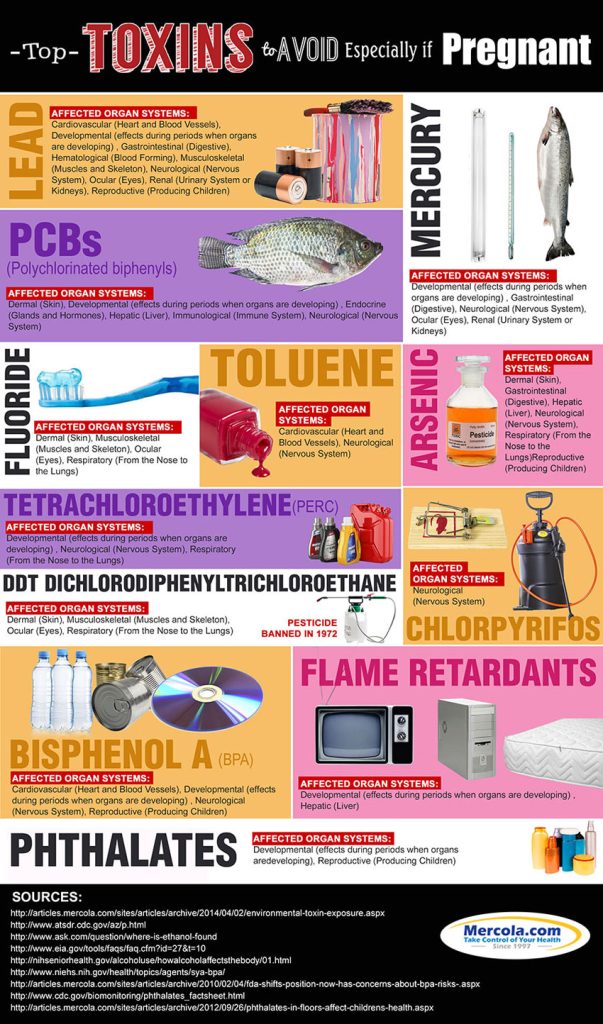 Toxins to Avoid if Pregnant Infographic – click image to expand |
Avoid drinking unfiltered tap water — Our waterways are constantly being polluted by industrial waste and byproducts, pharmaceutical drugs (such as birth control pills and other hormone therapies), pesticides and commercial cleaning products. Heavy metals are the most common of the reproductive toxins reaching our water supply through industrial waste, jet fuel exhaust residue and a variety of other sources.
Eat an optimal fertility diet — An optimal fertility diet is about what to avoid as much as it is about what to include. Eat REAL food, ideally organic, to avoid pesticide residues, and locally grown. Processed and packaged foods are a common source not only of pesticides but also chemicals such as bisphenol-A and phthalates.
Key elements are good-quality protein sources (organic and grass fed when it comes to animal products) and healthy fats.
Avoid factory farmed animal products, harmful trans fats and processed vegetable oils. Also avoid unfermented soy products, as soybeans contain phytoestrogens that act on hormones. For an added boost, consider adding more of the following “sperm-enhancing” foods:37 organic pastured eggs, spinach, bananas, dark chocolate, asparagus, broccoli, pomegranates, walnuts, garlic and all zinc-rich foods (as zinc plays a key role in sperm development).
Avoid common allergens — An overactive immune system is more likely to attack its own body cells, and the link between food intolerances and anti-sperm antibodies is well established. The two most widely spread food intolerances are gluten and dairy. Factory farmed milk can also be a source of estrogen that can harm a man’s fertility. Hormones found in factory farmed cows’ milk include:
- Prolactin
- Somatostatin
- Melatonin
- Oxytocin
- Growth hormone
- Luteinizing hormone-releasing hormone
- Thyroid-stimulating hormone
- Estrogens
- Progesterone
- Insulin
- Corticosteroids and many more
Minimize microwave exposure — Avoid carrying your cellphone on your body while it is on, and avoid using laptops and tablets on your lap. More generally, it would also be wise to limit your total exposure by turning your Wi-Fi off at night, and make your bedroom an EMF-free zone.
Get checked for sexually transmitted diseases (STDs) — Some STDs can be asymptomatic, meaning you may not be aware you have them as there are no obvious symptoms. One such STD is a chlamydia infection. In men, chlamydia can lead to sperm abnormalities including sperm antibodies.
In women, it can lead to scarring, blocked tubes and miscarriage. Most STDs are easy to treat, so it pays for both partners to have an STD check. There is no point in only one partner going for a test as the other partner can reinfect them again.
Avoid coffee, smoking and alcohol — While organic black coffee has a number of health benefits, fertility does not appear to be one of them. On the contrary, studies suggest it decreases fertility. In one study, men who drank three or more caffeinated beverages per day during the conception phase raised their partner’s risk of miscarriage by more than 70%.38
Alcohol is also harmful to both eggs and sperm, and increases the risk of miscarriage. Needless to say, smoking and recreational drugs also have an adverse effect on fertility, reducing the size of your testes and lowering your sperm count.
Get regular exercise — According to research, getting at least 30 minutes of exercise three times a week can help boost men’s sperm count. And, to maintain healthy swimmers, you need to stay active — within a month of quitting exercise, sperm count starts to wane again.39 That said, be aware that bicycling may have an adverse effect on your sperm. In one study, men who routinely cycled 300 kilometers per week ended up having fertility problems.40Normalize your weight — Obesity contributes to infertility, so normalizing your weight can help improve your sperm quality and quantity. For guidance, please review my free nutrition plan.Limit hot baths and saunas — While hot baths and saunas have a myriad of health benefits, the heat can take a toll on sperm. In one three-year-long study, 5 of 11 men who quit taking hot baths were able to raise their sperm count by nearly 500%. So, limiting hot baths and saunas for a few months may be helpful during the conception phase. I do a far-infrared sauna nearly every day, but I put a small freezer block of ice next to my groin to keep the temperature low.Combat stress — From making sure you’re getting sufficient amounts of sleep and exercising regularly to incorporating a tool like the Emotional Freedom Techniques (EFT) or taking up yoga or meditation, there are many ways to address stress. Try a few different things and stick to whatever works.
Clean up your home environment — Use natural cleaning products or make your own. Avoid those containing 2-butoxyethanol (EGBE) and methoxydiglycol (DEGME) — two toxic glycol ethers that can compromise your fertility and cause fetal harm. Look for products made by companies that are Earth-friendly, animal-friendly, sustainable, certified organic and GMO-free.
This applies to everything from food and personal care products to building materials, carpeting, paint, furniture, mattresses and others.
When buying new products such as furniture, mattresses or carpet padding, consider buying flame retardant-free varieties, containing naturally less flammable materials, such as leather, wool, cotton, silk and Kevlar.
Avoid stain- and water-resistant clothing, furniture and carpets to avoid perfluorinated chemicals. Use a vacuum cleaner with a HEPA filter to remove contaminated house dust. This is one of the major routes of exposure to flame retardant chemicals.
Also switch over to organic toiletries, including shampoo, toothpaste, antiperspirants and cosmetics. EWG’s Skin Deep database41 can help you find personal care products that are free of phthalates and other potentially dangerous chemicals.
– Sources and References
- 1 Washington Post July 25, 2017
- 2 Scientific American July 26, 2017
- 3 Medical News Today July 26, 2017
- 4 Science Daily, July 26, 2017
- 5 CNN July 25, 2017
- 6 Human Reproduction Update July 25, 2017 [Epub ahead of print]
- 7 Time July 25, 2017
- 8 BBC News July 25, 2017
- 9 BMJ 1992 Sep 12;305(6854):609-13
- 10 PLOS Genetics July 20, 2017 [Epub ahead of print]
- 11, 15 New York Times March 11, 2017
- 12 Consumer Affairs May 18, 2017
- 13 Toxicology 2009 Aug 21;262(3):184-91
- 14 Environmental Health News July 26, 2017
- 16 The Daily Beast May 13, 2015
- 17 SourceWatch, American Chemistry Council
- 18 The Guardian November 4, 2013
- 19 JCRPE 2011 Mar; 3(1): 1–6
- 20 The New York Times March 30, 2012
- 21 EWG July 14, 2005
- 22 American Public Health Association, November 9, 2010
- 23 National Institute of Environmental Health Sciences, Endocrine Disruptors
- 24 EWG August 12, 2022
- 25 NIEHS, Endocrine Disruptors
- 26 EWG, July 21, 2022
- 27 The Guardian July 25, 2017
- 28 Natural Fertility Info, Pesticides in Food Affect Male Fertility
- 29 IARC, Press Release May 31, 2011
- 30 Rev Environ Health. 2015;30(2):99-116
- 31 The Journal of Sexual Medicine, Volume 20, Issue Supplement 1, May 2023
- 32 Safe Space Protection, Male Fertility Impacted by EMFs
- 33 Environ Int. 2014 Sep; 70C:106-112
- 34 Central European Journal of Urology 2014; 67(1): 65–71
- 35 Fertility and Sterility January 2012; 97(1): 39-45.e2
- 36 Natural Fertility Prescription
- 37 Practo December 17, 2016
- 38 Reuters March 30, 2016
- 39 BBC News December 6, 2016
- 40 Telegraph July 26, 2017 (Archived)
- 41 EWG Skin Deep Database