Bladder
now browsing by category
What Frequent Urination Means for Your Health and How to Address It Naturally
Reproduced from original article:
https://articles.mercola.com/sites/articles/archive/2026/04/22/frequent-urination-underlying-health-conditions.aspx
Analysis by Dr. Joseph Mercola April 22, 2026

Story at-a-glance
- Frequent urination (more than eight times daily) often signals underlying health issues like urinary tract infections (UTIs), diabetes, prostate problems or medication side effects rather than simply aging
- Tracking your fluid intake and urination patterns with a bladder diary reveals triggers and helps identify whether the cause is behavioral, neurological, hormonal or inflammatory
- UTIs are a common cause of urinary frequency; pharmaceutical-grade methylene blue and cranberry products are often helpful before resorting to antibiotics
- Neurological conditions, emotional stress, anxiety and depression disrupt brain-bladder signaling; this contributes to urinary frequency
- Natural solutions include adjusting when you drink fluids, addressing constipation, supporting prostate health, strengthening pelvic floor muscles and treating underlying conditions like UTIs and anxiety
Frequent urination disrupts more than your daily routine. It chips away at your energy, focus, and confidence over time. Whether it hits during the day or pulls you out of sleep at night, the constant need to go often signals that something deeper is out of balance. It’s a problem that affects millions, especially as you age. But here’s what surprises most people: it’s rarely just about getting older.
The causes are often overlooked or misunderstood, leading many to suffer in silence for years. What feels like a minor inconvenience is sometimes a warning sign that deserves your attention. Let’s explore the most common causes of frequent urination, the hidden factors that make it worse and what to do right now to support your body and regain control.
The Root Causes of Frequent Urination
The Cleveland Clinic shed light on the many underlying causes of frequent urination, highlighting both common and rare contributors and offering a roadmap for determining when it’s time to take action.1 Frequent urination — defined as needing to urinate more than eight times in a 24-hour period — affects people of all ages, but certain groups are more vulnerable.
If you’re over 70, pregnant or living with an enlarged prostate, your odds of developing this issue go up significantly. But it’s not always about age or anatomy. This symptom stems from a broad range of physiological, hormonal, neurological, and behavioral factors.
• Frequent urination is often triggered by urinary tract infections (UTIs) — UTIs are the most common cause, especially among women. They inflame the bladder and urethra, which increases the urgency and frequency of urination.
• Pregnancy hormones play a role — Rising levels of progesterone and other hormones in early pregnancy increase blood flow to the pelvic region and stimulate kidney function, making frequent trips to the bathroom more common. In later stages, your growing uterus compresses your bladder.
• Diabetes forces the kidneys to flush excess sugar — This not only pulls more water into the bladder, but also strains your body’s hydration levels. Frequent urination is often an early sign of both Type 1 and Type 2 diabetes.
Your Bladder Isn’t Acting Alone
Multiple organs, systems and lifestyle factors are involved in frequent urination. An enlarged prostate often blocks urine flow in men, for instance. The prostate gland surrounds the urethra. As it enlarges, often starting in the 50s, it presses on the urethra, making it harder to completely empty the bladder and increasing the frequency of urination.2
• Neurological conditions disrupt brain-bladder signaling — If you’ve had a stroke, spinal cord injury or conditions like fibromyalgia, your nervous system doesn’t always send or receive the right cues about when to release or hold urine. This results in an overactive bladder or urge incontinence.
• Pelvic organ issues aren’t just for women — Conditions like uterine prolapse or urethral prolapse affect how the bladder and surrounding tissues function. When these structures shift out of place, they put pressure on your bladder or urethra, creating the constant urge to urinate.
• Common medications trigger urinary urgency — Diuretics (often called water pills), antidepressants, blood pressure drugs, lithium and even antihistamines are all known to affect bladder control or urine production.3
• Your drink choices could be working against you — Caffeine and alcohol are both diuretics. They increase urine production and stimulate bladder muscles, which makes you feel like you need to go more often than usual.
• Bladder conditions and cancer are rare but serious culprits — Chronic bladder inflammation and bladder tumors mimic the symptoms of more benign causes like UTIs or overactive bladder. Blood in your urine, unexplained pain or urgency that doesn’t respond to lifestyle changes should prompt a medical evaluation.
Understanding How Often Is Too Often Depends on Your Baseline
If you’re urinating more than eight times per day, you fall into the frequent urination category, especially if it’s disrupting your sleep. Waking up more than twice a night is also a red flag. This condition, called nocturia, often points to underlying health concerns like congestive heart failure, diabetes or fluid retention in your legs.
• Your typical habits matter most — If you’ve always urinated frequently and nothing else has changed, you likely don’t need to worry. But if the frequency is new or worsening, it’s time to pay attention.
• Start with a symptom diary — Track what and how much you drink, how often you urinate and how much urine you produce. These details help you and your doctor identify patterns and rule out simple lifestyle triggers.
• Expect urine tests and imaging — If you see a doctor for frequent urination, a urinalysis helps identify infections or diabetes markers, while ultrasounds reveal bladder abnormalities, tumors or kidney issues. In complicated cases, procedures like cystoscopy allow a direct look inside your bladder to confirm or rule out structural issues.
• Sleep disruption adds a new layer of damage — Repeated nighttime urination fragments your sleep, which affects your immune system, mood, memory, and weight regulation.
Your Treatment Depends on the Cause, Not Just the Symptom
If a UTI is the reason for your frequent urination, it calls for immediate attention. If left untreated, the infection often travels up to your kidneys and causes long-term damage. Keep in mind that UTIs are one of the most overdiagnosed conditions in U.S. medicine, especially in seniors who often receive antibiotics without showing any infection symptoms. Pharmaceutical-grade methylene blue is one of the most effective agents I’ve found to stop UTIs at the source.
• Bladder training and pelvic therapy offer drug-free options — For overactive bladder or incontinence, exercises to strengthen your pelvic floor and physical therapy targeting your pelvic floor muscles help rebuild strength and control.
• Try adjusting your fluid intake — Reducing fluids before bed, avoiding caffeine and alcohol, and timing your drinking schedule are low-effort ways to see if your symptoms improve.
• Most causes are manageable — Whether it’s changing your fluid habits, adjusting medications, or treating an underlying condition, there’s hope to reduce the frequency and reclaim your daily routine.
Overlooked Risk Factors Driving Urinary Frequency in Older Adults
A large population study uncovered just how common frequent urination is in aging adults. Published in Frontiers in Public Health, the study surveyed 4,796 adults aged 65 to 100 in China.4 Researchers set out to assess how widespread frequent or urgent urination is in this population — and more importantly, what underlying health issues drive it.
• Many participants lived with symptoms for years, often without seeking care — Nearly 17.3% of men and 9.9% of women had experienced frequent urination for between one and four years. A smaller but significant number — 4.9% of men and 2.3% of women — had suffered for a decade or longer.
• A wide range of health conditions were strongly linked to symptoms — Researchers found strong associations between frequent urination and other chronic illnesses, including obesity, high blood pressure, diabetes, heart disease, constipation, anxiety, depression, and brain injury, affecting both men and women alike.
Participants with anxiety or depression had significantly higher rates of urinary frequency. This suggests a brain-bladder connection, where mental stress or nervous system disruptions interfere with normal bladder signaling.
• Constipation and brain trauma stood out as surprising contributors — Constipation and previous brain injury, such as stroke or head trauma, were both statistically significant contributors to urinary frequency in older adults.
One theory is that the nerves controlling the bladder and colon originate from the same spinal region, which means damage or strain in one area often spills over into the other. Long-term straining during bowel movements also weakens the pelvic floor, further aggravating bladder control.
• Older adults experiencing anxiety-driven symptoms are less likely to seek help — Beyond physical discomfort, frequent urination often creates emotional distress. The researchers pointed out that many older adults suffer in silence, either due to embarrassment, lack of awareness or assuming that their symptoms are simply part of aging.
How to Stop Frequent Urination by Targeting the Real Cause
If you’re peeing more than eight times a day or waking up multiple times a night just to run to the bathroom, it’s not something to ignore. Frequent urination is often the result of other underlying health issues.
Whether it’s inflammation from a UTI, blood sugar issues from diabetes or pressure from an enlarged prostate, your bladder is reacting to something deeper. That’s why solving the problem long-term means fixing what’s causing the symptom, not just masking it. Here are five simple, effective steps to get to the root of it and start feeling like yourself again:
1. Track what’s really happening with a bladder diary — If you’re not sure what’s triggering the frequent urination, a bladder diary gives you clarity fast. Write down what you drink, how much, when you urinate, and how urgent it feels. This single step often reveals clear patterns, whether it’s caffeine overload, poor fluid timing or signs of blood sugar trouble. You’ll start to see what’s stressing your bladder, and that makes it much easier to take the right action.
2. If it’s a UTI, use methylene blue and cranberries immediately — Don’t wait for a test result to start support. If your symptoms include burning, pressure or sudden urgency, and you suspect an infection, seek medical attention. In the meantime, pharmaceutical-grade methylene blue works fast. It concentrates inside your bladder where the bacteria live and kills them without harming your gut like antibiotics.
For a UTI, the dosing is generally one 65-milligram (mg) tablet three times daily after meals with water — for only a few days. Pair this with whole cranberries or organic cranberry juice to keep bacteria from sticking to your urinary tract lining. This one-two punch often clears symptoms quickly and avoids unnecessary antibiotics.
3. Support prostate health — Prostate enlargement is a common cause of frequent urination in men. While this becomes more common with age, metabolic dysfunction is also a key driver.
Excess linoleic acid, the primary polyunsaturated fat in vegetable oils, fuels chronic inflammation and disrupts hormone balance. Addressing insulin resistance, chronic inflammation and oxidative stress through diet, exercise and lifestyle changes will help slow prostate enlargement.
4. Rethink your fluid intake — not just how much, but when — If you’re drinking a lot late in the day or loading up on caffeine and carbonated drinks, your bladder’s going to fight back. Start hydrating earlier in the day and taper off by late afternoon.
5. Address underlying conditions that are stressing your bladder daily — If you’re dealing with constipation or even low mood, these are direct contributors. For constipation, fix your gut motility first: walk after meals, introduce soft fruits, and stay hydrated. And don’t underestimate the role of anxiety and depression. Lowering stress with daily movement and adequate sleep helps reset your body’s nervous system response.
Once you understand what’s triggering your frequent urination, take action that works with your body instead of against it. That’s how you stop chasing symptoms and start solving the problem at its source.
Frequently Asked Questions About Frequent Urination
Q: What qualifies as frequent urination, and when should I be concerned?
A: Frequent urination means you’re peeing more than eight times a day or waking up more than twice a night. If this is new for you, or if it’s affecting your sleep, daily life or energy, it’s time to investigate the cause. It’s not just an age thing — it’s usually a signal that something else in your body needs attention.
Q: What are the most common causes of frequent or urgent urination?
A: The leading causes include UTIs, diabetes, an enlarged prostate (in men), pregnancy and neurological conditions like stroke or spinal cord injury. Certain medications, caffeine, alcohol, and even emotional stress like anxiety also play a role. Each of these affects either your bladder’s function or the signals it receives from your brain.
Q: How do I figure out what’s causing my symptoms?
A: Start by keeping a bladder diary for a few days. Track when and how often you urinate, what you drink, how much and how urgent it feels. This helps you and your provider identify whether the issue is behavioral, neurological, hormonal, or inflammatory in nature.
Q: What are some natural ways to treat frequent urination caused by a UTI?
A: Use pharmaceutical-grade methylene blue (65 mg, three times a day after meals for a few days) to directly target bacteria in your bladder without harming your gut microbiome. Combine it with whole cranberries or organic cranberry juice to prevent bacteria from sticking to your bladder lining. This approach supports your body’s natural defenses without relying on antibiotics.
Q: Can emotional or nervous system issues really affect my bladder?
A: Yes. If you’ve had a stroke, brain injury or live with anxiety or depression, your bladder’s signals often become disrupted. This leads to urgency or incomplete emptying. Techniques like pelvic floor exercises, scheduled bathroom visits, nervous system support and managing emotional stress help improve your control and reduce urgency.
Millions of Women are Suffering from Leaking, Painful Intimacy and Pelvic Discomfort: Here’s What You Need to Know
© GreenMedInfo LLC. This work is reproduced and distributed with the permission of GreenMedInfo LLC.
Want to learn more from GreenMedInfo? Sign up for the newsletter here:
www.greenmedinfo.com/greenmed/newsletter
Reproduced from original article:
https://greenmedinfo.com/blog/millions-women-are-suffering-leaking-painful-intimacy-and-pelvic-discomfort-here-
Posted on: Sunday, June 9th 2024
Written By: Isa Herrera
This article is copyrighted by GreenMedInfo LLC, 2024

30 million women in the United States are suffering from pelvic floor disorders. Which means that 30 million women are suffering from debilitating and embarrassing symptoms such as urine leaking, painful sex, weak or non-existent orgasms and pelvic organ prolapse.(1-3) This is the female health epidemic that no one is talking about and many women are suffering alone and in silence. It doesn’t have to be this way! There are things you can do to help yourself heal.
Women are typically either undertreated, misdiagnosed or are told by their doctors that their only options for their “female conditions” are medications, injections into their vaginal walls or gynecological surgeries (2, 3). Other women who suffer pelvic and bladder symptoms have been told ”the pain is in your head” or you have a “small bladder” or “relax go home and have a glass of wine and use more lube”. Female pelvic floor conditions are physical conditions they are not emotional, psychological or sexual disorders. What’s even more alarming to me is that many female pelvic floor conditions can be healed with noninvasive natural, holistic therapies and medications are rarely needed.(4,5)
I personally know what happens when a women enters the system for pelvic issues. After the birth of my child I suffered from what I call the new “mom trifecta”, I had pain with sex, urine leaking and pelvic organ prolapse ( when your organs are not held in place by your pelvic floor muscles) . The nurses and doctors all told me what I was experiencing was normal. The pain with sex “normal”. The urine leaking when I carried my baby “normal”. The ache and pressure in my pelvis “normal”. Maybe it was my female intuition but I knew it wasn’t normal. So I went on a quest to heal myself.
At the bottom of all my symptoms was a dysfunctional pelvic floor. 1 out of 4 woman has one. In actuality, 18% of all gynecological laparoscopic surgeries are performed to determine the cause of pelvic pain and up to 15% of women of all women go to their doctors because of pelvic and bladder issues. So women are doing their best to find answers for their female problems, but the medical industry is falling short.
Doctors are rarely taught about the pelvic floor in medical school, so they often lack the education and expertise to help these women naturally. They resort to what they know, pills, surgeries and injections.(6,7) Most of the pelvic surgeries in my opinion are unnecessary. Even the most astute doctors overlook the real culprit of women’s pelvic pain, leaking, prolapse and abdominal pain… “the pelvic floor muscles.”
After personally doing over 14,704 pelvic healings in my center, I see women who’ve received experimental drugs, Botox injections to their vaginal walls, and mesh surgeries that failed. Frankly, the side effects of these drugs and surgeries are many times worse than the symptoms the women were originally feeling.(8,9) Guess what? You can heal your “Lady Parts” and Bladder naturally. Read on I will show you how.
What’s the Pelvic Floor and Why is it Important for Optimal Female Health
Our pelvic floor muscles AKA vaginal muscles are highly innervated, vascularized, and complex, and are susceptible to injuries. The pelvic floor muscles are involved in what I call the 5 functions of life. They support our organs, close off our urinary sphincters, enhance sexual function, stabilize our hips and spine and act as a sump pump for the pelvis. The pelvic floor muscles are also the deep connectors to the upper and lower extremities and when there’s an issue with them, such as scarring from births, episiotomies, spasms, trigger points or they are too weak or too tight, they can contribute to symptoms such as urinary and fecal incontinence, pain with sex, pelvic discomfort and low to non-existent orgasms.(10)
Research has shown that very few doctors, during routine gynecological exams, perform a digital exam of the pelvic floor muscles, the area where the women are experiencing most of their pain and symptoms.(11) Heck I’ve never had a doctor examine my pelvic floor or even speak to me about it. Have you?
Here’s the Truth You Should Know – your pelvic floor muscles can be healed through integrative and holistic practices that include massages, exercises, yoga, and meditation and mindfulness training all which can be incorporated into a self care program.(12,13)
As a matter of fact, The Center For Disease Control and National Institutes of Health have recommend natural therapies such as pelvic floor muscle training as the first line of defense in resolving symptoms related to leaking, pelvic organ prolapse and pelvic pain.(14,15) As a woman who suffered from pelvic pain and leaking after the birth of my daughter, and as a woman whom the medical community failed, I knew I had to change the conversation around pelvic healing. I scoured the earth, educated myself and read hundreds of research papers and books. I had to go deep into my own pelvic floor healing to find natural ways to heal and cure myself from my own debilitating condition…
…You might be thinking how did she heal her pelvis, bladder naturally and without stepping into a doctor office? I did it through natural and integrative therapies such as pelvic massages, exercises, breath work, yoga, meditation, bodywork, and mindfulness. We all know the value of eastern medicine and also know that traditional physical therapy works for many ailments. These therapies such as yoga, mindfulness, massage and acupuncture can also be applied to lady parts with tremendous success.(16)
The great news is that with the proper guidance you can learn how to do the massages, exercises and techniques on your own and conquer your pelvic condition naturally, and become the most vibrant, symptom and pain-free version of yourself. I have created a master class where I teach my best tips, massages and exercises that will put you back in the driver’s seat of your pelvic, sexual and bladder health.
References
1. Harlow BL, Kunitz CG, Nguyen RHN, et al. Prevalence of symptoms consistent with a diagnosis of vulvodynia: population-based estimates from 2 geographic regions. Am J Obstet Gynecol. 2014;210:40.
2. Mathias SD1, Kuppermann M, Liberman RF, et al. Chronic pelvic pain: prevalence, health-related quality of life, and economic correlates. Obstet Gynecol. 1996;87(3):321–327.
3. Reed BD, Harlow SD, Sen A, et al. Prevalence and demographic characteristics of vulvodynia in a population-based sample. Am J Obstet Gynecol. 2012;206:170.1–9.
4. Arnold LD, Bachmann GA, Rosen R, et al. Vulvodynia: characteristics and associations with comorbidities and quality of life. Obstet Gynecol. 2006;107:617–624.
5. Nickel JC, Tripp D, Teal V, et al. Sexual function is a determinant of poor quality of life for women with treatment refractory interstitial cystitis. J Urol. 2007;177(5):1832–1836.
6. Paulozzi LJ, Mack KA, Hockenberry JM. Vital signs: variation among states in prescribing of opioid pain relievers and benzodiazepines—United States, 2012. MMWR Morb Mortal Wkly Rep 2014;63:563–8. PubMed
7. Paulson JD, Delgado M. Chronic pelvic pain: The occurrence of interstitial cystitis in a gynecological population. Journal of the Society of Laparoendoscopic Surgeons. 2005;9(4):426–430.Retrieved from http://www.ncbi.nlm.nih.gov/pmc/articles/PMC3015651/?tool=pubmed.
8. Gerrits MM, van Oppen P, van Marijk HW,et al. Pain and the onset of depressive and anxiety disorders. Pain. 2014;155:53–59
9. Pacik PT, Understanding and Treating Vaginismus: A Multiimodal Approach. Int Urogynecol J. 2014 Dec;25(12):1613-20. doi: 10.1007/s00192-014-2421-y. Epub 2014 Jun 4.
10. Gray’s Anatomy: The Anatomical Basis of Clinical Practice, 41e by Susan Standring PhD
11. Kavvadias T, Baessler K, Schuessler B. Pelvic pain in urogynaecology. Part I: evaluation, definitions and diagnoses. International Urogynecology Journal. 2011;22(4):385–393. doi: 10.1007/s00192-010-1218-x. [PubMed]
12. Crisp CD, Hastings-Tolsma M, Jonscher KR. Mindfulness-based stress reduction for military women with chronic pelvic pain: a feasibility study. Mil Med. 2016;181(9):982-989. doi:10.7205/MILMED-D-15-00354
13. van der Kolk BA, Stone L, West J, et al. Yoga as an adjunctive treatment for posttraumatic stress disorder: a randomized controlled trial. J Clin Psychiatry. 2014; 75(6):e559-65. doi:10.4088/JCP.13m08561
14. CDC Guideline for Prescribing Opioids for Chronic Pain — United States, 2016 Recommendations and Reports / March 18, 2016 / 65(1);1–49
15. NIH State-of-the-Science Conference: Prevention of Fecal and Urinary Incontinence in Adults December 10-12, 2007 Bethesda, Maryland
16. Goldfinger C, Pukall CF, Thibault-Gagnon S, et al. Effectiveness of cognitive-behavioral therapy and physical therapy for provoked vestibulodynia: a randomized pilot study. J Sex Med. 2016; 13(1):88-94. doi:10.1016/j.jsxm.2015.12.003

How DMSO Protects and Heals Internal Organs
Reproduced from original article:
https://articles.mercola.com/sites/articles/archive/2024/12/06/dmso-internal-organs.aspx
Analysis by A Midwestern Doctor December 06, 2024

STORY AT-A-GLANCE
- The therapeutic actions of dimethyl sulfoxide (DMSO) make it well suited to treat challenging conditions throughout the body, including many of the internal organs
- DMSO effectively protects organs from injury, such as poisoning or blood loss, and has been shown to treat many life threatening conditions (e.g., heart attacks, ARDS, or pancreatitis)
- DMSO has been shown to treat disorders of the urogenital tract and reproductive system, such as kidney stones, nephritis, enlarged prostates, prostatitis, cystitis, epididymitis, genital pain, urethral syndrome, tubal infertility, and endometrial inflammation or fibrosis
- DMSO has also been shown to repair damaged organs (e.g., liver cirrhosis, pulmonary fibrosis, smoke inhalation damage) and improve blood sugar control
Dimethyl sulfoxide (DMSO) is a remarkably safe1 naturally occurring compound that can treat a variety of challenging conditions. Since DMSO is incredibly effective for treating chronic pain, arthritis, and injuries like sprains or burns2 (discussed further here), it quickly spread across America as a miracle drug.
Thousands of studies were conducted to confirm its value, and before long, hundreds of thousands of people considered it to be the most important therapeutic ever discovered. Unfortunately, due to politics, the FDA turned against DMSO and refused to relent3 even once:
• DMSO was shown to effectively treat strokes, traumatic brain injuries, spinal cord injuries, and many circulatory disorders (discussed here).
• DMSO was shown to cure a variety of “incurable” autoimmune and connective tissue disorders (discussed here).
• DMSO was shown to treat a variety of challenging (and often incurable) eye, ear, sinus, and dental conditions such as tinnitus and blindness (discussed here).
Since publishing those articles, I’ve received over a thousand reports from people of the remarkable effects DMSO has had on them (which can be read here), that while unbelievable, are almost identical to what people across America reported before the FDA buried DMSO.
Reversing Organ Degeneration
The following process underlies many disease states:

In rapid cases, this is easy to recognize (as cells will rapidly die after a traumatic injury or having their blood supply cut off), whereas in slower cases (e.g., those arising from a chronic illness or toxicity), the issue often is that the cellular repair process becomes frozen and unable to bring the cells back to normal functioning.
Many regenerative medical therapies in turn, seek to “unfreeze” this cell danger response so that the normal function of the cells can be restored.
DMSO is uniquely suited to reversing this process as, especially when done early in the rapid cases following a severe injury (whereas the more gradual and chronic ones we often see frequently require systemic regenerative therapy). This is because:
1. DMSO protects the blood supply of the body,4 and disperses the microclotting, which often follows injury (e.g., burns) and leads to tissue death.5 Simultaneously, it also protects tissues from dying during periods of inadequate blood supply (ischemia) or being injured when that blood supply is rapidly restored (reperfused).
Numerous animal studies have demonstrated DMSO’s protective effect in organs that rapidly die once they lose their blood supply, such as the heart6,7,8,9,10,11,12 and brain13,14,15,16,17,18,19,20,21,22,23 (and even DMSO maintaining their function24,25,26 during periods of ischemia).
Likewise, DMSO has also been shown to prevent ischemia and reperfusion injuries to the liver27,28 kidney,29,30,31,32 lungs,33,34 ovaries35 and small intestine.36
2. DMSO protects organs from toxins that would otherwise be lethal to them or permanently damage them. This has been shown with the heart,37 kidneys,38,39,40 liver41,42,43,44 lungs,45 pancreas.46,47,48 Additionally, DMSO has also been repeatedly shown to mitigate radiation damage to tissues (e.g., in the kidneys).49
3. DMSO has been shown to protect the brain50,51 liver,52 and lungs53 from the tissue damage that develops after blunt trauma or surgical excisions.
Note: This was also repeatedly demonstrated in humans with severe blunt head trauma.54,55,56
4. DMSO dampens the destructive autoimmune process and swelling that often follows tissue trauma.57,58 In addition to protecting organs from injury, and reversing that degenerative process, DMSO has also been shown to help with a variety of challenging medical conditions.
Heart
The majority of the pertinent studies evaluating DMSO’s interactions with the heart (e.g., the previously mentioned ones) evaluated its ability to protect the heart from ischemic events like heart attacks and to improve the circulation within the body.59

Save This Article for Later – Get the PDF Now
Gastrointestinal Tract
Numerous randomized controlled trials conducted in Iraq found DMSO was highly beneficial for gastrointestinal diseases:
| One evaluated 136 patients with recurrent attacks of proctosigmoid ulcerative colitis that were not being prevented by their prophylactic medical regimen. For those receiving standard care, 51% recovered in two weeks compared to 84% of those also receiving DMSO. Over the next year, 25% of those continuing to receive standard care had a relapse rate, whereas only 5% of those receiving DMSO did.60 |
| One evaluated hospitalized patients with pelvic fractures or hypovolemic shock who were at risk for a stress induced gastric ulcer. Of the 58 controls, 22% developed an ulcer, whereas of the 57 receiving DMSO, only 4% did. Additionally, none of those receiving DMSO deteriorated or required emergency surgery, whereas 8 controls and 1 allopurinol recipient did (of whom 3 then died).61 |
| One evaluated 302 consecutive patients with previous symptomatic duodenal ulceration that was shown to have healed, and who were smokers and social drinkers, to receive four different treatments. Of the 220 available for evaluation, 65% who received a placebo had a recurrence of the ulcer, 30% of those who received cimetidine, and 13% of those who received oral DMSO.62
Note: Similar results have been obtained by American physicians in a smaller number of patients.63 |
| One evaluated 363 consecutive patients whose duodenal ulcers that did not heal despite 3 months of treatment with cimetidine (and who were cigarette smokers or social drinkers), were given either cimetidine twice a day alone or with DMSO or allopurinol. In 315 patients who were evaluable for analysis, at 8 weeks, 60% of those who had cimetidine recovered, whereas 100% of those who received DMSO recovered.
Additionally, the one year relapse rate was 29% for cimetidine alone and 7% in those who took DMSO.64 |
| One evaluated 238 patients with symptomatic acute duodenal ulceration who were smokers and social drinkers were randomized to receive for 8 weeks cimetidine or 8 weeks of a half dose of cimetidine plus oral DMSO (400mg two times a day) or allopurinol. After 8 weeks, 69 of the 87 (79%) who only received cimetidine recovered, whereas all of the 85 who received DMSO did.
Additionally, 67% of those who received cimetidine over the next year relapsed, compared to 6% of those who took DMSO.65 |
| One evaluated 101 patients presenting with hematemesis (coughing up blood) due to erosive gastritis (a fairly dangerous condition). It gave them either saline or oral allopurinol and DMSO orally every 6 hours for 5 days.
Of the 50 controls and 48 who were treated (along with 2 who left because they could not tolerate the treatment), 29% of the controls and 8% of who were treated had further episodes of hematemesis (with three of the controls requiring subsequent surgery — one of whom died). Of those who remained stable, a subsequent endoscopy showed evidence of hemorrhagic inflammation in 44% of controls and 9% of those who were treated.66 Finally, DMSO also has been shown to help with irritable bowel syndrome, acute or chronic gastritis, peptic ulcers, enterocolitis, and mucomembranous colitis.67 |
Liver
In addition to DMSO protecting the liver from injury, DMSO can sometimes heal the liver. For example, 12 patients who had terminal liver cirrhosis who agreed to stop drinking all alcohol for the duration of the program were put on daily DMSO program.
Of the 8 who chose to continue the program for 6 months, all had improved health, significantly reduced vomiting, and improved liver function tests, and rather than all being dead within one year as expected, they were in better condition than they had been at the start of the study.68
Gallbladder
- A rat study created obstructive jaundice by ligating (cutting off) the common bile ducts and found that laboratory values showed DMSO mitigated the expected pathologic effects.69
- A Japanese study found that injecting 90% DMSO mixed with 5% hexametaphosphate into the biliary tract effectively dissolved gallstones within the liver and was safe for the patients.70
Lungs
Additional data supports the protective role of DMSO for the lungs:
•After sheep experienced a lung injury from inhaling smoke, nebulized DMSO (with heparin) was found to reduce the damage to their lungs significantly.71
Note: Some unresolved questions exist regarding the safety of long term DMSO nebulization.72
•DMSO was found to prevent oxygen deprivation and inability to exchange gasses through the lungs which results from an Ehrlichia ruminantium infection (which is typically fatal).
DMSO has also been shown to treat acute respiratory distress syndrome (ARDS), a challenging condition that frequently results in being placed on a ventilator (e.g., this happened throughout COVID-19).
In a hamster study and a mouse study, where a toxin was used to induce ARDS, DMSO significantly reduced the resulting lung damage and fluid leakage (which effectively drowns ARDS patients).73,74 A third mouse study found DMSO prevented all of them from dying (whereas 58% of controls died).75
In the one human study where IV DMSO was used for ARDS (given intravenously at concentrations under 10%) it was found to produce a dramatic improvement in all three patients who received it (e.g., one patient’s lungs were completely normal after a week) and prior to receiving DMSO all three were near death.76

Note: In the one case when DMSO was nebulized, the improvement occurred in 1 hour.
Finally, DMSO can help chronic lung conditions.
• One study found DMSO reduces chronic pulmonary fibrosis, and this beneficial effect was increased when it was mixed with zinc.77
• For older patients with chronic respiratory insufficiency (leading to chronically low blood oxygen levels, elevated carbon dioxide levels and an abnormal acid base balance, especially during exercises) due to issues in the lungs or bronchi, DMSO was found to bring about a recovery without the need for hospitalization in 35/43 (81%).78
• Human studies also have shown DMSO can treat asthma.79
Pancreas and Diabetes
Diabetics have reported that DMSO reduces (but does not eliminate) their need for insulin and that DMSO is particularly helpful for the condition since it can also alleviate the pain from diabetic peripheral neuropathy.80 Studies in this area include:
• Alloxan is toxic to the insulin producing cells of the pancreas and can be used to induce diabetes. A 1977 study found that DMSO prevented alloxan from causing diabetes.81
• DMSO has been shown to prevent the immune system from attacking transplanted insulin secreting cells (suggesting DMSO has significant potential for Type 1 diabetes).82
• GLP-1 is a key hormone the body uses to regulate satiety and blood sugar (and which diabetes drugs like Ozempic mimic). One study found that 0.5% to 2.5% DMSO increased GLP-1’s production of insulin by 2 to 2.5 times. This suggests DMSO could help treat diabetes or allow GLP-1 users to use a lower dose of the medication.83
• Exposing insulin secreting cells to DMSO was found to enhance glucose-induced and tolbutamide-stimulated insulin secretion without significant effects on basal secretion or potassium responsiveness.84
DMSO (along with ultraviolet blood irradiation) has also been shown to help pancreatitis, a challenging and dangerous condition85 (as there are no conventional treatments besides supportive care for most types of pancreatitis). For example, three rat and mice studies found DMSO significantly improved experimentally induced pancreatitis.86,87,88
Additionally, a randomized double-blind trial took 78 patients with chronic recurring pancreatitis (and no other confounding gastrointestinal disorders) who presented within 2 hours with signs of pancreatitis but did not have signs of generalized peritonitis. Of them, 26 received 10% DMSO rectally, and at least 57% were free of pain after 12 hours (compared to 17% of controls), and all were free of pain after 24 hours (whereas 48% of controls were still in pain).
As a result, all DMSO subjects were discharged within 3 days, whereas only 22% of controls were discharged after 5 days of hospitalization.89
Kidneys
In most circumstances, DMSO has been shown to be safe for the kidneys, to function as a potent diuretic, and to increase the kidney flow rate.90 In addition to protecting the kidneys from ischemia and toxins like mercury, many studies have also shown DMSO protects the kidneys from amyloidosis.91
Many kidney autoimmune diseases result from immune deposits in the kidneys (one of which is Heymann nephritis, an experimentally induced form of nephritis92 where antibodies that target the kidneys are injected causing immune deposits on the glomerular walls). In three rat studies of Heymann nephritis, DMSO was found to protect the kidneys and their function.93,94,95
Similarly, a study of 56 DMSO treated rats (and 48 controls) with lupus nephritis found that those who received DMSO had nearly normal kidneys, whereas the controls had significant damage to their kidneys.96 DMSO, likely due to its effects on zeta potential,97 has also shown promise for kidney stones:
• A study fed rats a diet designed to create kidney stones, and found that after two months, 40 of the 45 water-drinking rats had developed stones in the kidney, bladder or ureter, while only 11 of the 46 DMSO group did.98
• A study of 6 patients with kidney stones (5 of which were confirmed by ultrasound) found IV DMSO99 resolved the condition in 2 to 3 treatments (although one patient had a complete resolution after a single infusion).100
Note: We have had a great deal of success treating kidney stones by improving the physiologic zeta potential.
Genitourinary Disorders
DMSO is extremely helpful for inflammation of the bladder, particularly “interstitial cystitis” (also known as painful bladder syndrome), a challenging condition which results in very frequent, painful (and often bloody) urination. DMSO, however can also help many other parts of the urinary tract. For example one study found:101

Likewise, a study of inflammatory conditions of the urinary tract, in addition to showing significant benefit for interstitial cystitis, also found:102
• Of the 12 patients with radiation cystitis (e.g., from prostate cancer therapy) 50% had a good response to it.
• Of the 35 patients with chronic prostatitis, 75% benefited significantly, with 12 having an “excellent” response, 14 a “good” response, and in 90% of cases, inflammation of the prostatic urethra improved.
• Another study gave 4 men with chronic excessive (and untreatable) urination due to bladder or prostate issues DMSO, 3 of whom had an excellent response.103
• A Polish study found urethral syndrome (chronic irritation of the urethra without signs of an infection) responds to DMSO being put into the urethral tract.104
Note: Many other remarkable reports exist of DMSO’s value for prostatitis (e.g., one DMSO doctor recently shared that it treated 40 out of 40 cases of bacterial prostatitis).105
Additionally, while no formal studies have been conducted on prostate enlargement many anecdotal reports (including from readers of the Forgotten Side of Medicine) have found DMSO is remarkably beneficial for this condition.106
Reproductive Disorders
• A 1975 Chilean study at a Navy hospital took 69 women who were infertile due to an obstruction in their fallopian tubes and injected a DMSO mixture into their fallopian tubes six separate times (and then repeated the series if the tubes had not opened). Out of 47 patients, 27 (57.4%) subsequently became pregnant, including one who got pregnant twice (without any further assistance).
Of the 27 pregnancies, 12 resulted in successful deliveries, 7 had a normal pregnancy at the time of publication, 4 patients chose to have abortions, and 3 had spontaneous abortions, and 1 had an abnormal pregnancy requiring a surgical intervention, and 0 had ectopic pregnancies (one of the risks of surgically opening the fallopian tubes).
Additionally, out of the 426 DMSO hydrotubations which were performed, only 7 (1.5%) had side effects all of which were minor.107
Note: 25% to 35%108 of infertility is due to tubal obstructions (typically from inflammation there). The current surgical approach for opening a tubal obstruction and restoring fertility (which bears some risks) has a 10% to 30%109,110 success rate.
• One study administered 10% to 30% DMSO into the uteruses of horses that could not get pregnant. It found no harm occurred to the lining of the uterus and that 18 out of 27 had significant improvement to the lining of their uterus (compared to 2 out of 18 who received a saline placebo), such as a reduction of chronic inflammatory cell infiltrates and reduction of periglandular fibrosis.
Additionally, there were signs their fertility improved, but the trial’s design made it impossible to be sure this improvement occurred.111
A New Therapeutic Principle
When DMSO was discovered, Stanley Jacob quickly realized that it represented a new therapeutic principle since it made so many things which had previously seemed impossible in medicine suddenly possible — and even more remarkably, 60 years later, many of the things DMSO can address the medical system still struggles to deal with.
For example, in the same way DMSO could significantly improve surgical outcomes,112 the data here makes good case that DMSO should be a mainstay therapy whenever someone is at risk of organ failure from being poisoned (e.g., due to a drug overdose). Likewise, the data here shows how numerous immensely challenging diseases that require a hospital or intensive care admission could be dramatically improved with DMSO.
However, while the FDA’s war against DMSO was immensely unfortunate, I am extremely hopeful the unprecedented political climate we are now entering we will at last make it possible to reform a medical system that has always put profits before people.
Much of that is thanks to the incredible work many of you have done throughout the pandemic to bring awareness to the crimes of the medical industrial complex and I am profoundly grateful to each of you for helping to make it happen and giving me the voice to as well.
Author’s note: This is an abridged version of a longer article that goes into greater detail on the data discussed here, how DMSO is used for each of the conditions mentioned (along with other approaches we’ve seen help them), and provides guidance for personal DMSO use (e.g., dosing, therapeutic precautions and where to obtain it). That article and its additional references can be read here.
A Note from Dr. Mercola About the Author
A Midwestern Doctor (AMD) is a board-certified physician from the Midwest and a longtime reader of Mercola.com. I appreciate AMD’s exceptional insight on a wide range of topics and am grateful to share it. I also respect AMD’s desire to remain anonymous since AMD is still on the front lines treating patients. To find more of AMD’s work, be sure to check out The Forgotten Side of Medicine on Substack.
Biodistribution Study of Pfizer Covid-19 Injection suggests use of mRNA Vaccines should be suspended immediately
A biodistribution study of the Pfizer Covid-19 injection suggests a suspension of the use of mRNA ‘Vaccines’ is urgently required and blood donor organisations need to take a long hard look at their policies surrounding the acceptance of donations of blood from people who have received an mRNA based Covid-19 injection.
The Exposé is now censored by Facebook & Twitter. Let’s not lose touch, subscribe today to receive the latest news from The Exposé in your inbox…
Do you remember when public health and government officials assured everyone that the mRNA ‘vaccines’ function like traditional vaccine technologies? …meaning that they largely remain in the shoulder muscle where they are injected, with some portion going to the draining lymph nodes where an immune response is initiated.
Well, back in May 2021, I, along with some international colleagues, looked at a document that Pfizer had submitted to the Japanese health regulatory agency. It was a pre-clinical biodistribution study. This means it was an experiment done with an animal model to predict where the vaccine formulation might go when injected into people.
What I saw was startling.
Most of Pfizer’s vaccine spread throughout the body instead of staying at the injection site. This also meant there was the potential for toxicities that would never occur with traditional vaccines that largely remain at or close to the injection site. To ensure people could make a fully informed decision about whether to take the jab I went public with this information in a radio interview.
I wasn’t surprised by the systemic distribution of the vaccine per se. Being a vaccinologist, I knew that lipid nanoparticle delivery systems were originally designed to spread far and wide throughout the body with the hopes they could be a vehicle for gene therapy and/or drug delivery.
Instead, my surprise came from the fact that the data confirmed my historical understanding and contradicted public health messaging that the mRNA jabs behaved like traditional vaccines. Public statements by health officials made me assume the lipid nanoparticles had somehow been modified to stay at the injection site, which was news to me. This highlights one of the first rules of thumb when practicing science.
Transparently presented raw and/or peer-reviewed data are the cornerstones of objective science; not personal proclamations or data disseminated via media releases. In May 2021 I realized two things: 1. There was a lack of transparency about data supporting COVID-19 inoculations. 2. Incorrect messaging was being relayed to the public. As an academic public servant with relevant expertise, I spoke up when enquiries came from the public. I spoke the truth then and continue to do so.
As a result of this, a public campaign to impersonate and discredit me was mounted; it has not stopped and has likely caused irreparable harm to my career. Nobody involved in these personal attacks has ever been willing to talk to me about the scientific basis for my concerns. It is unfair to discredit a scientist based on a short interview for a lay audience in which only a tiny fraction of the messaging could be relayed.
My challenge to detractors then remains the same now: if you want to prove that I don’t know what I am talking about, then debate me in a moderated public forum. I contend that a real-time back-and-forth discussion of the science will show that I know exactly what I am talking about; I’m not sure the same would hold true for most of those participating in the smear campaign against me.
In that interview back in May 2021 I was asked if there might be a link between mRNA vaccines and cases of myocarditis that were being observed at increased frequency, especially among young males. My answer was yes and I started to present some potential mechanistic explanations for this, including Pfizer’s Japanese version of their biodistribution study.
Now, myocarditis is a publicly acknowledged side-effect of mRNA vaccines. Sadly, I have not received an apology from anyone who attacked me. Forgiving people is much easier when apologizing and seeking forgiveness is part of the resolution process. But this is no longer popular in our society, so I continue to struggle with forgiving those who relentlessly harass me. I need to do this to effectively move on.
In the meantime, the US Food and Drug Administration has been ordered by a court to release the data that they reviewed when authorizing Pfizer’s vaccine for emergency. Health Canada almost certainly would have reviewed the same information. It is unfortunate that the scientific community is only now starting to see reasonably transparent core data that were used to justify the rushed rollout of SARS-CoV-2 inoculations; an only due to a court order.
On March 1, 2022 an English version of the biodistribution study was released. It contains much more information than the Japanese version I had looked at. Also, this accurate English language translation has revealed inappropriate biases in the conclusions drawn by the study director. You can obtain the document from the website of Public Health and Medical Professionals for Transparency. Once at the website, enter the search term “185350”, which is the study number. What follows is a step-by-step breakdown of this study to help you understand its implications (page #s refer to this hyperlinked report).
Taking a Close Look at Pfizer’s Full Report of the Biodistribution Study
The study looked at the distribution of lipid nanoparticles (LNPs) manufactured by Acuitas Therapeutics, British Columbia, Canada. LNPs are essentially very tiny bubbles of fat that are used to deliver genetic material into our cells. In the case of Pfizer’s ‘vaccine’, the payload is a messenger RNA molecule that encodes the spike protein from SARS-CoV-2, which is the causative agent of COVID-19. When the mRNA gets into a cell, it uses the existing manufacturing capacity of the cell to make copies of the spike protein.
Of concern, Pfizer was never required to run a biodistribution study with the same ‘vaccine’ formulation that is being used in people. Instead, the study focused on the LNPs, which carried a mRNA encoding a protein that can be used in imaging studies; not the spike protein. Unfortunately, the expression of this protein was not evaluated, so we can not assess where the protein ended up in the body; only where the LNPs went.
Page 6: The title of the study is “A Tissue Distribution Study of a [3H]-Labelled Lipid Nanoparticle-mRNA Formulation Containing ALC-0315 and ALC-0159 Following Intramuscular Administration in Wistar Han Rats.” Rats are a commonly used animal model for pre-clinical research. In this case, three males and three females were euthanized at each of multiple timepoints to harvest a variety of tissues to quantify the amount of LNPs in them.
The mRNA in this study encoded ‘luciferase’; a protein that can be used to visualize where the mRNA is being converted into proteins. However, this analysis was not done in this particular experiment. “[3H]-labelled” means the LNPs were tritiated, or tagged with tritium. Tritium is a radioactive form of hydrogen.
This allowed the LNPs to be quantified in tissues by measuring radioactivity. “ALC-0315” is a fat-based molecule that helps to compact mRNA into a nanoparticle and also promotes the introduction of the mRNA into a cell. “ALC-0159“ is a molecule that contains polyethylene glycol (PEG). You might have heard a lot about PEG in the context of COVID-19 ‘vaccines’ since it is the component that has been most associated with causing anaphylactic shock (a severe hyperacute allergic reaction) in some recipients. It serves a couple of functions:
1. This is the commonly mentioned purpose: It helps to stabilize the mRNA molecules; if mRNA degrades before it gets into a cell, the protein that the immune system is supposed to target will never be produced.
2. This is the other function of PEG that you may never have heard about (but those who have followed mRNA vaccine technologies have known about for many years): It helps the LNPs avoid the immune system to promote wide-spread dissemination throughout the body. Yes, you read that correctly. But, don’t take my word for it. Check out this published peer-reviewed science as a few examples:
Watters, R.J., Kester, M., Tran, M.A., Loughran, T.P. & Liu, X. Chapter five – Development and Use of Ceramide Nanoliposomes in Cancer. In: Düzgüneş, N. (ed). Methods in Enzymology, vol. 508. Academic Press, 2012, pp 89-108
Suk, J.S., Xu, Q., Kim, N., Hanes, J. & Ensign, L.M. PEGylation as a strategy for improving nanoparticle-based drug and gene delivery. Advanced drug delivery reviews 99, 28-51 (2016)
Gabizon, A. & Martin, F. Polyethylene glycol-coated (pegylated) liposomal doxorubicin. Rationale for use in solid tumours. Drugs54 Suppl 4,15-21 (1997)
Papahadjopoulos, D. et al. Sterically stabilized liposomes: improvements in pharmacokinetics and antitumor therapeutic efficacy. Proc Natl Acad Sci U S A 88,11460-11464 (1991) Check out this quote: “This effect is substantially greater than that observed previously with conventional liposomes and is associated with a more than 5-fold prolongation of liposome circulation time in blood.”
Systemic distribution of LNPs was needed to try to replace genes in cells throughout the body, including the brain in order to treat things like Alzheimer’s disease and Parkinson’s disease. It was also necessary to deliver chemotherapeutic drugs to cancers that could have metastasized anywhere in the body, including the brain. However, this is not anywhere close to how a traditional vaccine technology behaves. Also, this wide distribution is accomplished by helping the LNPs avoid uptake by phagocytic cells, which are the cells of the immune system that promote induction of immune responses! I postulate that the mRNA inoculations would function better as vaccines if mRNAs could be stabilized without PEG.
Page 11 (section 5; Introduction): I have two serious concerns about this part.
- The aim of the study was to evaluate a single dose of the surrogate ‘vaccine’. This is very odd and suggests this experiment was run as an afterthought and was overly rushed. The proper way to do this type of study is to test a range of doses. The ideal situation is to reach a dose that is too high (i.e., it causes undesirable results) while simultaneously capturing ‘safe’ doses. This helps to inform proper dosing for subsequent studies, including those conducted with humans.
- Something is revealed here that was never revealed in the Japanese version of the document; namely that the first attempt to run the study was a failure due to overt toxicity. Rats were supposed to receive 100 μg of mRNA, but the study had to be truncated because the selected dose was causing obvious harm to the rats (see section 7.1 on page 19 of the report). The results were not formally discussed but some raw data were provided in the appendices.The study director noted that “a subsequent review of the data showed concentrations [of LNPs] were well detected in tissues”. The treatment caused an acute body weight loss of ~7% . Of the three males that were due to be euthanized at 48-hours post-inoculation, the treatment proved lethal for one, which was euthanized at 30 hours. Of the remaining two rats, they were showing clear signs of distress at 48 hours.As stated, “Additionally, animals 019M and 020M were hunched and piloerect from approximately 30 h post-dose onwards”. “Onwards” means up to 48 hours when they were euthanized to harvest tissues. In other words 3/3 (100%) of the rats were clearly sick by 30-hours post-jab and we have no idea whether this would have got worse or resolved beyond 48 hours.Only males were tested at the 100 μg dose, so we don’t know what it would have done to females.I have a real problem with this experiment. I conduct these kinds of studies all the time.If only a single dose of a treasured new medical intervention is going to be tested, one would always try to predict a dose that is going to place it in the ‘best light’. As such, Acuitas and Pfizer must have been confident in the safety of the 100 μg dose. The fact that they were wrong on this gamble is disconcerting and does not speak well of their knowledge of the safety margin of their own product.The study director contacted Acuitas to tell them the study was failing and the decision rendered was to repeat it at half the dose; multiple doses were still not considered, nor was expansion of the scope of the study done, despite obvious safety concerns, and signals that the experiment was too short. On the basis of this failed first attempt and an unwillingness to adjust course, regulatory agencies never should have let Pfizer proceed with their vaccine until a large array of safety questions were addressed experimentally.
Page 14 (section 6.3): Urine and fecal samples were collected but never analyzed (also see section 6.9.4). This is a shame considering the world-wide debate about potential shedding of mRNA ‘vaccine’ components and/or the spike protein they encode.
Page 15 (section 6.7): Blood cells were discarded from the blood samples. Therefore, the amount of LNPs in blood cells was presumably estimated by taking the total in whole blood and subtracting the amount in the plasma. This is unfortunate because an inappropriate conclusion was drawn about the irrelevance of blood cells as a destination for the LNPs. This is discussed below.
Pag 16 (section 6.8): It appears that some samples were analyzed while fresh; others were frozen, stored at -20oC for an unknown period of time, thawed and then analyzed. This would not be ideal for the stability of mRNAs, which might be one reason they and their protein products were not assessed in this study. These may also be less than ideal conditions for LNPs, but, presumably, they were OK for the radioactive tritium, which is what was measured. However, none of these issues were discussed nor were data provided to alleviate the concerns.
Page 18 (section 6.11): The wrong bones were taken from some rats so the correct ones were harvested from frozen and thawed carcasses. Again, it would be helpful to see analyses of LNP concentrations in tissues with and without a freeze-thaw to assure that they are equivalent. This should be standard practice when analyzing samples that have been handled differently.
Page 19 (section 7.1): Another aspect unique to the FDA’s version of the Pfizer biodistribution study is that it provides separate data for males and females. The data were pooled in the Japanese version, which hid important sex differences. Because the 100 μg dose of RNA was overly toxic, the study was truncated and re-started with a dose of 50 μg of RNA. However, the clinical observations reveal something disturbing.
Even at this lower dose, the mRNA ‘vaccine’ proved to be acutely toxic to one of the three females that was monitored beyond 24-hours post-injection. No obvious signs of illness were observed with the three males that were allowed to live past 24 hours (the endpoint was 48 hours).
Some may say it was only one female rat, but it is 1/3 (33.3%) of the female rats. Further, it is unknown whether others would have become visibly sick had the observation period been extended beyond 48 hours; especially when one understands that concentrations of LNPs were still rising in many female tissues (discussed below). Remember, in Canada, AstraZeneca’s COVID-19 ‘vaccine’ was deemed to be too unsafe for adults when public statements suggested it was causing dangerous blood clots in 1:55,000 people. So, writing off a 1:3 incidence of obvious toxicity in the pre-clinical study was unwise.
Also, although the numbers of rats used were far too small to draw any firm conclusions, these results suggest the mRNA ‘vaccine’ may have been more toxic in females, which could be due to a sex- or size difference. This is yet another reason why the study should have been repeated several times to build up the statistical power for proper analyses.
Biodistribution
Now for the biodistribution data. Table 1 spanning pages 23-24 is the same as the one in the Japanese document that I highlighted in May 2021. More telling, however, is table 2, spanning pages 25-26, because this separates the data for males and females. In assessing these data I will highlight some conclusions that were drawn by the study director.
Page 20: “The overall injection site concentrations and % dose values were higher in males than in females. Since concentrations in other tissues were broadly similar between the sexes, it is likely that the higher injection site values in males were a result of its more consistent identification and collection in males.” This fails to account for the fact that concentrations in tissues tended to peak or plateau at relatively early time points in males and were still climbing at the last time point in females. It also doesn’t consider the possibility that the LNPs might have been accumulating at higher concentrations than males in tissues that were not evaluated in the study.
Page 20: “the greatest mean tissue concentration and, in most instances, % of injected dose was found remaining in the injection site at each time point in both sexes.” Although technically true, the percentage of the injected dose was higher in the livers of males and females at 8- and 48-hours, respectively.
Further, this statement is highly misleading in that it draws attention away from the obvious. We were told that most of the dose would stay at the injection site. However, there was only one out of seven time points in males (i.e., 1-hour post-injection) where most of the dose was at the injection site (69%).
For the other seven time points and at all times in females, only a minority of the dose was detected at the injection site. In females, as little as 7% of the injected dose remained at the site of inoculation. This means the vast majority of the dose went somewhere else. Where did it go? The short answer is everywhere.
When I publicized these data from the Japanese study, many people tried to get the public to focus on the low percentages of the overall dose in most tissues. They were missing the point. These low percentages were because the ‘vaccine’ had spread so far and wide throughout the body; a little bit sprinkled everywhere.
Indeed, near the top of page 21, the study director concluded “Over 48 hours, [3H]-08-A01-C01 [this is the surrogate vaccine] distributed from the injection site to most tissues”. It is cherry-picking to try to compare the percentage of the total dose in something like the tiny adrenal glands to the large muscle in which the ‘vaccine’ bolus was injected. When the public were told that most of the dose remains at the injection site but only 7% of it could be detected there at a mere 15 minutes post-injection, then the messaging was wrong.
The proper way to assess distribution of a drug when telling people that most of the bolus is supposed to remain at the injection site would be to assess the percentage at the injection site versus ‘not at the injection site’. Here is this assessment for males (everything above the grey line represents the fraction of the dose that went somewhere else)…

Here is how much of the dose remained at the injection site in females…

The average proportion of the dose at the injection site across all time points for both sexes was only 29.7%. On this basis, I would not conclude that most of the dose stayed at the injection site.
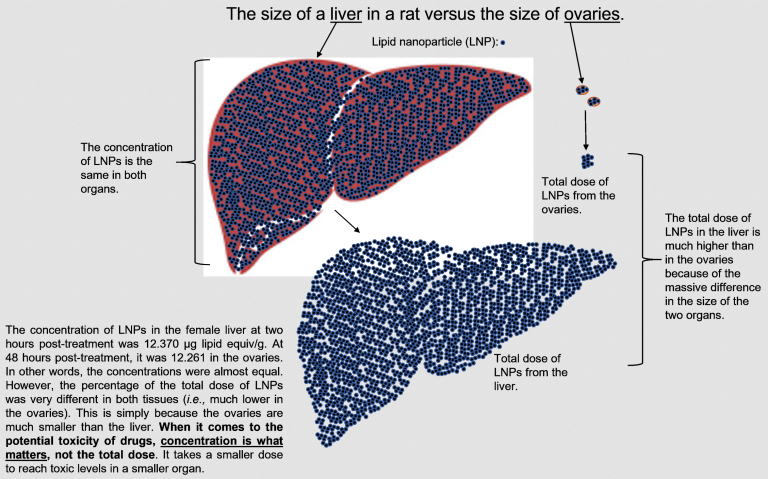
Also, focusing on the percentage of the dose that went to individual tissues loses sight of the fact that it is the concentration that matters. And the concentrations of LNPs in many tissues cannot be defined as insubstantial, especially when a safe concentration has never been established. Here is an illustration that I put together to highlight why the percentage of the total dose should not be used as a distraction from the concentration of the drug…

Here is an analogy to provide additional help…
Think about the risk of an accidental drug overdose in two people. One is a 250-pound man, the other is a 50-pound boy. They each accidentally consume the same high dose of a drug. In other words, 100% of the dose was found in the body of the man and 100% of the dose was found in the body of the boy. The percentage of the dose is equal but are they at equal risk of experiencing toxicity from an overdose? Obviously not. The tiny boy is at enhanced risk because the same high dose in a smaller body equals a higher concentration of the drug. The percentage of the drug given to the boy would have be scaled back a lot to avoid toxicity.
Looked at another way, let’s say the boy has consumed the minimum dose of a drug that causes toxicity. Would the same dose cause toxicity in the man? No, it would require a higher dose to be toxic.
In the same fashion, that is why dosage recommendations are lower for younger/smaller people. To prove this, go to your medicine cabinet and pull out a bottle of Aspirin or Tylenol or something similar. Look at the recommended dose for a child versus an adult. Children need lower total doses to achieve the same concentration of the drug once it is distributed in their body. Adult doses can potentially be toxic in children.
This same principle applies to the biodistribution of the lipid nanoparticles used to make mRNA vaccines. If a toxic dose were to be reached in the liver, the dose needed to cause toxicity in the vastly smaller ovaries would be much lower. Because the concentration of a drug is what matters.
Interestingly, the study director ignored that fact that the two-times higher dose of the mRNA ‘vaccine’ (100 μg) resulted in approximately two-times higher concentrations (that were toxic) in the various tissues as compared to the 50 μg dose; a classic dose-response effect. The percentage of the total doses reaching the tissues was almost equivalent between the 50 μg and 100 μg doses, but the latter proved more toxic because the concentrations were higher.
Page 20: “Mean plasma concentrations peaked by 4 hours post-dose in males and by 1 hour post-dose in females”. This is evidence of rapid systemic distribution with the kinetics accelerated in females.
Pages 20-21: “Concentrations were higher in plasma than in blood, with mean blood:plasma ratios generally ca. 0.5-0.6, indicating that the majority of the total radioactivity is associated with the plasma fraction.” Page 22: “and [3H]-08-A01-C01 did not associate with red blood cells.” But approximately one-third of the LNPs circulating in the blood were found in the cell fraction! Plus, the study director’s conclusion is based on the assumption that the ratio of cells to plasma in whole blood is ~50:50, but it is not; plasma represents a higher percentage. Here is a nice illustration from the University of Washington, Dept. of Laboratory Medicine, Specimen Procurement Section:

This means the amount of the LNPs in the cellular fraction was more likely ~40% of the total dose in the blood. How can one write this off as irrelevant? Further, the conclusion was that red blood cells weren’t a significant destination of the LNPs. Not only do the data contradict this assertion, it also fails to recognize that white blood cells and platelets make up <1% of whole blood. What if all the LNPs in the cellular fraction were in the white blood cells and/or platelets? This would represent a very high concentration of LNPs. Why wasn’t this studied? Instead, the cellular fraction was discarded. This is a very important question because white blood cells constitute a major component of the immune system. If they were to be negatively impacted, this would impede the vaccination effect. And if they aren’t killed but take up the mRNA, they would express the spike protein, which would then make them a target for spike-specific antibodies and/or T cells. Also, there have been reports of bleeding, blood clots, and thrombocytopenia (low platelet counts) post-‘vaccination’. The common factor with all of these is that they involve platelets, another component of the cellular fraction that was ignored. The question regarding the impact of LNPs on cells in the blood should have been addressed before there was any consideration of proceeding into human trials.
Page 22: The study director drew this overall biased conclusion: “The concentrations of [3H]-08-A01-C01 were greatest in the injection site at all time points”. Pardon me?!? Am I supposed to forget the statement on page 20 of the report, “the greatest mean tissue concentration and, in most instances, % of injected dose was found remaining in the injection site at each time point in both sexes”. This statement could only be applied to the data where results for males and females were pooled (i.e., the only data shown in the Japanese document), thereby hiding the fact that the % of the injected dose was higher in the liver than at the injection site at different times in males versus females.
Page 22: “The concentrations of [3H]-08-A01-C01 were greatest in the injection site at all time points, with levels peaking in the plasma by 1-4 hours post-dose and distribution mainly into liver, adrenal glands, spleen and ovaries over 48 hours.” I was lambasted by colleagues when I expressed concerns about biodistribution of LNPs to ovaries after seeing the Japanese document. But in the version of the document that was released by court-order, the study director concludes that the ovary is a main target organ for distribution of the LNPs! This concern is only enhanced when one looks at the kinetics of this biodistribution to the ovaries…

…the concentration of LNPs were rising almost exponentially at the conclusion of the study. How high would it have gone?
Page 21: “Maximum concentrations (Cmax) in liver and spleen were observed at 8 hours post-dose in males and 48 hours post dose in females, but were broadly similar and appeared to plateau at 8 hours post-dose when considering variability.” This conclusion needs to be corrected. The highest concentrations in female livers and spleens were observed at 48-hours post-treatment. But there is no way of knowing that these were maximal concentrations. In fact, the data suggest that maximum concentrations could be reached some time after 48 hours…


This idea of capturing a concentration plateau is based on averaging the values from males and females. In many of the male tissues, apparent peaks or plateaus appear to have been captured within 48 hours post-injection. However, the kinetics were different in females, with concentrations still rising in many cases. If one averages the post-peak values of males with rising values from females, it gives the false impression that a plateau has been captured.
This is very important because one of the key purposes of a biodistribution study is to determine when peak concentrations occur. Concerns related to potential toxicities can obviously not be allayed if only pre-peak concentrations have been captured; and this appears to be what happened with the females. Look at the following LNP concentrations over time in various tissues, with an emphasis on females (I already showed several other tissues above) and ask if you feel confident that a peak or plateau was captured. In other words, how confident are you that the concentrations would go no higher beyond 48 hours?


I question whether a peak was reached in male muscles…

All the Data are Indicative of Systemic Distribution
If a drug gets into the blood, one of the first places you should look for uptake is the spleen. This is because the spleen filters the blood. Indeed, with Pfizer’s ‘vaccine’ we see a rapid influx of LNPs into the blood and subsequent seeding of the spleen. Also, lymph nodes are designed to drain fluids from local tissues. So, if a drug seeds a tissue, one would expect to find it in the regional lymph nodes. In this study, the LNPs were found in two lymph nodes that were studied.
These lymph nodes drain distinct tissues (one drains the jaw region and the other drains fluids around the intestines). Although it was not stated, I assume the surrogate ‘vaccine’ was likely injected into one of the large muscles of the hind legs as this is what is commonly done. If true, the most relevant draining lymph node would be the popliteal node. Surprisingly, it looks like lymph nodes draining the injection site were not evaluated.
The fact that two ‘irrelevant’ lymph nodes had LNPs accumulating in them is suggestive of widespread dissemination into various tissues. I hypothesize that LNPs would have been found in most, if not all the lymph nodes in the rats. These results confirm a distribution pattern that is very different from traditional vaccine technologies where the dose would be concentrated at acute time points at the injection site, with some taken to the local draining lymph nodes.
6% of the Dose was in the Blood at Two Hours Post-Injection
No attempt was made by those conducting the biodistribution study to estimate the total amount of the dose of LNPs that were circulating in the blood, so I did this. We know the concentration per milliliter in the blood of males and females at each timepoint. So I took the average concentration across both sexes and picked the peak, which was at two hours after treatment. I estimated the total blood volumes (BV) in males and females using the formula BV (mL) = 0.06 x body weight + 0.77, which was derived from this study using the same strain of rats.
After plugging in the relevant numbers, I came up with a total average dose of blood-borne lipids of 1,290 μg; or ~6% of the total dose. This is substantial considering it represents a single time point in a dynamic tissue in which the LNPs are entering and exiting the blood throughout the duration of the study.
How the Study Should Have Been Conducted
As an expert in pre-clinical experimentation, I can assure you that Pfizer’s biodistribution study was of poor quality. It appears to have been rushed, with many corners cut, possibly in an effort to meet a deadline at ‘warp speed’. If one of my graduate students presented the data in Pfizer’s biodistribution study to their advisory committee and proposed to include it in their thesis, they would immediately be advised that it represented no more than a preliminary experiment; the type that is used to design much more informative and conclusive experiments. They would be required to expand its scope and repeat it multiple times. Here are some things I would recommend:
- The experiment should have been conducted independently at least three times to ensure the findings could be replicated and to provide sufficient statistical power to facilitate objective analyses.
- The experiment should have been run longer; specifically, until peak concentrations were clearly captured in all tissues.
- More doses should have been evaluated to determine when unwanted effects began and whether they could be mitigated.
- More tissues should have been assessed since there was evidence of extremely broad distribution. This should have included the lymph nodes draining the injection site, white blood cells, red blood cells, platelets, etc.
- Tissues should have been assessed for the presence of LNPs, plus the mRNA, plus the protein product; not just the LNPs. It would be helpful to know how long the mRNA remains intact versus how long the protein product and LNPs can be detected.
- Samples should have been analyzed to detect potential shedding. These samples should have included saliva, urine, feces and skin swabs.
- The study should have been run with the same formulation that is being used in people.
- A small-scale biodistribution study should have been incorporated into a phase I human clinical trial. If nothing else, it would have been very easy to monitor distribution in serial blood samples, as well as shedding samples, since these are all easy to obtain.
Repeated Dosing With Lipid Nanoparticles is Dangerous
Here is some information that is of concern considering that many people have already received three or four doses of an mRNA ‘vaccine’ in less than one year, with the potential for more on the horizon…
This might be news to many members of the public, but it is a long-accepted scientific fact that lipid nanoparticles used to deliver the mRNA in ‘vaccines’ can be toxic. In fact, that is the very reason why some big pharmaceutical companies strategically focused on using them as vaccine technologies instead of for gene therapies and to deliver drugs. A good quality vaccine, such as those used in the mandated childhood series, only require one or two doses for a person’s lifetime. It was assumed the same would hold true for mRNA vaccines. Repeated administration of lipid nanoparticles, especially over a limited period of time, is known to be toxic.
This was openly discussed with the media prior to the declared COVID-19 pandemic, but many people are either unaware of this or have forgotten. This included an interview with the Chief Executive Officer of Moderna and others in the biotechnology industry. Here are quotes from the hyperlinked article:
“In nature, mRNA molecules function like recipe books, directing cellular machinery to make specific proteins. Moderna believes it can play that system to its advantage by using synthetic mRNA to compel cells to produce whichever proteins it chooses. In effect, the mRNA would turn cells into tiny drug factories. It’s highly risky. Big pharma companies had tried similar work and abandoned it because it’s exceedingly hard to get RNA into cells without triggering nasty side effects.”; “Delivery — actually getting RNA into cells — has long bedeviled the whole field. On their own, RNA molecules have a hard time reaching their targets. They work better if they’re wrapped up in a delivery mechanism, such as nanoparticles made of lipids. But those nanoparticles can lead to dangerous side effects, especially if a patient has to take repeated doses over months or years. Novartis abandoned the related realm of RNA interference over concerns about toxicity, as did Merck and Roche”.
Indeed, there are many peer-reviewed scientific publications that have highlighted serious safety issues related to the administration of lipid nanoparticles used to deliver mRNAs. Some examples of toxicities that can be caused by lipid nanoparticles can be found here, here, and here. Remarkably, lipid nanoparticles used to deliver mRNAs have even been shown to be toxic to cells of the immune system that play a critical role in promoting vaccine-mediated immune responses. This would counteract the very immunization effect that is being sought. It could even, in theory, potentially cause counterproductive acute immunosuppression. A key question is to what degree are these toxicities additive? Unless lipid nanoparticles are definitively proven safe in humans, their repeated administration to people should be avoided.
Implications for Blood Donations
Blood donor organizations conduct fabulous, life-saving work. However, they need to take a long look at their policies surrounding mRNA-based vaccines. For example, Canadian Blood Services has the following policy: “Consistent with our eligibility criteria for other non-live vaccines, Canadian Blood Services accepts donations from otherwise eligible donors who have received a Health Canada-authorized COVID-19 vaccine, with no required deferral period following vaccination”. The problem is that mRNA ‘vaccines’ don’t function like traditional non-live vaccines. Pfizer’s own data suggest that their mRNA ‘vaccine’ circulates in the blood (in both the plasma and the cellular fraction) for at least 48 hours post-inoculation. Should blood containing variable quantities of a mRNA ‘vaccine’ that is still in its initial phase 3 human clinical trial be used in patients?
I strongly recommend that a simple time-course study evaluating the duration of circulation of lipid nanoparticles, mRNA, and the spike protein be conducted. This would allow a safe waiting period to be determined prior to accepting donations from individuals who have received a mRNA ‘vaccine’.
Practical Applications
What should be done with all this information? Well, I would suggest that you investigate the myriad of questions raised by Pfizer’s biodistribution study. Ask yourself if you have been presented with sufficient scientific evidence to address your queries. Do not settle for personal opinions, no matter how much of an ‘expert’ the person or organization appears to be. If you are not confident that systemic biodistribution of mRNA vaccines in people is a non-issue, then consider encouraging the promotion of research to provide definitive answers. Expecting public health officials to practice the precautionary principle is reasonable.
Further, encourage uncensored public discussions of the science between experts on both sides of the debate. After all, the full spectrum of scientific information should not be hidden from the public.
Finally, encourage health regulatory agencies to recruit unbiased scientists with pre-clinical research skills to carefully evaluate these early types of studies. It is challenging for a large company that is responsible for vast amounts of investor dollars to change course in the human clinical trial stages of research where massive amounts of money are one the line; much like trying to turn an oil tanker around. In contrast, there is much less invested at the earlier pre-clinical and translational stages due to the much lower cost of that type of research.
Changing course at this point is more akin to turning a speedboat around. Pre-clinical studies can be very informative and, if carefully critiqued, can be used to formulate important questions that can be answered with new, relatively inexpensive, easy and rapid experiments.
Unfortunately, most regulatory agencies and advisory committees that have been evaluating COVID-19 ‘vaccines’ have focused on the recruitment of clinically focused researchers. The many problems with Pfizer’s biodistribution study should have been obvious to a pre-clinical scientist.
Ideally, places like Health Canada should offer their regulatory scientists the equivalent of tenure in academia to ensure that they can maintain job security no matter how unpopular their reviews of submitted data may be.
In my continued effort to correct mis/dis-information, present information with greater transparency, and promote informed decision-making,
You can subscribe to Dr Bridle’s Substack here.