Metabolism
now browsing by category
From Farm to Health — A Vision for Regenerative Agriculture and Metabolic Wellness
Reproduced from original article:
https://articles.mercola.com/sites/articles/archive/2024/11/24/regenerative-agriculture-metabolic-wellness.aspx
Analysis by Dr. Joseph Mercola November 24, 2024
STORY AT-A-GLANCE
- Ashley Armstrong, co-founder of Angel Acres Egg Co., shifted from fitness coaching to health advocacy after discovering the connection between dietary choices and autoimmune issues
- Adequate carbohydrate intake — approximately 250 grams daily — is necessary for metabolic health, while low-carb diets increase cortisol and disrupt thyroid function
- Body temperature measurements three times daily provide a better indicator of metabolic health than conventional blood work, with 98.6 degrees F midday indicating normal function
- Polyunsaturated fatty acids (PUFAs) and phytoestrogens in modern diets interfere with thyroid function and estrogen detoxification, leading to metabolic disruptions
- Armstrong promotes regenerative farming practices, producing low-PUFA eggs and freeze-dried egg yolks while advocating for sustainable agriculture over conventional farming methods
I recently interviewed Ashley Armstrong, co-founder of Angel Acres Egg Co. and a leading advocate for regenerative agriculture. Ashley’s unique perspective bridges the gap between optimal health practices and sustainable farming, offering invaluable insights into how our food systems and dietary choices profoundly impact well-being.
Ashley began her health journey alongside her sister, Sarah, under the moniker “Strong Sisters.” Initially focused on weightlifting and resistance training, they documented their progress and reveled in the empowerment that came with physical strength. “It was so empowering … It’s you versus you,” Ashley shared.1
However, their path took a significant turn when both encountered health issues linked to their dietary choices, particularly the prevalence of polyunsaturated fatty acids (PUFAs) and processed ingredients. Sarah was diagnosed with a form of lupus at 21, prompting them to seek alternatives to conventional medicine.
“We went down rabbit holes of keto, fasting, carnivore, all of that … we felt relief initially … and then those decisions caught up to us. After about two years, we stumbled upon the work of Dr. Ray Pete, and the rest is history,” Ashley explained,2 emphasizing their shift toward understanding thyroid and metabolic health as interconnected facets of systemic well-being.
The Role of Carbohydrates in Metabolic Health
The importance of carbohydrates in maintaining metabolic rate and thyroid function is often overlooked. Ashley said, “Carbohydrates are vital. They’re optimal. They’re required. They’re necessary.” Part of their importance is linked to their effects on body temperature. She explained:3
“It’s up to you as an individual to find what carbs work well for you, focus on those for a period of time. Work on implementing more slowly, increasing those that work well for you, because that, over time, is going to raise your metabolic rate. As you raise your metabolic rate, your body temperature rises.
And that is the whole goal. We want to be hot. We don’t just want to look good. We want to be hot inside of us, because all the functions in our body, they run off of enzymes. And enzyme reaction rates depend on temperature.”
She criticized the dogmatic low-carb approaches prevalent in certain health communities, advocating instead for a personalized strategy to carbohydrate intake. By categorizing carbs into a traffic light system — green, yellow and red — my newest book, “Your Guide to Cellular Health: Unlocking the Science of Longevity and Joy,” provides a practical framework for you to identify and incorporate beneficial carbohydrates into your diet.
It’s important to meet a certain carbohydrate threshold, approximately 250 grams a day, to support metabolic functions. If you don’t reach that threshold, you’re going to run into health troubles. Low-carbohydrate diets, for instance, increase cortisol. Short-term elevation of cortisol is protective and necessary for survival.
However, chronic elevation leads to detrimental health effects, including muscle wasting, bone density loss and impaired cognitive function. Further, consuming enough healthy carbohydrates not only supports metabolic rate but also ensures the proper conversion of inactive thyroid hormone (T4) into its active form (T3), a process necessary for cellular energy production.
Measuring Health Beyond Conventional Blood Work
Ashley recommends the use of body temperature as a metric for assessing your metabolic health. Unlike conventional blood tests, which provide only a snapshot and are influenced by various external factors, body temperature measurements offer a continuous, real-time indicator of metabolic rate. “If your body temperature is rising, that’s a clear sign your cellular utilization of T3 is happening,” Ashley explained.4
She advocates for taking body temperature three times a day — upon waking, 30 to 45 minutes after breakfast and midday. This approach is effective because T3 levels are generally higher in the morning and decline as the day progresses. This routine allows you to monitor your metabolic trends and make informed dietary adjustments.
Ashley highlighted, “This is an easy tool … because blood work still doesn’t tell you whether your mitochondria are actually using that thyroid hormone T3.”5
Ideally, use a basal body temperature thermometer to measure your temperature, as they measure to 100th of a degree. A consistently low body temperature indicates a sluggish metabolism, while a morning body temperature of approximately 98 degrees F signifies healthy thyroid function. By midday, a temperature around 98.6 degrees F typically indicates a normal metabolic response.
Ashley also highlighted the limitations of conventional thyroid panels, which often focus solely on thyroid-stimulating hormone (TSH) levels. She stressed the importance of comprehensive thyroid testing, including free T3, reverse T3 and T4, to gain a true understanding of thyroid health and metabolic function.

Save This Article for Later – Get the PDF Now
The Dual Threat of PUFAs and Phytoestrogens
We also covered the detrimental effects of PUFAs, like linoleic acid (LA), and phytoestrogens on metabolic health. Ashley noted, “PUFAs damage our ability to detoxify estrogen,” explaining how these substances interfere with your body’s ability to convert T4 to T3, thereby lowering metabolic rates.6 This disruption not only hampers energy production but also fosters an environment conducive to autoimmune conditions and other health issues.
LA is found in seed oils, processed foods and even some seemingly healthy options like chicken, nuts and seeds. While it’s believed to be an essential fatty acid that your body needs, the modern Western diet typically provides far more than necessary. Optimizing your mitochondrial function is necessary for improving your cellular energy, but LA is a mitochondrial poison and also damages your gut health.
She also addressed the pervasive nature of phytoestrogens in the modern diet, particularly through soy and flax products. “Phytoestrogens have been shown to activate estrogen receptors in the same way we’re eating that through fake dairy products, soy milk, soy cheese,” Ashley warned. The accumulation of these estrogen-like compounds exacerbates metabolic disruptions, leading to estrogen dominance and further impeding thyroid function.
Exposure to endocrine-disrupting chemicals (EDCs) like phthalates and bisphenol A (BPA), often from microplastics, also overstimulates your estrogen receptors. Estrogen increases intracellular calcium levels, leading to peroxynitrite formation, a potent reactive oxygen species that contributes to poor health.
As bioenergetic researcher Georgi Dinkov explained in our previous interview, estrogen is carcinogenic and antimetabolic, radically reducing the ability of your mitochondria to create cellular energy. Many people believe that they are low in estrogen due to bloodwork, when they actually have high levels in their organs. This is because serum estrogen levels are not representative of estrogen that’s stored in tissues. Estrogen may be low in plasma, but high in tissues.
A better option for gauging estrogen levels in fat and tissues is a prolactin blood test. Estrogen promotes the production of prolactin, which is a hormone produced by the pituitary gland. Once you’ve dialed in your diet by reducing LA and consuming healthy carbs, an effective strategy that helps counteract estrogen excess is natural progesterone.
Transforming Agriculture — Regenerative Practices for Superior Nutrition
Ashley’s expertise as a chicken farmer is deeply intertwined with her health advocacy. She spearheads a movement toward regenerative agriculture, focusing on feeding chickens a diet low in PUFAs and free from harmful additives. “Our row crop farm partners are producing our grains that our chickens are eating regeneratively,” she explained, underscoring the importance of soil health and sustainable farming practices in producing nutrient-dense animal products.7
This commitment to regenerative practices enhances the nutritional profile of the eggs and ensures that the chickens are healthier and more robust. “We’re working with Mother Nature, with our row crop partners,” Ashley affirmed, highlighting the synergy between sustainable farming and optimal human health.8
One of the most exciting developments discussed was the introduction of freeze-dried egg yolks. This innovative product addresses the perishability and logistical challenges of traditional egg consumption while preserving the rich nutrient profile of the yolks. When you freeze-dry food, specifically egg yolks, you essentially remove all the moisture, reducing perishability and extending the shelf life.
These freeze-dried yolks are not only nutrient-dense but also versatile, allowing you to incorporate them into various dishes, like smoothies, without worrying about spoilage. Freeze-dried egg yolks offer a convenient, long-lasting source of essential nutrients like choline and vitamin K2. Ashley emphasized their role in supporting neurotransmitter function and overall metabolic health.
Choline is part of an important neurotransmitter called acetylcholine, which is part of the parasympathetic nervous system. Unfortunately, conventional health and agricultural systems prioritize profitability over health and sustainability. The dominance of Big Pharma and Big Agriculture has led to widespread use of harmful PUFAs, phytoestrogens and other additives that compromise both human and environmental health.
Ashley explained the economic challenges faced by small-scale farmers within these systems. “Farmers have to get off the farm jobs to support their farm,” she lamented, pointing out the unsustainable nature of current agricultural practices.9 Our collaborative efforts aim to create alternative markets and support structures that make regenerative farming viable and profitable, thereby ensuring the production of healthier food products.
She also touched upon the systemic issues perpetuated by federal subsidies, which have historically favored certain crops, leading to the overproduction of soy and corn — primary sources of PUFAs and phytoestrogens.
“The Farm Bill has subsidized the production of certain crops, and we’ve overproduced so much that now the costs are so low for feed producers,” Ashley explained.10 By shifting consumer demand toward regenerative and sustainable farming practices, we will gradually diminish the influence of these subsidies and promote a healthier, more resilient agricultural system.
Practical Steps to Enhance Metabolic Health
For those looking to improve their metabolic health, Ashley provided actionable advice rooted in her expertise. She emphasized the importance of:
- Ensuring a sufficient intake of healthy carbohydrates to support metabolic functions and thyroid health.
- Using body temperature measurements as a real-time indicator of metabolic rate and thyroid function.
- Avoiding foods high in PUFAs like LA and phytoestrogens to prevent metabolic disruptions and support thyroid hormone utilization.
- Incorporating nutrient-dense foods, including saturated fats and egg yolks to provide essential vitamins and minerals without harmful additives.
- Supporting regenerative agriculture by choosing products from regenerative farms to ensure the intake of healthier, sustainably produced food.
Ashley’s work serves as a reminder of the power of informed, sustainable practices. By prioritizing whole foods, minimizing harmful additives and supporting ethical farming methods, it’s possible to create a healthier, more resilient society.
Building a Sustainable, Healthy Future
As consumers become more aware of the profound connections between their dietary choices and overall health, the demand for regenerative products will naturally increase. This, in turn, will incentivize more farmers to adopt sustainable practices, creating a positive feedback loop that benefits both individuals and the planet.
Ashley concluded, “Health shouldn’t be hard. You shouldn’t be overwhelmed, and you are not forever broken if you give the body the tools it needs, remove the metabolic breaks and use simple body temperature measurements.”11 Her holistic approach underscores the interconnectedness of diet, agriculture and systemic health, offering a roadmap for individuals to achieve optimal well-being.
Ashley and I also discussed the forthcoming launch of the revolutionary Mercola Health Coach app and Mercola Health Labs. These initiatives will change how individuals access and interpret their health data, making comprehensive lab testing more accessible and affordable.
The Mercola Health Coach app will provide personalized monitoring and recommendations that support your best possible health. Food Buddy, an integral part of the Mercola Health Coach, is designed to help you effectively navigate daily food choices to reach optimal wellness.
Mercola Health Labs will offer a range of lab tests at a fraction of the current costs, with plans to provide some tests for free along with supplement purchases. This initiative is designed to empower you to take control of your health without the financial and logistical barriers associated with conventional lab testing. If you’d like to join the waitlist for the Mercola Health Coach app, click here.
As we continue to develop tools like the Mercola Health Coach app and expand regenerative farming partnerships, the vision of a healthier, more sustainable future becomes increasingly attainable.
We are pioneering a movement that not only transforms individual health but also redefines our relationship with the food we consume and the environment we inhabit. By empowering individuals with knowledge and supporting farmers with sustainable practices, we are laying the foundation for a thriving future.
- 1 Youtube, Dr. Mercola, A Vision for Regenerative Agriculture and Metabolic Wellness — Interview with Ashley Armstrong, 1:06
- 2 Youtube, Dr. Mercola, A Vision for Regenerative Agriculture and Metabolic Wellness — Interview with Ashley Armstrong, 2:09
- 3 Youtube, Dr. Mercola, A Vision for Regenerative Agriculture and Metabolic Wellness — Interview with Ashley Armstrong, 16:01
- 4, 5 Youtube, Dr. Mercola, A Vision for Regenerative Agriculture and Metabolic Wellness — Interview with Ashley Armstrong, 35:47
- 6 Youtube, Dr. Mercola, A Vision for Regenerative Agriculture and Metabolic Wellness — Interview with Ashley Armstrong, 1:27
- 7, 8 Youtube, Dr. Mercola, A Vision for Regenerative Agriculture and Metabolic Wellness — Interview with Ashley Armstrong, 1:09
- 9 Youtube, Dr. Mercola, A Vision for Regenerative Agriculture and Metabolic Wellness — Interview with Ashley Armstrong, 59:05
- 10 Youtube, Dr. Mercola, A Vision for Regenerative Agriculture and Metabolic Wellness — Interview with Ashley Armstrong, 1:03
- 11 Youtube, Dr. Mercola, A Vision for Regenerative Agriculture and Metabolic Wellness — Interview with Ashley Armstrong, 7:04
Carbohydrates: The Unexpected Ally in Your Fat Loss Journey
Reproduced from original article:
https://articles.mercola.com/sites/articles/archive/2024/09/10/carbohydrates-fat-loss.aspx
Analysis by Ashley Armstrong September 10, 2024

STORY AT-A-GLANCE
- Carbohydrates are not inherently fattening and can be beneficial for fat loss when included in a calorie-controlled diet. Including carbs in a fat loss diet can improve long-term adherence and satisfaction, making sustainable weight loss more achievable
- Insulin spikes from carbohydrates do not directly cause fat gain; obesity and inactivity are the primary contributors to insulin resistance
- Including carbs in your diet helps preserve muscle mass during fat loss by reducing muscle protein breakdown and supporting exercise performance
- Low-carb diets can negatively impact hormones, decreasing testosterone and increasing cortisol in both males and females
- Carbohydrates play a role in maintaining progesterone levels, which is important for hormonal balance in both men and women. Adequate carbohydrate intake also supports thyroid function and metabolic health by maintaining T3 hormone levels during calorie deficits
Let’s start with a myth: carbohydrates are inherently fattening and should be removed from your diet if you want to lose weight. This is not true! Carbohydrates can and should be included in a healthy fat loss phase. So in this article let’s talk about why including carbs in your diet is BENEFICIAL for fat loss.
But What About Insulin?
When it comes to fat loss, carbohydrates are demonized in many diet camps likely because of the fear mongering around insulin and blood sugar.
The logic seems so clear and appealing: High carbs lead to insulin which leads to fat storage. Low carbs keep insulin low, which should get you effortlessly lean while you enjoy endless amounts of fat, right? No! Do carbs increase insulin levels? Yes, they do. Does increased insulin after meals lead to fat gain? No. Did you know that dietary protein spikes insulin?1 So following the above logic, does dietary protein cause fat gain? No!
Insulin isn’t the devil people want you to believe. Like every other hormone in your body, insulin has a specific purpose and isn’t always a bad thing. (For example — insulin plays a crucial role in promoting muscle growth and maintenance since it facilitates glucose and amino acid uptake into muscle cells, preventing muscle protein breakdown).2
Research demonstrates that obesity and inactivity are the biggest contributors to insulin resistance3,4,5,6 not carbs. In fact, high fat diets can negatively impact insulin sensitivity.7,8 Dietary fat is not a bad thing — but moderate fat and the inclusion of carbs can be beneficial for a number of reasons.
Let’s look at what happened in one study comparing low carb (5% cal) vs. moderate carb (40% cal) where calories were controlled and protein was matched (this is a huge problem in the research: many low carb diet studies don’t match protein intake between the groups leading to more variables.)
Subjects who ate the moderate carb diet reported significantly better mood and lost about the same amount of weight as those on a ketogenic low-carb diet — demonstrating that carb consumption does not inhibit weight loss.
The group who ate more carbs showed a small (though not statistically significant) tendency to lose more body fat as compared to those on a low carb diet (5.5 kg vs 3.4 kg in 6 weeks).
Can a low-carb diet work to help people lose weight? Of course it can. Is it because it is low in carbs? No. As a weight loss strategy, cutting carbs (while reducing the total number of calories) can work well for some people! But cutting carbs can come with costs:
- Reduced thyroid and metabolic function
- Decreased glycogen levels
- Increased muscle loss
- Hormonal imbalances
- More frequent binge eating episodes
So, let’s explore why carbs might actually be good for fat loss:
1. Metabolic health: The carb and thyroid connection — Carbohydrates play a vital role in supporting metabolic health. The liver requires glucose (derived from carbohydrates) to convert T4 to T3, a crucial thyroid hormone. T3 is a thyroid hormone that plays a significant role in regulating metabolism.
When T3 levels are low, the body’s metabolic processes tend to slow down, which means that fewer calories are burned at rest, making fat loss more challenging.
Research has shown that maintaining carbohydrate intake during a calorie deficit helps sustain T3 levels, which is essential for overall metabolic health.9 “During the low carbohydrate diet rT3 increased and T3 decreased but they remained unchanged during the carbohydrate-rich diet.”10
The research is clear that including more carbohydrates tends to increase T3 levels in the body, while low-carb diets tend to lower T3 levels.11,12
 Image from: Chews Food Wisely
Low Energy Availability (LEA) is a condition where the body doesn’t have enough energy to support normal physiological functions after accounting for the energy expended in exercise and daily activities. This can lead to various health problems, including hormonal imbalances, reduced bone density, and impaired immune function.
Studies indicate that adequate carbohydrate intake can help prevent LEA, even during a calorie deficit.13 By providing your body with a steady source of easily accessible energy, you minimize the risk of entering this low energy state, supporting overall health and well-being during your fat loss journey.
In conclusion, including carbs in your diet during a fat loss phase might help sustain T3 levels, potentially supporting metabolic rate and preventing some of the negative effects associated with low-calorie diets on thyroid function.
2. The glycogen factor: Beyond water weight — One of the primary advantages of including carbohydrates in your fat loss diet is their role in maintaining muscle glycogen stores. (Glycogen is stored carbohydrates that serve as a quick-release energy reserve.) Your body can store approximately 400 to 500 grams of glycogen in muscles and 80 to 120 grams in the liver.14
Interestingly, each gram of glycogen is stored with about three grams of water, which means that 500 to 600 grams of glycogen can account for 3 to 4 pounds of your body weight.
 Image from: Heatrick
This glycogen-water relationship explains why people on low-carb diets often see rapid initial weight loss. As the body burns through stored glycogen (since you aren’t consuming carbs), the body releases the associated water, leading to a quick drop in scale weight.15 However, this is primarily water loss, not fat loss.
By maintaining carbohydrate intake, you ensure that your weight loss comes primarily from fat stores rather than this initial water weight.
If you stay in a calorie deficit on a keto diet for long enough, you will of course lose body fat as well. However, when you reintroduce carbs, you’ll likely regain some water weight back as your glycogen stores are replenished.
3. Reduce muscle protein breakdown — Researchers have found that low-carb diets can increase muscle protein breakdown, as measured by increased urinary nitrogen excretion.16
As we just discussed above, consuming carbs keeps your muscle glycogen levels full, which improves your gym performance and helps your recovery — increasing your chances of maintaining muscle mass during a calorie deficit.
When you lose weight, that includes some fat and muscle. But by including carbs, you reduce the amount of muscle you lose since you are reducing muscle protein breakdown! When you get enough carbs to meet your needs, you replenish muscle glycogen and create an anabolic (building-up) hormonal environment.
Conversely, when you don’t eat enough carbohydrate, muscle glycogen is depleted and a catabolic (breaking-down) hormonal environment is created,17 which means more protein breakdown and less protein synthesis. This means slower muscle growth — or even muscle loss.
Research shows that lowering carb intake can affect your muscle mass even if protein remains constant.18 Low carb diets likely increase muscle breakdown, because severely low carbs lowered insulin levels.
Another reason for the reduction in muscle protein breakdown is that carbs can help enhance your performance in the gym. The more you can push yourself in the gym with pushing close to muscular failure at heavier weights, the better mechanical tension and stimulus you can achieve, sending a message to the muscle: “please stick around!”
Carbs are also protein sparing, meaning they supply the body the glucose it needs for vital functions so that it doesn’t have to break down muscle tissue to produce those carbs. When you don’t consume carbs, your body will use some of your dietary protein to perform higher amounts of gluconeogenesis19 in order for your body to meet its baseline glucose needs.
Gluconeogenesis is primarily performed in the liver, so consuming carbs will support liver health since you are reducing one more thing the liver must do (amongst its list of 500 tasks) — more gluconeogenesis!
Carbohydrates play a crucial role in preserving muscle mass during a calorie deficit by maintaining glycogen stores. Plus, muscles that are full of glycogen look MUCH better aesthetically than muscles depleted of glycogen.
4. Negatively impacts hormones — Low carbohydrate diets have been shown to negatively impact hormones for both males and females, decreasing testosterone while increasing cortisol.20,21,22,23
When in a low carb state, your body activates stress hormones in order to make the carbs that your body requires for basic physiological functions.24
Most people nowadays are estrogen dominant due to xenoestrogens, phytoestrogens in certain foods, modern pollutants, birth control, and estrogen hormone replacement.25 For example — menopause and PCOS are not conditions of estrogen deficiency, instead it is excess estrogen.
Improving progesterone production helps balance hormones and reverse estrogen dominance. Well, low carb diets can negatively affect progesterone production. Dr. Katharina Dalton, a pioneer in hormonal balance and PMS, found that dietary changes could significantly influence hormonal levels and alleviate symptoms of PMS.
To properly restore the progesterone hormonal function and hormone balance, she had her patients eat carbs (primarily starches) at each meal.26 Dr. Dalton had two main reasons:
a. To avoid dips in blood sugar — “Progesterone receptors cannot transport or bind to, a molecule of progesterone if there has been a drop in blood sugar.”
b. To keep adrenaline as low as possible — “Progesterone receptors do not transport progesterone molecules into the nucleus of cells if adrenaline is present.”
We are bombarded with estrogenic substances in daily life, so progesterone is vital for truly everyone, including males! And carbs can help optimize progesterone production.
Female hormones are extremely sensitive to diet. For example, one study following 45 patients aged 12 to 19 on a ketogenic diet found menstrual dysfunction was the most common side effect (45% of female subjects) and 6 experienced amenorrhea.27
5. Improved diet adherence and satisfaction — Perhaps one of the most underappreciated benefits of including carbohydrates in a fat loss diet is improved adherence. Carbs contribute to greater food variety, making meals more enjoyable and satisfying. This increased satisfaction can make it easier to stick to your diet long-term, which is crucial for sustainable weight loss.
Finding a diet approach that you can remain consistent with that is not unnecessarily restrictive will help you avoid the never ending restrict-binge-restrict-binge cycle where you may lose 10 lbs, regain it, lose 10 lbs, regain it … that is not sustainable and is a sign what you are doing isn’t working!
This psychological factor is often overlooked but can be crucial in achieving and maintaining your fat loss goals. When you feel less restricted in your food choices, you’re more likely to adhere to your diet plan in the long run.
Conclusion: The Carbohydrate Balance
While creating a calorie deficit is necessary for fat loss, completely eliminating carbohydrates may not be the most effective or sustainable approach. The removal of carbs may help you initially lose weight (since you remove an entire food group, and thus a lot of calories). But, then what? How do you come out of that state? Can you maintain that day in and day out?
By including quality carbohydrates in your diet, you can support your fat loss goals while maintaining muscle mass, metabolic health, better hormones and diet satisfaction. While everyone’s metabolism will be slightly lowered when dieting (this is why you may stall after a while and have to make tweaks along the way), research shows that consuming carbs while eating in a caloric deficit leads to LESS of a metabolism reduction due to higher thyroid functioning.
It is important to point out, however, that even if carbs are included, CHRONICALLY eating lower calorie will eventually lead to a low-energy-availability state. Which is why it is important to have planned out fat loss phases, and not chronically under eat calories.
Remember, sustainable weight loss is about finding a balanced approach that works for you in the long term. So, before you jump on the no-carb bandwagon, consider the potential benefits of keeping carbs as part of your fat loss strategy. Your body — and your taste buds — might thank you for it.
Save This Article for Later – Get the PDF Now
Transform Your Health — One Step at a Time


Ashley and her sister Sarah have put together a truly groundbreaking step-by-step course called “Rooted in Resilience.” They have compiled what clearly is the best application of Dr. Ray Peat’s work on Bioenergetic Medicine that I have ever seen.
It is so good that I am using the core of their program to teach the many Health Coaches that I am in the process of training for the new Mercola Health Clinics I am opening this fall. It took these women working nearly full-time on this project for a year to create it.
This has to be one of the absolute best values for health education I have ever seen. If you want to understand why you struggle with health problems and then have a clear program on how to reverse those challenges, then this is the course for you.
It is precisely the type of program I wish I would have had access to when I got out of medical school. I fumbled around for decades before I reached the conclusion they discuss in the course and share with you so you can restore your cellular energy production and recover your health.
| Select and eat the right foods to heal your metabolism and improve glucose utilization |
| Balance your hormones to help reduce anxiety, weight gain and sleep disturbances |
| Use reverse dieting to increase your calories without gaining weight and tanking your metabolism, all while improving your energy levels |
| Heal your gut for proper immune function, mood and weight management |
| Tweak your diet and lifestyle habits to improve your mindset and mental health |
| Crush your fitness goals with ease and get your life back on track |
| Master the most essential habits for health with bonus guides, including over 100 meal plans to take the stress out of meal time planning and shopping, and so much more! |
About the Author
Ashley Armstrong is the cofounder of Angel Acres Egg Co., which specializes in low-PUFA (polyunsaturated fat) eggs that are shipped to all 50 states (join waitlist here), and Nourish Cooperative, which ships low-PUFA pork, beef, cheese, A2 dairy and traditional sourdough to all 50 states. Waitlists will reopen shortly.
- 1 Physiol Rep. 2023 Jan; 11(2): e15577
- 2 Am J Physiol Endocrinol Metab. Author manuscript; available in PMC 2010 Jan 12
- 3 Am J Med. 2006 May;119(5 Suppl 1):S10-6, doi: 10.1016/j.amjmed.2006.01.009
- 4 Free Radic Res. 2014 Jan;48(1):93-108, doi: 10.3109/10715762.2013.847528. Epub 2013 Oct 17
- 5 Am J Physiol Endocrinol Metab. 2021 Dec 1;321(6):E766-E781, doi: 10.1152/ajpendo.00254.2020. Epub 2021 Nov 1
- 6 Clin Nutr. 2010 Jun;29(3):386-90, doi: 10.1016/j.clnu.2009.09.006. Epub 2009 Oct 28
- 7 Front Public Health. 2023 Mar 16:11:1115333
- 8 Eur J Nutr. 2017 Feb;56(1):431-443. doi: 10.1007/s00394-015-1108-6. Epub 2015 Nov 28
- 9 J Clin Endocrinol Metab. 1976 Jan;42(1):197-200. doi: 10.1210/jcem-42-1-197
- 10 Am J Clin Nutr. 1982 Jan;35(1):24-35. doi: 10.1093/ajcn/35.1.24
- 11 Nutrients. 2018 Jan; 10(1): 5
- 12 PLoS One. 2022; 17(6): e0269440
- 13 Med Sci Sports Exerc. 2022 Mar 1;54(3):377-387. doi: 10.1249/MSS.0000000000002819
- 14 Nutr Rev. 2018 Apr; 76(4): 243–259
- 15 Nutrients. 2022 Feb; 14(3): 423
- 16 J Clin Endocrinol Metab. 2003 Aug;88(8):3801-5. doi: 10.1210/jc.2002-021087
- 17, 18 Journal of Applied Psychology, Volume 109, Issue 2, August 2010, Pages 431-438
- 19 The Journal of Clinical Endocrinology & Metabolism, Volume 85, Issue 5, 1 May 2000, Pages 1963–1967, doi: 10.1210/jcem.85.5.6573
- 20 Eur J Appl Physiol Occup Physiol. 1993;66(4):304-8. doi: 10.1007/BF00237773
- 21 Eur J Appl Physiol. 2010 Apr;108(6):1125-31. doi: 10.1007/s00421-009-1220-5. Epub 2009 Dec 20
- 22 Life Sciences, 40(18):1761-8 40(18):1761-8, doi: 10.1016/0024-3205(87)90086-5
- 23 Eur Food Res Technol 242, 2001–2009 (2016). doi: 10.1007/s00217-016-2772-3
- 24 Jay Feldman Wellness, April 30, 2024
- 25 Ray Peat, Aging, estrogen, and progesterone
- 26 Shakespeare & Co., Once a Month: Understanding and Treating PMS (Paperback)
- 27 Epilepsia. 2003 Jun;44(6):847-51. doi: 10.1046/j.1528-1157.2003.57002.x
The Many Forgotten Health Benefits of Aspirin
Reproduced from original article:
Analysis by Dr. Joseph Mercola August 29, 2024
STORY AT-A-GLANCE
- Aspirin offers benefits beyond heart health, including cancer prevention, improved pregnancy outcomes during influenza infection and treatment for fatty liver disease and pulmonary fibrosis
- Long-term low-dose aspirin use (over 10 years) may reduce the risk of dementia, particularly in people with pre-existing coronary heart disease
- Aspirin can enhance glucose utilization, reduce fatty acid release, lower cortisol levels and increase metabolic rate, potentially aiding in weight loss and hormone balance
- Studies suggest aspirin may improve survival rates in intensive care units, slow the progression of abdominal aortic aneurysms and reduce the risk of developing Type 2 diabetes
- When considering aspirin use, opt for immediate-release, uncoated versions. The suggested dosage is dependent on your circumstances 82 mg to 325 mg tablet daily with your largest meal
For years, you’ve probably heard that a daily low-dose aspirin can help prevent heart attacks and strokes. Now, suddenly, health authorities are backpedaling on this advice.1
Why the change? They claim it’s about bleeding risks, but there’s more to the story. Look at the timing — this shift comes as newer, far more expensive blood thinners flood the market. These drugs can cost up to $550 a month,2 while aspirin sets you back just $1.50.3
It’s a pattern we’ve seen before with drugs like ivermectin. Safe, effective and cheap medicines get pushed aside to make way for pricier alternatives. The pharmaceutical industry has a long history of this, dating back to when nonsteroidal anti-inflammatory drugs (NSAIDs) were introduced in the 1970s.
They’re telling you to avoid aspirin, but are they telling you the whole truth? As always, I encourage you to look beyond the headlines and consider who benefits from these changing guidelines. Your health — and your wallet — may depend on it.
For decades, aspirin has been a cornerstone in the prevention of cardiovascular disease (CVD). A comprehensive review of 13 primary prevention trials recently revealed that low-dose aspirin is associated with small but statistically significant reductions in major CVD events, such as heart attack and stroke.4
The absolute risk reduction can be up to 2.5%, which means that for every 1,000 people taking aspirin, up to 25 fewer may experience a major CVD event. But the truth is, aspirin offers numerous health advantages beyond heart health that are rarely talked about. Learning about these benefits can help you take control of your health.
Aspirin’s Role in Cancer Prevention
Recent studies have shed light on aspirin’s potential to prevent colorectal cancer (CRC) and other types of cancer. Taking at least 75 milligrams (mg) of aspirin daily for several years has been shown to reduce the long-term incidence and death from CRC,5 with the greatest benefit seen for proximal colon cancers, which are malignancies that occur in the first and middle sections of the colon, also known as the right side of the colon.
In fact, in women, aspirin use for over 20 years was associated with a 35% reduction in CRC incidence.6 The effect appears to be dose-dependent, with longer duration of use linked to greater benefits. Aspirin may also improve survival rates after a CRC diagnosis, with regular users showing reductions in CRC mortality of 29% and overall mortality of 21%.7
Interestingly, the benefits of aspirin use in CRC may extend to other cancer types as well. An analysis of eight trials found that the 20-year risk of any cancer death was reduced by 20%, and gastrointestinal cancer deaths by 35%. These findings suggest that low-dose aspirin use over multiple years could be a valuable tool in your cancer prevention strategy.
Research has also uncovered a role for aspirin in treating certain types of hepatocellular carcinoma (HCC), or liver cancer. A case study revealed that aspirin effectively controlled disease progression in a patient with HCC caused by adenomatous polyposis coli (APC) mutations.8 These mutations, which activate the Wnt pathway, were identified as the primary driver of the patient’s cancer.
By administering high-dose aspirin (300 mg daily), doctors achieved disease control for nearly five years. The effectiveness of aspirin in this HCC case is linked to its ability to inhibit the Wnt pathway, which plays a crucial role in cancer development. In patients with APC mutations, the Wnt pathway becomes overactivated, promoting tumor growth.
Aspirin works by activating glycogen synthase kinase 3 beta (GSK3β), which in turn increases the phosphorylation and degradation of β-catenin, a key protein in the Wnt pathway.
This mechanism effectively counteracts the effects of the APC mutation. Additionally, aspirin’s action as a cyclooxygenase 2 (COX2) inhibitor may contribute to its anticancer effects. This case demonstrates how a common, inexpensive drug like aspirin could be repurposed for targeted cancer therapy based on specific genetic profiles.
Aspirin Improves Pregnancy Outcomes During Influenza Infection
Low-dose aspirin may also offer benefits during influenza infection in pregnancy.9 A study using a mouse model found that aspirin treatment significantly improved vascular function in pregnant mice infected with influenza A virus.10 The infected mice showed impaired blood vessel relaxation, but aspirin treatment restored normal vascular function.
This is important because vascular dysfunction during pregnancy can lead to complications like preeclampsia and restricted fetal growth. The study also found that aspirin reduced inflammation in the blood vessels and decreased viral spread from the lungs to other tissues. Most notably, aspirin treatment improved outcomes for the offspring, including better survival rates and higher birth weights.
These findings suggest that the vascular protective effects of aspirin may help support a healthier pregnancy even in the face of influenza infection. The dosage used in the study was comparable to the low doses of aspirin already safely prescribed to some high-risk pregnant women to prevent preeclampsia. This suggests the treatment could be readily translatable to clinical use. However, as Georgi Dinkov notes:11
“The even better news is that these findings do not apply only to flu and/or only to pregnancy. COVID-19, as well as most other viral infections, cause similar systemic state of inflammation, which affects primarily the vascular system. As such, the study … suggests that aspirin may be a viable prophylactic and treatment intervention for all other viral conditions as well.”
Save This Article for Later – Get the PDF Now
Aspirin Therapy Shows Promise for Fatty Liver Disease
A daily aspirin regimen may offer more benefits than you realize. A study presented at the 2023 meeting of the American Association for the Study of Liver Diseases12 revealed that low-dose aspirin could be an effective treatment for metabolic dysfunction-associated steatotic liver disease (MASLD), a condition previously known as nonalcoholic fatty liver disease.
The terminology shift aims to more accurately reflect the underlying metabolic dysfunction associated with the condition, emphasizing the metabolic risk factors and pathophysiology rather than just the absence of alcohol consumption. In a groundbreaking trial, researchers found that taking 81mg of aspirin daily led to significant improvements in liver health for patients with MASLD.13
Over a six-month period, participants who took aspirin experienced a substantial reduction in liver fat content compared to those who received a placebo. This decrease in liver fat was accompanied by improvements in other markers of liver health, including inflammation and fibrosis.
The study’s findings are particularly exciting because they demonstrate aspirin’s ability to address multiple aspects of liver health. Not only did aspirin reduce the amount of fat in the liver, but it also showed promise in tackling inflammation and fibrosis — two key factors in the progression of liver disease.
Participants who took aspirin saw a 17.3% decrease in intrahepatic lipid content — the amount of fat stored within liver cells — while those in the placebo group experienced a 30.3% increase. This striking difference suggests that aspirin could potentially halt or even reverse the accumulation of fat in the liver, a hallmark of MASLD.
Additionally, the aspirin group showed improvements in liver enzyme levels and other markers of liver health, indicating a broader positive impact on liver function.
Aspirin Improves Mortality Rates in the ICU
While the previous study focused on aspirin’s benefits for fatty liver disease, new research suggests its potential extends to critical care settings. A large-scale study involving 146,191 intensive care unit (ICU) patients found that aspirin use during ICU stays was associated with a significant reduction in 28-day mortality rates.14
This effect was particularly notable in patients with systemic inflammatory response syndrome (SIRS) symptoms but without sepsis. The findings add another layer of understanding of aspirin’s many health benefits. Not only might it help protect your liver from fat accumulation and inflammation, but it could also improve your chances of survival if you ever find yourself in intensive care.
Aspirin’s Role in Preventing Diabetes and Abdominal Aortic Aneurysms
Aspirin also has a protective effect against Type 2 diabetes. An analysis of the ASPREE trial, which involved 16,209 adults aged 65 and older, revealed that those taking low-dose aspirin (100 mg daily) had a 15% lower risk of developing diabetes compared to those on placebo.15 This finding adds a new dimension to the potential benefits of aspirin therapy, especially for older adults.
The study also found that aspirin use was associated with a slower increase in fasting plasma glucose levels over time, revealing that aspirin might help maintain better blood sugar control, even in individuals who don’t develop full-blown diabetes.
A large cohort study involving 3,435 patients also revealed that aspirin use is associated with slower progression of abdominal aortic aneurysms (AAAs), particularly in men and nonsmokers.16 This reveals even more about aspirin’s potential benefits, extending beyond heart health and diabetes prevention.
AAAs are a serious vascular condition that can lead to life-threatening ruptures if left unchecked. The study found that patients taking aspirin had a 36% lower odds of rapid aneurysm progression compared to those not taking aspirin. While aspirin didn’t significantly impact long-term mortality or major bleeding risks, its potential to slow AAA growth could be a game-changer in managing this condition.
Aspirin’s Impressive Anti-Fibrotic Effects
Aspirin could also be useful as a treatment for pulmonary fibrosis,17 a lung disease that occurs when lung tissue becomes damaged and scarred. This thickening and stiffening of the tissue make it difficult for your lungs to work properly, leading to a decline in lung function.
Aspirin may help combat lung scarring. A study found that aspirin significantly inhibited the differentiation and migration of lung fibroblasts, which are key drivers of fibrosis, or scarring.18 When researchers treated fibrotic lung cells with aspirin, it markedly decreased the expression of proteins associated with fibrosis like collagen, fibronectin, and alpha-smooth muscle actin.
In a mouse model of pulmonary fibrosis, aspirin treatment reduced collagen deposition and lung fibrosis compared to untreated mice. These findings suggest aspirin may help prevent the excessive scarring and tissue remodeling seen in pulmonary fibrosis. Given aspirin’s wide availability, low cost and established safety profile, it presents an intriguing option for pulmonary fibrosis treatment.
The study also sheds light on how aspirin might combat pulmonary fibrosis — by enhancing a cellular process called autophagy. Autophagy is your cells’ way of recycling damaged components and maintaining homeostasis. Interestingly, insufficient autophagy has been observed in lung tissue from patients with idiopathic pulmonary fibrosis.
The research found that aspirin treatment increased markers of autophagy in fibrotic lung cells and tissues. Using electron microscopy, the researchers also observed more autophagosomes (structures involved in autophagy) in aspirin-treated samples. When autophagy was blocked using inhibitors, it reversed aspirin’s anti-fibrotic effects. This suggests that aspirin may work by activating autophagy to clear out damaged proteins and prevent the build-up of scar tissue.
By promoting this natural cellular cleaning process, aspirin could potentially slow down or even reverse the progression of pulmonary fibrosis, adding to aspirin’s diverse health benefits and opening up new possibilities for its therapeutic use.
Long-Term Aspirin Use Offers Cognitive Benefits
While previous research on aspirin’s cognitive benefits has been mixed, research published in Alzheimer’s Research & Therapy highlights the importance of long-term use.19 The analysis found that taking low-dose aspirin for more than 10 years was critical for detecting a protective effect against dementia.
This suggests that starting aspirin use in middle age and continuing it for at least a decade may offer cognitive benefits. Aspirin’s protective effects for dementia were mainly seen in people with pre-existing coronary heart disease (CHD).
Among CHD patients, low-dose aspirin use was associated with a 31% reduced risk of Alzheimer’s disease, 69% reduced risk of vascular dementia and 54% reduced risk of all-cause dementia. If you have CHD, it’s therefore possible that low-dose aspirin could provide dual benefits for your cardiovascular and cognitive health.
Aspirin’s Metabolic Magic: From Fat Burning to Hormone Balance
Aspirin also enhances your body’s use of glucose for energy while reducing the release of fatty acids from fat cells, particularly linoleic acid (LA), an omega-6 fat that’s a significant contributor to chronic disease.
This is crucial because most Americans have excess LA in their tissues, and it takes seven years of a low-LA diet to reduce it to healthy levels. Therefore, you want to avoid increasing LA release from fat stores into your body. It’s preferable to release LA gradually, allowing your liver to process it. Being water-soluble, you can eliminate it through urine without it being converted into inflammatory prostaglandins.
Notably, aspirin also lowers your baseline cortisol — indirectly by reducing inflammation, and directly by inhibiting an enzyme that converts inactive cortisone to active cortisol. Aspirin decreases stress-induced aldosterone production, potentially helping to lower blood pressure.
It increases your carbon dioxide and progesterone levels while inhibiting a major inflammatory pathway, NF kappa-B, which can help your body naturally boost the production of two important hormones: testosterone and progesterone.
Aspirin also uncouples mitochondria. This uncoupling of mitochondrial oxidative metabolism from ATP production can help increase your metabolic rate and aid in weight loss. Dinitrophenol (DNP), like aspirin, uncouples mitochondrial metabolism and causes significant weight loss. However, DNP’s effective dose is dangerously close to its toxic dose, making it too risky for clinical use and no longer available in the U.S.
Aspirin Purchasing Guidelines
If you decide to use aspirin, avoid coated extended-release versions due to their additives. Opt for immediate-release aspirin, which can be found on Amazon. Check the inactive ingredients list carefully — corn starch should be the only one listed. After thorough research, I found a product meeting these criteria. The suggested dosage is dependent on your circumstances 82 mg to 325 mg tablet daily with your largest meal.
I’m convinced of aspirin’s preventive value and now take 111 mg daily using Health Natura’s USP grade 60 gram aspirin powder for under $20. However, I use a 99% pure USP aspirin version that’s not in tablet form. I find its prometabolic, antilipolytic, anti-inflammatory, anticortisol, and anti-estrogen effects appealing, and its safety is well-established.
If you’re sensitive to aspirin, consider using a salicylic acid or willow bark supplement instead. When you take aspirin, your body metabolizes the acetylsalicylic acid into salicylic acid, which is responsible for aspirin’s anti-inflammatory, pain-relieving and antithrombotic effects. This compound is naturally found in willow bark.
Overall, aspirin is a versatile and underappreciated medication with a wide array of health benefits beyond its well-known cardiovascular applications. From cancer prevention and improved pregnancy outcomes to potential treatments for liver disease and cognitive decline, aspirin’s diverse effects warrant further research and consideration.
Its metabolic impacts and potential to influence hormone balance add another layer to its therapeutic potential. The breadth of aspirin’s potential benefits suggests that this common, inexpensive medication may have more to offer than health authorities are acknowledging in supporting overall health and preventing various chronic conditions.
- 1 AAFP October 21, 2021
- 2 Talk to Mira, How Much Do Blood Thinners Cost Without Insurance in 2024?
- 3 Walmart Aspirin Prices
- 4 Aspirin Use to Prevent Cardiovascular Disease and Colorectal Cancer: An Evidence Update for the U.S. Preventive Services Task Force
- 5, 6, 7 Cureus. 2024 Feb; 16(2): e54658
- 8 World J Clin Cases. 2021 Aug 26; 9(24): 7189–7195
- 9, 11 Haidut.me July 17, 2024 (Archived)
- 10 Frontiers in Immunology April 3, 2024
- 12, 13 American Association for the Study of Liver Diseases, 2023 Meeting, November 10-14
- 14 Clinical Therapeutics April 2023, Volume 45, Issue 4
- 15 European Association for the Study of Diabetes Annual Meeting 2023, Abstract 175
- 16 JAMA Network Open December 12, 2023
- 17, 18 Experimental Gerontology February 2023, Volume 172, 112085
- 19 Alzheimer’s Research & Therapy May 28, 2022
Transforming Health — How to Navigate Reductive Stress and the Metabolic Impact of Dietary Fats
Reproduced from original article:
https://articles.mercola.com/sites/articles/archive/2024/05/26/monounsaturated-fats.aspx
Analysis by Dr. Joseph Mercola May 26, 2024
STORY AT-A-GLANCE
- Reductive stress, caused by an excess of electrons in the electron transport chain, decreases metabolism and leads to degenerative diseases
- Dietary fats, particularly the balance of saturated and unsaturated, have a direct influence on your metabolic rate and health
- Desaturase enzymes, which are affected by dietary fats, signal your body to adjust its metabolic rate for energy conservation
- High consumption of polyunsaturated fats (PUFAs) mimics signals for metabolic slowdown, thereby contributing to metabolic syndrome
- Strategies to improve your metabolic health include managing your dietary fat intake and understanding the role of specific nutrients like stearoylethanolamide (SEA) in counteracting the negative effects monounsaturated fats, particularly oleic acid. These fats are implicated in slowing down the metabolic rate and increasing reductive stress, which SEA helps to mitigate by influencing metabolic processes and reducing inflammation
In this interview, repeat guest Brad Marshall, a molecular biologist, explains how different dietary fats influence your metabolism and overall health. You may want to listen to this interview a couple of times. If you still find it hard to understand, copy and paste the corresponding sections of the transcript into ChatGPT and ask it to explain it to you in even simpler terms.
In our previous interview, Marshall explained reductive stress and how it causes damage that leads to virtually every degenerative disease and the most common causes of death. Molecular biology can be hard to understand which is why I created the best 2-D illustration of how your body creates cellular energy. It will be helpful for you to review this illustration during our discussion.

The other strategy that will help you learn this important information is to have a dialog with ChatGPT 4 or your favorite large language model and ask it to help explain any concepts you don’t understand. If the answer is something you still don’t understand ask Chat to simplify its answer. Continue asking questions so you understand everything.
In summary, reductive stress results from an excess of electrons that slow down your metabolism and energy production. It’s like your body’s systems are overwhelmed with energy they can’t properly use, which leads to decreased efficiency and damage over time.
Why is it so important to understand these concepts? Because they’re the central keys to your health. If you understand these foundational concepts, you can make choices that will move you out of disease and towards health — because your body wants to be healthy. It’s designed to be healthy and will achieve that automatically once you give it what it needs.
I’ve admired Brad’s work so much that I’ve hired him to be my research director and we’re developing a test to measure the redox potential of your body. At present, such tests are not commercially available, and those that do exist provide results that are questionable at best.
How Dietary Fats Affect Metabolism
As explained by Marshall, reductive stress and metabolic syndrome might be better understood through the lens of evolution and animal behaviors like torpor — a state of decreased metabolic activity.
Animals adapt by changing the types of fat in their bodies seasonally to prepare for periods of dormancy like hibernation. The thing that triggers this fat composition change is the composition of fats in the animal’s diet.
For instance, the consumption of insects with high saturated fat content indicates to mammals the need for a more active metabolism suitable for warmer climates. Conversely, diets high in monounsaturated fats signal the approach of winter, prompting animals to lower their metabolic rate in preparation for hibernation.
Key components of this process are desaturase enzymes, which are responsible for adjusting the types of fats within your cells. These enzymes — Delta-6-desaturase, Delta-5-desaturase, and Delta-9-desaturase — signal your body to slow down its metabolic rate in anticipation of periods when less energy will be required or available by converting saturated fats into unsaturated fats, including monounsaturated fats.
As animals approach colder months, they naturally increase the production of these desaturase enzymes. This increase leads to a higher concentration of monounsaturated fats in the body, which is more efficiently stored as fat. This accumulation is part of the body’s preparation to conserve energy and maintain survival during periods of scarcity.
Thus, you could say that desaturase enzymes act as a metabolic switch that turns on your body’s torpor mode. By modifying the fat composition within your body, they effectively lower your metabolic rate, thereby allowing your body to conserve energy.
And again, this switch is influenced by the type of fat you consume. Saturated fats are associated with a higher metabolic rate and less reductive stress, while monounsaturated and polyunsaturated fats (PUFAs) lower your metabolic rate and increase reductive stress.
In short, if you consume high amounts of PUFAs, you’re tricking your body into thinking you need to conserve energy for hard times, like a famine or long winter with scarce food supplies. This process of conservation, in turn, downregulates or shuts down various biological processes because your body doesn’t have enough energy for all of them.
Why LA Is So Destructive
While we typically don’t think of torpor applying to humans, most Americans are in this state. The increase in unsaturated fats in the human diet over the last century — particularly PUFAs — mimic the natural signal for animals to enter a torpid state, but since humans do not hibernate, this reduced metabolism is neither necessary nor healthy. The process is further exacerbated when these fats become oxidized, as this increases reductive stress.
“In the last 100 years, we’ve eaten more and more and more of these unsaturated fats,” Marshall says. “And, of course, the polyunsaturated fats contribute to this process as well because the Delta-6-desaturates is the limiting step in the oxidation of the polyunsaturated fats.
You’ve talked a lot about concerns with polyunsaturated fats, and what I see when I look at it is, linoleic acid (LA) … is okay if it stays as linoleic acid, but once it starts getting converted to oxidized fats, that’s when it becomes a real problem.”
Through a series of enzymatic steps, LA is transformed into arachidonic acid. Arachidonic acid, when oxidized, can form various types of hydroxyeicosatetraenoic acids (HETEs), which are signaling molecules involved in numerous physiological processes, including inflammation and the immune response.
Marshall believes that two HETEs in particular, 5-HETE and 12-HETE, control the shifting of metabolism towards torpor metabolism. These HETEs, in turn, appear to be controlled by highly destructive oxidative linoleic acid metabolites (OXLAMs) that are produced when LA is oxidized.
Save This Article for Later – Get the PDF Now
The Link Between High-PUFA Diets, Metabolic Syndrome and Related Issues
When you oxidize a lot of PUFAs you also activate a nuclear receptor called the aryl hydrocarbon receptor (AHR), which controls your circadian rhythm. Marshall comments:
“If you give a mouse a drug that strongly activates the aryl hydrocarbon receptor, it shuts down the circadian rhythm of the mouse. The aryl hydrocarbon receptor controls your circadian rhythm. And people who have metabolic syndrome have issues with sleep.
If you trigger the aryl hydrocarbon receptor, you also get a dysregulated gut microbiome. If you are oxidizing a lot of polyunsaturated fat, you activate the aryl hydrocarbon receptor and all of a sudden you have overgrowth of bad gut bugs and you’ll have a decrease in the good gut bugs.”
The reason why AHR activation catalyzes a transition from beneficial to pathogenic gut bacteria is because the AHR is highly involved in controlling the immune system. If you activate the AHR, you see an increase in myeloid derived suppressor cells — immune cells that suppress your immune response.
Are Starches Good or Bad? It Depends
At this point in the conversation, Marshall brings up a crucial point. Many in the Ray Peat community believe that starches, especially resistant starches, will promote the growth of pathogenic bacteria that produce endotoxin, also known as lipopolysaccharide or LPS. LPS can get into your bloodstream and cause all kinds of problems, so you don’t want a high LPS response.
However, after looking at this issue for the last 18 months, I’ve started to understand the flaws in Peat’s work. One of the primary functions of the gut is to maintain an anaerobic environment (an environment without oxygen). The problem is, you need energy to keep oxygen out of there, and if that energy is not available, oxygen is going to seep in.
Most beneficial bacteria are gram-negative, and they’re called obligate anaerobes. They do not have LPS in their cell wall and hence will not produce endotoxin when they die off. However, when you don’t create enough cellular energy you are unable to create a low oxygen environment in your large intestine.
This kills the beneficial bacteria as oxygen seeps in and they are unable to survive. When they leave, they create a hole that allows endotoxin-producing bacteria — facultative anaerobes — to take over through competitive inhibition. Facultative anaerobes can tolerate oxygen and survive.
The primary obligate anaerobic bacterium in your gut is a species called Akkermansia, which makes mucin, the protective layer in your gut. When your Akkermansia die off due to lack of cellular energy to maintain the proper oxygen gradient in the large intestine, then your mucin barrier starts to break down and you end up with leaky gut.
Now, the reason starch CAN be problematic is because, if you are metabolically inflexible (and most are), then you’re not making enough mitochondrial energy to maintain a healthy gut. So, the idea that starch is problematic is likely true for most people, because most people have a disrupted microbiome. Starch is indiscriminate and will feed any bacteria. So, since most people have a preponderance of pathogenic gut bacteria, starch causes problems.
The flip side of this is that if you have a healthy microbiome, starch can be quite beneficial. So, the primary goal is to get your cellular energy up and improve your microbiome first. Then you can eat starch.
I now eat about 1.5 pounds of white rice a day and have cut down on my fruit consumption. In total, I consume over 500 grams of carbs a day, but I now get less fructose (as starch doesn’t contain fructose like fruit does). Ultimately, I suspect starch may be the ideal fuel once your microbiome is optimized. But again, it’s all dependent on your gut health.
I also added over 50 grams of collagen from homemade bone broth per day and added raw milk cheese with animal rennet. This experiment has resulted in gaining 4 pounds but my percent body fat dropped from 8.5% to 6.5%. So, I gained over 4 pounds of muscle and no fat. That’s a good trade from my perspective.
Other Feedback Loops That Push Us Toward Metabolic Syndrome
While Marshall agrees with my theory of why starches can cause problems, he points out that there are other feedback loops at work as well:
“This is all part of one sort of big complicated positive feedback loop. I 100% agree with you about the gut barrier function. But I also think that there’s a whole bunch of aligned systems that are pushing us towards this outcome [metabolic syndrome].
When you look at the hibernating animals, when they go towards winter and you see all those desaturase enzymes are increased, their gut permeability increases. One of the tricks that the animal does as the hibernating season is approaching is they increase gut permeability, and they let more LPS in.
That may also let more oxygen through. I’m not sure. One of the patterns that you see in obesity and metabolic syndrome is that branched-chain amino acids in your bloodstream increase and glycine goes down. In mice, if you supplement with glycine, it increases gut barrier function.
So, you have this pattern going into winter where AHR is activated, desaturases are activated, gut barrier function is decreasing and LPS is coming in that causes release of CD38, [which] breaks down NAD+. And so, anytime LPS is coming through, it’s decreasing NAD+ availability.
The thing about that is, all three desaturases run off NADH and not NAD+. So, the gut inflammation leads to increased activity of these desaturases, which leads to increased monounsaturated fat production, which continues to push you further in that direction of reductive stress, which lowers glycine, which makes the gut leakier. To me, it looks like it’s all wrapped into the same process.
These processes all work together, and they all work in these feedback loops because if you are an animal in the right situation, you want to have a low metabolic rate, you want to have slow metabolism, and you want to be storing extra fuel.
It’s a very complicated process with a lot of different parts, and they’re all working together to achieve the outcome, which we call metabolic syndrome. Because in our situation, we don’t have to store extra fat for winter and we’re not going to hibernate.”
Tracing the Inflammatory Cascade to Its Root
Marshall also points out research showing mice that lack SCD1, and therefore cannot make monounsaturated fat, have very low inflammatory markers.
In autumn, hibernating animals increase SCD1, which increases production of monounsaturated fats, which in turn increases the inflammatory immune cells like TLR4 and NF kappa beta. At the same time, stearoylethanolamide (SEA) production is reduced. SEA is a bioactive lipid made from stearic acid that is noted for its effects on reducing appetite and inflammation.
However, if you decrease Delta-9 desaturase activity, you eliminate that whole inflammatory cascade. So, Marshall suspects that it’s the inflammatory cascade resulting in elevated C-reactive protein can be traced back to the activation of Delta-9 desaturase. Hence, the remedy needs to include the deactivation of Delta-9 desaturase.
SEA, which is available as a supplement, has the remarkable effect of drastically raising your metabolic rate if the negative feedback loops just described are in play. In animal studies, SEA has been shown to reduce inflammation, suppress production of TNF alpha, SCD1 and Delta-9 desaturase.
“So, it’s doing all of the things that you would predict would help your metabolic rate,” Marshall says. In the interview, he describes the effects his SEA supplement had on his morning body temperature readings, which is a simple way to gauge your metabolic rate, and how he was able to use that to fine-tune his dosage.
What Do Countries With Low Diabetes Rates Eat?
As noted by Marshall, West Africa has one of the world’s lowest diabetes rates, partially attributed to its diet, which is rich in starchy tubers like plantains, cassava, and African yams, as well as collagenous meats like beef skin. These foods are often used in stews, extracting collagen and gelatin.
This dietary pattern, emphasizing starchy tubers and collagen-rich meats, contrasts with diets higher in processed foods and may contribute to the region’s lower diabetes prevalence, which is below 3%.
My idea of a healthy meal would be white rice cooked in bone broth, topped off with a couple of egg yolks and a small amount of beef liver. This meal would be high in starch and collagen, and low in fructose and muscle meat, which has a very different amino acid composition than collagen. For a refresher on the difference between muscle meat and collagen, see “Why Collagen Is a Proven Necessity.” Marshall comments:
“One of the things about starch is, if you eat a bunch of starch, your NAD+ availability increases postprandially. After the meal, you have more NAD+ availability if you’re burning a lot of starch. And so, it all comes down to reductive stress.”
Why Olive Oil Isn’t as Healthy as It’s Made Out To Be
Marshall also recounts research showing the differences between saturated and unsaturated fats in terms of how they affect your metabolism.
“This experiment has been done in humans about four or five times. They feed people bread and butter or bread and olive oil, and measure how much oxygen they’re consuming and how much carbon dioxide they’re breathing out. That’s called respiratory exchange ratio.
If you look at those two numbers, you can determine how much carbohydrate and fat people are burning. And so, if people eat bread with butter, they’ll have a relatively high respiratory exchange ratio, and that means that they’re burning a lot of the carbohydrate in the meal. So, you eat bread and butter, you can burn that carbohydrate cleanly, which is the right way to do it.
If you eat bread and butter, you want to burn those carbs first. Then, as your blood glucose levels drop, then you’ll start to burn more of the fat from the meal. That’s the correct sequence. If you eat olive oil and bread, you burn less of the glucose right away.
I would argue that the olive oil makes you essentially acutely insulin resistant. Because the insulin, you eat that bread, the insulin is signaling, it’s trying to clear the other things out to allow that glucose to burn. But if you eat bread and olive oil, your respiratory exchange ratio will be lower, and that means you’re burning more fat.
And of course, if you read those articles, they say, ‘Oh, eureka. If you eat olive oil, you’ll burn more fat than if you eat butter.’ When I look at that, I say, ‘This is bad. This is not what you want.’”
Olive oil, if pure (and most aren’t) is mostly oleic acid, a monounsaturated fat, but PUFAs have the same effect. Both will inhibit glucose metabolism. What’s more, when you consume oleic acid, it creates oleoylethanolamide (OEA), which has the opposite effect of SEA.
OEA activates a nuclear receptor called PPAR-alpha, which directly turns off glucose metabolism. So, every time you eat monounsaturated fat, PPAR-alpha is activated and turns off your ability to break down glucose.
High Metabolism Is the Goal
Marshall continues:
“If you compare bread and butter to bread and olive oil, the bread and butter looks like that’s what you want … as you want to burn those carbs. Because if you burn those carbs, your NAD+ availability will go up. And I said this in the last show, but there’s this old saying that ‘fat burns in the flame of carbohydrate.’
You get that NAD+ availability up and you get that flywheel spinning, and now you can efficiently burn the fat in the meal and also your stored body fat, because the carbs are really driving that process.”
One way to accomplish that is by taking a SEA supplement, as that will increase your metabolic rate. Remember, the key goal is to increase your body’s ability to create cellular energy, which means improving your mitochondrial function and increasing your metabolic rate. If you can do that, it doesn’t matter what disease you have; most will begin to improve.
Again, to summarize, SEA helps counteract the effects of oleic acid by influencing your body’s metabolism and its response to fats. It does this, in part, by suppressing the enzyme delta-9 desaturase in the liver, which plays a role in converting saturated fats into monounsaturated fats like oleic acid.
By doing so, SEA helps reduce your body’s tendency to store fat, mimicking a condition where energy storage for winter is unnecessary. This, in turn, helps to improve your metabolic rate and reduce inflammation by affecting NF kappa beta, a protein complex involved in inflammatory responses.
Lab Test for Redox Status Is in the Works
As mentioned earlier, Marshall and I are developing a lab test to assess redox status by analyzing three pairs of compounds: lactate and pyruvate, acetoacetate and beta-hydroxybutyrate, and oxidized and reduced glutathione.
We believe this approach will offer more precise insight into cellular health than directly measuring NAD+. We want this test to be affordable and able to provide detailed information about your mitochondrial function to help you monitor your progress as you make various lifestyle changes.
In the interview we discuss, in detail, how and why evaluating these three redox pairs are crucial for understanding how your body processes fuel and manages oxidative stress. We also explain how the balance of these pairs in the mitochondria and cytoplasm can indicate overall metabolic health and the effectiveness of your body’s antioxidant defenses, such as glutathione.
In short, the test aims to provide insight into your mitochondrial function and how it can be overwhelmed by excessive or improper fuel intake, which has significant implications for your health.
Marshall also explains how antioxidants, like vitamin C, interact with free radicals, substances with unpaired electrons that can damage cells. When antioxidants donate an electron to free radicals, like superoxide or lipid peroxides, they neutralize them, preventing damage.
However, this process can be complex, as illustrated by glutathione, a crucial antioxidant that, when in its reduced form, helps eliminate harmful substances but can also indicate reductive stress in cancer cells. Thus, maintaining a balanced level of reduced glutathione is essential for health.
More Information
To learn more, please listen to the interview in its entirety. You may need to listen to it several times, even, to really understand it. Once you do, however, the answers to many of your health problems will become that much clearer. And, if you want to dive deeper into molecular biology, be sure to check out Marshall’s YouTube channel, Fire in a Bottle. Marshall also sells a SEA supplement that is available at his website.
The Best Nutrition Course Is NOW Available for You!
In closing, I have other good news. Shortly, I will be sending out invites to train individuals interested in becoming one of my health coaches. My health coaches will be some of the best trained coaches on the planet because they will understand how biology works and how to correct it to optimize health.
Many will apply but only a few will be accepted. Once they are accepted, they will be allowed to enroll in my nutritional biochemistry course at no charge. This course is based on the concepts of the late Dr. Ray Peat who popularized bioenergetic medicine. That’s a fancy word for optimizing diet choices to maximize cellular energy production.
Poorly functioning mitochondria is pervasive and probably exists in 98% of the population. Diligent application of the principles outlined by Peat will help your mitochondria recover so they can produce the amount of energy they were designed to. This is important because your body needs energy to activate its intrinsic healing capacity.
The foundation for the nutritional biochemistry course that will be taught to our health coaches is from a course that Ashley and Sarah Armstrong put together. In my view, it is the best health course I’ve ever seen.
I only wish I had had this course when I first started practicing medicine. It would have been a game changer. It’s hard to imagine how many additional hundreds of millions of people I could have helped with this knowledge. Not to worry though, as the knowledge is now available for you.
If you are seriously interested in understanding how your body works, and more importantly, what specific actions you can take to guide it to working the way it was designed to, then this is the course you need to take.
You can enroll for the course on their website. I take no commissions from recommending this course. All the funds go directly to the Armstrong sisters. They’re probably the most knowledgeable farmers on the planet when it comes to health. This is why they can produce some of the healthiest food possible. But you may realize that farmers don’t earn very much, so you can support their mission to provide the world with healthy food by purchasing their course.
I would encourage you to seriously consider taking advantage of the wealth of knowledge that has taken them many years to compile and make available to you in an easy to learn format.
Intro to the Bioenergetic Theory of Health
Reproduced from original article:
https://articles.mercola.com/sites/articles/archive/2023/12/31/bioenergetic-theory-of-health.aspx
The original Mercola article may not remain on the original site, but I will endeavor to keep it on this site as long as I deem it to be appropriate.
Analysis by Dr. Joseph Mercola December 31, 2023
STORY AT-A-GLANCE
- While insulin resistance is routinely identified as a root cause of most chronic diseases, it too is only a symptom of a deeper problem. At the root will be impaired cellular energy production in the mitochondria
- Insulin resistance occurs when the cells are unable to properly oxidize or burn glucose
- When your body shifts into fat burning this results in lowering your metabolic rate, which is antithetical to optimal health. For optimal health, you need a high metabolic rate, and this is facilitated when your metabolism speeds up when you’re burning glucose in your mitochondria
- A general baseline for most average-sized people is between 150 grams and 250 grams of healthy carbs per day. If you’re very active, it could be as high as 500 or 600 grams a day. Keep in mind that as you increase carbs, you also need to cut down fat. Fat intakes above 30 to 40% or so of daily calories will tend to inhibit glucose metabolism
- Healthy carb choices include fresh whole fruit, fruit juice, root vegetables such as potatoes, sweet potatoes, parsnips and carrots, white rice, raw honey and maple syrup
In this video, I interview independent health researcher Jay Feldman, who has a podcast called “The Energy Balance Podcast.” I recently came to understand the importance of the late Ray Peat’s work, which I had previously dismissed for over three decades, largely due to confirmational bias.
Peat was a biologist and physiologist, and a cofounder of the prometabolic diet based on the bioenergetic theory of health.1 After re-exploring his work, I’ve come to realize just how ahead of his time he was. Feldman is among the few health researchers out there who has also embraced Peat’s work and understands it at a level that allows him to explain it in layman’s terms.
As some of you may know, I’m in the process of creating a master class in preparation for the next pandemic crisis, which I believe is inevitable, and it became obvious to me that Peat’s work is a really crucial component of being metabolically resilient and prepared for the next crisis.
You don’t have to wait for my master class to learn about Peat’s work, however. You can just dive into Feldman’s podcast. There are more than 100 episodes and I suggest starting at Episode 1 and working your way up. Feldman does a terrific job teaching you how to easily and practically implement these strategies.
What Causes Disease?
Well before I encountered Peat’s work, I was convinced most chronic disease was rooted in insulin resistance. I still think that’s a primary problem, but I’m convinced it’s not caused by excess sugar. High linoleic acid (LA) levels are the primary factor that drives insulin resistance, and LA is clearly far more damaging than sugar, especially in the long term.
As explained by Feldman, insulin resistance occurs when the cells are unable to properly oxidize or burn glucose, resulting in a backlog of glucose metabolites and a buildup of glucose in the cells, along with the production of lactate.
This forces the cells to rely on fatty acid oxidation, and the combination of fatty acid oxidation and glucose buildup prevents the cells from taking up more glucose, causing elevated blood sugar. It’s a symptom of a deeper problem, namely impaired energy production in the mitochondria:
“I always come back to the idea that the amount of cellular energy available is what’s going to drive our health, and the lack of energy is what’s going to lead to disease processes, dysfunction, degeneration.
When it comes to insulin resistance, I think there’s a bit of a misnomer. It’s a helpful term for encapsulating a larger idea, but we get caught up in the idea of insulin.
If we’re going to say that there’s one driver [of disease], it’s typically a lack of energy caused by issues with energy production, or inefficiencies in producing energy, due to mitochondrial dysfunction, and that causes insulin resistance.
Those things go hand in hand. When we’re talking about insulin resistance, we’re talking about a situation where the cells aren’t able to properly use glucose, so the glucose builds up. And regardless of how much insulin we have, it’s really hard to get more glucose into the cells, and we see rising blood sugar and all of the other downstream effects.
So, insulin resistance is there. I think it’s just a matter of what we call it. Do we call insulin resistance the fundamental problem, or energy dysfunction — low metabolism issues with energy production?
From my view, I would say that’s where we start, and insulin resistance is an effect of that. And the only reason why I would make that distinction is because we can get caught up in the idea that insulin is the problem and things that increase insulin will cause the cells to stop responding to insulin.
We need to figure out why the cells aren’t responding to insulin, and if we get down to that deeper layer, it comes back to an issue with producing energy.”
That said, Feldman agrees that fasting insulin is a good marker for health, in that it provides you with a good estimate of the efficiency of your cellular energy production. So, provided you’re consuming a healthy amount of carbohydrates, your fasting insulin is a good marker for how well you’re using that glucose and how well you’re producing energy.
Understanding the Underlying Problem
Just keep in mind that while you can lower your fasting insulin by avoiding carbs, that won’t fix the underlying energy production problem. In fact, if you’re on a low-carb diet, you’re causing insulin resistance. Sometimes you might not realize it because your insulin and glucose levels are so suppressed. Eventually, however, you might notice that your glucose level starts to rise.
As explained by Feldman, the underlying problem is not that you’re eating too many carbs. It’s that you cannot properly burn carbs. That’s what caused your glucose and insulin levels to be elevated in the first place. Cutting carbs will lower glucose and insulin, making it appear that all is well, but can you burn carbs? That’s the question.
If you’ve been on a ketogenic diet for some time and are experiencing deleterious effects like sleep disturbances, anxiety, a drop in testosterone and/or T3, reduced energy and exercise performance, then you may have “stealth insulin resistance.”
In other words, your cellular energy production is fundamentally impaired and the low-carb diet was just a Band-Aid masking the symptoms. The real problem persists, because carbs were never the driver of insulin resistance in the first place. An inability to properly oxidize (burn) the carbs was.
Download this Article Before it Disappears
How to Safely Add Carbs Back In
So, how do you bring carbs back in so that you actually improve your ability to use them and minimize negative effects? First and foremost, avoid omega-6-rich polyunsaturated seed oils, as they effectively interfere with energy production and the utilization of glucose. Instead, use monounsaturated and saturated fats.
Next, add carbs back in very slowly, to allow for the upregulation of enzymes that increase carb utilization and conversion to energy. Start by adding easily digestible carbs that won’t cause intestinal irritation or endotoxin production, such as whole fruits.
If you have microbial overgrowth in your gut, you’re producing a lot of endotoxin. In this case, you need to be careful about introducing fermentable carbohydrates, including fruit fibers, so fruit juice may be a better choice than whole fruit. Just be mindful of the juice you select. Apple juice, for example, has fermentable carbs.
Assuming you don’t have an underlying digestive problem, whole fruit is a great place to start. If you start eating whole fruit and notice an increase in gas or bloating, gurgling or belching, or if you feel sluggish or lethargic afterward, you likely have an intestinal issue such as SIBO (small intestinal bacterial overgrowth). You can also try having whole fruit sometimes and fruit juice at other times and see if you notice a major difference.
“If you feel a lot better with the fruit juice, then that’s a pretty clear sign that you are having some issues with fermentable carbohydrates,” Feldman says. In this case, you need to restore your microbiome before you add in more carbs. In the interview, we also discuss the use of antibiotics, either herbal or pharmaceutical, to treat small intestinal bacterial overgrowth (SIBO), so for more information on that, listen to the interview.
“Typically, we want [gas and bloating] to be minimal. This is central. In the same way we can’t overstate the importance of avoiding PUFA, we cannot overstate how much endotoxin — these bacterial byproducts — destroy your health.
You see it in every chronic health condition. In every degenerative condition you see this mild endotoxemia. You see it in fatty liver disease and diabetes, obesity, atherosclerosis.
This is one of the main reasons why people feel better on a low-carb diet or when they’re fasting. They’re avoiding anything that’s feeding the [bacteria in the] intestines. So, if you are one of those people who felt way better and lost weight and noticed a bunch of improvements [on a low-carb diet], there are two main reasons why that would be the case.
One is reductions in endotoxin … The other possible reason is, if they were extremely insulin resistant going in, they were having a lot of trouble using glucose, and so switching to fat and ketones led to a lot of relief.
That’s likely also a situation where your utilization of the carbohydrates is going to have to be ramped up slowly, and your capacity for that might be a little bit lower. So, we want to work on resolving that issue. It could be caused by endotoxin, polyunsaturated fats, by nutrient deficiencies, a lack of sleep and other forms of stress.
If you didn’t have these major benefits on low-carb, you might be able to bring in the carbs much faster and feel much better quicker. But that’s why it’s all dependent on the individual’s context.”
Quick Summary of How to Start
Feldman recommends starting with one piece of fruit with each meal for a week or two. If your appetite increases and you feel better overall, that’s a good sign that your metabolic rate is increasing. As long as you’re feeling good, increase to two pieces of fruit per meal and go from there. If you’re having negative effects, decrease your intake and go slower.
Feldman suggests the baseline for most average-sized people is between 150 grams and 250 grams of healthy carbs per day. If you’re very active, it could be as high as 500 or 600 grams a day. Keep in mind that as you increase carbs, you also need to cut down fat, as fat intake above 30 to 40% or so of daily calories will inhibit glucose metabolism. Other healthy carb choices include:
- Organic dried fruits without added sugars, additives or preservatives
- Root vegetables: potatoes, sweet potatoes, parsnips, carrots
- White rice (well-cooked) and ideally consumed with saturated fat to prevent the rice from feeding bad bacteria
- Raw honey
- Maple syrup
Carbs that may be tolerated by some but not others include grains that are traditionally processed, fermented, soaked and/or sprouted. Sourdough bread is one example. On the more harmful end are unprocessed whole grains and brown rice, as they’re high in anti-nutrients that impair all aspects of digestion.
They contain anti-nutrients like trypsin and amylase inhibitors, phytic acid and oxlates, which can inhibit the digestion of protein and starch while also reducing vitamin and mineral absorption. Most grains are also high in LA. And, of course, processed foods are also on the list of carbs to avoid.
Troubleshooting
Hopefully, if all goes well, you’ll make this transition and realize that both your glucose and fasting insulin are still at healthy levels, or maybe even lower than before. But what if you’ve made the transition to a higher-carb, lower-fat diet, and still have a fasting insulin level of 7 or 8?
Ideally, it should be below 3. Maybe you’re also gaining weight and still feeling sluggish. What’s going on? In short, these are all signs that you’re still metabolically inflexible. So, now what?
“There are a number of things I would go to,” Feldman says, “but again, the question is, what is causing the issue with [not] converting those carbohydrates to energy?
We talked about endotoxin being a huge one. If someone’s already cut out the polyunsaturated fats, endotoxin is really common, so we want to make sure that we’ve fixed everything up gut-wise. If not, that would be my target.
If that’s doing pretty well, and we’re generally not overstressing, we’re getting some good comfortable movement in, we’re eating carbohydrates from the right sources, and we’re still not seeing the benefits that we were looking for, we’re still not seeing the restoration of insulin sensitivity, then I might look for some other support for glucose metabolism.
That could be B vitamins … I know you’ve talked a lot about niacinamide. Thiamine is another one that is crucial for producing energy from carbohydrates … Supplementing with those would be potentially warranted there.
I would also look at other hormonal indications. I’d look at thyroid status at that point, because if we’ve made some of these shifts but we’re not seeing the conversion from T4 to T3, or we’re not seeing good thyroid hormone production, that could be a higher level issue that’s causing a ton of things farther down the chain, and that can include insulin resistance.
If that’s the case, I would look toward doing everything we can to restore that … I would also look at the steroid sex hormone production for women, maybe there’s too much estrogen, maybe not enough progesterone. That can be another huge factor here that can drive or contribute to insulin resistance.
For men, I’d be looking at low testosterone. There’s certainly a place for things like pregnenolone, progesterone, maybe a bit of DHEA to help support that hormonal state as well.”
Why Glucose Is the Ideal Fuel
As explained in the interview, glucose is the optimal fuel for creating energy in your mitochondria. Two byproducts of that process are metabolic or deuterium depleted water, and carbon dioxide. While commonly thought of as a waste product, Peat has made abundantly clear that carbon dioxide is a massively important molecule, and a far superior vasodilator than nitric oxide.
When you are low on carbon dioxide, you can’t be optimally healthy, and if you’re oxidizing (burning) fat in your mitochondria rather than glucose, you’re not going to generate as much carbon dioxide, which also protects proteins from being glycosylated, and lipids from being oxidized. Carbon dioxide also counteracts ROS and RNS (reactive nitrogen species). That’s not the only reason glucose is a better fuel than fat, though. As explained by Feldman:
“I think it’s always helpful to put this in the larger biological context. In any situation where we are starved, where we’re under major stress, when things are dysfunctional, we shift into fat oxidation, fat burning. And this includes when we’re not eating anything. This is why when we’re fasting, we will shift into ketosis, and we can mimic those states by going on a low-carb, high-fat diet, and low protein.
The biological context there is that our bodies view that as a situation when we’re under stress, when we don’t have a lot of fuel available, when we’re in a famine, when we need to survive for a long period of time. In a situation like that, we want to decrease our metabolic rate.
We don’t want to use a lot of energy on reproduction, cognition, digestion, growth and repair. We want to conserve energy because we don’t know when we’re getting food. So, everything around fat burning involves a slowing of the metabolic rate, and we see this again on that bigger picture level.
We see it when we look at thyroid hormone conversion, which gets impaired when we’re low in carbohydrate intake. We see it in terms of testosterone, and we also see it on the mitochondrial level, because on the mitochondrial level, that’s where this all starts.
That’s how our body senses whether it’s burning the fats or the carbs. When it’s burning fats, it has a number of different places that slow down the actual respiration, that slow down the conversion from the fats to energy. And again, this is all healthy and adaptive in that it allows us to survive if we’re starving.
But it’s not ideal for thriving. It’s not ideal for optimal function. It’s not ideal for reproduction. Our bodies don’t want to reproduce if there’s no food available. It’s not ideal for high-level cognition.
When we zoom into the mitochondria, what we see is that the primary difference between glycolysis, the starting of burning carbs and the bad oxidation of the fats, is a difference in the amount of NADH and FADH2 that gets produced.
And when we finish out through the Krebs cycle, and then go to the electron transport chain, depending on the length of the fatty acid, there will be considerably more, sometimes 250% more FADH2 relative to NADH than if we were to oxidize glucose.
What happens is, because we have this major drop off of electrons at Complex 2 through the FADH2, relative to Complex 1, we end up with reverse electron transport. [This is] reductive stress, and that’s because Complex 1 and Complex 2 both use the CoQ electron acceptor.
If you’re favoring Complex 2, you’re going to reduce the amount of electrons that can be dropped off at Complex 1, and you’re going to reduce the amount of electrons at Complex 1 that can keep going down the chain.
So, you get a buildup there, and you get this reverse electron transport and major production of ROS at Complex 1. The other thing that happens is, because of this buildup at Complex 1, the NADH can’t drop off its electrons, so you get buildup of NADH, relative to NAD.
Our bodies are really smart when they see this, because this then affects everything further up the chain. It affects various steps of the Krebs cycle. There are three different steps that need the NAD, so each of those get reduced. So, we’re slowing the activity through the Krebs cycle. We’re getting buildup of citrate, for example, that increases the synthesis of fat, and that gets built up even further.
We end up with a buildup of acetyl-coA that reduces the conversion of pyruvate to acetyl-coA, which also is dependent on NAD, so we’ve got two ways that that’s being inhibited.
And then when you look back up at glycolysis, there’s a number of steps there that get inhibited as well due to this high NADH to NAD ratio, this highly reduced state of the mitochondria. That is just a part of the natural braking mechanism that happens to make sure that when we’re burning fats, we’re doing it slowly. We also produce a lot of ROS, which slows this down.
As a result of this, you’ll eventually induce things like uncoupling, which will fully stop ATP production. So, we’ve got a number of different mechanisms that basically are signals. It’s telling our body that when we’re burning fats, we need to slow everything down, we need to slow our metabolic rate, and we’re going to produce a lot more ROS. We’re going to be slowing things down in the electron transport chain.
This is not ideal if energy is the currency of our health, if that’s what allows us to function and get us out of this constant stress state … That’s the crux of this difference between the carb and fat burning. And then we have the CO2 as the cherry on top … because it protects against the oxidative stress, or reductive stress, as well as being the main thing that oxygenates the cell, which keeps respiration going faster.
Again, that’s another braking mechanism. The cell will take up less oxygen because it’s producing less CO2, which it needs for that uptake of oxygen itself. I was in the low-carb sphere as well and got hooked on the idea that sugar burning is the one that’s the unhealthy and produces all the oxidative stress and everything, but totally missed what’s actually going on.”
Simple Way to Gauge Your Metabolic Rate
Feldman also takes a deeper dive into how glucose and fat burning affects your thyroid function but, basically, when you burn fat in the mitochondria, you inhibit your thyroid gland, which in turn invites weight gain, as your thyroid is your main metabolic regulator.
So, the answer to many a sluggish thyroid is not thyroid hormone supplementation, but eating the correct fuel so that your body has the energy it needs, and your thyroid doesn’t need to downregulate your metabolic rate. He also notes that many people are simply not eating enough calories. Low-calorie diets will also suppress your metabolism, for all the same reasons as detailed above.
While the ideal amount of calories vary based on your age, metabolic rate, physical activity and more, as a starting place, Feldman suggests using a typical calorie calculator to estimate your daily calorie requirement, and if you’re eating fewer calories than that and are gaining weight or maintaining your weight, your metabolism is low.
After you’ve estimated your daily calorie requirement, calculate how much protein you need. The formula for that is 0.6 to 0.8 grams of protein per pound of lean body mass or ideal body weight. The amount of protein you need should be about 15% of your daily calories. Then divide the rest into 45% to 65% healthy carbs and 20% to 40% healthy fats. In closing, Feldman has the following advice:
“If someone’s insulin resistant, they’re not using the carbs coming in, and if they’re not going to fix it, then sure, we might as well avoid carbs for a period of time. But I would say the better route is to work on fixing it. And in the vast majority of cases, the people who are in that state are not coming from a whole food, fruit, root vegetables, low PUFA fat sources type of diet …
So my suggestion would be, just go to that. We don’t even have to over-complicate it … just shift toward whole food, low PUFA, easily digestible foods, away from the grains. For the vast majority of people that gets them to where they need to go without needing something as restrictive and inherently stressful as keto and carnivore.
If that is the only way for someone to move forward, if it’s that or sticking with what they’re doing, then yeah, do it. Do keto or carnivore. There is an inherent long-term negative to it. There’s inherent stress that comes with it, but if that is the route that someone needs to go to make a change, then I think it’s fine to start there. I would just say let’s not stick with that long-term.
I’d really prefer to shift to including healthy carbohydrates as soon as possible. And that’s because whether the stress is for three months or a year, it’s always going to be a negative. What happens is, we have these major benefits from reducing the endotoxin, and relief from throwing carbs into an insulin resistant state, but once you’ve attained those benefits, the negatives will start to creep in.
I’d rather get all of those benefits without the negatives. I’d rather lower endotoxin by taking out grains and raw vegetables, raw leafy greens, those kinds of things, lowering fiber if we need to, but keeping carbohydrates so we can avoid the stress. I’d way rather get that benefit in that way as opposed to just taking out all carbohydrates.”
More Information
To check out more of Feldman’s work, visit his website, JayFeldmanWellness.com. Again, I recommend starting with Episode 1 and working your way up for a life-changing, immersive-learning experience on implementing bioenergetic medicine. Each episode has show notes and links to studies cited. You can also listen to his podcast on Apple Podcasts, Google Podcasts, Stitcher and Spotify. Just search for “The Energy Balance Podcast.”
Cancer Treatment From a Metabolic Perspective
Reproduced from original article:
https://articles.mercola.com/sites/articles/archive/2023/12/10/metabolic-health.aspx
The original Mercola article may not remain on the original site, but I will endeavor to keep it on this site as long as I deem it to be appropriate.
Analysis by Dr. Joseph Mercola December 10, 2023
STORY AT-A-GLANCE
- Most chronic diseases affecting us today, including heart disease, dementia, obesity, diabetes and cancer are rooted in metabolic dysfunction
- October 10 is the International Metabolic Health Day. Celebrate by assessing your metabolic health and cleaning up your diet
- One of the best ways to identify metabolic flexibility and health is a fasting insulin test. Ideally, you want it to be below 3
- If you’re already eating a healthy diet, exercising, and all of your metabolic parameters look good, yet you have an insulin level of 7 or 8, stress may be the culprit, because cortisol raises insulin. Cortisol release is actually a rescue mechanism to ensure you don’t die from low blood sugar
- The Metabolic Terrain Institute of Health will be a truly integrated residential oncology hospital and metabolic research institute. Once funding has been secured, they expect to be up and running within 18 months
In this interview, Dr. Nasha Winters, a naturopathic physician who specializes in supporting patients with cancer, discusses the importance of optimizing your metabolic health because, as she notes:
“All the diseases affecting us today — cardiovascular disease, dementias and Alzheimer’s, obesity, diabetes, cancer — all of these things have a common denominator, which is metabolic [dysfunction].”
In July 2022, a study1 in the Journal of the American College of Cardiology from Tufts showed that 14 out 15 Americans, over 93% of the population, are metabolically inflexible. While this is bad news, for sure, current statistics are likely even worse.
The study used data from 2018, prior to the pandemic, which radically worsened metabolic health, so, in all likelihood, well over 95%, or 19 out of 20 people, are now metabolically unfit.
Needless to say, the health care costs associated with metabolic dysfunction will eventually bankrupt us, both individually and nationally, if we don’t begin to address metabolic health in earnest.
What Is Metabolic Health Really About?
As noted by Winters, conventional medicine pays lip service to metabolic health, but so many of the guidelines are misguided and miss the mark. The five conventional factors of metabolic health are blood sugar, cholesterol, triglycerides, waist circumference and blood pressure,3 but what conventional medicine considers “normal” is often far from optimal.
“The ranges that our standard of care is giving are just too lax. They’re still saying it’s normal to have a blood glucose of 100. But that’s kind of the highway to the next step of things. They’re focused more on the overall cholesterol and overall LDL, but really the issues we want to look at are more the triglycerides and the HDL.”
Most doctors and laymen are also completely unaware of how linoleic acid (LA), an omega-6 fat found in seed oils and most processed foods, decimate mitochondrial function and metabolic health.
I suspect less than 0.5% of Americans have optimally healthy LA levels, and simply getting people to dramatically reduce their LA intake could go a long way toward improving metabolic health and lowering our chronic disease burden. So, we have a way to go when it comes to educating people on how to become metabolically healthy.
Key Metabolic Health Tests
One of the best ways to identify metabolic flexibility and health is a fasting insulin test. Ideally, you want it to be below 3. My last fasting insulin test was 1.4. I’ve been educating people on how to resolve their insulin resistance with diet and exercise for several decades now, but what do you do if you’re already eating a healthy diet, exercising, and all of your metabolic parameters look good, yet you have an insulin level of 7 or 8?
In this case, the core culprit may be stress, because when cortisol goes up, insulin rises with it. Cortisol release is actually a rescue mechanism to ensure you don’t die from low blood sugar.
To identify tease out if stress is a culprit, Winters typically starts with a complete blood count (CBC) test, because chronically depleted white blood cells is often a sign of chronic stress and high cortisol.
She also recommends getting an AM cortisol test after fasting for 12 to 16 hours. You don’t want to fast longer than that, because after 16 hours of fasting, cortisol will naturally start to rise.
“That morning cortisol and that fasted state is going to tell us a lot,” she says. “[AM cortisol of] 15 to 17 is my happy place range. There is a problem if it’s lower … If somebody has low [cortisol, i.e., below 15, fasting], that could elude they’ve been in a long-term stress response … I often see that.
I see that in folks who’ve really been through the wringer with a lot of conventional oncology therapies, for instance. It really wipes them out over time. In the beginning, cortisol will be elevated. If people are revving above the 17 mark, they’re kind of in a ‘run from the saber-tooth tiger’ [mode] on a pretty regular basis.
[Using] an adrenal stress index (ASI) test, where you’re checking [your cortisol] first thing in the morning, mid-morning, mid-afternoon and right before bed, you can see the pattern of the circadian rhythm, and a lot of people in our world today have what we call a switched circadian rhythm.
Cortisol and their insulin are actually really high at night, which makes it difficult to fall asleep and stay asleep … The other thing that can happen is the diurnal rhythm starts to spike early.
That 3 a.m. wake up call, when you’re waking with a busy brain, that’s going to shoot up your cortisol and insulin levels as well and create this dawn effect with elevations in your blood glucose and insulin levels. So we can get a little bit detective-like with this and really understand the pattern of the individual so we know where to best support them.”
Download this Article Before it Disappears
Carbs Help Normalize Cortisol
Importantly, if you’ve been on a strict low-carb diet long term, you’re much more likely to have elevated cortisol. Low-carb is technically anything under 150 grams of carbs a day, but some people take it below 50 grams or even 20 grams.
Provided you’re generally healthy, you need carbs to minimize your cortisol response. I detailed the reasons for this in “Important Information About Low Carb, Cortisol and Glucose.”
As mentioned, most people are metabolically inflexible and could definitely benefit from a temporary low-carb approach. The key word there is “temporary.” Provided you don’t have cancer, once you’ve regained your metabolic flexibility, I recommend raising your carb intake to about 55% or so, and lowering your fat intake to 30% or less of your daily calories.
“If you have dealt with a cancer diagnosis and you have a different metabolic process than you do in a non-cancer environment, you may need to restrict carbs in that window,” she says.
“People like myself and the folks that I train, we know to watch for when we need to alter the diet to the individual’s needs. I recognize the differences in the metabolism of somebody who’s dealing with cancer and the metabolism of somebody who’s not. And so when you get yourself flexible in the healthy state, you have and should be able to tolerate carbohydrates.”
Should You Stay on Low-Carb, or Transition Out?
That said, certain cancer patients may benefit from staying on a low-carb diet relatively long term to avoid recurrence and/or metastasis. Winters explains:
“There is biochemical individuality, epigenetic individuality. So for instance, some of the phenotypes such as the ADIPOQ gene, the ACSL1 gene, those basically wire you to be diabetic …
In the oncology world, if we see PIK3CA 3-kinase issues, that is 100% pushed by glycolytic [metabolism] and it’s in 70% of cancer types. It also makes for a much more aggressive and progressing cancer and a much higher recurrence rate. So we’re very, very careful with folks [who have] that …
You can also retest, because over time, when you’re treating that body, it may no longer express that in its tissues. So we check that periodically … A lot of people think that it is static and forever, but you can change that with whatever therapies you’re introducing into the system. And if that changes, then you can obviously change the way you’re going to feed it or not feed it …
My husband has a lot of those SNIPS around the diabetes. Everyone in his family dies of diabetes, complications of diabetes and cancer. He loves protein. He is incredibly active. He’s incredibly fit. But if he gets too much red meat, his insulin goes sky high. So he has the genes for that.
We have this belief system that, ‘I’m not taking any carbs in [so my insulin will be low]’ but gluconeogenesis can come from even too much protein in certain phenotypes …
I would love to be a vegetarian, that’s what my palate wants, but my body says no way. And as I’m moving into perimenopause, my body needs different things. I know I need more protein now … my body then uses the gluconeogenesis of the protein to fuel me versus that of the simple carbs.”
So are there any signs to look for that might indicate it’s appropriate to add more carbs back in? Winters suggests checking your heart rate variability (HRV), “because that’s going to show you the interplay between stress and insulin.”
“If it starts to drop below 70, you’ve got some issues. You really want it above 70 to show that you’ve got optimal regulation of your nervous system and of your metabolic system. It’s a very elegant, simple [test] …
One other clue is, if you have a difficult time falling asleep, that’s a metabolic insulin issue more often than not. And if you have a hard time staying asleep, if you wake often after you’ve gone deep into sleep, that often suggests a cortisol problem.
So, that’s where we start to go, OK, your cortisol is spiking, you might need a little more carbohydrate into your evening meal to help you keep that cortisol down throughout the night.”
How to Improve Your HRV
As for how to improve your HRV, Winters offers the following suggestions:
| Eat your last meal at least two hours before bed. | Take a walk after each meal, even if it’s only for 10 minutes, to help your body process the food. |
| Optimize your sleep — Sleep in pitch darkness and eliminate all electronic devices from your bedroom. | Watch the sunrise and sunset. |
| Turn the Wi-Fi off at night. | If you’re exposed to electronic screens before sunrise or after sunset, mitigate the blue light by wearing blue blocking glasses or install blue blocker software like IRIS. |
Linoleic Acid Is a Metabolic Saboteur
In July 2023, I published a peer-reviewed paper on LA. In the process of getting it published, one of the peer-reviewers brought up a really good point. Initially, my coauthor and I suggested the reason why LA is so inflammatory is because it’s converted into arachidonic acid, which is a classic proinflammatory omega-6 fat.
As it turns out, that’s not the case, and the reviewer supplied good data showing that. Now, LA does cause inflammation, but not by way of arachidonic acid. LA has two double bonds, and these double bonds are highly perishable and susceptible to oxidative damage, and when those double bonds are damaged, they produce oxidative metabolites and toxic reactive aldehydes that damage the tissues.
So, that’s one mechanism. But there’s an even more fundamental component, and that is that PUFAs, LA in particular, are antimetabolic. The fat gets integrated into your cellular machinery and decimates your mitochondrial function through reductive stress.
Yet another mechanism is that PUFAs increase intracellular calcium concentrations, which in turn increases superoxide and nitric oxide, which when combined forms into peroxynitrite — one of the most damaging free radicals we know of. So, I believe excessive LA consumption is a primary driver of chronic disease, including cancer.
The main source of LA is processed food, which is probably why sugar got the blame, as processed foods are notoriously high in both sugar and PUFAs. Sugar is not the culprit, however. LA is. So, cutting out LA is, I believe, one of the most effective ways to improve your metabolic health.
Keep in mind that this can take years, as the half-life of LA is in your body is 650 days. That said, you’ll likely start feeling better within a few weeks or months. If you are diligent about limiting your LA intake to 5 grams or less a day (mine is below 2 grams), you could in less than three years get your LA to a healthy level.
Ambitious Goals
Winters has several ambitious goals, one of which is to develop a sophisticated commercial assay to assess mitochondrial function, because we really don’t have a good tool for that as of yet.
“We’ve got some good surrogates, but we think we’re on the right track to get something more tangible … that can really help elucidate what’s happening with the patient, to actually show us if we’re being effective with whatever therapies we’re using, and also give us an early warning sign if we need to change gears,” Winters says.
“I think that’s one of the big things, especially in the oncology world. By the time it’s big enough and loud enough to capture our attention, that can be life-taking for many people. So, we want to be ahead of that.”
Winters suspects mitochondria are nonhomogenous, in that they may be tissue specific, and some of the novel delivery systems they’re investigating can, in fact, target mitochondria in specific tissues.
“I think we’re going to get to a very intricate and specific approach here,” she says. “We’ve got a lot of interest and passion to get some answers to know how to individuate the therapies in a way that’s meaningful, and stop that confusion of ‘Why does it work in this person, not in this person, and why does this diet work here and not here?’ I think we’re going to get much closer to those answers.”
Winters is also building a research institute in Arizona, which will be funded entirely by private donations and research grants. It’ll be housed in an Arizona State University complex. They’ve also acquired a 1,200-acre piece of land an hour and a half further south, which will be the home of a regenerative farming project and the Metabolic Terrain Institute of Health, which will be both a hospital and a research center.
“It’ll be the first of its kind — a truly residential, truly integrative oncology hospital and research institute,” Winters says. “There are places where you can go and stay and get ‘alternative therapy,’ but most of them are separated out.
You cannot also get your metronomic chemo, your biopsy, your tissue assays, along with your hyperbarics, hyperthermia, mistletoe, along with dietary interventions that are specific to your [case].
You have to go to multiple places to get all of that taken care of today, and maybe even multiple countries, because we’re limited in some of the things we can access here in the United States. So, we want to have a place where people can come, do a deep dive assessment and actually start their treatment, and then be able to go back home.
We are envisioning folks staying with us two to three weeks to get the full workup, initiate the program, and then getting them sent back home to the growing number of clinicians we are training worldwide in how to support patients with this metabolic approach.
So it’s more than just a hospital or a clinic. It’s more than just a lab. It’s a movement. It’s about changing health care as we know it, and it’s about impacting oncology outcomes in a way that we’ve never been able to do before.”
Once the funding is secured, they expect to be up and running in as little as 18 months. The institute will not accept any kind of insurance. Instead, they are fundraising for patient grants so that patients who don’t have the financial means can still get the care they need.
As noted by Winters, “Right now, truly integrative oncology care is only available to those with resources, and that shouldn’t be the case.” If you feel so inclined, consider making a donation to the Metabolic Terrain Institute of Health instead of throwing your money away at Pink Ribbon fundraisers.
More Information
You can learn more about Winters’ approaches in her 2017 book, “The Metabolic Approach to Cancer: Integrating Deep Nutrition, the Ketogenic Diet and Nontoxic Bio-Individualized Therapies.”
If you would like to engage her services, or more specifically, have your clinician consult with her, visit website, drnasha.com. At the bottom of the homepage, you’ll find a patient resource section with free tools. Go ahead and download the free guide describing the five steps to take when diagnosed with cancer.
Your clinician will need to go to the doctor section to sign up for a consultation. Should your doctor refuse to consider a consultation to learn about some of the options, Winters may be able to help you find a local physician that is receptive to collaboration.
How Refined Sugar Fuels Cancer
Reproduced from original article:
https://articles.mercola.com/sites/articles/archive/2023/12/08/refined-sugar.aspx
The original Mercola article may not remain on the original site, but I will endeavor to keep it on this site as long as I deem it to be appropriate.
Analysis by Dr. Joseph Mercola December 08, 2023
STORY AT-A-GLANCE
- All dietary carbohydrates are digested into sugars called glucose. Glucose, in turn, can be metabolized (burned) for fuel using two different pathways. First, the glucose is metabolized into pyruvate. The pyruvate can then either enter the glycolysis pathway in the cytoplasm of the cell and produce lactate (this is an inefficient backup pathway), or it can be converted into acetyl-CoA and shuttled to the mitochondrial electron transport chain, which results in optimal energy production
- The Warburg Effect refers to the observation that if your body has access to enough oxygen, it will preferentially burn (oxidize) glucose in your mitochondria by converting the pyruvate into acetyl-CoA
- The state of mitochondrial physiology that Warburg accurately identified occurs when your body has enough oxygen and the mitochondria are not maxed out, yet still uses the backup glycolysis pathway. This is also called cancer metabolism. It gives the false impression that cancer is using glucose to supply its metabolic needs for energy, but it is merely an illusion
- The primary reason glucose cannot be burned in your mitochondria is because the mitochondria are dysfunctional. This dysfunction is the result of the electron transport chain (ETC) being backed up with an excess of electrons that are unable to flow easily through the five complexes. This condition is known as reductive stress. In this situation, your body has no choice but to use the backup system, glycolysis
- Contrary to natural fructose (found in ripe fruits and honey, for example), refined sugars and many starches are more likely to cause gut dysbiosis that leads to the production of endotoxin. This endotoxin is one of the factors that destroys mitochondrial function, resulting in cancer metabolism (the Warburg Effect) where glucose is burned through glycolysis
There’s a common misconception that all sugar, i.e., carbohydrates in general, will act as fuel for cancer, but nothing could be further from reality. When it comes to the “sugar fuels cancer” issue, it’s important to make a distinction between the sources of the carbs.
While it is technically accurate to call all carbs sugar, there is a radical difference in the source of the carbs — ripe whole fruits versus starches, for example, and whole fruits versus refined processed sugar (ex: table sugar and high fructose corn syrup).
Many studies have indeed found a strong and accurate link between refined sugar intake and cancer risk. For example, research1 published in 2014 found that Stage 3 colon cancer patients who drank two or more servings of sugar-sweetened beverages per day had a 67% higher risk of cancer recurrence and death compared to those who consumed less than two servings per month.
The key term here is “sugar-sweetened beverages.” There are significant differences between liquid refined/processed sugar and unrefined sugars from fruits.
Refined sugars, as well as many starches, are a common cause of endotoxin production in your gut, which destroys mitochondrial function and results in cancer metabolism, whereas the fructose present in whole foods does not typically result in the production of endotoxin. This is one of the primary differences between refined sugar and fructose from ripe fruit and helps explain why refined sugars fuel cancer.
The Many Downstream Hazards of Glycolysis
The glycolysis pathway is great when you need quick fuel when you are activating your Type 2 muscle fibers. But if this is the primary way you burn glucose, then you are in a catastrophic metabolic state because you’re promoting insulin resistance and diabetes and creating loads of lactate as a waste product instead of healthy CO2 and metabolic water.
Lactate increases reductive stress, which causes reverse electron flow in the mitochondria and increases the ROS to 3% to 4%, which is 30 to 40 times more than when glucose is burned in the mitochondria. What’s more, glycolysis generates only two ATP for every molecule of glucose, which is 95% less energy than would be generated if the glucose were metabolized in your mitochondria.
You’re also promoting cancer, because cancer cells preferentially use glycolysis. But again, it’s not sugar that is driving the cancer process per se. It’s really rooted in mitochondrial dysfunction, and fatty acid oxidation (metabolism of fats instead of glucose) is part of what causes that dysfunction.
For a long time, I believed fats burned “cleaner” than carbs — that’s one of the “selling points” for keto — but I’ve since realized we had it backward. Glucose, when burned in the mitochondria, actually burns far cleaner than fat.
So, it’s important to get your macronutrient ratios right, because if the glucose you eat is constantly shuttled into glycolysis, you’re fueling cancer. At the same time, the fat you consume ends up in fat storage rather than being used up for fuel.
Ultimately, you want to burn glucose in your mitochondria. One exception is when you’re doing high-intensity exercise. When you’re engaging your Type 2 fibers, it’s safe to use the glycolysis pathway, but that’s the exception. When you’re resting, you want to burn glucose in your mitochondria.
The only way to ensure that is to keep your dietary fat content below 35% of your total calories. If you’re insulin resistant, which means you’re metabolically inflexible, that threshold may be closer to 20% or even 10%. So, if you’re insulin resistant, you’ll want to significantly lower your fat intake until your insulin resistance is resolved. Then you can increase it to 30%. All of this is easily calculated by using a free online program called Cronometer.
The Warburg Effect
You’ve probably heard that the Warburg Effect is involved in cancer. The Warburg Effect refers to the observation that cancer cells produce lactate even in the presence of adequate oxygen (aerobic respiration). Lactate is a byproduct of glycolysis (nonaerobic respiration).
I realize the above explanation of the Warburg Effect is technical, but the key point here, and what Warburg identified, is that if your body has access to enough oxygen, it will preferentially burn (oxidize) glucose in your mitochondria by converting the pyruvate into acetyl-CoA.
If you find this concept confusing, please be kind to yourself. Even some highly knowledgeable physicians in natural medicine misconstrue this point and incorrectly assert that Warburg demonstrated cancer is fueled by sugar. I, too, held this belief before delving into biologist and bioenergetic medicine pioneer Ray Peat’s work. However, it’s evident that such a claim is a profoundly serious misinterpretation of Warburg’s research.
Download this Article Before it Disappears
Glucose Metabolism 101
All dietary carbohydrates are digested into sugars called glucose. Glucose, in turn, can be metabolized (burned) for fuel using two different pathways, as illustrated below.
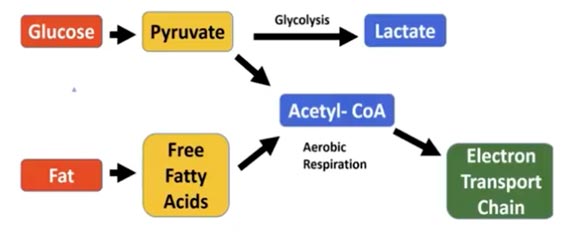
First, the glucose is metabolized into pyruvate. The pyruvate can then either enter the glycolysis pathway in the cytoplasm of the cell and produce lactate, or it can be converted into acetyl-CoA and shuttled to the mitochondrial electron transport chain.
There are many factors involved in cancer formation. It’s most assuredly not as simple as “cancer thrives on sugar.” Cancer cells can survive and thrive on protein and fats as well. Cancer cells simply use the glycolysis pathway — the same pathway glucose goes through when your glucose metabolism is impaired in the mitochondria.
This is the same pathway that your body uses when it reaches its limit to produce ATP in the mitochondria, which is the most efficient and least damaging way to produce energy. The downside is that this pathway is fine for normal activities, but when you engage in activities that exceed your mitochondria’s energy-producing capacity, like high intensity exercises, then glycolysis is the healthy and normal way your body produces energy.
Oxygen, Glucose and Cancer Metabolism Explained
In the case of vigorous exercise, your mitochondria are not really impaired, but merely maxed out, as they have reached their threshold to produce ATP when oxygen is present. They simply are unable to supply your body’s demand for energy. It is like driving a car with the gas pedal pushed to the floor and it simply is unable to go any faster, so the backup pathway must be activated.
The backup system is glycolysis, which creates energy very quickly but is highly inefficient and wastes loads of resources, does not produce CO2, and creates reductive stress by generating lactate. In this situation, this is not a problem, as it is a backup and you’re not going to be sprinting for very long and can easily recover from this relatively short-term abuse, which has many hermetic health benefits.
The state of mitochondrial physiology that Warburg accurately identified occurs when your body has enough oxygen and the mitochondria are not maxed out, yet still uses the backup glycolysis pathway. This, my friends, is also called cancer metabolism.
It gives the false impression that cancer is using glucose to supply its metabolic needs for energy, but it is merely an optical illusion. Even brilliant research scientists like Dr. Tom Seyfried, a leading expert on the theory of cancer as a metabolic disease, are confused about this. I would love to interview Tom about this, but he and most are so conformationally biased, they refuse to reconsider their position on this point.
What Causes Your Body to Switch to the Warburg Effect?
This is the crux of the problem that virtually no one in health understands. Why on earth would your body do such a foolish thing as to burn glucose in the inefficient and pathology-producing backup glycolysis pathway and not in your mitochondria? If you understand the answer to this question, you will know more about molecular biology than virtually every physician, including nearly all functional medicine doctors.
The primary reason it fails to burn glucose in your mitochondria is that the mitochondria are seriously damaged and have what is termed mitochondrial dysfunction. This is the result of the electron transport chain (ETC) being backed up with an excess of electrons that are unable to flow easily through the five complexes. This is a condition known as reductive stress, which refers to an excess of negative charges due to the electrons.
Your body has no choice but to use the backup system, glycolysis, when the mitochondria have maxed out their capacity to produce energy. If it fails to use the backup system, you will not create enough ATP and you will simply die because your body must have fuel to run its metabolism. It is the same thing that happens to a fire when it runs out of fuel.
This is the real Warburg Effect. Nearly everyone believes that cancer feeds on sugar, but that is simply inaccurate. The truth is the polar opposite. Cancer cells have such seriously damaged mitochondria they are simply incapable of burning sugar in the mitochondria and must rely on the backup system to survive.
This is why the most effective strategy is to not jump to low carb keto to avoid feeding the cancer, but rather to use metabolic therapies that fundamentally address why the cells are unable to oxidize sugar in the mitochondria.
Once you fix the mitochondria and allow the cancer cells to metabolize glucose in the mitochondria, the cancer regresses back to normal healthy cells because the mitochondria work again and they don’t require to use the emergency backup system.
Refined sugars and many starches are more likely to cause gut dysbiosis that leads to the production of endotoxin. This endotoxin is one of the factors that destroys mitochondrial function, resulting in cancer metabolism (the Warburg Effect), where glucose is burned through glycolysis.
What Causes Mitochondrial Dysfunction?
There are many factors that contribute to this, but I can strongly assure you that a diet including a moderate amount of healthy ripe fruits is not one of them. The fruits are actually part of the cure for cancer. There are four primary contributors to mitochondrial dysfunction:
- Excess linoleic acid (LA)
- Estrogen dominance
- EMFs
- Endotoxin
These all play major roles, but excess LA and estrogen dominance are clearly the leading contributors resulting in the vast majority of cancers resulting from mitochondrial dysfunction. This is largely because LA and estrogen negatively impact your body in many similar ways. They both:
- Increase free radicals that cause oxidative stress and damage your mitochondria’s ability to produce energy.
- Increase calcium intake inside the cell that causes an increase in nitric oxide and superoxide that increases peroxynitrite that also increases oxidative stress.
- Cause an increase in intracellular water causing your body to retain water.
- Slow down your metabolic rate and suppress your thyroid gland.
Nearly everyone in the developing world has 10 times the amount of LA in their tissues than their ancestors of 100 years ago had. This PUFA is very susceptible to oxidative damage and produces free radicals like reactive aldehydes in your body that destroy your mitochondria.
These toxic metabolites of LA create enormous amounts of reductive stress as a result of electrons building up in the ETC and blocking the forward movement of electrons to complex IV and V to create ATP.
And, because LA is embedded in the inner mitochondrial membrane, it gets damaged and leaks protons that normally build up in the inner mitochondrial space. This proton gradient is responsible for driving the nano motor in complex V to create ATP. Both processes combine to shut down and ultimately prematurely destroy the mitochondria.
Finally, when you eat carbs like starches, they can end up feeding bacteria in the intestine, which creates endotoxin that is a potent mitochondrial poison.
Refined Sugars Versus Sugar From Whole Foods
Now, when it comes to sugar feeding cancer, this really only applies to refined sugars, as well as many starches, because they are a common cause of endotoxin production in your gut.
As mentioned, endotoxin destroys mitochondrial function and results in cancer metabolism, whereas natural fructose does not typically result in the production of endotoxin. This is one of the primary differences between refined sugar and fructose from ripe fruit and helps explain why refined sugars fuel cancer while natural sugars don’t.
Now, if you have healthy mitochondria (which most people do NOT have) then refined and sugar from whole foods like ripe fruit would be burned in the mitochondria. The problem is, over time, the starch or refined sugar will increase endotoxin, which will prevent the mitochondria from burning any glucose well, whether from fruit or high fructose corn syrup.
The Best Fuel for Mitochondria and the Role of Carbs in Your Body
In the end, the fundamental health truth is that glucose is the ideal fuel for your mitochondria and the one that will create the most energy with the least amount of “exhaust” in the form of free radicals causing oxidative stress that damages your mitochondria, cell membranes and proteins. It will also create the most carbon dioxide in your body which is highly beneficial for your health.
Many mistakenly believe, like I previously did, that fat is the ideal fuel in your mitochondria, but that would be a serious mistake. Fat is an important and crucial fuel that many cells, like your heart, rely on, but it never was designed to be your primary fuel. It is merely a backup fuel to keep you alive long enough until you can find some healthy carbs.
Carbs are so important that if you don’t eat any, your body will make between 150 to 250 grams a day because your brain requires sugar. Without sugar you will go into a hypoglycemic coma and die. So, to keep yourself alive if you aren’t consuming carbs, your body will release stress hormones like glucagon, adrenaline and cortisol that will shred the protein from your muscles and bones to send to your liver to make glucose.
Solutions
This is really a mind-bending new way of viewing carbs, and it took me nearly a year to wrap my head around it. I have posted a podcast with osteopath Dr. Jay Feldman at the top of this page that I believe you will help you understand it better. More than likely, you will need to listen to it a few times. I listened to it five or six times and may review it a few more times, it’s so good. In closing then, the solutions, if you want to lower your risk of cancer, would be to:
- Lower your LA intake as low as possible by avoiding processed foods, seed oils, chicken, pork, seeds and nuts
- Making sure you’re eating healthy carbs such as ripe fruit
- Optimizing your mitochondrial function in general
- Decreasing lactate production and increasing carbon dioxide, as they have opposing effects.2 You can learn more about this in “The Biology of Carbon Dioxide“
Crucial Facts About Your Metabolism
Reproduced from original article:
https://articles.mercola.com/sites/articles/archive/2023/11/12/mitochondria-glucose-metabolism.aspx
The original Mercola article may not remain on the original site, but I will endeavor to keep it on this site as long as I deem it to be appropriate.
Analysis by Dr. Joseph Mercola November 12, 2023
STORY AT-A-GLANCE
- Cortisol is primarily a rescue hormone. It’s a glucocorticoid, so it increases your glucose level by shredding your muscle protein to produce glucose. Cortisol also accelerates the aging process and is implicated in most chronic diseases. It also uses your brain tissue to use amino acids to make glucose which contributes to brain atrophy and subsequent depression
- Your mitochondria can only burn one fuel at a time — either fat or glucose — and there’s a stealth switch that controls which of these fuels your mitochondria will burn. This switch is known as the Randle cycle
- Ideally, you want to metabolize (burn) glucose in your mitochondria, as this only generates 0.1% reactive oxygen species (ROS). This route also generates energy most efficiently, creating 36 to 38 adenosine triphosphates (ATP) for every molecule of glucose that is metabolized. For this to occur, you need to consume less than 30% of your calories as fat
- When you consume significantly more than 30% fat, the switch changes to burn fat in your mitochondria. As a result, glucose then backs up into your bloodstream, raising your blood sugar. This is a major contributor to diabetes
- When you lose muscle, your basal metabolic rate goes down, so it’s important to maintain muscle mass, because your muscle will burn fat even when you’re resting
In this interview, repeat guest Georgi Dinkov and I will again take a deep dive into the biochemistry of human metabolism. Dinkov is a student of the late Ray Peat, a biologist, thyroid expert and pioneer in prometabolic therapy and human metabolism.
Despite having a degree in computer science and having no formal academic training in health, Dinkov essentially has acquired a Ph.D. in molecular biology. After graduating from Georgetown University in 2002, Dinkov got a job as a programmer at the National Biomedical Research Foundation (NBRF).
There, he helped develop uniprot.org, a database of all known protein sequences. Surrounded by dozens of the brightest doctors and biochemists in the world, he developed an interest in biochemistry.
Clearing Up Confusion
I have long promoted a low-carb, high-fat diet for many years and have realized many are confused on the evolution of my recommendations. As I say in the interview, 95 to 97% of the population in the U.S. is metabolically inflexible and would likely benefit from a low-carb, high-fat keto approach with intermittent fasting.
However, once you have resolved your insulin resistance, which typically takes a few months but can take longer, and can optimally burn fat for fuel, it is very clear to me that you need to cycle carbs back into your diet. There are loads of questions about how this transition occurs, the timing of the transition, and the details of the cycling that need to be answered.
No one knows the answers, as the studies have not been done, but I am fairly convinced that many people will appear to do well in the long term on a low-carb, high-fat keto program like I did. However, I also believe they would do even better if they started to include more healthy carbs in their diet like I did. That does not mean processed foods or processed sugars, or virtually all grains and legumes. The ideal carbs are ripe fruits.
You should introduce carbs slowly and only after you have shifted your fat level down to 30%. This is easily calculated by using a free online program called Cronometer. If you still struggle with diabetes or obesity, then you can get your fat level down to 15 to 20% of your total calories.
Protein level should always remain the same and does not change from 0.7 to 1 gram protein/kg of lean body weight. So, if you are 20% body fat then you would multiply your body weight by 0.8 to get your lean body mass.
In my case, it took me about three to six months to go from 100 grams of carbs to 500 grams. The results for me were quite spectacular. I was already healthy, but it clearly improved my health even further as my body fat dropped from 15% to 12%, my inflammation decreased to radically low levels as my HS-CRP went from 0.8 to 0.18 which is almost below detection levels. Finally, even though I was not prediabetic as my blood sugar was in the low 90s, it dropped by 10 points to the low 80s.
The reason I made this shift is I was overwhelmed by the amount of strong scientific support for demonstrating that the ideal fuel in your mitochondria is indeed glucose, not fat. It has to do with decreasing reductive stress in your mitochondria which is a relatively unknown concept in molecular biology.
When implementing the transition to healthy carbs you need to be careful not to eat too many carbs as excess carbs will be shunted to glycolysis and into glucose into your blood and lead to an increased blood sugar. The more muscle mass you have and the more exercise you do, the more carbs you can eat.
I suspect most people could easily transition to 200 grams of carbs. I seem to do well with about 500 grams, mostly all fruit but do have white rice and red potatoes as well. You should see my shopping cart as every week it is loaded with about 60 pounds of fruit.
The Cortisol-Glucose Link
For example, Dinkov helped me understand the crucial role cortisol plays in glucose regulation. Cortisol is primarily a rescue hormone. It’s a glucocorticoid, and as the name implies, it increases your glucose level, because if your glucose level drops too low, you will go into a hypoglycemic coma and can die.
As such, cortisol is a lifesaver. The downside is that it uses up vital protein to make glucose, so high cortisol takes a toll on your muscles. The reason anabolic steroids build muscle mass is because they’re anti-cortisol. You would’ve thought anabolic steroids would have some direct action on the muscles, but no, they primarily inhibit cortisol’s catabolic impact.
Cortisol uses muscle protein to produce glucose in your liver, so when your glucose level drops, cortisol rises and shreds muscle to produce glucose. This is one of the puzzle pieces that explains why you don’t want your glucose levels to be low over prolonged periods.
Cortisol also accelerates the aging process and is implicated in most chronic diseases. In the case of Addison’s disease (adrenal failure), the opposite is present: low cortisol. These patients are typically required to take cortisol injections on a regular basis. On the upside, this chronic cortisol deficiency tends to impart a youthfulness. In most other chronic conditions, high cortisol is part of the problem.
Download this Article Before it Disappears
High Cortisol Speeds Aging
Dinkov comments:
“Studies as far back as the 1950s and 60s demonstrated that you can produce every single phenotype of aging if you inject cortisol, or at least create a state of relative glucocorticoid excess in the animal.
You can do that either by injecting synthetic or natural glucocorticoids, or by increasing the levels of natural anti-cortisol steroids in the body. Those are progesterone and DHEA, and in males testosterone and dihydrotestosterone.
It has been shown that cortisol levels do not decline with age unless you really have adrenal failure, while the levels of all these anti-cortisol, youth-promoting hormones decline with age. By the time you’re 80, their levels are at about 20% of what they used to be when you were in your 20s.
So, really, what happens is that cortisol stays the same, but your relative state of cortisol increases because there’s nothing to oppose the cortisol that is already there. Multiple intervention studies have demonstrated that if you administer agents that oppose cortisol, block it at the receptor level, or reduce its synthesis, you can achieve really good health results and also improve the way you look.
Anabolic steroids are probably the best known example. It’s really a misnomer because they’re not anabolic. They’re actually anticatabolic. Muscle has one of the highest expressions of the glucocorticoid receptor, through which cortisol shreds the muscle. It binds the receptor and increases a number of different proteolytic fibers.”
High Cortisol Linked to Depression
Your gastrointestinal tract and brain also have high numbers of glucocorticoid receptors, so cortisol shreds brain tissue as well, causing brain atrophy and subsequent depression. Research has shown that people with depression have smaller brain volumes than people who don’t have depression.
“Within 48 hours of the glucocorticoid blocker RU-486 being administered to people with clinical treatment-resistant depression, they experienced remission. So I think it’s a very good argument that cortisol is catabolic to the brain, and clearly, if it’s catabolic to the brain, it’s probably not going to improve your mood. If anything, it’s going to worsen it.”
Again, when your blood sugar level drops, that triggers your body to increase cortisol, which is the last thing you want if you struggle with depression or other chronic disease. Really, one of your primary goals in achieving optimal health is to limit the elevation of your cortisol. It’s far more destructive than having elevated blood sugar, which most focus on.
High Cortisol Is Far Worse Than High Blood Sugar
Many wear continuous glucose monitors that check your glucose level every five to 10 minutes. But high glucose is not the real danger here. Cortisol is, and it rises when glucose drops too low. As noted by Dinkov:
“All the drugs on the market, especially the more recent ones that lower HB A1C, the glycated hemoglobin, all of them increase mortality. So, clearly, messing directly with the levels of blood glucose, it’s not something you want to do.
You may temporarily decrease the biomarker, the glycated hemoglobin, but it does not mean you’re getting healthier. [These drugs] may lower your blood glucose, but they may kill you in the long run faster than the elevated glucose would’ve done by itself.”
Metformin is one classic example. Many are using this drug to lower their blood sugar. While it’s a natural product, and considered safe, it’s basically a mitochondrial toxin that will make your health decline in the long term.
All of that said, we’re NOT saying you should ignore elevated blood glucose. Absolutely not. But elevated glucose is a symptom that is best addressed indirectly. Once you address the foundational cause, it will normalize by itself. As a personal anecdote, when I first interviewed Dinkov, 70% to 80% of my diet was fat. Now, I’m down to 27% fat and 57% carbohydrates, and I’ve lost 5 pounds and my fasting blood sugar is down by 10 points.
So, it’s not the carbohydrate ingestion that’s causing high blood sugar. It’s what’s happening at the mitochondrial level. To help you understand that, I created a graphic (below) because this science can get somewhat complex.
The Randle Cycle
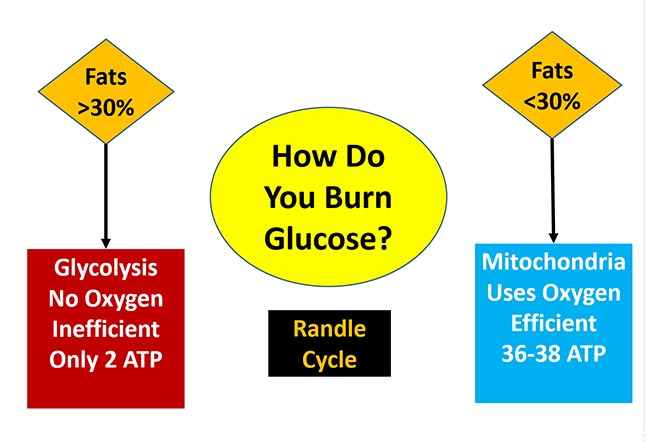
Your mitochondria can only burn one fuel at a time — either fat or glucose. Fats are broken down in a process called beta oxidation into acetyl-CoA, which gets fed into the Krebs cycle. Carbs are broken down to pyruvate, which cannot enter the electron transport chain until it is converted to acetyl-CoA by pyruvate dehydrogenase.
The key here is that there’s a stealth switch that controls which of these fuels your mitochondria will burn. The switch has been given the name the Randle Cycle, but it is more helpful to visualize it as a railroad switch that changes the tracks of the train. The train can only travel down one track: not both. This is because only one type of fuel can be burned at a time.
In a best-case scenario, you will metabolize, or burn, glucose in your mitochondria without any reductive stress. When you do this, you will only generate 0.1% reactive oxygen species (ROS).
Not only does this route generate less ROS, but it also is incredibly efficient at energy production by creating 36 to 38 adenosine triphosphates (ATP) for every molecule of glucose that is metabolized. It will also generate metabolic water and carbon dioxide, which are also important for your health.
For this to occur, as indicated in the figure above, you will need to consume less than 30% of your calories as fat. When you consume significantly more than that amount, the switch changes to burn fat in your mitochondria and you will not be able to burn glucose until your fat decreases to less than 30% of calories.
When your fat intake is higher than 30%, pyruvate is inhibited and unable to readily convert the glucose metabolite, pyruvate, into acetyl-CoA to be shuttled into the mitochondria to burn as fuel.
Consequently, glucose can back up into your bloodstream, raising your blood sugar. What little glucose is burned for fuel is done through glycolysis, which is a primitive pathway that bacteria and cancer cells use, and it generates the powerful metabolic reductant lactate.
This can be a major contributor to diabetes. If you’re exercising, healthy and doing strict keto, overt diabetes is unlikely to develop, but more than likely you will have fasting glucose in the 90s, rather than the more optimal 80s.
Additionally, chronically oxidizing fats as your primary fuel will tend to increase your cortisol level, resulting in chronic inflammation, both of which accelerate the aging process due to excess ROS generated in the mitochondria that occurs from increased reductive stress as a result of oxidizing fat instead of sugar.
It is great that we have this glycolysis pathway, as you absolutely need it for quick fuel when you are activating your Type 2 muscle fibers. But if this is the primary way you burn glucose, you are in a catastrophic metabolic state because you’re creating loads of lactate as a waste product instead of healthy CO2 and metabolic water.
What’s more, you’re only generating two ATP for every molecule of glucose, which is 95% less energy. Lactate increases reductive stress, which causes reverse electron flow in the mitochondria and increases the ROS to 3% to 4%, which is 30 to 40 times more than when glucose is burned efficiently in the mitochondria at 0/1% ROS.
When Adding Carbs, Reduce Your Fat Intake
Ideally, it is best to lower your fat intake and replace those calories with healthy carbs like ripe fruit. You likely won’t optimize your mitochondrial function, though, until your fat level decreases to 30% of your total calories. So, hold off on making a final decision about whether this change is helping you or not until you get your fat level to 30% or lower.
This is easily calculated by using a free online program called Cronometer. If you still struggle with diabetes or obesity, then you may need to get your fat level down to 15% to 20% of your total calories.
Protein Versus Fat and Carb Requirements
Determining the ideal balance between carbs and fats is the primary challenge for most people. The level of protein is a bit simpler. It tends to be about 15% of daily calories and remains stable. A basic guideline for protein intake is somewhere between 0.7 grams and 1 gram per kilogram of lean body mass (not total weight).
The level of dietary fat you need will depend on your endocrine balance. If you’re diabetic, for example, you may need to go below 20% to avoid shutting down your glucose metabolism. Dinkov comments:
“If you look at older people, and sick people as well, they have metabolic inflexibility. So, if you give them a meal that’s comprised of equal number of calories of carbs and fats, they’re going to oxidize mostly the fats and the carbohydrates will go unmetabolized.
So, they’ll raise their blood glucose and lactate. So, you need to play with the ratio, but I’ve noticed that between 15% and 20% is probably where most people in their current health state can metabolize the fat without causing problems through the Randle Cycle.
Most diabetics are overweight … which means they have plenty of supply of fat. In fact, they have two sources of fat: one through the diet, and the second one from their fatty tissue, because there’s always some lipolysis going on, which means shredding the fatty tissue and supplying the rest of the body with the fatty acids from a fatty tissue …
In the rested state, your muscles actually prefer to oxidize mostly fat. So, if you have a decent amount of muscle mass, you can actually burn most of this fat through the baseline lipolysis by simply resting and preferably raising the amount of lean muscle mass you have. The ratio of lean muscle mass to total body weight is the primary determinant of your basal metabolic rate. So it’s very important to not lose lean muscle mass …
So, for diabetic people, it’s probably a good idea to lower the intake of fat from the diet because they already have a lot coming from their own bodies. In fact, there are many clinics around the world that treat and even cure Type 2 diabetes by putting diabetics on this really restrictive diet until they lose most of their fat and then suddenly the metabolism of glucose gets restarted.
I think this directly shows you that it wasn’t the glucose that was fattening them up and causing the problems, rather they had too much fat in their bodies. Once you get rid of that fat, no matter how you do it … the problems with metabolizing glucose disappear.”
Signs of Excessive Fat/Insufficient Carb Intake
As explained by Dinkov, one of the reasons why obese people who lose a lot of weight end up gaining it all back, even when they continue to diet and exercise, is because most of the weight lost is actually muscle mass. When you lose muscle, your basal metabolic rate decreases, meaning you need fewer calories to maintain your weight.
As a result, you must stay on an extremely low-calorie diet to maintain your weight. So, again, it’s crucial to maintain muscle mass, because your muscles will burn fat even when you’re resting. During activity, especially strenuous activity, your muscles will burn mostly glucose.
“I think the best way to gauge if you are eating too much fat is cognitive function,” Dinkov says. “If you’re eating too much fat, to the point where you’re interfering with glucose metabolism, you’ll start getting brain fog. Your thinking process will slow. You’ll start searching for words. Your reaction time and coordination time will decrease.
Sleep quality is another. Also, exercise capacity. If you’re always catching your breath and you’re feeling fatigued all the time, that is actually a great sign/symptom of elevated lactate. In fact, many different interventions that lower lactate are used as performance improving substances, such as vitamin B1 and niacinamide …
I would say eat the more fat-heavy meals earlier in the day, for breakfast and maybe lunch, and then eat the more carb-heavy meals at night, because your brain and many of the other organs will really need that.
It’s very common that if you don’t consume sufficient amount of carbs before going to bed, you will have trouble sleeping … I think one of the reasons for this is that, if you don’t consume sufficient amount of glucose, you will raise cortisol at night, and cortisol is already higher at night than it should be.
The cortisol is lowest at around 3 or 4 p.m. and starts rising with the coming darkness. Cortisol is highest at around 6 to 8 a.m. in the morning. But if you don’t consume a sufficient amount of carbs, that cortisol will be up to 40% higher.”
Clean Carbs
Of course, when we say “eat more carbs,” we don’t mean pizza and doughnuts or even ostensibly healthy grains like whole wheat. Healthy or “clean” carbs include foods like ripe fruit, raw honey and maple syrup. Tropical fruits such as papaya, watermelon, oranges and tangerines are preferable, as in addition to higher levels of fructose, they also contain flavonoids that help to digest the sugars. Ripe melon, apples, peaches, plums, pears and grapes are also good.
Now, you’ve probably heard me say that you shouldn’t eat anything at least three or four hours before bedtime to optimize autophagy. Dinkov’s research, however, dispels some of the concerns about eating (clean) carbs before bed.
“You do not want to mess with autophagy too much,” Dinkov says. “It has a lot of beneficial effects in terms of getting rid of dead or metabolically deranged tissue. However, if you do have an already present tumor, autophagy and AMPK can actually drastically increase its aggressiveness and promote metastasis.
But let’s say you do want to increase autophagy. I think it’s a bit of a myth that eating will somehow suppress autophagy and put it at a suboptimal level. Several studies demonstrate that several of the carbohydrates — including fructose and sucrose — are autophagy enhancers.
I would say, [eat healthy carbs] an hour before bed, because if you eat a meal that’s too high in carbohydrates, there’s the infamous fructose malabsorption. There’s only a certain amount of carbohydrates that your gastrointestinal tract can absorb per unit of time.
So, you need about an hour or two before the meal, if it’s composed of simple carbohydrates, to get these things into your bloodstream. At that point, you’ll probably be very relaxed and naturally inclined to fall asleep.”
That fructose and sucrose enhance autophagy is probably news to most of you. It was to me. I personally eat a teaspoon of honey before I go to bed, which seems to be enough carbs to thwart an increase in cortisol and helps me get more deep sleep. So, to summarize, Dinkov suggests eating a small amount of healthy carbs, such as fruit, about an hour or two before bed to optimize sleep and, potentially, autophagy as well.
Serotonin Is Not Your Friend
Fruits to be consumed in small amounts include pineapple and bananas, as both contain serotonin. Bananas also contain tryptophan, which is used in the synthesis of serotonin.
While most people think of serotonin as a mood-booster, it’s actually one of your worst enemies. You do not want high levels of serotonin, because it’s an antimetabolite. This means it suppresses your body’s ability to create energy in your mitochondria in the electron transport chain, so you become tired and fatigued, your metabolic rate slows and you gain weight.
“The amount of serotonin we need is really, really low,” Dinkov says. “The biggest role of serotonin is gastrointestinal motility. Any increase, even minor increase of serotonin, has been known since the 1920s to rapidly lead to fibrosis. The most successful antifibrotic drugs on the market currently are serotonin blockers.”
More Information
For more details on the topics summarized here, be sure to listen to the entire interview, and keep your eyes peeled for Part 2, which will follow shortly. Also check out Georgi’s blog at www.haidut.me or follow him on Twitter. He also has hundreds of videos on YouTube on a plethora of topics. A major sampling of Ray Peat’s work is also available for free on these two sites: wiki.chadnet.org/Ray-Peat and RayPeat.com.
Obesity Study: ‘Fat but Fit’ Is a Myth
Reproduced from original article:
https://articles.mercola.com/sites/articles/archive/2023/10/20/metabolically-healthy-obesity-myth.aspx
The original Mercola article may not remain on the original site, but I will endeavor to keep it on this site as long as I deem it to be appropriate.
Analysis by Dr. Joseph Mercola October 20, 2023
STORY AT-A-GLANCE
- An estimated 15% to 20% of obese individuals have none of the metabolic derangements associated with obesity, such as high blood sugar, high blood fats, high blood pressure and Type 2 diabetes. This has led to the idea that you can be obese yet in good health
- According to recent research, “metabolically healthy obesity” (MHO) is a fallacy. Obese individuals, even without metabolic risk markers, are at increased risk of diabetes and heart disease
- High body mass index (BMI) in combination with normal glucose and lipid levels, and the absence of high blood pressure, is not sufficient for MHO classification. Rather, it’s the behavior of the adipose tissue that matters. People with normally sized adipocytes (cells that store fat), have far fewer obesity complications compared to those who have enlarged and inflamed adipocytes
- Where you store most of your fat also matters. Obese individuals with large visceral fat stores, meaning the fat is primarily stored around their internal organs, are far more likely to develop Type 2 diabetes than those whose fat stores are distributed more evenly around their body
- Obesity is a state of energy deficiency due to inhibited mitochondrial respiration, which causes calories to be stored as fat instead of being burned for fuel. The solution is to optimize your mitochondrial function and raise your metabolic rate
Can you be fat and still be fit? An estimated 15% to 20% of obese individuals have none of the metabolic derangements associated with obesity, such as high blood sugar, high blood fats, high blood pressure, Type 2 diabetes and other risk factors for cardiovascular disease.1
This phenomenon has led to the idea that you can be obese yet in good health. But according to recent research,2,3,4 this popular belief — known as “metabolically healthy obesity” (MHO) — is a fallacy. As reported by studyfinds.org:5
“The myth of being ‘fat but fit’ is, again, being debunked by a new study. Researchers found that obese individuals, even if they appear healthy, have an increased risk of diabetes and … are still 50% more susceptible to coronary heart disease.”
No Such Thing as ‘Fat and Fit’
According to professor Matthias Blüher, who presented the findings at the 2023 Meeting of the European Association for the Study of Diabetes,6 high body mass index (BMI) in combination with normal glucose and lipid levels, and the absence of high blood pressure, is not sufficient for MHO classification. Rather, it’s the behavior of the adipose cells that matters.
People who have normally sized adipocytes (cells that store fat), have far fewer obesity complications compared to those who have enlarged and inflamed adipocytes.
Dysfunctional adipocytes can result in fibrosis and the release of harmful molecules that contribute to organ damage. Fat-secreted hormones, known as adipokines, can also directly affect cells in your vascular system, leading to atherosclerosis.
Where you store most of your fat may also be key. Obese individuals with large visceral fat stores, meaning the fat is primarily stored around their internal organs, are far more likely to develop Type 2 diabetes than those whose fat stores are distributed more evenly around their body, the study found. Other studies have also confirmed this.7
What this means in practical terms is that obese patients still need to focus on losing weight and may need other preventive treatments as well. In an October 3, 2023, press release, Blüher explained:8
“So there is still a residual increased risk for those people living with obesity, even with what we would call metabolically healthy obesity.
Even in the absence of other cardiometabolic risk factors, increased fat mass and adipose tissue dysfunction contribute to a higher risk of Type 2 diabetes and cardiovascular disease. Therefore, weight management and recommendations for weight loss are still important for people living with metabolically healthy obesity.”
Other Studies Concur
Other recent research has come to the same conclusion. A prospective cohort study of 381,363 British participants, published in 2021, found that:9
“Compared with people who were not obese at baseline, those with MHO had higher incident HF [heart failure] (HR [hazard ratio] 1.60 …) and respiratory disease (HR 1.20 …). The associations of MHO were generally weaker for fatal outcomes and only significant for all-cause (HR 1.12 …) and HF mortality rates (HR 1.44 …).
However, when compared with people who were metabolically healthy without obesity, participants with MHO had higher rates of incident diabetes (HR 4.32 …), ASCVD [atherosclerotic cardiovascular disease] (HR 1.18 …), HF (HR 1.76 …), respiratory diseases (HR 1.28 …) and all-cause mortality (HR 1.22 …) …
Conclusions/interpretation: Weight management should be recommended to all people with obesity, irrespective of their metabolic status, to lower risk of diabetes, ASCVD, HF and respiratory diseases. The term ‘MHO’ should be avoided as it is misleading and different strategies for risk stratification should be explored.”
Download this Article Before it Disappears
Excess Calorie Intake Is Not the Cause of Weight Gain
In the Energy Balance Podcast above, independent health researchers Jay Feldman and Mike Fave explain why eating too much and exercising too little is not the reason for weight gain. Jay is one of the best teachers of the Bioenergetic view of health. I would strongly encourage you to listen to his YouTube channel, but watch the oldest ones first so you can get grounded in the basics.
Obesity is a state of energy DEFICIENCY due to inhibited mitochondrial respiration, which causes calories to be stored as fat instead of being burned for fuel. The solution, therefore, is not to eat less and exercise more. Rather, it’s to optimize your mitochondrial function and raise your metabolic rate.
This inefficient burning of fuel (metabolizing of food) is why people who are obese typically also struggle with other health issues, such as low energy, fatigue, an inability to maintain focus, digestive problems and poor immune function.
The Bioenergetic View of Energy
As explained by Feldman, “energy,” in terms of the human body, primarily refers to your ATP level. So, ATP equals energy. The conventional view is that calories equal energy, but that’s a misconception, because calories come from three primary substrates (fat, glucose and protein), and they do not produce the same amount of ATP calorie for calorie.
Another major misconception is that when you’re gaining weight, you’re converting all your fuel (from food) into ATP and simply don’t need any more (typically because you’re not active enough), and so the excess energy is stored as body fat instead of being burned.
What actually happens is that you have a problem converting the fuel you consume into energy, so the fuel gets stored as body fat instead. In other words, you’re not producing enough energy and are in an energy-deficient state. So, it’s not excess ATP/energy that gets stored. It’s the fuel that is stored, and it’s stored because your body cannot efficiently metabolize it.
The end result is excess body fat AND insufficient energy, which in turn forces your body to downregulate other systems, such as your thyroid activity and reproductive hormones — anything that is not essential for survival.
You’re also cursed with perpetual hunger because the hunger signal is predominantly regulated by energy availability. This in turn leads to overeating, resulting in a vicious cycle of low energy and weight gain.
Decreased Energy Causes Obesity
A study10 was recently published in the International Journal of Molecular Sciences, attributing obesity to broken mitochondria. As noted by the authors:
“An important component of the pathogenesis of the metabolic syndrome is mitochondrial dysfunction, which is associated with tissue hypoxia, disruption of mitochondrial integrity, increased production of reactive oxygen species, and a decrease in ATP, leading to a chronic inflammatory state that affects tissues and organ systems.”
In the podcast, Feldman cites an earlier study, published in 2003 in the Journal of Theoretical Biology, titled “Decreased Energy Levels Can Cause and Sustain Obesity.” An excerpt from the abstract reads:11
“Current theories consider obesity a result of overeating and sedentary life style and most efforts to treat or prevent weight gain concentrate on exercise and food intake. This approach does not improve the situation as may be seen from the steep increase in the prevalence of obesity.
This encouraged us to reanalyze existing information and look for biochemical basis of obesity … We began with the contradictory information: in obesity, more calories are consumed than used up, suggesting that obese people should have excess energy.
On the other side, obese people experience fatigue and decreased physical endurance that indicates diminished energy supply in the body. The result of our work is a chain of metabolic events leading to obesity.
The crucial event is the inhibition of the TCA [tricarboxylic acid] cycle at the step of aconitase. It disturbs energy metabolism and results in ATP deficiency with simultaneous fat accumulation.
Further steps in obesity development are the consequences of diminished energy supply: inhibition of beta-oxidation, leptin resistance, increase in appetite and food intake and a decrease in physical activity.
Thus, our theory shows that obesity does not have to be caused by overeating and sedentary life-style but may be the result of the ‘obese’ change in metabolism which is forcing people to overeat and save energy to sustain metabolic functions of cells. This ‘obese’ change is caused by environmental factors that activate chronic low-grade inflammatory process in the body …”
The screenshot below can be helpful. On the left is what normal metabolism looks like. The food you eat is turned into fuel, some of which is burned for energy and some of which is stored as body fat. When needed, body fat is also burned as fuel and converted into energy.
On the right is the “obese” metabolism. The primary differences here are the dotted arrows. The food consumed is turned into fuel, but very little of that fuel is converted into energy. Most of it is instead shuttled into fat storage, and because the metabolism is so inefficient, the stored fat is not released and burned for energy.
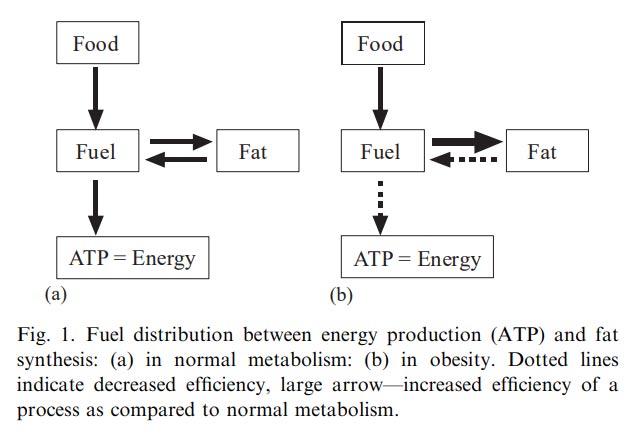
Many Normal Weight People Have Deranged Metabolism Too
As explained by Feldman, not only do obese individuals have this deranged metabolism, but many normal weight people do too. People who exercise a lot, or fast, or eat a low-carb diet may appear to have healthy metabolism because they’re not overweight, but the real reason they’re not overweight is because they’re forcing the conversion of fuel to energy through STRESS.
So, while they may not accumulate body fat, they still struggle with an energy deficiency, which can present as fatigue, brain fog, low mood, hormonal dysfunction and more.
As noted by Feldman, the bioenergetic solution to these problems is to improve the conversion of fuel to energy, “which means you have the energy available to properly function in terms of all your organ systems — your digestion, your reproductive systems, cognitive function, all of that.”
Endotoxin and PUFAs Decimate Mitochondrial Energy Production
One key strategy to optimize your mitochondrial energy production is to remove blocks in the electron transport chain so that electrons can move smoothly forward, without accumulating and backing up.
Endotoxin (lipopolysaccharide or LPS) and other bacterial toxins are among the biggest culprits when it comes to things that hinder mitochondrial energy production. These toxins can directly impair electron transport through the complexes of the electron transport chain. They can also impair certain enzymes in the Krebs cycle.
The primary solution for obesity and most other conditions is to raise your metabolic rate, and a key strategy for that is to remove blocks in the electron transport chain. Endotoxin and polyunsaturated fats (PUFAs) are two key culprits that need to be eliminated.
Poor digestion is frequently associated with negative gram bacteria in your gut that produce endotoxin, and this will inhibit your ability to convert food to energy, resulting in increased body fat. So, it’s important to reduce your endotoxin load. Aside from poor digestion, excess endotoxin is also a common culprit in degenerative conditions, metabolic syndrome, diabetes and fatty liver. To reduce your endotoxin load:
- Rebalance your gut microbiome by reintroducing beneficial bacteria (probiotics and prebiotics). One of the best and least expensive ways to do this is to eat a serving of fermented vegetables each day.
- Temporarily go on a low-fiber diet and avoid fiber supplements as it can feed undesirable bacteria. Avoid all vegetables temporarily and use fruit juice as your source of calories until your gut microbiome improves. Once it improves you can gradually add in whole fruits.
Once your microbiome is balanced and symptoms of poor gut function have resolved, you can slowly reintroduce starches like white rice and, if tolerated, progress to very well-cooked vegetables. Always cut back if you have signs of indigestion like belching, bloating or gas as this suggests you are not digesting those carbs yet.
Another effective blocker of mitochondrial energy production is polyunsaturated fat (PUFA). These are your processed seed oils, canola oil being among the worst of the worst. Seed oils are loaded with linoleic acid, an omega-6 PUFA, which appears to be one of the primary drivers of chronic diseases, in part due to its detrimental impact on your mitochondrial function and energy production.
So, you’ll want to severely limit your consumption of PUFAs. In addition to not cooking with them, this also means abstaining from processed foods, most of which are loaded with these harmful fats.
Rescue Remedies
While there are no magic pills to fix slow metabolism or low energy production, there are some that can help. I’ve previously written about the usefulness of niacinamide, for example. Another helpful one is methylene blue, which can both accept and donate electrons.
So, if you have blocks in the electron transport chain where most of the ATP is produced, say endotoxin or PUFAs, methylene blue can bypass those blocks, allowing your mitochondrial to produce energy anyway.
How to Gauge Your Metabolic Rate
According to the rate-of-living theory, the higher your metabolic rate — which means the quicker the electrons move from food toward oxygen, which is the final acceptor of electrons — the faster you’ll age because there’ll be higher oxidative stress.
However, deeper analysis reveals the exact opposite. The truth is, the higher your metabolic rate, the slower you age, because a high metabolism creates fewer reactive oxygen species (ROS) that can damage your tissues.
Your metabolism is high when electrons move rapidly and easily through the mitochondrial electron transport chain, which results in optimal energy production. When electrons are impeded from moving forward, they can back up, leak through the mitochondrial electron transport chain and start moving backward, where they combine with oxygen to create excessive ROS.
So, for optimal health, you want high energy production and that means a high metabolic rate. You can gauge your metabolic rate using your pulse, body temperature and calorie counting. These are not exact sciences, but can give you a general idea of where you’re at. Signs of low metabolism include:
- A body temperature below 97.8 degrees Fahrenheit upon waking, and/or 98.6 degrees F in the afternoon. You can also check your temperature before and after a meal. If your temperature drops after breakfast (compared to what it was in the morning), this could be a sign of less than optical metabolism as well.
- A resting pulse below mid-70 to low-80s, depending on your level of fitness. The greater your cardiovascular fitness, the lower your pulse rate will be, independent of your metabolic state, because your stroke volume is higher. The stroke volume is the amount of blood your heart pumps with each beat. When you’re very fit, your heart can push greater amounts of blood per beat.
- Assess how many, or how few, calories you can consume without adding to your weight. If you should be burning 3,000 calories a day, but you’re maintaining your weight on 2,200 calories a day, then your metabolism is likely low. Conversely, if you can maintain your weight when you add more calories, your metabolic rate is likely high, and the extra food will oftentimes improve your sleep, relaxation, energy and recovery.
- 1, 2 Endocrine Reviews June 2020; 41(3): bnaa004
- 3 Endocrine Review May 1, 2020; 41(3): bnaa004
- 4 Medical Xpress October 3, 2023
- 5 Study Finds October 3, 2023
- 6 Diabetologia, 59th EASD Annual Meeting of the European Association for the Study of Diabetes
- 7 Frontiers in Cardiovascular Medicine February 25, 2020; 7
- 8 EurekAlert! October 3, 2023
- 9 Diabetologia September 2021; 64(9): 1963-1972
- 10 International Journal of Molecular Sciences July 2023; 24(15): 12012
- 11 Journal of Theoretical Biology November 7, 2003; 225(1): 33-44
Cancer Treatment From a Metabolic Perspective
Reproduced from original article:
https://articles.mercola.com/sites/articles/archive/2023/09/24/metabolic-health.aspx
The original Mercola article may not remain on the original site, but I will endeavor to keep it on this site as long as I deem it to be appropriate.
Analysis by Dr. Joseph Mercola Fact Checked September 24, 2023
STORY AT-A-GLANCE
- Most chronic diseases affecting us today, including heart disease, dementia, obesity, diabetes and cancer are rooted in metabolic dysfunction
- October 10 is the International Metabolic Health Day. Celebrate by assessing your metabolic health and cleaning up your diet
- One of the best ways to identify metabolic flexibility and health is a fasting insulin test. Ideally, you want it to be below 3
- If you’re already eating a healthy diet, exercising, and all of your metabolic parameters look good, yet you have an insulin level of 7 or 8, stress may be the culprit, because cortisol raises insulin. Cortisol release is actually a rescue mechanism to ensure you don’t die from low blood sugar
- The Metabolic Terrain Institute of Health will be a truly integrated residential oncology hospital and metabolic research institute. Once funding has been secured, they expect to be up and running within 18 months
In this interview, Dr. Nasha Winters, a naturopathic physician who specializes in supporting patients with cancer, discusses the importance of optimizing your metabolic health because, as she notes:
“All the diseases affecting us today — cardiovascular disease, dementias and Alzheimer’s, obesity, diabetes, cancer — all of these things have a common denominator, which is metabolic [dysfunction].”
In July 2022, a study1 in the Journal of the American College of Cardiology from Tufts showed that 14 out 15 Americans, over 93% of the population, are metabolically inflexible. While this is bad news, for sure, current statistics are likely even worse.
The study used data from 2018, prior to the pandemic, which radically worsened metabolic health, so, in all likelihood, well over 95%, or 19 out of 20 people, are now metabolically unfit.
Needless to say, the health care costs associated with metabolic dysfunction will eventually bankrupt us, both individually and nationally, if we don’t begin to address metabolic health in earnest.
October 10 Is Metabolic Health Day
To raise awareness about the importance of metabolic health, Winters has launched an International Metabolic Health Day initiative to be held October 10, 2023,2 and hopefully every year hereafter. The campaign has been joined by dozens of organizations, including research organizations, hospitals, health-focused foundations and companies.
“We hope it’s the first of a grand movement,” Winters says, “and we’re very proud to be partnered with so many people like yourself in getting this information out there because we’re in trouble if we don’t. We hope within the next few weeks or months, this does become an officially adopted day internationally that we can come back to again and again.
October 10 also happens to be Mental Health Day, and we didn’t realize that, but it’s actually a beautiful merge of these two because we’re finding [that] the underpinnings of even our mental health relates to metabolic health.”
What Is Metabolic Health Really About?
As noted by Winters, conventional medicine pays lip service to metabolic health, but so many of the guidelines are misguided and miss the mark. The five conventional factors of metabolic health are blood sugar, cholesterol, triglycerides, waist circumference and blood pressure,3 but what conventional medicine considers “normal” is often far from optimal.
“The ranges that our standard of care is giving are just too lax. They’re still saying it’s normal to have a blood glucose of 100. But that’s kind of the highway to the next step of things. They’re focused more on the overall cholesterol and overall LDL, but really the issues we want to look at are more the triglycerides and the HDL.”
Most doctors and laymen are also completely unaware of how linoleic acid (LA), an omega-6 fat found in seed oils and most processed foods, decimate mitochondrial function and metabolic health.
I suspect less than 0.5% of Americans have optimally healthy LA levels, and simply getting people to dramatically reduce their LA intake could go a long way toward improving metabolic health and lowering our chronic disease burden. So, we have a way to go when it comes to educating people on how to become metabolically healthy.
Download this Article Before it Disappears
Key Metabolic Health Tests
One of the best ways to identify metabolic flexibility and health is a fasting insulin test. Ideally, you want it to be below 3. My last fasting insulin test was 1.9. I’ve been educating people on how to resolve their insulin resistance with diet and exercise for several decades now, but what do you do if you’re already eating a healthy diet, exercising, and all of your metabolic parameters look good, yet you have an insulin level of 7 or 8?
In this case, the core culprit may be stress, because when cortisol goes up, insulin rises with it. Cortisol release is actually a rescue mechanism to ensure you don’t die from low blood sugar.
To identify tease out if stress is a culprit, Winters typically starts with a complete blood count (CBC) test, because chronically depleted white blood cells is often a sign of chronic stress and high cortisol.
She also recommends getting an AM cortisol test after fasting for 12 to 16 hours. You don’t want to fast longer than that, because after 16 hours of fasting, cortisol will naturally start to rise.
“That morning cortisol and that fasted state is going to tell us a lot,” she says. “[AM cortisol of] 15 to 17 is my happy place range. There is a problem if it’s lower … If somebody has low [cortisol, i.e., below 15, fasting], that could elude they’ve been in a long-term stress response … I often see that.
I see that in folks who’ve really been through the wringer with a lot of conventional oncology therapies, for instance. It really wipes them out over time. In the beginning, cortisol will be elevated. If people are revving above the 17 mark, they’re kind of in a ‘run from the saber-tooth tiger’ [mode] on a pretty regular basis.
[Using] an adrenal stress index (ASI) test, where you’re checking [your cortisol] first thing in the morning, mid-morning, mid-afternoon and right before bed, you can see the pattern of the circadian rhythm, and a lot of people in our world today have what we call a switched circadian rhythm.
Cortisol and their insulin are actually really high at night, which makes it difficult to fall asleep and stay asleep … The other thing that can happen is the diurnal rhythm starts to spike early.
That 3 a.m. wake up call, when you’re waking with a busy brain, that’s going to shoot up your cortisol and insulin levels as well and create this dawn effect with elevations in your blood glucose and insulin levels. So we can get a little bit detective-like with this and really understand the pattern of the individual so we know where to best support them.”
Carbs Help Normalize Cortisol
Importantly, if you’ve been on a strict low-carb diet long term, you’re much more likely to have elevated cortisol. Low-carb is technically anything under 150 grams of carbs a day, but some people take it below 50 grams or even 20 grams.
Provided you’re generally healthy, you need carbs to minimize your cortisol response. I detailed the reasons for this in “Important Information About Low Carb, Cortisol and Glucose.”
As mentioned, most people are metabolically inflexible and could definitely benefit from a temporary low-carb approach. The key word there is “temporary.” Provided you don’t have cancer, once you’ve regained your metabolic flexibility, I recommend raising your carb intake to about 55% or so, and lowering your fat intake to 30% or less of your daily calories.
“If you have dealt with a cancer diagnosis and you have a different metabolic process than you do in a non-cancer environment, you may need to restrict carbs in that window,” she says.
“People like myself and the folks that I train, we know to watch for when we need to alter the diet to the individual’s needs. I recognize the differences in the metabolism of somebody who’s dealing with cancer and the metabolism of somebody who’s not. And so when you get yourself flexible in the healthy state, you have and should be able to tolerate carbohydrates.”
Should You Stay on Low-Carb, or Transition Out?
That said, certain cancer patients may benefit from staying on a low-carb diet relatively long term to avoid recurrence and/or metastasis. Winters explains:
“There is biochemical individuality, epigenetic individuality. So for instance, some of the phenotypes such as the ADIPOQ gene, the ACSL1 gene, those basically wire you to be diabetic …
In the oncology world, if we see PIK3CA 3-kinase issues, that is 100% pushed by glycolytic [metabolism] and it’s in 70% of cancer types. It also makes for a much more aggressive and progressing cancer and a much higher recurrence rate. So we’re very, very careful with folks [who have] that …
You can also retest, because over time, when you’re treating that body, it may no longer express that in its tissues. So we check that periodically … A lot of people think that it is static and forever, but you can change that with whatever therapies you’re introducing into the system. And if that changes, then you can obviously change the way you’re going to feed it or not feed it …
My husband has a lot of those SNIPS around the diabetes. Everyone in his family dies of diabetes, complications of diabetes and cancer. He loves protein. He is incredibly active. He’s incredibly fit. But if he gets too much red meat, his insulin goes sky high. So he has the genes for that.
We have this belief system that, ‘I’m not taking any carbs in [so my insulin will be low]’ but gluconeogenesis can come from even too much protein in certain phenotypes …
I would love to be a vegetarian, that’s what my palate wants, but my body says no way. And as I’m moving into perimenopause, my body needs different things. I know I need more protein now … my body then uses the gluconeogenesis of the protein to fuel me versus that of the simple carbs.”
So are there any signs to look for that might indicate it’s appropriate to add more carbs back in? Winters suggests checking your heart rate variability (HRV), “because that’s going to show you the interplay between stress and insulin.”
“If it starts to drop below 70, you’ve got some issues. You really want it above 70 to show that you’ve got optimal regulation of your nervous system and of your metabolic system. It’s a very elegant, simple [test] …
One other clue is, if you have a difficult time falling asleep, that’s a metabolic insulin issue more often than not. And if you have a hard time staying asleep, if you wake often after you’ve gone deep into sleep, that often suggests a cortisol problem.
So, that’s where we start to go, OK, your cortisol is spiking, you might need a little more carbohydrate into your evening meal to help you keep that cortisol down throughout the night.”
How to Improve Your HRV
As for how to improve your HRV, Winters offers the following suggestions:
| Eat your last meal at least two hours before bed. | Take a walk after each meal, even if it’s only for 10 minutes, to help your body process the food. |
| Optimize your sleep — Sleep in pitch darkness and eliminate all electronic devices from your bedroom. | Watch the sunrise and sunset. |
| Turn the Wi-Fi off at night. | If you’re exposed to electronic screens before sunrise or after sunset, mitigate the blue light by wearing blue blocking glasses or install blue blocker software like IRIS. |
Linoleic Acid Is a Metabolic Saboteur
In July 2023, I published a peer-reviewed paper on LA. In the process of getting it published, one of the peer-reviewers brought up a really good point. Initially, my coauthor and I suggested the reason why LA is so inflammatory is because it’s converted into arachidonic acid, which is a classic proinflammatory omega-6 fat.
As it turns out, that’s not the case, and the reviewer supplied good data showing that. Now, LA does cause inflammation, but not by way of arachidonic acid. LA has two double bonds, and these double bonds are highly perishable and susceptible to oxidative damage, and when those double bonds are damaged, they produce oxidative metabolites and toxic reactive aldehydes that damage the tissues.
So, that’s one mechanism. But there’s an even more fundamental component, and that is that PUFAs, LA in particular, are antimetabolic. The fat gets integrated into your cellular machinery and decimates your mitochondrial function through reductive stress.
Yet another mechanism is that PUFAs increase intracellular calcium concentrations, which in turn increases superoxide and nitric oxide, which when combined forms into peroxynitrite — one of the most damaging free radicals we know of. So, I believe excessive LA consumption is a primary driver of chronic disease, including cancer.
The main source of LA is processed food, which is probably why sugar got the blame, as processed foods are notoriously high in both sugar and PUFAs. Sugar is not the culprit, however. LA is. So, cutting out LA is, I believe, one of the most effective ways to improve your metabolic health.
Keep in mind that this can take years, as the half-life of LA is in your body is 650 days. That said, you’ll likely start feeling better within a few weeks or months. If you are diligent about limiting your LA intake to 5 grams or less a day (mine is below 2 grams), you could in less than three years get your LA to a healthy level.
Ambitious Goals
Winters has several ambitious goals, one of which is to develop a sophisticated commercial assay to assess mitochondrial function, because we really don’t have a good tool for that as of yet.
“We’ve got some good surrogates, but we think we’re on the right track to get something more tangible … that can really help elucidate what’s happening with the patient, to actually show us if we’re being effective with whatever therapies we’re using, and also give us an early warning sign if we need to change gears,” Winters says.
“I think that’s one of the big things, especially in the oncology world. By the time it’s big enough and loud enough to capture our attention, that can be life-taking for many people. So, we want to be ahead of that.”
Winters suspects mitochondria are nonhomogenous, in that they may be tissue specific, and some of the novel delivery systems they’re investigating can, in fact, target mitochondria in specific tissues.
“I think we’re going to get to a very intricate and specific approach here,” she says. “We’ve got a lot of interest and passion to get some answers to know how to individuate the therapies in a way that’s meaningful, and stop that confusion of ‘Why does it work in this person, not in this person, and why does this diet work here and not here?’ I think we’re going to get much closer to those answers.”
Winters is also building a research institute in Arizona, which will be funded entirely by private donations and research grants. It’ll be housed in an Arizona State University complex. They’ve also acquired a 1,200-acre piece of land an hour and a half further south, which will be the home of a regenerative farming project and the Metabolic Terrain Institute of Health, which will be both a hospital and a research center.
“It’ll be the first of its kind — a truly residential, truly integrative oncology hospital and research institute,” Winters says. “There are places where you can go and stay and get ‘alternative therapy,’ but most of them are separated out.
You cannot also get your metronomic chemo, your biopsy, your tissue assays, along with your hyperbarics, hyperthermia, mistletoe, along with dietary interventions that are specific to your [case].
You have to go to multiple places to get all of that taken care of today, and maybe even multiple countries, because we’re limited in some of the things we can access here in the United States. So, we want to have a place where people can come, do a deep dive assessment and actually start their treatment, and then be able to go back home.
We are envisioning folks staying with us two to three weeks to get the full workup, initiate the program, and then getting them sent back home to the growing number of clinicians we are training worldwide in how to support patients with this metabolic approach.
So it’s more than just a hospital or a clinic. It’s more than just a lab. It’s a movement. It’s about changing health care as we know it, and it’s about impacting oncology outcomes in a way that we’ve never been able to do before.”
Once the funding is secured, they expect to be up and running in as little as 18 months. The institute will not accept any kind of insurance. Instead, they are fundraising for patient grants so that patients who don’t have the financial means can still get the care they need.
As noted by Winters, “Right now, truly integrative oncology care is only available to those with resources, and that shouldn’t be the case.” If you feel so inclined, consider making a donation to the Metabolic Terrain Institute of Health instead of throwing your money away at Pink Ribbon fundraisers.
How to Celebrate Metabolic Health Day
So, in closing, mark your calendars, and get prepared to assess your metabolic health October 10. If you don’t have a doctor who can order the needed tests, there are many direct-to-consumer labs you can use.
Tests to start with include vitamin D, CBC, comprehensive metabolic panel (CMP) and fasting insulin. For a deeper look, add on C-reactive protein high-sensitivity (hs-CRP) to get a sense of your inflammatory response and assess your risk of coronary artery disease. What else can you do on Metabolic Health Day?
“Be conscious of what you’re putting into your body,” Winters says. “Read the labels on your food and see how much of that linoleic acid is sneaking in. See how much processed food is still hiding out in your fridge, freezer and pantry and get rid of it.
Going back to what your parents, grandparents, great-grandparents were eating is a simple strategy to start weeding things out of your life so you can really impact change in your mitochondria.”
More Information
You can learn more about Winters’ approaches in her 2017 book, “The Metabolic Approach to Cancer: Integrating Deep Nutrition, the Ketogenic Diet and Nontoxic Bio-Individualized Therapies.”
If you would like to engage her services, or more specifically, have your clinician consult with her, visit website, drnasha.com. At the bottom of the homepage, you’ll find a patient resource section with free tools. Go ahead and download the free guide describing the five steps to take when diagnosed with cancer.
Your clinician will need to go to the doctor section to sign up for a consultation. Should your doctor refuse to consider a consultation to learn about some of the options, Winters may be able to help you find a local physician that is receptive to collaboration.