SIBO
now browsing by category
Important Information About Low Carb, Cortisol and Glucose
Reproduced from original article:
https://articles.mercola.com/sites/articles/archive/2023/07/02/georgi-dinkov-cortisol-part-1.aspx
The original Mercola article may not remain on the original site, but I will endeavor to keep it on this site as long as I deem it to be appropriate.
Analysis by Dr. Joseph Mercola Fact Checked July 02, 2023
STORY AT-A-GLANCE
- If your fat intake is higher than 30%, glucose will be metabolized through glycolysis and not in the mitochondria, which increases lactic acid. The fat percentage limit for most healthy people is likely around 35%, whereas diabetics and the obese may need to limit their fat intake to 15%
- Your body releases cortisol to produce endogenous glucose when your blood sugar is low. Cortisol breaks down your lean muscle, bones and brain to make amino acids that your liver then converts to glucose. Cortisol also promotes inflammation
- The best complex carbs are ripe fruits that grow in tropical conditions, such as oranges, tangerines, mango, melon, watermelon and grapes. Cooked starches such as potatoes and white rice are also good if well-cooked. Avoid resistant starches, as they promote endotoxin production in your colon
This interview features repeat guest Georgi Dinkov who is a virtual firehose of information and an expert on the work of the late Ray Peat,1,2 Ph.D., an author and pioneer in nutrition, bioenergetic medicine, environmental factors and regenerative processes.
Some of the information in this interview will challenge some of your long held views as it did mine. We all have conformational biases and I encourage you to let yours go for awhile and consider the possibility that some of this information might be true for you and others.
This is among the best interviews I’ve done in years, and we take deep dives into a wide variety of topics. The full interview is over three hours long, so I’m dividing it into two parts. This is Part 1.
This year, on a near-daily basis, I’ve been listening to Dinkov’s podcast for two to three hours at a stretch, and I sometimes repeat them two or three times, because each episode is just so chockful of information. If you want to get a deep understanding of biochemistry and bioenergetic medicine, his podcasts on his YouTube channel and blog contain a treasure trove of information that is well worth your time exploring.
The good news is that you don’t have to pay anything to learn this information. No books to purchase, no membership sites to join; it is free for the taking, at least for the time being. Georgi doesn’t have his own channel, but merely is a guest on other people’s channels, which makes him hard to deplatform.
But who knows what the future holds? If this material interests you even a bit I would encourage you to start listening while you can before it disappears. And, as mentioned, I would also strongly recommend that you listen to my podcast with Georgi multiple times as I am sure that 99.9% of listeners will not understand or fully understand this information unless you are exposed to it multiple times.
How Does Cortisol Work?
Most of us think of cortisol as the stress hormone, but that is not its primary purpose in your body, which is to make sure your glucose level never drops too low, as that could result in a hypoglycemic coma which could kill you prematurely.
Both low-carb and fasting are great interventions in the short-term for those who are overweight and metabolically inflexible, but when used chronically they can damage your metabolism and lead to health complications because they tend to cause chronic elevations in cortisol resulting in inflammation and catabolic lean muscle loss.
So, if you don’t have enough glucose in your bloodstream, your body makes glucose by secreting cortisol, which breaks down your lean muscles, bones and brain to make amino acids that then convert to glucose in your liver. In one of his recent podcasts, Dinkov explained that the primary benefit of anabolic steroids is that they’re anti-cortisol. That’s how anabolic steroids work to build muscle mass.
Cortisol also uses up stored fat in a process called lipolysis. While this may sound like a great thing, the problem is that it doesn’t get rid of the harmful visceral fat found around your internal organs that causes inflammation. It burns your good fat, the peripheral and subcutaneous fat, which is useful.
So, ultimately, chronic excess cortisol is going to cause inflammation and impair your immune function. It also increases food cravings. So, you do not want your cortisol to be elevated continuously in an effort to rescue you from hypoglycemia. Hence, a chronic low-carb diet is not a good idea for most people.
Cortisol is also one of the primary drivers of aging. It accelerates the aging process, which is something very few in the longevity community are even aware of. If it is chronically elevated, you simply will die prematurely as it is highly catabolic, meaning it will break down your body tissues. To stay healthy as you age you need to be anabolic and build healthy tissues like muscle and mitochondria. Elevated cortisol will seriously impair those efforts. Dinkov comments:
“I think there’s hardly a chronic condition where you don’t see cortisol implicated, and usually, in the majority of cases, it is elevated cortisol, not low cortisol. In fact, the only situation in which low cortisol becomes problematic is probably Addison’s disease, which is adrenal failure. And that’s very rare.
Studies as far back as the 1950s and ‘60s demonstrated that you can produce every single phenotype of aging if you inject cortisol, or at least create a state of relative glucocorticoid excess in the animal. So you can do it either by injecting synthetic or natural glucocorticoids, or you can do it by reducing the levels of the natural anti-cortisol steroids in the body.
Those are pregnenolone, progesterone and DHEA. In males, testosterone and also dihydrotestosterone. If you reduce the levels of those anti-cortisol steroids and keep the cortisol levels normal, you will still achieve the same kind of phenotype of aging. And that’s pretty much what happens to people as well.
It has been shown that cortisol levels do not decline with age unless you have adrenal failure, while the levels of all of these anti-cortisol, youth-promoting hormones decline with age. Multiple intervention studies have demonstrated that if you administer agents that oppose cortisol at the receptor level, or reduce its synthesis, you can achieve both health results and improve the way you look.”
High Cortisol Is Bad for Your Brain and Mental Health
Importantly, cortisol not only shreds lean muscle, but also brain tissue, so elevated cortisol promotes brain atrophy, which is a hallmark of both dementia and depression. Dinkov cites studies showing that administering anti-cortisol medication to people with treatment-resistant depression put them into remission within as little as 48 hours.
“So I think it’s a very good argument that cortisol is catabolic to the brain, and clearly, if it’s catabolic to the brain, it’s probably not going to improve your mood, if anything is going to worsen it,” he says.

Download this Article Before it Disappears
Important Cautions Before You Increase Carbs
So, it’s clearly important that you need to be doing everything you can to keep your cortisol levels and chronic inflammation low. But it would also be a major mistake to increase your carb intake if you are still on a high-fat diet. I did this experiment in the mid-‘80s after I read the book by Harvey and Marilyn Diamond, called “Fit for Life”.
They suggested having fruit only for breakfast, which I tried. Then I did my lab work and found my fasting triglycerides and lipoprotein profiles had exploded for the worse. I prematurely concluded that a high-fruit diet was nonsense and remained relatively low-carb, eating little to no fruit for nearly four decades.
I recently reevaluated this approach after encountering Ray Peat’s work. I now understand that I was missing important parts of the strategy. I decided to experiment with my eating and now incorporate healthy carbs, primarily from ripe fruit, a few times a day.
However, just because carbs appear to be a better fuel because they generate less reactive oxygen species in your mitochondria, one can’t indiscriminately increase carbs in your diet without paying strict attention to the amount of fat you are consuming, and just as importantly, the quantify and the type of carbs you are consuming. Failure to do may result in a decrease in your health and vitality.
The Vital Metabolic Switch You Need to Understand
This is one of the most important principles in food science that I had never learned or understood until recently. My strong guess is that this is also true for most natural medicine clinicians. That is why I created the figure below to help you visualize so you can better understand this vital concept.
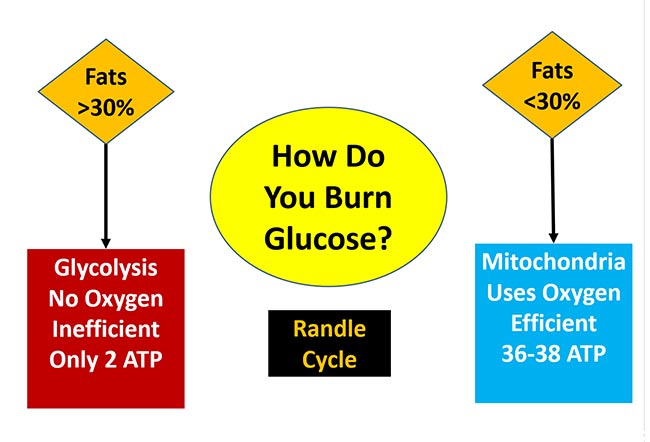
Low-carb diets have helped at least tens of millions of people improve their health for a very good reason, and that is there is a stealth switch that controls what fuel your mitochondria can burn, as they can only burn one fuel at a time: either fat or glucose.
The switch has been given the name the Randle Cycle, but it is more helpful to visualize it as a railroad switch that changes the tracks of the train, and the train can only travel down one track, not both. This is because only one type of fuel can be burned at a time.
The best-case scenario is you metabolize, or burn, glucose in your mitochondria without any reductive stress (a term I will explain in my upcoming interview with Georgi Dinkov). When you do this, you will only generate 0.1% reactive oxygen species (ROS).
Not only does this route generate less ROS, but it also is incredibly efficient at energy production by creating 36 to 38 ATPs for every molecule of glucose that is metabolized. It will also generate metabolic water and carbon dioxide, which are also important for your health.
For this to occur, as indicated in the figure above, you will need to consume less than 30% of your calories as fat. When you consume significantly more than that amount, the switch changes to burn fat in your mitochondria and you will not be able to burn glucose until your fat decreases to less than 30% of calories.
Since glucose is unable to be shuttled into the mitochondria to burn, it winds up backing up into your bloodstream, raising your blood sugar. This is a major contributor to diabetes. What little glucose is burned for fuel is done by using glycolysis, which is a primitive pathway that bacteria and cancer cells use.
It is great we have this pathway as you absolutely need it for quick fuel when you are activating your type II muscle fibers. But if this is the primary way you burn glucose, you are in a catastrophic metabolic state as you are creating loads of lactic acid as a waste product instead of healthy CO2, and you are only generating 2 ATPs for every molecule of glucose, which is 95% less energy.
Lactic acid increases reductive stress, which causes reverse electron flow in the mitochondria and causes reductive stress, which increases the ROS to 3 to 4%, which is 30 to 40 times more than when glucose is burned efficiently in the mitochondria.
Why Lactic Acid and CO2 Are so Important
Remember, when you are burning glucose efficiently in your mitochondria, the glucose is converted not only to 36 to 28 ATP, but when the electrons from the glucose are ultimately handed off to oxygen, metabolic water (deuterium-free) is made and, very importantly, carbon dioxide.
This is vital to understand, as carbon dioxide is a potent stimulator of mitochondrial biogenesis, which will increase the number of mitochondria that you have so you can make even more energy.
Conversely, when you are burning glucose far less efficiently in glycolysis, you are only generating two ATP and rather than creating life-sustaining carbon dioxide, you are generating life-damaging lactic acid, which will degrade your mitochondria and make them die sooner.
Too Much Dietary Fat Impedes Glucose Metabolism
Remember, the metabolic switch happens at about 30% fat. So, if you’re eating more than 30% fat you’re going to be mostly burning fat, and glucose metabolism (oxidation) will be inhibited. If you’re obese, the cutoff for fat is likely even lower. According to Dinkov:
“I’ve noticed that between 15% and 20% [dietary fat] is probably where most people, in their current health state, can metabolize the fat without causing problems for the glucose through the Randle cycle. Especially Type 2 diabetics.
Most of them are overweight or obese, which means they have two sources of fats — one through the diet and the second one from their fatty tissue, because there’s always some lipolysis going on. So for diabetic people, it’s probably a good idea to lower the intake of fat from the diet, because they already have a lot coming from their own bodies.
There’s so many clinics around the world that treat and even cure Type 2 diabetes by putting them on a really restrictive diet until they lose most of their fat. And then suddenly, the metabolism of glucose gets restarted. I think this directly shows you that the problem with glucose wasn’t the glucose itself.
It wasn’t the glucose that was fattening them up. They had too much fat in their bodies, and once you get rid of that fat, no matter how you do it, the problems when metabolizing glucose disappear which, to me, is a great testament to the Randle Cycle.”
You also don’t want fat to be too low, say, less than 15%. Between 15% and 30% might be the sweet spot, although, as noted by Dinkov, the ideal ratio of macronutrients isn’t known. That said, he believes, based on epidemiological studies, that an approximately equal ratio of calories from fat, carbs and protein (i.e., about 33% each) appears to be optimal for long-term health.
I respectfully disagree with this, as I believe 33% protein may be too high unless you weren’t eating many calories. Eating more than 35 to 40 grams of protein at a meal is likely counterproductive, as their absorption will be impaired, and you will be left with having to remove the ammonia and nitrogen, which could damage your kidneys.
At present, I believe that obtaining 15% of your overall calories from protein is probably about right when eating between 2,000 and 3,000 calories per day. Most people don’t need more than 120 grams of protein per day. Beyond that, you start burdening your kidneys. I’ve long used the formula of 1 gram per kilo of lean body mass (not total bodyweight), which Dinkov agrees seems to be an ideal way to determine your daily protein intake.
Weight Loss Rebound Explained
The Randle Cycle also helps explain why many people who lose large amounts of weight end up rebounding and gaining it all back, even when they’re still restricting calories. Dinkov explains:
“There’s always some baseline lipolysis going on. And in the rested state, your muscles prefer to oxidize fat. So, if you have a decent amount of muscle mass, you can burn most of this fat through this baseline lipolysis. The ratio of lean muscle mass to total body weight is the primary determinant of your basal metabolic rate. So, it’s very important to not lose lean muscle mass.
I think a lot of people get themselves in a situation where, through extreme fasting or extreme exercise, they lose a lot of body weight, but they’re not paying attention to how much they’re losing of each of the two components — fat mass and lean muscle mass.
Multiple studies have shown that over long-term fasting or a long-term exhaustive exercise, people lose a lot of body weight, but about 80% of that is lean muscle mass. So, they were much leaner, but their basal metabolic rate was much lower than what they started with because they lost most of their muscle mass.
So, when they went back to their normal lives and stayed on a reduced calorie regimen, they still regained all of their weight, and they were devastated. They said how is this possible?
Well, of course, what do you expect? Your basal metabolic rate went down by 50%. So, unless you stay on this severely restricted-calorie diet, you will regain all of those pounds.
So, the main thing is, maintain muscle mass, restrict a little bit of your dietary intake, and don’t overshoot with the lipolysis. Every time you stress yourself, you’re going to increase the rate of lipolysis. And if you float too much fat into the bloodstream, you will shut down the glucose oxidation, which will contribute to the lactic acid and all the other downstream effects mentioned.”
Not All Carbs Are Created Equal
When most people hear it’s OK to eat carbs, they think it’s an invitation to eat bread, pasta and processed foods and snacks. Nothing could be further from the truth. If your fat intake is over 30% and you throw junk carbs on there, you’re going to disrupt your lipoprotein profiles and increase your risk for heart disease, because you’re not metabolizing the carbs and are contributing to endotoxin production in your large intestine.
You also need to eat the right types of carbs to avoid endotoxin production, which is a major driver of increased cortisol and inflammation. High-fructose corn syrup (HFCS) is a processed carb that you should avoid. Most process including any processed foods that use HFCS because it is so cheap.
Other carbs to avoid would be resistant starches from legumes, beans, lentils, most grains, uncooked potatoes, green bananas, and pasta. Oatmeal can also cause trouble for many. You’ll know it’s incompatible with you if you get gas and/or constipation, or if it slows your digestion. Oatmeal is also high in linoleic acid (LA), which is why I avoid it.
The best complex carbs are ripe fruits that grow in tropical conditions, such as oranges, tangerines, mango, pineapple (keep intake moderate as it contains serotonin), melon, watermelon and grapes. Cooked starches such as potatoes and white rice are also acceptable. Potatoes contain oxalates, which can be problematic, but oxalates are water-soluble, so most will be radically lowered if you boil the potatoes.
If you have small intestinal bacterial overgrowth (SIBO), you may need to avoid starches like rice and potatoes, as you have inhibited ability to break down the starch into glucose. As a result, these kinds of starches may impede your recovery.
Incorporating Exercise for Optimal Results
The older you get, the more important your muscle mass becomes. Not only are strong muscles a requirement for mobility, balance, and the ability to live independently, but having reserve muscle mass will also increase your chances of survival3 when sick or hospitalized.
Muscle is lost far more easily and quicker than it’s built, so finding ways to continuously promote and maintain your muscle mass is crucial, especially as you get older.
Age-related loss of muscle mass is known as sarcopenia, and if you don’t do anything to stop it you can expect to lose about 15% of your muscle mass between your 30s and your 80s.4 An estimated 10% to 25% of seniors under the age of 70 have sarcopenia and as many as half those over the age of 80 are impaired with it.5
While declines in muscle mass and strength are relatively well-synchronized in the 35- to 40-year-old group, strength dramatically drops off as you get into the 75-year-old and over groups, with 85-year-olds usually seeing dramatic declines in strength and function relative to the decline in muscle size.
Blood Flow Restriction Training
One of the reasons I’m so passionate about blood flow restriction (BFR) training is because it has the ability to prevent and widely treat sarcopenia like no other type of training.
There are several reasons why BFR is far superior to conventional types of resistance training in the elderly. Importantly, it allows you to use very light weights, which makes it suitable for the elderly and those who are already frail or recovering from an injury. And, since you’re using very light weights, you don’t damage the muscle and therefore don’t need to recover as long.
I am also a huge fan of walking on the beach and typically go every day for about an hour. I also use the sauna and do targeted stretching daily.
More Information
To learn more, be sure to listen to the entire interview, and keep your eyes peeled for Part 2, which will follow shortly. Also check out Georgi’s blog at www.haidut.me or follow him on Twitter. He also has hundreds of videos on YouTube on a plethora of topics. A major sampling of Ray Peat’s work is also available for free on these two sites: wiki.chadnet.org/Ray-Peat and RayPeat.com.
How to Assess Your Biochemical Individuality
Reproduced from original article:
https://articles.mercola.com/sites/articles/archive/2022/10/30/urine-organic-acids-test.aspx
The original Mercola article may not remain on the original site, but I will endeavor to keep it on this site as long as I deem it to be appropriate.
Analysis by Dr. Joseph Mercola Fact Checked October 30, 2022
STORY AT-A-GLANCE
- Functional genomics testing looks at the single nucleotide polymorphisms (SNPs, pronounced “snips”) of genes
- The urine organic acid test (OAT) can provide valuable insight into your biochemical individuality, and combined with genomics testing can help chart a course for healing complex, chronic health problems
- G6PD insufficiency, the most common enzyme insufficiency in the world, can result in a significant loss of NADPH, thereby increasing inflammation and decreasing mitochondrial function
- Elevated oxalate is a common cause of chronic pain and fibromyalgia. One way to lower your oxalate level is to take Epsom salt baths, as the sulfate will displace the oxalates
- If you suspect oxalates are part of your health problems, combining high-oxalate food with calcium-rich foods or a calcium supplement will prevent the oxalate from causing a problem by binding to the calcium in your digestive tract
Emily Givler1 is a functional genetic nutrition consultant with the NutriGenetic Research Institute and Tree of Life, founded by Robert Miller, a traditional naturopath and trailblazer in the field of functional genomics, which looks at the single nucleotide polymorphisms (SNPs, pronounced “snips”) of genes.
Here, Givler discusses the benefits of the urine organic acid test (OAT) — a little-known test that can provide you with valuable insight into your biochemical individuality.
“We’re all living in this super toxic world, so everyone is being confronted by insult and injury to their bodies every day. Even those of us who are in this field can tweak things based on our biochemistry to make things work better for us,” she says.
“There’s not one right answer for everybody. We’ve got to find what makes us unique and find those places where we’re a little bit more vulnerable and support those areas appropriately.”
Givler’s Personal Story
Givler’s own health challenges were in part what drove her into the field of functional nutrition. She explains:
“I started with chronic pain and pretty excessive fatigue as a teenager … I had test after test and really got no answers. It took about five years before I got a fibromyalgia diagnosis. At the time, it was reassuring to know that this wasn’t all in my head. Other people felt this way too.
But where I got frustrated was the only recommendations I was given were narcotic painkillers or antidepressants … I was still a teenager. I decided I wanted to have a liver and kidneys by the time that I was 40, so I did not go down that route.
But I really had to carve out my own path to try to regain my health. I definitely had some missteps along the way. I stopped eating meat. I started eating a lot of spinach, beets and Swiss chard. Sounds good, right? I was eating these three meals a day, seven days a week and just felt worse and worse.
My rheumatologist told me to plan on being disabled by the time I was 30. I was about 20 at the time and thinking, ‘Boy, I knew to expect disability, but I didn’t think it would happen this fast.’
It turned out I was really dealing with extremely high levels of oxalates, which cause crystalline precipitates to form in the muscle and connective tissue. This was causing much of my pain and depleting my nicotinamide adenine dinucleotide phosphate (NADPH), which was zapping my energy. I looked like I had fibromyalgia. I really think a lot of people who have that label are probably dealing with something similar.
The healthy foods I was eating, the spinach and the beets, are sky-high in oxalates. I don’t want to suggest that no one should eat them, but I was poisoning myself with these healthy foods … The lowest my pain level ever got was an 8 out of 10.
I can say that now, almost two decades later, it’s completely managed with no painkillers … There are too many people who suffer every day. They think they’re doing the right things. On paper, they’re doing the right things. But what’s right for one person may be totally wrong for them, [and] there are ways you can figure this out rather than just fumbling through the way I did.”
SNP and OAT Testing Are a Powerful Combination
The irrefutable evidence Givler needed was found in her OAT test. She’d also done Miller’s functional genomics test, which further supported her conclusion that her fibromyalgia was related to an excess of dietary oxalates.
Indeed, the combination of functional genomics testing and OAT can be very powerful. When I had the SNP test done, it revealed I have a genetic variant that is essentially equivalent to celiac disease, with the crucial difference that it does not cause any noticeable gastrointestinal issues. Still, this genetic flaw means I must abstain from gluten to optimize my health and avoid autoimmune problems. Turns out I have a problem with oxalate as well.
“As clinicians, we tend to get into the habit of wanting to put people on a protocol. We find something that works and we push it. It may work for a lot of people, but there are always going to be people who slip through the cracks because there are differences in our biochemistry,” Givler says.
“Whether it’s differences because of genetic predispositions that may make us metabolize things, like oxalates, histamine or glutamate, differently than the average person, or because of particular environmental insults that we’re exposed to, either because of our occupation or because of our geography — those things pile up and may make us fall outside of that normal box.
If we can use genetics as kind of the framework around which we build our protocols, and then use functional testing like the urine organic acid testing, we can more precisely target the types of dietary choices or nutritional, supplemental interventions, and in some cases, lifestyle changes, we need to implement to really propel us towards health …
I think histamine foods are a really good example. We can read volumes about how good fermented foods are for your gut … and how we should be eating these things every day. But if you can’t clear histamine, or if you’re dealing with excessive mast cell activation, and you bring these foods into your diet, you may set off a catastrophic cascade of events and make your symptoms exponentially worse.
Too often then, you’re going to be told, ‘You’re just having die-off. Just keep going. You’re just not doing enough of it,’ when actually you may be making yourself sicker. Getting the right guidance with the right functional testing can really make a huge difference in people getting on the right plan for themselves.”
The Most Common Genetic Disorder in the World
Givler’s SNP test also revealed she has glucose-6-phosphate dehydrogenase (G6PD) insufficiency, which is one of the most common enzyme insufficiencies in the world.
“This is where things get complicated,” she says. “Very few of us are dealing with just one thing. We have to see where these patterns of weakness kind of pile up … G6PD insufficiency … can result in a significant loss of NADPH. That can increase inflammation in the body and decrease mitochondrial function.
That, piled on top of my genetic predispositions to over-absorb oxalates, which will also deplete NADPH, really gives me a one-two punch when it comes to energy … [Dr. Mercola] and I have spoken pretty extensively about things I can do to rebuild my nicotinamide adenine dinucleotide (NAD) and NADPH levels. That has really helped me to propel my health to the next level as well.”
NADPH may in fact be as important as adenosine triphosphate (ATP), because while it lowers inflammation, it’s also the primary source of electrons in your body to internally recharge antioxidants such as glutathione, vitamin C and vitamin E. If that’s not working, it’s very difficult to get healthy.
The good news is there are simple and inexpensive ways to improve your NADPH, such as glycine supplementation. The bad news is you won’t know you have a serious NADPH problem unless you do these two tests.
I my view, doing genomic and OAT testing can go a long way toward figuring out what you need to do if you have a chronic complex problem and not getting better, and Givler is quite skilled in interpreting these tests. In my case, she also detected a B2 insufficiency. She explains:
“So few people are thinking about B1, B2 and B6, but they are critical. For you, for true metabolic flexibility, getting adequate B2 to work with the level of fat that you’re eating was a big piece of it. Interestingly, with the gluten, it was not just the SNP test that showed it. That was reflected on the organic acid test as well. It took about four months, being strictly gluten-free, for you to get that metabolite back in line …
It’s amazing how much insight we can get from looking at the right functional testing. These two are just a one-two punch for figuring out, ‘Is it some inborn issue that you need more of a certain nutrient than someone else, or is it just poor dietary choices for you? Is it an environmental toxin?’ When we pair [SNP and OAT] together, so many of those pieces really come to light.”
Is Glyphosate Exposure Affecting Your Health?
There are several different labs where you can order glyphosate screening for yourself and your pets, for example, EnviroScience’s ELISA (enzyme linked immunosorbent assay) method, which utilizes an antibody specific for glyphosate,2 and my preferred lab, Health Research Institute, whose testing kits I include in my online store.
According to Givler, certain patterns in your OAT results can also be indicative of a problem with glyphosate exposure.
“We can see patterns when there is high level of glyphosate exposure,” Givler says. “Glyphosate’s very disruptive for the gut microbiome but it doesn’t kill all species uniformly.
If there are elevations in clostridia species, yeast and depleted beneficial bacteria, that is one pattern you can see with glyphosate exposure, because it’ll kill the lactobacilli and the bifidobacterium and leave some of the more opportunistic organisms, which will make you more vulnerable to lipopolysaccharides.
Glyphosate also breaks down into oxalate. For some people who are not dealing with the genetic predisposition but are dealing with the secondary hyperoxaluria, that may be a result of glyphosate as well. If we see a lot of mineral depletions — since glyphosate is a mineral chelator — that may be an indicator that there are some problems.
High succinate on the OAT test also can be an indicator, because succinate and glycine combine to move into the heme pathway. Without the glycine, if it’s being disrupted by glyphosate, that level may be elevated. If you’re seeing high oxalates, high succinate, high clostridia and low good bacteria, I would start looking for glyphosate exposure.”
A Clinical Example: My Personal OAT Results
To give you an idea of what OAT might tell you, I share my own test results in this interview, which Givler interpreted for me. My first OAT was in August, and the results shocked me. It was not at all what I expected considering how strict I am about living a healthy lifestyle and eating a healthy organic diet.
“There were definitely some things out of line,” Givler says. “One of the first things that I always tell my clients is this is a written explanation for why you’re feeling how you’re feeling. Sometimes when people see things out of line, they get really upset about it …
But if we don’t know what’s wrong, then we don’t know how to bring you back into balance. I’m a data lover. The more data we can collect, the better. This showed us that your gut was not in the best of shape. You were maybe overdoing it on good bacteria. I recommend that you slow down on your probiotics.”
Turns out I had small intestinal bacterial overgrowth, also known as SIBO. Interestingly, I’m a huge fan of molecular hydrogen, as it has a long list of health benefits. Alas, SIBO type C is one of the few, if not the only, clinical conditions where molecular hydrogen may actually do more harm than good, as it feeds the bacterial overgrowth.
SIBO-C is typically caused by an overgrowth of archaea, which feed on hydrogen. Now, I had SIBO type D. But SIBO-D will often progress to SIBO-C, because the overabundant bacteria that cause the diarrhea produce hydrogen, which then feed the archaea, which then produce the methane, which then causes the constipation.
“That’s why many people see evolving gastrointestinal issues that start in one way and end up another way,” Givler says. “If you take hydrogen water and you get gassy, bloated, constipated or brain fogged, there is a really good chance that there’s an overabundance of organisms in your digestive tract.”
In my case, the therapy was cutting down on fiber and eliminating gluten. Elevated hippurate also revealed that my phase II liver detox was not keeping up with phase I. Givler explains:
“Phase I was moving too fast for phase II. Phase I takes those fat-soluble toxins and turns them into intermediary metabolites, which are more toxic than those toxins when they were sequestered in fat cells … They should move right onto phase II to move into one of our six conjugative pathways of detoxification so they turn into a water-soluble form to leave the body.
When hippurate is elevated, it’s often an indicator that you’re getting stuck with those more toxic intermediary metabolites. Phase II needs a little bit of assistance.”
My last test, in February, revealed the bacteria in my gut had rebalanced, but I still need to improve my phase II detox pathway. This test also revealed a mold marker suggestive of black mold exposure, which makes sense, as I had a small leak in my laundry room that had gone unnoticed for perhaps a year or more. Some of the wood behind the wall was rotted through by the time I discovered the problem.
Oxalates May Be a Problem Even if Test Results Are Negative
As mentioned, one thing that’s an issue for both of us are the oxalates. Interestingly, oxalates may be a problem even if your test is normal. Givler explains:
“[In your] first test we saw an overt elevation. There were oxalates physically leaving your body. The oxalic acid was elevated. But if you are storing oxalates, if they’re all aggregated in connective tissue, in the lungs or the pelvic griddle, in your brain or in your eyes … then they don’t necessarily show up in unprovoked urine tests.
Just in the same way that if you are doing an unprovoked heavy metal test, you are only seeing what’s excreted and not what’s being stored. There are times that the oxalic acid can show up in range, or even low, when there is truly a high body burden of oxalates.
This is where [you need to look] at the bigger picture. Is there mold? Is there yeast? Are there other types of dysbiosis? Are there genetic predispositions on genes like the alanine-glyoxylate aminotransferase (AGXT) or the glyoxylate and hydroxypyruvate reductase (GRHPR) or 4-hydroxy-2-oxoglutarate aldolase 1 (HOGA-1)?
If you find variants there and you find patterns of inflammation and pain presentations going along with it, then you may actually be dealing with retained oxalates. This is a risk for osteoporosis. It’s a risk for iron deficiency anemia because the oxalates will chelate your calcium; they’ll chelate your magnesium; they’ll chelate your iron and form these really painful precipitates.
The most common form or the one that people are most familiar with are kidney stones because the oxalates [are] physically leaving your body … But only 0.5% of people who have oxalate issues will actually develop kidney stones. The other 99.5% have issues, like myself, where the pain presentation or those oxalates are actually trapped in the body and creating issues.
They’re linked with some really serious health conditions, as well as a pretty significant amount of chronic pain. Like myself, they may find themselves doing healthy things that are really wrong for them, but there are some really excellent, easy and inexpensive things you can do if you suspect the oxalates are an issue. Or if you have testing like this that tells you beyond a shadow of a doubt that, yes, oxalates are a problem.”
How to Lower Your Oxalate Level
One way to lower your oxalate level is to take Epsom salt baths. Epsom salt is magnesium sulfate. When you eat sulfurous foods such as broccoli, cauliflower, cabbage and eggs, your body must metabolize that sulfur. The sulfur goes through a multistep process, getting converted into sulfite and then into sulfate.
When you take an Epsom salt bath or foot soak, on the other hand, it’s already in the sulfate form, which your body can absorb transdermally, thereby displacing a lot of the oxalates.
“Many of your listeners probably use Epsom salt soaks for aching muscles and they think, ‘Oh, the magnesium is really helping me.’ I don’t want to discount the role of magnesium — it’s really important for that — but that sulfate the magnesium is bonded to, if there are oxalates, that’s the part that’s really making the difference with pain,” Givler says.
“If you suspect oxalates, the Epsom salts are a pretty safe, gentle and effective way of starting to move those out of your system.”
Another little pearl Givler taught me is to combine any high-oxalate food I eat with calcium-rich foods or a calcium supplement. The oxalates will then bind to the calcium in the digestive tract, preventing them from becoming a problem.
“The oxalates get into the system through the sulfate transporters, and then they attach to the sulfate receptor sites, which is part of why they’re able to get into so many tissues.
We tend to think about absorption as being a function of the small intestine, but our sulfate transporters are all over the colon. If you can bind the oxalate and the minerals in the stomach, then they will bypass those transporters in the colon and be excreted in the stool without giving you any difficulty,” she says. “Bringing in any type of calcium source … is a really good idea if you have oxalate issues.”
More Information
You can learn more about Givler and/or become a client by visiting the Tree of Life website.
“For many, food has become the enemy because they can’t figure out what they’ll actually feel good on. They don’t realize they don’t necessarily have to navigate that road on their own through trial and error.
We can take targeted action, eliminate a lot of the guesswork, actually make progress and save a lot of money by testing and seeing what the right answer is for you, rather than shifting through wrong answer after wrong answer,” Givler says.
The NutriGenetic Research Institute also offers a 30-hour, 14-module online certification course to become a nutritional genetic consultant for health practitioners. This course will teach you what you need to know about functional genomic analysis and how to apply it in your own practice. Webinars for health practitioners are held every other Thursday.
Patients interested in more information are directed to the yourgenomicresource.com which includes a listing of doctors who have completed the training and are qualified to provide nutritional guidance based on your SNPs.