Toxins
now browsing by category
Obesity Study: ‘Fat but Fit’ Is a Myth
Reproduced from original article:
https://articles.mercola.com/sites/articles/archive/2023/10/20/metabolically-healthy-obesity-myth.aspx
The original Mercola article may not remain on the original site, but I will endeavor to keep it on this site as long as I deem it to be appropriate.
Analysis by Dr. Joseph Mercola October 20, 2023
STORY AT-A-GLANCE
- An estimated 15% to 20% of obese individuals have none of the metabolic derangements associated with obesity, such as high blood sugar, high blood fats, high blood pressure and Type 2 diabetes. This has led to the idea that you can be obese yet in good health
- According to recent research, “metabolically healthy obesity” (MHO) is a fallacy. Obese individuals, even without metabolic risk markers, are at increased risk of diabetes and heart disease
- High body mass index (BMI) in combination with normal glucose and lipid levels, and the absence of high blood pressure, is not sufficient for MHO classification. Rather, it’s the behavior of the adipose tissue that matters. People with normally sized adipocytes (cells that store fat), have far fewer obesity complications compared to those who have enlarged and inflamed adipocytes
- Where you store most of your fat also matters. Obese individuals with large visceral fat stores, meaning the fat is primarily stored around their internal organs, are far more likely to develop Type 2 diabetes than those whose fat stores are distributed more evenly around their body
- Obesity is a state of energy deficiency due to inhibited mitochondrial respiration, which causes calories to be stored as fat instead of being burned for fuel. The solution is to optimize your mitochondrial function and raise your metabolic rate
Can you be fat and still be fit? An estimated 15% to 20% of obese individuals have none of the metabolic derangements associated with obesity, such as high blood sugar, high blood fats, high blood pressure, Type 2 diabetes and other risk factors for cardiovascular disease.1
This phenomenon has led to the idea that you can be obese yet in good health. But according to recent research,2,3,4 this popular belief — known as “metabolically healthy obesity” (MHO) — is a fallacy. As reported by studyfinds.org:5
“The myth of being ‘fat but fit’ is, again, being debunked by a new study. Researchers found that obese individuals, even if they appear healthy, have an increased risk of diabetes and … are still 50% more susceptible to coronary heart disease.”
No Such Thing as ‘Fat and Fit’
According to professor Matthias Blüher, who presented the findings at the 2023 Meeting of the European Association for the Study of Diabetes,6 high body mass index (BMI) in combination with normal glucose and lipid levels, and the absence of high blood pressure, is not sufficient for MHO classification. Rather, it’s the behavior of the adipose cells that matters.
People who have normally sized adipocytes (cells that store fat), have far fewer obesity complications compared to those who have enlarged and inflamed adipocytes.
Dysfunctional adipocytes can result in fibrosis and the release of harmful molecules that contribute to organ damage. Fat-secreted hormones, known as adipokines, can also directly affect cells in your vascular system, leading to atherosclerosis.
Where you store most of your fat may also be key. Obese individuals with large visceral fat stores, meaning the fat is primarily stored around their internal organs, are far more likely to develop Type 2 diabetes than those whose fat stores are distributed more evenly around their body, the study found. Other studies have also confirmed this.7
What this means in practical terms is that obese patients still need to focus on losing weight and may need other preventive treatments as well. In an October 3, 2023, press release, Blüher explained:8
“So there is still a residual increased risk for those people living with obesity, even with what we would call metabolically healthy obesity.
Even in the absence of other cardiometabolic risk factors, increased fat mass and adipose tissue dysfunction contribute to a higher risk of Type 2 diabetes and cardiovascular disease. Therefore, weight management and recommendations for weight loss are still important for people living with metabolically healthy obesity.”
Other Studies Concur
Other recent research has come to the same conclusion. A prospective cohort study of 381,363 British participants, published in 2021, found that:9
“Compared with people who were not obese at baseline, those with MHO had higher incident HF [heart failure] (HR [hazard ratio] 1.60 …) and respiratory disease (HR 1.20 …). The associations of MHO were generally weaker for fatal outcomes and only significant for all-cause (HR 1.12 …) and HF mortality rates (HR 1.44 …).
However, when compared with people who were metabolically healthy without obesity, participants with MHO had higher rates of incident diabetes (HR 4.32 …), ASCVD [atherosclerotic cardiovascular disease] (HR 1.18 …), HF (HR 1.76 …), respiratory diseases (HR 1.28 …) and all-cause mortality (HR 1.22 …) …
Conclusions/interpretation: Weight management should be recommended to all people with obesity, irrespective of their metabolic status, to lower risk of diabetes, ASCVD, HF and respiratory diseases. The term ‘MHO’ should be avoided as it is misleading and different strategies for risk stratification should be explored.”

Download this Article Before it Disappears
Excess Calorie Intake Is Not the Cause of Weight Gain
In the Energy Balance Podcast above, independent health researchers Jay Feldman and Mike Fave explain why eating too much and exercising too little is not the reason for weight gain. Jay is one of the best teachers of the Bioenergetic view of health. I would strongly encourage you to listen to his YouTube channel, but watch the oldest ones first so you can get grounded in the basics.
Obesity is a state of energy DEFICIENCY due to inhibited mitochondrial respiration, which causes calories to be stored as fat instead of being burned for fuel. The solution, therefore, is not to eat less and exercise more. Rather, it’s to optimize your mitochondrial function and raise your metabolic rate.
This inefficient burning of fuel (metabolizing of food) is why people who are obese typically also struggle with other health issues, such as low energy, fatigue, an inability to maintain focus, digestive problems and poor immune function.
The Bioenergetic View of Energy
As explained by Feldman, “energy,” in terms of the human body, primarily refers to your ATP level. So, ATP equals energy. The conventional view is that calories equal energy, but that’s a misconception, because calories come from three primary substrates (fat, glucose and protein), and they do not produce the same amount of ATP calorie for calorie.
Another major misconception is that when you’re gaining weight, you’re converting all your fuel (from food) into ATP and simply don’t need any more (typically because you’re not active enough), and so the excess energy is stored as body fat instead of being burned.
What actually happens is that you have a problem converting the fuel you consume into energy, so the fuel gets stored as body fat instead. In other words, you’re not producing enough energy and are in an energy-deficient state. So, it’s not excess ATP/energy that gets stored. It’s the fuel that is stored, and it’s stored because your body cannot efficiently metabolize it.
The end result is excess body fat AND insufficient energy, which in turn forces your body to downregulate other systems, such as your thyroid activity and reproductive hormones — anything that is not essential for survival.
You’re also cursed with perpetual hunger because the hunger signal is predominantly regulated by energy availability. This in turn leads to overeating, resulting in a vicious cycle of low energy and weight gain.
Decreased Energy Causes Obesity
A study10 was recently published in the International Journal of Molecular Sciences, attributing obesity to broken mitochondria. As noted by the authors:
“An important component of the pathogenesis of the metabolic syndrome is mitochondrial dysfunction, which is associated with tissue hypoxia, disruption of mitochondrial integrity, increased production of reactive oxygen species, and a decrease in ATP, leading to a chronic inflammatory state that affects tissues and organ systems.”
In the podcast, Feldman cites an earlier study, published in 2003 in the Journal of Theoretical Biology, titled “Decreased Energy Levels Can Cause and Sustain Obesity.” An excerpt from the abstract reads:11
“Current theories consider obesity a result of overeating and sedentary life style and most efforts to treat or prevent weight gain concentrate on exercise and food intake. This approach does not improve the situation as may be seen from the steep increase in the prevalence of obesity.
This encouraged us to reanalyze existing information and look for biochemical basis of obesity … We began with the contradictory information: in obesity, more calories are consumed than used up, suggesting that obese people should have excess energy.
On the other side, obese people experience fatigue and decreased physical endurance that indicates diminished energy supply in the body. The result of our work is a chain of metabolic events leading to obesity.
The crucial event is the inhibition of the TCA [tricarboxylic acid] cycle at the step of aconitase. It disturbs energy metabolism and results in ATP deficiency with simultaneous fat accumulation.
Further steps in obesity development are the consequences of diminished energy supply: inhibition of beta-oxidation, leptin resistance, increase in appetite and food intake and a decrease in physical activity.
Thus, our theory shows that obesity does not have to be caused by overeating and sedentary life-style but may be the result of the ‘obese’ change in metabolism which is forcing people to overeat and save energy to sustain metabolic functions of cells. This ‘obese’ change is caused by environmental factors that activate chronic low-grade inflammatory process in the body …”
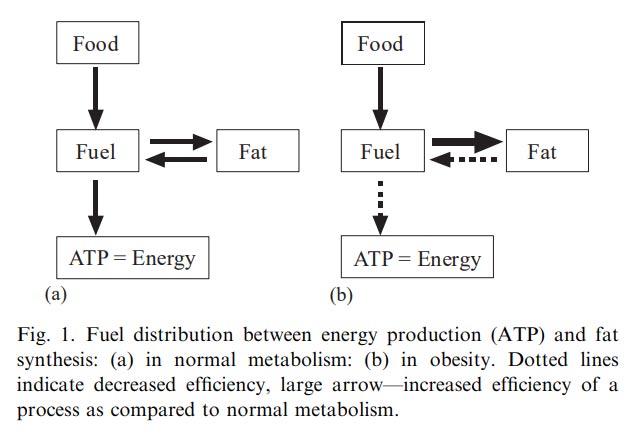
The screenshot below can be helpful. On the left is what normal metabolism looks like. The food you eat is turned into fuel, some of which is burned for energy and some of which is stored as body fat. When needed, body fat is also burned as fuel and converted into energy.
On the right is the “obese” metabolism. The primary differences here are the dotted arrows. The food consumed is turned into fuel, but very little of that fuel is converted into energy. Most of it is instead shuttled into fat storage, and because the metabolism is so inefficient, the stored fat is not released and burned for energy.
Many Normal Weight People Have Deranged Metabolism Too
As explained by Feldman, not only do obese individuals have this deranged metabolism, but many normal weight people do too. People who exercise a lot, or fast, or eat a low-carb diet may appear to have healthy metabolism because they’re not overweight, but the real reason they’re not overweight is because they’re forcing the conversion of fuel to energy through STRESS.
So, while they may not accumulate body fat, they still struggle with an energy deficiency, which can present as fatigue, brain fog, low mood, hormonal dysfunction and more.
As noted by Feldman, the bioenergetic solution to these problems is to improve the conversion of fuel to energy, “which means you have the energy available to properly function in terms of all your organ systems — your digestion, your reproductive systems, cognitive function, all of that.”
Endotoxin and PUFAs Decimate Mitochondrial Energy Production
One key strategy to optimize your mitochondrial energy production is to remove blocks in the electron transport chain so that electrons can move smoothly forward, without accumulating and backing up.
Endotoxin (lipopolysaccharide or LPS) and other bacterial toxins are among the biggest culprits when it comes to things that hinder mitochondrial energy production. These toxins can directly impair electron transport through the complexes of the electron transport chain. They can also impair certain enzymes in the Krebs cycle.
The primary solution for obesity and most other conditions is to raise your metabolic rate, and a key strategy for that is to remove blocks in the electron transport chain. Endotoxin and polyunsaturated fats (PUFAs) are two key culprits that need to be eliminated.
Poor digestion is frequently associated with negative gram bacteria in your gut that produce endotoxin, and this will inhibit your ability to convert food to energy, resulting in increased body fat. So, it’s important to reduce your endotoxin load. Aside from poor digestion, excess endotoxin is also a common culprit in degenerative conditions, metabolic syndrome, diabetes and fatty liver. To reduce your endotoxin load:
- Rebalance your gut microbiome by reintroducing beneficial bacteria (probiotics and prebiotics). One of the best and least expensive ways to do this is to eat a serving of fermented vegetables each day.
- Temporarily go on a low-fiber diet and avoid fiber supplements as it can feed undesirable bacteria. Avoid all vegetables temporarily and use fruit juice as your source of calories until your gut microbiome improves. Once it improves you can gradually add in whole fruits.
Once your microbiome is balanced and symptoms of poor gut function have resolved, you can slowly reintroduce starches like white rice and, if tolerated, progress to very well-cooked vegetables. Always cut back if you have signs of indigestion like belching, bloating or gas as this suggests you are not digesting those carbs yet.
Another effective blocker of mitochondrial energy production is polyunsaturated fat (PUFA). These are your processed seed oils, canola oil being among the worst of the worst. Seed oils are loaded with linoleic acid, an omega-6 PUFA, which appears to be one of the primary drivers of chronic diseases, in part due to its detrimental impact on your mitochondrial function and energy production.
So, you’ll want to severely limit your consumption of PUFAs. In addition to not cooking with them, this also means abstaining from processed foods, most of which are loaded with these harmful fats.
Rescue Remedies
While there are no magic pills to fix slow metabolism or low energy production, there are some that can help. I’ve previously written about the usefulness of niacinamide, for example. Another helpful one is methylene blue, which can both accept and donate electrons.
So, if you have blocks in the electron transport chain where most of the ATP is produced, say endotoxin or PUFAs, methylene blue can bypass those blocks, allowing your mitochondrial to produce energy anyway.
How to Gauge Your Metabolic Rate
According to the rate-of-living theory, the higher your metabolic rate — which means the quicker the electrons move from food toward oxygen, which is the final acceptor of electrons — the faster you’ll age because there’ll be higher oxidative stress.
However, deeper analysis reveals the exact opposite. The truth is, the higher your metabolic rate, the slower you age, because a high metabolism creates fewer reactive oxygen species (ROS) that can damage your tissues.
Your metabolism is high when electrons move rapidly and easily through the mitochondrial electron transport chain, which results in optimal energy production. When electrons are impeded from moving forward, they can back up, leak through the mitochondrial electron transport chain and start moving backward, where they combine with oxygen to create excessive ROS.
So, for optimal health, you want high energy production and that means a high metabolic rate. You can gauge your metabolic rate using your pulse, body temperature and calorie counting. These are not exact sciences, but can give you a general idea of where you’re at. Signs of low metabolism include:
- A body temperature below 97.8 degrees Fahrenheit upon waking, and/or 98.6 degrees F in the afternoon. You can also check your temperature before and after a meal. If your temperature drops after breakfast (compared to what it was in the morning), this could be a sign of less than optical metabolism as well.
- A resting pulse below mid-70 to low-80s, depending on your level of fitness. The greater your cardiovascular fitness, the lower your pulse rate will be, independent of your metabolic state, because your stroke volume is higher. The stroke volume is the amount of blood your heart pumps with each beat. When you’re very fit, your heart can push greater amounts of blood per beat.
- Assess how many, or how few, calories you can consume without adding to your weight. If you should be burning 3,000 calories a day, but you’re maintaining your weight on 2,200 calories a day, then your metabolism is likely low. Conversely, if you can maintain your weight when you add more calories, your metabolic rate is likely high, and the extra food will oftentimes improve your sleep, relaxation, energy and recovery.
- 1, 2 Endocrine Reviews June 2020; 41(3): bnaa004
- 3 Endocrine Review May 1, 2020; 41(3): bnaa004
- 4 Medical Xpress October 3, 2023
- 5 Study Finds October 3, 2023
- 6 Diabetologia, 59th EASD Annual Meeting of the European Association for the Study of Diabetes
- 7 Frontiers in Cardiovascular Medicine February 25, 2020; 7
- 8 EurekAlert! October 3, 2023
- 9 Diabetologia September 2021; 64(9): 1963-1972
- 10 International Journal of Molecular Sciences July 2023; 24(15): 12012
- 11 Journal of Theoretical Biology November 7, 2003; 225(1): 33-44
Alarming COVID Jab Contamination Shocks Scientists
Reproduced from original article:
https://articles.mercola.com/sites/articles/archive/2023/10/03/covid-jab-contamination.aspx
The original Mercola article may not remain on the original site, but I will endeavor to keep it on this site as long as I deem it to be appropriate.
Analysis by Dr. Joseph Mercola Fact Checked October 03, 2023

STORY AT-A-GLANCE
- In early April 2023, microbiologist Kevin McKernan detailed finding massive DNA contamination in Pfizer’s and Moderna’s bivalent COVID booster shots. The highest level of DNA contamination found was 30%, meaning nearly one-third of the content of the shot was plasmid DNA, the presence of which dramatically increases the likelihood of DNA integration and cancer
- An in vitro experiment found that the modified RNA in the Pfizer jab has the ability to enter human liver cells and reverse transcribe into DNA in as little as six hours post-exposure
- The lipid nanoparticles that the mRNA and DNA contaminants are encased in facilitate getting the DNA inside the cell. Once it’s in the cytoplasm, bits of DNA can enter the nucleus by random chance
- Mice injected with the COVID mRNA shot passed on their acquired immune traits — both good and bad — to offspring, which not only suggests that the mRNA can enter the nucleus of the cell, but also that it can be permanently integrated into chromosomal DNA and have intergenerational effects
- Pfizer’s bivalent jab has also been found to contain simian virus 40 (SV40) promoter, an oncogenic piece of the virus’ DNA known to drive very aggressive gene expression. Combined with pieces of DNA, the presence of SV40 promoter make the risk of cancer all the more likely
- The SV40 promoter is a sequence used in gene therapy to drive DNA into the nucleus of cells. If the shots aren’t supposed to alter the human genome, why do they contain bits of DNA and an SV40 promoter that can drive that DNA into the nucleus?
In early April 2023, microbiologist Kevin McKernan — a former researcher and team leader for the MIT Human Genome project1 — posted a preprint paper2 detailing massive DNA contamination in Pfizer’s and Moderna’s bivalent COVID booster shots.3,4,5,6 As explained in the abstract:7
“Several methods were deployed to assess the nucleic acid composition of four expired vials of the Moderna and Pfizer bivalent mRNA vaccines. Two vials from each vendor were evaluated …
Multiple assays support DNA contamination that exceeds the European Medicines Agency (EMA) 330ng/mg requirement and the FDAs 10ng/dose requirements …”
The highest level of DNA contamination found was 30%, meaning nearly one-third of the content of certain vials was plasmid DNA, the presence of which dramatically increases the likelihood of genomic integration and cancer.
What this means, in plain English, is that the shots could potentially alter your DNA, which is something vaccine makers, health authorities and fact checkers have vehemently denied and written off as “impossible.” Yet here we are, with inconvenient facts staring us in the face yet again.
Regulatory Agencies Were Aware of the Problem
In a May 20, 2023, Substack article,8 McKernan pointed out that regulatory agencies were clearly aware of this problem early on, as Pfizer submitted documents to the European Medicines Agency (EMA) showing sampled lots had a broad range of double-stranded DNA (dsDNA) in them.
The EMA’s limit for dsDNA is 330 nanograms per milligram (ng/mg), and Pfizer’s data show sampled lots had anywhere from 1 ng/mg to 815 ng/mg of DNA. And, according to McKernan,9 the EMA’s limit may be too high to begin with, as “lower limits should be applied if the DNA is packaged in transfection ready lipid nanoparticles,” as they are in the shots.
In a sane regulatory environment, this kind of contamination would have resulted in a massive recall, considering the known and suspected dangers of dsDNA contaminants. Yet nothing was done about it.
Since McKernan’s paper was posted, others have confirmed the presence of dsDNA contaminants in the COVID shots. To be clear, DNA should not be present in a commercial product that has been made under good manufacturing practices.
Obviously, Pfizer and Moderna have not perfected their commercial process, or have taken shortcuts they shouldn’t have. As a result, countless millions have been injected with unnecessarily risky COVID shots.
DNA Contamination Confirmed
University of South Carolina professor Phillip Buckhaults has since confirmed the presence of dsDNA in the COVID shots. September 13, 2023, he testified10 to this before the South Carolina Senate Medical Affairs Ad-Hoc Committee on the Department of Health and Environmental Control (DHEC).
Buckhaults is a molecular biologist and cancer geneticist with extensive experience in DNA sequencing, and initially set out to debunk McKernan’s claims. To his shock, he replicated McKernan’s findings instead.
In his testimony, he explained how these DNA contaminants can integrate into your genome and disrupt the function of other genes, either long term or permanently, and may be passed on to offspring for generations.
He told the senators he was “alarmed about this DNA being in the vaccine,” as “there is a very real hazard” of the dsDNA integrating into a person’s genome and becoming a “permanent fixture of the cell” that can result in autoimmune problems and cancers.11
Buckhaults suspects high levels of DNA contaminants may also be causing some of the more serious side effects of the jabs, such as lethal cardiac arrest.12 Of the two lots he analyzed, he found between 5 nanograms and 20 ng of plasmid DNA — ranging from one to 200 base pairs long — per 300 microliter dose, and he points out that having a multitude of tiny fragments is far riskier than having one big piece of DNA.13
The risk of genome integration by dsDNA has been known for decades,14 so the individuals who decided to allow this contamination to remain cannot claim they didn’t know public health would be put at risk.
Buckhaults stressed that we need to collect and analyze DNA from various tissues of those who have received the COVID jabs — at least a few hundred people — to determine whether genomic integration is taking place, and what changes are occurring.
He also explained how the DNA contamination occurred in the first place. In summary, the products used during the clinical trials and the commercial products were not made in the identical way. The commercial product grew the modified RNA using a mix of DNA plasmid and E. coli, and the DNA were not properly filtered out — a clear sign of poor manufacturing processes.
Download this Article Before it Disappears
COVID Shots May Cause Cancer in Several Ways
The presence of DNA isn’t the only way in which the mRNA COVID shots can cause cancer. mRNA can also reverse transcribe into DNA under the right circumstances. For example, one in vitro experiment,15,16 published in 2022, demonstrated that the modified RNA in the Pfizer jab has the ability to enter human liver cells and reverse transcribe into DNA in as little as six hours post-exposure. As reported in that peer-reviewed study:17
“… a recent study showed that SARS-CoV-2 RNA can be reverse-transcribed and integrated into the genome of human cells. In this study, we investigated the effect of BNT162b2 on the human liver cell line Huh7 in vitro. Huh7 cells were exposed to BNT162b2, and quantitative PCR was performed on RNA extracted from the cells.
We detected high levels of BNT162b2 in Huh7 cells and changes in gene expression of long interspersed nuclear element-1 (LINE-1), which is an endogenous reverse transcriptase.
Immunohistochemistry using antibody binding to LINE-1 open reading frame-1 RNA-binding protein (ORFp1) on Huh7 cells treated with BNT162b2 indicated increased nucleus distribution of LINE-1 …
Our results indicate a fast up-take of BNT162b2 into human liver cell line Huh7, leading to changes in LINE-1 expression and distribution. We also show that BNT162b2 mRNA is reverse transcribed intracellularly into DNA in as fast as 6 h upon BNT162b2 exposure.”
COVID Jab mRNA Can Enter the Cell Nucleus
According to a 2022 study,18 both the SARS-CoV-2 spike protein and the spike protein mRNA translocated into the nucleus of infected human cells. According to the authors, “the nuclear translocation of both S mRNA and S protein reveals a novel pathogenic feature of SARS-CoV-2.”
If the spike mRNA in the natural virus (and I use that term loosely, considering SARS-CoV-2 was most likely manmade) can enter human cells, might the mRNA in the COVID shots do the same? Probably.
As noted by Buckhaults,19 the lipid nanoparticles that the mRNA and DNA fragments are encased in “facilitate getting the DNA inside the cell — just inside the cell membrane. But once it’s in the cytoplasm, bits of DNA go to the nucleus just by random chance.” He told investigative journalist Maryanne Demasi:20
“We do this in the lab all the time. We take pieces of naked DNA, put them in lipofectamine which is a solution that delivers genetic material into cells, and by magic, some of the pieces integrate into the cellular DNA, and permanently modified the cells.
I’ve been doing this since I was a graduate student, so I know that this happens. The only question is, what is the frequency of this happening across a vaccinated population? …
IF genome modification is happening, It’s just a matter of time before one of these fragments hits a tumor suppressor gene and initiates the beginning of cancer in a single stem cell.
Also, there have been reports of myocarditis. I’m wondering if it’s possible that these little bits of DNA actually encode pieces of the spike protein … There’s a lot of open reading frames in these pieces of DNA that code for peptides that don’t belong in humans and are neo-antigens.
My concern is that some of these pieces of DNA could transform long lived stem cells in, maybe the myocardium, or pericardium, or maybe the liver, or lymph nodes … and now that tissue makes a long-lived expression of some neo-antigen that could be causing a long-term autoimmunity type response like myocarditis.
So, they are the two things that immediately come to mind — the small possibility of cancers in people in the next five years down the road, or the possibility of autoimmunity from the production of these peptides.”
So, the claim that the mRNA in the COVID shots — which is based on but not identical to the spike protein mRNA found in SARS-CoV-2 — cannot enter the nucleus of human cells and therefore cannot be integrated into the human genome, is simply false. Science tells us genome integration can occur in several ways.
COVID Jab Can Have Intergenerational Effects
Another 2022 study21 found that mice injected with the COVID mRNA shot passed on their acquired immune traits — both good and bad — to offspring, which not only suggests that the mRNA can enter the nucleus of the cell, but also that it can be permanently integrated into chromosomal DNA and have intergenerational effects. As reported in this study:
“Hundreds of millions of SARS-CoV-2 mRNA-LNP vaccine doses have already been administered to humans. However, we lack a comprehensive understanding of the immune effects of this platform.
The mRNA-LNP-based [mRNA-lipid nanoparticle-based] SARS-CoV-2 vaccine is highly inflammatory, and its synthetic ionizable lipid component responsible for the induction of inflammation has a long in vivo half-life.
Since chronic inflammation can lead to immune exhaustion and non-responsiveness, we sought to determine the effects of pre-exposure to the mRNA-LNP on adaptive immune responses and innate immune fitness.
We found that pre-exposure to mRNA-LNPs or LNP alone led to long-term inhibition of the adaptive immune response … On the other hand, we report that after pre-exposure to mRNA-LNPs, the resistance of mice to heterologous infections with influenza virus increased while resistance to Candida albicans decreased …
Interestingly, mice pre-exposed to the mRNA-LNP platform can pass down the acquired immune traits to their offspring …
In summary, the mRNA-LNP vaccine platform induces long-term unexpected immunological changes affecting both adaptive immune responses and heterologous protection against infections. Thus, our studies highlight the need for more research to determine this platform’s true impact on human health.”
FDA Responds to DNA Contamination Concerns
McKernan presented his findings to the FDA in June 2023. After Buckhaults confirmed the presence of dsDNA in Pfizer’s and Moderna’s shots, Demasi asked the FDA “if it had begun an investigation into the issue of DNA contamination and whether it would review its guidance to industry about residual DNA in vaccines.”22
She also asked if the agency “had instructed Pfizer and Moderna to conduct further testing to demonstrate the absence or presence of genome modification and whether it would issue new warnings to the public about the potential risks, now that DNA contamination in the vaccines had been established and replicated.” This was the FDA’s response:23
“The mRNA COVID-19 vaccines authorized or approved for use in the United States are not defined as a gene therapy. The FDA is confident in the quality, safety, and effectiveness of these vaccines. The agency’s benefit-risk assessment and ongoing safety surveillance demonstrates that the benefits of their use outweigh their risks.”
In other words, the FDA has taken no action on the matter and has no intention of doing so.
Cancer Promoter Also Found in Pfizer’s Bivalent Jab
In addition to DNA fragments that can more readily integrate into the human genome, and the possibility of mRNA reverse transcribing into chromosomal DNA, McKernan’s team also discovered simian virus 40 (SV40) promoter in the shots, which have long been suspected of causing cancer in humans.24
The SV40 promoter is a sequence used in gene therapy to drive DNA into the nucleus of cells. If the shots aren’t supposed to alter the human genome, why does it contain bits of DNA and an SV40 promoter that can drive that DNA into the nucleus?
SV40 promoter is an oncogenic piece of a virus known to drive very aggressive gene expression for cancer. Combined with pieces of DNA, the presence of SV40 promoter make the risk of cancer all the more likely. What’s more, according to McKernan,25 the SV40 promoter is a sequence used in gene therapy to drive DNA into the nucleus of cells!
If the shots aren’t supposed to alter the human genome, why do they contain bits of DNA and an SV40 promoter that can drive that DNA into the nucleus?
Considering these facts, is it not reasonable to suspect, then, that the “turbo cancers”26 oncologists around are now reporting might indeed be a side effect of the COVID jabs? “Turbo cancer” is an invented term to describe cancers that grow at such unprecedented rates that patients often die before a treatment plan can be implemented.
Repeat Dosing May Promote Cancer and Autoimmune Problems
So, that makes three ways in which some of the shots can contribute to or directly cause cancer. A fourth way the jabs may trigger cancer is simply by repeat dosing. As detailed in a May 2023 paper in the journal Vaccines:27
“To date, 72.3% of the total population has been injected at least once with a COVID-19 vaccine … [I]ncreasing evidence has shown that … they do not produce sterilizing immunity, allowing people to suffer frequent re-infections.
Additionally, recent investigations have found abnormally high levels of IgG4 in people who were administered two or more injections of the mRNA vaccines …
[E]merging evidence suggests that the reported increase in IgG4 levels detected after repeated vaccination with the mRNA vaccines … constitutes an immune tolerance mechanism to the spike protein that could promote unopposed SARS-CoV2 infection and replication by suppressing natural antiviral responses.
Increased IgG4 synthesis due to repeated mRNA vaccination with high antigen concentrations may also cause autoimmune diseases, and promote cancer growth and autoimmune myocarditis in susceptible individuals.”
SV40 Promoter Contamination Confirmed
Buckhaults has also confirmed the presence of SV40 promoter in the plasmid DNA, as has Yusuke Murakami, a professor at Tokyo University. In an interview, Murakami explained:28
“The Pfizer vaccine sequence contains part of the SV40 sequence … This sequence is known as a promoter. Roughly speaking, the promoter causes increased expression of the gene.
The problem is that the sequence is present in a well-known carcinogenic virus. The question is why such a sequence that is derived from a cancer virus is present in Pfizer’s vaccine.
There should be absolutely no need for such a carcinogenic virus sequence in the vaccine. This sequence is totally unnecessary for producing the mRNA vaccine. It is a problem that such a sequence is solidly contained in the vaccine …
If a sequence like this is present in the DNA, the DNA is easily migrated to the nucleus. So it means that the DNA can easily enter the genome. This is such an alarming problem. It is essential to remove the sequence. However, Pfizer produced the vaccine without removing the sequence. That is outrageously malicious.”
Excess Deaths in 2023
If the COVID pandemic was real, we would have seen the highest excess mortality rates in 2020, when the most problematic strain of the virus was in circulation. But that’s not the case. Instead, excess mortality rates didn’t really take off until the rollout of the experimental COVID shots — and rates are still going up, two years later.
In the video above, John Campbell, Ph.D., a retired nurse educator, reviews the latest mortality statistics from the Organization for Economic Co-Operation and Development (OECD).29 He also compares the OECD data with that from Our World in Data, and the two data sets are in agreement — excess deaths continued to be far above normal in 2023, and there’s no pandemic to blame it on.
For the U.K., there were 36,316 excess deaths during weeks 1 through 30 (January 1 through July 30, 202330). A telling trend is that deaths in private homes and “other settings” are above the five-year average, whereas deaths in hospitals and care homes are both below average.31,32
What does that mean? It means that more people than normal are dying unexpectedly, at home and in places other than a hospital. It also suggests that younger people are dying at a higher rate. The higher excess death rate is not because more elderly are dying in care homes.
In the U.S., there were 147,828.8 more deaths than expected during the first 30 weeks of 2023. Other interesting data reveal that, in Minnesota, excess deaths involving blood disorders began in 2020 but then skyrocketed in 2022, nearly doubling from the 2020 rate.33
The original Wuhan strain of SARS-CoV-2 was associated with blood disorders, but that strain had mutated into a mild cold by 2022. What we did have in 2022, however, were the COVID jabs, which are also associated with blood disorders.
Got the Jab? Take Action to Safeguard Your Health
If you already got one or more jabs and now have concerns about your health, what can you do? Well, first and foremost, never take another COVID booster, another mRNA gene therapy shot or regular vaccine. You need to end the assault on your system.
If you developed symptoms you didn’t have before your shot, I would encourage you to seek out expert help. At present, the Front Line COVID-19 Critical Care Alliance (FLCCC) seems to have one of the best treatment protocols for post-jab injuries. It’s called I-RECOVER and can be downloaded from covid19criticalcare.com.34
Dr. Pierre Kory, who cofounded the FLCCC, has transitioned to treating the vaccine injured more or less exclusively. For more information, see DrPierreKory.com. Dr. Peter McCullough is also investigating post-jab treatments, which you can find on PeterMcCulloughMD.com.
The World Health Council has also published lists of remedies that can help inhibit, neutralize and eliminate spike protein, which most experts agree is the primary culprit. I covered these in my 2021 article, “World Council for Health Reveals Spike Protein Detox.”
- 1, 5 The Healthcare Channel May 22, 2023
- 2, 7 OSF Preprints April 10, 2023, Edited April 11, 2023 DOI: 10.31219/osf.io/b9t7m
- 3, 28 Twitter KanekoaTheGreat May 20, 2023
- 4, 8, 9 Anandamide (Kevin McKernan) Substack May 20, 2023
- 6, 11, 12, 16, 25 Spectator Australia September 25, 2023
- 10 Jessica Rose Substack September 18, 2023
- 13, 19, 20, 22, 23 Maryanne Demasi September 21, 2023
- 14 Ann N Y Acad Sci November 27, 1995; 772: 140-151
- 15, 17 Curr Issues Mol Biol 2022; 44(3): 1115-1126
- 18 BioRxiv September 27, 2022 DOI: 10.1101/2022.09.27.509633
- 21 PLOS Pathogens September 2, 2022 DOI: 10.1371/journal.ppat.1010830
- 24 Expert Rev Respir Med October 2011; 5(5): 683-697
- 26 Makis MD Substack June 16, 2023
- 27 Vaccines (Basel) May 2023; 11(5): 991
- 29 Organization for Economic Co-Operation and Development Excess Deaths by Week, 2020-2023
- 30 Week Number Calendar 2023
- 31 ONS.gov.uk Deaths Registered Weekly in England and Wales Week 36
- 32 ONS.gov.uk Deaths Registered Weekly in England and Wales Week 37
- 33 Resisting the Intellectual Illiteratti Substack September 19, 2023
- 34 Covid19criticalcare.com
What’s Actually in the COVID-19 Vaccines?
Reproduced from original article:
https://articles.mercola.com/sites/articles/archive/2023/09/30/sv40-promoter-covid-vaccine.aspx
The original Mercola article may not remain on the original site, but I will endeavor to keep it on this site as long as I deem it to be appropriate.
Analysis by Dr. Joseph Mercola Fact Checked September 30, 2023
STORY AT-A-GLANCE
- Microbiologist Kevin McKernan and colleagues discovered simian virus 40 (SV40) promoters in COVID-19 shots that, for decades, have been suspected of causing cancer in humans
- The media were quick to “fact check” the finding, with the AP publishing a rebuttal titled, “No, ‘Monkey Virus DNA’ Was Not Found in COVID Vaccines”
- McKernan points out again that they never stated the entire SV40 virus is in the shots, just the SV40 promoter and enhancer, which is also cause for concern
- While there are limits on how much DNA can be in a vaccine due to concern over DNA integration, the guidelines don’t consider lipid nanoparticles and other factors in COVID-19 shots that could enhance how much DNA can enter a cell
- Not only do COVID-19 shots contain SV40 promoters, they also contain a 72 base pair insertion that makes the promoter much more aggressive and also drives the sequence into the nucleus of the cell, raising additional health risks
Jan Jekielek, senior editor with The Epoch Times and host of “American Thought Leaders,” spoke with microbiologist Kevin McKernan — a former researcher and team leader for the MIT Human Genome project1 — about DNA contamination in COVID-19 shots.2
In a preprint study McKernan and colleagues assessed the nucleic acid composition of four expired vials of the Moderna and Pfizer mRNA shots. “DNA contamination that exceeds the European Medicines Agency (EMA) 330ng/mg requirement and the FDAs 10ng/dose requirements” was found.3
So, in addition to the spike protein and mRNA in COVID-19 shots, McKernan’s team also discovered simian virus 40 (SV40) promoters that, for decades, have been suspected of causing cancer in humans, including mesotheliomas, lymphomas and cancers of the brain and bone.4 The media were quick to “fact check” the finding, with the AP publishing a rebuttal titled, “No, ‘Monkey Virus DNA’ Was Not Found in COVID Vaccines.’”5
Speaking with Jekielek, McKernan took issue with the AP’s fact check article, noting their paper “never said that the entire virus was present in the vaccines. We said that the promoter and the enhancer and the origin was in there, along with the polyA signal. It seems as if the AP has erected a strawman argument where they are trying to debunk something that was never said.”6
Could DNA Contamination in COVID Shots Cause Cancer?
The AP and other media outlets also downplayed the notion that DNA contamination in COVID-19 injections could contribute to cancer. “They are trying to make claims that this is not cancer-causing,” McKernan says, but “there are limits on how much DNA can be in a vaccine precisely because of the concern over DNA integration.”7
Such guidelines were based on research by the U.S. Food and Drug Administration’s molecular biologist Keith Peden,8 but when he evaluated how much DNA could “safely” exist in vaccines, he didn’t consider lipid nanoparticles (LNPs) and other factors that could enhance how much DNA could enter a cell. McKernan explains:9
“Here are two additional things going on that mean the DNA in these vaccines is more likely to get to the nucleus and integrate into the genome than the information they had at that time. When they came to those regulations, they were assuming the previous DNA in the shots were host cell DNA, like maybe you grew the vaccine in some type of monkey kidney cell.
As a result of this, there’s background monkey DNA, or background human DNA, due to whatever host cell line they use. We have something very different going on here. We have a well-known promoter that’s used in gene therapy that’s inside the vaccines that’s getting injected through an LNP that makes it very effective at transecting cells. Then it has a signal in there that drives that DNA into the nucleus.
I don’t think Keith Peden had anticipated that when he came up with these 10 nanogram limits of DNA. I’d say the verdict is still out as to whether or not they can be cancer-causing, but the risk is certainly elevated from what the FDA’s guidelines have been constructed off of.”
How SV40 Promoters in COVID Shots Could Drive Disease
McKernan explains that in many cases, when tumors are sequenced, they’re found to contain sequences from SV40 and other viruses, which can integrate into your genome, causing disruptions and instability that can trigger the cell line to grow out of control.10
In the case of COVID-19 shots, he says, “The concern is if this DNA integrates the genome, one portion of the SSV40 sequence is an SV40 promoter, a very strong promoter, which means it drives transcription wherever it lands in the genome.
If this happens to drop itself in front of a proto-oncogene [a gene that has the potential to cause cancer] and drives a lot of expression off of a gene that’s known, if you hyper-express it and turn the cell cancerous, then we have a concern that DNA is in fact doing that.”11
But not only do COVID-19 shots contain SV40 promoters, they also contain a 72 base pair insertion that makes the promoter much more aggressive and also drives the sequence into the nucleus of the cell. “And they’re right next to each other,” McKernan says. “If this DNA moves into the nucleus and it drags a promoter with it, and that integrates in front of a gene, it can disrupt gene regulation and potentially lead to the oncogenesis.”12
At the same time, a Pfizer trial showed that the shots may induce lymphocytopenia and neutropenia, or low concentrations of white blood cells. This could further allow for cancerous changes to proliferate. “After vaccination, patients have lower white blood cells, which you need to clear out cells that are misbehaving, like cancer cells,” McKernan adds.13
He’s also seen research showing that the spike protein from COVID-19 shots can enter the nucleus and disrupt regulation of p53 and BRCA1 genes:14
“People are probably familiar with BRCA1 because of breast cancer genes, but p53 is also another guardian of the genome. These are genes that clean up genomes that have been broken or have integration events …
If you have all three of those potentially increased integration risks happening, with white blood cell reduction and spike protein inhibiting the genes that are meant to clean up this type of problem, the combination of those things could certainly be tied to the rise in cancer that we’re currently seeing.”
Download this Article Before it Disappears
COVID Shots’ Lipid Nanoparticles Could Also Be Toxic
Another concerning compound in COVID-19 shots are the lipid nanoparticles, or LPNs. Because natural mRNA is easily broken down, this means the gene therapy needs a special delivery system to make it to the body’s cells. Moderna and Pfizer used lipid nanoparticles that contain polyethylene glycol (PEG)15 for this purpose.
The mRNA is wrapped in lipid nanoparticles (LNPs) that carry it to your cells, and the LNPs are “PEGylated” — that is, chemically attached to PEG molecules to increase stability.16 In their corporate prospectus17 released in 2018 at the time of their stock market launch, Moderna acknowledged that their LNPs carried risks.18 Among them, Moderna stated:
- “Most of our investigational medicines are formulated and administered in an LNP which may lead to systemic side effects related to the components of the LNP which may not have ever been tested in humans.”19
- “While we have continued to optimize our LNPs, there can be no assurance that our LNPs will not have undesired effects. Our LNPs could contribute, in whole or in part, to one or more of the following: immune reactions, infusion reactions, complement reactions, opsonation reactions, antibody reactions including IgA, IgM, IgE or IgG or some combination thereof, or reactions to the PEG from some lipids or PEG otherwise associated with the LNP.”20
Meanwhile, the shot trials didn’t include a control to show what happens if you just expose people to LNPs without mRNA. McKernan says:21
“What happens to people in that case? We don’t know the answer to that … a year from now, there will be more of a scientific consensus that spike protein was a bad idea, and that maybe we should switch this to a different protein or maybe we should use this platform to hit RSV [respiratory syncytial virus] or flu. If we don’t know the toxicity of the LNPs alone, that might be just as dangerous of an approach.
We really do need to understand if this transfection is a good way to fend off a respiratory virus. Many people have argued that this is a horrible way to thwart off a respiratory virus because you’re building immunity in the wrong compartment of the body.
You really need immunity in the nasal mucosa, and you’re not going to get very effective nasal mucosa immunity through injection. You take on all of these injection risks where you’re sending LNPs through the entire body and it’s not very targeted.”
What Happens if Shot Particles Enter the Ovaries?
There are concerns that shot particles are traveling throughout the body with unknown effects. Pfizer’s biodistribution study, which was used to determine where the injected substances go in the body, showed the spike protein from the shots accumulated in “quite high concentrations” in the ovaries.22
A Japanese biodistribution study for Pfizer’s jab also found that vaccine particles move from the injection site to the blood, after which circulating spike proteins are free to travel throughout the body, including to the ovaries, liver, neurological tissues and other organs.23 According to McKernan:24
“We know from the biodistribution study that some of these LNPs are getting to the ovaries, so that’s a huge concern. If 1% of these LNPs get to the ovaries, there’s 40 billion in each shot, we’re getting down to 400 million that go to the ovaries. Now you’re starting to really concern yourself.
If there’s only 300,000 oocytes in each female, and there are 400 million LNPs down there, these numbers are worrisome. What are we doing to the germline in the future generation?”
Already, a study published in Obstetrics & Gynecology — and funded by the National Institute of Child Health and Human Development (NICHD) and the National Institutes of Health (NIH) Office of Research on Women’s Health — confirmed an association between menstrual cycle length and COVID-19 shots.25
The implication is that the shots could be having an effect on fertility. As the Obstetrics & Gynecology researchers noted, “Menstrual cyclicity is an overt sign of health and fertility.”26
‘There Is Residual DNA in Both Shots’
As for why the SV40 promoter and enhancer is in COVID-19 shots in the first place, it’s related to the plasmid growth medium, which is E. coli. McKernan explains:27
“It’s [SV40 promoter] a common tool used in the biotech industry to drive very aggressive expression of a gene. In this case, Pfizer has it in front of a neomycin resistance gene, which drives resistance for neomycin. The reason they want it there is so that they can grow this plasmid in E. coli.
E. coli doubles every 30 minutes, so you can grow E. coli overnight and get gobs of this DNA. You then have to purify it from E. coli to make RNA out of it.
There is some risk that if you don’t fully purify it from E. coli, you can leave behind what’s known as endotoxin or lipopolysaccharides, usually abbreviated as LPS. This is an additional risk that Pfizer took on. Moderna’s doing a very similar thing, although they don’t have SV40 in there. They are using E. coli to amplify their plasmid DNA, and it comes with some of this risk.
What we do know is there is residual DNA in both shots, and this DNA is either right above the regulatory limit or tenfold higher … When looking at RNA to DNA ratios, it’s even worse. The actual outcome is that there is more like a 17- to 80-fold gap from what is required in the regulations, as best we can tell.”
According to McKernan, Pfizer also used two different tools to measure RNA versus DNA. This allowed them to “cook the books,” inflating the amount of RNA and depressing the amount of DNA so “they can squeak through these regulatory requirements without anyone really understanding what’s going on.”28 Further, Pfizer didn’t disclose its SV40 information to the European Medicines Agency, which McKernan believes was intentional:29
“They did that because they know the SV40 region is a very controversial base in its history in the vaccine field. The polio vaccines were contaminated with the full virus, not just these little components, but the full virus.
The full virus has over 5,000 bases. The components we have are about 466 bases of the virus, but they’re arguably the most functional aspects of the virus’s genome for replicating and for gene expression. The fact that they hid that this is in there from the EMA is a concern.”
While McKernan and colleagues continue to spread the word about SV40 promotor and components in COVID-19 shots, the media continues to try to discredit their findings. McKernan points out again that they never stated the SV40 virus is in the shots — but that doesn’t make their study any less worrisome:30
“We said there was an SV40 promoter and some of the components. We were very clear about that, but it quickly got associated with, ‘These guys are claiming there’s something there that isn’t there.’ Then everyone missed the point that there are components of SV40 that are actually quite functional that we need to be concerned about.
They are in these vaccines because they’ve been studied as being gene therapy tools … They are perhaps not as frightening as what happened in the polio vaccine, which some people have attributed to causing some cancers in the past. It’s still a controversy in that field, but there’s still things that we need to know about.
… There does seem to be a tendency for them [media] to either erect a strawman, or flood the zone with alternate information, so that an average person is just confused on what to believe, because there’s a mixture of messages coming through the media that are meant to drown out the real signal.”
- 1 The Healthcare Channel May 22, 2023
- 2 The Epoch Times August 23, 2023
- 3 OSF Preprints April 10, 2023
- 4 Expert Rev Respir Med October 2011; 5(5): 683-697
- 5 AP June 23, 2023
- 6, 7 American Thought Leaders, Jekielek/McKernan Transcript, Page 1
- 8 U.S. FDA, Development of Quantitative Assays to Evaluate the Safety of Cell Substrates and Vaccines, Keith Peden
- 9, 10, 11, 12, 13, 14 American Thought Leaders, Jekielek/McKernan Transcript, Page 2
- 15 Anthrax Vaccine January 11, 2021
- 16 Science December 21, 2020
- 17, 19, 20 SEC.gov November 9, 2018
- 18 Children’s Health Defense August 6, 2020
- 21, 24 American Thought Leaders, Jekielek/McKernan Transcript, Page 3
- 22 Children’s Health Defense June 3, 2021
- 23 Rights and Freedoms, Confidential Pfizer Research Document
- 25, 26 Obstetrics & Gynecology: January 5, 2022 – Volume – Issue – 10.1097
- 27, 28, 29 American Thought Leaders, Jekielek/McKernan Transcript, Page 4
- 30 American Thought Leaders, Jekielek/McKernan Transcript, Page 20
Here’s Why You Don’t Ever Want to Eat Moldy Bread
Reproduced from original article:
https://articles.mercola.com/sites/articles/archive/2023/09/21/never-eat-moldy-bread.aspx
The original Mercola article may not remain on the original site, but I will endeavor to keep it on this site as long as I deem it to be appropriate.
Analysis by Dr. Joseph Mercola Fact Checked September 21, 2023
STORY AT-A-GLANCE
- Mold is a microscopic fungi; there may be up to 300,000 species, some of which are poisonous if you eat them
- Mold grows by sending out a network of thread-like roots throughout the nutrient source; stalks containing the reproductive part of the fungi grow upward producing visible, colored spores
- Inhaling or consuming mold may expose you to mycotoxins, poisonous substances often found around the thread-like roots, increasing your risk of gastrointestinal and liver damage
- Reduce mold growth at home by inspecting food for mold before purchase, purchasing food within expiration dates, keeping humidity at home below 40%, cleaning your refrigerator every week or so and removing moldy or spoiled foods immediately
Editor’s Note: This article is a reprint. It was originally published October 6, 2018.
Molds are microscopic fungi. To date, no one knows exactly how many species exist, but estimates range from tens of thousands to potentially more than 300,000.1 As demonstrated in the featured video, fungi are made of many cells and can sometimes be seen with the naked eye.
When mold appears on your food, there are strategies you may use to help determine whether or not the food is safe to eat. Generally speaking, softer foods, such as bread, should be discarded when you see mold, as the part of the fungi visible is usually just the tip of the iceberg.
Some common foods are developed using mold as an ingredient or part of the process, such as alcoholic beverages, blue cheese and soy sauce. Although these types of mold are safe to eat and digest, if you have a mold allergy, illness or a history of yeast infection, it’s best to stay away from these foods.
The list of salvageable foods with mold growth is much smaller than the list that should be discarded immediately. Learning how to differentiate the foods on these lists begins with understanding how mold grows.
How Mold Grows
Mold spreads through spores produced by the fungus as it matures. Mold spores are present on many surfaces but remain dormant until they are in an environment conducive to germination and growth. Food is a perfect breeding ground and even fresh food hosts mold spores.
Once mold has germinated and grown, the visible mold is the reproductive part called the sporangium.2 Each sporangium releases tens of thousands of spores to spread the fungi. Beneath the sporangium is a vast network of roots called hyphae. These thread-like roots invade the food sending a stalk to rise above the surface where the sporangia develops.
The spores are what give the mold color. When airborne, spreading the fungus, they are so small you can’t see color with the naked eye. Although the roots are difficult to see when the mold is growing on food, they have the potential to spread throughout the food, branching out further than the visible sporangium.
Just as there are types of wild mushrooms which are safe to eat and others that are deadly, some molds may produce mycotoxins, poisonous substances that can make you sick. Dangerous molds often contain mycotoxins around the root threads, meaning the toxins may have spread throughout the food once mold growth is visible.3
Molds prefer warm and humid conditions and require a nutrition source, suitable air quality and adequate moisture for growth. Indoors, they may be found where humidity levels are highest, such as a bathroom.
However, while most prefer warmer temperatures, some are able to grow in the refrigerator as well. Molds are more tolerant of salt and sugar than other food invaders. This means they can grow in refrigerated jams and jellies or on cured salty meats such as ham, bacon or salami.4
Will Heat Make Moldy Food Safe?
Since the root system of mold may travel throughout a single piece of food, or from one food to another when they are packed close together, it is unwise to eat any of the bread from a loaf with mold. Even if you can’t see the mold, the entire loaf of bread or piece of fruit may be teaming with fungus.
You might be unwilling to throw out food, but a single piece of bread may have dangerous consequences. Just heating food to a boiling point does not kill most molds. This means running your bread through the toaster won’t do the trick. Boiling for several minutes at a high temperature or baking, however, will kill many molds and may destroy the dangerous aflatoxin they produce.
Download this Article Before it Disappears
What’s Causing the Health Problems?
Molds may produce poisonous mycotoxins, a term for poisonous substances produced by fungus. Mycotoxins are found primarily in grain and nut crops, but have been found on celery, apples, grapes and other produce as well. The Food and Agriculture Organization (FAO) of the United Nations estimates 25% of food crops are affected by mycotoxins.
There are many mycotoxins but only a few are regularly found in grains and seeds with the potential to harm humans and livestock. While visible mold contamination may be superficial, the mycotoxins produced are able to do significant damage.5
The effects of illness are acute and often appear quickly. Specific types of mycotoxins called aflatoxins have long-term or cumulative effects on health, including an association with cancer and immune deficiency. Aflatoxins are some of the most toxic chemicals known to exist,6 produced by Aspergillus mold, found growing in decaying vegetation, hay and grains. Crops most frequently affected include:7
- Cereals — corn, wheat, rice, sorghum
- Oilseeds — peanut, sunflower and cottonseed
- Spices — chili pepper, black pepper, coriander, turmeric and ginger
- Tree nuts — pistachio, almond, walnut, coconut and Brazil nut
Aflatoxicosis is a disease found in livestock, domestic animals and humans throughout the world. Unfortunately, the U.S. Food and Drug Administration (FDA) and the U.S. Department of Agriculture (USDA) believe even with good manufacturing processes, aflatoxins are unavoidable contaminants of food and feed.8
Ergot: A Dangerous Food Mold
Ergot is a fungus found on rye and other cereal grasses, such as wheat. Historically, eating ergot-contaminated foods during the Middle Ages, such as rye bread, was called “Saint Anthony’s fire” as the illness was often cured by visiting the shrine of Saint Anthony, located in a region of France that was free of ergot.9
Some historians believe the mold played a role in the Salem Witch Hunt of 1692 and, despite serious safety concerns, it has also been used to control excessive bleeding during menstrual periods and before and after miscarriage.
Laws regulate the amount of ergot allowed in food as ergotoxins are active and extremely dangerous even in minute quantities. One example of an ergotoxin is LSD. Unless well-regulated, ergotoxins have the potential to reach dry cereal and wheat breads.10
Even in tiny doses, it may help explain changes in behavior sometimes attributed to allergies.11 As your liver is unable to keep up with detoxification, it can result in changes in behavior. If this happens at home, try removing all moldy food types, such as cold cereals, nuts and nut butters or store-bought breads and baked goods for at least three weeks to evaluate changes in behavior.
Health Concerns Triggered by Moldy Food
If you’ve opened a bag of moldy bread, do not sniff it! Inhaling mold spores may trigger difficulty breathing, nasal irritation, eye irritation and wheezing.12 Ingesting mycotoxin contaminated food may result in illness, including liver, gastrointestinal and carcinogenic diseases.13
Aspergillus mold, found on meat and poultry and in the environment, can trigger an infection called aspergillosis.14 The illness is actually a group of illnesses affecting your lungs or even a whole-body infection. Invasive aspergillosis is the most serious type, invading your blood vessels and spreading throughout your body.
With an aspergillosis infection you may grow a “fungal ball” in your lungs, which is a tangled ball of fungal fiber called an aspergilloma. This may lead to hemoptysis (coughing up blood), wheezing, shortness of breath, fatigue and weight loss. Depending on the severity of the condition, your physician may recommend antifungal medications, steroids, surgery or embolization.15
Reduce Mold Growth on Your Food
The average U.S. consumer throws away nearly 40% of the food they purchase, usually because it has gone bad.16 You can drastically reduce this kind of waste by learning the basics of food storage and planning your meals before you go to the grocery store.
A thorough cleaning of your refrigerator once a week or so is also important to reduce the spread of mold spores and to keep your refrigerator sanitary.
Any bacteria or parasite capable of causing food poisoning may be transferred to refrigerator shelves and crisper drawers.17 While cleaning, it’s a good time to use up the food you can and discard anything spoiled. The simplest time to schedule a cleaning is right before trip to the grocery store or farmers market when the refrigerator contains the least amount of food.
When you invest time and money into the food you purchase, you also want to be sure it lasts as long as possible. The following suggestions may help reduce mold growth:18
- Clean out the inside of the refrigerator with 1 tablespoon of baking soda in 1 quart of water and rinse with fresh clean water and then dry it.
- Keep any dishcloth, towels, sponges and mops clean and fresh. If they smell musty, they’re likely spreading mold.
- Seek to keep your home’s humidity level below 40%.
- Check foods before you purchase them at the grocery store for visible signs of mold and for expiration dates.
What to Do When You Find Mold on Your Food
If you find mold on your food, do not smell it as it’s likely you will inhale spores, potentially triggering a nasty respiratory problem. Instead, throw the food out in a small paper bag, in a covered trash can away from children or animals.19
Clean the area where the food was stored and check nearby items the moldy food may have touched. Mold spreads quickly between fruits and vegetables. While it’s best to throw out any moldy food, you may be able to salvage hard cheese, dry-cured ham and firm produce.20
As it’s difficult for the mold to penetrate deeply into these products, you may be able to cut at least 1 inch around and below the mold spot, keeping the knife out of the mold to prevent cross-contamination of other areas. After trimming the mold, store the food in a fresh container.
- 1, 3, 4, 8 U.S. Department of Agriculture, Molds on Food
- 2 Business Insider, September 19, 2018
- 5 USDA. International Trade and Food Safety
- 6, 11 Living Network, Moldy Foods and Aflatoxins
- 7 World Health Organization, Mycotoxins
- 9 Medical News Today. Ergot Poisoning, Treatment and Symptoms
- 10 University of Nebraska Extension, Ergot of Small Grain Cereals
- 12 Centers for Disease Control and Prevention, Facts About Mold and Dampness
- 13 Journal of Toxicology, 2004;42(2):217
- 14 Mold Help, Aspergillosis
- 15 MayoClinic, Aspergillosis
- 16 Marketwatch, June 5, 2018
- 17, 18, 19 University of Minnesota Extension, Are Molds on Food Dangerous?
- 20 Mother Nature Network, September 21, 2018
STARTLING discovery: Researchers detect microplastics in human hearts
Reproduced from original article:
https://www.naturalhealth365.com/startling-discovery-researchers-detect-microplastics-in-human-hearts.html
by: August 22, 2023
 (NaturalHealth365) In a truly unsettling revelation, recent reports have shed light on a concerning fact: the average person unwittingly ingests a weekly serving of microplastics equivalent to a whole credit card. Yes, you read that right – it’s like swallowing a mini credit card every week, weighing around five grams. But here’s the kicker: some of these pesky microplastics don’t simply pass through our bodies as expected; they decide to stick around.
As if that weren’t distressing enough, researchers have uncovered an even more troubling truth – microplastics have made their way into the very chambers of our hearts.
Shocking findings from medical research: Microplastics infiltrating the heart
The recent report highlighting how microplastics have made their way into heart tissue was made after analyzing patients before and after heart surgery. While there’s a hint of a possibility that some microplastics might find their way into heart tissue during medical procedures, the prevailing evidence suggests a more unsettling truth – it’s our consumer-driven world that’s primarily responsible for this intrusion.
These tiny microplastics navigate their way into the heart through body openings like the nose and mouth. And while it’s plausible that other organs might also host these minuscule invaders, the fact that they’re making their home in the heart is particularly worrisome. After all, the heart is the symbolic engine that keeps our body running smoothly.
Thousands of microplastic pieces found in human heart tissues and blood samples
This unsettling discovery unfolded through meticulous research conducted by a team from Beijing’s Capital Medical University. During surgeries, they collected tissue samples from patients’ hearts and gathered blood samples before and after these medical procedures. They employed a cutting-edge technique called laser direct infrared imaging to unveil the hidden truth.
Under this microscopic scrutiny, the researchers found tiny particles, measuring between 20 and 500 micrometers, lurking within the patients’ hearts. These microplastics comprised over half a dozen distinct types of plastics, ranging from polymethyl methacrylate to polyvinyl chloride. What’s particularly concerning is that the presence of polymethyl methacrylate couldn’t be attributed to accidental exposure during surgery.
Even more disconcerting, the majority of the collected samples contained tens of thousands of these minuscule microplastic pieces. To compound the issue, the patients’ blood samples were also found to be teeming with microplastics. However, it’s important to note that some tissue samples remained untouched by these intruders, hinting at the possibility of a healthy heart free from microplastics.
Tips to avoid microplastic consumption
While the full extent of harm caused by microplastics in the human body remains uncertain, the prevailing belief is that these tiny particles could have lasting and impactful consequences.
Contrary to common belief, microplastics are not limited to oceans and water bodies; they have become ubiquitous. While eliminating them entirely is impossible, you can make a difference by reducing your plastic consumption. Opt for glass bottle refills over disposable plastic water bottles.
To further safeguard against exposure, limit your consumption of certain seafood, including bivalves and bottom feeders like crabs or crayfish, which tend to bioaccumulate more unwanted substances. Also, avoid microwaving food or beverages in plastic containers, as this can release even more microparticles.
Taking preventive measures such as dusting and vacuuming with a HEPA filter can curtail microplastic circulation indoors, minimizing inhalation risk.
Sources for this article include:
Undeniable link: How arsenic contamination in food and water causes cancer
Reproduced from original article:
https://www.naturalhealth365.com/undeniable-link-how-arsenic-contamination-in-food-and-water-causes-cancer.html
by: August 10, 2023
 (NaturalHealth365) Arsenic, a potent carcinogen, is a familiar substance to many, but its true nature remains elusive to most. This chemical element is primarily encountered in various minerals, often in conjunction with metals and sulfur. While it holds significance in industrial applications, its pervasiveness has led to contamination of the air, soil, water, and food we rely upon.
Being exposed to arsenic carries the risk of triggering a range of health issues, even potentially resulting in death. In fact, a recent study highlights that such exposure is closely linked to the development of cancer.
Study reveals how arsenic causes cancer
You might unknowingly consume arsenic during your daily meals, whether it’s breakfast or lunch, and its effects may only become apparent as health issues arise in the future. Arsenic exposure occurs through tainted foods, contaminated drinking water, and even polluted air inhalation.
The previously mentioned study offers compelling proof that arsenic exposure triggers the development of cancer, particularly in the liver, lungs, bladder, and skin. This research builds upon prior investigations using cellular and animal models, which established a connection between arsenic and cancer progression.
Scholars readily acknowledge that the exact mechanisms behind arsenic-induced carcinogenesis remain somewhat elusive. The process through which arsenic exposure leads to cancer is intricate, targeting specific cellular pathways. Additionally, the metabolic behavior of this chemical element adds complexity to understanding the ensuing carcinogenic effects.
Arsenic provokes oxidative stress reactions that harm human DNA and various other important molecules. It interferes with DNA repair and disrupts the epigenetic regulation of gene expression. Moreover, arsenic substitutes zinc in certain proteins, affecting their functionality. Each of these processes contributes to the aforementioned development of cancer spurred by arsenic exposure.
The research suggests that arsenic disturbs cellular signaling pathways and weakens the immune system’s effectiveness. The cumulative impact of these types of harm and impairment creates conditions that facilitate the formation of cancer. Furthermore, scientists have established a link between prolonged arsenic exposure and the emergence of cancer stem cells. These cells reside within tumors and are thought to drive the growth and spread of cancer.
Assess your arsenic exposure risk
Those residing in regions characterized by elevated arsenic levels in water and soil face a notably heightened risk of exposure and subsequent cancer development. For instance, states like New Mexico, Nevada, and Arizona are renowned for their elevated arsenic concentrations. Furthermore, if you live in an area with substantial agricultural or mining operations, the likelihood of arsenic infiltrating your water and food sources increases.
Arsenic is also prevalent in various food and beverage products, including rice and rice-based items. Additionally, a number of bottled water brands accessible to consumers in the United States have been found to contain unhealthy levels of arsenic. It’s important for parents to be aware that certain baby food formulas have been identified as containing unsafe concentrations of arsenic.
How to reduce exposure to arsenic
Take control of your exposure to arsenic by adopting certain measures. Decrease your intake of store-bought fruit juices, with particular attention to apple juice, due to concerns about arsenic levels. If you rely on well water, ensure it undergoes testing to stay below the 10 parts per billion threshold for arsenic. And, especially if you’re drinking well water, use a reverse osmosis water system to clean up the drinking (and cooking) water.
If you have an infant, avoid feeding them rice milk, as arsenic can accumulate in rice syrup. Additionally, it’s advisable to rinse organic rice thoroughly before cooking to minimize the arsenic content on each grain.
Enhance your diet by incorporating a wide range of organic fruits and vegetables from diverse sources, thus reducing the likelihood of consuming produce grown in arsenic-contaminated environments. It’s important to note that arsenic can also be present in some cigarettes, cosmetics, and certain unregulated supplements.
Just remember, you can greatly reduce your risk of exposure to many toxins, like arsenic. This just takes a little effort … but, you’re worth it.
Sources for this article include:
We Should Be Alarmed by the Staggering Decline of Birds
Reproduced from original article:
https://articles.mercola.com/sites/articles/archive/2023/08/09/birds-declining.aspx
The original Mercola article may not remain on the original site, but I will endeavor to keep it on this site as long as I deem it to be appropriate.
Analysis by Dr. Joseph Mercola Fact Checked August 09, 2023

STORY AT-A-GLANCE
- Worldwide, 1 in 8 bird species is at risk of extinction
- Another 223 bird species are critically endangered and could disappear from the planet
- A net loss of 2.9 billion birds, or 29%, occurred in the U.S. and Canada since 1970
- Industrial agriculture, with its rapid expansion and use of toxic chemicals, is driving bird losses the world over and represents the greatest threat to birds
- Birds are a crucial element of our ecosystem, controlling pests, spreading seeds and pollinating about 5% of plants that humans use for food and medicine
Worldwide, 1 in 8 bird species is at risk of extinction.1 We should be very concerned, since, as BirdLife International notes, “Birds are our early warning system.”2 Declines in bird populations signal that something serious is happening in the environment — habitats are being destroyed, chemical pesticides are taking a toll on wildlife and more.
Already, 223 bird species are critically endangered3 and could disappear from the planet — a loss that would cut deeply. BirdLife explains:4
“Birds have the power to unite people. Many species migrate vast distances, motivating nations to work together to protect them every step of the way. In this way, birds show us the levels of global cooperation needed to tackle the … extinction crises in coming years. More simply than that, a love of birds is something we can all share, regardless of our differences.”
Imagining a world without birds isn’t only about missing their visual beauty and melodic songs. Birds are a crucial element of our ecosystem, controlling pests, spreading seeds and pollinating about 5% of plants that humans use for food and medicine.5 So, a loss of birds should sound alarm bells for every one of us.
“Birds tell us about the health of our natural environment — we ignore their messages at our peril,” says Patricia Zurita, BirdLife’s CEO.6
3 Billion North American Birds Gone in 50 Years
The situation is dire for many bird species, including the black-tailed godwit, a large shorebird with long legs and an equally long bill. Wired interviewed Alice Cerutti, whose 115-hectare (about 284-acre) rice farm in Italy is the country’s last known regular nesting site for the species:7
“During the past decade or so, she and her family have planted thousands of trees, reestablished wetlands, and brought in experts to help study and manage the precious birds that nest in areas Cerutti has set aside for wildlife. It seems to be working. ‘We have this amazing and big responsibility,’ Cerutti says … Local researchers found the bird clinging on there even as it disappeared from other locations.”
It’s a story of hope among an otherwise dismal outlook. A net loss of 2.9 billion birds, or 29%, occurred in the U.S. and Canada since 1970,8 including not only rare species but also common birds at backyard feeders, such as sparrows, warblers, finches and blackbirds.9 Writing in the journal Science, researchers and colleagues with the Cornell Lab of Ornithology explained:10
“Integration of range-wide population trajectories and size estimates indicates a net loss approaching 3 billion birds … A continent-wide weather radar network also reveals a similarly steep decline in biomass passage of migrating birds over a recent 10-year period. This loss of bird abundance signals an urgent need to address threats to avert future avifaunal collapse and associated loss of ecosystem integrity, function, and services.”
Nineteen common bird species lost more than 50 million birds during the study period, with lead author and conservation scientist Ken Rosenberg told CBS News, “There’s an erosion of the numbers of common birds.” “We expected to see continuing declines of threatened species,” he said. “But for the first time, the results also showed pervasive losses among common birds across all habitats, including backyard birds.”11
Birds Declining Throughout Europe
It’s not only North American birds that are in peril. “A further 600 million have been lost in the European Union since 1980, an area five times smaller,” Bird Life International reported.12 There are about 10,000 species of birds worldwide, and half are declining in numbers.13 In Great Britain, 73 million birds have disappeared since 1970, a decline of nearly one-third.
As in the U.S., birds affected included both common and rare species, including a loss of nearly 30 million house sparrows, 20 million starlings, 4 million skylarks and 2 million blackbirds. According to the British Trust for Ornithology (BTO), which conducted the research:14
“The estimated losses actually total 114 million individuals (or 57 million breeding pairs). The losses are masked in part by increases in certain other species, including some familiar residents (e.g. Wren, Woodpigeon and Blackcap), and new arrivals (e.g. Little Egret and Cetti’s Warbler).
The growing numbers of these species, which result in gains of c. 41 million individuals, do not compensate for the extraordinary losses overall, resulting in a net loss of 73 million individuals.”
European mountain birds are also disappearing. Researchers with BTO and colleagues revealed a 7% population decline in 44 bird species monitored from 2002 to 2014.15 Changes in human land use, including grazing pressure and afforestation, may be partly to blame.
European birds that eat insects, known as insectivores, represent another category in trouble, with insectivorous bird populations declining 13% across Europe and 28% in Denmark from 1990 to 2015 or 2016, respectively. “Our findings suggest that the decline of insectivores is primarily associated with agricultural intensification and loss of grassland habitat,” researchers explained.16
Download this Article Before it Disappears
We’ve Already Lost 94% of Some Bird Species
BirdLife International’s State of the World’s Bird report is published every four years, most recently in 2022.17 Along with the 1,409 bird species threatened with extinction, the report found that only 6% of species have populations that are increasing.
Over the last 500 years, meanwhile, more than 160 bird species have been eliminated. Now the rate of extinction is accelerating, says Lucy Haskell, science officer for BirdLife.18 According to a news release for the report:19
“Although long-term population data is far more comprehensive for species in these regions [North America and the European Union], signs point to similar catastrophic declines elsewhere across the globe.
For instance, since 1850, forest and wetland specialist species in Japan are estimated to have declined by a staggering 94 and 88 percent respectively, while populations of Kenya’s raptor species have declined on average by nearly three quarters since 1970.”
Industrial Agriculture Is the Leading Threat to Birds
Industrial agriculture, with its rapid expansion and use of toxic chemicals, is driving bird losses the world over and represents the greatest threat to birds. BirdLife’s report stated:20
“Across the world, birds are impacted by an array of different threats, nearly all of which are caused by human actions. Agriculture — both through its expansion into important habitats and the increasing use of machinery and chemicals as it intensifies — is the leading threat to bird species, impacting at least 73 percent of threatened species.”
A study by Environment Canada suggested agricultural pesticides alone may lead to 2.7 million bird losses there annually.21 It’s also been shown that birds exposed to widely used neurotoxic pesticides called neonicotinoids feed less, accumulate less body mass and fat stores and ultimately delay migration, which can affect survival and reproduction.22
Habitat loss and habitat degradation are also problematic.23 Habitat loss refers to instances when land is converted for other uses, such as agriculture or development. When habitat is degraded, it may not disappear entirely but becomes altered, fragmented or compromised in a way that makes it less able to support bird life. Due to agricultural intensification, habitat essential to birds is rapidly disappearing. BirdLife explained:24
“In Europe, this has resulted in an over 50 percent decline in abundance of the continent’s farmland birds since 1980 and, further south, the conversion of grasslands to croplands has resulted in an 80 percent decline in the population of the Liben Lark (Critically Endangered) in just 15 years.”
Meanwhile, logging is another serious threat. “Over 7 million hectares (17,297,376.7 acres) of forest are lost every year — an area larger than the Republic of Ireland — and this impacts nearly half of the world’s threatened bird species,” BirdLife added.25
This includes the Harpy Eagle, which depends on old-growth trees — 90% of which are targeted by logging in the rainforests of South America.26 Aside from habitat loss and pesticide usage, some of the additional human-caused threats to birds include:27
| Cats | Window collisions |
| Vehicles | Power lines |
| Communication towers | Wind turbines |
Still, many are taking action toward positive change. Wired reported that on Cerutti’s farm, she’s taken steps to avoid pesticides that are so toxic to birds:28
“Cerutti has dispensed with pesticides and allowed vegetation in wetland areas to regrow. Besides the black-tailed godwits, there are bitterns and lapwings — both also in decline.
And no, she doesn’t make as much money as she might if she were driven to maximize profits on the same tract of land. It doesn’t matter. ‘Not every farmer can do what we’re doing, but I think that it’s important to do something,’ she says. A neighbor was recently inspired by Cerutti’s efforts to stop spraying places that border her farm with glyphosate, an incredibly potent herbicide. ‘I think it’s a great step,’ says Cerutti.”
What Do We Lose if Birds Disappear?
Birds play a vital role globally, helping to pollinate plants and disperse seeds while acting as both scavengers and predators. But, humans’ connection to birds runs even deeper. It’s revealing that, in the U.K., more than 1.3 million people belong to the Royal Society for the Protection of Birds, which is more than the members of all the country’s political parties combined.
And in the U.S., birdwatching is a favorite hobby for more than 70 million people,29 while birders can be found worldwide, making a habit of seeking out different bird species whenever they can. Encounters with birds involve both sight and sound, providing complex, multisensory experiences. Interactions with birds in your everyday life may be enough to compel lasting change to your mood.30
The presence of birdsongs also enhances the mental benefits of spending time in nature.31 Birdsongs, in particular, may be appreciated by humans because birds have been around throughout evolution. Singing birds are also often heard in spring and summer, indicating forthcoming or current pleasant weather.32 All of this could be lost if changes aren’t made to protect these vulnerable creatures.
7 Simple Steps to Help Birds
The light at the end of the tunnel is regenerative agriculture, which is a savior to birds, insects and other species worldwide. The best course of action to reduce the harm of industrial agriculture and habitat loss is having on birds is to support biodynamic, grass fed farms that are conserving diversity and not relying on synthetic chemicals and other intensive agriculture practices that harm birds and other wildlife.
Meanwhile, we can all get involved to help make the world a safer place for birds. 3 Billion Birds, a partnership between Audubon, American Bird Conservancy, Bird Conservancy of the Rockies, Georgetown Environment Initiative, the Cornell Lab of Ornithology and Smithsonian, suggests everyone take the following seven actions to help birds now, before their populations decline even further:33
1. Make windows safer — Install screens or break up reflections using film, paint or string to prevent birds from hitting your windows.
2. Keep cats indoors — Free-roaming cats kill birds; give your cat environmental enrichment by providing a catio, a secure outdoor enclosure where your cat can enjoy the outdoors without harming birds.
3. Reduce your lawn, plant native plants instead — Lawns do little to support birds, while native plants sustain birds and provide shelter and nesting areas.
4. Avoid pesticides — They’re toxic to birds and reduce insects, which birds rely on for food; avoid using pesticides in your home and garden and choose organic or biodynamic food produced without pesticides.
5. Choose shade-grown coffee — Sun-grown coffee contributes to forest destruction and requires pesticides and fertilizers; shade-grown coffee preserves forests and helps migratory birds survive the winter.
6. Avoid plastic — Plastic is polluting oceans and harming wildlife, including seabirds; avoid all forms of single-use plastics, including bags, bottles, straws, disposable utensils and wraps.
7. Watch birds and share — Monitoring birds is important to protect them. According to 3 Billion Birds, “The world’s most abundant bird, the Passenger Pigeon, went extinct, and people didn’t realize how quickly it was vanishing until it was too late.”34
Researchers need help from citizen scientists to monitor birds in their own communities and report on what they see. A number of projects are underway, including eBird, Project FeederWatch and a Christmas Bird Count, so you can get involved watching birds in your own backyard.
- 1, 2 BirdLife International, Homepage
- 3, 4, 5 BirdLife International, Birds
- 6, 12, 18, 19, 20, 24, 25, 26 BirdLife International September 28, 2022
- 7, 13, 28 Wired June 20, 2023
- 8 The New York Times September 22, 2019
- 9, 11 CBS News September 19, 2019
- 10 Science September 19, 2019
- 14 British Trust for Ornithology May 11, 2023
- 15 Glob Chang Biol. 2019 Feb;25(2):577-588. doi: 10.1111/gcb.14522. Epub 2018 Dec 11
- 16 Conserv Biol. 2019 Oct;33(5):1120-1130. doi: 10.1111/cobi.13307. Epub 2019 Mar 26
- 17 BirdLife International, State of the World’s Birds 2022
- 21 CBC October 1, 2013
- 22 Science September 13, 2019
- 23 3billionbirds.org, Findings
- 27 3billionbirds.org, Findings, Bar Chart
- 29 Scientific Reports October 27, 2022, Intro
- 30 Scientific Reports October 27, 2022
- 31 Int J Environ Res Public Health. 2020 Apr; 17(7): 2271., Abstract
- 32 Proc Biol Sci. 2020 Dec 23; 287(1941): 20201811., Background
- 33, 34 3billionbirds.org, 7 Simple Actions To Help Birds
How Endotoxins and Estrogen Can Wreck Your Health
Reproduced from original article:
https://articles.mercola.com/sites/articles/archive/2023/08/06/endotoxins-and-estrogen-health-effects.aspx
The original Mercola article may not remain on the original site, but I will endeavor to keep it on this site as long as I deem it to be appropriate.
Analysis by Dr. Joseph Mercola Fact Checked August 06, 2023
STORY AT-A-GLANCE
- Endotoxin and mycotoxins play an important role in many chronic degenerative diseases
- Endotoxin, also known as lipopolysaccharide (LPS), is produced by gram-negative bacteria in your gut. When complex carbs aren’t digested in your stomach, they travel down to the intestine where they feed these bacteria, and as the bacteria grow, multiply and die, the bacteria release LPS, which can result in leaky gut, allergic reactions, organ dysfunction and even sepsis
- Endotoxin also catalyzes metabolic reactions that convert tryptophan in your gut to serotonin. You do not want high levels of serotonin because it’s antimetabolic. It suppresses your body’s ability to create energy in the electron transport chain, so you become tired and fatigued, your metabolic rate slows and you gain weight
- Estrogen excess can produce symptoms that are identical to endotoxin toxicity, and an estimated 30% of endotoxin cases are misdiagnosed, and are related to excess estrogen
- Estrogen is one of our biggest toxic threats today, as both men and women are exposed to high amounts of estrogenic compounds in their diet and environment. Most already have too much estrogen, which is a major driver of certain cancers
Today’s interview features Kashif Khan, founder and CEO of The DNA Company, which analyzes your DNA and keeps your data private, unlike 23andMe and other companies that sell your genetic data to third parties like drug companies.
Our discussion here is not about DNA analysis, however, but rather endotoxin and mycotoxin, which can play an important role in many chronic degenerative diseases, and estrogen excess, which can produce symptoms identical to endotoxin. Khan is quite knowledgeable in this area.
“The biggest area where we’re seeing a flood of people coming in, is in the female health world,” Khan says. “Not that this is an answer for everybody, but what we’re seeing is that all these women are concerned about how they feel and it’s been labeled as an endotoxin problem.
We’re diving in and seeing that about 30% of them are misdiagnosed. It’s actually an estrogen problem. They have the same symptoms, same complaints, same everything. We know that endotoxins are a concern, and so that concern is being taught in functional medicine … Mycotoxins are also being misdiagnosed.
So, a big area we end up supporting and helping is actually looking at the hormone pathway and seeing what toxic hormones are people making. This is one piece of the conversation, it’s one slice, but it’s a big slice where the most help is needed …
Whether it’s men producing DHT that’s causing inflammation, or women producing 4-hydroxy estrogen or 16-hydroxy estrogen as this constant trickle of inflammation, representing the same symptoms, same everything, they’re just not getting help. They’re not getting fixed because that’s what’s actually driving the symptoms. And we keep seeing this over and over again.”
What Are Endotoxin and Mycotoxin?
Endotoxin, also known as lipopolysaccharide (LPS), is produced by gram-negative bacteria in your gut. When complex carbs aren’t digested in your stomach, they travel down to the intestine where they feed these bacteria, and as the bacteria grow, multiply and die, the bacteria release LPS, which can result in leaky gut, allergic reactions, organ dysfunction and even sepsis.
Endotoxin also catalyzes a series of metabolic reactions that convert tryptophan in your gut to serotonin. Most people think serotonin is good, but mostly, especially higher levels, it is not good for your health. You do not want high levels of serotonin because it’s an antimetabolite.
This means it suppresses your body’s ability to create energy in your mitochondria in the electron transport chain, so you become tired and fatigued, your metabolic rate slows and you gain weight.
While endotoxin typically is related to gram-negative bacteria, mycotoxin is generated by things like fungi and yeast, such as candida. Mycotoxin such as mold can also have a volatile organic compounds (VOCs) aspect to it. This is the smell or odor, which can make you sick all by itself.
Toxic Reservoirs Must Be Addressed
As explained by Khan, when it comes to endotoxin and mycotoxin, it’s important to realize that you likely have a reservoir of toxin-producing bacteria in your system that will continue causing problems for as long as you keep feeding them. What’s more, within the metabolic pathway of endotoxin, a gene expression change occurs that is triggered by nutrition or environment.
“That triggers production of enzymes and proteins like amylase and cellulase to then convert the fuel that they’re consuming into the building blocks of the ensuing toxins, like mycotoxins, for example,” Khan explains.
“So, you have this internal combustion engine of making more and more, and the genes are being triggered in the actual toxin to make more of the outcome of this inflammatory toxin. And so, it’s happening on the inside too. That’s what people don’t get.
You’re binding and clearing, but if you’re not dealing with innate fungal overgrowth or toxin overload, you’re still making more of it. We often look at the gut as the source of what you need to work on, but it’s not just about what’s coming in. It’s also what you make on the inside. People need to think about that.”
Download this Article Before it Disappears
How to Address Endotoxin and Mycotoxin
To address this vicious cycle, you need to heal and seal your gut. Beneficial bacteria, such as bifidobacteria and lactobacillus, and beneficial yeast like Saccharomyces boulardii can help repopulate your gut with beneficial microbes.
Saccharomyces boulardii is frequently prescribed by knowledgeable physicians to individuals who need to take antibiotics, because the saccharomyces are not killed by antibiotics. Intermittent use of binders such as activated charcoal, cholestyramine (a prescription drug), clays and chlorella can also be helpful to clear out some of the endotoxin.
In severe cases, you may even need to use antibiotics to sterilize your gut, although I don’t typically recommend this. Obviously, you also need to reduce the fuel source, so avoid complex carbs and resistant starches.
The strategies for mycotoxin are similar. However, as noted by Khan, most of the mycotoxin you’re exposed to comes from your food, and most of the mycotoxin in food is produced during shipping and storage. Generally, about 10% of the food supply is contaminated at the source, but once it’s reached its destination, the contamination level is 25%. So, to avoid mycotoxin, eating locally-grown food is part of the solution.
Humic and Fulvic Acids Help Clear Intracellular Toxins
If binders and beneficial bacteria and/or yeast don’t do the trick, you may have leaky gut. In that case, your gut also needs to be healed. Signs of leaky gut include constipation or diarrhea, and the route of elimination needs to be fixed before you can start to really move toxins out.
“One really cool thing we’re finding is there’s sometimes solutions that aren’t labeled for a particular problem, but they work. Humic and fulvic minerals are doing a really good job of drawing [out] intracellular [toxins], and healing the cellular membrane, because fulvic minerals have this unique attribute where they have this charge to be able to bring nutrients into the cell.
Once they do that, they flip their charge to draw toxins out. They bring them back out with them. And so, we’re finding people who are taking good minerals are healing much faster, if they’re taking the right stuff, because there’s this double whammy of healing the gut, taking out what’s in the blood, but also intracellular [and] cell membrane-wise.”
You may also need liver and bile support to ensure efficient detox. One thing to remember is that complete healing can take a long time. “It can take two years,” Khan says. “If you’re not just masking a symptom to feel better, it’s going to take time. It’s not a question of weeks.”
Serotonin Toxicity
Getting back to serotonin for a moment, this is a major problem that most people aren’t aware of. There’s a disease process called serotonin syndrome, caused by excess serotonin in the gut. One of the signs of serotonin syndrome is loose stools or diarrhea.
If you’re one of the 40% of adult women in the United States over 40 who are taking an SSRI antidepressant, consider finding a competent physician to help you wean yourself from that drug as soon as possible. There are other safer ways to address depression and anxiety.
Safer, and far more beneficial would be drugs like Benadryl or diphenhydramine, which is an antihistamine. It can block serotonin quite effectively, as can famotidine (Pepsid). Also reduce your intake of tryptophan-rich foods, as tryptophan converts into serotonin. Khan adds:
“When it comes to the serotonin issue, it’s not always about production. It’s more about utilization. We can predict somebody’s genetic propensity to use serotonin. It’s in the length of the receptor. When somebody has the shorter receptor, it’s not that they’re producing less, but they can’t use it. They can’t utilize it efficiently, and so these people are often constantly irritable.
They’re very distractible. It becomes hard for their brain to prioritize a stimulus because they don’t have the right receptor to bind and experience the stimulus as it should be. So, they appear to be irritable and distractible. If things annoy you a lot, if things bother you, if you have trouble staying asleep in the second half of night, those are traits of serotonin dysregulation.”
The Hazards of Estrogen
While estrogen replacement therapy is all the rage, this strategy is likely doing far more harm than good. I strongly recommend avoiding estrogen replacement therapy, even bioidentical, organic estrogen replacement therapy. You can go on other forms of hormone therapy, but not estrogen. Khan explains:
“[Estrogen] is certainly one of our biggest toxic threats today, especially given that you have to think of it contextually. Our context today is not grandma’s context. [Due to] the hormone disruption and estrogen mimics we’re dealing with [today], you already have too much, and you’re adding more through hormone replacement therapy or birth control pills.
So, we’re already in a context where it’s a threat, so you have to pay attention to it. The layers you have to look at are dominance. So, what do I make? Am I more androgenized, am I more estrogenized? And you can predict that through the genes that metabolize each step of the cascade … progesterone to testosterone, to estrogen. What do I do in each one of those steps?
Many women — and men, by the way — are estrogen-dominant and just produce way too much. It’s [due to] a conversion of CYP19A1 to testosterone and estrogen. That’s why aromatase-inhibitor inhibitors work well, because you are just flowing the gene expression down in that one location, and all of a sudden, you have more free flowing testosterone.
By the way, there are three pathways that your estrogens convert into, potentially, before you clear them, and these metabolites are 2-, 4- and 16-hydroxy estrogen. 2-hydroxy estrogen is the good clean stuff you want. 4- and 16-hydroxy estrogen are toxic.
We’ve seen over and over again, when we’re dealing with breast cancer patients, ovarian cancer patients, who were told, ‘You have BRCA, go cut your breasts off.’ And then they’re just getting ovarian cancer instead. Or vice versa. It’s because of this.
So, BRCAs are a repair tool. It’s just supposed to fix things. It doesn’t cause anything. But these two metabolites, the 4 and 16 [are] highly inflammatory, [and] we know all chronic conditions are rooted in inflammation. For men, the 16-hydroxy pathway is closely connected to testicular cancer. In the androgen pathway, dihydrotestosterone fuels prostate cancer.”
Detox and Clearance of Estrogen
To detox estrogen, the same detox pathways used for other toxins also apply here, such as the glutathione pathway, antioxidation, superoxide dismutase and COMT, which is the tail end of methylation. COMT, in particular, is really important for clearing toxic estrogens, whereas glucuronidation deals with some of the androgen toxins.
“If you take a hormone therapy and look at this cascade, what are most women getting? They’re getting estradiol, typically, which converts into 4-hydroxy estrogen, which is a cancer fuel.
If you have a woman who is already teetering on the edge of poor health because she converts into one of these buckets and you give her estradiol, you’ve just given the raw ingredients to fuel this, and then all of a sudden inflammation’s through the roof. And where did this breast cancer come from?
I’m dealing with a family where there’s breast cancer, and a woman that previously had ovarian cancer. And what happened in those two parts of her life? Two years prior to the breast cancer, in menopause, she started her hormone replacement therapy, and she took estradiol …
Keep in mind, in menopause you don’t have a menstrual cycle anymore, so you’re not clearing that toxin. It just gets stored in fat. That’s what your body does with it, which is why you have inflammation in the breast. That’s where you have a lot of fat as a woman.
Take it back a couple of decades, when she had the ovarian cancer, it’s because she was on the birth control pill for eight years. Same thing, she was fueling more estrogen into that bucket that she converted into 4-hydroxy estrogen, which caused ovarian cancer at that time. Same problem. The root is the estrogen dominance and toxicity.
In men, we see things like gynecomastia, loss of libido, hair loss. And you’re seeing that in numbers today more than ever before. There are no manly men. Where did they all go?
We have estrogens in our water. Estrogens don’t break down, they’re like forever chemicals. When a woman flushes her tampon in the toilet or her birth control pill that she peed out and some guy drinks it months later, once it gets past filtration and sanitation, he’s still taking the estrogens in.
They’re still there. The challenge is that the total load just keeps increasing, and we’re all exposed to it. We have to think about not only what we make and who we are, but in the context of this estrogen toxic soup, where it’s everywhere already, so the total load is far too much.”
How to Measure Estrogen Excess
There are two ways to measure or gauge potential estrogen excess. One is to look at your genetics to understand how you metabolize estrogen. The other is to take a standard DUTCH test, which is commonly used to monitor patients on hormone replacement therapy.
Unfortunately, many doctors are not trained on interpreting metabolites. They’re looking at estrogen alone, not understanding that there are genes that metabolize and turn the estrogen into different things.
“We work with a lot of NHL hockey players,” Khan says. “In 2019, a bunch of them were coming to us with man boobs, and we found out there was a new trend of taking this AndroGel pack.
It’s a gel that goes on your stomach. Androgens, testosterone, enters your bloodstream, and the thinking is, ‘I gave you testosterone, you should have more testosterone.’
But … some men had the fast CYP19A1 gene that converts it all into estrogen. So, I gave you testosterone, but your body’s saying, ‘Turn that into estrogen.’ And that’s what you’re doing with it. All those gentlemen needed was an aromatase inhibitor. Just block the estrogen conversion.
That’s where knowing where to intervene in that cascade makes things a lot easier. Most of the time, we already have the raw ingredients, we just need to plug into the right place with the right supplement, either speed something up or slow something down.”
Better Options
I’m not opposed to all hormone replacement therapy. The master precursor hormone, though, is pregnenolone. That is the base hormone that converts to all others, and it’s unlikely to aromatize. The ideal administration route is once a day in a cacao butter suppository. DHEA, which is a male hormone, at 5 to 10 mg can also be added.
Easier, but not as effectively absorbed, would be to swallow it as an oral pill, but it must be taken with a saturated fat to make sure it bypasses liver metabolism. Something like a teaspoon of butter or beef with fat in it would also work.
DHEA can easily aromatize and can form estrogen, which is not a good thing, so you need to be careful about using too much. Those are two base hormones that people can use rather safely. You can also use progesterone, which is anti-estrogen.
The oral route is only about 85% effective with the butter, compared to nearly 100% with the suppository route. Cacao butter works much better than coconut oil, as it is a longer chain saturated fat and does not melt at room temperature. If you do use suppositories, ideally, you should not have a bowel movement for three to four hours after insertion.
Estrogen, aside from increasing intracellular calcium concentration, is also antimetabolic, as it slows down your metabolic rate and inhibits your thyroid function, both of which are bad news. It’s toxic to your body in most cases. It is likely only second to excess LA intake as a factor that increases your risk of cancer.
You do need it sometimes, certainly for reproductive purposes and for wound healing, but most of the time you have more than enough to fill those roles, and it’s just an excess, especially with all the xenoestrogens we’re exposed to in the food supply.
“Menopause is a protective measure,” Khan says. “You’re past the fertility stage of your life and this toxin that you needed for that purpose, you don’t need anymore, so your body naturally goes into a state to protect you by not having so much of it. We break nature and try and maintain it, not understanding why the body does this. It’s to protect you. That’s why you go into menopause.”
More Information
If you’re interested in learning more about gene sequencing and genetic testing, which Khan’s company, The DNA Company, does, please listen to the entire interview. We segue into that toward the end.
We also discuss a new Canadian bill that could potentially eliminate most nutritional supplements on the market. This, even though there has not been a single reported death in Canada from a nutritional supplement since 1965. You can learn more about this bill in “Discussion Paper on 2023 Health Canada Initiatives.”1
Basically, they intend to license supplements as drugs, which means bringing a product to market will end up costing around $250,000 to $500,000. “If you go to your naturopath who’s compounding something … they don’t even sell $20,000 of that product per year, so how are they going to pay $500,000 to get it registered?”
And, there’s no grandfather clause. They intend to do this for all products, including existing ones. The bill has already passed, so now they’re just working on its implementation. As a result of this bill, naturopaths may not be able to remain in business either, since they’ll have virtually nothing to prescribe, other than whole foods. “The intention is to put [supplements] in allopathic health care control,” Khan says.
Perhaps the most important take-home from this dialogue is that we need to be prepared. This is already happening in Canada, which means it probably won’t be long before the same kind of legislation shows up in the U.S. When it does, we have to be prepared to push back with all our might.
In closing, if you’re interested in getting genetic testing, go to thednacompany.com/Mercola for 15% (the discount will show at checkout). If you just want to learn more, visit theDNAway.com. There you can also learn more about Khan’s book, “The DNA Way.” You can also follow him on Instagram.
How Do Vaccines Cause Autism?
Reproduced from original article:
https://articles.mercola.com/sites/articles/archive/2023/08/05/how-do-vaccines-cause-autism.aspx
The original Mercola article may not remain on the original site, but I will endeavor to keep it on this site as long as I deem it to be appropriate.
Analysis by A Midwestern Doctor

STORY AT-A-GLANCE
- Conventional wisdom proclaims that there is no evidence vaccines cause autism. In reality there is a great deal of evidence showing they do, but the same playbook used to cover up the wave COVID-19 adverse reactions was also used to cover up the brain damage many our children have received from vaccination
- Evidence supports a variety of theories for why vaccination could cause autism. The leading theory is that autism results from vaccines triggering a sustained autoimmune response in the brain
- A strong case can also be made that vaccinations cause microstrokes in the brain and shock the brain’s cells, causing them to enter a dormant defensive mode where they no longer function properly
- Each of these three mechanisms also appear to be the underlying cause of COVID-19 vaccine injuries; the only difference being that the spike protein vaccines are much more likely than the traditional childhood immunization to cause these three things to occur. In turn, treatments directed at those mechanisms have produced remarkable improvements for both autistic children and individuals with COVID-19 vaccine injuries
One of the most challenging things for me throughout my time in the medical field has been watching children become neurologically damaged by vaccines, and the widespread blindness of the medical profession to this issue.
Unfortunately, because so much money has been spent to engineer the societal belief that vaccines do not cause autism, anyone that asserts otherwise is immediately subject to widespread ridicule, to the point it’s mostly a lost cause to convince medical professionals vaccines aren’t always safe. In many cases, the only thing that can open their eyes is their own child being severely injured.
The business of using propaganda (public relations or PR) has gradually evolved into a more and more streamlined formula that reuses the PR techniques found to be the most effective for manipulating the public. Because of this, once the COVID-19 vaccine push started, those who already had firsthand experience with the PR techniques used to prop up the previous vaccinations immediately recognized that something bad was in the works.
More importantly, since the exact same vaccine PR scripts were reused to gaslight those with COVID-19 vaccine injuries, it led many to begin questioning the earlier scripts, like those used to debunk any link between vaccines and autism.
Recently Steve Kirsch started looking at that question, and in an attempt to bring attention to the issue, raised three very important points:
1. Contrary to popular belief, there is actually a great deal of compelling evidence linking vaccines to autism. For example, regressive autism always develops shortly after vaccination — but never before, something that cannot happen unless one causes the other. Likewise, there is a significant amount of evidence correlating vaccine uptake with autism rates.
2. There is presently no accepted explanation for what is causing the explosion of autism we are facing.
3. The explosion of autism is one of the costliest diseases facing our country, so decades of hand waiving that has insisted there’s no scientifically valid explanation for this explosion doesn’t cut it.
You might notice how these three points mirror what we are now seeing with the massive wave of (often unmistakable) side effects from the COVID-19 vaccines.

Note: For those interested in learning more about vaccines and autism, I would strongly recommend reading Kirsch’s article. He does a good job of concisely presenting some of the most compelling evidence (e.g., specific cases where vaccination was irrefutably linked to autism and the hundreds of papers on the subject).
One of the major stumbling blocks in proving that vaccines could autism has been to explain their mechanism for doing so. In this article I will start by describing the most commonly cited mechanisms followed by the two‚ I believe play key roles in both vaccines causing autism and the current wave spike protein injuries. Since all of these mechanisms are interrelated, treating one often improves the others.
Vaccine Autism Research
This section was sourced from a compilation of 224 studies that can be viewed here, the book Miller’s Critical Review of Vaccines Studies and Chapter 5 of How to End the Autism Epidemic. Of these, I believe the final book provides the most concise (but detailed)‚ summary of those mechanisms. Much of the research on the link between vaccines and autism has focused on the following areas:
1. Immune activating events being repeatedly correlated with an increased likelihood of developing neurological developmental disorders like autism.
2. Increased blood levels of inflammatory cytokines (e.g., “Plasma levels of IL-1β, IL-6 and IL-8 were increased in children with ASD and correlated with regressive autism, as well as impaired communication and aberrant behavior“). Autistic individuals also appear to have a predisposition to developing inflammatory immune responses.
3. Vaccinations creating inflammation in the brain and inflammation in the brain being linked to autism. This neurological inflammation is often chronically active in the brains of autistic individuals and appears to be most specifically linked to aluminum and the measles virus component of the measles, mumps and rubella (MMR) vaccine.
For example, the vaccine measles virus was observed to correlate to the production of autoantibodies to brain tissue, increases levels of measles antibodies were found to be significantly higher in autistic children (but not antibodies to mumps or rubella), and live measles viruses were found in immune cells of autistic children with inflammatory bowel disorders.
The strongest case for the link between the measles vaccine virus and autism came from the discovery that vaccines with the measles component have triggered severe brain injury and death but those with only the mumps or rubella components have not.
4. Enlarged brains are also often associated with autism (likely due to that inflammation). This swelling may play a key role in the pathology of autism and explain why certain individuals are more susceptible to it.
5. The brain inflammation induced by vaccines occurs at a critical period of brain development.

This argues for providing the vaccines later in a more spaced out fashion; something many have observed dramatically lowers the rate of adverse neurological reactions to vaccines. Unfortunately, safer vaccination practices are never even discussed as doing so would be a tacit admission vaccines are not 100% safe.
This is likewise why I believe defenders of the orthodoxy (e.g., Peter Hotez) devote so much energy toward attacking the parents desperately trying to treat vaccine injuries in their autistic children.
6. Pathologic alterations in the gut microbiome (which increases the likelihood of autoimmunity), a dysregulated immune response (which includes ones in the gastrointestinal tract and ones towards a variety of common allergens such as those within foods), along with a variety of gastrointestinal symptoms being observed in autistic individuals.
7. The neurotoxicity of mercury, the tendency of autistic individuals to have elevated mercury exposures, and autistic individuals having difficulty detoxifying mercury. All of the previous has also be found for lead, another toxic heavy metal.
8. Aluminum, an inflammatory and neurotoxic vaccine adjuvant, when injected into mice was found to rapidly trigger symptoms similar to those observed in neurological developmental disorders. Aluminum was also found to trigger a fourfold increase in brain levels of IL-6, the inflammatory cytokine most closely linked to autism.
9. Aluminum being found in elevated levels in the brains of autistic individuals. For example:
“The aluminium [it is spelled this way in England] content of brain tissue in autism was consistently high. The mean (standard deviation) aluminium content across all 5 individuals for each lobe were 3.82(5.42), 2.30(2.00), 2.79(4.05) and 3.82(5.17) μg/g dry wt. for the occipital, frontal, temporal and parietal lobes respectively.
These are some of the highest values for aluminium in human brain tissue yet recorded and one has to question why, for example, the aluminium content of the occipital lobe of a 15 year old boy would be 8.74 (11.59) μg/g dry wt.?”
10. Impairment of the blood-brain barrier being observed in autism (increased permeability of the gut barrier has also been observed).
11. A dose-response relationship existing between specific vaccinations and the likelihood of autism. For example:
“The average MMR coverage for the three countries fell below 90% after Dr. Wakefield’s infamous 1998 publication but started to recover slowly after 2001 until reaching over 90% coverage again by 2004.
During the same time period, the average autism spectrum disorder prevalence in the United Kingdom, Norway and Sweden dropped substantially after birth year 1998 and gradually increased again after birth year 2000.”
12. Likewise, a dose-response relationship exists that has found autism is more likely to occur in premature infants (who effectively receive a higher dose since they are smaller) and those who receive multiple vaccinations simultaneously. For example:
“No association was found between preterm birth and NDD [neurological developmental disorders] in the absence of vaccination, but vaccination was significantly associated with NDD in children born at term (OR 2.7, 95% CI: 1.2, 6.0).
However, vaccination coupled with preterm birth was associated with increasing odds of NDD, ranging from 5.4 (95% CI: 2.5, 11.9) compared to vaccinated but non-preterm children, to 14.5 (95% CI: 5.4, 38.7) compared to children who were neither preterm nor vaccinated.”
Note: This is also the same pattern that has been observed with vaccines causing sudden infant death syndrome (SIDS).
13. A variety of genetic and metabolic abnormalities have been extensively studied in autism. Many of these (e.g., those relating to glutathione) correlate with impaired detoxification and mitochondrial dysfunction, conditions both frequently observed in autistic individuals.
One important thing to understand about these points is the difficulty of identifying a single precise cause autism without a broader picture of what causes it. For example, many were convinced that mercury in vaccines was the primary cause of autism, and there was quite a bit of research that substantiated this link. Yet, despite vaccine mercury being mostly pulled from market, autism has increased rather than decreased since thiomersal (mercury) was pulled.
How Do Vaccines Cause Autism?
In my eyes, there are three core reasons why vaccines cause autism:
- They create chronic neurological inflammation.
- They cause a zeta potential collapse.
- They create a sustained cell danger response in the body.
Additionally, each of these can cause the other two, making their separation be somewhat arbitrary. There are a few important correlates of these three processes.
The first is that things besides vaccines can also trigger each of these occur (e.g., a congenital rubella infection). The difference with vaccinations is that they are highly likely to cause each of them and more importantly, are something (almost) every child is exposed to. As a result, the most common trigger for autism is vaccination, but other things can also serve as the trigger for each of these processes. This helps to explain much of the confusion on exactly what causes autism.
Secondly, these are the same critical processes that underlie many other diseases such as Alzheimer’s and the myriad of COVID-19 vaccine injuries. One of the most compelling data points I have come across supporting this relationship comes from Ed Dowd’s recent discovery of England’s disability claims data, within which the rate of adult autism requiring disability support spiked in parallel with the vaccine roll-out:

Note: This dataset is for claims in individuals aged 16 and older.
Third, most of the treatments I have seen that effectively treat autism ultimately addressed one or more of these three processes. For example, one large survey of parents with autistic children found virtually all the medications they were prescribed did not help, but four things did:
- Addressing food allergies (e.g., by removing gluten from the diet)
- Addressing an underlying candida infection
- Addressing genetically impaired methylation
- Removing heavy metals from the body
There are a few other treatments I have also seen significantly improve regressive autism, and I believe each of those treatments likewise improves one of more of the three critical processes. Many of those treatments have also been quite helpful in treating COVID-19 vaccine injuries, so I believe they are even more important to understand now.
Download this Article Before it Disappears
Inflammation
The most common side effect of vaccinations are autoimmune disorders. This makes sense since vaccines work by stimulating the immune system to respond to something, and autoimmune disorders result from excessive activation of the immune system. Although there are many different mechanisms at work here, at this point, I believe the primary ones are as follows:
1. If the immune system develops an immune response to a target protein (an antigen) it will often also develop an immune response to other antigens with similarities to the target antigen, a process known as molecular mimicry which is well recognized to occur with certain infectious organisms (e.g., the bacteria which causes rheumatic fever).
Certain vaccine antigens have a higher overlap with human tissue and hence have a higher rate of autoimmune complications.
Note: One of the major concerns with the COVID-19 vaccines was that its spike protein antigen had an extremely high degree of overlap with human tissue. Although this concern was repeatedly raised (e.g., consider this early 2021 paper) it was ignored — much to the detriment of the many COVID-19 vaccine recipients who developed autoimmune complications from the vaccine (which ranged from 5-25% of recipients depending on the dataset).
2. Vaccines are typically composed of a target antigen under the theory that exposing the body to the antigen will eventually cause it to develop an immune response to an infection which also has that antigen. Antigens tend to be expensive to produce, so it is often not economically viable to produce enough of the antigen for each vaccine to elicit the needed antibody response.
There are two common solutions to this approach. The first is to create a self-replicating antigen (e.g., with an infectious virus that contains the antigen or an mRNA gene therapy) so enough of the antigen is produced to solicit an immune response.
The second approach is to use an adjuvant — a cheap compound like aluminum that provoked the immune system to attack anything there and thereby significantly decreases the amount of antigen needed and thus the cost of the vaccine.
The problem with adjuvants is that they will also often provoke the immune system to develop undesirable responses as well (e.g., allergies to pollens circulating at the time of vaccination or autoimmunity to human tissue resembling parts of the vaccine antigen).
3. In medicine, it is often expensive and time consuming to prove a medication will yield a long term benefit. For this reason “surrogate markers,” changes which appear quickly and are assumed to correlate with improved health benefits are evaluated instead. Unfortunately, in many cases, changes in surrogate markets do not actually correlate with a tangible benefit.
In the case of vaccines, the surrogate marker is antibody formation. This creates a situation where vaccine manufacturers do whatever is needed to create an antibody response — something which can often be highly problematic. For example, with the HPV vaccine, a major design problem was it not eliciting a sufficient antibody response.
This problem was “solved” by using a stronger aluminum adjuvant, which achieved the desired surrogate marker but also had the side effect of creating an extremely high rate of autoimmune complications in the HPV vaccine recipients (making it arguably the most dangerous vaccine on the market prior to the COVID-19 vaccines).
Note: The best summary of the evidence linked vaccines to autoimmune disorders can be found within this textbook on the subject.
Since “inflammation” is a relatively well understood topic, I will focus on the other two processes for the remainder of this article.
The Cell Danger Response
Recently, I wrote a series that:
- First described the cell danger response (CDR).
- Then explained the existing approaches for treating a persistent CDR localized to a specific tissue (something which is often necessary to heal otherwise chronic injuries).
- Then concluded with methods for treating a systemic sustained CDR (e.g., spike protein vaccine injuries).
Since a persistent CDR is often the underlying cause of a variety of chronic illnesses and functional impairments that significantly affect individual’s quality of life, the CDR both provides a helpful context to understand why so many different things can cause the same illness and why the same trigger can cause so many different illnesses, many of which persist years after the initial trigger has disappeared. This section is an abridged summary of those three articles on the CDR.
When cells are threatened by something in their environment, they will often switch to a defensive mode where the cells attempt to protect themselves rather than performing their normal functions. This process is orchestrated by the mitochondria, who switch from providing the energy to power the cell into an inflammatory form that produces the metabolites necessary to defend the cell from.
When the CDR is triggered, it should go through an inflammatory phase (CDR1), which is followed by a proliferative and regenerative phase (CDR2), and then an integrative phase where the cell gradually resumes its normal function (CDR3) and then exits the CDR. This cycle is essential for the survival of the human body, and many therapies work by inducing it to repair tissue.
However, in many cases, when the CDR is triggered, instead of it completing, cells get trapped in either CDR1, CDR2 or CDR3, leading to chronic illnesses characteristic of the specific frozen and unresolved CDR phase. The CDR model is extremely useful in clinical practice for a few reasons:
• First, it helps to explain many of the mysteries in treating complex chronic illnesses. A classic example would be that integrative physicians typically assume the mitochondrial dysfunction they see associated with a chronic illness is the cause of the illness and hence attempt to treat it by providing mitochondrial supports, an approach which often either does not work or worsens the patient’s condition.
Note: Each of the common genes known to strongly increase the risk of autism can be shown to play a role in CDR signaling or maintenance. This helps to explain why so many different genes have been found to be connected to autism and why they did not typically cause autism until the trigger of mass vaccination was also present. Likewise, the wide range of metabolic abnormalities seen in autism overlap with the metabolic changes created by the CDR.
• Second, a sustained CDR is often the primary cause of autoimmune disorders. This is an extremely important but relatively unknown fact. Conversely, factors known to trigger autoimmunity (e.g., an immune stimulating event) often are also “dangers” to cells that trigger the CDR.
• Third, many degenerative conditions (e.g., Alzheimer’s or a non-healing tendon) result from cells being trapped in a dormant state where they shut down and thereby neither heal nor resume their normal function. As a result, regenerative medicine’s trick for treating many different chronic conditions characterized by a dramatically reduced functionality of the body is to “wake cells up out of the CDR.”
• Finally, the CDR helps guide how to treat chronic illnesses and how to recognize which things are important to address and which should be left alone because they are simply the result of the body’s compensation to an underlying issue.
Note: I primarily reference the work of Dr. Robert Naviaux. Others have also researched the process Naviaux termed the CDR and given it different names.
Autism for instance is characterized by cells trapped in the CDR, and many of the most successful approaches I’ve seen used for treating autism all treat the CDR.
Naviaux in turn conducted multiple studies demonstrating that one pharmaceutical drug blocked the CDR, and when used in autistic animals and then human beings, significantly improved the condition while the drug remained active — a result that to my knowledge has never been found in clinical trials of any other therapy for autism. Sadly, despite years of research on this subject, the drug is impossible to obtain in America.
Note: Excluding Naviaux’s approach, every method I have seen which I believe effectively improved autism was never feasible to test in a formal clinical trial.
My renewed interest in the CDR arose after I saw rapid improvements in long COVID and vaccine injured patients (e.g., someone who had been on oxygen for months no longer needing oxygen within minutes) from one of the treatments we previously had had success treating severe COVID-19 cases with. I spent a while trying to figure out why that improvement could be occurring, and eventually concluded it had to be because an unresolved CDR was being rapidly resolved.
Since the CDR is known to be triggered by toxic dangers to cells (e.g., the spike protein), especially after repeated cellular exposures to a danger (e.g., from synthetic mRNA that persists in the body and continually produces new dangerous spike proteins), this seemed plausible. After I contacted a few leading experts in this area, they all told me their vaccine injured patients were characterized by a sustained CDR that could not resolve on its own.
I then asked around more and found out that the same approach we were using to treat the CDR in spike protein illnesses was also treating a variety of complex (and otherwise impossible to treat) autoimmune disorders. It also took a bit longer, but I was eventually able to also find clinicians who were using it to treat autistic children and each reported remarkable improvements from it (much of which they had video footage to corroborate).
For all of these reasons, I believe a sustained CDR trigged by the danger vaccines present to the body is a core component of autism (immune activating events trigger the CDR). However, while addressing the CDR can often significantly improve conditions it causes, the benefit is often temporary unless the underlying cause is addressed so the cells no longer have a need to reenter the CDR.
Zeta Potential
Most fluids in nature are colloids (particles suspended in water). With a colloid, two factors are always at play: forces that clump the colloid’s particles together and forces that separate (disperse) them. In most cases, the primary determinant of a colloid’s dispersion — quantified through zeta potential — is if the negative charge surrounding each particle is sufficient to prevent those particles from clumping together.
Since the fluids within the body are colloidal systems, once the zeta potential is no longer sufficient to prevent clumping (agglomeration), the fluids to varying extents solidify and create a variety of problems for the body. This is the easiest to understand with blood, as when the zeta potential declines, blood cells will separate from the plasma, clump together and stop flowing with the circulation.
At this point, I believe the physiologic zeta potential is one of the primary determinants of health. This is because many different diseases (particularly those which cause one to get hospitalized) result from impaired zeta potential, and that many of the consequences of aging come from a gradual impairment of the kidney’s ability to maintain the physiologic zeta potential.
In my own practice I’ve found treating zeta potential is often one of the most useful things I can do for patients who show up, so the applications of this concept are very broad.
When I started studying COVID-19, I realized that the disease had all the clinical signs of being extremely disruptive to the physiologic zeta potential of the body (which I believe was why COVID-19 was often so dangerous).
After more research, I concluded that this was likely due to there being a strong positive charge on the spike protein, and since then have found papers corroborating this theory and that restoring zeta potential is often critical for treating both COVID and COVID vaccine injuries.
The individual who first linked vaccine injuries to poor zeta potential was Andrew Moulden. Moulden was a Canadian Neurologist (and psychiatrist) who also had an extensive research background (e.g., a Masters and PhD) in the neurocognitive development of children and adolescents, behavioral disorders, neurobehavioral assessment of brain, and detecting acquired brain injuries.
Moulden observed that children who were vaccinated would frequently present with neurological signs of a having had a stroke following vaccination; unfortunately while those signs would often be recognized in adults, they were typically ignored in children. Likewise, I have seen many of the same injuries he described in children (especially abducens nerve palsy’s) develop in friends of mine who received the COVID-19 vaccine.
To try and explain these observations, Moulden drew on decades of previous research into blood clumping and the various diseases it caused (discussed here). He concluded that vaccines diminished the zeta potential of the recipient, causing their blood to clump together and obstruct the circulation of regions of the brain with the weakest blood supplies, thereby triggering microstrokes that were too small to detect with conventional imaging techniques.
Additionally, he found evidence suggesting the microstroke issue was worsened by immune activations because white blood cells (which are larger than red blood cells) would migrate into the small blood vessels and obstruct their flow, something he termed MASS.
Moulden then mapped out the most common microstrokes that would occur (due to the nature of their blood supply). In this, noticed that many children who developed severe neurological disorders like autism simultaneously showed clinical signs of having had microstrokes, leading him to conclude those microstrokes were causing a variety of brain injuries, including autism and SIDS.
One of the most important things about Moulden’s model was that like the CDR, it was a universal mechanism of harm and things besides vaccines (e.g., a congenital rubella infection) could also cause those dangerous microstrokes to happen. Additionally, certain vaccines (Gardasil, Anthrax and I would argue the original Smallpox vaccine) had a much greater propensity to cause the same microstrokes that the COVID-19 vaccines have now made us all aware of.
Conversely, those who already had an impaired zeta potential were the ones most likely to have severe reactions to vaccines because they could not tolerate additional impairment of their physiologic zeta potential.
This for example characterized the patients I have seen who were admitted to the hospital for a complication caused by a traditional vaccine and why the elderly (who have a baseline impairment of their zeta potential) are so much more vulnerable to conditions like the flu which consistently worsen the physiologic zeta potential, hence bringing vulnerable individuals past the agglomeration threshold that they can tolerate.
Note: After discovering this mechanism of injury, Moulden switched his focus to trying to treat it, but shortly before he had planned to release his treatment died unexpectedly and many have since tried to figure out what he had discovered.
Based on studying his work and talking to friends who knew him shortly before his death, I believe Moulden’s approach was based around restoring the zeta potential of vaccine injured children, something which is much easier to do with the tools available now than those that were known when Moulden was still alive.
My colleagues who actively work with the CDR in practice believes it goes hand in hand with zeta potential and that the CDR often cannot be treated unless the fluid stagnation inside a patient is addressed (e.g., Lyme and mycotoxins both frequently cause stagnation because their positive charges impair zeta potential).
Furthermore, in many cases, the loss of blood flow to, or drainage from tissue can be sufficient to trigger the CDR. In general, my colleagues believe one of the biggest treatment oversights made by integrative doctors who work with complex illnesses is the doctor’s failure to address the lymphatic stagnation that results from a zeta potential collapse in their patients.
Note: While treating the CDR will improve many symptoms of a disease, especially if the trigger of the CDR (e.g., a chronic infection) is still present and treated as well, treating it will not address existing damage, such as that previously caused by microstrokes. This is why the animal studies Naviaux conducted found his drug improved many symptoms of autism but did not improve those resulting from damaged and lost brain tissue.
Likewise, my colleagues have found many of the core symptoms of autism can be improved with approaches directed at the CDR or Zeta Potential which reactive dormant brain cells, but it is much more challenging to treat specific neurological deficits resulting from previous microstrokes.
I also believe impaired zeta potential goes hand in hand with autoimmunity. This is because:
| The existing diagnostic system that best encapsulates impaired zeta potential is “blood stasis” from Traditional Chinese Medicine. TCM links blood stasis to a variety of autoimmune conditions. |
| Lymphatic stagnation will cause autoimmunity. I believe a key reason why blood stasis is linked to autoimmunity is because lymphatic stasis will exist in parallel to blood stasis as both result from the same impaired physiologic zeta potential. |
| Inflammatory states (as shown by the ESR test) reduce the zeta potential of the blood. |
| Inflammatory activation triggers MASS which creates microstrokes, especially in the setting of poor zeta potential. |
| Aluminum, the most commonly used vaccine adjuvant, is also the element with the greatest adverse effect on zeta potential (aluminum’s coagulating ability is orders of magnitude greater than any other element). |
| I suspect aluminum’s ability to disrupt zeta potential is why it functions as such an effective adjuvant. This is because many infectious organisms also create a localized disruption of zeta potential and hence any disruption of zeta potential serves as a universal signal to activate the immune system. |
Note: One of the reasons why aluminum is so problematic is because macrophages will treat it as an invading microbe and eat it. However, since they cannot digest it, the macrophages will keep the aluminum inside them and eventually deposit it in specific parts of the body (e.g., where the macrophage eventually dies).
For reasons that are not fully understood, the macrophages predominantly concentrate aluminum in critical tissues in the body (e.g., the brain and spleen) and are more likely to do this when smaller doses of aluminum are used, thereby allowing a small dose of aluminum to become a toxic dose. A major problem with both aluminum and the mRNA gene therapies is that they don’t obey the classic assumptions in toxicology (e.g., that toxicity increases directly in proportion to the initial dose).
Presently, I believe the reason why both zeta potential and the CDR are such frequent causes of chronic illness is because each evolved in an era when we had far less stressors on our system. In the case of the CDR, while protective, if it is repeatedly triggered, it becomes more likely for cells to become stuck in the CDR.
While an increasing sensitivity to environmental dangers was helpful in the past, since we are now exposed to too many triggers for the CDR, many are now to varying degrees trapped in the CDR.
In the case of zeta potential, the body ideally wants to have a zeta potential slightly above the threshold that will cause blood clumping and then clotting to occur, as this saves you from otherwise fatal bleeds. However because we are exposed to so many zeta potential disrupting toxins (e.g., the aluminum throughout our environment), the negative charge our bodies evolved to contain is often no longer are sufficient to keep us above the critical agglomeration threshold.
Furthermore, I believe the three mechanisms outlined here, inflammation, an unresolved CDR, and impaired zeta potential are also the primary causes of aging. To this point, one of the most common side effects of a COVID-19 vaccine injury are those individuals reporting that it seemed as though their bodies had aged significantly, something also observed by pathologists who had performed autopsies on individuals killed by the COVID-19 vaccines.
Conclusion
Many have argued an epidemic of neurological and autoimmune disorders characterize the modern age. For example:
“Under Dr. Fauci’s leadership, the allergic, autoimmune, and chronic illnesses which Congress specifically charged NIAID to investigate and prevent, have mushroomed to afflict 54 percent of children, up from 12.8 percent when he took over NIAID in 1984.”
One of the primary culprits for this change was Fauci brokering a 1986 deal that incentivizing a flood of unsafe childhood vaccines to enter the market:

Note: The vaccine schedule has since been updated to include unjustifiable childhood COVID-19 vaccinations. It is not yet clear how many doses of those will be required (presently its 2-3 but COVID-19 could easily become another annual vaccination).
Typically when a pharmaceutical harms someone, it is relatively subtle and hence hard to recognize. The best way I can think to describe the process is with this graph:

Normally, we would depend on large research studies to determine if a pharmaceutical was in fact causing “moderate reactions.” Unfortunately, because of the systemic corruption in medical science, data showing a lucrative pharmaceutical is harming large numbers of people almost never gets published.
Instead, we often can only recognize the presence of severe and unmistakable reactions (such as the epidemic of sudden deaths in healthy athletes) to clue us into the harm of a pharmaceutical. Those severe reactions are critically important to recognize because as the above curve shows, they are the tip of the iceberg and indicate a much larger number of less severe reactions are also occurring.
For example, while the COVID-19 vaccines are well known for causing fatal blood clots in the brain, what is less appreciated is the widespread effects they have had on general cognitive function (something generally recognized to decline with age as a result of poor blood flow to the brain).
Many people (including numerous physician colleagues) I know have reported cognitive impairment following COVID vaccination and I have likewise observed this in many colleagues who still support the vaccine. Likewise, now and then I hear of significant cognitive decline in an elderly individual after they received a traditional vaccination.
Recently, I learned that the Netherland’s healthcare system had discovered that since the COVID vaccines rolled out, there was a 24% increase in doctor visits for memory and concentration problems in adults (the increase varied from 18% – 40% depending on age). This is an absolutely massive increase (discussed further here), and helps to illustrate a real life example of the pharmaceutical injury bell curve.
The individuals who are more sensitive to toxins (and likely to have a severe reaction) are often referred to as “canaries in the coal mines.” It is my belief that if as a society we considered the severe reactions those canaries had experienced from pharmaceuticals rather than ignoring or gaslighting them, the health of the nation would be dramatically improved since we would not have to deal with the much larger number of moderate injuries hidden within the bell curve.
Autism is one critical example, as the severe regressive cases caused by vaccination represent the visible extremes of the injury while far more moderate neurological injuries from vaccines also occur throughout the population (including less severe forms of autism — hence why it now is termed “autism spectrum disorder”).
For example, many of the same mechanisms that cause autism, when instead allowed to work over a slower period are the most likely causes of Alzheimer’s disease (e.g., elevated aluminum concentrations are also found in those brains). Likewise, one of the common tragic COVID-19 vaccine injuries is rapid cognitive decline in elderly individuals following their vaccination, which is then typically written off as Alzheimer’s and never further investigated.
Like autism, many effective treatments exist for Alzheimer’s disease (e.g., treating the CDR or restoring fluid circulation to the brain), but since none of them revolve around utilizing lucrative drugs, they have all been swept under the rug.
It is my sincere hope that the need to address the severe consequences of the COVID-19 vaccines throughout the population will make the world be open to looking at the much broader consequences of the vaccination program and what can be done to heal the ever-increasing damage it has inflicted upon society.
A Note From Dr. Mercola About the Author
A Midwestern Doctor (AMD) is a board-certified physician in the Midwest and a longtime reader of Mercola.com. I appreciate his exceptional insight on a wide range of topics and I’m grateful to share them. I also respect his desire to remain anonymous as he is still on the front lines treating patients. To find more of AMD’s work, be sure to check out The Forgotten Side of Medicine on Substack.
Alarming government study reveals ‘forever chemicals’ taint almost half of U.S. tap water
Reproduced from original article:
https://www.naturalhealth365.com/alarming-government-study-reveals-forever-chemicals-taint-almost-half-of-us-tap-water.html
by: July 13, 2023
 (NaturalHealth365) As you probably know, our bodies are composed of approximately 60% to 70% water. It’s truly incredible how much water plays a fundamental role in our very existence. As we age, our bodies naturally experience water loss, underscoring the importance of adequate water intake to maintain our overall health and sustain optimal energy levels. Furthermore, water is vital in eliminating harmful toxins from our system.
Even most medical professionals widely agree that the average individual should consume more than six 8 oz glasses of water daily, depending on health status and activity levels. However, an intriguing revelation made by Patricia Bragg in her book “Water: The Shocking Truth That Can Save Your Life” challenges the safety of tap water for human consumption.
As far back as 2015, the federal government publicly acknowledged the potential hazards of fluoride, an additive commonly found in tap water. Yet, fluoride is not the sole concern regarding tap water quality. A recent government study has unveiled the presence of toxic “forever chemicals” in nearly half of the country’s tap water supply.
Think twice before drinking: The startling truth about PFAS in tap water
The Centers for Disease Control and Prevention (CDC) has just released a report based on data from the National Health and Nutrition Examination Survey (NHANES), and it’s quite eye-opening. According to their findings, per- and polyfluoroalkyl substances (PFAS) have been detected in the bloodstream of almost every single American. Imagine how bad this must be for a corrupt government “health” agency, like the CDC, to admit how toxic the bloodstream has become.
Now, you might wonder how these forever chemicals are making their way into our bodies. One of the primary routes of exposure is through water consumption, among other means. This means that the water we drink can potentially introduce these substances into our system.
The study referenced above holds tremendous significance, as it represents the first comprehensive nationwide attempt to assess the prevalence of PFAS in tap water across the United States. Its findings reveal a startling reality: there is a nearly 50% probability that the tap water flowing from your kitchen faucet contains these persistent chemicals, commonly known as forever chemicals, which have been linked to a wide range of health issues, including cancer.
Unfortunately, it appears that mainstream media outlets have only provided limited coverage of the study results. This restrained approach may stem from a desire to mitigate public outcry or prevent undue panic. Nevertheless, given the potential health implications associated with PFAS exposure, it is crucial to ensure that this issue receives the attention it deserves and that appropriate actions are taken to address it effectively.
Greater public awareness is the key to ensuring these chemicals get out of our environment.
Contaminated drinking water is nearly everywhere
It’s a harsh truth that might surprise many, but the reality is that contaminated drinking water is a widespread issue that affects not only specific regions but also extends across rural, suburban, and urban areas throughout the entire nation.
Now, you may be wondering why our drinking water has become unsafe for consumption. The answer lies in a combination of factors. Industrialization, with its accompanying manufacturing processes and chemical usage, has played a substantial role in introducing these contaminants into our water sources. For more information about this issue, watch the movie “Dark Waters” – which reveals the greed and corruption related to how forever chemicals have poisoned our water supply.
In addition, many would argue that ineffective (negligent) federal government agencies, often criticized as being influenced by corporate interests, fail to adequately regulate and truly protect public health. No doubt, this is a big part of the problem.
Where are the chemicals coming from?
The introduction of “forever chemicals” into our public and private water sources can be attributed to the products manufactured by corporations that have operated with limited oversight. This has allowed the unchecked use of these substances, leading to their widespread presence in our environment. Again, the movie “Dark Waters” does an excellent job at revealing how corporations ignore the dangers of their products.
To understand the current situation, it’s worth mentioning the landmark 1976 U.S. Supreme Court ruling in Buckley v. Valeo. This ruling established that political campaign contributions, including those from corporations, are considered a form of free speech. Unfortunately, this decision has had unintended consequences, enabling corporations to engage in financial contributions to political campaigns with the aim of influencing policy decisions in their favor.
As a result, politicians at both the federal and state levels often lack the financial incentive to regulate corporations effectively, including those that employ PFAS in a variety of consumer goods. From cooking pans to food packaging and clothing, these products can contain PFAS, and their disposal in landfills can lead to the contamination of groundwater and other water bodies. This ultimately compromises the quality of the water that Americans rely on for their ongoing health, biological functions, and overall survival.
Tips for consuming healthy drinking water
Bragg’s recommendation to distill tap water indeed presents an option for those concerned about water quality. Water distillers, although they can be a bit costly and produce some noise, offer a method to address potential health compromises resulting from toxic chemicals and impurities in tap water. The distillation process effectively eliminates these contaminants, providing a purified water source.
It’s important to note that distilled water lacks minerals naturally present in water. However, it’s entirely possible to obtain these minerals through other dietary sources. So, even though distilled water may not contain minerals, it can still be a viable option for drinking and other uses.
However, it’s understandable that not everyone may have the financial means to invest in water distillers. In such cases, using a water filter can still be a practical alternative to remove at least some of the harmful components found in tap water. For instance, a reverse osmosis filtration system is a great option. While it may not provide the same level of purification as distillation, a water filter can help improve the overall quality and safety of the water you consume.
Ultimately, the decision to distill water or use a water filter depends on your circumstances, preferences, and budgetary considerations. Regardless of the method chosen, take proactive steps to ensure the purity of your drinking water, safeguarding your health and well-being.
Sources for this article include:
Harvard.edu
Sciencedirect.com
NIH.gov
EPA.gov
Pressherald.com