Linoleic Acid
now browsing by category
Research Links Mitochondrial Dysfunction to Immune Decline, Opening Paths for Cancer Treatment
Reproduced from original article:
https://articles.mercola.com/sites/articles/archive/2024/03/14/reversing-immunodeficiency.aspx
The original Mercola article may not remain on the original site, but I will endeavor to keep it on this site as long as I deem it to be appropriate.
Analysis by Dr. Joseph Mercola March 14, 2024

STORY AT-A-GLANCE
- New research shows mitochondrial dysfunction in T cells leads to immune system decline, affecting the body’s ability to fight infections and cancer
- The study identifies glycolysis as an inefficient way to produce energy, and the reactive oxygen species (ROS) produced in the process damage T cells
- The findings suggest reversing mitochondrial damage could improve immune response and cancer therapies
- Excess linoleic acid (LA) intake and estrogen dominance are major contributors to mitochondrial dysfunction
- Strategies that will improve your mitochondrial function include lowering your LA intake, reducing stress and taking a niacinamide supplement
Immune system weakening has long been attributed to aging and poor lifestyle choices, but according to an October 2023 study1 in Nature Communications, the key reason for this immune system decline is dysfunctional mitochondria, your cells’ powerhouses, particularly the mitochondria found in T cells (a type of immune cell).
When the mitochondria don’t work well, the T cells don’t have the energy required to perform their functions, which leads to a decline in immune system function. This in turn, results in an inability to ward off both acute infections and chronic diseases. As reported by Medical Xpress:2
“… In the immune system, chronic infections and the defense against tumors often lead to the phenomenon of T cell exhaustion: In this process, the T lymphocytes gradually lose their function, which impairs their responses against cancer and infections …
This research has now shown that the exhaustion process is significantly influenced by … the mitochondria. When mitochondrial respiration fails, a cascade of reactions is triggered, culminating in the genetic and metabolic reprogramming of T cells, a process that drives their functional exhaustion.”
The good news, which was confirmed by the featured study, is that this decline can be reversed with treatments that target mitochondrial function.
Poor Mitochondrial Function Can Lead to T Cell Exhaustion
In simple terms, when your body fights an infection, immune cells called CD8+ T cells transform into cytotoxic T lymphocytes (CTLs) to destroy the infected cells. This transformation requires changes in gene expression, cell structure and energy use.
However, in long-lasting infections or cancer, the T cells can become worn out or “exhausted,” losing their effectiveness. This exhaustion is related to energy problems within the cells, particularly in the mitochondria. Researchers are now exploring how fixing these energy problems can rejuvenate exhausted T cells, thereby improving cancer treatments. Bioenergetic researcher Georgi Dinkov comments on these findings:3
“So far, the decline in immune function seen in aging had been explained with the simplistic ‘wear and tear’ concept, and when immunodeficiency occurs in younger people it is ascribed either to genetic vulnerability or lifestyle choices such as alcohol/drug consumption.
In other words, to this day medicine does not seem to have a good grip on why immune function fails in aging and disease, and what (if anything) can be done to prevent that.
The study … demonstrates that the direct cause of immune decline is rather simple — decline in mitochondrial function (OXPHOS). When T-cells (immune cells produced by the thymus) have dysfunctional mitochondria, they have to rely exclusively on glycolysis for energy production.
Glycolytic production of energy is insufficient to support proper T-cell differentiation and activity, and in fact can lead to T-cell damage or even death due to the high amount of reactive oxygen species (ROS) produced when glycolysis is the main mode of energy production.
The study also demonstrated that such mitochondrial dysfunction is a necessary and sufficient condition for immune decline to occur (aka T-cell ‘exhaustion’) and that the decline was reversible when mitochondrial function was restored pharmacologically.”
Glucose Metabolism 101
So, what is “glycolytic production of energy” and why is it so detrimental? All dietary carbohydrates are digested and broken down into glucose, a type of sugar. Glucose, in turn, can be metabolized (burned) for fuel using two different pathways, as illustrated below.
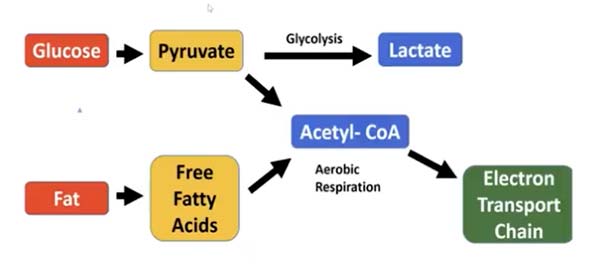
First, the glucose is metabolized into pyruvate. The pyruvate can then either enter the glycolysis pathway in the cytoplasm of the cell and produce lactate, or it can be converted into acetyl-CoA and shuttled to the mitochondrial electron transport chain.
Cancer cells are notorious for using the glycolysis pathway — the same pathway glucose goes through when your glucose metabolism is impaired in mitochondria. Basically, this is the pathway your body uses whenever it reaches its limit to how much ATP can be produced in the mitochondria (which is the most efficient and least damaging way to produce energy).

Save This Article for Later – Get the PDF Now
The Downstream Hazards of Glycolysis
While the glycolysis pathway is wonderful when you need quick fuel, if this is the primary way you burn glucose, then you are in a constant state of activating stress hormones and promoting insulin resistance and diabetes, which in turn creates loads of lactate as a waste product instead of healthy carbon dioxide (CO2) and metabolic water.
Lactate increases reductive stress, which causes reverse electron flow in the mitochondria and increases the ROS to 3% to 4%, which is 30 to 40 times more than when glucose is burned in the mitochondria. This elevated ROS production is what causes T cell damage and death.
What’s more, glycolysis generates only two ATP for every molecule of glucose, which is 95% less energy than would be generated if the glucose was metabolized in your mitochondria.
The Devil’s in the Details
Now, you’ve probably heard that sugar promotes cancer, because cancer cells preferentially use glycolysis. However, it’s a mistake to think that all glucose uses the glycolysis pathway. As illustrated above, glucose can also be burned in the electron transport chain of the mitochondria, which is the most efficient way to produce energy.
So, when it comes to the “sugar fuels cancer” issue, it’s important to make a distinction between the sources of the carbs. While it is technically accurate to call all carbs sugar, there is a radical difference in the source of the carbs — ripe whole fruits versus starches, for example, and whole fruits versus refined processed sugar (ex: table sugar and high fructose corn syrup).
Refined sugars, as well as many starches, are a common cause of endotoxin production in your gut, which destroys mitochondrial function and results in cancer metabolism, whereas the fructose present in whole foods does not typically result in the production of endotoxin.
This is one of the primary differences between refined sugar and fructose from ripe fruit and helps explain why refined sugars fuel cancer while natural fructose does not. So, to be clear, it’s not sugar that is driving the cancer process per se. It’s really rooted in mitochondrial dysfunction, and fatty acid oxidation (the metabolism of fats instead of glucose) is part of what causes that dysfunction.
You Want to Burn Glucose in Your Mitochondria
For a long time, I believed fats burned “cleaner” than carbs — that’s one of the “selling points” for keto — but I’ve since realized we had it backward. Glucose, when burned in the mitochondria, actually burns far cleaner than fat.
So, it’s important to get your macronutrient ratios right, because if the glucose you eat is constantly shuttled into glycolysis, you’re fueling cancer. At the same time, the fat you consume ends up in fat storage rather than being used up for fuel.
Ultimately, you want to burn glucose in your mitochondria, and the way you ensure that is by keeping your dietary fat intake below 35% of your total calories. The reason for this is because when fat intake is too high, glucose gets shuttled into glycolysis. For a more in-depth explanation of this metabolic switch, see “Understanding the Randle Cycle.”
If you’re insulin resistant, which means you’re metabolically inflexible, that threshold may be closer to 20% or even 10%. So, if you’re insulin resistant, you’ll want to significantly lower your fat intake until your insulin resistance is resolved. Then you can increase it to 30%.
Dysfunctional T Cells and Cancer Cells Use Glycolysis
The reason cancer cells use the glycolysis pathway is because they have severely dysfunctional mitochondria. The mitochondria are so damaged, they cannot burn glucose. As a result, the cancer cells must rely on the backup system, glycolysis, to survive. This is what the Warburg Effect is all about.
Likewise, when the mitochondria inside T cells become dysfunctional, the T cells are forced to rely on glycolysis for energy production, which is what causes immune system weakening and failure.
As mentioned in the featured study, T cell exhaustion is a feature of cancer, which makes sense when you consider that it’s all tied to mitochondrial dysfunction. The cancer starts because the mitochondria in cells are severely damaged, and as the disease progresses, the mitochondria in the T cells begin to fail as well.
Once you fix the mitochondria so that they can generate sufficient energy again, then the cancer will typically regress and immune function will be restored, as they no longer need to rely on glycolysis.
Since mitochondrial dysfunction is at the heart of it all, the most effective strategy is to use metabolic therapies that address why the cells are unable to oxidize (burn) sugar in the mitochondria. Once you fix the mitochondria so that they can generate sufficient energy again, then the cancer will typically regress and immune function will be restored, as they no longer need to rely on glycolysis.
What Causes Mitochondrial Dysfunction?
There are four primary contributors to mitochondrial dysfunction:
- Excess linoleic acid (LA) intake
- Estrogen dominance
- Electromagnetic field (EMF) exposure
- Endotoxin — Refined sugars and many starches are more likely to cause gut dysbiosis that leads to the production of endotoxin. This endotoxin is one of the factors that destroys mitochondrial function, resulting in the Warburg Effect (cancer metabolism), where glucose is burned through glycolysis
These all play major roles, but excess LA and estrogen dominance, I believe, are the leading contributors to mitochondrial dysfunction. This is largely because LA and estrogen negatively impact your body in similar ways. They both:
- Increase free radicals that cause oxidative stress and damage your mitochondria’s ability to produce energy.
- Increase calcium intake inside the cell that causes an increase in nitric oxide and superoxide that increases peroxynitrite that also increases oxidative stress.
- Cause an increase in intracellular water causing your body to retain water.
- Slow down your metabolic rate and suppress your thyroid gland.
Nearly everyone in the developing world has 10 times the amount of LA in their tissues than their ancestors of 100 years ago had. This polyunsaturated fat (PUFA) is very susceptible to oxidative damage, and produces free radicals like reactive aldehydes in your body that destroy your mitochondria.
These toxic metabolites of LA create enormous amounts of reductive stress as a result of electrons building up in the ETC and blocking the forward movement of electrons to complex IV and V to create ATP. And, because LA is embedded in the inner mitochondrial membrane, it gets damaged and leaks protons that normally build up in the inner mitochondrial space.
This proton gradient is responsible for driving the nano motor in complex V to create ATP. Both processes combine to shut down and ultimately prematurely destroy the mitochondria. Also, when you eat starches, they can end up feeding endotoxin-producing bacteria in your intestine, and endotoxin is a potent mitochondrial poison.
Solutions
In closing then, some of the key solutions, if you want to improve or restore your mitochondrial function, would be to:
- Lower your LA intake as low as possible by avoiding processed foods, seed oils, chicken, pork, seeds and nuts.
- Make sure you’re eating healthy carbs such as ripe fruit, raw honey and maple syrup.
- Decrease lactate production and increase carbon dioxide, as they have opposing effects.4 You can learn more about this in “The Biology of Carbon Dioxide.”
- Reduce your stress, as chronic stress promotes cortisol release, which is a potent suppressor of mitochondrial function and biogenesis. Progesterone can be quite helpful here, as it’s a potent cortisol blocker. You can learn more about this in “What You Need to Know About Estrogen and Serotonin.”
- Take supplemental niacinamide, as your mitochondria cannot make energy without it. I recommend taking 50 mg of niacinamide three times a day.
Vitamin E Helps Decrease Your Cancer Risk
Reproduced from original article:
https://articles.mercola.com/sites/articles/archive/2024/03/12/vitamin-e-helps-decrease-cancer-risk.aspx
The original Mercola article may not remain on the original site, but I will endeavor to keep it on this site as long as I deem it to be appropriate.
Analysis by Dr. Joseph Mercola March 12, 2024
STORY AT-A-GLANCE
- Vitamin E is an important fat-soluble vitamin and antioxidant that combats inflammation, makes red blood cells, supports healthy immune function and helps your body use vitamin K, which is important for heart health
- Vitamin E deficiency increases your risk for immune dysfunction, cognitive deterioration, cardiovascular disease and certain cancers, including prostate, breast, colon and lung cancers
- A meta-analysis of 11 studies concluded that patients with lower concentrations of serum vitamin E (the vitamin E level in your blood) had a higher risk for colorectal cancer. Other studies have shown natural vitamin E may reduce your risk of lung cancer by more than 60%, and gamma-tocotrienol, a cofactor, may decrease prostate tumor formation by 75% and inhibit growth in human breast cancer cells
- Vitamin E also prevents linoleic acid (LA) stored in your tissues from being oxidized into toxic byproducts. Since most people have LA stores that are 10 times higher than normal, and since excess LA likely is one of the primary contributors to chronic disease, it can be a good idea to take vitamin E regularly until you get your LA down to healthy levels
- When supplementing, make sure it’s made with natural (not synthetic) vitamin E and has a balance of all eight vitamin E compounds that is free of genetically engineered ingredients and soy
Vitamin E is a fat-soluble vitamin with potent antioxidant activity that helps combat damaging free radicals. It also plays a role in the making of red blood cells, helps your body use vitamin K (which is important for heart health1) and is involved in your immune function and cell signaling. As with many other nutrients, many do not get enough of this basic micronutrient from their diet.
In the U.S. alone, 75% to 90% of the population fails to reach the recommended dietary allowance (RDA) of vitamin E.2,3 The RDA for people over the age of 14 is 15 milligrams of vitamin E per day, but most Americans get only half that amount.4 Insufficient vitamin E can increase your risk for a wide variety of diseases, including immune dysfunction, cognitive deterioration, cardiovascular disease and certain cancers,5 especially prostate, colon and lung cancers.6,7
Obesity heightens your risk of vitamin E deficiency further, in part because the increased oxidative stress in fat cells increases your body’s need for vitamin E to begin with. Obesity also impairs your body’s utilization of vitamin E.8,9 Food is your best source of vitamin E, since food contain a combination of the eight types of vitamin E. If you’re using a supplement, there are key considerations that need to be heeded, which I’ll review below.
Low Vitamin E Level Linked to Higher Risk of Cancer
A number of studies have looked at vitamin E’s influence on diseases like cancer. It’s important to realize that while some studies have linked vitamin E supplementation to an increased risk for cancer,10 most of those studies were looking at synthetic vitamin E, which I do not recommend using.
For example, there was a study published in 2015 that analyzed the effects of vitamin E intake on lung cancer risk among female nonsmokers. This was a study that looked at diet versus supplemental vitamin E in 72,000 subjects. After 12 years of follow-up, 481 women had been diagnosed with lung cancer.
Interestingly, dietary vitamin E strongly correlated with a lower risk of lung cancer, while supplemental vitamin E was associated with an increased risk. Not surprisingly, the supplemental vitamin E used was synthetic.
Overall, this makes a strong case for making sure you’re either getting your vitamin E from food, or from a natural vitamin E supplement, as natural vitamin E is the only kind that has a protective effect. Case in point: studies assessing the anti-cancer potential of natural vitamin E have found that:
- 300 IUs11 of natural vitamin E per day may reduce lung cancer risk by 61%12
- Gamma-tocotrienol, a cofactor found in natural vitamin E preparations, may decrease prostate tumor formation by 75%13
- Gamma-tocotrienol also fights existing prostate cancer tumors and may inhibit growth in human breast cancer cells14
A 2017 meta-analysis15 of 11 studies concluded that patients with lower concentrations of serum vitamin E (the vitamin E level in your blood) had a higher risk for colorectal cancer. An earlier study,16 published in 1993, also found that high intake of vitamin E helped decrease the risk of colorectal cancer — especially in those under the age of 65. As explained in the study:
“Vitamin E is the major lipid-soluble antioxidant found in cell membranes, where it protects against lipid peroxidation. In addition, like carotenoids and water-soluble vitamin C, it can also stimulate the immune system and may protect against the development of cancer by enhancing immune surveillance. Vitamins E and C reduce nitrite, compounds that induce tumors …”
Other Health Benefits of Natural Vitamin E
Aside from its cancer-preventive potential, natural vitamin E may also:
• Lower your risk of heart disease and stroke.17
• Help relieve symptoms associated with nonalcoholic steatohepatitis, a common obesity-related fatty liver disease.
• Lower your risk of age-related macular degeneration, a leading cause of vision loss in the elderly.18
• Boost improvements in blood vessel function that occur when a smoker quits smoking.19
• Delay loss of cognitive function in Alzheimer’s patients.20 Results showed that clinical progression of Alzheimer’s slowed by 19% per year in the group receiving 2,000 IUs per day of vitamin E, compared with placebo. This delay translated into just over six months of delayed progression over the two-year follow-up period. Caregiver time also increased the least in the group receiving vitamin E.
This study actually used synthetic alpha-tocopherol that was not balanced with tocotrienols or any of the other tocopherols — beta, gamma and delta. Chances are the benefits would have been even greater if the natural form was used.
Download this Article Before it Disappears
Vitamin E Protects Against Damage Caused by Linoleic Acid and Estrogen
Another important benefit of vitamin E is that it prevents linoleic acid (LA) stored in your tissues from being oxidized into toxic byproducts. Since most people are walking around with LA stores that are 10 times higher than normal.
Since excess LA is likely one of the primary contributors to chronic disease, it can be a good idea to take vitamin E regularly until you get your LA down to healthy levels, which may take up to six years for most people. Vitamin E can almost miraculously prevent most of the damage done by LA.
Vitamin E can also reverse or prevent many of the issues associated with excess estrogen. This is important because excess estrogen has remarkable parallels to LA in terms of its metabolic and anti-health effects. When you eat excess polyunsaturated fat (PUFA) or LA, you increase your body’s production of estrogen. So, when you increase LA, estrogen levels go up — and that’s not a good thing.
Both LA and estrogen increase the influx of calcium into the cell, which causes nitric oxide and superoxide to increase inside the cell. Nitric oxide and superoxide combine almost instantaneously to form a very pernicious reactive nitrogen species called peroxynitrite, which causes pervasive damage to tissues in your body.
LA and estrogen also increase a potentially dangerous process in your body called lipolysis, which is simply the liberation of fatty acids from your fat cells into your bloodstream where they are mobilized. This then increases the oxidation of LA, which is precisely what you want to avoid as ideally you want to keep LA in your fat cells until they metabolize it with peroxisomes. Fortunately, vitamin E can also help neutralize this damaging effect of LA.
Vitamin E also directly inhibits the activity of an enzyme called aromatase. This is an enzyme that converts the male hormones like testosterone and DHEA into estrogens. Even better, it serves as an estrogen antagonist, meaning it binds to the estrogen receptor to block it from binding to estrogen. This dramatically lowers the damage from excess estrogen.
Vitamin E works very similarly to the drug tamoxifen, which is used to treat estrogen receptor-positive breast cancers. For these reasons, I firmly believe nearly everyone needs to be getting vitamin E in their diet. However, due to the high LA burden, very few people can get enough vitamin E to suppress this oxidative destruction unless they’re taking a supplement.
The good news is that since the supplementation is short term (provided you’re actively reducing your LA intake), you’re not going to need it the rest of your life. If you can keep your LA intake to below 5 grams a day for three years, it’s likely you may not even need it at all, or at most, only a few times a month.
However, if you go out and binge on a meal that’s very high in LA, I would strongly recommend taking a vitamin E capsule to protect yourself from this exposure.
Once your LA levels get low, you only need about 2 mg of vitamin E per gram of LA. If your LA intake is at or below 5 grams a day, as recommended, you only need about 10 mg of vitamin E, which is a very low dose. Since vitamin E is fat soluble, it stays in your fat tissues for some time.
Vitamin E Reverses Mitochondrial Oxidation Inhibition
Two studies that highlight the destructive influences of estrogen and cortisol were published all the way back in 196321 and 1960.22 As explained by bioenergetic researcher Georgi Dinkov,23 these studies show that estrogen and cortisol inhibit NADH oxidation in the mitochondria, thereby shifting the ratio between NAD+ and NADH in the mitochondria in favor of reduction.
Reduction, in turn, causes a reverse in the flow of electrons in the electron transport chain, which causes damaging reactive oxygen species (ROS) to be generated. The end result is poor mitochondrial function and chronic inflammation, which are at the root of most chronic conditions, including diabetes, cardiovascular disease and cancer.
On top of that, estrogen also inhibits pyruvate dehydrogenase, which increases NADH accumulation and skews the NAD+/NADH ratio even more, and “induces a multi-fold rise in ceruloplasmin — a reliable biomarker of both acute and chronic inflammation, as well as some cancers (e.g. lymphomas),” Dinkov warns.24 The good news is that since vitamin E is such a potent inhibitor of both estrogen and cortisol, it can reverse these adverse effects.
How Much Vitamin E Do You Need for Optimal Health?
According to one scientific review,25,26 a mere 21% of the people studied had a protective level of serum vitamin E, which is thought to be 30 micromole per liter (μmol/L). This appears to be the threshold above which “definable effects on human health in multiple areas” are obtained.27 Human studies have also found that achieving a level of 30 μmol/L requires a daily intake of at least 50 IUs of vitamin E.28
A primary reason for such widespread deficiency is that most people eat a primarily processed food diet, which tends to be lacking in vitamin E and other important nutrients.
Deficiency during pregnancy can be particularly problematic. Worldwide, about 13% of people have vitamin E levels below the “functional deficiency” threshold of 12 μmol/L, and most of these are newborns and young children. Babies deficient in vitamin E are at increased risk for immune and vision problems. Being deficient in vitamin E during pregnancy also raises your risk for miscarriage.29
Since vitamin E is fat-soluble, taking it with some healthy fat, such as coconut oil or avocado, can help increase its bioavailability. In fact, studies have shown your body will absorb only about 10% of the vitamin E from a supplement when you take it without fat.30
Signs and Symptoms of Vitamin E Deficiency
Signs and symptoms of serious vitamin E deficiency include:31,32
| Muscle weakness and unsteady gait | Loss of muscle mass |
| Cardiac arrhythmia | Vision problems, including constriction of your visual field; abnormal eye movements; blindness |
| Dementia | Liver and kidney problems |
How to Pick a Good Vitamin E Supplement
Most vitamin E supplements are synthetic, and you want to steer clear of those. Studies have demonstrated that synthetic vitamin E has the opposite effect of natural vitamin E, such as increasing the risk of certain cancers rather than lowering it,33,34,35 for example. So, it’s important to make sure you’re getting a natural version.
Synthetic vitamin E is called alpha tocopherol acetate. The acetate indicates that it’s synthetic. Next, you need to pay attention to the orientation of the optical isomer. Most vitamin supplements are racemic, or they have left- and right-hand isomers. This is a problem as most biological molecules have optical isomers that are right-handed.
They’re usually called D and L isomers, which stands for right and left. When you have both left and right isomers present, it’s called racemic. Biologically, there’s usually only one optical isomer that works well, and with vitamin E it is the D isomer that works in your body, while the L isomer is useless.
Yet in synthetic supplements, 50% of the vitamin E is the useless L isomer. To make matters even worse, many synthetic versions use an ester of vitamin E, which only has about 50% of the activity of the natural product. So, the total activity of many vitamin E supplements is reduced by 75%.
So, the first step in identifying healthy good vitamin E supplements is to make sure you’re getting real vitamin E and not synthetic. What you’re looking for is “d alpha tocopherol.” This is the pure D isomer, which is what your body can use. Synthetic alpha-tocopherol is listed with a “dl” (i.e., dl-alpha-tocopherol).
There are also other vitamin E isomers, and you want the complete spectrum of tocotrienols, specifically the beta, gamma, and delta types of vitamin E, in the effective D isomer.
Another potential problem is that if you take high amounts of alpha-tocopherol in isolation, it could potentially deplete the other tocopherols and tocotrienols from your body. This is true whether you’re taking a natural or a synthetic one, so I recommend looking for a food-based supplement that has a balance of all eight types of vitamin E (four tocopherols and four tocotrienols).
Also look for a supplement that is free of soy, soybean oil derivatives and genetically engineered (GE) ingredients (some of the most common GE ingredients found in supplements are derivatives of corn, soy and cotton seed).
Your Best Source of Vitamin E
Supplements are best taken in addition to, not in place of, a healthy diet, and only if you actually need them. One way to evaluate your need for a vitamin E or other supplements is to use a nutrient tracker, such as Cronometer.com/Mercola, which is the most accurate one on the market because of their decision to eliminate inaccurate crowd sourced data. It’s available free of charge.
Vitamin E can easily be obtained from a healthy diet, so before considering a supplement, consider including more vitamin E-rich foods36,37 in your diet. Vitamin E is synthesized by plants, and the highest amounts are found in plant oils.
However, while some health authorities recommend canola oil as a good source,38 this is actually a terrible source due to its high LA content. Beans — another good source of vitamin E — may also be problematic for many due to their high lectin content.
One of the best healthy natural sources of vitamin E would be grass fed ruminants like beef or bison. A normal serving can provide enough vitamin E to protect against the oxidative stress from LA in a low LA diet. If you have a high LA diet and have had one for quite some time, like most people, then you will want to consider a supplement with around 100 units of vitamin E that meets the criteria in the section above.
Avoid supplements that don’t meet these criteria or much higher doses of vitamin E as more is not necessarily better and can be highly counterproductive.
- 1, 5, 31 University of Maryland Medical Center, Vitamin E (Archived)
- 2 British Journal of Nutrition 2012 Aug;108(4):692-8
- 3, 6, 25 Prevent Disease July 26, 2016 (Archived)
- 4, 17 National Institutes of Health, Vitamin E Fact Sheet
- 7, 38 PCRM.org, How Vitamin E Helps Protect Against Cancer (Archived)
- 8 Science Daily November 2, 2015
- 9, 30 Science Daily October 7, 2015
- 10 Science Daily May 19, 2016
- 11 Calculator Site, How to Convert IUs to Mcg or Mg
- 12 Int J Cancer. 2008 Sep 1;123(5):1173-80
- 13 International Journal of Cancer 2011: 128/(9); 2182-2191
- 14 European Journal of Lipid Science and Technology January 18, 2008
- 15 Medicine 2017 Jul; 96(27): e7470
- 16 Cancer Research September 15, 1993; 53: 4230-4237 (PDF)
- 18 Ophthalmology. 2009 May;116(5):939-46
- 19 Time Magazine April 25, 2013
- 20 JAMA January 1, 2014: 311(1); 33-44
- 21 Journal of the American Geriatrics Society April 1963, 11(4)
- 22 The Journal of Biological Chemistry 1960; 235(12): 3413-3416
- 23, 24 Haidut.me March 4, 2024 (Archived)
- 26 Nutraingredients-USA.com July 19, 2016
- 27, 28 International Journal for Vitamin and Nutrition Research, ISSN 0300-9831
- 29 Johns Hopkins December 3, 2014
- 32 Medscape Vitamin E December 21, 2021
- 33 Cancer Prevention Research May 2012, DOI: 10.1158/1940-6207.CAPR-12-0045
- 34 Science Daily April 23, 2012
- 35 Sci Transl Med 29 January 2014: Vol. 6, Issue 221, p. 221ra15
- 36 The World’s Healthiest Foods Vitamin E (Archived)
- 37 MyFoodData.com, Top 10 Foods Highest in Vitamin E
Understanding the Randle Cycle
Reproduced from original article:
https://articles.mercola.com/sites/articles/archive/2024/03/09/randle-cycle.aspx
The original Mercola article may not remain on the original site, but I will endeavor to keep it on this site as long as I deem it to be appropriate.
Analysis by Dr. Joseph Mercola March 09, 2024
STORY AT-A-GLANCE
- Some in the keto and carnivore space argue that eating fats and carbs together will result in weight gain because of the Randle cycle, which serves as a switch that only allows your body to burn either fats or glucose, one at a time, not both together
- The Randle cycle refers to an antagonism between glucose and fats as fuel, which explains why you can become insulin resistant when you avoid carbohydrates
- If you’re in chronic ketosis, your tissues decrease their insulin sensitivity, which can lead to or contribute to insulin resistance
- A low-carb diet is best implemented as a temporary strategy to restore metabolic flexibility. Once metabolic flexibility is regained, adding more carbs back in will help to lower cortisol, which is highly inflammatory
- A narrow time-restricted eating (TRE) window is also counterproductive once you’ve regained metabolic flexibility, as extended fasting also raises cortisol
Many appreciate my openness to integrating new information into my personal health approach and what I teach. I am a perpetual learner and seek to constantly evolve my approach, so it is aligned with biological truth, even if I have to admit I was mistaken.
Along those lines, I only learned most of the information in this article earlier this year, and it has had a dramatic impact on how I view burning food for energy. This approach is dramatically different than I previously understood and recommended, which was focused on high-fat and low-carb consumption.
You might recall for the last few years I have warned that chronic low-carb eating is not a good idea, and that you need to cycle in and out of low carb. This was a great move in the right direction, but what I have recently learned is that it was not enough and that most people would benefit from far higher amounts of carbs.
When I first started keto, I was below 50 grams of carbs a day for about a year and then for the next five years increased to about 100 grams per day. For the past few months, I have increased that to 425 grams of carbs per day, mostly in the form of ripe fruit.
I have noticed dramatic beneficial changes in my blood work that I won’t go into now but will dive deep into in future articles. I will reveal that increasing my carbs by 400% resulted in a highly counterintuitive, 10% decrease in my fasting blood sugar, and that I also lost 10 pounds despite increasing the number of calories I was consuming — precisely the opposite of what most “experts” would predict.
This doesn’t mean you should stop what you are currently doing and switch, but if you have been struggling with keto and are unable to lose weight, it is likely that a high-fat diet is slowing down your metabolic rate, increasing your cortisol levels and contributing to an inability to achieve your ideal body weight.
My strong recommendation would be to not dismiss this concept as well-intentioned but seriously misguided nonsense, but to take the time needed to understand the solid science behind it.
The reason I switched to the higher carb, low-fat diet was due to learning the late Ray Peat’s work through his student Georgi Dinkov. Peat was a biologist and thyroid expert; Dinkov is a biohack expert. Since the beginning of the year I have been watching Georgi’s videos on YouTube for about two to three hours a day.
He has a thick Bulgarian accent and talks fast so you need to listen at 1X, although I typically watch his videos at least two to five times as it seems every time I relisten to them I learn something new or understand what he has to say in a new way.
Here is a chronologically sorted link to most of his past interviews.1 And wouldn’t you know it, he has not been censored by the globalists, so hundreds of hours are available for free on YouTube and it won’t cost you anything but your time to review.
However, please know that everyone is different and has a unique biochemistry, so your dietary program would have to be customized and fine-tuned for you. Many of the principles are universal and can be widely adopted, though, so If properly done I am convinced that most will notice profound improvement in their metabolic rate, mitochondrial function and energy levels, along with a reduction in inflammation.
Why I Changed My Mind About Low-Carb Diets
One of the foundational concepts of health that I’ve had to radically revise my thinking on, based on Peat’s and Dinkov’s work, is the idea that eating a low-carb diet long-term is the best way to optimize your metabolic and mitochondrial health.
I now realize that this was misguided, and the reason for that has to do with the fact that your body requires glucose, and if you aren’t eating it you will go into a hypoglycemic coma and die. Obviously, your body has safeguards to prevent that, and the major one is the hormone cortisol.
In medical school, we learned that cortisol is a glucocorticoid. Gluco means glucose (sugar) and cortico means it comes from the adrenal cortex. It’s also another word for steroid. We were told that cortisol is responsible for maintaining glucose homeostasis, but led to believe its primary purpose was for inflammation.
Well, that is just not true. While cortisol certainly contributes to glucose balance, its primary purpose is to raise your blood sugar when it is too low and you don’t have enough glycogen reserves in your liver.
How Does Cortisol Work?
But just how does cortisol increase your blood sugar? It does it by breaking down your muscles, bones and brain. It sacrifices your lean muscle mass to release amino acids that your liver converts to glucose in a process called gluconeogenesis.
So, ultimately, cortisol also is going to increase inflammation and impair your immune function. And it increases food cravings. So, you do not want your cortisol to be elevated. For a long time, I was a proponent of a low-carb diet, but now I realize that chronic low-carb is not a good idea.
As a fuel, glucose is vastly superior to fat, and this was something I simply got wrong. The same thing goes for fasting. Both low-carb and fasting are great interventions in the short-term for those who are overweight and metabolically inflexible.
However, once you’ve regained your metabolic flexibility, it is important to revise your strategy and add healthy carbs back in, or these strategies will backfire and lead to decreased metabolic health, compromised mitochondrial function and impaired metabolism.
Cortisol happens to be the primary aging hormone. If it is chronically elevated, you simply will die prematurely as it is highly catabolic, meaning it will break down your body tissues. To stay healthy as you age you need to be anabolic and build healthy tissues like muscle and mitochondria.
Elevated cortisol will seriously impair those efforts. So, it is clear that you need to be doing everything you can to keep your cortisol levels and chronic inflammation low.
Download this Article Before it Disappears
The Paradox of Simple Versus Complex Carbs
Since I recorded the video above, it has become clear to me why there is a problem with the seemingly paradoxical conclusion that simple carbs are better than complex carbs for most people. I did not understand this when I recorded the video.
I have since determined that this is a result of most people eating large amounts of metabolic poisons like linoleic acid (LA) their entire life, in addition to regular estrogen exposure in the form of plastics which are xenoestrogens. As a result of these exposures, they have dramatically altered the composition of their microbiomes.
This occurs because these metabolic poisons result in a decrease in cellular energy production in the mitochondria, which then decreases carbon dioxide production in the intestine. The relatively lower concentration of carbon dioxide in the large intestine promotes the growth of pathogenic disease-causing bacteria known as facultative anaerobes.
These specific bacteria have high amounts of lipopolysaccharide (LPS) embedded in their cell membranes. When they are provided with food in the form of complex carbohydrates, they serve as fertilizer to accelerate their growth, so they multiply and eventually die.
When they die, this LPS, otherwise known as endotoxin, is released, and that is another potent metabolic poison that will radically decrease your mitochondria’s ability to create cellular energy, thus contributing to a vicious downhill cycle.
This sets up the seemingly paradoxical scenario where healthy food such as complex carbohydrates can make your health worse, because they are increasing the concentration of endotoxin in your body, which in high concentrations can result in septic shock that kills you.
The solution is to improve your health by improving your mitochondrial function and their ability to create sufficient cellular energy, which will subsequently restore the balance of healthy bacteria in your gut. When this is achieved, then complex carbohydrates transition to becoming very healthy.
But until your mitochondria produce adequate energy, complex carbs frequently contribute to worsening your health through the production of endotoxin. So it’s wise to carefully navigate with the introduction of complex carbs if you have been exposed to metabolic poisons for most of your life.
I believe the most prudent strategy is to listen and trust your body. If you have any problems eating complex carbs that result in bowel symptoms, then it would be wise to consider restricting your carbs to very simple carbohydrates such as fruit juice, which is the easiest carbohydrate to digest.
Once that is tolerated then you can go to healthy whole fruits. Once that is tolerated then you can progress to including other more forms of more complex carbohydrates until you are feeling that you can tolerate those.
Important Cautions Before You Increase Carbs
It would be a major mistake to increase your carb intake if you are still on a high-fat diet. I did this experiment in the mid-‘80s after I read the book by Harvey and Marilyn Diamond called “Fit for Life.”
They suggested having fruit only for breakfast – which I tried. Then I did my lab work and found my fasting triglycerides and lipoprotein profiles had exploded for the worse. I prematurely concluded that a high fruit diet was nonsense and remained relatively low-carb for nearly four decades.
This was until I encountered Ray Peat’s work and reevaluated my initial impression. I now understand that I was missing important parts of the strategy. And now I eat 3 to 4 pounds of watermelon every morning at 5:30 as my first meal, followed by three eggs and 8 ounces of white rice and 2 ounces of maple syrup one to two hours later.
That sounds like a lot of carbs, and it is. I have additional fruits later in the day and now my carb intake is about 425 grams a day. You might wonder what has happened to my weight and blood sugar with all these extra carbs.
Well, I thought my weight was good at 192 as I increased my muscle mass, but it has decreased by 10 pounds to 182 with no change in muscle mass. My fasting blood sugar has dropped 10 points and, so far, it seems to be working for me.
The Vital Metabolic Switch You Need to Understand
This is one of the most important principles in food science that I had never learned or understood until recently. My strong guess is that this is also true for most natural medicine clinicians. That is why I created the figure below to help you visualize it, so you can better understand this vital concept.
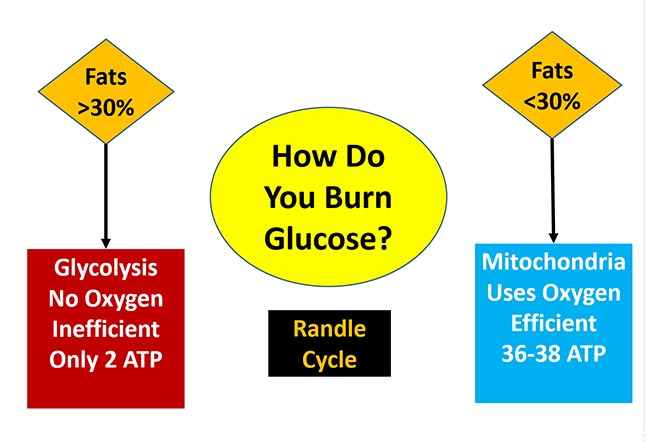
Low-carb diets have helped at least tens of millions of people improve their health for a very good reason, and that is there is a stealth switch that controls what fuel your mitochondria can burn. They can only burn one fuel at a time, either fat or glucose.
The switch has been given the name the Randle cycle, but it is more helpful to visualize it as a railroad switch that changes the tracks of the train. The train can only travel down one track; not both. This is because only one type of fuel can be burned at a time.
The best-case scenario is you metabolize, or burn, glucose in your mitochondria without any reductive stress (a term I will explain in my upcoming interview with Georgi Dinkov). When you do this, you will only generate 0.1% reactive oxygen species (ROS).
Not only does this route generate less ROS, but it also is incredibly efficient at energy production by creating 36 to 38 Adenosine triphosphates (ATP) for every molecule of glucose that is metabolized. It will also generate metabolic water and carbon dioxide, which are also important for your health.
For this to occur, as indicated in the figure above, you will need to consume less than 30% of your calories as fat. When you consume significantly more than that amount, the switch changes to burn fat in your mitochondria and you will not be able to burn glucose until your fat decreases to less than 30% of calories.
Since glucose is unable to be shuttled into the mitochondria to burn, it winds up backing up into your bloodstream, raising your blood sugar. This is a major contributor to diabetes. What little glucose is burned for fuel is done by using glycolysis, which is a primitive pathway that bacteria and cancer cells use.
It is great that we have this pathway, as you absolutely need it for quick fuel when you are activating your type II muscle fibers. But if this is the primary way you burn glucose, you are in a catastrophic metabolic state as you are creating loads of lactic acid as a waste product instead of healthy CO2. And, you are only generating two ATP for every molecule of glucose, which is 95% less energy.
Lactic acid increases reductive stress, which causes reverse electron flow in the mitochondria and causes reductive stress, which increases the ROS to 3% to 4%, which is 30 to 40 times more than when glucose is burned efficiently in the mitochondria. You likely don’t yet understand reductive stress, the opposite of oxidative stress, but I will be doing an interview with Georgi on this and will be posting it later this month.
Why Lactic Acid and CO2 Are so Important
Remember, when you are burning glucose efficiently in your mitochondria, the glucose is converted not only to 36 to 28 ATP, but when the electrons from the glucose are ultimately handed off to oxygen, metabolic water (deuterium free) is made and, very importantly, carbon dioxide.
This is vital to understand as carbon dioxide is a potent stimulator of mitochondrial biogenesis which will increase the number of mitochondria that you have so you can make even more energy.
Conversely, when you are burning glucose far less efficiently in glycolysis you are only generating two ATPs, and rather than creating life-sustaining carbon dioxide, you are generating life-damaging lactic acid, which will degrade your mitochondria and make them die sooner.
Georgi Dinkov’s Review of the Randle Cycle
In this second video, anti-vegan activist Paul Saladino interviews Dinkov about the Randle cycle. Dinkov comments:
“The first accusation against you, that whole milk will somehow make you fat because of the Randle cycle [is] misguided because if you look at the label, whole fat milk has like 5 grams of fat per serving but 12 grams of carbs, so you’re actually [getting] more carbs.
But let’s talk about meat. Most meats … are actually not that high in fat, and a lot of the fat in them is actually short chain fatty acids, which are not subject to the Randle cycle because they get transported into the cells through a known L-carnate-independent mechanism.
They metabolize similarly to sugar, and they don’t seem to be triggering the same sort of Randle cycle effect. Now, what drives the Randle cycle effect? When you’re oxidizing primarily fats … the master conductor redox modulator — which is the NAD to the NADH ratio, specifically the intra-mitochondrial one — drops. (This simply means the more NAD+ the better).
Basically, the NAD to the NADH ratio — which signals how oxidized versus how reduced you are, metabolically — [is] the primary regulator of whether the pyruvate dehydrogenase (PDH) will accept pyruvate and convert it into acetyl-CoA and then continue with the Krebs cycle in the electron transport chain, or not.
(Pyruvate is the three-carbon molecule breakdown product of glucose. PDH is the enzyme that converts it to acetyl-CoA which allows it to enter the mitochondria and be burned efficiently. If PDH is inhibited, it will force your body to use fat).
In other words, a high ratio of NAD to NADH (meaning high NAD+) when you’re very oxidized favors the activity of pyruvate dehydrogenase, so you will not be accumulating pyruvate [and] you will not be generating lactate.
But if you’re eating a lot of fat, the NAD to the NADH ratio drops, and then the buildup starts to happen. Pyruvate accumulates, lactic [acid] accumulates. [This means] the Krebs cycle is working because it’s accepting acetyl-CoA from the beta oxidation. That’s how the fatty acids get oxidized.
So, that’s the gist of the Randle cycle … If you’re providing a lot of glucose, in theory you should be able to out-compete the free fatty acids and oxidize more glucose versus fat, but that all depends on how much glucose can get into the cell.
And, unfortunately, when you’re eating these high-fat diets, when you have higher lipolysis, the actual uptake of glucose into the cell is already largely blocked …
Free fatty acids not only block the metabolism of glucose, they also block the uptake of glucose into the cell. So, they prevent the positive effects that the glucose would have had, in terms of competing with the free fatty acids …
Basically, too much fat blocks your uptake and utilization of glucose, and whatever glucose is taken up, you largely convert to nonbeneficial byproducts such as lactic acid …”
So, to summarize Dinkov’s rather complex exposition on the Randle cycle’s effects: a) fats can make you fat directly; and b) fats limit your ability to metabolize glucose. This is due to the Randle cycle’s preference to fat metabolism when more than 35% of your calories come from fats. And, even if you metabolize small amounts of glucose, your body will favor the conversion of glucose into fat versus ATP, water and carbon dioxide.
This is because the enzyme PDH, which converts the glucose metabolite pyruvate, is inhibited by high fat concentrations, and won’t convert pyruvate to acetyl-CoA to be burned in the mitochondria. Instead, because PDH is inhibited, the pyruvate is metabolized into lactate. This entire process is antimetabolic and slows down your metabolism, increases your ability to gain weight, and lowers your ability to generate cellular energy.
So, when more than 30% to 35% of your calories are coming from fat, you are forcing your cells to burn fat and put glucose on the back burner, instead of being metabolized like it should be.
Simple Strategies You Can Implement to Help Your Metabolism
Clearly, the most important strategy to help your metabolism is to avoid eating linoleic acid at all costs. It is impossible to avoid as it is in nearly every food, but you want to keep your levels below 2% of your daily calories. This means avoiding ALL processed foods and typically most restaurants.
A powerful strategy that nearly everyone should do is to make sure that you are taking a high-quality vitamin E supplement once a day. Why? Because most everyone has 20 to 30 times more LA in their body than optimal. Not only will vitamin E impair the release of it from fat cells, but once released it will help protect the LA from converting into dangerous oxidized linoleic acid metabolites (OXLAMs).
Most vitamin E supplements should be avoided, so how do you identify a high-quality vitamin E supplement? It should have most of the vitamin E isomer as alpha tocopherol, typically about 150 units. It should also have the other tocopherol isomers: alpha, beta and gamma, but at far lower doses.
Additionally, it should have alpha, beta and gamma tocotrienols. Finally, it should only have the “D” isomer. Avoid all vitamin E supplements that are “DL,” which are 50% of the wrong isomer.
It would be very wise to make sure you have enough NAD+ as it will also inhibit the release of LA from your fat cells. If you haven’t read and viewed by interview with molecular biologist Nichola Conlon on this topic, you can read it on my Substack. Sadly, NAD+ decreases dramatically as you age, which leads to nearly a 1-to-1 reduction in ATP, your cellular energy currency.
Fortunately, this can be inexpensively addressed by taking 50 mg of niacinamide three times a day. More is not better, so avoid 500 mg tablets as they will impair your longevity proteins. Typically, one sixty-fourth of a teaspoon of niacinamide powder is about 50 mg.
Finally, aspirin can be a very useful way to inhibit LA lipolysis. Aspirin is a very interesting approach and I go into far more details in my recent article on it.
Why Long-Term Low-Carb Diets Can Backfire
I previously touched on the Randle cycle in “How the Wrong Dietary Fat Can Wreck Your Health,” which also featured an interview with Dinkov. In that interview, Dinkov cleared up several areas of confusion, including the following:
•Low-carb dieting is a great short-term intervention for people who are overweight and insulin resistant. Lowering carbs will help reset your metabolism and recover your metabolic flexibility. However, in the long-term you will likely run into trouble — especially if you’re also doing a lot of endurance training.
One of the reasons for this is because when you’re in a low-carb state, lipolysis is elevated, which releases inflammatory polyunsaturated fatty acids (PUFAs) such as LA from your cells that are then into dangerous OXLAMs (oxidative linoleic acid metabolites) that will damage your tissues.
PUFAs such as LA are not digested. Instead, they’re stored.2 Most of the body fat in obese individuals is composed of PUFAs, not saturated fat. Saturated dietary fat is mostly burned (oxidized) and used up. So, most people have large stores of LA, and these stores need to be lowered to safe levels of 1% to 2% LA.
• Extended fasting and using an excessively narrow time-restricted eating (TRE) window can also backfire once you’re metabolically flexible, as it too helps push LA out of your cells.3,4,5,6,7,8,9,10 An extreme example of TRE is the one meal a day (OMAD) protocol, where you’re fasting 22 hours or more each day. Dinkov believes this is too extreme for most people.
The half-life of PUFAs such as LA, which get embedded and integrated into your cell membranes, is about 680 days. This means that ridding your body of LA will take approximately seven years, provided you don’t load more in. And you really do want to get rid of this fat, as it’s highly inflammatory and prevents your mitochondria and cellular machinery from operating properly. But you need to do it slowly and methodically.
Exercise and fasting will help drive the LA out, but you need to be really careful if you have a lot of LA storage. You want to avoid excessive lipolysis — any situation where you’ve run out of glycogen, which can easily happen when you’re not eating for long periods, when you’re on a chronic low-carb diet, and/or when you’re engaging in intense exercise, especially if you exercise in a fasted state.
• Chronic long-term, low-carb, and chronic extended fasting also result in elevated cortisol, which is highly inflammatory and promotes the storage of fat. Elevated cortisol is also highly catabolic and will cause you to lose lean muscle mass so your liver can make glucose. For these reasons, low-carb diets and fasting are best implemented as temporary strategies to restore metabolic flexibility.
How to Safely Reduce LA Stores Without Self-Sabotaging
With all of that in mind, how can you safely reduce your LA stores without self-sabotaging? Extensive fasting will, in this instance, backfire, as will overtaxing yourself with heavy exercise. You’ll need to accept that achieving optimal health is a marathon, not a sprint, and that it’s going to take years to purge your LA stores. Dinkov suggests the following strategy:
- Build muscle and maximize lean muscle mass
- Avoid fasting for longer than 16 hours
- Avoid all processed foods, restaurant foods, condiments and animal foods raised on grains, such as chicken and pork, as all of these are high in LA
- Eat a diet with about 15% protein, restricting fats to below 35% with the remainder consisting of carbs in the form of ripe fruits and some vegetables and well-cooked low-oxalate starches. Be careful to avoid all processed sugars as they typically are loaded with high fructose corn syrup that will increase endotoxin in your gut
So, to recap, temporarily implementing a six- to eight-hour time restricted eating window, or even longer eating restrictions and fasts, is appropriate for anyone who is insulin resistant and metabolically inflexible — and that’s about 95% of the population.
However, once you lose your insulin resistance and become metabolically flexible — which typically takes a few weeks — you’ll want to increase your eating window to eight to 12 hours to avoid elevating your cortisol, as cortisol promotes chronic inflammation that can lead to tissue damage, and promotes the storage of fat.
If you stop supplying carbs to your body, the organs that need them will activate glucose creation in your body by elevating cortisol. So, once you’re metabolically flexible, you want to avoid extended fasting.
How does TRE and extended fasting raise cortisol, you ask? It is important to understand that cortisol is a powerful hormone whose primary purpose is to shred your lean muscle mass and bones to obtain amino acids for your liver so it can produce glucose. This is cortisol’s primary role. If your blood sugar gets too low, you will go into a hypoglycemic coma and die. Your brain requires sugar and if it doesn’t get it, it is game over.
Usually, it takes a few weeks and occasionally longer, for you to recover your metabolic flexibility. During those first three to six months, stick to a six- to eight-hour eating window. Once you’re metabolically healthy, avoid eating windows under eight hours. I’ve now shifted to a schedule where I always have an eating window of more than eight hours a day and closer to 12, in the summer when there is plenty of daylight.
Interestingly a recent study showed that a lower fat, higher carb approach lowers the risk of death by 30%, while with the converse a high-fat, low-carb diet increases the risk of death by 30%.11,12 So, it’s your choice for sure, but I am convinced that having more healthy carbs than fat is a great choice to improve your metabolic health.
- 1 YouTube Georgi Dinkov
- 2 Haidut.me October 22, 2019 (Archived)
- 3 Haidut.me February 16, 2021 (Archived)
- 4 Haidut.me September 27, 2022 (Archived)
- 5 Haidut.me March 4, 2021 (Archived)
- 6 Haidut.me December 10, 2021 (Archived)
- 7 Haidut.me June 21, 2022 (Archived)
- 8 Haidut.me November 17, 2020 (Archived)
- 9 Haidut.me December 21, 2021 (Archived)
- 10 Haidut.me September 30, 2020 (Archived)
- 11 J Intern Med. 2023 May 3. Low-carbohydrate diets, low-fat diets, and mortality in middle-aged and older people: A prospective cohort study
- 12 Haidut.me May 9, 2023 (Archived)
Latest Additions to Long COVID Recovery Protocol
Reproduced from original article:
https://articles.mercola.com/sites/articles/archive/2024/02/24/long-covid-recovery-protocol.aspx
The original Mercola article may not remain on the original site, but I will endeavor to keep it on this site as long as I deem it to be appropriate.
Analysis by Dr. Joseph Mercola February 24, 2024
STORY AT-A-GLANCE
- The Front Line COVID-19 Critical Care Alliance has updated its treatment protocols for long COVID and post-jab injuries, adding time-restricted eating (TRE) and photobiomodulation (PBM), using either the sun or near-infrared sauna
- The primary benefit of TRE for these conditions is its ability to optimize your mitochondrial function, which is key for recovery from any illness or disease. As a general rule, I recommend compressing your eating window to between six and eight hours, and fasting for the remaining 16 to 18 hours each day
- Near-infrared light triggers production of melatonin in your mitochondria. Melatonin is one of the most important antioxidant molecules in your body. Aside from having direct antioxidant effects, it also stimulates the synthesis of glutathione and other important antioxidants
- Fifty-three percent of sunlight is near-infrared. Sauna Space also makes near-infrared sauna bulbs that mimic the sun, providing 39% near-infrared light, but no UV
- You can further optimize your mitochondria by combining PBM with methylene blue. This combination has been shown to provide neuroprotective benefits. It can also address the chronic fatigue that is so common in long COVID and post-jab injuries
The video above features the Front Line COVID-19 Critical Care Alliance’s (FLCCC) weekly update for October 26, 2022, in which I reviewed the benefits of two of the latest additions to the FLCCC’s long COVID recovery protocol,1 and their post-jab recovery protocol:2 time-restricted eating (TRE) and photobiomodulation using either the sun or a near-infrared sauna. Leading the discussion are FLCCC cofounders Dr. Paul Marik and Dr. Pierre Kory.
Time-Restricted Eating (TRE)
The vast majority of people eat across 12 hours or more, which is a recipe for metabolic disaster. Health statistics bear this out. In July 2022, the Journal of the American College of Cardiology3 posted an update on the metabolic fitness or flexibility of the American population.
Metabolic fitness includes things like blood glucose and blood sugar, blood pressure and weight, and metabolic flexibility refers to your body’s ability to seamlessly transition between burning fat and carbohydrates as your primary fuel.
In 2016, 12.2% of Americans were considered metabolically fit.4 Two years later, in 2018, only 6.8% of U.S. adults had optimal cardiometabolic health.5 That was four years ago, so today, that ratio is probably even lower.
I believe at least 95% of Americans are by now metabolically unhealthy, which means some 19 out of 20 people would benefit from TRE, as it’s one of the easiest yet most powerful interventions for reducing insulin resistance, restoring metabolic flexibility and losing excess body fat.
As it pertains to long COVID and post-jab recovery, the primary benefit of TRE is its ability to optimize your mitochondrial function, which is key for recovery from any illness or disease.
As a general rule, I recommend compressing your eating window to between six and eight hours, and fasting for the remaining 16 to 18 hours each day. The timing of that eating window is important though.
You want to avoid eating first thing in the morning (wait at least two or three hours) and you want to avoid eating right before bed. Ideally, have your last meal at least three hours or more before bedtime. So, to give you an example, you could eat all your meals between 10 a.m. and 6 p.m., or 11 a.m. and 5 p.m.
Near-Infrared Exposure and Melatonin
Another important mitochondrial tool is strategic use of near infrared light and its impact on melatonin, which is one of the most important antioxidant molecules in your body. Aside from having direct antioxidant effects, it also stimulates the synthesis of glutathione and other important antioxidants like superoxide dismutase and catalase.
While commonly thought of as something produced only in the pineal gland of your brain, which is produced in response to darkness, it only accounts for 5% of the melatonin in your body. A couple of years ago, Dr. Russel Reiter published a groundbreaking paper explaining that the vast majority, 95%, is actually made within the mitochondria inside your cells,6 where it is produced in response to near-infrared light, which could be from the sun or near-infrared sauna bulbs.
Considering melatonin combats oxidative damage, it makes sense that most of it is made in your mitochondria, because that’s precisely where a majority of the oxidative damage occurs — in the mitochondrial electron transport chain. So, it’s a truly phenomenal system. The key that makes this system work, however, is exposure to near-infrared light. To dive deeper into this topic, see my interview with Reiter.
This is one of the reasons why exposing as much bare skin as possible to the sun for an hour a day is my No. 1 recommendation to optimize your health. And it’s free. As you can see in the graph below, 52% of the sun’s rays are near-infrared.

Download this Article Before it Disappears
Concerning Skin Cancer
As noted by Marik, many shy away from sun exposure as a source of UV and near IR for fear of skin cancer. This is yet another example of medical propaganda. The fact is the sun is a nutrient that will actually decrease your risk of both skin cancer and internal cancers, provided you avoid sun burn.
Another little-known fact is that the fats in your diet can, to a significant degree, dictate how predisposed you are to burning and sun-related skin damage. The key is to limit omega-6 fats in your diet. That means avoiding processed foods, foods cooked in seed oils, and animal foods raised on seed oils and/or grains, such as chicken and pork.
Omega-6 seed oils are primarily linoleic acid (LA), a polyunsaturated fat that is highly susceptible to oxidative damage when exposed to a variety of stressors. What’s more LA can remain embedded in your cell membranes and tissues for up to seven years, all the while wreaking havoc and causing damage through oxidative stress.
As it pertains to sun exposure, the LA embedded in your cell membranes gets activated by the exposure to the sun, which contributes to skin damage. Once you drastically reduce or eliminate LA from your diet, your risk of sunburn will be dramatically reduced over time, as will your risk of skin cancer.
General Benefits of Photobiomodulation (PBM)
Light in the red and infrared range has several important health benefits, including:
| Increasing mitochondrial ATP production | Increasing heat shock proteins, which help proteins maintain their three-dimensional structure and refold misfolded proteins |
| Activating cell stress responses | Increasing autophagy |
| Reducing inflammation | Speeding up wound healing |
Near-infrared light specifically, which is invisible to the naked eye, can penetrate 5 to 7 inches into your body, into your subcutaneous tissue, muscle tissue, bone and even interior tissues as you can see by the graphic below. This is in stark contrast to far IR that most saunas use, which penetrates less than half an inch.

This is what makes near-infrared saunas so useful, as you can boost melatonin production throughout your entire body, including your organs, thereby detoxing and healing them. In comparison, far-infrared penetrates only 1 to 2 millimeters, yet far-infrared is, unfortunately, what most commercially available electrical saunas use.
General Benefits of Sauna Therapy
Research has demonstrated sauna use can:
| Improve cardiovascular fitness and lower your risk of death from cardiovascular disease, stroke and heart attack |
| Lower your blood pressure |
| Lower your risk of dementia |
| Improve your mood and mental health, and reduce symptoms of depression, in part by sensitizing opioid receptors |
| Strengthen your immune function |
| Reduce all-cause mortality |
| Improve athletic endurance |
| Reduce inflammation by lowering c-reactive protein, and increasing IL-10 and IL-6 (aka, myokine), and activating Nrf2 |
| Activate and replenish stem cells |
| Improve fasting glucose and insulin sensitivity |
| Reduce the stress hormone cortisol7 |
All of these benefits occur in a dose-dependent manner, so the more frequent your sauna use, the more robust your benefits will be. For example, using the sauna two to three times a week has been shown to reduce your risk of cardiac death by about 22% compared to once-a-week use, whereas those who use it seven times a week lower their risk by 63%.
Similarly, those who use it four to seven times a week have a 40% lower all-cause mortality risk than those who use it only once a week. To learn more about these and other health benefits of sauna therapy, see “The Stunning Health Benefits of Sauna Therapy.”
Different Saunas Provide Different Sets of Benefits
Many of the benefits listed above are related to the heat exposure alone, and for heat, it doesn’t much matter what type of sauna you use: a traditional thermal Finnish sauna, a far-infrared sauna or a near-infrared one. Although one needs to be careful as many far IR saunas simply do not get hot enough to generate heat shock proteins and detox.
Near-infrared saunas have benefits that you simply cannot get with the others. Below is a simple chart showing the differences in benefits between the three primary types of saunas available in the U.S.

As you can see, all will provide detoxification to some degree (although the detox provided by far-infrared is questionable, seeing how it barely penetrates your tissue. Far-infrared saunas also oftentimes cannot get hot enough for efficient detox, which requires you to sweat profusely). Detoxification is something just about every person needs, as we’re surrounded by toxins and take them in with both food and water.
Unstructured proteins tend to aggregate, and these aggregates can then form plaques in your vascular system or brain, contributing to neurodegenerative diseases and cardiovascular problems. Heat shock proteins serve a really crucial role in keeping these kinds of problems at bay.
All three will also generate heat shock proteins to some degree. As mentioned earlier, heat shock proteins are important because they refold misfolded proteins and all of us have misfolded proteins.
Unstructured proteins tend to aggregate, and these aggregates can then form plaques in your vascular system or brain, contributing to neurodegenerative diseases and cardiovascular problems, so heat shock proteins serve a really crucial role in keeping these kinds of problems at bay.
Again, there’s a question mark by far-infrared, as many far-infrared saunas can’t get hot enough. Near-infrared saunas also are nowhere near as hot as the Finnish-style sauna, but they don’t need to be, due to the extreme penetration. You’ll sweat profusely and activate heat shock proteins even though the air temperature is lower than a Finnish thermal sauna.
You can determine if your sauna is hot enough for you by measuring your temperature with an oral thermometer. It should be around 101 to 103 degrees Fahrenheit as you finish your sauna. You could also weigh yourself before and after the sauna and you should lose between 2 and 4 pounds of water (sweat). This would be one pint to one quart of water.
Next on the list, melatonin production. This can only be achieved in a near-infrared sauna, as melatonin is not produced in response to mere heat or light in the far-infrared range.
The Importance of an EMF-Free Sauna
Lastly, there’s the issue of adverse health effects of electromagnetic fields (EMF). I published a book about this in early 2020, called “EMF*D.” Virtually no far-infrared saunas on the market are truly EMF-free, even when advertised as such. The reason for this is because EMFs include both electric and magnetic fields, and most saunas address only one of these.
If you’re using a wood-burning Finnish sauna, it will of course be EMF-free, but almost no one has that in the U.S. Most Finnish-style saunas sold here use electrical heaters and emit electrical fields. When you’re detoxing, you want to be in a parasympathetic environment. When you’re exposed to EMFs, it activates your sympathetic nervous system, which impairs your ability to detox properly.
The near-infrared Sauna Space sauna that I use and recommend has no EMFs. And, again, while traditional and some FIR saunas can provide outstanding benefits in detox and heat shock protein generation, neither of them provide the light wavelengths to generate PBM benefits.
What Make Sauna Space’s Bulbs so Unique
Sauna Space uses incandescent heat lamps (shown in the photo further below) that produce the majority of the heat as mid-infrared, plus a significant percentage of near- and mid-infrared frequencies that provide PBM benefits. The spectral distribution of these bulbs is shown in the following graph.
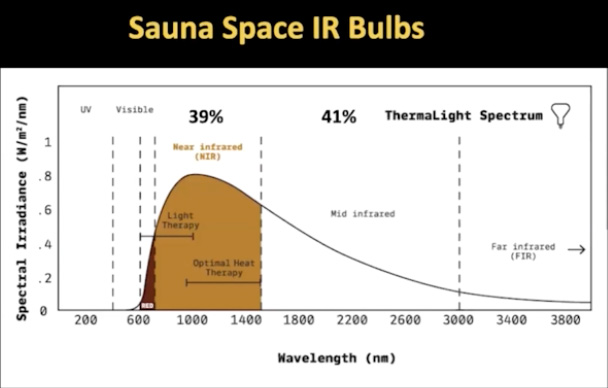
As mentioned, 53% of sunlight is near-infrared, and the Sauna Space bulbs mimic sunlight with 39% of the light being in the near-infrared range. (They do not have any UV light, however, so you will not make vitamin D. The bulbs only mimic sunlight in terms of their infrared distribution.) This is vastly superior to the average red heat lamp (graph below), in which only 14% is near-infrared.
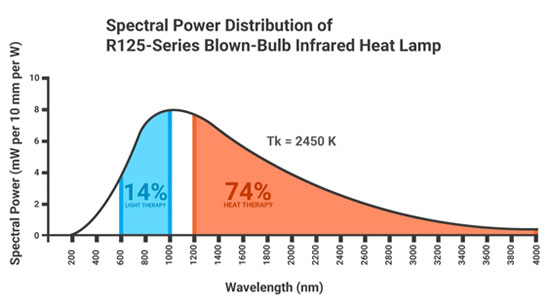
In “Near-Infrared Sauna Therapy — A Key Biohack for Health,” I provide instructions for how you can create your own near-infrared sauna using the Sauna Space near-infrared bulbs.
Sauna Space is the only company that I know of that makes these kinds of bulbs, so they’ve really cornered the market, at least for now. Using these, you’ll be able to make the absolute best, most effective sauna there is, as you’re getting both the standard sauna benefits and the PBM benefits, and none of the EMF hazards.

Optimizing Photobiomodulation With Methylene Blue
If you want to further optimize your mitochondria, you can combine PBM (the near-infrared light) with methylene blue. A 2020 paper8 in Translational Neurodegeneration reviews the benefits of this combination, specifically as it refers to neuroprotection. I believe this combination can also be very valuable in the treatment of long COVID and in post-jab recovery, many symptoms of which are neurological in character.
In 1890, the German physician Dr. Paul Ehrlich published a study showing methylene blue could effectively treat malaria. Interestingly, many of the most useful drugs for COVID are antimalarial and antiparasitic drugs such as hydroxychloroquine. Well, methylene blue is the parent molecule to chloroquine.
Methylene blue can be particularly useful for addressing the fatigue that is so common in long COVID. You can learn more in “The Surprising Health Benefits of Methylene Blue,” in which I interview Francisco Gonzalez-Lima, Ph.D., who has spent many years studying this drug.
In closing, you can find the latest, updated protocols for long COVID9 and post-jab injuries10 on the FLCCC’s website. These protocols are continually updated as the team learns more.
- 1, 9 FLCCC Alliance, I-RECOVER Long COVID Treatment
- 2, 10 FLCCC Alliance, I-RECOVER Post-Vaccine Treatment Protocol
- 3 Journal of the American College of Cardiology July 2022; 80(2): 138-151
- 4, 5 Metab Syndr Relat Disord February 2019; 17(1): 46-52
- 6 Physiology February 5, 2020
- 7 YouTube The Science & Health Benefits of Deliberate Heat Exposure | Huberman Lab Podcast #69
- 8 Translational Neurodegeneration 2020; 9: 19
The Four Hormones Most Adults Need More Of
Reproduced from original article:
https://articles.mercola.com/sites/articles/archive/2024/02/18/four-hormones-most-adults-need-more-of.aspx
The original Mercola article may not remain on the original site, but I will endeavor to keep it on this site as long as I deem it to be appropriate.
Analysis by Dr. Joseph Mercola February 18, 2024
STORY AT-A-GLANCE
- Four hormones most adults can benefit from are progesterone, thyroid hormone T3, DHEA and pregnenolone
- Around the ages of 11 and 12, right before puberty, the hormonal profiles of boys and girls are relatively similar. They produce about the same amounts of pregnenolone and progesterone. This is also the time when thyroid hormone levels are the highest they’ll ever be, and it’s the time in a person’s life cycle when their mortality is the lowest. Most supplementation recommendations are based on these prepubescent levels
- To optimize bioavailability, take T3, DHEA and/or pregnenolone orally, after dissolving them in a long-chain fat (14 carbons or more) such as ghee or butter
- The normal daily output of DHEA by the adrenal gland is about 20 to 50 milligrams (mg), so for most people, the max DHEA dose would be 50 mg, ideally split into several smaller doses. Human studies have shown that once you take more than 50 mg of DHEA per day, you begin to increase estrogen biomarkers. Best to start at 5-10 mg
- As a general recommendation, I recommend taking 30 to 50 mg of bioidentical progesterone per a day, taken in the evening before bed, as it can promote sleep. The same dose (30 to 50 mg a day) is recommended for pregnenolone. This is the physiological dose, meaning it’s what you need for full replenishment, assuming you’re producing nothing
In this interview, repeat guest Georgi Dinkov and I discuss the four hormones most adults need more of if they want to optimize their health. In my introduction I mention that we will review the benefits and mechanisms of action of carbon dioxide (CO2), but that will be covered in Part 2 of this interview that will be posted in the next few weeks.
As for hormones, if you’re optimally healthy, hormone replacement therapy (HRT) is unnecessary, as your body will make whatever hormones you need. The problem is that very few people, including me, enjoy truly optimal health.
We live in a very polluted world, so “optimal health” is a high bar for all of us. I take four hormones that I believe most adults can benefit from: Progesterone, thyroid hormone T3, DHEA and pregnenolone.
Three of these, progesterone, DHEA and pregnenolone are available over-the-counter. Thyroid hormones, however, require a doctor’s prescription. You also need to get routine blood tests done (typically two to four times a year) to make sure your thyroid hormones are maintained at optimal levels. Overtreatment can result in hyperthyroid symptoms, which you clearly want to avoid.
How Hormones Impact Health Span and Life Span
As noted by Dinkov, around the ages of 11 and 12, right before puberty, the hormonal profiles of boys and girls are relatively similar, and they produce about the same amounts of pregnenolone and progesterone.
This is also the time when thyroid hormone levels are the highest they’ll ever be, and it’s the time in a person’s life cycle when their mortality is the lowest. Once puberty strikes, adrenal activity increases. In fact, the old name for puberty was adrenarche, which tells you that adrenal activity is driving the process.
At this time, boys start producing more testosterone and girls progesterone (depending on where they are in the menstrual cycle). Interestingly, many studies have shown that the later puberty starts, the longer the lifespan and health span of both sexes. Conversely, the earlier the onset of puberty, the shorter the lifespan and the more prone to diseases the individual will be.
“After puberty starts and until the late 20s, people are remarkably resilient to stress,” Dinkov notes. “In fact, stress often seems stimulating for them. This seems to change drastically after they hit 30, and especially after 35. It’s basically a very steep decline.
And if you look at the way the hormonal profile changes, you’ll see that whenever young, healthy people are exposed to stress, there’s a spike in cortisol release, followed closely by a spike of pregnenolone and DHEA release for males, and pregnenolone, progesterone and DHEA release for females.
That delayed release of these secondary hormones drop off a cliff after the age of about 35. The ranges for pregnenolone, progesterone and DHEA, and even testosterone, change depending on what age group you fall into, but the range for cortisol doesn’t change.
So, throughout your lifetime, unless you’re critically ill, in which case cortisol drops, or you have Addison disease, which is full on adrenal failure, your cortisol levels do not decline, and that’s what keeps you alive because, if you have adrenal failure, unless you take cortisol shots you will die from hypoglycemia or Addison’s disease. So, it’s lethal.
Cortisol is really a life-saving hormone. It’s proinflammatory, but its primary purpose is to keep blood sugar from dropping too low, because your brain runs predominantly on glucose. So, basically, after the age of 35, cortisol stays the same.
It’s a catabolic hormone. It can shred your muscles, soft tissue, bone, you name it. There’s no organ that is immune to the effects of cortisol. There is only one that is somewhat resilient, and it’s the heart. And the reason the heart is so resilient in both genders is because in males, the heart contains a very large amount of testosterone, and in females it contains very large amounts of progesterone.
Both of these happen to be glucocorticoid antagonists. So they’re protecting this vital muscle … but all the other tissues can be shredded and they’re considered basically nonessential. So, after the age of 35, you have a stable supply of a catabolic hormone and then a rapidly declining supply of pregnenolone, progesterone and DHEA, all three of which have antiglucocorticoid effects.”
All of that said, if you’re taking progesterone, you don’t need to worry about the DHEA converting to estrogenic substances because progesterone will block that conversion. Even if there is conversion, progesterone is an antagonist at the estrogen receptors so it will directly block the estrogen as well. Pregnenolone has similar effects. It’s a milder aromatase inhibitor than progesterone, but it’s still quite good at preventing the uptake of estrogen into the cell.
Cortisol-to-DHEA Ratio Is a Good Predictor of Life Span
One of the take-homes from the above is that when you’re young, before puberty sets in, you have high production of T3 thyroid hormone, cortisol and anti-cortisol steroids. After age 35, there’s a gradual decline of thyroid function and a rapid decline in the synthesis and release of the anti-cortisol hormones, some of which also happen to be anti-estrogenic.
As a result, you enter a state of relative glucocorticoid and estrogen excess, both of which have detrimental effects on health. Dinkov explains:
“The state of glucocorticoid excess is not very well known. It’s easily measurable though by the ratio of cortisol to DHEA, or cortisol to progesterone, or cortisol to pregnenolone. Studies demonstrate that the cortisol to DHEA ratio is the best predictor we have for how long you’re going to live and for any diseases that you’re going to develop throughout your lifetime.”
Download this Article Before it Disappears
DHEA Influences Your Immune Function
One of the reasons for this is because DHEA is an immune booster, and your immune system is your first line of defense against both acute and chronic diseases, including cancer. And the amount of DHEA produced is about the same in both sexes, regardless of age. Dinkov suspects an ideal ratio of cortisol to DHEA is 0-to-3 or lower.
As for DHEA by itself, he recommends aiming for a level in the upper 50th percentile for the upper range of a 20-year-old, which is around 600 nanograms per deciliter (ng/dL). So, ideally, if you’re older than 35, you’d want your DHEA to be somewhere between 300 and 600 ng/dL.
As for the daily dosage, the normal daily output of DHEA by the adrenal gland is about 10 milligrams (mg), so for most people, the max DHEA dose would be 5-10 mg and mixed with a long-chain fat. According to Dinkov, human studies have shown that once you take more than 10 mg of DHEA per day, you begin to increase estrogen biomarkers, which is something you don’t want.
“Anything less than [10 mg], which happens to be a physiological dose, doesn’t really cause that much of a problem, but I would still take it with progesterone because blood levels are not always indicative of tissue levels,” Dinkov says.
“In fact, [DHEA] is not always reflected on the blood test … If you look at the studies, they show you that cells have a very high uptake of pregnenolone and DHEA. They accumulate them at levels 100 times higher than what they are in the bloodstream. So if you’re very DHEA deficient, it will take a while to fill up your reserves and then for the extra to spill over. About six months.
There’s a study with Italian women. They took 10 mg for a full year. Eventually that restored their levels back to normal, but not until the six-month mark did they see significant change. So it really depends on how deficient you are, for how long you’ve been deficient, and the state of your adrenal gland.
Another study demonstrated that the DHEA starts working immediately. You don’t see it in the blood test, but they started measuring downstream metabolites of DHEA and found that taking just 10 mg of DHEA drastically increased the metabolites of the dihydrotestosterone such as 3-alpha androstane diol and metabolites of testosterone, such as testosterone glucoronate and sulfate.
So, DHEA starts working immediately and converting to downstream hormones, but it’s going to take a while to see that in the biomarkers that are usually measured, which is DHEA and DHEA sulfate. What they really should be doing is measure all of the other things that DHA can convert into.
And some of those things are estrogens. Chances are, at least based on studies, that either prolactin or estrone will rise if you’re taking too high of a dose long before there will be changes in the blood levels of DHEA or DHEA sulfate.”
Caveats and Warnings
There are a few important caveats here. Taking too high a dose of DHEA can cause unwanted hair growth in women, and breast growth in men,1 so be sure to monitor your symptoms. DHEA is also banned in sports. It’s classified as a doping agent by the World Anti-Doping Agency, so athletes must take their competitive status into account before taking supplemental DHEA.
Also, never take DHEA without progesterone. They need to be taken together. Another point to optimize the therapy and not derail it is that if you take T3, DHEA and/or pregnenolone orally, you need to dissolve them in a long-chain fat (14 carbons or more) first.
If you don’t do that, they’ll be metabolized by your liver, which significantly lowers their effectiveness. According to Dinkov, the bioavailability of oral hormones can be as low as 10%. Dissolving the supplements in a little ghee or butter will bypass liver metabolism and allow you to get the most out of your supplements.
Olive oil is also a long-chain fat, but I don’t recommend it in this case, as it can have 20% linoleic acid (LA) and a flavor that many don’t like. According to Dinkov, at least one study has demonstrated that LA binds directly to estrogen receptors and acts like estrogen.
So, LA not merely promotes the effects of estrogen but also acts as an estrogen directly. Since estrogen is a potent carcinogen, you want to avoid things with estrogenic activity.
Progesterone Works Best With Vitamin E
Progesterone, meanwhile, needs to be mixed into vitamin E for optimal bioavailability. Health Natura sells a progesterone in vitamin E product. Alternatively, you can make your own by dissolving pure USP progesterone powder in one capsule of a high-quality vitamin E. The difference in bioavailability between taking progesterone orally without vitamin E and taking it with vitamin E is 45 minutes versus 48 hours.
Another good reason for taking progesterone with vitamin E is because it binds to red blood cells, which allows the progesterone to be carried throughout your body and be distributed to where it’s needed the most. What’s more, Dinkov cites recent research showing that when you dissolve a substance in vitamin E, it specifically targets sites with the highest inflammation.
Other Important Benefits of Vitamin E
Another important benefit of vitamin E is that it prevents LA stored in your tissues from being oxidized into toxic byproducts. Since most people are walking around with LA stores that are 10 times higher than normal, and since excess LA is likely one of the primary contributors to chronic disease, it can be a good idea to take vitamin E regularly until you get your LA down to healthy levels, which may take up to six years for most people.
Vitamin E also prevents LA stored in your tissues from being oxidized into dangerous toxic byproducts.
Vitamin E can almost miraculously prevent most of the damage done by LA. It can also reverse or prevent many of the issues associated with excess estrogen. This is important because LA has remarkable parallels to excess estrogen in terms of its metabolic and anti-health effects.
When you eat excess PUFA or LA, you increase your body’s production of estrogen. So, when you increase LA, estrogen levels go up — and that’s not a good thing. Both LA and estrogen interestingly increase the flow of calcium from outside the cell to inside because the concentration of calcium outside as well is 50 times higher than inside. So, the excess as LA will cause the influx of calcium inside the cell, which causes nitric oxide and superoxide to increase inside the cell.
Nitric oxide and superoxide combine almost instantaneously to form a very pernicious reactive nitrogen species called peroxynitrite, which causes pervasive damage to tissues in your body.
Both LA and estrogen also increase a potentially dangerous process in your body called lipolysis, which is simply the liberation of fatty acids from your fat cells into your bloodstream where they are mobilized. This then increases the oxidation of LA, which is precisely what you want to avoid as ideally you want to keep LA in your fat cells until they metabolize it with peroxisomes.
Fortunately, vitamin E can also help neutralize this damaging effect of LA. Vitamin E also directly inhibits the activity of an enzyme called aromatase. This is an enzyme that converts the male hormones like testosterone and DHEA into estrogens.
Even better, it serves as an estrogen antagonist, meaning it binds to the estrogen receptor to block it from binding to estrogen. This dramatically lowers the damage from excess estrogen.
Vitamin E works very similarly to the drug tamoxifen, which is used to treat estrogen receptor-positive breast cancers. For these reasons, I firmly believe nearly everyone needs to be getting vitamin E in their diet. However, due to the high LA burden, very few people can get enough vitamin E from their diet to suppress this oxidative destruction unless they’re supplementing with vitamin E.
The good news is that since the supplementation is short term, you’re not going to need it the rest of your life. If you can keep your LA intake to below 5 grams a day for three years, it’s likely you may not even need it at all, or at most, only a few times a month.
However, if for whatever reason, during this time, or when the LA in your tissues are low or normal, and you go out and binge on a meal that’s very high in LA, I would strongly recommend taking a vitamin E capsule to protect yourself from this exposure.
Vitamin E also protects against free radical damage and the normal effects of aging. It’s particularly important for brain health, and studies have found it can help delay the loss of cognitive function in people with Alzheimer’s disease by preventing cell membrane damage and neuronal death.2
How to Pick a Good Vitamin E Supplement
Most vitamin E supplements are synthetic, and you want to steer clear of those. Studies have demonstrated that synthetic vitamin E has the opposite effect of natural vitamin E, such as increasing the risk of certain cancers rather than lowering it, for example. So, it’s important to make sure you’re getting a natural version.
Synthetic vitamin E is called alpha tocopherol acetate. The acetate indicates that it’s synthetic. Next, you need to pay attention to the orientation of the optical isomer. Most vitamin supplements are racemic, or they have left- and right-hand isomers. This is a problem as most biological molecules have optical isomers that are right-handed.
They’re usually called D and L isomers, which stands for right and left. When you have both left and right isomers present, it’s called racemic. Biologically, there’s usually only one optical isomer that works well, and with vitamin E it is the D isomer that works in your body, while the L isomer is useless. Yet in synthetic supplements, 50% of the vitamin E in the supplement is the useless L isomer.
To make matters even worse, many synthetic versions use an ester of vitamin E, which only has about 50% of the activity of the natural product. So, the total activity of many vitamin E supplements is reduced by 75%.
So, the first step in identifying healthy good vitamin E supplements is to make sure you’re getting real vitamin E and not synthetic. What you’re looking for is “d alpha tocopherol.” This is the pure D isomer, which is what your body can use.
Many vitamin E brands will use vitamin E from sunflower oil, which has a very high percentage of LA. However, the LA in the capsule is an insignificant amount, probably less than 50 or 100 mg, so in this case it’s not a problem. Your goal is to keep LA intake under 5,000 mg, and even better under 2,500 mg, so it really won’t negatively impact your LA intake at all.
As for dose, you don’t need more than 100 mg a day. There are also other vitamin E isomers, and you want the complete spectrum of tocotrienols, specifically the beta, gamma, and delta types of vitamin E, in the effective D isomer. It’s important to get this right, which is why I’m going into this much detail.
Most People Can Benefit From Bioidentical Progesterone
So, to tie up the discussion about progesterone, bioidentical progesterone (not synthetic progestin) is probably the most important hormone that most adults need. Conversely, I believe estrogen — including bioidentical estrogen — should never be used, as estrogen is carcinogenic.
As noted by Dinkov, virtually all cancers respond to hormones and estrogen is a primary growth factor in all of them. So, there’s really no such thing as a nonendocrine cancer. To learn more about this, see our previous interview, where we dove deeper into the hazards of estrogen.
Unfortunately, most people who use progesterone use it transdermally, which could be problematic. As explained by Dinkov, your skin expresses high levels of 5-alpha reductase enzyme, which causes a significant portion of the progesterone you’re taking to be irreversibly converted primarily into allopregnanolone and cannot be converted back into progesterone.
If you’re taking it orally with vitamin E as the solvent, a significant portion will be non-metabolized, that non-metabolized progesterone has potent pro-thyroid effects. It’s also a thermogenic steroid. It induces uncoupling, so you’ll be producing more heat, which is one of the effects of taking T3. While not as potent as taking T3, it can raise your metabolic rate by about 10%.
Progesterone also blocks cortisol and helps protect against excess cortisol production, but not to the point of causing cortisol deficiency (Addison disease), and it helps deactivate adrenaline.
“There are human studies demonstrating that you administer progesterone, even in its nonoptimal form — such as just the powder without the long-chain fatty acids and definitely without the tocopherols — even in that form, 100 to 200 milligrams orally.
A single dose is sufficient to drop cortisol and adrenaline by about 60%. As a side effect of that, the blood pressure also dropped in both sexes,” Dinkov says. “So, we know that progesterone has a very potent antistress effect by acting specifically on the two sides of the stress system, cortisol and adrenaline.
One of the explanations is that progesterone has shown some ability to directly activate the alpha receptors, which are negative feedback. In other words, if you activate the alpha adrenal receptor, you basically send in the signal that there’s too much adrenaline, so the body will produce less adrenaline …”
The dose of bioidentical progesterone I recommend is 30 to 50 mg a day (again, mixed with a long-chain fat), taken in the evening before bed, as it can promote sleepiness. The same dose (30 to 50 mg a day) is recommended for pregnenolone. This is the physiological dose, meaning it’s what you need for full replenishment, assuming you’re producing nothing.
Important Caveat for Menstruating Women
Women who still menstruate need to be careful with the timing of their progesterone supplementation. Progesterone is crucial for successful pregnancy, and you can severely inhibit your ability to get pregnant if you take it at the wrong time. (During pregnancy, progesterone actually skyrockets. In the third trimester, women produce about 600 mg a day.)
If your menses are regular, start taking the progesterone on the 14th day after your menstrual flow begins, and take it for 14 days straight (until cycle day 27). If your cycles are short, start on day 12 and continue for 14 days. Always take the progesterone for the full 14 days even if your menses begin before the 14 days are over. Start the next progesterone 14 days after the flow began.3
There’s no toxicity to progesterone, unlike estrogen and testosterone, neither of which I recommend. Progesterone, T3, DHEA and pregnenolone are the only hormones you really need. Supplementing progesterone also will not lower your natural production, so you don’t need to be concerned about that. In fact, it enhances your natural production.
Thyroid Hormone Supplementation
When it comes to your thyroid, most people only need T3. That said, desiccated thyroid contains both T3 and T4 and can be a good option for some. Here, unless you’re treating a specific thyroid problem, the generally recommended dose is 10 micrograms two to three times a day. Dinkov comments:
“The thyroid gland produces about 100 micrograms in a healthy person — 100 micrograms of T3 over 24-hour period. If you take more than 25 micrograms, even that is a very high dose because it has such a potent thermogenic effect, and in higher doses can be catabolic.
The body has deiodinase enzymes, and they very quickly convert the excess T3 into something called T2 and even T1 … So, in other words, you’re going to be wasting most of it. Interestingly, the same type of enzymes, T3 deactivating, are highly overexpressed in cancer cells, and cancer cells just happen to be very hypometabolic, as we’ve discussed previously.
So the thyroid gland produces T3 and T4 in a ratio of about 1 to 4 in favor of T4. T4 is actually a prohormone, it by itself does not have a very high activity directly at the thyroid receptors T3. So, it circulates and about 80% of it in the liver, in a healthy person, should get converted to T3. The other 20% can get converted to T3 peripherally, or if the dosage of T4 is too high, the excess very quickly gets converted to something called reverse T3.
This is a very dangerous state because reverse T3 acts as a thyroid hormone antagonist … Most doctors don’t take these things into account, so if they prescribe you, let’s say, 100 or 200 micrograms T4 daily. You better be praying that this will get properly converted because if it doesn’t, and gets converted to reverse T3, you’ll end up in a more hypothyroid state than if you did not take the T4 at all …
T4 is almost never a good option by itself unless the person is very young. But even then, if a person is hypothyroid, that by definition already means that the liver will be burdened, because one of the primary functions of the liver is the detox mechanisms and one of the primary things that liver detoxifies are polyunsaturated fats and estrogens.
But the detoxification mechanisms themselves depend on thyroid function. So hypothyroid means sluggish liver by definition. So, if you give a hypothyroid person T4 only, especially if the dose is higher, you’re asking for trouble. Some of that will get converted to reverse T3.”
Lower Your Blood Pressure With This Simple Exercise
Reproduced from original article:
https://articles.mercola.com/sites/articles/archive/2024/02/15/isometric-exercise.aspx
The original Mercola article may not remain on the original site, but I will endeavor to keep it on this site as long as I deem it to be appropriate.
Analysis by Dr. Joseph Mercola February 15, 2024

STORY AT-A-GLANCE
- Simple isometric exercises, including wall sits, offer a natural strategy to lower blood pressure
- Out of multiple forms of physical activity, isometric exercise came out on top as “the most effective mode in reducing both systolic and diastolic blood pressure”
- Broken down to individual exercises, wall squats (isometric) were the most effective for reducing systolic blood pressure while running (aerobic) was most effective for reducing diastolic blood pressure
- About eight minutes of isometric training three times a week may be enough to significantly lower blood pressure
- Wall squats, planks, glute bridge and the overhead hold are examples of simple isometric exercises you can do virtually anywhere
For the 48.1% of U.S. adults with high blood pressure,1 learning how to do simple isometric exercises, including wall sits, may offer a natural strategy for relief. In fact, a systematic review and meta-analysis of 270 randomized controlled trials looked at the effects of multiple types of exercise, including aerobics, high-intensity interval training (HIIT), resistance training and combined training, on blood pressure.
While all were beneficial, isometric exercise came out on top as “the most effective mode in reducing both systolic and diastolic blood pressure.”2 It turns out that static contraction of muscle as you hold your body in one position, i.e., isometric exercise, may offer blood pressure benefits that some other types of more dynamic movement don’t.
Isometric Exercises Improve Resting Blood Pressure
When it comes to exercise recommendations to lower blood pressure, cardio aerobic-type exercises typically come to mind. But, according to researchers from Canterbury Christ Church University, this is outdated advice based on older study data that excludes HIIT and isometric exercise.3
The meta-analysis, which included clinical trials that analyzed the effects of exercise for two weeks or more on resting blood pressure, found all types of exercise led to significant reductions in resting systolic and diastolic blood pressure. However, the greatest reductions occurred after isometric training.4
The top number of your blood pressure measurement, the systolic, is a measurement of the maximum pressure inside your arteries as your heart contracts. The bottom number, the diastolic, is a measurement of the pressure in your blood vessels when your heart is not contracting. Both numbers are important in determining how much damage may occur over time to your blood vessels and other organ systems.
Effectiveness based on the “surface under the cumulative ranking curve” (SUCRA) values for systolic — which refers to the mean probability of being the best for lowering your systolic blood pressure — placed isometric exercise in the No. 1 slot with an effectiveness rating of 98.3%, followed by combined training (75.7%), dynamic resistance training (46.1%), aerobic exercise training (40.5%) and high-intensity interval training (39.4%).5
In rank order, the analysis found significant reductions in resting systolic blood pressure and diastolic blood pressure:
- Isometric exercise (–8.24/–4.00 mmHg)
- Combined training (–6.04/–2.54 mmHg)
- Dynamic resistance training (–4.55/–3.04 mmHg)
- Aerobic exercise (−4.49/–2.53 mmHg)
- High-intensity interval training (–4.08/–2.50 mmHg)
Broken down to individual exercises, wall squats (isometric) were the most effective for reducing systolic blood pressure while running (aerobic) was most effective for reducing diastolic blood pressure. Overall, however, isometric exercise worked best for lowering both systolic and diastolic blood pressure. Study author Jamie O’Driscoll told The Washington Post:6
“Our main message is that actually engaging in exercise is fantastic and any exercise might reduce your blood pressure. But if you’re an individual who is currently exercising to the guidelines and you’re still having a bit of difficulty reducing that blood pressure and you want to avoid going on medication, perhaps isometrics is an additional mode to complement the exercise you’re already doing.”
What Are Isometric Exercises?
Isometric exercises are low-impact movements that involve holding a position so the same muscle length is maintained, tiring out your muscles to fatigue.7 “Any kind of an exercise that is holding tension in any position which doesn’t involve dynamic movement is generally isometric exercise,” study author Jamie Edwards told The Washington Post.8 In other words, static contraction defines isometric exercise, examples of which include:9
| Wall squat | Isometric calf raise | Planking |
| Hollow-body hold | Low isometric squat | Static slide lunge |
| Overhead hold | Iso hang | Glute bridge |
| Incline pushup hold | V-sit | Single-leg stand |
In addition to blood pressure benefits, isometric strength exercises may help strengthen joints better than dynamic strength training,10 and it’s useful for reducing pain while increasing range of motion and functional ability in people with knee osteoarthritis.11 Isometric training is also beneficial for relieving neck pain, improving joint mobility and improving neck dysfunction.12
Past research similarly revealed that isometric resistance training reduces systolic blood pressure by nearly 7 mmHg and diastolic blood pressure by close to 4 mmHg. Performing isometric handgrip exercise also significantly reduces systolic blood pressure and mean arterial pressure, offering another accessible tool for blood pressure health.
As the scientists explained in the journal Medicine, “Low- to moderate-intensity isometric handgrip exercise can be performed anywhere, requires relatively inexpensive equipment, and does not elicit the same level of cardiovascular stress as aerobic exercise.”13 As for how isometric exercise lowers blood pressure so effectively, The Washington Post reported:14
“Isometric exercises effectively lower blood pressure because contracting a muscle and holding the position temporarily reduces blood flow to that muscle, O’Driscoll said. When you release that contraction, blood flow through the muscle tissue increases. This produces important signals that prompt blood vessels to relax more and creates less resistance to blood flow, which ultimately reduces blood pressure, O’Driscoll said.”
Download this Article Before it Disappears
Eight Minutes of Isometric Exercise, Three Times a Week
How much isometric exercise is necessary to lower blood pressure? Isometric exercise training programs often use protocols involving four, two-minute contractions separated by one to four-minute rest intervals. The sessions are done three times a week.15 In other words, about eight minutes of isometric training three times a week may significantly lower blood pressure.
A wall sit is one straightforward option that can be easily done in two-minute increments, followed by two minutes of rest and repeated four times. The entire workout is then repeated three times each week. “On average, a regular isometric routine of wall sits lowered systolic blood pressure (the top number) by 10 mmHg and diastolic pressure by 5 mmHg, according to the research,” The Washington Post reported.16
Meditation Exercises Also Lower Blood Pressure
On the topic of low-impact forms of exercise that are useful for maintaining healthy blood pressure, meditation exercises, particularly qigong, are useful for lowering diastolic blood pressure in people with elevated levels,17 while research shows meditation may also help lower blood pressure with just three months of practice, while at the same time decreasing psychological distress and increasing coping ability among young adults.18
Another group of researchers conducted a meta-analysis involving 13 studies on meditation and yoga for blood pressure health. Blood pressure decreased in response to both meditation and yoga, and meditation appeared to be particularly useful in decreasing the blood pressure of subjects older than 60 years.19
The calming effect of meditation has also been shown in numerous studies to benefit blood pressure. In a 2019 study published in the Journal of Human Hypertension, mindfulness meditation was evaluated for its effects on not only blood pressure but also anxiety, stress and depression.
For an eight-week period, participants engaged in mindfulness training for two hours a week, or participated in a control group involving health education talks. The meditation group had lower blood pressure monitoring values after the intervention, and were also less judgmental, more accepting and less depressed than the control group.20
Practicing “mindfulness” means you’re actively paying attention to the moment you’re in right now. Rather than letting your mind wander, when you’re mindful, you’re living in the moment and letting distracting thoughts pass through your mind without getting caught up in their emotional implications.
What Else Works to Lower Blood Pressure?
If your blood pressure is running high, you need to restore your insulin and leptin sensitivity, and the following strategies are among the most effective for doing so:
- Replace processed foods with whole, unprocessed organic foods.
- Avoiding seed oils — It would be helpful to also eliminate seeds and nuts unless you have been on a low-LA (linoleic acid) diet for at least three years.
- Optimize your vitamin D level.
- Only use healthy fats — Sources of healthy fats to add to your diet include grass fed butter, raw organic dairy, organic pastured egg yolks, coconuts, coconut oil and macadamia nuts and grass fed meats. The best carbs to add would be ripe fruit that you tolerate well. But the key is to make sure your fat intake is below 30%, which you can determine with Cronometer. If you fail to do this, the carbs can convert to fat and change your cholesterol profile unfavorably.
- Exercise regularly.
Optimizing your sodium to potassium ratio is also important. It’s generally recommended that you consume five times more potassium than sodium, but most Americans get the opposite ratio, eating two times more sodium than potassium. If you eat a lot of processed foods, which contain processed table salt, your sodium to potassium ratio is likely out of balance.
While conventional health care practitioners may suggest you remedy this by limiting salt intake, especially when it comes to lowering the risk of high blood pressure, focusing on increasing potassium is key. Research shows an association between higher potassium intake and lower blood pressure, regardless of sodium intake.21
To improve your ratio, eliminate processed foods, which are very high in processed salt and low in potassium and other essential nutrients. When using added salt, use a natural salt such as Himalayan salt. Further, eat a diet of whole, unprocessed foods, ideally organically and locally-grown to ensure optimal nutrient content.
This type of diet will naturally provide much larger amounts of potassium in relation to sodium. In my view the absolute best way to increase your potassium is by eating ripe fruit. Taking potassium supplements is not a good strategy and will simply not provide you with the benefits you are seeking. Other examples of potassium-rich foods include:22
| Spinach | Broccoli | Beet greens |
| Avocado | Bananas | Cantaloupe |
| Oranges | Coconut water | Tomatoes |
| Yogurt | Winter squash | Wild-caught salmon |
Latest Obesity Drugs to Do Wonders for Blood Pressure — How Perfect
Eli Lilly’s obesity drug tirzepatide — brand name Zepbound — is being positioned as the latest breakthrough to lower blood pressure. The U.S. Food and Drug Administration approved tirzepatide to manage Type 2 diabetes in 2021, under the brand name Mounjaro, a direct competitor to semaglutide (Ozempic). It was then approved to treat obesity in 2023,23 competing with the popular weight loss drug Wegovy.24
Now, however, tirzepatide is being said to “do wonders” for blood pressure,25 after research published in the journal Hypertension26 found it led to an average 7.4 mmHg drop in systolic blood pressure among those taking the lowest dose. Those taking the highest dose had an average drop of 8 mmHg.27 In a statement from the American Heart Association, study author Dr. James A. de Lemos said:28
“Although tirzepatide has been studied as a weight loss medication, the blood pressure reduction in our patients in this study was impressive. While it is not known if the impact on blood pressure was due to the medication or the participants’ weight loss, the lower blood pressure measures seen with tirzepatide rivaled what is seen for many hypertension medications.”
The news came just days before an announcement by former director of the U.S. Centers for Disease Control and Prevention Tom Frieden called for high blood pressure to be the “focus of the next breakthrough”:29
“In 2023, the weight-loss drug Wegovy and similar medications were a scientific and cultural — and profit-making — breakthrough … But what if we had medications that cost 5,000 times less and are better at preventing heart attacks and strokes? And what if only 1 in 5 people who need these medications get them? That’s the situation with drugs to treat high blood pressure — and it needs to change.”
It seems to be the perfect setup to roll out the next “blockbuster” blood pressure medication, but tirzepatide can cause side effects ranging from nausea and diarrhea to hair loss and gastroesophageal reflux disease.30
It also causes thyroid C-cell tumors in rats and, according to the FDA, “contains warnings for inflammation of the pancreas (pancreatitis), gallbladder problems, hypoglycemia (blood sugar that is too low), acute kidney injury, diabetic retinopathy (damage to the eye’s retina) in patients with Type 2 diabetes mellitus and suicidal behavior or thinking.”31
Given these significant risks, it’s important to remember that blood pressure can often be effectively lowered via lifestyle changes, including simple isometric exercises.
How to Perform 6 Popular Isometric Exercises
Getting back to isometric exercises, they provide a simple way to support healthy blood pressure while offering additional health gains. Best of all, you can do them virtually anywhere. If you’d like to give it a try, here are six examples of isometric exercises and how to perform them.
1. Wall squat and low squat — For the wall squat, stand with your back flat against a wall, then walk your feet about 1.5 feet (0.5 meter) out from the wall. With your feet shoulder-width apart, back flat against the wall and your abs tight, squat until your knees are bent at a 90-degree angle, or as low as you can comfortably go. Remain squatting for as long as you can, then stand back up by pushing up from your heels.
The low squat is similar, but here you’re not using a wall. Start by standing with your feet slightly more than hip-width apart. Keep your hands on your hips, or straight out in front of you. Push your hips back into a sitting position while bending your knees. Keep your spine long (don’t round forward). Hold for 10 to 30 seconds, then return to the starting position.
2. High plank and side plank — For the high plank, start in a kneeling pushup with your hands shoulder-distance apart. Straighten your knees, pushing down into the balls of your feet to raise your body into a high plank position, which looks exactly like the upward position of a pushup.
With your hands aligned with your shoulders and legs straight, engage your core and hold for 20 to 60 seconds, or as long as you can maintain proper form.
For the side plank, start out lying on your left side with legs straight (your hips, knees and feet stacked). Bend your left elbow and place your forearm on the ground under your shoulder. Push your left forearm into the ground to lift your torso and hips off the ground.
Engage your core to maintain your body in a straight line from head to heel. You can keep your right arm by your side or stretched up in the air. Hold for at least 10 seconds. Lower your torso down and switch sides.
3. Overhead hold — Using a suitable weight (based on your level of fitness) with both hands, engage your core and extend your arms above your head. Keep your arms fully extended and in line with your shoulders. Hold the weight steady over your head for 20 to 30 seconds.
4. Glute bridge — Lie on your back. Bend your knees so that your heels are about 12 to 16 inches from your behind. Keep your arms by your sides. Press into your heels, brace your core, and push your pelvis upwards by squeezing your glutes. Maintain the bridge position for 30 seconds without letting your hips sink.
5. Hollow-body hold — Lie on your back with your legs extended toward the ceiling, perpendicular to the floor. Squeeze your core to press your low back into the floor, then raise your head and shoulders a few inches off the floor while simultaneously lowering your legs as close to the floor as possible. Hold until you can’t hold any longer, then lower your head and shoulders to the floor.
6. Incline pushup hold — Place your hands on a sturdy surface, such as a bench or low table. Position your hands slightly wider than your shoulders. Walk backward until you’re in a pushup position, with your body weight supported on your hands and the balls of your feet. Engage your core and make sure your shoulders are not pushing up toward your ears.
Bend your elbows as in the downward motion of a pushup until your chest nearly touches the bench or table. Your arms should flare outward, forming 45-degree angles with your torso. Pause here and hold as long as you can, then step forward to stand up.
- 1 U.S. CDC, Facts About Hypertension
- 2, 5 British Journal of Sports Medicine 2023;57:1317-1326
- 3, 4 Canterbury Christ Church University July 26, 2023
- 6, 8, 14, 16 The Washington Post January 30, 2024 (Archived)
- 7 Cleveland Clinic September 14, 2023
- 9 Vertimax 20 Isometric Exercises
- 10 Int J Sports Med. 2019 May;40(6):363-375. doi: 10.1055/a-0863-4539. Epub 2019 Apr 3
- 11 Cureus. 2021 Oct; 13(10): e18972
- 12 Medicine (Baltimore). 2022 Sep 30; 101(39): e30864
- 13 Medicine (Baltimore). 2016 Dec; 95(52): e5791
- 15 British Journal of Sports Medicine 2023;57:1317-1326., Screening and study eligibility
- 17 Evid Based Complement Alternat Med. 2017; 2017: 9784271
- 18 American Journal of Hypertension, December 2009
- 19 J Altern Complement Med. 2017 Sep;23(9):685-695. doi: 10.1089/acm.2016.0234. Epub 2017 Apr 6
- 20 J Hum Hypertens. 2019 Mar;33(3):237-247. doi: 10.1038/s41371-018-0130-6. Epub 2018 Nov 13
- 21 American Journal of Physiology — Endocrinology and Metabolism April 4, 2017
- 22 Harvard T.H. Chan School of Public Health, Potassium
- 23, 29 The Washington Post February 7, 2024 (Archived)
- 24 The New York Times November 8, 2023
- 25, 27 Gizmodo February 5, 2024
- 26 Hypertension February 5, 2024
- 28 American Heart Association February 5, 2024
- 30, 31 U.S. FDA November 8, 2023
Changing the Food System From the Bottom Up
Reproduced from original article:
https://articles.mercola.com/sites/articles/archive/2024/02/11/healthy-eggs.aspx
The original Mercola article may not remain on the original site, but I will endeavor to keep it on this site as long as I deem it to be appropriate.
Analysis by Dr. Joseph Mercola February 11, 2024
STORY AT-A-GLANCE
- Around the advent of the American Civil War, in the 1870s or so, is when they developed the technology to extract oils from seeds. Before then, the average LA intake was less than 5 grams a day, and likely closer to 2 or 3 grams
- Eggs and bacon are two sources that, today, have very high LA levels, thanks to being fed an unnatural and PUFA-rich diet
- The mainstream is so convinced that saturated fat is bad and PUFAs are good that they’re now starting to use technology to turn the saturated fats in ruminant animals into PUFAs
- Ashley Armstrong’s farm, Angel Acres Egg Co., produces eggs that are low in linoleic acid (LA), as nature intended. On average, her eggs contain 17 to 20 milligrams of LA, which is about one-quarter of the LA found in conventional eggs
- Armstrong has also started a new private member food system called Nourish Cooperative that offers milk, cheese, low-PUFA pork, low-PUFA chicken and grass fed beef. Angel Acres Egg Co. and Nourish Cooperative both ship farm-fresh food right to your door
The video above features an interview with return guest Ashley Armstrong, a certified personal trainer with a Ph.D., MS and BS in engineering, and cofounder of Angel Acres Egg Co., which specializes in low-PUFA (polyunsaturated fat) eggs. On average, her eggs contain 17 to 20 milligrams of linoleic acid (LA), which is about one-quarter of the LA found in conventional eggs.
She’s also started a new private member food system that offers milk, cheese, low-PUFA pork and low-PUFA chicken, called Nourish Cooperative. Both ship farm-fresh food right to your door.
“One of my favorite topics is essentially just returning back to how food used to be made,” Armstrong says. “One-hundred fifty years ago, the dietary linoleic acid (LA) was naturally low, so people would just go to the grocery store and their food options didn’t have a bunch of linoleic acid.
It was, in my opinion, probably easier to source food back then. And now we’re inundated with not just PUFAs from vegetable oils, but also from animal products as well, because some animals are just vehicles for vegetable oils. The statement that ‘You are what you eat’ has never been more true because of how much the agriculture industry has changed over the last 100 years.”
Modern Diet Is Loaded With Harmful LA
Around the advent of the American Civil War, in the 1870s or so, is when they developed the technology to extract oils from seeds. Before then, the average LA intake was less than 5 grams a day, and likely closer to 2 or 3 grams.
Today, most people exceed that by the time they’re done with breakfast. As noted by Armstrong, eggs and bacon are two sources that, today, have very high LA levels, thanks to being fed an unnatural and PUFA-rich diet.
Eggs and bacon are typically perceived as healthy food options, especially among carnivores, but what most are missing is that LA is a metabolic poison that impairs, if not destroys, mitochondrial function and, as such, conventional eggs and bacon is a recipe for ill health. The good news is there are ways to raise eggs and pork that aren’t loaded with LA, which is what Armstrong specializes in.
“I think the best thing someone can do for their health is track their food on chronometer for five days and just pay attention to the amount of PUFAs in their diet. If you can push that as low as possible, I think you’re going to see improvements in your health pretty quickly,” Armstrong says.
“And you can’t achieve that going out to eat at restaurants. You can’t achieve that eating a ton of nuts and seeds. You can’t achieve that eating conventional bacon, conventional egg yolks, conventional drumsticks and things like that.
You have to really pay attention to the types of fat you’re eating. It’s kind of eye-opening that food sourcing really does matter in today’s day and age, because the abundance we have in these high-PUFA, high-LA options is kind of alarming and frightening.”
Fortunately, the word is starting to get out. There’s now an app called Seed Oil Scout that identifies which restaurants cook their food in seed oils and which do not. Unless you go to a seed oil-free restaurant, you can be virtually guaranteed they’re cooking in seed oil, because it’s far cheaper than cooking in butter.
Why Healthy Eggs Are so Important
Chicken eggs are an enormously important part of our diet because they contain nutrients that are really difficult to get from other foods, choline in particular. Choline, found in ample amounts in organic, pastured egg yolks, was first discovered in 1862.1
It was officially recognized as an essential nutrient for human health by the Institute of Medicine in 1998.2 Since then, we’ve learned that choline has a long list of health benefits. For example, it’s required for:
| Healthy fetal development3 |
| Optimal brain function, memory and cognition |
| Nervous system health — Choline is necessary for making acetylcholine, a neurotransmitter involved in healthy muscle, heart and memory performance |
| Cell structure — Choline is needed for the synthesis of phosphatidylcholine, better known as lecithin, which is required for the composition of cell membranes |
| Mitochondrial function4 |
| Metabolism (energy production) |
| DNA synthesis |
| Methylation reactions5 |
| Cardiovascular health |
| Liver health, as choline is needed to carry cholesterol from your liver; a choline deficiency could result in excess fat and cholesterol buildup6 |
Research7 published in 2020 also concluded that choline has anti-inflammatory activity and can be particularly useful in those with insulin resistance and/or metabolic syndrome. And, while a choline supplement was good in this regard, eggs were far better.
Download this Article Before it Disappears
Choline Is Required for Energy Production
Armstrong comments:
“In terms of maximal nutrients in square footage, I don’t know if you can beat egg yolk. Mother nature designed the egg to protect the yolk because the yolk is the most precious part of the egg. The shell acts as a physical barrier to protect the yolk, and the egg white is very antimicrobial, antibacterial in nature to protect the integrity of the yolk.
So the egg yolk is a nutrient powerhouse. It has all of the nutrients needed to grow a chicken. From this little yolk, an entire chicken is grown. How beautiful is that? It’s incredible. It contains a large amount of B vitamins, and all of the B vitamins are necessary cofactors in the steps to produce energy in your body.
If you don’t have enough of the micronutrients, if you’re micronutrient deficient, your metabolism won’t be as robust, because you don’t have the necessary cofactors to generate ATP. Choline, I think, is one of the most important nutrients that a lot of people are deficient in. In carbohydrate metabolism, carbohydrate oxidation, choline is a necessary step in energy production.”
Assuming you’re not getting choline from other sources, you need to eat at least two, probably three and more, egg yolks per day. I eat six yolks a day, but only one egg white, because I work out and walk at least five to six miles a day. The more active you are, the more choline you need to support a higher metabolic rate.
Armstrong recommends trying honey cured egg yolk. Simply place the egg yolk in a glass container and pour enough honey over the yolk to cover it. Let it cure overnight. This will firm up the yolk a bit, making it less runny. You can just scoop it out of the honey, eat it raw, and then reuse the honey to cure more yolk.
Mad Science — Transforming the Fatty Acid Profiles of Animals
As explained by Armstrong, livestock are classified into two types: ruminant animals, which includes cows, lamb, goats and deer, and monogastric animals such as chickens and swine (and humans).
Ruminant animals have a complex digestive system consisting of, typically, four stomachs. Their digestion involves a variety of microbes that help break down the food they eat. These digestive microbes also convert dietary PUFAs into saturated fats through a process called biohydrogenation. As a result, ruminant animal products tend to be lower in PUFA, even if they’re fed a high-PUFA diet.
Monogastric animals have just one stomach, and whatever fats they eat is translated into their tissues. This is why conventionally raised chicken meat and pork are so high in PUFAs.
Unfortunately, the mainstream is so convinced that saturated fat is bad and PUFAs are good that they’re creating technologies to manipulate the fatty acid composition in ruminant animals. In other words, they’re using technology to turn the saturated fats in ruminant animals into PUFAs, which is nothing short of a disaster.
“That’s why I think conversations like this are so important, to spread awareness and empower those who are in food production,” Armstrong says. “Our farmers need to be educated on why we need to go back to traditional farming styles, traditional feed programs, so we can return the natural fatty acid profiles that mother nature created.”
While monogastric feed diets are already very high in PUFAs, conventional farmers are also using dried distillers grains (DDGs), made from the waste products of the ethanol industry, which is driving the PUFA content in monogastric livestock even higher.
“There are studies showing that for pigs fed DDGs, their fat composition has the same amount of PUFAs as canola oil. So we’re literally transforming the fatty acid profile in our agriculture system for the worst,” Armstrong says.
This wouldn’t be quite as bad if it was given to ruminant animals, as they have the capacity to convert the PUFAs into saturated fat. Alas, they’re giving it to monogastric animals like chickens and pigs, turning those foods into something that can only harm your health in the long run. Unfortunately, there are no regulations around the use of DDGs, so we don’t know how much is being used, or who’s using it.
Barriers to Healthier Foods
Equally unfortunate is that farmers like Armstrong, who understands nutrition and wants to raise animals right, are held back in more ways than one. She can’t take advantage of government subsidized feed, for example. She also doesn’t have the benefit of scale. She explains:
“The biggest obstacle is the feed, because the big feed mills are so efficient in what they do that they can bring in massive quantities of the feed ingredients at the same time. They have that economy of scale that is really hard to have at a single farm level.
We’re not bringing in truckloads of feed ingredients at a time. And the more trucking that you have in creating your feed automatically raises the prices. Anyone involved in trucking knows how expensive trucking is right now. So if there’s this system set in place where massive quantities of corn and soy are trucked in at the same time, and a bunch of feed is made at the same time, that’s where you can cut a lot of costs.
That’s good thing, that’s advantageous. But right now, I don’t have enough volume to push those types of economies of scale. It’s just going to be more expensive as we’re starting to grow and grow.
But the more farmers that we bring into our partnership … if we develop hubs in our area and we can create those economies of scale a little bit better … bringing feed to a general hub, that’s where we can start to lower costs over time and can get more and more competitive with the prices at the grocery store.
If anyone were to log onto my website right now and see what the price per egg box is, they’d probably be a little bit alarmed, but I’m not making a ton of money on the eggs. It is my goal to lower the costs significantly over time. We are actively making steps towards that.
One thing, for example, is we’re optimizing box dimensions so that we can get better shipping rates. Another thing is our feed, hopefully in the next couple months, will be delivered in semi-trucks with an auger arm. We’ve been doing feed bags for years now, and that’s so expensive.
The fact that now we have the option of a semi-truck, that’s going to save significant costs on delivery of the feed. Ultimately, at the end of the day, I think one of the coolest things that can happen is connecting feed crop farmers with livestock farmers.
We need people to grow our feed. I don’t have enough land to grow the crops for our livestock. We’re not going to have feed that’s sprayed with pesticides. That’s unacceptable on our end. So how can we have a network of row crop farmers working with livestock farmers to produce low-PUFA, low linoleic acid food grown as nature intended?
We’re currently working on those steps behind the scenes, as well as to directly connect with the people growing the feed as well, because that’s a very integral part of this … We’re just trying to replicate what mother nature did 100, 200 years ago.
It doesn’t matter if the eggs are [labeled] ‘organic;’ if the chickens are still fed organic soy, it’s still going to have high linoleic acid. Organic soybeans don’t have low linoleic acid. A conventional and organic soybean is the same.”
Livestock Guardians
If you want to raise your own chickens for eggs, you not only need to ensure you’re feeding them correctly, but you must also protect them from predators. I’ve had at least 50 chickens killed by predators. Armstrong has now hooked me up with a livestock guard dog, a Great Pyrenees puppy named Joy. We discuss the reason for using this breed in the interview. Of course, once you have a guard dog or two, you also need to make sure you’re feeding them correctly as well.
“Feeding them what they are biologically designed to eat is very important so that they can function at their best and protect the chickens,” Armstrong says. “So, an integral part of what we do here, and this is just something that I started way back in the beginning when costs were so high.
How do I reduce costs in a way that doesn’t sacrifice quality? And I was like, well, for some reason the butcher shop by me has a bunch of extra organ scraps because humans don’t like organs and they’ve got meat scraps. So for the last two and a half years, I’ve gone every week to a local butcher shop, picked up beef meat scraps and beef organs … that I feed to our chickens.
And the nice thing is that the livestock guardian dogs just munch right along the chickens. So, they get bones, they get calcium, they get all the connective tissue around the bones, they get the muscle meat, they get the organs.
And so that’s an integral part of something that I’ll try to set up for all of the farmers in our network — connecting to a local butcher because there is so much food waste. It allows the chickens to get a protein boost. It allows the chickens to get a nutrient intake boost, and it really helps the livestock guardian dogs as well.
I just go weekly to pick it up. I tip him and I also bring trash bags, and it’s a great relationship because it costs the butcher money for garbage trucks to come take these scraps to landfill.”
Why Ashley Was Able to Make Such Brave and Courageous Choices
Ashley had been on a quest for health and wellness her whole life. She dabbled with various fad diets, but never was able to identify what truly resonated with her. While attending graduate school for her Ph.D., she chased a path in prosthetics, 3D printing and control engineering, believing it to be her passion.
Yet, deep down, she felt a disconnect, realizing she was more influenced by others’ expectations than her own desires. Despite her initial excitement, a grand sense of fulfillment completely eluded her.
Her true calling came unexpectedly through her fascination with regenerative agriculture. Volunteering at local farms opened her eyes to a world where food production not only nourishes humans, but also revitalizes the soil and respects livestock. This newfound passion consumed her free time, igniting a Joy within her that academic pursuits never could.
Her story also illustrates the consequences of making similar choices. Not only did she radically improve the quality of her own life, but her choice allowed her to create a business that provides the finest commercially produced eggs in the United States. Her brand is Golden Nuggets because that is what they are.
They literally are golden nuggets of nutrition that are rarely available outside of growing your own chickens. Her eggs help people avoid one of the most potent metabolic toxins in their diet. So not only can you improve your own life by making brave and courageous choices, but you can also improve the lives of many others.
It is highly probable that her story will resonate very powerfully with you and offer both insight and inspiration as she describes her journey to reclaim her Joy.
By setting aside the advice of others to unearth her own truths, she embodies the essence of bravery and courage. Choosing to walk away from years of hard work influenced by the expectations of others, she exemplifies a profound example of someone rediscovering her Joy. It’s difficult to envision a more fitting example of a return to Joy.
Very similar to Ashley, I also made a courageous and brave decision a few days after our interview that will have profound implications on the future exciting trajectory of this site. I suspect it will radically increase your ability to experience Joy.
In the video segment above Ashley reflects on the timeline of her decision, considering how just a few years ago, her health was far from ideal. She struggled with mitochondrial energy production, and her body was in a low thyroid state. Your body prioritizes energy for essential tasks, and decision-making requires significant energy.
Your brain consumes about 20% of your body’s energy despite being only 2% of its weight. Ashley simply would not have had enough cellular energy to supply her brain to make a decision like she did unless she improved her health. Factors like excess linoleic acid, estrogen and endotoxins were depleting her cellular energy, which is crucial for making energy-intensive decisions.
Her transformation underscores the power of nurturing your health to gain the energy necessary for making significant life changes. Avoiding dietary pitfalls like seed oils played a key role in this journey, enabling her to tap into a newfound capacity for brave decisions — a testament to the profound impact of regaining cellular energy on her ability to navigate life’s choices.
It is my sincere desire and hope that you consider her journey to inspire and empower you to make similar choices in your own life and reclaim the Joy that you deserve. Imagine experiencing the nearly limitless Joy that Ashley has with her 1000 chickens and four Livestock Guard Dogs below.
Join the New Food Revolution
If you want to purchase eggs from Armstrong’s farm, Angel Acres Egg Co., visit angel-acresfarm.com. She’s slowly increasing the number of chickens within the network to fulfill the demand, so be sure to add your name to the wait list. She is doing everything to scale this business as fast as possible, but remember that your support will help her scale the operation so that we can train more farmers to raise the chickens closer to where you live so you can avoid shipping costs and have the highest quality Golden Nuggets of nutrition for you and your family.
“Regenerative agriculture and mobile pasture raised is very important for me. So, on a single farm, I don’t want to have more than 2,000 chickens, because at that point, potential diseases start to come into play. You start degrading the landscape, and I don’t think that that’s where chickens can really be super healthy.
So it’s ultimately going to be hubs and more and more farmers getting involved,” she says. “Those who join the wait list will be notified first when more spots open up.”
She’s also started a new private member food system called Nourish Cooperative that offers milk, cheese, low-PUFA pork, low-PUFA chicken, grass fed beef and lamb. Both will ship farm-fresh food right to your door.
“The goal of both is returning back to how food used to be produced and creating these food systems where humans can naturally consume lower levels of linoleic acid,” Armstrong says. “We’re trying to make it easier for humans to get their nutrients without increasing their PUFA intake. So we’re starting both from the ground, up, and as we reach more economies of scale, we bring more farmers into the network.
That’s how we make a change — when we show these big players in the industry that ‘Hey, these are metrics that consumers care about. So either make that change or get out of the way.’
That’s when we can truthfully make a change, when we can start making the people high up in the agriculture system start to question, ‘Maybe we were wrong about polyunsaturated fatty acids. Maybe saturated fat actually isn’t bad.’ We can show that by consumer interest and where consumers are buying food from.”
Liposomal Carnosine Is Essential for Detoxing Linoleic Acid
Reproduced from original article:
https://articles.mercola.com/sites/articles/archive/2024/02/05/liposomal-carnosine.aspx
The original Mercola article may not remain on the original site, but I will endeavor to keep it on this site as long as I deem it to be appropriate.
Analysis by Dr. Joseph Mercola February 05, 2024

STORY AT-A-GLANCE
- Carnosine is a dipeptide found in meat. The highest concentrations of carnosine are found in your muscles, brain, central nervous system and gastrointestinal tract
- If you’re a vegetarian or vegan, you will have lower levels of carnosine in your muscles. This is one reason why many strict vegans who do not properly compensate for this tend to have trouble building muscle
- Carnosine binds to advanced lipoxidation endproducts (ALEs) that form from oxidized seed oils in your diet, making it a crucial aid in the detoxification of linoleic acid (LA)
- Thanks to its ability to scavenge 4-hydroxynonenal (4HNE), carnosine is also protective against obesity, diabetes, cardiovascular disease and Alzheimer’s disease, just to name a few
- The best way to optimize your carnosine level is to eat organic grass fed beef. When it comes to carnosine supplements, your best bet is liposomal versions as they have the highest bioavailability
Carnosine is a dipeptide found in meat. It’s not found in any plant foods. Dipeptide means it’s made up of two amino acids, in this case beta-alanine and histidine. The highest concentrations of carnosine are found in your muscles, brain, central nervous system1 and gastrointestinal tract,2 which gives you an indication of its potential importance.
Unfortunately, it’s also one of the top 10 most common nutrient deficiencies, especially among vegans. If you’re a vegetarian or vegan, you will have lower levels of carnosine in your muscles. This is one reason why many strict vegans who do not properly compensate for this tend to have trouble building muscle.
Carnosine also binds to advanced lipoxidation endproducts (ALEs) that form from oxidized seed oils in your diet, making it a crucial aid in the detoxification of linoleic acid (LA).
Carnosine’s Physiological Roles
Carnosine has several physiological roles and benefits. For example, it:3
| Provides athletic benefits — Approximately 99% of carnosine is found in muscle tissue where it facilitates lactic acid detoxification, improves muscle contraction and muscle relaxation and enhances endurance |
| Alleviates diabetic nephropathy by protecting podocyte and mesangial cells4 |
| Modulates energy metabolism in macrophages and microglia by restoring and/or enhancing the basal conditions |
| Has antioxidant properties and scavenges reactive oxygen species (ROS) and aldehydes created by peroxidation of fatty acid cell membranes during oxidative stress5 |
|
Regulates the activity of stem cells |
| Modulates glucose metabolism |
| Enhances the degradation and/or scavenging of nitric oxide (NO) |
| Promotes wound healing |
| Opposes glycation6 |
| Slows down the aging process by prolonging the life of cells and preserving cellular homeostasis7 |
| Regulates osmotic pressure |
| Modulates glutamate production and transport |
| Modulates brain metabolism |
| Chelates heavy metals8 |
| Acts as a pH buffer9 |
| Acts as a neurotransmitter |
| Protects olfactory receptor neurons in the elderly |
Beef, Liposomal Carnosine and Precursors Are the Best Sources
Interestingly, a June 2023 paper10 in the medical journal Pharmaceuticals reviewed the science behind carnosine with the aim of developing new delivery systems for carnosine-based drugs. As noted in this paper:
“Because of its well-demonstrated multimodal pharmacodynamic profile, which includes anti-aggregant, antioxidant, and anti-inflammatory activities, as well as its ability to modulate the energy metabolism status in immune cells, this dipeptide has been investigated in numerous experimental models of diseases, including Alzheimer’s disease, and at a clinical level.
The main limit for the therapeutic use of carnosine is related to its rapid hydrolysis … [This is the] reason why the development of new strategies, including the chemical modification of carnosine or its vehiculation into innovative drug delivery systems (DDS), aiming at increasing its bioavailability and/or at facilitating the site-specific transport to different tissues, is of utmost importance.”
Delivery systems currently in use or in development include intraperitoneal injections, intranasal sprays and oral administration of various nanoformulations. But while the drug industry is keen on figuring out how to profit from carnosine by making it into a drug, you certainly don’t need a drug to get these benefits.
Simply eating organic grass fed beef is one of the most efficient ways to raise your carnosine level.11 This is one of many reasons why cultured beef is not a viable substitute for real beef. Not only does fake beef lack carnosine but also B vitamins, retinol, long-chain omega-3 fatty acids, taurine, creatine and bioavailable forms of iron and zinc.12
Most carnosine supplements aren’t very effective either because the carnosine is rapidly broken down into its constituent amino acids by certain enzymes. Your body then reformulates those amino acids back to carnosine in your muscles.
An exception to this is liposomal carnosine, which appears to work quite well. Another alternative is to supplement with beta-alanine, which is the rate limiting amino acid in the formation of carnosine. According to a 2021 paper,13 daily intake of beta-alanine can raise the carnosine content of skeletal muscle by as much as 80%.
Download this Article Before it Disappears
Carnosine Protects Against LA-Induced Oxidative Stress
One benefit not expounded upon in the Pharmaceuticals paper is carnosine’s ability to reduce LA-induced oxidative stress. While your body will slowly eliminate stored LA over time, provided you reduce your intake, carnosine can help reduce the oxidative damage caused by LA while your body is cleaning itself out. I take liposomal carnosine every day before meals to help detoxify LA.
The omega-6 fat LA is highly susceptible to oxidation, and as the fat oxidizes it breaks down into harmful sub-components such as ALEs and oxidized LA metabolites (OXLAMs). These ALEs and OXLAMs are what cause most of the damage.
Carnosine binds to ALEs like a magnet and acts as a sacrificial sink. It’s basically a substitute target for these profoundly damaging molecules. In this way, carnosine allows your body to excrete the ALEs from your body before they damage your mitochondria, DNA or proteins. (Another molecule that protects against LA-induced damage is carbon dioxide). The illustration below shows how carnosine works in this regard.
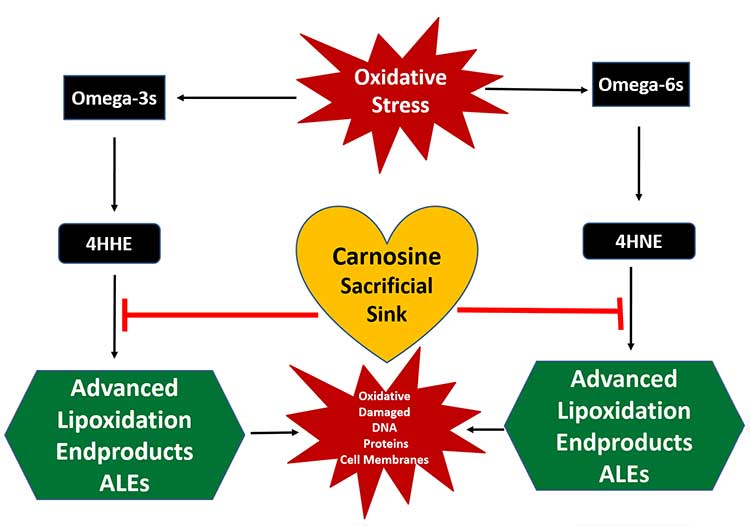
Carnosine May Be Protective Against a Wide Range of Diseases
A more detailed explanation of how carnosine protects against reactive oxygen species (ROS) and how that helps protect against oxidative stress-related pathologies is given in a 2021 paper in the journal Antioxidants:14
“A study that examined the effect of carnosine on oxidative stress in human kidney tubular epithelial (HK-2) cells indicated that carnosine decreased NADPH oxidase (NOX) 4 expression and increased total superoxide dismutase (T-SOD) activity, thus reducing the production of intracellular ROS, relieving the oxidative stress of cells, and ultimately inhibiting the mitochondrial pathway of apoptosis.
Ability of carnosine to protect against pathologies characterized by oxidative stress has been shown in a number of conditions … Carnosine changes the reactivity of superoxide anion by forming a charge-transfer complex with the superoxide radical and also by reducing the efficiency of hydroxyl radicals, creating a compound less reactive than the hydroxyl radical.
One of the mechanisms to protect organisms from oxidative stress is the chelation of transition metals, preventing them from participating in deleterious processes involving ROS … Interestingly, when comparing metals involved in free radical generation, carnosine was found to have a greater antioxidant activity coupled with copper than iron …
At physiological concentrations, carnosine directly reacts with superoxide anion similar to ascorbic acid. In physiological conditions, carnosine was found to reduce oxidative damage and to improve antioxidant activity of different antioxidative enzymes …
Experiments on aged rats showed that therapy with 250 mg/kg/carnosine per day significantly decreased oxidative stress and increased activity of antioxidative enzymes … In similar model of aged rats, carnosine increased liver vitamin E, which further demonstrates its importance in defending the organism from free radicals.
Rising data indicate that carnosine acts as a scavenger of reactive and cytotoxic carbonyl species including 4-hydroxynonenal (HNE). HNE is an aldehyde generated endogenously by lipid peroxidation of unsaturated fatty acids that act as ‘toxic second messengers,’ extending the harmful potential of free radicals.
HNE is considered an important biomarker of oxidative stress and accumulating data indicate that it may modulate signaling pathways of cell proliferation, apoptosis, and inflammation.”
How Carnosine Protects Against Alzheimer’s
As noted in the Pharmaceuticals paper,15 one of the pathologies that carnosine is protective against is Alzheimer’s disease. In my November 2021 interview with Tucker Goodrich, he explained the role of HNE, specifically, in Alzheimer’s, and why it’s so important to get rid of it.
“In heart failure, Alzheimer’s, and AMD [age-related macular degeneration], one of the things they see is an inability of the cell to produce enough energy. The mitochondria are getting damaged. HNE does that damage. It damages 24% of the proteins in the cell, primarily around energy production.
One of the ways your cells produce energy is they basically ferment glucose into pyruvate outside of the mitochondria. This is a perfectly normal part of metabolism and they produce something called pyruvate. A molecule called pyruvate dehydrogenase takes pyruvate into the mitochondria and converts it to acetyl-CoA so the mitochondria can burn it very efficiently for fuel.
Well, one of the things HNE does is it breaks pyruvate dehydrogenase, and they see this in Alzheimer’s where their cells are no longer able to produce enough energy. This is why your cells are dying in Alzheimer’s.
The beta amyloid plaques in Alzheimer’s disease are induced by HNE. There’s a great model that came out of Harvard a couple of years ago showing that.
Even the critical, the most important part of the mitochondria, complex 5, — ADP synthase — which is what takes all the energy coming from your mitochondria and turns it into ATP, which is what fuels the rest of your body — is damaged by HNE. This is a huge issue. There’s no more fundamental problem in aging and health than protein damage.”
Carnosine is the most effective scavenger of HNE, so optimizing your level can go a long way toward protecting against the HNE-induced damage that promotes Alzheimer’s.
Carnosine — A Promising Therapeutic for Obesity-Related Conditions
Elevated HNE has also been found in obese and diabetic patients,16 so there’s reason to suspect carnosine can be important in the treatment of these conditions as well. Another disease where elevated HNE plays a role is atherosclerosis. As noted in the 2021 Antioxidants paper:17
“… emerging studies have indicated that these reactive aldehydes are more than simply markers of oxidative stress.
Rather, it is suggested that these reactive species may play a significant pathogenic role in obesity-associated disorders such as insulin resistance and a carnosine analog alleviates the production or enhances the removal of reactive carbonyl species, providing promising new therapeutic compounds for cardiovascular and metabolic diseases related to obesity.”
Take Control of Your Health by Lowering Your LA Intake
As detailed in several previous articles, the evidence strongly suggests excessive LA is driving most if not all modern diseases, including heart disease and cancer. Fortunately, the solution is simple. Just lower your LA intake.
The easiest way to do this is to use an online nutritional calculator such as Cronometer to calculate your daily intake. Cronometer will tell you how much omega-6 you’re getting from your food down to the 10th of a gram, and you can assume 90% of that is LA. Anything over 10 grams is likely to cause problems. I keep my intake below 5 grams a day.
Since there’s no downside to limiting your LA, you’ll want to keep it as low as possible, which you do by avoiding high-LA foods. Keep in mind you’ll never be able to get to zero, and you wouldn’t want to do that either. You do need some LA, but since it’s found in most foods, and since you need only small amounts, there’s really no way to end up with a deficiency.
- 1, 3, 10, 15 Pharmaceuticals June 2023; 16(6): 778
- 2, 4, 5, 6, 7, 8, 9, 13, 14, 16, 17 Antioxidants July 2021; 10(7): 1037
- 11 Science Direct, Carnosine; Nutritional Supplements and Metabolic Syndrome
- 12 Animal Frontiers April 15, 2023
10 Things to Eliminate for Better Health
Reproduced from original article:
https://articles.mercola.com/sites/articles/archive/2022/05/02/10-things-to-eliminate-for-better-health.aspx
The original Mercola article may not remain on the original site, but I will endeavor to keep it on this site as long as I deem it to be appropriate, and will not be bullied into removing it.
Analysis by Dr. Joseph Mercola Fact Checked May 02, 2022

STORY AT-A-GLANCE
- Removing toxic exposures from your life can help reduce your risk of disease and increase your quality of life and well-being
- The No. 1 item to remove is linoleic acid, the primary fatty acid found in vegetable/seed oils in most processed and restaurant foods
- Other items to eliminate for better health include artificial sweeteners, plastic food containers and bottles and nonstick cookware
- Antibacterial soaps, commercial cleaning and personal care products, and EMFs from your cellphone should also be eliminated as much as possible
- Avoiding eating after dinner and replacing your desk chair with a standup desk round out the list of items you can do for optimal health
For more than two decades, it’s been my goal to empower you with tools to take control of your health and improve your quality of life and well-being. An estimated 60% of Americans say they want to feel healthier,1 yet only 2.7% actually meet the definition of leading a healthy lifestyle.2
While it can feel overwhelming to overhaul your physical activity levels and eating habits, breaking down the changes into “bite-sized” steps makes it much more manageable.
The information that follows is an example of straightforward, powerful strategies that can make a dramatic difference to your health, even if you institute it one step at a time. By removing these items from your life, you eliminate exposure to toxic influences that contribute to disease and malaise, while opening space for the introduction of health-promoting influences in their place.
Eliminate These 10 Things for a Healthier Life
1. Linoleic acid — Linoleic acid is the primary fat found in polyunsaturated fatty acids (PUFAs), including vegetable/seed oils, and accounts for about 80% of the fat composition of vegetable oils. Omega-6 fats must be balanced with omega-3 fats in order to not be harmful, but this isn’t the case for most Americans. Most of the omega-6 people eat, including seed oils, has been damaged and oxidized through processing.
“Most of this linoleic acid, when it oxidizes, it develops lipid hydroperoxides and then these rapidly degenerate into … oxidized linoleic acid metabolites,” says Dr. Chris Knobbe, an ophthalmologist and the founder and president of the Cure AMD Foundation.3 According to Knobbe, OXLAMs (oxidized linoleic acid metabolites) are:
- Cytotoxic and genotoxic
- Mutagenic
- Carcinogenic
- Atherogenic
- Thrombogenic
Metabolic dysfunction can also occur, while OXLAMs are toxic to the liver and are associated with inflammation, fibrosis and fatty liver disease in humans.4 Linoleic acid is found in virtually every processed food, including restaurant foods, sauces and salad dressings, so to eliminate it you’ll need to eliminate most processed foods and restaurant foods from your diet — unless you can confirm that the chef only cooks with butter.
However, because animals are fed grains that are high in linoleic acid,5 it’s also hidden in “healthy” foods like chicken and pork, which makes these meats a major source as well. Olive oil is another health food that can be a hidden source of linoleic acid, as it’s often cut with cheaper seed oils.
2. Eating after dinner — The timing of your meals is nearly as important as the foods that make them up. Time restricted eating (TRE) is a simple powerful intervention that mimics the eating habits of our ancestors and restores your body to a more natural state that allows a whole host of metabolic benefits to occur.6
TRE involves limiting your eating window to six to eight hours per day instead of the more than 12-hour window most people use. Research shows, for instance, that TRE promotes insulin sensitivity and improves blood sugar management by increasing insulin-mediated glucose uptake rates,7 which is important for resolving Type 2 diabetes.
In another study, when 15 men at risk of Type 2 diabetes restricted their eating to even a nine-hour window, they lowered their mean fasting glucose, regardless of when the “eating window” commenced.8 Ideally, you’ll want to stop eating for several hours before bedtime, then start your eating window in mid- to late morning after you wake up.
3. EMFs and cellphones — Most cellphones include a little-known warning that states to keep the phone a certain distance away from your body — usually 5 to 15 millimeters (mm) — to limit exposure to radiofrequency (RF) exposure to under the federal safety limit.9 If you carry your phone in your pocket or your bra, or hold it against your ear when you talk, you’re violating this warning with unknown health consequences.
Devra Davis, Ph.D., founder and president of the Environmental Health Trust, has warned for years about the risks of cellphones in general but, in particular, about the risks to pregnant women and their unborn children, noting that prenatal animal studies have shown exposure to radiation from cellphones:10
- Altered DNA
- Altered brain metabolism
- Compromised spinal cords
- Affected learning abilities
Research conducted by the National Toxicology Program (NTP)11 also found “clear evidence” that exposure to cellphone radiation led to heart tumors in the male rats, along with “some evidence” that it caused brain and adrenal gland tumors in them.12
While most people won’t want to eliminate their cellphone entirely, avoid carrying it on your body and keep it in airplane mode as much as possible. However, even in airplane mode it can still emit signals, which is why you should not sleep with it in your bedroom and should turn it off at night.
4. Artificial sweeteners — Consuming artificially sweetened foods and beverages leads to disruptions to metabolism13,14 and has been linked to increased appetite and cravings, as well as an increased risk of diabetes and other metabolic diseases.15,16
The artificial sweeteners acesulfame potassium and sucralose — brand name Splenda —may even interfere with your liver’s detoxification process, as research found they inhibited the activity of P-glycoprotein (PGP), a “defense protein” that’s important for protecting organisms against environmental toxins.17
Because PGP also plays a role in other body functions, including maintaining the blood-brain barrier, the researchers stressed the need for further research to determine how artificial sweeteners may be affecting other organs beyond the liver. A large-scale cohort study also found that people who consumed higher levels of artificial sweeteners, including aspartame, had higher risk of overall cancer compared to nonconsumers.18
Specifically, total cancer risks increased by 13% among artificial sweetener consumers, while the risk of breast cancer rose by 22% and the risk of obesity-related cancers increased up to 15%.19 In addition to their common usage in diet beverages and low-sugar snacks, be aware that artificial sweeteners are hidden in many products that might surprise you, including dairy products, ketchup, salad dressing, baked goods and medications.
5. Plastic food containers and bottles — If you’re still storing your food in plastic containers or drinking from plastic bottles, switching to safe alternatives like glass, ceramic and stainless steel is a smart choice.
Microplastics, which are simply tiny pieces of plastic, are common in bottled water, for starters. When researchers with the department of chemistry at the State University of New York at Fredonia tested 259 bottles of water, they found microplastic contamination in 93% of them.20
It’s unknown what health risks are posed by consuming these tiny plastic particles, but it is known that microplastics may act like sponges for contaminants including heavy metals, persistent organic pollutants, polychlorinated biphenyls (PCBs) or pathogens, or could cause harm on a cellular or subcellular level.21
Plastics can also leach chemicals into your food and beverages. Phthalates are just one example of high-production volume chemicals used frequently as plasticizers in polyvinyl chloride (PVC) and other plastics, some of which are used in food packaging used by fast food and take-out restaurants. The risk may be even greater if you heat food in plastic or even let a plastic water bottle sit in the sun.
For instance, antimony, a toxic chemical used to manufacture polyethylene terephthalate (PET) plastics used for water bottles, is known to leach into water, and a study found that storing the bottles at higher temperatures increased the amount of leaching.22
6. Nonstick cookware — The convenience of a nonstick surface comes at a steep price, as chemicals used in their production persist in the environment, are contaminating water supplies and have been linked to developmental problems, cancer, liver damage, immune effects, thyroid problems and more.
Polyfluoroalkyl or perfluoroalkyl chemicals (PFASs), which include PFOA and PFOS, are estimated to be in the blood of more than 98% of Americans.23 While production of PFOA ended in 2015, DuPont and other companies have substituted similar chemicals in the production of nonstick cookware.
In May 2015, more than 200 scientists from 40 countries signed the Madrid Statement, which warns about the harms of PFAS chemicals and documents the following potential health effects of exposure:24
| Liver toxicity | Disruption of lipid metabolism, and the immune and endocrine systems |
| Adverse neurobehavioral effects | Neonatal toxicity and death |
| Tumors in multiple organ systems | Testicular and kidney cancers |
| Liver malfunction | Hypothyroidism |
| High cholesterol | Ulcerative colitis |
| Reduced birth weight and size | Obesity |
| Decreased immune response to vaccines | Reduced hormone levels and delayed puberty |
Healthier options include ceramic and enameled cast iron cookware, both of which are durable, easy to clean and completely inert, which means they won’t release any harmful chemicals into your home.
7. Antibacterial soaps and detergents — The excessive and liberal use of antimicrobial products like household and industrial disinfectants, hand sanitizers and other antibacterial cleaners is raising the risk of antimicrobial resistance (AMR) in the environment.
AMR has been declared one of the top 10 global public health threats to humanity,25 causing about 700,000 deaths globally every year.26 The use of antibacterial soap even causes shifts in the microbial composition of your skin, which could affect skin health.27
Antibacterial products may also contain triclosan, an antibacterial chemical and known endocrine disrupter. It’s so widely used that it’s estimated 75% of the U.S. population has been exposed, a concerning statistic since it is readily absorbed into human skin and oral mucosa, where it may affect immune responses, production of reactive oxygen species and cardiovascular functions.28 Reproductive and developmental effects have also been observed.
Unless you are in a hospital setting, avoid antibacterial soaps and detergents, including hand sanitizers and wipes, toothpaste, deodorants and laundry detergents.
8. Commercial cleaning products — Household cleaning products commonly release volatile organic compounds that may cause asthma and respiratory illnesses. One study found women who used chemical cleaning agents had accelerated decline in lung function, which may signal a risk to long-term respiratory health.29
Phthalates are also common in cleaning products, especially fragranced varieties. Studies show associations between exposure to phthalates in utero and the following health conditions:30
| Attention-deficit hyperactivity disorder (ADHD) | Other behavioral problems |
| Adverse cognitive development | Lower IQ |
| Poorer psychomotor development | Impaired social communication |
The good news is that it’s easy to replace chemical cleaners with a short list of basic ingredients, which can be used to make your own natural cleaning products:
| Baking soda | White vinegar | Lemon juice |
| Hydrogen peroxide | Liquid castile soap | Organic essential oils (optional). Certain ones, including lavender and tea tree oil, have antibacterial qualities |
| Mixing bowls | Spray bottles | Microfiber cloths |
9. Toxic personal care products — Personal care products often contain endocrine-disrupting chemicals, including phthalates and parabens, and toluene, a neurotoxicant. Very few chemicals on the market are tested for safety, but even those that aren’t necessarily safe. Part of this is because safety testing is typically done on just one chemical at a time, and under laboratory conditions.
The way you’re actually exposed to chemicals — in combination and under countless different real-world scenarios — may increase their toxicity exponentially. It’s possible that use of personal care products and cosmetics may influence age at menopause,31 along with having a baby that’s at increased risk of being small for gestational age.32
At least 11 chemicals and chemical families of concern have been uncovered that are commonly used in cosmetics. They include:33
| Butylated hydroxyanisole/butylated hydroxytoluene Coal tar dyes |
Diethanolamine | Formaldehyde releasing preservatives |
| Parabens | Phthalates | 1,4 dioxane |
| Polycyclic aromatic hydrocarbons | Siloxanes | Talc/asbestos |
| Triclosan |
To avoid exposure, simplify your routine and make your own personal care products using safe ingredients like coconut oil, mild soap and essential oils.
10. Your chair — Sitting is a pernicious negative influence on your health, as being sedentary for long periods of time each day appears to accelerate aging at the cellular level.34 Among close to 1,500 older women included in one study, those who sat the longest were, on average, eight years older, biologically speaking, than women who moved around more often.35
Separate research, published in the American Journal of Preventive Medicine, further found that sitting for more than three hours a day caused 3.8% of all-cause deaths in the 54 countries surveyed.36
Cutting your sitting time to less than three hours a day could increase your life expectancy by 0.2 years, the researchers concluded. More than 60% of people globally spend more than three hours a day sitting,37 so “sit less, move more” is a motto worth repeating. A simple way to do this is to replace your desk chair with a standup desk and walk each day as much as possible.
Remember, while I encourage you to work your way through each item on this list, you don’t have to eliminate them all overnight. With each toxic exposure you remove from your life, you’ll enjoy better health and receive renewed motivation to keep going on your quest toward reaching optimal health.
- 1 The Beet January 27, 2021
- 2 Mayo Clinic Proceedings April 1, 2016, Volume 91, Issue 4, P432-442
- 3 YouTube June 13, 2020
- 4 J Lipid Res. 2018 Sep; 59(9): 1597–1609
- 5 Journal of Dairy Science January 2018; 101(1): 222-232
- 6, 7 Science November 16, 2018; 362(6416): 770-775
- 8 Obesity April 19, 2019; 27(5)
- 9, 10 YouTube, CBC News March 24, 2017
- 11, 12 National Toxicology Program November 1, 2018
- 13 Curr Biol. 2017 Aug 2
- 14 Medicine Net August 11, 2017
- 15 Yale J Biol Med. 2010 Jun;83(2):101-8
- 16 Tech Times August 12, 2017
- 17 Sci Adv. 2016 Apr; 2(4): e1600001
- 18 PLOS Medicine March 24, 2022
- 19 UPI March 24, 2022
- 20 Front Chem. 2018; 6: 407
- 21 CNN December 5, 2018
- 22 Water Research February 2008, Volume 42, Issue 3, Pages 551-556
- 23 Environ Health Perspect. 2007 Nov; 115(11): 1596–1602
- 24 Environ Health Perspect 123:A107–A111, Madrid Statement
- 25 WHO, Antimicrobial Resistance
- 26 Front Microbiol. 2020; 11: 1020
- 27 PLoS One. 2018; 13(8): e0199899
- 28 J Toxicol Environ Health B Crit Rev. 2017; 20(8): 447–469
- 29 American Journal of Respiratory and Critical Care Medicine February 16, 2018
- 30 American Journal of Public Health page e2 February 18, 2021
- 31, 33 Fertil Steril. 2016 Sep 15; 106(4): 978–990
- 32 Sci Rep. 2019; 9: 8030
- 34, 35 American Journal of Epidemiology January 18, 2017
- 36 American Journal of Preventive Medicine March 2016
- 37 The New York Times March 29, 2016