Mitochondria
now browsing by category
Hidden Jeopardy of Vegetable Oils That Few People Suspect
Reproduced from original article:
https://articles.mercola.com/sites/articles/archive/2022/05/12/effects-of-vegetable-oil-on-our-health.aspx
The original Mercola article may not remain on the original site, but I will endeavor to keep it on this site as long as I deem it to be appropriate, and will not be bullied into removing it.
Analysis by Dr. Joseph Mercola Fact Checked May 12, 2022

STORY AT-A-GLANCE
- Replacing dangerous vegetable oils such as corn oil, soybean oil and canola oil with healthy fats such as lard, butter or coconut oil is a simple way to boost your health and reduce your risk of chronic disease, including cancer
- Vegetable oils are a concentrated source of omega-6 linoleic acid, which has led to a severe imbalance between the omega-6 to omega-3 ratio in most people’s diets. This imbalance appears to be why vegetable oils promote cancer
- Consumption of saturated animal fats such as butter, lard and beef tallow fell by 27% between 1970 and 2014, while consumption of vegetable oils rose by 87%
- Historically, mankind consumed omega-3 and omega-6 at a ratio of 1-to-1. Today, most get 25 times more omega-6 than omega-3, and this imbalance has been linked to heart disease, gastrointestinal diseases, inflammatory conditions and cancer, especially neuroblastoma, breast, prostate, colon and lung cancer
- Your body metabolizes omega-3 and omega-6 PUFAs into eicosanoids (hormone-like substances), and as a general rule, omega-3 eicosanoids are anti-inflammatory while omega-6 eicosanoids have proinflammatory effects. Part of the benefits of omega-3 fats is that they block the proinflammatory effects of omega-6 eicosanoids
This article was previously published November 25, 2019, and has been updated with new information.
Dietary fats are a crucial component of a healthy diet, but the devil’s in the details, and the type of fats you choose can make a world of difference. Replacing dangerous oils with healthy fats is one simple way to boost your health and reduce your risk of chronic disease.
Sadly, the fats that promote ill health are the very ones we’ve been told are the healthiest, and vice versa. Among the absolute worst types of fat you can eat are vegetable oils such as corn oil, soybean oil, sunflower and canola oil, found in most processed foods and restaurant meals.
According to the 2017 U.S. Department of Agriculture report,1 “U.S. Trends in Food Availability,” consumption of saturated animal fats such as butter, lard and beef tallow fell by 27% between 1970 and 2014, while consumption of vegetable oils rose by 87%. Intake of salad and cooking oils specifically rose by a remarkable 248%.
In my view, processed vegetable oils, rich in omega-6 polyunsaturated fatty acids (PUFAs), are the most dangerous dietary factor of them all, taking a greater toll on human health than high fructose corn syrup even.
Not only have vegetable oils been linked to heart disease, gastrointestinal diseases such as irritable bowel disorder, and inflammatory conditions such as arthritis, they’ve also been linked to cancer, especially neuroblastoma, breast, prostate, colon and lung cancer.2
Vegetable Oils — A Hidden Cause of Cancer
In a November 8, 2019, Medium article,3 Maria Cross, a nutritionist with a master of science degree, discusses the science behind vegetable oils and what makes them carcinogenic. She explains:
“There are two classes of PUFA: omega-6 and omega-3. Although functionally distinct and non-interchangeable, these two classes are perpetually engaged in a metabolic balancing act, pushing and pulling as they compete for absorption in the body.
There is nothing intrinsically wrong with omega-6 PUFAs: we need them … If omega-6 fat is essential to health, it makes no sense that it can also cause cancer …
That’s why scientists believe that it is not omega-6 per se that is to blame; it’s the balance between the two groups of PUFA that is out of kilter and wreaking havoc on our bodies. We evolved on, and are genetically adapted to, a diet that provides more or less equal amounts of omega-3 and omega-64 …
With the industrialization of our diets, and the vast quantities of vegetable cooking oils that go into them, the ratio between omega-6 and omega-3 has shifted enormously and we consume up to 25 times5 more omega-6 than omega-3 …
There can only be consequences, and indeed there are: experimental data6 supports the theory that it is this skewed balance between the two PUFAs that influences the development of a tumor.”
How Lopsided PUFA Ratios Promote Cancer
The cancer connection is also reviewed in a 2016 paper,7 “Role of Diets Rich in Omega-3 and Omega-6 in the Development of Cancer,” which points out that “Omega-6 and omega-3 PUFAs often compete with one another for metabolism and act in an opposing manner.”
Your body metabolizes omega-3 and omega-6 PUFAs into eicosanoids, which are hormone-like substances, and as a general rule, omega-3 eicosanoids are anti-inflammatory while omega-6 eicosanoids have proinflammatory effects.8 Part of the benefits of omega-3 fats is that they block the proinflammatory effects of omega-6 eicosanoids.
As noted in the 2016 paper9 cited above, “several studies have demonstrated that omega-6 PUFAs induce progression in certain types of cancer,” while “omega-3 PUFAs possess a therapeutic role against certain types of cancer.”
Table 1 in that paper lists eight known mechanisms by which omega-3 lowers your risk of cancer. For example, omega-3 has been shown to inhibit insulin-like growth factor (IGF) and down-regulate growth factor receptors involved in cancer.
Omega-3 fats also reduce angiogenesis and cell-to-cell adhesion, improve the structure and function of cells, combat inflammation (which is a hallmark of cancer10) and induce cancer cell apoptosis (cell death).11 Table 2 in that same paper lists the pro-tumor mechanisms of omega-6 fats, which include:12
- Creation of reactive species that damage DNA
- 17-beta-estradiol epoxidation, which in turn generates a carcinogenic compound
- Enhancing the genotoxic effects of other compounds
As explained in my book, “Superfuel,” co-written with James DiNicolantonio, Pharm.D., omega-6 also inhibits cardiolipin, an important component of the inner membrane of your mitochondria that needs to be saturated in DHA in order for it to function properly.13
Cardiolipin can be likened to a cellular alarm system that triggers apoptosis (cell death) by signaling caspase-3 when something goes wrong with the cell. If the cardiolipin is not saturated with DHA, it cannot signal caspase-3, and hence apoptosis does not occur. As a result, dysfunctional cells are allowed to continue to grow, which can turn into a cancerous cell.
Vegetable Oils Exacerbate Virtually All Chronic Disease
Cancer is by far not the only health risk associated with vegetable oils. As mentioned, they promote virtually all chronic disease by throwing your omega-3 to omega-6 ratio off kilter. But they also influence your disease risk in other ways.
Importantly, vegetable oils degrade when heated, forming extremely toxic oxidation products, including cyclic aldehydes.14 Cyclic aldehydes cause oxidized low-density lipoprotein (LDL) associated with heart disease. They also crosslink tau protein and create neurofibrillary tangles, thereby contributing to the development of neurodegenerative diseases.
As explained by Dr. Cate Shanahan in her book, “Deep Nutrition: Why Your Genes Need Traditional Food,”15 in order to understand how dietary fats affect your health you need to understand how fats oxidize.
The omega-6 PUFAs found in vegetable oils have highly perishable bonds that react with oxygen, creating a free radical cascade that turns normal fatty acids in your body into dangerous high-energy molecules that zip around, wreaking havoc in a way similar to that of radiation.
What’s more, many of the vegetable oils produced today — especially corn and soy oil — are genetically engineered and a significant source of glyphosate exposure, and glyphosate has also been linked to gut damage and other health problems.
Shanahan’s book also expounds on the hazards of 4-hydroxynonenal (4HNE), which forms during the processing of most vegetable oils. 4HNE is highly toxic, especially to your gut bacteria, and consumption of 4HNE has been correlated with having an obesogenic balance of gut flora.
4HNE causes cytotoxicity and DNA damage, and instigates free radical cascades that damage the mitochondrial membrane. As Shanahan in 2017:
“You can’t design a better delivery vehicle for a toxin that’s going to destroy your health slowly over the course of maybe 10, 20 years, depending on the genetics of your antioxidant system capacity.”
Shanahan also notes that organic vegetable oil is not the answer, as 4HNE occurs even if the oil is obtained from organic crops. It’s an intrinsic byproduct of the refining and processing of the oil, no matter how healthy the oil initially was.
The omega-6 found in vegetable oils also damages the endothelium (the cells lining your blood vessels), allowing LDL and very low-density lipoprotein (VLDL) particles to penetrate into the subendothelium.
In other words, these oils get integrated into your cell and mitochondrial membranes, and once these membranes are impaired, it sets the stage for all sorts of health problems.
They also make cell membranes less fluid, which impacts hormone transporters in the cell membrane and slows your metabolic rate, and inhibit the removal of senescent cells — aged, damaged or crippled cells that have lost the ability to reproduce and produce inflammatory cytokines that rapidly accelerate disease and aging.
Vegetable oils also strip your liver of glutathione (which produces antioxidant enzymes), thereby lowering your antioxidant defenses,16 and inhibit delta-6 desaturase (delta-6), an enzyme involved in the conversion of short-chained omega-3s to longer chained omega-3s in your liver.17
Address Your Omega-6 to Omega-3 Ratio
Marine-based omega-3 is one of the most important fats in the human diet, as docosahexaenoic acid (DHA) and eicosapentaenoic acid (EPA) are actually key structural elements of cells, including your brain cells, and not just simple fuel. If you don’t have enough DHA and EPA, your body’s ability to repair and maintain healthy cell structures is seriously impaired.
The key that many overlook is the importance of getting the ratio of omega-3 to omega-6 right. Simply adding in more omega-3 might not be sufficient if you’re not also taking steps to significantly lower your omega-6 intake, and vegetable oils are a primary source.
As noted in the 2002 paper,18 “The Importance of the Ratio of Omega-6/Omega-3 Essential Fatty Acids”:
“Excessive amounts of omega-6 polyunsaturated fatty acids (PUFA) and a very high omega-6/omega-3 ratio, as is found in today’s Western diets, promote the pathogenesis of many diseases, including cardiovascular disease, cancer, and inflammatory and autoimmune diseases, whereas increased levels of omega-3 PUFA (a low omega-6/omega-3 ratio) exert suppressive effects.
In the secondary prevention of cardiovascular disease, a ratio of 4/1 was associated with a 70% decrease in total mortality. A ratio of 2.5/1 reduced rectal cell proliferation in patients with colorectal cancer, whereas a ratio of 4/1 with the same amount of omega-3 PUFA had no effect.
The lower omega-6/omega-3 ratio in women with breast cancer was associated with decreased risk. A ratio of 2–3/1 suppressed inflammation in patients with rheumatoid arthritis, and a ratio of 5/1 had a beneficial effect on patients with asthma, whereas a ratio of 10/1 had adverse consequences.
These studies indicate that the optimal ratio may vary with the disease under consideration. This is consistent with the fact that chronic diseases are multigenic and multifactorial.
Therefore, it is quite possible that the therapeutic dose of omega-3 fatty acids will depend on the degree of severity of disease resulting from the genetic predisposition. A lower ratio of omega-6/omega-3 fatty acids is more desirable in reducing the risk of many of the chronic diseases of high prevalence in Western societies …”
Since most processed foods and restaurant foods contain these oils, ridding your diet of them means ditching processed fare and restaurant meals, and cooking from scratch using healthier cooking fats. While you do need omega-6, it should be in its unprocessed form, not industrial vegetable oils. Good sources are whole, raw plant seeds and tree nuts.
Healthiest Fats for Cooking
While the devil’s in the details, and the details may be complicated, the simplest way to understand what a healthy diet consists of is to think back 100 years or so and consider what food was back then, and how it was prepared.
What you’re aiming for is real food — whole food that is as close to its natural state as possible. This may be particularly important when it comes to fats. Again, ditching vegetable oils and any food cooked with it can go a long way toward lowering inflammation and mitochondrial and cellular damage, which will protect you from a variety of common killers, including cancer. As for what to replace the vegetable oils with, the following are among your healthiest options:
• Grass fed tallow — This is probably the best fat to cook with.
• Coconut oil is another excellent cooking oil that is loaded with health benefits.
• Olive oil — Authentic olive oil contains healthy fatty acids that can help lower your risk of heart disease. While the standard recommendation has been to avoid using olive oil for cooking and to only use it cold, recent research19 in which 10 popular cooking oils were compared contradicts this advice, showing extra-virgin olive oil actually scored best for both oxidative stability and lack of harmful compounds produced when heated.
A word of caution is warranted, however. Fake olive oil abounds,20 so it’s important to take the time to investigate your sources. Many are adulterated with cheap vegetable oils or nonhuman grade olive oils,21 which are harmful to health in a number of ways.
• Organic butter (preferably made from organic grass fed raw milk) instead of margarines and vegetable oil spreads — Butter is a healthy whole food that has received an unwarranted bad rap.
• Organic ghee is even better, as you remove the milk solids that many have problems with — Ghee is pure fat with no carbs and is what I personally use. The best way to make it is to place it in a glass container in a dehydrator and don’t heat it higher than 100 degrees F. to preserve the quality.
You can suck off the milk solids with a glass baster. Once you have the ghee you don’t even need to refrigerate it as it is stable at room temperature for many weeks.
To round out your healthy fat intake, be sure to eat raw fats, such as those from avocados, raw nuts, raw dairy products and olive oil. Also increase your animal-based omega-3 fat intake by eating more sardines, anchovies, mackerel, herring or wild-caught Alaskan salmon, or take a supplement such as krill oil.

How to Conquer Fatigue and Low Energy
Reproduced from original article:
https://articles.mercola.com/sites/articles/archive/2022/05/08/eat-for-energy.aspx
The original Mercola article may not remain on the original site, but I will endeavor to keep it on this site as long as I deem it to be appropriate, and will not be bullied into removing it.
Analysis by Dr. Joseph Mercola Fact Checked May 08, 2022
STORY AT-A-GLANCE
- To address fatigue and low energy, you need to improve your mitochondrial energy production
- Mitochondria have a mutually exclusive dual function. They produce energy, but they’re also environmental sensors that detect threats inside the body. When a threat is detected, the mitochondria downshift energy production to focus on self-defense
- Common threats that can result in reduced mitochondrial energy production include oxidative stress, poor nutrition, environmental toxins, psychological stress and sleep deprivation
- Mitochondrial capacity declines by about 10% with each decade of life, but it’s not a natural function of aging. Rather, the loss of mitochondria is due to a lack of hormetic stress. Mitochondria have to be challenged and stimulated in order to stay big and strong
- Light deficiency is an extremely common cause for fatigue. Sun exposure is required for melatonin production in your mitochondria, which protects them from damage. Red and infrared light also stimulate tissue-specific growth factors, directly stimulate ATP production at the mitochondria level, and act as signals to encourage mitochondria to grow bigger and stronger
In this interview, Ari Whitten, a return guest, discusses his latest book, “Eat for Energy: How to Beat Fatigue, Supercharge Your Mitochondria, and Unlock All-Day Energy.”
Whitten has also written an excellent book about infrared light exposure or photobiomodulation as a healing modality, called “The Ultimate Guide to Red Light Therapy: How to Use Red and Near-Infrared Light Therapy for Anti-Aging, Fat Loss, Muscle Gain, Performance, and Brain Optimization.”
As you might guess, the focus of his latest book is fatigue, and the foundational core for addressing that is to improve mitochondrial energy production. Your circadian rhythm also plays an important role. Whitten explains the premise of the book:
“It’s a collection of science-based strategies as far as what to eat, how to eat and when to eat, that can be tied in with any particular dietary pattern that you’ve already adopted. So, I’m not asking if you’re paleo or vegan or keto or Mediterranean. I’m not asking you to change that.
It’s dozens of strategies that you can incorporate into the dietary pattern of your choosing. So, I feel like it’s a really key piece of the puzzle for a lot of people. They can just immediately plug in with pretty minimal effort and get big results …
In the last 100 years, we’ve seen massively accelerating risks of dozens of diseases, and that is not the result of everybody being a unique individual and responding randomly to what’s going on. It’s not that everybody’s genetics just decided to express lots of disease.
It’s because the modern world changed in very fundamental ways, as far as diet, the modern lifestyle, as far as being sedentary, being in climate-controlled offices, losing all these forms of hormetic stressors, sleeping less, disrupting our circadian rhythm — these are the main drivers of pretty much all of these different chronic diseases.
And the answer isn’t to treat everybody as a unique individual and pretend like we don’t know all of these universal factors that are the actual root cause drivers of these diseases. It’s to address the foundation of these root cause drivers of diseases. That’s where you have to start.”
A New Understanding of Mitochondria
In high school and college biology courses, we’re taught to think of mitochondria as mindless energy generators that take in the food we eat, mostly carbs and fats, and then pump out cellular energy in form of the ATP. However, in the past five to 10 years, we’ve gained a whole new understanding of mitochondria, largely thanks to the work of Dr. Robert Naviaux, who runs a mitochondrial medicine lab at the University of California, San Diego.
“Naviaux, I think, is one of the most brilliant scientists and has created one of the biggest breakthroughs in medicine in the last century, arguably. He figured out that mitochondria have a second role, other than energy production, and that is in cellular defense.
In his words, mitochondria are the central hub of the wheel of metabolism. They are not just energy producers, but also environmental sensors, and they are constantly sampling the environment around them, figuring out what’s going on in the body.
And, basically, they’re asking one fundamental question: Are we under attack? Is there something we need to defend against? And this is the big key — these dual roles of energy production and cellular defense are mutually exclusive. So, to the degree that mitochondria are picking up on some dangers that are present, they turn down the dial on energy production.
And if the mitochondria are turning down the dial on energy production, subjectively on a macro level, us as an organism, a collection of trillions of these cells filled with mitochondria, feel the symptom of fatigue. We can think of our energy levels as largely a function of the degree to which our mitochondria are detecting the presence of dangers or threats in the body.”
Common threats your mitochondria might be responding to if you feel fatigued include oxidative stress, poor nutrition, environmental toxins, psychological stress and sleep deprivation, just to name a few.
What’s Your Resilience Threshold?
Most if not all stressors can be boiled down to oxidative stress, reactive nitrogen species, inflammation and purinergic signaling (a situation in which energy molecules leak out of the cell). Even something like psychological stress can cause this kind of reaction. But whether the stressor is serious enough to cause fatigue depends on your resilience threshold. What wipes one person out might not affect another.
“I like to think of fatigue as having two fundamental causes,” Whitten says. “One is all of these different kinds of environmental and lifestyle stressors. The other thing that interplays with, and is often left out by a lot of people, is what is happening at the cellular level inside of your body.
And the key thing to understand here is that our cells can either be filled with big, strong mitochondria, and lots of them, or weak, fragile, shrunken, broken, dysfunctional mitochondria, and very few of them.
It’s been shown in research that mitochondrial capacity declines by about 10% with each decade of life. If you look at older people, they generally have somewhere between 50% to 75% lower mitochondrial capacity than a young person.
But it’s not a natural function of aging, because we know from other research that when they look at mitochondrial capacity of healthy 70-year-olds, who are lifelong athletes, they don’t have lower mitochondrial capacity than an adult at 40 years old.
What that tells us is the loss of mitochondria is not a function of aging, per se. It’s a function of lack of hormetic stress in your life. Mitochondria have to be challenged and stimulated in order to stay big and strong.”
Other Factors That Influence Your Energy Levels
While mitochondrial dysfunction is a central issue in fatigue, other factors also come into play, including:
- Low muscle mass — Greater muscle mass contributes to metabolic flexibility and health, because muscle acts as a sink for glucose, thereby reducing your risk of insulin resistance. Low muscle mass, on the other hand, is a leading contributor to early death, and it’s a major contributor to low energy and fatigue
- Elevated blood sugar and insulin resistance — This primarily goes back to a poor diet high in processed foods and constant grazing throughout the day. Eating a whole food diet and implementing TRE can go a long way toward normalizing your insulin and blood sugar
- Lack of hermetic stress such as insufficient amounts of exercise
- Stress
- Poor gut health
How Your Diet Influences Your Energy Level
Naturally, your diet has a central influence on your energy level. One key driver of low energy and ill health is excessive omega-6 linoleic acid (LA) intake. LA contributes to insulin resistance, obesity and chronic inflammation, and as mentioned earlier, when mitochondria detect inflammation, they dial down energy production to shift resources toward self-defense.
High LA consumption has also been implicated in neurodegenerative diseases, cancer and many other chronic diseases. Processed food, which is not only high in LA but also sugar, can also considerably impact your energy levels by impairing your hormone regulation.
Circadian Rhythm Disruption Is a Common Culprit
According to Whitten, arguably one of the most important things you can do to improve your energy level is to optimize your circadian rhythm by consistently going to bed and rising in the morning at the same times. Another crucial factor is to get plenty of daytime sunlight exposure and to minimize artificial light exposure at night. As explained by Whitten:
“The circadian clock in your brain learns to distinguish what is day and what is night based on the differences in light intensity, along with the color of the wavelengths of that light. When you start your morning in indoor environments, under indoor lighting, looking at screens, and end your day in indoor environments with indoor lighting, looking at screens, you don’t have a big [light intensity] differential.”
Your circadian rhythm is also influenced by nutrient sensors throughout your body. While you use light to optimize the central clock in your brain, you use nutrition to optimize the peripheral clocks and sync them with the central clock. One way to do this is through time-restricted eating (TRE), where you eat all your meals within a six- to 10-hour window.
The Importance of Sun Exposure
Light deficiency is another extremely common cause for fatigue. Sun exposure triggers vitamin D production, which is important, but it also has many other functions and benefits that can directly impact your energy level.
For example, the vast majority of melatonin, some 95%, is produced in your mitochondria in response to sunlight (specifically red near-infrared light, which is what provides warmth). Melatonin is a potent anti-inflammatory, so sunlight allows you to target oxidative stress right where it’s needed the most.
“Melatonin is absolutely vital for protecting your mitochondria from harm and preventing them from accumulating damage as you age,” Whitten says. But swallowing melatonin is useless for this, as oral melatonin cannot reach the mitochondria.
Sunlight also allows for the conversion of retinol (vitamin A) to retinoids, which is crucial for the function of vitamin D, and interacts with your malanocortin system, which involves alpha-melanocyte-stimulating hormone that helps regulate inflammation and appetite.
Sunlight also creates a surge of nitric oxide, which helps normalize your blood pressure and reduce your cardiovascular disease risk. Whitten cites a Swedish study that showed women with the lowest sun exposure had a cardiovascular disease risk equivalent to smoking a pack of cigarettes per day. Red and infrared light also have a long list of other health benefits.
Importantly, red and infrared light directly stimulate ATP production at the mitochondria level. These wavelengths also create a transient increase in reactive oxygen species, which are signaling molecules that instruct the mitochondria to grow bigger and stronger.
Red and infrared wavelengths also stimulate tissue-specific growth factors. So, in muscle cells, it increases insulin-like growth factor 1, which is a key growth factor for muscle growth. In your thyroid, it stimulates growth factors that help regenerate thyroid gland tissue in the brain.
In your skin, fibroblasts are stimulated by red and near-infrared light to increase collagen production. So, essentially, red and infrared light act as signals that trigger growth and regeneration at the cellular level, throughout your whole body.
“Our biology has evolved for millions of years to require adequate sun exposure in order to express normal health,” Whitten says. “Just to function normally, we require these different bioactive wavelengths and red and infrared light …
We know that hermetic stress, that doing exercise, doesn’t just protect the cells and the mitochondria from harm from exercise. It protects against a broad range of other stressors.
So, having a body that does exercise, that’s fit, protects you from oxidative damage that might occur from psychological stress or sleep deprivation or environmental toxins — things that are totally unrelated to the initial source of that hermetic stress that led to those adaptations.
I think what we have with melatonin is probably something that’s very similar. This is something critical for protecting our mitochondria from a broad range of, basically, every type of stressor. You got to have those melatonin levels charged up, and that’s a function of exposing your body to light.”
The Antiaging, Energy-Boosting Benefits of Methylene Blue
Methylene blue is the parent molecule for hydroxychloroquine and chloroquine, an off-patent drug commonly used to treat not only malaria but also COVID-19. Interestingly enough, this molecule has been shown to have antiaging benefits when used topically. There’s even a new cosmetics brand that uses it in their formulas. While it has a blue tint, when mixed with a carrier oil it does not stain your skin blue. According to Whitten, methylene blue:
“… has profound antiaging effects, anti-wrinkle effects and protects that skin from damage. It has mitochondrial protective effects … it’s neuroprotective, combats neurological disease and improves long-term brain health. It can also help increase energy …
It’s worth mentioning that there are some contraindications, there are some interactions with certain drugs that can be dangerous. Definitely, SSRIs [are contraindicated]. There’s also a strange medical condition called G6PD [that it’s contraindicated for].”
Methylene blue also contains important copper enzymes called ceruloplasmin, which acts as a copper storage in your body. Copper is extremely important from mitochondrial energy production, and methylene blue forms a buffer to oxidation, which allows the copper to work better.
More Information
To learn more, be sure to pick up a copy of “Eat for Energy: How to Beat Fatigue, Supercharge Your Mitochondria, and Unlock All-Day Energy.” The book addresses several foundational nutritional causes of fatigue and how to fix it, including:
| The influence of your circadian rhythm and how to optimize it via nutrition |
| TRE and how to sync your eating window with your waking-sleeping cycle |
| Calorie stacking — how stacking more of your daily calories towards the earlier part of the day results in increased energy levels (in part by enhancing neurotransmitters and hormones that are synced with the circadian rhythm) |
| How to optimize your body composition |
| How to optimize your gut health |
| Superfoods and supplements to optimize energy levels |
You can also learn more by tuning into his popular podcast, “The Energy Blueprint,” where every week he delves into a wide variety of health promoting strategies.

The Surprising Health Benefits of Methylene Blue
Reproduced from original article:
https://articles.mercola.com/sites/articles/archive/2022/04/17/methylene-blue-health-benefits.aspx
The original Mercola article may not remain on the original site, but I will endeavor to keep it on this site as long as I deem it to be appropriate, and will not be bullied into removing it.
Analysis by Dr. Joseph Mercola Fact Checked April 17, 2022
Sorry, this video no longer available…
STORY AT-A-GLANCE
- Methylene blue helps mitochondrial respiration and improves brain energy metabolism. By doing that, it can improve cognitive performance and prevent neurodegeneration
- Methylene blue is the parent molecule for hydroxychloroquine and chloroquine, off-patent drugs commonly used to treat not only malaria but also COVID-19
- Emergency rooms around the world use it, as it’s the only known antidote for metabolic poisons causing methemoglobinemia, which is when a metabolic poison interferes with the transport of oxygen in hemoglobin
- Methylene blue is a hormetic drug, so low doses have the opposite effect of high doses
- Low doses, 0.5 mg to 1 mg per kilo of bodyweight, are recommended for nonacute, longer-term treatments. Uses include the prevention and treatment of dementia, post-stroke and other brain injuries, cognitive enhancement, and the general optimization of health if you’re already healthy
In this interview, Francisco Gonzalez-Lima, Ph.D., discusses a really powerful strategy to improve your mitochondria, which generate the vast majority of the energy your cells produce from food.
Gonzalez-Lima is an expert on methylene blue, which helps mitochondrial respiration and improves brain energy metabolism. By doing that, it can improve cognitive performance and prevent neurodegeneration.
“With methylene blue, we have been able to show all of those [benefits],” Gonzalez-Lima says. “Our group was the first to map the effects of methylene blue in the brain of humans and show its effects on improving brain metabolism, blood flow and memory function.”
What Is Methylene Blue?
Methylene blue is the parent molecule for hydroxychloroquine and chloroquine, off-patent drugs commonly used to treat not only malaria but also COVID-19. Best known as a fish tank antiseptic and textile dye for blue jeans, it was actually the first synthetic drug in modern history, developed in 1876. Since then, we’ve discovered it has many really important medicinal benefits.
The first medical application of methylene blue was for malaria. In 1890, Paul Ehrlich, a scientist at the famous Charité Hospital in Berlin, Germany, discovered methylene blue inhibits an enzyme that weakens the malaria parasite.
One of the first antipsychotic medications was also made from methylene blue. Other drugs developed from or with it include antibiotics and antiseptics. In the past, it was commonly used to treat urinary tract infections. It’s also been used as an antiviral agent in blood used for transfusions.
To this day, methylene blue is found in every hospital in the world, as it’s the only known antidote for metabolic poisons (any poison that interferes with oxygen transport or displaces oxygen, either from the blood or from the mitochondria).
For example, if you’re admitted for carbon monoxide poisoning, they’ll give you methylene blue intravenously. Cyanide is another example. The only known antidote for cyanide poisoning is methylene blue. It’s also been speculated that methylene blue might be useful in the treatment of acute lung infections such as SARS-CoV-2.
Importantly, methylene blue is a hormetic drug, which means that low doses have the opposite effect as high doses. For example, it’s primarily used in emergency rooms at the upper dosage limit (3 milligrams to 4 mg per kilo of bodyweight) for methemoglobinemia, which is when a metabolic poison interferes with the transport of oxygen in hemoglobin, by the iron in hemoglobin being oxidized to +3 rather than its normal reduced +2 state.
However, if you take too high a dose, you produce methemoglobinemia. At dosages in between, there’s no effect. Likewise, while low dosages have an antioxidant effect, high doses are pro-oxidative and can kill bacteria and tumor cells.
Methylene Blue, an Antioxidant and Energy Producer
Gonzalez-Lima’s research has primarily focused on low-dose benefits for nonacute purposes over the longer term — such as neuroprotective benefits and cognitive enhancement. While it has several mechanisms of action, a unique feature is that it acts on the level of electrons. He explains:
“Our body uses electrons as part of the electron transport chain that happens inside mitochondria, and these electrons, moved along through the mitochondria, are generated from electron donors that we produce by the foods that we eat.
All the foods that we eat, the only way they contribute to energy is by producing electron donors. They donate these electrons to the electron transport inside the mitochondria. The ultimate electron acceptor in nature is oxygen. That’s why the process of removing electrons from a compound is referred to as oxidation.
In mitochondria, this process is called oxidative phosphorylation. The electron transport is coupled with the phosphorylation of adenosine to eventually produce the adenosine triphosphate molecule (ATP). Methylene blue is an electron cycler. It’s an autooxidizing compound.
So, methylene blue donates its electrons directly to the electron transport chain, it obtains electrons from surrounding compounds, and maintains oxygen consumption and energy production. By doing this, it helps oxygen to be fully reduced into water.
So, it becomes two things that are often not found together. It acts as an antioxidant, because oxygen is neutralized into water by donating electrons to the electron transport, and it produces energy, because when the electron transport pumps are moving along oxidative phosphorylation, you have an increase in ATP formation.
Oftentimes, we have things that improve energy metabolism, but then they lead to oxidative stress. In the case of methylene blue, that’s not the case.
You can increase oxygen consumption rates, increase ATP production for energy metabolism, and at the same time reduce oxidative stress which, of course, will lead to reduction in oxidative damage at the level of mitochondria, then at the level of the other parts of the cells, and eventually membranes of the cells, and reactions that are cascades of this oxidative damage.”
Basically, as an electron cycler, methylene blue acts like a battery, but unlike other compounds that do the same thing, it doesn’t cause damaging oxidation in the process. If anything interferes with oxygenation or cellular respiration, such as cyanide, methylene blue is able to bypass that point of interference through electron cycling, thus allowing mitochondrial respiration, oxygen consumption and energy production to function as it normally would.
Improved Mitochondrial Respiration Improves Health, Cognition
Methylene blue can also be helpful in instances where you have impaired blood flow that prevents the delivery of oxygenated hemoglobin to the tissues. In this case, methylene blue helps counteract the reduced blood flow by optimizing the efficiency of mitochondrial respiration.
Healthy blood flow is particularly important for brain function, and many older people have chronic hypoperfusion that contributes to neurodegeneration and memory problems. These issues, Gonzalez-Lima says, can be prevented by methylene blue.
In summary, inside the electron transport chain in your mitochondria are five complexes, the primary purpose of which is to conduct the electrons generated from food, primarily carbohydrates and fat, in the form of acetyl CoA. Sometimes the electron transport chain gets blocked or impaired, and methylene blue is able to bypass such blockages.
When you’re perfectly healthy, low doses of methylene blue will enhance oxygen consumption, mitochondrial respiration and ATP production above baseline, basically optimizing the whole system. So, it acts as a metabolic enhancer and not just an antidote for metabolic poisons and other inhibitory processes.
The most important complex, Cytochrome c Oxidase, which catalyzes the reaction of oxygen becoming water, is blocked by cyanide. But methylene blue can insert electrons wherever there is a blockage.
What’s more, when you’re perfectly healthy, low doses of methylene blue will enhance oxygen consumption, mitochondrial respiration and ATP production above baseline, basically optimizing the whole system. So, it acts as a metabolic enhancer and not just an antidote for metabolic poisons and other inhibitory processes.
Methylene blue’s action on mitochondrial respiration is also coupled with biochemical upregulation of your oxygen consumption machinery in general, and hemodynamic processes that increase local blood supply to tissues.
And, as detailed by Gonzalez-Lima in the interview, this upregulation remains even after the methylene blue is expelled from your system (primarily through urination unchanged as your body minimally metabolizes it), and over time, it can actually increase the number of mitochondria. In your brain, this will benefit cognition, as your brain is the most energy-dependent organ in your body.
Methylene blue also activates the Nrf2 pathway. Nrf2 is a transcription factor that, when activated, goes into the cell’s nucleus and binds to the antioxidant response element (AREs) in the DNA. It then induces the transcription of further cytoprotective enzymes such as glutathione, superoxide dismutase catalase, glutathione peroxidase, phase II enzymes, heme-1 oxygenase and many others.
Methylene Blue for Brain Health
Perhaps one of the most revolutionary benefits of methylene blue is for the prevention and treatment of dementia, neurodegenerative diseases such as Alzheimer’s and Parkinson’s, and neural injuries caused by stroke and traumatic brain injuries (TBIs). This is particularly important as the COVID jabs have radically increased strokes. As explained by Gonzalez-Lima:
“Any process where increasing oxygen-based energy production plays a major role, methylene blue will have a role to play. One of the first studies we did that was very impressive [was on] a model in the eye. The reason we used the eye was because the retina in animals is readily accessible so that we can inject into the retina.
Rotenone [a broad-spectrum pesticide and Complex 1 inhibitor] inhibits mitochondrial respiration, subsequently there is atrophy and degeneration of the retinal layer, which is very dramatic. If methylene blue is on board, we can prevent this process because the mitochondrial respiration can continue, so the tissue is not affected.
This was a model called an optic neuropathy due to mitochondrial defects. It’s the most common form of blindness in younger people, so we did this to verify in vivo that [methylene blue] could have this neuroprotective effect. Then we did it in other things like brains. We found a similar phenomenon …
Methylene blue can be protective in ischemic and hemorrhagic strokes. We’ve also published a study with a hypoxia. In other words, we reduced the amount of oxygen delivered to the animals, and we could use an fMRI, noninvasively, in the animals to see that we were able to increase the amount of cerebral metabolic rate for oxygen consumption in the presence of methylene blue under hypoxic conditions.
With respect to dementia, by the time you see the tau protein inside neurons, those neurons are metabolically, essentially, dead, so it is too late. By acting on that, you cannot recover the metabolic machinery and the health of the neurons.
So, those neurons are not rescued in any way that is functionally meaningful. Generally speaking, biomarkers are not good therapeutic targets because they may or may not have any causal relationship with the disease.”
In biohacker circles, low-dose methylene blue is used as a nootropic, meaning a compound that helps improve cognitive function. However, while some promote sublingual or buccal application (under your tongue or on the inside of your cheek), the best way is to swallow it, as the acid in your stomach makes it more bioavailable.
Urinary Tract Infections in the Elderly
In my mind, this is one of the most important uses: It is a highly effective agent against urinary tract infections (UTIs). Many elderly are put on antibiotics, which disrupts their microbiome. Methylene blue was used for many decades at a dose of 65 mg per day and was even sold in pharmacies as Urolene Blue.
Since your body doesn’t really metabolize it, it is excreted by your kidneys into your bladder where it reaches very high concentrations over time and becomes a potent oxidant stress that kills virtually any pathogen in the bladder. Plus, it has the additional “side effect” of improving brain health and reducing dementia. In my mind, it is reprehensible medical malpractice not to use methylene blue in UTIs in the elderly. It clearly is the safest and most effective drug of choice.
Contraindications
While methylene blue is very safe, there are some contraindications. One is G6PD deficiency, which is also a contraindication for high-dose ascorbic acid treatments, which could be deadly. Methylene blue is also a mild monoamine oxidase (MAO) inhibitor, so taking high doses with a selective serotonin reuptake inhibitor (SSRI) antidepressant could potentially lead to serotonin syndrome, which is not good. The risk of this, however, is very small. Gonzalez-Lima explains:
“With respect to the warning about the SSRIs, the problem is not methylene blue but the amount of SSRI. The problem was in a specific application of methylene blue where they use it for parathyroid surgery as a stain …
To my knowledge, there’s never been more than five cases, where the patients were anesthetized, and they still had SSRIs [in their system], and they did repeated flushing in the open neck with methylene blue, which exceeded these doses that we have been talking about.
The U.S. FDA reacted with this warning. But this has been reviewed by both surgeons and pharmacologists at the Mayo Clinic, and they wrote a rebuttal paper where they indicate that there is no evidence to suggest oral methylene blue has any interaction with the therapeutic dosing of serotonergic compounds, especially SSRIs, and that this was something that happened under these specific [surgical] conditions.
Canada limits the warning to that particular application, but our FDA went beyond that to any kind of serotonergic drug. I think there is absolutely no evidence for oral methylene blue having interactions in this low-dose range with any SSRIs.
And when they talk about the MAO inhibitor function, it really only works as an MAO inhibitor in the higher concentration of the higher dose range, not the low-dose range. So, the effects of methylene blue as an antidepressant — only to a very limited extent, if you repeat it cumulative treatments — can be due to any kind of a MAO inhibitor role.
In addition, it is due to its metabolic enhancing function, so it antagonizes some of the depression symptoms like the low energy that is experienced with depression. So yes, it is effective to reduce symptoms of depression. Unfortunately, this warning is going to make some physicians scared of using it in combination with SSRIs.”
Dosing Suggestions
As mentioned, methylene blue is a hormetic, so low dosages have the opposite effect of high dosages. While every possible dose response has not been tested, as a general guideline, the benefits Gonzalez-Lima discusses in this interview are based on dosages between 0.5 milligram per kilogram of bodyweight to 4 mg per kg. He admits lower doses may work but he hasn’t tested them.
For an acute treatment, the upper limit is between 3 mg to 4 mg per kg, which is typically the range given as an IV antidote for methemoglobinemia. For nonacute, more long-term treatment, 0.5 mg to 1 mg per kg per day works better. It has a half-life of 12 to 13 hours, so once-a-day dosing is fine. He gives the following example of how methylene blue has been used in the treatment of fears and phobias:
“One of the processes in which a memory formation can be used therapeutically is when you form a memory to extinguish fear. Individuals who have a phobia, you can expose them to the specific situation that is involved in the phobia, and there is a learning called extinction learning that happens that you extinguish your response.
In that situation, we only give methylene blue once after this extinction learning to facilitate the process of memory consolidation. What happens after you go through the learning is the process of consolidation, which requires energy.
So, by facilitating the energy availability during the consolidation phase, which happens over a number of hours, then the next time [you’re exposed to fear-evoking stimuli, you’ve] consolidated that extinction memory more effectively.
We’ve done this also with post-traumatic stress disorder (PTSD), where you use prolonged exposure therapy. In that situation, you can give the methylene blue after different sessions where you see that there is a good extinction learning.
In other words, where people are learning through exposure to reduce their fear levels, that’s when you want to reinforce that therapeutic learning by giving them the methylene blue right after the session.”
For brain health, nootropic effects and the prevention or treatment of dementia, 0.5 mg to 1 mg per kg per day (or when needed) is the dose Gonzalez-Lima recommends and uses.
How to Select a High-Quality Product
Last but not least, selecting the correct product is of crucial importance, in addition to getting the dosing right. There are three basic types of methylene blue: industrial, chemical and pharmaceutical-grade.
The only version you’ll want to use medicinally is pharmaceutical-grade. Do not ingest methylene blue from the pet store that is meant for fish tanks. Industrial-grade methylene blue has lots of impurities, and typically contain only 10% to 25% methylene blue.
Chemical or laboratory grade, which is used for staining purposes on laboratories, has a much higher purity, but it’s still not suitable for medicinal purposes as it typically has heavy metal contaminants like lead, cadmium and arsenic. Over time, the impurities can accumulate in your body, resulting in toxicity.
Pharmaceutical grade is 99%+ pure. This is the kind used when injected intravenously for antidote purposes, or used orally. These products will be marked USP, which stands for United States Pharmacopeia.
According to Gonzalez-Lima, USP is better in terms of purity than the European pharmaceutical grade, which has fewer requirements. Taking the methylene blue with some ascorbic acid (vitamin C) facilitates absorption. You won’t find methylene blue at your local pharmacy but many compounding pharmacies can obtain the pharmaceutical grade.
“Ascorbic acid is a way to facilitate the cycling of methylene blue by promoting its reduction,” he explains. Considering the importance of mitochondrial health, methylene blue appears to be a simple and remarkably effective way to improve your overall health and cognitive function.
Simple but Powerful Ways to Boost Athletic Performance
Reproduced from original article:
https://fitness.mercola.com/sites/fitness/archive/2022/03/13/win-exercise.aspx
The original Mercola article may not remain on the original site, but I will endeavor to keep it on this site as long as I deem it to be appropriate, and will not be bullied into removing it.
Analysis by Dr. Joseph Mercola Fact Checked March 13, 2022
STORY AT-A-GLANCE
- When and what you eat, and how you hydrate, can make a big difference in your athletic performance, and can affect your payoff in terms of the amount of muscle you can build
- Athletes need about 30 grams of protein four times a day. If you do a whole-body workout, you’ll need about 40 grams of protein to maximize muscle protein synthesis
- The choice of exercising in a fasted state or not depends on your goal. For a professional athlete, it makes sense to have some carbs and food in your system to optimize performance. For the average person, however, especially older people, optimizing autophagy is likely a far more important goal, so for them exercising while fasting may be a better choice
- Dehydration acclimation will trigger beneficial adaptations such as expansion of baseline blood volume, which will improve your athletic performance over time
- Athletic performance can also be improved by boosting your blood volume with acute salt and fluid loading, increasing your bicarbonate level to hit peak alkalosis, and by cooling your body before or during your workout
James DiNicolantonio, PharmD, (my coauthor for “Superfuel”) and Siim Land have written three books together, “The Immunity Fix,” “The Mineral Fix” and, now, “WIN: Achieve Peak Athletic Performance, Optimize Recovery and Become a Champion,” which is the topic of today’s discussion. “WIN” is a great reference, loaded with simple but powerful exercise strategies. It’s also one of the best books ever written on hydration.
I’ve often warned that unless you’re engaging in regular exercise, especially after you hit 40 or 50, you’re headed for an eventual metabolic and structural catastrophe. The only sure thing about your future is that you’ll become frail, which is a miserable way to die. There’s no magic pill for frailty.
To avoid frailty you simply must engage in regular movement and exercise. When and what you eat, and how you hydrate, can make a big difference in your performance though, and can affect your payoff in terms of the amount of muscle you can build.
Should You Eat Before Exercising?
Many fitness experts believe that you should have carbs and protein before you work out, because you’ll be able to work out stronger. However, I believe far greater benefits can be had by exercising in a fasted state, as this will allow you to maximize autophagy. Land addresses this in his brilliant book, “Metabolic Autophagy.” DiNicolantonio says:
“I think it’s important to train both in a fasted state, as well as loading with complex carbs about an hour before vigorous exercise. The reason is because you want metabolic adaptations for both systems — utilizing fat for fuel in a fasted state, and also the ability to utilize glucose.
Essentially, if you’re exercising in a fasted state, your body’s going to be better at utilizing fat for fuel, and it’s going to help spare glycogen, which is important for anaerobic performance. So, training in a fasted state … will help more vigorous exercise performance [by] sparing of glycogen, because you’re able to utilize the fat for fuel better, and you’re probably going to burn fat better in a fasted state as well.
But the data is very clear that if you are performing at a vigorous pace, essentially 70% VO2 max or higher, preloading with about 50 grams of complex carbs is absolutely going to help preserve muscle glycogen levels and improve performance, both from an endurance and a peak power output standpoint.”
Land agrees, stating that the choice of exercising in a fasted state or not depends on your goal. If you’re a professional athlete, he believes it makes more sense to have some carbs and food in your system, because it will optimize performance. And, if you’re competing, you’ll need to train at near-peak performance most if not all the time, so training in a fasted state may be counterproductive.
“Of course, there is some merit to training periodically in a fasting state or a low-glycogen state, to build up this metabolic flexibility and adaptation. But from a progressive overload perspective, which means that you actually get better over time, you get stronger or faster, whatever the sport is, then you will need to have some calories to help you to push yourself further,” Land says.
For the average person, however, especially older people, optimizing autophagy is likely a far more important health goal. Nothing depletes glycogen from your muscles more effectively than exercising in a fasting state, which will maximally upregulate autophagy. So, for many, it’s a really powerful strategy. That said, it’s not black-and-white. As noted by Land:
“Always exercising in a fasting state can also lead to a muscle catabolism, and that can also be harmful for the elderly. So even for the elderly, it can be good to, periodically at least, have some calories in their system, especially amino acids, during the exercise to help to prevent this muscle catabolism.”
Should You Take HMB?
One of the things you want to achieve with your exercise is the activation of mTOR, and one way to do that is to make sure your body has plenty of branched-chain amino acids, especially leucine, isoleucine and valine. One of the metabolic byproducts of leucine is hydroxymethylbutyrate (HMB). Some fitness experts recommend taking HMB either before or after your workout.
According to DiNicolantonio, there’s evidence that HMB is beneficial, particularly in catabolic states, but the jury’s still out. Some studies show dramatic improvements in muscle gains when using HMB, but it’s still fairly controversial. “Personally, I can’t necessary recommend it outside of really low-caloric intake states to help preserve muscle mass,” he says.
Land agrees, saying he believes HMB would be most appropriate for people with sarcopenia, or people who are on low-calorie or low-protein diets. “If you’re getting enough protein in your diet, then you probably don’t need it,” he says.
How Proper Hydration Can Optimize Your Workout
My favorite part of “WIN” is the section on hydration. There’s far more to proper hydration and hydrating for fitness performance than meets the eye. Most will simply drink water or, worse, sports drinks chockfull of sugar in addition to the electrolytes, and call it done. But as explained by DiNicolantonio:
“If you’re a highly competitive athlete, training three months out before competition … then you want to practice something called dehydration acclimation. Multiple sessions of mild dehydration will lead to adaptations where you will get expansion of baseline blood volume and all these other adaptations, where you’re actually performing better later on.
Your training may suffer a little bit performing dehydration acclimation [but] you get those metabolic adaptations. Then, before competition, you do salt loading with high doses of salt and fluids about 90 minutes prior. That’s going to dramatically boost blood volume and increase performance. But you don’t always want to use high doses of salt, because you want adaptations to being in a dehydrated state.
So, there’s really three ways to hydrate. If you don’t feel like you have a lot of energy before a training camp, you want to take 1,000 to 2,000 milligrams of sodium [one-half to 1 full teaspoon of salt] and 10 to 20 ounces of fluid, respectively, to get a blood volume expansion of about 3% to 4%, so that you can train fairly well.
The goal then is to actually lose about 1.5 to 2.5% of your body weight through sweat, which will induce mild dehydration. When you do that multiple times, you get dehydration acclimation …
The top benefits are when you start hitting 3,000 to 4,300 milligrams of sodium, which is essentially 1.5 to 2 teaspoons of salt per liter of fluid. When you hit those higher amounts (consumed with 26 to 33.8 oz. of fluid, respectively), you can get 8% to 10% increases in blood volume and dramatic improvements in performance …
If you want to acutely boost performance dramatically, you want an 8% to 10% increase in blood volume, because the blood volume drops within five minutes of vigorous exercise by 8% to 10% as blood flows away from the heart towards working skeletal muscle.
This relative drop of blood volume feeding the heart … is really the main linchpin for decreasing athletic performance. So, if you … take appropriate salt solutions prior to performance, you can prevent the drop in blood volume and dramatically improve performance.
When I say dramatically improve performance, there’s nothing better. Nothing even comes close to preloading with salt and fluids. I’ll give you an example. Beta-alanine can increase the time you can perform vigorous exercise by about one minute. However, taking salt solutions can increase exercise time by anywhere from typically 10 to over 20 minutes, so it’s 10 to 20 times more effective than the best preworkout [supplement] on the market.”
The Importance of Carnosine
That said, beta-alanine is also very important. It’s the rate-limiting amino acid for the formation of carnosine, which slows the aging of cells and protects against mitochondrial dysfunction.1 It’s especially important if you’re prediabetic, which a majority of Americans are. Another way to boost your carnosine level is with magnesium orotate. Orotate (orotic acid, a mineral) converts into beta-alanine, and then into carnosine in your liver.
So, it basically acts like a delayed-release beta-alanine. There are also carnosine supplements available, but they’re not as cost-effective. As noted by DiNicolantonio, taking a precursor is typically better than taking the actual substance that you’re trying to increase.
Hydration Is More Than Merely Drinking Water
A common misconception is that hydration is all about water intake. DiNicolantonio and Land turn that myth on its head in their book. Merely hydrating with plain water can actually have negative effects on performance, both vigorous exercise performance and endurance exercise. DiNicolantonio explains:
“To give you an example, if you consume just 5 ounces of water in 15 minutes, that exceeds gastric emptying. And, when you’re vigorous exercising, gastric emptying dramatically goes down. So, if you drink too much water, you’re going to bloat the system.
Water is just going to sit in the stomach, and you can actually decrease vigorous exercise performance by 2.5% just drinking water, which is what most people think is going to help them.
So, that’s the problem in vigorous exercise. In endurance exercise, drinking too much plain water dramatically increases hyponatremia or low sodium levels in the blood, which can kill you … Drinking plain water has also been shown to increase the susceptibility of skeletal muscle to electrically-induced muscle cramps. So again, salt and electrolytes play key roles here at reducing muscle cramps, especially in performance in the heat …
If you get the salt solution dosing correct, it can decrease your heart rate by nine to 10 beats per minute. It can increase exercise duration by 20 to 21 minutes, which is essentially anywhere from 25% to 50% increase in how long you can exercise vigorously, which is crazy when you think about it.
And, it can decrease core body temperature by three-quarters of a degree Fahrenheit, because we lose water from our blood volume to dissipate heat through sweat. And so, if you have more fluid, you can cool off better. You’ll have better sweat rates, and that can evaporate and cool you down quicker. So, you can keep your core body temperature lower simply by drinking salt solutions before exercise.”
Hydration and Other Benefits of Glycine
To do the hydration protocol reviewed above, you’d start drinking the salt solutions around 90 minutes before your exercise, finishing it off over the course of about 30 minutes. It’s important to not include any kind of glucose in the solution, as glucose will increase diuresis and cause dehydration.
To your salt solution you could, however, add glycine, an amino acid with a mildly sweet taste. Glycine helps increase the absorption of sodium in the intestine and decrease core body temperature. Glycine is also an inhibitory neurotransmitter and may help reduce muscle cramps. Glycine is thought to be the reason for why pickle juice is so effective at rapidly aborting muscle cramps.
“There’s been two studies showing that pickle juice, at about 2.5 ounces, can abort a muscle cramp within 30 to 90 seconds,” DiNicolantonio says. “It can’t be due to volume expansion and interstitial fluid expansion. It would never happen that quick. It’s the acetic acid in the pickle juice, we think, that releases glycine, and that basically aborts a muscle cramp.”
My favorite hydration strategy is to drink a quart of water about one hour before my workout and sauna, in which I have added two packets of our new electrolyte powder and one-half teaspoon of glycine powder (about 3 grams).
Summary of the Dehydration Acclimation Protocol
So, to summarize the dehydration acclimation protocol discussed above:
- 90 minutes before exercise, start drinking a solution of 0.5 to 1 teaspoon salt with 10 to 20 ounces of fluid to get a blood volume expansion of 3% to 4%, or 1.5 to 2 teaspoons of salt with 26 ounces to a full liter of fluid, respectively, for an 8% to 10% increase in blood volume for maximum improvement in performance.
- Optional: Add 4 o 6 grams of glycine to improve sodium absorption and decrease core body temperature.
- Next, your goal is to lose 1.5% to 2.5% of your body weight through sweat, which will induce mild dehydration.
- Rehydrate using a formula of one-half teaspoon of sodium per liter of fluid lost during your training.
- As you do that multiple times, you become acclimated to dehydration and get all the benefits of that — better baseline blood volume, better sweat rates, improved ability to cool off.
Raising Your Alkalinity Can Boost Performance
There’s a common misconception that delayed-onset muscle soreness is due to lactate or lactic acid. As explained by DiNicolantonio, lactate is actually the beneficial molecule that pulls the acid — hydrogen ions — out of your cells. Your body actually uses lactate as fuel during exercise.
However, lactate correlates with high acid in your cells, so there’s this myth that lactate is bad for you, even though it’s not. When you vigorously exercise, you produce loads of hydrogen ions because ATP demand exceeds supply. When that happens, you automatically retain acid.
You can get ahead of the problem by boosting your bicarbonate level to hit peak alkalosis. This will increase your pH, reducing the acidity in your blood, and this too can dramatically improve performance. The reason for this is because many mitochondrial enzymes are pH-sensitive. As the cell becomes more acidic, it shuts down those enzymes and reduces ATP production. Eventually, the muscle ceases to work.
“A lot of people don’t believe that you can make the body more alkaline,” DiNicolantonio says. “Well, it’s clear you can, because you can boost bicarbonate levels using things like sodium bicarbonate or sodium citrate.
A lot of people also don’t believe that diet has anything to do with the acid/base balance in the body, but it does. Because, from a physiological perspective, the kidneys can only get rid of 40 to 70 milliequivalents of acid before it starts retaining 1 milliequivalent of acid for every 2.5 milliequivalents above that threshold. To get rid of that retained acid, you have to breathe it out, but to breathe out acid, you have to deplete one molecule of bicarbonate.
So yes, you can breathe out acid, but it’s not a free lunch. You will deplete your bicarbonate levels. This is why you do need a balance if you’re on an animal-based diet or a carnivore diet. You need to be consuming some type of bicarbonate-forming substance, whether it be sodium citrate or sodium bicarbonate, to offset the acid load of the diet.”
I agree that this is likely a crucial point. If you’re on a high-meat or carnivore diet, you need to address this because you can get far too acidic and it best to neutralize this excessive acidity with bicarbonate and/or citrate. I personally use both, as citrate has the added advantage of binding to oxalates in your foods.
Testing for and Correcting High Acidity
The good news is you can easily measure the pH of your body fluids with a litmus test. According to DiNicolantonio, the best time to test is four hours after a meal. If your urine pH is less than 6.8, you’re likely retaining acid. Ideally, you want to be around 7.4.
If you’re too acidic, you can take either sodium citrate or sodium bicarbonate to lower it. DiNicolantonio’s preference is sodium citrate, as it does not increase the pH of your stomach the way sodium bicarbonate does. He explains:
“Essentially, when you are consuming bicarbonate, it’s making the stomach pH increase and you’re diluting the acid of your stomach. You need acid in order to digest food and absorb nutrients. It’s super important. So, if you start messing with the pH of your stomach, that’s not good because you might not be able to digest food well.
That’s how we kill pathogens, too, so the risk of food-borne illness will go up as well. And chloride is important to form hydrochloric acid in the stomach acid. The reason why I like sodium citrate is because you’re not dumping bicarbonate into the gut, and you’re not decreasing the acidity of the stomach.
The key here though is that most studies have inappropriately dosed sodium citrate much too close to exercise to show benefits. It takes longer to form bicarbonate in the body when you take citrate versus taking bicarbonate. So, you actually should be dosing sodium citrate about four hours before performance to get to a peak alkalosis state.
What’s great about citrate too is, if it doesn’t get converted to bicarbonate, citrate is actually better than bicarbonate in regards to improving alkalinity. Because one molecule of citrate can bind three hydrogen ions, whereas it’s a one-to-one binding of bicarbonate to hydrogen. So, citrate really is just an amazing way to alkalinize your body …
But here’s what’s really important. You don’t want to drink it in solution, because it’s tough on the gut. It’s really something you want to take with food, at least 20 to 25 grams of carbs. You take it four hours before performance, which is really when you should be having your protein meal. So, it’s nice that you can dose the citrate with food, so you can tolerate it better …
Five grams of sodium citrate inhibits 60 milliequivalents of acid. An average carnivore is going to produce 150 to 200 milliequivalents of acid. So, in order to neutralize that, you would need anywhere from 5 grams of sodium citrate, about three times a day.
You really want to be at a net acid excretion of zero, because even if your body is able to excrete acid, it’s still damaging on the kidneys to do that, so you want to try to get it to a neutral acid excretion.”
The Importance of Getting Your Protein Dosage Right
“WIN” also delves into the issue of protein, which is really important. In the past, I got overzealous about not activating mTOR and went on a low-protein diet (0.6 to 0.8 grams of protein per kilogram). It was a terrible mistake.
Once I realized it and doubled my protein intake to 1.5 grams per kg (140 to 150 grams) per day. This helped me put on over 25 pounds of muscle mass and I now weigh 200 pounds for the first time in my life and my body fat is around 10%. Land expounds on this important topic:
“In animal studies, mTOR activation can be linked to accelerated aging and some cancers. But there’s no human studies, and at least when it comes to exercise performance, mTOR is still quite central to things like muscle protein synthesis and muscle growth.
We also know that muscle use is very important for longevity and anti-aging, so I think the worries about [mTOR] can be a bit overblown. I mean, protein isn’t the only thing that activates mTOR. It’s also carbs and insulin, so you’re screwed either way if you’re wanting to restrict mTOR.
But there’s a limit to how much mTOR you’re going to activate in one sitting. Because the amount of protein synthesis is also limited, and that threshold is around 20 to 40 grams of protein in one sitting, you’re not going to activate more muscle protein synthesis by consuming more protein. So, it doesn’t matter if you eat 100 grams of protein or 20 grams of protein in one sitting. You’re still going to activate the same amount of mTOR …
If you eat six times a day, then you’re still going to turn on mTOR even if you eat very few calories. Even if you eat like 100 calories or 10 grams of protein. You’re on a low-protein diet, you’re eating 10 grams of protein, but you’re eating six times a day then it’s still spiking your mTOR several times, compared to eating two times a day or once a day.
But even if you are eating 200 grams of protein, for example, in one sitting, you’re not going to activate more mTOR because it’s going to be capped off. That’s why athletes and bodybuilders are eating six times a day, to basically have their protein synthesis elevated frequently so that they will build more muscle and recover faster.
So, that’s why the athlete would be eating more frequently whereas the average person [shouldn’t]. And it doesn’t matter how much protein they’re eating. If you’re eating in a confined eating window, then the eating frequency basically matters in terms of how much mTOR you’re going to activate over the course of 24 hours, not the actual amount of protein in grams.”
How Much Protein Do You Need for Muscle Building?
So, just how much protein do you need? The recommended daily allowance (RDA) for protein is quite low, only 0.4 grams per pound of body weight.
But the research shows that, at least for elderly people, higher protein intake is better for maintaining muscle mass and bone density and reducing frailty. For the elderly, Land recommends 0.7 to 1.0 grams of protein per pound of body weight (double that amount for grams per kg). So, the RDA is considered inadequate even for regular people.
For athletes, the evidence is pretty clear that you want about 30 grams of protein four times a day as a minimum. If you do a whole-body workout, you actually want to increase that to about 40 grams of protein to maximize muscle protein synthesis. ~ James DiNicolantonio
When it comes to sports and fitness, protein demands increase exponentially as well. According to Land, the optimal peak seems to be around 1.6 grams per kilogram of body weight, or 0.8 to 1 grams per pound of body weight. You’re not going to be building more muscle if you eat more protein than that. Higher amounts will help burn more fat though, or will result in less weight gain if you’re in a calorie surplus. DiNicolantonio chimes in:
“For athletes, the evidence is pretty clear that you want about 30 grams of protein four times a day as a minimum. If you do a whole-body workout, you actually want to increase that to about 40 grams of protein to maximize muscle protein synthesis. The data is pretty clear too, that taking 30 to 40 grams of casein, which is a long-acting protein, about 30 minutes before bedtime, will help maximize muscle protein synthesis.”
How to Cool Down More Effectively
Another important topic covered really well in “WIN” is how to lower your core body temperature. Most people make the mistake of simply cooling the back of their neck or their chest when they get hot.
But to rapidly and effectively lower your body temperature, you need to focus on your glabrous skin, which is enervated with special blood vessels that can dilate and bring in cold directly from the venous supply right into the arterial supply, bypassing the capillaries. Your glabrous skin is found on:
- The palms of your hands
- Your ears
- Your face, particularly the forehead and cheeks
- The bottoms of your feet
How Cooling Your Body Can Improve Performance
DiNicolantonio explains:
“Studies show that cooling the glabrous skin is twice as effective as cooling the chest or the back. In really hot situations, the glabrous skin can dump five times as much heat as compared to non-glabrous skin. The best way to cool those skin surfaces down is using water, because water conducts heat/cold two to four times better.
So simply putting your palms and the bottoms of your feet in cold water, you do that for 30 minutes and you’re going to drop your body temperature. The goal for precooling the body is to drop core body temperature by 0.5 degrees Fahrenheit, which is about 0.3 degrees Celsius.
You see the dramatic improvements in performance because you have a larger tank to soak up all the heat before you hit a critical core body temperature [where you start to sweat and lose electrolytes] …
If you’re precooling the body, you want to avoid water temperatures of 59 Fahrenheit or less, because that can actually inhibit performance. Ideally, you want to be between that 64 and 84 degrees Fahrenheit, which is considered cool water.
You can start at 84 and slowly notch your way down. What the studies show is that if you’re using 84 Fahrenheit water, it’s probably going to take you an hour to drop half a degree Fahrenheit. But if you’re using 64, it’ll probably only take you 20 to 30 minutes, depending on how much surface area you’re cooling.
You don’t even have to do precooling. You can do this during training. It’s been shown if you cool glabrous skin, like cooling both of the palms during the rest periods, you can increase bench reps and pull-ups by 40-140%. So, you get really good benefits from cooling the body.”
To learn more, be sure to pick up a copy of “WIN: Achieve Peak Athletic Performance, Optimize Recovery and Become a Champion.”
How to Measure and Optimize Your Mitochondrial Health
Reproduced from original article:
https://articles.mercola.com/sites/articles/archive/2022/03/06/mitochondrial-function.aspx
The original Mercola article may not remain on the original site, but I will endeavor to keep it on this site as long as I deem it to be appropriate, and will not be bullied into removing it.
Analysis by Dr. Joseph Mercola Fact Checked March 06, 2022
STORY AT-A-GLANCE
- As you age, your mitochondrial function decreases, and this is a hallmark of both the aging process itself as well as most chronic disease. Bio-energy testing can quantitatively measure the function of your mitochondria
- Even asymptomatic people in their 30s can have significantly decreased mitochondrial function. Early onset mitochondrial dysfunction is indicative of premature aging and future health problems
- Two substances that significantly improve mitochondrial function are B vitamins and intravenous ozone
- Certain lifestyle strategies will also improve mitochondrial function, the top two being interval exercise and an individualized diet. Lowering your stress and detoxing heavy metals are two others
- Your thyroid may also need to be addressed if your mitochondrial function is impaired. The key here is using bioidentical hormones
Dr. Frank Shallenberger, author of “Bursting With Energy: The Breakthrough Method to Renew Youthful Energy and Restore Health,” has been a natural medicine physician for nearly five decades.
He’s a true pioneer in the field and, as most good natural medicine physicians, a perpetual student. He was actually the first to innovate the use of nebulized hydrogen peroxide, which has become my favorite intervention for upper respiratory infections, including SARS-CoV-2. Sadly, it’s been widely disparaged, but those that have used it are typically really impressed by the results.
In this interview, we’ll review a number of strategies you can use to optimize your mitochondrial health and function. After graduating from medical school, Shallenberger first went into trauma medicine. After about seven years, he transitioned into being a general practitioner and internist. Within months, however, he realized that nobody was getting well. In fact, many were getting sicker from the drugs he prescribed.
As it happened, Linus Pauling had a once-a-month study group in the area, which Shallenberger was able to join. He quickly realized there are far better ways to treat disease.
The Importance of Mitochondrial Optimization
One of the things Shallenberger has pioneered is bio energy testing that measures mitochondrial function. As you age, your mitochondrial function typically decreases, and this is a hallmark of both the aging process itself as well as most chronic disease.
He decided he wanted a way to test mitochondrial status, and by 2004 he had developed a system that evaluates how much oxygen you consume and, in real time, how much carbon dioxide (CO2) you produce. This can give you a quantitative measure of how well your mitochondria are working.
My goal for all my patients is that no matter how old they are, they have youthful mitochondrial function. A lot of the stuff I’ve learned over the years is how to maximize that. ~ Dr. Frank Shallenberger
What he found was that even asymptomatic people in their 30s were having significantly decreased mitochondrial function. He calls this “early onset mitochondrial dysfunction,” and it’s indicative of future health problems, even if everything seems good and well right now.
“The conventional thinking has always been that our mitochondria lose their efficiency as a result of the aging process. But I started questioning that, and wondered if our mitochondria in fact lose their efficiency even before any signs of aging. And, the amazing thing I discovered was that mitochondrial efficiency can decrease significantly even in our 30s and 40s, long before any of the effects of aging.
I believe that this early decline is the primary factor that accelerates the aging process and makes us more vulnerable to the diseases of aging. And this is exactly what I have observed over the years. People with optimal mitochondrial function, no matter how old they are, rarely develop any of the diseases associated with aging, and routinely maintain full function even into their 90s.”
B Vitamins Needed for Optimal Mitochondrial Function
So, what are some of the most effective interventions Shallenberger has found for optimizing mitochondrial function? After a lot of testing and experimenting, the only two substances found to really move the needle were B vitamins and ozone treatment. He explains:
“B vitamins are absolutely critical for mitochondrial function — especially niacin, riboflavin and folate. Orally speaking, with niacin, I typically start them at 100 to 200 milligrams a day [but] you can go up to 2,000 mg easy on some patients. I use a B complex because I like to balance it out, but I’m focusing primarily on niacin, folate and riboflavin.”
Typically, when a deficiency of B vitamins is the cause of decreased mitochondrial function, I will see improved readings within two to three weeks, although the level of improvement can vary tremendously from one person to the next. An important caveat here is that mitochondria are vulnerable to any number of assaults, including emotional stress.
“I have literally seen patients have great mitochondrial function, be under stress for two months, and have their mitochondria wiped out just from emotional stress,” he says. “I haven’t done the studies, but I’m pretty sure that if you get under a lot of emotional stress, I bet your mitochondria suffer a measurable hit within 48 hours.”
Ozone Therapy
The other intervention Shallenberger found for mitochondria optimization is ozone therapy. He explains:
“First of all, people should understand what ozone is. When we talk about ozone and medicine, we’re not talking about ozone in the atmosphere. We’re talking about a very pure molecule, it’s pure oxygen, period. There’s nothing else in there. Regular oxygen that we breathe is what we call O2, that’s two oxygen atoms combined together.
Ozone is basically three oxygen atoms combined together. What makes that molecule so unique is that it is very electron deficient. It needs electrons big time. So as soon as you put that into the human body, or into any tissue, it’s going to start grabbing electrons. And as it grabs the electrons, it’s going to form molecules called peroxides [a reactive oxygen species, ROS].
So, after ozone treatment, you’re loaded with peroxides, and these peroxides can stay in the body for a good seven, maybe as much as 14 days. These peroxides are what mediate the various physiological and biochemical effects of ozone. They’re also, by the way, molecules that are electron deficient …
Ozone is a hormetic molecule, it has a hormetic clinical effect. This means that at low doses, it does one thing, and as you increase the dose high enough, it starts doing the exact opposite. So, deciding on the dose for ozone is pretty critical.
To stimulate mitochondrial function, I use relatively small doses, in the order of 10, maybe 12 mg … I get ozone treatments myself every week, just because I can. And it would be super good if everybody could do that.”
It is important that the ozone used intravenously be free of contaminants, so you need to use a machine that converts pure medical grade oxygen to generate pure ozone.
Ozone generators that convert air from an oxygen concentrator are only good for certain topical applications, not for intravenous injection. Also, while the peroxides are ROS, in this case, that’s what you want. You do not want to try to counteract the oxidative stress with antioxidants before the treatment, and here’s why:
“The reason is because I want these peroxides. When the ozone goes into the tissue, I want it to be interacting with lipids and maybe amino acids. I don’t want it to interact with ascorbate, because then I’ll get dehydroascorbate. That’s not what I’m looking for. I’m looking for peroxides.
The basic thinking with ozone therapy is, you really never want to give any kind of substance that’s going to donate electrons, like vitamin C or glutathioneprior to the treatment, if you want to maximize peroxide production. Now, after the treatment, yeah. You want to do it after, but you got to have that sequence correct.”
Lifestyle Strategies to Improve Mitochondrial Function
Certain lifestyle strategies will also improve mitochondrial function, the top two being interval exercise and a ketogenic diet (high in healthy fats and low in refined carbs, provided that’s optimal for you. For additional details, see section below). Lowering your stress and detoxing heavy metals are two others. With regard to exercise, Shallenberger says:
“Resistance training is really important, especially for the over 60 crowd. For lean body mass-types of reasons, for resting metabolic reasons, it’s very important. But it doesn’t do what classic aerobic interval training does …
For normal people, not athletes, to maintain good mitochondrial function, what you need is two 30-second intervals [where you go all-out, max exertion], followed by about four or five minutes of rest between the two, done three times a week. That’s hardly anything … [but] it’s every bit as good as any of the harder exercise routines.”
The Case for Bioidentical Hormones
Your thyroid may also need to be addressed if your mitochondrial function is impaired. The key here is using bioidentical hormones, which unfortunately is getting more difficult to get a hold of. Bioidentical thyroid hormones are basically made from desiccated animal thyroid and therefore contain all four of the natural thyroid hormones: T1, T2, T3 and T4.
Conventional doctors typically use Synthroid or Levo-Thyroid, which only contains synthetic T4. Ideally, you want all four of them, but at bare minimum, you want T3 and T4.
“Thyroid is critical for a number of reasons,” Shallenberger says. “First of all, probably 80% of people over the age of 50 have suboptimal thyroid function. It’s such a common problem … When I first got my equipment, I started measuring resting metabolic rates. Resting metabolic rate is how much energy your cells are producing when you’re actually not doing anything.
You’re sitting very quietly in a chair. In other words, no exertion. How much energy do you need for no exertion? It turns out the resting metabolic rate is almost entirely determined by thyroid hormone. Thyroid hormone also activates something called uncoupling protein 3 (UCP3), which is an uncoupling receptor on the mitochondria, which stop mitochondria from self destructing.
The thyroid prevents self-destruction of mitochondria. Thyroid also stimulates mitochondrial biogenesis, and stimulates mitochondrial division, so that when the cells divide, you get representative DARs cells with the same number of mitochondria. Also, through UCP3, that’s where a lot of fatty acids come in. Thyroid is very important for fatty acid metabolism of mitochondria.
So, [thyroid] hits mitochondria in about four or five different ways. It’s absolutely critical for mitochondrial function. A lot of the times that’s the big problem. Somebody comes in, their resting metabolic rate’s low, the mitochondrial function’s low. I give them enough thyroid to bring the resting metabolic rate up to what would be considered close to optimal, and bang, the mitochondrial function goes right up with it.”
Thyroid Tests Are Unreliable for Diagnosis
Unfortunately, many of the thyroid blood tests aren’t particularly good. TSH is particularly useless, according to Shallenberger. He’s convinced that measuring resting metabolic rate and increasing the dose of bioidentical thyroid hormone until you’re at an optimal or near-optimal metabolic resting rate is a far better way to gauge how much thyroid medication you need. For general reference, the most commonly used dose is between 1 grain (60 mg) and 1.5 grains (90 mg).
“I had lots of these cases. They’ll tell me, ‘I feel really good. Everything’s wonderful. Thank you so much.’ Then they come back maybe a year later and they say, ‘I’m miserable … I saw my doctor, he did the thyroid test and said ‘Oh, you’re being way overdosed.’ So, he reduced the dose and the test is looking good now, but I feel like crap again.’
The doctor says, that’s OK, ‘because your tests are looking good.’ So, that’s how good these tests are. They’re totally useless. The patient comes back to me, I put them back on the thyroid and that’s the end of that story. I’ll use T4 and T3 to monitor what I’m doing. But the TSH is absolutely useless. And they’re all useless for diagnostic purposes.”
The Importance of Being Metabolically Flexible
About 90% of the population are metabolically inflexible, and that will have a tremendous impact on their mitochondrial function. Most eat far too many refined carbs and have an impaired ability to use fat as their primary fuel. To address that, you typically need to significantly reduce your carb intake and increase healthy fats.
This is not a 100% absolute certainty, however. The mitochondrial machinery in some people is preferentially adapted to carbs and they won’t do well on a high-fat, low-carb diet. The good news is you can actually measure how well your mitochondria are working on a specific diet, using Shallenberger’s test. This way, you can really get a clear idea of what your personalized ideal diet is. Shallenberger explains:
“Mitochondria have the ability to generate energy by either burning glucose or fatty acids. If they’re purely burning glucose, they produce twice as much CO2 than if they’re purely burning fat.
If I look at the ratio between oxygen consumed and carbon dioxide produced, since it’s a linear equation, I can tell them exactly how much energy they’re generating from glucose and how much energy they’re generating from fatty acids. We have that capability, just from looking at these numbers, to determine that …
Now, carbohydrates in certain people suppress fatty acid metabolism. There’s a subset of the population that, when they eat carbs, it’s mitochondrial suppressive. The rationale is that since we’re all different, there are going to be a subset of people whose mitochondria prefer to get their protons from glucose.
There’s going to be another subset of people whose mitochondria prefer to get their protons from fatty acid. They’re just more efficient that way. So, you have these two extremes. The rest of us fit on some continuum between those two extremes.”
Nebulized Hydrogen Peroxide
As mentioned, Shallenberger was way ahead of everyone else with the use of nebulized hydrogen peroxide. Anytime you inhale something, it enters your bloodstream. Shallenberger had been using intravenous hydrogen peroxide for about 20 years when he suddenly had the idea to inhale it.
Respiratory viruses, of course, tend to hang out in the sinuses, respiratory tract and lungs. Hydrogen peroxide, meanwhile is known to kill most known viruses on contact. “It’s pretty simple, but it’s unbelievably effective,” he says. All you need is:
- A plug-in jet nebulizer
- 3% food grade hydrogen peroxide (food grade does not contain chemical stabilizers)
- Saline
- Optional: 1 to 2 drops Lugol’s iodine
Simply dilute the peroxide by mixing 7 teaspoons saline with one-fourth teaspoon of peroxide. This gives you a 0.1% solution, which is perfectly safe to inhale. If you like, you can add one drop of Lugol’s iodine into the cup along with the solution.
Heavy Metal Detox
Heavy metal toxicity is another problem that can take a toll on your mitochondria. To address heavy metals, Shallenberger typically uses a combination of colonics, saunas and chelation therapy. Like me, he’s a big fan of saunas. While most use far-infrared saunas, I prefer near-infrared saunas, for several reasons.
For starters, near-infrared penetrates much deeper into your tissues, releasing toxins. Importantly, 95% of melatonin is also produced in your mitochondria in response to near-infrared light. Melatonin is a very powerful antioxidant that helps mop up ROS in the mitochondria. Melatonin also helps increase glutathione, which is a major detoxification agent. For tips on how to create an EMF-free sauna, listen to our interview, as we go into more details than what I’ve summarized here.
TH1 Versus TH2 Immunity
In closing, we touch on immune function. Your immune system is divided into two “arms” or branches, the innate immune system (TH1) and the humoral immune system (TH2). If your innate immune system is not working well, you’re more prone to infection and illness. Unfortunately, vaccines of all kinds suppress TH1, pushing you toward a TH2 dominance.
“In 1994, there was a study published, looking at homosexual men. It had to do with AIDS and all these men were HIV positive, but only a portion of them had AIDS. They found that of the ones who had AIDS, 100% of them were all in TH2 dominance. Of the ones that didn’t have AIDS, only 30% were in TH2 dominance.
They were in TH1 dominance … I looked at that study and I thought, ‘Wow, you’re telling me that 30% of men in the control group were already in TH2 dominance? That’s pretty pathetic. This basically means their innate immune system is more or less shut down, and they’re in a TH2 humoral system imbalance.
I thought, they’ve ruined the TH1, because what happens is that the TH2 system produces cytokines that suppress TH1. TH1 produces cytokines that suppress TH2. So, it’s sort of like one aspect of the immune system is saying, ‘I got this, we don’t need you anymore.’
So, we’ve got a number of our population of so-called healthy people that are in a TH2 dominance. In the ‘80s, it was a big thing to test for antibodies. Everybody was testing for antibodies. The conclusion we came to is that if you have a lot of antibodies, that means you’re super-duper infected versus somebody who doesn’t have a lot of these antibodies.
Turns out that’s just not the case … The problem is not that these antibodies are being caused by super infection-type situations. The problem is they’re in TH2 dominance and that’s what they do. They live off antibodies.
Maybe as much as one-third of the population is already in TH2 dominance. Why is that? … What are we doing that’s making all these antibodies? Hello, vaccines. But what’s the definition of a good vaccine? It’s one that makes an antibody. Every time you get a vaccine, you’re automatically suppressing your innate immunity.
Statistical data came out a couple years ago, comparing the death rate from COVID in countries where the population was highly vaccinated for the flu in 2019 as opposed to countries with a low flu vaccine rate. And the death rate was something like 400% greater in the countries where most of the people had the 2019 influenza vaccines.
That stands to reason, because they suppressed their innate immunity. That was one thing that got to me. You know, vaccines aren’t really helping this game here. The other thing that got to me is that we know ozone stimulates gamma interferon and IL2, which are TH1 stimulants that act to suppress TH2.
So, my conclusion, finally, was that when you add it all up, why does ozone work for every viral infection you can get? … It has to do with the fact that I’m taking them out of a TH2 dominance putting them in a TH1 dominance.”
More Information
To learn more, you can pick up a copy of “Bursting With Energy: The Breakthrough Method to Renew Youthful Energy and Restore Health,” which is loaded with good advice.
If you’re interested in getting bio energy testing to measure your mitochondrial function, check out Shallenberger’s website, www.antiagingmedicine.com. Aside from Shallenberger’s clinic in Nevada, there are also testing centers1 in a dozen other states, and several other countries.
Is Sunbathing More Important Than Vitamin D?
Reproduced from original article:
https://articles.mercola.com/sites/articles/archive/2022/02/26/melatonin-in-mitochondria.aspx
The original Mercola article may not remain on the original site, but I will endeavor to keep it on this site as long as I deem it to be appropriate, and will not be bullied into removing it.
Analysis by Dr. Joseph Mercola Fact Checked February 26, 2022
STORY AT-A-GLANCE
- The vast majority, 95%, of the melatonin your body produces is made inside your mitochondria in response to near-infrared radiation from the sun. Only 5% of melatonin is produced in your pineal gland at night
- During the day, near-infrared rays from the sun penetrate deep into your body and activate cytochrome c oxidase, which in turn stimulates the production of melatonin inside your mitochondria
- Your mitochondria produce ATP, the energy currency of your body. A byproduct of this ATP production is reactive oxidative species (ROS), which are responsible for oxidative stress
- Excessive amounts of ROS will damage the mitochondria, contributing to suboptimal health, inflammation and chronic health conditions such as diabetes, obesity and thrombosis (blood clots)
- Melatonin mops up ROS that damage your mitochondria. Provided you get good sleep and plenty of sun exposure during the day, your mitochondria will be bathed in melatonin, thereby reducing oxidative stress
I have been absolutely fascinated with the association of sun exposure to health for nearly three decades. It was obvious to me that nearly all dermatologists are seriously confused about avoiding the sun, as sun exposure is essential to stay healthy.
I always knew there was some important fact we were missing, and I sincerely believe that in the MedCram video above, we learn what that is. Dr. Roger Seheult explains the ins and outs of how sunlight impacts your health — not only through increasing your vitamin D levels but through melatonin! It’s nearly two hours long, but well worth it if you have the time and are a fraction as fascinated by new science insights that could radically change your health as I am.
A condensed 25-minute version is included below. Seheult’s review is primarily based on the February 2020 paper,1 “Melatonin in Mitochondria: Mitigating Clear and Present Dangers,” published in the Physiology journal. It’s written by the best researcher in melatonin, Russel Reiter, Ph.D., whom I first heard lecture on melatonin over 25 years ago. This paper is one of the best papers I’ve read in a long while and you can access the full paper for free.
Melatonin Is Produced in Response to Sun Exposure
To summarize the key finding before we dive into the nitty-gritty, the vast majority of the melatonin your body produces — 95% — is actually made inside your mitochondria in response to near-infrared radiation from the sun. Only 5% of melatonin is produced in your pineal gland.
It is important to note that melatonin supplements, contrary to what you might expect, do not wind up in your mitochondria where they are needed most to quench the damage from oxidative stress produced in the electron transport chain.
Melatonin, of course, is a master hormone,2 a potent antioxidant3 and antioxidant recycler,4 and a master regulator of inflammation and cell death.5 These functions are part of what makes melatonin such an important anticancer molecule.6
Melatonin has also been shown to be an important part of COVID treatment, reducing incidence of thrombosis and sepsis7 and lowering mortality.8,9 As noted by Seheult, evidence suggests sun exposure may help combat any number of respiratory infections, including COVID, and the production of melatonin in your mitochondria appears to be a key part of why that works.
Seheult reviews a number of evidences showing that COVID rates across the world correlate to the solar index or the amount of sun striking the area. Positive case rates also correlate with vitamin D levels in the blood. Higher blood levels correlate with lower incidence of COVID and higher rates of survival for inpatients.
In short, vitamin D is more than likely a MARKER or surrogate for sun exposure. But all the benefits are likely due to other factors than vitamin D itself. As noted by Seheult, some studies looking at the effect of giving vitamin D to patients treated for severe COVID found no benefit, even at very high doses.
What’s more, research10 looking at UVA levels and COVID mortality rates found areas of the U.S., the U.K. and Italy with higher UVA also had lower COVID mortality rates. Vitamin D does not rise in response to UVA (only UVB), so, something in the sunlight, other than vitamin D, must have a beneficial impact. As noted by the authors:
“In conclusion, this study is observational and therefore any causal interpretation needs to be taken with caution. However, if the relationship identified proves to be causal, it suggests that optimizing sun exposure may be a possible public health intervention.
Given that the effect appears independent of a vitamin D pathway, it suggests possible new COVID-19 therapies and the importance of exploring the role of circulating NO [nitric oxide].”
Here, they speculated that nitric oxide, which is produced in response to UVA, could be the key, as nitric oxide has been shown to limit SARS-CoV-2 replication in vitro in addition to normalizing your blood pressure.
But while it’s true that nitric oxide rises in response to sunlight (specifically UVA and near-infrared), Seheult believes the primary mechanism at work here is melatonin, because it’s produced in response to the infrared spectrum, which makes up a much greater portion of the solar spectrum than ultraviolet, and works regardless of the angle at which it hits the earth.
Hence the southern part of England can have lower COVID deaths than the northern part, even though the entire country is too far north for vitamin D production.
Understanding Solar Energy
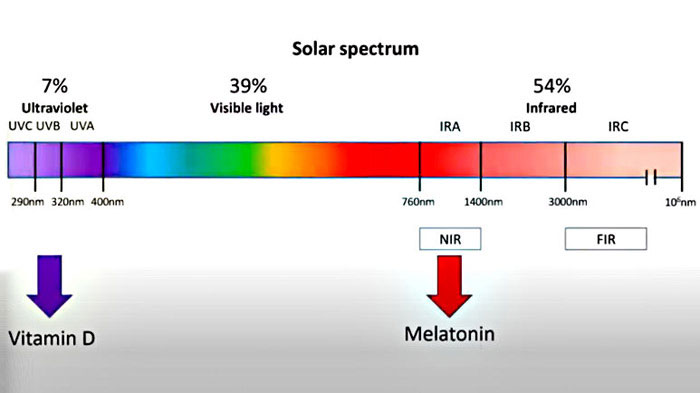
As you can see from the illustration above, 39% of the solar spectrum is what we see as visible light. The majority of the solar spectrum, 54%, is infrared,11 which is not visible but rather felt as heat. Ultraviolet light accounts for only 7% of the solar spectrum, and vitamin D is specifically produced in response to UVB radiation, which is only a small part of the ultraviolet spectrum.
Melatonin is produced inside your mitochondria in response to near-infrared radiation, which is part of the infrared spectrum. Because near-infrared has a much longer wavelength than ultraviolet, it can penetrate much deeper into your body, reaching cells in your subcutaneous tissue and not just on your skin. Near-infrared is not seen but rather felt as warmth. Its penetrative power (heat) also means it can penetrate lightweight clothing.
Melatonin Combats Oxidative Stress, Day and Night
Your mitochondria produce ATP, the energy currency of your cells. A byproduct of this ATP production are reactive oxidative species (ROS), which are responsible for oxidative stress. Excessive amounts of ROS will damage your mitochondria, contributing to suboptimal health, inflammation and chronic health conditions such as diabetes, obesity and thrombosis (blood clots).
The good news is your body has a built-in way to counteract these ROS. Inside your mitochondria, you also have an antioxidant system, and the main antioxidant is melatonin. (Melatonin also upregulates your glutathione pathway.)
Melatonin is perhaps best known as a sleep regulating hormone. At night, the level produced by your pineal gland rises, which help make you sleepy and ready for bed. As the sun rises and morning dawns, the level automatically recedes, allowing you to wake up.
But that’s not all melatonin does. As melatonin is released at night, it travels through your circulatory system and is taken up by cells. Once inside, the melatonin mops up excessive ROS.
Melatonin also helps counteract damaging ROS during the day, but through a different pathway. During the day, near-infrared rays from the sun penetrate deep into your body and activate cytochrome c oxidase, which in turn stimulates the production of melatonin inside your mitochondria.
Melatonin and Sunlight Are Intimately Connected
Melatonin and sunlight are intimately linked and their relationship is unique in the fact that there are two forms of melatonin, circulatory and subcellular, or that produced by the pineal gland and secreted into the blood, and that produced by your mitochondria and used there locally.
Both appear to be controlled by either the absence of sunlight or the presence of sunlight. While circulatory melatonin may be the “hormone of darkness,” subcellular melatonin is the “hormone of daylight.”
Since the beginning of human history, people have lived and worked outdoors during the light of day, absorbing light energy from the sky. An average of 10 hours outdoors each day, 70 hours weekly, was common. Today, we spend an average of fewer than 30 minutes a day or a mere three hours per week in daylight, according to a study by Dr. Daniel Kripke, professor of psychiatry at UC San Diego.12
It is likely that near-infrared (IR) photons stimulate subcellular melatonin synthesis in your mitochondria through cyclic adenosine monophosphate (cAMP) or NF-kB activation, or alternatively by stimulating bone marrow stem cells.13 However, if you fail to expose your skin to sufficient near-IR light from the sun than your mitochondria will have seriously depleted melatonin levels that can’t be corrected through supplementation.
Melatonin’s Role in COVID
Alright, so what does all of this have to do with treating COVID? For this, we need to snake our way through some biology. Angiotensin 2 is a pro-oxidant that is converted into angiotensin 1,7, an antioxidant, by the ACE2 enzyme. ACE2 is the same enzyme the SARS-CoV-2 spike protein attaches to and uses to enter the cell.
Angiotensin 2 increases blood pressure while angiotensin 1,7 lowers it by relaxing your vasculature. If you have high angiotensin 2, you’ll have higher ROS in the cell, which, as mentioned is detrimental, as it damages the machinery of the cell. Angiotensin 1,7, on the other hand, will decrease ROS in the cell.
The problem you encounter with COVID is that when the virus attaches to the cell, it knocks out the ACE2 enzyme (because the spike protein is now bound to it). So, angiotensin 2 increases, angiotensin 1,7 decreases, and the conversion from angiotensin 2 to angiotensin 1,7 cannot occur.
As a result, ROS increases unchecked inside the cell. SARS-CoV-2 infection also increases white blood cell production, and that increases ROS as well. The end result of this elevated oxidative stress is blood clots, which in turn leads to hypoxemia.
Melatonin can break this destructive cycle by mopping up ROS and protecting your mitochondria from destruction.14 As noted by Seheult, if you’re not getting enough sleep at night, and not getting enough sun exposure during the day, your mitochondria are basically “running hot” with inflammation. Melatonin is the coolant that dampens the ROS in your mitochondria.
If your mitochondria are already taxed and you come down with COVID, the added stress can tip you over the edge. If your melatonin system is working well, because you’re getting good sleep and plenty of sun exposure, you’re more likely to fight off the infection and not have it turn serious.
Seed Oils Increase Your Risk for Both COVID and Sunburn
This may seem like a tangent, but it’s an important one. Linoleic acid (LA) makes up the bulk — about 60% to 80% — of the omega-6 fat you consume, and it’s a primary contributor to nearly all chronic diseases. While formerly thought an essential fat, when consumed in excessive amounts, LA actually acts as a metabolic poison.
At a molecular level, excess LA consumption damages your metabolism and impedes your body’s ability to generate energy in the mitochondria. Polyunsaturated fats such as LA are highly susceptible to oxidation, which means the fat breaks down into harmful subcomponents. Oxidized LA metabolites (OXLAMs) are what cause the damage.
Over the last 150 years, the LA in the human diet has increased from 2 to 3 grams a day to 30 or 40 grams. It used to make up just 1% to 2% of the energy in our diet and now it makes up 15% to 20%. This massive increase in LA consumption is what likely contributes to the increased oxidative stress in your body contributing to an increased risk for virtually every chronic degenerative disease.
Primary sources are seed oils and processed foods (which contain seed oils). Conventionally-raised chicken and pork are other common sources, thanks to the LA-rich grains they’re fed. As indicated in the subhead, high LA intake can raise both your risk for sunburn (which you don’t want as that’s what’s contributes to skin cancer) and your risk for COVID.
Eliminating seed oils from your diet will dramatically reduce your risk of sunburn and skin cancer, as susceptibility to UV radiation damage is controlled by the level of PUFAs in your diet. It’s almost like a dial. The PUFAs control how rapidly your skin burns, and how rapidly you develop skin cancer.
As for LA’s impact on COVID, consider this: The key toxin that produces the symptoms of acute respiratory distress syndrome (ARDS) is called leukotoxin, which is made from LA by white blood cells to kill pathogens. Basically, the white blood cells convert the LA into leukotoxin, which contributes to the inflammatory domino effect Seheult describes.
Leukocytes incubated with LA convert all of the LA into this toxin until there’s none left, so, a major part of the disease process in ARDS is the conversion of LA into leukotoxin. That appears to be what’s killing many COVID patients. So, in summary, simply eliminating (or radically reducing) seed oils and conventional chicken and pork from your diet can go a long way toward:
a) Reducing your risk of sunburn, thus allowing you to get plenty of worry-free sun exposure to raise your vitamin D level, increase nitric oxide and boost melatonin production in your mitochondria
b) Lowering your risk of COVID complications by limiting the conversion of LA into leukotoxin
How Melatonin Is Created in Your Mitochondria
While Seheult focuses on the role of melatonin in COVID-19, the paper, “Melatonin in Mitochondria: Mitigating Clear and Present Dangers,”15 goes into much broader applications.
Again, melatonin is important for fighting cancer, and mitochondrial dysfunction plays a central role in most all chronic disease, including cancer, Parkinson’s, Alzheimer’s disease, heart disease and Type 2 diabetes, just to name a few. The paper also describes in far greater detail the mechanism for how melatonin is created within the mitochondria:16
“In normal cells, mitochondria account for energy (ATP) production, which results from glucose metabolism (glycolysis) and cellular respiration (oxidative phosphorylation or OXPHOS) in the inner mitochondrial membrane.
Glycolysis, which occurs in the cytosol, generates pyruvate, which is actively transported into the mitochondrial matrix. Here, pyruvate is converted to acetyl-CoA, the latter linking glycolysis with the citric acid cycle in the mitochondrial matrix and thus coupling it to ATP production.
Acetyl-CoA is also an essential co-factor for N-acetyltransferase (AANAT), which converts serotonin to N-acetylserotonin, the precursor of melatonin; AANAT activity rate limits melatonin synthesis.
In contrast to normal cells, many solid tumor cells allow the metabolism of glucose to pyruvate in the cytosol but restricts the transfer of pyruvate into the mitochondria; this is known as the Warburg effect … The Warburg effect allows cancer cells to rapidly proliferate, avoid apoptosis, and enhance the invasiveness and metastatic processes characteristic of tumors.”
The Warburg Effect in COVID
Interestingly, the Warburg effect is also at play in COVID. As explained in a June 2020 study17 that found melatonin inhibited COVID-19-induced cytokine storm, when your immune cells are in a hyper-inflammatory state, their metabolism changes in a way similar to that of cancer cells:
“Similar to cancer cells … immune cells such as macrophages/monocytes under inflammatory conditions abandon mitochondrial oxidative phosphorylation for ATP production in favor of cytosolic aerobic glycolysis (also known as the Warburg effect) …
The change to aerobic glycolysis allows immune cells to become highly phagocytic, accelerate ATP production, intensify their oxidative burst and to provide the abundant metabolic precursors required for enhanced cellular proliferation and increased synthesis and release of cytokines …
Because of melatonin’s potent antioxidant and anti-inflammatory activities, it would normally reduce the highly proinflammatory cytokine storm and neutralize the generated free radicals thereby preserving cellular integrity and preventing lung damage.”
Optimize Your Health With Sensible Sun Exposure
Basically, what “Melatonin in Mitochondria” found is that melatonin is an ideal target when trying to combat mitochondria-related diseases and cancer, because it has ready access to, and is synthesized in, your mitochondria, right where the oxidative stress occurs. By reprogramming the faulty glucose metabolism, melatonin can optimize mitochondrial function and curtail cancer growth.
Remember, taking melatonin supplements will not transfer to increasing mitochondrial melatonin production. It needs to be produced near your mitochondria and not float down from your pineal gland. So, oral supplementation is not a substitute for going outside during the day.
If you take it during the day, you’re tricking your body into thinking it’s nighttime, which could cause problems. As far as we know, the best way to increase mitochondrial melatonin is to optimize your near-IR exposure through regular sunlight exposure.
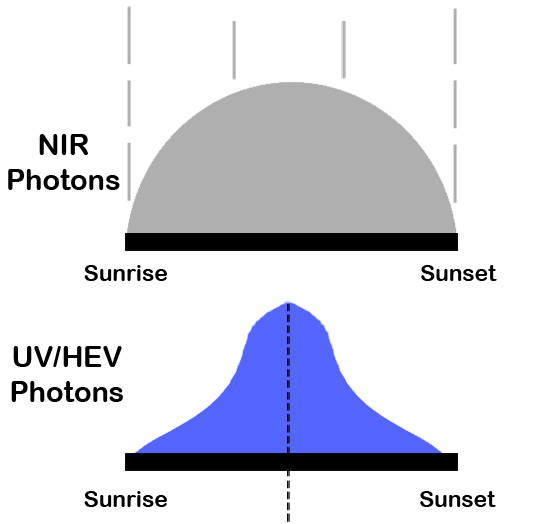
As you can see in the graph above, unlike increasing vitamin D, you have a much broader window where you can get near-IR exposure. Interestingly, spending time in nature is another way to increase your IR levels as most green plants and trees reflect IR. This is likely why forest bathing is so healthy.
The good news is you don’t have to be close to naked to benefit, as you do when optimizing your vitamin D production. The near-infrared radiation will penetrate lightweight clothing. So, you can cover yourself to prevent sunburn if you’re outside for a longer period of time, while still getting the near-infrared that you need. (Also, remember what I just told you about eliminating LA from your diet to cut your sunburn risk.) That said, you will absorb more IR on your bare skin.
The other side of the equation is avoiding bright light late at night. To optimize melatonin release in your pineal gland at night, avoid blue light-emitting gadgets at least a couple of hours before bed and keep the lighting in your room dim. Blue-blocking glasses can also be used. Once in bed, makes sure your room is pitch black, as even a small amount of light can interfere with melatonin production.
Together, sun exposure during the day and keeping it dark at night, will ensure your mitochondria are being bathed — day and night — in melatonin that reduces harmful ROS. So, as suggested by Seheult, try to spend more time outdoors, especially if you’re sick (whether it be COVID or some other respiratory infection) or battle chronic disease.
- 1, 15, 16 Physiology February 5, 2020 DOI: 10.1152/physiol.00034.2019
- 2 Indian J. Exp Biol. May 1996; 34(5): 391-402
- 3 Frontiers in Pharmacology August 21, 2020 DOI: 10.3389/fphar.2020.01220
- 4 Allergy Research Group, Melatonin, the Antioxidant Recycler
- 5 Cell Death & Disease 2019; 10 article number 317
- 6 Oncotarget June 13, 2017; 8(24): 39896–39921
- 7, 8 Diseases, 2021; doi.org/10.1016/j.ijid.2021.10.012
- 9 Frontiers in Medicine, 2020; doi.org/10.3389/fmed.2020.00226
- 10 British Journal of Dermatology May 31, 2021 10.1111/bjd.20093
- 11 Journal of Photobiochemistry and Photobiology February 2016; 155: 78-85
- 12 Sleep Med Rev. 2016 Aug; 28: 69–85
- 13 Melatonin Research February 2019; 2(1): 138-160
- 14 Life Sciences April 1, 2022; 294: 120368
- 17 Medical Drug Discoveries June 2020; 6:100044
How to Measure and Optimize Your Mitochondrial Health
Reproduced from original article:
https://articles.mercola.com/sites/articles/archive/2022/02/20/mitochondrial-function.aspx
The original Mercola article may not remain on the original site, but I will endeavor to keep it on this site as long as I deem it to be appropriate, and will not be bullied into removing it.
Analysis by Dr. Joseph Mercola Fact Checked February 20, 2022
STORY AT-A-GLANCE
- As you age, your mitochondrial function decreases, and this is a hallmark of both the aging process itself as well as most chronic disease. Bio-energy testing can quantitatively measure the function of your mitochondria
- Even asymptomatic people in their 30s can have significantly decreased mitochondrial function. Early onset mitochondrial dysfunction is indicative of premature aging and future health problems
- Two substances that significantly improve mitochondrial function are B vitamins and intravenous ozone
- Certain lifestyle strategies will also improve mitochondrial function, the top two being interval exercise and an individualized diet. Lowering your stress and detoxing heavy metals are two others
- Your thyroid may also need to be addressed if your mitochondrial function is impaired. The key here is using bioidentical hormones
Dr. Frank Shallenberger, author of “Bursting With Energy: The Breakthrough Method to Renew Youthful Energy and Restore Health,” has been a natural medicine physician for nearly five decades.
He’s a true pioneer in the field and, as most good natural medicine physicians, a perpetual student. He was actually the first to innovate the use of nebulized hydrogen peroxide, which has become my favorite intervention for upper respiratory infections, including SARS-CoV-2. Sadly, it’s been widely disparaged, but those that have used it are typically really impressed by the results.
In this interview, we’ll review a number of strategies you can use to optimize your mitochondrial health and function. After graduating from medical school, Shallenberger first went into trauma medicine. After about seven years, he transitioned into being a general practitioner and internist. Within months, however, he realized that nobody was getting well. In fact, many were getting sicker from the drugs he prescribed.
As it happened, Linus Pauling had a once-a-month study group in the area, which Shallenberger was able to join. He quickly realized there are far better ways to treat disease.
The Importance of Mitochondrial Optimization
One of the things Shallenberger has pioneered is bio energy testing that measures mitochondrial function. As you age, your mitochondrial function typically decreases, and this is a hallmark of both the aging process itself as well as most chronic disease.
He decided he wanted a way to test mitochondrial status, and by 2004 he had developed a system that evaluates how much oxygen you consume and, in real time, how much carbon dioxide (CO2) you produce. This can give you a quantitative measure of how well your mitochondria are working.
What he found was that even asymptomatic people in their 30’s were having significantly decreased mitochondrial function. He calls this “early onset mitochondrial dysfunction,” and it’s indicative of future health problems, even if everything seems good and well right now.
“The conventional thinking has always been that our mitochondria lose their efficiency as a result of the aging process. But I started questioning that, and wondered if our mitochondria in fact lose their efficiency even before any signs of aging. And, the amazing thing I discovered was that mitochondrial efficiency can decrease significantly even in our 30s and 40s, long before any of the effects of aging.
I believe that this early decline is the primary factor that accelerates the aging process and makes us more vulnerable to the diseases of aging. And this is exactly what I have observed over the years. People with optimal mitochondrial function, no matter how old they are, rarely develop any of the diseases associated with aging, and routinely maintain full function even into their 90s.”
B Vitamins Needed for Optimal Mitochondrial Function
So, what are some of the most effective interventions Shallenberger has found for optimizing mitochondrial function? After a lot of testing and experimenting, the only two substances found to really move the needle were B vitamins and ozone treatment. He explains:
“B vitamins are absolutely critical for mitochondrial function — especially niacin, riboflavin and folate. Orally speaking, with niacin, I typically start them at 100 to 200 milligrams a day [but] you can go up to 2,000 mg easy on some patients. I use a B complex because I like to balance it out, but I’m focusing primarily on niacin, folate and riboflavin.”
Typically, when a deficiency of B vitamins is the cause of decreased mitochondrial function, I will see improved readings within two to three weeks, although the level of improvement can vary tremendously from one person to the next. An important caveat here is that mitochondria are vulnerable to any number of assaults, including emotional stress.
“I have literally seen patients have great mitochondrial function, be under stress for two months, and have their mitochondria wiped out just from emotional stress,” he says. “I haven’t done the studies, but I’m pretty sure that if you get under a lot of emotional stress, I bet your mitochondria suffer a measurable hit within 48 hours.”
Ozone Therapy
The other intervention Shallenberger found for mitochondria optimization is ozone therapy. He explains:
“First of all, people should understand what ozone is. When we talk about ozone and medicine, we’re not talking about ozone in the atmosphere. We’re talking about a very pure molecule, it’s pure oxygen, period. There’s nothing else in there. Regular oxygen that we breathe is what we call O2, that’s two oxygen atoms combined together.
Ozone is basically three oxygen atoms combined together. What makes that molecule so unique is that it is very electron deficient. It needs electrons big time. So as soon as you put that into the human body, or into any tissue, it’s going to start grabbing electrons. And as it grabs the electrons, it’s going to form molecules called peroxides [a reactive oxygen species, ROS].
So, after ozone treatment, you’re loaded with peroxides, and these peroxides can stay in the body for a good seven, maybe as much as 14 days. These peroxides are what mediate the various physiological and biochemical effects of ozone. They’re also, by the way, molecules that are electron deficient …
Ozone is a hormetic molecule, it has a hormetic clinical effect. This means that at low doses, it does one thing, and as you increase the dose high enough, it starts doing the exact opposite. So, deciding on the dose for ozone is pretty critical.
To stimulate mitochondrial function, I use relatively small doses, in the order of 10, maybe 12 mg … I get ozone treatments myself every week, just because I can. And it would be super good if everybody could do that.”
It is important that the ozone used intravenously be free of contaminants, so you need to use a machine that converts pure medical grade oxygen to generate pure ozone.
Ozone generators that convert air from an oxygen concentrator are only good for certain topical applications, not for intravenous injection. Also, while the peroxides are ROS, in this case, that’s what you want. You do not want to try to counteract the oxidative stress with antioxidants before the treatment, and here’s why:
“The reason is because I want these peroxides. When the ozone goes into the tissue, I want it to be interacting with lipids and maybe amino acids. I don’t want it to interact with ascorbate, because then I’ll get dehydroascorbate. That’s not what I’m looking for. I’m looking for peroxides.
The basic thinking with ozone therapy is, you really never want to give any kind of substance that’s going to donate electrons, like vitamin C or glutathioneprior to the treatment, if you want to maximize peroxide production. Now, after the treatment, yeah. You want to do it after, but you got to have that sequence correct.”
Lifestyle Strategies to Improve Mitochondrial Function
Certain lifestyle strategies will also improve mitochondrial function, the top two being interval exercise and a ketogenic diet (high in healthy fats and low in refined carbs, provided that’s optimal for you. For additional details, see section below). Lowering your stress and detoxing heavy metals are two others. With regard to exercise, Shallenberger says:
“Resistance training is really important, especially for the over 60 crowd. For lean body mass-types of reasons, for resting metabolic reasons, it’s very important. But it doesn’t do what classic aerobic interval training does …
For normal people, not athletes, to maintain good mitochondrial function, what you need is two 30-second intervals [where you go all-out, max exertion], followed by about four or five minutes of rest between the two, done three times a week. That’s hardly anything … [but] it’s every bit as good as any of the harder exercise routines.”
The Case for Bioidentical Hormones
Your thyroid may also need to be addressed if your mitochondrial function is impaired. The key here is using bioidentical hormones, which unfortunately is getting more difficult to get a hold of. Bioidentical thyroid hormones are basically made from desiccated animal thyroid and therefore contain all four of the natural thyroid hormones: T1, T2, T3 and T4.
Conventional doctors typically use Synthroid or Levo-Thyroid, which only contains synthetic T4. Ideally, you want all four of them, but at bare minimum, you want T3 and T4.
“Thyroid is critical for a number of reasons,” Shallenberger says. “First of all, probably 80% of people over the age of 50 have suboptimal thyroid function. It’s such a common problem … When I first got my equipment, I started measuring resting metabolic rates. Resting metabolic rate is how much energy your cells are producing when you’re actually not doing anything.
You’re sitting very quietly in a chair. In other words, no exertion. How much energy do you need for no exertion? It turns out the resting metabolic rate is almost entirely determined by thyroid hormone. Thyroid hormone also activates something called uncoupling protein 3 (UCP3), which is an uncoupling receptor on the mitochondria, which stop mitochondria from self destructing.
The thyroid prevents self-destruction of mitochondria. Thyroid also stimulates mitochondrial biogenesis, and stimulates mitochondrial division, so that when the cells divide, you get representative DARs cells with the same number of mitochondria. Also, through UCP3, that’s where a lot of fatty acids come in. Thyroid is very important for fatty acid metabolism of mitochondria.
So, [thyroid] hits mitochondria in about four or five different ways. It’s absolutely critical for mitochondrial function. A lot of the times that’s the big problem. Somebody comes in, their resting metabolic rate’s low, the mitochondrial function’s low. I give them enough thyroid to bring the resting metabolic rate up to what would be considered close to optimal, and bang, the mitochondrial function goes right up with it.”
Thyroid Tests Are Unreliable for Diagnosis
Unfortunately, many of the thyroid blood tests aren’t particularly good. TSH is particularly useless, according to Shallenberger. He’s convinced that measuring resting metabolic rate and increasing the dose of bioidentical thyroid hormone until you’re at an optimal or near-optimal metabolic resting rate is a far better way to gauge how much thyroid medication you need. For general reference, the most commonly used dose is between 1 grain (60 mg) and 1.5 grains (90 mg).
“I had lots of these cases. They’ll tell me, ‘I feel really good. Everything’s wonderful. Thank you so much.’ Then they come back maybe a year later and they say, ‘I’m miserable … I saw my doctor, he did the thyroid test and said ‘Oh, you’re being way overdosed.’ So, he reduced the dose and the test is looking good now, but I feel like crap again.’
The doctor says, that’s OK, ‘because your tests are looking good.’ So, that’s how good these tests are. They’re totally useless. The patient comes back to me, I put them back on the thyroid and that’s the end of that story. I’ll use T4 and T3 to monitor what I’m doing. But the TSH is absolutely useless. And they’re all useless for diagnostic purposes.”
The Importance of Being Metabolically Flexible
About 90% of the population are metabolically inflexible, and that will have a tremendous impact on their mitochondrial function. Most eat far too many refined carbs and have an impaired ability to use fat as their primary fuel. To address that, you typically need to significantly reduce your carb intake and increase healthy fats.
This is not a 100% absolute certainty, however. The mitochondrial machinery in some people is preferentially adapted to carbs and they won’t do well on a high-fat, low-carb diet. The good news is you can actually measure how well your mitochondria are working on a specific diet, using Shallenberger’s test. This way, you can really get a clear idea of what your personalized ideal diet is. Shallenberger explains:
“Mitochondria have the ability to generate energy by either burning glucose or fatty acids. If they’re purely burning glucose, they produce twice as much CO2 than if they’re purely burning fat.
If I look at the ratio between oxygen consumed and carbon dioxide produced, since it’s a linear equation, I can tell them exactly how much energy they’re generating from glucose and how much energy they’re generating from fatty acids. We have that capability, just from looking at these numbers, to determine that …
Now, carbohydrates in certain people suppress fatty acid metabolism. There’s a subset of the population that, when they eat carbs, it’s mitochondrial suppressive. The rationale is that since we’re all different, there are going to be a subset of people whose mitochondria prefer to get their protons from glucose.
There’s going to be another subset of people whose mitochondria prefer to get their protons from fatty acid. They’re just more efficient that way. So, you have these two extremes. The rest of us fit on some continuum between those two extremes.”
Nebulized Hydrogen Peroxide
As mentioned, Shallenberger was way ahead of everyone else with the use of nebulized hydrogen peroxide. Anytime you inhale something, it enters your bloodstream. Shallenberger had been using intravenous hydrogen peroxide for about 20 years when he suddenly had the idea to inhale it.
Respiratory viruses, of course, tend to hang out in the sinuses, respiratory tract and lungs. Hydrogen peroxide, meanwhile is known to kill most known viruses on contact. “It’s pretty simple, but it’s unbelievably effective,” he says. All you need is:
- A plug-in jet nebulizer
- 3% food grade hydrogen peroxide (food grade does not contain chemical stabilizers)
- Saline
- Optional: 1 to 2 drops Lugol’s iodine
Simply dilute the peroxide by mixing 7 teaspoons saline with one-fourth teaspoon of peroxide. This gives you a 0.1% solution, which is perfectly safe to inhale. If you like, you can add one drop of Lugol’s iodine into the cup along with the solution.
Heavy Metal Detox
Heavy metal toxicity is another problem that can take a toll on your mitochondria. To address heavy metals, Shallenberger typically uses a combination of colonics, saunas and chelation therapy. Like me, he’s a big fan of saunas. While most use far-infrared saunas, I prefer near-infrared saunas, for several reasons.
For starters, near-infrared penetrates much deeper into your tissues, releasing toxins. Importantly, 95% of melatonin is also produced in your mitochondria in response to near-infrared light. Melatonin is a very powerful antioxidant that helps mop up ROS in the mitochondria. Melatonin also helps increase glutathione, which is a major detoxification agent. For tips on how to create an EMF-free sauna, listen to our interview, as we go into more details than what I’ve summarized here.
TH1 Versus TH2 Immunity
In closing, we touch on immune function. Your immune system is divided into two “arms” or branches, the innate immune system (TH1) and the humoral immune system (TH2). If your innate immune system is not working well, you’re more prone to infection and illness. Unfortunately, vaccines of all kinds suppress TH1, pushing you toward a TH2 dominance.
“In 1994, there was a study published, looking at homosexual men. It had to do with AIDS and all these men were HIV positive, but only a portion of them had AIDS. They found that of the ones who had AIDS, 100% of them were all in TH2 dominance. Of the ones that didn’t have AIDS, only 30% were in TH2 dominance.
They were in TH1 dominance … I looked at that study and I thought, ‘Wow, you’re telling me that 30% of men in the control group were already in TH2 dominance? That’s pretty pathetic. This basically means their innate immune system is more or less shut down, and they’re in a TH2 humoral system imbalance.
I thought, they’ve ruined the TH1, because what happens is that the TH2 system produces cytokines that suppress TH1. TH1 produces cytokines that suppress TH2. So, it’s sort of like one aspect of the immune system is saying, ‘I got this, we don’t need you anymore.’
So, we’ve got a number of our population of so-called healthy people that are in a TH2 dominance. In the ‘80s, it was a big thing to test for antibodies. Everybody was testing for antibodies. The conclusion we came to is that if you have a lot of antibodies, that means you’re super-duper infected versus somebody who doesn’t have a lot of these antibodies.
Turns out that’s just not the case … The problem is not that these antibodies are being caused by super infection-type situations. The problem is they’re in TH2 dominance and that’s what they do. They live off antibodies.
Maybe as much as one-third of the population is already in TH2 dominance. Why is that? … What are we doing that’s making all these antibodies? Hello, vaccines. But what’s the definition of a good vaccine? It’s one that makes an antibody. Every time you get a vaccine, you’re automatically suppressing your innate immunity.
Statistical data came out a couple years ago, comparing the death rate from COVID in countries where the population was highly vaccinated for the flu in 2019 as opposed to countries with a low flu vaccine rate. And the death rate was something like 400% greater in the countries where most of the people had the 2019 influenza vaccines.
That stands to reason, because they suppressed their innate immunity. That was one thing that got to me. You know, vaccines aren’t really helping this game here. The other thing that got to me is that we know ozone stimulates gamma interferon and IL2, which are TH1 stimulants that act to suppress TH2.
So, my conclusion, finally, was that when you add it all up, why does ozone work for every viral infection you can get? … It has to do with the fact that I’m taking them out of a TH2 dominance putting them in a TH1 dominance.”
More Information
To learn more, you can pick up a copy of “Bursting With Energy: The Breakthrough Method to Renew Youthful Energy and Restore Health,” which is loaded with good advice.
If you’re interested in getting bio energy testing to measure your mitochondrial function, check out Shallenberger’s website, www.antiagingmedicine.com. Aside from Shallenberger’s clinic in Nevada, there are also testing centers1 in a dozen other states, and several other countries.
US Autism Rate Is Now 1 in 44
Reproduced from original article:
https://articles.mercola.com/sites/articles/archive/2021/12/23/autism-rate-1-in-44.aspx
The original Mercola article may not remain on the original site, but I will endeavor to keep it on this site as long as I deem it to be appropriate, and will not be bullied into removing it.
Analysis by Dr. Joseph Mercola Fact Checked December 23, 2021

STORY AT-A-GLANCE
- In the mid-1960s, the autism rate was 1 in 10,000. By 2012, it had shot up to 1 in 88. In 2016, it was 1 in 68, and now it’s 1 in 44 8-year-olds
- Rates vary widely from state to state. In California, where incidence is the highest, 1 in 26 8-year-olds has a diagnosis of autism. Missouri, which has the lowest incidence, has a rate of 1 in 60
- Improved diagnosis alone cannot explain this trend. Genetics play only a minor role, and even then, primarily only when combined with toxic exposures
- Glyphosate appears to be a leading contributor to autism
- Other contributing factors include maternal antibodies associated with autoimmune diseases, maternal immune system overactivation and mitochondrial dysfunction (typically involving electron transport chain overactivity). Mitochondrial abnormalities are suspected of being involved in as many as 80% of cases
In the mid-1960s, the autism rate was 1 in 10,000.1 By 2012, it had risen to 1 in 88,2 then 1 in 68 as of 2016,3 and now, we’re looking at an autism rate of 1 in 44 8-year-olds, although rates vary widely from state to state.4
In California, where incidence is the highest, 1 in 26 8-year-olds has a diagnosis of autism. Missouri, which has the lowest incidence, has a rate of 1 in 60. According to the U.S. Centers for Disease Control and Prevention, the dramatic uptick is in part due to improved and more comprehensive identification and diagnosis.
However, improved diagnosis alone cannot explain this trend. One in 44 children were not autistic in the 1980s, with or without diagnosis. No, something is going on. One or more environmental factors are clearly having a devastating impact on our children.
Mitochondrial Dysfunction in Autism
According to an October 2020 scientific review5 in the journal Seminars in Pediatric Neurology, “Several lines of evidence implicate mitochondria in the pathophysiology of autism spectrum disorder (ASD).” For years, autism was believed to be due to genetics, but empirical studies have proven genetic predispositions play a very small role.
The authors point to “novel abnormalities” in mitochondrial function that have been found in autistic children, and the fact that treatments targeting mitochondrial dysfunction, such as L-carnitine supplementation and a ketogenic diet, have been fruitful.
In 2007, approximately 4% of autistic children could be diagnosed with a definite mitochondrial disease. More recent investigations looking at mitochondrial biomarkers and electron transport chain activity suggest mitochondrial abnormalities may be involved in as many as 80% of cases. Biomarkers of mitochondrial dysfunction include elevated levels of:
| Lactate | Pyruvate |
| Alanine | Creatine kinase |
| Ubiquinone | Acyl-carnitines |
| Carnitine (low levels being an indication of dysfunction) |
As noted by the authors, this is “remarkably interesting” because mitochondria are “very vulnerable to environmental factors.” In other words, something in our environment is triggering mitochondrial dysfunction in an ever-growing percentage of children. The question is what?
Children whose autism is rooted in mitochondrial dysfunction will typically have a key set of symptoms that include:
- Fatigability
- Gastrointestinal disorders
- Seizures and/or epilepsy
- Motor delay and/or ataxia and/or muscle weakness
- Unusual neurodevelopmental regression, including multiple regressions or regression later than commonly associated with ASD
Mitochondrial Overactivity
While classic mitochondrial disease is defined, at least in part, by severe deficits in electron transport chain activity, in children with ASD, mitochondrial dysfunction tends to involve overactivity. According to the authors:6
“… we have shown that about one-third of LCLs [lymphoblastoid cell lines] derived from children with ASD repeatedly show elevated respiratoryiou rates, approximately 200% of controls, for respiratory parameters associated with adenosine triphosphate production.
We have also demonstrated the consequences of elevated respiratory rates; specifically, this subset of ASD LCLs are more sensitive to acute exposure to reactive oxygen species (ROS) such that respiratory rates drop precipitously with acute increases in ROS.
We hypothesized these changes represent an adaptive response to previous environmental exposures, a phenomenon known as mitoplasticity.
To support this hypothesis, we demonstrated that elevated respiratory rates can be induced in LCLs with prolonged exposure (96 hours) to mild ROS, a microenvironment that simulates the effect of environmental toxicants on mitochondria.
Additionally, we have demonstrated that this subset of LCLs respond differently to environmental agents associated with ASD, including trichloroacetaldehyde hydrate and ethylmercury, and enteric short chain fatty acids propionate and butyrate, as compared to ASD LCLs which do not demonstrate these high respiratory rates at baseline.”
Important Nutritional Supplements
Two helpful treatments have already been mentioned: L-carnitine supplementation and ketogenic diets. Studies evaluating ketogenic diets and ASD have found them to be well-tolerated by a majority of children.
A review of four studies found 18% of children saw significant improvement on a ketogenic diet, 40% reported moderate improvement and 32% had mild improvement. Only 8% experienced a worsening of their symptoms.7
In cases where the ASD is caused by mitochondrial dysfunction, however, supplementing specific cofactors become important. The good news is this kind of supplementation is very safe and well tolerated. There’s virtually no risk involved, in terms of adverse side effects. Among the most important nutritional cofactors are:8
| B vitamins, including niacin (B3), riboflavin (B2), biotin (B7), thiamine (B1), pyridoxine (B6), pantothenic acid (B5), methylcobalamin (B12), reduced folate (B9) | Coenzyme Q10 or the reduced form, ubiquinol |
| L-carnitine or acetyl-L-carnitine | Creatine monohydrate |
| Alpha-lipoic acid | Vitamin E |
| Vitamin C | N-acetyl-L-cysteine (NAC) |
| Zinc |
Benefits of L-Carnitine and CoQ10
Of these, L-carnitine has been most widely studied. As explained in this paper:9
“Two medium sized (n = 30, 30) double-blind placebo-controlled studies using L-carnitine treatment (50 mg/kg/d for 3 months and 100 mg/kg/d for 6 months) found that scores on the Childhood Autism Rating Scale (CARS) improved with L-carnitine as compared to placebo with one study finding that greater symptomatic improvement was correlated with a greater increase in blood carnitine levels.
A small (n = 10) 8-week open-label trial of L-carnitine used particularly high doses (up to 400 mg/kg/d in 3 divided doses, maximum of 6000 mg/d) …
Several parental rated measures showed improvements in behavior and hyperactivity before correction for multiple comparisons and improvements in language correlated with post-treatment blood carnitine levels. Children with ASD and genetic mutations in the carnitine pathway also appear to response to L-carnitine.”
CoQ10 has also been evaluated in clinical trials. In one, 50 mg of ubiquinol was given twice a day for three months. Children who attained a CoQ10 blood level above 2.5 umol/L saw improvements in communication, interactions, sleep and food rejection.10
A three-month-long regimen of L-carnitine, CoQ10 and alpha-lipoic acid also produced encouraging results, improving mitochondrial function and ASD-related behavior. When the children discontinued the cocktail, their behavior worsened again.
Autism and Autoimmunity
Previous research also suggests ASD may have an autoimmunity component. As explained in a 2009 paper titled “Autoimmunity in Autism”:11
“Increasing evidence of autoimmune phenomena in individuals with autism could represent the presence of altered or inappropriate immune responses in this disorder, and this immune system dysfunction may represent novel targets for treatment.
Furthermore, in recent studies, antibodies directed against the fetal brain have been detected in some mothers of children with autism; these antibodies have the ability to alter behavioral outcomes in the offspring of animal models.”
Research12,13 published in 2013 found that more than 1 in 10 mothers of autistic children had antibodies associated with autoimmunity that adversely reacted with proteins in the brain of the baby, resulting in ASD. The authors point out that any activation of the mother’s immune system “might lead to an increased risk of a child with ASD.”
In light of the COVID injection campaign, the possibility of autoantibodies playing a role in ASD is extremely troublesome, as autoimmune diseases are a potential side effect. We don’t yet really know the extent of which the SARS-CoV-2 spike protein interacts with the human brain, but it’s clearly not beneficial.
Women, in particular, are suffering neurological dysfunction as a result of the COVID shot. How might the spike protein affect offspring? That’s still too early to say, but I suspect we’ll come to find that the effect can be devastating.
Toxic Chemicals Implicated in Autism
Not surprisingly, exposure to toxic chemicals in utero has also been identified as a potentially causative factor. According to the National Academy of Sciences, an estimated 3% of all neurobehavioral disorders in children are caused by toxic exposures.
Another 25%, the interaction of toxic exposures and genetic factors is thought to be causative.14,15 In 2012, scientists identified 10 chemicals suspected of causing learning disabilities and ASD:16
| Lead | Methylmercury |
| Polychlorinated biphenyls (PCBs) | Organophosphate pesticides, including glyphosate |
| Organochlorine pesticides | Endocrine-disrupting chemicals |
| Automotive exhaust | Polycyclic aromatic hydrocarbons (PAHs) |
| Brominated flame retardants | Perfluorinated compounds |
Of these, glyphosate is a top suspect17,18 for the simple reason that exposure to it is so widespread. Research19 published in 2019 found women exposed to 11 commonly used pesticides — including glyphosate — during pregnancy have a higher risk of having a child diagnosed with autism.
Pregnant women who lived within a 2,000-meter (1.24 miles) radius of a highly-sprayed area were 10% to 16% more likely to have children diagnosed with autism than those who lived farther away. As reported by Time:20
“When they looked at diagnoses of autism spectrum disorder that also came with intellectual disabilities, they found on average 30% higher rates among children who were exposed to the pesticides while in utero. Exposure in the first year of life increased the risk of autism by up to 50% compared to those not exposed to certain pesticides.”
Glyphosate Is Likely a Key Culprit
Stephanie Seneff, Ph.D., who has spent a large portion of her career studying glyphosate, believes it is a significant cause or contributor to autism. She’s shown glyphosate:
- Disrupts your gut microbiome
- Impairs peristalsis — a feature that is exceedingly common in children with autism21
- Inhibits bile acid release by impairing gallbladder contraction — Many autistic children have very pale stool, suggestive of low bile acid levels
- Impairs digestive enzymes — Many autistic children also have undigested particles in their stool, which suggests a lack of digestive enzymes. And, indeed, glyphosate affects your digestive enzymes, particularly trypsin, pepsin and lipase
The Roles of GI Inflammation and Maternal Gut Bacteria
Another potential trigger is maternal gut inflammation. Research22 published in early December 2021 found that when pregnant mice were challenged with immune activation, it changed their gut microbiota. This altered microbiota in turn primed the offspring for intestinal inflammation that resulted in neurodevelopmental disorders. MIT News reported the findings, noting:23
“Infection during pregnancy with elevated levels of the cytokine IL-17a may yield microbiome alterations that prime offspring for aberrant immune responses …
When a mother experiences an infection during pregnancy and her immune system produces elevated levels of the molecule Interleukin-17a (IL-17a), this can not only alter brain development in her fetus, but also alter her microbiome such that after birth the newborn’s immune system can become primed for future inflammatory attacks.
In four studies beginning in 2016,24 study co-senior authors Gloria Choi of MIT and Jun Huhof Harvard University traced how elevated IL-17a during pregnancy acts on neural receptors in a specific region of the fetal brain to alter circuit development, leading to autism-like behavioral symptoms in mouse models.
Their new research … shows how IL-17a can act to also alter the trajectory of immune system development. ‘We’ve shown that IL-17a acting on the fetal brain can induce autism-like behavioral phenotypes such as social deficits,’ says Choi …
‘Now we are showing that the same IL-17a in mothers, through changes in the microbiome community, produces co-morbid symptoms such as a primed immune system.’
The researchers caution that the study findings are yet to be confirmed in humans, but that they do offer a hint that central nervous and immune system problems in individuals with autism-spectrum disorders share an environmental driver: maternal infection during pregnancy.”
Here, the COVID-19 pandemic may end up worsening an already terrible trend, as the infection is associated with elevated IL-17a. IL-17a is a key molecule in both the innate and adaptive immunity that helps mobilize your immune system response during early infection. It’s been singled out as being involved in the thrombotic and vascular mechanisms of COVID-19 specifically.25
One October 2021 study26 suggested IL-17a acts as a silent amplifier of the COVID-19 immune response, resulting in some of the worst side effects associated with the infection. While pregnant women are universally instructed to get the COVID shot to protect themselves from the infection, there’s every reason to suspect the injection may cause far more harm than the infection itself.
If you get COVID while pregnant, you may or may not have a serious case of it, but if you take the shot, you have a 100% chance of suffering the effects of it, which for many include dramatically elevated levels of inflammation.
From my perspective, getting the COVID jab because you fear what COVID-19 might do to you and/or your baby is actually irrational, as your risk of adverse effects from the shot is exponentially higher than your risk of severe COVID-19 infection.
Autism Is a Multifactorial Condition
A number of other culprits could also be named, such as retroviruses (which the COVID shots can reactivate) and electromagnetic field (EMF) exposure. According to Judy Mikovits, Ph.D., a retrovirus family known as xenotropic murine leukemia virus-related viruses (XMRV) may play a causal role in autism.27
Disturbingly, one source for XMRVs is contaminated childhood vaccines. Mikovits details the history of this in her book, “Plague: One Scientist’s Intrepid Search for the Truth About Human Retroviruses and Chronic Fatigue Syndrome (ME/CFS), Autism and Other Disease.”
In previous interviews with me, Mikovits has also expressed concern that the COVID shots may activate latent XMRV infection. If it does, we could expect the autism rate to explode at an even more exponential rate than we’re seeing already.
I predict the COVID shots will be found to contribute to autism in a number of different ways. But even in the absence of these injections, it’s clear that environmental toxicities are wreaking havoc with our children’s health.
There’s no single answer to this problem. Since many different toxins can contribute, preventing autism must include the elimination of most toxic exposures.
Top suspects include childhood vaccines, the 10 chemicals listed earlier (glyphosate in particular), autoimmune antibodies, gut inflammation, retroviruses and EMF exposure. To this list, I would also add the COVID gene transfer injections, as they can be a source of severe inflammation and autoimmunity, and have been shown to have a direct adverse impact on neurology.
- 1, 3 Autism Society
- 2 National Autism Association
- 4 Yahoo News! December 7, 2021
- 5, 6, 8, 9, 10 Seminars in Pediatric Neurology October 2020; 35: 100829
- 7 Seminars in Pediatric Neurology October 2020; 35: 100829, Table 2
- 11 Curr Opin Investig Drugs May 2009; 10(5): 463-473
- 12 Molecular Psychiatry August 20, 2013; 18: 1171-1177
- 13 Science Daily August 29, 2021
- 14 Environmental Health Perspectives July 1, 2012; 120(7)
- 15, 16 Science Daily April 25, 2012
- 17 Journal of Molecular and Genetic Medicine, 2015;9:187
- 18 Medical Sciences, 2018;6(2):29
- 19 BMJ 2019;364:l962
- 20 Time March 20, 2019
- 21 Scientific Reports 9, Article number: 5987 (2019)
- 22 Immunity December 7, 2021 DOI: 10.1016/j.immuni.2021.11.005
- 23 MIT News December 9, 2021
- 24 The Picower Institute
- 25 Autoimmun Rev July 2020; 19(7): 102572
- 26 Biomedicine & Pharmacotherapy October 2021; 142: 111980
- 27 Plague: One Scientist’s Intrepid Search for the Truth About Human Retroviruses and Chronic Fatigue Syndrome (ME/CFS), Autism […], by Judy Mikovits
The Troubling Role of Glyphosate in COVID-19
Reproduced from original article:
https://articles.mercola.com/sites/articles/archive/2021/10/16/stephanie-seneff-glyphosate.aspx
Analysis by Dr. Joseph Mercola Fact Checked October 16, 2021
STORY AT-A-GLANCE
- Your body substitutes glyphosate for glycine, and in so doing, poisons your body’s machinery for creating proteins
- In normal physiology, processes in your mitochondria ensure deuterium depletion. If your mitochondria are damaged by glyphosate, they’re not going to be able to eliminate the deuterium properly and the buildup of deuterium may contribute to chronic disease
- Glyphosate may play an important role in cases of severe COVID-19. If you’ve accumulated a lot of glyphosate in your tissues, your immune cells will be impaired, making it difficult to clear the virus
- To avoid glyphosate exposure, the most important strategy is to eat certified organic foods whenever possible, and eat/drink more sulfur-containing foods, organic grass fed milk and butter, glacier water, animal fats and probiotic foods
- To help mitigate the toxic effects of glyphosate, you can take an inexpensive glycine supplement
This article was previously published February 28, 2021, and has been updated with new information.
In this interview, Stephanie Seneff, Ph.D., a senior research scientist at MIT, reviews the health impacts of glyphosate. She has just finished writing a book about glyphosate called “Toxic Legacy: How the Weedkiller Glyphosate is Destroying Our Health and the Environment,” which is expected to be published in June 2021.
For years, glyphosate was assumed safe and claims of toxicity were vehemently denied. But in recent years, studies on glyphosate have been demonstrating toxicity even at very low levels. Seneff also believes glyphosate exposure may be a key player in cases of severe COVID-19, which we’ll unravel in this interview.
Glyphosate’s Mechanism of Action
The “gly” in glyphosate actually stands for the amino acid glycine. The glycine amino acid in glyphosate has a methylphosphonate group attached to its nitrogen atom, which is responsible for its effects and toxicity.
After studying the research literature on glyphosate, Seneff has reached the conclusion that your body sometimes substitutes glyphosate for the amino acid glycine when it is constructing proteins, and this can have devastating consequences in some cases. The proteins created with glyphosate instead of glycine simply don’t work because glyphosate is much larger than glycine and also negatively charged, and as a result this alters important physical characteristics.
Monsanto’s own research, dating back to the late 1980s, shows that glyphosate accumulates in various tissues, even though they claim it doesn’t.1 The Monsanto researchers proposed that it was “incorporated into” the proteins in the tissues. This is not widely appreciated, even in the natural health community.
Now, if you have a distorted analog of glycine (in the form of glyphosate), the protein constructed from it is not going to work like it’s supposed to. In her book, Seneff details the amino acids in proteins that are most susceptible to damage because of what she calls a “glyphosate susceptible motif.”
“It’s really fascinating biology and so terrifying when you think of the potential consequences, if I’m right,” she says. “It matches so well with all the diseases that are going up dramatically in our society that I really think I’m onto something huge here.”
An aromatic amino acid called EPSP synthase is a critical enzyme that almost surely gets disrupted by glyphosate through this mechanism of substituting for glycine. This gets a bit technical, but it is important. The plant version of EPSP synthase binds a phosphate group in its substrate phosphoenolpyruvate at a site where there is a highly-conserved glycine residue (highly conserved usually means that it is critical for proper function).
It has been shown experimentally that, if you change the DNA code so that the glycine is substituted by an amino acid called alanine (one extra methyl group), the enzyme becomes completely insensitive to glyphosate at any concentration. It also takes a hit on phosphate binding because of the extra methyl group, but you can tweak another amino acid nearby to fix this problem, while still keeping its insensitivity to glyphosate.
Researchers from Dow-Dupont did exactly this to a maize version of EPSP synthase using CRISPR technology and were able to create synthetically a version of the maize’s own EPSP synthase that was completely resistant to glyphosate. The title of this paper is: “Desensitizing Plant EPSP Synthase to Glyphosate: Optimized Global Sequence Context Accommodates a Glycine-to-Alanine Change in the Active Site.”2
The shikimate pathway is the pathway that produces aromatic amino acids, which are essential to humans as we cannot create these amino acids in our body. The argument is we’re not susceptible to glyphosate because our cells don’t have EPSP synthase — in fact, they don’t have the entire shikimate pathway.
However, our gut microbes do have that pathway, and they use it to make essential amino acids for the host. So, our gut microbes are indeed affected by glyphosate, and when they’re damaged, our health can suffer in any number of ways.
But what might be an even more devastating problem with glyphosate is the way it probably messes up a large number of proteins that bind phosphate at a site where there is at least one, and often three, highly conserved glycine residues. Glyphosate slips its methylphosphonate group into the spot that is supposed to be where phosphate from the substrate fits snugly. Phosphate can’t bind because glyphosate is in the way.
The arguments for why glyphosate specifically disrupts proteins that depend on glycine for phosphate binding are described more fully in a paper Seneff published together with colleagues arguing that glyphosate is a major factor in kidney failure among young agricultural workers in Central America.3
The Importance of Deuterium
Laszlo Boros is a professor of pediatrics at UCLA and an expert on deutenomics, “the science of autonomic deuterium discrimination in nature.”4 After reading one of Seneff’s papers, he contacted her, suggesting she look into deuterium.
“I was blown away, and I immediately saw the connection to glyphosate,” she says. “This was a year ago in December, and I’ve just been reading everything I can on deuterium since then and hooking it to glyphosate. It’s just astonishing what I found, even, ultimately, [linking it] to COVID-19.
It’s been quite a year for me in terms of major breakthroughs in my understanding of how metabolism works and how it’s getting messed up by glyphosate, and then how that’s causing us to not be able to effectively deal with COVID-19.”
In normal physiology, your cells, specifically the mitochondria, function to help deplete your body of deuterium. Deuterium is a naturally occurring isotope of hydrogen. If you didn’t already know, deuterium is also known as heavy hydrogen, because it has a neutron in addition to the proton and electron in the hydrogen atom.
Provided your cell is healthy, it has deuterium-depleting enzymes and organelles that help remove deuterium from your cells. If your mitochondria are damaged by glyphosate, they’re not going to be able to eliminate the deuterium properly.
Deuterium is like iron in the way that it’s both essential in the right amounts and toxic in excess. Hydrogen is the smallest atom and by far the most common atom in your body. Deuterium, being a heavy hydrogen, has one extra neutron, in addition to the normal proton and electron that regular hydrogen has.
Now, your cells are surrounded by structured water, which is negatively charged and contributes to your body’s energy production by supplying deuterium-depleted hydrogen to lysosomes and mitochondria. The structured water is maintained by sulfates, which makes sulfate extremely important for health. Sulfate is made dysfunctional by glyphosate, which in turn destroys structured water, resulting in impaired energy production in the cell.5
“The mitochondria have [a] membrane, which has a part inside the membrane that’s really, really important,” Seneff says. “That’s where you have those protons, and you really don’t want it to be deuterons. This is what Laszlo brought home to me.”
How Your Body Creates Deuterium-Depleted Water
Endothelial NOS (eNOS) makes nitric oxide (NO), and for every molecule of NO that it makes, it produces two molecules of water, which are deuterium depleted. Stephanie believes the NO created by eNOS may act as a signal that deuterium-depleted water has been created. Interestingly enough, deuterium-depleted water is also created during the inflammatory process.
“The inflammation is there for a good reason, and the reason is to produce deuterium-depleted water,” Seneff says. “It’s all because the mitochondria are failing in their task of producing their own deuterium-depleted water, which they get in part through the structured water from the sulfate [and] through enzymes that are highly skilled at choosing hydrogen over deuterium …
NADH and NADPH are also fascinating. I’ve been chasing them through all the proteins. They are interesting because they are the carriers of that wonderful hydrogen that’s not deuterium. When you trace what’s doing what, where, you realize that the cytoplasm is producing NADH and handing it over to the mitochondria.
The mitochondria then take that H [hydrogen atom] off and throw it into the intermembrane space. So, the whole process ends up with the intermembrane space being assured that this is H [hydrogen] and not D [deuterium].
This is crucial because then those protons, once they build up, come back through the ATPase [ATP synthase] pump. If they are deuterons, they are going to wreck the pump … You release reactive oxygen species [that] break it, and of course, then you can’t make ATP.”
For clarification, the ATP synthase pump works like a mini-motor. When a hydrogen atom with one proton goes through it, it works flawlessly and generates ATP. If deuterium enters it, which has one neutron and one proton, making it twice the weight of hydrogen, it breaks that motor.
Interestingly, deuterium is everywhere, naturally, but your body has developed an intricate way to make it harmless by trapping it in the structured water, where it’s beneficial, as it actually supports the creation of structured water.
Problems arise when you cannot make enough structured water to sequester it all. Then, the deuterium gets loose, causing mitochondrial dysfunction, impairing energy production and contributing to chronic disease.
Glyphosate Damages Health in Many Ways
As noted by Seneff, glyphosate harms your health in a number of ways. For example, she cites a recent paper showing it causes endocrine disruption, which can lead to breast cancer, reproductive issues, obesity and thyroid problems.6
Another paper shows glyphosate sensitizes cells to be more receptive to cancer after exposure to other chemicals.7 “Glyphosate makes everything else more toxic than it would otherwise be,” Seneff says. “It disrupts your defense system against toxic chemicals.” Other research shows epigenetic and generational effects, even when no apparent problems can be found in the first generation exposed.8
Glyphosate also impairs flavoproteins — proteins that bind flavins. Many of these proteins play a crucial role in transferring hydrogen from NADH or NADPH to other molecules, essentially supporting the delivery of pure hydrogen to the mitochondria. Flavoproteins have a characteristic GxGxxG motif at the site where they bind phosphate in the flavins. The ‘G’ stands for glycine and the ‘x’ is a wildcard — any amino acid, including glycine.
This means they have at least three susceptible glycines at this critical region of the protein. Flavoproteins are molecules that facilitate the transfer of protons and electrons, and know how to avoid deuterium, by exploiting a special feature of hydrogen called proton tunneling.
All of them can be expected to be disrupted by glyphosate. A critical flavoprotein is succinate dehydrogenase, and several papers have shown it is adversely affected by glyphosate, Seneff says. It is the only enzyme that plays a role in both oxidative phosphorylation and the citric acid cycle in the mitochondria.
In addition to aromatic amino acids, the shikimate pathway is essential for riboflavin synthesis, and riboflavin, a B vitamin, is the main precursor to flavins. This means that riboflavin deficiency can be triggered from glyphosate exposure as well. Glyphosate also causes damage by:
- Increasing calcium uptake in cells, which causes toxicity to neurons
- Interfering with the ability to take glutamate out of your synapses
- Making manganese unavailable — This in turn disrupts and prevents glutamate from being turned into nontoxic glutamine after it’s removed from your synapses. The enzyme responsible for the conversion is also highly dependent on glycine, which could be replaced by glyphosate
Deuterium-Depleted Water May Be Central to Metabolism
According to Seneff, it appears deuterium-depleted water plays a central, hitherto unappreciated role in metabolism, as your body has so many ways to create it. For example, deuterium-depleted water is created through:
•Fatty acid synthesis and metabolism — The enzymes that synthesize fatty acids incorporate hydrogen that is carried by NADPH. This hydrogen atom has been carefully selected to be assured not to be deuterium. Interestingly, lipoxygenase is a protein expressed during conditions of stress, and according to Seneff, it has the greatest ability to select protons over deuterons of any protein.
It is highly upregulated in severe COVID-19 infection. It appears the virus triggers an increase in lipoxygenase because the virus captures linoleic acid (LA) in pockets in the viral membrane. However, lipoxygenase is not a flavoprotein, and it also doesn’t bind heme — this makes it resistant to damage from glyphosate. So, its activation becomes an alternative pathway to fix the mitochondrial deuterium problem.
SARS-CoV-2 picks up the omega-6 LA as it crosses the cellular membrane, and the LA then triggers the production of lipoxygenase that modifies the LA into leukotrienes — signaling molecules that bring in damaging macrophages.
But deuterium-depleted water is also produced in this process, by yanking two hydrogen atoms out of the fat and combining them with oxygen to make water. Note that this is just yet another way that excess LA damages your body, but with an ulterior motive that we often fail to appreciate.
•Sterol synthesis and metabolism — including cholesterol, vitamin D, cortisol, and sex hormones.
•Aromatic amino acid derivatives — including melatonin and neurotransmitters such as dopamine and serotonin, as well as thyroid hormone.
“All these molecules that go through these complicated steps are all focused on delivering deuterium-depleted water to the mitochondria,” Seneff says. “I mean, it’s an absolute obsession that the cell has.” She goes on to review how processes that may appear to have nothing but harmful effects are actually an effort to heal the body. This, for example, seems to be the case in COVID-19:
“I believe that whatever biology is doing, it’s doing it for a good reason. There may be damage, but there’s a good reason why you need that damage in order to survive long term. It’s trying to fix a problem that’s very serious, and that’s what I think is happening with [SARS-CoV-2].
Not only does it induce this lipoxygenase, which produces deuterium-depleted water, it then creates this inflammatory environment, which brings in the platelets and the macrophages, the immune cells and the stem cells. All these are having a big party in there in all this fluid that’s building up inside the lungs.
Meanwhile, it also increases the production of hyaluronic acid. Hyaluronic acid is able to trap deuterium-depleted water. It makes structured water. So, you get structured water inside the alveoli of the lungs, and then you get fluid water in the interstitial spaces.
The blood vessels are leaky, the capillaries are leaky. Everything’s coming out of the capillaries into this interstitial space where there’s this fluid water, and you’ve got this lipoxygenase making deuterium-depleted water.
So, you’re producing this environment of deuterium-depleted water, inviting the macrophages to come in, and the platelets release their mitochondria … the stem cells also come in and release their mitochondria, and then macrophages sweep up the mitochondria — and all this is happening in the interstitial space in the lungs where the fluid is. This is why you cannot breathe. You’re drowning.
Maybe one of the most important things platelets do is hang on to mitochondria that they can deliver to the macrophages under conditions of stress. So, what happens is all these mitochondria get released in that interstitial space, and the macrophages induce this macropinocytosis, where they actually sweep up the water and everything that’s in it and bring it inside the macrophage, including the mitochondria.
It’s actually been shown that platelets can release mitochondria into the environment, and macrophages can take them up and use them as perfectly functioning mitochondria. It’s astonishing. So, what they’re doing is restoring the mitochondrial health to the immune cells.”
Glyphosate Damage May Be a Factor in Severe COVID-19
As explained by Seneff, your immune cells are impaired by glyphosate, so the older you are, the more likely you’ve been exposed to glyphosate for decades and therefore have poorly functioning immune cells. Interestingly, Seneff points out that the comorbidities of COVID-19 — obesity, diabetes and high blood pressure — are also diseases whose prevalence is going up dramatically over time, exactly in step with glyphosate usage on core crops.
“So, I think it’s mostly about glyphosate,” she says. “If you’ve accumulated a lot of glyphosate in your tissues, you’re not going to do well with COVID-19, and that’s because [your body] is trying to repair the mitochondria in the immune cells so that the immune cells can actually clear the virus. If they can’t make ATP, they can’t do their job, and the virus flourishes.”
The key take-home message here is that this is yet another reason to clean up your diet to make sure you’re not exposed to glyphosate. It basically wrecks your immune cells, and the cascading damage that takes place in severe cases of COVID-19 appears to be your body’s response to salvage or repair those poorly functioning immune cells.
Dietary Recommendations
The answer to this problem is, first of all, to eat certified organic foods whenever possible. “We won’t buy it if we can’t find certified organic, and we’ve really seen health improvements since we’ve started doing that,” Seneff says. “I really swear by it, and I try to get all my friends to do the same. I think if you can eliminate glyphosate, you can really see great improvements in your health no matter what your problems are.” Other dietary recommendations include eating/drinking more:
| Sulfur-containing foods such as organic eggs and seafood | Organic grass fed milk and butter. Butter is one of the lowest deuterium foods available |
| Glacier water, which is naturally low in deuterium | Animal fats, which are also low in deuterium |
| Molecular hydrogen | Probiotics foods such as sauerkraut and apple cider vinegar |
To help “push” glyphosate out of your body and mitigate its toxicity, you can take an inexpensive glycine supplement. I take between 5 and 10 grams a day. It has a light, sweet taste, so you can actually use it as a sweetener.
“It makes sense because it’s basically going to outnumber the glyphosate molecules,” Seneff says. “Remember, glyphosate’s going to compete with glycine in building the protein. If there’s a lot of glycine around, then it’s much less likely that glyphosate will get in there.”
- 1 Uptake, depuration and bioconcentration of C-14 glyphosate to bluegill sunfish (Lepomis machrochirus) Part II
- 2 Journal of Biological Chemistry Volume 294, Issue 2, 11 January 2019, Pages 716-725
- 3 Journal of Environmental Research and Public Health 2019, 16, 2734
- 4 Lazlogboros.com
- 5 S Seneff and G Nigh. Sulfate’s Critical Role for Maintaining Exclusion Zone Water: Dietary Factors Leading to Deficiencies. Water 2019; 11: 22-42
- 6 Chemosphere 2020: 128619. [Epub ahead of print]
- 7 Front. Genet., 27 September 2019
- 8 Scientific Reports 2019: 9, Article number 6372
Could This Be the Answer to AFib, NAFLD and Other Diseases?
Reproduced from original article:
https://articles.mercola.com/sites/articles/archive/2020/10/22/does-ubiquinol-help-afib.aspx
Analysis by Dr. Joseph Mercola Fact Checked October 22, 2020

STORY AT-A-GLANCE
- CoQ10 is the third-most consumed supplement, after fish oil and multivitamins
- CoQ10 keeps your mitochondria healthy and plays a crucial role in the production of ATP, the cellular energy required to keep you alive
- CoQ10 deficiencies have been linked to many health problems, including migraines, heart disease and cancer
- Conversely, supplementing with CoQ10, or the natural form called ubiquinol, may help improve several chronic health conditions such as AFib, NAFLD and heart failure
Coenzyme Q10 (CoQ10) is the third-most consumed supplement,1 yet many people don’t realize how clinically effective it really is.
Although it’s not approved by the U.S. Food and Drug Administration as a treatment or preventative drug, several new studies show that taking CoQ10 supplements may help address several chronic health conditions, including atrial fibrillation (a-fib), nonalcoholic fatty liver disease (NAFLD), insulin resistance, heart failure, cancer and migraines, to name a few.
Ubiquinol — the reduced, electron-rich form of CoQ10 that your body produces naturally — plays an important role in the electron transport chain of your mitochondria, where it facilitates the conversion of energy substrates and oxygen into the biological energy (adenosine triphosphate or ATP) needed by your cells for life, repair and regeneration.
It’s a fat-soluble antioxidant, meaning it works in the fat portions of your body, such as your cell membranes, where it mops up potentially harmful byproducts of metabolism known as reactive oxygen species (ROS). As such, ubiquinol and CoQ10 supplements help protect your mitochondrial membranes from oxidative damage, and this in turn has been shown to be helpful for a number of health conditions and chronic diseases.
Why CoQ10 Is so Important
Many conditions, including heart disease and migraines — for which CoQ10 has been found beneficial — appear to be rooted in mitochondrial dysfunction.2 CoQ10 is used by every cell in your body, but especially your heart cells.
Cardiac muscle cells have about 5,000 mitochondria per cell, while liver cells have 1,000 to 2,000 mitochondria each.3 As another reference, mitochondria make up about 35% of the volume of cardiac tissue and only 3% to 8% of the volume of skeletal muscle tissue.4
About 90% or more of the ROS in your body are made by your mitochondria.5 Using the analogy of the mitochondria as an engine, the combustion (metabolism) that takes place in there creates exhaust fumes — damaging byproducts when produced in excessive amounts.
One of the functions of CoQ10, or ubiquinol, is to neutralize those byproducts.6 When ubiquinol is lacking, the byproducts remain and begin to damage the cell. Ubiquinol is particularly beneficial for your heart health. C-reactive protein (CRP) is a marker for inflammation, and when your CRP is elevated, it suggests you have a heightened risk for heart disease.7
Two other markers for inflammation are gamma-glutamyl transferase (GGT),8 which is an early marker of heart failure, and N-terminal pro b-type natriuretic peptide (NT-proBNP).9
There’s an association between the levels of these two markers and ubiquinol as well. When ubiquinol is supplemented, both these markers go down and genes associated with them are downregulated.
Low CoQ10 levels have also been detected in people with certain types of cancer,10 including lung, breast and pancreatic cancer, as well as melanoma metastasis, further strengthening the metabolic theory of cancer. The word “coenzyme” also provides a clue to its importance; it works synergistically with other enzymes to digest food, for example.
It also has the ability to increase your body’s absorption of important nutrients. More specifically, it helps recycle vitamins C and E,11,12 thereby maximizing their beneficial effects.
CoQ10 Can Help Improve Atrial Fibrillation (AFib)
AFib is an abnormal, often rapid, heart rhythm that occurs when the atria, your heart’s upper chambers, beat out of sync with the ventricles, the heart’s lower chambers. It’s a common symptom in those with heart failure or heart disease but can also occur on its own.
Oxidative stress and increased ROS can play a role in the development of AFib. Conversely, scavenging of ROS and a reduction in oxidative stress have been shown to be an essential part of keeping the heart functioning normally.13
In one study, 102 patients with AFib were divided into two groups. One group was given a CoQ10 supplement while the other group was given a placebo. After 12 months of supplementation, 12 people in the placebo group had AFib episodes compared to only three people in the CoQ10 group.14
CoQ10 Can Stop the Progression of NAFLD
NAFLD is the most common cause of chronic liver disease around the world, with a prevalence of 25%.15 Obesity and insulin resistance increase your risk of NAFLD. Mitochondrial dysfunction and oxidative stress, two hallmarks of CoQ10 deficiency, have also been shown to play a role,16 as has choline deficiency, as detailed in “Fatty Liver Disease Is Caused by Choline Deficiency.”
Currently, there are no approved medical treatments for NAFLD. Lifestyle changes, such as elimination of processed vegetable oils and processed carbs, remain the gold standard for managing NAFLD and, hopefully, preventing its progression. Since CoQ10 levels tend to be depleted in those with NAFLD, supplementation has been shown to help reduce oxidative stress and inflammation.17
In one study,18 44 patients were divided into two groups. One group was given 100 mg of CoQ10 each day, while the other was given a placebo. After four weeks of supplementation, the group taking CoQ10 dropped weight and had lower levels of serum AST, a blood marker that indicates liver disease and/or damage.
CoQ10 May Be the Answer for Several Other Conditions
In addition to helping with AFib and NAFLD, CoQ10 may be the answer to correcting several other chronic health conditions, including the following:
| High blood pressure — CoQ10 acts directly on your endothelium, dilating your blood vessels and lowering blood pressure.19,20 CoQ10 also decreases aldosterone, a hormone that makes you retain salt and water.21,22 When aldosterone goes down, excess salt and water are excreted through your kidneys, often causing your blood pressure to go down. |
| Dyslipidemia — In one study,23 101 participants with dyslipidemia were given 120 mg of Coq10 or a placebo every day for 24 weeks. Without taking any lipid-lower drugs, participants taking the CoQ10 had decreases in harmful LDL and triglycerides and increases in total antioxidant capacity. |
| Heart failure — CoQ10 deficiency is linked to poorer prognosis for those with heart failure.24 Supplementing with CoQ10 can restore normal CoQ10 levels, helping to prevent heart cell damage and significantly improving heart failure.25 |
| Chronic kidney disease — Increased oxidative stress is a major factor in chronic kidney disease and related cases of cardiovascular disease.26 Patients with chronic kidney disease tend to have decreased levels of CoQ10 in their blood. CoQ10 has been shown to improve mitochondrial function and decrease oxidative stress in chronic kidney disease patients, with and without dialysis.27 |
| Systemic inflammation — Studies28,29 show that supplementing with 60 mg to 500 mg of CoQ10 for eight to 12 weeks can significantly reduce tumor necrosis factor alpha (TNF-α), IL-6 and CRP; three measures of widespread inflammation. |
| Stroke — Systemic inflammation, oxidative stress and nerve cell damage play a role in the development of stroke. Studies30 show that supplementing with CoQ10 can reduce ischemic lesions and improve outcomes in patients who have been treated with a statin after having a stroke (statins reduce CoQ10 levels in your body). |
| Migraine — CoQ10 deficiency is a common underlying factor of idiopathic migraines. Supplementing with CoQ10 can help reduce frequency and severity of migraines and alleviate associated symptoms such as nausea and sensitivity to light.31 |
| Polycystic ovary syndrome (PCOS) — In one study,32 86 women with PCOS were given CoQ10 alone, CoQ10 with vitamin E, vitamin alone or a placebo. After eight weeks, the group taking CoQ10 alone had improved levels of sex hormones (lower levels of testosterone and luteinizing hormone) and improved insulin resistance. |
| Cancer — In one study,33 two women with breast cancer were given fatty acids, antioxidants and 300 mg to 390 mg of CoQ10. After two to three months, mammograms showed no tumors or residual tumor tissue, indicating cancer regression. A review34 in the Journal of Clinical Oncology that looked at how CoQ10 affected cancer treatment found it may help protect the heart and liver from toxicity during treatment. |
| Insulin resistance — CoQ10 levels are lower in mitochondria in insulin-resistant tissues.35 In one study,36 daily intake of 100 mg of CoQ10 improved insulin resistance and serum insulin levels in patients with markers of metabolic syndrome. |
CoQ10 Versus Ubiquinol
As mentioned, ubiquinol is the reduced version of CoQ10 (aka ubiquinone). They’re actually the same molecule, but when CoQ10 is reduced it takes on two electrons, which turns it into ubiquinol. In your body, this conversion occurs thousands of times every second inside your mitochondria.
The flipping back and forth between these two molecular forms is part of the process that transforms food into energy. Ubiquinol production ramps up from early childhood until your mid- to late 20s. By the time you hit 30, it begins to decline.37 Young people are able to use CoQ10 supplements quite well, but older people do better with ubiquinol, as it’s more readily absorbed.
How to Supplement With Ubiquinol
Your body can naturally make CoQ10, but genetic alterations in metabolism, poor diet, oxidative stress, chronic conditions and aging can all interfere with CoQ10 production and lead to CoQ10 deficiency. Statin drugs can also deplete CoQ10.
To maintain good health, an adult body should contain 0.5 to 1.5 g of CoQ1038 and sometimes it takes a supplement to keep you there. Dosing requirements will vary depending on your individual situation and needs.
As a general rule, the sicker you are, the more you need. The suggested dose is usually between 30 mg to 100 mg per day if you’re healthy, or 60 to 1,200 mg daily if you’re sick or have underlying health conditions.39
If you have an active lifestyle, exercise a lot or are under a lot of stress, you may want to increase your dose to 200 to 300 mg per day. Importantly, if you’re on a statin drug, you need at least 100 mg to 200 mg of ubiquinol or CoQ10 per day, or more. Ideally, you’ll want to work with your physician to determine your ideal dose.
- 1, 38, 39 Comprehensive Reviews in Food Science and Safety. 2020;19(2):574-594
- 2 Integr Med (Encinitas). 2014;13(4):35-43
- 3 PeerJ. 2018;6:e4790
- 4 Am J Physiol Heart Circ Physiol. 2014;307(3):H346-52
- 5 Nat Commun. 2019;10(1):1704
- 6 Redox Rep. 2018;23(1):136-145
- 7 Clinics. 2016;71(4):235-42
- 8 Nutr Metab. 2016;13:37
- 9 Clin Res Cardiol. 2010;99(7):445-52
- 10 PDQ Cancer Information Summaries. 2020
- 11 Nutrition and Dietary Supplements. 2018;10:1-11
- 12 Subcell Biochem. 1998;30:491-507
- 13, 24, 26, 35 Antioxidants (Basel). 2020;9(4)
- 14 J Investig Med. 2015;63(5):735-9
- 15 Gastroenterology. 2020;158(7):1851-1864
- 16, 17 Journal of Prescribing Practice. 2020;2(4)
- 18 Arch Med Res. 2014;45(7):589-95
- 19 Molecular Aspects of Medicine. 1994;15(1):s257-s263
- 20 Circ Res. 1989;65(1):1-21
- 21 Am J Physiol. 1965;208:1275-80
- 22 Molecular Aspects of Medicine. 1994;15(1):s265-s272
- 23 J Clin Lipidol. 2018;12(2):417-427.e5
- 25 Clin Investig. 1993;71(8 Suppl):S134-6
- 27 BMJ Open. 2019;9(5):e029053
- 28 Pharmacol Res. 2017;119:128-136
- 29 Pharmacol Res. 2019;148:104290
- 30 Nutr Neurosci. 2019;22(4):264-272
- 31 Headache. 2011;51(3):469-483
- 32 Arch Med Res. 2019;50(2):1-10
- 33 Biochem Biophys Res Commun. 1994;199(3):1504-8
- 34 J Clin Oncol. 2004;22(21):4418-24
- 36 Eur J Nutr. 2016;55(8):2357-2364
- 37 Biofactors