EPA
now browsing by category
NEW Paper Identifies ‘Smoking Gun’ of Chronic Disease
… and most of us are in the crosshairs. The US Navy knew about it way back in 1971, yet nothing was done to stop it.
World Council for Health Mar 04, 2025

In 1971, the U.S. Naval Medical Research Institute published a groundbreaking review of 2,311 scientific studies on the biological and health effects of electromagnetic fields. The findings were stark: 132 distinct biological effects, symptoms, and diseases were linked to wireless radiation exposure. The Navy’s report was a warning—a prophetic one, as it turns out. But like so many warnings about environmental and public health risks, it was ignored.
Today, we’re living in the shadow of that neglect. A new paper reveals the devastating consequences of that inaction. Announced at the Annual Conference of the American Academy of Environmental Medicine, the paper connects the dots between unheeded warnings from 50 years ago and the current epidemic of chronic disease in the United States.

The implications are staggering.
Of the 36 fastest-growing chronic diseases in the U.S., 23 were predicted by the Navy’s 1971 study. By 2015, these diseases accounted for over 549 million cases and added as much as $2 trillion in annual healthcare costs to the U.S. economy. The paper argues that this explosion in chronic illness is not a coincidence—it’s a direct result of unchecked exposure to wireless radiation.
It’s all comes down to a particular molecule
At the heart of this crisis is a molecule called peroxynitrite, which the authors describe as the “smoking gun” for chronic disease. Peroxynitrite is a byproduct of oxidative and nitrative stress, processes triggered by wireless radiation exposure. It’s a destructive molecule, implicated in systemic inflammation, mitochondrial dysfunction, and a host of other biological disruptions.
The paper introduces the concept of P-Factor, a lethal system of seven synergistic biofactors that accelerate disease. These include:
- Systemic inflammation
- Oxidative stress
- Mitochondrial dysfunction
- Autonomic dysfunction
- Epithelial dysfunction
- Nitrative stress
- Peroxynitrite (the central player)
P-Factor is not just a theoretical construct—it’s a shared mechanism underlying all 36 of the fastest-growing chronic diseases in the U.S. From diabetes to cardiovascular disease, autoimmune disorders to neurological conditions, the fingerprints of wireless radiation are everywhere.
Further reading…

The ‘Silent Tsunami’: Is Your WiFi Contributing to the Rise of Superbugs?
World Council for Health
16 Jan
Read full story
.

Who Tells Us What Amount of EMF Exposure Is Safe and Can We Trust Them?
11 June 2024
Read full story

Is your cell phone turning off your detox potential?
.
10 Jan
Read full story
A legacy of ignored warnings
The tragedy here is that this crisis was preventable. The Navy’s 1971 study was clear: wireless radiation poses significant health risks. Yet, for decades, U.S. regulators—including the FCC, EPA, and FDA—failed to act. Instead, they enabled the unchecked proliferation of wireless technologies, exposing millions of Americans to chronic, low-level radiation.
The result? A public health disaster. The authors argue that the refusal to act on the evidence has not only harmed human lives but also placed an unsustainable burden on the healthcare system and the economy.
It’s not just wireless radiation causing problems…
Of course, wireless radiation isn’t the only culprit in the chronic disease epidemic. Sugar consumption, glyphosate in the food supply, pesticides, and other chemicals also play a role. But what ties these factors together is their ability to trigger the production of peroxynitrite. Wireless radiation, however, stands out for its ubiquity and the sheer volume of scientific evidence linking it to chronic disease.
The time for denial is over. The science is clear, and the stakes are too high to ignore. We need stricter regulations on wireless technologies, greater public awareness of the risks, and a concerted effort to develop safer alternatives.
Where do we go from here?
- Regulatory Reform: The FCC, EPA, and FDA must revisit their outdated safety standards for wireless radiation, incorporating the latest scientific evidence.
- Public Education: Americans deserve to know the risks associated with wireless technologies and how to minimize their exposure.
- Research Funding: More studies are needed to understand the long-term effects of wireless radiation and to develop safer technologies.
- Corporate Accountability: The wireless industry must take responsibility for the health impacts of its products and invest in innovation that prioritizes safety.
The chronic disease epidemic is not inevitable. It’s the result of choices—choices to ignore warnings, prioritize profits over public health, and delay action in the face of overwhelming evidence. But we can make different choices. We can choose to listen to the science, to act on the evidence, and to protect future generations from the invisible threat of wireless radiation.
The question is: will we?
Get REAL facts about wireless radiation on our website!
Everything you need to know, all in one place…

PLUS, EMF Protection tools are available in the WCH Shop!
All proceeds go directly to supporting the work of World Council for Health.


Subscribe to World Council for Health
How This Chemical in Everyday Products Might Be Harming Your Health
Reproduced from original article:
https://articles.mercola.com/sites/articles/archive/2025/02/05/formaldehyde-exposure.aspx
Analysis by Dr. Joseph Mercola February 05, 2025

STORY AT-A-GLANCE
- Formaldehyde, a common chemical in household products like furniture and building materials, poses significant health risks including cancer, asthma and fertility problems, according to investigations by the U.S. Environmental Protection Agency (EPA)
- A long-awaited EPA report, released in 2024, downplayed formaldehyde risks, particularly for workers and people near industrial zones, amid pressure from chemical industry groups and political figures
- Formaldehyde “off-gases” from products over time, especially in warm environments, making it particularly concerning in indoor spaces like homes and workplaces where people spend significant time
- Studies show formaldehyde exposure increases asthma risk in children, and each increase of 10 micrograms per cubic meter leads to a 10% higher risk
- Consumers will be able to reduce exposure by ensuring good ventilation, choosing low-emission products, letting new furniture air out and staying informed about product labels and safety standards
Visualize yourself walking into a new home and noticing a strange, sharp smell. While you may think it’s coming from the fresh coat of paint, that smell also lurks in cleaning products or even your brand-new furniture. This invisible culprit in your home is formaldehyde, a chemical found in many everyday products.
Formaldehyde Is Dangerous to the Public
While formaldehyde has various industrial uses, an investigation by ProPublica1 on a report2 by the U.S. Environmental Protection Agency (EPA) raises concerns about its potential health risks in our daily lives.3 Specifically, it’s been found to cause cancer more compared to other chemicals released in the air, and that it also causes a host of other health issues, such as asthma, miscarriage and fertility problems.4
However, the report doesn’t end there. What’s more concerning is that the EPA downplayed the threat formaldehyde poses to people living in factories and industrial zones that release it into the air. Why? The most logical answer is that the chemical industry is colluding with certain high-ranking government officials. As noted in ProPublica’s analysis:5
“While a note accompanying the EPA’s report stated that workers have the greatest exposure to the chemical, the agency’s risk assessment adopted weaker standards for protecting workers from formaldehyde than had been proposed in a previous draft …
But even before the agency released the report, House Republicans urged the administration to invalidate it. And a chemical industry group immediately attacked the report as flawed, accusing the EPA of ‘pursuing unaccountable lame duck actions that threaten the U.S. economy and key sectors that support health, safety and national security’ …
When Trump first assumed office in 2017, the agency was preparing to publish a report on the toxicity of the chemical. But one of his EPA appointees, who was given a high-ranking role in the agency’s Office of Research and Development, was a chemical engineer who had worked to fend off the regulation of formaldehyde as an employee of Koch Industries, whose subsidiary made formaldehyde and many products that emit it.
The report was not released until August 2024, long after Trump’s appointee left the agency.”
As noted in ProPublica’s investigation, the previous draft of the EPA’s report, created back in March 2024, already had a final assessment saying that the health risks “are not unreasonable.” To make things worse, both the first and final drafts concluded that “formaldehyde in outdoor air isn’t a threat that needs to be addressed.”
This puts the people living near industrial areas (known as fence line areas) at risk with little hope of government protection because the regulations aren’t leaning towards their health and safety.6
What Is Formaldehyde and Where Do We Encounter It?
Formaldehyde is a simple organic molecule, similar to the building blocks of other familiar chemicals like sugar and vinegar. In its pure form, it’s a gas with a pungent odor. However, it’s often used in a liquid form combined with other chemicals in various products.
Think of pressed wood furniture like desks, bookshelves or cabinets. The glue that holds these wood pieces together often contains formaldehyde. Similarly, building materials like plywood, laminate flooring and even some types of insulation contain formaldehyde. Beyond construction materials, formaldehyde is found in certain glues, some fabrics like wrinkle-free clothes and even nail polish removers.
One of the main concerns with formaldehyde is its tendency to “off-gas,” meaning it slowly releases from these products as a gas over time, especially in warm or humid environments. This invisible gas then becomes part of the air you breathe indoors. Interestingly, the “new car smell” you experience is partly due to formaldehyde off-gassing from interior materials.7
While everyone encounters some level of formaldehyde throughout life, certain professions have a higher risk of exposure. For example, employees in tire manufacturing plants, hairdressers who use products with formaldehyde-based preservatives and furniture makers are at increased risk of inhaling higher levels.8

Save This Article for Later – Get the PDF Now
The Unreasonable Risk — Formaldehyde and Health Concerns
According to the U.S. Centers for Disease Control and Prevention (CDC), formaldehyde exposure causes a range of health problems, depending on the level and duration of exposure. Generally, it irritates the eyes, nose and throat.9 This is similar to the discomfort you experience from exposure to strong cleaning products.
But, as noted by the ProPublica report, there’s a more concerning issue — the link between formaldehyde exposure and an increased risk of certain cancers, particularly nasopharyngeal cancer.10
Beyond cancer, formaldehyde exposure is also linked to respiratory problems like asthma, especially in children. In one study, researchers noted that children exposed to formaldehyde at home are more likely to develop asthma. Specifically, they noted that each time formaldehyde exposure increases by 10 micrograms per cubic meter, the risk of asthma also goes up by 10%.11
Industry vs. Regulations — Who Will Prevail?
The EPA report concluded that formaldehyde exposure poses an “unreasonable risk” to human health, raising concerns for consumers and prompting calls for stricter regulations.12,13 But, as the ProPublica report stated, the EPA was criticized for its initial assessment.
The American Chemistry Council argues that stricter regulations will significantly impact jobs and the economy since formaldehyde is a “building block” chemical.14,15 Regulations for improved safety are currently under attack as well. Unsurprisingly, the EPA gave in:
“Compared to the draft published in March, which was heavily criticized by industry, the final version contained weaker standards for protecting workers. The acceptable levels of workplace formaldehyde exposure set in the final version of the assessment were significantly higher than the levels in the earlier draft of the report …
Last month, Rep. Pete Sessions, R-Texas, urged the incoming administration to make revisiting the Biden EPA’s work on formaldehyde ‘a top priority for 2025.’
In a letter to Lee Zeldin, Trump’s pick to run the agency, Sessions derided this week’s report as ‘based upon unscientific data that was utilized by unaccountable officials at the EPA to tie the hands of the new Administration and hamper economic growth.’ (The letter was first reported by Inside EPA.)
Sessions, who is a co-chair of the new Delivering Outstanding Government Efficiency caucus and a staunch ally of Trump, recommended scrapping the EPA’s assessments of formaldehyde and reversing course on ‘broader Biden policies’ on chemicals.”
The ongoing debate must center on finding the right balance. Stricter regulations will lead to the development of safer alternative materials and practices. However, immediate changes will have economic consequences. As such, scientists, government agencies and industry leaders should work together to find solutions that prioritize both public health and economic stability.
Simple Steps for a Safer Home
Based on the published reports, it’s clear that formaldehyde presents a clear danger to your health. While authorities figure out a way to balance regulations and economic growth, there are several strategies available to minimize your exposure to formaldehyde at home and create a healthier environment.
The first step is prioritizing good ventilation. Open windows and doors whenever possible to allow fresh air to circulate and dilute any formaldehyde off-gasing. Additionally, use exhaust fans in kitchens your kitchen, making sure to turn them on whenever you’re cooking.16
When purchasing new furniture or building materials, look for products labeled as “low-emission” or “formaldehyde-free.” These products are designed to release minimal amounts of formaldehyde into the air. While they may be slightly more expensive, the long-term health benefits are worth considering. Most furniture is made using different wood composites held together by glue to bind everything together. As noted in a January 2025 report by Children’s Health Defense:17
“The adhesives used in this type of furniture can contain formaldehyde, which goes through a process called off-gassing, where the chemical is released into the air over time. Federal regulators have set limits on how much of the chemical some composite woods can release.
But those limits, set more than a decade ago, are still well above the level that EPA scientists recently established to protect people from asthma, allergic reactions and other breathing problems.
So, at the very least, you want to look at the item’s packaging for a label that shows it is compliant with the standards set under the Toxic Substances Control Act (TSCA).”
Another helpful tip is to let new furniture or carpets air out in a well-ventilated space for several days before bringing them indoors. This allows most of the initial formaldehyde to off-gas before you start using the furniture.18
Stay Informed for a Healthy Future
Staying informed about the latest research and regulations regarding formaldehyde exposure is crucial for protecting you and your family’s health. Aside from government health agencies, various public organizations provide up-to-date information on the health risks and best practices for minimizing exposure. Frequently reading up on these sources will help you stay informed about any new findings or changes in regulations.
Consumer awareness and advocacy play a significant role in influencing industries to adopt safer practices. Thus, where you spend your money will be noticed by manufacturers.
By choosing products from companies that prioritize low emissions and transparency about their materials, consumers will eventually push manufacturers away from using formaldehyde. Supporting companies that prioritize health and safety sends a powerful message and encourages innovating safer alternatives.
Being aware of the symptoms of formaldehyde exposure is also important. If you have related concerns, especially if you experience persistent symptoms like respiratory problems, skin irritation or other unusual health issues, it’s important to discuss them with your doctor. They’ll assess your risk and provide personalized advice.
Taking Control of Your Indoor Air
Finally, consider adding some greenery to your home. Certain houseplants have been shown to help remove formaldehyde and other toxins from the air. While they won’t eliminate formaldehyde entirely, they’ll be able to contribute to a healthier indoor environment. For a list of the plants, read my article “The Importance of Reducing Indoor Pollution.” There, I give other tips, such as using a high-quality air purifier and cleaning appliances regularly.
The health risks associated with formaldehyde exposure, as highlighted by the ProPublica report, are a legitimate concern because most people are exposed to it. However, by taking proactive steps to minimize exposure in your home and workplace, you’ll significantly reduce your risk. Again, remember to turn on ventilation when cooking, choose low-emission products and be mindful of off-gasing from new items to make a real difference on your health.
While the issue of formaldehyde seems overwhelming considering how ubiquitous it is, remember that you have the power to make informed choices that help you take control of your health.
- 1, 3, 4, 5, 6, 12, 15 ProPublica January 3, 2025
- 2, 10, 13 EPA, December 2024
- 7 Forbes, April 15, 2023
- 8 Indoor Air. 2021 Oct 27;32(1):e12949, Results
- 9 U.S. CDC, Agency for Toxic Substances and Disease Registry, Public Health Statement for Formaldehyde
- 11 Indoor Air. 2020 Jul;30(4):682-690, Abstract
- 14, 17, 18 Children’s Health Defense, January 3, 2025
- 16 P65 Warnings, Formaldehyde
The Poison in Us All — Investigating the “Forever Chemicals” Scandal
Reproduced from original article:
https://articles.mercola.com/sites/articles/archive/2024/07/27/investigating-the-forever-chemicals-scandal.aspx
Analysis by Dr. Joseph Mercola July 27, 2024
STORY AT-A-GLANCE
- “The Poison in Us All,” a documentary by Bloomberg Investigates, explores the origins of per- and polyfluoroalkyl chemicals (PFAS) or “forever chemicals,” and how they are putting our lives and the lives of future generations at risk
- The U.S. Environmental Protection Agency (EPA) now recognizes more than 14,000 different chemical structures as PFAS. These synthetic, man-made chemicals don’t break down easily in the environment, and can bioaccumulate in people and wildlife
- Rates of cancer diagnosis in children are increasing in Minnesota, which is where chemical company 3M’s global headquarters are located. As far back as the 1960s, the company has been dumping PFAS chemicals in the surrounding areas
- Minnesota sued 3M for the damage that it has caused to the state’s natural resources, and in 2018, the company was ordered to pay $850 million for contaminating the state’s water supply for decades
“The Poison in Us All,” a documentary by Bloomberg Investigates, explores the origins of per- and polyfluoroalkyl chemicals, more commonly known as PFAS or “forever chemicals,” and how they are putting our lives and the lives of future generations at risk. I encourage you to watch this eye-opening film as it will expose just how pervasive these deadly chemicals have become.
Forever Chemicals Were a Product of the Manhattan Project
According to the film, the U.S. Environmental Protection Agency (EPA)1 now recognizes more than 14,000 different chemical structures as PFAS. These synthetic, man-made chemicals have a unique biochemistry, in that they have many carbon-fluorine bonds, which are “some of the strongest bonds in organic chemistry,” says Laurel Schaider, a senior scientist from the Silent Spring Institute.
This is why PFAS don’t break down easily in the environment, and why they can bioaccumulate in people and wildlife. In fact, PFAS have half-lives of two to five years in the human body.2
But how were PFAS discovered? Strangely enough, the origins of these chemicals can be attributed to one of the most controversial moments in U.S. history — The Manhattan Project. As most of you know, this was the top-secret program conducted in the 1940s, when the American government rushed to build an atomic bomb. Bloomberg News reporter Tiffany Kary explains:
“After the war, companies began experimenting with these chemicals. One company had a scientist who accidentally splashed some of it on their canvas shoes. They discovered the chemicals had stain-proof and waterproof properties. That company was 3M.”
The unique chemical properties of PFAS — greaseproof, stainproof and water-resistant — made them useful for the manufacturing of various products and industrial applications. However, as time progressed and more scientific research started to come out, the problems and potential dangers of these chemicals came to light.
“It’s hard to even talk to people about these chemicals and tell them, ‘Look, there’s a chemical that’s in you that’s not found anywhere in nature.’ These chemicals are found in 99% of people. It just sounds crazy. Tell people that these are also forever chemicals, that we’ve created a chemical that we don’t know how to destroy, it sounds even stranger,” Kary says.
PFAS Are Like a ‘Ticking Time Bomb’ in the Body
Forever chemicals are everywhere. They’re in our food supply, and are polluting our soil and drinking water. Even the most remote places in the world, like Antarctica and the Himalayas, are now contaminated with PFAS.
I’ve repeatedly warned about the dangers of PFAS, as these are endocrine-disrupting chemicals that can affect hormone and metabolism, as well as interfere with growth, fertility and development, which could put young children at risk.3
PFAS may also contribute to cancer, including promoting its spread.4 This is because PFAS can cause changes in epigenetics, immunosuppression, oxidative stress, inflammation or via hormone and metabolomic pathways.
In one study, for example, researchers examined the link between plasma PFAS levels and thyroid cancer diagnosis. Using data from 88 patients with thyroid cancer and 88 matched controls without thyroid cancer, the researchers measured levels of eight PFAS, and found “a 56% increased rate of thyroid cancer diagnosis per doubling of linear perfluorooctanesulfonic acid (n-PFOS) intensity.”5
Another study looked at the link between PFAS and colorectal cancer risk and found that every quantile increase in PFAS mixtures was associated with a 4.67% increase in the number of metastatic lymph nodes among patients with colorectal cancer.6 There’s also evidence suggesting that exposure to forever chemicals can trigger gastrointestinal inflammation and cause ulcerative colitis — a known precursor to colorectal cancer.7
What’s worse is that not only are the potential health effects becoming more apparent, but they’re also occurring at lower and lower doses and exposure levels.
“The safety advisories keep getting lower and lower. From 70 parts per trillion for both PFOA and PFOS in drinking water in 2016, the EPA lowered it to just four parts per trillion each. That’s less than a single drop in an Olympic-size swimming pool.
Each time those levels are lowered, it means that more people live in an area where contaminated water is thought to be a concern,” Kary narrates.
Save This Article for Later – Get the PDF Now
Cancer Rates Among Children Are Soaring
In the documentary, Kary journeys to Cottage Grove, Minnesota, where 3M’s global headquarters are located. In the surrounding areas, particularly in Oakdale and Lake Elmo, the company has been dumping the chemicals as far back as the 1960s. Alarmingly, the rates of cancer diagnosis in children are increasing in these communities.
“Death records show a child who died in Oakdale from 2003 to 2015 was 171% more likely to have had cancer compared to those who lived outside the contaminated area,” Kary reports.
Oakdale resident Amy Philpot suspects that using tap water contaminated with PFAS was a significant factor in her daughter Lexi’s cancer diagnosis. When Lexi was an infant, Amy used water from their local supply to prepare her infant formula. “We didn’t buy the filtered water then. It was more of a luxury. People didn’t want to spend money on that,” she said.
Lexi also shared that as a child, she ate the fish that her grandfather, an avid fisherman, caught from the lakes around their area. After five years of battling with the disease, she is now cancer-free.
But not everyone was as fortunate as Lexi. Twenty-year-old Amara Strande’s story is perhaps one of the most unforgettable yet heartbreaking examples of just how dangerous PFAS are. At age 15, she was diagnosed with Stage 4 fibrolamellar hepatocellular carcinoma, and had undergone “over 20 surgeries, including two liver resections and one open chest surgery.”
Amara blamed her cancer on the PFAS-contaminated water — dubbed by residents as “cancer water” — she was exposed to all her life. Although her condition progressively worsened, her determination stayed staunch, and she became a spokesperson who urged lawmakers to support the legislation to ban PFAS.
“We have all paid a high price due to large corporations carelessly dumping known toxic chemicals. Through no fault of my own, I was exposed to these toxic chemicals, and as a result, I will die with this cancer,” she said in a press conference.
Confidential Files Reveal Chemical Companies Knew PFAS Were Hazardous
In 2010, the state of Minnesota sued 3M for the damage that it has caused to the state’s natural resources. During the investigation, a mass of the company’s internal documents was released. What they discovered was disturbing, as it was found that, as early as 1975, the company was aware that PFAS were showing up in human blood.
3M also conducted its own internal investigation and found that workers who were exposed to the chemicals also had PFAS building up in their bodies. Animal studies also revealed disturbing effects. What’s more, in 1997, 3M provided DuPont, another chemical company, with a material safety data sheet with a cancer warning label — then removed that label the same year.
Robert Bilott, an environmental attorney who has spent over 20 years exposing the dangers of forever chemicals through litigations, comments, “You see the companies internally debating, ‘Do we say anything? Do we tell the government?’ And unfortunately, what they decided was, ‘no.'”
3M ended up settling in 2018, and was ordered to pay $850 million for contaminating Minnesota’s water supply for decades. Yet, there was no admission of any wrongdoing, nor did they admit that any cover-up occurred.
PFAS Have Infiltrated One of the Most Remote Communities on the Planet
The documentary also takes us to the Faroe Islands — a small archipelago in the North Atlantic with a population of just over 50,000 people. There are no manufacturing of chemicals in this area. Yet, many of the cutting-edge research regarding PFAS are being conducted on these islands.
One study explored the mercury levels within the local community. The Faroese were noted to have high mercury blood levels in their system, mainly from eating pilot whale meat, which is one of their staple foods. Pilot whales are prone to having high mercury levels. Once the people reduced their whale meat consumption, their mercury levels dropped over time.
However, PFAS are entirely different. The Faroese, just like the rest of the world, were being exposed to these chemicals, but only in small quantities from materials like waterproof jackets and stainproof couches. Yet, even these small quantities were enough for them to develop health issues. In the film, researcher Pál Weihe, MD, says:
“People in the Faroe Islands [are] far away from pollution, and they were exposed to these compounds at something we thought was very low concentrations. And still we found that every time a child had a doubled concentration of PFAS in the blood, the child would lose half of the antibody …
It means that there is a fault, a weakness, in your immune system. It’s not functioning optimally. We can see that those kids who have higher exposures have weaker skeleton[s]. And there’s a tendency at young ages to develop what we call prediabetes.”
Another disturbing fact about PFAS is there are very few methods to eliminate them from your body. The film mentions that giving birth and breastfeeding can help take out PFAS from your body, but at a severe cost, as it means passing on the chemical to your infant.
Researchers in Faroe are also studying the environmental effects of PFAS. Ornithologist Sjúrður Hammer, Ph.D., for example, is investigating the effects of PFAS on seabirds and to ecosystems as a whole. In the documentary, he said:
“We very often look for sub-lethal effects. They may have more subtle effects on their reproduction, for example. And also, in relation to PFAS, there are indications that the mothers pass it on to their eggs. So there’s what we call maternal transfer as well.”
Minnesota Will Ban PFAS Starting This Year
Amara Strande passed away on April 21, 2023, just two days shy of her 21st birthday. However, through her testimonies, she has helped set off a plan that will put an end to PFAS and save the lives of future generations.
As Minnesota continues to work out how to deal with PFAS, one recent development they put into place is the “Amara Law” — basically, this legislation will require PFAS-containing products to be labeled and will ban nonessential use of these chemicals starting in 2024.
“All Amara was asking for in testifying at the Capitol was for companies who are using these chemicals, do the right thing and take responsibility for their use. Her life doesn’t seem over … because she put so much in motion, and those things are still in motion,” her parents said.
In 2018, Bilott also filed a class action lawsuit against several producers of PFAS. It’s potentially bigger, as it could involve the entire U.S. population. He says:
“[T]he [chemical] companies immediately sought appeal, saying this was too big. Nobody had ever had a class action this large, involving millions and millions of people.
And our argument was, ‘Nobody else has contaminated the entire United States and has put chemicals into the blood of everyone in the country.’ This case is only this big because the harm is this big.”
How to Reduce Your Exposure to PFAS
As part of her research, Kary had her blood levels tested for PFAS, and she found that despite being cautious of these chemicals and living in an area with low PFAS levels in the water, her results still came back with “higher than average levels.”
In today’s modern world, it is truly difficult to avoid these chemicals entirely. This is why experts like Bilott are calling for a ban on the entire class of chemicals, rather than one at a time. The good news is, you can make a conscious effort to avoid products with high levels of PFAS, which will minimize your exposure.
I recommend avoiding the products listed below — you can find more useful tips in the Environmental Working Group’s (EWG) “Guide to Avoiding PFAS Chemicals.”8
| Pretreated or stain-repellent treatments — Opt out of these treatments on clothing, furniture and carpeting. Clothing advertised as “breathable” is typically treated with polytetrafluoroethylene, a synthetic fluoropolymer commonly known as Teflon. |
| Products treated with flame retardant chemicals — This includes furniture, carpet, mattresses and baby items. Instead, opt for naturally less flammable materials such as leather, wool and cotton. |
| Fast food and carry-out foods — The containers are typically treated with PFAS. |
| Microwave popcorn — PFAS may be present in the inner coating of the bag and may migrate to the oil from the packaging during heating. Instead, use “old-fashioned” stovetop non-GMO popcorn. |
| Nonstick cookware and other treated kitchen utensils — Healthier options include ceramic and enameled cast iron cookware, both of which are durable, easy to clean and completely inert, which means they won’t release any harmful chemicals into your home. |
| Personal care products containing PTFE, “fluoro” or “perfluoro” ingredients such as Oral B Glide floss — The EWG Skin Deep database is an excellent source to search for healthier personal care options.9 |
Progesterone
Lastly, progesterone will minimize endocrine disrupting chemicals’ ability to activate your estrogen receptors, thus helping to reduce their impact on your biology. It’s not a magic bullet though. You get the most benefit by implementing a Bioenergetic diet approach that allows you to effectively burn glucose as your primary fuel without backing up electrons in your mitochondria that reduces your energy production.
My new book, “Cellular Health: The Unified Theory of All Disease for Ultimate Longevity and Joy” comes out very soon and covers this process in great detail.
Once you have dialed in your diet, an effective strategy that can help counteract estrogen excess is to take transmucosal progesterone (i.e., applied to your gums, not oral or transdermal), which is a natural estrogen antagonist. Progesterone is one of only four hormones I believe many adults can benefit from. (The other three are thyroid hormone T3, DHEA and pregnenolone.)
I do not recommend transdermal progesterone, as your skin expresses high levels of 5-alpha reductase enzyme, which causes a significant portion of the progesterone you’re taking to be irreversibly converted primarily into allopregnanolone and cannot be converted back into progesterone.
Ideal Way to Administer Progesterone
Please note that when progesterone is used transmucosally on your gums as I advise, the FDA believes that somehow converts it into a drug and prohibits any company from advising that on its label. This is why companies like Health Natura promotes their progesterone products as “topical.”
However, please understand that it is perfectly legal for any physician to recommend an off-label indication for a drug to their patient. In this case progesterone is a natural hormone and not a drug and is very safe even in high doses. This is unlike synthetic progesterone called progestins that are used by drug companies, but frequently, and incorrectly, referred.
Dr. Ray Peat has done the seminal work in progesterone and probably was the world’s greatest expert on progesterone. He wrote his Ph.D. on estrogen in 1982 and spent most of his professional career documenting the need to counteract the dangers of excess estrogen with low LA diets and transmucosal progesterone supplementation.
He determined that most solvents do not dissolve progesterone well and discovered that vitamin E is the best solvent to optimally provide progesterone in your tissue. Vitamin E also protects you against damage from LA. You just need to be very careful about which vitamin E you use as most supplemental vitamin E on the market is worse than worthless and will cause you harm not benefit.
It is imperative to avoid using any synthetic vitamin E (alpha tocopherol acetate — the acetate indicates that it’s synthetic). Natural vitamin E will be labeled “d alpha tocopherol.” This is the pure D isomer, which is what your body can use. There are also other vitamin E isomers, and you want the complete spectrum of tocopherols and tocotrienols, specifically the beta, gamma, and delta types, in the effective D isomer.
There are also other vitamin E isomers, and you want the complete spectrum of tocopherols and tocotrienols, specifically the beta, gamma, and delta types, in the effective D isomer. As an example of an ideal vitamin E you can look at the label on our vitamin E in our store. You can use any brand that has a similar label.
You can purchase pharmaceutical grade bioidentical progesterone as Progesterone Powder, Bioidentical Micronized Powder, 10 Grams for about $40 on many online stores like Amazon. That is nearly a year’s supply, depending on the dose you choose.
You’ll need to purchase some small stainless steel measuring spoons as you will need a 1/64 tsp which is 25 mg and a 1/32 tsp which is 50 mg. A normal dose is typically 25 to 50 mg and is taken 30 minutes before bed, as it has an anti-cortisol function and will increase GABA levels for a good night’s sleep.
Unfortunately, this vendor frequently runs out of product, and if that’s the case, then you can use Simply Progesterone by Health Natura. It’s premixed with vitamin E and MCT oil. Again, while Health Natura states that its product is for “topical use only,” I recommend applying it transmucosally, by rubbing it on your gums.
If you are a menstruating woman, you should take the progesterone during the luteal phase or the last half of your cycle, which can be determined by starting 10 days after the first day of your period and stopping the progesterone when your period starts.
If you are a male or non-menstruating woman you can take the progesterone every day for four to six months and then cycle off for one week. The best time of day to take progesterone is 30 minutes before bed as it has an anti-cortisol function and will increase GABA levels for a good night’s sleep.
This is what I have personally doing for over a year with very good results. I am a physician so do not have any problems doing this. If you aren’t a physician you should consult one before using this therapy, as transmucosal progesterone therapy requires a doctor’s prescription.
- 1 U.S. EPA, PFAS Analytic Tools
- 2 Science of the Total Environment June 25, 2023, Volume 879, 163081
- 3 CNN March 20, 2023
- 4 Environ. Sci. Technol. 2023, 57, 50, 21016–21028
- 5 eBioMedicine October 24, 2023
- 6 Environ Res. 2024 Jan 1;240(Pt 1):117529
- 7 Front Toxicol. 2023; 5: 1244457
- 8 EWG’s Guide to Avoiding PFAS Chemicals
- 9 Environmental Working Group Skin Deep Database
Omega-3 — A Simple Way to Lower Your Risk of Disease
Reproduced from original article:
https://articles.mercola.com/sites/articles/archive/2023/11/12/omega-3-to-lower-your-risk-of-disease.aspx
The original Mercola article may not remain on the original site, but I will endeavor to keep it on this site as long as I deem it to be appropriate.
Analysis by Dr. Joseph Mercola November 12, 2023
STORY AT-A-GLANCE
- The Omega-3 Index test measures the amount of EPA and DHA, the two long-chain omega-3s found in marine sources, in red blood cell membranes, expressed as a percentage of the total fatty acids in the membrane
- Most Americans have an index of 4% to 5% of EPA/DHA in their red blood cell membranes, and the target is between 8% to 12%. To raise your index from 5% to 8%, you need roughly 1,000 mg to 1,200 mg of EPA/DHA per day
- Higher omega-3 index has been linked to better health across the board, and appears to lower the risk of most, if not all, chronic diseases
- Another ratio commonly referred to is the omega-6 to omega-3 ratio, but this ratio is not nearly as useful or important as the omega-3 index
- EPA and DHA help thin the blood, lower the risk of stroke and heart attack, lower serum triglyceride levels, blood pressure and inflammation, add structural stability to the mitochondrial membrane and aid mitochondrial energy processes
In this video, I interview William (Bill) Harris, Ph.D., an internationally recognized expert on omega-3 fatty acids. He’s been studying omega-3s since 1980 and has published more than 300 scientific papers on fatty acids and health.
Three years ago, he founded the Fatty Acid Research Institute (FARI)1 in South Dakota, which specializes in epidemiological research, where they look at the relationship between blood omega-3 levels and risk for disease. He’s also a faculty member of the University of South Dakota School of Medicine.
“We’re trying to build a case that omega-3 levels in the blood are as, if not more, important than knowing your cholesterol level when it comes to your health and being able to control it,” he says.
The Omega-3 Index
What he’s referring to is the level of omega-3 in your red blood cell membranes. Two decades ago, his team developed a red blood cell membrane-based omega-3 test called the Omega-3 Index. You can take the Omega-3 Index test at their website for only $49.95.
The Index measures the amount of EPA and DHA, the two long-chain omega-3s found in marine sources, in red blood cell membranes, expressed as a percent of the total fatty acids in the membrane.
“We thought that was absolutely the best way to assess your body’s omega-3 status, and so we’ve been using that ever since,” he says. Harris has conducted correlation studies showing the Omega-3 Index test reflects the status of the heart in heart transplant patients, for example. Commenting on the usefulness of the index, Harris says:
“It responds very well to increased intake of EPA and DHA, like a good biomarker should, and higher levels have been linked to better health across the board of a variety of disease conditions, so I think it really is meaningful.”
Higher Omega-3 Consistently Linked to Better Health
Harris goes on to discuss the relevance of epidemiological, population-based studies, which is where you look at large datasets of people. The Framingham Study is one classic example, where they sought to determine why so many men were dying of heart attacks in a Boston suburb in the 1940s.
Healthy men and women were recruited and data were collected on their lifestyles, diet and bloodwork. Participants were then followed for decades, to see who died of heart attack. The Framingham studies developed the concept of risk factors, which for heart attack include high blood pressure and smoking.
In the mid-1970s, offspring of participants in the original Framingham study were recruited for additional research. This is known as the Framingham Offspring Study, and it included Omega-3 Index testing of stored blood samples.
“The people, on average, were about 65 at the time that blood was drawn in the early 2000s. We then asked the question, ‘If you have a high (or low) omega-3 index at that age, does that predict any disease outcomes?’ Yes, it does. It predicts risk for Alzheimer’s disease. It predicts risk for heart disease. It predicts risk for death from any cause.
With higher levels of omega-3, people live longer. That’s a microcosm of the kinds of studies we work on at the Fatty Acid Research Institute because there have been 50 or 60 Framingham-type studies all around the world. [A]lmost all have measured omega-3 levels and disease outcomes. This is our sandbox!”
Download this Article Before it Disappears
What About the Omega-6 to Omega-3 Ratio?
Another ratio commonly referred to is the omega-6 to omega-3 ratio, but Harris doesn’t think this ratio is nearly as useful or important as the omega-3 index. For starters, it’s not very precise because there are other omega-3 fats besides EPA and DHA, such as DPA and ALA.
There are also seven different types of omega-6 fatty acids, and we don’t know a whole lot about them. One exception is linoleic acid (LA), which I’ve written about on many occasions. I also cowrote a paper on LA2 with Christopher D’Adamo, which was published in the peer-reviewed journal Nutrients in July 2023.
“So, when you say omega-6 or omega-3, you don’t really know what the denominator is and what the numerator is, and it presumes that all the omega-3s behave the same and have the same health benefits, and all the omega-6s have the same health benefits or detriments, which is really not true,” Harris explains.
“That’s not very nuanced in my view, because we’ve seen some studies where some omega-6 fatty acids are apparently good. They’re associated with better outcomes, whereas, others are not. So, to pool them into one metric where you don’t know how it’s made up is another reason I don’t like this particular ratio.
I guess the third one is, you can have a high level of omega-6 and a high omega-3, or a low omega-3 and a low omega-6 and have exactly the same ratio. It’s really the amount that’s there that’s the most important. What we’re lacking in America, or in the West in general, is the long-chain omega-3s. That’s the biggest problem.
I hate to distract from that problem by digging into the omega-6 side of it because some people could say, ‘Well, I can fix my ratio just by eating less omega-6 and not increasing my omega-3,’ and I don’t think that’s going to help.”
The counterargument to that would be that there are enzymes, desaturases and elongases, that take the baseline essential fats — ALA and LA — and convert these precursors into the long chains products, EPA/DHA and ARA, and if you overwhelm the system with LA, you essentially monopolize those enzyme systems and the omega-3 products are harder to make.
If you consume preformed long-chain omega-3s, then that is not an issue, but if you don’t, then excessive omega-6s will prevent the conversion of omega-3. Limiting omega-6 can, in this way, be somewhat helpful, as it allows for the shorter chain omega-3 (ALA) to be converted to the longer chain EPA and DHA. Harris responds:
“That’s true, but there are certain metabolites of even arachidonic acid that are beneficial. For example, lipoxgenase A1 is anti-inflammatory, and prostacyclin prevents platelet aggregation.
There are metabolites of linoleic acid itself that don’t go through arachidonic that have at least beneficial relationships with blood pressure and inflammation. It’s a much more complicated system, I think, than just omega-6 is bad, omega-3 is good. It’s just much more nuanced than that.”
OmegaQuant does offer an omega-6 to omega-3 ratio test called Omega-3 Index plus Omega-6/Omega-3 Ratio. But when it comes to addressing a bad ratio, Harris still believes the best way to do that is to increase your EPA and DHA intake, as opposed to merely lowering your omega-6 intake.
Why Omega-3s Are so Beneficial to Health
So, what is it about omega-3 EPA and DHA that makes them so important for health? In summary, these fatty acids:
| Help thin the blood, which discourages inappropriate clotting that can lead to a stroke or heart attack |
| Lower serum triglyceride levels |
| Help lower blood pressure, in part by improving the health of the lining of your blood vessels so that they can relax better |
| Have several anti-inflammatory effects — For example, provided you have enough EPA and DHA in your membranes, when an inflammatory insult occurs, metabolites of the EPA and DHA — resolvins and protectins — will be synthesized. As their names imply, these metabolites help protect against and resolve inflammation. If you do not have sufficient omega-3, the inflammatory response persists longer and can become chronic |
| Help the mitochondrial membrane process energy — Improving the fluidity and flexibility of the mitochondrial membrane allows enzymes and the other proteins embedded in the membrane to operate more smoothly |
| Add structural stability to cell membranes throughout the body — Importantly, if the membrane is loaded with monounsaturated or saturated fats, the omega-3 cannot get in there. The membrane will then be stiffer in that area, which impedes the activity of essential receptors, enzymes, transporters and other proteins that control the flow of nutrients into and waste products out of the cell.
With the proper amount of omega-3, the membranes allow these agents to move freely, making everything work as it should |
Why Fish Oil Is Not an Ideal Omega-3 Source
While most reach for fish oil to increase their omega-3 level, this isn’t the best choice. In fact, most “fish oils” on the market today are actually synthetic ethyl esters, which are different from the triglyceride and phospholipid forms omega-3 found in sea foods, which are roughly 50/50 triglycerides and phospholipids. Krill oil also delivers omega-3 primarily in the phospholipid form. Harris explains:
Yesterday I spoke to a few hundred people at the Documenting Hope Conference in Orlando and was able to share my latest insights on how to optimize your health and prepare for the next crisis. I was surprised that people fly in from around the world to see me.
“Yes, there are two natural forms. The omega-3s are found in triglycerides, which we classically think of as oils. A triglyceride has three fatty acids on each molecule. Typically, in most fish that are rich in omega-3, one of those three will be EPA or DHA, so about 30% of the fish oil will be omega-3. That’s the triglyceride.
The other natural form that marine omega-3s are found in is phospholipids. Phospholipids are the primary constituents of cell membranes, and it’s in the cell membrane where the omega-3s do their primary work.
There are two spots for fatty acids on a phospholipid, and it depends on the fish, but typically about maybe 20% to 30% of the phospholipids have EPA and DHA. Those two forms are natural. You get both triglycerides and phospholipids when you eat a salmon steak or any other “oily” fish; these are the highest in omega-3.
The ethyl ester is a completely synthetic product. It starts out as a raw fish oil. That’s where that EPA and DHA molecules comes from in the first place, but at the refinery, all the fatty acids get chopped off of the triglyceride backbone. Then they throw away the monounsaturates, the saturates and the small amount of omega-6s, and that leaves the omega-3s by themselves.
The omega-3s have to be hooked to something before encapsulation, and so the favorite thing is to hook them up to ethanol (alcohol) to make “ethyl esters.” When all they have in the vat is now omega-3 ethyl esters, then they can pack more EPA and DHA into each capsule, so the concentration is higher.
Virtually all of the pharmacologic products that are omega-3-based are ethyl esters, and they have been used since the mid-1990s. But there is nothing “natural” about an ethyl ester.
I guess there’s debate on how effective they are. We do know that if you take the ethyl ester on an empty stomach, you’re not really going to absorb it. They’re very poorly absorbed.
Their absorption can be improved if you take the ethyl ester with a fatty meal, because that will stimulate the digestive juices and allow some of it to be absorbed, but it’s not the best form for absorption. Triglycerides and phospholipids are much better forms for absorption.”
Are Ethyl Esters Beneficial?
In the Italian GISSI-Prevenzione Trial,3 published in 1999, heart attack survivors were given one capsule of Omacor (an ethyl ester form with 840 mg of EPA+DHA per 1 g capsule) a day. After two to three years of follow-up, they reported a tremendous drop in cardiovascular death and all-cause mortality.
However, there was no placebo group. They merely compared it to standard of care. It was also an open-label trial, with no objective assessment of compliance.4 Moreover, the study was funded by companies that sell the product, so there’s a conflict of interest there that may have influenced the results.
Indeed, since then, several studies have used Omacor (or Lovaza, the US version) and have produced mixed results. Some showed no benefit at all, others were positive. An example of the latter is the REDUCE-IT Study, which used an EPA-only ethyl ester called Vascepa, made by Amarin. Patients at high risk for heart disease were given 4 grams a day.
Compared to placebo, at the five-year mark, the treatment group had a 25% lower risk of cardiovascular disease, nonfatal heart attacks and all-cause mortality. That was a very positive outcome. However, the placebo was an indigestible mineral oil, which may have confounded results. Did Vascepa really improve health, or did the “placebo” increase the risk of cardiac events?
“That’s been hotly debated,” Harris says. “Of course, if your placebo really is harmful, even if your drug does nothing, it will look like the latter is doing great because it’s doing better than the placebo, which is supposed to be neutral.
Well, there is considerable evidence now that at least some of the apparent benefit of the EPA ethyl ester was derived from a worsening of outcomes in the placebo group. Taking 4 grams, almost a teaspoon of mineral oil a day for five years, well, that’s just not natural at all.”
See Me Speak Live in Miami Next Sunday
Next Sunday I will be speaking at the Everything Matters Event in Miami. It will be a very small event of only a few hundred people at the Sacred Space in Miami and we will be diving deep into the world of quantum healing and spiritual connection. For the first time ever I will be sharing my spritiual journey and my latest insights on how to optimize your health through bioidentcal progesterone therapy that I just learned last week and am using myself to balance my hormones.
It is a rare opportunity to hear me speak as the next time I am scheduled to speak will be at Biohacking in June next year. You will also have an opportunity to have dinner with me on Sunday evening. And one of the biggest surprises is that the tickets for this event are 95% less expensive than Biohacking. The dinner and admission is only $200 next week and is $5000 at Biohacking. My guess is that tickets for the event will sell out today.
So come and see me speak live and have dinner with me next Sunday at the Everything Matters Event in Miami. You can enjoy the warm weather and sunshine with temperatures projected to be 82 for a high and 72 for a low in lovely south Florida. It will likely be the last opportunity to hear me speak before the next crisis hits. Hope to see you there.
How Much Omega-3 Do You Need?
So, in summary, the best sources of omega-3 DHA and EPA are cold-water fatty fish like wild-caught Alaskan salmon (farm-raised salmon has omega-3 but in lower amounts than it used to since farmers have been adding vegetable oils to the salmon feed), mackerel, herring, sardines and krill oil.
The next question is, how much do you need for optimal health and disease prevention? This brings us back to the Omega-3 Index. Most Americans have an index of 4% to 5% of EPA/DHA in their red blood cell membranes, and the target is thought to be between 8% and 12%.
From Harris’ studies, raising your index from 5% to 8%, you need roughly 1,000 mg to 1,200 mg of EPA/DHA per day. As for the ratio of EPA to DHA, Harris says the general recommendation is either a 60-to-40 or 40-to-60 mix. “Just don’t do a 10-to-90 mix.” The ratio is a nonissue if you’re getting your omega-3s from fatty fish, which provide these fatty acids in a fairly balanced amount.
“Personally, I try to eat fish a couple of times a week,” Harris says. “But I don’t always succeed, so I do what a lot of people do. I take a supplement. I take about 1,400 mg a day, EPA and DHA.”
The best way to determine the dose you need is to do an Omega-3 Index test, available from OmegaQuant. It’s a dried blood spot test and the kit is sent to your home. The basic test is about $50, and you get your results about five days after it’s received in the lab. After a few months of supplementing, retest to see where you’re at, and adjust your dose accordingly. In closing, Harris notes:
“Again, my mantra is the Omega-3 index. EPA and DHA [levels] are what need to be improved, need to be increased. It’s not a silver bullet, but it’s one thing you CAN do something about cheaply, safely, easily, quickly. There’s not a disease yet that we’ve seen that has not benefited from having a higher omega-3.”
The Importance of Omega-3 for Cell Membrane Functionality
Reproduced from original article:
https://articles.mercola.com/sites/articles/archive/2023/09/03/nils-hoem-omega-3-cell-membrane.aspx
The original Mercola article may not remain on the original site, but I will endeavor to keep it on this site as long as I deem it to be appropriate.
Analysis by Dr. Joseph Mercola Fact Checked September 03, 2023
STORY AT-A-GLANCE
- The cellular membrane is the universal surface onto which, and into which, the cellular machinery is assembled. The integrity of the inner and outer membranes is vital for the function of the cell
- The cell membrane also hosts response elements and almost all signaling, except for hormones. Almost all short path signaling begins in the membrane
- Membranes are lipid structures made of phospholipids and other constituents. The food you eat provides the raw material substrate that is then assembled into the mitochondrial and cellular membranes, which is why the type of fats you consume is so important
- Most people aren’t willing to forgo processed foods and end up with far too much LA, which then necessitates taking extra omega-3. By increasing your omega-3 intake, the EPA and DHA can push the omega-6 out of your membranes
- Lysophosphatidylcholine (LPC) shuttles EPA and DHA into your eyes, liver and, in pregnant women, the placenta. LPC is endogenously produced, but your capacity to produce it is dependent on choline
In this interview, Nils Hoem, Ph.D., — a research scientist with Aker Biomarine, the largest krill oil company in the world — takes a deep dive into omega-3s and the crucial role they play in the health and functionality of your cell membranes.
“In my academic life, I spent the first 20 years as a researcher at the University of Oslo. I got my master’s and doctorate from the University of Oslo in pharmacology, and was an associate professor there … Fifteen years ago, I came … to work for Aker Biomarine … as the chief scientist, but I’m, by heart and mind, really, a pharmacologist,” Hoem says.
The Importance of Membranes
As explained by Hoem, the cellular membrane is the universal surface onto which, and into which, the cellular machinery is assembled. “Very little in the cell just floats around. It’s a very complex structure and the integrity of membranes is absolutely vital for the function of the cell,” he says.
The cell membrane also hosts response elements and almost all signaling, except for hormones. Almost all short path signaling begins in the membrane. Your mitochondria also have an inner and outer membrane, and the function of these are also crucial for health.
Membranes are lipid structures made of phospholipids and other constituents. Inside we find phosphatidylcholine and phosphatidylethanolamine, two ampholytic phospholipids, meaning they have a polar end and nonpolar end.
The food you eat provides the raw material substrate that is then assembled into the mitochondrial and cellular membranes, which is why the type of fats you consume is so important.
Omega-6 Competes Against Omega-3
As explained by Hoem, there are two polyunsaturated fats (PUFAs) that are considered to be essential in conventional medicine. One of them is the omega-6 linoleic acid (LA), which is an 18-carbon molecule. Although the level of LA needed is likely significantly lower than suggested, it is a moot point as virtually consuming 10 times the suggestion. The other is omega-3 alpha-linolenic acid (ALA), which also has 18 carbons.
Your body cannot make these fats, so you must get them from your diet. That said, since LA is found in nearly every food, and you need very small amounts, it’s virtually impossible to become deficient in LA.
Others, such as the omega-3 EPA and DHA, which have 20 and 22 carbons respectively, can be synthesized in your body, provided you have enough available delta-6-desaturase, an enzyme responsible for their conversion.
The problem is that there’s competitive inhibition for that enzyme, so when you have 10-fold (1,000%) more omega-6 in your system, then the delta-6-desaturase will be used to convert the omega-6 into arachidonic acid, instead of converting the ALA into EPA.
Processed foods are loaded with omega-6 fats, which radically skews the omega-3 to omega-6 ratio and inhibits your body’s innate ability to synthesize EPA and DHA.
“A Japanese professor showed me data from inner Mongolia, where they eat no seafood at all, but eat a lot of meat and dairy products from grass fed cattle. They get a lot of ALA and very little omega-6, and they actually had pretty high levels of EPA and DHA despite not eating any seafood at all. So that tells the story, I think,” Hoem says.
Download this Article Before it Disappears
Most People Consume Far Too Much LA
Historically, LA used to account for only 1% to 2% of daily calories. Today, it’s between 20% and 25%, which means most people have enormous stores of LA in their cells.
If you reduce your LA intake to historical norms, then there’s not this competition for delta-6. And if you have a baseline level of the omega-3 ALA, then you can make substantial amounts of DHA and EPA and probably don’t need supplements.
The problem is that most people aren’t willing to forgo processed foods and end up with far too much LA, which then necessitates taking extra omega-3. Basically, if you’re eating higher than historical amounts of LA, you have to either add more omega-3s or reduce your intake of omega-6. Ideally, you’d do both.
“The amount of omega-6 is so huge compared with the omega-3s that the only feasible way of increasing your omega-3s in the membranes is through taking omega-3s,” Hoem says. “Then there is a 1-to-1 exchange of EPA and DHA for omega-6s in the membrane.
So, if you increase one molar amount of EPA and DHA in the membrane, then you kick out exactly the same amount of omega-6. And it’s important to realize that the membrane will be a reflection of your intake of omega-6s versus omega-3s. You can’t really do much with the omega-6s because they’re everywhere, but you can fix it by increasing your intake of long chain omega-3s.”
That said, it is possible to dramatically reduce your intake of omega-6. I keep my intake below 1%, so it can be done. I’ve been doing it for about three or four years now. It takes about six or seven years to fully eliminate the stores of LA from your adipose tissue due to their long two-year half-life.
Upping Omega-3 Intake Is Necessary for Most People
Based on what Hoem is saying, you could facilitate the removal of LA by upping your omega-3 intake. The question is, how much omega-3 is needed to make a difference? And what happens to the omega-6 once it’s displaced? Is it burned as fuel, or put back into the adipose cells? Unfortunately, Hoem doesn’t have firm answers to those questions. His guess is that some of it gets burned as fuel and some gets stored.
“If you have a meal of salmon today, the EPA and DHA from that meal is going to wash around in your circulation and be exchanged within all different organs in your body for 14 days afterwards. We see that it undulates, so it goes in and out of plasma.
So, it increases in plasma, then it decreases in plasma, and increases again from six hours, then you have a 24-hour peak, and then you have another one usually, around 30 hours. When we look at how it’s being incorporated into different tissues, that might give you some ideas. You see how, for example, the liver really, really wants EPA and DHA, as does the brain.
We’ve done experiments with lysophosphatidylcholine (LPC), which is the form that is being transported into the brain and into neuronal tissue … The fatty acid is bound to lysophosphatidylcholine and that molecule is way more water soluble, 10 to the minus 4th actually.
Instead of being on its own, it’s like EPA and DHA and a number of other fats sit on a ferry boat, and that ferry boat is lysophosphatidylcholine, that transports them into the brain …
If you inject EPA and DHA LPC — lysophosphatidylcholine with EPA and DHA on it — it shoots into the brain and across the blood-retina barrier. So you see some organs that are very keen on grabbing these molecules. We call it infinite sink.
So, for example, what goes to the brain seems to stay in the brain until it’s broken down. With half-life, that is probably hundreds of hours, while in the circulation, the half-life is pretty much like a hundred-ish hours longer for DHA than for EPA.
What this means is that when you change your intake, it takes about 600 hours, at least, until you are back at steady state. So, you can’t fix anything fast with those fatty acid. You really need to be patient.”
The Importance of Choline
The same transporter, LPC, also shuttles EPA and DHA into your eyes, liver and, in pregnant women, the placenta. Since LPC is so crucial, you also need to have a regular supply of phosphatidylcholine, and this is a common nutritional deficiency.
LPC is endogenously produced, but your capacity to produce it is dependent on choline. You also need the raw materials to make it, which means you need EPA and DHA. Seafood is a great source of phosphatidylcholine. Many seafood sources also contain some EPA and DHA. For choline, the richest source is eggs.
“Research shows that if you increase your intake of choline, increase your intake of omega-3s, or basically increase your intake of phosphatidylcholine, you could actually reverse from nonalcoholic fatty liver back to a more normal liver, instead of sliding further down into steatosis and metabolic syndrome,” Hoem notes.
What’s the Best Omega-3 Supplement?
While many understand the importance of omega-3s, few realize that fish oil supplements aren’t necessarily the best source. In most fish oil supplements, the omega-3 is in the form of ethyl ester, a synthetic form of omega-3. Natural omega-3 comes in three forms: triglyceride form, phospholipid form and free fatty acids. Contrary to these natural forms, ethyl esters are difficult to digest, so they must be taken with a fatty meal.
“Your body doesn’t recognize it as fat, so if you take pure ethyl esters on its own, it will just slide through your body. It actually ends up in your stool. But if you take it with a fatty meal, then your body recognizes fat and starts the digestion process. But I’ve seen ethyl esters glide through the gut almost unabsorbed,” Hoem says.
“Most seafood would have both triglyceride and phospholipids, and of course, the interchange form is the free fatty acids. Free fatty acids is really minor. You won’t find much of free fatty acid. You find some, but it’s really the two major classes of glycerolipids — triglycerides and phospholipids.
That’s nature’s way of doing it, so whenever you eat whole foods, that’s what you get. Even though I work with phospholipids and krill oil, I won’t talk down fish oils because that’s how most people get their EPA and DHA, and it is way better than not getting it.
But there is one thing that I really do not appreciate, and this is a particular for the United States. You’re allowed to call ethyl esters fish oils, and frankly, I don’t like that at all. It needs to be clearly labeled, so that is something that needs to be done.
One advantage of the ethyl esters is that you can take out environmental toxins. Now, the price you pay for that is that there is a high thermic load on the molecule. You know the history of partially hydrogenated fats and trans fats … 50 years down the road, we found that it had killed a million Americans … and now they’re banned both in the U.S. and in Europe.
Trans fats are dangerous because they have the wrong geometry. They have the wrong structure. They bend in the wrong direction, and enzymes with certain response elements that read fat read them wrong. The way they are inserted into membranes, for example, is not normal, so you get a bent fat.”
Another downside of ethyl ester omega-3 is that it’s highly unstable, even more unstable than omega-6 fats, which means it’s perishable and highly susceptible to oxidative stressors. That leaves it predisposed to oxidation, which can spin off advanced lipoxidation end products (ALEs) that cause significant damage.
The key point here is that it’s predisposed to doing this spontaneously. When you have a whole food version, you typically don’t get this. Krill oil, for example, contains natural astaxanthin, which prevents this peroxidation. Phospholipids also do not oxidize as easily.
Krill Harvesting Is Carefully Regulated
In the interview, Hoem reviews how Aker Biomarine produces its krill oil, and what distinguishes it in terms of quality and sustainability. Aker is the world’s largest harvester of krill, mostly from the Antarctic, where Hoem spends much of his time doing research.
“Krill is probably the largest single species marine biomass,” he says. “Around the Antarctic region, you find more than 500 million tons. In the region where we harvest it, in west Antarctica, the estimated biomass is 60 million tons. I’ve been on surveys to find out how much there is, and at least for now, the amount has not gone down.
So, for the last at least decade, or even longer, the amount seems to be stable around 60 million tons. At the same time, the number of whales has increased. Occasionally, you now see thousands of whales. So the whale population is back at where it was pretty much pre-whaling.
There is an international body called CAMLR that regulates all the fisheries in the Antarctic region. You find types of krill all over the globe, but the Antarctic krill is very particular. It is larger than other krill, and krill oil by definition only comes from Antarctic krill because in other parts of the world, the lipid structure will be different.
We are allowed to catch less than 1% or 1% of the total biomass, so 620,000 tons, and we’ve been around half a percent up until now. That’s extremely conservative. And there isn’t anything to suggest that what we do will harm the whale population.”
Antarctic krill harvesting is also certified by an international body called the Marine Stewardship Council. It’s a third-party, independent body, not a paid-off front group, that oversees the harvesting. And, again, the amount of krill allowed to be harvested is very conservative, to ensure there are no adverse environmental impacts.
“Whales will eat way more krill than we harvest,” Hoem says. “I’ve seen a calculation that suggests whales, at a full population, will take out something in the neighborhood of up to 200 million tons a year.
Krill live for about six years and seems to have a tremendous ability, given enough algae, to increase its biomass. It increases its biomass up until levels regulated by other factors really. So, it’s really the algae bloom in Antarctica that governs the amount of krill available.”
Processing Dictates Quality
When it comes to the quality of an omega-3 supplement, the way it’s processed makes all the difference, and this is true whether we’re dealing with fish oil or krill oil. Hoem describes how Aker Biomarine assures the highest quality possible:
“We harvest krill in a continuous process. We have a trawl, which is a huge net, and then there is a suction pump at the end. The krill comes live onboard. We then immediately dry it at relatively low temperatures.
Then, we bring that on land and extract it, not by any type of heat treatment, but by ethanol extraction, which is very unusual for marine fats. Usually, you need a lot of heat. And this is because it’s a phospholipid triglyceride mixture.
Triglycerides are not soluble in ethanol, but phospholipids are, and the phospholipids drag the triglycerides out together with them. So, the way we fish and process it is different for krill oil than for the other marine fats.
It’s all about the processing. It’s all about being fresh. People may not know this, but most of the cheaper fish oil products are made from fish oil that is stored in huge tanks for years. Then you would have to process that raw fish oil into something that has the quality that you want.
We don’t do it that way. We take care of the raw material from second one. We don’t store it away in large storage tanks and then refine it to the quality we need. We try to take care of the quality from the very beginning to the very end. And, by the way, we own the whole value chain … We also have the infrastructure necessary. Quality is something that you get when you put quality into every step in your chain.”
Antarctic Krill Is Very Clean
Aside from its high omega-3 content, Antarctic krill also contains a fair amount of copper — approximately five micrograms per gram — while being very low in environmental contaminants such as phosphates, PCBs and heavy metals like mercury.
“There is no phosphate pollution in Antarctica. You do see some PCBs, a very, very small amount. We analyze for heavy metals, and others have analyzed for it, and you find very low amounts of, for example, mercury and lead. They’re not there. There are volcanoes in the area, for example, in what is called Deception Island, and there you can find it, but it’s not spread around.”
Is Krill a Good Food Source for Humans?
One argument that many people have about consuming krill is that krill is not a natural food source for humans. Ancestral humans didn’t consume krill. Hoem responds to this critique:
“Krill is a crustacean as good as any other crustacean, and certainly humans have been eating crustaceans. We haven’t harvested Antarctic krill because it’s where it is, but we certainly eat other types of krill. Shrimp are actually krill.
Nine out of 10 whales eat krill, so why shouldn’t we do it? The first paper on the suggestion on eating krill was published in 1958, and a guy called Peloquin suggested in Scientific American that we should stop whaling and rather fish for krill.
Of course, we should harvest as far down in the food chain as we could. Now, ideally, we should have harvested algae, but don’t ask me to harvest the microalgae that is five micrometers across. You won’t be able to do that. And to me krill is just the sweet spot of it.
Krill does the algae harvesting for us, and then we harvest krill instead … The Japanese also actually have eaten krill, what is called Pacific krill. If you go to Japan, in every bar, they will serve you dried Pacific krill as a snack.”
Krill Oil Has Better Absorption Than Synthetic Fish Oil
Interestingly, the EPA and DHA found in krill is relatively low compared to your typical fish oil supplement — up to 90% lower — but the radically improved absorption and distribution within your body makes up for it.
“It doesn’t really help you that much if your EPA and DHA reside in your white fat. So, it’s really about the utility of it,” Hoem says. “Ethyl esters are special. They do have an absorption problem.
I would say neither phospholipids nor triglycerides really have an absorption problem. They’re fairly well digested. Where you see the differences between them is in how they’re distributed. And that’s exactly why I think you need both.
So, I would never talk down fish oils. Now krill oil is more similar to what was called 18/12 oils. Krill is typically 8% to 9% DHA and 12% to 15% EPA, so they’re not that different from what you find in other natural sources. You do not find any natural source with super-high concentrations of EPA and DHA. Then it is a concentrate of some kind.
I’m actually writing up a paper on some of this. To be able to analyze this, you have to use radiolabel substances. So, we’ve made them synthetic and then we’ve put in a radioligand, C14, because otherwise your experiment is going to be way too diluted.
By doing this, in animals, you can actually see exactly where the different labeled fatty acids go, and there is a clear difference between the different forms. Again, phospholipids have certain specifics when it comes to the brain, the eye, the liver.
Triglycerides seems to have some specifics when it comes to the heart muscle for example, but our heart is able to extract EPA and DHA from the circulation quite well. There is a very high lipase activity there. But what I can say is that it is a really diverse pattern, and what it tells me so far is that we need both forms.
Let me also point out that krill oil also contains EPA and DHA in triglyceride form. Krill oil really isn’t an oil, it is lecithin. It’s a mixture of triglycerides and phospholipids. So, nature provides both, and I think we need both.”
EPA and DHA Are Required for Intercellular Communication
While certain tissues such as the brain, heart, liver, eyes and placenta need more EPA and DHA, they serve important functions in all tissues. As explained by Hoem, EPA and DHA serve as substrates for lipid-derived signaling between cells. This intercellular communication is part of how cells self-regulate to maintain health.
“The substrate for that signaling is usually fats or a fatty acid, and that’s not strange at all, because those membranes are everywhere in the cell. Everything in the cell is connected to a membrane. And then, prostaglandins or prostacyclins or thromboxanes, they are made from fats excised from the membrane.
You could excise either omega-6s or omega-3s from the membranes, and that’s dependent on the amount of these in the membrane. From this, you get two classes of signaling molecules. When you make the signaling molecules from EPA, for example, you get PGE-3 and not PGE-2. And the same goes for a number of these super important signaling molecules.
Further down the road, there is a type of molecule called resolving. Inflammation is there to fix a problem, but then it needs to be stopped, to be resolved, [which is what resolving does]. Resolvins are absolutely necessary to stop inflammation from overdoing its job. That’s the key to healthy inflammation.”
Resolvins are produced in situ, but to have a good specialized pro-resolving mediator (SPM) response, you need to load your membranes with EPA and DHA.
EPA and DHA Roles in Membranes
EPA and DHA are also incorporated into the inner membranes of the cell, and likely the mitochondrial membranes as well.
“Mitochondria need to communicate, so there will also be lipid-derived signals there. But now I’m easily ending into something that scientists shouldn’t do; we end up in speculation. But I think we have to realize that these are white spots on the map. We have been viewing lipids as energy for decades, and not as structure, despite the fact that we’re made of lipids.
The phospholipid membrane defines life. It defines the border between me and the environment outside. Without the membrane, there’s no life. So we are at the very, very core of our own definition.
The unsaturated fatty acid in general, and in particular EPA and DHA, are bulky fatty acids. And they’re bulky simply because they have these double bonds fixed. DHA is more of a linear bulky structure, while EPA is more of a circular bulky structure, and it can’t rotate around its carbon, so it’s really fixed. I think of them more as architectural building blocks.
And then you have to start asking yourself, ‘What’s going on in the membrane?’ Well, the membrane has response elements in it — transporters, iron channels, the electron transport chain, you name it. All of this is connected to the membrane, and a lot of response elements needs to flow transversely in the membrane.
So, when I say fluidity of the membrane, don’t necessarily think of it as it’s flexible on its outside, but more of how response elements can flow transversely in the membrane, how element A can reach to element B, because, quite often, you have two or three such elements that need to coalesce into one element to be activated.
Now, if we go to signaling substance, the best way to describe this is to be specific. And if we take prostaglandin, which is a universal inflammatory signal, it is being made from arachidonic acid, an omega-6. The enzyme that is doing this sits on the inside of the membrane, in the cytosolic part of the membrane.
And it sits there, closely to the membrane, because the substrate is a fat. The fat isn’t soluble in water. So, phospholipase A-2, for example, is excising out a fatty acid and feeds it directly into the hydrophobic pocket of that molecule. So, it doesn’t have to traverse water to get in there. And it’s not really one enzyme, it’s two enzymes in one. So it’s an epoxidase and an oxidase. And instead of arachidonic acid, it spits out PGE-2.
If instead phospholipase A-2 takes out an EPA, it spits out PGE-3. And PGE-3 has been shown to be less inflammatory, usually, than PGE-2. So that’s one. So the omega-3s are not anti-inflammatory. They are modulators of inflammation, and they’re part of a measured inflammatory response.
And then, downstream, PGE-3 is formed into moracins, the resolvins, and actually actively stops the inflammation and starts restoration instead. The omega-6s do not do that to the same extent. So you need EPA, DHA and DPA to have this resolving function going as it should.”
Closing Remarks
So, in closing, the summary take-home from all this is that most people probably need omega-3 supplementation, especially if you’ve been eating a lot of processed foods and therefore have high LA stores. Again, as your omega-3 intake increases, the EPA and DHA start replacing the omega-6s in your membranes at a ratio of 1 to 1.
Hoem recommends getting an omega-3 index test once a year. Ideally, you’d want to have an index of 7 or higher.
“Just remember, the kinetics is very slow,” he says. “So if you double your dose, it will take the best part of three to six months until you are at a steady state again. The same goes for if you reduce your dose to half; it also takes three to six months. It’s exactly the reverse. This is something that makes this tricky, because you won’t recognize from day one to day two your change, but you will recognize it in six months. So it’s long-term.
This is not pharmacology, it is nutrition. And it’s a question about being prepared when you need your lipid-based systems to function correctly. If you do not take care of your membranes with regards to the right fatty acids, when you need them to respond correctly or in a measured way, it’s too late to take them.”
Once your LA stores are depleted (which can take up to seven years, provided you’re not loading more in), and provided you’re consuming enough ALA, then your body will likely have the ability to endogenously produce the EPA and DHA it needs.
Omega-3 Fat EPA Significantly Lowers Heart Disease Risk
Reproduced from original article:
https://articles.mercola.com/sites/articles/archive/2023/08/12/epa-lowers-heart-disease-risk.aspx
The original Mercola article may not remain on the original site, but I will endeavor to keep it on this site as long as I deem it to be appropriate.
Analysis by Dr. Joseph Mercola Fact Checked August 12, 2023

STORY AT-A-GLANCE
- Omega-3 fats are essential fats your body needs for proper cell division and function of cell receptors, digestion, muscle activity, blood clotting, visual acuity, cognition, heart health and much more
- A proprietary prescription formulation of fish oil called Vascepa — a highly-processed form of the omega-3 fat EPA — lowered cardiovascular health risks by 25% compared to placebo
- Participants in the Vascepa trial received 4 grams of EPA per day — which is two to four times more EPA than typically given — for five years
- A pair of parallel studies published in 2008 — both lasting four years — found fish oil supplements worked better than placebo and the cholesterol-lowering drug Crestor in patients with chronic heart failure
- While a general recommendation is to take 3 to 4 grams of marine-based omega-3 per day, the only way to identify your ideal dose is to measure your omega-3 index with a blood test. For optimal health, aim for an omega-3 index of 8% or higher
Editor’s Note: This article is a reprint. It was originally published October 8, 2018.
Omega-3 fats are essential polyunsaturated fats (PUFAs) your body needs for proper cell division and function of cell receptors, digestion, muscle activity, blood clotting, visual acuity, cognition, heart health and much more.
Most omega-3s are considered “essential fats” as your body cannot make them. You have to get them from your diet. Omega-3 fats are found in both marine animals and plants, but each of these sources provides different types of omega-3, and they are not interchangeable.
It’s really important to be aware of these differences, especially if you’re taking omega-3 to protect or improve your heart or neurological health. For these benefits, you need marine-based omega-3. So, before I get into the evidence behind omega-3 fats for heart health, which is the primary focus of this article, let’s quickly review the basics.
Omega-3 Basics
Both plant- and animal-based omega-3 have their first double-bond in the third position — hence the name “omega-3.” However, the length of the carbon chain of each omega-3 fat makes a significant difference when it comes to bioavailability and biological effect.1,2,3
• Marine animal-based omega-3 — Found in fatty fish, fish oil and krill oil, marine animal-based omega-3s primarily contain docosahexaenoic acid (DHA), a long-chained PUFA consisting of 22 carbons, and eicosapentaenoic acid (EPA), which has 20 carbons.
• Plant-based omega-3 — Found in flaxseed, flaxseed oil, chia seeds, walnuts and leafy greens, for example, plant-based omega-3s contain alpha-linolenic acid (ALA), a shorter-chained PUFA consisting of 18 carbons. Plant-based omega-3s are completely devoid of DHA and EPA, which is why they cannot be used to obtain EPA and DHA-related health benefits.
While ALA is a precursor to EPA and DHA, the enzyme required for this conversion does not work very well in most people, hence the conversion rate is exceptionally small. Typically, less than 0.5 to 1% of the ALA is converted to EPA.4
DHA is especially important for optimal health, as it is a component of every cell in your body. This is particularly true for your brain, about 90% of which is made up of DHA. All other omega-3 fats are found only in trace amounts in your brain, including ALA, regardless of how much ALA you consume.5
There are actually specific transporters for long-chained omega-3s in your blood-brain barrier, the placenta (in pregnant women), and likely also in your liver, which transport these molecules in a very precise way into the cell membranes where they belong. No such transporters exist for the short-chained omega-3s.
EPA Lowers Heart Disease Risk
Aside from protecting and benefiting your brain, marine-based omega-3 is also really important for heart health. More recently, a study6,7,8 involving a proprietary prescription formulation of fish oil called Vascepa — a highly-processed form of EPA — found the drug lowered cardiovascular health risks by 25% compared to placebo containing mineral oil.
This included heart attacks, strokes, bypass surgery and chest pain requiring hospitalization. The drug trial was called REDUCE-IT and was done for five years. Perhaps the most unusual aspect of this trial is that they used a far higher dosage than is typically used in these types of studies.
Here, participants received 4 grams of EPA per day, which is two to four times more EPA than typically given. Also notable: A 25% reduction in cardiovascular risk is typically what you see with the use of statins, and this significant reduction is believed to be a byproduct of EPA’s ability to lower triglycerides.
While the full study will not be available for review until it is presented at the American Heart Association’s annual meeting November 10, 2018, the preliminary information looks promising, and supports what James DiNicolantonio and I predicted in our book “Superfuel,” which is being published November 13.
While this study is very strong support for the use of marine-based omega-3 fats, please understand that Vascepa is a highly processed and very expensive form of omega-3 that costs around $2,500 a year. You can purchase loads of krill, which I believe is superior because of its absorption and astaxanthin, for that price. As reported by Forbes:9
“Vascepa is already approved by the Food and Drug Administration to cut triglycerides in patients in whom levels have risen above 500 milligrams per deciliter [mg/dL], triple normal.
But there had been skepticism regarding whether it would provide a benefit in heart disease, because other fish oil pills had used much lower doses and because it has proved difficult for any drug significantly to reduce the risk of heart attacks and strokes when given on top of cholesterol-lowering medicines, which are already very effective.
But the results from the 8,179-patient study … seem to leave little doubt that the effect of the drug was substantial in people who had high triglycerides (median triglyceride levels in the study were 219 mg/dL, 50 percent more than normal) and had either had previous cardiovascular problems, such as a heart attack or stroke, or had diabetes and another risk factor for heart disease.”
Download this Article Before it Disappears
Higher Doses of Omega-3 Required for Optimal Health
For all its potential benefits, it’s worth noting that Vascepa costs over $200 per month. Natural EPA sources such as krill oil and clean fish such as anchovies and sardines are far less expensive. The key to achieving these results, though, is to approach the 4 grams per day dose.
As discussed in “Superfuel,” 3 to 4 grams of EPA and DHA appears to be ideal. (Meanwhile, you only need 1 to 2 grams of whole food-based omega-6 linoleic acid per day, ideally from plant seeds and tree nuts, not vegetable oils.)
Taking 3 to 4 grams of omega-3 (EPA and DHA in the form of fatty fish, triglyceride fish oil or krill oil) per day will saturate your cells and cell membranes with DHA, making them very fluid. As a result of improved cell function, your basal metabolic rate increases by as much as 15%, and your fat burning capacity during rest and exercise increases by 20 and 30% respectively.
As an example, research shows replacing 6 grams of visible fat in your diet (such as steak) with 6 grams of high-quality fish oil can help you lose 2 pounds of fat and gain half a pound of muscle in just three weeks.
Again, the reason for this is because omega-3 fat, particularly DHA, makes the cell membrane really fluid, allowing amino acids, glucose, sodium and potassium to easily flow in and out of the cell. Omega-3s also help synthesize protein, so muscle protein synthesis dramatically increases when you consume 3 to 4 grams of animal-based omega-3 per day.
Fish Oil Is Better Than Drugs for Preventing Heart Failure
The Varicepa trial is not the first to find omega-3 benefits your heart. For example, a pair of parallel studies10,11 published in 2008 — both lasting four years — found fish oil supplements worked better than placebo and the cholesterol-lowering drug Crestor in patients with chronic heart failure.
Chronic heart failure is a condition that occurs when the heart becomes enlarged and cannot pump blood efficiently around the body. Omega-3 fats have long been proven to protect and boost heart health in a number of ways. Here is just a sampling of omega-3’s heart benefits:12,13
| Antiarrhythmic — Counteracts and prevents cardiac arrhythmia |
| Antithrombotic — Prevent thrombosis (a blood clot within a blood vessel) |
| Antiatherosclerotic — Prevents fatty deposits and fibrosis of the inner layer of your arteries from forming |
| Anti-inflammatory — Counteracts inflammation |
| Improves endothelial function — A major factor in promoting the growth of new blood vessels |
| Has beneficial effects on the heart’s electrical system, preventing potentially life-threatening heart rhythm disorders |
| Lowers blood pressure |
| Lowers triglyceride concentrations |
DHA and EPA Lower Risk of Heart-Related Death
Other research published in 2016 found eating fatty fish and other omega-3 rich foods (including certain plant-based sources) may lower your risk of a fatal heart attack by about 10%.14
This effect held true even after accounting for confounding factors like age, sex, ethnicity, diabetes and use of aspirin or cholesterol-lowering drugs. While there are benefits from the fish fats you just need to be ultracareful to have clean fish that aren’t loaded with fat soluble toxins that will outweigh the fats’ benefits.
Other studies have found even more significant effects. In one, heart attack survivors who took 1 gram of marine-based omega-3 per day for three years had a 50% reduced chance of sudden cardiac death.15 That’s quite significant considering this is about one-quarter of the ideal dose.
Another placebo controlled study16 published in 2016 found that when taken after a heart attack, high doses of omega-3 can also significantly improve your odds of survival.17,18,19 Here, 360 heart attack patients were divided into two groups. The treatment group took 4 grams of the prescription omega-3 fish oil called Lovaza. The placebo group received corn oil.
After six months, the treatment group showed a 5.6% reduction in scarring of undamaged heart muscle. Their hearts were also better able to pump blood compared to the controls. Despite a positive result, it’s worth noting that corn oil is a terrible placebo. Placebos are supposed to be completely inert, like water.
Corn oil is actually a harmful industrially processed GMO-contaminated omega-6 fat that clearly adversely affects your heart. So, using a corn oil placebo could make the drug appear more potent than it really is.
Other Health Benefits of Marine-Based Omega-3
Aside from the benefits already discussed, omega-3s are also important for:
| Healthy, strong bones | Mood regulation |
| Reducing your risk of Parkinson’s disease | Reducing your risk of death from ALL causes |
| Protecting your tissues and organs from inflammation | Brain and eye development in babies, and preventing premature delivery |
| Reducing your risk of Alzheimer’s disease | Delaying progression to psychosis among patients at high risk for schizophrenia |
| Protecting against osteoarthritis and rheumatoid arthritis (RA)20,21,22 | Protecting against metabolic syndrome,23 including obesity, fatty liver,24 and type 2 diabetes (by reducing inflammation and blood sugar) |
| Improving in premenstrual syndrome (PMS) and dysmenorrhea25 | Lowering your risk for neurological/cognitive dysfunction, including: memory loss, brain aging, learning disorders and ADHD,26 autism and dyslexia27 |
| Reducing your risk of Crohn’s disease | Reducing your risk of colon cancer.28 Colon cancer patients who consumed a minimum of 0.3 grams of omega-3 from fish each day also reduced their risk of dying over the next decade by 41%29 |
| Reducing your risk of kidney disease30 | Reducing your risk of autoimmune disorders, such as lupus and nephropathy |
Your Blood Level, Not the Dosage, Is Key for Optimization
Despite many studies showing the importance of marine-based omega-3 for heart health, some have come to conflicting conclusions. For example, a Cochrane Collaboration review31 concluded omega-3 supplementation has little to no discernible benefit for heart health or longevity.
There are a number of reasons for these perplexing results. Perhaps most importantly, many nutritional studies fail to assess the correct parameters. The importance of looking at achieved blood levels of a nutrient rather than dosage has been made abundantly clear by GrassrootsHealth vitamin D researchers.
When studies look at dosage, no apparent benefits of vitamin D supplementation are found. However, when you look at people’s blood level — the concentration of the nutrient in the body — truly dramatic effects are detected.
The problem is that people metabolize the nutrient at different rates, and while one may need a very small dose to achieve a certain blood level, another may need several times that dose. As a result, assessing health effects based on supplement dosage can be unreliable.
For this reason, I recommend getting your omega-3 level tested on an annual basis. As with vitamin D, blood testing is the best way to customize your dosage to ensure sufficiency, because requirements for omega-3 will vary depending on your lifestyle; your intake of fatty fish, for example, and your level of physical activity.
So, while a general recommendation is to take 3 to 4 grams of omega-3 per day, the only way to really know whether this is too much or too little is via a blood test. For optimal health, you’ll want an omega-3 index of 8% or higher.
Buyer Beware: Most Commercial Fish Oils Are Synthetic
Another reason some fish oil studies reach negative results may be related to the use of inferior products. As noted by Naomi Whittel, former CEO of Twinlab, the processing of fish oil is deeply problematic, rendering the final product into something far from the natural oils you get from the whole fish.
Whittel estimates about 98% of the omega-3 products on the market are inferior (and perhaps even toxic) due to the way the fish are caught and processed — a summary of which is provided in the graphic below.

Several factors come into play that affect the efficacy of fish oil. One is the form of the long-chained omega-3 fats. In fish, about 98% of the DHA and EPA are in the form of triglycerides, which are the most bioavailable. In most commercial fish oil supplements, however, the DHA and EPA are delivered in the form of ethyl esters.32
Triglycerides Versus Ethyl Esters
A triglyceride consists of a three-carbon molecule that forms a “backbone” for the fatty acids to latch onto. Each carbon molecule is linked to a fatty acid so, in total, a triglyceride is composed of three carbons bonded to three fatty acids.
Ethyl ester fish oil is most prevalent simply because it’s far less expensive to produce than the triglyceride form. Ethyl esters are also easier to work with during processing, as they have a higher boiling point. This becomes important during the molecular distillation phase (see above), during which the oils are heated and purified of harmful environmental pollutants.
The molecular distillation phase also concentrates the EPA and DHA. You can tell the concentration of these two fats in any given supplement by looking at the label. In fish, the oil consists of about 20 to 30% EPA and DHA, whereas purified fish oil concentrate typically contains between 60 and 85% EPA and DHA.
Ethyl esters are essentially a synthetic substrate, created through the micro distillation process of crude fish oil, in which ethanol and/or industrial alcohol is added. This mix is heat distilled in a vacuum chamber, resulting in a concentrated omega-3 ethyl ester condensate.
It is also important to note that this purifying molecular distillation process removes vital resolvins and protectins present in the raw material that are important in reducing inflammation, and inflammation is a hallmark of both neurological and cardiovascular diseases and dysfunction.
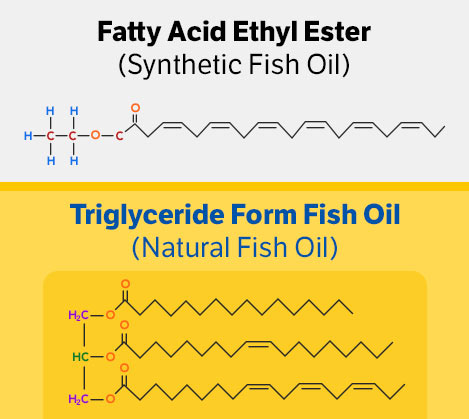
Ethyl Esters Are Poorly Absorbed, May Do More Harm Than Good
Ethyl esters — found in most fish oils — are the least bioavailable form of omega-3. Studies33 suggest a mere 20% of the EPA and DHA in ethyl ester form are absorbed by your body. When taken with other dietary fat, absorption increased threefold to 60%.
Meanwhile, EPA and DHA in their natural triglyceride form were found to have a 69% absorption rate from the start, and when taken with additional dietary fat, absorption increased to 90%. As a result, taking a triglyceride fish oil results in a 50% greater rise in omega-3 blood plasma levels than ethyl ester fish oil.
Another major drawback of ethyl ester fish oils is their rapid oxidation rate. Ethyl ester DHA is far more reactive than triglyceride DHA, oxidizing 33% more rapidly, and consuming rancid omega-3 is not going to do your health any good.
While manufacturers could convert them back into triglyceride form (by detaching the ethyl alcohol molecule and reattaching a glycerol molecule in a process known as re-esterification), this process is a costly one. So, in summary, it’s important to realize that the vast majority of clinical evidence showing health benefits of omega-3 relates to actual fish consumption, and virtually all of the omega-3s in fish are in triglyceride form.
Hence, to achieve reliable results, you really need to either eat omega-3-rich fish, or make sure the supplement you’re taking contains DHA and EPA in their triglyceride form. For a more in-depth understanding of these differences, see the paper, “A Comparison of Synthetic Ethyl Ester Form Fish Oil vs. Natural Triglyceride Form,”34 by Dr. Douglas MacKay.
- 1, 5 Omega-3 Institute, Differentiation of ALA (plant sources) from DHA + EPA (marine sources) as Dietary Omega-3 Fatty Acids for Human Health
- 2 Alwaysomega3s.com, Fact: Not all omega-3s are created equal
- 3 Harvard Nutrition Science, Omega-3s
- 4 Int J Vitam Nutr Res. 1998;68(3):159-73
- 6 STAT News September 24, 2018
- 7 CBS New York September 25, 2018
- 8 European Heart Journal Supplements Volume 22, Issue Supplement J, October 2020, Pages J34-J48
- 9 Forbes September 24, 2018
- 10 The Lancet August 31, 2008; 372(9545): 1223-1230
- 11 The Lancet August 31, 2008; 372(9545): 1231-1239
- 12 University of Rochester Medical Center 2018
- 13 Cleveland Clinic June 2017
- 14 Medical News Today June 27, 2016
- 15 Lancet 1999; 354:447-55
- 16 Circulation. 2016;134:378–391
- 17 Reuters August 1, 2016
- 18 Medical News Today August 2, 2016
- 19 Science Daily August 1, 2016
- 20, 22 Am J Gastroenterol. 2005 Dec;100(12):2674-80
- 21 BMC Musculoskelet Disord. 2010;11:136
- 23 J Anim Physiol Anim Nutr (Berl). 2012 Apr;96(2):295-306
- 24 J Agric Food Chem. 2009 Oct 14;57(19):9339-45
- 25, 26 Alternative Medicine Review 2003 May;8(2):171-9
- 27 Alternative Medicine Review 2007 Sep;12(3):207-27
- 28 Lipids Health Dis. 2008 Aug 29;7(1):30
- 29 Science Daily July 19, 2016
- 30 Urol Res. 2011 Feb;39(1):59-67
- 31 Cochrane Library July 18, 2018
- 32, 33 J Nutr. 2021 May; 151(5): 1111-1118
- 34 A Comparison of Synthetic Ethyl Ester Form Fish Oil vs. Natural Triglyceride Form (PDF)
This Toxic Herbicide Is Unregulated Despite Court Order
Reproduced from original article:
https://articles.mercola.com/sites/articles/archive/2023/05/06/dicamba.aspx
The original Mercola article may not remain on the original site, but I will endeavor to keep it on this site as long as I deem it to be appropriate.
Analysis by Dr. Joseph Mercola Fact Checked May 06, 2023

STORY AT-A-GLANCE
- In 2020, a federal court ruled the EPA ignored evidence that dicamba would lead to widespread crop damage and invalidated the registrations for this herbicide
- Instead of pulling it from the market, the EPA reapproved it months later with minor label changes
- In 2021, the EPA admitted that its changes made little difference, and dicamba was still causing grave damage, prompting a lawsuit alleging the agency failed to take action against the herbicide, despite the court order
- During the 2021 growing season, the EPA received reports of about 3,500 dicamba-related incidents, which revealed more than 1 million acres of soybean crops were damaged due to dicamba drift; similar damage was expected during 2022
- The EPA reported that these numbers significantly underestimate the true extent of dicamba-driven damage, but it still allows it to be widely used throughout the U.S.
Dicamba, a highly volatile herbicide known for drifting and damaging off-target crops, is still causing widespread environmental damage and, likely, harm to human health. This is despite a 2020 promise from the U.S. Environmental Protection Agency to take action against the chemicals, which are often sprayed “over the top” of genetically engineered dicamba-tolerant soybean and cotton crops.
In 2020, a federal court ruled, “The EPA made multiple errors in granting the conditional registrations”1 for dicamba herbicides, ignoring evidence that they would lead to widespread crop damage.
The court order invalidated the registrations for dicamba,2 but instead of pulling it from the market, the EPA reapproved it months later with minor label changes. In 2021, the EPA admitted that its changes made little difference, and dicamba was still causing grave damage, prompting a lawsuit alleging the agency failed to take action against the herbicide, despite the court order.3
Dicamba Drift Devastates US Crops
Millions of acres of croplands across the U.S. have been damaged by dicamba drift,4 and there’s also disturbing information that the chemical harms trees.5 Dicamba use has also turned farmers against one another, as those experiencing damaged crops blame neighboring farms for spraying dicamba.
When dicamba was first used, it was typically applied only sparingly and not during the growing season due to its known potential to kill nearby crops. As resistance grew to other herbicides, like glyphosate, however, Monsanto — now owned by Bayer — came up with a plan. As reported by investigative journalist Carey Gillam:6
“In 2011 Monsanto announced that glyphosate had been “relied on too long by itself” and said it planned to collaborate with BASF to develop a cropping system of genetically engineered (or GMO) crops that would tolerate being sprayed with dicamba. It said it would introduce a new type of dicamba herbicide that would not drift far from fields where it was sprayed.”
The newer dicamba was approved by the EPA in 2016, but it did not prove to be the panacea that Monsanto had promised. By November 2017, an estimated 3.6 million acres across 25 U.S. states had been damaged by dicamba drift.7 The EPA was aware of the damage then but didn’t go nearly far enough to stop the desecration. According to the EPA:8
“In 2017 and again in 2018, EPA amended the registrations of all over-the-top dicamba products following reports that growers had experienced crop damage and economic losses resulting from the off-site movement of dicamba.
The U.S. Court of Appeals for the Ninth Circuit vacated the 2018 registrations in June 2020 on the basis that ‘EPA substantially understated risks that it acknowledged and failed entirely to acknowledge other risks.’ Days after the court’s decision, EPA issued cancellation orders for the affected products that addressed existing stocks.”
EPA Admits It Failed to Stop Dicamba Damage
Four months after the 2020 court ruling, the EPA reapproved the toxic herbicides with new directions on the labels.9 The EPA reported:10
“In October 2020, EPA issued new registrations for two dicamba products and extended the registration of an additional dicamba product. These registration decisions were made with some input from EPA’s career scientists and managers and were expected to address the risk concerns noted by the Ninth Circuit.
All three registrations included new measures that the Agency expected to prevent off-target movement and damage to non-target crops and other plants.”
However, a follow-up conducted by the EPA in December 2021 revealed the same problems were occurring. The EPA admitted:11
“Despite the control measures implemented in EPA’s October 2020 dicamba registration decision, incident reports from the 2021 growing season showed little change in the number, severity, and/or geographic extent of dicamba-related incidents when compared to the reports the Agency received before the 2020 control measures were required.”
During the 2021 growing season, the EPA received reports of about 3,500 dicamba-related incidents, which revealed:12
- More than 1 million acres of soybean crops were damaged due to dicamba drift
- Dicamba also damaged other non-target crops, including sugar beets, rice, sweet potatoes, peanuts and grapes
- Dicamba damaged plants and trees growing near homes and in wild areas, including a 160,000-acre wildlife refuge
- More than 280 of the incident reports were from counties that had imposed additional restrictions on dicamba use to protect endangered species near dicamba-tolerant soybean and cotton crops
Further, the EPA reported that these numbers significantly underestimate the true extent of dicamba-driven damage, noting:13
“Based on prior research and numerous stakeholder meetings, EPA has reason to believe the number of incidents reported significantly understates the actual number of incidents related to dicamba use. For example, in a 2020 memo, EPA estimated that one in 25 dicamba incidents was reported to EPA. No evidence available to EPA suggests that underreporting has changed.”
Download this Article Before it Disappears
EPA Makes More Dicamba Label Changes
After their 2021 report revealed devastating damage due to dicamba, the EPA admitted that a similar amount of damage likely occurred during 2022:14
“EPA has not yet fully analyzed 2022 incident data, but based on incident reports received and discussions with state regulators, weed scientists, and academics, EPA has reason to believe dicamba-related incidents continued through the 2022 growing season as well.”
Still, in a bulletin released February 16, 2023, the EPA chose not to ban dicamba to stop its environmental destruction. Instead, it approved more labeling amendments intended to reduce the risks of over-the-top dicamba use. The revised labels state that over-the-top dicamba application on dicamba-tolerant crops is prohibited after June 12, 2023, in Iowa, Illinois and Indiana and after June 20 in South Dakota.15
“This restricts over-the-top dicamba application to earlier in the growing season, when temperatures are likely to be lower, and is intended to reduce the potential for dicamba to volatilize and drift off-site,” the EPA noted.16
In 2020, a lawsuit was filed against the EPA by National Family Farm Coalition, Center for Food Safety, Center for Biological Diversity and Pesticide Action Network North America. It challenged the EPA’s reapproval of dicamba after the court had removed it.17 New filings in the lawsuit, made in 2023, again allege the EPA has endangered U.S. cropland by ignoring the 2020 court order. In a statement, the plaintiffs explained:18
“The new litigation was prompted by the EPA’s decision to ignore the court’s ruling and move forward with reapproving the pesticide. In re-approving dicamba, the EPA once again failed to weigh the true costs to farmers and the environment.”
Speaking to The Guardian, Nathan Donley, environmental health science director with the Center For Biological Diversity, blamed the EPA’s close ties with the pesticide industry for their leniency in “treating the pesticide industry not as regulated companies, but as clients”:19
“The pesticide industry has a ton of clout in the EPA’s pesticide office, a ton of ability to persuade people there, and the culture at the office is very in alliance with the pesticide industry.”
Dozens of farmers are suing Bayer and BASF for crop damage caused by dicamba. The first case that went to trial involved Bader Farms in Missouri, which alleged an “ecological disaster” was created to force farmers to buy GE dicamba-tolerant seeds. Bader Farms was awarded $250 million in punitive damages and $15 million in compensatory damages in the case.20
Dicamba Linked to Cancer, Health Risks
The EPA has also downplayed health risks linked to dicamba, stating, “EPA has not identified any risks of concern regarding human health, including all population subgroups, or for occupational handlers. EPA has not identified cancer as a human health risk of dicamba.”21
However, an analysis that evaluated dicamba use with a follow-up period of up to 20 years found an association between the herbicide and liver cancer and intrahepatic bile duct cancer in those with the highest levels of exposure.22 Donley stated in a news release:23
“This sweeping study exposes the terrible human cost of the EPA’s reckless decision to expand the use of dicamba. For the EPA to approve widespread use of this poison across much of the country without assuring its safety to people and the environment is an absolute indictment of the agency’s persistent practice of rubber-stamping dangerous pesticides.
… Just as with glyphosate, we were falsely told that dicamba was completely safe for humans and there was nothing to worry about. With dicamba’s ability to drift for miles, people in many areas of the country are now routinely forced to breathe in this dangerous pesticide.”
Separate research also linked dicamba to colon and lung cancer24 and Non-Hodgkin lymphoma,25 along with an increased risk of hypothyroidism.26
Regulatory Capture Is Putting Health and Environment at Risk
André Leu, former president of International Federation of Organic Agriculture Movements (IFOAM) and current international director of Regeneration International, is the author of “Poisoning Our Children: The Parent’s Guide to the Myths of Safe Pesticides.” He explains how the agricultural industry and global chemical industry have manipulated the system to control and suppress safety concerns.
Through this regulatory capture, regulators end up working for the industry’s rather than the public’s interest. Part and parcel of this process is the revolving door between government and industry, where regulators are given high-paying industry jobs and industry executives get hired as senior managers in regulatory agencies such as the U.S. Environmental Protection Agency (EPA), where they start approving the products of their former company.
“That is really a form of corruption,” Leu says, “But we see this everywhere around the world. In every country I look at, the regulators are owned by the industry.” For its part, the EPA has a long history of siding with the pesticide industry. Not only has it stated that dicamba isn’t harmful, but it’s insisted the herbicide glyphosate “is not likely to be carcinogenic to humans.”27
Moreover, regulators make decisions on the safety of poisons in our food and environment based on data provided by the company selling the toxin — and most of these studies are confidential, so the public — as well as other scientists and researchers — cannot access them.
But as noted by Leu, when access to corporate studies is gained through freedom of information requests or legal discovery, most turn out to be of poor quality while others show a whole range of diseases and risks. When he reviewed data on pesticides, he concluded children, in particular, are at risk from exposure to even small amounts of these chemicals.
We can’t wait for the EPA to take action to start protecting the most vulnerable among us. To minimize your exposure to pesticides — and help influence positive agricultural change in your local area — buy organically produced foods from small farmers as much as possible, and avoid using pesticides around your home and garden. You can also plant and grow your own food using organic methods.
- 1, 2 The Guardian June 4, 2020
- 3, 9, 18, 19 The Guardian April 24, 2023
- 4 University of Missouri August 14, 2017
- 5 University of Missouri Extension, Winter 2018, Volume 22, Number 1
- 6 U.S. Right to Know June 12, 2020
- 7 New York Times November 1, 2017
- 8, 10, 11, 14, 15, 16 U.S. EPA February 16, 2023
- 12, 13 U.S. EPA December 21, 2021
- 17 Center for Food Safety December 21, 2020
- 20 U.S. Right to Know June 20, 2021
- 21 U.S. EPA Dicamba 2020 Registration
- 22 International Journal of Epidemiology, Volume 49, Issue 4, August 2020, Pages 1326–1337, doi: 10.1093/ije/dyaa066
- 23 Center for Biological Diversity May 4, 2020
- 24 Environmental Health Perspectives August 1, 2010, Discussion
- 25 Cancer Epidemiol Biomarkers Prev (2001) 10 (11): 1155–1163
- 26 Environmental Health Perspectives September 26, 2018
- 27 EPA Glyphosate Proposed Interim Registration Review Decision Case Number 0178 April 2019
Warning: Biodegradable Bowls Contain Toxic Chemicals
Reproduced from original article:
https://articles.mercola.com/sites/articles/archive/2022/09/10/biodegradable-bowls-with-pfas-health-effects.aspx
The original Mercola article may not remain on the original site, but I will endeavor to keep it on this site as long as I deem it to be appropriate, and will not be bullied into removing it.
Analysis by Dr. Joseph Mercola Fact Checked September 10, 2022
STORY AT-A-GLANCE
- Per- and polyfluoroalkyl substances (PFAS), widely used chemicals that make products water-, oil-, grease- and stain-resistant, are associated with significant health hazards
- PFAS chemicals take thousands of years to degrade, which is why many refer to them as “forever chemicals.” Disturbingly, these toxic chemicals have become ubiquitous in our environment
- One source of environmental contamination is PFAS-treated food wrappers and containers. Testing reveals all so-called “biodegradable” food containers contain PFAS, making them unsuitable for composting
- Using toxic nondegradable chemicals in a biodegradable product is a tremendous oversight that has led to a PR nightmare
- Research confirms that compost in which food packaging was included had a toxic load ranging from 28.7 micrograms per kilo to 75.9 mcg/kg. Compost samples that did not include food packaging had a PFOA contamination level ranging between 2.38 and 7.6 mcg/kg
Per- and polyfluoroalkyl substances1,2 (PFAS) are widely used chemicals that make products water-, oil-, grease- and stain-resistant. Perfluorooctanoic acid (PFOA) and perfluorooctanesulfonic acid (PFOS) are associated with a wide array of health problems — even at very low exposure levels — including:
| Immune dysfunction3 | Low birth weight4 |
| Thyroid dysfunction5 | High cholesterol6 |
| Ulcerative colitis7 | Pregnancy-induced hypertension8 |
| Testicular cancer9 | Kidney cancer10 |
In May 2015, 200 scientists from 38 countries signed the so-called Madrid Statement on PFASs,11,12 which warns about the harms of all PFAS chemicals, both old and new. According to the Madrid Statement, health effects associated with the older, long-chain PFAS’s such as PFOA, include:13
| Liver toxicity | Disruption of lipid metabolism, and the immune- and endocrine systems |
| Adverse neurobehavioral effects | Neonatal toxicity and death |
| Tumors in multiple organ systems | Testicular and kidney cancers |
| Liver malfunction | Hypothyroidism |
| High cholesterol | Ulcerative colitis |
| Reduced birth weight and size | Obesity |
| Decreased immune response to vaccines | Reduced hormone levels and delayed puberty |
PFAS Are ‘Everywhere’
PFAS chemicals take thousands of years to degrade, which is why many refer to them as “forever chemicals.” Disturbingly, these toxic chemicals have become ubiquitous in our environment, including groundwater.14,15
PFAS are also found in the U.S. food supply — and at levels far exceeding the advisory limit for PFOA and PFAS in drinking water (there’s currently no limits in food).
Of the 91 foods tested by the U.S. Food and Drug Administration in 2017 as part of its Total Diet Study16 (presented17 at the 2019 meeting of the Society of Environmental Toxicology and Chemistry), 10 were found to contain PFAS.18,19,20,21 How do they get there?
Food Wrappers — A Significant Source of PFAS
Industrial production is just one route by which PFAS enter our environment and food supply. Another is through everyday waste, such as fast food wrappers and containers that end up in landfills, from where they continue to contaminate soil and water.
Disturbingly, findings reveal that even so-called “biodegradable” food containers contain these “forever chemicals,” which may create an even greater problem.
Thinking the containers are biodegradable and safe, people will place them in their compost, creating a vicious circle where the chemicals contaminate and ruin the compost, which is then mixed into the soil, where they contaminate the food grown in it. Ultimately, the chemicals end up on your plate again, now inside the food.
Research22 by the U.S. Centers for Disease Control and Prevention published in 2007 found PFAS chemicals in the blood of more than 98% of Americans tested. Considering their current prevalence in our food supply, it seems reasonable to assume everyone is exposed to some degree, and that blood levels have likely increased in the years since the CDC’s testing.
Biodegradable Bowls Contain PFAS
Concerns over mounting plastic waste pushed fast food companies to invest in safer wrappers and containers, but recent findings reveal a truly remarkable lack of understanding on behalf of some manufacturers. Writing for New Food Economy, Joe Fassler reports the disappointing news:23
“The biggest culinary star of the past five years isn’t a chef, or a restaurant group, or the author of a cookbook. It’s a bowl, a humble piece of take-out packaging that’s taken the world of commercial foodservice by storm, rising so quickly that few have noted its troubling secret …
If molded fiber bowls have become a kind of status symbol in the restaurant world … it’s probably because they’ve been positioned as an antidote to the industry’s alarming take-out waste problem.
Many varieties are explicitly pitched to food-service buyers as compostable, certified by third-party assessors like the Biodegradable Products Institute (BPI). Unlike styrofoam clamshells or wax-lined soup cups, fiber products feel like they’d turn into mush on a leaf pile …
But these products … are instead contributing to a growing environmental crisis. According to experts consulted for this story, all molded fiber bowls contain PFAS …
This means that the bowls used at restaurants like Chipotle and Sweetgreen aren’t truly compostable, as has been claimed. Instead, they are likely making compost more toxic, adding to the chemical load of the very soil and water they were supposed to help improve.”
All Compostable Bowls Found to Contain PFAS
For its report, New Food Economy tested 18 biodegradable fiber bowls from eight restaurants at 14 locations in New York City, including Chipotle, Sweetgreen and Dig — three restaurants that claim to compost its waste.
All were found to contain high levels of fluorine,24 which is indicative of PFAS being used. The inside (food contact side) of the bowls averaged 1,599 parts per million (ppm) of fluorine, a level far higher than what you’d find in an accidentally contaminated sample.
Now, the test used only measures total fluorine, not individual PFAS chemicals, and the total level of any given PFAS is likely to be higher than the total fluorine level. Fassler explains:25
“… [A] bowl containing 1,670 ppm fluorine will contain more total PFAS, since every molecule of the chemical compound contains multiple atoms — not just of fluorine, but of carbon, and other elements.
Though it’s impossible to say for sure due to the wide variety of PFAS chemicals … according to a rough calculation, a bowl with 1,670 ppm fluorine would likely contain about 2,000 ppm total PFAS.
Put another way: A bowl with 2,000 ppm total PFAS might be mostly made from sugarcane fiber, but 0.2 percent of its total material would be made from fluorinated chemicals …
That might not sound like very much. But due to the unique properties of fluorinated chemicals, it turns out to be a significant number, and an alarming one. The Centers for Disease Control and Prevention (CDC) maintain that drinking water can only contain infinitesimal amounts of fluorinated chemicals before health concerns arise.”
Do Not Compost ‘Biodegradable’ Bowls
Research26,27 published in 2017 found fluorine in 46% of the fast food wrappers and takeout containers tested, and studies28,29,30 have confirmed fluorinated chemicals can migrate from the packaging into the food.
If it’s true that 100% of so-called “biodegradable” fiber bowls contain PFAS, then they would actually be a far more hazardous choice than other “standard” wrappers and containers — at least as far as PFAS exposure is concerned. As noted by Fassler, it is the surface treatment with PFAS that prevents the fiber bowls from falling apart when filled with hot, wet or greasy food.
Using toxic nondegradable chemicals in a biodegradable product is a tremendous oversight. Clearly, restaurants should not advertise these containers as compostable, yet many do just that. It’s not surprising then that the revelation has become a PR nightmare. As noted by Fassler:31
“… [A]ny product that contains PFAS can’t really be compostable, let alone biodegradable, despite restaurants’ claims to the contrary. Though fiber products have benefits from a greenhouse gas emissions standpoint, the bowls we tested are likely making soil and water quality worse.”
Indeed, recent research confirms this warning. Tipped off about the presence of PFAS in compostable containers, the authors of a 2019 paper32,33 decided to assess the presence of these chemicals in municipal compost. In all, samples from nine commercial compost stations and one backyard compost pile were tested for 17 different PFAS.
Confirming suspicions, compost in which food packaging was included had a toxic load ranging from 28.7 micrograms per kilo to 75.9 mcg/kg. Compost samples that did not include food packaging, on the other hand, had a contamination level ranging between just 2.38 and 7.6 mcg/kg.
While it’s disturbing that all compost samples contained PFOA and PFOS — the older, long-chained PFAS that are no longer in use — compost with food packaging was clearly more heavily contaminated with a variety of PFAS. If there’s any good news here, it’s that some states are starting to take action against PFAS.
As noted by Fassler,34 San Francisco is banning bowls manufactured with PFAS as of January 1, 2020, and Washington’s Healthy Food Packaging Act35 — enacted in 2018 — bans all PFAS in paper food packaging, effective 2022.36 A drawback of the Act is that the ban will not take effect until or unless a safer alternative is commercially available.
Sewage Sludge — A Major Source of PFAS on Farms
As reported by The Intercept37 in June 2019, sewage sludge appears to be a major source of PFAS. Documents38 obtained by The Intercept reveal 44 samples of sewage sludge tested by the Maine Department of Environmental Protection all contained at least one PFAS chemical, and “In all but two of the samples, the chemicals exceeded safety thresholds for sludge that Maine set early last year.”
Maine’s tolerance levels for PFAS are set at 2.5 parts per billion (ppb) for PFOA, 5.2 ppb for PFOS, and 1,900 ppb for PFBS. Mike Belliveau, executive director of the Environmental Health Strategy Center in Portland, told The Intercept these levels are “probably about 10 times weaker than they should be,” adding that “Even low parts-per-billion levels of PFAS in sludge can threaten the health of the food supply.”
You can learn more about the hazards of sewage sludge in the featured documentary, “Biosludged,”39 and the scientific fraud perpetrated by the U.S. Environmental Protection Agency that legalizes the pollution of agricultural soils through the usage of contaminated industrial and human waste as fertilizer.
DuPont Shirks Cleanup Duty
In related news, DuPont, a longtime maker of PFAS chemicals stands accused of creating a fraudulent spinoff, Chemours, in an effort to shirk environmental liabilities caused by its chemical manufacturing. (Chemours is the name of the spinoff company created through DuPont’s merger with Dow Chemical Inc. in 2015.40) Chemours lawyers told Bloomberg:41
“The separation agreement was the product of a one-sided process that lacked any of the hallmarks of arm’s-length bargaining. DuPont unilaterally dictated the terms of the separation agreement and imposed them on Chemours.”
One of DuPont’s environmental liabilities is the cleanup of Pompton Lakes in New Jersey. As reported by NorthJersey.com July 15, 2019:42
“The new claims by the state attorney general’s office were quietly added as amendments to a lawsuit filed against DuPont and Chemours seeking financial damages for widespread pollution in Pompton Lakes.
This includes a neighborhood where residents have had to endure cancer-causing solvents that migrated for decades beneath their homes from a now-shuttered DuPont explosives factory.
Like dozens of sites across the U.S., the cleanup in Pompton Lakes had long been DuPont’s responsibility. That changed in July 2015, when DuPont created Chemours as a spinoff company that took over the bulk of the DuPont’s environmental liabilities.
But two separate lawsuits against DuPont — one by New Jersey officials and another by Chemours itself — allege what many in Pompton Lakes feared at the time of the spinoff:
DuPont created Chemours to insulate itself from future cleanup and natural resource damage claims, and left Chemours vulnerable to financial problems that could put cleanup efforts at risk in New Jersey and across the country.”
Indeed, Chemours’ lawsuit against DuPont claims DuPont set up the company to fail from the start, allowing DuPont to simply walk away from all of its cleanup responsibilities.
Chemours is now asking the court to deny DuPont’s request for unlimited indemnity for its environmental liabilities.43 (Chemours, meanwhile, claims it has now stopped making three PFAS products used in the making of grease-resistant packaging.44)
North Jersey reports that, according to Chemours, the company received only 19% of DuPont’s business lines at the company’s inception, while taking on two-thirds of the environmental liabilities and 90% of all pending litigation against DuPont.
In all, Chemours liabilities exceeded earnings by 5.5-to-1 right from the get-go, yet its management team was not fully informed about the company’s financial situation. Chemours also claims DuPont systematically underestimated the legal and environmental cleanup costs.
“For instance, DuPont estimated that three lawsuits against it over contamination from the toxic chemical PFOA would cost no more than $128 million. They were settled by Chemours for $671 million less than two years later,” North Jersey reports.45
Lawmakers Promise to Pursue Corporate Accountability
As attention on PFAS pollution increases, PFAS manufacturers such as DuPont and 3M are ramping up lobbying efforts to prevent tighter regulations. Several recent hearings46,47,48 have been held on PFAS, however, and Democratic lawmakers have promised to “continue pursuing corporate accountability,” Think Progress reports.49 As noted by the Union of Concerned Scientists in a May 15, 2019, press release:50
“Today, the Energy and Commerce Committee of the U.S. House of Representatives held a hearing on perfluoroalkyl and polyfluoroalkyl substances (PFAS), a widely-used family of chemicals that contaminate the drinking water of millions of Americans.
Representatives also introduced a number of bills to manage the threat of PFAS pollution, including legislation that would require the U.S. Environmental Protection Agency to designate PFAS as hazardous chemicals, as well as bills to expand water testing, improve water infrastructure, assist communities facing PFAS contamination issues and limit the use of these chemicals in the future. This effort to tackle a common and dangerous class of pollutant is long overdue …”
Certain states are also taking matters into their own hands. Michigan, for example, where PFAS is a common water contaminant, says it’s planning to start regulating certain PFAS to protect residents rather than waiting for the EPA to take action.51
The New Jersey Department of Environmental Protection also has its sights on corporate accountability. Commissioner Catherine McCabe told Think Progress,52 “New Jersey believes that the manufacturers … should be held responsible to the public for the costs and damages of the drinking water contamination and other harmful consequences of their actions and negligence.”
How to Avoid PFAS Chemicals
The Madrid Statement recommends avoiding any and all products manufactured using PFASs, noting they include products that are stain-resistant, waterproof or nonstick. Helpful tips can also be found in the EWG’s “Guide to Avoiding PFCS.”53 Other suggestions that will help you avoid these dangerous chemicals include avoiding:
| Items that have been pretreated with stain repellants, and opt out of such treatments when buying new furniture and carpets |
| Water- and/or stain-repellant clothing — One tipoff is when an item made with artificial fibers is described as “breathable.” These are typically treated with polytetrafluoroethylene, a synthetic fluoropolymer |
| Items treated with flame retardant chemicals54 — This includes a wide variety of baby items, padded furniture, mattresses and pillows. Instead, opt for naturally less flammable materials such as leather, wool and cotton |
| Fast food and carry out foods — The wrappers are typically treated with PFCs |
| Microwave popcorn — PFCs may not only present in the inner coating of the bag, it also may migrate to the oil from the packaging during heating. Instead, use “old-fashioned” stovetop popcorn |
| Nonstick cookware and other treated kitchen utensils — Healthier options include ceramic and enameled cast iron cookware, both of which are durable, easy to clean and completely inert, which means they won’t release any harmful chemicals into your home.
A newer type of nonstick cookware called Duralon uses a nonfluoridated nylon polymer for its nonstick coating. While this appears to be safe, your safest bet is still ceramic and enameled cast iron. While some recommend using aluminum, stainless steel and copper cookware, I don’t for the following reasons: Aluminum is a strongly suspected causal factor in Alzheimer’s disease, and stainless steel has alloys containing nickel, chromium, molybdenum and carbon. For those with nickel allergies, this may be a particularly important consideration. Copper cookware is also not recommended because most copper pans come lined with other metals, creating the same concerns noted above. (Copper cookware must be lined due to the possibility of copper poisoning) |
| Oral-B Glide floss and any other personal care products containing PTFE or “fluoro” or “perfluoro” ingredients — The EWG has an excellent database called Skin Deep55 you can peruse to find healthier options |
| Unfiltered tap water — Unfortunately, your choices are limited when it comes to avoiding PFASs in drinking water. Either you must filter your water or obtain water from a clean source. Both solutions can be problematic and/or costly.
While many opt for bottled water, it’s important to realize that PFASs are not regulated in bottled water, so there’s absolutely no guarantee that it’ll be free of these or other chemicals. Bottled water also increases your risk of exposure to hazardous plastic chemicals such as bisphenol-A, which has its own set of health risks. Most common water filters available in supermarkets will not remove PFASs. You really need a high-quality carbon filtration system. The New Jersey Drinking Water Quality Institute recommends using granulated activated carbon “or an equally efficient technology” to remove PFC chemicals such as PFOA and PFOS from your drinking water.56 Activated carbon has been shown to remove about 90% of these chemicals |
- 1 EPA.gov PFAS
- 2 The Guardian May 23, 2019
- 3, 4, 5 EPA.gov Health effects from PFAS
- 6, 7, 8, 9, 10 C8 Science Panel Research Studies
- 11, 13 Environmental Health Perspectives 123:A107–A111, Madrid Statement
- 12 Newser May 1, 2015
- 14 EPA.gov, Health Advisory PFOA and PFOS
- 15 The Intercept, The Teflon Toxin Series
- 16 FDA.gov Total diet study
- 17 EWG.org Images of FDA presentation
- 18 CNN Health June 3, 2019
- 19 The Guardian June 3, 2019
- 20 Chicago Tribune June 3, 2019
- 21 Business Insider June 4, 2019
- 22 Environmental Health Perspectives 2007 Nov; 115(11): 1596–1602
- 23, 25, 31, 34 The New Food Economy, The bowls at Chipotle and Sweetgreen … contain cancer-linked “forever chemicals”
- 24 Infogram.com Fluorine Testing Results
- 26 Environmental Science and Technology Letters February 1, 2017
- 27 Environmentalhealthnews.org February 1, 2017
- 28 Food Additives and Contaminants 2008: 25(3); 384
- 29 Food Additives and Contaminants 2005 Oct;22(10):1023-31
- 30 Journal of Agricultural and Food Chemistry 2007; 55(8): 3203-3210
- 32 Environ. Sci. Technol. Lett. 2019; 6(6): 372-377
- 33 Popular Science May 30, 2019
- 35 Toxic-Free Food Packaging ESHB 2658
- 36 Department of Ecology, State of Washington, Alternatives to PFAS in Food Packaging (PDF)
- 37 The Intercept June 7, 2019
- 38 Documentcloud.org, PFAS Summary of Sludge Data 053019 (PDF)
- 39 YouTube. Biosludged. December 10, 2018
- 40, 41, 43 Bloomberg July 1, 2019
- 42, 45 Northjersey.com July 15, 2019
- 44 Politico August 9, 2019
- 46 House Committee on Energy & Commerce, May 15, 2019
- 47 Committee on Oversight and Reform, Subcommittee on Environment March 6, 2019
- 48 Senate Committee on Environment and Public Works May 22, 2019
- 49, 51, 52 Think Progress July 25, 2019
- 50 UCSUSA.org May 15, 2019
- 53 EWG’s Guide to Avoiding PFCS (PDF)
- 54 Green Science Policy, Flame Retardants
- 55 EWG Skin Deep Cosmetics Database
- 56 New Jersey Drinking Water Quality Institute, Recommendation on Perfluorinated Compound Treatment Options for Drinking Water, June 2015 (PDF)
Sickening food POISON: Chlorpyrifos linked to brain damage, yet the EPA is ignoring the science
Reproduced from original article:
www.naturalhealth365.com/chlorpyrifos-brain-damage-3614.html
by: Damon Hines, staff writer | November 5, 2020
 (NaturalHealth365) There’s a good chance you’ve never heard of the pesticide chlorpyrifos. And that’s because, compared to headline-grabbing toxins like dicambia or glyphosate, it’s flown under the radar for decades!
But, believe it or not, The Dow Chemical Company introduced chlorpyrifos to homes and farm fields in 1965. And, in recent years, it has been linked to: low IQ, developmental and cognitive problems, plus brain damage in children.
So, the really big question is: why isn’t the U.S. Environmental Protection Agency (EPA) doing anything to protect us?! The answer may surprise you.
Sickening Reality EXPOSED: Chlorpyrifos is a nerve agent
In January 2020, the European Food Safety Authority banned sales of chlorpyrifos as years of research indicated that there’s no “safe” level of exposure. In the United States, some individual states – including California and Hawaii – have banned its use on farm lands. Several other states – including Massachusetts, New York, Vermont, and Oregon – have sued the EPA for not enacting a nationwide ban.
But, as you might suspect, The Dow Chemical Company lobbying efforts have “persuaded” the EPA that the toxic and potentially deadly chemical could still be used in U.S. food production. This is a terrible example of corporate greed over the need for public safety.
“Despite several years of study, peer review, and public process, the science addressing neurodevelopment effects remains unresolved.”
The above statement is the EPA’s risk assessments of chlorpyrifos, and it’s a tragedy and public health hazard that the EPA would side with corporations instead of childrens’ health. Chlorpyrifos was designed to kill insects on crop staples such as corn, wheat, soybeans, apples and citrus, and it has been sprayed on U.S. farmlands for over a century.
Do NOT ignore the health dangers linked to toxic indoor air. These chemicals – the ‘off-gassing’ of paints, mattresses, carpets and other home/office building materials – increase your risk of headaches, dementia, heart disease and cancer.
Get the BEST indoor air purification system – at the LOWEST price, exclusively for NaturalHealth365 readers. I, personally use this system in my home AND office. Click HERE to order now – before the sale ends.
The effects of the insecticide on humans and animals has been studied since the 1970s. In other words, there’s nothing that remains “unresolved” about the chemical’s toxic effect on the neurological development of children.
Prenatal exposures to chlorpyrifos has been linked to lower birth weight, loss of working memory, attention disorders, impulsive behavior, and delayed motor development. According to the American Academy of Pediatrics, “the continued use of chlorpyrifos puts developing fetuses, infants, children and pregnant women at great risk.”
How are we exposed to chlorpyrifos? The residues on food, drinking water contamination, and toxic spray drift from pesticide applications are the main culprits. In fact, USDA’s Pesticide Data Program found chlorpyrifos residue on citrus and melons even after being washed and peeled.
Take action now
When is enough data enough to enact policy? When will public health outweigh corporate profit? As a nation, these are the questions we continue to ask only to be met with silence.
The EPA needs to be held accountable. Our political and regulatory leaders need to be held accountable. Contact the policy-makers in your area and voice your concerns about the dangers of chlorpyrifos.
In the short-term, the best thing you can do to protect your family and minimize exposure to pesticides is to buy organic. Support small, local (organic) farms.
Be aware and know where your food is coming from. Remember, “an apple a day” won’t keep the doctor away if it’s covered with chlorpyrifos.
Sources for this article include: