Antidepressants
now browsing by category
Depression Strongly Influences Surgical Recovery and Healing Outcomes
Reproduced from original article:
https://articles.mercola.com/sites/articles/archive/2025/12/01/depression-surgery-recovery.aspx
Analysis by Dr. Joseph Mercola December 01, 2025

Story at-a-glance
- Depression affects how your body heals after surgery by increasing inflammation and weakening your immune defenses, which lead to longer recovery times and higher complication rates
- Older adults with cancer who also have depression experience significantly higher post-surgical costs — nearly $25,000 compared to about $17,500 for patients without depression — showing that untreated mental health directly impacts both recovery and finances
- In patients undergoing spine surgery, depression nearly doubled the risk of delirium and tripled the likelihood of blood clots or infections, underscoring how mood disorders influence physical outcomes
- Depression triggers systemic inflammation and disrupts hormonal balance, particularly through chronically high cortisol levels, which slow wound healing and increase blood pressure — key drivers of poor recovery
- Addressing depression before surgery — through dietary changes, gut support, regular movement, sunlight exposure, and consistent rest — helps restore your body’s energy systems, reduces inflammation, and supports faster, more complete healing
Depression affects far more than your mood — it reaches into every system of your body, influencing how well you recover from illness, injury, or surgery. When your mind is under strain, your immune system weakens, inflammation rises, and your body’s repair processes slow down. That’s why people struggling with depression often take longer to heal, face more complications, and endure higher medical costs after surgery.
What’s striking is that depression often hides in plain sight. Its symptoms — fatigue, disrupted sleep, lack of motivation, and mental fog — are often dismissed as stress or aging. Yet these same signs reveal a deeper issue: your cells aren’t producing enough energy to keep your body functioning at full capacity. This shortage of cellular energy makes recovery harder and increases the risk of infections and chronic inflammation, both of which interfere with surgical healing.
Addressing depression — especially before an operation — isn’t just about emotional well-being. It’s about restoring your body’s energy systems so that you’re better equipped to handle the physical stress of surgery and recovery. Your mental state determines how effectively your body fights inflammation, repairs tissue, and manages pain — all key factors in whether you recover quickly or face setbacks.
In recent years, researchers have begun linking mental health directly to surgical outcomes, revealing that your brain-body connection is stronger than anyone once believed. The studies that follow explore how depression impacts postoperative recovery — and why addressing it early could make all the difference in your survival, resilience, and long-term health.
Depressed Cancer Patients Face Higher Post-Surgical Risk and Costs
A study examining outcomes in older adults with colorectal, hepatobiliary, and pancreatic cancers found that a diagnosis of depression, whether made up to a year before or after cancer detection, significantly worsens post-surgical recovery and drives up health care costs.1
Out of 32,726 participants, 1,731 had depression, and about three-quarters of them were prescribed antidepressants. The goal was to determine how depression — treated or untreated — affected recovery, hospital stays, readmissions, complications, and costs after surgery.
• Depressed patients faced tougher recoveries — Patients with depression faced higher risks of surgical complications, longer recovery times, and increased mortality. Those without depression fared best overall.
• Untreated depression drove costs up by thousands — The financial gap told a clear story. Non-depressed patients averaged $17,551 in total care costs. Those treated for depression spent about $22,086, while untreated depressed patients reached $24,897 — a 10.2% increase compared to patients without depression. These figures reveal that untreated mental health issues directly raise health care costs and slow recovery.
• Depression impairs your body’s ability to heal — Depression isn’t just a matter of mood. It interferes with self-care, disrupts immune responses, and increases inflammation — all of which slow wound healing. When depression goes untreated, patients are more likely to experience complications such as infections or delayed recovery.
• Experts call for integrating mental health into surgical care — Lead author Erryk S. Katayama explained that understanding mental health risk factors “can help create holistic and individualized treatment plans, anticipate and prevent complications, and ultimately optimize patient outcomes.” Senior author Dr. Timothy M. Pawlik added that treating depression may improve treatment compliance and overall self-care success.
• Your mindset matters before surgery — If you’re facing surgery, your emotional state isn’t secondary — it’s central. Addressing depression before an operation improves your physical resilience, shortens recovery time, and lowers costs. Simply put, healing starts long before you enter the operating room.
Depression Greatly Increases the Risk of Complications After Spine Surgery
As revealing as these findings are, they highlight a larger truth: depression doesn’t stay confined to your mind — it affects every system that determines how your body responds to injury, stress, and healing. The consistency of these results across very different types of surgery underscores a simple reality — no operation happens in isolation from your emotional health.
A study published in the Journal of Clinical Medicine reviewed 26 studies investigating how depression influences surgical recovery and complication rates in people undergoing spine surgeries.2 This meta-analysis evaluated outcomes like infection rates, reoperation frequency, and postoperative complications across tens of thousands of patients to determine whether depression altered the body’s ability to recover after major spinal procedures.
• Depressed patients experienced far more complications — The data revealed that depression was linked to a dramatic rise in surgical and medical complications. Depressed patients were almost twice as likely to experience delirium (sudden confusion or disorientation) and more than three times as likely to suffer from blood clots, including deep vein thrombosis and pulmonary embolism — conditions that often become life-threatening if untreated.
• Infections and neurological problems were far more common — Those with depression had higher odds of developing surgical site infections, urinary retention, or urinary tract infections, each of which can slow healing and prolong recovery. The odds of developing neurological injury — damage to nerves that control sensation and movement — were six times higher among depressed patients. These complications directly affect recovery time and quality of life after surgery.
• Hospital readmissions and reoperations increased significantly — Compared to non-depressed patients, those with depression were 35% more likely to be readmitted to the hospital and twice as likely to require a second operation. Even though their length of hospital stay was similar, their overall outcomes were worse, suggesting that the physical recovery process continued to be more complicated after discharge.
• Depression triggers systemic inflammation and disrupts immune balance — This means your body becomes less efficient at fighting infection or repairing tissue after injury. Depression also influences hormones like cortisol, which, when chronically elevated, slows wound healing and increases blood pressure. Together, these effects set the stage for poorer outcomes after surgery.

Save This Article for Later – Get the PDF Now
How to Strengthen Your Mind and Body to Overcome Depression
Depression weakens your body’s natural energy systems, making you feel tired, unmotivated, and disconnected from the world around you. It also affects your immune function, digestion, and ability to handle stress — the very systems you need to thrive, especially if you’re facing surgery. Before agreeing to any procedure, be sure it’s absolutely necessary. Ask questions, explore second opinions, and understand all your options so you can make the most informed decision possible.
Taking this pause to evaluate your choices also helps you begin shifting out of the helplessness that often surrounds depression. Regaining that sense of control and confidence is a powerful first step toward healing. You have far more control over this process than you may realize. By targeting the root causes that disrupt your body’s energy and mood balance, you can restore resilience from the inside out.
1. Remove seed oils and processed foods from your diet — Consuming ultraprocessed foods increases the risk of depression in older adults.3 These foods are loaded with linoleic acid (LA), a polyunsaturated fat that builds up in your tissues and damages mitochondria. This fat stresses your cells and impairs your brain’s ability to regulate mood. Start replacing vegetable oils — such as soybean, corn, and sunflower — with saturated fats like grass fed butter, ghee, or tallow.
Your target is less than 5 grams of LA daily, ideally under 2 grams. To track your intake, I recommend you download my Mercola Health Coach app when it’s available this year. It has a feature called the Seed Oil Sleuth, which monitors your LA intake to a tenth of a gram so you can stay in charge of your metabolism.
2. Rebuild your gut to repair your mood and immunity — Your gut and brain are in constant communication. When your microbiome — the community of bacteria living in your intestines — is imbalanced, it triggers inflammation that worsens depression. Your body needs about 250 grams of carbohydrates daily to maintain optimal cellular energy production, but too much fiber too soon ramps up endotoxin release and triggers digestive issues.
To fix this, focus on easily digestible carbohydrates like fruit and white rice first, then move to root vegetables and well-cooked legumes as your gut strengthens. When your digestion stabilizes, introduce whole grains that your body tolerates well. This step-by-step approach helps you restore balance, energy, and mood without unpleasant side effects.
3. Exercise regularly but gently — Movement helps regulate neurotransmitters that influence mood and energy production. One comprehensive review concluded that physical activity is 1.5 times more effective than the most prescribed antidepressants in reducing symptoms of depression and anxiety.4,5
Focus on daily walks and light strength training to improve circulation, oxygen delivery, and lymphatic flow. Even a 20-minute walk outdoors helps clear inflammation and supports better metabolic function — but gradually work your way up to one hour daily for best results.
4. Protect your mitochondria with daily sunlight — Expose your skin and eyes to morning sunlight to trigger natural energy production in your cells. This light signals your mitochondria to generate adenosine triphosphate (ATP) — your body’s energy currency — and stabilizes circadian rhythms. Avoid harsh midday sun until you’ve been off seed oils for at least six months; this helps prevent oxidative damage and rebuilds your skin’s tolerance to UV light.
5. Feed your body and mind with rest and rhythm — Healing starts with consistency. Keep regular sleep and meal times to support your circadian biology. To support high-quality sleep, dim your lights after sunset, and avoid screens late at night. When your body runs on rhythm, your stress hormones stabilize, inflammation drops, and your immune system can do its job — helping you recover faster and stronger after surgery.
FAQs About Depression and Surgical Recovery
Q: How does depression affect surgical outcomes?
A: Depression interferes with your body’s ability to heal by increasing inflammation and weakening your immune system. These effects slow wound repair, heighten infection risk, and make recovery longer and more difficult. Studies show that patients with depression experience more complications, higher readmission rates, and increased mortality after surgery compared to those without depression.
Q: Why does managing depression before surgery make such a difference?
A: Addressing depression before surgery gives your body a major advantage over going into an operation while depressed. Patients whose depression was managed had shorter hospital stays, fewer complications, and lower overall costs, while those who went into surgery untreated faced slower healing, higher inflammation, and a greater risk of readmission — clear proof that mental health directly determines physical recovery.
Q: What steps can I take to overcome depression naturally?
A: You can strengthen both mind and body by addressing the root causes of low mood and energy. Key steps include removing seed oils and processed foods, rebuilding gut health, getting daily sunlight, exercising regularly, and maintaining a consistent sleep routine. Each of these supports mitochondrial function, hormonal balance, and emotional stability.
Q: Is it true that diet affects mood and depression risk?
A: Yes. Research shows that consuming ultraprocessed foods increases the risk of depression. These foods contain fats like LA that damage mitochondria and promote inflammation. Replacing them with stable fats like grass fed butter, ghee, or tallow helps restore metabolic and mental health.
Q: What should I consider before having surgery if I’m struggling with depression?
A: First, make sure the procedure is truly necessary. Ask questions, explore second opinions, and understand your full range of options. Taking time to evaluate your choices helps you regain a sense of control — a key factor in overcoming depression. Strengthening your mental health before surgery not only supports faster healing but also improves your overall long-term outcome.
Antidepressants Can Rewire Your Mind to the Point of Committing Violent Crimes
Reproduced from original article:
https://articles.mercola.com/sites/articles/archive/2024/11/23/antidepressants-violence.aspxhttps://articles.mercola.com/sites/articles/archive/2024/11/23/antidepressants-violence.aspx
Analysis by Dr. Joseph Mercola November 23, 2024
STORY AT-A-GLANCE
- Mental health in America is declining, with only 31% of adults rating their mental health as “excellent” in 2022, down from 43% two decades prior. Antidepressant use is also widespread
- Research links antidepressants to increased risk of violent behavior, particularly in young adults. Drug manufacturers created the “Zoloft defense” strategy to protect themselves against legal repercussions from these cases
- Studies show antidepressants can cause emotional blunting and detachment. The FDA also requires black box warnings about side effects such as suicidal thoughts and aggressive behavior
- Specific SSRIs like Paxil and Luvox significantly increase your risk of violent behavior. Prozac is the most dangerous, raising aggressive behavior rates by up to 10.9 times
- Exercise has been shown to be 1.5 times more effective than antidepressants for mental health. Other recommended strategies include proper nutrition, vitamin D and the Emotional Freedom Techniques (EFT)
Mental health in America is slowly deteriorating. According to a report from TIME, only 31% of adults rated their mental health as “excellent” in 2022, which went down from 43% two decades prior. To help them cope, the first solution is typically to take an antidepressant. In fact, around 16% of adults have taken a psychiatric drug within the previous year, with antidepressants being the most used type.1
Worse, even the youth has been captured by Big Pharma. Between January 2016 and December 2022, the monthly antidepressant dispensing rate among Americans aged 12 to 25 years old rose by 66.3%. Among females aged 12 to 17, the rate surged by 129.6%.2
Despite their intended purpose to help those struggling with mental health problems, research has revealed a severe side effect of antidepressants — an increased risk of homicidal behavior. This pressing issue was discussed in the webinar “Antidepressants and Homicide: Automatism Spectrum Disorders” by Dr. David Healy, one of the United Kingdom’s top experts on selective serotonin reuptake inhibitors (SSRIs).3
Homicide — A Chilling Side Effect of Antidepressants
Healy explored the case of 15-year-old Christopher Pittman,4 a highly publicized case that happened in the early 2000s, where he was sentenced to 30 years in prison for killing his grandparents.5 A month before the crime occurred, Christopher ran away from home and ended up in a children’s mental health institute, where he was given Zoloft.
After he was picked up by his grandparents, Christopher began exhibiting severe behavioral changes. Two to three weeks later, while being under the influence of Zoloft, he shot his grandparents and burned down their house. When police officers took him in, he said he didn’t have any memory of what happened.6
Was the teenager “chemically compelled” or was he aware of his actions?7 Whatever your thoughts are on the matter, one thing is certain — antidepressants were a factor. This was also confirmed by a juror on the case.8 However, we’ve yet to see the judicial system take chemical induction to violence into account.
Sadly, Christopher is far from an isolated case. Published research has shown that taking antidepressants produces a variety of psychological side effects, and one of them is homicidal ideation.
In a study9 published in 2020, researchers noted that violent crime convictions were more prevalent among patients who took SSRIs than those who did not take these drugs. The age ranges with the highest conviction rates while on SSRIs were those between 15 and 34.
Among those over the age of 35, the risk of committing a violent crime while on an SSRI was negligible. While the study didn’t go into the cause of these events, they did point an important danger to using these drugs. According to the study authors:
“While questions on causality remain, these results indicate that there may be an increased risk of violent crime during SSRI treatment in a small group of individuals. It may persist throughout medicated periods, across age groups, and after treatment discontinuation.”
Automatism in Antidepressants
What could cause people who take antidepressants to commit violent crimes? While there’s no definite answer, Healy theorizes that these drugs eventually cause automatism, “an act which is done by the muscles without any control by the mind.”10 In short, antidepressants may cause you to do things you’re not aware of, similar to parasomnias (sleepwalking disorders) where people engage in activities such as eating garbage or driving while sleeping.
What’s worse is that drug manufacturers have known about this issue from the start. Healy recounted that Nobel Prize winner Dr. Arvid Carlsson, known for synthesizing the first SSRI sold to the public11 (zimeldine12), acknowledged that while it creates a positive effect for some, it has a negative effect on others.13
Originally, the drugs were meant to produce a “serenic effect,” meaning a feeling or state of calmness, peace, and tranquility. However, the problem is that sometimes the opposite state is induced. In some cases, violence is the end result. As noted by Healy, SSRIs don’t actually address the mental illness, but rather “work” by changing your personality.14
Save This Article for Later – Get the PDF Now
The Zoloft Defense
Again, drug manufacturers knew from the start that antidepressants will cause violent behavior in certain individuals. But did you know that they’ve already prepared a legal defense for it?
After the first cases of violent behavior caused by antidepressants were reported in the news, Pfizer and GlaxoSmithKline created a strategy to get them off the hook from legal repercussions, called the “Zoloft defense.” The first draft of this strategy appeared as early as 1993.15 Brenda Baletti, Ph.D., writing for The Defender, summarizes this legal scheme:16
“The manual’s rebuttal hinges on the claims that violence is common in the U.S. and that the FDA has found the drug to be safe. It also advises lawyers to emphasize the lack of statistically significant evidence from double-blind placebo-controlled clinical trials causally linking Zoloft to aggressive behavior or to akathisia, which are strong subjective feelings of distress or discomfort that could also induce violent behavior.”
When will Big Pharma be held responsible for the damages it has caused to the victims of antidepressant-induced violent behavior? The answer is difficult to predict, but some courts have recognized the harm that antidepressants cause.
In one example, Healy recounted the story of Don Schell. One day in 1998, Schell went to see a doctor because of sleeping problems and was diagnosed with anxiety. He was prescribed the SSRI Paxil. Forty-eight hours later he shot his family and committed suicide.17 The surviving relatives sued GlaxoSmithKline, the manufacturers, for causing the drastic change in Schell’s behavior. Eventually, the courts sided with them, forcing the company to pay $8 million in damages.18
While Healy laments the harm that antidepressants have caused, he doesn’t dismiss the use of drugs entirely. Rather, he hopes that at some point, patients and doctors will work closer together instead of having a private company dictating what a doctor will do to a patient.19
He also hopes that the criminal courts will begin to recognize when antidepressants have caused serious problems for people, chemically inducing them to commit violent acts they never would have had their brain chemistry not been so radically altered.20
The Risks of Using Antidepressants Are Clear
With all the negative press surrounding antidepressants, the government has been forced to act, but the best they can do is to update the packaging. Since mid-October 2004, the U.S. Food and Drug Administration (FDA) requires manufacturers of SSRIs to include a black box warning notifying users that the drugs can cause suicidal thoughts, aggressiveness and other radical shifts in behavior:21
“Anxiety, agitation, panic attacks, insomnia, irritability, hostility (aggressiveness), impulsivity, akathisia (psychomotor restlessness), hypomania, and mania have been reported in adult and pediatric patients being treated with antidepressants for major depressive disorder as well as for other indications, both psychiatric and nonpsychiatric.”
Even if you don’t experience the radical behavior shifts mentioned above, taking SSRIs have another side effect on the other end of the spectrum — emotional blunting to both positive and negative stimuli. As noted in a study22 published in Neuropsychopharmacology:
“Patients’ often report experiencing a ‘blunting’ effect. This blunting effect has also been demonstrated for rewarding and punishing stimuli. Specifically, participants receiving seven days of SSRIs had lower neural processing of both rewarding and aversive stimuli.
In light of our own results, it is possible that the clinical effectiveness of SSRIs for MDD (major depressive disorder) is due to this reduced negative affect. However, if indeed positive affect is also reduced, then this would lead to a more general blunting effect, as often reported by patients taking chronic SSRIs.
This is supported by the present study, in which lower reinforcement sensitivity would suggest decreased control over behavior by both rewarding and punishing stimuli.”
An older study23 reaffirms the behavior-changing effects of antidepressants. Here, researchers reviewed 484 drugs in the FDA’s database. They found that 31 of the samples accounted for 78.8% of all cases of violence, and 11 of those were antidepressants. Moreover, they noted that the following five SSRIs were associated with the highest risk for violence:24
- Fluoxetine (Prozac), which increased aggressive behavior 10.9 times
- Paroxetine (Paxil), which increased violent behavior 10.3 times
- Fluvoxamine (Luvox), which increased violent behavior 8.4 times
- Venlafaxine (Effexor), which increased violent behavior 8.3 times
- Desvenlafaxine (Pristiq), which increased violent behavior 7.9 times
Feeling Down? Exercise Is the Best Medicine
Barring any serious injury or medical condition, I believe that exercise is one of the best ways to beat the blues. Not only is exercise free, but it can also be incorporated into your routine right away. Basically, there are no downsides to exercising, especially to your mental well-being. In fact, research has shown that it’s even better than taking antidepressants.
In a review25 published in the British Journal of Sports Medicine, researchers analyzed a total of 97 reviews encompassing 128,119 participants affected with various physical and mental conditions. Using a measurement tool to assess each study, they noted that exercise had a marked beneficial effect on mental health, concluding that it was 1.5 times more effective than antidepressants. As noted by lead author Ben Singh, Ph.D.:26
“Physical activity is known to help improve mental health. Yet despite the evidence, it has not been widely adopted as a first-choice treatment … Higher-intensity exercise had greater improvements for depression and anxiety, while longer durations had smaller effects when compared to short and mid-duration bursts.
We also found that all types of physical activity and exercise were beneficial, including aerobic exercise such as walking, resistance training, Pilates, and yoga. Importantly, the research shows that it doesn’t take much for exercise to make a positive change to your mental health.”
While the research pointed out the benefits of higher-intensity exercise for mental health benefits, moderate intensity exercises tend to produce better results overall. As noted by cardiologist Dr. James O’Keefe, vigorous-intensity exercise for long periods of time cancels out some of the health benefits.
In fact, his research made me reconsider my own exercise program. For more information about this profound discovery, read my article “Nailing the Sweet Spots for Exercise Volume.”
Other Strategies to Help Manage Your Mental Health
In addition to exercise as a first-line treatment for depression, here are several additional healthy lifestyle habits that can help you manage your symptoms better:
• Eat a healthier diet — Your diet plays a key part in promoting overall physical and mental health. Keeping inflammation in check is an important part of any effective treatment plan. First and foremost, I recommend adding more B vitamins (including B1, B2, B3, B6, B8 and B12) into your diet. Research has shown these nutrients play important roles in cognition and overall brain health.
For example, a B1 deficiency causes irritability, emotional disturbances, confusion, disturbed sleep and memory loss. Meanwhile, a B3 deficiency has been linked to depression, anxiety, paranoia and aggression.27
Another important food to add to your diet is probiotics, especially if you’ve been eating an unhealthy diet as of late. According to a study28 published in Frontiers in Cellular and Infection Microbiology, “alterations in the gut bacteria can trigger changes in neurotransmitters, neuroinflammation and behaviors.” Building on this, another study29 noted that probiotics are just as effective as antidepressants to help manage major depressive disorder.
• Vitamin D — Are you getting enough sunshine? Research has shown that vitamin D, which is produced when sunlight hits your skin, has a profound effect on your mental health. In fact, deficiency has been associated with an increased risk of depression.30
How much vitamin D is enough? I recommend a range between 60 and 80 ng/mL, and the only to find out if you’re hitting this range is to get tested regularly. Now, before you expose yourself to sunlight, there are some precautions to take. If you’ve been on a high-linoleic acid (LA) diet, your risk of sunburn is increased.
If this is the case, avoid high-intensity sun exposure for six months while reducing your LA intake to 5 grams a day or less. Instead, go outside in the early morning or late afternoon, when the sun’s rays aren’t as intense. I also recommend taking 12 milligrams of astaxanthin. Other strategies include applying niacinamide cream and taking a low-dose aspirin, as these help protect your skin against harmful UV radiation.
• Emotional Freedom Techniques (EFT) — EFT is a form of psychological acupressure that takes inspiration from the same energy meridians used in acupuncture. To do EFT, you’re going to tap certain meridians while voicing positive affirmations to help get rid of negative thoughts and emotions.
For serious or complex issues, seek out a qualified health care professional that is trained in EFT31 to guide you through the process. That said, for people experiencing the symptoms of depression, this is a technique you can learn to do effectively on your own. In the video below, EFT practitioner Julie Schiffman shows you how.
If you are feeling desperate or have any thoughts of suicide, please call the National Suicide Prevention Lifeline, a toll-free number: 1-800-273-TALK (8255), or call 911, or simply go to your nearest hospital emergency department. You cannot make long-term plans for lifestyle changes when you are in the middle of a crisis.
- 1 Time, August 28, 2023
- 2 Pediatrics (2024) 153 (3): e2023064245
- 3, 13, 14, 16, 20 The Defender, October 9, 2024
- 4, 7, 17, 19 Youtube, David Healy, The Challenge Homicide on Antidepressants poses Justice Systems
- 5, 6, 8 NBC News, February 15, 2005
- 9 Eur Neuropsychopharmacol. 2020 Jul;36:1–9, Abstract
- 10 Med Sci Law. 2022 Jun 20;62(4):245–247, The Concept of Automatism
- 11 Soc Sci Med. 2015 Aug:138:217-24, Abstract
- 12 Indian J Psychiatry. 2010 Jan-Mar;52(1):87–88, “Arvid Carlsson, and the Story of Dopamine”
- 15 Zoloft Prosecutors’ Manual, July 19, 1993
- 18 ABC, June 7, 2001
- 21 Psychiatric News November 5, 2004
- 22 Neuropsychopharmacology volume 48, pages 664–670 (2023), Discussion
- 23 PLoS One. 2010 Dec 15;5(12):e15337, Abstract
- 24 Live Science, January 13, 2011
- 25 British Journal of Sports Medicine 2023;57:1203-1209, Abstract
- 26 University of South Australia, February 24, 2023
- 27 Nutrients. 2016 Jan 28;8(2):68, Table 1
- 28 Front Cell Infect Microbiol. 2023 Apr 17;13:1167116, Abstract
- 29 Nutr Rev. 2024 Jan 14:nuad171, Abstract
- 30 Cureus. 2022 Apr 21;14(4):e24363, Abstract
- 31 EFT Practitioner List (Archived)
Just How Far Will the FDA Go to Protect a Bad Drug?
Reproduced from original article:
https://articles.mercola.com/sites/articles/archive/2024/01/13/ssri-antidepressants-fda.aspx
The original Mercola article may not remain on the original site, but I will endeavor to keep it on this site as long as I deem it to be appropriate.
Analysis by A Midwestern Doctor January 13, 2024
STORY AT-A-GLANCE
- The SSRI antidepressants are some of the most harmful (but most profitable) medications on the market, and this was shown throughout their clinical trials
- In turn, once they hit the market, the FDA was overwhelmed with a deluge of adverse reactions being reported and the public demanding the drugs be investigated
- Remarkably, rather than address these issues, the FDA for decades did everything it could to cover up what was happening and protect the SSRIs
- The pharmaceutical executive who got Prozac (the first SSRI) to market testified that this required a variety of criminal tactics (e.g., overt bribery). Likewise, the Bush family was in bed with Prozac’s manufacturer and stocked their administrations with executives from the company, which further helps to explain the FDA’s unscrupulous conduct
In yesterday’s article, I reviewed the immensely concerning data that emerged throughout the SSRI antidepressant trials. Sadly, rather than this data being listened to, it was given a pass by the FDA, a pattern we have tragically seen occur with numerous highly lucrative pharmaceuticals. In my eyes, three things stand out about the SSRI saga.
The first is that numerous whistleblowers came forward and provided clear proof of exactly how this corruption transpired. The second is that the corruption reached the highest levels of government.
The third is that the FDA went to incredible lengths to protect the SSRIs, something many of us would not believe could be possible had we not just witnessed it throughout COVID-19.
Note: One of the greatest issues with the SSRIs is how addictive the drugs are (stopping them can cause severe withdrawals which are highly damaging to the nervous system and sometimes precipitate violent psychosis). If you are considering stopping them, I strongly recommend working with a health professional who is experienced in this regard.
For those who do not have access to one, I compiled a detailed summary of how to safely withdraw from them here (in the second half of this article).
John Virapen
It is exceedingly rare for a pharmaceutical executive to speak out against their industry (as doing so will permanently blacklist them from being hired again). In turn, the only ones I know of (besides an executive I’ve privately corresponded with) are Peter Rost and John Virapen, both of whom found themselves in very unique circumstances which enabled and compelled them to speak out against their industry and disclose the sociopathic behavior they observed within it.
Note: Rost’s story, along with similar accounts from the other Pfizer whistleblowers can be found in this article and this article.
One of the pharmaceutical executives directly involved in obtaining the approval for the original SSRI antidepressant, Prozac, developed a great deal of guilt for what he was complicit in once a large number of SSRI-linked deaths occurred. In turn, after he was unjustly fired, John Virapen chose to speak out.
Virapen chronicled those events in “Side Effects: Death — Confessions of a Pharma Insider.” These included outrageous acts of bribery to get his drugs approved, and photographing physicians with prostitutes provided by Eli Lilly so that they could be blackmailed into prescribing Lilly’s drugs. For those interested, this is a brief talk that Virapen gave about his experiences. I greatly appreciate the fact he used candid language rather than the euphemisms almost everyone else does:
At the start of the saga, Lilly’s senior management knew Prozac was garbage and wanted to shelve the drug, but since Lilly in dire financial straits they decided to go all in on the approval of Prozac in the hope it could save the company. Prozac, in turn, had initially been proposed as a treatment for weight loss (as this side effect of Prozac had been observed in treatment subjects).
However, Lilly ultimately concluded (as explained above) it would be much easier to create the illusion Prozac treated “depression” and then get a post-marketing approval for the treatment of weight loss.
As Prozac took off, it became clear that depression was a much better market, and the obesity aspect was forgotten. Lilly then used a common industry tactic and worked tirelessly to expand the definition of depression so that everyone could become eligible for the drug and aggressively marketed this need for happiness to the public, before long, transforming depression from a rare to a common one.
Unfortunately, while the marketing machine had no difficulties creating a demand for Prozac, the initial clinical trial data made it abundantly clear that the first SSRI, Prozac, was dangerous and ineffective. Lilly settled on the strategy of obtaining regulatory approval in Sweden, and using this approval as a precedent to obtain approval in other countries.
Virapen was assigned to this task and told by his superiors that if he failed, his career was over. Virapen, unfortunately, discovered that whenever he provided Lilly’s clinical trial data to experts, they laughed and had trouble believing he was actually seeking regulatory approval as Prozac’s trial data was just that bad.
Sweden (following their regulatory procedures) elected to allow an outside independent expert to make the final determination on whether Prozac should be approved or not. The identity of this expert witness was concealed, but Virapen was able to determine that it was Anders Forsman, a forensic psychiatrist and member of the legal council on the Swedish National Board of Health.
After meeting with Virapen, Forsman proposed an untraceable bribe. Then, upon receiving payment, wrote a glowing letter in support of Prozac, fully reversing his previous position (he had ridiculed it just two weeks before) and guided Virapen through re-writing the trial to conceal the 5 attempted (4 of which were successful) SSRI suicides in it.
Forsman’s “expert” opinion resulted in Prozac being partially approved and formally priced for reimbursement in Sweden, which was then used as a precedent to market it around the world at that same lucrative price.
Note: After leaving Lilly, Virapen tried to have Forsman prosecuted for bribery. Despite the chairman for the Institute against Bribery submitting a report to the Department of Justice affirming bribery had indeed occurred, Forsman (who repeatedly lied throughout the process) was not prosecuted because he was not an official employee of the agency. Forsman in turn was allowed to continue his professional career and was employed by the state long after the investigation ended.
Virapen noted that during this time, German drug regulators who had clearly and unambiguously stated that Prozac was “totally unsuitable for the treatment of depression” suddenly reversed their position, leading Virapen to suspect that similar under-the-table activity must have occurred in Germany.
David Healey, a doctor and director of the North Wales School of psychological medicine, likewise concluded that the German approval was due to “unorthodox lobbying methods exercised on independent members of the regulatory authorities.”
Note: A key reason why the German regulators initially refused to approve Prozac was because the specific criteria used for determining an improvement in depression was highly subjective and the benefit was only being reported by the trial psychiatrists but not the participants themselves.
Not long after saving Eli Lilly, Virapen was fired. Virapen believes he was fired because he was a man of color in an otherwise Caucasian company (he was told this by his supervisor).
Peter Gøtzsche, a leading expert in pharmaceutical research fraud, on the other hand, attributed this to typical organized crime tactics where Lilly sought to conceal their illegal activity by firing Virapen and his two assistants (as immediately after their abrupt termination, none of them were permitted to access their offices, and thus could not obtain any of the files that proved that they had bribed Forsman).
In short, given how horrendous the data supporting their safety and efficacy was, you must be wondering how the SSRIs made it through the regulatory approval process.
George H.W. Bush
There is a lot of dark history to the Bush family. The Bush dynasty was founded by Prescott Bush, who built his family fortune by collaborating with the Nazis directly against the wishes of the U.S. government (The Guardian, for example, confirms it here).
His son, George H.W. Bush had the unique accomplishment of being the only CIA chief to later become president, and during his brief tenure there was responsible for numerous crimes against humanity in South America. After leaving the CIA once Carter became president, Bush (senior) served as a board member for Eli Lilly.
He then joined the Reagan Administration as Vice President, where he helped to push through the catastrophic decision for the FDA to approve aspartame for consumer use (aspartame was so dangerous even the FDA did not want to approve it). After succeeding Ronald Reagan as President, Bush chose Dan Quayle as his Vice President:
“In Talking Back to Prozac (1994), I pointed out that Prozac was approved under the first Bush administration and that George Bush had been a member of the board of directors of Eli Lilly, the manufacturer of Prozac. I also pointed out that Vice President Dan Quayle was from Indiana, the home state and international headquarters for Eli Lilly.
At the time the FDA was approving Prozac, Quayle employed former Eli Lilly personnel on his own staff, and Quayle had considerable leverage over the FDA as the chair of a special committee that was investigating its operations.
I questioned whether the FDA might have rejected Prozac and that the entire SSRI onslaught might never have gotten started if the president and vice president of the United States had not been so closely affiliated with Eli Lilly.”
Bush’s son, President George W. Bush likewise followed in his father’s footsteps and appointed Eli Lilly executives to senior positions within his administration. In fact, he even inserted a provision into the Patriot Act to exempt vaccine manufacturers, including Eli Lilly, from liability for thimerosal (Mercury) within vaccinations.
In short, Bush profoundly changed the FDA’s regulatory conduct. Consider this example shared by John Virapen that occurred a few years before Bush became president. In 1980, Eli Lilly applied for the approval of benoxaprofen, and aggressively promoted this new blockbuster medication.
Not long after being approved, in 1982, benoxaprofen was taken off the market after being linked to a small number of deaths, and Eli Lilly underwent a lengthy investigation conducted by the Justice Department, where it was concluded that Lilly intentionally covered up the deaths caused by their drug. Benoxaprofen is banned, but nothing remotely similar has been done for the SSRIs.
Download this Article Before it Disappears
SSRIs and the FDA
The FDA’s treatment of the SSRIs is one of the only instances I know of, where, like the COVID vaccines, the agency has not only ignored, but actively tried to conceal a horrific number of adverse events for a pharmaceutical despite receiving widespread protest from the public. This was most likely heavily influenced by the Bush Administration being in bed with Eli Lilly.
As such, it is insightful to see how this has played out over decades, as we ponder how the FDA will handle the COVID vaccines and what we need to do to address this mess. First, consider the FDA’s behavior when Bush was not yet the president:
“Initially, the FDA was skeptical and noted serious flaws in Lilly’s trials. An FDA officer wrote in 1984 that patients who didn’t do well after two weeks had their blinding broken, and if they were on placebo, they were switched to fluoxetine (resulting in six weeks of fluoxetine being compared to two weeks on placebo).
An FDA review also discovered that 25% of the patients had taken an additional drug, and when the FDA in 1985 removed patients on other drugs from Lilly’s trials, there was no significant effect of fluoxetine.
By adding benzodiazepines, Lilly broke the rules for its trials but didn’t inform the FDA, and when the FDA later learned about it, the agency permitted it and thereby broke its own rules. The public and the doctors were never informed about this ruse.”
Prozac was ultimately approved in December 1987, at which point 3 of the 4 studies that this approval was based upon used benzodiazepines to conceal the agitating or psychotic syndromes created by the SSRI drugs.
Note: A good case can be made that many of the benefits attributed to SSRIs actually were due to the benzodiazepines that were used concurrently with them.
Once Prozac entered the market in 1988, adverse event reports began to accumulate, and by 1991, Prozac had one of the highest rates of adverse events ever reported to FAERS (similar to VAERS but for other pharmaceutical injuries).
As there was less regulatory capture at the time, these red flags were sufficient to convene a Congressional hearing on the SSRIs (whereas today, except for one held a month ago by Congresswoman Marjorie Taylor Greene, this still has not happened for the COVID-19 vaccines).
Note: In the first nine years, the FDA received 39,000 adverse event reports, far more than for any other drug. In those, there were thousands of suicides (e.g., by 1999 over 2000 Prozac suicides had been reported), horrendous crimes, hostility, psychoses, confusion, abnormal thinking, convulsions, amnesia and sexual dysfunction.
A 1991 FDA hearing was convened where many witnesses told stories about out-of-character suicides and homicides. The advisory committee members, many of whom had financial ties to pharmaceutical companies producing SSRIs, ignored those reports and unanimously rejected the following proposal:
“There is credible evidence to support a conclusion that antidepressant drugs cause the emergence and/or the intensification of suicidality and/or other violent behaviors.”
Note: Internal Lilly documents revealed that the FDA had already been working with Lilly on the suicide issue (and that previously Lilly had disclosed to German regulators that Prozac doubled the risk of suicide compared to placebo). However, at the meeting, the chair of the FDA committee interrupted an outside expert who tried to share this, resulting in most of the presentation being conducted by Lilly employees who were able to present Lilly’s narrative to everyone).
Similarly, at the time this hearing occurred, the FDA’s own employees had been raising concerns about the safety of Prozac. Furthermore, a later obtained document showed that the FDA knew that the suicide rate on Prozac was 0.52% (vs. 0.18% on placebo), and that in Pfizer’s Zoloft submission (which reported a 26% decrease in suicide attempts), when the FDA counted the deaths correctly, there was actually a 29% increase in them.
Sadly, buying out “expert” committees is a standard industry practice. To further illustrate the illegitimacy of these committees (who are entrusted to decide much of public policy), consider this report from Kim Witczak, a citizen activist who was able be appointed to one of them:
“Fast forward, after Pfizer settled the Chantix lawsuits Pfizer went to the FDA to ask to have the black box neuropsychiatric warning removed from their drug label. By this time, I was the Consumer Representative on the FDA Psychopharmacologic Drugs Advisory Committee.
We were going to review Pfizer’s new EAGLE study. I was really looking forward to being part of this committee and had many questions to ask about the safety, the lawsuits, the internal company documents discovered and reviewed by experts, and most importantly, the victims.
After all, Pfizer just settled the lawsuits for almost $300 million and silenced everyone. One would think the FDA committee would want to have all information including what was discovered in lawsuits involving 2700+ victims before making any decisions to remove the warnings.
A few days before the FDA Advisory Committee, I received an email from the FDA that they wanted to talk with me about the upcoming advisory committee meeting. Someone (cough Pfizer) brought it to their attention that I had an “intellectual bias” and shouldn’t serve on the committee.
The roomful of FDA staffers told me that I was being recused from serving on this meeting. I told them if they think safety is an intellectual bias (or a point of view), I will always have one.
Much to their surprise, I said I would still like to address the committee and speak during the open public hearing. I ended up flying out a few days later on my own time and dime to make sure my comments and questions were asked even though they wouldn’t be part of the official public record of this meeting.
Ultimately, in an unprecedented move, the FDA removed this serious black box warning that involved violence, hallucinations, suicide, and other psychiatric side effects. To this day, this story has never really been told by the media. These side effects didn’t suddenly go away. Just the FDA black box warnings.”
As detailed above, lawsuits against SSRI manufacturers like Lilly have repeatedly revealed those companies deliberately concealed the adverse events that occurred in their trials. Similarly, Lilly also chose to commit fraud by illegally failing to report 76 of 97 cases of suicidality from Prozac in a post-marketing surveillance study it submitted to the FDA.
Furthermore, Lilly also failed to report that, Cymbalta, an SNRI frequently marketed for treating chronic pain, was found to cause severe withdrawals once discontinued in half of those who had received it for at least 8 weeks. In turn, in the first quarter of 2012, more reports were submitted to the FDA on serious drug withdrawal effects for Cymbalta than for any other regularly monitored drug, including two opioids.
Note: Paxil is also notorious for being highly addictive (e.g., in their original license application they stated 30% of trial subjects experienced withdrawals), but for the first ten years it was on the market, GSK adamantly claimed it was not addictive. Eventually (in 2001) the WHO stated Paxil had the greatest withdrawal issues of any SSRI on the market (which was followed by a warning from the FDA in 2002).
GSK in turn finally “admitted” this by revising its prescribing instructions to state the risk of withdrawals was not 0.2% but instead 25% (a 125 fold increase).
Organized Cover-Ups
One of the most blatant examples of how far the FDA will go to protect the industry occurred in 2003, when while examining a clinical trial for giving Paxil to children, the FDA noticed that more episodes of “emotional lability” (rapid, often exaggerated changes in mood) were reported in children on Paxil than those on a placebo.
The FDA decided to investigate what the actual symptom Paxil’s manufacturer was concealing behind this label, and was informed most cases referred to suicidality. One of the FDA’s safety officers, Andrew Mosholder, a child psychiatrist, further investigated this issue and concluded that 22 studies showed that children given antidepressants were nearly twice as likely to become suicidal as those given placebos.
His superiors at the FDA who had recently hidden Paxil’s tendency to cause suicidality in children predictably disputed his report, and did not allow it to be released to the public or presented at an advisory meeting. A year later in 2004, the report was leaked, and in a very telling move, the FDA chose to conduct a criminal investigation of the leak rather than address the clear safety concerns it had raised.
Kim Witczak spearheaded many different initiatives against the SSRIs. For example, she filed a wrongful death, failure to warn lawsuit against Pfizer (which Pfizer responded to by sending investigators around her neighborhood to dig up dirt on her). Her lawsuit was able to obtain many crucial documents from Pfizer proving that they knew how dangerous their SSRI was (including the same out-of-body experiences which her husband had had before killing himself).
Her lawsuit eventually provided the ammunition to get a black box warning (easily visible red-alerts the FDA occasionally mandates for pharmaceuticals) placed on the SSRIs.
Note: Documents showed that Lilly initially planned to have a warning for Prozac causing psychosis in the USA package insert, but ultimately only did so in Germany, as their regulators, unlike the FDA, required Lilly to insert this warning.
Because of her efforts, like the previous example showed, Witczak was provided with a direct view into the corruption within the FDA. For example, this is how they addressed the “problem” that lawsuits against the SSRI manufacturers were causing their confidential documents (detailing the actual harms of the drugs) to be released:
“Pfizer used the FDA to intervene in Baum Hedlund’s civil lawsuits. It was discovered that Pfizer paid industry defense lawyer Dan Troy $300k for some legal work shortly before he was appointed FDA Chief Counsel by President Bush. In his new role at the FDA, Dan Troy was the mastermind behind the FDA preemption amicus “friend of the court” brief intervening on behalf of pharmaceutical companies in civil lawsuits.
The brief [falsely] argued that because drug was FDA approved, the lawsuits were “preempted” and should be dismissed.
The brief [falsely] claimed even if a company wanted to warn consumers, the FDA wouldn’t let them update their warning label if the FDA didn’t agree. Many Zoloft suicide lawsuits were tossed out by judges who believed the FDA was final authority on the drug label. Pfizer even tried arguing the FDA preemption brief in my lawsuit. Not once, but twice.
Federal Chief Justice James Rosenbaum disagreed with Pfizer and allowed my lawsuit to proceed.
We worked with NY Representative Maurice Hinchey to help expose the $300k Dan Troy received from Pfizer. Ultimately Dan Troy resigned his FDA Chief Counsel post but not before damage was done. He ultimately went back to work for private industry including becoming global Chief Counsel at GlaxoSmithKline, the maker of Paxil, another SSRI.”
Sadly, paying off regulators (e.g., by giving them cushy jobs of the pharmaceutical industry) is very common (the practice is known as the “revolving door”). For instance, many of the authors of government studies (e.g., FDA employees) who questionably determined the SSRIs were “safe and effective” were also paid off by the SSRI manufacturers.
In 2004, due to the mounting political pressure, the FDA finally released a black box warning linking SSRIs to increased suicidality in children. Despite knowing about this problem long before the SSRIs came to market, it took over two decades for the FDA to provide this critical warning.
More importantly, this only happened after massive public pressure, countless lawsuits proving these effects were deliberately concealed by the manufacturers, public hearings, and leaked reports publicly shaming the FDA.
Note: In 2006, the warning was extended to everyone under the age of 25. As this cut off was completely arbitrary (many of the SSRI suicides occurred in much older individuals) a large press conference was organized the day beforehand so those believing it needed to be applied to all ages could have the time to speak the FDA would not permit them to have during its hearing.
Although their action did not convince the FDA to change course, next year in 2006, the FDA did and applied that warning to all ages groups.
By 1990, the public was demanding for the FDA to determine if SSRIs were linked to increased suicidality. As the evidence proving this was unambiguous, the FDA deliberately avoided publishing a report on this topic. Sixteen years later, shortly after the FDA was exposed for suppressing the link between suicidality in children and SSRIs, the FDA finally published a meta-analysis addressing this question.
The 2006 meta-analysis encompassed 372 placebo-controlled trials of SSRIs (and related drugs) involving 100,000 patients, and showed that up to the age of 40, SSRIs increased suicidal behavior, while in older patients SSRIs decreased this risk.
Note: A common tactic in the pharmaceutical industry is to hyper-focus on one specific set of side effects so that the other side effects can be covered up.
For example, from comparing the incidences of blood clots I hear about relative to the percentage of people who chose the J&J vaccine, I am relatively certain that the mRNA vaccines are more likely to cause blood clots than J&J’s, but whenever this topic is raised, people default to believing only J&J can cause blood clots since it was linked to a few cases of central venous thrombosis and there was a brief period where the vaccine was suspended by the FDA to “assess” this risk.
I suspect that the FDA’s long-delayed meta-analysis and the black box warning were a direct response to the leaked report proving an indisputable link between SSRIs and adolescent suicidality that was produced to shield the other side effects from scrutiny. Sadly, these warnings have done very little to curb the usage of these drugs, as evidenced by how large their market has become.
Rather they served as a way to protect that market as they both were an alternative to pulling the drugs (which is what should have happened) and downplayed the side effects as much as possible (e.g., borrowing from the industry’s playbook, “abnormal thoughts” became abnormal dreams).
Furthermore, the FDA’s meta-analysis almost certainly also understated the risk. For example, the FDA gave the studies they analyzed a free pass on the variety of design flaws that made it easy to conceal their adverse events. In fact, the FDA reached out to many of the SSRI manufacturers and asked them to adjudicate (remove) possibly suicide-related adverse events in their trials as they saw fit and send those results to the FDA.
When analyzing the 2006 meta-analysis, Gøtzsche found numerous other signs of deliberate fraud by the FDA. For example, in many cases (often due to data revealed from litigation), a single study within the meta-analysis was shown to contain more cases of suicide from an SSRI than the 5 suicides the FDA claimed had occurred throughout all 372 of its studies.
From extensively reviewing all the data, Peter Gøtzsche, reached the overall conclusion that there are likely to have been 15 times more suicides on antidepressant drugs than reported by the FDA in its 2006 meta-analysis.
Note: In 2006, 35 million was spent by American’s National Institutes of Mental Health to conduct the STAR*D study, which assessed if SSRIs cured “treatment resistant” depression (making it the largest study on SSRI efficacy ever conducted) and was designed to assess typical patients in real life scenarios (although the care they received was likely better than what is seen in clinical practice).
It found 3% or less of subjects had their depression cured (with it not remitting for the year of observation within the trial). However, the NIMH repeatedly stated “about 70% of those who did not withdraw from the study became symptom-free,” significantly exaggerated the improvements in the patients, and that SSRI treatment was far more effective than placebo, despite no placebos being used in the trial.
In my personal opinion, when your results are off by an order of magnitude, this can only occur through deliberate fraud, something many of us have regrettably come to realize has occurred at both the CDC and the FDA throughout the COVID-19 vaccination campaign.
As it so happened, by 2013, the FDA employee in charge of the 2006 meta-analysis had completely transitioned to the private sector and had made a consulting firm dedicated to helping psychiatric drugs sail through the FDA.
Note: A variety of other large studies have used similar methods to conceal the dangers of the SSRIs. Since I can’t cover all of them here, I chose to focus on ones conducted by the US government.
The Big Lie
When Hitler wrote Mein Kampf in 1925, he described how people could be induced to believe a colossal a lie because they would not believe that someone “could have the impudence to distort the truth so infamously.” While he initially used this idea to attack others (e.g., the Jews), before long he fully adopted it, allowing the Nazi regime to become one of the most powerful forces of propaganda in history.
Many others have also used this approach. For example (as discussed in a recent article), for decades, US health authorities (and professional medical associations) have repeated the mantra that their vaccine is “safe and effective” while simultaneously suppressing all evidence to the contrary (e.g., from their own scientists).
This in turn has resulted in numerous disastrous vaccines (which everyone knew were bad) being pushed onto the market and not being taken off until a significant amount of injuries had occurred. With the SSRIs, we see a similar degree of audacity, as time and time again the SSRI advocates will insist their drugs are safe and effective despite all evidence to the contrary. For example:
“In 2014, the medical director at the Norwegian drug agency, Steinar Madsen, said at a meeting that antidepressants work for 50-60% of the patients. I [Peter Gøtzche] replied that his statement illustrated why we cannot trust our drug regulators and reminded him that the FDA had found in their analysis of 100,000 patients that antidepressants worked for only 10% of the patients.
Throughout the 1990s, while swearing publicly that fluoxetine didn’t increase the risk of suicide or violence, Lilly quietly settled lawsuits out of court and kept the incriminating evidence hidden by obtaining court orders to seal the documents.
[In 2011 the CEO of a company that sold five antidepressants], claimed in a radio programme that SSRIs reduce suicides in children and adolescents. When the stunned reporter asked him why the package inserts warned against suicide attempts, also for Lundbeck’s drugs, he replied that he expected the leaflets would be changed by the authorities!
The radio interview took place while Lundbeck’s US partner, Forest Laboratories, was negotiating compensation with 54 families whose children had committed or attempted suicide under the influence of Lundbeck’s antidepressant drugs.
[BBC Journalist] Shelley Joffre, showed that the GSK spokesperson, Dr Alastair Benbow, lied in front of a running camera. He denied, for example, that paroxetine could cause suicidality or self-harm while he sent data to the drug regulator one month later that showed exactly this, and which immediately led to a ban on using paroxetine in children.”
Note: The UK drug regulators also lied to the public to cover for GSK (which is based in the UK) by stating that the discovery Paxil caused those suicides was completely new to the company (whereas documents showed it had in fact known about it for at least eight years). Furthermore, when US senator Charles Grassley later asked GSK for how long the company had known that paroxetine increases the suicide risk, GSK repeated this lie, claiming GSK had not detected the risk until 2006.
Given their willingness to blatantly lie, even to a US Senator, it should come as no surprise these companies concocted elaborate ways to silence their critics. For example, GSK has publicly stated:
“Major depressive disorder is a potentially very serious illness associated with substantial morbidity, mortality, suicidal ideation, suicide attempts and completed suicide. Unwarranted conclusions about the use and risk of antidepressants, including paroxetine, do a disservice to patients and physicians.”
Many psychiatrists (especially those being paid off by the pharmaceutical industry) in turn have used similar arguments to silence all criticisms of their drugs. Sadly these tactics are not unique to the psychiatric industry. For example, in a previous article I discussed the significant dangers (and complete lack of benefit) from statins.
In turn, whenever statins are questioned, rather that defend them, cardiologists will often insist you are “killing patients” by scaring them away from the drugs, and this argument has been successfully against both physicians and news programs which questioned statins. In turn, as you might guess, that tactic has also been used against critics of the SSRIs.
“In New Zealand, psychiatrists and suicidologists managed to convince the government [with very weak evidence] that publishing information on suicides causes copycat suicide, which in turn made it a criminal offense for victims or the media to publicly discuss SSRI suicides.”
Likewise, this same playbook has been used against critics of a controversial vaccine. Sadly, since there had been numerous trial runs with other deadly products, by the time COVID-19 happened, the “dangerous misinformation” playbook had been developed, and that label was immediately plastered onto anyone who questioned any part of the pandemic response (e.g., the lockdowns, the suppression of early treatment or the COVID-19 vaccines).
This in turn set the stage for where it somehow became acceptable to argue people should be forced to vaccinate against their will despite a significant amount of evidence (and public opinion) existing that argued against vaccinating. In many ways, this is not that different from how psychiatric medication mandates are often pushed upon patients who (due to their side effects) simply do not want them.
Note: There are many sad stories of this — including numerous ones where the courts supported the psychiatric mandate no matter how much work was done to overturn them.
Conclusion
In my eyes, one of the most important things to consider in this article is just how many people are taking SSRIs, and by extension, just how many injuries the percentages I provided in this article translate to. Whenever a drug is being considered for approval, one of the primary concerns by the regulator used to be the total expected harms suggested by the preliminary data — yet as we can see both in the SSRI saga and throughout COVID-19, that principle has simply been discarded.
As I ponder how things could have gotten this way and how symbiotic the relationship has become between the pharmaceutical companies and the drug regulators, I am reminded of this iconic scene from Idiocracy:
The saddest thing about the SSRI saga is that as inexcusable as it was, things were much less corrupt then than they are now, especially within the federal government. At the time that the public challenged the SSRIs, the media would air stories critical of the malfeasance within the federal government and lawsuits could compel the pharmaceutical companies to disclose the harms they were hiding from the public, and Congress was willing to investigate.
Now, all the vaccine manufacturers have almost complete protection from liability and except for a few commentators on Fox News, no one so much as dares to question the vaccines (or any other pharmaceutical for that matter). One comment Kim made on our sad state of affairs really stuck with me:
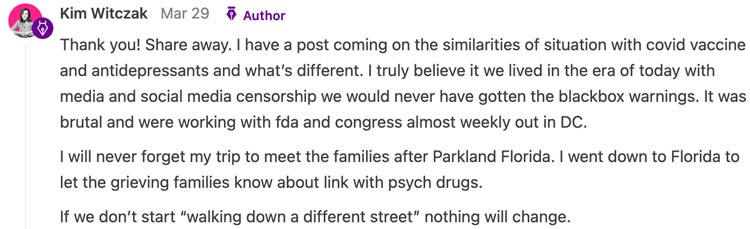
Note: Renowned journalist Sharyl Attkisson has made an excellent case the prolific censorship we have become accustomed to began during the Obama presidency.
My hope is that the harm of the COVID-19 vaccines is so egregious and unambiguous, and more importantly, has affected so many people, that it will prompt enough public outcry to fix or at least improve this systemic corruption.
In this series, I have tried to illustrate how the gross malfeasance that allowed the SSRIs to be brought onto the market and kept there despite countless red flags telling the FDA the drugs were not safe. Overcoming the pressure to take these drugs off the market in turn required a lot of money to be behind those drugs.
In the final part of this series, we will explore how the SSRI industry convinced the world everyone needed their (typically worthless) pills (while simultaneously causing many effective SSRI treatments to be dismissed and forgotten). Much of our culture is shaped by the pharmaceutical industry brands diseases and I believe the tactics they use must be recognized so our society stops falling victim to them.
I thank each of you for reading this series and helping bring attention to this tragedy as many people I am close to have been.
A Note From Dr. Mercola About the Author
A Midwestern Doctor (AMD) is a board-certified physician in the Midwest and a longtime reader of Mercola.com. I appreciate his exceptional insight on a wide range of topics and I’m grateful to share them. I also respect his desire to remain anonymous as he is still on the front lines treating patients. To find more of AMD’s work, be sure to check out The Forgotten Side of Medicine on Substack.
Decades of Evidence That SSRI Antidepressants Can Cause Mass Shootings
Reproduced from original article:
https://articles.mercola.com/sites/articles/archive/2023/12/30/ssri-antidepressants-mass-shootings.aspx
The original Mercola article may not remain on the original site, but I will endeavor to keep it on this site as long as I deem it to be appropriate.
Analysis by A Midwestern Doctor December 30, 2023
STORY AT-A-GLANCE
- SSRI antidepressants have a variety of horrendous side effects. These include sometimes causing the individual to become agitated, feeling they can’t be in their skin, turning psychotic, and occasionally becoming violently psychotic
- During these psychoses, individuals can have out of body experiences where they commit lethal violence either to themselves or others
- As lawsuits later showed, this violent behavior (and the frequent suicides that followed it) were observed throughout the SSRI clinical trials, but were covered up by the SSRI manufacturers and then the drug regulators (e.g., the FDA)
- Once the SSRIs entered the market, there has been a wave of SSRI suicides and unspeakable acts of violence
- Sadly, the idea that SSRIs could cause any of this has always been viewed as a “conspiracy theory” or “mistaking correlation with causation” because very few are aware of the extensive evidence linking SSRIs to violent and psychotic behavior — despite it now being on the warning label of those drugs
Most holistic doctors consider Selective Serotonin Reuptake Inhibitors (SSRI) anti-depressants to be one of most harmful mass-prescribed drugs on the market (it typically makes their top 5). However unlike the other drugs, which are just unsafe and ineffective, SSRIs also have a fairly unique problem — they can kill people who are not even taking the drugs.
Note: Other common contenders for that list are Statins, NSAIDs (e.g., ibuprofen), and acid reflux medications (proton pump inhibitors like prilosec). The harms and irrationality of those drugs are discussed here, here and here.
Since SSRIs first entered the market, many have noticed the unusual correlation between their consumption and completely out of character violently psychotic behavior, such as extremely disturbing homicides or suicides being committed by the individual.
As the years have gone by, more and more evidence has accumulated (e.g., through lawsuits against the drug companies) that SSRIs cause psychotic violence, and in parallel, as the usage of these drugs has spiked, more and more grisly killings have occurred.
As you might imagine, there are many taboo areas in medicine (e.g., suggesting that vaccines can cause neurological damage to children). However, out of all of them, I’ve found by far the most hostility is directed towards anyone who insinuates mass shootings may be linked to SSRIs (e.g., I got in quite a bit of professional trouble for doing this in the past).
One of the first articles I wrote on Substack (on 5-27-22) was about this topic. It went viral and since then I’ve noticed there has gradually been more and more people who have been willing to speak out on it.
I attribute this to the current political climate (the Trump presidency and the vaccine mandates has made conservatives much more willing to question both big media and big Pharma) being one where this message wanted to be heard and other conservative commentators seeing a large audience for it existed.
Two months later (on 7-25-22), Tucker Carlson aired what I believe to be the first segment I’ve seen in the mainstream media discussing this taboo topic:
Note: I edited out the political commentary from this segment. The full version of it can be viewed here.
Since that time, other prominent conservatives have spoken out on this issue (e.g., Rep. Marjorie Taylor Greene). Conversely, the horror of the “far-right hysteria against SSRIs” has become a talking point of the left (e.g., see this Huffington Post piece and this Slate piece) — something I suspect is due to the high rates of psychiatric medication usage in the modern left and big Pharma buying out the Democratic party during Obama’s presidency.
Fortunately, those attacks did not work, and the violent risks of SSRI’s have gradually become more acceptable to talk about (e.g., RFK Jr. has mentioned them during his presidential campaign and not backed down when challenged on the point).
In turn, each time a mass shooting happens, the same script is repeated (we need to ban all guns and have more mental health care [i.e. psyche meds] for everyone). Fortunately, this script is losing its appeal and SSRIs are more and more frequently being mentioned each time a mass shooting happens.
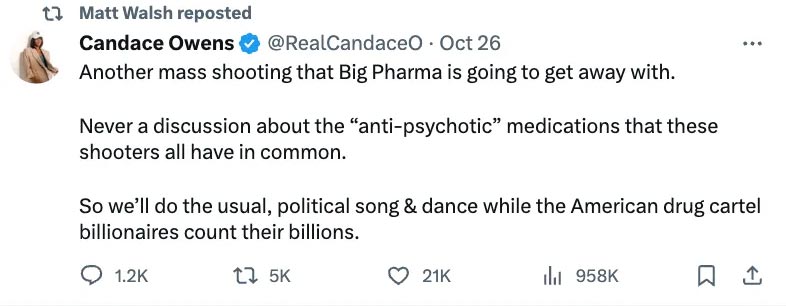
Recently Matt Walsh also did a segment on this topic, which like Tucker’s segment was seen by millions of people.
Note: The full version of this episode can be viewed here.
Having watched this dynamic play out for decades, it’s hard for me to put into words how monumental of a change this newfound awareness of the dangers of SSRIs is.
The only comparable example I can think of are many people now being open to considering the dangers of childhood vaccination — something which has taken a century to bring into the public awareness (e.g., my friends who gave everything they had to speak out in the 1980s and 1990s on vaccine safety were almost completely alone and cannot believe just how much the public’s receptivity to this message has changed in the last few years).
Correlation or Causation?
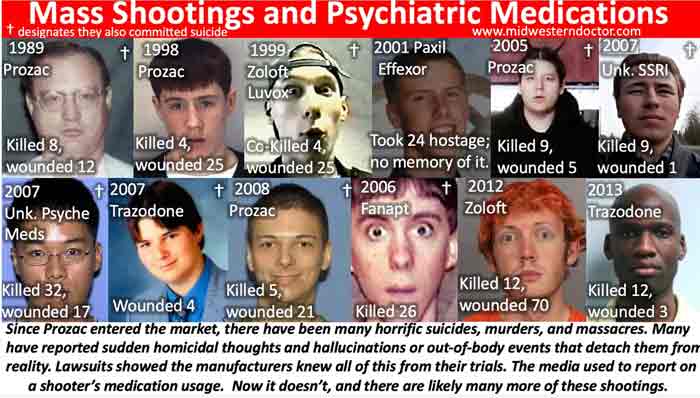
One of the most common arguments used to dismiss the link between SSRIs and psychotic violence is that people who are mentally ill are more likely to be on psyche meds, so the “correlation” between psyche meds and psychotic violence is simply a product of pre-existing mental illness and would have happened independently of the psyche med.
However, while claiming “correlation is not causation” makes it possible to refute this link while sounding intelligent in the process, there are a few major problems with this argument.
First, there is a lot of evidence tying SSRI usage to these events, including clinical trial data that was hidden from the public. Since that evidence was not covered in Tucker or Walsh’s presentation, it will be the focus of this article.
Second, there is a black-box warning on the SSRIs for them increasing the risk of suicide, something which can only be possible if some degree of causation does in fact exist.
Third, these psychotic events are completely out of character for the individuals who commit them, and in many cases they report a very similar (and disconcerting) narrative of what they experienced prior to and during the shooting.
Note: Big Pharma, working hand in hand with the FDA fought tooth and nail for decades to prevent a warning from ever being added to the SSRIs. I believe this is in part due to how much money is made off of these drugs (presently their sales make approximately 40 billion dollars a year).
The SSRI Era
Selective serotonin reuptake inhibitors (SSRIs) have a similar primary mechanism of action to cocaine. SSRIs block the reuptake of Serotonin, SNRIs, also commonly prescribed block the reuptake of Serotonin and Norepinephrine (henceforth “SSRI refers to both SSRI and SNRI), and Cocaine blocks the reuptake of Serotonin, Norepinephrine, and Dopamine.
SSRIs (and SNRIs) were originally used as anti-depressants, then gradually had their use marketed into other areas and along the way have amassed a massive body count.
Once the first SSRI entered the market in 1988, Prozac quickly distinguished itself as a particularly dangerous medication and after nine years, the FDA had received 39,000 adverse event reports for Prozac, a number far greater than for any other drug.
This included hundreds of suicides, atrocious violent crimes, hostility and aggression, psychosis, confusion, distorted thinking, convulsions, amnesia, brain-zaps, a feeling that your brain longer works right, and sexual dysfunction (long-term or permanent sexual dysfunction is one of the most commonly reported side effects from anti-depressants, which is ironic given that the medication is supposed to make you less, not more depressed).
Note: I and many colleagues also believe the widespread adoption of psychotropic drugs has significantly distorted the cognition of the demographics of the country that frequently utilize them (which to some extent stratifies by political orientation), which in turn has created a wide range of detrimental shifts in our society.
SSRI homicides are common, and a website exists that has compiled thousands upon thousands of documented occurrences. As far as I know (there are most likely a few exceptions), in all cases where a mass school shooting has happened, and it was possible to know the medical history of the shooter, the shooter was taking a psychiatric medication that was known for causing these behavioral changes.
After each mass shooting, memes illustrating this topic typically circulate online (often citing many of the same individuals in the picture in the previous section).
However, as mentioned above, the idea that “SSRIs cause mass shootings” is treated with widespread ridicule and animosity in a manner not that different from how anyone who claimed the “COVID vaccines were NOT safe and effective” was treated in 2020.
For instance, the argument to debunk both was always “correlation is not causation” (e.g., the young healthy lady who had a fatal heart attack immediately after a vaccine might have had that happen anyways), and when data to support this contention is presented, it is always ignored by the other side.
Since there are many serious issues with psychiatric medications, to avoid being too long, this article will exclusively focus on their tendency to cause horrific violent crimes, something which was known long before they entered the market by both the drug companies and the FDA.
Note: A significant portion of this article came from the book Deadly Psychiatry and Organized Denial by Peter C. Gøtzsche (which builds upon the critical work Peter Breggin did to expose this issue). For those of you interested in learning more about this topic, I would strongly advise reading that book, as I can only scratch the surface of the issues with these medications within this brief article.
Lastly, for anyone who reads this article is presently taking an SSRI or SNRI, it is critically important to NOT suddenly stop taking them. These addictive drugs produce very strong (and longlasting) withdrawal symptoms that many of my readers have shared. More importantly, there are many cases of catastrophic events (e.g., a suicide or mass murder) that followed the abrupt discontinuation of an SSRI.
If this is something you choose to do, you need to gradually taper down the dosage (sometimes to the point you use sandpaper to slowly shrink a pill) with a professional who has experience in this area.
However, since doctors who help can you safely withdraw from an SSRI are difficult to find, we put together a guide on the (incredibly unfair) withdrawal process which can be viewed in the second half of this article.
Note: Many of the stories I will share in this article are similar to those I have received from numerous readers (e.g., see the comments on the first article, second article, third article, and fourth article along with numerous comments on Twitter) — which I believe highlights how common SSRI injuries are. Many of these stories are very difficult to read through, but I nonetheless believe need to be heard.
Download this Article Before it Disappears
Akathisia
One of my relatives grew up in a big city during a particularly bad crime wave. One of his most notable memories from the time was looking up and seeing a man who was screaming “the ants are trying to get me” frantically tying bedsheets together (so he could flee down the fire escape) as armed men were rushing to his location yelling “get that ***** ******.”
My relative ran out of the area to avoid getting shot, but from the brief look he had at the fleeing man, was almost certain that man was high on cocaine, and experiencing coke (or crack) bugs, one form of Akathisia and a well-documented effect of those drugs.
Akathisia, an extreme form of restlessness is defined as a psycho-motor disorder where it is extremely difficult to stay still. What this definition omits to mention is that akathisia is incredibly unpleasant to the degree that many individuals who experience it frequently commit suicide or homicide (or both). One of the earliest reports from patients with drug-induced akathisia was:
“They reported increased feelings of strangeness, verbalized by statements such as ‘I don’t feel myself’ or ‘I’m afraid of some of the unusual impulses I have.’”
Akathisia is much more common than most people realize. To share a personal anecdote — I occasionally discuss this topic with medical students and a few have confided they previously experienced akathisia after using a psychiatric medication and it was so excruciating that one told me they seriously contemplated suicide at the time.
Akathisia (and psychosis) are known side effects of cocaine, methamphetamine, SSRIs, antipsychotics, and ADHD stimulant medications.
However, while the common triggers have been identified, the actual mechanism for akathisia is still poorly understood and theorized to result from alterations in the center of the brain involved in movement. These behavioral changes are so unusual and disturbing there are often simply described as the individual appearing to be possessed.
Note: Numerous patients I’ve talked to (with or without akathisia) who had bad reactions to SSRIs have shared that they felt as though some type of dark force was trying to take over their body.
From my own exploration of this topic, I have noticed that some individuals with cocaine intoxication (I have not yet examined a patient on the other drugs experiencing akathisia) have a characteristic (often porous) perturbation in their bio-electric field, which while very complex to describe, does resemble “frantic ants running all over the body,” and in theory could explain part of the akathisia experience.
As this idea is contained within a medical model most healthcare practitioners do not ascribe to, it has been difficult for me to evaluate the validity of this hypothesis. I have met a few other colleagues who made the identical observation, so this is a periodic topic of discussion amongst us as we believe there is significant value in developing a model that can explain this puzzling condition.
To further illustrate how perplexing the behaviors observed are on SSRIs consider this correspondence from a clinical investigator to Pfizer:

More importantly, consider Pfizer’s response:

A week ago, I heard the most compelling illustrations of this phenomenon I’ve come across after a 20-year-old with every characteristic of a mass shooter, snuck into an amusement park in Northern Colorado during the night.
“The suspect had been heavily armed with a semi-automatic rifle and semi-automatic handgun and multiple, loaded magazines for both weapons,” it added. “He was wearing body armor and what appeared to be a ballistic helmet. Additionally, multiple improvised explosive devices (IEDs) were discovered with the suspect and in a vehicle associated with the suspect.
The sheriff’s office said that while an investigation into the incident was ongoing, “given the amount of weaponry, ammunition, and explosive devices found, the suspect could have implemented an attack of devastating proportions upon our community.”
However, rather than conduct the shooting, he committed before the park opened and left a remarkable message:
“In the bathroom where Barajas Medina was discovered, written on the wall were the messages “I am not a killer” and “I just want to get into the caves,” a police spokesperson confirmed to Newsweek.”
Note: Like many other mass shooters, these actions were completely out of character for Barajas. His brother (who he lived with) “was at a loss for what was going on in his brother’s mind,” “didn’t know of any connections his brother had to the park” and stated “I didn’t think he was a dangerous person.”
This narrative suggests that the psychosis Barajas was under partially wore off during the night, at which he recognized something evil was compelling him to do the shooting and he chose to end his life to prevent it. This is similar to a few other stories I’ve heard of SSRI violence.
For instance, Cory Baadsgaard developed increasing (and sometimes demonic) hallucinations after starting an SSRI, went to school with a loaded rifle and then partially realized what he was doing after he’d taken everyone hostage, surrendered, partially regained consciousness in the principle’s office, but had no memories of what had happened until he woke up in a cell at Juvenile Hall (where he spent 14 months).
Note: The next (three minute) video featured provides an even more powerful illustration of this phenomenon.
Akathisia Homicides
This section will list some of the evidence substantiating the link between psychiatric medications and horrific homicides. When you review this type of information, it is very easy to intellectually disassociate from what’s contained within it. For that reason, I would like to request you first watch this two-minute video of one father who has to live with knowing he killed his child he still loves from the bottom of his heart.
He was ultimately not criminally convicted, however, most individuals in these circumstances typically are.
Note: I need to emphasize that this individual’s story is not unique, he just has been unusually dedicated in bringing public awareness to what happened. It also illustrates how evil these drugs are, as like the individuals mentioned above, they become forced to do something that violates every core principle they stand for.
Much like the vaccine industry, the psychiatric industry will always try to absolve their dangerous medications of responsibility and will aggressively gaslight their victims. Despite these criticisms, there are three facts can be consistently found throughout the literature on akathisia homicides which Gøtzsche argues irrefutably implicate psychiatric medications as the cause of violent homicides:
• “These violent events occur in people of all ages, who by all objective and subjective measures were completely normal before the act and where no precipitating factors besides the psychiatric medication could be identified.
• The events were preceded by clear symptoms of akathisia.
• The violent offenders returned to their normal personality when they came off the antidepressant.”
Numerous cases where this has happened are summarized within this article from the Palm Beach Post. In most of those cases, a common trend of these spontaneous acts of violence emerges: the act of violence was immediately preceded by a significant change in the psychiatric medications used by the individual.
In one case, shortly before committing one of these murders, one of the perpetrators also journaled that, while taking Prozac, that he felt as if he was observing himself “from above.”
Individuals with a mutation in the gene that metabolizes psychiatric drugs are much more vulnerable to developing excessive levels of these drugs and triggering severe symptoms such as akathisia and psychosis.
There is a good case to be made that individuals with this gene are responsible for many of the horrific acts of iatrogenic (medically induced) violence that occur, however to my knowledge, this is never considered when psychiatric medications are prescribed.
Gøtzsche summarized a peer-reviewed forensic investigation of 10 cases where this happened (all but one of these involved an SSRI or an SNRI):
“Male, 18 years, Prozac, sister was comatose after a car crash, violent akathisia for 14 days, killed his father four days after he ran out of pills.
Male, 35 years, Paxil, distressed by “on and off” relationship with mother of his child, stabbed former partner 30+ times to death after 11 weeks of akathisia.
Male, 46 years, Paxil, anxiety about not making enough money to support the family, killed his son in a manic-shift akathisia and delirium after 42 days.
Male, 16 years, Zoloft and Prozac, depressed, struggled at school, and the girlfriend left him, attempted suicide on both drugs, killed therapist in hospital after 11 weeks.
Male, 50 years, Effexor, distress over divorce, shot a stranger four days after stopping drug.
Female, 35 years, nortriptyline, distress due to husband’s drinking, killed teenage daughter in toxic delirium after three days.
Male, 24 years, Lexapro, anxiety and illicit substance use, several suicide attempts and assaults, nearly killed partner, 12 years in jail for attempted murder.
Female, 26 years, several SSRIs, difficulties with in-laws, two attempts to kill her two children.
Female, 52 years, Paxil and Celexa, harassment at work, suicide attempt and tried to kill her two children.
Female, 25 years, Celexa and Effexor, marital distress, several suicide attempts on both drugs, jumped in front of a train with her child while on citalopram.”
There are many other sad cases of akathisia homicides. One detailed by Gøtzsche is representative of how the pharmaceutically injured patients can be gaslighted by psychiatry.
When reviewing the story, keep in mind that the FDA insert explicitly lists the following as side effects of Effexor (an SNRI): intentional injury, malaise, suicide attempt, depersonalization, abnormal thinking, akathisia, apathy, ataxia, CNS stimulation, emotional lability, hostility, manic reaction, psychosis, suicidal ideation, abnormal behavior, adjustment disorder (which became a psychiatric diagnosis for her, although it was a side effect), akinesia, increased energy, homicidal ideation, and impulse control difficulties.
“A 26-year-old woman tried to kill her two children on two occasions. She was prescribed Paxil for stress but experienced an episode of rage and attempted suicide by inhalation of carbon monoxide, and then stopped taking the drug. Despite this, she was prescribed Paxil again and reassured about its safety two years later.
This time she experienced intense restlessness, surges of rage and anger, panic attacks, impulsive spending sprees, and constant suicidal ideation. She reasoned that her low self-esteem, insomnia, and suicidal behavior were due to difficulties with her in-laws. She overdosed and was admitted to the hospital where her Paxil was increased. She tried to kill herself again and was diagnosed with an “adjustment disorder.”
She was switched to Effexor, which was increased over three months until the dose was eight times higher than the initial dose. Each dose increase occasioned a week spent in bed with exhaustion, as she was unable to get up (akinesia). Her mental state deteriorated and violent outbursts and suicidal ideation became frequent and severe.
Unable to stay in one place, she drove several hundred miles with her children and tried to kill them and herself by car exhaust. A few days later she tried to kill her children and herself again.”
Evidence for SSRI Suicides
Violent psychotic reactions from SSRIs can manifest as both suicides and homicides. There is extensive documentation to support the occurrence of SSRI suicides, and while the psychiatric profession still uses an endless litany of excuses to deny this happens, many antidepressants now have a black box warning from the FDA for the occurrence of suicide.
The side effects were definitively known to result from SSRIs as far back as their early clinical trials (which were of course hidden from everyone) and a mountain of evidence proving this regularly occurs has accumulated since these drugs entered the market (which led to the FDA having to find numerous unscrupulous ways to conceal that danger such as silencing employees who saw it, ignoring rampant clinical trial fraud by the manufacturers, publishing a fraudulent meta-analysis to erase it, and stonewalling Congress during hearings on the drugs).
There are a large number of studies showing the link between SSRIs and suicide (especially those kept secret by the pharmaceutical industry). These will not be discussed as they are not the main focus of this article, but to provide some context on the issue, I will briefly discuss a microscopic and macroscopic study examining this picture. First to quote this peer-reviewed study’s abstract:
“Six depressed patients free of recent serious suicidal ideation developed intense, violent suicidal preoccupation after 2-7 weeks of fluoxetine treatment. This state persisted for as little as 3 days to as long as 3 months after discontinuation of fluoxetine. None of these patients had ever experienced a similar state during treatment with any other psychotropic drug.”
Second, the CDC has a system for reporting violent deaths that have occurred, and one subset of those deaths are suicides (which may be associated with a homicide or a concurrent suicide). 3616 of these deaths were evaluated for the presence of an antidepressant, and 35.3% tested positive for one at the time of their death.
A large number of individual mood-altering substances were tested for, and the only one that had a higher positive test rate than the antidepressants was alcohol (38.2%), although only 26.9% of those tested had enough alcohol present to be considered legally drunk. In the general population, between 11-13.2% of adults use antidepressants, which suggests there is a note-worthy correlation here.
Evidence for Akathisia Homicides
Most of the placebo-controlled data which is available showing the instances of homicidal behavior after taking an SSRI is available because of court orders from lawsuits where someone sued an SSRI manufacturer for their actions while on the SSRI. Consider for example this report from one clinical trial:

[Pt. began to verbalize feelings of killing other people and then himself. Pt. looked much more anxious and depressed than baseline; even though this is not reflected in Hamliton (the scale used to quantify anxiety in research)]
When you consider these figures, it is important to remember that while a 0.1% death rate for a drug is tragic (but typically deemed acceptable within medicine), it is incomparable in consequence to a 0.1% homicide rate for a drug.
As millions of children are given SSRIs, even numbers that small mean homicides will regularly occur. I can’t even guess how low a risk would constitute an acceptable threshold, but for the sake of conveying other points in this section, I will assume it to be 0.1%. In reality, any elevated risk in this regard should be viewed as unacceptable without any exceptions. I am emphasizing this point because I have never seen it considered by proponents of psychotropic drugs.
An excellent paper reviews private pharmaceutical research made public through litigation. The paper discusses internal company documents that compared 9219 research subjects (many of whom had pre-existing psychiatric diagnoses) that received Paxil, to 6455 research subjects (also with pre-existing psychiatric conditions) that received a placebo, 0.65% of the patients in clinical trials became hostile on Paxil compared with 0.31% on placebo.
The highest risk for hostility on Paxil was for those who also had Obsessive Compulsive Disorder. (0.34% is more than the 0.1% threshold)
The authors of this paper hypothesized that the violent actions following the usage of SSRIs may be explained by their tendency to trigger akathisia, emotional blunting, and manic or psychotic reactions. I will quote a few select passages from that paper:
“In healthy volunteer studies, hostile events occurred in three of 271 (1.1%) volunteers taking Paxil, compared with zero in 138 taking placebo.” (1.1% is more than 0.1%).
In data from sertraline pediatric trials submitted by Pfizer, aggression was the most common cause for discontinuation [removal from the trial] from the two Zoloft placebo-controlled trials in depressed children.
In these trials, eight of 189 patients randomized to Zoloft were discontinued for aggression, agitation, or hyperkinesis (another term for akathisia frequently used to conceal it), compared with discontinuations for these reasons in the 184 patients on placebo …
When discontinuations for any manifestation of treatment induced activation (suicidal ideation or attempts, aggression, agitation, hyperkinesis, or aggravated depression) were considered, there were 15 discontinuations on Zoloft compared with two on placebo, which meant this was 7.3 times more likely to happen when on sertraline.” (8.9% is more that 0.1%., 7.3 times more likely likewise is also unacceptable).
In pediatric trials of Effexor, two percent of children dropped out because of hostility, more than double the rate of dropout on placebo.
After a program on Paxil in 2002, the producers of the BBC television programme Panorama received 1,374 e-mails from viewers, mostly patients. Researchers then analyzed the full set of these responses. Many respondents linked emotional storms and thoughts and acts of violence or self-harm to Paxil, both to starting drug treatment and to dosage change.
These were not simple anecdotal reports, in that the analysis clearly pointed to a linkage with dosage. Second, they were self-reports of violence from patients with no apparent background of violent behavior. Third, the analysis was consistent with an analysis of reports of thoughts and acts of violence or self-harm on paroxetine that doctors had sent to the MHRA (England’s FDA) about other patients between 1991 and 2002.
In both patient and medical reports, severe mood changes were commonly associated with changes of drug dosage during the first week of treatment, with later dosage increase, or with dosage decrease or drug withdrawal. The accounts reported in both the medical and the patient series had much in common, including time frame and a linkage to dosage.”
Gøtzsche likewise has located less biased sources of data on the violent risks of SSRIs:
“As the published trial literature related to suicidality and aggression on antidepressants is unreliable, we looked at 64,381 pages of clinical study reports (70 trials) we got from the European Medicines Agency. We showed for the first time that SSRIs in comparison with placebo increase aggression in children and adolescents, odds ratio 2.79 (95% CI 1.62 to 4.81) (2).
This is an important finding considering the many school shootings where the killers were on SSRIs.
In a systematic review of placebo-controlled trials in adult healthy volunteers, we showed that antidepressants double the occurrence of events that the FDA has defined as possible precursors to suicide and violence, odds ratio 1.85 (95% CI 1.11 to 3.08)(3). The number needed to treat to harm one healthy adult person was only 16 (95% CI 8 to 100).
Based on the clinical study reports, we showed that adverse effects that increase the risk of suicide and violence were 4-5 times more common with duloxetine than with placebo in trials in middle-aged women with stress urinary incontinence. There were also more women on duloxetine who experienced a core or potential psychotic event, relative risk RR 2.25 (95% CI 1.06 to 4.81).
The number needed to harm was only seven. It would have been quite impossible to demonstrate how dangerous duloxetine is, if we had only had access to published research. In accordance with our findings, the FDA has previously announced that women who were treated with duloxetine for incontinence in the open-label extension phase of the clinical studies had 2.6 times more suicide attempts than other women of the same age.”
Gøtzsche has also reviewed some of the key legal cases regarding SSRIs:
“Akathisia homicides have been defended as instances of involuntary intoxication both with and without genetic evidence, and some people have succeeded in receiving damages from the manufacturers for failure to warn … the filings in a case on Paxil against SmithKline Beecham [now named GSK] included an unpublished company study of incidents of serious aggression in 80 patients, of which 25 resulted in homicide.
In one case, a man aged 74 strangled his wife, and another was 66 when he became delusional on Prozac and killed his wife who was found with 200 stab wounds.
In 2001, for the first time, a jury found a pharmaceutical firm liable for deaths caused by an antidepressant. Donald Schell, aged 60, had been taking Paxil for just 48 hours when he shot and killed his wife, his daughter, his granddaughter and himself.
Central to the case were SmithKline Beecham internal documents showing the company was aware that a small number of people could become agitated or violent from Paxil. Despite this knowledge, paroxetine packaging deliberately did not include a warning about suicide, violence or aggression.
The internal documents, stamped “confidential,” list the results of tests involving more than 2,000 healthy volunteers taking either Paxil or placebo. Some volunteers experienced anxiety, nightmares, hallucinations and other side effects – definitely caused by the drug – within two days of taking it.
Two volunteers attempted suicide after 11 and 18 days, respectively … Ten years after the verdict, GSK still denies that Paxil can cause people to commit homicide and suicide and that there are withdrawal problems.”
Note: After publishing the original article, I received this comment from a reader and their permission to share it:
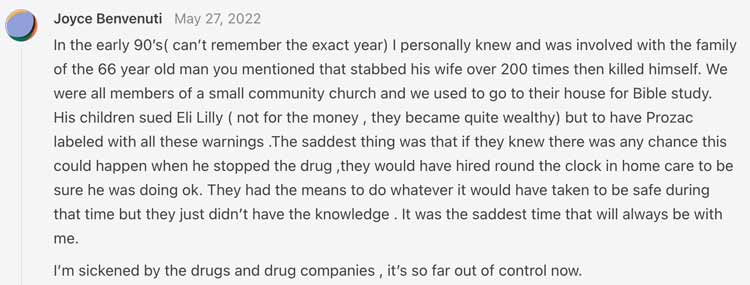
Typically, American courts are more likely to rule in favor of the pharmaceutical company, and Donald Shell (mentioned above) was a lucky exception. For example consider the three following cases:
“Christopher Pittman became manic and shot his two grandparents to death two days after his dose of Zoloft had been doubled. Despite being only 12 years old when he did this, he was sentenced to 30 years of prison.
David Crespi was on Prozac and three other drugs, which he had taken for a couple of weeks, when he killed his two twin daughters with a knife. He pleaded guilty to avoid the death penalty and got a life sentence with no chance of parole, although he became his old self after coming off the drugs.
Kurt Danysh was 18 years old when he was inappropriately prescribed Prozac by a general practitioner. He became restless and violent and shot his father, the person he loved the most, 17 days later in a totally out-of-character mood. Kurt had no history of violence prior to Prozac, but in 1996, he was convicted of murdering his father and sentenced to 22.5 to 60 years in prison.
During this case, Eli Lilly lied in court, and claimed that Prozac would not cause aggressive behaviour resulting in his conviction. Later in 2004 when it was exposed Lilly had concealed data from 1988 showing Prozac caused violence, the FDA recognized that SSRIs can cause violent behaviour, particularly in children and adolescents.
Despite these events and dozens of cases of homicide linked to Prozac that had subsequently been reported to the FDA, the judge has dismissed all appeals, and it took 24 years of legal work and petitioning for Kurt to finally be released from prison.”
Next, I would briefly like to share the work of an activist who was intimately involved in those court cases.

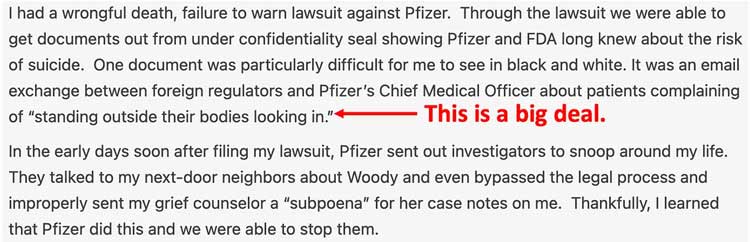
Note: Pfizer’s manual that was used to criminally convict victims of its SSRI (so the market could be shielded from public scrutiny) can be viewed here. Having reviewed it, I can state with certainty Pfizer included statements known to Pfizer to be false at the time this was written.
If you have time after you finish reading this article, I would highly recommend reading Pfizer’s prosecutor manual so you can see just what vintage early 1990s gaslighting looked like (it is quite a bit more sophisticated now). Additionally, the judgement from Witczak’s lawsuit against Pfizer can be viewed here, while many more appalling stories from whistleblowers within Pfizer can be viewed here and here.
Gøtzsche also notes the Canadian court system is more open to acknowledging pharmaceutical induced homicide. For example:
“In 2011 a Canadian judge ruled that Prozac induced a 16-year old boy to commit murder; he knifed a friend to death. In another case David Carmichael, who killed his 11-year old son while on antidepressants, was ruled “not criminally responsible on account of a mental disorder,” and today, Carmichael writes and speaks on the dangers of antidepressants.”
Mass Shooting and Psychiatric Medications
In the 1990s, school shootings transitioned from being very rare to a frequent facet of American life. As this timeline overlaps with the entrance of SSRIs to the US market (and the populace suddenly being flooded with psyche drugs), many articles have evaluated the link between mass shootings and psychiatric medications. I will quote a one of the more comprehensive summaries (written in 2013) which attempted to analyze all known mass shootings:
- Eric Harris age 17 (first on Zoloft then Luvox) and Dylan Klebold aged 18 (Columbine school shooting in Littleton, Colorado), killed 12 students and one teacher and wounded 23 others, before killing themselves. Klebold’s medical records have never been made available to the public.
- Jeff Weise, age 16, had been prescribed 60 mg/day of Prozac (three times the average starting dose for adults!) when he shot his grandfather, his grandfather’s girlfriend and many fellow students at Red Lake, Minnesota. He then shot himself. Ten dead, 12 wounded.
- Cory Baadsgaard, age 16, Wahluke (Washington state) High School, was on Paxil (which caused him to have hallucinations) when he took a rifle to his high school and held 23 classmates hostage. He has no memory of the event.
- Christopher Pittman, age 12, murdered both his grandparents while taking Zoloft.
- Kip Kinkel, age 15, (on Prozac and Ritalin) shot his parents while they slept then went to school and opened fire, killing two classmates and injuring 22 shortly after beginning Prozac treatment.
- Luke Woodham, age 16 (Prozac) killed his mother and then killed two students, wounding six others.
- A boy in Pocatello, ID (Zoloft) in 1998 had a Zoloft-induced seizure that caused an armed standoff at his school.
- Michael Carneal (Ritalin), age 14, opened fire on students at a high school prayer meeting in West Paducah, Kentucky. Three teenagers were killed, five others were wounded.
- Andrew Golden, age 11, (Ritalin) and Mitchell Johnson, aged 14, (Ritalin) shot 15 people, killing four students, one teacher, and wounding ten others.
- TJ Solomon, age 15, (Ritalin) high school student in Conyers, Georgia opened fire on and wounded six of his classmates.
- James Wilson, age 19, (various psychiatric drugs) from Breenwood, South Carolina, took a .22 caliber revolver into an elementary school killing two young girls and wounding seven other children and two teachers.
- Elizabeth Bush, age 13, (Paxil) was responsible for a school shooting in Pennsylvania
- Jason Hoffman (Effexor and Celexa) – school shooting in El Cajon, California
- Neal Furrow (Prozac) in LA Jewish school shooting reported having been court-ordered to be on Prozac along with several other medications.
- Hammad Memon, age 15, shot and killed a fellow middle school student. He had been diagnosed with ADHD and depression and was taking Zoloft and “other drugs for his conditions.”
- Matti Saari, a 22-year-old culinary student, shot and killed nine students and a teacher, and wounded another student, before killing himself. Saari was taking an SSRI and a benzodiazapine.
- Steven Kazmierczak, age 27, shot and killed five people and wounded 21 others before killing himself in a Northern Illinois University auditorium. According to his girlfriend, he had recently been taking Prozac, Xanax, and Ambien. Toxicology results showed that he still had trace amounts of Xanax in his system.
- Finnish gunman Pekka-Eric Auvinen, age 18, had been taking antidepressants before he killed eight people and wounded a dozen more at Jokela High School – then he committed suicide.
- Asa Coon from Cleveland, age 14, shot and wounded four before taking his own life. Court records show Coon was on Trazodone.
- Jon Romano, age 16, on medication for depression, fired a shotgun at a teacher in his New York high school.
The article also discussed a few recent school shootings where the information to determine if a psychiatric medication was used was not available (since is mentioned before, the industry has gotten much better at concealing this):
- What drugs was Jared Lee Loughner on, age 21 … killed six people and injuring 14 others in Tuscon, Az? [I was unable to locate any information on this case]
- What drugs was James Eagan Holmes on, age 24 … killed 12 people and injuring 59 others in Aurora Colorado? [Holmes was on Zoloft, which likely triggered violent behaviors in him in the weeks preceding the mass shooting, all of which his psychiatrist ignored.]
- What drugs was Adam Peter Lanza on, age 20, Killed 26 and wounded 2 in Newtown Ct.? [Lanza was later confirmed to have been prescribed Celexa in the past and was on a questionable antipsychotic, fanapt, known for inducing violent behavior at the time of the shooting].
Since the time that article was published, there have been many more large school shootings. In the five which immediately followed:
• Christopher Harper-Mercer (2015) who killed 10 was likely on psychiatric medication but there is no definitive proof.
• Nikolas Cruz (2017) who killed 17 was likely on psychiatric medication but there is no definitive proof.
• Dimitrios Pagourtzis (2018) who killed 10 was probably not on a psychiatric medication. His attorney said he was not (which may have been a deceitful legal maneuver, but most likely was the truth), while the president of the NRA said he was (and I was not able to determine his basis for this assertion).
• For Salvador Ramos (2022) who recently killed 22, there have been many posts stating he was on antidepressants, but while there is some circumstantial evidence suggesting this, there is presently no reliable information to confirm or deny it. For a more detailed summary of my thoughts on this matter, please see this comment.
• With the recent school shooter Audrey Hale, most of the focus has been on the shooter presumably taking testosterone, as this can trigger aggression.
While like many things, this potentially explains what happened, in the reports I found where testosterone led to homicidal behavior, it required a pre-existing psychiatric illness (which would typically be treated with a violence inducing psychiatric medication) to also be present.
Since a clear link has already been established to psychiatric medications causing this behavior (and based on the shooter’s background it is likely some were prescribed), I would suggest that until more information becomes known, the standard psychiatric medication violence it is a more probable explanation for the recent tragic events.
Note: Since Audrey Hale’s shooting, additional mass shootings have also occurred (e.g., those mentioned by Walsh like the recent one in Maine) where it was known the individual had psychiatric issues, despite repeated warnings those issues were not addressed, and based their history was almost certainly on psyche meds (but the public has not been permitted to know if they were).
Conclusion
While the tendency to provoke violence toward others is a major issue with SSRIs and other related medications, it is rarely considered a side effect of these drugs. One reason for this is that the other severe adverse effects from these medications are much more common (for example, SSRIs are one of most common causes of bipolar disorder) and as a result, these awful effects occupy a disproportionate focus when discussing their toxicity.
I however focused on this issue, because like the sudden deaths caused by the COVID-19 vaccines, it is so unmistakable and concerning it cuts through any the ambiguity over what the drug or vaccine is doing.
Sadly, In addition to SSRIs extremely damaging, it is very questionable if for most people (excluding those with a metabolic type that responds to SSRIs) these drugs have any benefit beyond statistical artifacts created by biased corporate research. This is incredibly tragic since:
• It results in many people taking a pill that ruins their life but simultanously had nothing of benefit to offer them in the first place.
Note: Did you know what Prozac was first discovered, Eli Lilly originally planned to sell it as a obsesity pill but pivoted to it treating depression because Lilly recognized that since “depression” is so subjective, it would be easy to create “proof” Prozac worked even if nothing happened?
• It results in effective treatments for depression (of which there are many) becoming largely forgotten since there is no money in adopting those approaches.
Note: We attempted to summarize those treatments in the second half of this article.
• The SSRIs being muscled through the approval process had a corrosive influence on the drug regulators and left us with a profound degree of corruption the public has repeatedly had to suffer through.
Note: Many of the regulators who signed off on the SSRIs either had already worked for the SSRI industry or soon after pushing the SSRIs through, left their regulatory agency (e.g., the FDA) and were hired by the drug industry.
This is not to different to how many of the officials (e.g., two sequential FDA commissioners) who muscled the COVID-19 vaccines through the approval process then left the agency and were rewarded with lucrative executive positions with the mRNA vaccine manufacturers.
In short, I believe what happened with the SSRIs provides a pivotal lesson for the modern vaccine safety movement. In both cases, we’ve seen incredibly dangerous (but profitable) pharmaceuticals be pushed upon the entire world but rather than our regulators do their jobs and protect the public, they’ve sided with the industry they are supposed to regulate (which in part is due to how much of the FDA’s funding comes from Big Pharma).
However, while the COVID-19 vaccines are almost complete immune from lawsuits, the SSRIs were not, and as a result, extensive litigation spearheaded by families of those directly harmed by SSRI violence were able to get the secret files which showed how abhorrent the industry’s conduct actually was.
One of the most remarkable things about the SSRI saga, is that as bad as the SSRI story is, the government was actually much less corrupt then and many were willing to try to do something about what was happening — something which has been almost non-existent throughout COVID-19. In turn, Kim made a particularly poignant comment on our sad state of affairs:
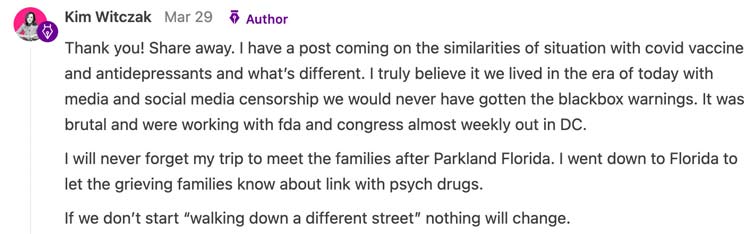
As we conclude, I recognize that this is an immensely challenging subject and I appreciate you for being able to maintain a level head while reading it. Thank you for the time and focus you have given to this topic and for sharing it with others who can benefit from it.
Lastly, I know this is already been stated, but do not attempt to stop taking an SSRI without the assistance of a physician who understands how to taper them. Very bad things can happen if you do not follow that advice.
In the next part of this series, I discuss the less severe but far more frequent harms of the SSRIs (some of which affect over half of the users).
This will be followed by examining how the drugs this dangerous could have gotten onto the market and the egregious corruption within the FDA that kept anything from being done about it as the injuries and deaths piled up.
Finally, this series will cover how the pharmaceutical industry created the “depression” industry and convinced the entire world to spend billions on their unsafe and frequently ineffective treatments for it while simultaneously dismissing the actual causes of depression and its (non- monetizable) treatments.
Lastly, if you have a way to get the data in this series to courageous journalists who are raising awareness on this issue, that would be greatly appreciated. I believe once this data becomes public knowledge, it will be much harder to maintain the current status disastrous quo with the SSRIs.
A Note From Dr. Mercola About the Author
A Midwestern Doctor (AMD) is a board-certified physician in the Midwest and a longtime reader of Mercola.com. I appreciate his exceptional insight on a wide range of topics and I’m grateful to share them. I also respect his desire to remain anonymous as he is still on the front lines treating patients. To find more of AMD’s work, be sure to check out The Forgotten Side of Medicine on Substack.
A Powerful Adaptogen That Boosts Vitality and Performance
Reproduced from original article:
https://articles.mercola.com/sites/articles/archive/2023/05/29/rhodiola-benefits.aspx
The original Mercola article may not remain on the original site, but I will endeavor to keep it on this site as long as I deem it to be appropriate.
Analysis by Dr. Joseph Mercola Fact Checked May 29, 2023
STORY AT-A-GLANCE
- Rhodiola rosea, sometimes called “golden root,” “roseroot” or “arctic root,” is a powerful adaptogen known to enhance vitality by helping your body adapt to physical, chemical and environmental stress
- Rhodiola rosea extract has been shown to have antidepressant and antianxiety effects, and helps improve symptoms associated with burnout
- The bioactive compounds rosavin and salidroside in rhodiola rosea have been shown to improve passage of serotonin precursors through the blood-brain barrier, and help preserve serotonin, thereby boosting mood
- Extract of rhodiola rosea not only may also enhance cognitive functions, modulate immune function, enhance cardiovascular, nervous system and reproductive health, but also has antiviral effects and enhances physical performance
Editor’s Note: This article is a reprint. It was originally published February 12, 2018.
The perennial plant rhodiola rosea, sometimes called “golden root,” “roseroot” or “arctic root,” is a powerful adaptogen known to enhance vitality by helping your body adapt to physical, chemical and environmental stress. In other words, it helps your body maintain homeostasis. The plant has a long history of use in traditional folk medicine in Russia and Scandinavian countries,1 and modern science has shown rhodiola:2,3,4,5,6
| Has antidepressant and antianxiety benefits7 and helps improve symptoms of burnout | Enhances cognitive function, improving mental clarity, thought formation and focus |
| Helps modulate immune function (raising low immune function and reducing overactive function) | Enhances nervous system health |
| Enhances cardiovascular health | Improves male and female sexual functioning, reproductive health and fertility |
| Improves blood sugar control in diabetics when combined with cinnamon | Has anticancer benefits |
| Helps protect against viral infections8 | Enhances athletic performance and shortens recovery time between workouts |
Exercise Benefits of Rhodiola
A 2004 study9 found extract of rhodiola rosea radix had an anti-inflammatory effect on healthy untrained volunteers, before and after bouts of exhausting exercise. It also protected muscle tissue during exercise. According to the abstract:
“Professional athletes effectively use rhodiola rosea (‘golden radix’) extract as a safe nonsteroid food additive improving endurance and rapid recovery of muscles during several decades. Rhodiola rosea extract improves muscle work due to mobilization and more economic expenditure of energy resources of muscles.
The use of adaptogens including R. rosea improved physical endurance of male athletes, reducing blood lactate level and accelerating recovery after exhausting exercise.”
Other studies have similarly found that rhodiola can significantly increase time to exhaustion during exercise,10 reduce C reactive protein levels and improve neuromotoric fitness. For example, a 2003 animal study11 found that rats given 50 milligrams per kilo (mg/kg) of rhodiola rosea extract along with the same amount of rhodiola crenulata root, prolonged the duration of exhaustive swimming the rats were capable of by nearly 25%.
This improvement was found to be due to the extracts’ ability to activate the synthesis or resynthesis of ATP in mitochondria. The extracts also stimulated reparative energy processes that take place post-exercise. Rhodiola rosea was determined to be the most effective of the two extracts for improving physical working capacity.
Antiviral Effects of Rhodiola
Rhodiola extract has also been shown to protect athletes from viral infections. In one study,12 48 marathon runners randomly received either 600 mg of rhodiola rosea or a placebo for four weeks prior to a race.
Blood samples were collected at three intervals: before the start of the race, and 15 minutes and 1.5 hours after the race ended. Follow-up studies using in vitro assays concluded that rhodiola was able to protect cells against the vesicular stomatitis virus for 12 hours after physical exertion.
David Nieman, director of the Appalachian State University Human Performance Laboratory, discovered that marathon runners are particularly prone to viral illnesses, especially upper respiratory tract illnesses, after competing. Rhodiola, he found, could help with this — in addition to providing athletes with enhanced performance and recovery benefits.
Download this Article Before it Disappears
Antidepressant Benefits
It’s not yet entirely clear how rhodiola rosea actually works, but some studies have shown it helps slow enzymatic breakdown of neurotransmitters such as serotonin by inhibiting monoamine oxidase.13,14 As such, it’s classified as an herbal monoamine oxidase inhibitor (MAOI). The bioactive phytochemical risiridin in rhodiola rosea has been shown to inhibit MAO-B by more than 80%. This helps explain some of its antidepressive and cognitive effects.
By boosting the concentration of important neurotransmitters in your brain, your neurons can communicate better. The bioactive compounds rosavin and salidroside in rhodiola rosea have also been shown to improve passage of serotonin precursors through the blood-brain barrier, and help preserve serotonin by dampening the activity of catechol-o-methyltransferase. Evidence suggests rhodiola also can raise serotonin levels significantly.15
Research published in 2015 compared rhodiola to the antidepressant sertraline, concluding it’s a safer choice. While the drug was overall more effective, rhodiola did improve depressive symptoms and had far fewer side effects. According to psychiatrists who use rhodiola in their clinical practice, the plant extract is a “viable choice in many cases for the treatment of mild to moderate depression.”16
According to a study published in the Journal of Alternative and Complementary Medicine, patients diagnosed with generalized anxiety disorder who received 340 mg of rhodiola rosea extract for 10 weeks also reported significant improvements in symptoms, based on the Hamilton anxiety rating scale, the four-dimensional anxiety and depression scale, and the clinical global impressions of severity/improvement scale.17
A number of other studies have also confirmed rhodiola’s mood boosting effects. According to health reporter and “medicine hunter” Chris Kilham, who specializes in discovering natural remedies:18
“Over 300 human studies19 on rhodiola rosea show that the plant has anti-stress, anti-anxiety, and anti-depressant properties, and that taking the extract of the root produces no significant negative effects. This is in sharp contrast to drugs for the same purposes, which typically cause sleep disorders, digestive upset, sexual dysfunction and a variety of mood disorders.
Unlike many other herbs, rhodiola rosea produces a palpable experience. When you take a preparation of this plant, you feel it. Typically, users report enhanced energy, improved mood, greatly reduced stress, better sleep and improved sexual vitality.”
Rhodiola Safely Combats Chronic Fatigue
Rhodiola’s energy- and vitality-boosting effects can have clear benefits for those struggling with chronic fatigue. A multicenter trial published last year found patients struggling with prolonged fatigue or chronic fatigue syndrome who received 400 mg of dry ethanol rhodiola extract per day for eight weeks experienced significant improvements within the first week.20
Overall, the most significant improvement occurred for the complaint of “general fatigue,” but scores for “impairment at work,” “impairment in social life,” and “impairment in family life” also significantly improved by the end of two months. In all, patients experienced a 42% reduction in total stress and a 39% reduction in fatigue. Eighty-three percent of them reported feeling “very much” or “much” improved by week eight. As reported by the American Botanical Council:21
“Nearly all outcome measures significantly improved over time and continued to decline to week eight, and the treatment was safe and well tolerated. Taken together, the authors conclude that the significant improvement in measures not only of core fatigue symptoms but a broad variety of symptoms and consequences of fatigue suggests a good potential for rhodiola to improve quality of life in chronic fatigue.”
The mechanism behind these effects is thought to be related to rhodiola’s ability to modulate catecholamine release and cAMP levels in your myocardium during stress.22 It also helps reduce the stress hormone cortisol. As noted by Mental Health Daily, “Other proposed mechanisms include interactions with protein kinases p-JNK, nitric oxide, defense mechanism proteins (e.g., heat shock proteins), and regulation of beta-endorphins and opioid peptides.”23,24
Rhodiola Safely Lowers Impact of Daily Stress
Importantly, rhodiola has been shown to be particularly beneficial for your nervous system. Work stress can trigger burnout, and research published in 2000 and 2017 suggest rhodiola can offer significant protection against this kind of stress. As noted in Life Extension Magazine:25
“A number of studies have shown that rhodiola can dramatically reduce mental and physical fatigue under stressful conditions, by increasing the body’s energy levels. In one study,26 a low dose (170 mg/day) of a R. rosea extract was given to 56 young physicians on night call, when there is notable decrease in physical and mental performance.
Using measures of cognitive and memory function, such as associative thinking, short-term memory, calculation, and speed of audiovisual perception, the researchers found a statistically significant reduction of stress-induced fatigue after just two weeks of supplementation with rhodiola. No side effects of rhodiola were reported.”
In a follow-up study27,28 published last year, 118 men and women with symptoms of burnout were given 400 mg of rhodiola rosea extract for 12 weeks. Over the course of the study, levels of emotional exhaustion, fatigue, exhaustion, lack of joy, loss of zest of life and depersonalization symptoms significantly improved.
Improved sexual functioning was also noted. According to the authors, the findings suggest rhodiola rosea extract “might be an important first step toward a continuous alleviation of burnout symptoms, thus inhibiting the exacerbation of the syndrome and preventing the development of subsequent disorders such as depression or physical illness.”
Rhodiola for Diabetic Control
While limited to animal research, evidence also suggests rhodiola may be helpful for diabetics when combined with cinnamomi cassia (cinnamon).29 Both of these remedies have been extensively used in folk medicine for the treatment of diabetes.
Here, diabetic rats fed a mix of rhodiola and cinnamon extracts for 12 weeks experienced significant reductions in blood glucose, while reduced glutathione, glutathione reductase, glutathione S-transferase, glutathione peroxidase, catalase and superoxide dismutase were increased.
Based on these effects, the researchers concluded that rhodiola extract may be helpful for “correcting hyperglycemia and preventing diabetic complications.”30 As noted by Life Extension Magazine,31 “These … results reaffirm earlier studies and anecdotal evidence demonstrating rhodiola as a comprehensive adaptogen that helps the body withstand the accumulating effects of stress and advancing age.”
- 1 American Botanical Council, Rhodiola Rosea: Phytomedicinal Overview
- 2, 16 Fox News April 15, 2015
- 3, 14, 19, 23 Mental Health Daily, Rhodiola Rosea Benefits
- 4, 25, 31 Life Extension December 2007
- 5 Medical News Today, Rhodiola Rosea
- 6 Superfoodly.com Rhodiola Rosea
- 7, 18 Fox News September 12, 2012
- 8 Natural Grocers
- 9 Bulletin of Experimental Biology and Medicine 2004 Jul;138(1):63-4
- 10 Phytomedicine 2011 Feb 15;18(4):235-44
- 11 Bulletin of Experimental Biology and Medicine 2003 Dec;136(6):585-7
- 12 Phytotherapy Research 2014 Dec;28(12):1829-36
- 13 Journal of Ethnopharmacology 2009 Mar 18;122(2):397-401
- 15 Molecules. 2022 Jun; 27(12): 3902
- 17 Journal of Alternative and Complementary Medicine 2008 Mar;14(2):175-80
- 20, 21 American Botanical Council, Complementary Medical Research February 2017; 24(1): 46-52
- 22 Eksp Klin Farmakol. 1994 Nov-Dec;57(6):61-3
- 24 Phytomedicine 2010 Jun;17(7):481-93
- 26 Phytomedicine 2000 Oct;7(5):365-71
- 27 Neuropsychiatric Disease and Treatment 2017; 13: 889–898
- 28 Nutra Ingredients USA August 18, 2017
- 29, 30 Biofactors 2006;26(3):209-19
Branch Chain Amino Acid Deficiency Linked to Autism?
Reproduced from original article:
https://articles.mercola.com/sites/articles/archive/2023/03/24/bcaa-deficiency-linked-to-autism.aspx
The original Mercola article may not remain on the original site, but I will endeavor to keep it on this site as long as I deem it to be appropriate.
Analysis by Dr. Joseph Mercola Fact Checked March 24, 2023

STORY AT-A-GLANCE
- Some cases of autism are caused by mutations in the branched chain ketoacid dehydrogenase kinase (BCKDK) gene; in those with BCKDK deficiency, BCAAs are broken down too quickly, leading to depletion
- BCAA deficiency is linked to a neurodevelopmental disorder that includes autism, intellectual disability and microcephaly
- In children with BCKDK deficiency, a high-protein diet and BCAA supplements led to significantly increased BCAA levels along with improvements or stabilizations in motor functions and head circumference in nearly all of the patients
- None of the children who started treatment before the age of 2 developed autism; the youngest child was 8 months old when treatment began, and they had normal development at age 3
- The researchers have called for adding BCKDK deficiency to newborn screening tests so BCAA supplementation could be started right away, potentially preventing autism development
Some cases of autism are caused by mutations in the branched chain ketoacid dehydrogenase kinase (BCKDK) gene.1 The BCKDK gene is involved in the metabolism of branched-chain amino acids (BCAAs). In those with BCKDK deficiency, BCAAs are broken down too quickly, leading to depletion.2
This, in turn, is linked to a neurodevelopmental disorder that includes autism, intellectual disability and microcephaly. Dietary changes, including supplementing with BCAAs, appears to be an effective treatment for some and, if started early, may even prevent autism from developing.
BCAA Supplements May Benefit Autism
In 2012, researchers found that supplementing with BCAAs reversed some of the associated neurological characteristics in mice, and explained:3
“By supplementing the diet of human cases with BCAAs, we have been able to normalize their plasma BCAA levels, which suggests that it may be possible to treat patients with mutations in BCKDK with BCAA supplementation.”
Joseph Gleeson, a professor with the University of California, San Diego, who was involved with the study, noted:4
“In a 2012 study, we determined that mice with a mutation in BCKDK that are on a diet low in branched-chain amino acids have traits similar to those of autistic children; feeding the animals high levels of the amino acids eliminates the traits.
Supplementing the diets of autistic children who have a BCKDK mutation improved their behavior remarkably. One young woman became calmer and spoke in full sentences; another was more energetic and attentive.
Although mutations in BCKDK appear to be rare, metabolic problems in autism may not be. One clinical trial found that nearly 17 percent of autistic participants showed signs of unusual amino-acid metabolism.5 And in 2012, researchers tied mutations in a gene involved in the synthesis of carnitine (a compound derived from an amino acid) to autism.6
The genetic risk factor is present in 1 in 350 boys, only 2 to 4 percent of whom have autism. However, if a boy with autism carries this mutation, a readily available supplement might treat the underlying cause.”
Could Early BCAA Supplementation Prevent Autism?
A 2023 study provides even more framework for using BCAAs to improve traits, such as head circumference and motor skills, in those with BCKDK deficiency.7 It used data from 21 children with BCKDK mutations, who were diagnosed with BCKDK deficiency when they were between 8 months and 16 years of age.
At the time of diagnosis, all the children had BCAA levels — including leucine, valine and isoleucine — below reference values in plasma and cerebrospinal fluid. All the children also had neurodevelopmental delays, including gross motor function impairment, intellectual disability, language impairment, autism spectrum disorder (ASD), epilepsy, clumsiness, hearing loss and/or feeding difficulties.
While none of the children had microcephaly at birth, 17 individuals developed it during the follow-up period.8 The children were treated with a high-protein diet (all protein-containing foods contain BCAAs) and BCAA supplements, which led to significantly increased BCAA levels along with improvements or stabilizations in motor functions and head circumference in nearly all of the patients.
Further, none of the three children who started treatment before the age of 2 developed autism. The youngest child was 8 months old when treatment began, and they had normal development at age 3. “This work highlights the potential benefits of dietetic treatment, in particular early introduction of BCAA,” according to the study.9
One of the best food sources of BCAAs is whey, which is rich in leucine. Grass fed beef and bison, organic, pastured eggs and grass fed dairy products are also good sources of BCAAs. The researchers have called for adding BCKDK deficiency to newborn screening tests. In the study, six of seven children with available newborn screening results had low amino acid levels.10
“Those children starting treatment younger, when they were younger than 2 years of age, evolve much better than the others,” lead study author Ángeles García-Cazorla told Spectrum News. “There is really a window of treatment where you can reverse or improve the disease a lot.”11
García-Cazorla informed Catalonia, Spain health officials in charge of newborn screenings about the study findings, and they added BCKDK deficiency to the screenings.
In the U.S., Spectrum News reported, “adding diseases to newborn screening can be a cumbersome and slow process. But many newborns already have their amino acid levels checked for another rare disease, maple syrup urine disease, [Gaia] Novarino [researcher on the 2012 study] notes. ‘So it should be a no-brainer to go ahead.’”12
Download this Article Before it Disappears
The Vitamin B12 Connection
It’s interesting to note that vitamin B12 is also sometimes used as a treatment for autism, with studies showing it typically has positive effects on symptoms13 such as expressive communication, daily living and coping social skills, sleep, gastrointestinal symptoms, hyperactivity, tantrums, vision, eye contact and more.
Vitamin B12 deficiency, meanwhile, may reduce the ability to metabolize BCAAs. In fact, a study on worms called Caenorhabditis elegans (C. elegans) found a B12-deficient diet harms the worms’ health at a cellular level by altering BCAA metabolism: “The research showed that the reduced ability to break down BCAAs led to a toxic buildup of partially metabolized BCAA byproducts that damaged mitochondrial health.”14
In a study of 57 children with autism, treatment with methyl B12 improved symptoms,15 while vitamin B12 deficiency in children can mimic signs and symptoms of autism, sometimes leading to a misdiagnosis. For instance, vitamin B12 deficiency can lead to obsessive-compulsive behaviors, aloofness, withdrawal and problems with speech, language and comprehension in children.16 Good food sources for vitamin B12 include:
| Grass fed organic beef and beef liver | Lamb |
| Venison | Scallops |
| Organic, pastured chicken and eggs | Raw organic, grass fed milk |
| Nutritional yeast |
The Mitochondrial Dysfunction Connection
Rates of autism continue to increase in the U.S., with the latest estimates showing 1 in 30, or 3.49%, of children ages 3 to 17 were diagnosed with ASD in 2020.17 One factor underlying this surge could be mitochondrial health. In October 2020, a scientific review published in Seminars in Pediatric Neurology outlined evidence that mitochondrial function may be related to autism.
It was estimated in 2017 that about 4% of children with autism could be diagnosed with a definite mitochondrial disease, while other research suggested abnormalities of mitochondrial function could affect up to 80% of children with autism.18
“Novel abnormalities” in mitochondrial function have been found in children with autism and treatments targeting mitochondrial dysfunction, such as L-carnitine supplementation and a ketogenic diet, have been found to be beneficial. Children whose autism is rooted in mitochondrial dysfunction will typically have a key set of symptoms that include:19
- Fatigability
- Gastrointestinal disorders
- Seizures and/or epilepsy
- Motor delay and/or ataxia and/or muscle weakness
- Unusual neurodevelopmental regression, including multiple regressions or regression later than commonly associated with ASD
The review’s author, Dr. Richard Frye with Barrow Neurological Institute at Phoenix Children’s Hospital in Arizona, pointed out that mitochondria are “very vulnerable to environmental factors” and a novel type of dysfunction of mitochondria “in which the activity of the electron transport chain is significantly increased … may be associated with environmental exposures.”20
In 2010, the federal vaccine court conceded that Hannah Poling’s autism was the result of vaccinations, which “significantly aggravated an underlying mitochondrial disorder, which predisposed her to deficits in cellular energy metabolism, and manifested as a regressive encephalopathy with features of autism spectrum disorder.”21
Do Antidepressants During Pregnancy Trigger Autism?
Environmental exposures, including to certain medications, are also likely involved. research, published in Brain, Behavior, and Immunity, suggests antidepressant drugs during pregnancy may play a role. The finding could have major implications for public health, considering that among pregnant women using antidepressants, 80% are prescribed antidepressant drugs known as selective serotonin reuptake inhibitors (SSRIs).22
The animal study revealed SSRIs may interact with inflammation in the mother’s body, producing a reaction that affects the maternal-fetal interface (MFI), which includes the decidua (a mucous membrane lining the uterus) and placenta, and ultimately the fetus’ developing brain.
Later in life, adult offspring whose mothers were exposed to inflammation during pregnancy had sex-based behavioral changes, including lessened communication and low interest in social interactions, mimicking those seen in people with autism.23
“Moreover,” the researchers explained, “the combination of maternal inflammation in the presence of pharmacologic inhibition of serotonin reuptake further transformed MFI physiology and offspring neurobiology, impacting immune and serotonin signaling pathways alike.”24
Even acetaminophen, brand name Tylenol, which many consider to be completely innocuous, is linked to autism when used during pregnancy. Compared to children of mothers with the lowest acetaminophen burden during pregnancy, children of those with the greatest acetaminophen burden had a 262% higher risk for ASD.
As noted by the authors, their findings “support previous studies regarding the association between prenatal and perinatal acetaminophen exposure and childhood neurodevelopmental risk.”25 Exposure to glyphosate,26 mercury, lead,27 aluminum28 and other chemicals, including phthalates29 and air pollution,30 has also been implicated in autism.
The Gut-Brain Connection in Autism
Another avenue being explored is that the gut plays an important role in the development of ASD. Gut dysfunction in autism may be due to mutations in genes found in both the gut and brain that affect neuronal communication and cause gut dysfunction.31
Russian neurologist Dr. Natasha Campbell-McBride believes brain toxicity stemming from gut toxicity, otherwise known as Gut and Psychology Syndrome (GAPS), is a key factor that sets the stage for autism, especially when vaccines are added into the mix. Having an imbalanced gut microbiome may also render children more susceptible to the adverse effects of environmental toxins.
Interestingly, BCAAs are also involved in regulating intestinal health and maintaining intestinal barrier function, while dietary supplementation with BCAAs promoted intestinal development and increased intestinal absorption of amino acids in animal studies,32 pointing to another avenue of potential benefit of BCAAs to this complex condition.
- 1 Science. 2012 Oct 19; 338(6105): 394–397
- 2, 4 Spectrum News December 17, 2019
- 3 Science. 2012 Oct 19; 338(6105): 394–397, paragraph before Supplementary Material
- 5 Biol Psychiatry. 2019 Feb 15;85(4):345-354. doi: 10.1016/j.biopsych.2018.08.016. Epub 2018 Sep 6
- 6 Proc Natl Acad Sci U S A. 2012 May 22;109(21):7974-81. doi: 10.1073/pnas.1120210109. Epub 2012 May 7
- 7, 8, 9 Brain February 2, 2023
- 10, 11, 12 Spectrum News February 21, 2023
- 13 J Pers Med. 2021 Aug; 11(8): 784
- 14 MedIndia March 14, 2019
- 15 J Child Adolesc Psychopharmacol. 2016 Nov;26(9):774-783. doi: 10.1089/cap.2015.0159. Epub 2016 Feb 18
- 16 Pharmacy Times February 18, 2014
- 17, 21 Children’s Health Defense July 14, 2022
- 18, 19, 20 Seminars in Pediatric Neurology October 2020, Volume 35, 100829
- 22, 23 UVA Health Newsroom December 19, 2022
- 24 Brain, Behavior, and Immunity February 2023, Volume 108, Page 80-97
- 25 JAMA Psychiatry October 30, 2019 doi: 10.1001/jamapsychiatry.2019.3259, Conclusions and Relevance
- 26 Substack, ‘Toxic Legacy’ — How Glyphosate Destroys Your Health June 27, 2021
- 27 Pediatric Health, Medicine and Therapeutics September 21, 2020, Volume 11, Pages 369-378
- 28 Journal of Trace Elements in Medicine and Biology March 2018; 46: 76-82
- 29 Neurotoxicology. 2009 Sep; 30(5): 822–831
- 30 Environ Health Perspect. 2013 Mar;121(3):380-6. doi: 10.1289/ehp.1205827. Epub 2012 Dec 18
- 31 Autism Research May 22, 2019 [Epub ahead of print]
- 32 Anim Sci J. 2018 Jan;89(1):3-11. doi: 10.1111/asj.12937. Epub 2017 Nov 22
Antidepressants Rarely Outperform Sugar Pills
Reproduced from original article:
https://articles.mercola.com/sites/articles/archive/2022/10/20/antidepressants-outperform-placebo.aspx
The original Mercola article may not remain on the original site, but I will endeavor to keep it on this site as long as I deem it to be appropriate.
Analysis by Dr. Joseph Mercola Fact Checked October 20, 2022
STORY AT-A-GLANCE
- The serotonin hypothesis posits that low serotonin levels in your brain are responsible for symptoms of depression. However, there’s little to no evidence for this. A number of studies have debunked the serotonin hypothesis, which is the basis upon which drug makers market SSRI antidepressants like Prozac, Lexapro and Zoloft
- According to recent research, “The main areas of serotonin research provide no consistent evidence of there being an association between serotonin and depression, and no support for the hypothesis that depression is caused by lowered serotonin activity or concentrations”
- The primary effect of SSRIs is to superimpose an abnormal drug state over your symptoms, much like recreational drugs and alcohol would. The small benefits seen in some drug trials are due to emotional numbing
- This numbing effect comes at a steep price, as it also prevents you from experiencing emotional highs and does little to counteract the loss of energy, interest and motivation that are so characteristic of depression
- Researchers at the U.S. Food and Drug Administration recently published the most comprehensive analysis of antidepressant clinical trial data submitted to the FDA, including unpublished trials. The evidence showed antidepressants outperformed placebo in only 15% of patients, and almost exclusively in those with the most severe depression
As of 2018, 13.2% — approximately 1 in 8 — of American adults over the age of 18 were on antidepressant medication, with more than twice as many women taking them (17.7%) than men (8.4%).1 Curiously, though, only 7.2% had actually been diagnosed with a major depressive episode — a statistical discrepancy that hints at massive antidepressant overprescribing. As noted by Newsweek:2
“Although there is widespread agreement that SSRIs [selective serotonin reuptake inhibitors] help some people with severe depression, these patients are a small minority of people who take the drugs.”
While those statistics are already staggering, depression rates have further risen since then, thanks to COVID lockdowns and the unprecedented fearmongering that has been a hallmark of this pandemic. As reported in “What Does the Best Evidence Say About Antidepressants?” 22.4% of American adults reported symptoms of depression in June 2022, compared to 7.1% in 2017.
No Evidence to Back Serotonin Hypothesis
The fact that antidepressants are still being used to this extent is a testament to how effectively the drug industry manipulates doctors and patients alike with less than truthful propaganda, as independent studies have repeatedly shown these drugs work no better than placebo.
As Irving Kirsch — associate director of the Program in Placebo Studies and the Therapeutic Encounter at Beth Israel Deaconess Medical Center and Harvard Medical School and a long-time critic of antidepressants — told Newsweek:3
“People do get better on the drug — but in the vast majority of cases it’s not because of what’s in the drug. There are other treatments that are at least equally effective, and that don’t carry the risks.”
Indeed, a number of studies have solidly debunked the serotonin hypothesis, which is the basis upon which drug makers market SSRI antidepressants like Prozac, Lexapro and Zoloft.
In short, the idea is that low serotonin levels in your brain is responsible for symptoms of depression. The problem is, there’s little to no evidence for this. In fact, low serotonin is associated with long-term antidepressant use, which is basically the converse effect you’d expect if the serotonin theory was true. As reported in a systematic review published in Molecular Psychiatry July 20, 2022:4
“The serotonin hypothesis of depression is still influential. We aimed to synthesize and evaluate evidence on whether depression is associated with lowered serotonin concentration or activity in a systematic umbrella review of the principal relevant areas of research …
17 studies were included: 12 systematic reviews and meta-analyses, 1 collaborative meta-analysis, 1 meta-analysis of large cohort studies, 1 systematic review and narrative synthesis, 1 genetic association study and 1 umbrella review …
Two meta-analyses of overlapping studies examining the serotonin metabolite, 5-HIAA, showed no association with depression … One meta-analysis of cohort studies of plasma serotonin showed no relationship with depression, and evidence that lowered serotonin concentration was associated with antidepressant use …
One meta-analysis of tryptophan depletion studies found no effect in most healthy volunteers, but weak evidence of an effect in those with a family history of depression. Another systematic review and a sample of ten subsequent studies found no effect in volunteers.
No systematic review of tryptophan depletion studies has been performed since 2007. The two largest and highest quality studies of the SERT gene, one genetic association study and one collaborative meta-analysis, revealed no evidence of an association with depression, or of an interaction between genotype, stress and depression.
The main areas of serotonin research provide no consistent evidence of there being an association between serotonin and depression, and no support for the hypothesis that depression is caused by lowered serotonin activity or concentrations. Some evidence was consistent with the possibility that long-term antidepressant use reduces serotonin concentration.”
Researcher’s Personal Experience With Antidepressants
An interesting backstory to this serotonin paper is that one of its coauthors, Mark Horowitz, Ph.D., a research scientist at the University College London, was on the antidepressant Lexapro for 15 years. His incentive to dive deeper into the truth behind antidepressants emerged when he tried to wean off the drug and found he couldn’t.
Panic attacks, insomnia and debilitating depression actually forced him to move back with his parents. All of these symptoms were far worse than what he suffered before taking the drug, and many others find themselves in the same situation — they can’t quit the drug because of the side effects. In essence, the addictive nature of these drugs ensures you’ll be a lifelong cash cow for the drug maker.
“Ever since beginning his calamitous effort to get off SSRIs, Horowitz has devoted himself to disproving the claims used to justify their widespread use, and lobbying lawmakers to take a second look,” Newsweek writes.5 “He now describes himself as no more neurotic than anyone in a Woody Allen movie and believes he should never have been prescribed SSRIs in the first place.”
We’ve Been Lied to About Antidepressants
But if the serotonin hypothesis is false, what is it that makes antidepressants appear to be working? In short, it’s the placebo effect. As reported by Newsweek:6
“The pharmaceutical industry used [the serotonin hypothesis] … to market the drugs to consumers for many years … As a result, according to the study’s authors, between 85 and 90% of the public believe that low serotonin levels cause depression.
After reviewing data from previous studies involving hundreds of thousands of individuals, Horowitz and his colleagues concluded that there is little to no evidence that this is true. ‘The drug companies convinced us that if you’re sad, you should go to your doctor and seek treatment,’ Horowitz told Newsweek.
‘They’ve made us all believe that normal aspects of the human condition are a medical illness called major depressive disorder — that normal reactions to difficult situations are a chemical brain problem that needs a medical solution. They convinced people these are very ‘mild’ drugs that are very easy to stop. None of this is true’ …
Horowitz and the paper’s other co-authors … call for a fundamental reassessment of how mental illness is treated. ‘We have a mistaken view of what psychiatric drugs are doing,’ says Dr. Joanna Moncrieff, professor of Critical and Social Psychiatry at University College London.
She is also Horowitz’s boss and the lead author of the serotonin paper. ‘This idea that they work by targeting the underlying biological mechanisms that produce the symptoms of mental disorders is actually not supported by evidence for any type of mental disorder, whether that’s depression or schizophrenia or whatever,’ she told Newsweek.
Instead, she argues, the drugs change ‘normal brain states’ and ‘normal mental states and processes’ in ways not that much different than recreational drugs like alcohol.”
Negative Emotions Are Part of the Human Condition
As explained by Moncrieff, the primary effect of SSRI’s is to “superimpose an abnormal drug state” over your symptoms, much like recreational drugs and alcohol would. She also stresses that the small benefits seen in some drug trials are due to emotional numbing.
This numbing effect comes at a steep price, however, as it also prevents you from experiencing emotional highs, and does little to counteract the loss of energy, interest and motivation that are so characteristic of depression. Moncrieff continues:7
“It’s not helpful to think of depression as a brain disease. I think that we should be thinking of it as an emotional reaction to life circumstances and life events. And indeed, there is very strong evidence that people who suffer from adverse life events are much more likely to get depressed.”
Adverse life events tend to be stressful, and stress is strongly linked to depression. People with depression typically report experiencing a stressful episode, such as the death of a loved one, a job loss or onset of a chronic disease, shortly before the onset of their depression.
The question is how to treat it. While many psychiatrists believe stress can cause changes in the brain that can be reversed by antidepressants, others, like Moncrieff, Horowitz and Kirsch, believe psychotherapy that centers on strengthening coping skills and emotional resiliency is a far better — and safer — option.
Most Comprehensive Analysis to Date
In 2022, another team, which included researchers at the U.S. Food and Drug Administration, also came out with the most comprehensive analysis of antidepressant clinical trial data ever published.
This paper,8 published in The BMJ, included all antidepressant clinical trial data submitted to the FDA between 1979 and 2016, including unpublished trials. In all, 232 randomized, double-blind, placebo-controlled trials involving 73,388 patients diagnosed with depression were analyzed.
Here, the evidence showed antidepressants outperformed placebo in only 15% of patients, and almost exclusively in those with the most severe depression. In short, the reason many believe they’re getting a benefit from these drugs is because of the placebo effect and nothing else.
This supports previous research, which found the placebo effect accounts for anywhere between 30%9 and 67%10 of the antidepressant treatment effect, and that placebo is just as effective as antidepressants in those with mild to moderate depression.11
Drug Makers Use Placebo Effect to Their Advantage
As you might expect, such a strong placebo effect is a problem for drug makers who need to prove their drug works better than a sugar pill. To get around this problem, they devise studies that capitalize on the placebo effect while hiding that fact. As reported by Newsweek:12
“The FDA study provides a glimpse of the true power of the SSRI placebo effect and the efforts of the pharmaceutical industry to use these effects to bolster the data on their own drugs. To win approval for a new drug, FDA requires drug makers to submit the results from ‘two well-designed clinical trials’ that demonstrate the drug itself is more potent than the placebo effect …
But the rules place no limit on how many clinical trials a drug company can conduct to get those two positive results. And though negative trial results must be registered with the FDA, there is no requirement that drug companies publish them.
As a result, the failure rate of trials of antidepressants is far higher than most people understand, says Dr. Erick Turner, a former FDA clinical reviewer, who is now a professor of psychiatry and pharmacology at Oregon Health and Science University …
By 2015, Dr. Turner had left the agency for academia. He conducted a review of the publication status of 74 studies involving 12 antidepressant agents with 12,564 patients and found that the drugs beat the placebo in only 51% of the studies in the FDA files — an outcome that was not reflected in the published medical literature at the time.
Of 33 studies that had negative or questionable results, 22 were never published and 11 were published in a way that falsely conveyed a positive outcome … Even though half of the trial had failed, 94% of the published trials reported positive trial results.”
Antidepressants Are Not for Long-Term Use
Importantly, SSRIs, even when they do work for someone, should not be used for years on end. As noted in a recent PLOS ONE paper:13
“The real-world effect of using antidepressant medications does not continue to improve patients’ HRQoL [health-related quality of life] over time. Future studies should not only focus on the short-term effect of pharmacotherapy, it should rather investigate the long-term impact of pharmacological and non-pharmacological interventions on these patients’ HRQoL.”
Dr. Michael Thase, professor of psychiatry at UPenn’s Perelman School of Medicine, agrees. While he believes antidepressants can be helpful by interrupting the damaging release of glutamate in the brain, he also believes the drugs should not be used for more than six to nine months. Beyond that, you need to have another treatment plan in place.14
This could go a long way toward avoiding the withdrawal symptoms that afflict 56% of those trying to wean off SSRIs.15 Since 2004, the average duration patients stay on SSRIs has doubled,16 and avoiding withdrawal symptoms appears to be a huge part of this trend. Doctors and patients also often misconstrue withdrawal symptoms for a relapse of depression.
Limiting their duration of use will also minimize other risks to your health, as antidepressants come with a long list of potential side effects, including:17,18
- Self-harm, suicide and violence against others. Many mass shooters have been on antidepressants
- Increased risk of developing Type 2 diabetes,19 even after adjusting for risk factors such as body mass index20
- Thickening of the greater carotid intima-media (the lining of the main arteries in your neck that feed blood to your brain),21 which could contribute to the risk of heart disease and stroke. This is true both for SSRIs and antidepressants that affect other brain chemicals. Users of tricyclic antidepressants have a 36% increased risk of heart attack22
- An increased risk of dementia; as the dose increases, so does the risk for dementia23
- Depletion of various nutrients. In the case of tricyclic antidepressants this includes coenzyme Q10 and vitamin B12, which are needed for proper mitochondrial function. SSRIs have been linked to iodine and folate depletion24
Depression Treatments That Actually Work
If you’re at all interested in following science-based recommendations, you’d place antidepressants at the very bottom of your list of treatment candidates. Far more effective treatments for depression include:
| Exercise — A number of studies have shown exercise outperforms drug treatment. Exercise helps create new GABA-producing neurons that help induce a natural state of calm, and boosts serotonin, dopamine and norepinephrine, which helps buffer the effects of stress.
Studies have shown there is a strong correlation between improved mood and aerobic capacity, but even gentle forms of exercise can be effective. Yoga, for example, has received particular attention in a number of studies. One study found 90-minute yoga sessions three times a week reduced symptoms of major depression by at least 50%.25 |
| Nutritional intervention — Keeping inflammation in check is an important part of any effective treatment plan. If you’re gluten sensitive, you will need to remove all gluten from your diet. A food sensitivity test can help ascertain this. Reducing lectins may also be a good idea.
As a general guideline, eating a whole food diet as described in my optimal nutrition plan can go a long way toward lowering your inflammation level. A cornerstone of a healthy diet is limiting sugar of all kinds, ideally to no more than 25 grams a day. In one study,26 men consuming more than 67 grams of sugar per day were 23% more likely to develop anxiety or depression over the course of five years than those whose sugar consumption was less than 40 grams per day. Certain nutritional deficiencies are also notorious contributors to depression, especially:
|
| Vitamin D — Studies have shown vitamin D deficiency can predispose you to depression and that depression can respond favorably to optimizing your vitamin D stores, ideally by getting sensible sun exposure.33,34 In one study,35 people with a vitamin D level below 20 nanograms per milliliter (ng/mL) had an 85% increased risk of depression compared to those with a level greater than 30 ng/mL.
A double-blind randomized trial36 published in 2008 concluded that supplementing with high doses of vitamin D “seems to ameliorate [depression] symptoms indicating a possible causal relationship.” Other research37 also claims that low vitamin D levels appear to be associated with suicide attempts. For optimal health, make sure your vitamin D level is between 60 and 80 ng/mL year-round. Ideally, get a vitamin D test at least twice a year to monitor your level. |
| Light therapy — Light therapy alone and placebo were both more effective than Prozac for the treatment of moderate to severe depression in an eight-week study.38 Spending time outdoors in broad daylight is the least expensive and likely most effective option. |
| Probiotics — Keeping your gut microbiome healthy also has a significant effect on your moods, emotions and brain. |
| Emotional Freedom Techniques (EFT) — EFT is a form of psychological acupressure that has been shown to be quite effective for depression and anxiety.39,40,41,42 For serious or complex issues, seek out a qualified health care professional who is trained in EFT to guide you through the process.
That said, for most of you with depression symptoms, this is a technique you can learn to do effectively on your own. In the video below, EFT practitioner Julie Schiffman shows you how. Additional videos for a variety of specific depression symptoms can be found on Schiffman’s YouTube channel. |
Other Helpful Treatment Strategies
Additional strategies that can help improve your mental health include the following:43
| Minimize electromagnetic field (EMF) exposure — In 2016, Martin Pall, Ph.D., published a review44 in the Journal of Neuroanatomy showing how microwave radiation from cellphones, Wi-Fi routers and computers and tablets not in airplane mode is clearly associated with many neuropsychiatric disorders.
These electromagnetic fields (EMFs) increase intracellular calcium and trigger the production of extremely damaging free radicals by acting on your voltage gated calcium channels (VGCCs), and the tissue with the highest density of VGCCs is your brain. Once these VGCCs are stimulated they also cause the release of neurotransmitters and neuroendocrine hormones, which contribute to anxiety and depression. So, be sure to limit your exposure to wireless technology. Simple measures include turning your Wi-Fi off at night, not carrying your cellphone on your body unless it’s in airplane mode, and not keeping portable phones, cellphones and other electric devices in your bedroom. |
| Clean up your sleep hygiene — Make sure you’re getting enough high quality sleep, as sleep is essential for optimal mood and mental health. The inability to fall asleep and stay asleep can be due to elevated cortisol levels, so if you have trouble sleeping, you may want to get your saliva cortisol level tested with an Adrenal Stress Index test.
Adaptogens, herbal products that help lower cortisol and adjust your body to stress, can be helpful if your cortisol is running high. There are also other excellent herbs and amino acids that help you to fall asleep and stay asleep. For more tips and guidelines, see “Sleep — Why You Need It and 50 Ways to Improve It.” |
| Optimize your gut health — A number of studies have confirmed gastrointestinal inflammation can play a critical role in the development of depression.45 Optimizing your gut microbiome will also help regulate a number of neurotransmitters and mood-related hormones, including GABA and corticosterone, resulting in reduced anxiety and depression-related behavior.46
To nourish your gut microbiome, be sure to eat plenty of fresh vegetables and traditionally fermented foods such as fermented vegetables, lassi, kefir and natto. If you do not eat fermented foods on a regular basis, taking a high-quality probiotic supplement is recommended. Also remember to severely limit sugars and grains, to rebalance your gut flora. |
| Cognitive behavioral therapy (CBT) — CBT has been used successfully to treat depression.47,48 This therapy assumes mood is related to the pattern of thought. CBT attempts to change mood and reverse depression by directing your thought patterns. |
| Make sure your cholesterol levels aren’t too low for optimal mental health — You may also want to check your cholesterol to make sure it’s not too low. Low cholesterol is linked to dramatically increased rates of suicide, as well as aggression toward others.49
This increased expression of violence toward self and others may be due to the fact that low membrane cholesterol decreases the number of serotonin receptors in the brain, which are approximately 30% cholesterol by weight. Lower serum cholesterol concentrations therefore may contribute to decreasing brain serotonin, which not only contributes to suicidal-associated depression, but prevents the suppression of aggressive behavior and violence toward self and others. |
| Ecotherapy — Studies have confirmed the therapeutic effects of spending time in nature. Ecotherapy has been shown to lower stress, improve mood and significantly reduce symptoms of depression.50 Outdoor activities could be just about anything, from walking a nature trail to gardening, or simply taking your exercise outdoors. |
| Breathing exercises — Breath work also has enormous psychological benefits and can quickly reduce anxiety by increasing the partial pressure of carbon dioxide in your body. To learn more, see “Top Breathing Techniques for Better Health.” |
Helpful supplements — A number of herbs and supplements can also be used in lieu of drugs to reduce symptoms of anxiety and depression, such as:
|
Guidelines for Safe Drug Withdrawal
If you’re currently on an antidepressant and want to get off it, ideally, you’ll want to have the cooperation of your prescribing physician. It would also be wise to do some homework on how to best proceed.
Dr. Peter Breggin’s book, “Psychiatric Drug Withdrawal: A Guide for Prescribers, Therapists, Patients and Their Families,”54 and/or “The Antidepressant Solution: A Step-by-Step Guide to Overcoming Antidepressant Withdrawal, Dependence, and Addiction”55 by Dr. Joseph Glenmullen can be helpful.
You can also turn to an organization with a referral list of doctors who practice more biologically or naturally, such as the American College for Advancement in Medicine at www.ACAM.org. A holistic psychiatrist will have a number of treatment options in their tool box that conventional doctors do not, and will typically be familiar with nutritional supplementation.
Once you have the cooperation of your prescribing physician, start lowering the dosage of the medication you’re taking. There are protocols for gradually reducing the dose that your doctor should be well aware of. At the same time, it may be wise to add in a multivitamin and/or other nutritional supplements or herbs. Again, your best bet would be to work with a holistic psychiatrist who is well-versed in the use of nutritional support.
If you have a friend or family member who struggles with depression, perhaps one of the most helpful things you can do is to help guide them toward healthier eating and lifestyle habits, as making changes can be particularly difficult when you’re feeling blue — or worse, suicidal.
Encourage them to unplug and meet you outside for walks. We should not underestimate the power of human connection, and the power of connection with nature. Both, I believe, are essential for mental health and emotional stability.
If you are feeling desperate or have any thoughts of suicide and reside in the U.S., please call the National Suicide Prevention Lifeline by dialing 988, or call 911, or simply go to your nearest hospital emergency department.
You cannot make long-term plans for lifestyle changes when you are in the middle of a crisis. U.K. and Irish helpline numbers can be found on TherapyRoute.com. For other countries, do an online search for “suicide hotline” and the name of your country.
- 1 CDC NCHS Data Brief No. 377, September 2020
- 2, 3, 5, 6, 7, 12, 14, 15, 16 Newsweek September 21, 2022
- 4 Molecular Psychiatry July 20, 2022
- 8 BMJ 2022; 378: e067606
- 9 Dialogues in Clinical Neuroscience March 2002; 4(1): 105-113
- 10, 11 Neuropsychiatric Disease Treatment 2013; 9: 915-920
- 13 PLOS ONE April 20, 2022
- 17 Mayo Clinic, Monoamine Oxidase Inhibitors
- 18 Drugs.com, Zoloft Side Effects
- 19 PLOS One July 31, 2017
- 20 Diabetologia. 2012 Jan;55(1):63-72
- 21 Emory April 4, 2011
- 22 Indian J Pharmacol. 2015 May-Jun;47(3):256-62
- 23 J Clin Psychiatry. 2016 Jan;77(1):117-22; quiz 122
- 24 Wellness Resources October 9, 2017
- 25 Journal of Alternative and Complementary Medicine March 1, 2017; 23(3)
- 26 Scientific Reports July 27, 2017; 7, Article Number: 6287
- 27 Translational Psychiatry (2016) 6, e756
- 28 Psychother Psychosom. 2004 Nov-Dec;73(6):334-9
- 29 Nutritionfacts.org March 30, 2017
- 30 American Journal of Psychiatry January 1, 2017; 174(1): 42-50
- 31 Vice August 9, 2017
- 32 PLOS One June 27, 2017
- 33 The Journal of Nutrition, Health & Aging 1999, 3(1):5-7
- 34, 36 Journal of Internal Medicine 264(6); 599-609
- 35, 37 Michigan State University October 7, 2014
- 38 JAMA Psychiatry November 18, 2015. doi:10.1001/jamapsychiatry.2015.2235
- 39 Traumatology September 1, 2012; 18(3)
- 40 Depression Research & Treatment, 2012. doi:10.1155/2012/257172
- 41 Veteran Stress Project, EFT
- 42 Lissa Rankin April 15, 2013
- 43 Care2 March 11, 2017
- 44 Journal of Chemical Neuroanatomy September 2016; 75 Part B: 43-51
- 45, 47 Nat Rev Immunol. 2016 Jan; 16(1): 22–34
- 46 Proc Natl Acad Sci U S A. 2011 Sep 20;108(38):16050-5
- 48 Journal of Human Behavior in the Social Environment 2012; 22:463
- 49 Eur Psychiatry. 2003 Feb ;18(1):23-7
- 50 Depressionalliance.org, Ecotherapy
- 51 Nutrition. 2014 Jul-Aug; 30(0 0): S37–S42
- 52 Orvosi Hetilap 2011 Sep 11;152(37):1477-85
- 53 BMC Complement Altern Med. 2017; 17: 73
- 54 Psychiatric Drug Withdrawal: A Guide for Prescribers, Therapists, Patients and Their Families by Peter R. Breggin MD
- 55 The Antidepressant Solution: A Step-by-Step Guide to Overcoming Antidepressant Withdrawal, Dependence, and Addiction by Joseph Glenmullen
Anticholinergic Drugs Increase Your Risk for Dementia
Reproduced from original article:
https://articles.mercola.com/sites/articles/archive/2022/08/04/anticholinergic-medication-and-dementia.aspx
The original Mercola article may not remain on the original site, but I will endeavor to keep it on this site as long as I deem it to be appropriate, and will not be bullied into removing it.
Analysis by Dr. Joseph Mercola Fact Checked August 04, 2022<

STORY AT-A-GLANCE
- While dementia and Alzheimer’s disease (the most advanced, severe and lethal form of dementia) are primarily diet- and lifestyle-driven, certain medications can also ramp up your risk
- One of the riskiest classes of drugs are anticholinergic drugs, prescribed for a wide variety of conditions, including depression, incontinence, insomnia, allergies and epilepsy
- Research assessing effects of 56 anticholinergics found statistically significant associations between dementia and anticholinergic antidepressants, anti-Parkinson’s drugs, antipsychotic drugs, bladder antimuscarinics and antiepileptic drugs
- In the highest exposure group (excess of 1,095 standardized daily doses over the past one to 11 years before diagnosis), the odds ratio for dementia was between 44% and 54%, with an average of 49%; anticholinergic antipsychotics raise risk by 70%
- A 2009 scientific review found all but two of 27 studies found an association between the anticholinergic activity of medications and either delirium, cognitive impairment or dementia
This article was previously published July 11, 2019, and has been updated with new information.
While dementia and Alzheimer’s disease (the most advanced, severe and lethal form of dementia) are primarily diet- and lifestyle-driven, certain medications can also ramp up your risk.
One of the riskiest classes of drugs are anticholinergic drugs, prescribed for such widely varying conditions such as depression, incontinence, insomnia, allergies and epilepsy.1 You can find a long list of anticholinergic drugs and the different conditions they’re used for on seniorlist.com.2
Anticholinergic drugs block acetylcholine, a neurotransmitter that performs important functions in your peripheral and central nervous systems, both as an activator and an inhibitor.3
For example, it triggers muscle contractions and pain responses, and is involved in the regulation of your endocrine system and REM sleep cycle. Of all the known neurotransmitters, acetylcholine is the most abundant.4
As reported by CNN,5 an observational study6 looking at anticholinergics and dementia risk “suggests that the link is strongest for … antidepressants such as paroxetine or amitriptyline, bladder antimuscarinics such as oxybutynin or tolterodine, antipsychotics such as chlorpromazine or olanzapine and antiepileptic drugs such as oxcarbazepine or carbamazepine.”
Study Highlights Risks of Anticholinergic Drugs
The research,7,8 published online in JAMA Internal Medicine, June 24, 2019, assessed data from 58,769 patients over the age of 55 diagnosed with dementia and 225,574 matched controls.
In all, the outcomes for 56 different anticholinergic drugs were assessed by looking at exposure to “standardized daily doses” of the drugs prescribed over the previous one to 11 years before the patient received a diagnosis of dementia.
After controlling for confounding variables that might influence the results, the researchers concluded “there were statistically significant associations of dementia risk with exposure to anticholinergic antidepressants, anti-Parkinson’s drugs, antipsychotic drugs, bladder antimuscarinics and antiepileptic drugs.”
Compared to those who did not use anticholinergic drugs, those in the lowest exposure group (taking between just one and 90 standardized doses over the previous one to 11 years), the adjusted odds ratio for dementia was, on average, 6%.
In the highest exposure group (excess of 1,095 standardized daily doses over the past one to 11 years before diagnosis), the odds ratio for dementia was between 44% and 54%, with an average of 49%. Even between the different types of anticholinergics there were significant variations in risk. Among those with the highest exposure:
- Anticholinergic antidepressants had an average adjusted odds ratio for dementia of 29%
- Antiepileptic drugs had an average adjusted odds ratio of 39%
- Anti-Parkinson’s drugs 52%
- Bladder antimuscarinic drugs (prescribed for overactive bladder9) 65%
- Antipsychotics 70%
Middle-Aged Individuals Urged to Minimize Exposure
The strongest associations were seen in those diagnosed with dementia before the age of 80. The adjusted odds ratio for those in the highest exposure group who were diagnosed with dementia after the age of 80 was 35%, while the odds for those diagnosed before the age of 80 was a whopping 81%.1011 As noted by the authors:
“Exposure to several types of strong anticholinergic drugs is associated with an increased risk of dementia. These findings highlight the importance of reducing exposure to anticholinergic drugs in middle-aged and older people.”
“No significant increases in risk” for dementia were found for anticholinergic antihistamines, muscle relaxants, antispasmodics (prescribed for gastrointestinal problems), antiarrhythmics and antimuscarinic bronchodilators.12
Avoiding Anticholinergics May Improve Cognition
While the authors of the featured JAMA study point out it cannot prove causality, it’s not the first study to find this link. There are quite a few of them in the medical literature, which you can find by searching PubMed.gov, the free online library of medicine run by the U.S. National Institutes of Health.13
Among them you’ll find the 2009 paper,14 “The Cognitive Impact of Anticholinergics: A Clinical Review,” which analyzed the results of 27 studies in which “anticholinergic activity was systematically measured and correlated with standard measurements of cognitive performance.”
According to the authors, “All but two studies found an association between the anticholinergic activity of medications and either delirium, cognitive impairment or dementia,” which led to the conclusion that:
“Medications with anticholinergic activity negatively affect the cognitive performance of older adults. Recognizing the anticholinergic activity of certain medications may represent a potential tool to improve cognition.”
Some Anticholinergics Clearly Worse Than Others
A case-control study15 published in 2018 in the BMJ — which like the featured JAMA study looked at the effects of various classes of anticholinergics — also found that antidepressant, urological and anti-Parkinson’s drugs posed the greatest risk. As noted by the authors:16
“It is well known that anticholinergics affect cognition, and guidelines suggest they are to be avoided among frail older people. Use of anticholinergic drugs among people with dementia is recognized as inappropriate by both the Beers and the Screening Tool of Older Persons’ potentially inappropriate Prescriptions (STOPP) criteria.
Over the past decade, prolonged exposure to anticholinergic drugs has been linked to long term cognitive decline or dementia incidence among community living cohorts and nursing home residents.”
Here, the researchers included 40,770 patients newly diagnosed with dementia, and compared their outcomes with their use of anticholinergic drugs four to 20 years before their diagnosis.
Each patient was compared to as many as seven matched controls who did not have dementia. The median age at diagnosis was 83 and the median drug exposure period was 7.1 years.17 The study had three stated objectives:18
- Assessing the effect of chronic anticholinergic drug use on dementia incidence
- Exploring whether observed effects are restricted to any particular drug class. Drugs were divided into three groups based on the “anticholinergic cognitive burden (ACB) scale,”19 where a score of 3 means the drug has “definite anticholinergic activity” and is known to significantly raise the risk of cognitive impairment
- Testing how the risk might vary based on the amount of exposure to any given drug class and the timing of use
The primary analysis found “a positive and significant association” between anticholinergics and dementia, regardless of their ACB score. Those with an ACB score of 1 and 2 had an odds ratio of 10% and drugs with an ACB score of 3 had an odds ratio of 11%.
The primary difference between the ACB classes were the dose-response effect. Drugs with an ACB score of 2 or 3 had a clear dose-dependent response, whereas drugs with a score of 1 did not.20 As for objective 2, the researchers found:
“When analyzed by class, there was a significant association between dementia incidence and any prescription of antidepressant, antiparkinson, or urological drugs with an ACB score of 3, but no association with antispasmodic, antipsychotic, antihistamine, or other drugs with an ACB score of 3.
Prescriptions for drugs with an ACB score of 2 were relatively rare, and so results are imprecise in this group, but there is some evidence for an association between dementia incidence and prescription of antiparkinson drugs.
We found positive associations for antidepressant drugs with an ACB score of 1 with an increased risk of dementia, but not with any other drugs with an ACB score of 1.”
Lastly, the timing of the drug exposure was assessed, looking at three different sets of time intervals: four to 10 years, 10 to 15 years, and 15 to 20 years of use before dementia diagnosis. For drugs with an ACB score of 3, the risk was “consistent” across all three exposure periods, although the strongest association was seen for ACB 3-class drugs used for 15 to 20 years before diagnosis. For this group, the odds ratio for dementia was between 10% and 24%, with an average of 17%.
Antidepressants and urological drugs with an ACB score of 3 “remained consistently significantly associated with dementia incidence,” with antidepressants having an average odds ratio of 19% and urological drugs 27%.21 For drugs with ACB scores of 1 and 2, the risks became more apparent closer to the date of diagnosis. As noted by the authors:
“[F]or antidepressants with an ACB score of 1, the association with dementia increased for prescriptions given in periods closer to a diagnosis of dementia. Similarly, the negative association between gastrointestinal drugs and dementia was not seen for exposures 15-20 years before the index date.”
Behavioral Changes Can Be an Early Sign of Dementia
As you can see, even within a single class of drugs, in this case, drugs broadly classified as anticholinergics, you find all sorts of factors that can increase or decrease their risks to any given individual.
Overall, however, anticholinergics as a group are risky, and the risk of dementia increases the longer you’re on them. Even if the drug in question has a low ACB score, if you’re on it for decades, the risk of dementia creeps up. It would be wise for everyone to be on the lookout for early signs of dementia, but especially so if you’re on an anticholinergic drug.
Now, dementia is not a disease in itself; it’s a term used to describe a number of different brain illnesses that may affect your memory, thinking, behavior and ability to perform everyday activities. Many people associate dementia with memory loss — and this is a red flag — however, not all memory problems are due to dementia or Alzheimer’s.
As noted by the Alzheimer’s Association,22 some causes of dementia-like symptoms (including memory loss), such as those related to thyroid problems and vitamin deficiencies, are reversible with proper treatment.
Before memory and thinking problems become obvious, people with dementia will often display changes in mood and behavior. A person may, for instance, stop doing something they’ve always loved to do, be it cooking a certain dish for your birthday or watching the evening news.
Apathy is another common sign, although some people may display more blatant changes like suddenly becoming sexually promiscuous or developing the habit of snatching food from other people’s plates.23,24
At the 2016 Alzheimer’s Association International Conference, a group of Alzheimer’s experts presented a 34-question checklist25 of signs of mild behavioral impairment (MBI), which they believe might help identify patients at high risk for Alzheimer’s.
Those with sudden mood or behavioral changes that persist tend to develop dementia at a faster rate.26,27 The MBI checklist was published in the Journal of Alzheimer’s Disease in 2017.28 You can find a copy of the questionnaire here.
Is It Age-Related Forgetfulness or Something More Serious?
Aside from that, the Alzheimer’s Association has also compiled a list29 of early signs and symptoms of Alzheimer’s, along with suggestions for how to determine whether you’re dealing with typical age-related changes or something more serious:
| Signs of Alzheimer’s/dementia | Typical age-related changes |
|---|---|
| Poor judgment and decision-making | Making a bad decision once in a while |
| Inability to manage a budget | Missing a monthly payment |
| Losing track of the date or the season | Forgetting which day it is and remembering it later |
| Difficulty having a conversation | Sometimes forgetting which word to use |
| Misplacing things and being unable to retrace steps to find them | Losing things from time to time |
As mentioned at the outset, Alzheimer’s is primarily diet- and lifestyle-driven. In fact, it shares many risk factors with heart disease, including insulin resistance and diabetes.
- 1, 16 BMJ 2018;361:k1315, Introduction section
- 2 Seniorlist.com Anticholinergic drugs
- 3, 4 Study.com Acetylcholine: Definition and Function
- 5 CNN June 25, 2019
- 6, 7 JAMA Internal Medicine June 24, 2019 [Epub ahead of print]
- 8 Eurekalert June 24, 2019
- 9 BMJ 2012;344:e2130
- 10, 11 JAMA Internal Medicine June 24, 2019 [Epub ahead of print], Additional analyses section
- 12 JAMA Internal Medicine June 24, 2019 [Epub ahead of print], Associations with dementia section
- 13 PubMed.gov Search results for “anticholinergic drugs cause dementia”
- 14 Clinical Interventions in Aging 2009; 4: 225–233
- 15 BMJ 2018;361:k1315
- 17 BMJ 2018;361:k1315, Results section
- 18 BMJ 2018;361:k1315, Selection of cases and controls section
- 19 IDND Anticholinergic Cognitive Burden List (ACB) (PDF)
- 20 BMJ 2018;361:k1315, Primary analysis section
- 21 BMJ 2018;361:k1315, Exposure by time before a diagnosis of dementia section
- 22 Alzheimer’s Association, What Is Dementia?
- 23, 26 The New York Times July 26, 2016
- 24, 27 The New York Times July 26, 2016 (Archived)
- 25, 28 J Alzheimers Dis. 2017; 56(3): 929–938
- 29 Alzheimer’s Association, 10 Early Signs and Symptoms of Alzheimer’s
What Does the ‘Best Evidence’ Say About Antidepressants?
Reproduced from original article:
https://articles.mercola.com/sites/articles/archive/2022/07/28/antidepressants-health-risks.aspx
The original Mercola article may not remain on the original site, but I will endeavor to keep it on this site as long as I deem it to be appropriate, and will not be bullied into removing it.
Analysis by Dr. Joseph Mercola Fact Checked July 28, 2022

STORY AT-A-GLANCE
- In June 2022, 22.4% of American adults reported symptoms of depression, compared to 7.1% in 2017. When the numbers were broken down in April 2022, half of young adults ages 18 to 24 reported feeling depressed; 22% ages 45 to 64 had depression symptoms; 9% of people age 65 or over reported feeling depressed
- Antidepressant drugs — the most widely used therapy for depression — are also among the least effective, and often make the situation worse, especially in the long term
- Studies have repeatedly shown antidepressants work no better than placebo for mild to moderate depression
- A 2017 systematic review of 131 placebo-controlled studies found that “all trials were at high risk of bias” and that clinical significance was questionable
- Antidepressants are neurotoxic and possible side effects include worsening depression, self-harm, violence and suicide, increased risk for diabetes, heart disease, heart attack, stroke and dementia, and depletion of various nutrients (depending on the type of drug you take)
This article was previously published April 4, 2019, and has been updated with new information.
In June 2022, 22.4% of American adults reported symptoms of depression, compared to 7.1% in 2017.1 When the numbers were broken down in April 2022, half of young adults ages 18 to 24 reported feeling depressed; 22% ages 45 to 64 had depression symptoms; 9% of people age 65 or over reported feeling depressed.2 While the rapid rise in depression has been attributed to the COVID-19 pandemic, the symptoms of depression have not changed.
Depression can interfere with personal and work relationships, reduce work or academic performance and affect physical health by impairing your ability to properly care for yourself and make good health decisions, including decisions about nutrition and sleep. Imbalances in nutrition, weight fluctuations and poor sleep habits may in turn compromise your immune function.3
The condition can also be lethal, as depression is a contributing factor in up to 70% of all suicides.4 In 2016, 44,965 Americans committed suicide.5 In 2020, 45,959 Americans died by suicide.6 Depression can also lead to self-harming behaviors such as drug or alcohol abuse,7 and 90% of people who struggle with suicidal thoughts experience a combination of depression and substance abuse.8
Unfortunately, antidepressant drugs — the most widely used therapy for depression — are also among the least effective. In fact, statistics suggest that far from being helpful, psychiatric drugs are making the situation worse.
According to research9,10 published in February 2017, 16.7% of the 242 million U.S. adults (aged 18 to 85) included in the survey reported filling at least one prescription for a psychiatric drug in 2013.
Twelve percent reported using an antidepressant; 8.3% used anxiolytics, sedatives and hypnotics; and 1.6% used antipsychotics. With nearly 17% of the adult population in the U.S. taking psychiatric drugs, it would be prudent to evaluate the larger ramifications of these types of medications.
In 2022, more than 24% of Americans (about 50 million) are taking a prescription mental health drug.11 And, while prescription rates for antidepressants and anxiolytics increased early during pandemic in 2020, they decreased near the end of that year, with researchers speculating that the decrease may have been due to fewer in-person doctor visits.12
Sadly, no matter what the prescription numbers are, statistics overwhelmingly fail to support the use of these drugs, yet they continue to be the leading form of treatment.
Medication Madness — A Psychiatrist Speaks Out
In a segment of Full Measure (above), award-winning investigative journalist Sharyl Attkisson interviewed psychiatrist and director of the International Center for Patient-Oriented Psychiatry, Dr. Peter Breggin. He is known to many as “the conscience of psychiatry,” as he was instrumental in preventing the return of lobotomy as a psychiatric treatment in the early 1970s.
Breggin is also the author of “Medication Madness,” in which he details the many hazards of psychiatric drugs. In his 50 years of practice, he has never placed a patient on drugs. In fact, he specializes in getting people off them, and wrote a book on psychiatric drug withdrawal, “Psychiatric Drug Withdrawal: A Guide for Prescribers, Therapists, Patients and Their Families.”13
When asked what he thinks people don’t know about psychiatric treatment, and ought to, Breggin responds, “They don’t know that all psychiatric drugs are neurotoxins. They don’t know that they aren’t correcting biochemical imbalances, they are causing biochemical imbalances.”
Prozac was the first selective serotonin reuptake inhibitor (SSRI), approved by the U.S. Food and Drug Administration (FDA) in 1987.14 Over the years, Prozac became the target of a number of lawsuits, as patients suffered all sorts of ill effects, from birth defects to suicide and serotonin syndrome, a condition caused by excess serotonin in the brain, leading to agitation, confusion, high blood pressure and more.15
Already by 1996, 35,000 complaints about the drug had been lodged with the FDA.16 In the early 1990s, Breggin was appointed by a federal court as the medical and scientific expert for the plaintiffs in all combined lawsuits facing Eli Lilly with regard to Prozac, a role that gave him access to corporate records.17 Breggin tells Attkisson:18
“Prozac … had amphetamine affects. The chief investigators said and wrote, ‘this drug has amphetamine like effects. We need to put this into the label. It can make depression worse, can make people agitated, make them angry, might increase the suicide rate,’ but the FDA wouldn’t allow onto the label what it’s chief investigator into adverse effects was telling them.
So, from the beginning, it was all a house of cards. And, as for it’s being useful, I looked it over, carefully analyzed the statistics and said the drug actually doesn’t work. It’s about as good as placebo.
Now, placebo will help anywhere between 40% and 80% of people, so it’s a huge effect and that especially with depression, because depression is not about a biochemical imbalance. It’s about hopelessness. Depression is part of the human experience.”
In Breggin’s view, “There is no promising medical treatment and probably there never can be,” for the simple reason that depression is primarily rooted in the complexity of human emotions and experiences. He believes one needs to avoid numbing and escapist behaviors such as drug and alcohol use, and implement strategies to support healthy brain function instead, in order to “be able to deal with your issues.”
Contrary to Popular Opinion, Antidepressants Don’t Work
In 2010, I interviewed medical journalist and Pulitzer Prize nominee Robert Whitaker about the use of psychiatric drugs, as he has written two books on this topic. I’ve included that interview here for your convenience. In it, Whitaker details the science showing antidepressants don’t work — and what actually does.
The available science has also brought Jacob Stegenga, a philosophy of science lecturer at the University of Cambridge and author of “Medical Nihilism,” to the same conclusion. In a recent essay, he notes:19
“Diving into the details of how antidepressant data are generated, analyzed and reported tells us that these drugs are barely effective, if at all … The best evidence about the effectiveness of antidepressants comes from randomized trials and meta-analyses of these trials.
The vast majority of these studies are funded and controlled by the manufacturers of antidepressants, which is an obvious conflict of interest. These trials often last only weeks — far less than the duration that most people are on antidepressants.
The subjects in these trials are selected carefully, typically excluding patients who are elderly, who have other diseases, or who are on several other drugs — in other words, the very kinds of people who are often prescribed antidepressants — which means that extrapolating the evidence from these trials to real patients is unreliable.
The trials that generate evidence seeming to support antidepressants get published, while trials that generate evidence suggesting that antidepressants are ineffective often remain unpublished …
To give one prominent example, in 2012 the U.K. pharmaceutical company GlaxoSmithKline pleaded guilty to criminal charges for promoting the use of its antidepressant Paxil in children (there was no evidence that it was effective in children), and for misreporting trial data … When analyzed properly, the best evidence indicates that antidepressants are not clinically beneficial.”
What Does the ‘Best Evidence’ Say About Antidepressants?
While some psychiatric drugs may be helpful for a small minority of people with very severe mental health problems, such as schizophrenia, it’s quite clear that a vast majority of people using these drugs do not suffer from the type of psychiatric illnesses that might warrant their prudent use.
Most are struggling with sadness, grief, anxiety, “the blues” and depression, which are in many ways part of your body’s communication system, revealing nutritional or sunlight deficiencies and/or spiritual disconnect, for example.
The underlying reasons for these kinds of troubles are manifold, but you can be sure that, whatever the cause, an antidepressant will not correct it. In fact, as noted by Breggin, studies20,21,22 have repeatedly shown antidepressants work no better than placebo for mild to moderate depression.
Irving Kirsch, associate director of the Program in Placebo Studies at Harvard Medical School, has conducted several meta-analyses of antidepressants in comparison to placebo, concluding there’s virtually no difference in their effectiveness. According to Kirsch, “The difference is so small, it’s not of any clinical importance.”23 For example:
In a 1998 meta-analysis24 that looked at 19 double-blind studies, Kirsch and colleagues noted that:
|
| Research published in 2008 found major discrepancies between published and unpublished research makes antidepressants appear far more beneficial and effective than the sum total of the research actually reveals them to be. Of 74 FDA-registered studies, 31% were never published.
As noted by the authors, “According to the published literature, it appeared that 94% of the trials conducted were positive. By contrast, the FDA analysis showed that 51% were positive … Selective reporting of clinical trial results may have adverse consequences for researchers, study participants, health care professionals and patients.” |
| A 2010 meta-analysis25 concluded that “The magnitude of benefit of antidepressant medication compared with placebo increases with severity of depression symptoms and may be minimal or nonexistent, on average, in patients with mild or moderate symptoms.” |
| In a 2011 paper,26 Kirsch notes that six-week trials have a higher success rate than eight-week trials — 55 versus 42% — which suggests long-term use of antidepressants is likely ineffective. |
| In a 2014 paper,27 Kirsch notes that “analyses of the published data and the unpublished data that were hidden by drug companies reveals that most (if not all) of the benefits are due to the placebo effect.” In this paper, he notes that two of his earlier meta-analyses28,29 actually revealed that when both published and unpublished trials were included, the placebo response accounted for a whopping 82% of the beneficial response to antidepressants.
A major benefit of evaluating FDA trial data was that all of the trials used the same primary measure of depression, which made the drug-to-placebo effects very easy to identify and compare. The primary measure of depression used in these studies was the Hamilton depression scale, a 17-item scale with a possible score of 0 to 53 points. The higher your score, the more severe your depression. Importantly, the mean difference between antidepressants and placebo was less than 2 points (1.8) on this scale. To illustrate just how insignificant of a difference this is, you can score a 6-point difference simply by changing sleep patterns without any reported change in other depressive symptoms. Simply fidgeting less results in a 4-point decrease in your depression score, so as noted by Stegenga in his essay,30 “a drug that simply made people sleep better and fidget less could lower one’s depression score by 10 points.” What’s more, clinical guidelines in the U.K. require antidepressants to lower depression scores by a mere 3 points,31 and this too reveals why and how the benefits of antidepressants have been overestimated and oversold. |
| Most recently, a 2017 systematic review with meta-analysis and trial sequential analysis of 131 placebo-controlled studies found that “all trials were at high risk of bias and the clinical significance seems questionable. SSRIs significantly increase the risk of both serious and non-serious adverse events. The potential small beneficial effects seem to be outweighed by harmful effects.”
None of the trials, even when reporting a positive result, met the threshold for clinical significance of 3 points on the depression score. |
Long-Term, Antidepressant Users Fare Much Worse
What’s more, research has shown that patients who do not take antidepressants fare better in the long term compared to those taking drugs,32 and research33 comparing exercise and drug treatment for depression suggests those not taking drugs have a lower risk of relapse. This risk is also addressed in Kirsch’s 2014 paper34 on antidepressants and the placebo effect.
“The serotonin theory is as close as any theory in the history of science to having been proved wrong. Instead of curing depression, popular antidepressants may induce a biological vulnerability making people more likely to become depressed in the future,” Kirsch writes.
Known Side Effects of Antidepressants
In addition to not working better than placebo, antidepressants also come with a long list of potential side effects, which include but are not limited to:35,36
| Worsening depression |
| Self-harm, violence and suicide |
| Increased risk of developing Type 2 diabetes,37 even after adjusting for risk factors such as body mass index38 |
| Thickening of the greater carotid intima-media (the lining of the main arteries in your neck that feed blood to your brain),39 which could contribute to the risk of heart disease and stroke. This was true both for SSRIs and antidepressants that affect other brain chemicals |
| An increased risk of heart attack, specifically for users of tricyclic antidepressants, who have a 36% increased risk of heart attack40 |
| An increased risk of dementia; as the dose increases, so does the risk for dementia41 |
| Depletion of various nutrients, including coenzyme Q10 and vitamin B12 — in the case of tricyclic antidepressants — which are needed for proper mitochondrial function. SSRIs have been linked to iodine and folate depletion42 |
Depression Treatments That Actually Work
If you’re at all interested in following science-based recommendations, you’d place antidepressants at the very bottom of your list of treatment candidates. Far more effective treatments for depression include:
| Exercise — A number of studies have shown exercise outperforms drug treatment. Exercise helps create new GABA-producing neurons that help induce a natural state of calm, and boosts serotonin, dopamine and norepinephrine, which helps buffer the effects of stress.
Studies have shown there is a strong correlation between improved mood and aerobic capacity, but even gentle forms of exercise can be effective. Yoga, for example, has received particular attention in a number of studies. One study found 90-minute yoga sessions three times a week reduced symptoms of major depression by at least 50%.43 |
| Nutritional intervention — Keeping inflammation in check is an important part of any effective treatment plan. If you’re gluten sensitive, you will need to remove all gluten from your diet. A food sensitivity test can help ascertain this. Reducing lectins may also be a good idea.
As a general guideline, eating a whole food diet as described in my optimal nutrition plan can go a long way toward lowering your inflammation level. A cornerstone of a healthy diet is limiting sugar of all kinds, ideally to no more than 25 grams a day. In one study,44 men consuming more than 67 grams of sugar per day were 23% more likely to develop anxiety or depression over the course of five years than those whose sugar consumption was less than 40 grams per day. Certain nutritional deficiencies are also notorious contributors to depression, especially:
|
| Vitamin D — Studies have shown vitamin D deficiency can predispose you to depression and that depression can respond favorably to optimizing your vitamin D stores, ideally by getting sensible sun exposure.51,52 In one study,53 people with a vitamin D level below 20 nanograms per milliliter (ng/mL) had an 85% increased risk of depression compared to those with a level greater than 30 ng/mL.
A double-blind randomized trial54 published in 2008 concluded that supplementing with high doses of vitamin D “seems to ameliorate [depression] symptoms indicating a possible causal relationship.” Recent research55 also claims that low vitamin D levels appear to be associated with suicide attempts. For optimal health, make sure your vitamin D level is between 60 and 80 ng/mL year-round. Ideally, get a vitamin D test at least twice a year to monitor your level. |
| Light therapy — Light therapy alone and placebo were both more effective than Prozac for the treatment of moderate to severe depression in an eight-weeklong study.56 Spending time outdoors in broad daylight is the least expensive and likely most effective option. |
| Probiotics — Keeping your gut microbiome healthy also has a significant effect on your moods, emotions and brain. |
| Emotional Freedom Techniques (EFT) — EFT is a form of psychological acupressure that has been shown to be quite effective for depression and anxiety.57,58,59,60 For serious or complex issues, seek out a qualified health care professional who is trained in EFT to guide you through the process.
That said, for most of you with depression symptoms, this is a technique you can learn to do effectively on your own. In the video below, EFT practitioner Julie Schiffman shows you how. |
Other Helpful Treatment Strategies
Here are several additional strategies that can help improve your mental health:
| Minimize electromagnetic field (EMF) exposure — In 2016, Martin Pall, Ph.D., published a review61 in the Journal of Neuroanatomy showing how microwave radiation from cellphones, Wi-Fi routers and computers and tablets not in airplane mode is clearly associated with many neuropsychiatric disorders.
These electromagnetic fields (EMFs) increase intracellular calcium and trigger the production of extremely damaging free radicals by acting on your voltage gated calcium channels (VGCCs), and the tissue with the highest density of VGCCs is your brain. Once these VGCCs are stimulated they also cause the release of neurotransmitters and neuroendocrine hormones, which contribute not only to anxiety and depression but also neurodegenerative diseases like Alzheimer’s. So, if you struggle with anxiety or depression, be sure to limit your exposure to wireless technology. Simple measures include turning your Wi-Fi off at night, not carrying your cellphone on your body unless it’s in airplane mode, and not keeping portable phones, cellphones and other electric devices in your bedroom. |
| Clean up your sleep hygiene — Make sure you’re getting enough high quality sleep, as sleep is essential for optimal mood and mental health. The inability to fall asleep and stay asleep can be due to elevated cortisol levels, so if you have trouble sleeping, you may want to get your saliva cortisol level tested with an Adrenal Stress Index test.
Adaptogens, herbal products that help lower cortisol and adjust your body to stress, can be helpful if your cortisol is running high. There are also other excellent herbs and amino acids that help you to fall asleep and stay asleep. |
| Optimize your gut health — A number of studies have confirmed gastrointestinal inflammation can play a critical role in the development of depression.62 Optimizing your gut microbiome will also help regulate a number of neurotransmitters and mood-related hormones, including GABA and corticosterone, resulting in reduced anxiety and depression-related behavior.63
To nourish your gut microbiome, be sure to eat plenty of fresh vegetables and traditionally fermented foods such as fermented vegetables, lassi, kefir and natto. If you do not eat fermented foods on a regular basis, taking a high-quality probiotic supplement is recommended. Also remember to severely limit sugars and grains, to rebalance your gut flora. |
| Visualization — Visualization and guided imagery have been used for decades by elite athletes before an event, successful business people and cancer patients — all to achieve better results through convincing your mind you have already achieved successful results.64,65 Similar success has been found in people with depression.66 |
| Cognitive behavioral therapy (CBT) — CBT has been used successfully to treat depression.67,68 This therapy assumes mood is related to the pattern of thought. CBT attempts to change mood and reverse depression by directing your thought patterns. |
| Make sure your cholesterol levels aren’t too low for optimal mental health — You may also want to check your cholesterol to make sure it’s not too low. Low cholesterol is linked to dramatically increased rates of suicide, as well as aggression toward others.69
This increased expression of violence toward self and others may be due to the fact that low membrane cholesterol decreases the number of serotonin receptors in the brain, which are approximately 30% cholesterol by weight. Lower serum cholesterol concentrations therefore may contribute to decreasing brain serotonin, which not only contributes to suicidal-associated depression, but prevents the suppression of aggressive behavior and violence toward self and others. |
| Ecotherapy — Studies have confirmed the therapeutic effects of spending time in nature. Ecotherapy has been shown to lower stress, improve mood and significantly reduce symptoms of depression.70 Outdoor activities could be just about anything, from walking a nature trail to gardening, or simply taking your exercise outdoors. |
| Breathing exercises — Breath work such as the Buteyko breathing technique also has enormous psychological benefits and can quickly reduce anxiety by increasing the partial pressure of carbon dioxide in your body. |
Helpful supplements — A number of herbs and supplements can be used in lieu of drugs to reduce symptoms of anxiety and depression. These include:
|
Guidelines for Safe Drug Withdrawal
If you’re currently on an antidepressant and want to get off it, ideally, you’ll want to have the cooperation of your prescribing physician. It would also be wise to do some homework on how to best proceed.
Breggin’s book, “Psychiatric Drug Withdrawal: A Guide for Prescribers, Therapists, Patients and Their Families,”75 and/or “The Antidepressant Solution: A Step-by-Step Guide to Overcoming Antidepressant Withdrawal, Dependence, and Addiction”76 by Dr. Joseph Glenmullen can be helpful.
You can also turn to an organization with a referral list of doctors who practice more biologically or naturally, such as the American College for Advancement in Medicine at www.acam.org. A holistic psychiatrist will have a number of treatment options in their tool box that conventional doctors do not, and will typically be familiar with nutritional supplementation.
Once you have the cooperation of your prescribing physician, start lowering the dosage of the medication you’re taking. There are protocols for gradually reducing the dose that your doctor should be well aware of. At the same time, it may be wise to add in a multivitamin and/or other nutritional supplements or herbs. Again, your best bet would be to work with a holistic psychiatrist who is well-versed in the use of nutritional support.
If you have a friend or family member who struggles with depression, perhaps one of the most helpful things you can do is to help guide them toward healthier eating and lifestyle habits, as making changes can be particularly difficult when you’re feeling blue — or worse, suicidal.
Encourage them to unplug and meet you outside for walks. We should not underestimate the power of human connection, and the power of connection with nature. Both, I believe, are essential for mental health and emotional stability.
If you are feeling desperate or have any thoughts of suicide, please call the National Suicide Prevention Lifeline, a toll-free number: 1-800-273-TALK (8255), or call the new, federal suicide and crisis hotline at 988.77 Or, simply go to your nearest hospital emergency department. You cannot make long-term plans for lifestyle changes when you are in the middle of a crisis.
- 1 Statista. June 2022
- 2 Forbes. 50% of Young Adults Report Symptoms of Depression. April 28, 2022
- 3 Family Health Psychiatric & Counseling Center. The Role of Exercise, Nutrition, and Sleep in the Battle Against Depression
- 4 Mental Health America, Suicide Statistics
- 5 National Center for Health Statistics, Depression
- 6 2020 USA General Statistics. Suicide
- 7 All About Depression, Major Depressive Disorder
- 8 Clinical Neuroscience Research, 2001;1(5):310
- 9 Jama Internal Medicine December 12, 2016
- 10 NBC News December 12, 2016
- 11 QuoteWizard Pandemic Fuels Rise in Mental Health Prescriptions. January 6, 2022
- 12 Front. Pharmacol., 27 April 2022
- 13, 75 Psychiatric Drug Withdrawal: A Guide for Prescribers, Therapists, Patients and Their Families by Peter R. Breggin MD
- 14, 15 Injury.findlaw.com, Prozac Lawsuits
- 16 UIA Inadequate Testing of Drugs
- 17 Breggin.com Legal Page
- 18 Full Measure March 17, 2019
- 19, 30, 31 Aeon, Do Antidepressants Work?
- 20 JAMA. 2010;303(1):47-53
- 21 PLOS Medicine February 26, 2008
- 22 Science Translational Medicine January 8, 2014: 6(218):218ra5
- 23 Quartz December 29, 2017
- 24 Prevention & Treatment 1998; 1(2), article ID 2a
- 25 JAMA 2010 Jan 6;303(1):47-53
- 26, 29 J Clin Psychiatry. 2011 Apr;72(4):464-7
- 27 Zeitschrift fur Psychologie 2014; 222(3): 128–134
- 28 PLoS Med. 2008 Feb;5(2):e45
- 32 Psychotherapy and Psychosomatics 2017;86:302-304
- 33 Psychosom Med. 2000 Sep-Oct;62(5):633-8
- 34 Z Psychology 2014; 222(3): 128–134
- 35 Mayo Clinic, Monoamine Oxidase Inhibitors
- 36 Drugs.com, Zoloft Side Effects
- 37 PLOS One July 31, 2017
- 38 Diabetologia. 2012 Jan;55(1):63-72
- 39 Emory April 4, 2011
- 40 Indian J Pharmacol. 2015 May-Jun;47(3):256-62
- 41 J Clin Psychiatry. 2016 Jan;77(1):117-22; quiz 122
- 42 Wellness Resources October 9, 2017
- 43 Journal of Alternative and Complementary Medicine March 1, 2017; 23(3)
- 44 Scientific Reports July 27, 2017; 7, Article Number: 6287
- 45 Translational Psychiatry (2016) 6, e756
- 46 Psychother Psychosom. 2004 Nov-Dec;73(6):334-9
- 47 Nutritionfacts.org March 30, 2017
- 48 American Journal of Psychiatry January 1, 2017; 174(1): 42-50
- 49 Vice August 9, 2017
- 50 PLOS One June 27, 2017
- 51 The Journal of Nutrition, Health & Aging 1999, 3(1):5-7
- 52, 54 Journal of Internal Medicine 264(6); 599-609
- 53, 55 Michigan State University October 7, 2014
- 56 JAMA Psychiatry November 18, 2015. doi:10.1001/jamapsychiatry.2015.2235
- 57 Traumatology September 1, 2012; 18(3)
- 58 Depression Research & Treatment, 2012. doi:10.1155/2012/257172
- 59 Veteran Stress Project, EFT
- 60 Lissa Rankin April 15, 2013
- 61 Journal of Chemical Neuroanatomy September 2016; 75 Part B: 43-51
- 62 Clin Exp Immunol. 2019 Sep; 197(3): 308–318
- 63 Proc Natl Acad Sci U S A. 2011 Sep 20;108(38):16050-5
- 64 Psychology Today, December 3, 2009
- 65 Applied Psychophysiology and Biofeedback 2000;25(2): 117
- 66 Psychology Today, October 26, 2011
- 67 Choosing Therapy. CBT for Depression: How It Works June 21, 2022
- 68 Journal of Human Behavior in the Social Environment 2012; 22:463
- 69 Eur Psychiatry. 2003 Feb;18(1):23-7
- 70 Depressionalliance.org, Ecotherapy
- 71 Neuropsychiatr Dis Treat. 2016; 12: 1715–1723
- 72 NIH. St. John’s Wort and Depression: In Depth. December 2017
- 73 Orvosi Hetilap 2011 Sep 11;152(37):1477-85
- 74 Evid Based Complement Alternat Med. 2021; 2021: 5516525
- 76 The Antidepressant Solution: A Step-by-Step Guide to Overcoming Antidepressant Withdrawal, Dependence, and Addiction by Joseph Glenmullen
- 77 SAMSHA 2022
A Major News Network has Finally Explored the Link Between Mass Shootings and SSRIs
Reproduced from original article:
https://amidwesterndoctor.substack.com/p/a-major-news-network-has-finally

7th July 2022
Five weeks ago, shortly after the last mass shooting occurred, I published a two-part series demonstrating the link between taking certain psychiatric medicines and developing violent psychotic behavior, which includes committing mass shootings. Although this idea is commonly viewed as a “conspiracy theory” this label is inappropriate because there is a large amount of evidence showing this does happen, and both the pharmaceutical companies and the FDA know beyond a shadow of a doubt that the link exists.
Because many people I know have been severely harmed by these medications and what happens to them is often very cruel, this is somewhat of a personal issue for me. I was thus overjoyed to discover that the article series went viral (it had approximately 50,000 views). However, even with that receptivity to this concept, I never imagined the topic would be discussed on mainstream television.
As far as I know, Tucker Carlson and Laura Ingraham are the only news hosts on any network who have ever been willing to air content that is critical of the pharmaceutical industry, and thus content critical of the Covid vaccinations. This systematic censorship exists because, during non-election years, the pharmaceutical industry (according to Robert F Kennedy) is the largest funder of the mainstream media. Because of this, news networks can never air content that upsets their primary sponsors, and as a result, virtually all pharmaceuticals scandals, each of which could easily become a national news story (due to how many individuals are affected by them) instead never television receive coverage.
Tucker Carlson’s presentation on this topic is shown below. He begins discussing the psychiatric medication link at 8:05, which can also be skipped to by clicking here.
Each statement Tucker made on this subject is factually correct and has evidence supporting it. There are a few key reasons why I believe the story is so important to be known:
• First, a large portion of our population is on these medications, and in most cases, these drugs do more harm than good. Prior to the Covid vaccines, I believed that SSRIs (the most common type of anti-depressant) and antipsychotics did more damage than any other class of medications on the market. Some of the side effects are obvious, but many are very subtle and have significantly changed the personality of our country.
• Secondly, school shootings have been transformed into a political wedge issue. Because of this, there is no real interest in stopping these mass shootings from occurring (best made clear by the fact that at the recent Uvalde shooting the police prevented anyone from stopping the massacre and allowed the shooter to continue unobstructed for over an hour). Instead, each time a big drama is created in the media with political leaders becoming as emotional as possible, and then subsequently laws are passed which do nothing besides enabling profiteering (for example, the FBI, which failed to act on tips they received about the shooter were rewarded for this failure and received a lot of money from the bill). I have lived through 23 years of these ritualistic sacrifices, and it is high time for things to change.
• Third, when individuals have severe injuries from pharmaceutical medications, the most common response they received from the medical field is that the symptoms they are experiencing are psychosomatic and the correct way to address the problem is to see a psychiatrist and be prescribed psychiatric medications. This is incredibly common, it has happened to many people I know, and it has happened to many of my readers after receiving the Covid vaccinations. For this reason, one of the first things I wrote here was a five-part series explaining why medical gaslighting occurs and why doctors cannot see obvious pharmaceutical injuries. Unless the truth about SSRIs is understood, many more people with vaccine injuries will also be subject to this cruel fate and the large number of side effects that result from unnecessary SSRI prescriptions.
• Finally, the systematic corruption within the FDA that kept the SSRIs on the market and suppressed all evidence of harm from them for decades is the best example I know of to describe and model the FDA’s egregious conduct with the Covid vaccines. For this reason, the exact history of what happened was critical for understanding how to address the present malfeasance within the agency.
I will now briefly summarize each article for those of you who do not have time to read them (although I strongly encourage you to do so). In reading the summaries, you will likely notice many parallels to what has happened with the Covid vaccine roll out.
• In every case where it has been possible to determine if a mass shooter was or was not on one of these dangerous psychiatric medications, the shooter was. In many cases, SSRI-induced psychosis preceded the violent shooting and was completely ignored by all of the medical professionals overseeing the case because they share a delusional belief that SSRIs cannot cause harm.
• These violent and psychotic episodes often occur when the dose of an SSRI is changed (either increased, decreased, or discontinued). This dose-response relationship provides further proof that SSRIs are causing violence and illustrates why it is critical to not suddenly discontinue the drugs on your own.
• One of the most common side effects of SSRIs (and other psychiatric medications) is a condition known as akathisia, where your body begins to writhe around uncontrollably and you feel as though bugs are crawling underneath your skin. This condition often triggers suicidal or homicidal behavior in previously peaceful adults who had never shown signs of psychosis or violent tendencies.
• There are a lot of very sad cases of SSRI homicides where someone who was kind and peaceful suddenly murdered a loved one in a brutal and horrific manner that shocked their community. This occurrence is common enough that one of a reader shared they knew both a culprit and their victim.
• Most of the clinical trials for the SSRIs showed these antidepressants caused akathisia suicides. The drug manufacturers did everything they could to conceal this link and were permitted by the drug regulators to construct a variety of absurd clinical trial protocols to conceal these events.
• Population level studies also show that SSRI usage correlates with increases in homicide and suicide rates.
• These drugs harm individuals of all ages and are relatively unique in their ability to harm individuals besides those actually taking the drug.
• There are a variety of evidence-based public policies that could be followed to address many of the major societal problems we have. The alternative to evidence-based policy, partisan political discourse has largely failed to come up with a solution for most of the major societal problems we face as each side just wants to promote inflammatory rhetoric that allows each side to evade responsibility for their shortcomings on a variety of important social issues. Unlike the failed (primarily political) policies we have heard trumpeted over the decades, there are very simple evidence-based policies that can be used to prevent mass shootings.
• The pharmaceutical executive who is largely responsible for getting Prozac onto the market, John Virapen, later decided to become a whistleblower of the industry. In his memoir, he shared that Prozac was such a bad drug every single psychiatrist and drug regulator it was brought before refused to even consider approving the drug, and Virapen was only able to solve this problem through bribing key figures within the regulatory process.
• Systematic fraud occurred throughout the clinical trials for the SSRIs. The fraud was blatant and easy to detect. For example, they used an old industry trick to re-classify a severe event as something benign, such as suicide attempts being documented as “depression,” and choose not to perform the required reporting of significant side effects that occurred to members of the public after the drug had been approved. Despite this clear fraud, all of it was ignored by the drug regulators.
• In many cases, the systematic research fraud that occurred only became known through court cases that forced the pharmaceutical companies to disclose private internal research documents the manufacturers and the FDA refused to make available to the public.
• George HW Bush and George W Bush were both in bed with Prozac’s manufacturer, Eli Lilly. They both staffed their administration with executives from Lilly and pushed Prozac through the approval process despite the fact the existing evidence could not justify approving it.
• The FDA spent decades trying to cover up the adverse events and harms from the drugs despite a deluge of severe adverse events being reported and widespread demand from the public for an investigation. This stonewalling included preventing officials within the FDA from publicly disclosing findings that demonstrated grave safety concerns with the SSRIs, resisting congressional and Senate investigations on this topic, and publishing a fraudulent meta-analysis that erroneously suggested safety (by one estimate they underestimated the harms of the drugs 15-fold).
I sincerely thank Tucker Carlson for having the courage to bring attention to this issue, and if there is anything I can do in the future to assist his producers or those for any other news anchor willing to expose pharmaceutical corruption, I would be grateful for the opportunity to do so.