Omega-6
now browsing by category
Obesity Study: ‘Fat but Fit’ Is a Myth
Reproduced from original article:
https://articles.mercola.com/sites/articles/archive/2023/10/20/metabolically-healthy-obesity-myth.aspx
The original Mercola article may not remain on the original site, but I will endeavor to keep it on this site as long as I deem it to be appropriate.
Analysis by Dr. Joseph Mercola October 20, 2023
STORY AT-A-GLANCE
- An estimated 15% to 20% of obese individuals have none of the metabolic derangements associated with obesity, such as high blood sugar, high blood fats, high blood pressure and Type 2 diabetes. This has led to the idea that you can be obese yet in good health
- According to recent research, “metabolically healthy obesity” (MHO) is a fallacy. Obese individuals, even without metabolic risk markers, are at increased risk of diabetes and heart disease
- High body mass index (BMI) in combination with normal glucose and lipid levels, and the absence of high blood pressure, is not sufficient for MHO classification. Rather, it’s the behavior of the adipose tissue that matters. People with normally sized adipocytes (cells that store fat), have far fewer obesity complications compared to those who have enlarged and inflamed adipocytes
- Where you store most of your fat also matters. Obese individuals with large visceral fat stores, meaning the fat is primarily stored around their internal organs, are far more likely to develop Type 2 diabetes than those whose fat stores are distributed more evenly around their body
- Obesity is a state of energy deficiency due to inhibited mitochondrial respiration, which causes calories to be stored as fat instead of being burned for fuel. The solution is to optimize your mitochondrial function and raise your metabolic rate
Can you be fat and still be fit? An estimated 15% to 20% of obese individuals have none of the metabolic derangements associated with obesity, such as high blood sugar, high blood fats, high blood pressure, Type 2 diabetes and other risk factors for cardiovascular disease.1
This phenomenon has led to the idea that you can be obese yet in good health. But according to recent research,2,3,4 this popular belief — known as “metabolically healthy obesity” (MHO) — is a fallacy. As reported by studyfinds.org:5
“The myth of being ‘fat but fit’ is, again, being debunked by a new study. Researchers found that obese individuals, even if they appear healthy, have an increased risk of diabetes and … are still 50% more susceptible to coronary heart disease.”
No Such Thing as ‘Fat and Fit’
According to professor Matthias Blüher, who presented the findings at the 2023 Meeting of the European Association for the Study of Diabetes,6 high body mass index (BMI) in combination with normal glucose and lipid levels, and the absence of high blood pressure, is not sufficient for MHO classification. Rather, it’s the behavior of the adipose cells that matters.
People who have normally sized adipocytes (cells that store fat), have far fewer obesity complications compared to those who have enlarged and inflamed adipocytes.
Dysfunctional adipocytes can result in fibrosis and the release of harmful molecules that contribute to organ damage. Fat-secreted hormones, known as adipokines, can also directly affect cells in your vascular system, leading to atherosclerosis.
Where you store most of your fat may also be key. Obese individuals with large visceral fat stores, meaning the fat is primarily stored around their internal organs, are far more likely to develop Type 2 diabetes than those whose fat stores are distributed more evenly around their body, the study found. Other studies have also confirmed this.7
What this means in practical terms is that obese patients still need to focus on losing weight and may need other preventive treatments as well. In an October 3, 2023, press release, Blüher explained:8
“So there is still a residual increased risk for those people living with obesity, even with what we would call metabolically healthy obesity.
Even in the absence of other cardiometabolic risk factors, increased fat mass and adipose tissue dysfunction contribute to a higher risk of Type 2 diabetes and cardiovascular disease. Therefore, weight management and recommendations for weight loss are still important for people living with metabolically healthy obesity.”
Other Studies Concur
Other recent research has come to the same conclusion. A prospective cohort study of 381,363 British participants, published in 2021, found that:9
“Compared with people who were not obese at baseline, those with MHO had higher incident HF [heart failure] (HR [hazard ratio] 1.60 …) and respiratory disease (HR 1.20 …). The associations of MHO were generally weaker for fatal outcomes and only significant for all-cause (HR 1.12 …) and HF mortality rates (HR 1.44 …).
However, when compared with people who were metabolically healthy without obesity, participants with MHO had higher rates of incident diabetes (HR 4.32 …), ASCVD [atherosclerotic cardiovascular disease] (HR 1.18 …), HF (HR 1.76 …), respiratory diseases (HR 1.28 …) and all-cause mortality (HR 1.22 …) …
Conclusions/interpretation: Weight management should be recommended to all people with obesity, irrespective of their metabolic status, to lower risk of diabetes, ASCVD, HF and respiratory diseases. The term ‘MHO’ should be avoided as it is misleading and different strategies for risk stratification should be explored.”

Download this Article Before it Disappears
Excess Calorie Intake Is Not the Cause of Weight Gain
In the Energy Balance Podcast above, independent health researchers Jay Feldman and Mike Fave explain why eating too much and exercising too little is not the reason for weight gain. Jay is one of the best teachers of the Bioenergetic view of health. I would strongly encourage you to listen to his YouTube channel, but watch the oldest ones first so you can get grounded in the basics.
Obesity is a state of energy DEFICIENCY due to inhibited mitochondrial respiration, which causes calories to be stored as fat instead of being burned for fuel. The solution, therefore, is not to eat less and exercise more. Rather, it’s to optimize your mitochondrial function and raise your metabolic rate.
This inefficient burning of fuel (metabolizing of food) is why people who are obese typically also struggle with other health issues, such as low energy, fatigue, an inability to maintain focus, digestive problems and poor immune function.
The Bioenergetic View of Energy
As explained by Feldman, “energy,” in terms of the human body, primarily refers to your ATP level. So, ATP equals energy. The conventional view is that calories equal energy, but that’s a misconception, because calories come from three primary substrates (fat, glucose and protein), and they do not produce the same amount of ATP calorie for calorie.
Another major misconception is that when you’re gaining weight, you’re converting all your fuel (from food) into ATP and simply don’t need any more (typically because you’re not active enough), and so the excess energy is stored as body fat instead of being burned.
What actually happens is that you have a problem converting the fuel you consume into energy, so the fuel gets stored as body fat instead. In other words, you’re not producing enough energy and are in an energy-deficient state. So, it’s not excess ATP/energy that gets stored. It’s the fuel that is stored, and it’s stored because your body cannot efficiently metabolize it.
The end result is excess body fat AND insufficient energy, which in turn forces your body to downregulate other systems, such as your thyroid activity and reproductive hormones — anything that is not essential for survival.
You’re also cursed with perpetual hunger because the hunger signal is predominantly regulated by energy availability. This in turn leads to overeating, resulting in a vicious cycle of low energy and weight gain.
Decreased Energy Causes Obesity
A study10 was recently published in the International Journal of Molecular Sciences, attributing obesity to broken mitochondria. As noted by the authors:
“An important component of the pathogenesis of the metabolic syndrome is mitochondrial dysfunction, which is associated with tissue hypoxia, disruption of mitochondrial integrity, increased production of reactive oxygen species, and a decrease in ATP, leading to a chronic inflammatory state that affects tissues and organ systems.”
In the podcast, Feldman cites an earlier study, published in 2003 in the Journal of Theoretical Biology, titled “Decreased Energy Levels Can Cause and Sustain Obesity.” An excerpt from the abstract reads:11
“Current theories consider obesity a result of overeating and sedentary life style and most efforts to treat or prevent weight gain concentrate on exercise and food intake. This approach does not improve the situation as may be seen from the steep increase in the prevalence of obesity.
This encouraged us to reanalyze existing information and look for biochemical basis of obesity … We began with the contradictory information: in obesity, more calories are consumed than used up, suggesting that obese people should have excess energy.
On the other side, obese people experience fatigue and decreased physical endurance that indicates diminished energy supply in the body. The result of our work is a chain of metabolic events leading to obesity.
The crucial event is the inhibition of the TCA [tricarboxylic acid] cycle at the step of aconitase. It disturbs energy metabolism and results in ATP deficiency with simultaneous fat accumulation.
Further steps in obesity development are the consequences of diminished energy supply: inhibition of beta-oxidation, leptin resistance, increase in appetite and food intake and a decrease in physical activity.
Thus, our theory shows that obesity does not have to be caused by overeating and sedentary life-style but may be the result of the ‘obese’ change in metabolism which is forcing people to overeat and save energy to sustain metabolic functions of cells. This ‘obese’ change is caused by environmental factors that activate chronic low-grade inflammatory process in the body …”
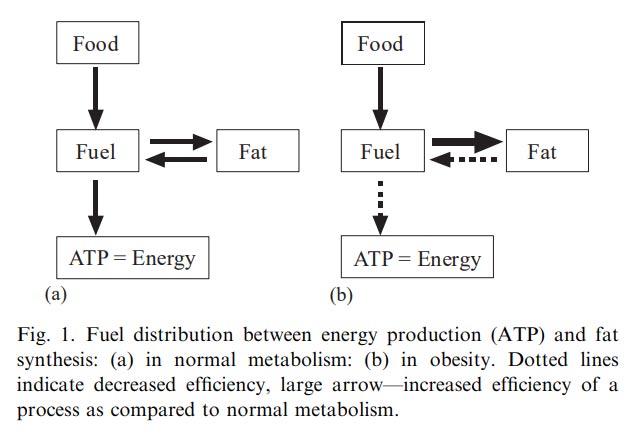
The screenshot below can be helpful. On the left is what normal metabolism looks like. The food you eat is turned into fuel, some of which is burned for energy and some of which is stored as body fat. When needed, body fat is also burned as fuel and converted into energy.
On the right is the “obese” metabolism. The primary differences here are the dotted arrows. The food consumed is turned into fuel, but very little of that fuel is converted into energy. Most of it is instead shuttled into fat storage, and because the metabolism is so inefficient, the stored fat is not released and burned for energy.
Many Normal Weight People Have Deranged Metabolism Too
As explained by Feldman, not only do obese individuals have this deranged metabolism, but many normal weight people do too. People who exercise a lot, or fast, or eat a low-carb diet may appear to have healthy metabolism because they’re not overweight, but the real reason they’re not overweight is because they’re forcing the conversion of fuel to energy through STRESS.
So, while they may not accumulate body fat, they still struggle with an energy deficiency, which can present as fatigue, brain fog, low mood, hormonal dysfunction and more.
As noted by Feldman, the bioenergetic solution to these problems is to improve the conversion of fuel to energy, “which means you have the energy available to properly function in terms of all your organ systems — your digestion, your reproductive systems, cognitive function, all of that.”
Endotoxin and PUFAs Decimate Mitochondrial Energy Production
One key strategy to optimize your mitochondrial energy production is to remove blocks in the electron transport chain so that electrons can move smoothly forward, without accumulating and backing up.
Endotoxin (lipopolysaccharide or LPS) and other bacterial toxins are among the biggest culprits when it comes to things that hinder mitochondrial energy production. These toxins can directly impair electron transport through the complexes of the electron transport chain. They can also impair certain enzymes in the Krebs cycle.
The primary solution for obesity and most other conditions is to raise your metabolic rate, and a key strategy for that is to remove blocks in the electron transport chain. Endotoxin and polyunsaturated fats (PUFAs) are two key culprits that need to be eliminated.
Poor digestion is frequently associated with negative gram bacteria in your gut that produce endotoxin, and this will inhibit your ability to convert food to energy, resulting in increased body fat. So, it’s important to reduce your endotoxin load. Aside from poor digestion, excess endotoxin is also a common culprit in degenerative conditions, metabolic syndrome, diabetes and fatty liver. To reduce your endotoxin load:
- Rebalance your gut microbiome by reintroducing beneficial bacteria (probiotics and prebiotics). One of the best and least expensive ways to do this is to eat a serving of fermented vegetables each day.
- Temporarily go on a low-fiber diet and avoid fiber supplements as it can feed undesirable bacteria. Avoid all vegetables temporarily and use fruit juice as your source of calories until your gut microbiome improves. Once it improves you can gradually add in whole fruits.
Once your microbiome is balanced and symptoms of poor gut function have resolved, you can slowly reintroduce starches like white rice and, if tolerated, progress to very well-cooked vegetables. Always cut back if you have signs of indigestion like belching, bloating or gas as this suggests you are not digesting those carbs yet.
Another effective blocker of mitochondrial energy production is polyunsaturated fat (PUFA). These are your processed seed oils, canola oil being among the worst of the worst. Seed oils are loaded with linoleic acid, an omega-6 PUFA, which appears to be one of the primary drivers of chronic diseases, in part due to its detrimental impact on your mitochondrial function and energy production.
So, you’ll want to severely limit your consumption of PUFAs. In addition to not cooking with them, this also means abstaining from processed foods, most of which are loaded with these harmful fats.
Rescue Remedies
While there are no magic pills to fix slow metabolism or low energy production, there are some that can help. I’ve previously written about the usefulness of niacinamide, for example. Another helpful one is methylene blue, which can both accept and donate electrons.
So, if you have blocks in the electron transport chain where most of the ATP is produced, say endotoxin or PUFAs, methylene blue can bypass those blocks, allowing your mitochondrial to produce energy anyway.
How to Gauge Your Metabolic Rate
According to the rate-of-living theory, the higher your metabolic rate — which means the quicker the electrons move from food toward oxygen, which is the final acceptor of electrons — the faster you’ll age because there’ll be higher oxidative stress.
However, deeper analysis reveals the exact opposite. The truth is, the higher your metabolic rate, the slower you age, because a high metabolism creates fewer reactive oxygen species (ROS) that can damage your tissues.
Your metabolism is high when electrons move rapidly and easily through the mitochondrial electron transport chain, which results in optimal energy production. When electrons are impeded from moving forward, they can back up, leak through the mitochondrial electron transport chain and start moving backward, where they combine with oxygen to create excessive ROS.
So, for optimal health, you want high energy production and that means a high metabolic rate. You can gauge your metabolic rate using your pulse, body temperature and calorie counting. These are not exact sciences, but can give you a general idea of where you’re at. Signs of low metabolism include:
- A body temperature below 97.8 degrees Fahrenheit upon waking, and/or 98.6 degrees F in the afternoon. You can also check your temperature before and after a meal. If your temperature drops after breakfast (compared to what it was in the morning), this could be a sign of less than optical metabolism as well.
- A resting pulse below mid-70 to low-80s, depending on your level of fitness. The greater your cardiovascular fitness, the lower your pulse rate will be, independent of your metabolic state, because your stroke volume is higher. The stroke volume is the amount of blood your heart pumps with each beat. When you’re very fit, your heart can push greater amounts of blood per beat.
- Assess how many, or how few, calories you can consume without adding to your weight. If you should be burning 3,000 calories a day, but you’re maintaining your weight on 2,200 calories a day, then your metabolism is likely low. Conversely, if you can maintain your weight when you add more calories, your metabolic rate is likely high, and the extra food will oftentimes improve your sleep, relaxation, energy and recovery.
- 1, 2 Endocrine Reviews June 2020; 41(3): bnaa004
- 3 Endocrine Review May 1, 2020; 41(3): bnaa004
- 4 Medical Xpress October 3, 2023
- 5 Study Finds October 3, 2023
- 6 Diabetologia, 59th EASD Annual Meeting of the European Association for the Study of Diabetes
- 7 Frontiers in Cardiovascular Medicine February 25, 2020; 7
- 8 EurekAlert! October 3, 2023
- 9 Diabetologia September 2021; 64(9): 1963-1972
- 10 International Journal of Molecular Sciences July 2023; 24(15): 12012
- 11 Journal of Theoretical Biology November 7, 2003; 225(1): 33-44
Best Anti-Inflammatory Nutrients
Reproduced from original article:
https://articles.mercola.com/sites/articles/archive/2023/10/16/best-anti-inflammatory-nutrients.aspx
The original Mercola article may not remain on the original site, but I will endeavor to keep it on this site as long as I deem it to be appropriate.
Analysis by Dr. Joseph Mercola Fact Checked October 16, 2023
STORY AT-A-GLANCE
- Inflammation is your body’s built-in emergency response to assaults resulting in injury or infection. If the inflammation is not resolved, it becomes chronic, which can result in serious disease states such as rheumatoid arthritis, liver disease and heart disease
- There are many anti-inflammatory nutrients, and if you make a habit of including enough of them in your diet, you can keep inflammation in check relatively easily
- Nutrients known for their potent anti-inflammatory properties include omega-3 fats EPA and DHA, which are also crucial for the functionality of your cell membranes and the membranes of your mitochondria, and ginger, which has been shown to bolster immune system function and ameliorate autoimmune diseases such as lupus and rheumatoid arthritis
- Curcumin, a compound found in turmeric, has antibacterial, anticancer, anti-inflammatory, antimalarial, antioxidant, antiparasitic, antiproliferative, pro-apoptotic and wound healing properties. Conditions responsive to curcumin include certain types of cancer, high blood pressure, heart disease and blood clots, intestinal and bowel issues, neurodegenerative conditions and glaucoma
- Other potent anti-inflammatory nutrients include chondroitin, glucosamine, MSM, vitamin E, glycine, bromelain, boswellic acid and green tea extract
Inflammation is your body’s built-in emergency response to assaults resulting in injury or infection. In the acute state, inflammation is an important and vitally necessary part of your body’s healing mechanism.
However, if the inflammation is not resolved, it becomes chronic, which is profoundly destructive and plays a role in nearly every chronic degenerative disease.
While anti-inflammatory drugs may be helpful in some situations, they can have undesirable side effects and are rarely an ideal solution in the long run. To prevent and treat chronic inflammation, dietary nutrients, either from whole food or a nutritional supplement, are typically your best option.
The good news is there are many anti-inflammatory nutrients out there, and if you make a habit of including enough of them in your diet, you can keep inflammation in check relatively easily. Below, in no particular order, I’ll review some of the nutrients known for their anti-inflammatory powers.
Vitamin E
Vitamin E prevents LA stored in your tissues from being oxidized into dangerous toxic byproducts. Since most people are walking around with LA stores that are 10 times higher than normal, and since excess LA is likely one of the primary contributors to chronic disease, it can be a good idea to take vitamin E regularly until you get your LA down to healthy levels, which may take up to six years for most people.
Vitamin E also prevents LA stored in your tissues from being oxidized into dangerous toxic byproducts.
Vitamin E can almost miraculously prevent most of the damage done by LA, and it can also reverse or prevent many of the issues associated with excess estrogen. This is important because LA has remarkable parallels to excess estrogen in terms of its metabolic and anti-health effects. You see, when you eat excess PUFA or LA, you increase your body’s production of estrogen.
So, when you increase LA, estrogen levels go up — and that’s not a good thing. Both LA and estrogen interestingly increase the flow of calcium from outside the cell to inside because the concentration of calcium outside as well is 50 times higher than inside. So, the excess as LA will cause the influx of calcium inside the cell, which causes nitric oxide and superoxide to increase inside the cell.
When you do this, with this magical combination, you increase a very pernicious reactive nitrogen species called peroxynitrite, and that causes pervasive damage to tissues in your body.
Both LA and estrogen also increase a potentially dangerous process in your body called lipolysis, which is simply the liberation of fatty acids from your fat cells into your bloodstream where they are mobilized. This then increases the oxidation or, simply, the burning of fats in your mitochondria, which is precisely what you want to avoid as ideally you want to be burning glucose in your mitochondria, not fatty acids.
Fortunately, vitamin E can help neutralize this damaging effect of LA. Vitamin E also directly inhibits the activity of an enzyme called aromatase. This is an enzyme that converts the male hormones like testosterone and DHEA into estrogens.
Even better, it serves as an estrogen antagonist, meaning it binds to the estrogen receptor to block it from binding to estrogen. This dramatically lowers the damage from excess estrogen.
Vitamin E works very similarly to the drug tamoxifen, which is used to treat estrogen receptor-positive breast cancers. For these reasons, I firmly believe nearly everyone needs to be getting vitamin E in their diet. However, due to the high LA burden, very few people are able to get enough vitamin E from their diet to suppress this oxidative destruction from excess LA in their tissues.
The good news is that since the supplementation is short term, you’re not going to need it the rest of your life.
If you can keep your LA intake to below 5 grams a day for three years, it’s likely you may not even need it at all, or at most, only a few times a month. However, if for whatever reason, during this time, or when the LA in your tissues are low or normal, and you go out and binge on a meal that’s very high in LA, I would strongly recommend taking a vitamin E capsule to protect yourself from this exposure.
Vitamin E also protects against free radical damage and the normal effects of aging. It’s particularly important for brain health, and studies have found it can help delay the loss of cognitive function in people with Alzheimer’s disease by preventing cell membrane damage and neuronal death.1
How to Pick a Good Vitamin E Supplement
Most vitamin E supplements are synthetic. This is a major clue that it is different from the vitamin E you’re getting from real food. How can you tell a vitamin E supplement is synthetic? Well, all you must do is read the label. Fortunately, they make it pretty simple.
Synthetic vitamin E is called alpha tocopherol acetate. The acetate is the key. If the label says tocopherol acetate, it’s screaming that it is synthetic. Next, you need to pay attention to the orientation of the optical isomer. Most vitamin supplements are racemic, or they have left- and right-hand isomers. This is a problem as most biological molecules have optical isomers that are right-handed. They’re usually called D and L isomers for right and left.
When you have both left and right isomers present, it’s called racemic. Biologically, there’s usually only one optical isomer that works well, and with vitamin E it is the D isomer that works in your body, while the L isomer is useless. Yet in synthetic supplements, 50% of the vitamin E in the supplement is the useless L isomer.
To make matters even worse, many synthetic versions use an ester of vitamin E, which only has about 50% of the activity of the natural product. So, the total activity of many vitamin E supplements is reduced by 75%.
So, the first step in identifying healthy good vitamin E supplements is to make sure you’re not getting real vitamin E and not synthetic. What you’re looking for is “d alpha tocopherol,” as on the label below. As you can see on this label, it says that this is d alpha tocopherol. It is not DL or racemic; this is the pure D isomer, which is what your body can use.

You might also have noticed that this is vitamin E from sunflower oil, which has a very high percentage of LA. Not to worry, though, as the LA in the capsule is an insignificant amount, probably less than 50 or 100 milligrams.
Your goal is to keep LA intake under 5,000 milligrams, so it really won’t negatively impact your LA intake at all. You’ll also notice that the dose is 134 milligrams or units. You really wouldn’t want to use much more than this, as it is unnecessary. More is not better; you don’t want to take 400 units, you don’t want 1,000 units, you want the sweet spot Goldilocks dose, which is about 100 units, or 100 mg.
You also see at the bottom of this label that there are other vitamin E isomers, the complete spectrum of tocotrienols, specifically the beta, gamma and delta types of vitamin E, which are also only the effective D isomer.
So, you can use this label as a template to select a healthy vitamin E supplement. It’s important to get this right, and nearly everyone watching this would benefit from taking the appropriate vitamin E supplement, which is why I’m spending so much time on it.
Download this Article Before it Disappears
Omega-3 Fats
Omega-3 fats play a crucial role in the health and functionality of your cell membranes and the membranes of your mitochondria. June 25, 2023, I posted an interview with Nils Hoem, Ph.D., in which we took a deep dive into this.
Membranes are lipid structures made of phospholipids and other constituents. The foods you eat provide the raw material substrate that is then assembled into the mitochondrial and cellular membranes, which is why the type of fats you consume is so important.
If you’re eating any processed foods, you’re likely getting far too much omega-6 linoleic acid (LA), which damages your mitochondrial machinery and reduces your body’s ability to convert the 18-carbon omega 3 fat ALA into the 20-carbon fat EPA and 22-carbon fat DHA.
If you reduce your LA intake to historical norms — about 2% of your daily calories — and get enough omega-3 ALA (found in chia seeds, walnuts, beans and seaweed), then you can make substantial amounts of DHA and EPA and may not need supplementation. You can probably also forgo supplements if you eat fatty fish like wild-caught salmon, mackerel, sardines and anchovies on a regular basis.
That said, most people who are not strict enough about reducing their LA intake and don’t eat these kinds of fish might benefit from a DHA/EPA supplement. If you decide to take an omega-3 supplement, I believe krill oil is superior to most fish oil supplements, which are synthetically produced ethyl esters. The omega-3 in krill, on the other hand, is just the way it is in nature, and is attached to phospholipids that increase its absorption, which means you need less of it.
Krill oil also contains almost 50 times more astaxanthin, a potent antioxidant, than fish oil, which prevents the highly perishable omega-3 fats from oxidizing before they’re integrated into your cellular membranes.
While LA is highly inflammatory, the omega-3s are anti-inflammatory and help protect your bones, muscles, joints and connective tissues from damage, and repair any damage that has already occurred.
A 2019 animal study2 that compared the analgesic and anti-inflammatory activity of Neptune krill oil and fish oil concluded that while both reduced severe inflammation and pain, the Neptune krill oil was the most effective.
Ginger Root
Ginger, which is easy to grow at home, has been shown to bolster immune system function and ameliorate autoimmune diseases such as lupus and rheumatoid arthritis by making neutrophils (a type of white blood cell) more resistant to neutrophil extracellular trap (NET) formation, which is known to propel inflammation and contribute to autoimmune diseases. As reported by CU Anschutz Medical Campus in September 2023:3
“In a clinical trial, the researchers found that daily intake of a ginger supplement for seven days (20 mg of gingerols/day) by healthy volunteers boosted a chemical inside the neutrophil called cAMP. These high levels of cAMP then inhibited NETosis (neutrophil extracellular trap formation) in response to various disease-relevant stimuli.
‘Our research, for the first time, provides evidence for the biological mechanism that underlies ginger’s apparent anti-inflammatory properties in people,’ said senior co-author Jason Knight, MD, PhD, associate professor in the Division of Rheumatology at the University of Michigan.”
Ginger also has antibacterial, antiviral, antioxidant and anticancer properties that protect against disease, both acute and chronic. The National Library of Medicine has the following to say about ginger:4
“The exact mechanism is not understood entirely, but several active compounds of ginger have been shown to have biological activity.
- Gingerol and gingerol-related compounds: Antioxidant activity, anti-tumor activity via induction of apoptosis and modulation of genetic activity, anti-inflammatory and anti-analgesic activity, antimicrobial activity, and hepatoprotective activity
- Paradol: Antioxidant, anti-cancerous, and antimicrobial properties
- Shogaol: Antioxidant, anti-inflammatory, anti-cancerous activity via inhibition of cell invasion, reduction of matrix metalloproteinase-9 expression, and anti-proliferation activity
- Zingerone: Antioxidant activity, anti-inflammatory, and anti-bacterial properties
- 1-Dehydro-10-gingerdione: Regulation of inflammatory genes
- Terpenoids: Induction of apoptosis via activation of p53
- Ginger flavonoids: Antioxidant activity
… Ginger has been shown to play a vital role as an antimicrobial agent. Several active components have been shown to be active against E coli, Salmonella typhi, Bacillus subtilis, Candida albicans, M. avium, and M. tuberculosis …
Antioxidants help free the body of free radicals and reduce oxidative stress. The imbalance between reactive oxygen species (ROS) production and antioxidative defense mechanisms can induce oxidative stress …
Ginger is a source of numerous antioxidants and plays a role in reducing lipid oxidation and ROS formation. Studies have shown ginger root’s active compounds’ ability to scavenge superoxide anion and hydroxyl radicals and inhibit lipid peroxidation in vivo.
Inflammation is an important immune response mechanism to damage and can be mediated via interleukin-1 (IL-1), tumor necrosis factor (TNF), and anti-inflammatory cytokines … In vivo studies have shown ginger’s ability to suppress pro-inflammatory cytokines and down-regulate induction of inflammatory genes.”
Turmeric Extract
Besides giving Indian curries their rich golden color, turmeric contains a polyphenol called curcumin, which exhibits more than 150 potentially therapeutic actions.
With thousands of studies performed,5 researchers have shown curcumin has antibacterial, anticancer, anti-inflammatory, antimalarial, antioxidant, antiparasitic, antiproliferative, pro-apoptotic and wound healing properties. Scientists investigating curcumin’s biological activities had this to say about the extent to which it plays a vital role in supporting your health:6
“Modern science has shown that curcumin modulates various signaling molecules, including inflammatory molecules, transcription factors, enzymes, protein kinases, protein reductases, carrier proteins, cell survival proteins, drug resistance proteins, adhesion molecules, growth factors, receptors, cell-cycle regulatory proteins, chemokines, DNA, RNA and metal ions.”
Given its antioxidant and anti-inflammatory properties, conditions shown to be responsive to curcumin include7 certain types of cancer8,9 (by blocking blood supply to tumors and modulating signaling pathways involved in cancer), high blood pressure, heart disease and blood clots, intestinal and bowel issues10 (by stimulating bile production), neurodegenerative conditions,11 and glaucoma12 (by limiting oxidative damage in the eye and lowering intraocular pressure).
While turmeric is widely available in powdered form, it contains a very small amount of curcumin, which is also known to be poorly absorbed through your gastrointestinal tract. For these reasons, you’ll receive more health benefits from a curcumin extract. Because it’s a lipophilic (fat-loving) molecule, many curcumin preparations include some sort of oil or fat to improve its absorbability and bioavailability.
Glucosamine, Chondroitin and MSM
Glucosamine and chondroitin are compounds found in human cartilage, while MSM13 (methylsulfonylmethane) is a sulphur-rich compound found in certain plants, fruits and vegetables.
Research suggests glucosamine and chondroitin work synergistically when paired, and MSM can further boost their effects by enhancing cell penetration. All three have anti-inflammatory properties and are commonly used in the treatment of arthritis symptoms.
Alone or together, glucosamine and chondroitin help relieve arthritis-related pain by slowing the degradation of collagen and cartilage and improving the function of your joints. As explained by Center TRT:14
“Glucosamine and chondroitin are two essential components of cartilage that play a crucial role in maintaining joint health. Glucosamine is a vital building block for glycosaminoglycans, which are essential for the formation and repair of cartilage.
Chondroitin, on the other hand, is a structural component of cartilage that helps it retain water, thereby providing the necessary lubrication and shock absorption for joints to function smoothly.
Together, glucosamine and chondroitin work synergistically to support healthy joints. While glucosamine promotes the growth and repair of cartilage, chondroitin helps maintain its integrity and flexibility. This is why glucosamine and chondroitin supplements are often recommended for individuals experiencing joint pain or stiffness resulting from age-related wear and tear, injury, or arthritis.
Moreover, research has shown that the combination of glucosamine and chondroitin can help slow down the progression of joint damage in individuals with osteoarthritis,15 which is a common degenerative joint disease characterized by the breakdown of cartilage.”
Other Anti-Inflammatory Nutrients
Other anti-inflammatory nutrients you may want to consider include:
• Glycine — Glycine exerts potent anti-inflammatory effects by inhibiting activation of immune cells and suppressing the production of pro-inflammatory cytokines. It acts on inflammatory cells like macrophages to block the signaling of the NLRP3 inflammasome.
Glycine also reduces TNFα, IL-6, and other cytokine levels in macrophages, and counteracts LPS-induced inflammatory responses. Furthermore, glycine acts on neutrophils to inhibit CXCR2 signaling and recruitment, as well as blocking ICAM-1 expression and limiting endothelial adhesion.
• Bromelain — Bromelain is an enzyme found in pineapples. It can reduce inflammation, joint pain and joint degradation, improve gut function and digestive health, and aid in the metabolism of amino acids. There’s also evidence suggesting it can help to prevent respiratory issues and heart disease, and bolster immune function.16
• Boswellic acid — Boswellic acid, extracted from the boswellia serrata tree, has a long history of use in traditional medicine. It can reduce pain and inflammation throughout the body, including arthritis pain.17
• Green tea extract — Green tea extract contains a potent antioxidant catechin called EGCG, which combats inflammation, relieves joint and muscle soreness, and prevents future oxidative stress and damage. It can also improve the function of your brain, heart and blood vessels, and help your immune system fight off various diseases.18
- 1 Medical News Today April 14, 2015
- 2 Biotechnology Reports June 2019; 22: e00341
- 3 CU Anschutz Medical Campus September 22, 2023
- 4 National Library of Medicine Ginger Root
- 5 PubMed.gov, Curcumin
- 6, 9 Clinical and Experimental Pharmacology and Physiology March 2012; 39(3): 283–299
- 7 LIVESTRONG October 3, 2017
- 8 Cancer Prevention Research (Philadelphia) April 2014; 7(4): 466-474
- 10 Cochrane Database of Systematic Reviews October 17, 2012; 10: CD008424
- 11 Biofactors January 2013; 39(1): 122-132
- 12 J Ocul Pharmacol Ther October 2014; 30(8): 657-664
- 13 Nutrients March 2017; 9(3): 290
- 14 Center TRT June 13, 2023
- 15 Molecular and Cellular Proteomics June 2012; 11(6): M111.012417
- 16 Biotechnol Res Int 2012; 2012: 976203
- 17 Indian Journal of Pharmaceutical Sciences May-June 2011; 73(3): 255-261
- 18 Chinese Medicine 2010; 5: 13
Cooking Oil: A Household Ingredient That You Should Not Take for Granted
Reproduced from original article:
https://www.mercola.com/infographics/healthiest-cooking-oil.htm
The original Mercola article may not remain on the original site, but I will endeavor to keep it on this site as long as I deem it to be appropriate.

Cooking oil is one of the most common culinary ingredients you’ll find in American homes. It’s used in countless dishes, but what exactly does it do?
The main purpose of using cooking oil is to quickly transfer heat to the food that’s being cooked. This is why frying is usually quicker than other cooking methods, such as boiling or roasting. Cooking oil has good tolerance against high temperatures, which means it doesn’t boil or break down right away.
In addition, cooking oil can provide additional flavor, depending on what it’s made of, and bring out the fat-soluble nutrients in the other ingredients. When used in baking, it can help with moisture retention, as well as tenderizing and leavening the ingredients.
Despite these advantages, the main issue with cooking oil (especially vegetable oil) is that when it is heated, it releases trans fat, free radicals and toxins that can leach into your food and wreak havoc on your health.
Why You Should Avoid Vegetable Oils Like the Plague
Vegetable oils are one of the unhealthiest oils you can consume. They are rich in trans fat, which is a synthetic fatty acid that inhibits your body’s production of prostacyclin, a factor that keeps your blood flowing smoothly. If your body cannot produce enough prostacyclin, blood clots can form in your arteries, increasing your risk of heart disease.
Aside from endangering your cardiovascular health, trans fat may even impair your memory. According to a study published in Time, participants who consumed high levels of trans fat remembered 11 fewer words compared to those who consumed lower levels.
Much of the reason why vegetable oils contain trans fat is because they are hydrogenated, a process wherein hydrogen gas is forced into the oil at a high pressure during manufacturing. Companies use this method to extend the shelf life of their products, but at the cost of people’s health.
Furthermore, vegetable oils produce oxidized cholesterol when heated, increasing thromboxane formation, a factor that clots your blood, as well as two toxins: cyclic aldehydes and acrylamide.
In light of all this information, which vegetable oils should you avoid? I’ve put together a list of vegetable oils that can endanger your health:
- Soybean oil: This contains plenty of highly processed omega-6 fats. When you use it to cook food, the increased levels of omega-6 can lead to chronic inflammation.
- Corn oil: Similar to soybean oil, corn oil has extremely high amounts of omega-6 compared to omega-3. In fact, the ratio is estimated to be around 49:1. Ideally, the ratio should be 1:1 only.
- Cottonseed oil: It’s estimated that 93 percent of cotton in the U.S. is genetically engineered. Consuming oil made from these cotton plants can have an adverse effect on your health in the long run.
- Canola oil: You may have seen plenty of advertisements that present canola oil as a safe and healthy cooking ingredient. Unfortunately, this is not true, as canola oil can introduce oxidized cholesterol into your body when consumed.
Instead of Vegetable Oils, These Are the Healthiest Cooking Oils You Can Use
With the prevalence of hydrogenated cooking oils in the market, what options are you left with? Fortunately, there are many healthy alternatives available, and they are easy to acquire:
- Olive oil: This oil contains healthy fatty acids that can help lower your risk of heart disease. In addition, it may help lower the risk of breast cancer in women.
- Grass-fed butter: Raw, organic butter made from healthy grass-fed cows’ milk contains many nutrients, such as vitamins A, D, E and K2. Furthermore, it contains various minerals and antioxidants that can help support your health.
- Peanut oil: This oil contains high levels of omega-6 similar to other vegetable oils, but it can be beneficial to your health (it is high in antioxidants) as long as you consume it unheated and in moderation.
- Sesame oil: Similar to peanut oil, sesame oil is high in omega-6. However, if consumed unheated and in small amounts, it may benefit your health, especially if you are diabetic.
- Coconut oil: This is what I believe is the best cooking oil you can use for your dietary needs. It has various health benefits, which I will discuss below.
Cooking With Coconut Oil: One of the Best Oils You Can Use
Coconut oil has been getting plenty of attention lately, and rightfully so. I believe it’s one of the best things you can add to your diet because it can help optimize your health in ways you may have never experienced before. In fact, I use it exclusively whenever I cook, and I wholeheartedly believe that you should as well. Take a look at the amazing benefits it can provide:
- Cardiovascular Health
Coconut oil may have a positive effect on your heart health. Researchers discovered that consuming it can help improve your good cholesterol levels, while simultaneously lowering bad cholesterol levels. As a result, your risk of heart disease decreases. - Energy Boost
Coconut oil can be a great source of healthy energy, thanks to its medium-chain fatty acids (MCFAs). When consumed, the MCFAs are immediately digested and converted by your liver into energy that you can immediately use. - Weight Management
Aside from giving you an energy boost, coconut oil simultaneously stimulates your metabolism to encourage shedding body fat, thus helping you maintain a healthy weight profile. - Antimicrobial Properties
The compounds of coconut oil can help keep your internal organs free from microbes. According to a mice study, subjects who were fed coconut oil had a significant reduction in candida albicans, a yeast strain that causes candidiasis, or more commonly known as yeast infection. - Oral Health
Coconut oil can be used for oil pulling, a hygienic practice that uses oil to rinse your mouth. Its antimicrobial properties help “pull” out and eliminate bacteria and viruses that live in your mouth, along with food debris stuck between your teeth.
Try These Healthy and Delicious Recipes That Use Coconut Oil
The great thing about coconut oil is that it can be used in a variety of cooking methods. It has a mild flavor that helps bring out the natural flavors of other ingredients. I encourage you to try the following recipes so you can taste the difference.
|
Mom’s Best Fried Chicken Recipe |
Salmon Supreme Recipe |
Healthy Quinoa Pie Recipe |
Ingredients:
|
Ingredients:
|
Ingredients:
|
Procedure:
Note: Do not burn or char your meats and avoid eating the black portions. |
Procedure:
*Note: If Old Bay Seasoning is not available, another seafood seasoning would be fine, or a combination of celery salt, dried mustard, black pepper and a small amount of the following: ground bay leaves, ground cloves, allspice, ginger, mace, cardamom, cinnamon and paprika. |
Procedure:
|
Top 13 Reasons to Replace Dangerous Oils With Healthy Fats
Reproduced from original article:
https://articles.mercola.com/sites/articles/archive/2023/10/13/replace-dangerous-oils-with-healthy-fats.aspx
The original Mercola article may not remain on the original site, but I will endeavor to keep it on this site as long as I deem it to be appropriate.
Analysis by Dr. Joseph Mercola – Expert Review by James DiNicolantonio, Pharm.D Fact Checked October 13, 2023

STORY AT-A-GLANCE
- Replacing dangerous oils with healthy fats is one simple way to boost your health and reduce your risk of chronic disease
- While partially hydrogenated vegetable oils are now recognized as harmful due to their trans fat content, and are being largely eliminated, trans fat-free vegetable oils still have the worrisome problem of degrading into toxic oxidation products when heated
- Vegetable oils are also a concentrated source of omega-6 linoleic acid, which has led to a severe imbalance between the omega-6 to omega-3 ratio in most people’s diets, and many commonly used vegetable oils are genetically engineered
- Maintaining a healthy ratio of omega-6 to omega-3 is important for optimal health. Ideally, you want to maintain a 4-to-1 ratio of omega-6 and omega-3 fats or less
- Black seed oil has at least 20 different pharmacological actions, and has been shown to be useful for a wide variety of ailments, including Type 2 diabetes, asthma, cognitive decline, stress and rheumatoid arthritis
Editor’s Note: This article is a reprint. It was originally published January 7, 2019.
Dietary fats are a crucial component of a healthy diet, but the devil’s in the details, and the type of fats you choose can make a world of difference. While the notion that saturated fats cause heart disease is a fallacy, some fats do cause cardiovascular problems and need to be avoided.
Replacing dangerous oils with healthy fats is one simple way to boost your health and reduce your risk of chronic disease. Here, I’ll review some of the key points to remember when adding more fat into your diet.
Trans Fat — A Hidden Culprit in Heart Disease for Decades
Before 1900, American housewives used lard and butter for cooking. It wasn’t until 1911 that our diets experienced a dramatic change with the introduction of trans fat in the form of Crisco, the first hydrogenated vegetable oil product to hit the market.
Hydrogenated vegetable oils and margarine quickly became the backbone of the food industry. In my book “Superfuel: Ketogenic Keys to Unlock the Secrets of Good Fats, Bad Fats, and Great Health,” cowritten with James DiNicolantonio, Pharm.D, we take a deep dive into this topic. In fact, our book reveals how the consumption of soybean oil has increased over a thousand percent from 1909 to 1999.
Trans fats became a staple dietary fat with the introduction of processed foods, and could be found in everything from cookies and crackers to french fries and frozen food. Unfortunately, it would take more than a century for the truth about trans fat to be fully recognized.
The U.S. Food and Drug Administration (FDA) didn’t remove partially hydrogenated oils from the generally recognized as safe (GRAS) list until 2015,1 based on evidence suggesting their removal could prevent thousands of heart attacks and deaths each year.
In reality, research by trans fat scientist Fred Kummerow, dating back to 1957, showed that trans fat interferes with the basic functioning of cellular membranes. Even small amounts of manufactured trans fat have been shown to have adverse effects on your heart, insulin sensitivity and neurological system.
Processed Vegetable Oils Do More Harm Than Good
In response to research and public opinion, many restaurants have since turned from partially hydrogenated oils to 100% vegetable oil. However, while these oils do not have trans fats, they’re just as bad, if not worse. There are three significant reasons for this:
1. When heated, vegetable oils degrade to extremely toxic oxidation products, including cyclic aldehydes,2 which have been linked to neurodegenerative diseases and certain types of cancer. In her book, Teicholz cites research showing that aldehydes cause toxic shock in animals through gastric damage.
2. Vegetable oils are a concentrated source of omega-6 linoleic acid, which has led to a severe imbalance between the omega-6 to omega-3 ratio in most people’s diets.
3. Many of the vegetable oils produced today — especially corn and soy — are products of genetic engineering (GE) and a significant source of glyphosate exposure, and glyphosate has also been linked to gut damage and other health problems.
In addition, processed vegetable oils (polyunsaturated fat) harm health by:
4. Creating high amounts of oxidation products when used in cooking (as they are very susceptible to heat), including aldehydes, which are what cause oxidized low-density lipoprotein (LDL) associated with heart disease. Aldehydes also crosslink tau protein and create neurofibrillary tangles, thereby contributing to the development of neurodegenerative diseases.
5. Damaging the endothelium (the cells lining your blood vessels) and causing an increase in penetration of LDL and very low-density lipoprotein (VLDL) particles into the subendothelium. In other words, these oils get integrated in your cell and mitochondrial membranes, and once these membranes are impaired, it sets the stage for all sorts of health problems.
6. Damaging your mitochondria and DNA by making your cell membranes more permeable, allowing things to enter that shouldn’t.
7. Making the cell membrane less fluid, which impacts hormone transporters in the cell membrane and slows your metabolic rate.
8. Inhibiting cardiolipin, an important component of the inner membrane of your mitochondria that needs to be saturated in DHA in order for it to function properly.
Cardiolipin can be likened to a cellular alarm system that triggers apoptosis (cell death) by signaling caspase-3 when something goes wrong with the cell. If the cardiolipin is not saturated with DHA, it cannot signal caspase-3, and hence apoptosis does not occur. As a result, dysfunctional cells are allowed to continue to grow, which can turn into a cancerous cell.
9. Inhibiting the removal of senescent cells, i.e., aged, damaged or crippled cells that have lost the ability to reproduce and produce inflammatory cytokines that rapidly accelerate disease and aging.
10. Stripping your liver of glutathione (which produces antioxidant enzymes), thereby lowering your antioxidant defenses.3
11. Inhibiting delta-6 desaturase (delta-6), an enzyme involved in the conversion of short-chained omega-3s to longer chained omega-3s in your liver.4
12. Exposing you to toxic 4-hydroxynonenal (4HNE), which forms during the processing of most vegetable oils, even if the oil is obtained from organic crops. 4HNE is highly toxic, especially to your gut bacteria, and consumption of 4HNE has been correlated with having an obesogenic balance of gut flora. It also causes DNA damage and instigates free radical cascades that damage your mitochondrial membranes.5
13. Exposing you to glyphosate residues, as most vegetable oils are made with genetically engineered crops. Glyphosate has been shown to disrupt the tight junctions in your gut and increase penetration of foreign invaders, especially heated proteins, which can cause allergies.
Download this Article Before it Disappears
Address Your Omega-6 to Omega-3 Ratio to Protect Your Health
Marine-based omega-3 is one of the most important fats in the human diet, as docosahexaenoic acid (DHA) and eicosapentaenoic acid (EPA) are actually key structural elements of cells, including your brain cells, and not just simple fuel. If you don’t have enough DHA and EPA, your body’s ability to repair and maintain healthy cell structures is seriously impaired.
Unfortunately, in the past 100 years, our omega-6 intake has nearly tripled while our intake of omega-3 has decreased 10fold, and this imbalance has also likely played a significant role in our skyrocketing disease rates.
Eating too much damaged omega-6 fat — found in abundance in processed vegetable oils — and too little animal-based omega-3 sets the stage for diabetes, cardiovascular disease, rheumatoid arthritis, cancer, depression and Alzheimer’s, just to name a few.
Now, omega-6 fat in and of itself is not the problem. The problem is that most people get far too much of it, and insufficient amounts of omega-3, and that most of the omega-6 people eat has been damaged and oxidized through processing. Evidence implicating excessive consumption of omega-6-rich vegetable oils as a direct cause of heart disease include but is not limited to:6
| The amount of linoleic acid in adipose tissue and platelets is positively associated with coronary artery disease, and studies7 measuring changes in linoleic acid concentrations in adipose tissue in Americans show concentrations increased from 9.1% in 1959 to 21.5% in 2008. This increase also paralleled increases in the prevalence of obesity, diabetes and asthma.
Conversely, the long-chained omega-3s docosahexaenoic acid (DHA) and eicosapentaenoic acid (EPA) have been shown to protect against coronary artery disease, which is why maintaining a healthy balance between omega-3 and omega-6 is so important. |
| Patients with atherosclerosis have higher amounts of linoleic acid oxidation products in their plasma, low-density lipoprotein (LDL) and atherosclerotic plaques. |
| Oxidation of linoleic acid begins before any clinical signs of atherosclerosis become apparent. |
| When the endothelium (the interior lining of your blood vessels) is exposed to linoleic acid, LDL transfer across the endothelium is increased and this is an essential step in the atherosclerotic process. |
| Low linoleic acid diets reduce LDL oxidation. |
| A meta-analysis of randomized controlled trials in humans showed that when saturated fat and trans fat are replaced with omega-6 PUFAs, all-cause mortality, ischemic heart disease mortality and cardiovascular mortality increase. |
| Oxidation products of linoleic acid are found in infarcted tissue. |
| The linoleic acid metabolite 9-HODE is a strong promoter of inflammation, and may be both a marker for and inducer of atherosclerosis. |
Healthiest Fats for Cooking
Getting back to cooking oils, if vegetable oils are “out,” what should you use to cook with? Healthy alternatives include:
• Coconut oil — This is what I believe is the best cooking oil. It has a number of valuable health benefits, including a positive effect on your heart and antimicrobial properties. It’s also a great source of energy, thanks to its medium-chain fatty acids (MCFAs). When consumed, the MCFAs are digested and converted by your liver into energy that you can immediately use. Coconut oil also helps stimulate your metabolism to encourage a healthy weight profile.
• Grass fed butter — Raw, organic butter made from healthy grass fed cows’ milk contains many valuable nutrients, including vitamins A, D, E and K2. Furthermore, it contains various minerals and antioxidants that support good health.
• Organic ghee, which has been used for cooking for thousands of years, is another good choice.
• Olive oil — This oil contains healthy fatty acids that can help lower your risk of heart disease. While the standard recommendation has been to avoid using olive oil for cooking and to only use it cold, research8 in which 10 popular cooking oils were compared, contradicts this advice, showing extra-virgin olive oil actually scored best for both oxidative stability and lack of harmful compounds produced when heated.
A word of caution is warranted, however. Fake olive oil abounds, so it’s important to take the time to investigate your sources. Tests reveal anywhere from 60 to 90% of the olive oils sold in American grocery stores and restaurants are adulterated with cheap vegetable oils or nonhuman-grade olive oils, which are harmful to health in a number of ways.9
For tips on how to assess the quality of your olive oil, see the short video below. For more information, see “Is Your Olive Oil Fake?” where I cover this topic in-depth.
Peanut oil and sesame oil are two other healthy options. While both are high in omega-6, peanut oil is high in antioxidants, and sesame oil has been shown to benefit diabetics. The caveat with these two oils is that you need to consume them unheated and in moderation, so as not to throw off your omega-6 to omega-3 ratio.
Black Seed Oil — The Forgotten Gem
Black seed (Nigella Sativa) oil is another exceptional fat with a long history of use in traditional systems of medicine, including Ayurveda and Siddha. The most abundant active plant chemical in black seed is thymoquinone; other bioactive compounds include α-hederin, alkaloids, flavonoids, antioxidants and fatty acids.
As for its antioxidant activity, black cumin seed has been found to be far more potent than vitamin C.10 In modern times, researchers have confirmed Nigella Sativa may be helpful for:
| Type 2 diabetes — In one study, Nigella sativa improved glucose tolerance as efficiently as metformin.11 It’s also been shown to improve the performance of antidiabetic medication12 |
| Reducing asthma symptoms — In one study,13 thymoquinone was found to be instrumental, by reducing two inflammatory mediators of asthma and other inflammatory processes.
Another study14 found black cumin seed also acts as a relaxant, and displays both anticholinergic (reducing spasms in smooth muscle) and antihistaminic (blocking allergic reactions) effects. Here, thymoquinone was found to be superiorto the asthma drug fluticasone (a synthetic glucocorticoid) |
| Enhancing memory and reducing stress — The results showed black cumin seed inhibited stress-induced biochemical changes in a dose-dependent manner. Memory and cognition was also dose-dependent15 |
| Reducing damage caused by cadmium poisoning16 — May also serve as prophylactic against chemical warfare agents |
| Protecting against and attenuating aflatoxicosis17 |
| Alleviating symptoms of allergic rhinitis18 |
| Candidiasis19 |
| Rheumatoid arthritis20 |
| Cancer21,22,23 |
Black seed oil has at least 20 different pharmacological actions, which helps explain how it can be useful for so many different and varying ailments, including:24
| Antidiabetic | Anti-cancer |
| Immunomodulatory | Analgesic (pain relief) |
| Antimicrobial | Anti-inflammatory |
| Spasmolytic | Bronchodilator25 |
| Hepatoprotective | Renal protective |
| Gastroprotective | Antioxidant |
How to Use Black Seed Oil
Black seed oil is a highly undervalued and oft-forgotten kitchen staple. When used in cooking, it imparts a warm, slightly bitter flavor that tastes something like a blend of thyme, oregano and nutmeg.
A mixture of black seed oil, honey and garlic also makes for a powerful tonic that can help soothe coughs and boost immunity, especially during cold and flu season or if you feel like you’re coming down with an infection.26
Like all seeds, black seed oil is high in polyunsaturated fats. So, when taken in excess, it could make your mitochondrial membranes more susceptible to oxidation.
For this reason, I suggest limiting your daily intake to 1 to 2 tablespoons or less. A simple way to get a small amount of black seed oil into your diet on a regular basis is to use it in your homemade dressing. Here are a few suggestions:
- Mix apple cider vinegar, black seed oil, fresh lemon juice, cilantro and tahini. Experiment with the ratios to enhance the flavor you enjoy the most
- A simple and yummy dressing that goes particularly well with broccoli, asparagus or salad greens includes: 1 tablespoon apple cider vinegar, 1 tablespoon lemon juice, one-half teaspoon minced garlic, a dash of ground black pepper and a few fresh basil leaves, chopped
- Alternatively, you can use apple cider vinegar and/or black seed oil as substitutes for other oils and vinegars in whatever dressing recipe you’re already using. Keep in mind that the black seed oil does have a spicy kick to it, so substituting the full amount may make it too spicy. Start by adding just a small amount, and experiment to find the ratio of vinegar, olive oil and black seed oil you enjoy
Optimize Your Health by Selecting the Right Fats
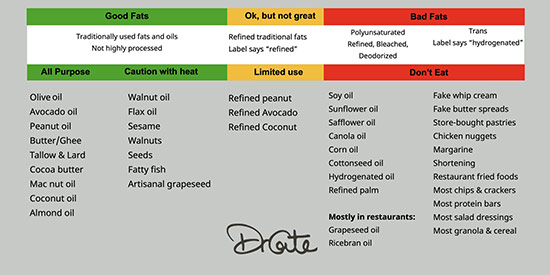
The list below, obtained from Dr. Cate Shanahan, author of “Deep Nutrition: Why Your Genes Need Traditional Food,” summarizes some of the best and worst fats found in our modern diet. Replacing the bad fats in your diet with ones from the “good” list is a simple way to safeguard your health without making any radical changes.
To learn more about the ins and outs of dietary fats, pick up a copy of my book, “Superfuel: Ketogenic Keys to Unlock the Secrets of Good Fats, Bad Fats, and Great Health,” cowritten with James DiNicolantonio, Pharm.D, which gives more in-depth specifics on how to discriminate between healthy and harmful dietary fats.
- 1 FDA.gov, Final Determination Regarding Partially Hydrogenated Oils
- 2 Science Daily February 22, 2012
- 3, 4, 5 Deep Nutrition: Why Your Genes Need Traditional Food by Dr. Cate Shanahan
- 6 Open Heart 2018;5:e000898
- 7 Open Heart. 2018; 5(2): e000898; doi: 10.1136/openhrt-2018-000898
- 8 Acta Scientific Nutritional Health June 2018; 2(6)
- 9 FoodFraud.org
- 10 J Herb Pharmacother. 2004;4(2):1-10
- 11 Journal of Endocrinology and Metabolism April 2011; 1(1): 1-8
- 12 Indian J Physiol Pharmacol. 2010 Oct-Dec;54(4):344-54
- 13 J Enzyme Inhib Med Chem. 2004 Oct;19(5):431-6
- 14 Planta Med. 2010 Feb;76(3):218-22
- 15 Pharm Biol. 2011 Jul;49(7):702-8
- 16 Biological Trace Element Research December 2005
- 17 Journal of Applied Toxicology April 26, 2005
- 18 American Journal of Otolaryngology September-October 2011
- 19 Archives of Clinical Infectious Diseases: Vol.10, issue 1; e22991. January 24, 2015
- 20 Phytotheray Research December 12, 2011
- 21 Natural Society, Black Cumin
- 22 The American Journal of Chinese Medicine 2011
- 23 African Journal of Traditional, Complementary and Alternative Medicines 2011
- 24 Asian Pacific Journal of Tropical Biomedicine May 2013; 3(5): 337-352
- 25 Phytomedicine. 2010 Aug;17(10):707
- 26 Kitchen Doctor, Black Cumin
Intro to the Bioenergetic Theory of Health
Reproduced from original article:
https://articles.mercola.com/sites/articles/archive/2023/10/08/bioenergetic-theory-of-health.aspx
The original Mercola article may not remain on the original site, but I will endeavor to keep it on this site as long as I deem it to be appropriate.
Analysis by Dr. Joseph Mercola Fact Checked October 08, 2023
STORY AT-A-GLANCE
- While insulin resistance is routinely identified as a root cause of most chronic diseases, it too is only a symptom of a deeper problem. At the root will be impaired cellular energy production in the mitochondria
- Insulin resistance occurs when the cells are unable to properly oxidize or burn glucose
- When your body shifts into fat burning this results in lowering your metabolic rate, which is antithetical to optimal health. For optimal health, you need a high metabolic rate, and this is facilitated when your metabolism speeds up when you’re burning glucose in your mitochondria
- A general baseline for most average-sized people is between 150 grams and 250 grams of healthy carbs per day. If you’re very active, it could be as high as 500 or 600 grams a day. Keep in mind that as you increase carbs, you also need to cut down fat. Fat intakes above 30 to 40% or so of daily calories will tend to inhibit glucose metabolism
- Healthy carb choices include fresh whole fruit, fruit juice, root vegetables such as potatoes, sweet potatoes, parsnips and carrots, white rice, raw honey and maple syrup
In this video, I interview independent health researcher Jay Feldman, who has a podcast called “The Energy Balance Podcast.” I recently came to understand the importance of the late Ray Peat’s work, which I had previously dismissed for over three decades, largely due to confirmational bias.
Peat was a biologist and physiologist, and a cofounder of the prometabolic diet based on the bioenergetic theory of health.1 After re-exploring his work, I’ve come to realize just how ahead of his time he was. Feldman is among the few health researchers out there who has also embraced Peat’s work and understands it at a level that allows him to explain it in layman’s terms.
As some of you may know, I’m in the process of creating a master class in preparation for the next pandemic crisis, which I believe is inevitable, and it became obvious to me that Peat’s work is a really crucial component of being metabolically resilient and prepared for the next crisis.
You don’t have to wait for my master class to learn about Peat’s work, however. You can just dive into Feldman’s podcast. There are more than 100 episodes and I suggest starting at Episode 1 and working your way up. Feldman does a terrific job teaching you how to easily and practically implement these strategies.
What Causes Disease?
Well before I encountered Peat’s work, I was convinced most chronic disease was rooted in insulin resistance. I still think that’s a primary problem, but I’m convinced it’s not caused by excess sugar. High linoleic acid (LA) levels are the primary factor that drives insulin resistance, and LA is clearly far more damaging than sugar, especially in the long term.
As explained by Feldman, insulin resistance occurs when the cells are unable to properly oxidize or burn glucose, resulting in a backlog of glucose metabolites and a buildup of glucose in the cells, along with the production of lactate.
This forces the cells to rely on fatty acid oxidation, and the combination of fatty acid oxidation and glucose buildup prevents the cells from taking up more glucose, causing elevated blood sugar. It’s a symptom of a deeper problem, namely impaired energy production in the mitochondria:
“I always come back to the idea that the amount of cellular energy available is what’s going to drive our health, and the lack of energy is what’s going to lead to disease processes, dysfunction, degeneration.
When it comes to insulin resistance, I think there’s a bit of a misnomer. It’s a helpful term for encapsulating a larger idea, but we get caught up in the idea of insulin.
If we’re going to say that there’s one driver [of disease], it’s typically a lack of energy caused by issues with energy production, or inefficiencies in producing energy, due to mitochondrial dysfunction, and that causes insulin resistance.
Those things go hand in hand. When we’re talking about insulin resistance, we’re talking about a situation where the cells aren’t able to properly use glucose, so the glucose builds up. And regardless of how much insulin we have, it’s really hard to get more glucose into the cells, and we see rising blood sugar and all of the other downstream effects.
So, insulin resistance is there. I think it’s just a matter of what we call it. Do we call insulin resistance the fundamental problem, or energy dysfunction — low metabolism issues with energy production?
From my view, I would say that’s where we start, and insulin resistance is an effect of that. And the only reason why I would make that distinction is because we can get caught up in the idea that insulin is the problem and things that increase insulin will cause the cells to stop responding to insulin.
We need to figure out why the cells aren’t responding to insulin, and if we get down to that deeper layer, it comes back to an issue with producing energy.”
That said, Feldman agrees that fasting insulin is a good marker for health, in that it provides you with a good estimate of the efficiency of your cellular energy production. So, provided you’re consuming a healthy amount of carbohydrates, your fasting insulin is a good marker for how well you’re using that glucose and how well you’re producing energy.
Understanding the Underlying Problem
Just keep in mind that while you can lower your fasting insulin by avoiding carbs, that won’t fix the underlying energy production problem. In fact, if you’re on a low-carb diet, you’re causing insulin resistance. Sometimes you might not realize it because your insulin and glucose levels are so suppressed. Eventually, however, you might notice that your glucose level starts to rise.
As explained by Feldman, the underlying problem is not that you’re eating too many carbs. It’s that you cannot properly burn carbs. That’s what caused your glucose and insulin levels to be elevated in the first place. Cutting carbs will lower glucose and insulin, making it appear that all is well, but can you burn carbs? That’s the question.
If you’ve been on a ketogenic diet for some time and are experiencing deleterious effects like sleep disturbances, anxiety, a drop in testosterone and/or T3, reduced energy and exercise performance, then you may have “stealth insulin resistance.”
In other words, your cellular energy production is fundamentally impaired and the low-carb diet was just a Band-Aid masking the symptoms. The real problem persists, because carbs were never the driver of insulin resistance in the first place. An inability to properly oxidize (burn) the carbs was.
Download this Article Before it Disappears
How to Safely Add Carbs Back In
So, how do you bring carbs back in so that you actually improve your ability to use them and minimize negative effects? First and foremost, avoid omega-6-rich polyunsaturated seed oils, as they effectively interfere with energy production and the utilization of glucose. Instead, use monounsaturated and saturated fats.
Next, add carbs back in very slowly, to allow for the upregulation of enzymes that increase carb utilization and conversion to energy. Start by adding easily digestible carbs that won’t cause intestinal irritation or endotoxin production, such as whole fruits.
If you have microbial overgrowth in your gut, you’re producing a lot of endotoxin. In this case, you need to be careful about introducing fermentable carbohydrates, including fruit fibers, so fruit juice may be a better choice than whole fruit. Just be mindful of the juice you select. Apple juice, for example, has fermentable carbs.
Assuming you don’t have an underlying digestive problem, whole fruit is a great place to start. If you start eating whole fruit and notice an increase in gas or bloating, gurgling or belching, or if you feel sluggish or lethargic afterward, you likely have an intestinal issue such as SIBO (small intestinal bacterial overgrowth). You can also try having whole fruit sometimes and fruit juice at other times and see if you notice a major difference.
“If you feel a lot better with the fruit juice, then that’s a pretty clear sign that you are having some issues with fermentable carbohydrates,” Feldman says. In this case, you need to restore your microbiome before you add in more carbs. In the interview, we also discuss the use of antibiotics, either herbal or pharmaceutical, to treat small intestinal bacterial overgrowth (SIBO), so for more information on that, listen to the interview.
“Typically, we want [gas and bloating] to be minimal. This is central. In the same way we can’t overstate the importance of avoiding PUFA, we cannot overstate how much endotoxin — these bacterial byproducts — destroy your health.
You see it in every chronic health condition. In every degenerative condition you see this mild endotoxemia. You see it in fatty liver disease and diabetes, obesity, atherosclerosis.
This is one of the main reasons why people feel better on a low-carb diet or when they’re fasting. They’re avoiding anything that’s feeding the [bacteria in the] intestines. So, if you are one of those people who felt way better and lost weight and noticed a bunch of improvements [on a low-carb diet], there are two main reasons why that would be the case.
One is reductions in endotoxin … The other possible reason is, if they were extremely insulin resistant going in, they were having a lot of trouble using glucose, and so switching to fat and ketones led to a lot of relief.
That’s likely also a situation where your utilization of the carbohydrates is going to have to be ramped up slowly, and your capacity for that might be a little bit lower. So, we want to work on resolving that issue. It could be caused by endotoxin, polyunsaturated fats, by nutrient deficiencies, a lack of sleep and other forms of stress.
If you didn’t have these major benefits on low-carb, you might be able to bring in the carbs much faster and feel much better quicker. But that’s why it’s all dependent on the individual’s context.”
Quick Summary of How to Start
Feldman recommends starting with one piece of fruit with each meal for a week or two. If your appetite increases and you feel better overall, that’s a good sign that your metabolic rate is increasing. As long as you’re feeling good, increase to two pieces of fruit per meal and go from there. If you’re having negative effects, decrease your intake and go slower.
Feldman suggests the baseline for most average-sized people is between 150 grams and 250 grams of healthy carbs per day. If you’re very active, it could be as high as 500 or 600 grams a day. Keep in mind that as you increase carbs, you also need to cut down fat, as fat intake above 30 to 40% or so of daily calories will inhibit glucose metabolism. Other healthy carb choices include:
- Organic dried fruits without added sugars, additives or preservatives
- Root vegetables: potatoes, sweet potatoes, parsnips, carrots
- White rice (well-cooked) and ideally consumed with saturated fat to prevent the rice from feeding bad bacteria
- Raw honey
- Maple syrup
Carbs that may be tolerated by some but not others include grains that are traditionally processed, fermented, soaked and/or sprouted. Sourdough bread is one example. On the more harmful end are unprocessed whole grains and brown rice, as they’re high in anti-nutrients that impair all aspects of digestion.
They contain anti-nutrients like trypsin and amylase inhibitors, phytic acid and oxlates, which can inhibit the digestion of protein and starch while also reducing vitamin and mineral absorption. Most grains are also high in LA. And, of course, processed foods are also on the list of carbs to avoid.
Troubleshooting
Hopefully, if all goes well, you’ll make this transition and realize that both your glucose and fasting insulin are still at healthy levels, or maybe even lower than before. But what if you’ve made the transition to a higher-carb, lower-fat diet, and still have a fasting insulin level of 7 or 8?
Ideally, it should be below 3. Maybe you’re also gaining weight and still feeling sluggish. What’s going on? In short, these are all signs that you’re still metabolically inflexible. So, now what?
“There are a number of things I would go to,” Feldman says, “but again, the question is, what is causing the issue with [not] converting those carbohydrates to energy?
We talked about endotoxin being a huge one. If someone’s already cut out the polyunsaturated fats, endotoxin is really common, so we want to make sure that we’ve fixed everything up gut-wise. If not, that would be my target.
If that’s doing pretty well, and we’re generally not overstressing, we’re getting some good comfortable movement in, we’re eating carbohydrates from the right sources, and we’re still not seeing the benefits that we were looking for, we’re still not seeing the restoration of insulin sensitivity, then I might look for some other support for glucose metabolism.
That could be B vitamins … I know you’ve talked a lot about niacinamide. Thiamine is another one that is crucial for producing energy from carbohydrates … Supplementing with those would be potentially warranted there.
I would also look at other hormonal indications. I’d look at thyroid status at that point, because if we’ve made some of these shifts but we’re not seeing the conversion from T4 to T3, or we’re not seeing good thyroid hormone production, that could be a higher level issue that’s causing a ton of things farther down the chain, and that can include insulin resistance.
If that’s the case, I would look toward doing everything we can to restore that … I would also look at the steroid sex hormone production for women, maybe there’s too much estrogen, maybe not enough progesterone. That can be another huge factor here that can drive or contribute to insulin resistance.
For men, I’d be looking at low testosterone. There’s certainly a place for things like pregnenolone, progesterone, maybe a bit of DHEA to help support that hormonal state as well.”
Why Glucose Is the Ideal Fuel
As explained in the interview, glucose is the optimal fuel for creating energy in your mitochondria. Two byproducts of that process are metabolic or deuterium depleted water, and carbon dioxide. While commonly thought of as a waste product, Peat has made abundantly clear that carbon dioxide is a massively important molecule, and a far superior vasodilator than nitric oxide.
When you are low on carbon dioxide, you can’t be optimally healthy, and if you’re oxidizing (burning) fat in your mitochondria rather than glucose, you’re not going to generate as much carbon dioxide, which also protects proteins from being glycosylated, and lipids from being oxidized. Carbon dioxide also counteracts ROS and RNS (reactive nitrogen species). That’s not the only reason glucose is a better fuel than fat, though. As explained by Feldman:
“I think it’s always helpful to put this in the larger biological context. In any situation where we are starved, where we’re under major stress, when things are dysfunctional, we shift into fat oxidation, fat burning. And this includes when we’re not eating anything. This is why when we’re fasting, we will shift into ketosis, and we can mimic those states by going on a low-carb, high-fat diet, and low protein.
The biological context there is that our bodies view that as a situation when we’re under stress, when we don’t have a lot of fuel available, when we’re in a famine, when we need to survive for a long period of time. In a situation like that, we want to decrease our metabolic rate.
We don’t want to use a lot of energy on reproduction, cognition, digestion, growth and repair. We want to conserve energy because we don’t know when we’re getting food. So, everything around fat burning involves a slowing of the metabolic rate, and we see this again on that bigger picture level.
We see it when we look at thyroid hormone conversion, which gets impaired when we’re low in carbohydrate intake. We see it in terms of testosterone, and we also see it on the mitochondrial level, because on the mitochondrial level, that’s where this all starts.
That’s how our body senses whether it’s burning the fats or the carbs. When it’s burning fats, it has a number of different places that slow down the actual respiration, that slow down the conversion from the fats to energy. And again, this is all healthy and adaptive in that it allows us to survive if we’re starving.
But it’s not ideal for thriving. It’s not ideal for optimal function. It’s not ideal for reproduction. Our bodies don’t want to reproduce if there’s no food available. It’s not ideal for high-level cognition.
When we zoom into the mitochondria, what we see is that the primary difference between glycolysis, the starting of burning carbs and the bad oxidation of the fats, is a difference in the amount of NADH and FADH2 that gets produced.
And when we finish out through the Krebs cycle, and then go to the electron transport chain, depending on the length of the fatty acid, there will be considerably more, sometimes 250% more FADH2 relative to NADH than if we were to oxidize glucose.
What happens is, because we have this major drop off of electrons at Complex 2 through the FADH2, relative to Complex 1, we end up with reverse electron transport. [This is] reductive stress, and that’s because Complex 1 and Complex 2 both use the CoQ electron acceptor.
If you’re favoring Complex 2, you’re going to reduce the amount of electrons that can be dropped off at Complex 1, and you’re going to reduce the amount of electrons at Complex 1 that can keep going down the chain.
So, you get a buildup there, and you get this reverse electron transport and major production of ROS at Complex 1. The other thing that happens is, because of this buildup at Complex 1, the NADH can’t drop off its electrons, so you get buildup of NADH, relative to NAD.
Our bodies are really smart when they see this, because this then affects everything further up the chain. It affects various steps of the Krebs cycle. There are three different steps that need the NAD, so each of those get reduced. So, we’re slowing the activity through the Krebs cycle. We’re getting buildup of citrate, for example, that increases the synthesis of fat, and that gets built up even further.
We end up with a buildup of acetyl-coA that reduces the conversion of pyruvate to acetyl-coA, which also is dependent on NAD, so we’ve got two ways that that’s being inhibited.
And then when you look back up at glycolysis, there’s a number of steps there that get inhibited as well due to this high NADH to NAD ratio, this highly reduced state of the mitochondria. That is just a part of the natural braking mechanism that happens to make sure that when we’re burning fats, we’re doing it slowly. We also produce a lot of ROS, which slows this down.
As a result of this, you’ll eventually induce things like uncoupling, which will fully stop ATP production. So, we’ve got a number of different mechanisms that basically are signals. It’s telling our body that when we’re burning fats, we need to slow everything down, we need to slow our metabolic rate, and we’re going to produce a lot more ROS. We’re going to be slowing things down in the electron transport chain.
This is not ideal if energy is the currency of our health, if that’s what allows us to function and get us out of this constant stress state … That’s the crux of this difference between the carb and fat burning. And then we have the CO2 as the cherry on top … because it protects against the oxidative stress, or reductive stress, as well as being the main thing that oxygenates the cell, which keeps respiration going faster.
Again, that’s another braking mechanism. The cell will take up less oxygen because it’s producing less CO2, which it needs for that uptake of oxygen itself. I was in the low-carb sphere as well and got hooked on the idea that sugar burning is the one that’s the unhealthy and produces all the oxidative stress and everything, but totally missed what’s actually going on.”
Simple Way to Gauge Your Metabolic Rate
Feldman also takes a deeper dive into how glucose and fat burning affects your thyroid function but, basically, when you burn fat in the mitochondria, you inhibit your thyroid gland, which in turn invites weight gain, as your thyroid is your main metabolic regulator.
So, the answer to many a sluggish thyroid is not thyroid hormone supplementation, but eating the correct fuel so that your body has the energy it needs, and your thyroid doesn’t need to downregulate your metabolic rate. He also notes that many people are simply not eating enough calories. Low-calorie diets will also suppress your metabolism, for all the same reasons as detailed above.
While the ideal amount of calories vary based on your age, metabolic rate, physical activity and more, as a starting place, Feldman suggests using a typical calorie calculator to estimate your daily calorie requirement, and if you’re eating fewer calories than that and are gaining weight or maintaining your weight, your metabolism is low.
After you’ve estimated your daily calorie requirement, calculate how much protein you need. The formula for that is 0.6 to 0.8 grams of protein per pound of lean body mass or ideal body weight. The amount of protein you need should be about 15% of your daily calories. Then divide the rest into 45% to 65% healthy carbs and 20% to 40% healthy fats. In closing, Feldman has the following advice:
“If someone’s insulin resistant, they’re not using the carbs coming in, and if they’re not going to fix it, then sure, we might as well avoid carbs for a period of time. But I would say the better route is to work on fixing it. And in the vast majority of cases, the people who are in that state are not coming from a whole food, fruit, root vegetables, low PUFA fat sources type of diet …
So my suggestion would be, just go to that. We don’t even have to over-complicate it … just shift toward whole food, low PUFA, easily digestible foods, away from the grains. For the vast majority of people that gets them to where they need to go without needing something as restrictive and inherently stressful as keto and carnivore.
If that is the only way for someone to move forward, if it’s that or sticking with what they’re doing, then yeah, do it. Do keto or carnivore. There is an inherent long-term negative to it. There’s inherent stress that comes with it, but if that is the route that someone needs to go to make a change, then I think it’s fine to start there. I would just say let’s not stick with that long-term.
I’d really prefer to shift to including healthy carbohydrates as soon as possible. And that’s because whether the stress is for three months or a year, it’s always going to be a negative. What happens is, we have these major benefits from reducing the endotoxin, and relief from throwing carbs into an insulin resistant state, but once you’ve attained those benefits, the negatives will start to creep in.
I’d rather get all of those benefits without the negatives. I’d rather lower endotoxin by taking out grains and raw vegetables, raw leafy greens, those kinds of things, lowering fiber if we need to, but keeping carbohydrates so we can avoid the stress. I’d way rather get that benefit in that way as opposed to just taking out all carbohydrates.”
More Information
To check out more of Feldman’s work, visit his website, JayFeldmanWellness.com. Again, I recommend starting with Episode 1 and working your way up for a life-changing, immersive-learning experience on implementing bioenergetic medicine. Each episode has show notes and links to studies cited. You can also listen to his podcast on Apple Podcasts, Google Podcasts, Stitcher and Spotify. Just search for “The Energy Balance Podcast.”
Link Between Insulin Resistance and Disease Acceleration
Reproduced from original article:
https://articles.mercola.com/sites/articles/archive/2023/09/29/insulin-resistance-disease-acceleration.aspx
The original Mercola article may not remain on the original site, but I will endeavor to keep it on this site as long as I deem it to be appropriate.
Analysis by Dr. Joseph Mercola Fact Checked September 29, 2023

STORY AT-A-GLANCE
- I’ve long warned that insulin resistance is at the foundation of most chronic disease, from heart disease and Type 2 diabetes to cancer
- Researchers with the University of Copenhagen are now encouraging doctors to monitor blood sugar levels in their cancer patients after finding that many struggle with insulin resistance
- In their systematic review and meta-analysis, they revealed cancer patients are “markedly insulin resistant”
- Processed foods — which are loaded with added sugars, processed grains and industrially processed omega-6 seed oils rich in linoleic acid (LA) — are the primary culprits causing insulin resistance
- Most cases of insulin resistance can be resolved via dietary changes, time restricted eating and enough daily movement
I’ve long warned that insulin resistance is at the foundation of most chronic disease, from heart disease and Type 2 diabetes to cancer. Now, researchers with the University of Copenhagen in Denmark are encouraging doctors to monitor blood sugar levels in their cancer patients after finding that many struggle with insulin resistance.1
“Insulin resistance is a critical cause of metabolic dysfunctions. Metabolic dysfunction is common in patients with cancer and is associated with higher cancer recurrence rates and reduced overall survival. Yet, insulin resistance is rarely considered in the clinic,” the team explained.2 In their systematic review and meta-analysis, they revealed cancer patients are “markedly insulin resistant,”3 which should guide priorities for treatment and prevention.
Many Cancer Patients Are Insulin Resistant
While insulin resistance is still not factored in to mainstream cancer treatment, it’s been known since the 1920s that cancer patients often had sweet-smelling urine due to high blood sugar levels.
“This was one of the first things we learned about cancer patients,” study author Lykke Sylow told SciTechDaily. “In cancer patients, the cells do not respond well to the hormone insulin. It therefore takes more insulin to create the same effect in cancer patients. If you suffer from insulin resistance, your body has to produce more insulin than usual to be able to regulate the blood sugar.”4
It’s not only people with cancer who tend to be insulin resistant, however. At least 40% of U.S. adults between the ages of 18 and 44 have insulin resistance, which is associated with obesity and Type 2 diabetes, as well as high blood pressure and limited physical activity.5 Other estimates suggest even more Americans are insulin resistant, and that can be true even if your fasting glucose is normal.6
A bombshell study came out in July 2022, showing that in 2017 to 2018, only 6.8% of U.S. adults had optimal cardiometabolic health.7 What this means is that more than 93% of U.S. adults are metabolically unfit, and the actual percentage is probably over 95%.8
Without lifestyle changes, Type 2 diabetes may develop about 10 to 15 years after insulin resistance begins. However, this isn’t the only consequence.9 While insulin is essential to staying alive, insulin resistance accelerates the aging process and contributes to the development of degenerative diseases.
To compensate, your pancreas secretes more insulin into your bloodstream to lower your blood sugar. Insulin, however, is very efficient at lowering blood sugar by turning it into fat. The more you secrete, the more fat your body will accumulate.
“The metabolic consequences of insulin resistance can result in hyperglycemia, hypertension, dyslipidemia, hyperuricemia, elevated inflammatory markers, endothelial dysfunction, and a prothrombotic state,” according to the National Library of Medicine.10 But cancer is also related.
“In cancer patients the cells do not respond well to the hormone insulin,” one of the study’s main authors, Lykke Sylow, explained. “It therefore takes more insulin to create the same effect in cancer patients. If you suffer from insulin resistance, your body has to produce more insulin than usual to be able to regulate the blood sugar.” And that, according to a second main author, Joan Màrmol, “can be a huge problem for cancer patients.”11
Alzheimer’s, Other Diseases Linked to Insulin Resistance
The featured study suggested further research to determine if resolving insulin resistance in cancer patients could improve outcomes. In fact, it’s already known that resolving insulin resistance is important for optimal health and warding off most chronic diseases.
Alzheimer’s disease is intricately connected to insulin resistance;12 even mild elevation of blood sugar is associated with an elevated risk for dementia.13 Further, as noted in Frontiers in Endocrinology, “Insulin resistance (IR) plays a crucial role in the development and progression of metabolism-related diseases such as diabetes, hypertension, tumors, and nonalcoholic fatty liver disease, and provides the basis for a common understanding of these chronic diseases.”14
Chronic kidney disease, heart attack, coronary artery disease, vascular stiffness, polycystic ovarian syndrome and cerebrovascular diseases are also linked to insulin resistance.15 In terms of cancer, insulin resistance may increase risk and worsen outcomes via multiple mechanisms, including chronic inflammation, promotion of cell proliferation, epigenetic modifications and gut dysbiosis.16
Its health consequences are varied and significant, as insulin resistance results in mitochondrial dysfunction. The process begins because your body is unable to burn fat as a primary fuel. When your body relies primarily on sugar instead, more reactive oxygen species (ROS) are generated, which damage the mitochondria in your cells.
Download this Article Before it Disappears
What Causes Insulin Resistance — and What to Do About It?
Insulin resistance is typically caused by lifestyle factors, especially poor diet choices. Specifically, processed foods — which are loaded with added sugars and processed grains. But, most deleterious are the industrially processed omega-6 seed oils rich in linoleic acid (LA) — which are the primary culprits causing insulin resistance.
The most important change to make is cutting out industrially processed seed oils, which are misleadingly labeled as vegetable oils. Examples of seed oils high in LA, which will radically increase oxidative free radicals and cause mitochondrial dysfunction,17 include soybean, cottonseed, sunflower, rapeseed (canola), corn and safflower.18
In order to avoid LA, you’ll need to avoid eating processed foods and most restaurant food and focus on real food instead. Consider cutting LA down to below 5 grams per day, which is close to what our ancestors consumed before chronic health conditions, including cancer, became widespread.
For most people it takes three years of a rigid seed oil restriction to normalize their tissue LA levels to healthy ranges. To be more specific, LA should be less than 2% of your daily calories. To keep track, enter your food data into Cronometer and it will calculate your percentage automatically.
Time-restricted eating is another important strategy. Our ancient ancestors did not have access to food 24/7, so our genetics are optimized to having food at variable intervals, not every few hours. When you eat every few hours for months, years or decades, never missing a meal, your body forgets how to burn fat as a fuel.
Most people who practice TRE limit the time they consume food to eight to 10 hours or less on most days of each week. In one study, adults with obesity who used an eight-hour eating window lost more weight, and had better improvements in diastolic blood pressure and mood, than those who used a 12-hour or more eating window.19
Fasting is also useful for Type 2 diabetes, leading to increased insulin sensitivity.20 Once you regain insulin sensitivity, you can increase your food intake window to 10 to 12 hours.
How to Keep Track of Your Blood Sugar Level
A blood sugar level over 90 mg/dl puts you in the danger zone for insulin resistance. Your blood sugar is measured through a glucose test, of which there are four types:
1. Fasting plasma glucose test — When you fast overnight and take your blood sample in the morning
2. Oral glucose tolerance test — Similar to the fasting blood sugar test, overnight fasting is required for this, and your fasting blood sugar level is measured. Afterward, a sugary liquid is provided and the levels are then tested for the next two hours
3. Hemoglobin A1C test — This test checks the percentage of blood sugar attached to the hemoglobin and will indicate your average blood sugar level for the past two to three months
4. Random plasma glucose test — This makes use of a blood sample that is taken at a random time
For most people, a simple at-home glucose test, where you prick your finger and deposit a drop of blood onto a glucose testing strip, will do the job.21 Ideally, test yourself two to three times a day: first thing in the morning, before your first meal and a couple of hours after your last meal.
However, glucose levels can be deceptive because once you fast for a day or go low-carb, your blood glucose levels will decrease; but then they increase because your body requires a certain amount of glucose and your body increases cortisol to sacrifice protein from your muscles and bones to make it.
Your blood glucose levels will vary throughout the day. According to conventional recommendations, if you are healthy and do not have diabetes, your fasting blood glucose upon waking should be below 100 mg/dL. But I recommend aiming for a fasting (when you wake up) level below 90 mg/dL.
Before meal time, your glucose level should read between 70 to 99 mg/dL. After meals — or what’s called “postprandial” and is usually taken two hours after eating — the level should be below 140 mg/dL. Keep in mind there are two measurements used for blood sugar levels.
In the U.S., the measurement is in milligrams of glucose per deciliter of blood (mg/dL). In the U.K. and Canada, the measurement for blood sugar is in millimoles/liter (mmol/L). To convert to mg/dL, multiply the amount by 18. So, if a person in the U.K. has a blood glucose result of 7 mmol/L, in the U.S. it’s read as 126 mg/dL.
Berberine Helps Regulate Blood Sugar
Insulin resistance is typically easy to resolve by making dietary changes. However, if you’re looking for additional support, consider berberine, a compound that’s extracted from goldenseal, barberry, Oregon grape and tree turmeric. It shows promise for helping to regulate blood pressure. In a 2022 systematic review of the literature, berberine reduced insulin levels, with the optimal dose being 1.8 grams a day.22
Berberine functions much like metformin, a commonly used medication for the treatment of diabetes. Both work, at least in part, by activating adenosine monophosphate-activated protein kinase (AMPK). Known as the “metabolic master switch,” AMPK is an enzyme that controls how energy is produced in your body and how it’s used by the cells.
By activating this enzyme, berberine and metformin help regulate the biological activities that normalize lipid, glucose and energy imbalances. Berberine, used in Chinese medicine to treat diabetes, has also been shown to counteract hepatic insulin resistance in diabetic rodents.23,24
Berberine may also help alleviate metabolic disorders via favorable effects on the gut microbiome, including strengthening intestinal barrier function and reducing inflammation.25 Supplements like berberine should be used as part of a comprehensive strategy to optimize your blood sugar.
Exercise and daily movement are also important. One study published in Medicine & Science in Sports & Exercise found even a single session of moderate exercise can improve the way your body regulates glucose and reduces postprandial glucose spikes.26
So, whether you’re specifically targeting cancer or not, taking steps to resolve insulin resistance is an important strategy for warding off chronic disease and maintaining optimal health.
- 1, 4, 11 SciTechDaily September 11, 2023
- 2, 3 Acta Oncologica 2023, Volume 62, Issue 4, Abstract
- 5, 9, 10 National Library of Medicine, StatPearls, Insulin Resistance August 17, 2023, Epidemiology
- 6 The Fat Emperor May 10, 2015
- 7, 8 J Am Coll Cardiol. 2022 Jul 12;80(2):138-151. doi: 10.1016/j.jacc.2022.04.046
- 12 JAMA Neurology July 27, 2015. doi:10.1001/jamaneurol.2015.0613v
- 13 NEJM August 8, 2013; 369:540-548
- 14 Front. Endocrinol., 28 March 2023
- 15 Front. Endocrinol., 28 March 2023, Figure 1
- 16 Front. Endocrinol., 28 March 2023, 2.2 IR and tumor
- 17 BMJ Open Heart 2018;5:e000946. doi: 10.1136/openhrt-2018-000946, Intro
- 18 Int J Mol Sci. 2020 Feb; 21(3): 741, Intro
- 19 JAMA Internal Medicine August 8, 2022
- 20 Nutrients. 2023 Aug 10;15(16):3525. doi: 10.3390/nu15163525
- 21 Medical News Today April 23, 2019
- 22 Frontiers in Nutrition, 2022; 9
- 23 J Ethnopharmacol. 2015 Feb 23;161:69-81
- 24 Evidence-Based Complementary and Alternative Medicine 2012, article ID 591654
- 25 Frontiers in Cellular and Infection Microbiology, 2022;12(854885)
- 26 Med Sci Sports Exerc. 2012 Feb;44(2):225-31
Fat vs. Glucose for Weight Loss: Constructing the Ideal Menu
Reproduced from original article:
https://articles.mercola.com/sites/articles/archive/2023/09/23/ideal-menu-to-maximize-energy.aspx
The original Mercola article may not remain on the original site, but I will endeavor to keep it on this site as long as I deem it to be appropriate.
Analysis by Dr. Joseph Mercola Fact Checked September 23, 2023
STORY AT-A-GLANCE
- When the fuel from the food you eat cannot efficiently be burned and converted to energy (ATP), it’s typically diverted and stored as fat. So, the primary cause of obesity is the inability to efficiently metabolize food, typically glucose in the mitochondria, into energy
- The inefficient burning of fuel (metabolizing of food) is why people who are obese typically also struggle with other health issues, such as low energy, fatigue, an inability to maintain focus, digestive problems and poor immune function
- Mitochondrial dysfunction, psychological stress, oxidative stress (reductive stress), heavy metals, endotoxin, lack of sleep and certain nutritional deficiencies can flip your metabolism into fat burning, which then impedes the metabolism of glucose and converts the glucose into fat rather than energy
- High energy production equates to high metabolism, so part of the solution for obesity and most other conditions is to raise your metabolic rate
- A key strategy to optimize your mitochondrial energy production is to remove blocks in the electron transport chain. Endotoxin and other bacterial toxins are among the biggest culprits, as they can directly impair electron transport. Another effective blocker of mitochondrial energy production is polyunsaturated fat (PUFA)
In the “GET LEAN Eat Clean” podcast above, personal health and wellness coach Brian Gryn interviews Jay Feldman — a health coach and independent health researcher who is extremely knowledgeable in the work of the late Ray Peat — about the underlying causes of obesity and how to optimize mitochondrial energy. I am also scheduled to interview Jay in the near future.
Feldman is the founder of Jay Feldman Wellness and hosts the Energy Balance podcast. A key concept he presents is that when the fuel from your food you eat cannot be efficiently metabolized and converted to energy (ATP), it’s instead typically diverted and stored as fat. In my view, he is the best teacher of Ray Peat’s work. You can view the first seven episodes of his podcast to develop a foundational understanding of bioenergetic medicine.
Another key concept is that high energy production equates to high metabolism, so part of the solution for obesity is to raise your metabolic rate. Unlike conventional wisdom which suggests calorie restriction is associated with longevity, a high metabolic rate slows aging and helps you remain more youthful — at least biologically speaking — as you age.
Lack of Energy Is a Foundational Problem in Obesity
The inefficient burning of fuel (metabolizing of food) is why people who are obese typically also struggle with other health issues, such as low energy, fatigue, an inability to maintain focus, digestive problems and poor immune function.
As noted by Feldman, these all result from a lack of energy production in your mitochondria. So, the primary problem in obesity is that your body cannot efficiently convert the food you eat into energy. Instead, it gets converted into fat. As a result, you end up with obesity, low energy and perpetual hunger, which leads to overeating. Feldman explains:
“I … come from the bioenergetic view of health … the idea that energy, the energy that’s produced in our mitochondria, is the main driver of our health, and a lack of that energy is what leads to dysfunction …
I would say obesity is an energy problem, and endocrine problems are superimposed, happening on the energetic front. So, it’s really helpful to look at hormones … like cortisol … thyroid hormones … the reproductive hormones …
Those things are really helpful when we’re trying to get a gauge on where somebody’s at because you can’t always see what’s happening in the cells and the mitochondria. So, we can look at hormones as a proxy there, but those hormones are just signals and messengers that are being produced or inhibited in response to what’s going on in terms of the energetic state.”
Glucose Metabolism Is Easily Hindered
As noted by Feldman, your metabolism is a sensitive system, especially when it comes to glucose metabolism. Things like mitochondrial dysfunction, psychological stress, oxidative stress (reductive stress), heavy metals, endotoxin, lack of sleep and certain nutritional deficiencies can flip your metabolism into fat burning, which then impedes the metabolism of glucose and converts the glucose into fat rather than energy.
“This is why we want to be looking at food choices in terms of how they affect our energy production,” Feldman says. The conventional view is that fuel equates to energy, which is why obesity is thought of as an energy excess and all you need to do is eat less and exercise more. But that’s not accurate.
“That [view] is something I think we definitely want to work ourselves away from and instead focus on how well we’re using the food that’s coming in, and what types of foods are better used, considering our human physiology,” Feldman says. “That’s really where we want to focus, as opposed to eating less or exercising more.”
Download this Article Before it Disappears
Lack of Fat Burning Is Not the Problem
Many, myself included, used to believe that optimizing fat burning was the solution not only to obesity but most other health problems as well, but we’re now starting to realize that this is borne out of a misconception. As explained by Feldman:
“I think what’s happened is we’ve come into this with preconceived notions that people are overweight and have excess body fat, so there must be a fat burning problem. And that is an assumption that I would say is definitely not true …
There have been clear metabolic studies where they see that you can be on a low-carb diet and you can be burning more fat with lower insulin, and having more fat released from the fat stores, and still be losing less body fat because there’s also more fat coming into the fat stores.
And on the flip side, you can be on a higher carb diet, burning less body fat, and still losing more body fat because in that case you’re storing less body fat. So, we’ve just focused in on this one piece of the equation — how much fat are we burning — when it doesn’t acknowledge the whole flow in and out of of the fat stores …
I used to think that … everyone was oxidizing carbs and the problem was that we needed to become better fat burners, but when you actually look at what’s going on in these states, fat burning is part of the problem. That is what happens when things are problematic.
There is one caveat here that’s important, which is that burning carbohydrates doesn’t always mean the same thing. We can oxidize glucose through oxidative processes, meaning we go through glycolysis, and then we go through the Krebs cycle, and then we go through the electron transport chain …
The glucose gets oxidized and we end up with a decent amount of energy. When we are in a degenerated state, in addition to burning more fat, we also run through glycolysis more, and glycolysis is the first step … of glucose burning.
Because there are blocks farther down, we can’t use the glucose all the way, and that’s a problem … but that is not caused by the sugar, it’s not caused by the carbohydrates, it’s not caused by carb burning.
That’s caused by mitochondrial dysfunction caused by our ability to produce energy. So, we’re stuck in a very inefficient glucose burning along with fat burning, and that’s not a great state to be in. But that is not the same thing as fully oxidizing glucose in a healthy metabolic state.”
How Your Body Produces Energy
I like to use graphics when explaining this, so let me restate what Feldman is saying, along with a couple of images. In summary, your body can use two fuels for energy: glucose and fat. If you eat any type of sugar or complex carbohydrate, it’s metabolized to glucose. Glucose is then broken down to pyruvate.
At that point in the process, there’s a “switch,” known as the Randle Cycle. The pyruvate can either enter the glycolysis pathway and turn into lactate, or it can be metabolized into acetyl-CoA through aerobic respiration, as shown in the image below.
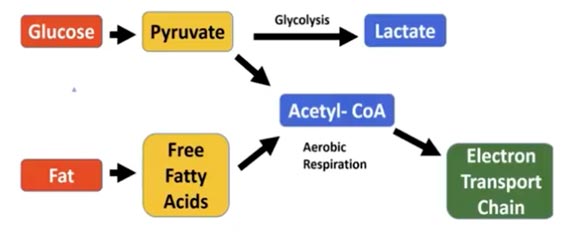
Provided your fat intake is below 30% or so (this is merely a best-guess at this point, as no one knows exactly what the threshold is), the glucose you consume will be shuttled into acetyl-CoA. When it goes to acetyl-CoA, it goes into the electron transport chain in the mitochondria.
Free fatty acids can also be metabolized into acetyl-CoA through beta-oxidation in the mitochondria, and there’s a competition that occurs there with glucose, which is why your fat intake needs to be low enough for glucose to enter this pathway.
Aerobic respiration uses oxygen in the mitochondria, whereas glycolysis, which occurs in the cytosol, does not use oxygen and is very inefficient. Glycolysis only generates two ATP molecules for each molecule of glucose, whereas aerobic respiration, which occurs in the mitochondria, generates 36 to 38 ATPs per molecule of glucose.
Ultimately, you want to burn glucose in your mitochondria. That’s the most efficient, allowing you to generate the most energy, while simultaneously producing the least amount of harmful “exhaust” in the form of reactive oxygen species (ROS).
And, again, the only way to ensure that is to keep your dietary fat content below 30% of your total calories. If you’re insulin resistant, which means you’re metabolically inflexible, that threshold may be closer to 20% or even 10%. So, if you’re insulin resistant, you’ll want to significantly lower your fat intake until your insulin resistance is resolved. Then you can increase it to 30%.
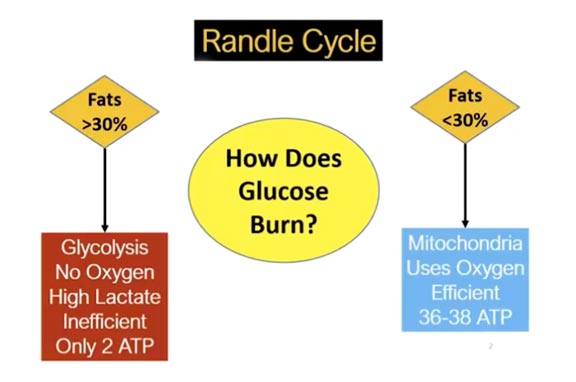
Endotoxin and PUFAs Decimate Mitochondrial Energy Production
Next, Feldman discusses a key strategy to optimize your mitochondrial energy production, which is to remove blocks in the electron transport chain so that electrons can move smoothly forward, without accumulating and backing up.
“We don’t need to focus on doing extra things to stimulate [mitochondrial energy production],” Feldman says. “Our mitochondria will work perfectly well if they have the right fuel and nutrients, and they aren’t being inhibited or blocked.”
According to Feldman, endotoxin (lipopolysaccharide or LPS) and other bacterial toxins are among the biggest culprits when it comes to things that hinder mitochondrial energy production. These toxins can directly impair electron transport through the complexes of the electron transport chain. They can also impair certain enzymes in the Krebs cycle.
The primary solution for obesity and most other conditions is to raise your metabolic rate, and a key strategy for that is to remove blocks in the electron transport chain. Endotoxin and polyunsaturated fats (PUFAs) are two key culprits that need to be eliminated.
Poor digestion is frequently associated with negative gram bacteria in your gut that produce endotoxin, and this will inhibit your ability to convert food to energy, resulting in increased body fat. So, it’s important to reduce your endotoxin load. Aside from poor digestion, excess endotoxin is also a common culprit in degenerative conditions, metabolic syndrome, diabetes and fatty liver. To reduce your endotoxin load:
- Rebalance your gut microbiome by reintroducing beneficial bacteria (probiotics and prebiotics). One of the best and least expensive ways to do this is to eat a serving of fermented vegetables each day.
- Temporarily go on a low-fiber diet and avoid fiber supplements as it can feed undesirable bacteria. Cook your vegetables thoroughly rather than eating them raw, and if your condition is serious, limit fruits for a time too.
- Eat a low-carb ketogenic diet and/or fast until the problem is resolved. As noted by Feldman, “This is one of the main places where low-carb diets, ketogenic diets, fasting, carnivore [diets] are really helpful, as they provide relief from the feeding of bacteria that are producing a lot of endotoxin.” Foods to avoid include most grains, legumes, nuts, and seeds.
- Avoid resistant starches, as they feed LPS-producing bacteria.
Once your microbiome is balanced and symptoms of poor gut function have resolved, you can slowly reintroduce whole fruits, vegetables, roots and tubers, and other foods. Another effective blocker of mitochondrial energy production is polyunsaturated fat (PUFA).
These are your processed seed oils, canola oil being among the worst of the worst. Seed oils are loaded with linoleic acid, an omega-6 PUFA, which appears to be one of the primary drivers of chronic diseases, in part due to its detrimental impact on your mitochondrial function and energy production.
The Expensive Tissue Hypothesis
After a short discussion about ancestral diets and the likelihood that such diets were generally high in carbs, Feldman and Gryn review the “expensive tissue hypothesis,” which is the idea that the less energy you waste on hard to digest, fibrous foods, the more energy is available for your brain.
“… that’s also a reason to be consuming a lot of carbohydrates and not excess protein, because the conversion from protein to glucose and then to energy is very inefficient,” Feldman says.
“It’s about 30% less efficient than just using glucose. So, if we consider the … expensive tissue hypothesis, we shouldn’t be consuming excess protein beyond our needs and trying to use that for energy, because … that leaves less energy for our immune function, our brain function, for reproductive function and and on …
Coming back to weight loss, there’s the constrained model of energy expenditure, which is very related here, which basically says that you can’t just expend more and more calories from, let’s say, exercise, without it coming at a cost.
So, if you exercise 1,000 calories’ worth and before you were burning 2,000 calories, that doesn’t mean that you just burned 3,000. What actually happens is, you start to cut into your own basal metabolic rate, and you start to cut into your bodily function.
So, your reproduction is turned down, your immune function is turned down … Extrapolated, it really also gets at the problem with the ‘eat less exercise more’ advice for weight loss.”
Endotoxin, Not Fructose, Causes Fatty Liver Disease
Feldman also debunks the argument that fructose, unlike what is being promoted by Drs, Robert Lustig, Richard Johnson and David Perlmutter, causes nonalcoholic fatty liver disease (NAFLD). He reminds listeners that both dietary fat and fructose can be converted into fat, and fructose isn’t automatically destined to end up as liver fat.
“In fact, very little fructose gets converted to fat,” he says, because “there are all sorts of of routes for it to go before it’s getting converted to fat … Fructose does go to the liver and it gets picked up by the liver immediately, whereas glucose will go out into the bloodstream and can be picked up by the muscles.
But our livers have developed to handle massive amounts of fructose. Most of the research that is looking at what happens to fructose … is going on in rats. And there are a few differences, there are a few problems there. One is that rat livers are very different from human livers in their capacity for fructose handling.
Our livers have an incredible capacity for handling fructose. Hundreds and hundreds of grams can be stored as glycogen, can be converted to glucose or lactate and sent out to be stored elsewhere, or used elsewhere, and then can also be oxidized.
So, when we consume excess fructose in a normal context, in a healthy liver, very little is going to be going to fat. It takes huge amounts of carbohydrates before you’re … producing much fat in the liver through de novo lipogenesis. And that’s because our livers have this incredible capacity for handling it …”
Feldman also remarks that many fructose studies are flawed in that they’re looking at fructose-only sources, which rarely ever exists in our food supply as it is virtually always accompanied with glucose. Results from such studies therefore do not tell you much about how natural, whole food-based fructose, say from fruit or honey, acts in the body.
“Whether you’re consuming fruit or honey or anything else, the fructose to glucose ratio is always near 1-to-1,” he says. “Sometimes there’s a slight bit more fructose [than] glucose, but even in high fructose corn syrup … it’s about 55% fructose and 45% glucose. We’re really not talking about major differences here.
And that’s important because our intestines don’t absorb pure fructose. If there’s glucose present, we absorb it very well. But if there’s no glucose present … you can’t really absorb it very well.
So, what happens is a lot of it doesn’t get absorbed in our small intestine. [It] continues down to the large intestine where it feeds bacteria. Those bacteria produce endotoxin, and that is what leads to things like fatty liver production [and] fatty liver disease.”
How to Gauge Your Metabolic Rate
According to the rate-of-living theory, the higher your metabolic rate — which means the quicker the electrons move from food toward oxygen, which is the final acceptor of electrons — the faster you’ll age because there’ll be higher oxidative stress.
However, deeper analysis reveals the exact opposite. The truth is, the higher your metabolic rate, the slower you age, because a high metabolism creates fewer ROS that can damage your tissues.
Your metabolism is high when electrons move rapidly and easily through the mitochondrial electron transport chain, which results in optimal energy production. When electrons are impeded from moving forward, they can back up, leak through the mitochondrial membrane and start moving backward, where they combine with oxygen to create excessive ROS.
So, for optimal health, you want high energy production and that means a high metabolic rate. As explained by Feldman, you can gauge your metabolic rate using your pulse and body temperature.
“If you’re not hitting 98.6 [degrees Fahrenheit] later in the day, if you’re not hitting 97.8 or 98.0°F when you’re waking up, that can be a sign of a hypometabolic state,” he says.
“If your [resting] pulse [first thing in the morning] is particularly low, if you’re not getting into the mid-70s or potentially low-80s, depending on your fitness state, that can also be a sign of a low metabolic rate.
The caveat is that the more cardiovascularly fit you are, the lower your pulse rate will be, independent of metabolic state. That’s because your stroke volume increases. The stroke volume is the amount of blood your heart pumps with each beat. So you can have fewer beats and still pump the same amount of blood … You can also look at temperature and pulse before and after a meal.
If … somebody wakes up at temperature 98.4°F. and then they have their breakfast and it drops to 97.5°F., that is a situation of a drop in stress hormones, where someone was waking up in a stress state, their sleep’s probably not optimal, they’re probably not optimal metabolically, then they’re consuming some carbohydrates and their stress hormones drop.
If you’re seeing that happen after a meal, it’s a pretty good sign that that’s what’s happening.
Another good way to do it is just seeing how many calories you can consume while maintaining your weight … If, with your activity and everything else, you should be burning 3,000 calories a day, but you’re maintaining your weight on 2,200 calories a day, that’s a sign that you’re pretty hypometabolic.”
Conversely, if you can maintain your weight when you add more calories, your metabolic rate is likely high, and the extra food will oftentimes improve your sleep, relaxation, energy and recovery.
Methylene Blue — A Useful Rescue Remedy
While there are no magic pills to fix slow metabolism or low energy production, there are some that can help. I’ve previously written about the usefulness of niacinamide, for example. Another helpful one is methylene blue. As explained by Feldman:
“As a supplement, it’s got a number of interesting effects. For one, it’s antimicrobial … but it also has some pretty interesting mitochondrial or energetic effects, where it is able to work as an electron acceptor and donor.
So, if things are not working well in the electron transport chain, the main site where we produce ATP, [if] something’s blocked, let’s say by endotoxin or polyunsaturated fats, whatever it is, methyl blue can help us bypass those issues and allow us to continue to produce energy despite those things.
It also lowers nitric oxide, which is another inhibitor of mitochondrial respiration. So, it’s got a number of benefits. I will say, like any other supplement, there’s a place for it and there’s also a place where it can be problematic, and it’s never the first thing I would go to.
We always want to work at those foundations first — get diet on point, eat consistently, get enough carbs and fats in, make sure we’re getting the nutrients we need, trying to work on our sleep hygiene, our movement …
But I do think there’s a place for methylene blue to help with either those microbial issues or for getting the metabolism going in certain instances. It also, in particular, has some benefits neurologically, because of these stimulating effects on respiration … So, yeah, I like it. Again, it’s not magic in that it is going to fix the problems, but it can be helpful along the way.”
Constructing the Ideal Diet to Maximize Energy
While it’s nearly impossible to come up with a diet that is ideal for everyone, general guidelines can be provided. After that, it’s up to you to experiment and note what works and what doesn’t. For example, some are outfitted with genes that can handle dietary fats better than others, while some may have had their gallbladder removed and can’t handle much fat at all. Following are some general principles for devising your ideal diet:
• Protein — Most adults need about 0.6 to 0.8 grams of protein per pound of lean body mass. As an example, if your body fat mass is 20%, your lean mass is 80% of your total body weight. Ideally, stick to animal-based protein such as clean seafood and low-LA animals like beef, bison, lamb and other ruminant game animals, raw grass fed dairy and organic pastured eggs.
Avoid chicken and pork as, even if pasture-raised and organically fed, they are given grains and other foods that are high in LA so they will increase your LA levels. Many plant-based proteins, including nuts and seeds (with the exception of macadamia nuts), are also high in PUFAs.
• Carbs — Avoid hard-to-digest carbs like most grains, including brown rice, and legumes, unless they’re soaked, properly cooked, sprouted or fermented. Good options include raw authentic honey, maple syrup, white rice, ripe and dried fruit, and well-cooked (preferentially pressure cooked) tubers like red potatoes, sweet potatoes and parsnip.
• Fats — Avoid seed oils, which are loaded with PUFAs like LA. Good options include butter, tallow, ghee, coconut oil and avocados.
If you’ve been on a low-carb, high-fat diet, slowly add in more carbs while simultaneously lowering your fat intake. As mentioned earlier, your fat intake probably needs to be somewhere around 30% or lower to allow for efficient glucose metabolism.
Feldman typically recommends a range of 20% to 40%, with the upper limit being for more physically active people with greater muscle mass. With fats at 30%, carbs would then be in the range of 55% to 60%, with protein making up the remaining 10% to 15%.
Increase Your Metabolism to Slow Your Aging
As mentioned earlier, high metabolism is the key to slowing down aging. And the slower you age, the more youthful and resilient you’ll be. As noted by Feldman:
“When we’re in our 20s, let’s say, or late teens, we can kind of eat whatever, our metabolic rate’s really, [we have] high libido’s, sleep is never an issue … digestion is really good; things don’t bother you. That’s the state … we want to be getting to. And I would say the key difference there is, where is our metabolic rate at?
Over time, metabolic rate slows, mitochondrial respiration slows. If you take aged mitochondria from someone who’s above the age of let’s say 60 or 70, there’s a dramatic reduction in energy production … So, the solution is to get back to that young metabolism. And I think it’s totally doable.
It’s just a matter of eating the things that are designed for optimal function, that allow for maximal energy production, [and] avoiding the things that interfere with that — avoiding the polyunsaturated fats, lowering endotoxin, having good, consistent sleep, consistent movement.
It’s a complex, right? It’s never as simple as ‘Just eat this one thing,’ or ‘just take this one pill.’ [It’s] having that perspective of trying to think of speeding things up, as opposed to slowing things down.”
Is Ghee Better Than Butter?
Reproduced from original article:
https://articles.mercola.com/sites/articles/archive/2023/09/08/is-ghee-better-than-butter.aspx
The original Mercola article may not remain on the original site, but I will endeavor to keep it on this site as long as I deem it to be appropriate.
Analysis by Dr. Joseph Mercola Fact Checked September 08, 2023

STORY AT-A-GLANCE
- Ghee has been used in traditional cooking for eons, as an oil and as an ingredient, but it’s also an Ayurvedic go-to for massages and herbal ointments, and as a medicinal to remedy rashes and burns
- Making ghee starts with butter made from cow’s milk and involves separating liquid fats from the milk solids and removing the milk solids, a method many believe is healthier than butter
- Ghee, which is heated longer than most other types of clarified butter, is darker and has a richer, nuttier flavor, as well as a higher smoke point, making it easier and healthier for sautéing — and you can make your own
- Due to compounds such as conjugated linoleic acid (CLA) and a fatty acid known as butyrate acid in ghee, your inflammation and coronary heart disease risk may be reduced and your digestion improved
- In ghee, the milk is separated from the fat, so the lactose as well as casein is reduced, making it better than butter if you have allergies or sensitivities to dairy products
Editor’s Note: This article is a reprint. It was originally published May 14, 2018.
For anyone unfamiliar with the term ghee, another name for it is clarified butter. One difference between ghee and regular butter is that the former doesn’t have as many dairy proteins, and there are a host of health advocates who maintain that ghee is the healthier option.
Starting with pure butter made from cow’s milk, the ghee-making process involves heating and separating liquid fats from the milk solids, which become caramelized, and removing the milk solids (which also removes most of the lactose).
Ghee has been used in traditional cooking in India, Pakistan and Southeast Asia for eons, as an oil and as an ingredient, but it’s also an Ayurvedic go-to for herbal ointments, massage and as a medicinal to remedy rashes and burns. While butter isn’t bad for you (especially in comparison with vegetable oil, margarine and the multitude of erroneous, mass-marketed options introduced in the 1960s), ghee, which started as butter, may be the better choice.
For one thing, ghee, heated longer than most clarified butter, is darker and has a nuttier flavor, as well as a higher smoke point, making it easier and healthier for sautéing. In fact, including ghee in your diet may bring benefits for several areas, including your heart. Ghee is made up of about 50% saturated fat, which was considered a bad thing until the medical community and nutritionists began realizing that fat — including saturated fat — is good for you.
Interestingly, breast milk contains 54% saturated fat. Good fat like this is vital to proper development and your body can’t function without it. Even the American Heart Association recommends that people get 5 or 6% of their daily food intake from saturated fat, which is still far too low (you actually need upward of 50 to 70% healthy fat in your diet for optimal health), but butter deliciously helps to fulfill that requirement.1
So the “clarified” part is at least part of what makes ghee better than butter, but still, there are caveats. It’s also helpful to understand that “milk,” produced as it typically is in the U.S. today, contains elements that weren’t (or shouldn’t be) meant for human consumption. To explore all the facets of what ghee is, you must first start with milk.
You Must Start With Milk, but Not Just Any Old Milk
You probably already know that most of the milk produced on American farms is highly processed to homogenize and pasteurize it, superficially to remove potential pathogens. However, zapping it with high temperatures, called ultra-high temperature processing (UHT), is also to give the milk a longer shelf life, and the process destroys many of the natural immune-boosting enzymes and vitamins such as B6, B12 and C.
Beneficial digestive bacteria are eradicated as well, which often leads to constipation along with a host of other problems. In one of the most ironic twists, pathogenic bacteria might be killed off, but they’re not removed from the final product, so those fragments remain, further explaining the alarming abundance of milk allergies. The Organic Consumers Association (OCA) notes:
“When you drink milk that has gone through these processes, you’re basically getting a ‘dead’ beverage … pasteurization and homogenization destroy nutrients and proteins, make healthy fats rancid and cause free radicals to form in the body. They denature milk by altering its chemical structure …
Enzymes like lactase, galactase and phosphate, essential for the assimilation of nutrients … are destroyed. Without these, milk becomes very difficult to digest. In fact, the lack of lactase in pasteurized milk is the cause of lactose intolerance. Unfortunately, the pancreas cannot produce these enzymes, so it becomes overstressed — a risk factor for diabetes and other diseases.”2
Sustainable Table notes that modern processes are so far removed from traditional farming methods they can’t even be called farming anymore. It began with the industrialized “animal feeding operations, where animals are kept and raised in confined situations.”3 When they get large enough — 700 cows in a dairy operation — the word “concentrated” is added, as in CAFOs.4 In a nutshell:
“During the early 20th century, the increase in livestock in industrial dairy farms led to unsanitary and poor hygiene practices. This resulted in the rampant spread of disease-causing bacteria to become rampant, which contaminated the milk and infected people. That was the main reason why pasteurization became widespread.
Today, most commercial milk that comes from confined [concentrated] animal feeding operations (CAFOs) still needs to be pasteurized because the conditions in these overcrowded farms have worsened exponentially, leading CAFOs to becoming hotbeds for pathogenic bacteria contamination.”5
‘Sensitivities’ Can Involve Casein, Lactose and Gluten
Ghee, because it’s had quantities of the dairy proteins removed, has in the process had much of the casein and lactose eliminated. Lactose, according to the Cambridge Dictionary,6 is a type of sugar found in milk, and casein is the main protein in raw milk. Casein and gluten have a similar molecular structure. Healthy Eating notes:
“Gluten and casein are both proteins, but gluten is found in wheat, barley and rye, while casein is in milk and dairy products. Some people are allergic to one or both; others have an inherited condition called celiac disease.”7
Cow’s milk is noted as one of the first foods given to babies and subsequently is one of the first types of allergies to appear in children. Respiratory problems are one of the first symptoms. Initially conducted in Austria in 2014, one study8 notes several symptoms that casein sensitivity can bring about, including:
- Rashes or redness
- Itching
- Abdominal pain and bloating
- Nausea, vomiting and diarrhea
- Coughing, wheezing and asthma symptoms
Unfortunately, those are the milder cow’s milk allergy (CMA) symptoms. As far back as Hippocrates, gastrointestinal and skin problems were reported, but in the early 20th century, symptomology from milk consumption became more frequent. Besides diarrhea, there were incidences of slowed physical growth in children, as well as anaphylactic shock.
A page in an article covered by JAMA Network in 19949 noted that cow’s milk allergens in infants range from 0.5 to 7.5% but may be as high as 25% in some patient groups, and it’s often missed due to unspecified symptoms and different areas of the world. Another study noted that cow’s milk more frequently being given to infants in lieu of breast milk may explain part of the increase being seen.
Download this Article Before it Disappears
Ghee Made From Organic, Grass Fed Butter Is Better
Why start with organic, grass fed butter for making ghee? Consider that the overuse of antibiotics leads to antibiotic resistance, which results in even stronger pathogenic bacteria and new strains of diseases. According to a report from the U.S. Food and Drug Administration’s (FDA’s) Department of Health and Human Services,10 80% of the antibiotics used in the U.S. are routinely fed to livestock animals to “fight disease.”
In addition, the ghee you eat is only as good as the milk used to make the original butter. Your very best bet is organic, grass fed butter, which is made from the milk of cows that ate grass rather than grains, such as genetically engineered (GE) corn.
And if possible, use the raw form of the milk, especially if you’re making your own ghee. Some of the best nutrients in ghee, and in butter as well, are vitamins A, E, K, folate and choline, according to USDA’s National Nutrient Database.11 Nutritionally, differences between butter and ghee include:
- Butter can smoke and burn at 350 degrees Fahrenheit (F), while ghee can handle heat up to 485 degrees F.
- Compared to other oils, ghee contains less acrylamide, a chemical compound that becomes toxic under heat and has even been linked to cancer in animal studies.12
- According to Medical News Today,13 ghee is rich in conjugated linoleic acid (CLA), which has been linked to a lower coronary heart disease risk.14
- Ghee contains a fatty acid known as butyrate acid, found to aid in digestive health and, like butter, possibly fighting inflammation15 as well as irritable bowel syndrome (IBS) and leaky gut.16
- Butyric acid may also help prevent colon cancer and insulin sensitivity, and as a result may help protect against Type 2 diabetes.17
The Better Question May Be ‘When Is Ghee Better?’
Butter is good, not just because it’s not margarine, but as a healthy food, again, provided it’s organic and grass fed. For some people, though, ghee is better. It depends on your needs. The bottom line is, if you’re lactose sensitive or intolerant, ghee is a double blessing, and the higher smoke point translates to healthier forms of the food you cook with it.
Ghee is widely available at supermarkets and organic specialty stores, or you can make your own from pure organic, grass fed butter. Kettle and Fire explains its simple seven-step process:18
| Cut organic, grass fed butter into one-half inch pieces. |
| Melt the butter over medium heat. |
| Simmer it until the butter starts to foam and bubble. |
| Cook another 10 to 15 minutes until it begins to foam a second time. |
| Turn off the heat once the milk solids have turned red-brown and settled in the bottom of your pan. |
| Allow it to cool for a few minutes. |
| Then strain the mixture through a cheesecloth into a container with a tight-fitting lid. That’s it. |
As for cooking, you can use ghee in any food just as you would butter: on your eggs, meats, veggies — you name it. The smoke point argument comparing ghee with butter is a valid one, but ghee in this regard is also better than coconut oil, MCT oil and olive oil, according to Bulletproof, which adds:
“Ghee has a nutty flavor and tastes more buttery than butter itself. It holds up to strong spices well, which is one reason it’s a staple of Indian and Thai cooking. Ghee also pulls fat-soluble flavors and nutrients out of spices when you cook the two together.
It’s ideal for curries, sauces, and other slow-cooked or simmered dishes. It’s also great drizzled over veggies with a bit of sea salt. Oh, and you don’t have to refrigerate it. It’s shelf-stable and won’t go bad for years.”19
- 1 AHA October 12, 2016
- 2, 5 Organic Consumers March 8, 2016
- 3 Sustainable Table 2018
- 4 EPA
- 6 Cambridge Dictionary Lactose 2018
- 7 Healthy Eating
- 8 Methods. 2014 Mar 1; 66(1): 22–33
- 9 Arch Pediatr Adolesc Med. 1994;148(11):1224-1228
- 10 FDA September, 2014
- 11 USDA National Nutrient Database
- 12 NIH National Cancer Institute December 5, 2017
- 13 Medical News Today May 2, 2018
- 14 Circulation August 26, 2014
- 15 USDA May 13, 2013
- 16 Prz Gastroenterol. 2013; 8(6): 350–353
- 17 Diabetes. 2009 Jul; 58(7): 1509–1517
- 18 Kettle and Fire 2018
- 19 Bulletproof 2018
Animal and Plant Protein Sources Are Not Equal
Reproduced from original article:
https://articles.mercola.com/sites/articles/archive/2023/09/05/protein-sources-are-not-equal.aspx
The original Mercola article may not remain on the original site, but I will endeavor to keep it on this site as long as I deem it to be appropriate.
Analysis by Dr. Joseph Mercola Fact Checked September 05, 2023
STORY AT-A-GLANCE
- Protein is the primary building block for muscle and muscle loss is associated with a loss of independence and risk of premature death. Data show that animal protein is more bioavailable and provides more essential amino acids than plant protein
- The Dietary Guidelines for Americans uses an ounce-equivalent standard portion to compare nutritional content, which data suggest may not be accurate. The bioavailability of amino acids is an important consideration and one researcher suggests the data may call into question the recommendation to eat more plant-based foods
- For multiple reasons, the push to eat more plant-based foods is not sustainable as it doesn’t provide the needed nutrition and leads to nutritional deficiencies. Fake meat products are also metabolically hazardous, as they are created with vegetable fats and raise greenhouse gas emissions
- Fake foods are the very definition of junk food. A society that relies on fake foods for nutrition can be easily controlled through the supply chain. A healthier choice for you and the environment is real, grass fed meat that has proven to produce a negative net total carbon footprint
Maintaining your muscle mass as you age is an integral part of staying healthy and independent. A 2023 study1 evaluated protein intake in young and older adults, two populations that historically have challenges in consuming protein-based foods. The data indicated that not all protein sources offer the same health benefit.
After reaching your 40s, you can lose roughly 1% of muscle mass each year, which corresponds to a 1% to 3% reduction in strength.2 Losing muscle is associated with a loss of independence in the elderly and a downward decline in health, including the risk of premature death.
Building muscle is a complex process that requires two vital foundational factors. The first is resistance training or muscle strengthening exercises that help to strengthen and build muscle. The second is protein that your body uses to build that muscle. It turns out that the debate over plant- versus meat-based diets must also include whether both diets can adequately feed muscle development.
You can determine your ideal protein intake by multiplying your lean body mass in pounds by 0.6 to determine the low range and 0.8 to determine the high range. Your lean body mass is what is left over after you subtract your body fat. So if you are 20% body fat your lean body mass would be your weight times 0.8.
All Protein Is Not Created Equal
Research scientists from Purdue University3 completed the study4 comparing 2-ounce equivalents of animal-based foods against plant-based sources. The Dietary Guidelines for Americans uses an ounce-equivalent (oz-eq) portion to compare nutritional content.
For example, a 1 oz-eq of protein is equal to one whole egg, 1 ounce of meat, a fourth-cup of beans or a half-ounce of nuts. Wayne Campbell, Ph.D., was the primary investigator and is a professor in the department of nutrition science at Purdue University.
He suggests that the basis for equating plant- and meat-based protein sources as equivalent means they have a nutritional content that is used similarly within the body, and yet this is not clear.5 In addition to the different nutrient content, including protein quality and quantity, there is also limited information about how the body processes different types of protein foods in a mixed meal.
The researchers were interested in analyzing this question in two populations. The first were younger adults who historically lack variety in their diet and the second were older adults whose diet may contain poor quality sources of protein despite their nutritional needs.
The researchers gathered 30 young adults and 25 older adults for an investigator-blinded, randomized crossover trial. Each participant completed four sessions during which they ate a meal with 2 oz-eq of either whole eggs, unprocessed pork, black beans or sliced almonds.
The researchers measured plasma essential amino acids at baseline, 30, 60, 120, 180, 240 and 300 minutes after eating. The data showed that the age of the participant did not affect the bioavailability of the essential amino acids in all four protein food groups tested. In both age groups, pork yielded greater essential amino acid bioavailability and pork and eggs yielded greater bioavailability than black beans and almonds.
The researchers concluded from the data that the oz-eq used by the Dietary Guidelines for Americans does not provide an equivalent amount of bioavailable essential amino acids in younger or older adults.
Gavin Connolly, Ph.D., was the clinical trials project manager and is a research associate in the department of nutrition science and gerontology at Purdue University. He notes that bioavailable essential amino acids are linked with the ability to build body protein or muscle and suggests, “This is an important consideration for muscle and whole-body health and physical function across the life course.”6
The authors also suggest that the findings have public health nutrition guidance implications, and Campbell goes so far as to say, “These results are also pertinent to the DGA’s recommendation to consume more plant-based foods.”7
Push to Eat Green Is Not Sustainable
Data from this study are yet another indication that plant-based and lab-produced meat substitutes are not sustainable options. Even at an early age, children need protein. Initially, this is supplied through breast milk, but once children move on to table food, there is a significant health benefit to adding whole foods to their diet, but not restricting them to a plant-based diet.
Although meat substitutes seek to look and taste like meat, they are not. One study8 of Polish children between the ages of 5 and 10 years analyzed body composition, cardiovascular risk and micronutrient status in children who were vegetarian and vegan as compared to omnivores.
The study claimed that the vegan diet was associated with a healthier cardiovascular risk profile based largely on lower levels of LDL cholesterol, which is not a good indicator of cardiovascular health.
Yet, these same children had an increased risk of nutritional deficiencies, lower bone mineral content and were shorter by about 3.15 centimeters or 1.2 inches. The researchers called this “concerning,” and wrote:9
“Our data suggest that restriction of animal-based foods could prevent children from achieving optimal height or bone mineral status and could lead to selected nutritional deficiencies. The shorter height of children consuming PBDs [plant-based diets] may have mixed implications for long-term health.”
Fake meat products are metabolically hazardous as they use vegetable fats to replace animal fats which are devoid of important vitamins and loaded with the dangerous omega-6 fat, linoleic acid. Although the push to eat fake food is reportedly to reduce greenhouse gas emissions and protect the environment, it is only a formula for disaster.
A 2022 study10 demonstrated that ultraprocessed foods already account for 36% to 45% of total diet-related biodiversity loss and up to one-third of total diet-related greenhouse gas emissions. Increasing the amount of processed fake food would only drive these percentages higher.
For all the lip service that’s paid to “equity,” increasing consumption of processed foods like fake meat and lab-produced meat products will worsen economic inequalities as it redirects money away from small farmers and independent homesteaders to transnational corporations that rely on underpaid workers.
Download this Article Before it Disappears
Lab-Produced Meat Alternatives Are Junk Food
Additionally, fake meat products are the very definition of ultraprocessed foods, which are “formulations of ingredients, mostly of exclusive industrial use, that result from a series of industrial processes (hence ‘ultraprocessed’).”11 According to this 2019 study, ultraprocessed foods already make up more than half of the energy consumed in high-income countries such as the U.K., Canada and the U.S.
By contrast only one-fifth to one-third of the total caloric intake in middle income countries came from ultraprocessed foods. Should globalists be successful in pushing a fake food diet, that percentage will rise precipitously.
In an effort to get you hooked on fake meat, the products are marketed as healthier and better for the environment. Added to this, Impossible Burger and Beyond Burger have nearly the same amount of fat and calories as real beef burgers. They also have more processed sodium and as a reporter at NBC News so succinctly pointed out:12
“If eating more realistic fake meat was about health, the offerings would be far lower in salt content, contain fewer calories and have a bit less dietary fat. None of them do, because the point was never to live up to the marketing of healthier eating. It was to simply act as a smooth replacement for the meat we worried about eating in our day-to-day lives.”
If health is not the underlying reason for developing fake meat and plant-based products, what is? You need only consider how easily a society that depends on lab-produced and manufactured foods can be manipulated.
Although eating red meat has been vilified for decades as being unhealthy, cancer-promoting and artery-clogging, data13 from the University of Washington’s Institute for Health Metrics and Evaluation showed weak evidence of any association between unprocessed red meat and several health conditions, including hemorrhagic and ischemic stroke.
A 2019 paper14 demonstrated that if there were health benefits from eating less beef, they were minimal. The researchers concluded there was “low to very low” evidence that red meat triggered health problems. When you choose your meat for dinner, do you want grass fed beef that’s rich in vitamins and healthy fat, or a fake meat product with over 263 global patents?15
Grass Fed Meat Is a Far Better Choice
Some think of lab-created or vegetable-based meat substitutes as the lesser of two evils when compared to CAFO meat. Yet, as the featured study demonstrates, not all protein is created equal, and altering the natural order of the life cycle is not the answer.
As I’ve written in the past, White Oak Pastures in Bluffton, Georgia, has demonstrated through a commissioned analysis that regeneratively grown beef can produce a net total emission of carbon in the negative numbers as compared to CAFO and meat foodstuffs that hold multiple patents and are quantifiably junk food.
It’s also worth noting that products that use soy, such as the Impossible Burger, are made with GMO soy that contains glyphosate. A healthier, more sustainable choice is grass fed beef, which also has a healthier ratio of dietary fat, and supports environmental health.
When given the choice, as we hope we will always be able to make, skip the fake meat alternative that is trying to disguise itself as healthy food and opt for real food that’s being raised the right way instead.
- 1, 4 Nutrients, 2023;15(13)
- 2 YouTube, June 29, 2022 Min 5:44
- 3, 5, 6, 7 SciTechDaily, August 18, 2023
- 8, 9 American Journal of Clinical Nutrition, 2021;113(6)
- 10 Journal of Cleaner Production, 2022; 368(133155)
- 11 Public Health Nutrition, 2019;22(5)
- 12 NBC News, September 8, 2019
- 13 Nature Medicine, 2022;28
- 14 Annals of Internal Medicine, 2019; doi.org/10.7326/M19-1621
- 15 Insights, January 20, 2022
Kids Intentionally Poisoned by Artificial School Lunches
Reproduced from original article:
https://articles.mercola.com/sites/articles/archive/2023/09/06/kids-poisoned-by-artificial-school-lunches.aspx
The original Mercola article may not remain on the original site, but I will endeavor to keep it on this site as long as I deem it to be appropriate.
Analysis by Dr. Joseph Mercola Fact Checked September 06, 2023

STORY AT-A-GLANCE
- Two Kraft Heinz ready-to-eat prepackaged Lunchables are being added to K-12 school lunch programs across the U.S. this fall
- Kraft Heinz — which is primarily owned by institutional shareholders, the top four being Berkshire Hathaway, BlackRock, Vanguard and State Street — is a partner of the School Nutrition Association, and has been pushing to get their wares into the lunch program for some time
- According to Katie Wilson, executive director of the Urban School Food Alliance, the fact that a processed, packaged food meets school lunch standards points to problems with the federal nutritional guidelines
- Topping my list of concerns for the Lunchables extra cheese pizza product is the presence of soybean oil, which is loaded with harmful omega-6 linoleic acid (LA). Evidence suggests LA is a key contributor to chronic diseases, as it impairs mitochondrial function and energy production
- “Vital wheat gluten” is another concern. This is pure gluten, which can contribute to or cause leaky gut. Other questionable ingredients include artificial flavors, preservatives, food coloring and “cellulose powder,” which is a fancy name for refined wood pulp. In addition to being an anticaking agent, wood pulp also provides bulk (cutting down on the amount of “real” ingredients required) and can have a laxative effect in sufficient quantity
The quality of school lunches has been deteriorating for decades, and it just got another downgrade. As reported by CNN,1 two Kraft Heinz ready-to-eat prepackaged Lunchables are being added to K-12 school lunch programs across the U.S. as of this fall semester.
Improved Nutrition?
The school Lunchables have reportedly been reformulated to meet the National School Lunch Program’s (NSLP) nutritional requirements, which include higher grain content and lower sodium, compared to the Lunchables sold in stores.
But if you have even the slightest knowledge about diet and nutrition, you’ll realize that NSLP nutritional requirements really don’t amount to much. They certainly do not guarantee that your children are being well-fed.
Schools are required to offer students five meal components: fruit, vegetable, protein, grain and milk, and students must take at least three, including a fruit or vegetable option, as part of their lunch.
While that seems sound, once you start looking at what qualifies as fruit, vegetable, protein, grain and milk, you quickly realize that what the kids are actually getting is ultraprocessed junk food loaded with artificial ingredients.
Pizza, for example, has been a staple in schools for a long time, with tomato sauce qualifying as “vegetable.” The Lunchables “extra cheesy pizza” isn’t even regular pizza. It’s basically an ultraprocessed imitation of an ultraprocessed junk food.
Not surprisingly, Kraft Heinz is a partner of the School Nutrition Association, and has reportedly been pushing to get their wares into the lunch program for some time.2
Meanwhile, the Kraft Heinz Company is primarily owned by institutional shareholders.3 As of this writing, the top four owners are Berkshire Hathaway, BlackRock, Vanguard and State Street4 — the same entities that have a monopoly on the world’s resources in general.
Balanced Nutrition?
Kraft Heinz has also partnered with Del Monte to provide a Lunchables with Fresh Fruit option, where the processed lunch meat and cheese is served with pieces of fruit (apples, pineapple, grapes or clementines) rather than crackers.
According to foodsided.com,5 the fruit-based Lunchables is an effort to create a more “balanced eating school lunch option.”
These products are not being rolled out as part of the school lunch program, however. They’ll be available in grocery stores across the South-Central region of the U.S. this fall, and are being marketed to children who bring their own lunches.
Download this Article Before it Disappears
Lunchables Raise Concern Among Child Nutritionists
According to The Washington Post,6 the new Lunchables offerings “could appeal to schools that are struggling with labor shortages in cafeterias and supply chain kinks that have limited their menu options.” However, “many nutrition experts greeted the news with a heaping side of skepticism” — as they well should. The Washington Post writes:7
“Katie Wilson, the executive director of the Urban School Food Alliance, said the approval of Lunchables points to bigger problems with federal guidelines. ‘The fact that a processed, packaged food meets school lunch standards is part of what needs to change in the national school lunch program,’ she said …
Dariush Mozaffarian, a cardiologist and professor at the Tufts Friedman School of Nutrition, said he wouldn’t have a problem with Lunchables — if they didn’t include processed meat or high sodium levels.
The World Health Organization considers products such as sandwich meats, hot dogs and bacon to be ‘Group 1’ carcinogens, the same category as cigarettes and asbestos, he noted …
‘These are products that could be used in an emergency situation, but I certainly hope they don’t become the norm in school meals,’ Wilson said. ‘What message are we sending our children about healthy eating?’ And then there’s the packaging — plastic trays and wrappers — which some critics say is wasteful.”
Plastic Contamination — Another Pressing Concern
Indeed, each Lunchables product comes in a plastic tray with plastic wrap cover, so just how much plastic trash will be added by serving Lunchables to 30 million students, every day of the school year?
Without getting bogged down in actual math, we can conclude it’s going to be quite a lot, so where’s the environmental concern? Aren’t we eliminating livestock and cutting agriculture to save the planet? Shouldn’t we leave the cows and rice paddies alone and eliminate processed foods wrapped in plastic instead?
Both food and water are becoming increasingly contaminated with these toxic bits. Microplastic particles, which are less than 5 millimeters long, are literally clouding the oceans in spots.
Carried along with the ocean’s currents, swirling gyres of “plastic smog”8 now cover about 40% of the world’s ocean surfaces.9 Plastic bits are eaten by fish and other marine life, which are then eaten by us.10
Remarkably, the annual release of plastics to land is estimated to be four to 23 times greater than that released to oceans.11 Eighty-three percent of tap water samples tested worldwide, and 94% of samples in the U.S., are also contaminated with plastic.12
Pure Garbage
While media report the content of these Lunchables in terms of the amounts of grains, meat/meat alternatives, saturated fat and sodium in them, most nutritionally-aware people know that there’s more to nutrition than that. Just what is in these products?
Here’s the Nutrition Facts label and list of ingredients for the Lunchables Extra Cheesy Pizza (4.2-ounce package) sold in U.S. grocery stores:13

|
 |
The school lunch program version comes in a 5.05-ounce container and is formulated to contain 2 ounces of meat/meat alternative, 2 ounces of grains, one-eighth cup of red vegetable (tomato sauce), 7 grams of saturated fat and 700 milligrams of sodium.
Aside from those details, I’ve not been able to locate a full list of ingredients for the school version, but I believe it’s reasonable to assume that most of the individual ingredients will be the same as the grocery store version.
Soybean oil is loaded with harmful omega-6 linoleic acid — a key contributor to chronic diseases, as it impairs mitochondrial function and energy production.
Topping my list of concerns for the “pizza” version is the presence of soybean oil, which is loaded with harmful omega-6 linoleic acid (LA). Evidence suggests LA is a key contributor to chronic diseases, as it impairs mitochondrial function and energy production.
“Vital wheat gluten” is another concern. This has been described as “normal wheat flour on steroids.”14 It’s basically pure gluten, which can contribute to or cause leaky gut. Other questionable ingredients include artificial flavors of unknown constitution, sodium benzoate preservative and food coloring.
It’s worth noting that they’re not using real mozzarella cheese but rather two kinds of “cheese product.” The food coloring (apocarotenal) is a yellow-red compound used to give it a familiar yellowish cheese color.
They also add “cellulose powder” as an anticaking agent, which is a fancy name for refined wood pulp.15 Bon Appetit! Wood pulp also provides bulk (cutting down on the amount of “real” ingredients required) and can have a laxative effect in sufficient quantity.
Even Worse Garbage
Taking a look at Lunchables Uploaded, which are sold in stores but not part of the school lunch program, provides an even more revolting read. These 15.12 ounce trays come with an artificially-flavored, artificially- and naturally-sweetened drink, a bag of Cheez It and Trolli gummy candy. And Kraft Heinz wants you to think they’re concerned with “balanced nutrition.”
Here’s the complete ingredients list for Lunchables Uploaded Ultimate Deep Dish Pepperoni Pizza with Cheez It & Trolli Candy:16
“Purified Drinking Water; Pizza Sauce (Water, Tomato Paste, Sugar, Contains Less than 2% of Modified Food Starch, Garlic Powder, Salt, Onion Powder, Spice, Citric Acid, Dried Basil, Sea Salt, Sodium Benzoate and Potassium Sorbate [Added as Preservatives], Xanthan Gum, Natural Flavor)
Pizza Crust: (Enriched Flour [Wheat Flour, Niacin, Reduced Iron, Thiamine Mononitrate, Riboflavin, Folic Acid], Water, Whole Wheat Flour, Soybean Oil, Yeast, Sugar, Contains 2% or Less of: Reduced Sodium Salt Blend [Salt, Potassium Chloride, Natural Flavor], Dough Conditioner [Whey (Milk), L-Cysteine], Vital Wheat Gluten, Natural and Artificial Flavors, Mono-Diglycerides, Sodium Stearoyl Lactylate, Rice Bran Extract, Calcium Propionate, Dough Conditioner [Enriched Wheat Flour (Wheat Flour, Niacin, Reduced Iron, Thiamine Mononitrate), Enzymes], Dehydrated Garlic, Cellulose Powder)
Baked Snack Crackers (Enriched Flour [Wheat Flour, Niacin, Reduced Iron, Thiamin Mononitrate (Vitamin B1), Riboflavin (Vitamin B2), Folic Acid], Vegetable Oil [Soybean and Palm Oil], Cheese Made with Skim Milk [Skim Milk, Whey Protein, Cheese Cultures, Salt, Enzymes, Annatto Extract for Color], Contains Two Percent or Less of Salt, Paprika, Yeast, Paprika Oleoresin for Color, Soy Lecithin)
Gummy Worms: (Corn Syrup, Sugar, Gelatin, Modified Corn Starch, Fumaric Acid, Lactic Acid, Citric Acid, Sodium Citrate, Calcium Lactate, Sodium Lactate, Natural and Artificial Flavors, Titanium Dioxide [Color], Red 40, Yellow 5, Yellow 6, Blue 1)
Cheese Blend (Mozzarella Pasteurized Prepared Cheese Product [Part-Skim Milk, Water, Milk Protein Concentrate, Milkfat, Contains Less than 2% of Salt, Cheese Culture, Sodium Citrate, Sorbic Acid as Preservative, Enzymes, Vitamin A Palmitate, Cellulose Powdered Added to Prevent Caking]
Pasteurized Prepared Cheese Product [Pasteurized Part-Skim Milk, Water, Milk Protein Concentrate, Milkfat, Contains Less than 2% of Salt, Cheese Culture, Sodium Citrate, Sorbic Acid as Preservative, Enzymes, Apocarotenal (Color), Vitamin A Palmitate, Cellulose Powder Added to Prevent Caking])
Pepperoni Made with Pork and Chicken (Pork, Mechanically Separated Chicken, Salt, Contains 2% or Less of Pork Stock, Spices [Including Mustard], Dextrose, Lactic Acid Starter Culture, Oleoresin of Paprika, Flavoring, Sodium Ascorbate, Sodium Nitrite, BHA, BHT, Citric Acid)
Tropical Punch Artificial Flavored Soft Drink Mix (Sugar, Fructose, Citric Acid, Contains Less than 2% of Ascorbic Acid [Vitamin C], Natural and Artificial Flavor, Acesulfame Potassium and Sucralose [Sweeteners], Calcium Phosphate, Artificial Color, Red 40, Blue 1, BHA [Preserves Freshness]).”
Vegetable oils, pure gluten, refined wood pulp, soy, corn syrup, sugar, artificial flavors, artificial colors, nitrites, preservatives and artificial sweeteners — this is what passes for “food” for growing children whose development and IQ depend on proper nutrition. It’s beyond sad. And it certainly helps to explain the explosion of chronic diseases in childhood.
Processed Food Diets Are Deadlier Than Smoking
Research has shown refined high-carb diets are as risky as smoking, increasing your risk for lung cancer by as much as 49%,17 while other estimates suggest processed foods kill more people prematurely than cigarette smoking.18
Many studies have also demonstrated that the more processed a food is, the worse it is for your health, and more than $1 trillion is spent on treating junk food-related diseases in the U.S. each year.19
Processed foods promote a wide variety of chronic health problems, including obesity,20 cardiovascular diseases, Type-2 diabetes, metabolic syndrome, irritable bowel syndrome, depression and cancer.
A 2018 study published in BMJ,21 which included 104,980 participants who were followed for an average of five years, found that each 10% increase in ultraprocessed food intake raised the cancer rate by 12%. This works out to nine additional cancer cases per 10,000 people per year. The risk of breast cancer, specifically, went up by 11% for every 10% increase in ultraprocessed food.
Processed foods also raise your risk of premature death,22,23,24,25,26 which makes sense, considering how health issues like heart disease and cancer can shave years, if not decades, off your life span.
French research27 published in 2019 found that for each 10% increase in the amount of ultraprocessed food consumed, the risk of premature death rose by 14%. This then also means you have a significant degree of control over your expected life span. Cut your processed food consumption by half and you’re already 70% less likely to die early than you were before.
Ultraprocessed Defined
Food processing occurs on a spectrum, with traditionally canned or fermented foods being “processed” but minimally so, whereas ultraprocessed foods have not only been cooked or altered, but also contain unnatural ingredients — such as those found in Lunchables.
Generally, ultraprocessed foods can be defined as food products containing one or more of the following:
- Ingredients that are not traditionally used in cooking
- Unnaturally high amounts of sugar, salt, processed industrial oils and unhealthy fats
- Artificial flavors, colors, chemical sweeteners and other additives that imitate sensorial qualities of unprocessed or minimally processed foods (examples include additives that create textures and pleasing mouth-feel)
- Preservatives and chemicals that impart an unnaturally long shelf-life
- Genetically engineered (GE) ingredients, which in addition to carrying potential health risks also tend to be heavily contaminated with toxic herbicides
As described in the NOVA classification of food processing,28 “A multitude of sequences of processes is used to combine the usually many ingredients and to create the final product (hence ‘ultraprocessed’).” Examples include hydrogenation, hydrolysation, extrusion, molding and preprocessing for frying.
Ultraprocessed foods also tend to be far more addictive than other foods, thanks to high amounts of sugar (which has been shown to be more addictive than cocaine29), salt and fat. The processed food industry has also developed “craveabilty” into an art form. Nothing is left to chance, and by making their foods addictive, manufacturers ensure repeat sales.
Processed Food and the Obesity Epidemic
For a clear illustration of what processed food has done to public health, just look at photos of beachgoers in the 1960s and ‘70s and compare it to a beach scene of today. Even as recently as my childhood in the 1970s, obesity was uncommon and even older people were relatively trim.
The obesity rate among adults through the 1960s and ‘70s was only 13%.30 In 2020, the U.S. obesity rate hit 42%,31,32 and another 30% of adults were overweight.33 Combined, that means more than 7 out of 10 people are carrying excess weight, placing them at increased risk for preventable health problems, mental health issues, chronic disease and early death.34
A main culprit behind this obesity epidemic is the omega-6 fat, linoleic acid (LA), which is found most abundantly in seed (commonly referred to as vegetable) oils that processed foods are loaded with.
As the takeover and transformation of our food system ramps up, the problems associated with processed foods will only get more severe, as the globalists’ goal is to replace most natural and whole foods with unhealthy patented ultraprocessed products.
Animal farming will be regulated into oblivion in order to be replaced by insect farms (so-called micro livestock), gene-edited food, lab grown meat and synthetic animal-free dairy products — all in the name of safeguarding public health and protecting the environment.
Back in 2016, the World Economic Forum (WEF) published an article titled “What Will We Eat in 2030?”35 The article proposed to improve the food system by increasing food processing and the engineering foods in “ways that are better for our health.”
“’Ultraprocessed’ foods need not be unhealthy,” the WEF claimed. But this is as big a lie as “Roundup is safe enough to drink,” “Smoking is safe for pregnant women,” “DDT is good for me” and “COVID vaccines are safe and effective.” There is no way to make ultraprocessed food healthy. Period. And the sooner people realize this, the sooner we can turn the obesity and childhood disease trends around.
Healthy Eating Habits Start at Home
In my view, eating a diet consisting of 90% whole (ideally organic) food and only 10% or less processed foods is an achievable goal for most that could make a significant difference in your weight and overall health, and that of your children. You simply need to make the commitment and place a high priority on it.
Remember, your children’s eating habits are formed at an early age, at home. If they’re used to eating healthy whole food at home, they may be less inclined to opt for Lunchables at school, especially if they’ve been told why one is better than the other.
And, if you’re tucking Lunchables into your child’s lunch bag out of sheer convenience, please consider the long-term ramifications to your child’s health. Review the disease and mortality statistics for processed food diets again. The fact is, eating healthy isn’t all that complicated.
Simply focus on whole foods. Your child’s lunch could consist of some white rice with a piece of cooked chicken from last night’s dinner, for example, along with some fresh fruit and/or vegetable.
- 1, 2 CNN March 14, 2023
- 3 Nasdaq August 3, 2021
- 4 Nasdaq KHC Institutional Holdings
- 5 Foodsided.com July 30, 2023
- 6, 7 Washington Post March 16, 2023
- 8 Huffington Post May 24, 2017
- 9 The Center for Biological Diversity, Plastics Pollution
- 10 Daily Mail August 28, 2016
- 11 Science of the Total Environment May 15, 2017; 586: 127-141
- 12 Orb, Invisibles: The Plastic Inside Us
- 13 Stop & Shop Lunchables Extra Cheesy Pizza
- 14 Happy Herbivore Vital Wheat Gluten
- 15 Drugs.com Cellulose Powder
- 16 Amazon Lunchables Uploaded
- 17 Cancer Epidemiology, Biomarkers & Prevention March 2016, DOI: 10.1158/1055-9965.EPI-15-0765
- 18, 34 American Journal of Lifestyle Medicine September-October 2018; 12(5): 375-381
- 19 Valuing the Impact of Food May 2020, p.2
- 20 Cell Metabolism, 2019; doi: 10.1016/j.cmet.2019.05.008
- 21 BMJ 2018; 360:k322
- 22, 27 JAMA Internal Medicine February 11, 2019;179(4):490-498
- 23 BMJ February 14, 2018; 360
- 24 JAMA 2017;317(9):912-924
- 25 BMJ, 2019;365:I1451
- 26 BMJ, 2019;365:l1949
- 28 World.openfoodfacts.org
- 29 Curr Opin Clin Nutr Metab Care. 2013 Jul;16(4):434-9
- 30 American Psychological Association July 2012
- 31 Trust for America’s Health, State of Obesity 2022
- 32, 33 Single Care Obesity Statistics 2022
- 35 WEforum November 10, 2016