NAD+
now browsing by category
‘Long Vax’ Finally Enters Lexicon
Reproduced from original article:
https://articles.mercola.com/sites/articles/archive/2024/04/05/covid-vaccine-long-vax.aspx
Analysis by Dr. Joseph Mercola April 05, 2024

Story at-a-glance
- Dr. Pierre Kory and Dr. Paul Marik are trying to get the word out that long vax is not only real but has disabled many Americans who were at the peak of health prior to getting a COVID jab
- At Kory’s long COVID clinic, 70% of the patients actually have long vax and reported their symptoms began “minutes, hours, days or several weeks” after receiving a COVID-19 shot
- Long vax symptoms are nearly identical to those of long COVID — the difference being that the long vax patients tend to be sicker, with more frequent small fiber neuropathy and dysautonomia
- A study by Yale scientists detailed long vax, which they called chronic post-vaccination syndrome, in 241 people
- Top reported symptoms include exercise intolerance, excessive fatigue, numbness, brain fog and neuropathy
An estimated 6.4% of U.S. adults have experienced symptoms of long COVID, a term used to describe a complex disorder that persists for three or more months after contracting COVID-19.1 While long COVID has been extensively covered in the media, millions more suffer from long vax — a condition with nearly identical symptoms to long COVID, but often even more severe.
New York pulmonologist Dr. Pierre Kory and Dr. Paul Marik, a critical care doctor formerly with Sentara Norfolk General Hospital in East Virginia, are part of the Front Line COVID-19 Critical Care Working Group (FLCCC). They’re trying to get the word out that long vax is not only real but has disabled many Americans who were at the peak of health prior to getting a COVID jab.2
At Long COVID Clinic, 70% of Patients Have Long Vax
Kory opened a tele-health practice that specializes in treating COVID disease, including long COVID. Kory says:3
“Long COVID, although a new name, is not a new disease. It meets the diagnostic criteria for a decades-old condition called myalgic encephalitis/chronic fatigue syndrome (ME/CFS).
The three symptom ‘pillars’ which lead to the diagnosis are fatigue, post-exertional malaise (PEM), and ‘brain fog’ (i.e. cognitive deficits ranging from word finding difficulties, short term memory loss, inability to focus/comprehend, and more rarely confusion or disorientation).
Although this triad is present in nearly every patient I see (rarely brain fog is missing), the patients also present with a ‘side menu’ of problems which can include sensory neuropathies, dysautonomia/POTS, motor neuropathies, abdominal issues, musculoskeletal complaints, and cranial symptoms (i.e tinnitus, vertigo, headaches, vision, hearing loss, smell loss, taste loss).
Many of my patients are debilitated and meet criteria for disability, despite the majority reporting being in the peak of health and functioning prior to the pandemic.”
Yet, Kory and colleagues quickly noticed that most of their patients reported their symptoms began “minutes, hours, days or several weeks”4 after receiving a COVID-19 shot. While many had also had COVID-19, only a small number tied their symptoms to the viral infection.
While the team initially called the condition post-COVID vaccine injury syndrome, they changed the diagnosis to “long vax” because the symptoms were so close to long COVID — the difference being that the long vax patients tended to be sicker, with more frequent small fiber neuropathy and dysautonomia, Kory said.5
Research Details Neuropathic Symptoms Following COVID-19 Jabs
Scientific studies detailing long vax symptoms continue to emerge. In one study from early in the pandemic, more than two-thirds of those reporting long COVID symptoms had negative antibody tests, suggesting at least some of them didn’t even have COVID-19.6 Meanwhile, many COVID jab recipients report long COVID-like symptoms.
As reported by Science magazine in 2022, “In rare cases, coronavirus vaccines may cause long COVID-like symptoms,”7 which can include (but is not limited to) brain fog, memory problems, headaches, blurred vision, loss of smell, nerve pain, heart rate fluctuations, dramatic blood pressure swings and muscle weakness. The feeling of “internal electric shocks” are also reported.
Also in 2022, a preprint study from the U.S. National Institutes of Health reported new neuropathic symptoms that began in 23 adults within one month of receiving a COVID-19 shot.8 All of the patients felt severe tingling or numbness in their faces or limbs, and 61% also experienced dizziness when standing up, intolerance to heat and heart palpitations.
When 12 of the patients had their nerve function tested, seven had less sweating in their hands and feet than normal, while six had a condition where their heart beats too fast when they stand up.9
The researchers also took skin samples from the lower legs of 16 patients. Among them, 31% showed signs that the small nerves in the skin were not as dense as they should be, which can indicate nerve damage. Another 13% were on the border of being considered damaged, and 19% had swollen nerve fibers. When five of the samples were evaluated more closely, signs of an immune reaction in the blood vessels were detected.10
Further, while electrical tests on the nerves were normal for most participants, 52% showed clear signs of damage to the small nerves that can be felt but not easily seen. The study shows that after getting the COVID-19 shot, a range of symptoms related to nerve damage is possible, which might be caused by an immune system reaction.

Save This Article for Later – Get the PDF Now
Yale Scientists Detail Long Vax Symptoms
A study by Yale scientists, including Dr. Harlan Krumholz of Yale School of Medicine in New Haven, Connecticut, also shed light on long vax, which they described as chronic post-vaccination syndrome, or PVS.11 In a study of 241 people who reported PVS after an mRNA COVID-19 shot, the median time from the jab to the onset of symptoms was three days, with symptoms continuing for 595 days. The five most common symptoms included:12
- Exercise intolerance (71%)
- Excessive fatigue (69%)
- Numbness (63%)
- Brain fog (63%)
- Neuropathy (63%)
In the week before the survey was completed, patients reported a range of additional symptoms highlighting the mental toll the condition takes. The symptoms required a median of 20 interventions for treatment and included:13
| Feeling unease (93%) | Fearfulness (82%) |
| Overwhelmed by worries (81%) | Feelings of helplessness (80%) |
| Anxiety (76%) | Depression (76%) |
| Hopelessness (72%) | Worthlessness (49%) |
“In this study,” the researchers explained, “individuals who reported PVS after COVID-19 vaccination had low health status, high symptom burden, and high psychosocial stress despite trying many treatments. There is a need for continued investigation to understand and treat this condition.”14
Even a 2021 study reported a series of patients who experienced new autoimmune conditions — or flare-ups of existing autoimmune disease — following mRNA COVID-19 shots,15 highlighting the importance of careful research into the ongoing health risks.
Will Long Vax Be Censored?
It’s hopeful that scientific on long vax is reaching medical journals and getting some media coverage.16 But Kory and Marik are concerned it could reach a similar fate as other COVID shot coverage during the pandemic.
“The concern is that our findings, Krumholz’s study, and any reports of adverse events from COVID-19 vaccination, will be subject to the same institutional censorship we saw throughout the pandemic. Suppressing this information risks creating an even bigger disaster,” they told The Hill,17 referring to a potential epidemic of autoimmune diseases that could occur as a result.
“America’s health agencies need to snap into action to help study this problem so we can better understand and treat these conditions. Unfortunately, there doesn’t seem to be much hope of this happening,” Kory and Marik wrote. “The National Institutes of Health is fixated on studying the effect of Paxlovid, an antiviral COVID treatment, to treat long COVID and long vax, despite it having no proven effect on autoimmune disease.”18
Further, Kory explains that while major medical centers and hospitals across the U.S. have opened long COVID clinics, the treatments they offer are largely ineffective, and they often gas-lit long vax patients who tried to get help:19
“[F]or most of 2022 into 2023, those centers consistently gas-lit the Long Vax patients who presented to those clinics. Gaslighting of medical injuries is the well-described inability for physicians to recognize or accept when their own treatments (i.e the mRNA vaccines) cause harm …
The stories my patients would tell me of the care they received included what I would describe as abuse or insults from the treating physicians when the patients tried to convince them that the vaccines were the cause. These stories still make my blood boil and have estranged many of my patients from ‘the system.’ I believe the gaslighting responses have lessened somewhat but I don’t really know how much.
What angered me even further is that the health agencies only directed funding at long COVID and the medical literature and media only referred to sufferers as having long COVID. The contribution of the gene therapy vaccines are consistently ignored.”
Is Long Vax Behind the Explosion of Disability Claims?
Kory believes that long vax, and to a lesser extent long COVID, are behind the explosion of disability claims that have occurred since COVID-19 shots rolled out.20
Data compiled by former BlackRock analyst and fund manager Edward Dowd revealed a sobering glimpse into the true carnage that occurred at the hands of the COVID-19 shot campaign,21 and its results are striking. It revealed the following estimated human and economic costs:22
Human cost:
- 26.6 million injuries
- 1.36 million disabilities
- 300,000 excess deaths
Economic cost:
- Total: $147.8 billion
- Injuries: $89.9 billion
- Disabilities: $52.2 billion
- Excess deaths: $5.6 billion
What’s more, this data is from the employed population, aged 16 to 64 — a typically healthy crowd. To put this into perspective, John Leake writes on Courageous Discourse, “Note that this death count in one year is 5.2 times the number of men killed in ten years of combat in Vietnam.”23
Help for Long Vax Symptoms
As long vax and its symptoms become increasingly recognized, it will hopefully lead to increased access to effective treatments. If you’re experiencing symptoms, it’s important to find a holistic health care practitioner who’s familiar with long vax and how to treat it. You can also access FLCCC’s I-RECOVER24 guide,25 which offers step-by-step instructions on how to treat reactions from COVID-19 injections.26
I also summarized strategies to optimize mitochondrial health if you’re suffering from long COVID or long vax, with a focus on boosting mitochondrial health. To allow your body to heal you’ll want to minimize EMF exposure as much as possible. Your diet also matters, as the cristae of the inner membrane of the mitochondria contains a fat called cardiolipin, the function of which is dependent on the type of fat you get from your diet.
The type of dietary fat that promotes healthy cardiolipin is omega-3 fat, and the type that destroys it is omega-6, especially linoleic acid (LA), which is highly susceptible to oxidation. So, to optimize your mitochondrial function, you want to avoid LA as much as possible and increase your intake of omega-3s.
Primary sources of LA include seed oils used in cooking, processed foods and restaurant foods made with seed oils, condiments, seeds and nuts, most olive oils and avocado oils (due to the high prevalence of adulteration with cheaper seed oils). Animal foods raised on grains, such as conventional chicken and pork, are also high in LA.
Another major culprit that destroys mitochondrial function is excess iron — and almost everyone has too much iron. You can learn more about the health risks of excess iron in my interview with Christy Sutton, D.C. The most effective way to lower your iron is to donate blood two to four times a year.
Copper is also important for energy metabolism, detoxification and mitochondrial function, and copper deficiency is common. Other strategies include sun exposure and near-infrared light therapy, NAD+ optimizers and methylene blue, which can be a valuable rescue remedy. By improving your mitochondrial function and restoring the energy supply to your cells, you’ll significantly increase your odds of reversing the problems caused by the jab or the virus.
- 1 U.S. CDC, MMWR February 15, 2024 / 73(6);135–136
- 2, 3, 4, 5, 19, 20 Pierre Kory’s Medical Musings March 8, 2024
- 6 TNR December 8, 2022
- 7 Science January 20, 2022
- 8, 9, 10 medRxiv May 17, 2022
- 11, 12, 13, 14 medRxiv November 10, 2023
- 15 Int Immunopharmacol. 2021 Oct:99:107970. doi: 10.1016/j.intimp.2021.107970. Epub 2021 Jul 10
- 16, 17, 18 The Hill March 6, 2024
- 21 Phinance Technologies, The Vaccine Damage Project March 2023
- 22 Zero Hedge March 28, 2023
- 23 Substack, Courageous Discourse March 29, 2023
- 24, 25 FLCCC Alliance, I-RECOVER
- 26 FLCCC Alliance, I-RECOVER, Post-Vaccine Treatment Guide
The Vital Role of NAD+ and Niacin in Longevity and Well-being
Reproduced from original OMNS article (OrthoMolecular News Service):
http://orthomolecular.org/
Subscribe to the free Orthomolecular Newsletter: http://orthomolecular.org/subscribe.html
Go to the OMNS Archive: http://orthomolecular.org/resources/omns/index.shtml
Orthomolecular Medicine News Service, March 22, 2024
Richard Z. Cheng, Sarah Myhill and Atsuo Yanagisawa
OMNS (Mar 22, 2024)
Abstract
The paper delves into the critical role of NAD+ and its precursor, niacin, in health, aging, and disease management. It highlights the decline in NAD+ levels with aging, associated with age-related diseases, and the potential therapeutic benefits of restoring NAD+ through precursors like niacin. Boosting NAD+ levels have shown significant improvements in cardiovascular health by reducing blood pressure and arterial stiffness. Moreover, niacin supplementation exhibits anti-inflammatory effects and plays a crucial role in neurological health conditions like Alzheimer’s and Parkinson’s diseases. Studies also suggest that niacin may have a preventive effect on cancer and contribute to longevity by enhancing immune function and metabolic homeostasis. Overall, the research underscores the pivotal impact of NAD+ and niacin on well-being, longevity, and disease prevention, emphasizing the need for further exploration into targeted strategies for maintaining NAD+ availability through supplementation with its precursors including niacin.
NAD+ levels decline with aging
NAD+ decline is a key feature of aging and cancer, and its restoration through precursors may offer therapeutic benefits (Demarest 2019, Khaidizar 2021). NAD+ levels decline with aging, a phenomenon attributed to increased consumption by NAD+-consuming enzymes such as PARPs, SARM1, sirtuins, and CD38 (Schultz 2016, Strømland 2021). This decline has been observed in various species, including humans, and is associated with age-related diseases (Peluso 2021, Clement 2019). The decline in NAD+ levels is accompanied by an increase in the reduced form of NAD+ and NADP+ (Clement 2019). This age-related decline in NAD+ levels is linked to metabolic dysfunction and age-related diseases (Chini 2017). However, the evidence for this decline is limited and often restricted to a single tissue or cell type (Peluso 2021). Further research is needed to better understand the role of NAD+ in aging and to develop targeted strategies to maintain its availability (McReynolds 2020).
Boosting NAD+ levels improve cardiovascular health
A growing body of research suggests that boosting NAD+ levels can improve cardiovascular health. Chronic supplementation with NAD+ precursors, such as nicotinamide riboside, is well-tolerated and effectively elevates NAD+ levels in healthy middle-aged and older adults, potentially reducing blood pressure and arterial stiffness (Martens 2018, Rotllan 2021, Freeberg 2023). NAD+ precursors are safe and can increase NAD+ levels in multiple tissues (Freeberg 2023). Boosting NAD+ metabolism in cardiovascular diseases has the potential benefits (Matasic 2018). NAD+ repletion can induce health benefits in age-related cardiovascular and metabolic disease models (Kane 2018). The positive effects of NAD+ replenishment in preclinical models of cardiovascular diseases were noted (Abdellatif 2021), including the potential of nicotinamide mononucleotide as a nutraceutical against cardiac aging (Wei 2021). Mechanistic evidence, showing that boosting NAD+ levels can improve mitochondrial respiration and reduce proinflammatory activation in heart failure patients was shown (Zhou 2020).
NAD precursors and hallmarks of aging
NAD+ is a critical metabolite that declines with aging and is associated with age-related diseases (Lautrup 2023). Its depletion contributes to mitochondrial dysfunction, a hallmark of aging (McReynolds 2019). NAD+ precursors, such as niacin, nicotinamide riboside and nicotinamide mononucleotide, have shown potential in promoting healthy aging and improving neurodegeneration (Reiten 2021). These precursors have also been linked to lifespan extension and redox homeostasis (Lin 2015, Braidy 2019). Boosting NAD+ levels may counter aging-associated pathologies and age-related diseases (Aman 2018). The NAD+-mitophagy axis, which regulates mitochondrial homeostasis, is a promising therapeutic target for aging and neurodegenerative diseases (Aman 2018). NAD+ precursors have been shown to improve glucose and lipid metabolism, reduce weight gain, and protect the heart from ischemic injury (Bhasin 2023). Age-related changes in NAD+ metabolism in the brain have been linked to Alzheimer’s disease (Braidy 2010).
Comparison of NAD+ Precursors in Biological and Therapeutic Effects
NAD+ precursors, including niacin, niacinamide (NAM), and NMN, play crucial roles in cellular processes and have garnered attention for their therapeutic potential. Here is a comparison of these precursors based on their biological effects and FDA approval status:
- Niacin (NA):
- Niacin has been established as an approved drug for the treatment of certain conditions (Yaku 2023).
- It is known for its role in redox reactions and as a signaling molecule that controls key processes like energy metabolism and cell survival (Rajman 2018).
- Niacin has been shown to delay the onset of diabetes mellitus type 1 in experimental models and prevent inflammation and atherosclerosis in animals (Rotllan 2021).
- Niacinamide (NAM):
- Niacinamide has demonstrated neuroprotective effects and reduced infarct size in experimental models (Rajman 2018).
- Studies have shown that NAM administration did not cause adverse effects and prevented inflammation and atherosclerosis in animals (Rotllan 2021).
- Nicotinamide Mononucleotide (NMN):
- NMN has shown promising therapeutic effects, including reducing infarct size in experimental models (Rajman 2018).
- Recent evidence suggests that NMN treatment replicated the neuroprotective effects seen with NAM administration (Rajman 2018).
In summary, all three NAD+ precursors have shown beneficial effects in various studies. While niacin is an approved drug with established benefits, niacinamide and NMN have demonstrated neuroprotective effects and potential therapeutic applications. Further research is needed to fully understand the efficacy of these precursors in humans and optimize their therapeutic outcomes.
Comparison of niacin and NAM, NMN on lipid metabolism
Niacin and its derivatives, such as NAM and NMN, have shown effects on reducing LDL-cholesterol and increasing HDL-cholesterol levels. Niacin, in pharmacological doses, acts as a lipid-modulating drug that increases HDL levels, which are crucial for cholesterol scavenging and transport to the liver (Rajman 2018). It has been found to reduce non-HDL cholesterol levels and cardiovascular events (Rajman 2018). Niacin also plays a role in stabilizing ApoA-I and preventing the uptake of HDL in the liver, thereby increasing HDL availability for cholesterol scavenging (Rajman 2018).
On the other hand, NAM supplementation has shown significant effects on improving lipid metabolism, particularly in patients with cardiovascular disease and dyslipidemia (Zhong 2022). While NAM itself may not directly improve lipid metabolism, it is essential in the NAD+ pathway, which influences lipid levels. NMN, another precursor, has been linked to improving muscle performance and increasing NAM levels in the body (Pirinen 2020).
In summary, niacin has a direct impact on lipid metabolism by increasing HDL levels and reducing non-HDL cholesterol, while NAM and NMN play roles in the NAD+ pathway that indirectly affect lipid metabolism. Each of these compounds offers unique benefits in managing cholesterol levels.
Advantages of Niacin Over NAM and NMN
Niacin, a well-known NAD+ precursor, offers distinct advantages over nicotinamide (NAM) and nicotinamide mononucleotide (NMN) based on various studies and research findings:
- Metabolic Bypass Therapy:
- Niacin serves as a metabolic “by-pass” therapy, providing functional benefits through the suppression of mTOR signaling (Pirinen 2020).
- This unique characteristic of niacin highlights its potential in metabolic regulation and cellular processes.
- Approved Drug Status:
- Niacin has been established as an approved drug for specific therapeutic applications (Yaku 2023).
- Its approval status signifies its recognized efficacy and safety profile in clinical settings.
- Lipid Modulation and Health Benefits:
- Niacin has been shown to increase the use of lipids as energy substrates, improve cholesterol profiles, and promote SIRT1-target gene expression in adipose tissues (Romani 2019).
- These lipid-modulating effects of niacin contribute to its potential benefits for cardiovascular health and metabolic functions.
In summary, niacin’s unique metabolic effects, approved drug status, and lipid-modulating properties distinguish it from NAM and NMN. While all three precursors play essential roles in NAD+ metabolism, niacin stands out for its established therapeutic benefits and specific mechanisms of action that make it a valuable option in promoting cellular health and metabolic balance.
Niacin supplementation improves cardiovascular health.
Niacin supplementation has been shown to improve cardiovascular health through various mechanisms. It inhibits acute vascular inflammation and improves endothelial function, independent of changes in plasma lipid levels (Wu 2010). It also improves the distribution of lipoprotein particle sizes and reduces inflammatory markers in patients with coronary artery disease (Kuvin 2006). Furthermore, niacin has been associated with a reduction in cardiovascular events, including coronary artery revascularization, nonfatal myocardial infarction, and stroke (Duggal 2010). However, the efficacy of niacin in reducing cardiovascular disease events has been challenged by the results of the AIM-HIGH trial (Lavigne 2013. Despite these conflicting findings, niacin has consistently shown benefits in preventing or treating atherosclerotic cardiovascular disease in various clinical trials (Guyton 1998). However, the role of niacin in managing cardiovascular disease outcomes in current practice remains uncertain (D’Andrea 2019, Garg 2017).
Niacin and inflammation
Niacin supplementation has been shown to have anti-inflammatory effects in various studies. Niacin was found to reduce oxidative stress and inflammation in rats with chronic renal failure (Cho 2009), to inhibit acute vascular inflammation and improved endothelial function (Wu 2010, Wu 2012), to alter lipoprotein particle size and distribution, and to reduce inflammatory markers in patients with coronary artery disease (Kuvin 2006). Niacin increased anti-inflammatory markers and decreased pro-inflammatory markers in mice with high-fat diet-induced obesity and rats with ulcerative colitis, respectively (Wanders 2013, Salem 2017). These findings were further supported by the findings that show that niacin downregulated the nuclear transcription factor-κB signaling pathway and attenuated lung inflammation in guinea pigs and rats with sepsis (Si 2014, Kwon 2011).
Niacin improves renal insufficiency
Niacin supplementation has shown promising results in ameliorating oxidative stress, inflammation, proteinuria, and hypertension in rats with chronic renal failure (Cho 2009). It has also been found to improve renal lipid metabolism and slow the progression of chronic kidney disease (Cho 2009b). Furthermore, niacin has been suggested as a potential treatment for dyslipidemia and hyperphosphatemia associated with chronic renal failure (Ahmed 2010). In patients with chronic kidney disease, low-dose niacin supplementation has been found to improve dyslipidemia, lower serum phosphorus levels, and increase glomerular filtration rate (Kang 2013). McConnell and Penberthy (McConnell 2021) reported improvement or reversal of renal insufficiency in more than 2 dozen patients with various stages of renal insufficiency by taking niacin along with sodium bicarbonate.
Niacin’s effects on neurological health
Niacin plays a crucial role in neurological health, particularly in conditions like Alzheimer’s disease (AD), Parkinson’s disease (PD), emotional disorders, and schizophrenia.
- 1. Alzheimer’s Disease.
- Association with AD: Dietary niacin intake has been inversely associated with AD, suggesting a potential protective effect against cognitive decline (Gasperi 2019).
- Biological Mechanisms: Niacin influences key biological processes like energy metabolism, mitochondrial functions, and calcium homeostasis, which are vital for brain functions such as neurotransmission, learning, and memory (Gasperi 2019).
- Clinical Trials: Studies have shown that niacin supplementation may help limit Alzheimer’s progression by modulating microglial activity in the brain (Manjarrez 2022).
- Parkinson’s Disease
- Niacin’s Role: Increased niacin intake enhances striatal dopamine synthesis and restores optimal NAD+/NADH ratio in PD patients (Gasperi 2019).
- Clinical Trials: Research suggests that niacin enhancement can potentially maintain or improve quality of life in PD patients and slow disease progression (Chong 2021).
- Emotional Disorders and Schizophrenia
- Symptom Management: Niacin supplementation has been shown to combat symptoms like psychosis, disorientation, memory loss, and confusion in conditions resembling AD (Fricker 2018).
- Neuro-Inflammation: Niacin has been found to ameliorate neuro-inflammation in PD through specific receptors like GPR10 (Fricker 2018).
Niacin’s effects on cancer
Niacin has been studied for its potential role in cancer prevention and treatment. Niacin supplementation increased the latency of carcinogenesis in rats, suggesting a protective effect (Boyonoski 2002). Niacin intake was found to be associated with reduction of risks of squamous cell carcinoma risks (Park 2017) and leukemia (Bartleman 2008). Niacin seems to have a protective effect on skin cancer in mice, possibly through its role in DNA repair and immune system regulation (Gensler 1999). These findings are consistent with the hypothesis that niacin deficiency may enhance carcinogenesis (Kirkland 2003, Jacobson 1995). Jacobson further developed a biomarker for assessing niacin status, which could be used to evaluate its potential role in cancer prevention (Jacobson 1993).
Niacin’s effects on longevity
Niacin, a precursor to NAD+ and a key player in cellular metabolism, has been linked to longevity and improved health in several studies. Niacin has important roles in immune function, cellular metabolism and metabolic homeostasis, inflammation, oxidative stress and antioxidant defense, all of which are crucial for aging and age-related diseases (Li 2006, Cho 2009a, Mocchegiani 2008, Yaku 2018). Niacin supplementation can increase lifespan and reduce mortality, particularly in the context of cardiovascular health (Preuss 2011, Canner 1986). Niacin inhibits vascular inflammation and improves endothelial function, independent of changes in plasma lipids (Wu 2010). These findings collectively suggest that niacin supplementation may have a positive impact on longevity and health span, particularly in the context of cardiovascular health and cellular metabolism.
Niacin on energy metabolism, endurance and muscle health
Research on NAD+ boosters, particularly niacin, has shown promising results in improving energy metabolism, exercise endurance, and muscle health. Studies have demonstrated that niacin supplementation can increase NAD+ levels in both blood and muscle, leading to improvements in muscle strength, mitochondrial biogenesis, and body composition (Pirinen 2020, Remie 2020). However, the effects of niacin on insulin sensitivity, mitochondrial function, and other metabolic health parameters are still under investigation (Remie 2020). Niacin has also been found to have anti-inflammatory effects, which could be beneficial for muscle health (Elhassan 2019). Despite these positive findings, some studies have reported no significant effects of niacin supplementation on exercise performance (Stocks 2020, Kourtzidis 2016). Further research is needed to fully understand the potential of niacin as an NAD+ booster in improving energy metabolism, exercise endurance, and muscle health.
Contribution of Drs. Abram Hoffer, Andrew W Saul, and Other Orthomolecular Medicine Experts on Niacin
Dr. Abram Hoffer and Dr. Andrew W. Saul, along with other orthomolecular medicine experts, have made significant contributions to the understanding and utilization of niacin in healthcare. Dr. Hoffer, born in 1917, was a pioneer in the field, emphasizing the therapeutic benefits of niacin in treating various conditions like schizophrenia, arthritis, high blood cholesterol, learning disorders, and more (Passwater 2017). His extensive research and publications have revolutionized medical approaches towards natural healing and reduced reliance on pharmaceuticals.
Abram Hoffer, M.D., Ph.D., founder of the International Society for Orthomolecular Medicine (ISOM.Ca) (Carter 2019), was a pioneer in the field, emphasizing the therapeutic benefits of niacin in treating various conditions like schizophrenia, arthritis, high blood cholesterol, learning disorders, and more (Passwater 2017). His extensive research and publications have revolutionized medical approaches towards natural healing and reduced reliance on pharmaceuticals.
Niacin plays a crucial role in various metabolic pathways in the body. Hoffer’s work highlighted the benefits of niacin in preventing atherosclerosis, hyperlipidemia, and related coronary diseases (Smith 2023). He emphasized that niacin is essential for optimal health due to its role as a precursor to NAD, an enzymatic co-factor in metabolic processes (Smith 2023). Hoffer’s research suggested that high doses of niacin can be particularly beneficial for individuals with specific genetic backgrounds or health conditions, as it can help prevent and reverse diseases like schizophrenia, depression, cardiovascular issues, and even conditions like Alzheimer’s and cancer (Smith 2023).
Moreover, Hoffer’s studies indicated that niacin therapy could have positive effects on various health conditions such as arthritis, ADHD, mental illnesses, and even COVID-19 recovery (Smith 2023). He also explored the use of niacin to improve circulatory health and potentially address erectile dysfunction (Smith 2023). Hoffer’s approach involved individualizing niacin doses based on each person’s needs, with typical daily doses ranging up to 3,000 mg divided into three doses. He noted that niacin is generally safe and not toxic at tolerable doses but can cause flushing in some individuals (Hoffer 2015).
Hoffer’s work on megavitamin therapy and orthomolecular medicine, although controversial in mainstream medical circles, has contributed significantly to understanding the potential benefits of high-dose niacin therapy for various health conditions (Wikipedia). While his ideas have faced criticism and skepticism from some quarters of the medical community, his research laid the foundation for exploring the therapeutic potential of niacin and other nutrients in treating diseases like schizophrenia and cancer (Wikipedia).
Abram Hoffer’s research on niacin underscores its importance in maintaining overall health and its potential therapeutic benefits for a range of conditions. His work has shed light on the significant impact of niacin supplementation on disease prevention and treatment.
Dr. Saul, a prominent figure in orthomolecular medicine, has collaborated with Dr. Hoffer on several books, including “Niacin: The Real Story,” (Saul 2023) which delves into the healing properties of niacin and its role in cardiovascular health (Saul 2023, Passwater 2017). Their work highlights the effectiveness of niacin in lowering cholesterol levels and preventing heart disease, emphasizing lifestyle changes alongside niacin supplementation for optimal health outcomes (Passwater 2017).
The research conducted by these experts underscores the importance of niacin as a vital nutrient with diverse health benefits. Their advocacy for natural healing approaches and the therapeutic potential of niacin has significantly impacted medical practices and continues to offer valuable insights into holistic healthcare solutions (Saul 2017).
Summary and Conclusion
In the realm of integrative medicine, the significance of NAD boosters like niacin in chronic disease management and anti-aging protocols cannot be overstated. The research presented underscores the pivotal role of NAD+ and niacin in promoting health, combating age-related diseases, and enhancing longevity. Niacin’s ability to boost NAD+ levels, improve cardiovascular health, exhibit anti-inflammatory effects, impact neurological health positively, and potentially prevent cancer aligns seamlessly with the principles of integrative medicine. Incorporating NAD boosters like niacin into integrative medical management protocols offers a holistic approach to addressing chronic diseases by targeting underlying metabolic dysfunctions and age-related pathologies. The therapeutic potential of niacin in maintaining redox homeostasis, enhancing cellular metabolism, and modulating inflammation underscores its importance in anti-aging medicine. Therefore, integrating NAD boosters like niacin into integrative medical protocols can be a valuable strategy for optimizing health outcomes, managing chronic diseases, and promoting healthy aging.
Niacin stands out as a superior NAD booster compared to other alternatives due to its extensive history of research, FDA approval status, and well-documented health benefits. With a long-standing legacy in medical research, niacin has been extensively studied and endorsed by prominent figures in integrative and orthomolecular medicine like Abram Hoffer, MD. Niacin’s FDA approval status and established safety profile further solidify its position as a reliable and effective NAD booster. The wealth of evidence supporting niacin’s efficacy across various health domains positions it as a cornerstone in holistic approaches to health and longevity.
Niacin has been part of the integrative protocols for orthomolecular medicine practitioners such as one of the authors (RZC) for chronic disease management and anti-aging medicine on hundreds if not thousands of patients with excellent results. The usual dosages RZC recommends are between 500-2,000 mg/day. The dosage may be increased on certain conditions such as emotional or psychiatric disorders such as depression, anxiety, or schizophrenia. First, no significant side effects have been reported, except “niacin flush” which is expected and probably desired response. Improvements ranging from anxiety, depression even improvement in schizophrenia have been observed. Not being a trained psychiatrist, RZC was pleasantly surprised to be able to help psychiatric patients. RZC has also seen several cases of improvement of renal insufficiency. Niacin is also part of RZC’s standard integrative cancer protocol and RZC has many cancer patients happily maintained on the integrative cancer management protocol, with at least improved quality of life and probably prolonged survival. RZC has a high number of autoimmune disease patients under his care. Reversal or significant improvement of autoimmune diseases with niacin as part of the integrative protocol is common among RZC’s patients.
Atherosclerotic cardiovascular disease (ASCVD) is one of the most interested areas for RZC simply because it’s the world’s No. 1 killer. RZC has improved/reversed 6 cases ASCVD so far (Cheng 2023). RZC himself personally takes between 2,000 – 3,000 mg of niacin (the plain instant release form) with a meal, as part of his own nutrition supplement package. He has seen his lipid profile improving and insulin resistance markers (HOMA-IR, T/HDL, TyG) completely reversed to normal levels. Very importantly, his physical strength and endurance have improved significant which allows him (a 64-year man) to be able to compete with young men often 10-30 years younger on badminton courts for 2-3 hours each time and 3 times a week.
References:
1. Abdellatif M, Sedej S, Kroemer G. NAD+ Metabolism in Cardiac Health, Aging, and Disease. Circulation. 2021 Nov 30;144(22):1795-1817. doi: 10.1161/CIRCULATIONAHA.121.056589. Epub 2021 Nov 29. PMID: 34843394.
2. Ahmed MH. Niacin as potential treatment for dyslipidemia and hyperphosphatemia associated with chronic renal failure: the need for clinical trials. Ren Fail. 2010 Jun;32(5):642-6. doi: 10.3109/08860221003753323. PMID: 20486851.
3. Aman et al. Therapeutic potential of boosting NAD+ in aging and age-related diseases, Translational Medicine of Aging, Volume 2, 2018, Pages 30-37. https://doi.org/10.1016/j.tma.2018.08.003.
4. Bartleman AP, Jacobs R, Kirkland JB. Niacin supplementation decreases the incidence of alkylation-induced nonlymphocytic leukemia in Long-Evans rats. Nutr Cancer. 2008;60(2):251-8. doi: 10.1080/01635580701649628. PMID: 18444158.
5. Boyonoski AC, Spronck JC, Jacobs RM, Shah GM, Poirier GG, Kirkland JB. Pharmacological intakes of niacin increase bone marrow poly(ADP-ribose) and the latency of ethylnitrosourea-induced carcinogenesis in rats. J Nutr. 2002 Jan;132(1):115-20. doi: 10.1093/jn/132.1.115. PMID: 11773517.
6. Braidy N, Berg J, Clement J, Khorshidi F, Poljak A, Jayasena T, Grant R, Sachdev P. Role of Nicotinamide Adenine Dinucleotide and Related Precursors as Therapeutic Targets for Age-Related Degenerative Diseases: Rationale, Biochemistry, Pharmacokinetics, and Outcomes. Antioxid Redox Signal. 2019 Jan 10;30(2):251-294. doi: 10.1089/ars.2017.7269. Epub 2018 May 11. PMID: 29634344; PMCID: PMC6277084.
7. Carter S. Origins of Orthomolecular Medicine. Integr Med (Encinitas). 2019 Jun;18(3):76-77. PMID: 32549819; PMCID: PMC7217386.
8. Canner PL, Berge KG, Wenger NK, Stamler J, Friedman L, Prineas RJ, Friedewald W. Fifteen year mortality in Coronary Drug Project patients: long-term benefit with niacin. J Am Coll Cardiol. 1986 Dec;8(6):1245-55. doi: 10.1016/s0735-1097(86)80293-5. PMID: 3782631.
9. Cheng, R. (2023) Reversal of cardiovascular disease, sharing a few cases. https://www.drwlc.com/blog/2023/01/22/reversal-of-cardiovascular-diseases-sharing-a-few-cases/; https://youtu.be/0oeZeJRp0WY?si=XtYekUNYsrAg_QGk
10. Chini CCS, Tarragó MG, Chini EN. NAD and the aging process: Role in life, death and everything in between. Mol Cell Endocrinol. 2017 Nov 5;455:62-74. doi: 10.1016/j.mce.2016.11.003. Epub 2016 Nov 5. PMID: 27825999; PMCID: PMC5419884.
11. Cho KH, Kim HJ, Rodriguez-Iturbe B, Vaziri ND. Niacin ameliorates oxidative stress, inflammation, proteinuria, and hypertension in rats with chronic renal failure. Am J Physiol Renal Physiol. 2009 Jul;297(1):F106-13. doi: 10.1152/ajprenal.00126.2009. Epub 2009 May 6. PMID: 19420110.
12. Cho KH, Kim HJ, Kamanna VS, Vaziri ND. Niacin improves renal lipid metabolism and slows progression in chronic kidney disease. Biochim Biophys Acta. 2010 Jan;1800(1):6-15. doi: 10.1016/j.bbagen.2009.10.009. Epub 2009 Oct 28. PMID: 19878707.
13. Chong R, Wakade C, Seamon M, Giri B, Morgan J, Purohit S. Niacin Enhancement for Parkinson’s Disease: An Effectiveness Trial. Front Aging Neurosci. 2021 Jun 17;13:667032. doi: 10.3389/fnagi.2021.667032. PMID: 34220485; PMCID: PMC8245760.
14. Clement J, Wong M, Poljak A, Sachdev P, Braidy N. The Plasma NAD+ Metabolome Is Dysregulated in “Normal” Aging. Rejuvenation Res. 2019 Apr;22(2):121-130. doi: 10.1089/rej.2018.2077. Epub 2018 Oct 23. PMID: 30124109; PMCID: PMC6482912.
15. D’Andrea E, Hey SP, Ramirez CL, Kesselheim AS. Assessment of the Role of Niacin in Managing Cardiovascular Disease Outcomes: A Systematic Review and Meta-analysis. JAMA Netw Open. 2019 Apr 5;2(4):e192224. doi: 10.1001/jamanetworkopen.2019.2224. PMID: 30977858; PMCID: PMC6481429.
16. Demarest et al. NAD+ Metabolism in Aging and Cancer. Annual Review of Cancer Biology 2019 3:1, 105-130
17. Duggal JK, Singh M, Attri N, Singh PP, Ahmed N, Pahwa S, Molnar J, Singh S, Khosla S, Arora R. Effect of niacin therapy on cardiovascular outcomes in patients with coronary artery disease. J Cardiovasc Pharmacol Ther. 2010 Jun;15(2):158-66. doi: 10.1177/1074248410361337. Epub 2010 Mar 5. PMID: 20208032.
18. Elhassan YS, Kluckova K, Fletcher RS, Schmidt MS, Garten A, Doig CL, Cartwright DM, Oakey L, Burley CV, Jenkinson N, Wilson M, Lucas SJE, Akerman I, Seabright A, Lai YC, Tennant DA, Nightingale P, Wallis GA, Manolopoulos KN, Brenner C, Philp A, Lavery GG. Nicotinamide Riboside Augments the Aged Human Skeletal Muscle NAD+ Metabolome and Induces Transcriptomic and Anti-inflammatory Signatures. Cell Rep. 2019 Aug 13;28(7):1717-1728.e6. doi: 10.1016/j.celrep.2019.07.043. PMID: 31412242; PMCID: PMC6702140.
19. Gensler HL, Williams T, Huang AC, Jacobson EL. Oral niacin prevents photocarcinogenesis and photoimmunosuppression in mice. Nutr Cancer. 1999;34(1):36-41. doi: 10.1207/S15327914NC340105. PMID: 10453439.
20. Freeberg KA, Udovich CC, Martens CR, Seals DR, Craighead DH. Dietary Supplementation With NAD+-Boosting Compounds in Humans: Current Knowledge and Future Directions. J Gerontol A Biol Sci Med Sci. 2023 Dec 1;78(12):2435-2448. doi: 10.1093/gerona/glad106. PMID: 37068054; PMCID: PMC10692436.
21. Fricker RA, Green EL, Jenkins SI, Griffin SM. The Influence of Nicotinamide on Health and Disease in the Central Nervous System. Int J Tryptophan Res. 2018 May 21;11:1178646918776658. doi: 10.1177/1178646918776658. PMID: 29844677; PMCID: PMC5966847.
22. Garg A, Sharma A, Krishnamoorthy P, Garg J, Virmani D, Sharma T, Stefanini G, Kostis JB, Mukherjee D, Sikorskaya E. Role of Niacin in Current Clinical Practice: A Systematic Review. Am J Med. 2017 Feb;130(2):173-187. doi: 10.1016/j.amjmed.2016.07.038. Epub 2016 Oct 26. PMID: 27793642.
23. Gasperi V, Sibilano M, Savini I, Catani MV. Niacin in the Central Nervous System: An Update of Biological Aspects and Clinical Applications. Int J Mol Sci. 2019 Feb 23;20(4):974. doi: 10.3390/ijms20040974. PMID: 30813414; PMCID: PMC6412771.
24. Guyton JR. Effect of niacin on atherosclerotic cardiovascular disease. Am J Cardiol. 1998 Dec 17;82(12A):18U-23U; discussion 39U-41U. doi: 10.1016/s0002-9149(98)00767-x. PMID: 9915658.
25. Hoffer A. Niacin: The Real Story: Learn About the Wonderful Healing Properties of Niacin. 2015. Basic Health Publications, Inc.
26. Kane AE, Sinclair DA. Sirtuins and NAD+ in the Development and Treatment of Metabolic and Cardiovascular Diseases. Circ Res. 2018 Sep 14;123(7):868-885. doi: 10.1161/CIRCRESAHA.118.312498. PMID: 30355082; PMCID: PMC6206880.
27. Khaidizar FD, Bessho Y, Nakahata Y. Nicotinamide Phosphoribosyltransferase as a Key Molecule of the Aging/Senescence Process. Int J Mol Sci. 2021 Apr 2;22(7):3709. doi: 10.3390/ijms22073709. PMID: 33918226; PMCID: PMC8037941.
28. Kirkland JB. Niacin and carcinogenesis. Nutr Cancer. 2003;46(2):110-8. doi: 10.1207/S15327914NC4602_02. PMID: 14690785.
29. Kuvin JT, Dave DM, Sliney KA, Mooney P, Patel AR, Kimmelstiel CD, Karas RH. Effects of extended-release niacin on lipoprotein particle size, distribution, and inflammatory markers in patients with coronary artery disease. Am J Cardiol. 2006 Sep 15;98(6):743-5. doi: 10.1016/j.amjcard.2006.04.011. Epub 2006 Jul 26. PMID: 16950175.
30. Kwon WY, Suh GJ, Kim KS, Kwak YH. Niacin attenuates lung inflammation and improves survival during sepsis by downregulating the nuclear factor-κB pathway. Crit Care Med. 2011 Feb;39(2):328-34. doi: 10.1097/CCM.0b013e3181feeae4. PMID: 20975550.
31. Hoffer, Abram. https://www.tpauk.com/main/article/vitamin-b3-niacin-therapy-as-used-by-abram-hoffer-m-d/
32. Kang et al. Kidney Res Clin Pract. 2013 Mar;32(1):21-6. doi: 10.1016/j.krcp.2012.12.001. Epub 2012 Dec 31. PMID: 26889433; PMCID: PMC4716108.
33. Jacobson EL. Niacin deficiency and cancer in women. J Am Coll Nutr. 1993 Aug;12(4):412-6. doi: 10.1080/07315724.1993.10718330. PMID: 8409103.
34. Jacobson EL, Dame AJ, Pyrek JS, Jacobson MK. Evaluating the role of niacin in human carcinogenesis. Biochimie. 1995;77(5):394-8. doi: 10.1016/0300-9084(96)88152-1. PMID: 8527495.
35. Lavigne PM, Karas RH. The current state of niacin in cardiovascular disease prevention: a systematic review and meta-regression. J Am Coll Cardiol. 2013 Jan 29;61(4):440-446. doi: 10.1016/j.jacc.2012.10.030. Epub 2012 Dec 19. PMID: 23265337.
36. Lautrup S, Hou Y, Fang EF, Bohr VA. Roles of NAD+ in Health and Aging. Cold Spring Harb Perspect Med. 2024 Jan 2;14(1):a041193. doi: 10.1101/cshperspect.a041193. PMID: 37848251; PMCID: PMC10759992.
37. Li F, Chong ZZ, Maiese K. Cell Life versus cell longevity: the mysteries surrounding the NAD+ precursor nicotinamide. Curr Med Chem. 2006;13(8):883-95. doi: 10.2174/092986706776361058. PMID: 16611073; PMCID: PMC2248696.
38. Lin, J., Pan, Y. & Wang, J. NAD+ and its precursors in human longevity. Quant Biol 3, 193-198 (2015). https://doi.org/10.1007/s40484-015-0055-9
39. Manjarrez, Alejandra Apr 11, 2022. https://www.the-scientist.com/could-vitamin-supplementation-help-alzheimer-s-patients-69897
40. Martens CR, Denman BA, Mazzo MR, Armstrong ML, Reisdorph N, McQueen MB, Chonchol M, Seals DR. Chronic nicotinamide riboside supplementation is well-tolerated and elevates NAD+ in healthy middle-aged and older adults. Nat Commun. 2018 Mar 29;9(1):1286. doi: 10.1038/s41467-018-03421-7. PMID: 29599478; PMCID: PMC5876407.
41. Matasic DS, Brenner C, London B. Emerging potential benefits of modulating NAD+ metabolism in cardiovascular disease. Am J Physiol Heart Circ Physiol. 2018 Apr 1;314(4):H839-H852. doi: 10.1152/ajpheart.00409.2017. Epub 2017 Dec 22. PMID: 29351465; PMCID: PMC5966770.
42. McConnell, Stephen, Penberthy, W. Todd. Reversing Chronic Kidney Disease with Niacin and Sodium Bicarbonate. Orthomolecular Medical News Service 2021. http://orthomolecular.org/resources/omns/v17n22.shtml
43. McReynolds MR, Chellappa K, Baur JA. Age-related NAD+ decline. Exp Gerontol. 2020 Feb 22;134:110888. doi: 10.1016/j.exger.2020.110888. Epub ahead of print. PMID: 32097708; PMCID: PMC7442590.
44. Mocchegiani E, Malavolta M, Muti E, Costarelli L, Cipriano C, Piacenza F, Tesei S, Giacconi R, Lattanzio F. Zinc, metallothioneins and longevity: interrelationships with niacin and selenium. Curr Pharm Des. 2008;14(26):2719-32. doi: 10.2174/138161208786264188. PMID: 18991691.
45. Park SM, Li T, Wu S, Li WQ, Weinstock M, Qureshi AA, Cho E. Niacin intake and risk of skin cancer in US women and men. Int J Cancer. 2017 May 1;140(9):2023-2031. doi: 10.1002/ijc.30630. Epub 2017 Feb 14. PMID: 28152570; PMCID: PMC5937269.
46. Peluso A, Damgaard MV, Mori MAS, Treebak JT. Age-Dependent Decline of NAD+-Universal Truth or Confounded Consensus? Nutrients. 2021 Dec 27;14(1):101. doi: 10.3390/nu14010101. PMID: 35010977; PMCID: PMC8747183.
47. Kourtzidis IA, Stoupas AT, Gioris IS, Veskoukis AS, Margaritelis NV, Tsantarliotou M, Taitzoglou I, Vrabas IS, Paschalis V, Kyparos A, Nikolaidis MG. The NAD(+) precursor nicotinamide riboside decreases exercise performance in rats. J Int Soc Sports Nutr. 2016 Aug 2;13:32. doi: 10.1186/s12970-016-0143-x. PMID: 27489522; PMCID: PMC4971637.
48. Passwater R. 2017. https://www.wholefoodsmagazine.com/articles/8635-niacin-the-original-megavitamin-is-more-important-than-ever
49. Pirinen E, Auranen M, Khan NA, Brilhante V, Urho N, Pessia A, Hakkarainen A, Kuula J, Heinonen U, Schmidt MS, Haimilahti K, Piirilä P, Lundbom N, Taskinen MR, Brenner C, Velagapudi V, Pietiläinen KH, Suomalainen A. Niacin Cures Systemic NAD+ Deficiency and Improves Muscle Performance in Adult-Onset Mitochondrial Myopathy. Cell Metab. 2020 Jun 2;31(6):1078-1090.e5. doi: 10.1016/j.cmet.2020.04.008. Epub 2020 May 7. Erratum in: Cell Metab. 2020 Jul 7;32(1):144. PMID: 32386566.
50. Preuss HG, Echard B, Clouatre D, Bagchi D, Perricone NV. Niacin-bound chromium increases life span in Zucker Fatty Rats. J Inorg Biochem. 2011 Oct;105(10):1344-9. doi: 10.1016/j.jinorgbio.2011.01.005. Epub 2011 Feb 1. PMID: 21930012.
51. Rajman L, Chwalek K, Sinclair DA. Therapeutic Potential of NAD-Boosting Molecules: The In Vivo Evidence. Cell Metab. 2018 Mar 6;27(3):529-547. doi: 10.1016/j.cmet.2018.02.011. PMID: 29514064; PMCID: PMC6342515.
52. Reiten OK, Wilvang MA, Mitchell SJ, Hu Z, Fang EF. Preclinical and clinical evidence of NAD+ precursors in health, disease, and ageing. Mech Ageing Dev. 2021 Oct;199:111567. doi: 10.1016/j.mad.2021.111567. Epub 2021 Sep 10. PMID: 34517020.
53. Remie CME, Roumans KHM, Moonen MPB, Connell NJ, Havekes B, Mevenkamp J, Lindeboom L, de Wit VHW, van de Weijer T, Aarts SABM, Lutgens E, Schomakers BV, Elfrink HL, Zapata-Pérez R, Houtkooper RH, Auwerx J, Hoeks J, Schrauwen-Hinderling VB, Phielix E, Schrauwen P. Nicotinamide riboside supplementation alters body composition and skeletal muscle acetylcarnitine concentrations in healthy obese humans. Am J Clin Nutr. 2020 Aug 1;112(2):413-426. doi: 10.1093/ajcn/nqaa072. PMID: 32320006; PMCID: PMC7398770.
54. Romani M, Hofer DC, Katsyuba E, Auwerx J. Niacin: an old lipid drug in a new NAD+ dress. J Lipid Res. 2019 Apr;60(4):741-746. doi: 10.1194/jlr.S092007. Epub 2019 Feb 19. PMID: 30782960; PMCID: PMC6446705.
55. Rotllan N, Camacho M, Tondo M, Diarte-Añazco EMG, Canyelles M, Méndez-Lara KA, Benitez S, Alonso N, Mauricio D, Escolà-Gil JC, Blanco-Vaca F, Julve J. Therapeutic Potential of Emerging NAD+-Increasing Strategies for Cardiovascular Diseases. Antioxidants (Basel). 2021 Dec 3;10(12):1939. doi: 10.3390/antiox10121939. PMID: 34943043; PMCID: PMC8750485.
56. Salem HA, Wadie W. Effect of Niacin on Inflammation and Angiogenesis in a Murine Model of Ulcerative Colitis. Sci Rep. 2017 Aug 2;7(1):7139. doi: 10.1038/s41598-017-07280-y. PMID: 28769047; PMCID: PMC5541000.
57. Saul AW. (2017) Abram Hoffer Centenary. http://orthomolecular.org/resources/omns/v13n19.shtml
58. Saul AW, Hoffer A, Foster HD. (2023) Niacin, the Real Story (2nd Ed). Basic Health Publications, Inc.
59. Schultz MB, Sinclair DA. Why NAD(+) Declines during Aging: It’s Destroyed. Cell Metab. 2016 Jun 14;23(6):965-966. doi: 10.1016/j.cmet.2016.05.022. PMID: 27304496; PMCID: PMC5088772.
60. Si Y, Zhang Y, Zhao J, Guo S, Zhai L, Yao S, Sang H, Yang N, Song G, Gu J, Qin S. Niacin inhibits vascular inflammation via downregulating nuclear transcription factor-κB signaling pathway. Mediators Inflamm. 2014;2014:263786. doi: 10.1155/2014/263786. Epub 2014 May 27. PMID: 24991087; PMCID: PMC4058495.
61. Smith, R. 2023. Niacin: The Real Story (2nd Edition) by Abram Hoffer, Andrew W. Saul, and Harry D. Foster https://isom.ca/article/niacin-the-real-story-2nd-edition-review/
62. Stocks B, Ashcroft SP, Joanisse S, Dansereau LC, Koay YC, Elhassan YS, Lavery GG, Quek LE, O’Sullivan JF, Philp AM, Wallis GA, Philp A. Nicotinamide riboside supplementation does not alter whole-body or skeletal muscle metabolic responses to a single bout of endurance exercise. J Physiol. 2021 Mar;599(5):1513-1531. doi: 10.1113/JP280825. Epub 2021 Jan 29. PMID: 33492681.
63. Strømland Ø, Diab J, Ferrario E, Sverkeli LJ, Ziegler M. The balance between NAD+ biosynthesis and consumption in ageing. Mech Ageing Dev. 2021 Oct;199:111569. doi: 10.1016/j.mad.2021.111569. Epub 2021 Sep 9. PMID: 34509469.
64. Velagapudi V, Pietiläinen KH, Suomalainen A. Niacin Cures Systemic NAD+ Deficiency and Improves Muscle Performance in Adult-Onset Mitochondrial Myopathy. Cell Metab. 2020 Jun 2;31(6):1078-1090.e5. doi: 10.1016/j.cmet.2020.04.008. Epub 2020 May 7. Erratum in: Cell Metab. 2020 Jul 7;32(1):144. PMID: 32386566.
65. Wanders D, Graff EC, White BD, Judd RL. Niacin increases adiponectin and decreases adipose tissue inflammation in high fat diet-fed mice. PLoS One. 2013 Aug 13;8(8):e71285. doi: 10.1371/journal.pone.0071285. PMID: 23967184; PMCID: PMC3742781.
66. Wei Z, Chai H, Chen Y, Cheng Y, Liu X. Nicotinamide mononucleotide: An emerging nutraceutical against cardiac aging? Curr Opin Pharmacol. 2021 Oct;60:291-297. doi: 10.1016/j.coph.2021.08.006. Epub 2021 Sep 8. PMID: 34507029.
67. Wikipedia. https://en.wikipedia.org/wiki/Abram_Hoffer
68. Wu BJ, Yan L, Charlton F, Witting P, Barter PJ, Rye KA. Evidence that niacin inhibits acute vascular inflammation and improves endothelial dysfunction independent of changes in plasma lipids. Arterioscler Thromb Vasc Biol. 2010 May;30(5):968-75. doi: 10.1161/ATVBAHA.109.201129. Epub 2010 Feb 18. PMID: 20167660.
69. Wu BJ, Chen K, Barter PJ, Rye KA. Niacin inhibits vascular inflammation via the induction of heme oxygenase-1. Circulation. 2012 Jan 3;125(1):150-8. doi: 10.1161/CIRCULATIONAHA.111.053108. Epub 2011 Nov 17. PMID: 22095827.
70. Yaku K, Nakagawa T. NAD+ Precursors in Human Health and Disease: Current Status and Future Prospects. Antioxid Redox Signal. 2023 Dec;39(16-18):1133-1149. doi: 10.1089/ars.2023.0354. Epub 2023 Aug 4. PMID: 37335049.
71. Yaku K, Okabe K, Nakagawa T. NAD metabolism: Implications in aging and longevity. Ageing Res Rev. 2018 Nov;47:1-17. doi: 10.1016/j.arr.2018.05.006. Epub 2018 Jun 5. PMID: 29883761.
72. Zhong O, Wang J, Tan Y, Lei X, Tang Z. Effects of NAD+ precursor supplementation on glucose and lipid metabolism in humans: a meta-analysis. Nutr Metab (Lond). 2022 Mar 18;19(1):20. doi: 10.1186/s12986-022-00653-9. PMID: 35303905; PMCID: PMC8932245.
73. Zhou B, Wang DD, Qiu Y, Airhart S, Liu Y, Stempien-Otero A, O’Brien KD, Tian R. Boosting NAD level suppresses inflammatory activation of PBMCs in heart failure. J Clin Invest. 2020 Nov 2;130(11):6054-6063. doi: 10.1172/JCI138538. PMID: 32790648; PMCID: PMC7598081.
Nutritional Medicine is Orthomolecular Medicine
Orthomolecular medicine uses safe, effective nutritional therapy to fight illness. For more information: http://www.orthomolecular.org
Find a Doctor
To locate an orthomolecular physician near you: http://orthomolecular.org/resources/omns/v06n09.shtml
The peer-reviewed Orthomolecular Medicine News Service is a non-profit and non-commercial informational resource.
Editorial Review Board:
Albert G. B. Amoa, MB.Ch.B, Ph.D. (Ghana)
Seth Ayettey, M.B., Ch.B., Ph.D. (Ghana)
Ilyès Baghli, M.D. (Algeria)
Barry Breger, M.D. (Canada)
Ian Brighthope, MBBS, FACNEM (Australia)
Gilbert Henri Crussol, D.M.D. (Spain)
Carolyn Dean, M.D., N.D. (USA)
Ian Dettman, Ph.D. (Australia)
Susan R. Downs, M.D., M.P.H. (USA)
Ron Ehrlich, B.D.S. (Australia)
Hugo Galindo, M.D. (Colombia)
Gary S. Goldman, Ph.D. (USA)
William B. Grant, Ph.D. (USA)
Claus Hancke, MD, FACAM (Denmark)
Patrick Holford, BSc (United Kingdom)
Ron Hunninghake, M.D. (USA)
Bo H. Jonsson, M.D., Ph.D. (Sweden)
Dwight Kalita, Ph.D. (USA)
Felix I. D. Konotey-Ahulu, M.D., FRCP (Ghana)
Peter H. Lauda, M.D. (Austria)
Fabrice Leu, N.D., (Switzerland)
Alan Lien, Ph.D. (Taiwan)
Homer Lim, M.D. (Philippines)
Stuart Lindsey, Pharm.D. (USA)
Pedro Gonzalez Lombana, M.D., Ph.D. (Colombia)
Victor A. Marcial-Vega, M.D. (Puerto Rico)
Juan Manuel Martinez, M.D. (Colombia)
Mignonne Mary, M.D. (USA)
Joseph Mercola, D.O. (USA)
Jorge R. Miranda-Massari, Pharm.D. (Puerto Rico)
Karin Munsterhjelm-Ahumada, M.D. (Finland)
Sarah Myhill, MB, BS (United Kingdom)
Tahar Naili, M.D. (Algeria)
Zhiyong Peng, M.D. (China)
Isabella Akyinbah Quakyi, Ph.D. (Ghana)
Selvam Rengasamy, MBBS, FRCOG (Malaysia)
Jeffrey A. Ruterbusch, D.O. (USA)
Gert E. Schuitemaker, Ph.D. (Netherlands)
Thomas N. Seyfried, Ph.D. (USA)
Han Ping Shi, M.D., Ph.D. (China)
T.E. Gabriel Stewart, M.B.B.CH. (Ireland)
Jagan Nathan Vamanan, M.D. (India)
Andrew W. Saul, Ph.D. (USA), Founding Editor
Richard Cheng, M.D., Ph.D. (USA), Editor-In-Chief
Associate Editor: Robert G. Smith, Ph.D. (USA)
Editor, Japanese Edition: Atsuo Yanagisawa, M.D., Ph.D. (Japan)
Editor, Chinese Edition: Richard Cheng, M.D., Ph.D. (USA)
Editor, Norwegian Edition: Dag Viljen Poleszynski, Ph.D. (Norway)
Editor, Arabic Edition: Moustafa Kamel, R.Ph, P.G.C.M (Egypt)
Editor, Korean Edition: Hyoungjoo Shin, M.D. (South Korea)
Editor, Spanish Edition: Sonia Rita Rial, PhD (Argentina)
Editor, German Edition: Bernhard Welker, M.D. (Germany)
Associate Editor, German Edition: Gerhard Dachtler, M.Eng. (Germany)
Assistant Editor: Michael Passwater (USA)
Contributing Editor: Thomas E. Levy, M.D., J.D. (USA)
Contributing Editor: Damien Downing, M.B.B.S., M.R.S.B. (United Kingdom)
Contributing Editor: W. Todd Penberthy, Ph.D. (USA)
Contributing Editor: Ken Walker, M.D. (Canada)
Contributing Editor: Michael J. Gonzalez, N.M.D., Ph.D. (Puerto Rico)
Technology Editor: Michael S. Stewart, B.Sc.C.S. (USA)
Associate Technology Editor: Robert C. Kennedy, M.S. (USA)
Legal Consultant: Jason M. Saul, JD (USA)
This article may be reprinted free of charge provided 1) that there is clear attribution to the Orthomolecular Medicine News Service, and 2) that both the OMNS free subscription link http://orthomolecular.org/subscribe.html and also the OMNS archive link http://orthomolecular.org/resources/omns/index.shtml are included.
Riordan Clinic | Orthomolecular.org
3100 N Hillside Ave
Wichita, Kansas 67219
United States
Niacin Was, Is, and Always will be Essential to Life and the Prevention of Cardiovascular Disease, Just for Starters
Reproduced from original OMNS article (OrthoMolecular News Service):
http://orthomolecular.org/
Subscribe to the free Orthomolecular Newsletter: http://orthomolecular.org/subscribe.html
Go to the OMNS Archive: http://orthomolecular.org/resources/omns/index.shtml
Orthomolecular Medicine News Service, March 9, 2024
By W. Todd Penberthy, Stephen McConnel, Robert G. Smith, Thomas Levy, Michael Passwater, and Richard Cheng
OMNS (Mar 9, 2024) Approximately 100 years ago, the niacin deficiency disease pellagra, was at its peak in the southern United States of America. Over 120,000 people would die between 1900 to 1920 due to a deficiency of the yet to be discovered niacin molecule. [1]
Then, in the 1940s after the discovery of niacin, the government made it a law that flour and rice had to be fortified to prevent pellagra, deaths, mental health issues, and overcrowding in insane asylums. [2]
This ultimately has saved countless lives ever since the mandatory fortification of niacin, and one also wonders whether it may have played a bigger role in creating a more peaceful world, no longer engaged in World Wars. [3]
Pellagra was by far the worst nutritional disaster in the history of the US, and this history speaks volumes to the sensitivity of the human body machine to niacin deficiency.
Nobody disputes that niacin fortification was one of the biggest advances in the US history of public health and this niacin fortification continues to rescue countless people even today in 2024 from excessive consumption of processed food.
So why is there now news questioning whether niacin fortification may suddenly be causing cardiovascular disease? [4,5]
Well, it gets your attention so you can watch inserted advertisements, but it started from a just published study from Stanley Hazen’s group at Cleveland Clinic. [6]
The study involves the measurement of plasma metabolites that correlate with major adverse cardiovascular events (MACE).
They identified two excreted metabolites (2PY and 4PY) as associated with MACE. Like most metabolites, they are excreted by the body for a reason.
These two plasma metabolites are produced after NAD is broken down (nicotinamide adenine dinucleotide; Vitamin B3 is taken to make NAD). This is shown in their manuscript.
However, the authors chose to label 2PY and 4PY as “niacin-associated” metabolites when in in fact these are “NAD-associated” metabolites. 2PY and 4PY are breakdown products of NAD, not niacin at all! This is clearly shown directly in figure 1 and in the last figure of their own manuscript.
Until the publication by the Cleveland Clinic, these metabolites, 2PY and 4PY, had never been associated with negative MACE or any negative outcomes. Nephrology journals have attempted to determine if these could be true uremic toxins.
However, Niacin was shown in a VA analysis of over 3.2 million, across an eight-year period, to actually reduce mortality by 11%. [7] This had an incredibly valid, P value, and analysis of all the nephrology journals related to niacin, shows a clear benefit.
Niacin has anti-protein and uric properties, improves GFR, and some studies have shown improvements in parathyroid status and FGF 23. [8] In fact, these metabolites appear to be associated with improvements in production, fibrosis, and inflammation. This contradicts what the authors claim in the Cleveland Clinic publication.
The Cleveland Clinic study did make interesting basic research observations suggesting that 2PY/4PY may have atherogenic properties. [6] However, this is an active area of research. Just last year a study evaluated 2PY in kidney disease models and actually concluded the opposite, stating that “NAD+ metabolites, such as N-Me-2PY, are not uremic toxins but are potential therapeutic agents that have anti-fibrotic effects in chronic kidney disease.” [9] Note, that these authors referred to 2PY as a “NAD+ metabolites,” which is a much more accurate description than “niacin-metabolites.”
Previously, there was a lot of focus on 2PY and 4PY in the nephrology community, given that high-dose nicotinamide was being used with great clinical success for the treatment of clinical kidney disease. [10] In these studies, it was observed that 2PY is a potent inhibitor of PARP1, which effectively helps prevent excessive depletion of NAD.
Niacin is different from the other NAD precursors (nicotinamide, NMN, nicotinamide riboside)
In fact, niacin is distinctly different from the other NAD precursors, such as nicotinamide, tryptophan, NMN, and nicotinamide riboside).
Niacin is distinguished as the only NAD precursor that consistently corrects dyslipidemia, favorably adjusting cholesterol, triglycerides, VLDL, LDL, ApoB, and Lp(a) levels in an unparalleled manner, and it has repeatedly reduced cardiovascular disease events in randomized clinical trials. [7]
Much of the uniqueness of niacin is due to the fact that it activates a separate and distinct pathway that none of the other NAD precursors activate. This is the GPR109 receptor-mediated flush-associated pathway. [11,12]
The researchers in this latest NAD-metabolite publication even took their erroneous association one grandiose step further by suggesting that an increase in niacin fortification initiated in ~1974 is what likely led to increases in MACE.
The suggestion that niacin may cause cardiovascular disease is the final straw in a string of errors, and this mistake could have potentially deadly consequences for patients.
There was no experimental niacin supplementation performed or any measures of NAD levels within the MACE population of the study. In other words, the study did not establish a direct connection with niacin at all.
Furthermore, the researchers found an association between the worst quartile of MACE patients and soluble VCAM1, which is known to be associated with atherogenesis and inflammation. They also found that the normally excreted metabolite 2PY can cause an increase in VCAM1. As a result, they concluded that niacin may be increasing VCAM1.
However, the complete opposite is true for niacin and VCAM1. It has been known for over a decade that niacin dramatically reduces VCAM1 and this has been shown in 6 independent studies. [13-18] This in direct contradiction with Dr. Hazen’s conclusions. Again, niacin administration was not even tested in this study.
Additionally, niacin decreases LpPLA2, MPO, hsCRP, ADMA, etc. An FDA indication statement: “Niacin can be used in combination with a bile acid binding agent to slow progression or regress atherosclerosis in patients with a history of CAD and hyperlipidemia.”
Plain old niacin (immediate-release niacin) is predominantly excreted through the kidneys, so these two metabolites under scrutiny do not stay in the bloodstream for any significant amount of time. Properly dosed, these metabolites are not present in the circulation for more than three or four hours a day. The authors failed to establish causality, which is the primary message here. They are putting patients at risk and confusing doctors who still use niacin.
I (SM) question whether the authors have any substantial clinical experience with niacin. I highly doubt it. If most of their day is spent doing procedures in the clinic, it is very unlikely that they have devoted any time to niacin therapy or any complex metabolic management that can be considered preventative.
Furthermore, opinions are just that, opinions. The people who have valid opinions have been using niacin for years, such as Dr. William Castelli, Dr. John Guyton, Dr. Capuzzi, and the list goes on. These are actual niacin experts. Why have they not been questioned? Why has the major media ignored any counterpoint to the Cleveland Clinic position?
Plain old grocery store available niacin still has the best outcomes for cardiovascular disease, even after nearly 90 niacin-inclusive trials attempting to improve.
The historical fact is that high-dose (≥500mg) niacin therapy has been proven to correct dyslipidemia and reduce cardiovascular disease in many independent randomized clinical trials since 1955. [7]
When niacin is assessed on its own in clinical trials, the results are that it clearly reduces the risk for strokes, acute coronary syndrome (any sudden reduced blood flow to the heart) and the likelihood for revascularization procedures, niacin clearly provides tremendous benefits in the context of cardiovascular disease. [19]
After more than 87 clinical trials using niacin, The Coronary Drug Project (CDP; 1975-) remains perhaps the only study that has ever evaluated the use of plain old grocery store-available immediate release niacin on its own compared to a placebo. [19-21]
The Coronary Drug Project (CDP; 1975-) used plain old grocery store available immediate release niacin (3g/d) daily for 5-6 years (Niacin, n=616 v Clofibrate, n=637 v placebo, n=1,587). [7]
Population was individuals with a prior myocardial infarction
11% reduction in total mortality at 15y, even after cessation of treatment at 6y
27% reduction in subsequent myocardial infarctions
25% reduction in cerebrovascular events (strokes)
This long-term benefit is remarkable and may be in part due to long-term epigenetic mechanisms of action involving niacin-NAD-Sirtuin pathways.
Most studies since the CDP have evaluated treatment groups that have either used modified forms of niacin (extended release, sustained release, other) or combinations (niacin with statins/laropiprant/other). Most of these studies compared these alternative niacin forms/combinations to statins.
In the HATS trial, niacin plus simvastatin reduced major clinical events (death, myocardial infarction, stroke or revascularization) by 90% compared to placebo (P = 0.03). [22]
For more rigorous and comprehensive explanations of niacin trials (mechanisms & meta-analysis), please see the amazing video presentations by biomedical scientist/statistician Nicolas Verhoeven, which dispel many of the misinterpretation/misinformation about niacin and clearly present in great detail the undeniable remarkably positive proven benefits of niacin in cardiovascular disease. [23-25]
You may wonder, how can there be 87 niacin-inclusive clinical trials and counting. This is because niacin remains the gold standard of cardiovascular disease dyslipidemia research.
Still plain old immediate release niacin persists as the best form of niacin, producing unbeaten positive outcomes in clinical trials with the Coronary Drug Project in spite of numerous attempts to control the flush response.
The Many Forms of Niacin: Failed Attempts to Improve
Many attempts have been made to reduce the flush by developing timed-release forms of niacin, such as extended-release niacin (ER-niacin/Niaspan) or sustained-release niacin (SR-niacin), or by adding pharmaceuticals that can inhibit the flush. These approaches did reduce the flush, but did they improve outcomes compared to common immediate-release niacin (IR-niacin)? Or could it be that the flush is actually beneficial?
While these approaches did reduce the flush response, the outcomes were never as positive as plain old IR-niacin in the CDP study (1g, 3x/d). Moreover, their safety profiles were not as good as IR-niacin. [26]
In fact, the real concerns with niacin come from its inability to be removed from the body, rather than from the flush itself. The flush may be shocking to someone who is not familiar with it, and individuals should never be given niacin without being warned about what to expect. However, with the awareness of what to expect comes comfort and unparalleled good health.
It is very clear that the flush response is desirable and has therapeutic benefits. When a flush inhibitor (laropiprant) was combined with niacin in an attempt to increase compliance in niacin-naive patients in the HPS-THRIVE trials (n>25,000), it actually prevented the positive outcome. Any basic scientist understands that this is clear evidence that the flush is desirable.
Laropiprant is a medication that was withdrawn worldwide based on recommendations from the European regulator. Despite this, niacin was still conveniently blamed. More details on this 2014 controversy tarnishing the reputation of niacin are described in my (WTP) previous OMNS piece. [8]
Other examples of the flush being therapeutic include dimethyl fumarate (Tecfidera), which is one of the most popular oral therapeutics for treating multiple sclerosis, and beta alanine, which is clinically proven to increase muscle performance. Both work by activating the same flush pathway (GPR109A activation) as niacin. However, neither of these are NAD precursors, and so dimethyl fumarate is likely inferior and Tecfidera is more expensive, while beta alanine is a precursor to vitamin B5, so it has additional benefits that have yet to be fully characterized and understood.
The data on immediate-release (standard grocery store) niacin remains an unparalleled success in the history of cardiovascular disease trial outcomes. [7,27,28]
There is no question about the benefits of plain immediate-release niacin (IRN). While extended-release niacin (ERN/Niaspan) from 1955-1998 may have drawbacks, it is therapeutically beneficial. Sustained-release niacin (SR) clearly has potential hepatic toxicity. Frankly, nearly any molecule would be toxic if it was released for more than 12-20 hours during the day, compared to the time frame of less than an hour for IRN-niacin.
Niacin vs Statins
Simple inexpensive immediate release niacin works on its own demonstrably reducing carotid intima thickness, while statins have repeatedly failed to achieve this endpoint. [7]
Niacin raises HDL more than any pharmaceutical, while lowering triglycerides, excessive cholesterol, LDL, Lp(a), ApoB, and VLDL. Statins do not achieve any of these endpoints as well and statins in fact raise Lp(a), which is actually a bad thing as Lp(a) happens to be one of the most important lipid markers of all.
Statins are well known to increase the risk for myopathy by depleting coenzyme Q (an essential part of mitochondrial respiration) [29], to increase the risk for diabetes [30], and to cause memory loss in some individuals. [31]
Statins increase Lp(a) by as much as 30% to raise the risk of major cardiovascular events (MACE) [32,33]. Statin patients with statin elevated Lp(a) is known to increase progression of calcific aortic stenosis. [34] Multiple studies have proven no benefit for statins for this indication. Niacin lowers Lp(a) to reduce MACE risk and are known to reduce carotid intimal calcifications (CIMT), while have failed to demonstrate benefits for CIMT.
Statins are known to increase the risk for new onset diabetes and the FDA has put this on their warning labels. [35,36] Statins increase the risk for hemorrhagic stroke [37],
By contrast 1g per day ER-niacin high dose niacin is actually proven to increase muscle strength [38], to reduce the most common cause of death among diabetics (heart disease; [39]), and to prevent dementia [40].
Statin clinical research has also been plagued by statistical deception as investigators make use of relative risks instead of absolute risks to make results appear more impressive and likely than they truly are. [41]
Immediate release inexpensive niacin has been used at high doses for over 70 years to correct dyslipidemia without any serious safety concerns. It costs pennies a day and continues to remain unbeaten in this regard. [26]
The Niacin Discoveries March on…
Shortly after the discovery of high dose niacin therapy for correcting elevated cholesterol in 1955, Dr. Abram Hoffer evaluated the use of high dose niacin to address schizophrenia. [42,43] He had previously been involved in determining how much niacin should be used for fortifications to Native American reservations in western Canada. After being put in charge of a mental asylum in Saskatchewan, he explored the use of high doses for schizophrenic patients. Ultimately, over several decades he would treat thousands of schizophrenic patients with great success and his legacy lives on with well-informed practicing integrative psychiatrists. [43,44]
Given the ongoing daily mass shootings in America, one wonders if we should honestly be increasing our fortification of niacin.
Niacin is the only B vitamin known to reverse chronic kidney disease by stages. [8]
We are still discovering many new uses for niacin. Four years ago it was discovered that “Niacin Cures Mitochondrial Myopathy” in a Finnish study as described a Cell Metabolism publication. [38]
One of us (WTP) personally knows of an individual that eliminated 8 years of trigeminal neuralgia after taking high dose niacin for 2 weeks. This condition is commonly called “the suicide disease” for its horrific pain. Niacin can be amazing for all things neurological.
This has now been proven in literally hundreds of basic research publications. [45,46] In this regard, basic research tends to always be 10 years ahead of what is known in clinical research due to the ethical and financial limitations of clinical research. Since the return on investment is the driving force behind most clinical research, clinical research is mostly limited to evaluating patentable xenobiotic molecules. Immediate-release niacin is not a patentable/profitable naturally occurring molecule.
Niacin is currently being evaluated in clinical trials for glioblastoma and under consideration for addressing demyelinating diseases by Dr. V. Wee Yong, Professor and Canada Research Chair of Neuroimmunology at the Hotchkiss Brain Institute and the Departments of Clinical Neurosciences and Oncology at The University of Calgary. [47,48]
His unbiased screening for small molecules led to the discovery and experimental proof that niacin is clearly extremely useful in the contexts of both cancer and demyelinating disease. With over 320 peer-reviewed publications and counting, his research is now being translated into clinical trials for the evaluation of niacin for treating glioblastoma.
Niacin has been repeatedly proven to reduce fatty liver in many studies and it is currently in clinical trials for treating Non-Alcoholic Fatty Liver Disease. [16,38,49] This stands in contrast to the common misconception that niacin exerts liver toxicity, which was a problem observed only with the previously patented sustained-release form of niacin, but not the immediate release form of niacin that is commonly available in most grocery stores.
High-dose niacin is linked to increased longevity and improved health, improved metabolic homeostasis, and antioxidant defense. [50-53]
How does niacin do so much?
Well for starters the NAD that is made from niacin is required for over 400 gene functions, which is a far greater number of genetic functions than any other vitamin. [54] Accordingly, high-dose niacin can restore good health by restoring gene function for many individuals.
Secondly, there is the flush pathway, which inherently exerts dramatic physiological effects even in the skin and brain capillaries. When combined, the benefits of niacin are too numerous to categorize and amazingly, it is completely safe. [26,55]
Again, the “niacin-associated” metabolites, 2PY and 4PY, are in fact NAD-associated excreted metabolites and they are not niacin-associated metabolites since they are not breakdown products of niacin.
Yes NAD, the hottest supplement in the past 10 years. This is shown right in their figures within the manuscript. Hardly any scientist is respecting the conclusion of their study, but unfortunately the story line is getting out.
Metabolomics technology without an appreciation of history and thorough thought, has no practical value or far worse in this case, when the conclusion is wrong. Tragically for patients, the media has taken this and ran with it, generating much misinformation disparaging a fortification that clearly saves countless lives as shown in figure 1 and despite high doses of niacin continually proven in RCTs to reduce cardiovascular disease. Every dyslipidemia cardiovascular disease scientist knows niacin remains the gold standard in their basic research for positive outcomes.
Meanwhile, Physician’s Weekly reports on the latest JAMA publication describing lower all-cause mortality in patients with higher dietary niacin intake. [56,57] This is not even patients that are taking supplements, but at least this study considered the documented niacin intake within the population of patients with NAFLD. The latest study could not even consider the niacin intake for the MACE patients.
Getting benefits from niacin can be very individualized.
Some individuals are quite sensitive to the flush from niacin, while others do not experience the flush at all. The niacin flush is always completely safe, but it can be shocking for those uninformed. Many learn to love the flush, myself (WTP) included. I know of one individual with multiple sclerosis (MS) who struggles to get a more pronounced flush response because he walks best when he experiences the flush. Moreover, clinical trials have now proven that high doses of niacin (750-1000mg) increase muscle strength, which is expected to be beneficial in the treatment of MS. [38]
There have been instances where physicians have told patients to take niacin, but did not inform them of the flush, causing panic when they experienced flushing, resulting in spiked blood pressure and falls. [58] It is important to get to know the flush on your own, starting with just 50-100mg and gradually increasing the dosage to as much as 2g at a time, typically.
One of us (RZC) includes high dose niacin (500-2,000 mg daily) as part of his integrative protocol for many chronic diseases especially for atherosclerotic cardiovascular disease, autoimmune diseases, and cancer for hundreds if not thousands of patients. He has seen significant improvement and even reversal of these diseases.
Clearly the parent molecule, nicotinic acid/niacin, has virtually, no deleterious effects. Like any medication, there are contraindications. However, it has been found to not cause diabetes or exacerbate insulin resistance, with the caveat that it needs to be dosed properly as it was before the introduction of niacin.
Taking niacin during a fasting state, as a single bolus once a day, can pose problems. These problems are all reversed when niacin is taken at mealtime. This also enables divided doses, which are easier to administer, and simplify and facilitate compliance for the patient. Smaller doses at mealtime, enable 2, 3, or 4 doses a day. The FDA still maintains an indication for the original niacin, up to 6 g per day. Very few providers are aware of this today, as most of the success of niacin was between 1955 and 1998.
It is common to build up a tolerance to higher doses of niacin. A lack of flush response is generally considered a sign of poor health. Schizophrenics on average do not flush as much or at all in response to niacin, but they often recover their ability to flush simultaneously with recovery from schizophrenia. This has led to theories about fatty acid deficiencies in schizophrenia. [59,60] In any case, niacin is completely safe and has been used by informed physicians for over 70 years and counting. [55]
In general, our suggestion is to strive for experiencing one, two, or three flushes a day with immediate release niacin (not timed, not sustained, not extended release).
This involves personal titration typically starting with 100mg for a first-time user to get to know how you respond. The range is typically 500mg-2g as an endpoint, with 500mg being the most common historically.
I (WTP) have personally taken over 1g daily for 20 years, with as much as 2g taken 3x a day more recently and always have a perfect lipid profile.
The higher doses exert a greater activity in correcting lipodystrophy and an increasing variety of yet-to-be discovered indications. [61]
It is always best to not only do niacin monotherapy but rather to always include absorbable magnesium/minerals (never the oxide form), vitamin D, zinc, and more orthomolecular or integrative basic treatments such as 500mg thiamine and 50mg vitamin B6 (pyridoxyl-5-phosphate), bowel tolerance vitamin C when indicated, etc…
Finally, sometimes elimination is the most important thing of all to solve a health issue. Eliminations may involve allergens, excessive sugar, excessive alcohol, drugs, or other toxins.
In closing, do not be scared by curious fleeting news stories. Instead, learn from history and never forget it.
Niacin is not going anywhere. It is required for life itself and higher doses are clearly safe and long-since proven to prevent cardiovascular disease just for starters.”
References
1. The Butterfly Caste: A Social History of Pellagra in the South (Contributions in American History): 9780837162768: Medicine & Health Science Books @ Amazon.Com Available online: https://www.amazon.com/Butterfly-Caste-Pellagra-Contributions-American/dp/0837162769 (accessed on 21 February 2024).
2. Park, Y.K.; Sempos, C.T.; Barton, C.N.; Vanderveen, J.E.; Yetley, E.A. Effectiveness of Food Fortification in the United States: The Case of Pellagra. Am J Public Health 2000, 90, 727-738, doi:10.2105/ajph.90.5.727. https://pubmed.ncbi.nlm.nih.gov/10800421
3. Penberthy, W. Todd Niacin Rescues Cannibalistic Hamsters The Historical Significance of 1940s Mandatory Niacin Enrichment 2017. http://orthomolecular.org/resources/omns/v13n09.shtml
4. Cleveland Clinic-Led Study Discovers Link between High Levels of Niacin – a Common B Vitamin – and Heart Disease – Cleveland Clinic Newsroom Available online: https://newsroom.clevelandclinic.org/2024/02/19/cleveland-clinic-led-study-discovers-link-between-high-levels-of-niacin-a-common-b-vitamin-and-heart-disease/ (accessed on 21 February 2024).
5. High Levels of Niacin May Increase Heart Disease Risk: What to Know about the B Vitamin Available online: https://www.nbcnews.com/health/heart-health/high-levels-niacin-may-increase-heart-disease-risk-know-b-vitamin-rcna139249 (accessed on 21 February 2024).
6. Ferrell, M.; Wang, Z.; Anderson, J.T.; Li, X.S.; Witkowski, M.; DiDonato, J.A.; Hilser, J.R.; Hartiala, J.A.; Haghikia, A.; Cajka, T.; et al. A Terminal Metabolite of Niacin Promotes Vascular Inflammation and Contributes to Cardiovascular Disease Risk. Nat Med 2024, 30, 424-434, doi:10.1038/s41591-023-02793-8. https://doi.org/10.1038/s41591-023-02793-8, https://pubmed.ncbi.nlm.nih.gov/38374343
7. Creider, J.C.; Hegele, R.A.; Joy, T.R. Niacin: Another Look at an Underutilized Lipid-Lowering Medication. Nat Rev Endocrinol 2012, 8, 517-528, doi:10.1038/nrendo.2012.22. https://pubmed.ncbi.nlm.nih.gov/22349076
8. McConnell, Stephen; Penberthy, W. Todd Reversing Chronic Kidney Disease with Niacin and Sodium Bicarbonate. Orthomolecular Medical News Service 2021. http://orthomolecular.org/resources/omns/v17n22.shtml
9. Yoshimura, N.; Yamada, K.; Ono, T.; Notoya, M.; Yukioka, H.; Takahashi, R.; Wakino, S.; Kanda, T.; Itoh, H. N-Methyl-2-Pyridone-5-Carboxamide (N-Me-2PY) Has Potent Anti-Fibrotic and Anti-Inflammatory Activity in a Fibrotic Kidney Model: Is It an Old Uremic Toxin? Clin Exp Nephrol 2023, 27, 901-911, doi:10.1007/s10157-023-02379-1. https://link.springer.com/article/10.1007/s10157-023-02379-1
10. Lenglet, A.; Liabeuf, S.; Bodeau, S.; Louvet, L.; Mary, A.; Boullier, A.; Lemaire-Hurtel, A.S.; Jonet, A.; Sonnet, P.; Kamel, S.; et al. N-Methyl-2-Pyridone-5-Carboxamide (2PY)-Major Metabolite of Nicotinamide: An Update on an Old Uremic Toxin. Toxins (Basel) 2016, 8, 339, doi:10.3390/toxins8110339. https://www.researchgate.net/publication/310432989_N-methyl-2-pyridone-5-carboxamide_2PY-Major_Metabolite_of_Nicotinamide_An_Update_on_an_Old_Uremic_Toxin
11. Penberthy, W.T. Nicotinic Acid-Mediated Activation of Both Membrane and Nuclear Receptors towards Therapeutic Glucocorticoid Mimetics for Treating Multiple Sclerosis. PPAR Res 2009, 2009, 853707, doi:10.1155/2009/853707. https://pubmed.ncbi.nlm.nih.gov/19461950
12. Taing, K.; Chen, L.; Weng, H.-R. Emerging Roles of GPR109A in Regulation of Neuroinflammation in Neurological Diseases and Pain. Neural Regen Res 2023, 18, 763-768, doi:10.4103/1673-5374.354514. https://pubmed.ncbi.nlm.nih.gov/36204834
13. Stach, K.; Zaddach, F.; Nguyen, X.D.; Elmas, E.; Kralev, S.; Weiss, C.; Borggrefe, M.; Kälsch, T. Effects of Nicotinic Acid on Endothelial Cells and Platelets. Cardiovasc Pathol 2012, 21, 89-95, doi:10.1016/j.carpath.2011.04.002. https://pubmed.ncbi.nlm.nih.gov/21632263
14. Gomaraschi, M.; Ossoli, A.; Adorni, M.P.; Damonte, E.; Niesor, E.; Veglia, F.; Franceschini, G.; Benghozi, R.; Calabresi, L. Fenofibrate and Extended-Release Niacin Improve the Endothelial Protective Effects of HDL in Patients with Metabolic Syndrome. Vascul Pharmacol 2015, 74, 80-86, doi:10.1016/j.vph.2015.06.014. https://pubmed.ncbi.nlm.nih.gov/26133666
15. Digby, J.E.; Martinez, F.; Jefferson, A.; Ruparelia, N.; Chai, J.; Wamil, M.; Greaves, D.R.; Choudhury, R.P. Anti-Inflammatory Effects of Nicotinic Acid in Human Monocytes Are Mediated by GPR109A Dependent Mechanisms. Arterioscler Thromb Vasc Biol 2012, 32, 669-676, doi:10.1161/ATVBAHA.111.241836. https://pubmed.ncbi.nlm.nih.gov/22267479
16. Ganji, S.H.; Qin, S.; Zhang, L.; Kamanna, V.S.; Kashyap, M.L. Niacin Inhibits Vascular Oxidative Stress, Redox-Sensitive Genes, and Monocyte Adhesion to Human Aortic Endothelial Cells. Atherosclerosis 2009, 202, 68-75, doi:10.1016/j.atherosclerosis.2008.04.044. https://pubmed.ncbi.nlm.nih.gov/18550065
17. Motawi, T.K.; Darwish, H.A.; Hamed, M.A.; El-Rigal, N.S.; Naser, A.F.A. A Therapeutic Insight of Niacin and Coenzyme Q10 Against Diabetic Encephalopathy in Rats. Mol Neurobiol 2017, 54, 1601-1611, doi:10.1007/s12035-016-9765-x. https://pubmed.ncbi.nlm.nih.gov/26867655
18. Wu, B.J.; Chen, K.; Barter, P.J.; Rye, K.-A. Niacin Inhibits Vascular Inflammation via the Induction of Heme Oxygenase-1. Circulation 2012, 125, 150-158, doi:10.1161/CIRCULATIONAHA.111.053108. https://pubmed.ncbi.nlm.nih.gov/22095827
19. D’Andrea, E.; Hey, S.P.; Ramirez, C.L.; Kesselheim, A.S. Assessment of the Role of Niacin in Managing Cardiovascular Disease Outcomes: A Systematic Review and Meta-Analysis. JAMA Netw Open 2019, 2, e192224, doi:10.1001/jamanetworkopen.2019.2224. https://jamanetwork.com/journals/jamanetworkopen/fullarticle/2730481
20. Schandelmaier, S.; Briel, M.; Saccilotto, R.; Olu, K.K.; Arpagaus, A.; Hemkens, L.G.; Nordmann, A.J. Niacin for Primary and Secondary Prevention of Cardiovascular Events. Cochrane Database Syst Rev 2017, 6, CD009744, doi:10.1002/14651858.CD009744.pub2. https://www.cochranelibrary.com/web/cochrane/content?templateType=information&urlTitle=%2Fcdsr%2Fdoi%2F10.1002%2F14651858.CD009744.pub2&doi=10.1002%2F14651858.CD009744.pub2&type=cdsr&contentLanguage=
21. Garg, A.; Sharma, A.; Krishnamoorthy, P.; Garg, J.; Virmani, D.; Sharma, T.; Stefanini, G.; Kostis, J.B.; Mukherjee, D.; Sikorskaya, E. Role of Niacin in Current Clinical Practice: A Systematic Review. Am J Med 2017, 130, 173-187, doi:10.1016/j.amjmed.2016.07.038. https://www.amjmed.com/article/S0002-9343(16)31058-0/fulltext
22. Vittone, F.; Chait, A.; Morse, J.S.; Fish, B.; Brown, B.G.; Zhao, X.-Q. Niacin plus Simvastatin Reduces Coronary Stenosis Progression Among Patients with Metabolic Syndrome Despite a Modest Increase in Insulin Resistance: A Subgroup Analysis of the HDL-Atherosclerosis Treatment Study (HATS). J Clin Lipidol 2007, 1, 203-210, doi:10.1016/j.jacl.2007.05.003. https://pubmed.ncbi.nlm.nih.gov/18591993/
23. Massive New Study Shows Niacin and NAD+ Cause Heart Disease?? Is This True?; 2024; https://youtu.be/xInw3F2AVTg?si=-khShvyzbhLHXezN
24. Niacin (Vitamin B3): Flushing Away Heart Disease. [4 Studies]; 2023; https://www.youtube.com/watch?v=N17cmKCVxcw
25. Can Niacin (Vitamin B3) Reduce Heart Disease? [Study 198 – 201 Analysis]; 2023; https://www.youtube.com/watch?v=p10JZ9crwXo
26. Guyton, J.R.; Bays, H.E. Safety Considerations with Niacin Therapy. Am J Cardiol 2007, 99, 22C-31C, doi:10.1016/j.amjcard.2006.11.018. https://pubmed.ncbi.nlm.nih.gov/17368274
27. Canner, P.L.; Berge, K.G.; Wenger, N.K.; Stamler, J.; Friedman, L.; Prineas, R.J.; Friedewald, W. Fifteen Year Mortality in Coronary Drug Project Patients: Long-Term Benefit with Niacin. J Am Coll Cardiol 1986, 8, 1245-1255, doi:10.1016/s0735-1097(86)80293-5. https://pubmed.ncbi.nlm.nih.gov/3782631
28. Carlson, L.A.; Rosenhamer, G. Reduction of Mortality in the Stockholm Ischaemic Heart Disease Secondary Prevention Study by Combined Treatment with Clofibrate and Nicotinic Acid. Acta Med Scand 1988, 223, 405-418, doi:10.1111/j.0954-6820.1988.tb15891.x. https://pubmed.ncbi.nlm.nih.gov/3287837
29. Tsushima, Y.; Hatipoglu, B. Statin Intolerance: A Review and Update. Endocr Pract 2023, 29, 566-571, doi:10.1016/j.eprac.2023.03.004. https://pubmed.ncbi.nlm.nih.gov/36958647/
30. Singh, H.; Sikarwar, P.; Khurana, S.; Sharma, J. Assessing the Incidence of New-Onset Diabetes Mellitus with Statin Use: A Systematic Review of the Systematic Reviews and Meta-Analyses. touchREV Endocrinol 2022, 18, 96-101, doi:10.17925/EE.2022.18.2.96. https://www.ncbi.nlm.nih.gov/pmc/articles/PMC9835812/
31. Lipitor Thief of Memory: Duane Graveline, Kilmer S. McCully, Jay S. Cohen: 9781424301621: Amazon.Com: Books Available online: https://www.amazon.com/Lipitor-Thief-Memory-Duane-Graveline/dp/1424301629 (accessed on 16 February 2021).
32. Effect of an Increase in Lp(a) Following Statin Therapy on Cardiovascular Prognosis in Secondary Prevention Population of Coronary Artery Disease – PubMed Available online: https://pubmed.ncbi.nlm.nih.gov/36348286/ (accessed on 7 March 2024).
33. Willeit, P.; Ridker, P.M.; Nestel, P.J.; Simes, J.; Tonkin, A.M.; Pedersen, T.R.; Schwartz, G.G.; Olsson, A.G.; Colhoun, H.M.; Kronenberg, F.; et al. Baseline and On-Statin Treatment Lipoprotein(a) Levels for Prediction of Cardiovascular Events: Individual Patient-Data Meta-Analysis of Statin Outcome Trials. Lancet 2018, 392, 1311-1320, doi:10.1016/S0140-6736(18)31652-0. https://pubmed.ncbi.nlm.nih.gov/30293769/
34. Marcovina, S.M.; Moriarty, P.M.; Koschinsky, M.L.; Guyton, J.R. JCL Roundtable-Lipoprotein(a): The Emerging Risk Factor. Journal of Clinical Lipidology 2018, 12, 1335-1345, doi:10.1016/j.jacl.2018.11.003. https://pubmed.ncbi.nlm.nih.gov/30527801/
35. FDA Drug Safety Communication: Important Safety Label Changes to Cholesterol-Lowering Statin Drugs | FDA Available online: https://www.fda.gov/drugs/drug-safety-and-availability/fda-drug-safety-communication-important-safety-label-changes-cholesterol-lowering-statin-drugs (accessed on 7 March 2024).
36. Zigmont, V.A.; Shoben, A.B.; Lu, B.; Kaye, G.L.; Clinton, S.K.; Harris, R.E.; Olivo-Marston, S.E. Statin Users Have an Elevated Risk of Dysglycemia and New-Onset-Diabetes. Diabetes/Metabolism Research and Reviews 2019, 35, e3189, doi:10.1002/dmrr.3189. https://onlinelibrary.wiley.com/doi/10.1002/dmrr.3189
37. Sanz-Cuesta, B.E.; Saver, J.L. Lipid-Lowering Therapy and Hemorrhagic Stroke Risk. Stroke 2021, 52, 3142-3150, doi:10.1161/STROKEAHA.121.034576. https://www.ahajournals.org/doi/10.1161/STROKEAHA.121.034576
38. Pirinen, E.; Auranen, M.; Khan, N.A.; Brilhante, V.; Urho, N.; Pessia, A.; Hakkarainen, A.; Kuula, J.; Heinonen, U.; Schmidt, M.S.; et al. Niacin Cures Systemic NAD+ Deficiency and Improves Muscle Performance in Adult-Onset Mitochondrial Myopathy. Cell Metab 2020, 31, 1078-1090.e5, doi:10.1016/j.cmet.2020.04.008. https://pubmed.ncbi.nlm.nih.gov/32386566
39. Li, S.; Wang, J.; Zhang, B.; Li, X.; Liu, Y. Diabetes Mellitus and Cause-Specific Mortality: A Population-Based Study. Diabetes Metab J 2019, 43, 319-341, doi:10.4093/dmj.2018.0060. https://pubmed.ncbi.nlm.nih.gov/31210036/
40. Gasperi, V.; Sibilano, M.; Savini, I.; Catani, M.V. Niacin in the Central Nervous System: An Update of Biological Aspects and Clinical Applications. Int J Mol Sci 2019, 20, 974, doi:10.3390/ijms20040974. https://pubmed.ncbi.nlm.nih.gov/30813414/
41. Diamond, D.M.; Ravnskov, U. How Statistical Deception Created the Appearance That Statins Are Safe and Effective in Primary and Secondary Prevention of Cardiovascular Disease. Expert Rev Clin Pharmacol 2015, 8, 201-210, doi:10.1586/17512433.2015.1012494. https://www.researchgate.net/publication/272189007_How_statistical_deception_created_the_appearance_that_statins_are_safe_and_effective_in_primary_and_secondary_prevention_of_cardiovascular_disease
42. Hoffer, A. Adventures in Psychiatry: The Scientific Memoirs of Dr. Abram Hoffer; KOS Publishing: Caledon, Ont., 2005; ISBN 978-0-9731945-6-2.
43. Hoffer, A.; Prousky, J. Successful Treatment of Schizophrenia Requires Optimal Daily Doses of Vitamin B3. Altern Med Rev 2008, 13, 287-291. https://pubmed.ncbi.nlm.nih.gov/19238764
44. Schizophrenia Is Chronic Encephalitis…and Niacin Cures It Available online: https://www.tomlevymd.com/articles/omns20231012/Schizophrenia-Is-Chronic-Encephalitis…and-Niacin-Cures-It (accessed on 21 February 2024).
45. Penberthy, W.T.; Tsunoda, I. The Importance of NAD in Multiple Sclerosis. Curr. Pharm. Des. 2009, 15, 64-99, doi:10.2174/138161209787185751. https://pubmed.ncbi.nlm.nih.gov/19149604
46. Wuerch, E.; Urgoiti, G.R.; Yong, V.W. The Promise of Niacin in Neurology. Neurotherapeutics 2023, 20, 1037-1054, doi:10.1007/s13311-023-01376-2. https://pubmed.ncbi.nlm.nih.gov/37084148
47. Sarkar, S.; Yang, R.; Mirzaei, R.; Rawji, K.; Poon, C.; Mishra, M.K.; Zemp, F.J.; Bose, P.; Kelly, J.; Dunn, J.F.; et al. Control of Brain Tumor Growth by Reactivating Myeloid Cells with Niacin. Sci Transl Med 2020, 12, eaay9924, doi:10.1126/scitranslmed.aay9924. https://pubmed.ncbi.nlm.nih.gov/32238578
48. Niacin-Mediated Rejuvenation of Macrophage/Microglia Enhances Remyelination of the Aging Central Nervous System – PubMed Available online: https://pubmed.ncbi.nlm.nih.gov/32030468/ (accessed on 22 May 2022).
49. High-Dose Niacin Is a Promising Treatment for Non-Alcoholic Fatty Liver Disease Available online: https://researchfeatures.com/high-dose-niacin-promising-treatment-non-alcoholic-fatty-liver-disease/ (accessed on 22 February 2024).
50. Jonathan Niacin, Coronary Disease and Longevity Available online: https://isom.ca/article/niacin-coronary-disease-longevity/ (accessed on 22 February 2024).
51. Mocchegiani, E.; Malavolta, M.; Muti, E.; Costarelli, L.; Cipriano, C.; Piacenza, F.; Tesei, S.; Giacconi, R.; Lattanzio, F. Zinc, Metallothioneins and Longevity: Interrelationships with Niacin and Selenium. Curr Pharm Des 2008, 14, 2719-2732, doi:10.2174/138161208786264188. https://pubmed.ncbi.nlm.nih.gov/18991691
52. Xiang, S.; Li, Y.; Li, Y.; Zhang, J.; Pan, W.; Lu, Y.; Liu, S. Increased Dietary Niacin Intake Improves Muscle Strength, Quality, and Glucose Homeostasis in Adults over 40 Years of Age. J Nutr Health Aging 2023, 27, 709-718, doi:10.1007/s12603-023-1967-0. https://pubmed.ncbi.nlm.nih.gov/37754210
53. Ganji, S.; Kamanna, S.; Kamanna, V.S.; Kashyap, M.L. Niacin Increases Human Aortic Endothelial Sirt1 Activity and Nitric Oxide: Effect on Endothelial Function and Vascular Aging. Am J Transl Res 2023, 15, 6771-6778. https://pubmed.ncbi.nlm.nih.gov/38186996
54. Penberthy, W. Todd; Kristian B. Axelsen Table of NAD-Utilizing Enzymes 2022. https://www.cmescribe.com/vitamin-dependent-gene-databases
55. Carlson, L.A. Nicotinic Acid: The Broad-Spectrum Lipid Drug. A 50th Anniversary Review. J Intern Med 2005, 258, 94-114, doi:10.1111/j.1365-2796.2005.01528.x. https://pubmed.ncbi.nlm.nih.gov/16018787
56. Pan, J.; Zhou, Y.; Pang, N.; Yang, L. Dietary Niacin Intake and Mortality Among Individuals With Nonalcoholic Fatty Liver Disease. JAMA Netw Open 2024, 7, e2354277, doi:10.1001/jamanetworkopen.2023.54277. https://jamanetwork.com/journals/jamanetworkopen/fullarticle/2814504
57. Dietary Niacin Supplementation May Reduce Mortality Risk in Patients with Non-Alcoholic Fatty Liver Disease – Physician’s Weekly Available online: https://www.physiciansweekly.com/dietary-niacin-supplementation-may-reduce-mortality-risk-in-patients-with-non-alcoholic-fatty-liver-disease/ (accessed on 4 March 2024).
58. Dr Abram Hoffer MD – Niacin Safety Pt1, No Danger (From Nicotinic Acid) But Must Warn About Flush; 2017; https://www.youtube.com/watch?v=UPfFAn7RSBg
59. Messamore, E. The Niacin Response Biomarker as a Schizophrenia Endophenotype: A Status Update. Prostaglandins Leukot Essent Fatty Acids 2018, 136, 95-97, doi:10.1016/j.plefa.2017.06.014. https://pubmed.ncbi.nlm.nih.gov/28688777
60. Orthomolecular Medicine for Everyone: Megavitamin Therapeutics for Families and Physicians : Hoffer, M.D. Ph.D. Abram, Saul, Andrew W: Amazon.Com.Au: Books Available online: https://www.amazon.com.au/Orthomolecular-Medicine-Everyone-Megavitamin-Therapeutics/dp/1681627620 (accessed on 22 February 2024).
61. Pieper, J.A. Understanding Niacin Formulations. Am J Manag Care 2002, 8, S308-314. https://pubmed.ncbi.nlm.nih.gov/12240702
Nutritional Medicine is Orthomolecular Medicine
Orthomolecular medicine uses safe, effective nutritional therapy to fight illness. For more information: http://www.orthomolecular.org
Find a Doctor
To locate an orthomolecular physician near you: http://orthomolecular.org/resources/omns/v06n09.shtml
The peer-reviewed Orthomolecular Medicine News Service is a non-profit and non-commercial informational resource.
Editorial Review Board:
Albert G. B. Amoa, MB.Ch.B, Ph.D. (Ghana)
Seth Ayettey, M.B., Ch.B., Ph.D. (Ghana)
Ilyès Baghli, M.D. (Algeria)
Barry Breger, M.D. (Canada)
Ian Brighthope, MBBS, FACNEM (Australia)
Gilbert Henri Crussol, D.M.D. (Spain)
Carolyn Dean, M.D., N.D. (USA)
Ian Dettman, Ph.D. (Australia)
Susan R. Downs, M.D., M.P.H. (USA)
Ron Ehrlich, B.D.S. (Australia)
Hugo Galindo, M.D. (Colombia)
Gary S. Goldman, Ph.D. (USA)
William B. Grant, Ph.D. (USA)
Claus Hancke, MD, FACAM (Denmark)
Patrick Holford, BSc (United Kingdom)
Ron Hunninghake, M.D. (USA)
Bo H. Jonsson, M.D., Ph.D. (Sweden)
Dwight Kalita, Ph.D. (USA)
Felix I. D. Konotey-Ahulu, M.D., FRCP (Ghana)
Peter H. Lauda, M.D. (Austria)
Fabrice Leu, N.D., (Switzerland)
Alan Lien, Ph.D. (Taiwan)
Homer Lim, M.D. (Philippines)
Stuart Lindsey, Pharm.D. (USA)
Pedro Gonzalez Lombana, M.D., Ph.D. (Colombia)
Victor A. Marcial-Vega, M.D. (Puerto Rico)
Juan Manuel Martinez, M.D. (Colombia)
Mignonne Mary, M.D. (USA)
Joseph Mercola, D.O. (USA)
Jorge R. Miranda-Massari, Pharm.D. (Puerto Rico)
Karin Munsterhjelm-Ahumada, M.D. (Finland)
Sarah Myhill, MB, BS (United Kingdom)
Tahar Naili, M.D. (Algeria)
Zhiyong Peng, M.D. (China)
Isabella Akyinbah Quakyi, Ph.D. (Ghana)
Selvam Rengasamy, MBBS, FRCOG (Malaysia)
Jeffrey A. Ruterbusch, D.O. (USA)
Gert E. Schuitemaker, Ph.D. (Netherlands)
Thomas N. Seyfried, Ph.D. (USA)
Han Ping Shi, M.D., Ph.D. (China)
T.E. Gabriel Stewart, M.B.B.CH. (Ireland)
Jagan Nathan Vamanan, M.D. (India)
Andrew W. Saul, Ph.D. (USA), Founding Editor
Richard Cheng, M.D., Ph.D. (USA), Editor-In-Chief
Associate Editor: Robert G. Smith, Ph.D. (USA)
Editor, Japanese Edition: Atsuo Yanagisawa, M.D., Ph.D. (Japan)
Editor, Chinese Edition: Richard Cheng, M.D., Ph.D. (USA)
Editor, Norwegian Edition: Dag Viljen Poleszynski, Ph.D. (Norway)
Editor, Arabic Edition: Moustafa Kamel, R.Ph, P.G.C.M (Egypt)
Editor, Korean Edition: Hyoungjoo Shin, M.D. (South Korea)
Editor, Spanish Edition: Sonia Rita Rial, PhD (Argentina)
Editor, German Edition: Bernhard Welker, M.D. (Germany)
Associate Editor, German Edition: Gerhard Dachtler, M.Eng. (Germany)
Assistant Editor: Michael Passwater (USA)
Contributing Editor: Thomas E. Levy, M.D., J.D. (USA)
Contributing Editor: Damien Downing, M.B.B.S., M.R.S.B. (United Kingdom)
Contributing Editor: W. Todd Penberthy, Ph.D. (USA)
Contributing Editor: Ken Walker, M.D. (Canada)
Contributing Editor: Michael J. Gonzalez, N.M.D., Ph.D. (Puerto Rico)
Technology Editor: Michael S. Stewart, B.Sc.C.S. (USA)
Associate Technology Editor: Robert C. Kennedy, M.S. (USA)
Legal Consultant: Jason M. Saul, JD (USA)
Riordan Clinic | Orthomolecular.org
3100 N Hillside Ave
Wichita, Kansas 67219
United States
Even More Health Benefits of Niacinamide
Reproduced from original article:
https://articles.mercola.com/sites/articles/archive/2024/02/27/more-health-benefits-of-niacinamide.aspx
The original Mercola article may not remain on the original site, but I will endeavor to keep it on this site as long as I deem it to be appropriate.
Analysis by Dr. Joseph Mercola February 27, 2024
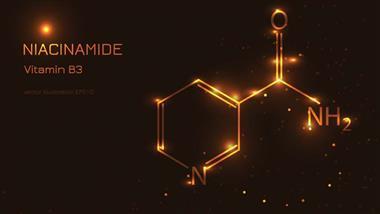
STORY AT-A-GLANCE
- Niacinamide, also known as nicotinamide (a form of vitamin B3), is important for healthy mitochondrial function and cellular energy production
- Patients with established glaucoma scored significantly higher on visual field tests after taking niacinamide and calcium pyruvate daily for about two months
- Niacinamide can be used to treat declining testosterone levels in men and women, and protects against stress by lowering cortisol
- Niacinamide has anticancer and antiaging effects, and can be useful in the treatment of Alzheimer’s disease and COVID-19
- It may also be valuable in the treatment of both alcoholic liver disease and nonalcoholic liver disease (NAFLD), as low NAD is involved in the disease process
I recently posted an article detailing the importance of niacinamide (aka, nicotinamide, a form of vitamin B3 or niacin) for healthy mitochondrial function and cellular energy production, and how it can help reverse obesity and leaky gut, and prevent neurodegeneration, kidney disease and heart failure. Here, I’ll review several additional conditions that can be prevented and/or treated with this inexpensive and readily available supplement.
More Niacinamide Is NOT Better, There’s a Goldilocks’ Dose
Keep in mind that the dosages used in the research studies discussed below do vary widely, but as a rule, I only recommend taking small doses of 50 milligrams of niacinamide three times a day.
This dosage has been shown to optimize energy metabolism and boost NAD+ levels, which are foundational for everything else to work. It can be taken four times a day if you space them out. Take a dose as soon as you get up, before going to bed, and twice evenly spaced between those times.
The problem with taking too much vitamin B3, whether in the form of niacin or niacinamide, is that it might backfire and contribute to cardiovascular disease as documented by the Cleveland Clinic. ZeroHedge reports:1
“The new study out of the Cleveland Clinic, published in Nature Medicine,2 determined there is a delicate balance between too much niacin and just enough — a sort of Goldilocks effect … [As] observed by the Cleveland Clinic team, too much niacin creates a byproduct known as 4PY.
This product circulates within the bloodstream and is associated with a higher risk of heart attack, stroke, and other cardiac events. Additionally, 4PY was shown in preclinical studies to trigger vascular inflammation, damaging blood vessels and eventually leading to atherosclerosis.
The researchers discovered this by examining data from 1,162 patients who had experienced major cardiovascular events. Just under half of the patients (442) were female. Initially, the team sought common markers that could lead to cardiovascular events. The most common factor within the pool of patients was excess levels of niacin.
The findings led to additional studies to validate the initial research. Both cohort studies, conducted in the United States and Europe, confirmed that niacin breakdown predicted an individual’s future risk of heart attack, stroke, and death from cardiovascular disease.”
Niacinamide Limits Damage From PUFA Peroxidation
With that caveat out of the way, let’s take a look at some of the health benefits associated with niacinamide supplementation, starting with its ability to ameliorate damage caused by linoleic acid (LA) consumption.
One of the most toxic metabolic byproducts of LA is 4 HNE, a toxic aldehyde that appears to play a causative role in heart failure.3 Fortunately, there is an enzyme system called aldehyde dehydrogenases that deactivates 4 HNE. The best way to increase the activity of this enzyme system is to make sure you have sufficient NAD+, and the most efficient way to optimize your NAD+ level is to make sure you’re getting 50 mg of niacinamide three times a day.
Download this Article Before it Disappears
Raise Your Testosterone Naturally With Niacinamide
Niacinamide can be used to treat problems associated with declining testosterone levels due to aging, as demonstrated in a February 2022 Nature Aging study.4 This study also involved eye health, specifically evaporative dry eye disease, but with a focus on the effects of androgens.
They found that by raising NAD+, local testosterone distribution in the meibomian gland in the eyelids, which produces oil to prevent the evaporation of tears, was improved. As a result, age-related atrophy of the gland was reduced, which alleviated the dry eye condition. In this case, they used a 5% solution of the NAD+ precursors nicotinamide mononucleotide (NMN) or nicotinamide riboside (NR). The two regimens assessed were as follows:
- Chronic — 2 mg NAD+ precursor four times a day in each eye for 90 days.
- Acute — 5 mg NAD+ precursor six times a day in each eye for 14 days.
However, as noted by biohacker Georgi Dinkov,5 plain niacinamide has been shown to be just as effective as NMN and NR for raising NAD+, so there’s no reason why it wouldn’t work as well. Moreover, these findings are also applicable for other tissues and organs affected by declining testosterone, not just your eyes.
It confirms that niacinamide is a necessary cofactor to address the nearly universal decline in testosterone in both males and females, so this is yet another reason that most people need it. Dinkov writes:6
“… the findings that androgen (in this case, testosterone) deficiency seen almost universally with advancing age is apparently due primarily to deficiency of the co-factor NAD+, which can apparently be remediated by supplementing NAD+ precursors such as niacinamide.
It appears that the rate-limiting step for androgen (testosterone) synthesis is the enzyme 3b-HSD, for which NAD+ is the main cofactor. Thus, a decline in NAD+ seen in aging (and disease) leads to decline in 3b-HSD activity and thus reduced androgen (testosterone) levels.
Conversely, the study found that restoring NAD+ levels almost fully remediated the reduced function of 3b-HSD, the androgen (testosterone deficiency), and thus was basically curative for the specific condition (dry-eye) the study investigated…
As far as the systemic steroidogenic deficiency seen with aging that I mentioned earlier, oral dosing of an NAD+ precursor such as niacinamide would likely be needed, and human studies have demonstrated that daily doses in the 300 mg-500 mg daily range optimally stimulate NAD+ synthesis. (It would be better to start with 50 mg three times a day (150 mg) and increase if necessary.)
While most studies found that higher daily oral doses are unable to further raise NAD+ levels through the precursor pathway, higher doses of niacinamide specifically have been shown to inhibit the enzyme PARP-1, which is a ‘consumer’ of NAD+ and inhibiting it also raises NAD+ levels.
So, experimenting with the niacinamide with doses in the 500mg-1,500mg daily range would probably identify an optimal daily dose regimen for most people looking to increase steroidogenesis, especially if precursors such as pregnenolone and/or DHEA are taken as well.”
To address declining testosterone, I recommend taking:
- 50 mg of niacinamide three times a day
- 5 mg to 10 mg of DHEA orally once a day
- 50 mg of oral pregnenolone once a day
Ideally, take the hormone supplements DHEA and pregnenolone with a saturated fat, like a teaspoon of butter, to make sure they bypass metabolism in the liver, which will radically decrease their effectiveness.
Niacinamide Protects Against Stress
Another phenomenally important human study7,8,9 confirms that niacinamide lowers cortisol by increasing NAD+. NAD+ is the cofactor for an enzyme called 11b-HSD2, which deactivates cortisol by turning it into cortisone. So, increasing NAD+ with niacinamide will help lower cortisol, and this can benefit just about everyone, seeing how most people are plagued by stress and have elevated cortisol, which in turn drives inflammation and inhibits fat loss.
Raising NAD+ with niacinamide supplementation was also shown to improve glucose metabolism and insulin sensitivity. It also increased ATP levels, which is your cellular energy currency. As such, niacinamide may be one of the most important supplements you can take.
Importantly, this study used plain niacinamide rather than the more expensive NMN or NR, so we don’t have to infer these benefits. They took place using plain niacinamide and D-ribose. The dosages used were 240 mg of niacinamide twice a day, and 1,280 mg of D-ribose twice a day, for one week.
Anticancer Effects
Niacinamide can also help prevent and treat cancer. As noted in one 2022 study in Nature Metabolism,10,11 limiting fat availability to cancer cells may be one of the keys to curing cancer. NAD+ also plays an important role, and niacinamide raises NAD+:
“Production of oxidized biomass, which requires regeneration of the cofactor NAD+, can be a proliferation bottleneck that is influenced by environmental conditions … Here, we show that de novo lipid biosynthesis can impose a substantial NAD+ consumption cost in proliferating cancer cells.
When electron acceptors are limited, environmental lipids become crucial for proliferation because NAD+ is required to generate precursors for fatty acid biosynthesis. We find that both oxidative and even net reductive pathways for lipogenic citrate synthesis are gated by reactions that depend on NAD+ availability.”
An earlier study,12 published in 2020, found that niacin (vitamin B3) could control the growth of brain tumors by reactivating myeloid cells (a type of bone marrow cell). As explained by the authors:
“Although innate immune cells are typically present inside tumors, they often have an inactive phenotype such that they are ineffective at killing the cancer cells or even promote tumor growth. Sarkar et. al. discovered that it may be possible to reprogram these cells to a more active type using niacin (vitamin B3).
The authors showed that niacin-exposed monocytes can inhibit the growth of brain tumor-initiating cells. Moreover, niacin treatment of intracranial mouse models of glioblastoma increased monocyte and macrophage infiltration into the tumors, stimulated antitumor immune responses, and extended the animals’ survival …”
Here, a mere 7 mg of niacin per kilo of bodyweight per day halted the growth of brain tumors and nearly doubled survival times. The niacin group also survived longer than those receiving chemotherapy alone. While this study used niacin, niacinamide would work just as well. Tying the results back to the study above, Dinkov notes:13
“The proposed mechanism of action was immune system activation. I, personally, do not buy this explanation as a main mechanism of action. IMHO vitamin B3’s known effects on inhibiting lipolysis … and promoting the oxidation of glucose are probably more important for inhibiting the tumor growth and prolonging survival.”
Antiaging Effects
Niacinamide and other B vitamins also have important antiaging effects. In a December 2021 article, Dinkov reviewed a 2011 study14 that suggests fasting can speed up aging by depleting your energy reserves, and that vitamin B2 has the opposite effect and slows the aging process. Commenting on this finding, Dinkov wrote:15
“[This is] a great study that not only suggests a dirt cheap and widely available option for retarding aging, but once again demonstrates that stress (e.g. fasting) directly causes aging by depleting/blocking OXPHOS [oxidative phosphorylation, the metabolic pathway cells use to oxidize nutrients, thereby releasing chemical energy to produce ATP], and the key mechanism for stopping/reversing aging is by restoring energy production.
The proposed ‘senolytic’ in this study is the humble vitamin B2, also known as riboflavin. Vitamin B2 is the precursor for FAD [flavin adenine dinucleotide] — a key coenzyme, responsible for about 20% of the energy produced in the OXPHOS process. Btw, the other 80% are controlled by NAD — a molecule synthesized endogenously from the precursor niacinamide.
There has been an explosion in publications over the last decade touting NAD as the cure to virtually every disease out there, and many of those claims are well-backed by evidence. While there are … proprietary NAD precursors such as nicotinamide riboside and nicotinamide mononucleotide, plain old niacinamide works just as well and is drastically cheaper.
Niacin is another NAD precursor but [it] increases histamine and serotonin, and still has to be converted into niacinamide before it can end up as NAD. So, no reason to take anything else but niacinamide.
Doing so, raises the NAD/NADH ratio, shifts the cell redox state towards oxidation (as opposed to reduction), and the ample energy produced by the cell can be used for all types of maintenance ‘work’ the cells need to perform in order to stay healthy, prevent aging, etc …
[V]itamin B2 has a similar metabolic role as well. It is a precursor to the co-factor FAD and taking B2 raises FAD and thus the FAD/FADH ratio, which facilitates electron flow through the electron chain complexes I&II. Conversely, having insufficient levels of FAD (and/or low FAD/FADH ratio) can effectively block the ETC [electron transport chain].
This crucial role of FAD in the ETC demonstrates why excessive fatty acid oxidation (FAO) is harmful. Namely, FAD is consumed in the process of beta-oxidation of fatty acids and as such excessive FAO can consume too much FAD, drop the FAD/FADH ratio, and thus block electron flow through ETC.
This reduction/blockade of ETC is exactly what is seen in most chronic, degenerative diseases, but especially in conditions such as cancer, diabetes, Alzheimer’s disease, autoimmune conditions, etc.
Well, the [Physiology] study … found that this reduction of mitochondrial activity (ETC) is exactly what triggers the senescence process, and activating mitochondria (specifically ETC II) by supplementing vitamin B2 prevented cellular aging. Here is the actual explanation from the study authors:
‘… Cells under stress produce SLC52A1, and increase their absorption of vitamin B2 from outside the cell. Once inside the cell, the vitamin B2 is converted into FAD and increases mitochondrial energy production by becoming a coenzyme of mitochondrial respiratory chain complex II. As a result of the AMPK and p53 (which induce cellular senescence) are inactive, therefore stress-mediated cellular senescence is suppressed.’”
Niacinamide for Liver Disease
Niacinamide may also be valuable in the treatment of both alcoholic liver disease and nonalcoholic liver disease (NAFLD). By now, you can probably guess why. It’s because low NAD is involved in the disease process.
A study16,17 published in 2016 showed that chronic alcohol bingeing injures your liver and other organs by reducing NAD+, which is a required cofactor for important enzymes and mitochondrial renewal.
In short, a decline in the NAD/NADH ratio (your redox status) is a main driver of alcohol-related pathologies, and not just in your liver but in all organs. The answer is to increase NAD+, which is effectively done using niacinamide. According to Dinkov, niacinamide also works synergistically with methylene blue:18
“Both [niacinamide and methylene blue] can raise the NAD/NADH ratio quite robustly on their own, but in combination are synergistic and may allow for much lower doses to achieve the same effects.
People have sent me emails showing their blood tests demonstrated the same increase in NAD/NADH from a combination of 1mg MB [methylene blue] and 250 mg niacinamide as using 5mg+ MB or 750mg-1,000mg niacinamide separately.”
Related to this is the importance of eating the correct fats. You want to increase your saturated fat and avoid PUFAs, especially linoleic acid (LA), as PUFAS are stored and accumulated whereas saturated fats are burned for energy.19,20 It can take up to seven years to clear LA from your body due to its long half-life. In the meantime, you need to be careful about not pushing the LA out too rapidly through fasting, low-carb diets or vigorous exercise.
The accumulation of PUFAs in your cells are, I believe, one of the greatest contributors to chronic and degenerative diseases of all kinds, as they wreak havoc with your cellular machinery and impair mitochondrial function (and hence reduce energy production). Niacinamide can be helpful while you’re clearing stored PUFAs from your cells, as it’s an anti-lipolytic agent.
Niacinamide for Alzheimer’s Disease
Niacinamide is required for healthy metabolism and, as such, it can also be useful in early Alzheimer’s treatment.21 Combining it with methylene blue may boost benefits even further, as they work synergistically, and methylene blue alone has been shown to stop the progression of Alzheimer’s.22
Increasing the carbs only seems to work when your fat intake is below 35% of your total daily carbs. If it is higher, the Randle cycle will prevent the extra carbs from being metabolized in the mitochondria and will shuttle them to glycolysis which increases lactic acid and will likely worsen one’s health.
Thiamine, the B1 mentioned in the study, is a cofactor for the enzyme that converts the glucose metabolite pyruvate into acetyl-CoA, which is what is pushed into the mitochondria to be burned as fuel. Taking niacinamide (vitamin B3) will help three of the complexes in the mitochondria work and vitamin B2, riboflavin, will help one complex to produce the ATP, so using all three would be ideal.
Niacinamide is the only one that appears to benefit from lowering the dosing to 50 mg three times a day. As reported by Dinkov:23
“[A 2019] study24 demonstrated that increasing levels of acetyl-CoA (the starting intermediate of the Krebs cycle), even at a stage of very advanced aging/AD [Alzheimer’s disease], can reverse aspects of both pathologies.
While the study used patented compounds, the same effects can be achieved by ensuring a steady supply of dietary carbs combined with increasing the function of pyruvate dehydrogenase (PDH). Increasing the activity of PDH can be achieved by supplementing with vitamin B1 (a cofactor of PDH), keeping the NAD/NADH ratio as high as possible and keeping fatty acid oxidation (FAO) down …
[T]hese approaches have been successfully tested in many animal models and one of the molecules that works through the latter two mechanisms is niacinamide. In fact, there is a human clinical trial25 [completed in August 2022] with 3 grams of niacinamide daily for treating AD, and though the results have not been published yet the leaked information suggests highly positive results. Methylene blue (MB) can do the same …”
Niacinamide and COVID-19
As it turns out, raising NAD+ appears to be therapeutic for COVID infection as well.26 The reason for this is because SARS-CoV-2 infection dysregulates NAD synthesis and the NAD metabolome, which is a component of your innate immunity.
As noted by Dinkov, this study again demonstrates “the crucial role energy plays even in ‘non-metabolic’ diseases such as viral infections.” Indeed, without energy your body cannot defend itself against infection and disease, and since NAD+ is such a crucial component of energy production, it makes perfect sense that having higher NAD levels will make you more resilient against viral infections. The answer again, then, is niacinamide, with or without methylene blue.
By now, you should have a good idea about how important niacinamide is for your health, and why I think it’s one of the most important supplements you can take on a daily basis.
Niacinamide Helps Treat Glaucoma
Research27,28 published in November 2021 reported that patients with established glaucoma scored significantly higher on visual field tests after taking 3 grams of niacinamide in combination with 3 grams of (calcium) pyruvate daily for about two months. As reported by the authors:
“Given the decrease in NAD with aging, which may render retinal neurons more vulnerable to disease-related insults, the investigators hypothesized that increasing NAD may support the mitochondrial activity of RGCs and decrease their susceptibility to glaucoma.
In a rat model of ocular hypertension, retinal and optic nerve NAD declined as a function of IOP, while nicotinamide was neuroprotective at a range of doses. In addition, nicotinamide has been shown to be low in the sera of patients with primary open-angle glaucoma. These data further support a role for NAD in glaucoma.
Furthermore, Harder et al reported that an IOP-mediated decrease in retinal pyruvate levels was associated with dysregulated glucose metabolism prior to detectable optic nerve degeneration in metabolic studies of DBA/2J mice.
They also found that oral supplementation with pyruvate protected both rat and mouse models of glaucoma from neurodegeneration, with a combination of nicotinamide and pyruvate being the most protective in the chronic mouse model…
Given the significant neuroprotective effects observed in recent studies, the similarities in cellular biology of NAD+ and pyruvate pathways between mice and humans, as well as the safety profile of these supplements, we investigated the effect of nicotinamide and pyruvate on the visual function of patients with treated manifest glaucoma …
[R]esults suggest that treatment with nicotinamide and pyruvate tripled the likelihood of improvement of test locations relative to placebo.”
If you have glaucoma and want to give niacinamide a try, I recommend limiting your dose to 50 mg three times a day, before increasing to 3 grams a day, which I believe is excessive.
- 1 ZeroHedge February 21, 2024
- 2 Nature Medicine February 19, 2024; 30: 424-434
- 3 Haidut.me February 21, 2024 (Archived)
- 4 Nature Aging 2022; 2: 105-114
- 5, 6 Haidut.me March 31, 2022 (Archived)
- 7 Nutrients June 2022; 14(11): 2219
- 8 Nutritional Outlook July 11, 2022
- 9 Haidut.me July 12, 2022 (Archived)
- 10 Nature Metabolism 2022; 4: 711-723
- 11, 13 Haidut.me July 14, 2022 (Archived)
- 12 Science Translational Medicine April 1, 2020; 12(537)
- 14 Physiology August 2011; 26(4): 214-224
- 15 Haidut.me December 21, 2021 (Archived)
- 16 Exp Mol Pathol April 2016; 100(2): 303-306
- 17 NMN.com April 7, 2016
- 18 Haidut.me October 22, 2020 (Archived)
- 19 PLOS ONE 2012; 7(11): e48852
- 20 Haidut.me October 22, 2019 (Archived)
- 21, 25 Clinical Trials Nicotinamide as an Early Alzheimer’s Treatment NCT03061474
- 22 Haidut.me December 2, 2019 (Archived)
- 23 Haidut.me December 13, 2019 (Archived)
- 24 eLife Sciences November 19, 2019
- 26 Metabolism December 2020; 295(52): 17986-17996
- 27 JAMA Ophthalmology 2022;140(1):11-18
- 28 Haidut.me December 9, 2021 (Archived)
The Crucial Role of NAD+ in Optimal Health
Reproduced from original article:
https://articles.mercola.com/sites/articles/archive/2023/12/03/nad-plus-optimal-health.aspx
The original Mercola article may not remain on the original site, but I will endeavor to keep it on this site as long as I deem it to be appropriate.
Analysis by Dr. Joseph Mercola December 03, 2023
STORY AT-A-GLANCE
- NAD+ (nicotinamide adenine dinucleotide) is one of the most important biomolecules in your body. It’s involved in the conversion of food to energy, maintaining DNA integrity and ensuring proper cell function. Together, these functions help protect against or delay aging and disease
- NAD also acts as fuel for longevity proteins called sirtuins
- NAD levels dramatically decline with age, contributing to aging and chronic disease states. NAD is also used up by DNA repair enzymes and enzymes involved in inflammation and immunity, such that chronic inflammation, or acute illness in old age, can rapidly result in depletion
- To restore NAD, you need to fix the root cause for NAD depletion, which primarily involves addressing the decline in the NAD salvage pathway. By increasing enzymes in that pathway, which decline with age, your body can recycle NAD like it did naturally when it was younger
Editor’s Note: This article is a reprint. It was originally published March 27, 2022.
In this interview, Nichola Conlon, Ph.D., a molecular biologist, antiaging specialist and founder of a nutraceutical company that produces an NAD+ boosting supplement.
NAD+ (nicotinamide adenine dinucleotide) is one of the most important biomolecules in your body. It’s involved in the conversion of food to energy, maintaining DNA integrity and ensuring proper cell function. Together, these functions help protect against or delay aging and disease. As explained by Conlon:
“NAD is actually something I ended up working on in the drug development industry. I was fortunate enough to work for a company that was forward thinking. It actually started looking at developing molecules that would improve our health span, which is the proportion of the life that we live in good health.
So, rather than just focusing on individual diseases, we were actually looking at underlying mechanisms of cellular aging and looking at slowing cellular aging to improve healthy lifespan.
This is when I came across NAD, which is an incredibly important molecule in the body. Going back to molecular biology roots, NAD is important for two critical things in the body.
The first is energy production. The process that takes the energy out of the food we eat and converts it into ATP, which is the form of energy currency that our cells can use to survive and do all the functions that they need to do, absolutely requires NAD.
Without it, we simply wouldn’t be alive because our bodies wouldn’t be able to make any energy. It’s estimated that if we didn’t have any NAD in our body, we’d literally be dead in 30 seconds, which shows how critical it is to our cells.
The second thing that it’s really important for is cellular maintenance and repair. NAD almost acts as a sensor in the body. It enables the cell to react to changes in energetic stress, which is basically how much energy or lack of energy the cell has … These are the two major things that NAD is known for, and because of these roles, it’s absolutely fundamental to overall cellular health.”
As an example, if you were to exercise or fast, that uses up cellular energy. NAD will sense this raised energy demand and increase its levels. Elevated NAD is actually a signal that the cell is in a state of stress. In response, cellular maintenance and repair processes are switched on to preserve the cell and help it survive the stress.
Some History
NAD plays a large role in the Krebs citric acid cycle as it helps to pass the electrons along in the mitochondria in the electron transport chain to facilitate oxidative phosphorylation and generate cellular ATP. While discovered in 1905, well over a century ago, few scientists have paid much attention to it.
In the late 1990s, David Sinclair, Ph.D., while working in Leonard Guarente’s lab at Massachusetts Institute of Technology (MIT), realized that NAD is the fuel for longevity proteins called sirtuins. That’s when it started coming into prominence as an anti-aging agent.
“It was around 2014 that I started getting involved in the aging field,” Conlon says. “This was a time when a lot of scientists were talking about this idea that we could slow cellular aging … [Today], there isn’t a single scientist that works in the field of biogerontology — the study of aging — who doesn’t say that you can slow biological.”
Testing NAD Levels Is Complicated
Oftentimes, before you start supplementing something, you’ll want to find out what your level is. Unfortunately, that’s extremely difficult to do with NAD. We do know that NAD levels decrease with age, which is one of the reasons why people want to boost their NAD back to youthful levels.
“In scientific laboratories, we use some fairly sophisticated techniques to measure NAD,” Conlon says, “But now there’s been an emergence of companies saying, ‘Send your blood and we’ll measure it for you.’ The reality is, unfortunately, that as good as that would be, it just doesn’t work that way.
If you think of what NAD does, NAD is described as a redox molecule. What that means is, that it is continually flipping states. It carries electrons in the electron transport chain and [is involved in] the mitochondrial reactions. This means that by its very nature, NAD is designed to flip between different states, so it’s really, really unstable.
Literally, as soon as NAD is taken out of the body, it starts to break down into its precursors. It starts to change form. Therefore, if you don’t do something to stop those reactions very, very quickly, what you end up measuring is not a correct reflection of what is actually in the body and in the cell.
When we measure NAD in the laboratory, we have to make sure that as soon as it is taken out of the person, it’s put straight on ice to stop any reactions and then immediately prepped to take out the cells that we want to measure the NAD from. They’re then cryogenically frozen to stop any changes or any reactions until we measure the NAD. You’ve got around a 30-minute window to get this done.
After that, to work out how much NAD is in the sample, you can then use techniques such as mass spectrometry, which compares the amount of NAD in the sample to standards, which are known amounts of NAD.
These are not simple techniques. They are quite advanced laboratory techniques. So, when companies that say they can provide this as a postal service, at the moment, I’m quite skeptical of what they are actually measuring.”
Download this Article Before it Disappears
How NAD Is Made and Regenerated
Your net NAD level is the sum of what your body makes minus what it loses. If you can successfully limit the amount being lost, then you can maintain your NAD level. So, how is it made, and how is it lost? Conlon explains:
“It’s incredibly complex. It’s not just a simple case of adding two things together to make more NAD and that’s the end of it. Within the cell, there are five different precursors that NAD can be made out of. These are the raw materials that your body uses to manufacture NAD …
You’ve got the B vitamins and derivatives nicotinic acid (nicotinamide), niacin, nicotinamide riboside (NR) and nicotinamide mononucleotide (NMN). And also the amino acid tryptophan. Once these are inside the cell, they enter various different pathways which then assemble them into NAD.
There are three main pathways. The most important pathway for NAD production is something called the NAD salvage pathway. This is because not only can it make NAD from these external raw materials that come into the cell, but it can also recycle NAD as it is broken down.
A key thing that many people don’t realize is that when NAD is being used up in all of these beneficial processes in the cell, such as in DNA repair and activating other cellular pathways like the sirtuins, it actually gets broken down into one of its precursors, nicotinamide.
The cell is really clever because what it’s evolved to have is this salvage pathway, a recycling pathway for this nicotinamide (niacinamide). Which means that when NAD is used up, it gets broken down in nicotinamide and this nicotinamide then just gets recycled straight back into fresh NAD again.
This makes absolute sense, because why would the body want to rely on generating such a critical molecule using external precursors? It needs to use something endogenous, something that it’s always going to have a ready supply of.
This also means that as demand for NAD goes up, more NAD is broken down in to nicotinamide, so technically there’s more raw material that can simply be recycled straight back into fresh NAD again. This has been demonstrated to be the most important pathway for NAD production in the body.
So when we’re young, we’ve got this abundant supply of NAD that’s continually being recycled via the salvage pathway. Unfortunately, as we get older, NAD declines. There are two main reasons for this. Firstly, more NAD is used up.
When more NAD is used up, this means more needs to be recycled to replenish NAD. But it’s also been found that that salvage pathway also declines with age. So right at this point in your life when you’ve got an increased demand for NAD, you’ve also got a reduction in the body’s ability to regenerate NAD via this recycling route.
When you put those two things together, what you get is an exponential decline in NAD, which is exactly what we see in human tissues throughout life. We see about a 50% reduction in NAD levels in our tissues every 20 years, which is quite shocking considering how important it is to our lives.”
How NAD Is Depleted
The thing that depletes NAD the most is when it’s acting as a cofactor for other enzymes, such as the sirtuins and DNA repair enzymes. In that role, NAD acts much like a fuel, so it gets used up, causing your level to decline. In its energy production role, it merely flips between states, so the overall amount doesn’t really change. The two primary enzymes that consume NAD are:
• Poly ADP ribose polymerases (PARPs), especially PARP1, a DNA repair enzyme — With age, the amount of DNA damage increases, which has to be repaired. One of the key enzymes that repairs this damage is called PARP1. For that enzyme to work, it needs NAD as a fuel. It literally takes NAD and breaks it down to form its reaction in the DNA repair action.
“What you see is that if you’ve got increased levels of DNA damage in your tissues, you get increased activity of this enzyme and you get NAD depletion,” Conlon says. Studies suggest extensive DNA damage within a cell can within five minutes deplete the NAD level in that cell to about 5% to 10% of what it started out with.
One common exposure that causes DNA damage is electromagnetic field exposures (EMFs) from cell phones and wireless technologies. Some studies have shown that every time PARP1 is activated for DNA repair, it consumes 150 NAD molecules.1
• CD38 — Another enzyme called CD38, found on the surface of many immune cells, also consumes about 100 molecules of NAD for every cycle of its reaction. CD38 is a cell signal enzyme involved in sending calcium signals throughout the cell to activate parts of your immune system.
“CD38 is one of the biggest NAD consumer in the body because of the fact that it is so inefficient at using NAD,” Conlon says. “It’s been found that even if you can inhibit CD38 by just a very, very small amount, you can have a significant impact on NAD levels because it is so inefficient.”
The Challenges of Exogenous NAD Supplementation
Unfortunately, boosting NAD is no easy feat either. Many use NR or NMN, but the bioavailability of these is quite poor. It’s kind of like swallowing bioidentical hormones. It’s the real deal when you swallow it, but your liver has a tendency to want to detoxify and typically conjugates or adds in methyl groups to facilitate excretion. So, they don’t really have time to transfer into your blood.
It’s clearly now demonstrated that to restore NAD, you need to fix the root causes. You need to fix that salvage pathway. You need to increase the enzymes in that pathway that are actually declining with age so that your body can recycle NAD like it did naturally when it was younger. ~ Nichola Conlon, Ph.D.
Conlon and her team discovered another way of boosting NAD.
“When we started looking at NAD, the first thing we did was to look for evidence that you could use molecules or supplements to boost NAD. At the time, everyone was looking at enhancing NAD levels with nicotinamide riboside or nicotinamide mononucleotide. which are the precursors or the raw materials that the body uses to make NAD.
But there was no evidence that the reason that NAD was declining was because the body had a lack of availability of these precursors. In fact, still to this day, there’s no evidence that our bodies have a reduced capacity to absorb these or that there’s a reduced amount circulating in the plasma for the cells to use.
Over the last couple of years, more understanding of NAD decline has emerged. It’s clearly now demonstrated that to restore NAD, you need to fix the root causes. You need to fix that salvage pathway. You need to increase the enzymes in that pathway that are actually declining with age so that your body can recycle NAD like it did naturally when it was younger.
You also need to look at these processes that are wasting NAD. You need to look at inhibiting CD38 and stopping chronic low level inflammation that’s wastefully using up NAD. You also need to look at reducing DNA damage and being more efficient in its repair so you don’t have this constant chronic activation of DNA repair, which is also using up NAD.”
Conlon and her team decided to pursue a multi-target strategy. Rather than just putting more raw material into the cell, the aim is to fix the cell. In experiments, they’ve demonstrated that you can boost NAD levels in the cells without putting any precursor in. You can actually just use ingredients that inhibit CD38 and activate nicotinamide phosphoribosyltransferase (NAMPT). This will boost NAD without having to add more raw materials to the cell.
NAMPT Is a Rate Limiting Enzyme for NAD Production
NAMPT is really important because that’s the bottleneck, the rate limiting enzyme for the production of NAD. Conlon explains:
“The reason the salvage pathway declines with age is because of this one key enzyme. NAMPT actually recycles niacinamide and converts it into NMN, which then gets converted back into NAD. The rate limiting step, the bottleneck in that process, is NAMPT. And lo and behold, that is the key enzyme that declines as we get older.
Studies have demonstrated that you get a 50% decrease in this enzyme between the ages of 45 and 60. That’s a significant decline considering how important this is for new NAD production. The decline in the levels of this enzyme again correlate with the decline in NAD that we experience.
Many diseases and issues that are associated with NAD decline are found to be because of a reduction in this enzyme. So, it’s absolutely critical to try and improve the activation and expression of this enzyme in the body to enhance NAD. It worked brilliantly to give us high NAD levels when we were younger, so why not restore it back to that?”
How Much Does NAD Decline Over Time?
NAD starts declining from the day you’re born. For every 20 years thereafter, you lose about 50%. So, by the time you’re 20, your NAD level is half of what you had at birth. By age 40, it’s halved again from what you had at age 20, and so on. “It’s an exponential curve,” Conlon says, “Looking in elderly people’s tissues, they really don’t have very much left.” I believe this may be one of the many reasons why elderly people are so susceptible to COVID. Perhaps even a primary one.
Conlon cites research showing SARS-CoV-2 infection does cause massive NAD depletion by over activating the PARPs. While PARP1 is involved in DNA repair, some of the other PARPs are involved in inflammatory responses, and they too need NAD.
“The running theory is that if we’re older or sicker we have lower levels of NAD to begin with, so when we get infected, we’re already at a lower starting point. So in someone who’s younger and healthy and has high NAD, when they get infected, they’ve already got quite a good level to begin with, so even when they get that depletion, they can get by because they had adequate supplies to begin with.
The other really interesting thing is what the cell does in response to the virus to try and mitigate this. All of the genes that the cell regulates to try and protect itself are all to do with NAD salvage. The body actively tries to increase NAMPT to protect itself because it knows that’s the best way to produce NAD and rectify the problem.”
NAD Restoration for Optimal Health
According to Conlon, preclinical animal studies have shown NAD restoration really does help reverse disease and improve health span. In humans, using NR supplementation, the benefits have been less stellar. So far, they’ve not been able to replicate the preclinical models. Conlon suspects this is because NR and other precursors simply don’t address the root causes of NAD decline.
“NAMPT is an enzyme, and you can get antibodies which will selectively attach to it. To measure it, we use a Western blot, which basically measures the amount of NAMPT protein that is available in the cell and it shows as a dark band. Basically, the darker the band, the more expression.
Alpa lipoic acid works by increasing the activation of another energy sensor in the body called AMPK. AMPK is a sensor of any energy stress. When there’s an energy stress in the body, AMPK goes up and it basically activates NAMPT so that it can increase NAD levels in the cells,” Conlon explains.
Best and Least Expensive Way to Improve Your NAD+ Levels
So deeply appreciate Dr. Conlon’s insights and expertise on NAD+ precursors. Although I have read dozens if not hundreds of papers on NAD+ the entire subject is confusing and I now realize it is likely because of financial interests that the best precursor is not recommended more frequently. Dr. Conlon has concluded, and I thoroughly agree with her, that the best single NAD+ precursor is niacinamide, not niacin, NR or NMN.
It is now beyond obvious to me why no one is promoting niacinamide. This is because it costs less than one cent a day and as a result there is simply no money to be made in promoting it. Ideally you buy niacinamide powder and use 1 to 1/2 of 1/64th of a teaspoon three times a day (25-50 mg).
You will need special measuring spoons to measure this small a dose. This is important as more is most definitely not better and much worse. If you use too much you will actually inhibit sirtuins which are important longevity proteins.
Spending $11 on 250 grams of niacinamide powder will give you a nearly four year supply of niacinamide. That pencils out to 23 cents a month or less than one penny a day. It is basically free. NMN in therapeutic doses of 1-2 grams/day can be one to two hundred dollars a month or 400-800X more expensive than niacinamide powder.
So let me review the reasons why Dr. Conlon and I both are convinced that niacinamide is the best NAD+ precursor. The immediate breakdown product of NAD+ is niacinamide and the enzyme NAMPT is the rate limiting enzyme in the salvage pathway to restore niacinamide back to NAD+. As you can see by the pathway below niacinamide is actually first converted to NMN before NAD+. This is likely why researchers like David Sinclair and others promote NMN.
However the enzyme NMNAT1-3 that converts NMN to NAD+ is not the rate limiting enzyme. Recall that NAMPT is what controls how much NAD+ you make. So you flooding your body with NMN is not going to be as useful as using small amounts of niacinamide and activating NAMPT as discussed below. Ideal dosing of niacinamide is from 25 to 50 mg three times a day. It is the rare person that will not respond favorable to this simple intervention for increasing NAD+.
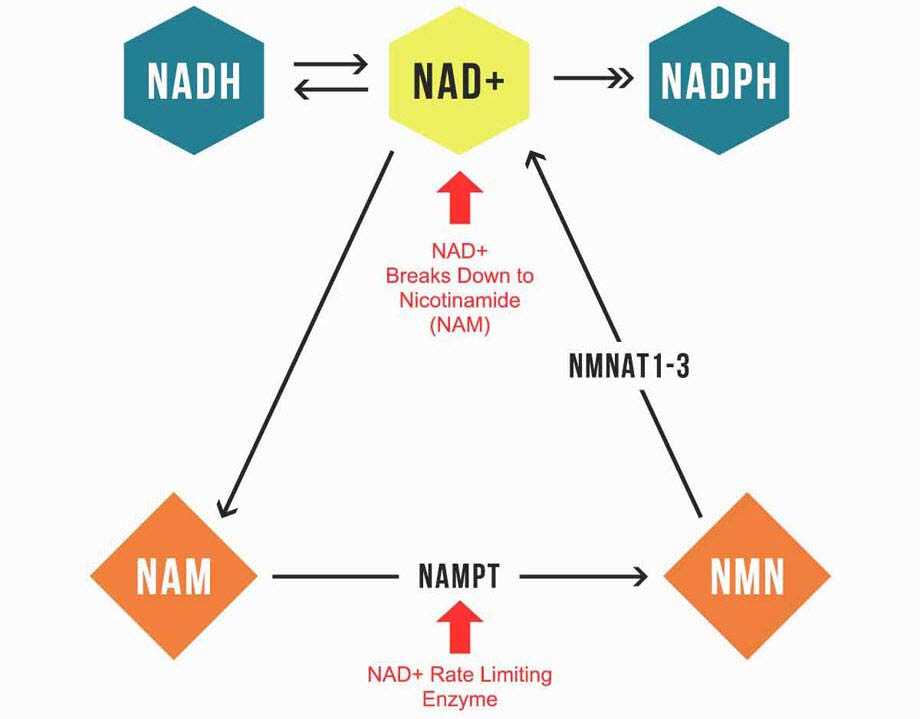
Synergistic Lifestyle Strategies
While supplementation can be very valuable, it’s not a magic bullet. In most cases, supplementation needs to be done in conjunction with other healthy lifestyle changes for lasting, optimal results. So, to boost and maintain youthful NAD levels, consider the following healthy lifestyle strategies:
- Physical exercise — Naturally increases NAMPT by activating AMPK, which in turn increases NAD. Conlon cites research showing about three weeks of resistance training will boost NAMPT by about 127%, which again is far greater than what you can get from an NR supplement alone.
- Fasting or time-restricted eating — Naturally increases NAMPT by activating AMPK, which in turn increases NAD.
- Circadian rhythm optimization by going to bed at sunset and getting up at sunrise and avoiding blue light after sunset will have profound impacts on increasing NAMPT.
- Avoid radiation exposure — To protect your NAD by preventing its consumption by PARPs, consider avoiding EMFs in the form of your cell phone and Wi-Fi and other forms of DNA damaging radiation, such as unnecessary medical x-rays and CAT scans.
- Sauna bathing — Heat stress also helps boost NAD.
Considering you can’t really measure your NAD level, how can you your levels are improving? Conlon replies:
“We have three things that people always report back on. The first is energy levels, which is not surprising whatsoever given the key role that NAD has in the body of producing our energy. It’s not an energy boost where people feel wired … It’s more like having enthusiasm about the day — more ‘get up and go.’
The other thing is mental clarity and focus. And the final thing is sleep. NAD levels are actually circadian and cyclical and can fluctuate throughout your day … As you get older and NAD levels decline, the peaks and troughs of NAD decline too which can hamper your circadian rhythm, which means your sleep quality isn’t as good. Those are the three main things.”
I have a very optimized lifestyle that optimizes my NAD+ to youthful levels. I do this through an 18-hour daily fast in which I start my resistance training, and most days will follow that with an EMF-free sauna at 160 degrees F. for 20 minutes. I use 50 mg of the niacinamide powder I described above.
Even though I am rapidly approaching 70, my levels are that of someone much younger because of the activities I engage in that radically upregulate NAMPT. If you want to optimize your levels of NAD+, I encourage you to incorporate some of these strategies.
The Biology of Carbon Dioxide
Reproduced from original article:
https://articles.mercola.com/sites/articles/archive/2023/11/18/carbon-dioxide-biology.aspx
The original Mercola article may not remain on the original site, but I will endeavor to keep it on this site as long as I deem it to be appropriate.
Analysis by Dr. Joseph Mercola November 18, 202
STORY AT-A-GLANCE
- Carbon dioxide (CO2) is a driver of energy production, as it improves the delivery of oxygen into your cells. CO2 also helps protect against the harmful effects of lipid peroxidation
- CO2 and lactate have opposing effects. Lactate is the byproduct of metabolizing glucose without oxygen in the cytoplasm. So, where lactate causes problems, CO2 has beneficial effects
- Elevated lactate production is a common theme in diabetes, Alzheimer’s, heart failure, shock and general aging. It promotes inflammation and degrades mitochondrial function. Conversely, low CO2 concentrations have been linked to epileptic seizures, muscle spasms, inflammation, hypothyroidism, stroke and clotting disorders
- All these issues, whether caused by elevated lactate or low CO2, can be successfully treated with CO2 therapies of various kinds, such as CO2 baths (where CO2 is pumped into the tub, much like bathing in carbonated mineral water) or adding CO2 into standard hyperbaric treatment
- Simpler ways to raise your tissue content of CO2 include breathing into a paper bag, having an adequate supply of calcium, and supplementing with salt, baking soda or carbonated beverages
In this 2010 interview, the late Ray Peat, a biologist and physiologist who specialized in the bioenergetic theory of health,1 reviewed some of the key benefits of CO2 and how it works within the human body. This article is a summary of the key points made in that interview.
I apologize for the video quality. The video was recorded 13 years ago, and appears to have been shot on a cell phone. In 2010 the cameras were not very good. However, the audio is fine, and more importantly, this information is really hard to come by since Peat is no longer with us. Only 2,000 people had viewed it when I first saw it.
I watched it four times as it is so good. I’m convinced optimizing your carbon dioxide (CO2) level is one of the most important strategies you can do to slow down degeneration due to aging.
On that point, I will be interviewing one of the leading breathing experts in the world, Peter Litchfield, Ph.D., who will educate us on why most breathing techniques don’t work, as they don’t address the underlying triggered breathing habits that lower CO2.
CO2 Is Crucial for Optimal Health
CO2 is typically thought of as nothing more than a harmful waste product of respiration, and a “pollutant” that endangers the earth by raising global temperatures.
The reality is that CO2 is a driver of mitochondrial energy production, and it improves the delivery of oxygen into your cells. It’s also essential for most life on Earth, plants in particular. In fact, CO2 appears to be a more fundamental component of living matter than oxygen.2 All of this was well-known in decades past, but somehow knowledge about the beneficial effects of CO2 has been suppressed over time.
Importantly, CO2 allows for more efficient energy production in your mitochondria, which is why people who live or spend time at higher altitudes tend to be healthier and have fewer chronic health problems such as asthma. The reason for this is because the pressure of CO2 relative to oxygen is greater at higher altitudes.
A Simple Biohack to Boost CO2
According to Forbes Health, biohacking is “a term used to describe various tips and tricks for enhancing the body’s ability to function at peak performance — and maybe even extend one’s lifespan.”
A biohack for mimicking being at a higher altitude in order to boost CO2 is to breathe into a paper lunch bag for a minute or two. The bag should not be too small or too large (an ideal size is 6 inches by 15 inches, or 15 centimeters by 38 centimeters). Breathe into the bag with your mouth and nose covered until you feel better.
With each exhale, you expel carbon dioxide. By rebreathing the carbon dioxide inside the paper bag, you effectively raise your carbon dioxide level. According to Peat, breathing into a paper bag a few times a day has been shown to bring blood pressure down by as much as 30 points, and stabilize it there after a few days of repetition.
Download this Article Before it Disappears
CO2 and Lactate Have Opposing Effects
As explained by Peat, CO2 and lactate have opposing effects.3,4,5 So, where lactate causes problems, CO2 has beneficial effects.
For example, elevated lactate production is a common theme in diabetes, Alzheimer’s, heart failure, shock and general aging. It promotes inflammation and degrades mitochondrial function. Conversely, low CO2 concentrations have been linked to epileptic seizures, muscle spasms, inflammation, hypothyroidism, stroke, and clotting disorders.
According to Peat, all these issues, whether caused by elevated lactate or low CO2, can be successfully treated with CO2 therapies of various kinds, such as CO2 baths (where CO2 is pumped into the tub, much like bathing in carbonated mineral water) or adding CO2 into standard hyperbaric treatment.
Simpler ways to raise your tissue content of CO2 include breathing into a small paper lunch bag a few times a day as detailed above, having an adequate supply of calcium, and supplementing with salt, baking soda or carbonated beverages.6
Peat tells the story of how he told an individual suffering from transient ischemic attacks who’d gone to the emergency room with stroke symptoms and paralysis on several occasions to drink a soda or carbonated water when the attacks occurred, as the bubbles in carbonated drinks are CO2 gas. “That worked for him,” he said.
CO2 Promotes Efficient Energy Production
Lactate is the byproduct of glycolysis, or nonaerobic respiration. It occurs when your mitochondria are compromised and are unable to metabolize glucose. Instead of pyruvate going to the mitochondria to be burned, it is oxidized to lactate in the cell’s cytoplasm. When this occurs in the presence of oxygen it is called the Warburg Effect, which is major pathway that cancer cells use.
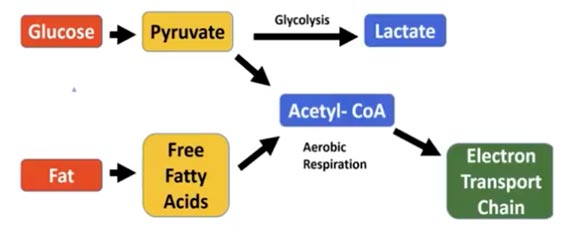
As illustrated in the graph below, glucose can be metabolized in two different ways. When fat intake is too high, glucose is burned though glycolysis, which uses no oxygen and produces lactate. This is a highly inefficient way to produce energy, as it generates only 2 ATP per glucose molecule. And, in the context of this article, no CO2.
When fat intake is in the sweet spot of 15% to 40%, and glucose intake is high enough, it can be burned for fuel in the mitochondria. This generates up to 38 ATP per glucose molecule. In this process, NADH and CO2 are also produced.7
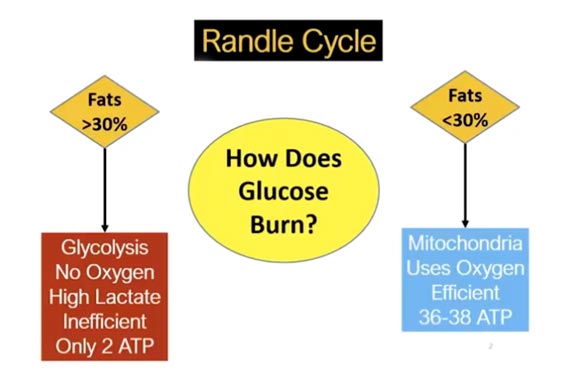
If fat intake is over 40% and the carb intake is below 200 grams per day, the glucose is burned in glycolysis in the cell’s cytoplasm, which produces lactate that suppresses glucose oxidation and shifts metabolism to the burning of fats instead.
Lactate also promotes inflammation and fibrosis. CO2, meanwhile, limits the formation of lactate, increases oxidation of glucose, helps trigger mitochondrial formation (i.e., boosts the number of mitochondria in your cells) and boosts cellular ATP concentrations.8
As explained by Peat, glycolysis products (pyruvate and lactate) compete with CO2 for binding sites inside the mitochondrion. Glycolysis decreases energy production by reducing CO2.
Energy Production Summary
In summary, two key points from all this are:
- 1. The most efficient way to generate cellular energy is to burn glucose in the electron transport chain of your mitochondria (aerobic respiration). In addition to generating up to 38 ATP molecules per glucose molecule (opposed to the two generated through glycolysis), it also generates an estimated 50% more CO2 than fat oxidation.9
In order for glucose to be metabolized in your mitochondria, your dietary fat intake needs to be sufficiently low so as not to inhibit the oxidation of glucose. While there’s no hard evidence on how much fat is too much, I suspect you need to restrict fat to 30% or 40%, depending on your individual needs, to optimize your glucose metabolism. - 2. There are two possible energy states:
- i. A glycolytic stress state in which energy production is reduced by the inhibition of CO2.
- ii. An energy-efficient state in which CO2 is produced and lactate is suppressed.
CO2 Protects Against Lipid Peroxidation
CO2 also helps protect against the harmful effects of lipid peroxidation. Lipid peroxidation10 refers to a process in which free radicals and other harmful oxidants attack lipids (fats) that have carbon-carbon double bonds. Polyunsaturated fats (PUFAs) such as linoleic acid (LA) are particularly prone to this.
The key that many fail to recognize is that lipid peroxidation increases when CO2 levels are low, as CO2 protects the fats from damage. As explained by Peat, when CO2 is low, that’s when PUFAs increase their production of lipid peroxides11 (oxidation products of phospholipids).
Lipid peroxides degrade into reactive aldehydes such as malondialdehyde and 4-hydroxy-2-noneal (4-HNE), which damage DNA and proteins, causing them to malfunction. Lipid peroxidation is known to contribute to conditions such as cancer, atherosclerosis and neurodegenerative conditions, just to name a few.12
Peat cites one experiment in which they showed that when you raise the CO2 in human tissues to three times normal, the amount of lipid peroxides went to zero. So, CO2 has a potent anti-inflammatory effect and effectively protects against lipid peroxidation.
This is an important piece of information, as most people nowadays consume enormously excessive amounts of seed oils that are loaded with PUFAs, and thus have very elevated levels of stored LA in their cells.
As explained in “Linoleic Acid — The Most Destructive Ingredient in Your Diet,” LA is a primary contributor to chronic disease, as it causes mitochondrial dysfunction and promotes inflammation.
Augmenting CO2 in your tissues may be an effective way to limit LA-induced damage while you work to eliminate the excess LA from your tissues and replace it with healthy fats (which can take six or seven years).
How Lactate and CO2 Influence Stress
Peat also goes into an extended discussion involving many separate pieces to explain how lactate and CO2 influence the stress response and other parts of human biology that impact disease, including cancer.
For starters, the cytochrome oxidase enzyme — also known as Complex IV in the mitochondrial electron transport chain, which is what uses oxygen — governs your rate of oxygen consumption.
So, the more cytochrome oxidase you have, and the more active it is, the greater your oxygen consumption. Cytochrome oxidase is also responsible for increasing the total number of mitochondria within the cell as needed to accommodate for increased oxygen consumption.
When you saturate a cell with a very large amount of CO2, you rapidly increase the amount of cytochrome oxidase in the cell, and you boost its activity almost instantly. This shifts the oxidative balance of the cell towards the oxidized state, as electrons are being pulled out of the system. This lowers reductive stress in the cell, which is what you want to do.
In healthy cells, there’s a balance between NAD+ and NADH that is critical for energy production. Conditions like cancer or diabetes disrupt this balance, leading to excess lactate and reduced NAD+. Carbon dioxide is crucial because it prevents excessive lactate production, maintaining a healthy NAD+ to NADH ratio.
CO2 also influences the water balance in cells, supporting an oxidized cellular condition with lowered reductive stress that results in proper oxygen utilization. Hyperventilation, or over-breathing, which reduces CO2, typically leads to overproduction of lactate, contributing to stress and disrupting cellular balance.
CO2 in Emergency Care
Peat also discusses the role of CO2 in emergency care that has the potential to save your life or the life of someone you love. Stroke patients are typically ventilated with pure oxygen to prevent hypoxia-induced brain damage,13 but this isn’t the best way to help these patients.
A ventilation strategy called permissive hypercapnia appears to be far better. Permissive hypercapnia refers to a ventilation strategy employing partial pressures of CO2 that are higher than physiological norms. I have been encouraging those in the hyperbaric oxygen community to explore and adopt this strategy in their hyperbaric chambers. As explained by Peat:
“Quite a few people are now, just in the last few years, starting to talk about permissive hypercapnia … instead of ventilating someone to death [by] giving them pure oxygen. When people aren’t getting enough oxygen to the brain, they’ll give them pure oxygen and then hyperventilate them.
The idea is to shrink their brain by hyperventilating them, because it shuts down the blood circulation of the brain. But if they’re dying of a lack of oxygen to the brain, [that’s] not what you want to do …
I had mentioned [using carbonated beverages during ischemic stroke] in a nutrition class. I had said soda water, meaning carbonated water, but the next week, one of the students said that she had interpreted it as baking soda in water.
Basically, it’s the same idea, but she said she gave a spoonful of baking soda to her mother who had been half-paralyzed for six months, and 15 minutes after drinking just a glass of baking soda water the paralysis lifted and stayed away.”
The reason baking soda worked in this case is probably because CO2 is carried through your bloodstream by sodium bicarbonate (baking soda).14 Peat goes on to discuss how, in the past, firemen used to carry CO2 for the treatment of shock and respiratory arrest.
In the 1920s, Yandell Henderson, director of the Yale Laboratory of Applied Physiology, devised a system using oxygen with 5%, 7% or 10% CO2 added in. Fire departments all over the United States, and many hospitals, were using 5% CO2 to resuscitate babies that had stopped breathing and treat shock cases. It was also used post-operatively to aid in the recovery process.
The Green Agenda’s Flawed View of CO2
In closing, Peat also overturned key arguments of the green agenda by pointing out that during the Carboniferous period of Earth’s history, when plant and animal life was extraordinarily abundant, carbon dioxide levels were some 20 times higher than they are now, and temperatures were relatively stable.
“The expansion of vegetation will reflect infrared rays back into space,” he said, “so it’s sort of like the Earth has a thermostat that will regulate for huge changes in in CO2,” he said.
Even more importantly, nothing thrives in low CO2 environments — not plants, not animals or insects and, as evidenced by everything discussed above, not humans. If anything, the world may actually need a bit more CO2, seeing how CO2-deficiency states are rampant, forests are dying and plants aren’t growing very well. As noted by Peat:
“All animals and even plants suffer from a lack of carbon dioxide. If you lower it, even plants won’t do well … In the 1940s, people experimented with poisoning to death rats or mice with 50% carbon dioxide, keeping them dead for an hour and then reviving them, and they had no brain damage. If they gave them extra CO2, they weren’t damaged by the absence of oxygen. So, for primitive organisms, it’s more essential than oxygen.”
The increasingly erratic weather systems we’re now experiencing likely have little to do with the CO2 content of our atmosphere, and far more to do with a combination of decades-long weather manipulation15 and natural solar cycles.16,17
- 1 Umzu. Who Is Ray Peat?
- 2 Conscious Breathing Carbon Dioxide, Physiology
- 3, 8 Ray Peat, Mitochondria and Mortality
- 4 Skool.com Ray Peat Simplified
- 5 Functional Performance Systems CO2 v. Lactic Acid
- 6 Ray Peat, Protective CO2 and Aging
- 7 StatPearls Biochemistry, Electron Transport Chain
- 9 Ray Peat Forum May 29, 2017
- 10, 12 Toxicological Research March 2011; 27(1): 1-6
- 11 Science Direct Lipid Peroxide
- 13 Stroke October 1, 1999; 30: 2033-2037
- 14 Conscious Breathing Carbon Dioxide
- 15 Geoengineering Watch
- 16 Patreon Adapt2030
- 17 YouTube Adapt2030
Why Most People Need a Multivitamin
Reproduced from original article:
https://articles.mercola.com/sites/articles/archive/2023/11/06/multivitamin-supplementation.aspx
The original Mercola article may not remain on the original site, but I will endeavor to keep it on this site as long as I deem it to be appropriate.
Analysis by Dr. Joseph Mercola November 06, 2023
STORY AT-A-GLANCE
- Older adults taking a multivitamin supplementation may experience memory improvements
- Taking a multivitamin improved performance by “the equivalent of 3.1 years of age-related memory change” compared to placebo and could not only help maintain cognitive functioning but potentially enhance it
- Separate research found three years of multivitamin supplementation translated to a 60% slowing of cognitive decline; Improvements in global cognition, episodic memory and executive function were noted
- Other research revealed daily multivitamins potentially reduced lung cancer by 38% and improved levels of several nutritional biomarkers
- While whole, nutrient-dense foods are the best source of nutrition, older adults may be at risk of nutrient deficiencies and some may benefit from multivitamin supplementation
Food is your best source of nutrients, but with soil health declining and many people not eating an ideal diet, multivitamins may help address any gaps. This may be particularly true for adults age 60 and over. A large study on the effects of multivitamins and cognitive function found the supplements have the potential to improve memory.1
It’s the second study using data from the COcoa Supplement and Multivitamin Outcomes Study Web (COSMOS-Web), which was an ancillary study of COSMOS, to link a daily multivitamin to better brain function. Separate research also linked multivitamins to improved cognition.2
“When we start seeing that kind of consistency across well-designed studies, it certainly helps convince me — the ultimate skeptic — that we’re on to something real,” professor Adam Brickman of Columbia University, who worked on the first study, told Insider. “… I started taking multivitamins the day we ran the analyses and saw the results, and I take ’em every morning.”3
Daily Multivitamin Gives Memory a Boost
Scientists from Harvard Medical School and Columbia University demonstrated that older adults taking a multivitamin supplementation may experience memory improvements.4 In this group of 3,562 older adults, including men over the age of 60 and women over 65, participants received either a multivitamin supplement or a placebo.
The participants were evaluated at baseline and each year using a battery of neuropsychological tests over a period of three years. Results showed that participants taking the multivitamin supplement had better immediate recall at the first year point, which was maintained during follow-up. Effects were most pronounced in people with cardiovascular disease.
“There is evidence that people with cardiovascular disease may have lower micronutrient levels that multivitamins may correct, but we don’t really know right now why the effect is stronger in this group,” Brickman said.5
The researchers estimated that taking a multivitamin improved performance by “the equivalent of 3.1 years of age-related memory change” compared to placebo6 and could not only help maintain cognitive functioning but potentially enhance it later in life. The team concluded:7
“Vitamin supplementation is relatively inexpensive, accessible, and has a few adverse effects, and thus might be a potentially useful population health intervention … Daily multivitamin supplementation, compared with placebo, improves memory in older adults. Multivitamin supplementation holds promise as a safe and accessible approach to maintaining cognitive health in older age.”
Multivitamins Offer Cognitive Benefits
A separate study involving 2,262 participants with a mean age of 73 tested whether cocoa extract versus placebo and a multivitamin supplement versus placebo improved cognition.8 In addition to taking the supplement, the participants took tests designed to evaluate memory and other cognitive functions when the study started and annually.
Significant benefits were found from the daily multivitamin, with three years of such supplementation translating to a 60% slowing of cognitive decline, which is equivalent to about 1.8 years.9
Improvements in global cognition, episodic memory and executive function were noted, with the effects again most pronounced in people with cardiovascular disease. According to the study, which was published in the journal Alzheimer’s & Dementia:10
“COSMOS-Mind provides the first evidence from a large-scale, long-term, pragmatic RCT [randomized controlled trial] to suggest that daily use of a safe, readily accessible, and relatively low-cost MVM [multivitamin-mineral] supplement has the potential to improve or protect cognitive function for older women and men.
An additional trial is needed to confirm these findings in a more representative cohort and to explore potential mechanisms for cognitive benefit. This work may ultimately have important public health implications for standard of care to improve or protect cognitive function in older adults.”
Download this Article Before it Disappears
Multivitamins May Lower Cancer Risk
The larger COSMOS study evaluated whether cocoa extract supplementation with and without a standard multivitamin affected the risk of developing cardiovascular disease and cancer. The larger study enrolled 21,442 participants and found cocoa flavanol supplementation did not show a significant impact in reducing the total number of cardiovascular events.
However, when the data was evaluated further, they found daily multivitamins potentially reduced lung cancer by 38% and “did appear to improve levels of several nutritional biomarkers.”11 Previous research also found that daily multivitamin supplementation led to a statistically significant reduction in the incidence of total cancer among men aged 50 years or older.12
Other research found multivitamin use was associated with a 70% decrease in risk of non-cardia gastric cancer among Black participants in the Southern Community Cohort Study who were below the healthy eating index median, meaning they had a lower quality diet.13
B Vitamins May Also Slow Brain Aging
Many multivitamins contain B-complex vitamins, which are important for your brain. Vitamins B6, B9 (folate) and B12 support cognitive function as you age and have been shown to play a major role in the development of dementia. As noted in Nutrition Reviews:14
“Deficiencies of the vitamins folate, B12 and B6 are associated with neurological and psychological dysfunction … In the elderly, cognitive impairment and incident dementia may be related to the high prevalence of inadequate B vitamin status and to elevations of plasma homocysteine.
Plausible mechanisms include homocysteine neurotoxicity, vasotoxicity and impaired S-adenosylmethionine-dependent methylation reactions vital to central nervous system function. In light of this, it is imperative to find safe ways of improving vitamin B status in the elderly …”
Research published in PLOS One even suggests B vitamins may slow brain aging. It compared brain atrophy in participants taking folic acid (0.8 milligrams (mg) per day), vitamin B12 (0.5 mg per day) and vitamin B6 (20 mg per day) for 24 months with that in patients taking a placebo.15
Those taking B vitamins had a lower rate of brain atrophy per year — 0.76% — than those not taking them, who had an atrophy rate of 1.08%. According to the researchers, “The accelerated rate of brain atrophy in elderly with mild cognitive impairment can be slowed by treatment with homocysteine-lowering B vitamins.”16
Vitamin B3 is found in grass fed beef, mushrooms and avocados,17 while vitamin B6 is plentiful in grass fed beef, potatoes, bananas and avocados.18 You can find folate, or vitamin B9, spinach, broccoli, avocado and asparagus.19
Vitamin B12-rich foods include grass fed beef liver, wild rainbow trout and wild sockeye salmon. For more serious deficiency you may need weekly shots of vitamin B12 or daily high-dose B12 supplements.
Trace Nutrient Protects Brain Health
Another nutrient to be aware of as you age is nicotinamide riboside (NR), a precursor of nicotinamide adenine dinucleotide (NAD+) and a form of vitamin B3. Found in milk as well as in supplement form, NR may help to boost levels of NAD+, which typically declines in the brain with age, leading to metabolic and cellular dysfunction.20 By raising NAD+ levels, NR may modify neurodegenerative disease in humans, helping to protect brain health.
In a study published in the journal Aging Cell, Martens and colleagues found that NR supplementation increases NAD+ levels and lowers biomarkers of neurodegeneration in plasma extracellular vesicles enriched for neuronal origin (NEVs).21
Among the 22 older adults who took NR at a dosage of 500 mg twice a day for six weeks, NAD+ levels in NEVs increased while kinases involved in insulin resistance and neuroinflammatory pathways decreased.22 The results suggest NR, by increasing NAD+, could help ward off Alzheimer’s disease.
The NAD+ precursor niacinamide is also beneficial, but it’s not widely promoted because it costs much less than other NAD+ precursors, including NR. You can use 1 to 1/2 of 1/64th of a teaspoon of niacinamide powder three times a day (25 mg to 50 mg), but will need special measuring spoons to carefully measure it out. In this case, more is not better as too much can inhibit sirtuins, which are important longevity proteins.
Why Older Adults May Need a Nutritional Boost
Older adults may be perfect candidates for multivitamins as they may be predisposed to deficiencies and inadequacies in micronutrients. Nutrient absorption may decline with age, for instance, while gastrointestinal pH changes, existing diseases, the use of certain medications and inflammation in the gut can all contribute to nutrient deficiencies.23
In addition, older adults may use micronutrients in greater concentrations, making it difficult to maintain adequate levels.24 Changes in eating habits and poor oral health, leading to tooth loss, can further affect older adults’ ability to consume enough nutrients and in a wide enough variety.
Ideally, people of all ages should strive to get their nutrition from whole, nutrient-dense foods. “We’re not suggesting that people should get their vitamin and nutrient intake from supplements — the primary source of that should be from whole and healthy foods,” Brickman told Insider. “… I think that multivitamins, along with a lot of other things that we could potentially do as we age, might have a modest but meaningful effect on how we age, cognitively.”25
He added in a news release, “Supplementation of any kind shouldn’t take the place of more holistic ways of getting the same micronutrients.”26 In the event you feel you’re not getting the nutrients you need from diet alone, however, you might want to consider a multivitamin.
They’re among the most popular supplements in the U.S., with an estimated one-third of U.S. adults — and one-quarter of children and adolescents — using them.27 If you decide to add one to your daily routine, look for a manufacturer that has checks and balances in place to ensure a high-quality product.
Since multivitamins contain both water- and fat-soluble vitamins, it’s generally recommended you take half your daily dose in the morning, with breakfast, and the other half with your main meal.
- 1, 4, 6, 7 The American Journal of Clinical Nutrition July 2023, Volume 118, Issue 1, Pages 273-282
- 2, 8, 10 Alzheimer’s & Dementia September 14, 2022
- 3, 25 Insider October 11, 2023
- 5, 26 Columbia University Irving Medical Center May 24, 2023
- 9 Atrium Health, Wake Forest Baptist September 14, 2022
- 11 Cocoa Supplement and Multivitamin Outcomes Study, Multivitamin Findings
- 12 JAMA. 2012 Nov 14;308(18):1871-80. doi: 10.1001/jama.2012.14641
- 13 Cancer Causes Control. 2023 Jun 13. doi: 10.1007/s10552-023-01734-7
- 14 Nutrition Reviews 2010 Dec;68 Suppl 2:S112-8
- 15, 16 PLOS One September 8, 2010
- 17 My Food Data, Vitamin B3 September 26, 2022
- 18 My Food Data, Vitamin B6 September 26, 2022
- 19 My Food Data, Vitamin B9 September 26, 2022
- 20, 21, 22 Aging Cell December 14, 2022
- 23, 24 Nutrients 2023, 15(12), 2691; doi: 10.3390/nu15122691
- 27 NIH, Multivitamin/mineral Supplements, Fact Sheet for Health Professionals
Schizophrenia Is Chronic Encephalitis …and Niacin Cures It
Reproduced from original OMNS article (OrthoMolecular News Service):
http://orthomolecular.org/
Subscribe to the free Orthomolecular Newsletter: http://orthomolecular.org/subscribe.html
Go to the OMNS Archive: http://orthomolecular.org/resources/omns/index.shtml
Orthomolecular Medicine News Service, October 12, 2023
by Thomas E. Levy, MD
OMNS (October 12, 2023) Orthomolecular medicine is based on the concept that most chronic diseases are ultimately initiated, and then sustained, by the chronic deficiency of one or more vitamins, minerals, nutrients, or other natural agents. When the deficiency can be lessened, the disease improves. Conversely, the worse the deficiency and the longer it persists in the body, the more advanced and entrenched the disease becomes. What often is unclear for both the public as well as many healthcare providers is that the clinical benefits of some nutrient supplements continue to increase as the doses are increased. These doses can vastly exceed the Recommended Dietary [or Daily] Allowance (RDA) disseminated by the Food and Nutrition Board, a committee established by the United States National Academy of Sciences. Since 1997, the term Dietary Reference Intake (DRI) has been in use to describe much the same information as the RDA. The DRI recommendations have not significantly deviated from the earlier RDA recommendations. [1]
While a few nutrients can rapidly become toxic with minimally excessive intake (calcium, copper, and iron), many nutrients have little toxicity at almost any dose. [2] In general, the doses of vitamins are difficult to push to the point of clinical toxicity. However, nearly all the nutrient minerals can readily be taken to excess and result in various presentations of toxicity. Toxicity in this context refers to definable physiological damage to the supplement taker, not occasional side effects such as nausea in a sensitive stomach (niacin) or osmotic diarrhea (vitamin C or magnesium) when too much is not efficiently absorbed but accumulates in the colon instead.
However, the concern about potential toxicity keeps supplements like niacin, vitamin C, and magnesium severely underdosed, resulting in a loss of the incredible benefits they offer when optimally dosed.
Vitamin C and Magnesium Supplementation
Vitamin C is the safest of all known nutrient supplements. In fact, there has never been established any dose of vitamin C above which toxicity will reliably ensue. This is consistent with the fact that vitamin C is the molecule on which the physiology of all cells runs, and the healthy function of the body relies on having large amounts of it both inside the cells as well as outside of them. Arguably, vitamin C is the safest consumable agent in existence. Rare individuals can experience minimal side effects, but this should not be confused with any degree of cell-damaging toxicity. By contrast, too much water intake is toxic and can even result in death. [3-5]
The vitamin C RDA for older children and adults ranges from 45 to 90 mg per day. However, many people maintain a much higher level of general health when multigram supplementation is taken regularly, on the order of 100 times the RDA. Furthermore, the administration of vitamin C in doses 1,000 times the RDA are frequently given intravenously around the world for the treatment of a wide range of infections and medical conditions, with excellent effect and unrivaled safety. [6-8]
Magnesium, like all minerals, can be pushed to toxic levels of intake. However, it is almost impossible to induce toxicity with ORAL magnesium intake, as the highest levels of intake will reliably induce an osmotic diarrhea from unabsorbed magnesium reaching the colon. But when given intravenously, enough magnesium will reliably lower even the most elevated of blood pressures to hypotensive levels. In some surgeries, sufficient magnesium is infused to deliberately keep blood pressure below normal levels to help achieve hemostasis and keep the surgical field from bleeding excessively. [9-11]
Such highly-dosed infusions should only be administered in a hospitalized setting. However, the addition of a few grams of magnesium can always be added to a therapeutic vitamin/mineral IV bag and be safely infused over an hour or so in the clinic setting. In fact, the appropriate administration of magnesium by IV infusion is the best way to help restore low body levels of magnesium, especially in patients who cannot take very much orally. [12,13] Some caution and dosage adjustments need to be made by the clinician when there is decreased kidney function.
Just like vitamin C, but much less dramatically so, oral magnesium supplementation of several grams daily can be taken as long as the osmotic diarrhea is not induced. With a magnesium RDA of roughly 300 to 400 mg daily, the amounts of supplementation to keep most adults out of a significant deficiency of magnesium will be in the range of 5-fold or more of this RDA. Furthermore, very few people can reach an optimal magnesium status with oral supplementation. Rather, the practical goal is to minimize the degree of magnesium deficiency. Nevertheless, as a significant magnesium deficiency causes some diseases and makes all diseases worse, taking as much magnesium supplementation as can be readily tolerated is always a good idea. [14]
Of the 13 essential vitamins (A, C, D, E, K, B1, B2, B3, B5, B6, B7, B9, B12), increased intake and/or increased blood levels have been associated with decreased all-cause mortality for 11 of them. [15-23] Studies clearly establishing the same associations with biotin (vitamin B7) and pantothenic acid (vitamin B5) were not found. For the most part, these studies only examined vitamin intakes in the range of the RDA or DRI values, further supporting their critical support of good health even when ingested in relatively small amounts. While toxic effects can be seen with vigorous dosing of vitamin A, vitamin D, or vitamin E, the rest have RDA or DRI values that can be greatly exceeded, resulting in only improved health and blood chemistries.
Niacin: Nomenclature and Physiology
Confusion can easily arise in sorting through the literature on niacin and its derivatives. Niacin is vitamin B3. It is also known as nicotinic acid. These are all synonyms for the chemically identical substance. Niacin, vitamin B3, and nicotinic acid are completely interchangeable terms. For completeness, niacin is also rarely referred to in the literature as “vitamin PP,” with the PP meaning “pellagra-preventive.” Pellagra is the clinical condition that results from a severe deficiency of niacin in the body. [24]
Niacin has several vitamers. Vitamers are derivatives or related chemical substances that fulfill the same specific vitamin functions despite not being chemically identical. Niacin derivatives that qualify as vitamers include niacinamide (also known as nicotinamide or nicotinic acid amide), nicotinamide riboside, and nicotinamide mononucleotide. Referring to nicotinamide as niacinamide decreases the possibility of niacin and its vitamers as being perceived by the public as having nicotine-like properties, which it does not. All these substances promote the biosynthesis of NAD (nicotinamide adenine dinucleotide) throughout the body, and they are the primary sources of NAD. [25,26]
Large amounts of NAD are essential for optimizing the electron supply in the first of the four steps of the electron transport chain (ETC). Located along the membranes of the mitochondria inside every cell, the ETC is responsible for the production of all the ATP (adenosine triphosphate) in the body. ATP is the most important energy-providing molecule in the body. Any compromises in its production results in a decline in the healthy function of all affected tissues and organs. When there is not enough NAD present at the beginning of the ETC, sufficient ATP simply cannot be generated.
Optimizing the production of NAD for ATP synthesis in the cells is the most important function of niacin and its vitamers.
Furthermore, greater deficiencies in available NAD results in even more pronounced declines in cellular function throughout the body. Nothing is more important for optimal health than maximal amounts of intracellular ATP. [27] Low NAD levels have been recognized as a sign of aging in not only humans, but in all living cells, including those in animals and insects. [28-34]
Niacin Supplementation
Names of forms of niacin supplementation that directly fuel NAD production in the body:
- Niacin
- Niacinamide
- Nicotinamide
- Nicotinamide riboside
- Nicotinamide mononucleotide
- Inositol hexaniacinate
- Inositol hexanicotinate
Of note, niacin has an additional important property that its vitamers do not have. Reported as early as 1955, niacin has been documented to lessen the abnormal lipid metabolism that promotes atherosclerosis. [35-37] It reduces triglycerides and the lipoproteins VLDL and LDL while raising HDL, the “good” lipoprotein. [38]
If well-tolerated, niacin is the best of the supplement forms itemized above to take, as it has both the positive impact on the lipids as well as on the NAD levels in the body. It also costs less. However, niacin causes a warm to hot flushing effect in many people who supplement it. While for many people this flushing effect is either minimal or even disappears after several doses, for some people it is not tolerable. The other supplement forms noted above are largely “flush-free,” and can be easily taken by nearly everyone. The downside is that the non-flushing forms do not have the positive lipid impact of unmodified niacin.
Niacin and all its vitamers profoundly impact ATP generation throughout the body, as noted above. However, like so many other powerful orthomolecular therapies, the niacin RDA and DRI is amazingly tiny, completely misleading the health seeker as to its importance and impact of much higher doses. The optimal energy-supporting doses of niacin can be 200- to 1,000-fold higher than these officially-advised doses. And other than nausea in a few individuals, side effects are decidedly uncommon. [39] Very high doses have been linked to liver toxicity, as reflected in significant liver enzyme elevation. However, minor enzyme elevation that typically resolves without discontinuation of the supplementation is not uncommon. Such enzyme increases are felt to represent a temporary increased metabolic activity in the liver cells and not inflammatory damage. [40]
In the toxin-laden, pro-oxidant environment in which we now all live, virtually everyone is deficient in the antioxidant impact provided by niacin supplementation and the NAD levels it supports. Everybody should take at least some niacin supplementation. There really does not exist a dietary regimen that can provide the NAD-producing benefits of even a minimal supplementation of niacin.
Niacin, Health, and Schizophrenia
Optimizing the production of ATP in the body is a very desirable goal. Many clinicians today regard chronic fatigue patients as having “mitochondrial dysfunction” or “mitochondrial fatigue.” While decreased ATP production is uniformly present in such patients, different patients can have different reasons for that decline in production. [41] However, except for individuals with genetic deficiencies that typically cannot be completely resolved, increasing the production of ATP not only can resolve the fatigue and associated symptoms, it can also infuse the needed energy into the dysfunctional metabolic pathways to completely resolve the biochemical abnormalities that decreased the ATP production in the first place. Quite literally, this results in cellular healing. Niacin supplementation has been shown to restore healthy NAD levels (which then increase ATP production), greatly improving muscular strength in patients with mitochondrial dysfunction. [42]
Ultimately, all such dysfunction inside the cytoplasm as well as inside the mitochondria comes from increased numbers of inactivated, oxidized biomolecules relative to the numbers of normal, reduced biomolecules. This is traditionally referred to simply as increased oxidative stress. Improvements in all pathological states can be anticipated with increased ATP production, although certain conditions, such as muscle fatigue from low ATP levels, can be expected to respond even more dramatically. The heart muscle in heart failure is a classic example of a tissue severely depleted of ATP, no longer able to respond to significant exercise with a sufficiently increased production of ATP. [43]
Endomyocardial biopsies have documented that heart muscle in congestive and hypertrophic cardiomyopathies have significantly depressed levels of both ATP and NAD. [44] Normal heart muscle has the highest NAD levels in the body. [45] In both congestive and hypertrophic cardiomyopathy impaired energy metabolism has been identified. [46] Consistent with these findings, the elevation of NAD levels in different studies has been shown to improve atherosclerosis as well as different forms of heart failure, including ischemic, hypertrophic, and congestive cardiomyopathies. [47,48] In an animal study, niacin has also been shown to lessen damage in myocardial infarction. [49] Studies in both animals and humans have shown that niacinamide can lower elevated blood pressures and decrease cardiac mortality. [50,51] In a mouse model of cardiac arrest, niacinamide administration was able to normalize NAD levels and improve survival. [52]
Niacin vitamer supplementation in humans has been clearly shown to dramatically increase blood levels of NAD. [53] Not surprisingly, NAD-increasing agents, with their strong support of ATP production, are also being increasingly appreciated as being useful for both anti-aging and overall good health. [54-59] In an animal study of sepsis, probably the most advanced and dire of medical conditions, a niacin vitamer was shown to increase survival and prevent the lung and heart injury otherwise seen. [60]
Some studies indicate that lower NAD and ATP levels are the primary abnormalities that result in cancer. [61-63] In one human study, it was shown the niacinamide supplementation was effective in reducing the appearance of new skin cancers. [64] This is consistent with the pellagra-associated skin inflammation (dermatitis) seen when niacin levels are very low. [65] Higher niacin intake has been linked to decreased all-cause mortality, indicating its importance in every cell in the body. [66,67]
The clinical effectiveness of daily multigram niacinamide dosing depends on how severely the affected tissues or organs in a disease are depleted of the NAD needed to make ATP. Heart failure, while not always responsive to increased NAD production, will often respond dramatically to an improved NAD status. A significant number of patients with congestive cardiomyopathy and low cardiac output have been spared heart transplantation after adequately-dosed Coenzyme Q10 (CoQ10), another agent capable of increasing ATP production via the ETC in the mitochondria. In many of those patients, ejection fractions have increased dramatically, and all-cause mortality decreased along with an improved exercise capacity. [68-74] Also, like niacinamide, CoQ10 also improves heart failure patients with preserved ejection fractions (hypertrophic cardiomyopathy with diastolic dysfunction). [75,76]
Niacinamide has also been shown to enhance acetyl-CoA production, which in turn enhances the biosynthesis of CoQ10.
This means that niacinamide supplementation can provide the substrates needed for both NAD and CoQ10 production, directly powering two of the four steps of the ATP-producing ETC. [77,78]
Like heart muscle, the brain and central nervous system (CNS) require very high levels of ATP for normal function relative to the rest of the body. As such, having inadequate building blocks for ATP production in the body will be reflected more often and more prominently as nervous system and psychiatric disorders than other medical conditions. Many studies have indicated that niacinamide is essential for the development, growth, and maintenance of the CNS. [79-81] Furthermore, niacinamide has been shown to readily pass the blood-brain barrier in both directions, supporting its supplementation as a simple and effective approach to treating various CNS conditions. [82] Also, oral niacinamide supplementation has been shown to be very well-absorbed. [83]
Animal studies have shown that niacinamide will protect against ischemia-induced (decreased blood supply) damage in the brain and CNS. Neuronal death is reduced, and the recovery of affected sensory and motor function is improved as well. [84-87]
Significant infection protection and resolution can be seen when NAD production is optimized with niacin and several other NAD-producing agents. Sepsis recovery is supported by increased niacin levels. COVID has also been shown to resolve more rapidly with agents that help to optimize cellular ATP levels. [88-91] Improved outcomes in COVID-related acute kidney injury have been seen with niacinamide therapy. [92] Niacinamide has also been shown to lessen inflammation-induced renal failure in an animal model. [93] It has a protective effect against the pro-inflammatory toxicity of paraquat in rats. [94]
Severe niacin deficiency results in a disease known as pellagra. This syndrome has been characterized by a triad of symptoms: delirium, dermatitis, and diarrhea. More accurately, the triad should be referred to more broadly as neurocognitive, dermatological, and gastrointestinal symptoms. A substantial variation in this symptom pattern can be seen, as the circumstances resulting in a deficiency of niacin can result in a variety of other significant nutrient and micronutrient deficiencies in a given patient. [95-97] Nevertheless, the complete restoration of niacin levels in the body, along with the micronutrients supplied by a balanced diet, reliably resolves the symptoms of pellagra, including those involving the CNS.
The neurocognitive symptoms in patients with severe niacin deficiency are always present, and they can be very pronounced clinically. Both Alzheimer’s disease and Parkinson’s disease typically have depleted NAD levels in the affected tissue, and some of their symptoms can be lessened with increased niacin intake. [98] Other CNS symptoms, including disorientation, memory loss, confusion, dementia, poor sleep, and even frank psychosis can be seen in the severely niacin-deficient patient. [99] Of note, the statistical risk of Parkinson’s disease is lessened in individuals having an increased consumption of niacin-containing foods. [100,101]
Schizophrenia is one of the most devastating of diseases, with enormous societal impact in addition to the symptoms endured along with the effective loss of a functional life in the patient. [102] Chronically increased oxidative stress defines a state of chronic inflammation in the brain (neuroinflammation). The presence of chronic inflammation in the brains of schizophrenic patients has been well-documented. [103,104] Studies have shown that schizophrenia in younger individuals can be initiated following exposure to the toxins, or pro-oxidants, encountered in prenatal exposures to infection. [105,106] Consistent with this, many cases of schizophrenia start early in life with toxin-induced abnormal neurodevelopment. [107,108]
The symptoms of schizophrenia are numerous and diverse, with some symptoms assuming a much more prominent role in one patient versus another. The bulk of the literature simply recounts the classical and well-known symptoms of schizophrenia that focus solely on brain dysfunction. Such symptoms include hallucinations, delusions with loss of contact with reality, difficulty thinking clearly, and social/emotional withdrawal, sometimes to the point of staying in a largely motionless, catatonic state. However, it has also been recognized that symptoms not directly referable to brain dysfunction are often present as well. These include the classical symptoms of pellagra, the potentially fatal condition secondary to severe niacin deficiency in the body.
The niacin deficiency in pellagra can result brain and CNS pathology manifesting as irritability, difficulty concentrating, some social withdrawal, depression and manic depression, insomnia, delirium, hallucinations, coma and even frank psychosis. Some authors have termed this “pellagroid encephalopathy.” [109] Furthermore, the psychosis with associated delusions that sometimes occurs in pellagra is indistinguishable from some cases of schizophrenia. [110] These symptoms all typically resolve with adequate restoration, and maintenance, of niacin levels in the body. [111] The effective use of niacin for psychiatric symptoms has also spawned the concept of “reversible dementia,” a remarkable term since dementia is generally considered to be progressive and non-resolving in nature, especially in older individuals. [112] Similarly, the close relationship between pellagra and brain dysfunction has spawned the term “niacin-respondent subset of schizophrenia.” [113]
The niacin deficiency in pellagra always has symptoms of brain dysfunction, and niacin restoration treats them very effectively.
Pellagra causes significant gastrointestinal problems and symptoms. This is significant in understanding the contribution and worsening that a pellagra-related leaky gut with a pathogen-overgrown microbiome does to diseases of the CNS (and elsewhere in the body). Alzheimer’s, Parkinson’s, amyotrophic lateral sclerosis (ALS), and schizophrenia have all been clearly documented to either have pathogens and/or their toxic metabolites present in the affected nervous tissue. [114-125] The damage that niacin deficiency (pellagra) does to the microbiome is a major factor in the associated neuropsychiatric problems and schizophrenia-like symptoms seen with it as well. Niacin deficiency not only results in decreased energy production in the brains of schizophrenics, it also results in the continued exposure of pathogens and/or their toxic metabolites from an abnormal gut microbiome to the CNS of those patients.
Schizophrenia most commonly appears in late adolescence or early adulthood. [126] But it can occur later in life as well. Increased intracellular oxidative stress, left unchecked, results in premature death of the affected cells. Brain volume studies have established that schizophrenic patients progressively lose gray matter and the actual physical mass of the brain over time, well beyond the deterioration seen with aging. [127-130] Microglia, the scavenger white cells of the brain, become activated in the inflammation seen in schizophrenia. [131-133] Pro-inflammatory cytokines and other inflammatory markers are also increased. [134-136] All this information leads to the following assertion:
Schizophrenia is chronic encephalitis.
Encephalitis is inflammation of the brain, typically occurring acutely in conjunction with a new viral infection precipitating widespread inflammation throughout the brain and CNS. In schizophrenia the chronically elevated inflammatory parameters indicate that ongoing inflammation is causing the signs and symptoms of schizophrenia. Schizophrenia = chronic brain inflammation = chronic encephalitis. [137] Many of the symptoms seen in acute encephalitis brain are also seen in the chronic encephalitis brain of the schizophrenic patient, including alterations in consciousness, confusion, hallucinations, and cognitive impairment. Some authors have descriptively referred to schizophrenia as “the shattered mind.” [138] The steady destruction of brain tissue by the chronic inflammation also explains why schizophrenia present for years responds less readily to any nutrient or drug regimen than schizophrenia of recent onset. The chronic inflammation slowly destroying brain tissue in schizophrenia is analogous to the patient with ongoing myocarditis and death of heart muscle eventually going into congestive heart failure. The later a positive therapy is started, the less effective it will be.
The effective clinical resolution of many schizophrenics is further complicated and even impaired by the common and severe side effects seen with the drugs commonly used in its treatment. Many of these side effects are indistinguishable from many of the symptoms for which the drugs are being given. Such symptoms include restlessness, brain fog, and social withdrawal with the loss of desire to interact with others. [139] Once a schizophrenic patient has received prescription drugs for a long enough period, it can become impossible to know when the condition itself is getting worse or a drug needs to be discontinued and/or decreased in dosage. As it is, the clinical picture of an unmedicated schizophrenic patient also spans a variety of symptoms present in many different combinations. [140]
The levels of niacin in schizophrenic patients are always low, oftentimes severely so. This also means that their cellular ATP levels are significantly depressed as well. It has been clearly shown that high doses (relative to RDA or DRI recommendations) of niacin or a niacin vitamer often completely resolves schizophrenia, even in its advanced stages. And when clinical resolution is not complete, significant improvement in the major symptoms of schizophrenia is nearly always seen.
In a group of 30 acute schizophrenia patients, one gram three times daily of niacin or niacinamide were given for only 30 days, and the patients were then followed for one year. 80% of the niacin-treated group recovered versus 33% of the placebo-treated group. [141] Recovery in acute or chronic schizophrenia was only considered to have been reached when the patient
- Had complete disappearance of disease-related symptoms and signs
- Was interacting normally with family members as well as members of the community
- Became gainfully employed
Vitamin C, a perfect treatment for any condition involving chronic inflammation, was often given in a dose of 1 to 10 grams daily as well. As the primary antioxidant (anti-inflammatory agent) in the body, vitamin C should always be used to help resolve the brain inflammation of schizophrenia. [142] Much higher doses will always help, and sometimes dramatically so, especially in schizophrenia of recent onset.
While not typical, acute schizophrenia can spontaneously resolve. Presumably, the factors provoking the inflammation in the brain of those patients eventually resolve, or become much less pronounced (e.g., infection, toxin, autoimmune reaction, micronutrient depletion).
Six more double-blind, randomized and controlled clinical trials confirmed the positive impact of niacin on the recovery of schizophrenic patients. [143,144] Many of the most chronic patients (with the most structural brain damage) required this therapy for five or more years to derive clear benefits. [145] For the niacin treatment of schizophrenia, the starting dose was 1,000 mg three times daily, with the dose slowly increased to as much as 4,500 to 18,000 mg daily, depending on clinical response. For those treated with niacinamide rather than niacin, the daily dose rarely exceeded 6,000 mg due to the increased problems with nausea and stomach sensitivity. [146-148]
Dr. Abram Hoffer treated over 5,000 schizophrenic patients with this niacin protocol. No deaths ever resulted from the administration of niacin. Furthermore, consistent with the wide-ranging positive effects of niacin on NAD levels throughout the body described above, Hoffer noted improvements in many symptoms not directly attributable to schizophrenia in his niacin-treated patients. [149] He also developed a more comprehensive orthomolecular approach to schizophrenia over the course of his years in clinical practice. [150] Currently, over 85% of chronic schizophrenic patients treated with traditional measures never resolve, even if some treatment benefits are realized. Instead, they remain sick and dysfunctional for the rest of their lives when niacin is not at least a part of their treatment program.
The following can be definitively asserted:
Niacin cures acute schizophrenia most of the time. And substantial clinical improvement is the rule even when a complete cure is not realized in acute or long-standing schizophrenia.
As covered above, schizophrenia, with its close connection to pellagra, is a condition precipitated and worsened by multiple factors. A quality diet and a wide array of vitamin and mineral nutrients are mandatory for an optimal clinical response in all these patients. Several reasons account for the varied (but positive) clinical responses of schizophrenia patients treated with niacin. [151] Nevertheless, monotherapy with niacinamide has completely resolved schizophrenia. [152] As an important and non-toxic nutrient vitamin, niacin should NEVER be denied to any patient with any brain disorder, much less schizophrenia. As Dr. Hoffer put it: “Apparently the worst sin in orthodox medicine is to see a recovery for the wrong reason.”
The production of ATP, the final physiological goal in the severely NAD-depleted brain (and body) of the schizophrenic patients is specifically nurtured and supported not only by niacin, but also by riboflavin, CoQ10, and methylene blue. These four agents directly power the different steps in the mitochondrial ETC needed to optimize ATP production, which directly accounts for all healing and good health. And when permanent brain damage is minimal and the symptoms are due to ongoing neuroinflammation, an excellent clinical response can be anticipated, even if a complete cure is not realized. Niacin, CoQ10, and riboflavin comprise a nutrient triad that has been shown to benefit the antioxidant status of breast cancer patients. [153-155] And even though vitamin B3 is important to everyone, its optimal dosing is achieved by few individuals. While it is literally good for everyone, it nevertheless needs to be clearly asserted that:
Everyone with any psychological or psychiatric condition should take niacin or one of its vitamers, and the dose should be maximized before considering such a condition permanent and/or unresponsive.
Currently, the standard of care in psychiatry does not include the routine administration of niacin or niacinamide for schizophrenia or any other mental or emotional disorder.
While the established standard of practice is usually sufficient to protect a physician from malpractice, deliberately avoiding the usage of niacin for schizophrenia after being exposed to much of the literature and information cited in this article nevertheless constitutes clear medical malpractice, even if it remains unadjudicated.
Healthcare practitioners have an obligation, albeit rarely-honored, to stay informed on the science of old, current, and new therapies. The benefit of niacin therapy in schizophrenia and most brain disorders is certainly not a new discovery. As with all other conditions that have been shown to clearly benefit from an orthomolecular approach to addressing vitamin, mineral, and other nutrient deficiencies, a healthcare practitioner should always be open to all legitimate scientific information that the patient might offer. If such a practitioner refuses to even review such information, and/or will not even discuss such information with the patient, it is time to find a new one.
You do not need a doctor to give you niacin, and there are no absolute contraindications to taking it. You can take it for yourself, and you can advise any friend or family member with a neurological or psychiatric condition that you have information indicating that it is often beneficial regardless of the precise diagnosis.
Recap
Niacin and its related compounds have a long history of improving the mental status of a wide variety of mental and emotional disorders. It has been shown to cure or greatly improve most cases of schizophrenia for which it is properly-dosed. These disorders are primarily caused by a severe deficiency of NAD in the ATP-generating mitochondria in all cells. The primary role of niacin is to increase NAD levels, resulting in an improved or normalized amount of cellular ATP, the most important energy-providing molecule in the body. While many other nutrients will be of benefit in schizophrenia, highly-dosed vitamin C and magnesium should always be given to further control and quell the ongoing neuroinflammation.
Pellagra, the disease established to occur after severe and long-standing niacin deficiency, typically presents with significant brain dysfunction, sometimes clinically identical to schizophrenia. Niacin administration often completely resolves such states of psychosis, further supporting the concept that NAD repletion leading to optimal ATP levels in the brain is the root cause of schizophrenia.
A chronic NAD deficiency always causes increased oxidative stress in the affected tissue. This means that schizophrenia is a chronic encephalitis, as chronic encephalitis simply means an ongoing state of neuroinflammation in the brain.
The variability in clinical response of schizophrenia to niacin therapy is primarily due to how many other nutrient deficiencies are present and whether they are properly restored. How long the schizophrenia has been present and how much irreversible brain damage (decreased brain mass) has occurred is also critical in determining how much clinical benefit is realized.
Even though the psychiatric standard of care does not include niacin therapy for schizophrenia, it can only be considered malpractice not to apply it, especially considering the enormous physical, mental, and societal impact of this dreaded disease. Opting not to use a toxic therapy that might only help a little for a relatively minor condition does not apply to niacin for schizophrenia. That reasoning is reserved for many pharmaceutical agents, not natural nutrients.
Dedicated to the work of Abram Hoffer, MD, PhD
(Dr. Thomas E Levy, an OMNS Contributing Editor, is a cardiologist, attorney, and author of 13 books. He can be reached at televymd@yahoo.com. A collection of all his OMNS articles can be easily accessed with the following link under the subheading of “Orthomolecular”: https://www.tomlevymd.com/health_ebytes.php )
References
1. Institute of Medicine (US) Committee on Use of Dietary Reference Intakes in Nutrition Labeling (2003) Dietary Reference Intakes: Guiding Principles for Nutrition Labeling and Fortification. PMID: https://pubmed.ncbi.nlm.nih.gov/24967483/
2. Levy T (2023) http://orthomolecular.org/resources/omns/v19n36.shtml
3. Ferrier I (1985) Water intoxication in patients with psychiatric illness. British Medical Journal (Clinical Research Ed.) 291:1594-1596. PMID: https://pubmed.ncbi.nlm.nih.gov/3935199/
4. de Leon J, Verghese C, Tracy J et al. (1994) Polydipsia and water intoxication in psychiatric patients: a review of the epidemiological literature. Biological Psychiatry 35:408-419. PMID: https://pubmed.ncbi.nlm.nih.gov/8018788/
5. Siegel A (2015) Fatal water intoxication and cardiac arrest in runners during marathons: prevention and treatment based on validated clinical paradigms. The American Journal of Medicine 128:1070-1075. PMID: https://pubmed.ncbi.nlm.nih.gov/25910792/
6. Levy T (2002) Curing the Incurable: Vitamin C, Infectious Diseases, and Toxins, Henderson, NV: MedFox Publishing
7. Levy T (2021) http://orthomolecular.org/resources/omns/v17n28.shtml
8. Levy T, Hunninghake R (2022) http://orthomolecular.org/resources/omns/v18n14.shtml
9. Ryu J, Sohn I, Do S (2009) Controlled hypotension for middle ear surgery: a comparison between remifentanil and magnesium sulphate. British Journal of Anaesthesia 103:490-495. PMID: https://pubmed.ncbi.nlm.nih.gov/19687032/
10. Jangra K, Malhotra S, Gupta A, Arora S (2016) Comparison of quality of the surgical field after controlled hypotension using esmolol and magnesium sulfate during endoscopic surgery. Journal of Anaesthesiology, Clinical Pharmacology 32:325-328. PMID: https://pubmed.ncbi.nlm.nih.gov/27625479/
11. Juibari H, Eftekharian H Arabion H (2016) Intravenous magnesium sulfate to deliberate hypotension and bleeding after bimaxillary orthognathic surgery; a randomized double-blind controlled trial. Journal of Dentistry 17:276-282. PMID: https://pubmed.ncbi.nlm.nih.gov/27840841/
12. Woods K, Fletcher S (1994) Long-term outcome after intravenous magnesium sulphate in suspected acute myocardial infarction: the second Leicester Intravenous Magnesium Intervention Trial (LIMIT-2). Lancet 343:816-819. PMID: https://pubmed.ncbi.nlm.nih.gov/7908076/
13. Shechter M, Hod H, Rabinowitz B et al. (2003) Long-term outcome of intravenous magnesium therapy in thrombolysis-ineligible acute myocardial infarction patients. Cardiology 99:205-210. PMID: https://pubmed.ncbi.nlm.nih.gov/12845247/
14. Levy T (2019) Magnesium: Reversing Disease, Henderson, NV: MedFox Publishing [For a free download of the eBook: https://mag.medfoxpub.com/]
15. Huang Y, Lee M, Wahlqvist M (2012) Prediction of all-cause mortality by B group vitamin status in the elderly. Clinical Nutrition 31:191-198. PMID: https://pubmed.ncbi.nlm.nih.gov/22071291/
16. Ricci C, Freisling H, Leitzmann M et al. (2020) Diet and sedentary behaviour in relation to cancer survival. A report from the national health and nutrition examination survey linked to the U.S. mortality registry. Clinical Nutrition 39:3489-3496. PMID: https://pubmed.ncbi.nlm.nih.gov/32229168/
17. Imdad A, Mayo-Wilson E, Haykal M et al. (2022) Vitamin A supplementation for preventing morbidity and mortality in children from six months to five years of age. The Cochrane Database of Systematic Reviews 3:CD008524. PMID: https://pubmed.ncbi.nlm.nih.gov/35294044/
18. Shea M, Barger K, Booth S et al. (2022) Vitamin K status, all-cause mortality, and cardiovascular disease in adults with chronic kidney disease: the Chronic Renal Insufficiency Cohort. The American Journal of Clinical Nutrition 115:941-948. PMID: https://pubmed.ncbi.nlm.nih.gov/34788785/
19. Wang J, Fan J, Yang Y et al. (2022) Vitamin D status and risk of all-cause and cause-specific mortality in osteoarthritis patients: results from NHANES III and NHANES 2001-2008. Nutrients 14:4629. PMID: https://pubmed.ncbi.nlm.nih.gov/36364891/
20. Xu K, Peng R, Zou Y et al. (2022) Vitamin C intake and multiple health outcomes: an umbrella review of systematic reviews and meta-analyses. International Journal of Food Sciences and Nutrition 73:588-599. PMID: https://pubmed.ncbi.nlm.nih.gov/35291895/
21. Hong Y, Zhou Z, Zhang N et al. (2022) Association between plasma vitamin B5 levels and all-cause mortality: a nested case-control study. Journal of Clinical Hypertension 24:945-954. PMID: https://pubmed.ncbi.nlm.nih.gov/35699663/
22. Liu Y, Geng T, Wan Z et al. (2022) Associations of serum folate and vitamin B12 levels with cardiovascular disease mortality among patients with type 2 diabetes. JAMA Network Open 5:e2146124. PMID: https://pubmed.ncbi.nlm.nih.gov/35099545/
23. Xu Q, Qian X, Sun F et al. (2023) Independent and joint associations of dietary antioxidant intake with risk of post-stroke depression and all-cause mortality. Journal of Affective Disorders 322:84-90. PMID: https://pubmed.ncbi.nlm.nih.gov/36372128/
24. Holubiec P, Leonczyk M, Staszewski F et al. (2021) Pathophysiology and clinical management of pellagra-a review. Folia Medica Cracoviensia 61:125-137. PMID: https://pubmed.ncbi.nlm.nih.gov/34882669/
25. Fricker R, Green E, Jenkins S, Griffin S (2018) The influence of nicotinamide on health and disease in the central nervous system. International Journal of Tryptophan Research 11:1-11. PMID: https://pubmed.ncbi.nlm.nih.gov/29844677/
26. Vignier N, Chatzifrangkeskou M, Rodriguez B et al. (2018) Rescue of biosynthesis of nicotinamide adenine dinucleotide protects the heart in cardiomyopathy caused by lamin A/C gene mutation. Human Molecular Genetics 27:3870-3880. PMID: https://pubmed.ncbi.nlm.nih.gov/30053027/
27. Bonora M, Patergnani S, Rimessi A et al. (2012) ATP synthesis and storage. Purinergic Signalling 8:343-357. PMID: https://pubmed.ncbi.nlm.nih.gov/22528680/
28. Lopez-Otin C, Blasco M, Partridge L et al. (2013) The hallmarks of aging. Cell 153:1194-1217. PMID: https://pubmed.ncbi.nlm.nih.gov/23746838/
29. Fang E, Lautrup S, Hou Y et al. (2017) NAD+ in aging: molecular mechanisms and translational implications. Trends in Molecular Medicine 23:899-916. PMID: https://pubmed.ncbi.nlm.nih.gov/28899755/
30. Imai S, Guarente L (2014) NAD+ and sirtuins in aging and disease. Trends in Cell Biology 24:464-471. PMID: https://pubmed.ncbi.nlm.nih.gov/24786309/
31. Yoshino J, Baur J, Imai S (2018) NAD+ intermediates: the biology and therapeutic potential of NMN and NR. Cell Metabolism 27:513-528. PMID: https://pubmed.ncbi.nlm.nih.gov/29249689/
32. Mouchiroud L, Houtkooper R, Moullan N et al. (2013) The NAD(+)/sirtuin pathway modulates longevity through activation of mitochondrial UPR and FOXO signaling. Cell 154:430-441. PMID: https://pubmed.ncbi.nlm.nih.gov/23870130/
33. Sohal R, Arnold L, Orr W (1990) Effect of age on superoxide dismutase, catalase, glutathione reductase, inorganic peroxides, TBA-reactive material, GSH/GSSG, NADPH/NADP+ and NADH/NAD+ in Drosophila melanogaster. Mechanisms of Ageing and Development 56:223-235. PMID: https://pubmed.ncbi.nlm.nih.gov/2128525/
34. Verdin E (2015) NAD+ in aging, metabolism, and neurodegeneration. Science 350:1208-1213. PMID: https://pubmed.ncbi.nlm.nih.gov/26785480/
35. Altschul R, Hoffer A, Stephen J (1955) Influence of nicotinic acid on serum cholesterol in man. Archives of Biochemistry and Biophysics 54:558-559. PMID: https://pubmed.ncbi.nlm.nih.gov/14350806/
36. Parsons Jr W, Achor R, Berge K et al. (1956) Changes in concentration of blood lipids following prolonged administration of large doses of nicotinic acid to persons with hypercholesterolemia: preliminary observations. Proceedings of the Staff Meetings. Mayo Clinic 31:377-390. PMID: https://pubmed.ncbi.nlm.nih.gov/13336128/
37. Parsons Jr W (2000) Introduction of niacin as the first successful treatment for cholesterol control, a reminiscence. Journal of Orthomolecular Medicine 15:121-126. http://orthomolecular.org/library/jom/2000/pdf/2000-v15n03-p121.pdf
38. Ganji S, Kamanna V, Kashyap M (2003) Niacin and cholesterol: role in cardiovascular disease (review). The Journal of Nutritional Biochemistry 14:298-305. PMID: https://pubmed.ncbi.nlm.nih.gov/12873710/
39. Huber R, Wong A (2020) Nicotinamide: an update and review of safety & differences from niacin. Skin Therapy Letter 25:7-11. PMID: https://pubmed.ncbi.nlm.nih.gov/33196157/
40. Parsons Jr W (2003) Cholesterol Control without Diet! The Niacin Solution. 2nd ed., Scottsdale, AZ: Lilac Press
41. Filler K, Lyon D, Bennett J et al. (2014) Association of mitochondrial dysfunction and fatigue: a review of the literature. BBA Clinical 1:12-23. PMID: https://pubmed.ncbi.nlm.nih.gov/25147756/
42. Pirinen E, Auranen M, Khan N et al. (2020) Niacin cures systemic NAD+ deficiency and improves muscle performance in adult-onset mitochondrial myopathy. Cell Metabolism 31:1078-1090. PMID: https://pubmed.ncbi.nlm.nih.gov/32386566/
43. Schwemmlein J, Maack C, Bertero E (2022) Mitochondria as therapeutic targets in heart failure. Current Heart Failure Reports 19:27-37. PMID: https://pubmed.ncbi.nlm.nih.gov/35147851/
44. Starling R, Hammer D, Altschuld (1998) Human myocardial ATP content and in vivo contractile function. Molecular and Cellular Biochemistry 180:171-177. PMID: https://pubmed.ncbi.nlm.nih.gov/9546644/
45. Tannous C, Booz G, Altara R et al. (2021) Nicotinamide adenine dinucleotide: biosynthesis, consumption and therapeutic role in cardiac diseases. Acta Physiologica 231:e13551. PMID: https://pubmed.ncbi.nlm.nih.gov/32853469/
46. Kalsi K, Smolenski R, Pritchard R et al. (1999) Energetics and function of the failing human heart with dilated or hypertrophic cardiomyopathy. European Journal of Clinical Investigation 29:469-477. PMID: https://pubmed.ncbi.nlm.nih.gov/10354207/
47. Diguet N, Trammell S, Tannous C et al. (2018) Nicotinamide riboside preserves cardiac function in a mouse model of dilated cardiomyopathy. Circulation 137:2256-2273. PMID: https://pubmed.ncbi.nlm.nih.gov/29217642/
48. Abdellatif M, Sedej S, Kroemer G (2021) NAD+ metabolism in cardiac health, aging, and disease. Circulation 144:1795-1817. PMID: https://pubmed.ncbi.nlm.nih.gov/34843394/
49. Trueblood N, Ramasamy R, Wang L, Schaefer S (2000) Niacin protects the isolated heart from ischemia-reperfusion injury. American Journal of Physiology. Heart and Circulatory Physiology 279:H764-H771. PMID: https://pubmed.ncbi.nlm.nih.gov/10924076/
50. Abdellatif M, Trummer-Herbst V, Koser F et al. (2021) Nicotinamide for the treatment of heart failure with preserved ejection fraction. Science Translational Medicine 13:eabd7064. PMID: https://pubmed.ncbi.nlm.nih.gov/33568522/
51. Bays H, Rader D (2009) Does nicotinic acid (niacin) lower blood pressure? International Journal of Clinical Practice 63:151-159. PMID: https://pubmed.ncbi.nlm.nih.gov/19054161/
52. Zhu X, Li J, Wang H et al. (2023) Nicotinamide restores tissue NAD+ and improves survival in rodent models of cardiac arrest. PLoS One 18:e0291598. PMID: https://pubmed.ncbi.nlm.nih.gov/37713442/
53. Airhart S, Shireman L, Risler L et al. (2017) An open-label, non-randomized study of the pharmacokinetics of the nutritional supplement nicotinamide riboside (NR) and its effects on blood NAD+ levels in healthy volunteers. PLoS One 12:e0186459. PMID: https://pubmed.ncbi.nlm.nih.gov/29211728/
54. Hootkooper R, Canto C, Wanders R, Auwerx J (2010) The secret life of NAD+: an old metabolite controlling new metabolic signaling pathways. Endocrine Reviews 31:194-223. PMID: https://pubmed.ncbi.nlm.nih.gov/20007326/
55. Canto C, Menzies K, Auwerx J (2015) NAD(+) metabolism and the control of energy homeostasis: a balancing act between mitochondria and the nucleus. Cell Metabolism 22:31-53. PMID: https://pubmed.ncbi.nlm.nih.gov/26118927/
56. Jacobson M, Jacobson E (2018) Vitamin B3 in health and disease: toward the second century of discovery. Methods in Molecular Biology 1813:3-8. PMID: https://pubmed.ncbi.nlm.nih.gov/30097857/
57. Rotllan N, Camacho M, Tondo M et al. (2018) Therapeutic potential of emerging NAD+-increasing strategies for cardiovascular diseases. Antioxidants 10:1939. PMID: https://pubmed.ncbi.nlm.nih.gov/34943043/
58. Mehmel M, Jovanovic N, Spitz U (2020) Nicotinamide riboside-the current state of research and therapeutic uses. Nutrients 12:1616. PMID: https://pubmed.ncbi.nlm.nih.gov/32486488/
59. Sharma C, Donu D, Cen Y (2022) Emerging role of nicotinamide riboside in health and diseases. Nutrients 14:3889. PMID: https://pubmed.ncbi.nlm.nih.gov/36235542/
60. Hong G, Zheng D, Zhang L et al. (2018) Administration of nicotinamide riboside prevents oxidative stress and organ injury in sepsis. Free Radical Biology & Medicine 123:125-137. PMID: https://pubmed.ncbi.nlm.nih.gov/29803807/
61. Poljsak B, Kovac V, Dahmane R et al. (2019) Cancer etiology: a metabolic disease originating from life’s major evolutionary transition? Oxidative Medicine and Cellular Longevity 2019:7831952. PMID: https://pubmed.ncbi.nlm.nih.gov/31687086/
62. Shah G, Shah R, Veillette H et al. (2005) Biochemical assessment of niacin deficiency among carcinoid cancer patients. The American Journal of Gastroenterology 100:2307-2314. PMID: https://pubmed.ncbi.nlm.nih.gov/16181385/
63. Kirkland J (2003) Niacin and carcinogenesis. Nutrition and Cancer 46:110-118. PMID: https://pubmed.ncbi.nlm.nih.gov/14690785/
64. Chen A, Martin A, Choy B et al. (2015) A phase 3 randomized trial of nicotinamide for skin-cancer chemoprevention. The New England Journal of Medicine 373:1618-1626. PMID: https://pubmed.ncbi.nlm.nih.gov/26488693/
65. Benavente C, Jacobson M, Jacobson E (2009) NAD in skin: therapeutic approaches for niacin. Current Pharmaceutical Design 15:29-38. PMID: https://pubmed.ncbi.nlm.nih.gov/19149600/
66. Canner P, Berge K, Wenger N et al. (1986) Fifteen year mortality in Coronary Drug Project patients: long-term benefit with niacin. Journal of the American College of Cardiology 8:1245-1255. PMID: https://pubmed.ncbi.nlm.nih.gov/3782631/
67. Liu W, Cao S, Shi D et al. (2023) Association between dietary vitamin intake and mortality in US adults with diabetes: a prospective cohort study. Diabetes/Metabolism Research and Reviews Sep 26. Online ahead of print. PMID: https://pubmed.ncbi.nlm.nih.gov/37750562/
68. Langsjoen P, Folkers K, Lyson et al. (1990) Pronounced increase in survival of patients with cardiomyopathy when treated with coenzyme Q10 and conventional therapy. International Journal of Tissue Reactions 12:163-168. PMID: https://pubmed.ncbi.nlm.nih.gov/2276894/
69. Langsjoen P, Langsjoen A (2008) Supplemental ubiquinol in patients with advanced congestive heart failure. Biofactors 32:119-128. PMID: https://pubmed.ncbi.nlm.nih.gov/19096107/
70. Oleck S, Ventura H (2016) Coenzyme Q10 and utility in heart failure: just another supplement? Current Heart Failure Reports 13:190-195. PMID: https://pubmed.ncbi.nlm.nih.gov/27333901/
71. Lei L, Liu Y (2017) Efficacy of coenzyme Q10 in patients with cardiac failure: a meta-analysis of clinical trials. BMC Cardiovascular Disorders 17:196. PMID: https://pubmed.ncbi.nlm.nih.gov/28738783/
72. Langsjoen P, Langsjoen A, Folkers K (1990) A six-year clinical study of therapy of cardiomyopathy with coenzyme Q10. International Journal of Tissue Reactions 12:169-171. PMID: https://pubmed.ncbi.nlm.nih.gov/2276895/
73. Mortensen S, Rosenfeldt F, Kumar A et al. (2014) The effect of coenzyme Q10 on morbidity and mortality in chronic heart failure: results from Q-SYMBIO: a randomized double-blind trial. JACC. Heart Failure 2:641-649. PMID: https://pubmed.ncbi.nlm.nih.gov/25282031/
74. Fotino A, Thompson-Paul A, Bazzano L (2013) Effect of coenzyme Q10 supplementation on heart failure: a meta-analysis. The American Journal of Clinical Nutrition 97:268-275. PMID: https://pubmed.ncbi.nlm.nih.gov/23221577/
75. Langsjoen P, Langsjoen A, Willis R, Folkers K (1997) Treatment of hypertrophic cardiomyopathy with coenzyme Q10. Molecular Aspects of Medicine 18 Suppl:S145-S151. PMID: https://pubmed.ncbi.nlm.nih.gov/9266516/
76. Sobirin M. Herry Y, Sofia S et al. (2019) Effects of coenzyme Q10 supplementation on diastolic function in patients with heart failure with preserved ejection fraction. Drug Discoveries & Therapeutics 13:38-46. PMID: https://pubmed.ncbi.nlm.nih.gov/30880321/
77. Yan H, Zou T, Tuo Q et al. (2021) Ferroptosis: mechanisms and links with diseases. Signal Transduction and Targeted Therapy 6:49. PMID: https://pubmed.ncbi.nlm.nih.gov/33536413/
78. Walker M, Tian R (2018) Raising NAD in heart failure: time to translate? Circulation 137:2274-2277. PMID: https://pubmed.ncbi.nlm.nih.gov/29784680/
79. Griffin S, Pickard M, Orme R et al. (2013) Nicotinamide promotes neuronal differentiation of mouse embryonic stem cells in vitro. Neuroreport 24:1041-1046. PMID: https://pubmed.ncbi.nlm.nih.gov/24257250/
80. Griffin S, Pickard M, Orme R et al. (2017) Nicotinamide alone accelerates the conversion of mouse embryonic stem cells into mature neuronal populations. PLoS One 12:e0183358. PMID: https://pubmed.ncbi.nlm.nih.gov/28817722/
81. Gasperi V, Sibilano M, Savini I, Catani M (2019) Niacin in the central nervous system: an update of biological aspects and clinical applications. International Journal of Molecular Sciences 20:974. PMID: https://pubmed.ncbi.nlm.nih.gov/30813414/
82. Spector R (1987) Niacinamide transport through the blood-brain barrier. Neurochemical Research 12:27-31. PMID: https://pubmed.ncbi.nlm.nih.gov/2952896/
83. Ito T, Sato T, Takanashi Y et al. (2021) A single oral supplementation of nicotinamide within the daily tolerable upper level increases blood NAD+ levels in healthy subjects. Translational Medicine of Aging 5:43-51. https://www.sciencedirect.com/science/article/pii/S2468501121000055
84. Cui X, Chopp M, Zacharek A et al. (2010) Niacin treatment of stroke increases synaptic plasticity and axon growth in rats. Stroke 20671245 https://pubmed.ncbi.nlm.nih.gov/20671245/
85. Shehadah A, Chen J, Zacharek A et al. (2010) Niaspan treatment induces neuroprotection after stroke. Neurobiology of Disease 40:277-283. PMID: https://pubmed.ncbi.nlm.nih.gov/20554037/
86. Maiese K, Chong Z (2003) Nicotinamide: necessary nutrient emerges as a novel cytoprotectant for the brain. Trends in Pharmacological Sciences 24:228-232. PMID: https://pubmed.ncbi.nlm.nih.gov/12767721/
87. Mokudai T, Ayoub I, Sakakibara Y et al. (2000) Delayed treatment with nicotinamide (vitamin B3) improves neurological outcome and reduces infarct volume after transient focal cerebral ischemia in Wistar rats. Stroke 31:1679-1685. PMID: https://pubmed.ncbi.nlm.nih.gov/10884473/
88. Suchard M, Savulescu D (2022) Nicotinamide pathways as the root cause of sepsis-an evolutionary perspective on macrophage energetic shifts. The FEBS Journal 289:955-964. PMID: https://pubmed.ncbi.nlm.nih.gov/33686748/
89. Kujundzic R (2022) COVID-19: are we facing secondary pellagra which cannot simply be cured by vitamin B3? International Journal of Molecular Sciences 23:4309. PMID: https://pubmed.ncbi.nlm.nih.gov/35457123/
90. Altay O, Arif M, Li X et al. (2021) Combined metabolic activators accelerates recovery in mild-to-moderate COVID-19. Advanced Sciences 8:e2101222. PMID: https://pubmed.ncbi.nlm.nih.gov/34180141/
91. Badawy A (2020) Immunotherapy of COVID-19 with poly (ADP-ribose) polymerase inhibitors: starting with nicotinamide. Bioscience Reports 40:BSR20202856. PMID: https://pubmed.ncbi.nlm.nih.gov/33063092/
92. Raines N, Ganatra S, Nissaisorakarn P et al. (2020) Niacinamide may be associated with improved outcomes in COVID-19-related acute kidney injury: an observational study. Kidney360 2:33-41. PMID: https://pubmed.ncbi.nlm.nih.gov/35368823/
93. Kumakura S, Sato E, Sekimoto A et al. (2021) Nicotinamide attenuates the progression of renal failure in a mouse model of adenine-induced chronic kidney disease. Toxins 13:50. PMID: https://pubmed.ncbi.nlm.nih.gov/33440677/
94. Brown O, Heitkamp M, Song C (1981) Niacin reduces paraquat toxicity in rats. Science 212:1510-1512. PMID: https://pubmed.ncbi.nlm.nih.gov/7233236/
95. Hoffer A (1975) Nutrition and schizophrenia. Canadian Family Physician 21:78-82. PMID: https://pubmed.ncbi.nlm.nih.gov/20469184/
96. Morris M, Schneider J, Tangney C (2006) Thoughts on B-vitamins and dementia. Journal of Alzheimer’s Disease 9:429-433. PMID: https://pubmed.ncbi.nlm.nih.gov/16917152/
97. Rivadeneira A, Moyer P, Salciccioli J (2019) Pellagra in the USA: unusual manifestations of a rare entity. BMJ Case Reports 12:e230972. PMID: https://pubmed.ncbi.nlm.nih.gov/31570356/
98. Morris M, Evans D, Bienias J et al. (2004) Dietary niacin and the risk of incident Alzheimer’s disease and of cognitive decline. Journal of Neurology, Neurosurgery, and Psychiatry 75:1093-1099. PMID: https://pubmed.ncbi.nlm.nih.gov/15258207/
99. Wakade C, Chong R, Bradley E et al. (2014) Upregulation of GPR109A in Parkinson’s disease. PLoS One 9:e109818. PMID: https://pubmed.ncbi.nlm.nih.gov/25329911/
100. Hellenbrand W, Boeing H, Robra B et al. (1996) Diet and Parkinson’s disease. II. A possible role for the past intake of specific nutrients. Results from a self-administered food-frequency questionnaire in a case-control study. Neurology 47:644-650. PMID: https://pubmed.ncbi.nlm.nih.gov/8797457/
101. Fall P, Fredrikson M, Axelson O, Granerus A (1999) Nutritional and occupational factors influencing the risk of Parkinson’s disease: a case-control study in southeastern Sweden. Movement Disorders 14:28-37. PMID: https://pubmed.ncbi.nlm.nih.gov/9918341/
102. Hoffer L (2008) Vitamin therapy in schizophrenia. The Israel Journal of Psychiatry and Related Sciences 45:3-10. PMID: https://pubmed.ncbi.nlm.nih.gov/18587164/
103. Pasternak O, Kubicki M, Shenton M (2016) In vivo imaging of neuroinflammation in schizophrenia. Schizophrenia Research 173:200-212. PMID: https://pubmed.ncbi.nlm.nih.gov/26048294/
104. Ansari Z, Pawar S, Seetharaman R (2022) Neuroinflammation and oxidative stress in schizophrenia: are these opportunities for repurposing? Postgraduate Medicine 134:187-199. PMID: https://pubmed.ncbi.nlm.nih.gov/34766870/
105. Meyer U (2013) Developmental neuroinflammation and schizophrenia. Progress in Neuro-Psychopharmacology & Biological Psychiatry 42:20-34. PMID: https://pubmed.ncbi.nlm.nih.gov/22122877/
106. Karlsson H, Dalman C (2020) Epidemiological studies of prenatal and childhood infection and schizophrenia. Current Topics in Behavioral Neurosciences 44:35-47. PMID: https://pubmed.ncbi.nlm.nih.gov/30852763/
107. Rund B (2018) The research evidence for schizophrenia as a neurodevelopmental disorder. Scandinavian Journal of Psychology 59:49-58. PMID: https://pubmed.ncbi.nlm.nih.gov/29356007/
108. Falkai P, Schmitt A (2022) Failed regeneration and inflammation in schizophrenia: two sides of the same coin? Journal of Neural Transmission 129:611-615. PMID: https://pubmed.ncbi.nlm.nih.gov/35451657/
109. Shah D, Pandey S, Rathi R (1972) Psychiatric manifestations in pellagra. The Journal of the Association of Physicians of India 20:575-578. PMID: https://pubmed.ncbi.nlm.nih.gov/4680826/
110. Periyasamy S, John S, Padmavati R et al. (2019) Association of schizophrenia risk with disordered niacin metabolism in an Indian genome-wide association study. JAMA Psychiatry 76:1026-1034. PMID: https://pubmed.ncbi.nlm.nih.gov/31268507/
111. Prakash R, Gandotra S, Singh L et al. (2008) Rapid resolution of delusional parasitosis in pellagra with niacin augmentation therapy. General Hospital Psychiatry 30:581-584. PMID: https://pubmed.ncbi.nlm.nih.gov/19061687/
112. Mahler M, Cummings J, Benson D (1987) Treatable dementias. The Western Journal of Medicine 146:705-712. PMID: https://pubmed.ncbi.nlm.nih.gov/3617715/
113. Xu X, Jiang G (2015) Niacin-respondent subset of schizophrenia-a therapeutic review. European Review for Medical and Pharmacological Sciences 19:988-997. PMID: https://pubmed.ncbi.nlm.nih.gov/25855923/
114. Torrey E, Yolken R (2003) Toxoplasma gondii and schizophrenia. Emerging Infectious Diseases 9:1375-1380. PMID: https://pubmed.ncbi.nlm.nih.gov/14725265/
115. Rantala M, Luoto S, Borraz-Leon J, Krams I (2022) Schizophrenia: the new etiological synthesis. Neuroscience and Biobehavioral Reviews 142:104894. PMID: https://pubmed.ncbi.nlm.nih.gov/36181926/
116. Miklossy J, Khalili K, Gern L et al. (2004) Borrelia burgdorferi persists in the brain in chronic Lyme neuroborreliosis and may be associated with Alzheimer’s disease. Journal of Alzheimer’s Disease 6:673-681. PMID: https://pubmed.ncbi.nlm.nih.gov/15665404/
117. Sasmita A (2019) Modification of the gut microbiome to combat neurodegeneration. Reviews in the Neurosciences 30:795-805. PMID: https://pubmed.ncbi.nlm.nih.gov/31095511/
118. Wozniak M, Mee A, Itzhaki R (2009) Herpes simplex virus type 1 DNA is located within Alzheimer’s disease amyloid plaques. The Journal of Pathology 217:131-138. PMID: https://pubmed.ncbi.nlm.nih.gov/18973185/
119. Alonso R, Pisa D, Marina A et al. (2014) Fungal infection in patients with Alzheimer’s disease. Journal of Alzheimer’s Disease 41:301-311. PMID: https://pubmed.ncbi.nlm.nih.gov/24614898/
120. Dominy S, Lynch C, Ermini F et al. (2019) Porphyromonas gingivalis in Alzheimer’s disease brains: evidence for disease causation and treatment with small-molecule inhibitors. Science Advances 5:eaau3333. PMID: https://pubmed.ncbi.nlm.nih.gov/30746447/
121. Balin B, Gerard H, Arking E et al. (1998) Identification and localization of Chlamydia pneumoniae in the Alzheimer’s brain. Medical Microbiology and Immunology 187:23-42. PMID: https://pubmed.ncbi.nlm.nih.gov/9749980/
122. Jiang C, Li G, Huang P et al. (2017) The gut microbiota and Alzheimer’s disease. Journal of Alzheimer’s Disease 58:1-15. PMID: https://pubmed.ncbi.nlm.nih.gov/28372330/
123. Fang X (2016) Potential role of gut microbiota and tissue barriers in Parkinson’s disease and amyotrophic lateral sclerosis. The International Journal of Neuroscience 126:771-776. PMID: https://pubmed.ncbi.nlm.nih.gov/26381230/
124. Ning J, Huang S, Chen S et al. (2022) Investigating casual associations among gut microbiota, metabolites, and neurodegenerative diseases: a Mendelian randomization study. Journal of Alzheimer’s Disease 87:211-222. PMID: https://pubmed.ncbi.nlm.nih.gov/35275534/
125. Zhuang Z, Yang R, Wang W et al. (2020) Associations between gut microbiota and Alzheimer’s disease, major depressive disorder, and schizophrenia. Journal of Neuroinflammation 17:288. PMID: https://pubmed.ncbi.nlm.nih.gov/33008395/
126. Picchioni M, Murray R (2007) Schizophrenia. BMJ 335:91-95. PMID: https://pubmed.ncbi.nlm.nih.gov/17626963/
127. Madsen A, Keidling N, Karle A et al. (1998) Neuroleptics in progressive structural brain abnormalities in psychiatric illness. Lancet 352:784-785. PMID: https://pubmed.ncbi.nlm.nih.gov/9737286/
128. Cahn W, Pol H, Lems E et al. (2002) Brain volume changes in first-episode schizophrenia: a 1-year follow-up study. Archives of General Psychiatry 59:1002-1010. PMID: https://pubmed.ncbi.nlm.nih.gov/12418933/
129. Emsley R, Asmal L, du Plessis S et al. (2017) Brain volume changes over the first year of treatment in schizophrenia: relationships to antipsychotic treatment. Psychological Medicine 47:2187-2196. PMID: https://pubmed.ncbi.nlm.nih.gov/28347393/
130. Hirayasu Y (2007) Brain imaging in schizophrenia. Neuropathology 27:601-603. PMID: https://pubmed.ncbi.nlm.nih.gov/18021383/
131. Muller N (2018) Inflammation in schizophrenia: pathogenetic aspects and therapeutic considerations. Schizophrenia Bulletin 44:973-982. PMID: https://pubmed.ncbi.nlm.nih.gov/29648618/
132. Marques T, Ashok A, Pillinger T et al. (2019) Neuroinflammation in schizophrenia: meta-analysis of in vivo microglial imaging studies. Psychological Medicine 49:2186-2196. PMID: https://pubmed.ncbi.nlm.nih.gov/30355368/
133. Leng F, Edison P (2021) Neuroinflammation and microglial activation in Alzheimer disease: where do we go from here? Nature Reviews Neurology 17:157-172. PMID: https://pubmed.ncbi.nlm.nih.gov/33318676/
134. Na K, Jung H, Kim Y (2014) The role of pro-inflammatory cytokines in the neuroinflammation and neurogenesis of schizophrenia. Progress in Neuro-Psychopharmacology & Biological Psychiatry 48:277-286. PMID: https://pubmed.ncbi.nlm.nih.gov/23123365/
135. Buckley P (2019) Neuroinflammation and schizophrenia. Current Psychiatry Reports 21:72. PMID: https://pubmed.ncbi.nlm.nih.gov/31267432/
136. Murphy C, Walker A, Weickert C (2021) Neuroinflammation in schizophrenia: the role of nuclear factor kappa B. Translational Psychiatry 11:528. PMID: https://pubmed.ncbi.nlm.nih.gov/34650030
137. Bechter (2013) [Schizophrenia-a mild encephalitis?] Article in German. Fortschritte der Neurologie-Psychiatrie 81:250-259. PMID: https://pubmed.ncbi.nlm.nih.gov/23629631/
138. Osmond H, Hoffer A (1959) A small research in schizophrenia. Canadian Medical Association Journal 80:91-94. PMID: https://pubmed.ncbi.nlm.nih.gov/13618799/
139. Lahteenvuo M, Tiihonen J (2021) Antipsychotic polypharmacy for the management of schizophrenia: evidence and recommendations. Drugs 81:1273-1284. PMID: https://pubmed.ncbi.nlm.nih.gov/34196945/
140. Weller M (1987) The spectrum of schizophrenia. Postgraduate Medical Journal 63:1021-1024. PMID: https://pubmed.ncbi.nlm.nih.gov/3330234/
141. Hoffer A, Osmond H, Callbeck M, Kahan I (1957) Treatment of schizophrenia with nicotinic acid and nicotinamide. Journal of Clinical and Experimental Psychopathology 18:131-158. PMID: https://pubmed.ncbi.nlm.nih.gov/13439009/
142. Sandyk R, Kanofsky J (1993) Vitamin C in the treatment of schizophrenia. The International Journal of Neuroscience 68:67-71. PMID: https://pubmed.ncbi.nlm.nih.gov/8063516/
143. Hoffer A, Prousky J (2008) The proper treatment of schizophrenia requires optimal daily doses of vitamin B3. Journal of Orthomolecular Medicine 23:191-195. http://orthomolecular.org/library/jom/2008/pdf/2008-v23n04-p191.pdf
144. Hoffer A, Prousky J (2008) Successful treatment of schizophrenia requires optimal daily doses of vitamin B3. Alternative Medicine Review 13:287-291. PMID: https://pubmed.ncbi.nlm.nih.gov/19238764/
145. Hoffer A (1994) Chronic schizophrenic patients treated ten years or more. Journal of Orthomolecular Medicine 9:7-37.
146. Hoffer A, Osmond H (1964) Treatment of schizophrenia with nicotinic acid. A ten year follow-up. Acta Psychiatrica Scandinavica 40:171-189. PMID: https://pubmed.ncbi.nlm.nih.gov/14235254/
147. Hoffer A (1963) Nicotinic acid: an adjunct in the treatment of schizophrenia. The American Journal of Psychiatry 120:171-173. PMID: https://pubmed.ncbi.nlm.nih.gov/13963912/
148. Osmond H, Hoffer A (1962) Massive niacin treatment in schizophrenia: review of a nine-year study. Lancet 1:316-319. PMID: https://pubmed.ncbi.nlm.nih.gov/14482545/
149. Hoffer A, Saul A, Foster H (2023) Niacin: The Real Story. Nashville, TN: Basic Health Publications, Inc.
150. Hoffer A (2020) Light on Schizophrenia: Revealing causes and solutions from an orthomolecular perspective. Victoria, BC: Tellwell Publishing
151. Hoffer A (1971) Megavitamin B-3 therapy for schizophrenia. Canadian Psychiatric Association Journal 16:499-504. PMID: https://pubmed.ncbi.nlm.nih.gov/4947171/
152. Hoffer A (1973) A neurological form of schizophrenia. Canadian Medical Association Journal 108:186. PMID: https://pubmed.ncbi.nlm.nih.gov/4684627/
153. Premkumar V, Yuvaraj S, Vijayasarathy K et al. (2007) Effect of coenzyme Q10, riboflavin and niacin on serum CEA and CA 15-3 levels in breast cancer patients undergoing tamoxifen therapy. Biological & Pharmaceutical Bulletin 30:367-370. PMID: https://pubmed.ncbi.nlm.nih.gov/17268082/
154. Yuvaraj S, Premkumar V, Vijayasarathy K et al. (2008) Augmented antioxidant status in tamoxifen treated postmenopausal women with breast cancer on co-administration with coenzyme Q10, niacin and riboflavin. Cancer Chemotherapy and Pharmacology 61:933-941. PMID: https://pubmed.ncbi.nlm.nih.gov/17668211/
155. Premkumar V, Yuvaraj S, Sathish S et al. (2008) Anti-angiogenic potential of Coenzyme Q10, riboflavin and niacin in breast cancer patients undergoing tamoxifen therapy. Vascular Pharmacology 48:191-201. PMID: https://pubmed.ncbi.nlm.nih.gov/18407793/
Nutritional Medicine is Orthomolecular Medicine
Orthomolecular medicine uses safe, effective nutritional therapy to fight illness. For more information: http://www.orthomolecular.org
Find a Doctor
To locate an orthomolecular physician near you: http://orthomolecular.org/resources/omns/v06n09.shtml
The peer-reviewed Orthomolecular Medicine News Service is a non-profit and non-commercial informational resource.
Editorial Review Board:
Albert G. B. Amoa, MB.Ch.B, Ph.D. (Ghana)
Seth Ayettey, M.B., Ch.B., Ph.D. (Ghana)
Ilyès Baghli, M.D. (Algeria)
Barry Breger, M.D. (Canada)
Ian Brighthope, MBBS, FACNEM (Australia)
Gilbert Henri Crussol, D.M.D. (Spain)
Carolyn Dean, M.D., N.D. (USA)
Ian Dettman, Ph.D. (Australia)
Susan R. Downs, M.D., M.P.H. (USA)
Ron Ehrlich, B.D.S. (Australia)
Hugo Galindo, M.D. (Colombia)
Gary S. Goldman, Ph.D. (USA)
William B. Grant, Ph.D. (USA)
Claus Hancke, MD, FACAM (Denmark)
Patrick Holford, BSc (United Kingdom)
Ron Hunninghake, M.D. (USA)
Bo H. Jonsson, M.D., Ph.D. (Sweden)
Dwight Kalita, Ph.D. (USA)
Felix I. D. Konotey-Ahulu, M.D., FRCP (Ghana)
Peter H. Lauda, M.D. (Austria)
Fabrice Leu, N.D., (Switzerland)
Alan Lien, Ph.D. (Taiwan)
Homer Lim, M.D. (Philippines)
Stuart Lindsey, Pharm.D. (USA)
Pedro Gonzalez Lombana, M.D., Ph.D. (Colombia)
Victor A. Marcial-Vega, M.D. (Puerto Rico)
Juan Manuel Martinez, M.D. (Colombia)
Mignonne Mary, M.D. (USA)
Joseph Mercola, D.O. (USA)
Jorge R. Miranda-Massari, Pharm.D. (Puerto Rico)
Karin Munsterhjelm-Ahumada, M.D. (Finland)
Sarah Myhill, MB, BS (United Kingdom)
Tahar Naili, M.D. (Algeria)
Zhiyong Peng, M.D. (China)
Isabella Akyinbah Quakyi, Ph.D. (Ghana)
Selvam Rengasamy, MBBS, FRCOG (Malaysia)
Jeffrey A. Ruterbusch, D.O. (USA)
Gert E. Schuitemaker, Ph.D. (Netherlands)
Thomas N. Seyfried, Ph.D. (USA)
Han Ping Shi, M.D., Ph.D. (China)
T.E. Gabriel Stewart, M.B.B.CH. (Ireland)
Jagan Nathan Vamanan, M.D. (India)
Andrew W. Saul, Ph.D. (USA), Editor-In-Chief
Associate Editor: Robert G. Smith, Ph.D. (USA)
Editor, Japanese Edition: Atsuo Yanagisawa, M.D., Ph.D. (Japan)
Editor, Chinese Edition: Richard Cheng, M.D., Ph.D. (USA)
Editor, Norwegian Edition: Dag Viljen Poleszynski, Ph.D. (Norway)
Editor, Arabic Edition: Moustafa Kamel, R.Ph, P.G.C.M (Egypt)
Editor, Korean Edition: Hyoungjoo Shin, M.D. (South Korea)
Editor, Spanish Edition: Sonia Rita Rial, PhD (Argentina)
Editor, German Edition: Bernhard Welker, M.D. (Germany)
Associate Editor, German Edition: Gerhard Dachtler, M.Eng. (Germany)
Assistant Editor: Michael Passwater (USA)
Contributing Editor: Thomas E. Levy, M.D., J.D. (USA)
Contributing Editor: Damien Downing, M.B.B.S., M.R.S.B. (United Kingdom)
Contributing Editor: W. Todd Penberthy, Ph.D. (USA)
Contributing Editor: Ken Walker, M.D. (Canada)
Contributing Editor: Michael J. Gonzalez, N.M.D., Ph.D. (Puerto Rico)
Technology Editor: Michael S. Stewart, B.Sc.C.S. (USA)
Associate Technology Editor: Robert C. Kennedy, M.S. (USA)
Legal Consultant: Jason M. Saul, JD (USA)
Comments and media contact: drsaul@doctoryourself.com OMNS welcomes but is unable to respond to individual reader emails. Reader comments become the property of OMNS and may or may not be used for publication.
Riordan Clinic | Orthomolecular.org
3100 N Hillside Ave
Wichita, Kansas 67219
United States
Simple Strategies That Will Help You Live Longer
Reproduced from original article:
https://articles.mercola.com/sites/articles/archive/2023/10/08/strategies-that-will-help-you-live-longer.aspx
The original Mercola article may not remain on the original site, but I will endeavor to keep it on this site as long as I deem it to be appropriate.
Analysis by Dr. Joseph Mercola Fact Checked October 08, 2023
STORY AT-A-GLANCE
- Supercentenarians are the rare individuals who have made it to the age of 110 and beyond. At any given time, there are only 50 to 80 supercentenarians in the entire world. In the U.S., an estimated 120,000 people make it to 100, but only 20 of them make it to 110
- What sets them apart is that, up until the ages of 105 to 108, they’ve maintained the health of someone in their 70s and 80s. They have no age-related diseases, and typically die from sudden onset immune failure
- In many respects, supercentenarians age normally, while the rest of us age at an accelerated rate. The basis of the book, “The Switch: Ignite Your Metabolism With Intermittent Fasting, Protein Cycling, and Keto,” is essentially how to normalize your aging rate, thus allowing you to optimize your life span
- Cyclically activating and deactivating the mTOR pathway to intermittently trigger autophagy is a key element that will increase your longevity. Time-restricted eating and other fasting regimens accomplish this. Fasted exercise can further boost results
- NAD+ is one of the most important longevity molecules that we know of. NAD+ is a coenzyme needed by longevity-related enzymes called sirtuins. It’s also required for DNA repair, but levels plummet with age, necessitating ways to boost NAD+ levels. Strategies include time-restricted eating, fasted exercise and supplementation
Editor’s Note: This article is a reprint. It was originally published Decemebr 29, 2019.
If you’re interested in healthy living, you won’t want to miss this interview with antiaging scientist James Clement, author of “The Switch: Ignite Your Metabolism With Intermittent Fasting, Protein Cycling, and Keto,” While a lawyer by trade, he has since transitioned into a full-time research position, running his own antiaging research laboratory.
From Lawyer to Full-Time Researcher
Clement wrote “The Switch” because he saw that many still don’t understand the basics of health and longevity. The “switch” refers to the switch between activating and deactivating the mammalian target of rapamycin (mTOR) pathway, which is the central topic of discussion here. His book also covers how to upregulate your mitochondrial function and other important pathways for health and longevity, such as NAD+.
“For [as long as] I can remember, I’ve always been interested in longevity,” Clement says. “I just didn’t know that there was a field that dealt with [longevity] until Durk Pearson and Sandy Shaw’s book, ‘Life Extension: A Practical Scientific Approach,’ came out in 1982.
I happened to be a third-year law student at the time, married to another law student. As soon as I read the book, which I did in like two days, I said, ‘I’m going to be a molecular biologist.’ She jokingly said, ‘No. You aren’t.’ But I did start reading molecular biology. I became very passionate about keeping up with antiaging science.
I was lucky enough in 2009 to get on the board of the first direct-to-consumer genome company called Knome that George Church had co-founded. I had my own whole genome sequenced in 2009. George was the scientist who read me my interpretation of my genome.
We started talking about aging. I found out that he had this similar passion. We came up with a project called the Supercentenarian Research Study. That sort of launched my becoming a full-time scientist as opposed to a lawyer and entrepreneur that I’ve done previously …
We were a couple of years into the supercentenarian project. I was starting to open my own lab. I started a vivarium and eventually added 1,200 mice that I raised by myself with a couple of interns. At that time, I approached George and asked him, ‘Do you think it would be beneficial to my credibility, career and knowledge to enroll in a Ph.D. program?’
George kind of looked at me and said, ‘You’re doing projects that grad students would give their right arm for. You’re already reading 10 to 20 scientific papers a day. You’re involved in writing up research papers. This is what a scientist is. This is what they do. You don’t need to go work for someone else to learn these processes.’ So, I stuck with what I was doing.”
What Sets Supercentenarians Apart?
Supercentenarians are the rare individuals who have made it to the age of 110 and beyond. According to Clement, there are only 50 to 80 supercentenarians in the entire world at any given point. In the U.S., an estimated 120,000 people make it to 100, but only 20 of them make it to 110.
As Clement began working with these supercentenarians, he realized that what set them apart was the fact that, up until the age of 105 to 108, they’d really had the health of someone in their 70s and 80s. They have no age-related diseases, and typically die from sudden onset immune failure followed by pneumonia.
This suggests that improving your immune function is an essential criterion to make it past 100. Clement goes so far as to say that, in many respects, supercentenarians age normally, while the rest of us age at an accelerated rate. The basis of his book is essentially how to normalize your aging, thus allowing you to optimize your life span.
It’s worth noting that while your lifestyle plays a tremendous role, there’s also a strong genetic influence. Siblings of supercentenarians have a 17 times greater chance of reaching 100 years old than the rest of us, for example, and many female supercentenarians have a mutation in the IGF-1 pathway.
This makes them short in stature, so 5 feet is about the size of the normal supercentenarian woman. In men, it tends to be a growth hormone mutation that similarly makes supercentenarian men somewhat shorter than the average man. Importantly, these mutations limit mTOR and turns on autophagy, which is what gives these people such a head-start on longevity. But there are ways for the rest of us to limit mTOR and increase autophagy as well.
Download this Article Before it Disappears
The Switch
The target of rapamycin (TOR), from which mTOR derives, is an evolutionary mechanism that started with bacteria. All organisms need nutrition, and the ability to make proteins and reproduce. When nutrition is scarce, as it tends to be from time to time in the natural world, the organism must venture out to seek more resources.
“The organisms that developed ways to hunker down and protect themselves during these times of scarcity are the ones that survived and we evolved from,” Clement explains.
“We evolved and carried with us those genes that protected bacteria, yeast cells, C. elegans worms, drosophila, mice, primates, et cetera. They all have a version of mTOR. They all go through this metabolic switch called mTOR and have an anabolistic state, anabolism, and a catabolic state, or catabolism.”
Anabolism is what allows you to grow and increase muscle mass, whereas catabolism is the process of breaking down, repairing and removing old worn-out cells. Importantly, catabolism is the phase that cells enter when resources are scarce.
The cells essentially slow down protein production and cell division at this time, and activate the process of autophagy, which gets rid of misfolded proteins and dysfunctional organelles.
These old, worn-out proteins and organelles are recycled by lysosome, which breaks them down into their base component parts and then releases them back into the cell. These components can then be used to make new amino acids capable of rebuilding new proteins.
This natural clean-out and regeneration process is why activating autophagy on a regular basis is key for health and longevity. The same process occurs in your mitochondria, which is called mitophagy.
“Like all other organisms, humans, for most our evolutionary history, encountered this feast-or-famine state. Only recently, like literally the last 150 years, has food production, industrialization of farming and livestock management and refrigeration made it possible … to have a never-ending abundance, mostly of foods that we didn’t evolve to eat in the first place,” Clement says.
Why Cycling Through Feast and Famine Is so Important
One common mistake, which I also made, is continuously inhibiting mTOR. It’s really important to cycle back and forth between inhibition and activation of mTOR. The anabolic state triggers cell growth, and that includes stem cells — cells that can become any cell needed, anywhere in your body.
“If you learn about mTOR and you say, ‘I don’t want cancer, and turning on mTOR full-time and keeping autophagy off leads to cancer, so I’m going to do the reverse,’ then what you end up doing is not having a strong populating of stem cells, not replacing damaged tissue, and you end up losing muscle mass through sarcopenia.
I experienced this myself. I was on a vegan version of the ketogenic diet for five years. I was doing this as self-experimentation … I ended up losing a lot of muscle mass.
But as soon as I recognized what was going on and really thought about the literature and what this meant, I realized that I was foregoing the thing that nature had previously required, which is that you go through this feast [stage],” Clement says.
“We have a whole chapter describing the different ways that you can implement this in your own life. There’s no one plan. There are basically guidelines. … You can still have your pizza, your cheese, cake, ice cream, et cetera, but you can’t do this day in and day out. You can’t leave mTOR on [activated] and the brakes on autophagy full-time.”
How to Incorporate Exercise for Optimal Results
The timing of exercise can also play a role. If you’re fasting for 20 hours and eating within a four-hour window, aggressively working out about two hours before you break your fast will suppress mTOR and activate autophagy even further, increasing metabolic markers such as 5 AMP-activated protein kinase (AMPK) and decreasing insulin-like growth factor (IGF), at least in your muscle.
As noted by Clement, this strategy will actually allow you to achieve the benefits of a two- to three-day long fast.
“By and large, the average person, who is obese and on seven medications by the time they’re 70 years old and has hypertension and all these problems, those people got there because they weren’t paying attention to this switch,” Clement says.
“These discussions about autophagy tell people essentially what to do to turn it on, but hasn’t really focused much on the balance — the fact that we need both sides of this. I’ve also concentrated on the triggers that turn on mTOR, because if we want it on, then we want to make sure we aren’t taking supplements or doing something else that tends to inhibit it …
A branched-chain amino acid named leucine, which is four times higher in dairy than it is in human breast milk, essentially locks on mTOR … Leucine is almost like a key that, alone, without any help from anything else, in sufficient quantities, will trigger mTOR activation and turn off autophagy …
Generally speaking, if you are consuming dairy or animal meat, you will likely have sufficient levels of leucine. Now, the cell also needs, for mTOR to be working fully, insulin … which means you need certain levels of blood sugar that will essentially trigger insulin to be relatively high …
Without leucine or sufficient amino acids, mTOR is going to essentially wait. That’s what autophagy is actually meant to do — it’s to create more amino acids by breaking down organelles and misfolded proteins to supply the cell [raw material to reuse].
It’s got the sugar. It’s got the energy. The insulin receptor is turned on but it lacks the amino acids. So, through a short bout of autophagy, the cell would most likely have enough to go through with cell division or protein production.”
The Importance of NAD+
Overall, NAD+ may be one of the most important longevity molecules that we know of. As explained by Clement, NAD+ is a coenzyme needed by longevity-related enzymes called sirtuins. It’s also required for DNA repair.
Finding data on NAD+ sorely lacking, Clement began his own research, starting with a clinical trial testing intravenous (IV) NAD+ in elderly people, in collaboration with Dr. John Sturges. Clement also underwent the treatment, which involved an infusion of 1,000 milligrams of NAD+ per day for six straight days, finding it remarkably effective for tremors he’d had since he was 20 years old.
“My hands would shake … It was just some neurological problem. It wasn’t the onset of Parkinson’s at 20 years old or anything else that anyone could point to. But surprisingly, within an hour or two of starting the IV infusion, my tremors went away completely, which I had had for the previous 40 years.
I noticed later that evening that I fell asleep and didn’t wake up during the middle of the night … I woke up way earlier than I normally would, completely refreshed and ready to get back to work. This was the same kind of experiences all of our elderly patients were telling us as well. We had several people who had tremors that went away.
I think [1,000 mg of NAD+] is too much for people who don’t have issues that would cause incredibly severe NAD+ depletion … Your body uses copious amounts of NAD+ to detoxify alcohol, for example. In and of itself, drinking every single night of your life will drastically deplete your NAD+ levels.
There are other things that people do that can deplete their NAD+ levels. We’ve seen that in teenagers who get an infection, influenza or something and then all of a sudden start getting migraines.
NAD+ will totally prevent the onset of migraines for periods of two or three months at a time. People who have had multiple migraines a month who get on these iontophoresis NAD+ patches can go years without having migraines.
There are many, many symptoms of NAD+ depletion that we’re just now learning. We’re finding that restoring the NAD+ to healthy levels gets rid of these symptoms almost immediately.”
NAD Plummets With Age
NAD+ levels plummet by the time you’re 60 years old, and is nearly undetectable by the time you’re 80. NAD+ is a crucial part of the longevity puzzle, as it’s essential for repairing broken DNA. Broken DNA is not something that occurs once in a while.
Single-stranded DNA breaks occur about 125 times an hour in every cell of your body, and double-stranded breaks occur about 25 times per day in every cell. DNA breaks are further accelerated if you’re exposed to high levels of electromagnetic fields, which virtually everyone in the developed world are.
“There are lots of lifestyle practices and exposures that will increase [DNA breaks] dramatically, and you need NAD+ in order to turn on gene repair,” Clement says.
“If [NAD+] is naturally going down — by the time you’re 60 it’s maybe 50% of what it was when you were in your 20s and 30s, and then by the time you’re 70, it’s 10% and then at 80, there’s almost none — you can see how this huge build-up of damaged DNA in every cell of your body is potentially one of the driving forces of these morbidities that you see with aging, heart disease, cancer [and] Alzheimer’s …”
While IV NAD+ is available, it’s cost prohibitive at $1,000 per IV. Fortunately, there are less expensive ways to raise your NAD+. Two precursors to NAD+ are nicotinamide riboside (NR) and nicotinamide mononucleotide (NMN), both of which are available in supplement form. NAD+ patches are also available, and all of these are far more economical than IV.
A 1,000-milligram dose of NR has been shown to double your NAD+ level. The problem is that for the elderly, doubling a grossly deficient level is not enough. In people with near-undetectable levels, the NAD+ levels need to be increased by 10 to 100 times.
So, while taking an NR or NMN precursor for six months will double your level, you may still be depleted. Clement’s study revealed many older people need 4 or 5 grams a day for a period of time to restore more youthful levels, which could end up being costly at today’s price of NAD supplements.
To circle back to exercise and time-restricted eating, both of these strategies will increase nicotinamide phosphoribosyl transferase (NAMPT) by about 30%, and NAMPT is the rate-limiting enzyme for the recovery of NAD+ from its metabolic breakdown product, nicotinamide. In other words, implementing time-restricted eating and fasted exercise will naturally increase your NAD+ levels even without taking any NAD+ supplements.
More Information
Clement also reviews the possibilities of using CRISPR technology for gene editing, so for additional information, please listen to the interview in its entirety, or read through the transcript. He also discusses how his laboratory is pushing the limits to minimize the transitional period from discovery to integration into clinical medicine.
“[Many] for-profit companies that have gone into the antiaging field … have one particular target, one arrow in their quiver, essentially, to aim at [antiaging].
Most … get locked into spending the next four or five years working on a particular antiaging pathway that may or may not turn out to be all that important, whereas as a nonprofit and supported by donors who really want to foster antiaging, I can say that we’re looking at dozens of different completely independent pathways for antiaging,” Clement says.
“I’ve read between 18,000 and 20,000 scientific papers on aging. I’ve made long notes about the things that were working on model organisms, like flies and mice, for example. In many cases, we know that these same things should work in humans, but the molecules or the techniques used are generic drugs or compounds that you can’t patent for various reasons …
Therefore, there’s just not a financial incentive for a venture capital company to fund someone researching metformin, let’s say, and rapamycin, both of which are generic drugs, specifically for antiaging.
What you see is the venture capital companies are putting money into companies that want to create novel compounds that mimic compounds we already know about.
But no one’s really studied or optimized those compounds … and because anybody can knock that off, you might see a pharma company trying to create a synthetic molecule that takes attributes of those and has a particular molecular benefit similar to what they do.
But my parents, my elderly friends, they don’t have 10 years to wait. And then, often, these drugs are really powerful. For a lot of people, they aren’t appropriate anyway. The natural compound or the generic drug that we already knew about would have probably been a better choice.
What we want to do is take a lot of these compounds that are already proven to work in other organisms, try them on humans, and then if they do seem to work, then we go through a process of optimizing them.
If they don’t work, we just simply drop it and move on. Because no one’s counting on us turning this particular thing into a product, so we don’t have that weight over us that somehow the one and only thing that we chose now has to be [profitable] …
Everything that we’ve talked about today is a result of decades’ worth of very intense research by hundreds and hundreds of scientists that are focused on antiaging and who are not specifically trying to make a profit from a single molecule or cell line or therapy, but merely doing the hard work of telling us what seems to work and what doesn’t.
And then testing those in model organisms, from C. elegans, worms, drosophila, fruit flies and rodents, like mice and rats.
Much of this is already known that we can rapidly, I think, qualify these things in humans using these clinical trials and know, ‘OK. This is worth spending more time on because it has profound antiaging effects or it helps one particular morbidity pathology.'”
It was to this end, also, that Clement wrote “The Switch: Ignite Your Metabolism With Intermittent Fasting, Protein Cycling, and Keto,” which I highly recommend adding to your library. Reading through it, and implementing the strategies covered in this book can go a long way toward warding off age-related diseases and optimizing your longevity.
How to Help Prevent and Treat Alzheimer’s Disease
Reproduced from original article:
https://articles.mercola.com/sites/articles/archive/2023/07/02/dale-bredesen-alzheimers.aspx
The original Mercola article may not remain on the original site, but I will endeavor to keep it on this site as long as I deem it to be appropriate.
Analysis by Dr. Joseph Mercola Fact Checked July 02, 2023
STORY AT-A-GLANCE
- In 2014, Dr. Dale Bredesen published a paper demonstrating healthy lifestyle choices could reverse Alzheimer’s in 9 out of 10 patients. His team is now launching a new randomized, controlled trial at six sites. Biological aging, brain aging and epigenetics will be included in this trial, using newer blood tests that weren’t available even a few years ago
- The glial fibrillary acidic protein (GFAP) test can be a valuable tool. This test basically looks at brain changes associated with astrocytosis. Astrocytes respond when there’s a problem in the brain, so it can give you a heads-up that something is afoot up to 10 years before symptoms set in
- Supporting energy production and reducing inflammation in the brain are the two most important factors to prevent and treat Alzheimer’s
- The entire family of herpes viruses is associated with changes in the brain and neurons. Left untreated, chronic infections put your innate immune system into overdrive. Alzheimer’s is an innate immune system mismatch with the adaptive system. You’re not clearing the pathogen, so you’ve got a continued onslaught of cytokines causing damage in your brain
- Valuable adjuncts that can help improve mitochondrial energy production include methylene blue, niacinamide, NAC and glycine
In this video, I interview repeat guest Dr. Dale Bredesen, a neurologist specializing in the treatment of Alzheimer’s. In 2014, he published a paper1 demonstrating the power of lifestyle choices for the prevention and treatment of this tragic condition. By leveraging 36 healthy lifestyle parameters, he was able to reverse Alzheimer’s in 9 out of 10 patients.
This included the use of exercise, ketogenic diet, optimizing vitamin D and other hormones, increasing sleep, meditation, detoxification and eliminating gluten and processed foods. It’s been several years since we spoke last, so he’s got quite a few updates to share.
Randomized Trial Launch
For starters, his team has published another proof-of-concept paper and are now launching a randomized, controlled trial at six sites: Hollywood, Florida; Nashville, Tennessee; Cleveland, Ohio; and Sacramento, Oakland and San Francisco in California.
Biological aging, brain aging and epigenetics will be assessed in this trial, using newer blood tests that weren’t available even a few years ago, including phospho-tau 181, phospho-tau 217, A-beta 42 to 40 ratio, glial fibrillary acidic protein (GFAP) and neurofilament light polypeptide (NF-L).
“A couple of these are not commercially available yet, so we’re doing these as research, but they will all become commercially available,” Bredesen says. “Currently, phospho-tau 181 is commercially available and so is the A-beta 42 to 40 ratio. So now, for the first time, you can get an idea, without necessarily having a PET scan, where you stand.
More importantly, you can follow it as you improve. Prevention is key, but also reversing cognitive decline, which we were the first to do … We’ve seen it again and again, when you’re doing the right things, when you’re attacking the important drivers of the process, you see [reversal].”
Valuable Tests
The GFAP test, while nonspecific, can be a valuable tool. This test basically looks at brain changes associated with astrocytosis. Astrocytes respond when there’s a problem in the brain, so it can give you a heads-up that something is afoot up to 10 years before symptoms become apparent. “The good news is if it’s normal, you’re in pretty good shape. So you want to know that going forward,” he says.
The phospho-tau 181 and phospho-tau 217 are specific tests for Alzheimer’s changes related to the death of neurons. Genetic testing is also important to ascertain how many copies of the APOE ε4 gene you might have. “That’s a critical piece,” Bredesen says. “Everybody should know their APOE status.” Hormone testing and testing for toxins, including mycotoxins and heavy metals, are also important.
Download this Article Before it Disappears
Where There’s Smoke There’s Fire
According to conventional thought, elevated tau and beta-amyloid are causative factors in Alzheimer’s, but Bredesen’s research suggests otherwise. He explains:
“This is a little bit like saying, ‘There’s some smoke there. If we just blow away the smoke, then the house is not going to burn down.’ It makes no sense. The key thing to know is that [tau and beta-amyloid] are responses and mediators. You’ve talked a lot about mitochondrial function, which is absolutely critical in this disease, but we know of many upstream contributors, and that’s another update.
People have not known what’s causing this disease, and it’s often said there’s nothing that prevents, reverses or delays it. Nothing could be further from the truth. We know there are many contributors, [including] anything that damages mitochondria [and] different infections.
What we now see from the research is that Alzheimer’s disease fundamentally is a network insufficiency. You have this beautiful network of about 500 trillion synapses and as you get exposed to inflammation, infections in your mouth, insulin resistance, leaky gut, not enough blood flow, reduced oxygenation, reduced mitochondrial function, any of these things, that network is no longer sufficiently supported.
And, no surprise, it pulls back and that’s why you see the tau. They are part of the mediators of making this effect enhanced. They amplify the problem. Dr. Lee Hood and Dr. Nathan Price have just published a wonderful book called ‘The Age of Scientific Wellness,’ and as they point out, amyloid is an excellent biomarker but a terrible therapeutic target, and that’s exactly what’s coming out of the data.
Unfortunately, Lecanemab was just recommended by the panel for FDA approval. It slowed the decline. But here’s the thing they didn’t say, which they should have said, what are the things that performed better? Lecanemab doesn’t make you better, it doesn’t keep you the same, it slows the decline by 27%. That’s it.
So what worked better in their trials? No. 1, ketones alone worked better than this drug. No. 2, extra virgin olive oil alone in a trial worked better than this drug. No. 3, combined metabolic activators — carnitine, nicotinamide, riboside, things like that. Again, supporting energetics. This is about energetics and inflammation. Those are the two big players.
And then of course, the protocol we developed worked the best of anything. We’ve got people now who have sustained their improvement for more than 10 years. So, it’s sad that this drug has been recommended for approval.”
Two Key Causative Factors That Must Be Addressed
According to Bredesen, supporting energy and reducing inflammation in the brain are the two most important factors to prevent and treat Alzheimer’s. Basics that all of Bredesen’s patients implement include:
| Dietary intervention — Bredesen recommends a plant-rich, mildly ketogenic diet, with a good omega-3 to omega-6 ratio, no dairy, no grains and no simple carbs. “That’s the approach that has worked the best,” he says. “We call that KetoFLEX 12/3.” Nutrition for Longevity now offers meal kits for the KetoFLEX 12/3 diet at KetoFlex123.com, to make it easier to follow.
In the interview, I counter some of Bredesen’s dietary recommendations, as he still recommends polyunsaturated fats (PUFAs). I’m convinced all omega-6 PUFAs need to be kept low, below 2% or even 1% of daily calories, for optimal health, and I strongly suspect people with dementia need to be even more cautious, as the PUFA linoleic acid (LA) appears to be the biggest dietary source of all the drivers of Alzheimer’s, including inflammation, oxidative stress, mitochondrial dysfunction and dysfunction in electron transport chain such that you cannot efficiently produce ATP. I’ve written extensively on the ins and outs of this, so for more information, listen to the interview and/or review “Linoleic Acid — The Most Destructive Ingredient in Your Diet.” I’m also not convinced that the omega-3 to omega-6 ratio is as helpful as commonly suggested since you cannot counter the damage caused by omega-6 fats simply by taking more omega-3. On top of that, most omega-3 supplements, primarily fish oil, are worthless because they’re synthetic and rancid to boot, so making sure you’re getting high-quality omega-3 is an essential factor. |
| Exercise — Bredesen is seeing particularly good results with KAATSU (blood flow restriction training) and exercise with oxygen therapy (EWOT). |
| Sleep optimization — Sleep apnea is a common problem that unquestionably contributes to cognitive decline, as it reduces oxygen to your brain and raises adrenaline while you’re sleeping.
“Sleep is a huge area in and of itself,” Bredesen says. “Patient zero, the first person we treated back in 2012 who reversed her cognitive decline beautifully, she’s now over a decade in on this, doing great continually. She’s now in her late 70s. One of her issues was poor sleep and, of course, one of the things that was addressed. Getting at least an hour of deep sleep and at least an hour and a half of REM sleep is very helpful … Poor sleep gives you more amyloid. It’s just a marker, but it’s a marker of things that aren’t so good, and unfortunately, amyloid then gives you poorer sleep.” |
| Stress reduction |
| Brain training |
| Detox |
| Targeted supplements |
The other part of Bredesen’s program is customized to each patient. Many have undiagnosed chronic infections, for example, that need to be addressed. Common ones include P. gingivalis and T. denticola, which work their way into your brain from your oral microbiome, herpes simplex and human betaherpesvirus 6A (HHV-6A).
The entire family of herpes viruses is associated with changes in the brain and neurons. HHV-6A in particular is associated with the brain degeneration seen in Alzheimer’s. Chlamydia pneumoniae is also highly troublesome, as are all tick-borne infections, including Borrelia, Bartonella, Babesia and Anaplasma.
All these infections put your innate immune system into overdrive and need to be quenched. As noted by Bredesen, COVID-19 and Alzheimer’s are “both innate immune system mismatches with the adaptive system.” You’re not clearing the pathogen, so you’ve got this continued onslaught of cytokines. In the case of COVID, you die from the acute cytokine storm, whereas in Alzheimer’s, you die from cytokine drizzle. “It’s a long-term cytokine problem,” Bredesen says.
High-Fructose Corn Syrup Down-Regulates ATP Production
Bredesen also highlights the importance of avoiding fructose. In March 2023, Dr. Richard Johnson, Bredesen, Dr. David Perlmutter and several other coauthors published a paper2 on Alzheimer’s disease as “a maladaptation of an evolutionary survival pathway mediated by intracerebral fructose and uric acid metabolism.”
“It’s really the long-term research of Rick Johnson. You talk about mitochondrial function, about damage to mitochondria. He’s talking about a change in signal. They’re both important. As he points out, when you get that fructose, your body is literally responding to it saying, ‘Winter is coming. We are going to store fat and we’re going to turn down your ATP by about 15%.’
Well, when you’re right on the ragged edge of not getting enough energetics, then turning down your ATP by 15% is the last thing you want and is associated with cognitive decline.
Rick put together a whole table looking at all the relationships, changes in PET scans, changes in blood biomarkers. In each of these cases, what happens with fructose is the same thing that happens in Alzheimer’s disease.
So again, it comes back to the critical nature of the energetics, whether you’re turning them down by taking too much fructose and high fructose corn syrup, which is not to say you can’t eat some fruit, it just means you don’t want to have massive amounts of fructose.”
Fruit Versus High-Fructose Corn Syrup
Here too, my current views veer a bit. It’s important to understand there is a world of difference between fructose from fruit and high-fructose corn syrup. I used to recommend limiting both sources, but I’ve recently changed my thinking on this, as fructose from fruit activates pyruvate dehydrogenase, which you need to metabolize glucose from pyruvate to acetal-CoA in your mitochondria. If that enzyme is not activated, the glucose cannot be used for fuel.
The key to this riddle for me was the Randle Cycle, which basically acts as a metabolic switch. Your primary fuels are fats and carbs, and the Randle cycle determines how your cells decide which one to burn. When your diet is more than 30% to 35% fat, this switch shifts to fat metabolism, so that you’re burning fat in your mitochondria rather than glucose. The glucose instead gets shuttled into glycolysis and any excess goes out into your blood.
So, eating a lot of fruit and a lot of fat at the same time is not a good idea. In essence, fructose by itself is not what’s causing the problem. Rather it’s eating too much fructose in combination with too much fat. If you increase your fresh fruit intake, you also need to lower your fat intake, or else the sugar can’t be used for fuel.
Additionally, there are individual variations in metabolic flexibility, toxicity and microbiome that likely contribute to a person’s ability to tolerate increased carbohydrates.
The other point of contention I have is that PUFAs also appear to induce torpor (decreased physiological activity marked by a reduced metabolic rate), much like high-fructose corn syrup does. So, I suspect ripe fruit is not going to be a major contributor to dementia. In a previous interview with Johnson, he also admitted being surprised that fructose from fruit did not have the same effects as high-fructose corn syrup. Bredesen replies:
“Yes. And it makes perfect sense. The interesting thing to me is we are frugivore (animals that thrive on raw fruits), we are descended from frugivores. The problem we have today, of course, is that our fruit has been bred to have a much higher sugar content. That’s the issue. But the good news is, it retains the wonderful fiber and, as you pointed out, it doesn’t give you that effect that high fructose corn syrup and processed foods give you.”
Methylene Blue, Niacinamide, NAC and Glycine
One treatment adjunct Bredesen favors is methylene blue, which is something I recommend for just about anyone who wants to improve their health and reverse degenerative disease, primarily because it’s so effective at reducing reductive stress. It facilitates electron transfer forward in the mitochondria, thereby allowing ATP production to occur, even if the complexes are damaged.
Raising NAD+ is also important for energy production. NAD+ is oxidized, not reduced, so it facilitates the transfer of electrons forward in the electron transport chain. While there are expensive precursors out there, my favorite is plain old niacinamide, which is incredibly inexpensive yet raises NAD+ effectively.
Recent research has also confirmed that niacinamide helps slow brain aging. For general health, I recommend taking 50 milligrams of niacinamide three times a day. Niacinamide also works synergistically with methylene blue.
Many dementia patients also have low glutathione levels, especially if they’ve been exposed to mycotoxins or other toxins. I’m not a fan of taking glutathione, because glutathione is reduced, and you need the oxidized form to really make it work.
To make the actual glutathione molecule, you need both cysteine and glycine, so one way to boost your glutathione level would be to take glycine and N-acetylcysteine (NAC).
Two other ways to get more glycine into your diet are to eat “nose to tail,” not including muscle meat, or taking a collagen supplement or gelatin powder. “Nose to tail” refers to organ meats and connective tissues, which are rich in collagen. Collagen, in turn, makes up about one-third of the protein in your body, so it’s incredibly important. About 30% of the collagen and gelatin is glycine, so it’s an excellent source.
Precision Medicine Program to Launch
Bredesen is also part of a team launching a Precision Medicine Program at the Pacific Neuroscience Institute in Santa Monica, California. The program will work to prevent and treat chronic conditions at all stages, but will focus on getting people in for prevention and early treatment.
“When you get Alzheimer’s, you go through four stages,” Bredesen says. “You go through a presymptomatic phase, and you go through subjective cognitive impairment (SCI) that lasts on average 10 years. For these areas, prevention and treatment are pretty much 100% effective. We can prevent, and we can reverse virtually every time people are in SCI.
MCI is the next. It’s too bad it’s called mild cognitive impairment. It’s like telling someone they have mildly metastatic cancer. It’s a relatively late stage of Alzheimer’s disease. Still, in our trial, we had 84% of those people improve.
The final stage is dementia. And we still see some people with proof of dementia improve. But the farther you go, the harder it is to get them all the way back. So, we encourage everyone, please come in early.
We’ve had people go from MoCA [Montreal cognitive assessment] scores of 18 to 30, which is fantastic, from demented to normal. We’ve had people go from zero to 9. But we’ve never seen anyone yet be able to go from zero MoCA, which is end-stage Alzheimer’s, to perfect 30 …
A guy wrote me a nasty note a couple years ago, saying ‘How dare you tell people that if they’re too far along, they shouldn’t get on this protocol? My wife had a MoCA score of zero. She’s in a nursing home. We used the protocol that you developed, she only went up a little bit, but her symptoms were so much better.’ She could dress herself, she could speak again, she could engage.
So I don’t say there’s a limit, but it is much harder below 16. You can get some dramatic subjective improvements. And again, we’ve seen people go from 15 to 27. So, it does happen, it’s just that it’s harder the longer you wait, which is why we encourage everyone to come early. If everybody would come in in those first two phases — prevention or SCI — dementia would be a rare problem.”