Statins
now browsing by category
Statin Use Linked to Dementia
Reproduced from original article:
https://articles.mercola.com/sites/articles/archive/2023/09/20/statin-dementia-risk.aspx
The original Mercola article may not remain on the original site, but I will endeavor to keep it on this site as long as I deem it to be appropriate.
Analysis by Dr. Joseph Mercola Fact Checked September 20, 2023

STORY AT-A-GLANCE
- Having lower levels of low-density lipoprotein (LDL) cholesterol is linked to a higher risk of dementia, according to a study of nearly 4,000 people aged 50 and over
- A high level of LDL cholesterol was found to be inversely associated with dementia in the study participants, even after controlling for other factors that might increase risk, including demographic characteristics, health behavior, mood assessment and medical history
- The association was so strong that researchers concluded a high level of LDL cholesterol may be considered as a “potential protective factor against cognition decline”
- Your brain contains up to 30% cholesterol, which is an essential component of neurons and necessary to develop and maintain neuronal plasticity and function
Editor’s Note: This article is a reprint. It was originally published November 20, 2018.
Worldwide, someone develops dementia every three seconds, and by 2030 it’s estimated that 75 million will be living with the condition.1 In the U.S. alone, 5.7 million Americans are living with Alzheimer’s disease, the most common form of dementia, and someone develops the disease every 65 seconds.2
Meanwhile, the use of statin cholesterol-lowering drugs doubled among U.S. adults from 2000 to 2011,3 and by 2019 U.S. doctors were writing 818 million prescriptions for such drugs every year.4 In the fervor to lower cholesterol levels — a misguided strategy still being mistakenly promoted to reduce heart disease risk — might health care professionals be increasing dementia risk?
So suggest the results of a study published in the journal Frontiers in Neurology, which looked into the relationship between cholesterol and cognitive function.5 While cholesterol is still largely vilified, and statin use still heavily promoted, the study found that having lower levels of low-density lipoprotein (LDL) cholesterol is linked to a higher risk of dementia.
High LDL Cholesterol Protects Against Cognitive Decline
The study involved data from nearly 4,000 residents aged 50 years or over in an urban community in China. A high level of LDL cholesterol was found to be inversely associated with dementia in the study participants, even after controlling for other factors that might increase risk, including demographic characteristics, health behavior, mood assessment and medical history.
What’s more, the researchers noted, “There was a significantly higher proportion of participants with low levels of total cholesterol (TC) and … [LDL] cholesterol in the dementia group than in groups without dementia.”6 The association was so strong that they concluded a high level of LDL cholesterol may be considered as a “potential protective factor against cognition decline.”
This may come as a surprise for those who have been told that cholesterol is more of a liability than an asset, but other studies have also found cholesterol to be protective to the brain. For instance, cholesterol levels in the high-normal range were associated with better cognitive performance in people aged 65 years and over.7
Those researchers concluded, “[L]ow cholesterol may serve as a clinical indicator of risk for cognitive impairment in the elderly.” Lower cholesterol levels were also associated with worse cognitive function among South Korean study participants aged 65 and over, and were considered to be a “state marker for AD [Alzheimer’s disease].”8
A U.S. study of more than 4,316 Medicare recipients aged 65 and over also revealed that higher levels of total cholesterol were associated with a decreased risk of Alzheimer’s disease, even after adjusting for cardiovascular risk factors and other related variables.9
Other studies have found higher HDL cholesterol to be associated with better cognitive function,10 with researchers suggesting, “Further exploration of the protective effect of HDL-C [HDL cholesterol] on cognitive function in aging is warranted through follow-up, longitudinal studies.”11
Why Higher Cholesterol Levels May Be Good for Your Brain
Your brain contains up to 30% cholesterol, which is an essential component of neurons and, as stated by the researchers of the featured study, “of great importance to develop and maintain neuronal plasticity and function.”12 In fact, cholesterol is critical for synapse formation, i.e., the connections between your neurons, which allow you to think, learn new things and form memories.
Beyond this, it’s been suggested that high cholesterol could be an indicator of overall good nutritional status and health, whereas low cholesterol has been linked to a higher risk of mortality and is often seen alongside malnutrition and chronic diseases, including cancer.13 In one study, women with high cholesterol actually had a 28% lower mortality risk than women with low cholesterol.14
The Frontiers in Neurology study authors also suggested that, as a major component of the brain, decreasing cholesterol levels could be associated with cerebral atrophy, “a typical anatomic syndrome of dementia,” and other factors more directly related to your brain health. They continued:15
“Another speculation is that high LDL-C could reduce neurons’ impairments or facilitate compensatory repair of injured neurons. The inhibitions of dendrite outgrowth and synaptogenesis, and the acceleration of neurodegeneration have been observed when neurons was a short of cellular cholesterol or cholesterol supply.
Besides, cholesterol plays an important role in the synthesis, transportation and metabolism of steroid hormones as well as lipid-soluble vitamins, both of which have an impact on synaptic integrity and neurotransmission.”

Download this Article Before it Disappears
Statins Linked to Neuromuscular Disease
While the featured study didn’t look specifically at statin use, it stands to reason that using such drugs to lower your cholesterol to artificially low levels could backfire in the form of degenerating your brain health. Previously, statins have been linked to the neuromuscular degenerative disease amyotrophic lateral sclerosis (ALS), also known as Lou Gehrig’s disease.
The World Health Organization (WHO) Foundation Collaborating Centre for International Drug Monitoring receives safety reports associated with statin medications and has noted a disproportionately high number of patients with upper motor neuron lesions among those taking statin medications.16
The lead researcher, Ivor Ralph Edwards, is an expert in toxicology, acute and chronic poisoning and adverse drug reactions. He stated, “We do advocate that trial discontinuation of a statin should be considered in patients with serious neuromuscular disease such as the ALS-like syndrome, given the poor prognosis and a possibility that progression of the disease may be halted or even reversed.”17
Should You Think Twice Before Taking Statins?
If you’ve been told you need a statin drug to lower your cholesterol levels, you may want to think carefully before filling the prescription — for a few key reasons. Side effects are one of them. Aside from an increased risk of dementia, statins deplete your body of Coenzyme Q10 (CoQ10), which accounts for many of their devastating results.
CoQ10 is used for energy production by every cell in your body. Its reduced form, ubiquinol, is a critical component of cellular respiration and production of adenosine triphosphate (ATP). ATP is a coenzyme used as an energy carrier in every cell of your body. The depletion of CoQ10 caused by statins can actually increase your risk of acute heart failure.
While this can be somewhat offset by taking a Coenzyme Q10 supplement (if you’re over 40, I would recommend taking ubiquinol instead of CoQ10), statins still come with a risk of other serious side effects, including:
- Diabetes18
- Cancer19
- Cataracts20
- Musculoskeletal disorders, including myalgia, muscle weakness, muscle cramps, rhabdomyolysis and autoimmune muscle disease21
- Depression22
Statins also inhibit the synthesis of vitamin K2, which can make your heart health worse instead of better, and reduce ketone production. Ketones are crucial nutrients to feed your mitochondria and are important regulators of metabolic health and longevity.
The other major issue is that the payoff for taking on this heightened risk of side effects is very small, as there is far more that goes into your risk of heart disease than your cholesterol levels.
If you look at absolute risk, statin drugs benefit just 1% of the population. This means that out of 100 people treated with the drugs, one person will have one less heart attack.23 Keep in mind also that statins reduce your total cholesterol number, without addressing your HDL, LDL, very low-density lipoproteins (VLDL) or triglyceride levels.
While your total cholesterol number gives you a general overview, it isn’t the information needed to evaluate your risk of cardiovascular disease. Instead, you’ll need to compare your HDL, LDL, VLDL and triglyceride numbers against your total cholesterol.
A review of three large industry-funded studies even found LDL cholesterol does not cause cardiovascular disease,24 raising serious concerns about the continued push for statin drugs to lower cholesterol.
What Are the Early Signs of Dementia?
Whether you’re taking a statin drug or not, being on the lookout for early signals of dementia is important. Dementia is not a disease in itself but, rather, is a term used to describe a number of different brain illnesses that may affect your memory, thinking, behavior and ability to perform everyday activities.
Many people associate dementia with memory loss — and this is a red flag — however, not all memory problems are due to Alzheimer’s (and some causes of dementia-like symptoms, including memory loss, can be reversed, such as those related to thyroid problems and vitamin deficiencies).25
Before memory and thinking problems become obvious, people with dementia may display changes in mood and behavior. A person may, for instance, stop doing something they’ve always loved to do, be it cooking a certain dish for your birthday or watching the evening news.
Apathy is another common sign, although some people may display more blatant changes like suddenly becoming sexually promiscuous or developing the habit of snatching food off other people’s plates.26 Mild cognitive impairment (MCI) may follow the earliest changes in mood and behavior.
MCI is a slight decline in cognitive abilities that increases your risk of developing more serious dementia, including Alzheimer’s disease.
Forgetting important information that you would have normally recalled, such as appointments, conversations or recent events, may be a sign, and you may have a harder time making sound decisions, figuring out the sequence of steps needed to complete a task, or judging the time needed to do so.
The Alzheimer’s Association also compiled differences between symptoms of dementia and typical age-related changes:27
| Signs of Alzheimer’s/dementia | Typical age-related changes |
|---|---|
| Poor judgment and decision-making | Making a bad decision once in a while |
| Inability to manage a budget | Missing a monthly payment |
| Losing track of the date or the season | Forgetting which day it is and remembering it later |
| Difficulty having a conversation | Sometimes forgetting which word to use |
| Misplacing things and being unable to retrace steps to find them | Losing things from time to time |
- 1 Alzheimer’s Disease International, Dementia Statistics
- 2 Alzheimer’s Association, Facts and Figures
- 3 AHRQ.gov, Statin Use in U.S. Adults Doubles in 10 Years
- 4 Saudi Pharm J. 2023 Jun; 31(6): 795–800
- 5, 6, 12, 13, 15 Frontiers in Neurology November 12, 2018
- 7 J Nutr Health Aging. 2016 Mar;20(3):280-7
- 8 J Nutr Health Aging. 2002;6(5):320-3
- 9 Arch Neurol. 2004 May;61(5):705-14
- 10 J Int Neuropsychol Soc. 2014 Nov;20(10):961-70
- 11 Int J Neurosci. 2017 Mar;127(3):243-252
- 14 J Eval Clin Pract. 2012 Feb;18(1):159-68
- 16, 17 Drug Safety June 2007
- 18 The Lancet February 2010; volume 375, No. 9716, p735-742
- 19 Cancer Epidemiol Biomarkers Prev. 2013 Sep;22(9):1529-37
- 20 Open Journal of Endocrine and Metabolic Diseases 2013, Vol. 3, No. 3
- 21 JAMA Intern Med. 2013;173(14):1318-1326
- 22 Annals of General Psychiatry, 2017;16:20
- 23 Expert Rev Clin Pharmacol. 2015 Mar;8(2):201-10
- 24 Expert Review of Clinical Pharmacology September 10, 2018
- 25 Alzheimer’s Association, What Is Dementia?
- 26 The New York Times July 26, 2016
- 27 Alzheimer’s Association, 10 Signs of Alzheimer’s
Just Say No to Statins
Reproduced from original article:
https://articles.mercola.com/sites/articles/archive/2023/05/27/just-say-no-to-statins.aspx
The original Mercola article may not remain on the original site, but I will endeavor to keep it on this site as long as I deem it to be appropriate.
Analysis by Dr. Joseph Mercola Fact Checked May 27, 2023
STORY AT-A-GLANCE
- Widespread myths about lowering your cholesterol with statins to improve your heart health still permeate modern medicine
- A comprehensive review of the literature, published in 2018, found that LDL cholesterol does not cause heart disease, so statins’ ability to lower LDL is of dubious value
- Over a five-year period, taking a statin once you’ve had a heart attack will only increase your life expectancy by four days
- Just like COVID-19, they manipulated the statistics and grossly exaggerated statin benefits by conflating relative and absolute risks. If you take a statin, your chance of a heart attack is only 1.1% lower than if you’re not taking it: that is your absolute, not relative, risk
- Even though public health perpetuates the notion that lower LDL cholesterol is better, there’s no consistent relationship between lowering LDL with statins and death, heart attack or stroke
In the U.S. alone, 40 million adults take statin cholesterol-lowering medications in the mistaken belief that this will reduce their risk of heart disease.1 But lowering your cholesterol is not the panacea to heart health that you’ve been led to believe.
On “The Joe Rogan Experience,” Dr. Aseem Malhotra, an interventional cardiologist consultant from the U.K., speaks out about the overprescribing of statins for heart disease — and the widespread myths about cholesterol and your heart that still permeate modern medicine.2
Only Extremely High Levels Were a Problem
The Framingham Study, which began in 1948, involved 5,209 people from Massachusetts.3 It was instrumental in starting the myth that high total cholesterol is a major risk factor for heart disease, but what many people don’t realize is the correlation only existed if cholesterol was over 300 milligrams per deciliter (mg/dl). “Very few people have total cholesterol that high,” Malhotra says.4
Further, he believes, your cholesterol levels are 80% genetics. In your body, cholesterol is necessary for maintaining cell membranes and it plays a role in the immune system and synthesizing hormones and vitamin D.
In the Framingham Study, the majority of people with cholesterol levels over 300 mg/dl had a genetic condition called familial hyperlipidemia, which leads to very high levels of cholesterol. About 1 in 250 people have this condition, according to Malhotra.5
What also wasn’t widely publicized about the Framingham Study was what occurred in people who were in their 50s, 60s and beyond. In this age range, as cholesterol dropped, mortality rate increased. “So, the association of cholesterol and heart disease is quite weak, first and foremost,” Malhotra says.6
Malhotra and colleagues conducted a study to determine if a correlation exists with lowering LDL cholesterol and total cholesterol and preventing heart attacks and strokes, and no clear correlation was found. “This is based upon randomized, controlled trial data, so this is the most robust evidence you can get,” he says.7
LDL Cholesterol Doesn’t Cause Heart Disease
In the context of statins, Malhotra says, they do lower LDL cholesterol, but they also have anti-inflammatory and anti-clotting properties, and this is where any benefit comes in for preventing heart attacks and strokes. However, if you’re at low risk of heart disease, this benefit amounts to only about 1%. Among those who’ve had a heart attack, the benefits aren’t much better. Malhotra explains:8
“What are those benefits when you break them down in absolute terms? … Over a five-year period, if you take your statin religiously and don’t get side effects — because … the trials took out people with side effects — the best-case scenario is 1 in 83 for saving your life and 1 in 39 in preventing a further heart attack. Now, a lot of people find that quite underwhelming.”
He also points out that, over that five-year period, taking a statin once you’ve had a heart attack will only increase your life expectancy by four days.9 Further, a comprehensive review of the literature, published in 2018, found that LDL cholesterol does not cause heart disease, so statins’ ability to lower LDL is of dubious value:
“For half a century, a high level of total cholesterol (TC) or low-density lipoprotein cholesterol (LDL-C) has been considered to be the major cause of atherosclerosis and cardiovascular disease (CVD), and statin treatment has been widely promoted for cardiovascular prevention.
However, there is an increasing understanding that the mechanisms are more complicated and that statin treatment, in particular when used as primary prevention, is of doubtful benefit.”
The review delved into three reviews published by statin advocates, which claimed to support the LDL cholesterol-heart disease link.
However, the authors noted, serious errors were involved in their research, along with other “obvious falsification of the cholesterol hypothesis … the conclusions of the authors of the three reviews are based on misleading statistics, exclusion of unsuccessful trials and by ignoring numerous contradictory observations.”10 They further stated:11
“The idea that high cholesterol levels in the blood are the main cause of CVD is impossible because people with low levels become just as atherosclerotic as people with high levels and their risk of suffering from CVD is the same or higher.”
Download this Article Before it Disappears
Statins Don’t Protect Your Heart
Despite the questions surrounding their safety and effectiveness, statins are recommended for four broad patient populations:12
- Those who have already had a cardiovascular event
- Adults with diabetes
- Individuals with LDL cholesterol levels ≥190 mg/dL
- Individuals with an estimated 10-year cardiovascular risk ≥7.5% (based on algorithm that uses your age, gender, blood pressure, total cholesterol, high density lipoproteins (HDL), race and history of diabetes to predict the likelihood you’ll experience a heart attack in the coming 10 years)
Even though statins are prescribed for these sizeable groups, and “target” cholesterol levels have been achieved, a systematic review of 35 randomized, controlled trials found that no additional benefits were gained. An analysis in BMJ Evidence-Based Medicine by Malhotra and colleagues revealed:13
“Recommending cholesterol lowering treatment based on estimated cardiovascular risk fails to identify many high-risk patients and may lead to unnecessary treatment of low-risk individuals. The negative results of numerous cholesterol lowering randomized controlled trials call into question the validity of using low density lipoprotein cholesterol as a surrogate target for the prevention of cardiovascular disease.”
Even in the case of recurrent cardiovascular events — and despite an increase in statin use from 1999 to 2013 — researchers writing in BMC Cardiovascular Disorders noted, “there was only a small decrease in the incidence of recurrent CVD, and this occurred mainly in older patients without statins prescribed.”14
Cholesterol Treatment Trialists Monopolize Statin Debate
Rory Collins heads up the Cholesterol Treatment Trialists’ (CTT) collaboration, a group of doctors and scientists who analyze study data and report their findings to regulators and policymakers.15 Collins coauthored a 2008 study16 that claims statins lower your risk of heart attack by 36%.
Table 417 in this study shows the rate of heart attack in the placebo group was 3.1% while the statin group’s rate was 2% — a 36% reduction in relative risk. However, the absolute risk reduction — the actual difference between the two groups, i.e., 3.1% minus 2% — is only 1.1%, which isn’t very impressive.
In the real world, if you take a statin your chance of a heart attack is only 1.1% lower than if you’re not taking it, as Malhotra told Joe Rogan. Just like COVID-19, the drug companies manipulated their statistics and grossly exaggerated statin benefits by conflating relative and absolute risks.
Collins is also noteworthy, as he spearheaded an attack against Malhotra by contacting the British Medical Journal and demanding it retract one of Malhotra’s studies, which cited a statistic that statins cause side effects in 18% to 20% of people who take them.18 Rather than retract the study, an independent panel reviewed the study, calling only for a correction to be added:19
“The corrections explain that, although the 18-20% figure was based on statements in the referenced observational study by Zhang et al — which said that “the rate of reported statin related events to statins was nearly 18%,” the articles in The BMJ did not reflect necessary caveats and did not take sufficient account of the uncontrolled nature of the data of Zhang et al.”
Malhotra pointed out that, had the article been retracted, it would have been career-destroying for him, as it would have damaged his credibility. “I was on trial, essentially, for two months,” he says, “and it was very tough.” But when the panel came back, it voted 6-0, unanimous in favor of Malhotra’s study. “There was no call for retraction.”20
No Relationship Between LDL, Risk of Heart Attack
Other research has also found unimpressive results for statin treatment, including a systematic review and meta-analysis of 21 trials21 using similar criteria to the CTT.22
One of the authors, Maryanne Demasi, Ph.D., explained the study “found no consistent relationship between lowering LDL-C with statins and death, heart attack or stroke,” even though the “public health mantra about cholesterol has always been ‘the lower the better.’”23,24 It also once again highlighted the misleading nature of using relative risk reduction in place of absolute risk:25
“Statins are very effective at lowering LDL-C, but in some trials, that did not necessarily translate into a meaningful benefit for the patient. This contradicts the prevailing view, promoted by the CTT, that there is a strong “linear” relationship between lowering LDL-C and cardiovascular outcomes from statin therapy.
Our analysis also highlighted the significant difference in the relative risk reduction (RRR) and absolute risk reduction (ARR) of statin therapy on death, heart attack and stroke.
For example, if your baseline risk of having a heart attack is 2% and taking a drug reduces that risk to 1%, then in relative terms you halved your risk (50% RRR) which sounds impressive, but in absolute terms, you have only reduced your risk by 1% (ARR).
Our analysis showed that trial participants taking a statin for an average of 4.4 years, showed a 29% RRR in heart attacks, but the ARR was only 1.3%. If this is not effectively communicated to a patient, can they make a fully informed decision about their treatment?”
Statins Will Wreck Your Health
In short, statin drugs have not derailed the rising trend of heart disease, and instead have put users at increased risk of health conditions linked to their use, such as diabetes,26,27 dementia28 and others, including:
- Cancer29
- Cataracts30
- Musculoskeletal disorders, including myalgia, muscle weakness, muscle cramps, rhabdomyolysis and autoimmune muscle disease31
- Depression32
In the event you’re taking statins, be aware that they deplete your body of coenzyme Q10 (CoQ10) and inhibit the synthesis of vitamin K2. The risks of CoQ10 depletion can be somewhat offset by taking a coenzyme Q10 supplement or, if you’re over 40, its reduced form ubiquinol. But ultimately, if you’re looking to protect both your brain and heart health, avoiding statin drugs and instead optimizing your diet.
If you’re interested in learning more about your individual heart disease risk, don’t rely on total cholesterol or LDL on their own. You can get a more accurate idea of your risk of heart disease with the following tests:
| Omega-3 index | HDL/total cholesterol ratio |
| Fasting insulin level | Fasting blood sugar level |
| Triglyceride/HDL ratio | Iron level |
I personally would never take or prescribe a statin drug as there are far better options that directly address the underlying and foundational causes of high cholesterol. The primary one, as most of you know, is to radically reduce and ideally eliminate all processed foods.
This is because nearly all processed foods contain seed oils and processed sugar in the form of high fructose corn syrup, both of which contribute strongly to virtually every chronic degenerative disease, including the most common ones of heart disease, cancer and diabetes.
- 1 American Heart Association January 6, 2020
- 2 YouTube, PowerfulJRE, Cardiologist on the Over-Prescribing of Statins for Heart Disease April 29, 2023
- 3 Lancet. 2014 Mar 15; 383(9921): 999–1008
- 4 YouTube, PowerfulJRE, Cardiologist on the Over-Prescribing of Statins for Heart Disease April 29, 2023, 0:53
- 5 YouTube, PowerfulJRE, Cardiologist on the Over-Prescribing of Statins for Heart Disease April 29, 2023, 1:50
- 6 YouTube, PowerfulJRE, Cardiologist on the Over-Prescribing of Statins for Heart Disease April 29, 2023, 3:31
- 7 YouTube, PowerfulJRE, Cardiologist on the Over-Prescribing of Statins for Heart Disease April 29, 2023, 4:12
- 8 YouTube, PowerfulJRE, Cardiologist on the Over-Prescribing of Statins for Heart Disease April 29, 2023, 5:07
- 9 YouTube, PowerfulJRE, Cardiologist on the Over-Prescribing of Statins for Heart Disease April 29, 2023, 7:07
- 10 Expert Review of Clinical Pharmacology 2018, Volume 11, Issue 10
- 11 Expert Review of Clinical Pharmacology 2018, Volume 11, Issue 10, Conclusion
- 12, 13 BMJ Evidence-Based Medicine August 4, 2020 doi: 10.1136/bmjebm-2020-111413
- 14 BMC Cardiovasc Disord. 2018; 18: 209
- 15 CTT Collaboration, About
- 16 European Heart Journal February 1, 2008; 29(4): 499-508
- 17 European Heart Journal February 1, 2008; 29(4): 499-508, Table 4
- 18, 19 BMJ Independent statins review panel
- 20 YouTube, PowerfulJRE, Cardiologist on the Over-Prescribing of Statins for Heart Disease April 29, 2023, 11:50
- 21 JAMA Intern Med. 2022;182(5):474-481. doi: 10.1001/jamainternmed.2022.0134
- 22, 23, 25 Substack, Maryanne Demasi March 14, 2022
- 24 AHA/ACC/AACVPR/AAPA/ABC/ACPM/ADA/AGS/APhA/ASPC/NLA/PCNA Guideline on […]: Executive Summary. Journal of the American College of Cardiology. Page 4, #2
- 26 Medical News Today June 26, 2019
- 27 Diabetes Metabolism Research and Reviews May 24, 2019
- 28 Journal of Nuclear Medicine May 2021, 62 (supplement 1) 102
- 29 Cancer Epidemiol Biomarkers Prev. 2013 Sep;22(9):1529-37
- 30 Open Journal of Endocrine and Metabolic Diseases 2013, Vol. 3, No. 3
- 31 JAMA Intern Med. 2013;173(14):1318-1326
- 32 Annals of General Psychiatry, 2017;16:20
Stunning statin drug results linked to your risk of death revealed by cardiologist will SHOCK most cardiovascular patients
Reproduced from original article:
https://www.naturalhealth365.com/stunning-statin-drug-results-linked-to-your-risk-of-death-revealed-by-cardiologist-will-shock-most-cardiovascular-patients.html
by: May 11, 2023
 (NaturalHealth365) Statins (aka HMG-CoA reductase inhibitors) are a group of drugs used to lower cholesterol, and boy, are they popular in the Western healthcare model! Consistently ranked among the top ten most-prescribed drugs in the United States – along with other highly profitable drugs used to control lifestyle-related conditions like high blood pressure, diabetes, and heartburn – the global statins market reached a whopping $14.9 billion last year and is expected to exceed $18.1 billion by 2028.
As you may know, statins come with plenty of controversy. Over the past several decades, many opinion articles and peer-reviewed papers have been published regarding concerns such as overprescribing, harsh side effects, and the fact that the benefits vs. risks of statin drugs “[vary] considerably by age, sex, and statin type,” according to one January 2019 study published in Annals of Internal Medicine. (Frustrating then, isn’t it – that despite how much individual factors influence the necessity of a drug, Big Pharma and mainstream media outlets push the narrative of drugs being “safe and effective” for everyone.)
And in a recent interview on the popular podcast The Joe Rogan Experience, one cardiologist shares some shocking insights into the true dangers of this medication.
“Public health scandal:” Renowned British cardiologist sounds off on overprescribing of cholesterol-lowering drug, underreporting of side effects
Branded “controversial” by the most used search engines, Dr. Aseem Malhotra is a British cardiologist who is well-known for championing the fight against excess sugar consumption and overprescribing of medications – not the least of which is the overprescription of statins.
Sharing a clip of his recent interview with Joe Rogan, where he discussed his professional insights in detail, Dr. Malhotra recently wrote on Twitter: “The lack of transparency in the prescription of [cholesterol-lowering] statin drugs in relation to side effects is a public health scandal.” This rings especially true when we consider that research shared by the cardiologist during the interview reveals that statins do NOT appear to have a meaningful protective effect against heart disease death rates … in part because the drug makes people feel so lousy that as many as 50 percent of patients prescribed them stop taking them!
Dr. Malhotra also explains why statin side effects have been historically underreported in the literature. Referring to a process called a “pre-randomization running period,” Dr. Malhotra notes that participants were often enrolled before the trials officially started – and any participants who had side effects were excluded from the remainder of the trial. “The end result of those trials,” Dr. Malhotra says to a shocked Joe Rogan, “is therefore biased toward people who didn’t get side effects.”
For more information, watch a clip from the interview below:
These are the side effects of statin drugs that conventional healthcare providers don’t like to talk about
Informed medical consent requires that prescribing physicians ensure their patients understand the potential benefits and risks of the drugs or treatments they agree to take – otherwise, how could someone consent to an intervention if they don’t fully understand it?
With that in mind, here are some of the most well-known harsh side effects of statin drugs that everybody should be aware of:
- Muscle pain, spasms, and aches
- Severe muscle damage known as rhabdomyolysis
- Liver damage
- Diarrhea
- Nausea
- Fatigue
- Insomnia
- Increased blood sugar – which for many people results in the onset of type 2 diabetes
- Memory loss and confusion
Ask yourself: would you take a drug if you knew that the risks likely outweighed the benefits? Have millions of people around the world currently taken statins been offered the same opportunity to make that informed decision for themselves? Clearly, the answer to both questions would be “no.”
To discover the best heart health strategies, own the Cardiovascular Docu-Class, presented by Jonathan Landsman and featuring many of the top integrative healthcare providers in the world.
Sources for this article include:
Medlineplus.gov
Drugs.com
NIH.gov
Medicalnewstoday.com
Researchandmarkets.com
ACPjournals.org
Mayoclinic.org
How Sugar Harms Your Brain and Drives Alzheimer’s Epidemic
Reproduced from original article:
https://articles.mercola.com/sites/articles/archive/2023/01/07/sugar-brain-function.aspx
The original Mercola article may not remain on the original site, but I will endeavor to keep it on this site as long as I deem it to be appropriate.
Analysis by Dr. Joseph Mercola Fact Checked January 07, 2023

STORY AT-A-GLANCE
- One in 3 seniors in the U.S. dies with Alzheimer’s, and the disease kills more than breast and prostate cancers combined
- A growing body of research suggests there’s a powerful connection between your diet and your risk of developing Alzheimer’s disease, via similar pathways that cause Type 2 diabetes
- Some research shows that sugar and other carbohydrates can disrupt your brain function even if you’re not diabetic or have any signs of dementia
- Long-term, sugar can contribute to the shrinking of your hippocampus, which is a hallmark symptom of Alzheimer’s disease
- The researchers propose that lowering glucose levels, even if they’re within the “normal” range, may have a positive influence on cognition in older people
Alzheimer’s disease, a severe form of dementia, affects more than 6 million Americans, according to 2022 statistics.1 One in 9 seniors over the age of 65 has Alzheimer’s; and the disease kills more than breast and prostate cancers combined.
A growing body of research suggests there’s a powerful connection between your diet and your risk of developing Alzheimer’s disease, via similar pathways that cause type 2 diabetes. Seventy-three percent of people with Alzheimer’s are over age 75; two-thirds of Americans with Alzheimer’s are women.
Contrary to popular belief, your brain does not require glucose, and actually functions better burning alternative fuels, especially ketones, which your body makes in response to digesting healthy fats.
According to experts at Emory School of Medicine, Alzheimer’s and other brain disorders are associated with proteins that regulate glucose metabolism. Previously, they had determined that abnormalities in the process by which the brain breaks down glucose were associated with amyloid plaques in the brain and the onset of memory loss.
Interestingly, Alzheimer’s disease was tentatively dubbed “Type 3 diabetes” in early 20052 when researchers discovered that in addition to your pancreas, your brain also produces insulin, and this brain insulin is necessary for the survival of brain cells.
“What we found is that insulin is not just produced in the pancreas, but also in the brain,” researchers said in a press release at the time. “And we discovered that insulin and its growth factors, which are necessary for the survival of brain cells, contribute to the progression of Alzheimer’s.”
Sugar Damages Brain Structure and Function
In your brain, insulin helps with neuron glucose-uptake and the regulation of neurotransmitters, such as acetylcholine, which are crucial for memory and learning. This is why reducing the level of insulin in your brain impairs your cognition.
Research3 has also shown that Type 2 diabetics lose more brain volume with age than expected — particularly gray matter. This kind of brain atrophy is yet another contributing factor for dementia.
Studies have found that people with lower levels of insulin and insulin receptors in their brain often have Alzheimer’s disease. But according to research published in the journal Neurology,4 sugar and other carbohydrates can disrupt your brain function even if you’re not diabetic or have any signs of dementia.
To test their theory, they evaluated short- and long-term glucose markers in 141 healthy, non-diabetic, non-demented seniors. Memory tests and brain imaging were administered to assess their brain function and the actual structure of their hippocampus. As reported by Scientific American:5
“Higher levels on both glucose measures were associated with worse memory, as well as a smaller hippocampus and compromised hippocampal structure.
The researchers also found that the structural changes partially accounted for the statistical link between glucose and memory. According to study co-author Agnes Flöel, a neurologist at Charité, the results ‘provide further evidence that glucose might directly contribute to hippocampal atrophy.'”
The findings suggest that even if you’re not diabetic or insulin resistant, of which about 80% of Americans are, sugar consumption can still disrupt your memory. Long-term, it can contribute to the shrinking of your hippocampus, which is a hallmark symptom of Alzheimer’s disease. (Your hippocampus is involved with the formation, organization and storage of memories.)
The authors of the study suggest that “strategies aimed at lowering glucose levels even in the normal range may beneficially influence cognition in the older population.”
‘Normal’ Blood Sugar Levels May Still Be Too High
Normally, a fasting blood sugar level between 100 and125 mg/dl is diagnosed as a prediabetic state.6 A fasting blood sugar level of 90 to 100 is considered “normal.” But in addition to the featured research, other studies have also found that brain atrophy occurs even in this “normal” blood sugar range.
Neurologist Dr. David Perlmutter insists that being very strict in limiting your consumption of sugar and non-vegetable carbs, and consuming healthy fats,7 are some of the most important steps you can take to prevent Alzheimer’s disease for this very reason.
He cites research from the Mayo Clinic,8 which found that diets rich in carbohydrates are associated with an 89% increased risk for dementia. Meanwhile, high-fat diets are associated with a 44% reduced risk.9
Sugar Lobby Threatens Organizations, Buries Science
Compelling research shows that your brain has great plasticity, which you control through your diet and lifestyle choices. Unfortunately, the American public has been grossly brainwashed by the sugar and processed food industries into believing that sugar is a perfectly reasonable “nutrient” that belongs in a healthy diet.
Without accurate information, it’s certainly more difficult to make health-affirming choices. Newsweek10 recently ran an article revealing just how far the sugar industry will go to defend its market share:
“According to a new report11 from the Center for Science and Democracy … industry groups representing companies that sell sweeteners, like the Sugar Association and the Corn Refiners Association … have poured millions of dollars into countering science that indicates negative health consequences of eating their products.
For example, when a University of Southern California study from 2013 found that the actual high fructose corn syrup content in sodas ‘varied significantly’ from the sugar content disclosed on soda labels, the Corn Refiners Association considered paying for its own counter research.
A consultant suggested that the counter research should only be published if the results aligned with their goal of disputing the USC study: ‘If for any reason the results confirm [the University of Southern California study], we can just bury the data,’ the consultant wrote, according to the report.”
According to the Center for Science report, the Sugar Association even threatened the director general of the World Health Organization (WHO). WHO had published a paper on sugar, recommending a 10% limit on added sugars, stating that added sugars “threaten the nutritional quality of diets.”
The Sugar Association shot off a letter to the director general, warning him that, unless WHO withdrew the study, the Sugar Association would persuade the US Congress to withdraw the WHO’s federal funding. The following year, when WHO published its global health strategy on diet and health, there was no mention of the offending sugar study.
Sugar Lobby Deserves Blame for Fueling Chronic Disease
Indeed, despite overwhelming evidence showing that sugar, and processed fructose in particular, is at the heart of our burgeoning obesity and chronic disease epidemics, the sugar lobby spent decades trying to dissuade regulatory agencies from looking at the “factual” dangers of sugar.
As a result, today, according to Centers for Disease Control and Prevention (CDC) data,12 3 in 5 Americans aged 2 years and older exceed the CDC’s recommendation to consume less than 10% of total calories in a day. On average adult men in the U.S. eat 19 teaspoons of added sugars a day; adult women eat an added 15. This adds up to about 14.1% of the average American’s food consumption.13
In the U.K., a report14 by the Scientific Advisory Committee on Nutrition (SACN) recommends limiting added sugar intake to just 5%, in order to avoid obesity and Type 2 diabetes. They calculate this to be the equivalent of 25 grams of sugar (5 to 6 teaspoons) per day for women, and 35 grams (7 to 8 teaspoons) for men.
This matches my own recommendations for healthy, noninsulin-resistant individuals — with one key difference. I recommend restricting sugar/fructose consumption to 25 grams from ALL sources, not just added sugar. This includes limiting your non-vegetable carbohydrates as well.
Crazy enough, the Scientific Advisory Committee on Nutrition still recommends you get 50% of your daily energy intake in the form of starchy carbohydrates, which will undoubtedly and significantly raise your risk of insulin resistance.
If you’re insulin/leptin-resistant, diabetic, overweight or have high blood pressure, heart disease or cancer, I recommend restricting your sugar/fructose consumption to a maximum of 15 grams per day from all sources, until your insulin/leptin resistance has been resolved.
Dietary Guidelines for Maintaining Healthy Brain Function
It’s becoming increasingly clear that the same pathological process that leads to insulin resistance and type 2 diabetes may also hold true for your brain. As you over-indulge on sugar and grains, your brain becomes overwhelmed by the consistently high levels of glucose and insulin that blunts its insulin signaling, leading to impairments in your thinking and memory abilities, eventually causing permanent brain damage.
Additionally, when your liver is busy processing fructose (which your liver turns into fat), it severely hampers its ability to make cholesterol, an essential building block of your brain that is crucial for optimal brain function. Indeed, mounting evidence supports the notion that significantly reducing fructose consumption is a very important step for preventing Alzheimer’s disease.
Because of the very limited treatments, and no available cure as of yet, you’re really left with just one solid solution, and that is to prevent Alzheimer’s from happening to you in the first place. As explained by neurologist Perlmutter, Alzheimer’s is a disease predicated primarily on lifestyle choices, the two main culprits being excessive sugar and gluten consumption.
Another major factor is the development and increased consumption of genetically engineered (GE) grains which are now pervasive in most processed foods sold in the US. The beauty of following my optimized nutrition plan is that it helps prevent and treat virtually ALL chronic degenerative diseases, including Alzheimer’s.
Dr. Perlmutter’s book, “Grain Brain: The Surprising Truth about Wheat, Carbs, and Sugar — Your Brain’s Silent Killers,” also provides powerful arguments for eliminating grains from your diet, particularly if you want to protect the health of your brain. In terms of your diet, the following suggestions may be among the most important for Alzheimer’s prevention:
| Avoid sugar and refined fructose — Ideally, you’ll want to keep your total sugar and fructose below 25 grams per day, or as low as 15 grams per day if you have insulin resistance or any related disorders. In one recent animal study, a junk food diet high in sugar resulted in impaired memory after just one week!15 Place recognition, specifically, was adversely affected.
As a general rule, you’ll want to keep your fasting insulin levels below 3, and this is indirectly related to fructose, as it will clearly lead to insulin resistance. However, other sugars (sucrose is 50% fructose by weight), grains, and lack of exercise are also important factors. Lowering insulin will also help lower leptin levels, which is another factor for Alzheimer’s. |
| Avoid gluten and casein (primarily wheat and pasteurized dairy, but not dairy fat, such as butter) — Research shows that your blood-brain barrier, the barrier that keeps things out of your brain where they don’t belong, is negatively affected by gluten.
Gluten also makes your gut more permeable, which allows proteins to get into your bloodstream, where they don’t belong. That then sensitizes your immune system and promotes inflammation and autoimmunity, both of which play a role in the development of Alzheimer’s. |
| Eat a nutritious diet, rich in folate, such as the one described in my nutrition plan. Vegetables, without question, are your best form of folate, and we should all eat plenty of fresh raw veggies every day. Avoid supplements like folic acid, which is the inferior synthetic version of folate. |
| Increase consumption of all healthful fats, including animal-based omega-3 — Beneficial health-promoting fats that your brain needs for optimal function include organic butter from raw milk, clarified butter called ghee, organic grass fed raw butter, olives, organic virgin olive oil and coconut oil, nuts like pecans and macadamia, free-range eggs, wild Alaskan salmon, and avocado.
Contrary to popular belief, the ideal fuel for your brain is not glucose but ketones. Ketones are what your body produces when it converts fat (as opposed to glucose) into energy. The medium-chain triglycerides (MCTs) found in coconut oil are a great source of ketone bodies, because coconut oil is about 66% MCTs. Also make sure you’re getting enough animal-based omega-3 fats, such as krill oil. (I recommend avoiding most fish because, although fish is naturally high in omega-3, most fish are now severely contaminated with mercury.) High intake of the omega-3 fats EPA and DHA help by preventing cell damage caused by Alzheimer’s disease, thereby slowing down its progression, and lowering your risk of developing the disorder. |
| Optimize your gut flora by regularly eating fermented foods or taking a high-potency and high-quality probiotic supplement. |
| Eat blueberries — Wild blueberries, which have high anthocyanin and antioxidant content, are known to guard against Alzheimer’s and other neurological diseases. |
Other Helpful Dietary Tips and Valuable Supplements
Another helpful tip is to reduce your overall calorie consumption, and/or intermittently fast. As mentioned above, ketones are mobilized when you replace carbs with coconut oil and other sources of healthy fats. A one-day fast can help your body to “reset” itself, and start to burn fat instead of sugar.
As part of a healthy lifestyle, I prefer an intermittent fasting schedule that simply calls for limiting your eating to a narrower window of time each day. By restricting your eating to a six- to eight-hour window, you effectively fast 16 to 18 hours each day.
Also be aware that when it comes to cholesterol levels and Alzheimer’s, lower is NOT better. Quite the contrary. Research shows that elderly individuals with the lowest cholesterol levels have the highest risk for Alzheimer’s.16 They also have the highest risk for dying. As he says, the war on cholesterol is fundamentally inappropriate and harmful.
Finally, there’s a short list of supplement recommendations worth noting for their specific benefits in preventing and treating dementia. So, although your fundamental strategy for preventing dementia should involve a comprehensive lifestyle approach, you may want to take special note of the following natural dietary agents. These four natural foods/supplements have good science behind them, in terms of preventing age-related cognitive changes:
1. Ginkgo biloba — Many scientific studies have found that Ginkgo biloba has positive effects for dementia. A 1997 study from JAMA showed clear evidence that Ginkgo improves cognitive performance and social functioning for those suffering from dementia.
Another 2006 study found Ginkgo as effective as the dementia drug Aricept (donepezil) for treating mild to moderate Alzheimer’s type dementia. A 2010 meta-analysis also found Ginkgo biloba to be effective for a variety of types of dementia.
2. Alpha lipoic acid (ALA) — ALA has been shown to help stabilize cognitive functions among Alzheimer’s patients and may slow the progression of the disease.
3. Vitamin B12 — A small Finnish study published in the journal Neurology17 found that people who consume foods rich in B12 may reduce their risk of Alzheimer’s in their later years. For each unit increase in the marker of vitamin B12 the risk of developing Alzheimer’s was reduced by 2%. Remember sublingual methylcobalamin may be your best bet here.
Lifestyle Strategies That Can Help Ward off Alzheimer’s
Lifestyle choices such as getting regular sun exposure and exercise, along with avoiding toxins, are also important factors when it comes to maintaining optimal brain health. Here are several of my lifestyle suggestions:
| Optimize your vitamin D levels with safe sun exposure — Strong links between low levels of vitamin D in Alzheimer’s patients and poor outcomes on cognitive tests have been revealed.18 Researchers believe that optimal vitamin D levels may enhance the amount of important chemicals in your brain and protect brain cells by increasing the effectiveness of the glial cells in nursing damaged neurons back to health.
Vitamin D may also exert some of its beneficial effects on Alzheimer’s through its anti-inflammatory and immune-boosting properties. Sufficient vitamin D is imperative for proper functioning of your immune system to combat inflammation that is also associated with Alzheimer’s. |
| Exercise regularly — It’s been suggested that exercise can trigger a change in the way the amyloid precursor protein is metabolized,19 thus, slowing down the onset and progression of Alzheimer’s.
Exercise also increases levels of the protein PGC-1alpha. Research has also shown that people with Alzheimer’s have less PGC-1alpha in their brains20 and cells that contain more of the protein produce less of the toxic amyloid protein associated with Alzheimer’s. I would strongly recommend reviewing the Peak Fitness Technique for my specific recommendations. |
| Avoid and eliminate mercury from your body — Dental amalgam fillings, which are 50% mercury by weight, are one of the major sources of heavy metal toxicity. However, you should be healthy prior to having them removed. Once you have adjusted to following the diet described in my optimized nutrition plan, you can follow the mercury detox protocol and then find a biological dentist to have your amalgams removed. |
| Avoid aluminum, such as antiperspirants, non-stick cookware, vaccine adjuvants, etc. |
| Avoid flu vaccinations as most contain both mercury and aluminum, well-known neurotoxic and immunotoxic agents. |
| Avoid anticholinergics and statin drugs — Drugs that block acetylcholine, a nervous system neurotransmitter, have been shown to increase your risk of dementia. These drugs include certain nighttime pain relievers, antihistamines, sleep aids, certain antidepressants, medications to control incontinence, and certain narcotic pain relievers.
Statin drugs are particularly problematic because they suppress the synthesis of cholesterol, deplete your brain of coenzyme Q10 and neurotransmitter precursors, and prevent adequate delivery of essential fatty acids and fat-soluble antioxidants to your brain by inhibiting the production of the indispensable carrier biomolecule known as low-density lipoprotein. |
| Challenge your mind daily — Mental stimulation, especially learning something new, such as learning to play an instrument or a new language, is associated with a decreased risk of Alzheimer’s. Researchers suspect that mental challenge helps to build up your brain, making it less susceptible to the lesions associated with Alzheimer’s disease. |
- 1 Alzheimer’s Association. Alzheimer’s Disease Facts and Figures
- 2 EurekAlert! March 7, 2005
- 3 Diabetes Care. v.36(12); 2013 Dec
- 4 Neurology November 12, 2013: 81(20); 1746-1752
- 5 Scientific American June 12, 2014
- 6 CDC. Diabetes Tests
- 7 David Perlmutter MD
- 8 J Alzheimers Dis. 2012 Jan 1; 32(2): 329–339
- 9 David Perlmutter MD. Eating Fat, Fighting Alzheimer’s
- 10 Newsweek June 27, 2014
- 11 Center for Science and Democracy, Union of Concerned Scientists
- 12 CDC. Be Sugar Smart
- 13 Am J Clin Nutr. 2014 Sep; 100(3): 901–907
- 14 British Nutrition Foundation. Sugar
- 15 Worldhealth.net December 30, 2013
- 16 Neurology. 2010 Nov 23; 75(21): 1888–1895
- 17 Neurology October 19, 2010: 75(16); 1402-3
- 18 Neurology. 2014 Sep 2; 83(10): 920–928
- 19 Journal of Neuroscience, April 27, 2005: 25(17); 4217-4221
- 20 Journal of Alzheimer’s Disease, 2011: 25(1); 151-62
Statins Double Diabetes Rates
Reproduced from original article:
https://articles.mercola.com/sites/articles/archive/2022/10/27/statins-double-diabetes-rates.aspx
The original Mercola article may not remain on the original site, but I will endeavor to keep it on this site as long as I deem it to be appropriate.
Analysis by Dr. Joseph Mercola Fact Checked October 27, 2022

STORY AT-A-GLANCE
- While past research has indicated statins increase your risk of diabetes, data demonstrate they double your risk of Type 2 diabetes, and when taken for more than two years may even triple your risk
- Statins work by blocking a liver enzyme your body uses to make cholesterol; blocking this enzyme triggers a depletion of CoQ10 and vitamin K2, both necessary for heart health and the prevention of some cancers. Your body makes cholesterol as it is necessary for the production of hormones and cell walls, and to produce substances to digest food
- While the relative risk reduction of a cardiovascular event with statin medications is between 20% and 25%, the absolute risk, or the actual difference in rates of coronary death is 2.3%
- Additional risks associated with statin medications include neurodegenerative diseases, musculoskeletal disorders, cataracts and heart disease; consider using natural approaches to improve your cardiovascular health
Statins are a type of medication prescribed to lower cholesterol levels. They work by blocking an enzyme in the liver your body uses to make cholesterol.1 Although vilified for many years as causing heart attacks and stroke,2 your body makes cholesterol as it is needed to produce hormones, build cell membranes and produce substances used to digest food.3
Cholesterol is found in foods from animals, such as dairy products and meats.4 Your body makes the fatty substance cholesterol, but it cannot travel in the bloodstream alone.5 The body encases small particles of cholesterol inside protein particles that are able to mix easily with the blood. These are called lipoproteins and they’re responsible for transporting cholesterol.6
One of the main types of lipoproteins is high-density lipoprotein (HDL), sometimes called the “good” cholesterol as its job is to collect cholesterol and deliver it to your liver where it’s removed.7
Low density lipoprotein (LDL) and very low-density lipoprotein (VLDL) are often referred to as “bad.”8 It’s important to remember that only 20% of the cholesterol in your body is acquired from the food you eat, while the rest is made by your body.9
Prescriptions for statins are written to reduce the levels of cholesterol made by the body.10 However, since your body is so complex, changing one factor often results in unintended events, sometimes called side effects or adverse reactions.11 As suggested by one study, one adverse reaction from statin drugs may be doubling your risk of Type 2 diabetes.12
Risk of Diabetes Doubles With Cholesterol Medication
Past studies have demonstrated that statins increase the risk of diabetes.13 A new study led by a graduate researcher at The Ohio State University14 explored this link in research published in Diabetes Metabolism Research and Reviews. The study was a retrospective evaluation of medical records using employees and spouses from a private insurance plan.
Yearly biometric screening, health surveys, medical claims and pharmacy data were gathered from 2011 through 2014.15 Individuals who had indications for statin use, or who had a previous cardiovascular event, were enrolled. Adults who had Type 2 diabetes before the study or who acquired it in the first 90 days were excluded.
Records were classified as belonging to a statin user if they had two or more prescriptions filled, but individuals using statins before January 2011 or within the first 90 days of enrollment in the insurance were excluded. Data were collected from 755 individuals using statins and 3,928 who were not.16
After accounting for factors such as age, gender, ethnicity, education and body mass index, the researchers found those who used statins during the study were two times as likely to be diagnosed with diabetes than those who did not take statin medications.17
Interestingly, individuals who used statin drugs longer than two years experienced an increased risk of more than three times as likely to get the disease.18 The data also indicated that individuals taking statin medications had a 6.5% increased risk of high blood sugar as measured by hemoglobin A1c values.
The hemoglobin A1c blood test is an average level of blood sugar measuring the past 60 to 90 days.19 The test measures how much sugar is bound to hemoglobin on red blood cells. Since red blood cells live for up to 90 days, the test is an average of your blood glucose level during this time.
Take One Medicine for the Side Effects of Another
In 2012, the FDA20 approved changes to labels on statin medications to provide information on adverse events, including reports of increased blood sugar and higher A1c testing. Other side effects listed on the label included cognitive effects such as memory loss and confusion.
While there had been reports of rare but serious liver conditions in those taking statin medications,21 in the same announcement, the FDA22 removed the need for routine monitoring of liver enzymes and recommended they should be performed before starting therapy and then as clinically necessary. Since severe injury was rare, they concluded routine monitoring would not be effective.
The NHS, National Health Services from England, recommends23 statins should not be used in those with severe liver disease since they affect your liver and are “more likely to cause serious problems if you already have a severely damaged liver.”
In 2014,24 one team of researchers discovered adding Glyburide to a statin regimen suppressed the immune response they believed was responsible for the development of Type 2 diabetes. The team led by Jonathan Schertzer, Ph.D., from McMaster University, believed this finding may lead to a next generation of statins. As reported in a press release:25
“Recently, an increased risk of diabetes has been added to the warning label for statin use. This was perplexing to us because if you are improving your metabolic profile with statins you should actually be decreasing the incidence of diabetes with these drugs, yet, the opposite happened.
We found that statins activated a very specific immune response, which stopped insulin from doing its job properly. So we connected the dots and found that combining statins with another drug on top of it, Glyburide, suppressed this side effect.”
In other words, to offset a significant adverse event from one drug, the team recommended the addition of a second drug, which comes with an additional list of side effects including vasculitis, hyponatremia (low blood sodium associated with confusion, seizures and muscle weakness),26 alopecia and liver damage.27
One journalist for Diabetes.co.uk commented on this turn of events, saying: “However, as glyburide stimulates insulin production, using a type 2 diabetes drug to prevent type 2 diabetes seems a peculiar treatment.”28
Statins Trigger High Number of Side Effects
Statin medications deplete your body of coenzyme Q10 (CoQ10), which may account for some of the devastating long-term results. It was strongly suggested29 the FDA add a black box warning to statin medications to advise patients and physicians about this, but in 2014 the FDA decided against it.30
The reduction in CoQ10 may be responsible for an increased risk of acute heart failure31 and atherosclerosis, as reported in a 2015 scientific investigation.32 The study addressed physiological mechanisms in the reduction of CoQ10, including the inhibition of the synthesis of vitamin K2 necessary to protect against arterial calcification.
A reduction in vitamin K2 may contribute to osteoporosis,33 heart disease,34 brain disease35 and inappropriate calcification.36 Statins have also been associated with an increased risk of neurodegenerative diseases,37 cataracts,38 cancer.39,40 and musculoskeletal disorders.41
In one study,42 a research team evaluated the use of statins in patients with terminal illnesses who had a high likelihood of dying within one year. They found those who stopped taking statins had a mean survival of 39 more days than those who continued to take statins — 229 days without statins and 190 days with statins.
Although the FDA calls liver complications rare, one physician’s43 search of MedWatch, the FDA’s Adverse Event Reporting Program, found 5,405 individuals reporting hepatitis or liver function abnormalities associated with just two statin medications between 2006 and 2013.
Effectiveness of Statins Lower Than Publicized
How effective a medication may or may not be is expressed as relative risk or absolute risk.44 If the type of risk is not identified it may be difficult to determine whether taking action would affect you.
For instance, if a medication under investigation to prevent prostate cancer enrolls 200 men and splits them into two equal groups, one is likely to receive a placebo and the other is likely to receive the experimental drug. In the placebo group, two men may develop prostate cancer; in the treatment group, perhaps only one man develops it. When compared, the researchers find there’s a 50% reduction in relative risk.
Relative risk is determined by comparing the number between two groups. One man developed it in the treatment group and two in the control group. Since one is half of 2, there’s a 50% reduction in the development of the disease. The absolute risk is far smaller.
The risk of developing prostate cancer in the control group was 2%, since two out of 100 developed prostate cancer, but in the treatment group it was 1%. This means there’s a 1% absolute risk of developing prostate cancer with the medication as compared to 2%. Your absolute risk is not 50% less but rather just 1% less when taking the medication.
Knowing the difference between relative risk and absolute risk is necessary when balancing the benefits of statin medications against the side effects and adverse events. If you are in a position of needing to decide to use statin medications, it’s important to note the relative reduction in risk of a major cardiac event while using statins was between 20% and 25%.
In the case of having to decide whether the potential benefits of statins are worth the known risks, for example, it’s important to consider a report from 2016. In an Expert Analysis article, it was noted that a meta-analysis45 of 27 randomized trials revealed that “[F]or every ~40mg/dL LDL-C reduction with statin therapy, the relative risk of major adverse events is reduced by ~20-25%, and all-cause mortality is reduced by 10%.”
While another study found a similar relative risk, the actual difference in rates of coronary death in the population was 9% in the placebo group and 6.7% in those who were treated with statins.46
Researchers therefore found the difference between the treated and untreated groups was a mere 2.3% and not the inflated relative risk of 28%. They wrote that while the reduction in relative risk appears impressive to some readers, this form of data presentation is misleading.47
Simple Strategies to Normalize Your Cholesterol Levels
Before becoming concerned about your cholesterol levels, it’s important to evaluate whether you really need a statin drug to reduce your risk of a cardiovascular event. Updated guidelines published by the American Heart Association and the American College of Cardiology are based on a personalized risk assessment.48
However, the U.S. Department of Health and Human Services critically evaluates those with cholesterol levels over 200 milligrams per deciliter.49 I believe this total cholesterol measurement has little benefit in evaluating your risk for heart disease unless the number is over 300.
In some instances, high cholesterol may indicate a problem, provided it’s your LDL or triglycerides and you have low HDL. A better evaluation of your risk of heart disease are these two ratios in combination with other lifestyle factors, such as your iron level and diet.
- HDL/Cholesterol ratio — Divide your HDL level by your cholesterol. This ratio should ideally be above 24%.
- Triglyceride/HDL ratio — Divide your triglyceride level by your HDL. This ratio should ideally be below 2. Data demonstrate a ratio greater than four is a powerful predictor of coronary artery disease.50
You have control over your health and may protect your heart and lower your risk of heart disease by following suggestions affecting your lifestyle and exposure to environmental toxins.
- 1 Medical News Today, July 17, 2017
- 2 Harvard Health Publishing, Cholesterol
- 3, 4, 7, 8 Medline Plus, Cholesterol
- 5, 6, 9 Harvard Health Publishing, February 2017
- 10 American Heart Association, Cholesterol Medications
- 11 Food and Drug Administration, July 19, 2018
- 12, 15, 16 Diabetes Metabolism Research and Reviews, May 24, 2019; doi:10.1002/dmrr.3189
- 13 Journal of Pharmacology and Pharmacotherapeutics, 2014;5(3):181
- 14, 17, 18 Medical News Today, June 26, 2019
- 19 CDC. All About Your A1C
- 20, 22 Food and Drug Administration, January 19, 2016
- 21 Hepatology, 2014;60(2):679
- 23 NHS, Statins, Considerations
- 24 Diabetes, 2014;63(11)
- 25 EurekAlert! June 11, 2014
- 26 MayoClinic, Hyponatremia
- 27 Drugs.com, Glyburide Side Effects
- 28 Diabetes.co.uk, June 23, 2015
- 29 Holistic Primary Care, October 15, 2002
- 30 Lawyers and Settlements, January 16, 2015
- 31 BMJ Open Heart, 2015;2:e000326 doi:10.1136/openhrt-2015-000326
- 32 Expert Review of Clinical Pharmacology, 2015;8(2)
- 33 Journal of Nutrition and Metabolism, 2017;2017:6254836
- 34 Current Nutrition Reports, 2017;6(3):197
- 35 Frontiers in Neurology, 2019;10:239
- 36 Integrative Medicine, 2015;14(1):34
- 37 Movement Disorders 2015; doi.org/10.1002/mds.26152
- 38 JAMA Ophthalmology 2013;131(11):1427
- 39 The Prostate. 2011;71(16):1818
- 40 Cancer Epidemiology Biomarkers Prev. 2013;22(9):1529
- 41 JAMA Internal Medicine 2013;173(14):1318
- 42 JAMA Internal Medicine, 2015;175(5):691
- 43 Journal of American Physicians and Surgeons, Adverse Effects of Statin Drugs: A Physician Patient’s Perspective
- 44 Institute for Work & Health. Absolute and Relative Risk. November 2006
- 45 American College of Cardiology, 2016; Summarizing the Current State and Evidence on Efficacy and Safety of Statin Therapy
- 46, 47 BMJ, 2017;358:j4171
- 48 American Heart Association, November 10, 2018
- 49 National Cholesterol Education Program, High Blood Cholesterol What You Need to Know
- 50 Clinics, 2008;63(4)
Cholesterol Does Not Cause Heart Disease
Reproduced from original article:
https://articles.mercola.com/sites/articles/archive/2022/08/09/cholesterol-myth-what-really-causes-heart-disease.aspx
The original Mercola article may not remain on the original site, but I will endeavor to keep it on this site as long as I deem it to be appropriate, and will not be bullied into removing it.
Analysis by Dr. Joseph Mercola Fact Checked August 09, 2022

STORY AT-A-GLANCE
- A 2018 scientific review presents substantial evidence that high LDL and total cholesterol are not an indication of heart disease risk, and that statin treatment is of doubtful benefit as a form of primary prevention for this reason
- Three recent that supported the cholesterol hypothesis were found to have misrepresented data and findings of previous studies to support their own conclusions
- Overall, the analysis found the association between total cholesterol and CVD is weak, absent or inverse in many studies
- Older people with high LDL do not die prematurely — they actually live the longest, outliving both those with untreated low LDL and those on statin treatment
- A 2015 meta-analysis of 11 statin drug studies found statin use postponed death by a mere 3.2 days in primary prevention trials and 4.1 days in secondary prevention trials
For the past six decades, the U.S. dietary advice has warned against eating cholesterol-rich foods, claiming dietary cholesterol promotes arterial plaque formation that leads to heart disease. We now have overwhelming evidence to the contrary, yet dogmatic thinking can be persistent, to say the least.
After decades’ worth of research failed to demonstrate a correlation between dietary cholesterol and heart disease, the 2015-2020 Dietary Guidelines for Americans1,2 finally addressed this scientific shortcoming, announcing “cholesterol is not considered a nutrient of concern for overconsumption.” Unfortunately, the 2020-2025 guidelines do not include that statement and, instead, now states:3
“The National Academies recommends that trans fat and dietary cholesterol consumption to be as low as possible without compromising the nutritional adequacy of the diet. The USDA Dietary Patterns are limited in trans fats and low in dietary cholesterol.”
While I agree that trans fats should be limited or even eliminated from your diet, it is absurd for the USDA to revert to its old recommendations, as cholesterol is NOT the cause of heart disease.
To this day, the evidence keeps mounting, showing there’s no link between cholesterol and heart disease. Similarly, the evidence supporting the use of cholesterol-lowering statin drugs to lower your risk of heart disease is slim to none, and is likely little more than the manufactured work of statin makers — at least that’s the implied conclusion of a scientific review4 published in the Expert Review of Clinical Pharmacology in 2018.
Cholesterol Myth Kept Alive by Statin Advocates?
The 2018 review5 identified significant flaws in three studies “published by statin advocates” attempting “to validate the current dogma.” The paper presents substantial evidence that total cholesterol and low-density lipoprotein (LDL) cholesterol levels are not an indication of heart disease risk, and that statin treatment is of “doubtful benefit” as a form of primary prevention for this reason. According to the authors:6
“According to the British-Austrian philosopher Karl Popper, a theory in the empirical sciences can never be proven, but it can be shown to be false. If it cannot be falsified, it is not a scientific hypothesis. In the following, we have followed Popper’s principle to see whether it is possible to falsify the cholesterol hypothesis.
We have also assessed whether the conclusions from three recent reviews by its supporters are based on an accurate and comprehensive review of the research on lipids and cardiovascular disease (CVD) …
Our search for falsifications of the cholesterol hypothesis confirms that it is unable to satisfy any of the Bradford Hill criteria for causality and that the conclusions of the authors of the three reviews are based on misleading statistics, exclusion of unsuccessful trials and by ignoring numerous contradictory observations.”
As reported by Reason.com:7
“A comprehensive new study on cholesterol, based on results from more than a million patients, could help upend decades of government advice about diet, nutrition, health, prevention, and medication …
The study … centers on statins, a class of drugs used to lower levels of LDL-C, the so-called ‘bad’ cholesterol, in the human body. According to the study, statins are pointless for most people …
The study also reports that ‘heart attack patients were shown to have lower than normal cholesterol levels of LDL-C’ and that older people with higher levels of bad cholesterol tend to live longer than those with lower levels.”
No Evidence Cholesterol Influences Heart Disease Risk
Indeed, the authors of the Expert Review of Clinical Pharmacology analysis point out that were high total cholesterol in fact a major cause of atherosclerosis, “there should be exposure-response in cholesterol-lowering drug trials.”8 In other words, patients whose total cholesterol is lowered the most should also see the greatest benefit. Alas, that’s not the case.
A review of 16 relevant cholesterol-lowering trials (studies in which exposure-response was actually calculated), showed this kind of exposure-response was not detected in 15 of them. What’s more, the researchers point out that the only study9 showing a positive exposure-response to lowered cholesterol used exercise-only as the treatment.
Patients with high total cholesterol should also be at increased risk of death from CVD, but the researchers found no evidence of this either, not-so-subtly pointing out that this is “an idea supported by fraudulent reviews of the literature.” They provide the following example of how research has been misrepresented:10
“The hypothesis that high TC [total cholesterol] causes CVD was introduced in the 1960s by the authors of the Framingham Heart Study. However, in their 30-year follow-up study published in 1987, the authors reported that ‘For each 1 mg/dl drop in TC per year, there was an eleven percent increase in coronary and total mortality’.
Three years later, the American Heart Association and the U.S. National Heart, Lung and Blood Institute published a joint summary concluding, ‘a one percent reduction in an individual’s TC results in an approximate two percent reduction in CHD risk’. The authors fraudulently referred to the Framingham publication to support this widely quoted false conclusion.”
Contradictory Findings Routinely Ignored or Misrepresented
To determine whether the three reviews under analysis had misrepresented previous findings, they scoured the three papers for quotations from 12 studies reporting results “discordant with the cholesterol hypothesis.” Only one of the three reviews had quoted articles correctly, and even then, only two of the dozen studies were quoted correctly.11
“About half of the contradictory articles were ignored. In the rest, statistically nonsignificant findings in favor of the cholesterol hypothesis were inflated, and unsupportive results were quoted as if they were supportive. Only one of the six randomized cholesterol-lowering trials with a negative outcome was cited and only in one of the reviews.”
The researchers also highlight a large meta-analysis that simply ignored “at least a dozen studies” in which no or inverse association was shown. Overall, the Expert Review of Clinical Pharmacology analysis found that “the association between total cholesterol and CVD is weak, absent or inverse in many studies.”
No Link Between LDL and Heart Disease Either
The Expert Review of Clinical Pharmacology paper12 also tears apart claims that high LDL causes atherosclerosis and/or CVD. Just as with total cholesterol, if high LDL was in fact responsible for atherosclerosis, then patients with high LDL would be diagnosed with atherosclerosis more frequently, yet they’re not, and those with the highest levels would have the greatest severity of atherosclerosis, yet they don’t.
The researchers cite studies showing “no association” between LDL and coronary calcification or degree of atherosclerosis. Ditto for LDL and CVD. In fact, a study looking at nearly 140,000 patients with acute myocardial infarction found them to have lower than normal LDL at the time of admission.
Even more telling, another study, which had originally reported similar findings, still went ahead and lowered the patients’ LDL even more. At follow-up three years later, they discovered that patients with an LDL level below 105 mg/dl (2 mmol/L) had double the mortality rate of those with higher LDL.13
Interestingly, the authors suggest this inverse relationship may be due to low LDL increasing your risk for infectious diseases and cancer, both of which are common killers.
They also review evidence showing older people with high LDL do not die prematurely — they actually live the longest, outliving both those with untreated low LDL and those on statin treatment. One such study14 — a meta-analysis of 19 studies — found 92% of individuals with high cholesterol lived longer.
Benefits of Statin Treatment Are Overblown
Lastly, the Expert Review of Clinical Pharmacology paper analyzes statin claims, showing how studies exaggerate benefits through a variety of different tactics. Again, in some cases, by simply excluding unsuccessful trials.
“Furthermore, the most important outcome — an increase of life expectancy — has never been mentioned in any cholesterol-lowering trial, but as calculated recently by Kristensen et al.,15 statin treatment does not prolong lifespan by more than an average of a few days,” the authors state.16
Indeed, the study they’re referring to, published in BMJ Open in 2015, which looked at 11 studies with a follow-up between two and 6.1 years, found “Death was postponed between -5 and 19 days in primary prevention trials and between -10 and 27 days in secondary prevention trials.” The median postponement of death in primary prevention trials was 3.2 days, and in secondary prevention trials 4.1 days!
Considering the well-documented health risks associated with statins, this is a mind-bending finding that really should upend the dogma. And yet, the dogma remains, and may even strengthen in coming days.
JAMA Editorial Calls for End to ‘Fake News’ About Statins
The cholesterol myth has been a boon to the pharmaceutical industry, as cholesterol-lowering statins — often prescribed as a primary prevention against heart attack and stroke — have become one of the most frequently used drugs on the market. In 2012-2013, 27.8% of American adults over the age of 40 reported using a statin, up from 17.9% a decade earlier.17,18 But that was six years ago, I suspect over a third of adults over the age of 40 are now using statins.
In addition to the BMJ Open study cited above, an evidence report19 by the U.S. Preventive Services Task Force, published November 2016 in JAMA, found 250 people need to take a statin for one to six years to prevent a single death from any cause; 233 had to take a statin for two to six years to prevent a single cardiovascular death specifically. To prevent a single cardiovascular event in people younger than 70, 94 individuals would have to take a statin.
As noted in a 2015 report,20 “statistical deception created the appearance that statins are safe and effective in primary and secondary prevention of cardiovascular disease.” The paper points out that by using a statistical tool known as relative risk reduction, the trivial benefits of statins appear greatly amplified.
Scientific findings such as these are the core reason why statins are given negative press. However, we may soon see a reversal in the news cycle, with negative statin articles being tagged as “fake news.”
According to a June 2019 editorial21 in JAMA Cardiology, written by cardiologist Dr. Ann Marie Navar,22 statins are the victim of “fear-based medical information,” just like vaccines, and this is what’s driving patient nonadherence. Cardiovascular Business reported:23
“We know that what people read influences their actions, Navar said, and indeed, one 2016 study in the European Heart Journal found that on a population level, statin discontinuation increased after negative news stories about statins surfaced in those communities.
In another study, more than one in three heart patients said they declined a statin prescription solely for fears of adverse effects. ‘Measles outbreaks are highly visible: a rash appears, public health agencies respond, headlines are made and the medical community responds vocally,’ Navar wrote.
‘In contrast, when a patient who has refused a statin because of concerns stoked by false information has an MI, the result is less visible. Nevertheless, cardiologists and primary care physicians observe the smoldering outbreak of statin refusal daily.'”
Cardiovascular Business summarizes Navar’s suggestions for how doctors can fight back against false information about statins and build adherence, such as handing out yearlong prescriptions with automatic refills.24
When I first wrote about the censorship of anti-vaccine material occurring on every single online platform, I warned that this censorship would not stop at vaccines. And here we’re seeing the call for censoring anti-statin information by glibly labeling it all “fake news.”
Chances are, the censoring of anti-statin information is already underway. A quick Google search for “statin side effects” garnered pages worth of links talking about minor risks, the benefits of statins, comparison articles, looking at two different brands — in other words, mostly positive news.
The scientific fact is, aside from being a “waste of time” and not doing anything to reduce mortality, statins also come with a long list of potential side effects and clinical challenges, including:
| An increased risk for diabetes |
| Decreased heart function25 |
| Nutrient depletions — Including CoQ10 and vitamin K2, both of which are important for cardiovascular and heart health |
| Impaired fertility — Importantly, statins are a Category X medication,26 meaning they cause serious birth defects,27 so they should never be used by a pregnant woman or women planning a pregnancy |
| Increased risk of cancer — Long-term statin use (10 years or longer) more than doubles women’s risk of two major types of breast cancer: invasive ductal carcinoma and invasive lobular carcinoma28 |
| Nerve damage — Research has shown statin treatment lasting longer than two years causes “definite damage to peripheral nerves”29 |
How to Assess Your Heart Disease Risk
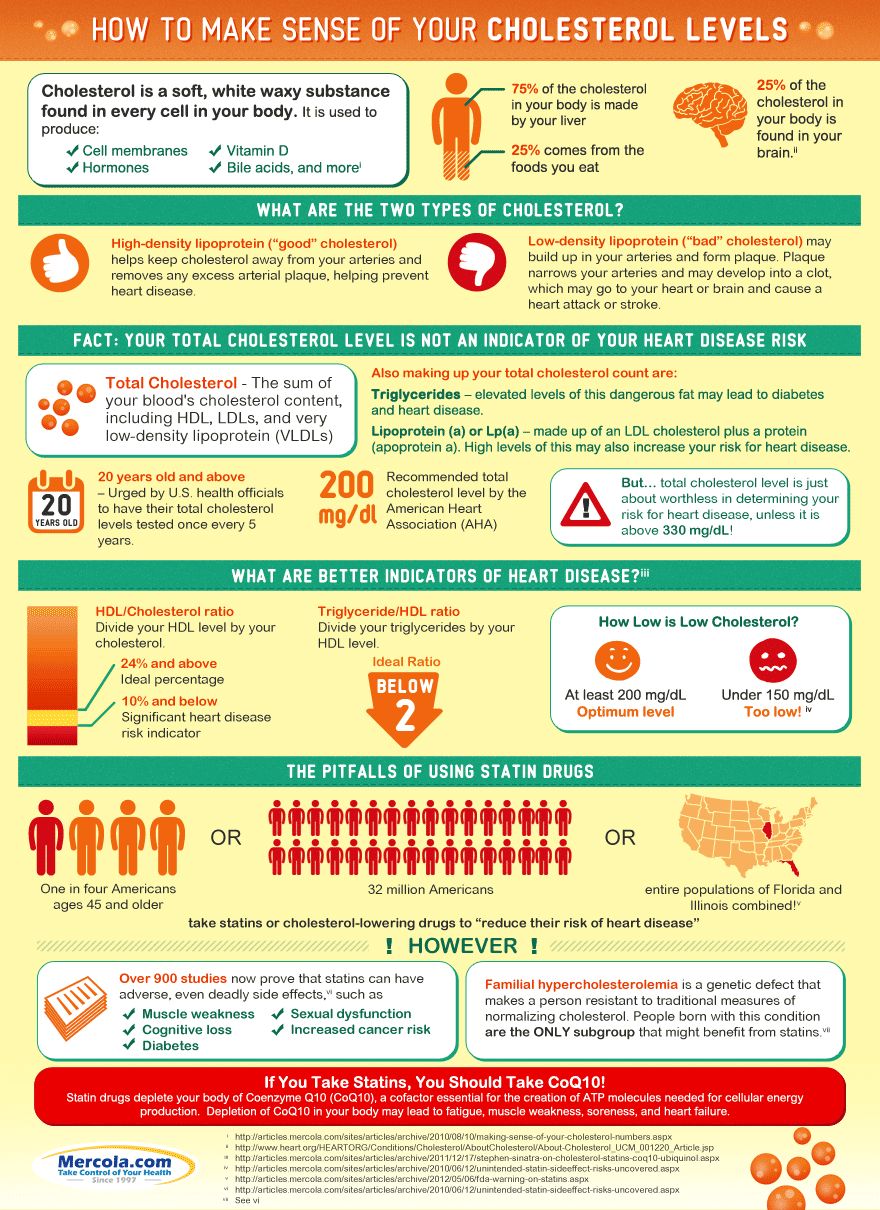
As a general rule, cholesterol-lowering drugs are not required or prudent for the majority of people — especially if both high cholesterol and longevity run in your family. Remember, the evidence overwhelmingly suggests your overall cholesterol level has little to nothing to do with your risk for heart disease.
For more information about cholesterol and what the different levels mean, take a look at the infographic above. As for evaluating your heart disease risk, the following tests will provide you with a more accurate picture of your risk:
| HDL/Cholesterol ratio — HDL percentage is a very potent heart disease risk factor. Just divide your HDL level by your total cholesterol. That percentage should ideally be above 24%. |
| Triglyceride/HDL ratio — You can also do the same thing with your triglycerides and HDL ratio. That percentage should be below 2. |
| NMR LipoProfile — Large LDL particles do not appear to be harmful. Only small dense LDL particles can potentially be a problem, as they can squeeze through the lining of your arteries. If they oxidize, they can cause damage and inflammation.
Some groups, such as the National Lipid Association, are now starting to shift the focus toward LDL particle number instead of total and LDL cholesterol to better assess your heart disease risk. Once you know your particle size numbers, you and your doctor can develop a more customized program to help manage your risk. |
| Your fasting insulin level — Heart disease is primarily rooted in insulin resistance,30 which is the result of a high-sugar diet. Sugar, not cholesterol or saturated fat, is the primary driver. Clinical trials have shown high fructose corn syrup can trigger risk factors for cardiovascular disease within as little as two weeks.31
Any meal or snack high in carbohydrates like fructose and refined grains generates a rapid rise in blood glucose and then insulin to compensate for the rise in blood sugar. The insulin released from eating too many carbs promotes fat accumulation and makes it more difficult for your body to shed excess weight. Excess fat, particularly around your belly, is one of the major contributors to heart disease. |
| Your fasting blood sugar level — Research has shown people with a fasting blood sugar level of 100 to 125 mg/dl have a nearly 300% increased higher risk of coronary heart disease than people with a level below 79 mg/dl.32,33 |
| Your iron level — Iron can be a very potent oxidative stress, so if you have excess iron levels you can damage your blood vessels and increase your risk of heart disease. Ideally, you should monitor your ferritin levels and make sure they are not much above 80 ng/ml.
The simplest way to lower them if they are elevated is to donate your blood. If that is not possible you can have a therapeutic phlebotomy and that will effectively eliminate the excess iron from your body. |
- 1 Am J Cardiol 2015 Nov 1;116(9):1479-80
- 2 Health.gov, Dietary Guidelines 2015 Overview
- 3 USDA. Dietary Guidelines for Americans 2020-2025
- 4, 5, 12 Expert Review of Clinical Pharmacology, September 10, 2018, doi.org/10.1080/17512433.2018.1519391
- 6 Expert Review of Clinical Pharmacology, September 10, 2018, doi.org/10.1080/17512433.2018.1519391, Expert Commentary
- 7 Reason.com September 22, 2018
- 8 Expert Review of Clinical Pharmacology, September 10, 2018, doi.org/10.1080/17512433.2018.1519391, 2.2 No Exposure-Response
- 9 QJM 2002 Jun;95(6):397-403
- 10, 11 Expert Review of Clinical Pharmacology, September 10, 2018, An idea supported by fraudulent reviews of the literature
- 13 Expert Review of Clinical Pharmacology, September 10, 2018, LDL-C of patients with acute myocardial infarction is lower than normal
- 14 BMJ Open 2016; 6(6): e010401
- 15 BMJ Open 2015 Sep 24;5(9):e007118
- 16 Expert Review of Clinical Pharmacology, September 10, 2018, The benefit of statin treatment is exaggerated
- 17 JAMA Cardiology 2017;2(1):56-65
- 18 CDC.gov, Prescription Cholesterol-Lowering Medication Use in Adults, 2003-2012 (PDF)
- 19 JAMA 2016;316(19):2008-2024, Discussion
- 20 Expert Rev Clin Pharmacol. 2015 Mar;8(2):201-10
- 21 JAMA Cardiology June 26, 2019 doi:10.1001/jamacardio.2019.1972
- 22 UT Southwestern Medical Center
- 23, 24 Cardiovascular Business July 1, 2019
- 25 Clinical Cardiology 2009 Dec;32(12):684-9
- 26 Drugs.com Simvastatin Pregnancy Warning
- 27 British Journal of Clinical Pharmacology 2007 Oct; 64(4): 496–509
- 28 Cancer Epidemiol Biomarkers Prev. 2013 Sep;22(9):1529-37
- 29 Neuro Endocrinol Lett. 2011;32(5):688-90
- 30 Crossfit.com July 7, 2019
- 31 American Journal of Clinical Nutrition June 2015; 101(6): 1144-1154
- 32 American Journal of Cardiology April 2002 89(5):596-9
- 33 Diabetes in Control April 22, 2002
Low Cholesterol May Raise Your Alzheimer’s Risk
Reproduced from original article:
https://articles.mercola.com/sites/articles/archive/2022/04/02/low-cholesterol-linked-to-alzheimers-disease.aspx
Analysis by Dr. Joseph Mercola Fact Checked April 02, 2022

STORY AT-A-GLANCE
- Cholesterol is found in your bloodstream and cells, and is necessary for the production of cell membranes. Cholesterol also plays an important role in the formation of memories and is vital for healthy neurological function
- Higher cholesterol levels are associated with better brain health; low cholesterol levels have been shown to increase your risk of depression and suicide
- A 2014 study found higher levels of HDL and lower levels of LDL were associated with a reduced risk for amyloid plaque deposits in the brain, independently of age and presence of the APOE4 gene, which raises your risk for Alzheimer’s
- Research published in 2008 found elderly individuals who were not genetically predisposed to Alzheimer’s disease who had the highest levels of cholesterol — including the highest levels of LDL — had the best memory
- Another study published in 2018 came to a similar, although more complex, conclusion. While having higher total cholesterol at midlife was associated with a reduced risk for cognitive decline after the age of 85, those whose cholesterol levels increased between midlife and late life were at increased risk
While cholesterol has been vilified as something that should be as low as possible to prevent heart disease, it’s actually a crucial component for good health and too low a level can have serious repercussions for your health.
Cholesterol is found not only in your bloodstream but also in every cell in your body, and is necessary for the production of cell membranes, virtually every steroid hormone, vitamin D and bile acids that help you digest fat.
Cholesterol also plays an important role in the formation of memories and is vital for healthy neurological function. For example, low cholesterol levels have been shown to increase your risk of depression and suicide,1 in some cases rather dramatically.
As noted by neurologist Dr. David Perlmutter, a quarter of all the cholesterol in your body is found in your brain, where it performs the function of an antioxidant.2 A number of studies have demonstrated that, contrary to popular belief, higher cholesterol levels are associated with better brain health.
According to senior research scientist Stephanie Seneff, Ph.D., insufficient fat and cholesterol in your brain play a crucial role in the Alzheimer’s disease process, detailed in her 2009 paper3 “APOE-4: The Clue to Why Low Fat Diet and Statins May Cause Alzheimer’s.”
Cholesterol 101
As noted by nutritional researcher Zoe Harcombe, a researcher in dietary fat who has a Ph.D. in public health nutrition, “It is virtually impossible to explain how vital cholesterol is to the human body. If you had no cholesterol in your body you would be dead.”4
Your liver manufactures most, about 80 percent, of the cholesterol your body requires, which in and of itself suggests your body cannot survive without it. The remaining 20% comes from your diet. However, dietary cholesterol is absorbed at a rate of 20% to 60% depending on the individual, and if you consume less, your body will compensate by making more and vice versa.
In order to be transported through your bloodstream, the cholesterol is encapsulated in a lipoprotein, which is where the terms LDL (low-density lipoprotein), HDL (high-density lipoprotein) and VLDL (very-low-density lipoprotein) come from. Whether LDL is truly as hazardous as many in the medical community insist, however, is still up for debate.
According to Harcombe, the notion that there is good (referring to HDL) and bad (LDL) cholesterol is incorrect, as technically LDL and HDL are not even cholesterol; they’re carriers and transporters of cholesterol, triglycerides (fat), phospholipids and proteins. “LDL would more accurately be called the carrier of fresh cholesterol and HDL would more accurately be called the carrier of recycled cholesterol,” Harcombe explains.5
Now, HDL is indeed beneficial in that it acts as a master manager, helping protect LDL against oxidation and transporting triglycerides and cholesterol in and out of the VLDL. In a healthy person, the LDL will be reabsorbed by the liver after about two days, where it gets broken up and recycled. As a general rule, a high-sugar diet will cause damaged LDLs to rise, beneficial HDLs to drop, triglycerides and, often, total cholesterol to rise.
How Cholesterol Impacts Neurological Function, Disease Risk
Getting back to Alzheimer’s, a number of studies have demonstrated the importance of higher cholesterol for the prevention of this devastating neurodegenerative disease. In 2014, a study6 in JAMA Neurology investigated the impact of cholesterol levels on the deposition of beta-amyloid plaque in the brains of 74 seniors with a mean age of 78. Three of them had mild dementia, 33 were clinically normal and 38 had mild cognitive impairment. As explained by the authors:7
“Cholesterol, vital to neuronal structure and function, has important roles in the synthesis, deposition, and clearance of β-amyloid (Aβ) and may have a pathogenic role in Alzheimer disease (AD) … There are also important connections among apolipoprotein E (APOE), Aβ, and cholesterol.
A strong genetic risk factor for AD, the APOE ε4 allele is associated with earlier and higher deposition of Aβ. APOE is the primary transporter of cholesterol in the brain, and its isoforms differentially modulate brain cholesterol levels.”
Here, the researchers found that higher levels of HDL and lower levels of LDL were associated with a reduced risk for amyloid plaque deposits in the brain, and these findings were independent of age and presence of the APOE4 gene. Study coauthor Dr. Charles DeCarli, a professor of neurology at UC Davis and director of the UC Davis Alzheimer’s Disease Center, commented on the results:8
“If you have an LDL above 100 or an HDL that is less than 40 … you want to make sure that you’re getting those numbers into alignment. You have to get the HDL up and the LDL down.”
That said, research9 published in 2008 found that elderly individuals who were not genetically predisposed to Alzheimer’s disease who had the highest levels of cholesterol — including the highest levels of LDL — had the best memory, so the verdict is still out on whether high LDL is a significant risk factor.
Another study 10,11 published in 2018 similarly came to a similar, although more complex, conclusion. In this study, the researchers evaluated the total cholesterol levels of participants in the Framingham Heart Study at midlife (around the age of 40) and late-life (around the age of 75). They also assessed mean total cholesterol between midlife and late life, and the total change in cholesterol since midlife.
Here, they found that having higher total cholesterol at midlife was associated with a reduced risk for cognitive decline after the age of 85. However, those whose cholesterol levels increased between midlife and late life were at increased risk, suggesting there are likely other unknown variables at play as well.
New Theory Proposed
In related news, researchers at Florida Atlantic University’s (FAU) Brain Institute and Vanderbilt University have proposed a new theory to help explain the link between cholesterol, beta-amyloid and Alzheimer’s. The study,12 published in Neurobiology of Disease in July 2019, tracked the location and mobility of amyloid precursor protein to assess its function in neurons.
Amyloid precursor protein is strongly associated with Alzheimer’s, but its distribution across various brain membranes and neuronal functions are still unclear. As reported by Science Daily:13
“In the case of more common sporadic Alzheimer’s disease, the highest genetic risk factor is a protein that is involved in cholesterol transportation and not this amyloid precursor protein … For the study, [Qi] Zhang [Ph.D., senior author and researcher at FAU Brain Institute] and collaborators genetically disrupted the interaction between cholesterol and amyloid precursor protein.
Surprisingly, by disengaging the two, they discovered that this manipulation not only disrupts the trafficking of amyloid precursor protein but also messes up cholesterol distribution at the neuronal surface.
Neurons with an altered distribution of cholesterol exhibited swollen synapses and fragmented axons and other early signs of neurodegeneration. ‘Our study is intriguing because we noticed a peculiar association between amyloid precursor protein and cholesterol that resides in the cell membrane of synapses, which are points of contact among neurons and the biological basis for learning and memory,’ said Zhang.
‘Amyloid precursor protein may just be one of the many accomplices partially contributing to cholesterol deficiency. Strangely, the heart and brain seem to meet again in the fight against bad cholesterol.'”
High-Fat Ketogenic Diet Protects Your Brain Health
As noted by Seneff in her 2009 paper14 on Alzheimer’s:
“ApoE-4 … is a known risk factor [for Alzheimer’s disease]. Since apoE plays a critical role in the transport of cholesterol and fats to the brain, it can be hypothesized that insufficient fat and cholesterol in the brain play crucial role in the disease process.
In a remarkable … study, it was found that Alzheimer’s patients have only 1/6 of the concentration of free fatty acids in the cerebrospinal fluid compared to individuals without Alzheimer’s. In parallel, it is becoming very clear that cholesterol is pervasive in the brain, and that it plays a critical role both in nerve transport in the synapse and in maintaining the health of the myelin sheath coating nerve fibers …
Throughout a person’s life, the myelin sheath has to be constantly maintained and repaired. This is something that researchers are only beginning to appreciate, but two related properties of Alzheimer’s are poor quality myelin sheath alongside a drastically reduced concentration of fatty acids and cholesterol in the cerebrospinal fluid …
An extremely high-fat (ketogenic) diet has been found to improve cognitive ability in Alzheimer’s patients. These and other observations … lead me to conclude that both a low-fat diet and statin drug treatment increase susceptibility to Alzheimer’s.”
Indeed, I’ve previously written about how a ketogenic diet, high in healthy fats, helps protect against neurodegenerative diseases such as Alzheimer’s. One of the most striking studies15 showing the effects of a high-fat/low-carb versus high-carb diets on brain health revealed that high-carb diets increase your risk of dementia by a whopping 89 percent, while high-fat diets lower it by 44 percent.
According to the authors, “A dietary pattern with relatively high caloric intake from carbohydrates and low caloric intake from fat and proteins may increase the risk of mild cognitive impairment or dementia in elderly persons.” A ketogenic diet benefits your brain in a number of different ways. For example, it:
• Triggers ketone production — A cyclical ketogenic diet will help you convert from carb-burning mode to fat-burning mode, which in turn triggers your body to produce ketones, an important source of energy (fuel) for your brain16 that have been shown to help prevent brain atrophy and alleviate symptoms of Alzheimer’s.17 They may even restore and renew neuron and nerve function in your brain after damage has set in.
• Improves your insulin sensitivity — A cyclical ketogenic diet will also improve your insulin sensitivity, which is an important factor in Alzheimer’s.18 The link between insulin sensitivity and Alzheimer’s is so strong, the disease is sometimes referred to as Type 3 diabetes.
Even mild elevation of blood sugar is associated with an elevated risk for dementia.19 Diabetes and heart disease20 are also known to elevate your risk, and both are rooted in insulin resistance.
The connection between high-sugar diets and Alzheimer’s was also highlighted in a longitudinal study published in the journal Diabetologia in January 2018.21 Nearly 5,190 individuals were followed over a decade, and the results showed that the higher an individual’s blood sugar, the faster their rate of cognitive decline.
Studies have also confirmed that the greater an individual’s insulin resistance, the less sugar they have in key parts of their brain, and these areas typically correspond to the areas affected by Alzheimer’s.22,23
• Reduces free radical damage and lowers inflammation in your brain — Ketones not only burn very efficiently and are a superior fuel for your brain, but also generate fewer reactive oxygen species and less free radical damage.
A ketone called beta hydroxybutyrate is also a major epigenetic player, stimulating radical decreases in oxidative stress by decreasing NF-kB, thus reducing inflammation and increase NADPH levels along with beneficial changes in DNA expression that improve your detoxification and antioxidant production.
I explain the ins and outs of implementing this kind of diet, and its many health benefits, in my book, “KetoFast.” In it, I also explain why cycling through stages of feast and famine, opposed to continuously remaining in nutritional ketosis, is so important.
Phospholipid-Bound DHA Is Particularly Important
A type of fat that is of particular importance for your brain health and prevention of neurodegeneration is the marine-based omega-3 fat docosahexaenoic acid (DHA), found in fatty fish, fish oil and krill oil.
Research24 by a biomedical research scientist on aging, Rhonda Patrick, Ph.D., highlights the benefits of DHA bound to phospholipids — such as that found in krill oil — showing this particular form may actually reduce the risk of Alzheimer’s in those with the APOE4 gene, which is thought to be present in about one-quarter of the population.
Having a single copy of the gene raises your risk two- to threefold. For those with two copies, the risk of Alzheimer’s is as much as 15 times higher than those without this genetic predisposition.
Two hallmarks of Alzheimer’s are amyloid beta plaques and tau tangles, both of which impair normal brain functioning. Alzheimer’s patients also have reduced glucose transport into their brains, and this is one of the reasons why plaque and tangles form and accumulate. As explained by Patrick in her press release:25
“DHA promotes brain glucose uptake by regulating the structure and function of special proteins called glucose transporters located at the blood-brain barrier, the tightly bound layer of cells that limits passage of substances into the brain …
DHA … naturally occurs in a triglyceride form and a phospholipid form. Eating DHA-rich fish slows the progression of Alzheimer’s disease and improves symptoms in APOE4 carriers. However, some evidence suggests that taking DHA supplements, which largely lack the phospholipid form, does not.”
According to Patrick, this variation in response appears to be related to the different ways in which the two forms of DHA are metabolized and ultimately transported into your brain.
Phospholipid DHA May Be Ideal for High-Risk Individuals
When the triglyceride form of DHA is metabolized, most of it turns into non-esterified DHA, while the phospholipid form is metabolized primarily into DHA-lysophosphatidylcholine (DHA-lysoPC). While both of these forms can cross the blood-brain barrier to reach your brain, the phospholipid form does so far more efficiently. Patrick explains:26
“Whereas non-esterified DHA passes through the blood-brain barrier via passive diffusion, the phospholipid form, DHA-lysoPC, enters via a special transporter called Mfsd2a.
Previous studies have found APOE4 disrupts the tight junctions of the blood-brain barrier, leading to a breakdown in the barrier’s outer membrane leaflet and a subsequent loss of barrier integrity. One end result of this loss is impaired diffusion of non-esterified DHA.”
According to Patrick, people with APOE4 have a faulty non-esterified DHA transport system, and this may be why they’re at increased risk for Alzheimer’s. The good news is that DHA-lysoPC can bypass the tight junctions, thereby improving DHA transport, and for those with one or two APOE4 variants, taking the phospholipid form of DHA may therefore lower their risk of Alzheimer’s more effectively.
“When looking at the effects of DHA on cognitive function in people with APOE4-related Alzheimer’s disease, it’s important that researchers consider the effects of DHA in phospholipid form, especially from rich sources such as fish roe or krill, which can have as much as one-third to three-quarters of the DHA present in phospholipids,” Patrick says.27
“That’s where we’re most likely to see the greatest benefits, particularly in vulnerable APOE4 carriers.”
Alzheimer’s Prevention Basics
One of the most comprehensive assessments of Alzheimer’s risk is Dr. Dale Bredesen’s ReCODE protocol, which evaluates 150 factors known to contribute to the disease. This protocol also identifies your disease subtype or combination of subtypes so that an effective treatment protocol can be devised.
In his book, “The End of Alzheimer’s: The First Program to Prevent and Reverse Cognitive Decline,”28 which describes the complete protocol, you will also find a list of suggested screening tests and the recommended ranges for each test, along with some of Bredesen’s treatment suggestions.
If you’re concerned about Alzheimer’s, I highly recommend picking up a copy of Bredesen’s book. You can also find some of the program details in his 2014 case paper, which you can download for free online.29 Following are some of the lifestyle strategies Bredesen describes that I believe to be among the most important:
| Eat real food, ideally organic — Avoid processed foods of all kinds, as they contain a number of ingredients harmful to your brain, including refined sugar, processed fructose, grains (particularly gluten), vegetable oils, genetically engineered ingredients and pesticides like glyphosate.
Ideally, keep your added sugar to a minimum and your total fructose below 25 grams per day, or as low as 15 grams per day if you already have insulin/leptin resistance or any related disorders. Opting for organic produce will help you avoid synthetic pesticides and herbicides. Most will also benefit from a gluten-free diet, as gluten makes your gut more permeable, which allows proteins to get into your bloodstream where they sensitize your immune system and promote inflammation and autoimmunity, both of which play a role in the development of Alzheimer’s. |
| Replace refined carbs with healthy fats — Diet is paramount, and the beauty of following my optimized nutrition plan is that it helps prevent and treat virtually all chronic degenerative diseases, including Alzheimer’s. It’s important to realize that your brain actually only needs 15% of its energy from carbs, which can easily be produced in your liver; ketones are far more important for optimal brain function.
A cyclical ketogenic diet has the double advantage of both improving your insulin sensitivity and lowering your Alzheimer’s risk. As noted by Perlmutter, lifestyle strategies such as a ketogenic diet can even offset the risk associated with genetic predisposition. (Estimates suggest genetics account for less than 5 percent of Alzheimer’s cases. An estimated 75 million Americans have the single allele for APOE4. It’s unknown how many Americans have the TOMM40 gene or others that may affect your risk.) When your body burns fat as its primary fuel, ketones are created, which not only burn very efficiently and are a superior fuel for your brain, but also generate fewer reactive oxygen species and less free radical damage. Pay close attention to the kinds of fats you eat — avoid all trans fats or hydrogenated fats that have been modified in such a way to extend their longevity on the grocery store shelf. This includes margarine, vegetable oils and various butter-like spreads. Healthy fats to add to your diet include avocados, butter, organic pastured egg yolks, coconuts and coconut oil, grass fed meats and raw nuts such as pecans and macadamia. MCT oil is also a great source of ketone bodies. |
| Keep your fasting insulin levels below 3 — Lowering your insulin will also help lower leptin levels which is another factor for Alzheimer’s. If your insulin is high, you’re likely consuming too much sugar and need to cut back. |
| Optimize your omega-3 level — Also make sure you’re getting enough animal-based omega-3 fats. Ideally, get an omega-3 index test done once a year to make sure you’re in a healthy range. Your omega-3 index should be above 8 percent and your omega 6-to-3 ratio between 0.5 and 3.0. |
| Optimize your gut flora — To do this, avoid processed foods, antibiotics and antibacterial products, fluoridated and chlorinated water, and be sure to eat traditionally fermented and cultured foods, along with a high-quality probiotic if needed. |
| Intermittently fast — Compress your eating window to six to eight hours. Intermittent fasting is a powerful tool to jump-start your body into remembering how to burn fat and repair the insulin/leptin resistance that is a primary contributing factor for Alzheimer’s.
Once you have worked your way up to where you’ve been doing 20-hour daily intermittent fasting for a month, are metabolically flexible and can burn fat as your primary fuel, you can progress to the far more powerful KetoFast protocol, detailed in my book. |
| Move regularly and consistently throughout the day — It’s been suggested that exercise can trigger a change in the way the amyloid precursor protein is metabolized,30 thus, slowing down the onset and progression of Alzheimer’s.
Exercise also increases levels of the protein PGC-1 alpha. Research has shown that people with Alzheimer’s have less PGC-1 alpha in their brains and cells that contain more of the protein produce less of the toxic amyloid protein associated with Alzheimer’s. |
| Optimize your magnesium levels — Preliminary research strongly suggests a decrease in Alzheimer symptoms with increased levels of magnesium in the brain. Keep in mind that the only magnesium supplement that appears to be able to cross the blood-brain barrier is magnesium threonate. |
| Optimize your vitamin D, ideally through sensible sun exposure — Sufficient vitamin D is imperative for proper functioning of your immune system to combat inflammation associated with Alzheimer’s. It’s important to recognize that sun exposure is important for reasons unrelated to vitamin D.
Your brain responds to the near-infrared light in sunlight in a process called photobiomodulation. Research shows near-infrared stimulation of the brain boosts cognition and reduces symptoms of Alzheimer’s, including more advanced stages of the disease. Delivering near-infrared light to the compromised mitochondria synthesizes gene transcription factors that trigger cellular repair, and your brain is one of the most mitochondrial-dense organs in your body. |
| Curcumin supplementation — Research31,32 published last year suggests curcumin supplementation may lower your risk of Alzheimer’s by improving memory and focus. The double-blind, placebo-controlled study, published in the American Journal of Geriatric Psychiatry, included 40 adults between the ages of 50 and 90 who reported mild memory lapses.
None had a diagnosis of dementia at the time of their enrollment. Participants randomly received either 90 milligrams of curcumin twice a day for 18 months, or a placebo. A standardized cognitive assessment was administered at the start of the study and at six-month intervals thereafter, and the level of curcumin in their blood was measured at the beginning and end of the study. Thirty of the participants also underwent positron emission tomography (PET) scans to assess their level of amyloid and tau deposits before and after treatment, both of which are strongly associated with Alzheimer’s risk. Those who received curcumin saw significant improvements in memory and concentration, while the control group experienced no improvement. PET scans confirmed the treatment group had significantly less amyloid and tau buildup in areas of the brain that control memory, compared to controls. Overall, the curcumin group improved their memory by 28 percent over the year-and-a-half-long treatment period. Curcumin has also been shown to increase levels of brain-derived neurotrophic factor (BDNF),33 and reduced levels of BDNF have been linked to Alzheimer’s disease. Yet another way curcumin may benefit your brain and lower your risk of dementia is by affecting pathways that help reverse insulin resistance, hyperlipidemia and other symptoms associated with metabolic syndrome and obesity.34 |
| Avoid and eliminate mercury from your body — Dental amalgam fillings are one of the major sources of heavy metal toxicity; however, you should be healthy before having them removed. Once you have adjusted to following the diet described in my optimized nutrition plan, you can follow the mercury detox protocol and then find a biological dentist to have your amalgams removed. |
| Avoid and eliminate aluminum from your body — Common sources of aluminum include antiperspirants, nonstick cookware and vaccine adjuvants. |
| Avoid flu vaccinations — Most flu vaccines contain both mercury and aluminum. |
| Avoid statins and anticholinergic drugs — Drugs that block acetylcholine, a nervous system neurotransmitter, have been shown to increase your risk of dementia. These drugs include certain nighttime pain relievers, antihistamines, sleep aids, certain antidepressants, medications to control incontinence and certain narcotic pain relievers.
Statin drugs are particularly problematic because they suppress the synthesis of cholesterol, deplete your brain of coenzyme Q10, vitamin K2 and neurotransmitter precursors, and prevent adequate delivery of essential fatty acids and fat-soluble antioxidants to your brain by inhibiting the production of the indispensable carrier biomolecule LDL. |
| Limit your exposure to wireless radiofrequencies like cellphones, Wi-Fi and routers — Radiation from cellphones and other wireless technologies trigger excessive production of peroxynitrites,35 a highly damaging reactive nitrogen species.
Increased peroxynitrite production from cellphone exposure will damage your mitochondria, stem cells, DNA, cell membranes and proteins.36,37 Your brain is the most mitochondrial-dense organ in your body. Increased peroxynitrite generation has also been associated with increased levels of systemic inflammation by triggering cytokine storms and autonomic hormonal dysfunction. |
| Optimize your sleep — Sleep is necessary for maintaining metabolic homeostasis in your brain. Without sufficient sleep, neuron degeneration sets in, and catching up on sleep during weekends will notprevent this damage.38,39,40 It is very clear this is one of the most important and overlooked areas and many fail to integrate this into their lifestyle.
Sleep deprivation causes disruption of certain synaptic connections that can impair your brain’s ability for learning, memory formation and other cognitive functions. Poor sleep also accelerates the onset of Alzheimer’s disease.41 Most adults need seven to nine hours of uninterrupted sleep each night. Deep sleep is the most important, as this is when your brain’s glymphatic system performs its cleanout functions, eliminating toxic waste from your brain, including amyloid beta. |
| Challenge your mind daily — Mental stimulation, especially learning something new, such as learning to play an instrument or a new language, is associated with a decreased risk of dementia and Alzheimer’s. Researchers suspect that mental challenge helps to build up your brain, making it less susceptible to the lesions associated with Alzheimer’s disease. |
- 1 Great Plains Laboratory November 16, 2015
- 2 Drperlmutter.com, Your Brain Needs Cholesterol
- 3, 14 MIT.edu APOE-4: The Clue to Why Low Fat Diet and Statins May Cause Alzheimer’s by Stephanie Seneff
- 4, 5 ZoeHarcombe.com, We have got cholesterol completely wrong
- 6, 7 JAMA Neurology 2014;71(2):195-200
- 8 Medical News Today December 31, 2014
- 9 American Journal of Geriatric Psychiatry 2008 Sep;16(9):781-5
- 10 Alzheimer’s and Dementia July 2018; 14(7): 952-960
- 11 The Conversation March 5, 2018
- 12 Neurobiology of Disease July 2019; 127: 449-461
- 13 Science Daily April 23, 2019
- 15 J Alzheimers Dis. 2012; 32(2):329-339
- 16 British Journal of Nutrition 2015 Jul 14;114(1):1-14
- 17 Science Daily. Eating More Ketones May Fight Against Alzheimer’s. December 9, 2019
- 18 JAMA Neurology July 27, 2015. doi:10.1001/jamaneurol.2015.0613v
- 19 NEJM August 8, 2013; 369:540-548
- 20 Medicinenet.com March 31, 2014
- 21 Diabetologia (2018) DOI: 10.1007/s00125-017-4541-7
- 22 JAMA Neurology 2015;72(9):1013-1020
- 23 Huffington Post July 29, 2015
- 24 FASEB Journal October 5, 2018
- 25, 26, 27 PR Newswire October 25, 2018
- 28 Amazon.com, The End of Alzheimer’s: The First Program to Prevent and Reverse Cognitive Decline, by Dr. Dale Bredesen
- 29 Aging September 27, 2014; 6(9): 707-717
- 30 Journal of Neuroscience, April 27, 2005: 25(17); 4217-4221
- 31 The American Journal of Geriatric Psychiatry March 2018; 26(3): 266-277
- 32 Deccan Chronicle January 24, 2018
- 33 Brain Research 2006; 1122(1):56-64
- 34 European Journal of Nutrition 2011; 50(3):151-161
- 35 BioRxiv May 19, 2016
- 36 Journal of Cellular and Molecular Medicine 2013; 17(8):958
- 37 The Root Cause in the Dramatic Rise of Chronic Disease, May 2016
- 38 Journal of Neuroscience 19 March 2014, 34(12): 4418-4431
- 39 Penn Medicine Press Release March 18, 2014
- 40 Medical News Today March 20, 2014
- 41 Neurobiology of August 2014; 35(8): 1813-1820
How Polypharmacy Led to 43 Prescription Pills at Once
Reproduced from original article:
https://articles.mercola.com/sites/articles/archive/2021/12/10/polypharmacy.aspx
The original Mercola article may not remain on the original site, but I will endeavor to keep it on this site as long as I deem it to be appropriate, and will not be bullied into removing it.

STORY AT-A-GLANCE
- While 89% of people aged 65 and older take at least one prescription medication, 54% take four or more
- A commentary by Dr. Mark E. Williams detailed the case of “Allison,” who was taking 43 different medications and suffering multiple side effects as a result
- Polypharmacy is a preventable risk factor for hospital admission in older adults, due to adverse drug events
- The risks of polypharmacy include mortality, falls, adverse drug reactions, increased length of hospital stay and hospital readmission
- A holistic approach, one that addresses the key tenets of good health and creates real wellness instead of attempting to cover up symptoms with more pills, is needed to achieve optimal health
Polypharmacy, or the use of multiple medications, is common in older adults. While 89% of people aged 65 and older take at least one prescription medication, 54% take four or more.1 Data from Merck similarly found that nearly 80% of older adults regularly take at least two prescription drugs while 36% regularly use five or more different drugs — and this doesn’t include over-the-counter medications.2
Adverse effects from polypharmacy are common and may drive patients to seek out ever-more drugs to treat the side effects caused by their unsafe drug regimen. It’s a vicious cycle, one that’s perpetuated by a broken health care system that revolves around pharmaceutical-driven, fragmented care.
Not only do many patients see multiple doctors, each of whom may prescribe their own set of medications, but patients may pressure doctors to prescribe drugs they’ve seen on direct-to-consumer advertisements. Instead of looking at the big picture of how to get healthy, tending to essential factors like diet, stress and physical activity, “health care” for seniors often turns into “drug care,” with potentially disastrous results.
One Patient — 43 Prescription Drugs
A commentary by Dr. Mark E. Williams published on Medscape highlights just how extreme polypharmacy can become. In some cases, it’s not “just” four or five medications but dozens of them, and in the case of Williams’ patient “Allison,” it was 43. The woman had been transferred to a chronic care facility for long-term care due to bipolar illness.
Days earlier, she was treated at a hospital for mental health issues, which Williams said “was probably related to inappropriate polypharmacy.”3
“Despite being admitted to the hospital for adverse drug reactions related to polypharmacy, Allison was discharged to my facility on 43 prescription medications and an almost equal number of over-the-counter (OTC) drugs. It took more than 10 minutes for the nurse to review the admission medications with me over the phone,” he wrote.4
Allison’s symptoms included fatigue, dizziness, muscle aches, headache, nausea, insomnia and more, and she requested additional medications to treat them. Not only was the woman taking duplicate medications meant to treat the same symptoms, but she was also taking medications intended to treat common adverse effects.
“The ‘chemical soup’ in her body is leading to mental and physical problems,” Williams told the patient’s daughter, but she, too, bought into the notion that more drugs equaled better care. After overcoming the patient’s resistance to going off the drugs, over a three-month period Williams was able to reduce Allison’s medications to about 15 — still a staggering number, but less so than 43.
“Allison improved, both mentally and physically,” Williams wrote,5 but challenges still ensued, including the patient demanding a memory drug she had seen advertised on television, and an incident in which her daughter gave her an over-the-counter sleep aid, leading to lethargy, confusion and slurred speech.
Ultimately, Allison was transferred to another facility, where the dangerous polypharmacy undoubtedly continued. While Williams’ commentary highlights an extreme case, it’s not unique — polypharmacy is prevalent among seniors.
Polypharmacy Worsens Health
When medications are prescribed in excess, including to treat the side effects of other drugs, the patient’s health suffers. “The use of numerous medications may result in medication-related problems such as inappropriate indications, therapeutic duplication, adverse effects, drug interactions, unnecessary medications, poor adherence and a strain on health care resources,” according to a featured article in The Journal for Nurse Practitioners.6
It also noted that polypharmacy is a preventable risk factor for hospital admission in older adults, due to adverse drug events. The risks of polypharmacy, meanwhile, are well noted. In BMC Geriatrics, adverse outcomes including mortality, falls, adverse drug reactions, increased length of hospital stay and hospital readmission are listed, and the risk of harm increases with the number of medications.7 According to the systematic review:8
“Harm can result due to a multitude of factors including drug-drug interactions and drug-disease interactions. Older patients are at even greater risk of adverse effects due to decreased renal and hepatic function, lower lean body mass, reduced hearing, vision, cognition and mobility.”
In 2007, Dr. Michael Stern, geriatric emergency medicine specialist at New York Presbyterian Hospital, even told a New York Times reporter that polypharmacy accounts for more than one-fourth of all admissions to the hospital and that it would be considered the fifth leading cause of death if it were categorized that way.9
Older People Are More Vulnerable to Drug Side Effects
The fact that older people are more likely to be taking more prescription drugs is a double-edged sword, as the elderly are already at increased risk of drug side effects. In fact, the elderly are estimated to be twice as susceptible to adverse drug events compared to younger people.
“Side effects are also likely to be more severe, affecting quality of life and resulting in visits to the doctor and in hospitalization,” according to the Merck Manual, which also explains several reasons why older people are so vulnerable to drug side effects:10
- Older people have less water and more fat tissue in the body; this allows higher concentrations of drugs that dissolve in water and increased accumulation of drugs that dissolve in fat
- The kidneys are less effective at excreting drugs into urine
- The liver is less able to metabolize drugs, so they’re not removed as readily from the body
- “Older people are more likely to have chronic medical disorders that may be worsened by drugs or that may affect how the drugs work”
Some common examples of how drugs may affect seniors differently include blood pressure drugs, which may lead to more dramatic drops in older people, leading to symptoms of dizziness and falls. Older adults may also become confused and sleepy when using antianxiety drugs, more so than typically seen in younger people. Such effects may only be compounded when multiple drugs are being taken at the same time.
In fact, due to changes that occur during biological aging, it’s now recognized that medications should be clinically tested specifically with older adults in mind. However, older adults are often excluded from clinical trials, which means the safety and efficacy of drugs in this population is often unknown, with supportive evidence lacking.
“Inevitably, this lack of evidence has often led to inappropriate drug treatment and, consequently, to various adverse clinical outcomes,” according to a review published in March 2021 in European Geriatric Medicine.11
Why Are so Many More Seniors Taking Antidepressants?
Overprescribing is rampant among the senior population, and antidepressants are one such example. There’s been a major rise in the number of antidepressants being prescribed for older adults over the last two decades, without a similarly sharp increase in the number depressed, according to a study published in The British Journal of Psychiatry.12
The findings suggest seniors may be being overprescribed antidepressant drugs, which could have serious implications for their health, although the researchers weren’t willing to state this, noting instead, “we can’t infer that older patients are prescribed antidepressants unnecessarily.”13
In the first study group, 4.2% of the adults were taking antidepressants, but this jumped to 10.7% in the later study. During this time, the prevalence of depression decreased, but only slightly, from 7.9% to 6.8%.14 Also noteworthy, among older adults living in care homes, the prevalence of depression was unchanged but the use of antidepressants rose from 7.4% to 29.2%.15
There were a few suggestions offered for why antidepressant prescribing rates increased so steeply without a similar increase in depression, including overdiagnosis or prescribing the drugs for conditions other than depression. However, most of those prescribed antidepressants had not been diagnosed with depression.
Further, antidepressants carry a risk of side effects that could easily spiral into more drug prescriptions. For instance, antidepressant users have an increased risk of developing Type 2 diabetes,16 and antidepressant use has been linked to thicker arteries, which could contribute to the risk of heart disease and stroke.17
Nearly Half of Over 75s Take Statins
Statin cholesterol-lowering drugs are another example of a wildly overprescribed drug class that’s contributing to polypharmacy risks. In the U.S., close to 50% of U.S. adults over 75 years take a statin,18 even though their use may also harm brain health — more than doubling risk of dementia in some cases.19
A connection also exists between statins and diabetes, to the extent that people who take statins are more than twice as likely to be diagnosed with diabetes than those who do not, and those who take the drugs for longer than two years have more than triple the risk.20,21 With a diabetes diagnosis, of course, comes more drugs.
Often, statins are unnecessary in the first place. While they are effective at lowering cholesterol, whether this is the panacea for helping avoid heart disease and extend lifespan is a topic of heated debate. In 2018, a scientific review presented substantial evidence that high LDL and total cholesterol are not an indication of heart disease risk, and that statin treatment is of doubtful benefit as a form of primary prevention for this reason.22
Drugs Don’t Equate to Good Health
Overprescribing pills is setting up seniors for a downward spiral of increasing side effects and worsening health. A holistic approach is needed, one that addresses the key tenets of good health and creates real wellness instead of attempting to cover up symptoms with more pills.
As just one example, in a study of older depressed adults, 80% experienced a significant reduction in depressive symptoms after taking up strength training for 10 weeks, such that researchers concluded that the exercise was “an effective antidepressant in depressed elders, while also improving strength, morale and quality of life.”23
It’s important to work with a health care provider who understands the risks of polypharmacy and the fact that good health doesn’t come from a pill. Only by building a health plan that addresses diet, exercise, sleep, emotional wellness and toxic exposures, along with only targeted and truly necessary medications and/or supplements, can you reach optimal health.
- 1 KFF August 9, 2019
- 2, 10 Merck Manual July 2021
- 3, 4, 5 Medscape November 17, 2021
- 6 The Journal for Nurse Practitioners March 1, 2020
- 7, 8 BMC Geriatr. 2017; 17: 230
- 9 New York Times, September 18, 2007 Para 7
- 11 Eur Geriatr Med. 2021; 12(3): 443–452. Intro
- 12, 15 The British Journal of Psychiatry October 7, 2019
- 13, 14 Medscape October 11, 2019
- 16 PLOS One July 31, 2017
- 17 Emory April 4, 2011
- 18, 19 SciTechDaily June 28, 2021
- 20 Medical News Today June 26, 2019
- 21 Diabetes Metabolism Research and Reviews May 24, 2019
- 22 Expert Review of Clinical Pharmacology, September 10, 2018, doi.org/10.1080/17512433.2018.1519391
- 23 J Gerontol A Biol Sci Med Sci. 1997 Jan;52(1):M27-35
Discover 10 dangers of statin drugs
Reproduced from original article:
https://www.naturalhealth365.com/statin-drugs-cholesterol-3509.html
by: Lori Alton, staff writer | August 9, 2020

(NaturalHealth365) With over 25 percent of American adults over age 40 currently taking statin drugs to lower cholesterol, it’s clear to see that these medications are capable of yielding astronomical profits for Big Pharma. In 2019 alone, for example, Lipitor (atorvastatin) generated a stunning $2 billion dollars in revenue for its manufacturer, Pfizer.
While statin medications are lavishly endorsed and prescribed by Western medicine, natural health experts have long cautioned of toxic side effects – and clinical research exists to back them up. Let’s take a look at ten unwanted adverse effects from statin drugs, along with some nutrients that can help manage cholesterol naturally.
Cholesterol: Villain or hero?
Most conventionally-trained physicians believe that a specific type of cholesterol known as LDL is a primary risk factor for heart disease, the leading cause of mortality in the United States. Statin drugs – which include fluvastatin, simvastatin and pravastatin – are touted as lowering LDL cholesterol while raising levels of beneficial HDL cholesterol.
Undeniably, these medications can lower cholesterol drastically. But, at what price to the body?
Research has shown that cholesterol is essential to the proper functioning of cells – and is also converted into vital hormones such as estrogen and testosterone. An increasing number of integrative doctors maintain that LDL cholesterol is actually necessary for body function – and that heart disease is really triggered by unaddressed infections, a lack of physical activity and, of course, a poor diet of processed foods and toxins.
In addition, too little cholesterol, they note, can be just as harmful as too much!
Do NOT ignore the health dangers linked to toxic indoor air. These chemicals – the ‘off-gassing’ of paints, mattresses, carpets and other home/office building materials – increase your risk of nasal congestion, fatigue, poor sleep, skin issues plus many other health issues.
Get the BEST indoor air purification system – at the LOWEST price, exclusively for NaturalHealth365 readers. I, personally use this system in my home AND office. Click HERE to order now – before the sale ends.
In fact, an eye-opening 2005 study from Columbia University found that people with the very lowest total cholesterol and LDL cholesterol levels were twice as likely to die within three years, compared to those with the highest levels.
Statin-induced muscle stress causes muscle pain, weakness and fatigue
Muscle and joint pain are among the most common adverse effects reported by statin users. Sharp cramps, a nagging, aching sensation, persistent tenderness, muscle fatigue and even tendonitis are all on the “menu” of possible effects.
Disturbingly, experts say that these adverse effects of statin drugs may be only partially reversible.
These muscle problems can progress to myositis (an inflammation of the muscles) and, in severe cases, to rhabdomyolysis -a potentially fatal condition that can cause severe inflammation, muscle damage, muscle cell death and kidney failure.
Keep in mind, reports clearly indicate that statin drugs can cause toxic stress on the mitochondria, the “energy power stations” in the cells – thereby inhibiting the birth of new mitochondria. In addition, statin drugs can worsen symptoms of other muscle disorders such as myasthenia gravis and muscular dystrophy.
Double whammy: Statin drugs may promote muscle injury while reducing mitochondria after exercise
One of the physical benefits of exercise is to raise the quantity and function of the mitochondria. But statin use seems to cause mitochondria to decrease with exercise – meaning these drugs not only negate an important benefit of exercise, but actually reverse it.
And, being in optimal physical condition seems to offer no protection. Marathon runners and elite athletes have higher levels of muscle injury with statins compared to those not taking statins.
One study even showed that animals that exercised on statins had an astonishing 226 percent more muscle damage than those not receiving statins – a troubling finding by any standards.
Health ALERT: Statin drug “therapy” increases risk of type 2 diabetes
Statin drugs increase insulin in the blood, which can trigger insulin resistance and set the stage for type 2 diabetes. In a 2014 meta-analysis of 137,000 patients published in the British Medical Journal, researchers found a “moderately increased” risk of new-onset diabetes in patients given higher potency statins after cardiovascular events or procedures.
In the face of this powerful evidence, the FDA has been forced to acknowledge that statins can occasionally cause diabetes.
Warning: “Brain fog” ahead! Statin drugs can cause memory loss, impaired concentration and mood changes
Not only can statin drugs cause pain and muscle damage, but they can harm something that is arguably even more important – our memories and cognitive abilities. In various studies, statin drugs have been associated with forgetfulness, impaired concentration and diminished ability to remember words.
They can also cause disturbances in mood.
In 2008, Beatrice Golomb, M.D., Ph.D. – Associate Professor of Medicine at the University of California San Diego – conducted a $5 million dollar statin drug study funded by the NIH. Dr. Golomb notes that a substantial 30 percent of statin drug users report experiencing mood changes including anxiety, irritability and depression.
Statin drugs can promote obesity
Although the mechanism is unclear, statin drugs seem to lead to overeating and weight gain.
One 12-year study published in JAMA Internal Medicine showed that statin users increased their calorie intake by 9 percent, their fat consumption by 14.1 percent and their body mass index measurement by a hefty 1.3 – when compared to non-statin users.
It should be noted: two thirds of American adults are currently overweight or obese – a primary risk factor for heart disease.
Statins are associated with heightened cancer risk
In an extensive review of studies published in BMC Cancer, the authors reported that prolonged use of statins was associated with significantly increased risk of colorectal, bladder and lung cancers.
And, the bad news just keeps on coming.
Medical authorities warn: Watch for liver inflammation and injury
Statin drugs raise the liver’s production of enzymes, which can cause liver damage and inflammation. In fact, the Mayo Clinic specifically warns statin users to be vigilant for signs of liver damage, such as jaundice (yellowing of the skin) dark-colored urine and fatigue.
This is common sense, everything we consume must be filtered (processed) through the liver. Unfortunately, many people have no idea that they are harming their liver health.
Statins contribute to atherosclerosis
Ironically, there is some evidence that statin drugs may damage the very arteries they are supposed to protect!
In a study of 6,673 subjects published in Atherosclerosis, researchers found that statin drugs increased amounts of dangerous calcified plaque in coronary arteries -thereby raising risk of coronary heart disease.
Statin therapy causes nerve damage
Statin use is associated with higher incidence of nerve degeneration and pain.
Caution: Drugs for high cholesterol can reduce levels of antioxidants and essential nutrients
Finally, statin drugs can interfere with the production of disease-fighting molecules like glutathione – an important antioxidant that is strongly correlated with health and even longevity.
They also impair production of CoQ10, a vitamin-like antioxidant compound vital for heart health, normal blood pressure and muscle function.
Statin drugs are also associated with reduced blood levels of alpha-tocopherol (a natural form of vitamin E) and beta-carotene, an antioxidant natural plant pigment.
Support heart health with natural supplements and proper diet
Many natural healers strongly endorse CoQ10 supplementation for those taking statin drugs. Integrative healthcare providers may advise typical dosages of 100 mg to 300 mg a day, but (as always) check first with your own doctor.
For maximum benefit, your doctor may advise combining CoQ10 with vitamin E and L-carnitine.
In addition, curcumin from turmeric – a potent antioxidant that helps muscle fiber repair – and creatine, a compound needed to build muscle, can also help support mitochondrial activity. You can boost dietary levels of creatine by eating grass-fed beef, wild-caught salmon and cage-free organic chicken.
And, don’t forget the importance of proper nutrition for managing cholesterol levels.
Harvard Medical School advises avoiding trans fats, refined sugars, simple carbs and alcohol – along with eating healthy amounts of oatmeal, beans, eggplant, okra, soy, nuts, cold-water fatty fish and pectin-rich fruits such as apples and strawberries.
Clearly, statin drugs come with a lot of harmful “baggage.” While you should never reduce or eliminate prescribed medications unless advised to do so by your integrative physician, it might be time for you and your doctor to take a second look at statin drugs – and have an honest talk with your doctor about the risk to your health.
Sources for this article include:
Study: Diabetics on Statins More Likely to Die From COVID
Reproduced from original article:
https://articles.mercola.com/sites/articles/archive/2020/11/25/diabetics-on-statins-more-likely-to-die-from-covid.aspx
Analysis by Dr. Joseph Mercola Fact Checked November 25, 2020

STORY AT-A-GLANCE
- People with diabetes who also take statins have a higher risk of mechanical ventilation and death when hospitalized with COVID-19
- According to the researchers, “… the potentially deleterious effects of routine statin treatment on COVID-19-related mortality demands further investigation”
- Statins do not protect against cardiovascular disease and increase your risk of other health conditions, including heart disease, liver and muscle damage and cataracts
- Consider making lifestyle choices to balance your cholesterol ratios, which are more important to evaluate your risk of heart disease. Include changes to control your blood sugar to reduce or eliminate the need for medication
Type 2 diabetes is a risk factor for severe COVID-19 disease, according to the U.S. Centers for Disease Control and Prevention.1 And, it is clear that people with diabetes have a much higher risk of death within the first week of hospitalization for COVID-19 than people without diabetes.2 However, recent data from two different studies analyzing the association between statin use, diabetes and severity of disease with COVID-19 have found conflicting results.3
Researchers believe there is a relationship between statins, diabetes and an increased risk of severe disease from COVID-19. But there was a relationship between the drug and the health condition that predates the current pandemic.
Statin drugs are one of the most prescribed medications.4 According to a study in JAMA Cardiology, the number of people using statins jumped from 21.8 million in 2002-2003 to 39.2 million in 2012-2013, the most current data available.5 Annual prescriptions rose from 134 million to 221 million during the same time, which represented a 64.9% increase.
According to the American Diabetes Association, the prevalence of diabetes in the U.S. in 2018 was 10.5% of the population or 34.2 million people.6 In this group, 26.8 million had a diagnosis of diabetes and 7.3 million were as yet undiagnosed. Every year, 1.5 million more people are diagnosed with diabetes.
The numbers are overwhelming and it’s likely you know someone who has diabetes, takes statin drugs or both. Thankfully there are ways to help reduce or eliminate your use of medication and subsequently lower your risk of severe disease from SARS-CoV-2, the virus that causes COVID-19.
Statin Use by Diabetics With COVID-19 Raises Mortality Rate
From the beginning of the pandemic, experts have recognized there were groups of individuals who had a higher risk of experiencing severe disease and death. The CDC maintains a list of health conditions that increase a person’s risk that includes obesity, Type 2 diabetes and heart conditions.7
Many of these health conditions are also risk factors for other infectious diseases as they significantly impact your immune response. In March 2020, a group of scientists from Nantes University Hospital in France listed a study on Clinical Trials called COVID-19 and Diabetes Outcomes (CORONADO), to measure the prevalence of severe COVID-19 in hospitalized patients who had diabetes.8
The study included children, adults and older adults. Initial results were published in Diabetes and Metabolism,9 in which researchers analyzed data gathered from participants in 68 hospitals in France with the primary outcome of intubation or death within seven days or 28 days of admission.
The researchers analyzed 2,449 patients with Type 2 diabetes, of whom 48.7% were using statins before they were admitted to the hospital. Without adjustment of confounding factors, patients who were taking statins had similar primary outcome measures to those who did not take statins.
However, the data also showed that mortality rates were significantly higher within seven days and 28 days compared to people who were not using statins. The researchers acknowledged those taking the drug were older, more frequently male and often had more comorbidities, including high blood pressure, heart failure and complications of diabetes.
They found the results surprising since other observational studies had found a potentially beneficial effect of statin medications in people who had COVID-19. They wrote a potential explanation was their focus on people with a known risk factor for severe disease, Type 2 diabetes.
Additionally, patients in the CORONADO study who were taking statin medications had a higher number of comorbidities than nonusers. However, despite the limitations, the researchers found enough evidence in the over 2,400 participants to conclude:10
“… our present results do not support the hypothesis of a protective role of routine statin use against COVID-19, at least not in hospitalized patients with T2DM (Type 2 diabetes mellitus).
Indeed, the potentially deleterious effects of routine statin treatment on COVID-19-related mortality demands further investigation and, as recently highlighted, only appropriately designed and powered randomized controlled trials will be able to properly address this important issue.”
Statins, Diabetes and COVID-19
On the other hand, a second observational study published in the Journal of the American Heart Association found results that were similar to past studies, linking statins with lower mortality in people hospitalized with COVID-19.11
While the two studies appear to find contradictory evidence, Dr. Daniel Drucker from Mount Sinai Hospital, Toronto, commented that it was not uncommon for data to reveal different results in observational studies, making it a challenge to find meaningful, causal inferences.12
The second study,13 led by Dr. Omar Saeed from Montefiore Medical Center in New York, gathered data from 4,252 patients with a confirmed diagnosis of COVID-19. In this study, only 53% had diabetes and 32% had been treated with statins, as compared to 100% of patients in the CORONADO study who had diabetes.
The data from Saeed’s study showed patients taking statins had a 23% chance of dying in the hospital, versus 27% in those who were not taking statins. The data also showed people with diabetes who had been taking statins had a 24% chance of mortality versus 39% in diabetics who were not taking statins.
Data from the CORONADO study published earlier in the year14 revealed 10% of people with diabetes who were hospitalized with COVID-19 died within a week and nearly 33% required mechanical ventilation. The data showed an individual’s:15
“… body mass index (BMI) was independently associated with death or intubation at 7 days, while A1c and use of renin-angiotensin-aldosterone system (RAAS) blockers and dipeptidyl peptidase-4 inhibitors were not.”
The scientists in the CORONADO study were encouraged by the fact there were no deaths in people with Type 1 diabetes who were under the age of 65. One scientist from the team, Dr. Samy Hadjadj, spoke with Medscape Medical News about the results, saying:16
“Before the CORONADO study it was ‘all diabetes [patients] are the same.’ Now we can surely consider more precisely the risk, taking age, sex, BMI, complications, and [obstructive sleep apnea] as clear ‘very high-risk situations.'”
He further cautioned:
“… even in diabetes, each increase in BMI is associated with an increase in the risk of intubation and/or death in the 7 days following admission for COVID-19. So let’s target this population as a really important population to keep social distancing and stay alert on avoiding the virus.”
Statins Are a Waste of Money and Resources
Whether statins raise the risk of mortality in severe COVID-19 or not, they do not protect you against cardiovascular disease as intended and do increase your risk of other negative health conditions. Since there are strategies you can use at home to reduce your risk of severe disease and protect your health, it is typically unnecessary and likely dangerous to seek out statin drugs.
In 2014, Maryanne Demasi, Ph.D., produced a documentary, “Heart of The Matter: Dietary Villains.”17 The film exposed the cholesterol and saturated fat myth that Big Pharma uses to bolster the prescription rate of statin medications and the financial links that support the pharmaceutical industry.
Ultimately, ABC TV expunged the documentary under pressure from Australian Heart Foundation and the Cholesterol Treatment Trialists Collaboration (CTT).18 ABC stopped Demasi from writing opinion pieces, talking to journalists or going to medical conferences. By 2016, she and her colleagues were out of a job.
Although cholesterol and saturated fat have been the villains of heart disease for four decades, studies do not support the claim. Since the release of the documentary, the evidence against statins and the theory that cholesterol is the foundation of heart disease has only continued to grow.
In a recent scientific review of the literature in the journal BMJ Evidence-Based Medicine, researchers found lowering LDL cholesterol does not lower your risk of heart disease and stroke, writing: “Decades of research have failed to show any consistent benefit for this approach.”19 In other words, billions of dollars are spent on medications that are ineffective and potentially harmful.
Since the commercialization of statin drugs in the late ’80s (lovastatin was the first one that gained approval in 1987),20 total sales have reached nearly $1 trillion.21,22 Lipitor — which is just one of several brand name statin drugs — was named the most profitable drug in the history of medicine to date.23,24
Yet these drugs have done nothing to derail the rising trend of heart disease, which remains the leading cause of death.25 The BMJ study authors argue that since dozens of randomized controlled trials looking at LDL-cholesterol reduction “have failed to demonstrate a consistent benefit, we should question the validity of this theory,”26 going on to say:
“In most fields of science the existence of contradictory evidence usually leads to a paradigm shift or modification of the theory in question, but in this case the contradictory evidence has been largely ignored, simply because it doesn’t fit the prevailing paradigm.”
They concluded:27
“The negative results of numerous cholesterol lowering randomised controlled trials call into question the validity of using low density lipoprotein cholesterol as a surrogate target for the prevention of cardiovascular disease.”
Statins Sabotage Your Health and Raise Diabetes Risk
In addition to not being helpful in preventing or delaying heart attacks and strokes, statins are dangerous to your long-term health. A stunning review of statin trials published in 2015 found that in primary prevention, the median postponement of death in those taking statins was a mere 3.2 days.28
As damaging, the study found in those using statins for secondary prevention to reduce the risk of second heart attack, the median postponement of death was 4.1 days. While taking a pill to potentially extend life by three to four days already seems questionable, those taking statins are also at increased risk for the following, adding even more controversy to their use:
| Diabetes29,30,31 | Dementia, neurodegenerative diseases and psychiatric problems such as depression, anxiety and aggression32,33 |
| Musculoskeletal disorders34 | Osteoporosis35 |
| Cataracts36 | Heart disease37 |
| Liver damage38 |
Consider Making Dietary and Lifestyle Changes
Using simple strategies at home may help normalize your cholesterol and blood sugar levels. I believe a total cholesterol measurement has little benefit in evaluating your risk for heart disease, unless the total number is over 300.
In some instances, high cholesterol may indicate a problem when your LDL or triglycerides are high, and your HDL is low. You’ll be better able to evaluate your risk by looking at the two ratios below, in combination with other lifestyle factors such as iron level and diet.
- HDL/Cholesterol ratio — Divide your HDL level by your cholesterol. This ratio should ideally be above 24%
- Triglyceride/HDL ratio — Divide your triglyceride level by your HDL. This ratio should ideally be below 239
You may lower your risk of heart disease by following suggestions that affect your lifestyle and exposure to environmental toxins. In my article, “Cholesterol Managers Want to Double Statin Prescriptions,” I share a list to help minimize your toxic exposure and improve your body’s ability to maintain good heart health.
Additionally, in my article “Nearly Half of American Adults Have Cardiovascular Disease,” I summarize further strategies to improve microcirculation in your heart. I also talk about mitochondrial function and insulin resistance, which are related to strong heart health.
It is difficult to control Type 2 diabetes when you rely strictly on medication and do not change the underlying lifestyle factors that have caused the problem. If properly addressed, Type 2 diabetes can be entirely reversible in most people.
The reason is because Type 2 diabetes is a diet-derived condition rooted in insulin resistance and faulty leptin signaling. Because of this it can effectively be treated and reversed through dietary and lifestyle means. I discuss this further, with suggestions for changes, in “Diabetes Can Increase Complications of COVID-19.”
- 1, 7 Centers for Disease Control and Prevention, People With Certain Medical Conditions
- 2, 15, 16 Medscape, June 1, 2020
- 3, 12 Medscape, November 4, 2020
- 4 Journal of Pharmacology and Pharmacotherapeutics, 2014;5(3):181
- 5 JAMA Cardiology, 2017;2(1):56 Trends in Statin Use/Results
- 6 American Diabetes Association, Statistics About Diabetes
- 8 Clinical Trials, COVID-19 and Diabetes Outcomes (CORONADO)
- 9, 10 Diabetes and Metabolism, 2020; doi.org/10.1016/j.diabet.2020.10.001
- 11, 13 Journal of the American Heart Association, 2020;doi.org/10.1161/JAHA.120.018475
- 14 Diabetologia, 2020;63:1500
- 17 Highsteaks, ABC Catalyst: Heart Of The Matter – Dr Maryanne Demasi
- 18 YouTube, September 12, 2019 Dr. Maryanne Demasi: My Experience of Exposing the Statin Controversy, minute 33:30
- 19, 26 Science Daily, August 3, 2020
- 20 News Medical Life Science, Statin History
- 21 RT, August 4, 2020
- 22 British Journal of Sports Medicine 2018;52:905
- 23 Youtube.com Maryanne Demasi, Statin Wars: Have We Been Misled by the Evidence?
- 24 Kiplinger December 1, 2017
- 25 Centers for Disease Control and Prevention, Leading Causes of Death
- 27 BMJ Evidence-Based Medicine August 4, 2020 DOI: 10.1136/bmjebm-2020-111413
- 28 BMJ Open 2015 Sep 24;5(9):e007118
- 29 Diabetologia, 2015;58:1109
- 30 Science Daily, March 4, 2015
- 31, 32, 38 U.S. Food and Drug Administration, January 19, 2016
- 33 Psychiatric Times, November 30, 2010
- 34 JAMA Internal Medicine, 2013;173(14)
- 35 Annals of the Rheumatic Diseases 2019;78:1706
- 36 Reuters, September 20, 2013
- 37 Clinical Cardiology, 2009;32(12)
- 39 Clinics, 2008;63(4)