Lungs
now browsing by category
Disease Categories with Strong Evidence for Molecular Hydrogen Therapy
Reproduced from original article:
https://articles.mercola.com/sites/articles/archive/2026/03/26/molecular-hydrogen-therapy.aspx
Analysis by Dr. Joseph Mercola March 26, 2026

Story at-a-glance
- Molecular hydrogen therapy is gaining scientific attention because it selectively neutralizes the most damaging reactive oxygen species that drive cellular damage, inflammation, and many chronic diseases
- Clinical research analyzing dozens of human trials found hydrogen therapy shows benefits across several major disease categories, including cardiovascular disease, cancer, respiratory disorders, and neurological injuries
- Hydrogen’s extremely small molecular size allows it to penetrate biological membranes and reach areas many drugs can’t access, including your brain and the mitochondria that produce your cellular energy
- Studies show hydrogen inhalation and hydrogen-rich water improve measurable health markers such as blood vessel function, inflammation levels, breathing performance, and neurological recovery after brain injury
- Using hydrogen therapy alongside lifestyle strategies that reduce oxidative stress — such as eliminating seed oils, avoiding alcohol, getting regular sunlight, and supporting your metabolism with adequate carbohydrates — strengthens cellular repair and improves overall resilience
More than 2,000 scientific papers now examine molecular hydrogen — a gas researchers once dismissed as biologically inert. That assumption held for decades until studies began revealing that hydrogen interacts directly with the reactive oxygen species responsible for cellular damage, inflammation, and chronic disease.
Your body produces reactive oxygen species — unstable molecules that damage your cells — naturally during energy metabolism. They’re a normal byproduct of being alive. But modern exposures accelerate their production far beyond what your defenses can handle. Pollution, ultraprocessed foods, toxins, and chronic illness all push your body toward oxidative stress — a state where damage outpaces repair.
This imbalance contributes to heart disease, cancer, neurodegenerative disorders, and metabolic dysfunction, making it one of the central problems in modern medicine. Most supplemental antioxidants work indiscriminately — they suppress harmful oxidants but also knock out the beneficial ones your cells use for signaling and immune defense.
Molecular hydrogen works differently, and the clinical research now emerging helps explain why scientists view it as one of the more promising therapeutic tools under investigation.
Molecular Hydrogen Therapy Influences Multiple Disease Systems
A scientific review published in the journal Molecules examined clinical research on molecular hydrogen therapy and evaluated its therapeutic effects across a wide range of diseases.1 The researchers analyzed 81 registered clinical trials and 64 peer-reviewed human studies investigating hydrogen administration through methods such as inhalation, hydrogen-rich water, and hydrogen-infused saline.
The goal of the review was to determine whether hydrogen gas could emerge as a viable medical therapy and identify which diseases respond most strongly to it. The researchers also explored the safety of hydrogen administration and how delivery methods influence outcomes in real-world clinical settings.
• Hydrogen therapy studies span heart disease, cancer, and brain disorders — Participants in the analyzed studies included patients with cardiovascular disease, cancer, respiratory illness, neurological disorders, autoimmune disease, metabolic conditions, and fatigue-related disorders. Researchers also examined hydrogen therapy in athletes, people with obesity, and patients recovering from severe infections.
Across these diverse groups, the researchers repeatedly observed improvements in markers of oxidative stress, inflammation, and metabolic function. Hydrogen’s benefits appear strongest in diseases driven by excessive oxidative stress — meaning conditions where unstable molecules damage tissues and disrupt normal cellular function.
• Cardiovascular studies revealed measurable improvements in heart and blood vessel function — In one early study, patients inhaled 2% hydrogen gas alongside standard temperature management therapy following cardiac arrest.2
The group receiving hydrogen experienced significantly higher 90-day survival rates compared to the control group receiving standard care alone. Researchers also recorded improvements in neurological outcomes, meaning patients retained better brain function after oxygen deprivation events associated with cardiac arrest.
• Other cardiovascular trials showed hydrogen improved blood vessel performance — Another clinical study examined how hydrogen-rich water affected endothelial function — the ability of blood vessels to expand and contract properly.
Participants who consumed water containing about 7 milligrams (mg) of dissolved hydrogen per liter showed significantly improved flow-mediated dilation compared to those receiving placebo water.3 Flow-mediated dilation measures how well arteries widen in response to blood flow, and impaired dilation is a warning sign of cardiovascular disease. Improved dilation indicates healthier blood vessel function and better circulation.
• Cancer research revealed hydrogen therapy influences immune activity and treatment tolerance — One clinical study involving 58 patients with advanced non-small cell lung cancer reported that patients receiving hydrogen inhalation experienced relief from pulmonary symptoms and longer progression-free survival compared to untreated patients.4
Progression-free survival refers to the length of time a patient lives without the cancer worsening. Researchers also observed that hydrogen therapy improved tolerance to chemotherapy, targeted therapy, and immunotherapy when used alongside conventional treatments.
• Hydrogen therapy improved quality of life during cancer treatments — Liver cancer patients undergoing radiation who drank hydrogen-rich water for six weeks reported meaningfully better quality of life — and importantly, the hydrogen didn’t weaken the radiation’s tumor-killing effects.5
The hydrogen therapy group showed reduced biological responses to radiation-induced oxidative stress without weakening the tumor-killing effects of radiation therapy. Researchers emphasized that hydrogen didn’t interfere with cancer treatment but instead reduced the damage to healthy tissue surrounding the tumors.
Hydrogen Therapy Improves Lung Inflammation and Brain Recovery
Hydrogen inhalation also demonstrated strong effects in respiratory disorders such as asthma and chronic obstructive pulmonary disease (COPD). In one clinical trial, patients inhaled a hydrogen-containing gas mixture for 45 minutes.6 Researchers observed significant reductions in inflammatory markers that signal inflammation in the lungs. Lower levels of these markers corresponded with reduced respiratory inflammation and improved breathing comfort.
• Neurological studies revealed hydrogen reaches the brain and improves recovery after injury — Because hydrogen molecules are extremely small and electrically neutral, they easily pass through biological membranes, including the blood-brain barrier that protects your brain from harmful substances.
Clinical trials investigating stroke and brain ischemia — meaning reduced blood flow to the brain — found that hydrogen inhalation or hydrogen-rich solutions reduced oxidative stress markers and improved neurological recovery scores in patients. Some patients also showed improvements in MRI imaging indicators that reflect reduced damage to brain tissue following stroke events.
• Hydrogen acts as a selective antioxidant — It neutralizes the most damaging reactive oxygen species, particularly hydroxyl radicals. These radicals are among the most destructive molecules produced inside cells because they attack DNA, proteins, and cellular membranes. By selectively neutralizing hydroxyl radicals while leaving beneficial signaling molecules intact, hydrogen preserves normal cellular communication while reducing oxidative damage.
• Hydrogen’s molecular size allows it to reach tissues other antioxidants can’t — Hydrogen has a molecular weight of only 2 Daltons, making it the smallest molecule in existence. Hydrogen is roughly 90 times smaller than vitamin C — small enough to slip through cell membranes the way air passes through a screen door.
Because of this extremely small size, hydrogen diffuses rapidly through biological membranes and distributes throughout the body, including inside mitochondria — the tiny structures that generate cellular energy. This rapid diffusion allows hydrogen to reach tissues that many drugs and antioxidants struggle to penetrate, including the brain and deep cellular compartments.
• Hydrogen therapy influences cellular signaling and inflammation regulation — Several clinical trials reported reductions in oxidative stress biomarkers and inflammatory cytokines after hydrogen therapy. Cytokines are small signaling proteins that coordinate immune responses. Think of cytokines as alarm signals your immune system sends — helpful in a crisis, but destructive when the alarm won’t stop ringing.
When cytokine levels become excessive, chronic inflammation develops and drives diseases such as heart disease, diabetes, and neurodegeneration. Hydrogen therapy helped bring these signaling molecules back to functional levels — enough to mount an immune response when needed, but not so much that inflammation becomes chronic and self-destructive.
Simple Ways to Use Molecular Hydrogen to Restore Cellular Balance
What makes these clinical findings so relevant is that hydrogen therapy isn’t locked behind a prescription pad or a hospital setting. Unlike many of the interventions studied in those trials — intravenous saline infusions, controlled gas inhalation under medical supervision — the core benefits of molecular hydrogen are accessible to you at home.
The same molecule that improved survival after cardiac arrest and reduced brain damage after stroke is available in forms you can use daily to protect your cells before disease takes hold. The question isn’t whether hydrogen works — the research increasingly confirms it does. The question is how to use it in a way that gives your body the greatest advantage.
Oxidative stress sits at the center of many chronic health problems. When damaging reactive oxygen species overwhelm your body’s defenses, mitochondria struggle to produce energy, inflammation rises, and recovery slows. Molecular hydrogen helps reset that system by supporting mitochondrial repair, improving cellular signaling, and reducing destructive oxidative stress.
When you combine hydrogen therapy with habits that protect your metabolism, you give your cells the conditions they need to recover and perform at their best. Here’s how to apply hydrogen therapy in a way that supports your body rather than working against it.
1. Start with hydrogen-rich water daily to restore cellular balance — If you want a simple place to begin, hydrogen-rich water offers one of the easiest entry points. Drop one hydrogen tablet into a glass of room-temperature water and drink it immediately after the tablet fully dissolves and the water turns cloudy. That cloudy appearance signals active hydrogen gas in the water.
Once the gas escapes, the therapeutic effect disappears. Drinking it right away ensures your body receives the hydrogen while it’s still active. If you deal with symptoms like brain fog, chronic fatigue, or persistent inflammation, taking hydrogen water two or three times daily — spaced at least an hour apart — creates a rhythmic pulse that strengthens your cellular defense systems.
2. Use the correct delivery method and timing — As noted in my interview with Tyler LeBaron, Ph.D., one of the world’s foremost experts on molecular hydrogen, hydrogen therapy works best when your cells receive it in short pulses rather than constant exposure. Hydrogen-rich water made from properly formulated tablets offers one of the most practical options for daily use. Drink it immediately after preparation so the hydrogen gas remains dissolved.
If you prefer inhalation, keep sessions short — about one to three hours — instead of continuous exposure. Intermittent exposure trains your cells to activate their own protective systems rather than becoming dependent on constant hydrogen supply.
3. Combine hydrogen therapy with habits that lower oxidative stress — Even the most powerful molecule can’t offset constant daily damage. If your goal is to restore cellular energy and reduce inflammation, the environment inside your body need to support that process.
Excessive intake of industrial seed oils, including soybean oil, corn oil, canola oil, or other vegetable oils, floods your cells with linoleic acid (LA), disrupting energy production and increasing oxidative stress. Replace seed oils with saturated fats such as grass fed butter, ghee, or tallow, and avoid ultraprocessed foods and restaurant meals, which are typically high in LA.
The goal is to get your LA intake below 5 grams, and ideally closer to 2 grams, daily. To track your intake, download the upcoming Mercola Health Coach app, which includes the Seed Oil Sleuth feature that calculates LA exposure with precise accuracy.
Alcohol also interferes directly with mitochondrial function and blocks recovery, so removing it from your routine protects the very systems hydrogen therapy strengthens. Daily sunlight exposure further amplifies the effect. Sunlight stimulates mitochondrial energy production and improves cellular signaling that hydrogen therapy supports.
If your body is full of LA from years of seed oil consumption, your skin is more prone to burning during midday sun. Avoid sunlight from 10 a.m. to 4 p.m. until you’ve reduced seed oils for at least six months, focusing instead on morning and late afternoon light. Once your tissues are free from these unstable fats, you’ll tolerate more sun safely.
4. Feed your metabolism with the carbohydrates your cells require — Starving your body with extreme dieting weakens mitochondrial energy production. When energy production drops, oxidative stress rises and your cells lose the ability to repair themselves. Your liver and muscles require adequate carbohydrates to maintain stable energy production.
Roughly 250 grams of carbohydrates per day supports metabolic function for most adults, with higher intake needed for people who exercise regularly. If your digestion struggles, begin with easy-to-digest foods like fruit and white rice before adding more complex carbohydrates. As your digestion improves, your body handles a wider range of foods and hydrogen therapy works more effectively.
5. Use hydrogen strategically before physical or mental stress — Timing hydrogen intake around stressful events strengthens your resilience. Drink hydrogen-rich water roughly 30 minutes before exercise, travel, intense workdays, or emotionally demanding situations. This pre-loads your cells with hydrogen right before the spike in oxidative stress that exercise, travel, or intense work normally triggers — giving your mitochondria a protective head start.
Many people notice sharper focus, better stamina, and faster recovery afterward. If you push hard physically or mentally, this timing strategy transforms hydrogen therapy from a passive supplement into a targeted tool that protects your cellular energy systems.
FAQs About Molecular Hydrogen Therapy
Q: What is molecular hydrogen therapy and why are scientists studying it?
A: Molecular hydrogen therapy uses hydrogen gas — the smallest molecule in existence — to help reduce oxidative stress inside the body. Oxidative stress occurs when reactive oxygen species build up and damage cells, contributing to diseases such as heart disease, cancer, neurological disorders, and metabolic dysfunction.
Research now includes more than 2,000 scientific papers and dozens of clinical trials investigating hydrogen therapy because it selectively neutralizes the most damaging free radicals without disrupting beneficial cellular signaling.
Q: What health conditions show the strongest evidence for hydrogen therapy?
A: Clinical studies reviewed in the journal Molecules report promising results across several major disease categories.7 These include cardiovascular diseases, cancer, respiratory illnesses such as asthma and COPD, neurological conditions including stroke and brain ischemia, metabolic disorders, autoimmune diseases, and chronic fatigue. Hydrogen therapy appears most effective in conditions driven by high oxidative stress and inflammation.
Q: How does molecular hydrogen work inside the body?
A: Hydrogen acts as a selective antioxidant that targets highly destructive molecules called hydroxyl radicals. These radicals damage DNA, proteins, and cellular membranes.
Because hydrogen has an extremely small molecular size, it easily diffuses through biological membranes and reaches tissues that many drugs can’t access, including your brain and mitochondria. This allows hydrogen to reduce oxidative stress, improve cellular signaling, and support mitochondrial energy production.
Q: What are the most common ways hydrogen therapy is used?
A: Hydrogen therapy is typically delivered in three ways: inhalation of hydrogen gas, drinking hydrogen-rich water, or receiving hydrogen-infused saline in clinical settings. Drinking hydrogen-rich water made with hydrogen-producing tablets is the simplest approach for daily use. In research studies, inhalation is also widely used, especially for respiratory and neurological conditions.
Q: How can you maximize the benefits of hydrogen therapy?
A: Hydrogen therapy works best when combined with lifestyle habits that lower oxidative stress. Limiting industrial seed oils that contain LA, avoiding alcohol, spending time in natural sunlight, and supporting mitochondrial energy production through adequate carbohydrate intake all help improve cellular health. Using hydrogen-rich water strategically — such as before physical or mental stress — also helps reduce oxidative stress and improve recovery.
How Proper Breathing Builds Better Strength and Lasting Power
Reproduced from original article:
https://articles.mercola.com/sites/articles/archive/2025/12/03/breathing-strength-core-stability.aspx
Analysis by Dr. Joseph Mercola December 03, 2025

Story at-a-glance
- The way you breathe directly determines how efficiently your body stabilizes your core, aligns your spine, and generates strength during movement
- Coordinating your breath with each lift or motion activates deep core muscles, improving posture, balance, and injury prevention while keeping your nervous system calm and focused
- Faulty breathing habits such as chest breathing or breath-holding restrict oxygen flow, tighten neck and back muscles, and reduce your power output and endurance
- Breathing too deeply or too often disrupts the natural balance between oxygen and carbon dioxide (CO2), narrowing blood vessels and lowering brain oxygen levels — the opposite of what most people intend when they “breathe deeply”
- Relearning to breathe lightly, rhythmically, and through your nose retrains your diaphragm, balances your CO2 levels, and builds both physical strength and mental stability for lasting energy and control
You take about 20,000 breaths each day, yet most of them happen without a single thought. Breathing feels automatic, but it’s far more than an exchange of oxygen and carbon dioxide. Every breath influences how your body moves, stabilizes, and performs — whether you’re lifting weights, climbing stairs, or sitting at your desk.
What many people overlook is that breath is movement. It shapes your posture, your coordination, and even how safe your body feels during physical effort. When your breathing pattern is off, muscles that were never meant to stabilize your core step in to compensate, creating tension, fatigue, and imbalance.
True strength doesn’t begin with heavier weights or longer workouts — it begins with awareness. The way you breathe sets the tone for everything else your body does. When your breath and muscles work in harmony, movement becomes effortless, powerful, and controlled.
This connection between breath, stability, and strength is now backed by emerging research showing how breathing affects everything from spinal alignment to nervous system balance. Understanding how this works is the first step to unlocking deeper, more sustainable strength from the inside out.
Breathing Shapes Strength from the Inside Out
The simple act of breathing influences every lift, squat, and push you perform. In a CNN article, Dana Santas, a certified strength and conditioning specialist who coaches professional athletes, explains that most people focus on form and technique yet ignore breathing — a mistake that limits power, stability, and safety.1
She emphasizes that “how and when you breathe during strength training directly affects muscle engagement, core stability and power output.” The piece reveals how coordinating breath with movement not only strengthens your body but also calms your nervous system, allowing for more controlled, pain-free motion.
• Your diaphragm does far more than move air — Your diaphragm — the dome-shaped muscle at the base of your lungs — works in unison with your pelvic floor, deep abdominals, and back muscles to form a stabilizing cylinder around your core. This muscle coordination maintains posture, protects your spine, and supports every physical movement. When you inhale properly, your diaphragm descends and creates internal abdominal pressure that supports your midsection.
When you exhale during exertion, your diaphragm lifts, your ribs align over your pelvis, and your spine gains a stable, supported structure. This dynamic movement enhances performance across all exercises — from pushing and pulling to squatting and rotating — by engaging your natural stabilization system.
• Improper breathing disrupts strength, balance, and oxygen flow — Holding your breath increases blood pressure and deprives muscles of oxygen, while shallow, chest-dominant breathing shifts the workload to your neck and upper back, creating unnecessary tension and fatigue.
Over time, these faulty patterns cause misalignment in your rib cage and pelvis, reducing stability and increasing injury risk. In other words, breathing through your chest makes your movements weaker and less efficient, while diaphragmatic breathing builds strength from your center outward.
• Exhaling during effort unlocks hidden power and stability — Santas describes what she calls the “exhale advantage,” a technique that involves exhaling during the hardest part of a lift or movement. This coordinated breath activates your core muscles — including your obliques and pelvic floor — which helps you maintain alignment under pressure.2
As Santas writes, exhaling during the effort phase “teaches your nervous system that the position is safe, reducing protective tension and allowing you to access greater strength.” This means you’ll be able to lift heavier, move more freely, and experience less pain simply by timing your breathing correctly.
• Different types of movements require specific breathing patterns — The CNN report breaks down four functional patterns that mirror everyday activities — pushing, pulling, squatting, and rotating.
◦ When pushing, such as during a push-up or bench press, you inhale to prepare and exhale as you push. This engages the muscles along the side of your ribs, keeping your shoulder blades stable.
◦ When pulling, like during a row or pull-up, you exhale as you draw the movement toward your body, which stabilizes your spine and activates your mid-back muscles.
◦ In squats, inhaling as you lower and exhaling as you rise helps stack your ribs over your pelvis and protect your lower back.
◦ During rotations, such as a golf swing or wood chop, an exhale helps your obliques control the motion and reduce torque on your spine.
Breath Control Is Also a Neurological Reset
Breathing is more than a muscular function — it’s a bridge between your conscious and automatic nervous systems. When your breathing is shallow or erratic, your body perceives stress, triggering protective muscle tension that limits movement.
Purposeful diaphragmatic breathing does the opposite: it signals safety, relaxes unnecessary tension, and allows your brain to release muscular “brakes” that restrict power. By aligning breath and motion, you retrain your nervous system to support stability and freedom of movement simultaneously.
• Short, controlled breath holds serve a specific purpose — Experienced lifters sometimes use the Valsalva maneuver — taking a deep breath and holding it while exerting force — to create temporary intra-abdominal pressure and protect the spine under very heavy loads.
However, this technique is only appropriate for advanced athletes with strong cardiovascular health. For most people, breath holds raise blood pressure too sharply and reduce oxygen flow. Coordinated breathing patterns are safer and far more effective for long-term performance.
• Integrating daily breathwork strengthens your mind-body connection — Santas advises practicing six conscious, diaphragmatic breaths daily to reinforce healthy patterns. Sitting tall with your hands on your ribs, you should feel them expand outward with each inhale and draw inward with each exhale.
She recommends extending the exhale slightly longer than the inhale to calm your nervous system and strengthen your diaphragm. Regular practice retrains your breathing to support every movement, both in and out of the gym, so your body feels more stable, energized, and confident with every step.

Save This Article for Later – Get the PDF Now
Breathing Retrains Your Core from the Ground Up
In an article published in Ellicottville Now, certified personal trainer Kim Duke explores how controlled breathing patterns restore posture, core function, and pain-free motion.3 Duke emphasizes that strength training isn’t just about building muscle — it’s about retraining your body’s foundation for safe, efficient movement.
Her focus is on teaching readers how to train your breathing to “work in tandem with your muscles” so your nervous system feels supported rather than threatened. This mind-body link allows smoother, more coordinated movement and deeper strength that feels natural rather than forced.
• Your breathing pattern reveals how well your core actually works — Many people assume their breathing happens correctly by default, yet small imbalances in the way your ribs, diaphragm, and pelvis move together disrupt everything from posture to muscle activation.
Duke teaches clients to test their breathing by lying on their back with knees bent, placing hands on their lower ribs, and noticing whether those ribs expand outward during inhalation. If movement happens only in the chest or shoulders, it means your diaphragm isn’t working efficiently — a red flag for poor core function.
• Correct breathing balances your rib cage, pelvis, and spine for pain-free movement — Shallow or misaligned breathing alters how your diaphragm, pelvic floor, and abdominal wall coordinate. This causes tension in your lower back, shoulders, and neck because those muscles compensate for the lack of true stability. This “chain reaction” disrupts how your ribs and pelvis align, leaving you feeling tight or off-balance during workouts.
By retraining your breath to move your ribs laterally — meaning outward rather than upward — you restore internal pressure that stabilizes your spine and prevents strain. Over time, this builds a more resilient posture and reduces the likelihood of recurring pain during lifting or daily movement.
• Posture problems usually begin with faulty breathing, not weak muscles — Common postural imbalances are linked to poor breathing habits. The most frequent issue is an anterior pelvic tilt — when your pelvis tips forward, exaggerating the curve in your lower back.4
This restricts your pelvic floor muscles from expanding properly and forces your abs and back muscles to overcompensate. Another frequent pattern is excessive rib rotation, where one side of your rib cage flares outward more than the other.
This throws off diaphragm function and weakens your spinal stabilizers, setting the stage for chronic pain. Correcting these subtle misalignments through breathwork restores balance throughout your musculoskeletal system, often resolving pain that traditional strength training fails to address.
• Small daily practices lead to big long-term changes — For example, taking time each day to lie down and practice diaphragmatic expansion under your ribs re-educates your nervous system and reinforces posture awareness.
These short sessions, when performed consistently, lead to lasting improvements in balance, mobility, and coordination. For people recovering from chronic tension or limited mobility, this approach transforms breathing from a passive act into an active form of training that strengthens both your body and mind.
How Overbreathing Disrupts Your Brain and Body
As you retrain your breath to stabilize your spine and core, it’s equally important to understand that not all breathing techniques are helpful. Too much of a good thing — like exaggerated deep breathing — actually throws your entire system off balance.
In my interview with Peter Litchfield, Ph.D., one of the world’s leading experts in breathing physiology, he teaches that real breathing efficiency depends on balance, not volume. I’ve taken his breathing course, and it completely shifted how I view oxygen, carbon dioxide, and the body’s natural rhythm.
• Your body already knows how to breathe — problems begin when you override it — Litchfield explains that your body’s breathing reflex is self-regulating and naturally efficient. Trouble starts when stress, trauma, or habitual tension lead you to override that rhythm.
Over time, you unconsciously develop dysfunctional patterns such as chest breathing, chronic sighing, or overventilation — breathing too deeply or too often. These habits upset the delicate balance between oxygen and carbon dioxide (CO2), causing the very fatigue, anxiety, and imbalance you’re trying to fix.
• Overbreathing reduces oxygen, even when you think you’re taking in more air — Deep breathing feels healthy, but when overdone, it drops your CO2 levels too low — a condition known as hypocapnia. This triggers vasoconstriction, or tightening of blood vessels, which cuts off blood flow to your brain and muscles.
As a result, your red blood cells cling to oxygen instead of releasing it to the tissues that need it most. You end up with less oxygen where it matters, even while taking bigger breaths. It’s like flooding an engine with fuel — the system gets too much input to function efficiently.
• Carbon dioxide keeps your blood vessels open and your energy steady — Carbon dioxide is your body’s most reliable vasodilator — it naturally keeps blood vessels relaxed and open. Many people rely on nitric oxide for this effect, but nitric oxide has a dark side: it interferes with your mitochondria, slowing energy production at the cellular level. CO2, by contrast, supports mitochondrial function and helps maintain smooth, efficient energy output.
When your CO2 drops from overbreathing, your blood vessels constrict, your energy crashes, and your brain loses oxygen — the exact opposite of what deep breathing is supposed to do.
• Overbreathing alters brain chemistry and triggers emotional release — When your brain doesn’t get enough oxygen and glucose, neurons switch to a less efficient energy process, producing lactic acid and changing brain chemistry. Litchfield notes that this shift causes “disinhibition,” a sudden surge of emotions like anger, fear, or panic.
In the short term, this emotional release feels like relief, reinforcing the behavior. But it also hardwires the habit — making overbreathing a learned coping mechanism tied to stress, rather than a healthy breathing pattern.
Many people develop dysfunctional breathing in response to emotional trauma or chronic stress. When those memories or sensations resurface, your brain reactivates the same breathing response, dropping CO2 again.
The lower your CO2, the more tension, dizziness, and anxiety you feel — and the more you try to “breathe through it,” unintentionally deepening the imbalance. Maintaining healthy CO2 levels supports both physical performance and emotional stability far more effectively than trying to “breathe it out.”
• A quick rescue method restores balance when you overbreathe — Litchfield recommends a simple test to confirm CO2 deficiency: breathe slowly into a paper bag (never plastic) for several breaths.
The trapped air allows CO2 to build back up, often relieving symptoms such as dizziness, tingling, or lightheadedness within seconds. Use a medium-sized paper bag, about six by 15 inches, and stop once symptoms subside. It’s not a long-term solution but an effective way to reset your chemistry when you’ve unintentionally overventilated.
Litchfield emphasizes that healthy breathing isn’t about forcing deeper or slower breaths — it’s about trusting your body’s built-in intelligence. When you stop micromanaging your breath and allow natural rhythm to return, your CO2 stabilizes, your blood flow improves, and your energy steadies. This is the foundation of true respiratory health — learning not to breathe more, but to breathe better.
How to Retrain Your Breath for Strength and Stability
If you’ve been lifting weights, sitting long hours, or dealing with recurring tension in your neck or lower back, the real issue often isn’t weak muscles — it’s an untrained breathing pattern. When your breath doesn’t support your core, your body compensates with stiffness, strain, and fatigue. The goal isn’t to breathe more or deeper — it’s to breathe smarter. By restoring balance between oxygen and carbon dioxide, you’ll stabilize your spine, calm your nervous system, and move with greater strength and control.
1. Rebuild your breathing awareness daily — Lie on your back with your knees bent and feet flat. Place one hand on your chest and the other on your ribs. Breathe gently through your nose, noticing where your body moves. Your ribs should expand outward as your belly softens — not your chest or shoulders.
If you feel tension in your neck, you’re overbreathing. Keep your breath light and unforced for five to 10 minutes, several times a day. This rebalances your CO2 levels and restores the natural rhythm your body already knows.
2. Pair every movement with purposeful, balanced breathing — Whether you’re lifting, reaching, or standing up, exhale during the effort. This activates your deep core muscles, aligns your ribs over your pelvis, and stabilizes your spine. Avoid holding your breath or forcing a big inhale before moving. Instead, breathe smoothly — inhale to prepare, exhale through the hardest part — keeping your breath calm and rhythmic rather than exaggerated.
3. Correct your posture through breath-driven alignment — Poor posture often comes from disrupted breathing mechanics, not weak muscles. Instead of bracing your abs or pulling your shoulders back, use your breath to create natural alignment. Focus on gentle rib expansion on the inhale and a soft narrowing on the exhale. Over time, this trains your diaphragm and pelvic floor to work together, restoring effortless stability without tension in your back or neck.
4. Use short breathwork sessions to reset your nervous system — Set aside a few minutes daily to take light, slow breaths while sitting upright. Inhale through your nose for four counts, pause briefly, and exhale gently through your mouth for six. Avoid taking large or forceful breaths — the goal is to maintain steady CO2, not to over-oxygenate. This slower rhythm engages your parasympathetic (“rest and digest”) system, lowering stress, improving focus, and helping your muscles perform efficiently.
5. Integrate conscious breathing into daily movement — Once breathing awareness feels natural, bring it into your workouts and daily tasks. Practice gentle nasal breathing during walking, stretching, or strength training. You can even place a small book on your abdomen during practice to observe balanced movement — not big belly rises. The more often you practice rhythmic, relaxed breathing, the more stable, energized, and clear-headed you’ll feel.
By retraining how you breathe, you’re not just improving posture — you’re reprogramming your physiology for stability, calm, and energy efficiency. When you stop overbreathing and trust your body’s natural rhythm, every movement becomes more powerful, controlled, and effortless.
FAQs About Breathing for Better Strength and Stability
Q: How does breathing improve strength and stability?
A: Your breath sets your core and controls spinal alignment so you generate more force with less strain. Coordinating an inhale to prepare and an exhale during effort improves muscle engagement, core stability, and power output.
Q: What is the best way to breathe during lifts and daily movements?
A: Inhale to set your position, then exhale through the hardest part of the movement. Use calm, nasal inhales and steady exhales to keep ribs stacked over your pelvis and your shoulder blades stable during pushing, pulling, squatting, and rotating patterns.
Q: How do I know if I’m overbreathing, and why does it matter?
A: Signs include neck and shoulder tension, frequent sighing, lightheadedness, tingling, and feeling wired but tired. Overbreathing lowers carbon dioxide, tightens blood vessels, and reduces oxygen delivery to your brain and working muscles, which undermines strength and focus.
Q: What daily practice locks in better breathing mechanics?
A: Lie on your back with one hand on your chest and one on your lower ribs and practice light nasal breaths for five to 10 minutes, a few times per day. Aim for gentle rib expansion on the inhale and a soft narrowing on the exhale; bring the same rhythm into walking, stretching, and strength work.
Q: When is a breath hold useful, and what quick fix helps if I overbreathe?
A: A brief, intentional breath hold (Valsalva) is reserved for experienced lifters handling very heavy loads; most people get better, safer results with coordinated breathing rather than holds. If you experience acute overbreathing symptoms, a short bout of breathing into a medium paper bag — never plastic — helps restore carbon dioxide balance and ease symptoms.
– Sources and References
DMSO for Respiratory Diseases — Research and Patient Reports on COPD, Asthma, and Lung Recovery
Reproduced from original article:
https://articles.mercola.com/sites/articles/archive/2025/07/25/dmso-respiratory-diseases-treatment.aspx
Analysis by A Midwestern Doctor July 25, 2025

Story at-a-glance
- Chronic respiratory diseases remain profitable but poorly treated, subjecting patients to expensive healthcare, impaired stamina, and painful decline
- DMSO is an “umbrella remedy” treating diverse ailments through therapeutic properties including reducing inflammation, improving circulation, and reviving dying cells
- These properties uniquely address underlying causes of chronic respiratory diseases by reducing fibrosis and inflammation, restoring damaged organs, and improving circulation
- DMSO addresses respiratory infections through antimicrobial activity, reduced lung inflammation, and potentiation of antimicrobial therapies
- Extensive published data and user reports demonstrate DMSO’s remarkable results for asthma, COPD, cystic fibrosis, interstitial lung disease, pulmonary fibrosis, and pneumonia, including cases in which transplant was no longer necessary due to significant organ recovery
Since childhood, I’ve known numerous smokers who had slow, agonizing deaths from COPD (chronic obstructive pulmonary disease). These deaths were often quite traumatic for their family and friends, particularly as patients became increasingly disabled from their loss of respiratory function.
Once I entered medicine, I saw the other half of this tragic story. I lost count of how many COPD patients were subjected to the same medical protocols — which they often couldn’t refuse because people will do anything to be able to breathe. They’d eventually get hospitalized for COPD exacerbations or pneumonia (common COPD complications), and before long, they’d enter a cycle of ever more frequent repeat hospitalizations until they died.
Note: Steroids are frequently used to manage COPD and slow lung destruction. However, steroids suppress the immune system, which coupled with the reduced respiratory turnover seen in COPD, makes patients much more vulnerable to pneumonia.
I later learned that the lungs concentrate a coating of glutathione (at levels 100 times that in other parts of the body1) to protect them from damage and that restoring this coating with nebulized glutathione could (without side effects) prevent further progression of COPD. Numerous studies in turn showed this worked2,3 particularly in COPD exacerbations4 and that in chronic lung diseases, the lung’s glutathione tends to be depleted.5
Unfortunately, this idea never caught on. Most of my conventional colleagues weren’t open to it, though I’ve come across many integrative doctors and naturopaths over the years who offer it for both COPD and chronic damage from wildfire inhalation.
To some extent, this resistance is predictable. Like many businesses, medicine revolves around recurring sales, and COPD is one of its core markets — patients are on medications for life and often need more as the disease progresses.
This helps explain why chronic diseases of the respiratory tract are the fourth most common cause of death in the United States, and in the US alone, 24 billion dollars was spent on COPD in 2023.6 This isn’t a market the medical industry will ever willingly give up, regardless of the suffering created.
Note: Asthma is in a similar situation. While not as fatal as COPD, it still makes over 40 billion a year (increasing at 4.4% annually).7 Despite all the money poured into it, asthma rates keep going up (e.g., in 1999, 9.1% of Americans had ever been diagnosed with asthma; by 2022, 44.2 million Americans had it).8
The Power of Umbrella Remedies
In medicine, there are a few therapies (like ultraviolet blood irradiation) that can cure a wide range of diseases. We call these “umbrella therapies” because they address the root causes of many illnesses — things like poor circulation throughout the body, inflammation, and cells getting stuck in a state of shock where they stop functioning and eventually die.
DMSO safely does each of these and has repeatedly shown remarkable effectiveness for an incredibly diverse range of disorders:
- Strokes, paralysis, neurological disorders (like Down syndrome and dementia), and circulatory disorders (Raynaud’s, varicose veins, hemorrhoids) — which I discussed here
- Tissue injuries like sprains, concussions, burns, surgical incisions, and spinal cord injuries (discussed here)
- Chronic pain from bad discs, bursitis, arthritis, or complex regional pain syndrome — covered here
- Autoimmune conditions like scleroderma, amyloidosis, and interstitial cystitis (discussed here)
- Head and neck problems: tinnitus, vision loss, dental issues, sinusitis (discussed here)
- Internal organ diseases like pancreatitis, infertility, liver cirrhosis, and endometriosis (discussed here)
- Skin conditions: burns, varicose veins, acne, hair loss, ulcers, skin cancer, autoimmune skin diseases (discussed here)
- Challenging infections including chronic bacterial infections, herpes, and shingles (discussed here)
- Many aspects of cancer treatment and symptoms (discussed here)
Additionally, DMSO has a unique ability to enhance the absorption of medications and natural therapies by facilitating their entry into the body, resulting in a myriad of beneficial therapeutic combinations (discussed here).
Because of this, I’ve now received over 3,000 reports9 from readers of life-changing benefits from using DMSO (which can be read here).
Real Stories from Real People
One thing that caught my eye in those testimonials was that numerous people shared how DMSO had either improved or reversed their incurable lung diseases, such as this man who overcame his incapacitating COPD.
Daniel’s Story is not unique. For example:
“I am currently treating a 45 year old CF patient with DMSO and glutathione. She was in the beginning stages of getting worked up for lung transplant. We’ll have PFT’s from before treatment and updates every 3 months starting in August. 1 month in, she’s feeling like a teenager again, exercising and has been illness free for 4 weeks now, which is the longest period without antibiotics since she was in her 20’s.10
Okay, decades of smoking and drinking ruined my lungs — I knew it, but I was unable to stop at that point in my life. I’d had an operation to cut off some of the ruined parts of my lungs and that did not go well — Bullous Emphysema. Long story short, I was bedridden and on 4 liters of supplemental oxygen.
Trying to get upstairs in my home to shower was the biggest impediment. I was tremendously depressed and ready, (in my mind) to die. I tried nebulizing DMSO and now I can do household chores and light yardwork and my blood oxygen goes to 100%.11
I was told I have emphysema in the upper part of my lungs. After 2 strokes due to a clogged left carotid, I purchased DMSO to apply on my scar — which diminished pretty quickly. I also rub it on my chest and nebulize it — which cured my COPD. I also apply a drop to my ear to lessen tinnitus — it went from 35 decibels to five.12
My husband is 85 and has pulmonary fibrosis and emphysema. I rubbed his shoulders, back, and sides with DMSO for back pain and it’s amazing. Now he has more energy, is getting stronger, refused his wheelchair to go to church yesterday, and makes coffee for me before going to bed.13
I am using DMSO via a nebulizer (as well as topically) and it seems to be showing significant improvement in my lungs! I was on 4 liters and now use NO supplemental oxygen or any other medicine for my lungs (I was also taking Trelogy). Despite decades of excessive smoking and drinking, I am seeing remarkable results.14
I had a patient with scleroderma and interstitial lung disease (which had put them on the transplant list) but after receiving DMSO, the lung recovered and they no longer need a transplant. I also just saw a patient with sarcoidosis treating himself with DMSO nebulized. He said it made a big difference.” — James Miller MD15
Numerous studies over the decades in turn, corroborate these reports.
Save This Article for Later – Get the PDF Now
How DMSO Protects Injured Lungs
DMSO’s protective and restorative properties have been shown to rescue and revitalize the functions of many different organs including the lungs. For example:
- DMSO was found to prevent significant inflammation and tissue injury following traumatic impact on the lungs.16
- In mice exposed to lethal radiation doses, oral DMSO allowed all to survive and protected many body parts including the lungs.17
- DMSO prevented injuries from respiratory anoxia (being unable to breathe air in).18
- Following cold-restraint stress, DMSO reduced lipid peroxidation and stress-induced injuries in the stomach and lungs.19,20
- In rats with lung injury caused by blood flow loss and restoration, treatment with 5% DMSO reduced lung swelling, lowered harmful inflammation markers, and decreased mitochondrial DNA release, helping protect lung tissue.21 Similar results have been obtained in other studies.22,23,24
- DMSO was found to prevent lung injury from hemorrhagic shock (significant blood loss) and transfusing lost fluids back.25
COPD and Pulmonary Fibrosis — Where DMSO Really Shines
DMSO has been shown to effectively reduce fibrosis and scar tissue throughout the body (particularly in the skin). As this characterizes the lung damage in many chronic lung disorders, DMSO hence is a promising therapeutic option for them. Data includes:
- DMSO at 0.5% to 3% in a dose-dependent fashion, roughly halving the proliferation of fibroblast cells, suggesting it could reduce the fibrosis seen in chronic lung diseases.26
- In rats with experimentally induced silicosis, DMSO (2 ml/kg) reduced pulmonary fibrosis, lowered hydroxyproline levels, and normalized lung white blood cell counts.27
- DMSO reduced chronic pulmonary fibrosis, particularly when combined with zinc.28
DMSO hence has been shown to help those lung patients regain the ability to breathe. For example, in older patients with chronic respiratory insufficiency (characterized by chronically low blood oxygen levels, elevated carbon dioxide, and abnormal acid-base balance), daily intramuscular DMSO was found to lead to recovery without hospitalization in 35/43 (81%) patients.29
Note: Other studies have also shown that DMSO helps with chronic non-specific lung diseases.30
Protection Against Toxic Exposures
“DMSO has helped me though. I have a weak heart and lungs due to 10 years of exposure to chlorine in a pool. My chest pain instantly retreats when I use it as well as tinnitus when I apply to my forehead.”31
Many chronic lung issues come from respiratory exposure to toxins or numerous small ones, such as the particulate matter from smoking and wildfires (e.g., research from Hawaii shows the majority of those in the Lahaina fire still have symptoms such as headaches, dizziness, weakness, breathing issues, chest pain).32,33
• After sheep experienced lung injury from inhaling smoke, nebulized DMSO (with negatively charged heparin) was found to reduce lung damage significantly.34
Note: Positive ions (which disrupt the physiologic zeta potential) disable the movement of cilia, and hence prevent the airway from expelling harmful particulates.35,36
• In human lung cells, cooking oil fume condensate caused genetic damage — which DMSO effectively reduced.37
• Radioactive uranium dust (either from mining or depleted uranium munitions) is quite toxic and challenging to heal from. Fortunately, numerous studies have shown DMSO effectively neutralizes its toxicity and DNA damage in airway cells in a dose-dependent fashion.38,39,40,41,42,43,44,45,46,47,48
• DMSO prevents the inflammation, cellular damage, and edema alloxan causes in the lungs.49
• In human lung cells exposed to harmful cigarette smoke, a mixture of tea polyphenols and DMSO provided strong protection by significantly reducing DNA damage, chromosome abnormalities, and gene mutations.50
Note: Nebulized glutathione is also often very helpful for recovering from smoke or wildfire injuries.
Respiratory Infections
My English bulldog had a very stubborn case of pneumonia. She was on three different antibiotics over eight weeks and nothing seemed to help. Then we added DMSO to the treatment protocol! One week later her lungs were clear.51
Many of DMSO’s properties make it uniquely suited for treating infections, particularly in enhancing the penetration of antibiotics and reducing antimicrobial resistance. Since pneumonia is one of the top causes of hospital admissions and deaths, particularly in individuals with chronic lung diseases, this facet of DMSO is also quite helpful. Here’s what the research shows.
• Tuberculosis is the world’s most deadly infection, particularly due to increasing resistance. Many lab studies have shown DMSO directly inhibits bacterial growth52 and increases sensitivity to antibiotics by 3 to 200 times.53,54,55,56 As such, in guinea pigs with isoniazid-resistant tuberculosis, all died despite treatment, whereas if DMSO was given prior, they all survived.57
• In humans, DMSO significantly improves tuberculosis outcomes, such as in patients with destructive pulmonary and endobronchial tuberculosis who received nebulized antibiotics mixed in DMSO,58 in children,59 including a study where it healed destructive cavities,60 and where children had contracted tuberculosis from contaminated vaccines.61
• DMSO also treats other acute or suppurative respiratory diseases such as acute stenosing laryngotracheobronchitis in children.62,63,64 For example, in 2020,65 a Libyan hospital reported administering 16.67% DMSO and 2.78% ceftriaxone to 31 patients with lung abscesses — all experienced complete recovery with no recurrence.66
ARDS — When Lungs Fill with Fluid
Acute Respiratory Distress Syndrome (ARDS) is a life-threatening condition where alveoli fill with fluid and collapse (often requiring ventilators). DMSO has also been shown to help here:
• In rats with ARDS, intraperitoneal DMSO maintained blood oxygen levels, reduced plasma protein leakage into the lungs, and significantly protected the capillary-alveolar lining.67 When vitamin E was given as well lung injury further decreased.68
• In one study where DMSO was used for ARDS (given intravenously at concentrations under 10%),69 it produced a dramatic improvement in all three patients who received it. Prior to DMSO, all three were near death. In one case, when DMSO was nebulized, improvement was observed within one hour.

Asthma — Breathing Easy Again
As DMSO both reduces inflammation, relaxes muscles, and increases blood circulation, it holds significant promise for asthma.70 Many readers with asthma, in turn, have shared how DMSO changed their lives:
“Holy moly, this is crazy. Dosed this weekend, 3 days, taking a short break (just can’t have that odor during office hours), and already my asthma is almost non-existent. Beyond belief.71
I’ve been using DMSO for about a week now for rather persistent asthma … and have felt a marked improvement! I went from using my inhaler more than I have in a while to now using nothing but DMSO and feeling like my chest has opened entirely and I can take entire deep breaths! I went on a walk this morning and cruised up rather steep hills without barely any increase in my respirations! That never happens.72
Within days of starting to take 1 tablespoon of DMSO per day, I was able to use my albuterol inhaler less. Now it’s been months since I last used it. I used to need an inhaler every time I played table tennis, but now never. I feel less sensitive to dust, although certainly not cured.73
I’ve been using DMSO since November 2024 (big improvement in veins and circulation). That is helping my severe asthma amazingly.74 DMSO has greatly improved my asthma.”75
Including for a cat:
“My 20 yr old cat developed a cough which the vet diagnosed as asthma.76 He wanted to put her on an inhaler, but I had my doubts that she would tolerate that. So I tried using DMSO on the back of her neck … No coughing at all. Amazing stuff.”
Research supports these accounts:
• In mice with asthma, DMSO significantly reduced the proportion of TCD4 cells (which play a key role in airway inflammation and hyperresponsiveness).77,78
• A study gave 153 adults DMSO mixed with a bronchodilator, steroid, and antihistamine via intramuscular injections. After evaluation, 37 (24.5%) had excellent results, 92 (60%) had good responses, while 24 (15.5%) had no change.79,80
• Numerous studies found DMSO increases steroid potency, making it possible to use much lower doses.81,82,83,84 Since steroids often have significant toxicity,85 this can be quite useful.
Note: There is also a century of research showing ultraviolet blood irradiation (which shares many therapeutic properties with DMSO) treats asthma, including treatment resistant cases.
Conclusion
DMSO’s broad spectrum of applicability for so many different diseases suggests that many illnesses we have arise from similar causes, and that illnesses rather than being discrete entities are simply different ways the body ends up manifesting that disease process.
Unfortunately, this way of looking at medicine goes against the interests of the medical industry, as it relies upon having different proprietary treatments for each condition that do enough to improve the condition that patients continue to take them, but not enough to cure it (and hence prevent them from becoming lifelong customers).
As such, umbrella remedies like DMSO are heavily marginalized by the medical profession, irrespective of how much data supports their use or how dire the need is for an effective therapy in many of the conditions they treat.
Fifty years ago, the recognition of what DMSO could do for struggling patients motivated many scientists and doctors around the world to devote themselves to studying it, and while the FDA largely succeeded in erasing their work — in reality, they only delayed it because if something is true, it is impossible to suppress it forever.
Due to an extraordinary confluence of events, it now appears we have arrived at the time many of the things the medical industry has spent a century burying can no longer be suppressed, with DMSO being just one of many things now suddenly emerging into the public consciousness. This is an incredibly exciting time to be alive and thank each of you for being a part of it with me.
Author’s Note: This is an abridged version of a longer article which goes into greater details about how DMSO and nebulized glutathione can be used to treat lung diseases. That article, along with resources and protocols for obtaining and using DMSO can be read here.
A Note from Dr. Mercola About the Author
A Midwestern Doctor (AMD) is a board-certified physician from the Midwest and a longtime reader of Mercola.com. I appreciate AMD’s exceptional insight on a wide range of topics and am grateful to share it. I also respect AMD’s desire to remain anonymous since AMD is still on the front lines treating patients. To find more of AMD’s work, be sure to check out The Forgotten Side of Medicine on Substack.
Mindless Habits That Fuel Overwhelm and Exhaustion
Reproduced from original article:
https://articles.mercola.com/sites/articles/archive/2025/03/28/energy-draining-habits.aspx
Analysis by Dr. Joseph Mercola March 28, 2025

STORY AT-A-GLANCE
- Daily habits like poor posture, shallow breathing and cluttered environments significantly drain your energy without your awareness
- Workspace chaos such as cluttered desks, too many browser tabs and constant interruptions scatters focus and depletes mental energy throughout the workday
- Task management problems like leaving things unfinished, overplanning and letting small tasks accumulate create mental weight that exhausts you
- Lifestyle choices including intense TV shows and bright lights before bed disrupt your circadian rhythm and emotional balance, leaving you tired
- Sensory overload from environmental stimuli and ignoring your body’s needs overwhelm your nervous system, requiring intentional breaks and stress management
Do you often feel wiped out, even after sleeping all night? You’re not the only one — lots of people deal with low energy every day. The sneaky part? Your daily habits could be the culprits, quietly draining you without you noticing.1 From putting up with household clutter to staying up with bright lights, these little things add up fast.
But here’s the best news: you can turn it around with easy fixes. Let’s explore why these habits tire you out and give you simple tips to feel better. Soon, you’ll spot these energy-drainers in your own life and know how to kick them out — starting right now.
Your Body’s Energy SOS — Habits That Wear You Down Physically
Your body needs steady care to keep going strong. Disregard that, and you’ll feel slow and tired. Here are three habits that zap your physical energy — and how to stop them.
• Sitting like a couch potato — Slouching feels cozy, but it’s secretly exhausting. When you hunch over, your muscles strain to hold you up, and your lungs can’t fill with air. It’s like lugging a heavy bag the wrong way all day — it wears you out. Sit up straight with a cushion or a good chair to help your back. Stretch a couple times during the day, and you’ll feel a lift.
• Breathless and drained — Ever catch yourself barely breathing when you’re stressed? Quick, shallow breaths don’t give you enough oxygen, leaving you foggy and worn out. But instead of taking deep, vertical breaths that trigger the stress response, practice horizontal breathing.
This means expanding your ribcage sideways rather than lifting your chest upwards. Horizontal breathing promotes relaxation by avoiding the activation of stress pathways in your nervous system.
• Why it matters and what to do — These habits creep in because they’re so normal — slumping in your seat or holding your breath when you’re busy. But they drain your body little by little. Start small: sit less, adjust your chair or set a breathing reminder. You’ll feel stronger soon!
Chaos at Your Desk — How Your Workspace Steals Your Energy
Your work area either keeps you sharp or leaves you fried. These three habits might be tiring you out at your desk — here’s how to take back control.2
• Clutter chaos — A desk covered in papers and knick-knacks scrambles your brain. It’s like cooking in a kitchen with no space — stressful and slow. Clutter pulls your focus, so everything takes longer and tires you out. Take 10 to 15 minutes a day to tidy up — put things away and keep only what you need. A clean desk clears your head too.
• Tab overload — A screen full of open tabs is like juggling too many balls — you’ll drop one eventually. Your brain gets frazzled switching between them, draining your energy quick. Every hour, ask: “Which tabs do I need right now?” Close the rest or save them for later. Fewer tabs mean more focus and less burnout.
• Phone call fatigue — Jumping to answer every call yanks you off track. It’s like someone pulling you around while you walk — you stumble and lose steam. Switching focus fast wears your brain out. Let calls wait unless they’re urgent — pick a time each day to deal with them. Send a quick text to check if it’s a good time, and save yourself the hassle.
• Taming your workspace — A jumbled desk, too many tabs and constant calls turn work into an energy trap. Imagine a calm setup: neat, focused and quiet. Pick one fix to start — like clearing your desk tonight — and watch how much better you feel by day’s end.
Save This Article for Later – Get the PDF Now
Task Trouble — When Your To-Do List Drains You Dry
How you manage tasks can keep you pumped or leave you swamped. These three habits overload your brain — here’s how to lighten up.
• Leaving things half-done — Like pausing a movie before the end — keeps your brain hooked on it. Experts call it “attention residue,” and it tires you out juggling old and new information in your head. Finish what you can before switching, or write down where you stopped. That quick note frees your mind for the next thing.
• Overthinking the future — Planning every detail weeks ahead sounds smart, but it stresses you out. It’s like stuffing a suitcase so full you can’t carry it. A jammed schedule stops fun and rest, draining you dry. Plan the big stuff (work, appointments), but leave some days free for whatever. Less planning means more energy.
• Letting small tasks pile up — Ignoring tiny tasks — like replying to a text or changing a bulb — builds a mental mess. It’s like snow piling on your roof; it gets too heavy to handle. All those “I’ll do it later” thoughts drag you down. Knock out quick jobs (under five minutes) right away, or list them and hit them weekly.
• Getting back in control — Unfinished tasks, overpacked plans and a growing to-do pile weigh your days down. Picture the opposite: finishing tasks, keeping plans loose and clearing small jobs fast. Try one tweak this week — like jotting tasks down — and feel your energy climb.
Everyday Choices That Tire You Out
Your daily routine can sneakily sap your energy. Are these three habits hiding in your life? Let’s dig them out and fix them.3
• TV that wears you out — Love gripping shows? They wear you down with an emotional rollercoaster. It’s like running a feelings marathon — you’re beat after. Big emotions, even fun ones, tire your brain. Switch to lighter shows or save dramas for weekends when you can relax after.
• Bright lights before bed — Bright lights and blue light at night fool your brain into thinking it’s day. It’s like sleeping with the sun in your face — hard to rest! This throws off your sleep and your circadian rhythm, leaving you tired the next day. Block blue light in the evenings by using blue-light blocking glasses, installing blue light filters on your devices and opting for warmer, dimmer lighting in your home as it gets dark.
• Following bad-fit advice — Adopting tips that don’t suit you often backfires. Advice that doesn’t fit wastes your effort. Figure out what works for you — like tweaking your diet or skipping a rule that feels off. Custom fixes save your energy.
• Reclaiming your spark — TV binges, late-night lights and mismatched advice gradually drain. Start with one swap, like dimming lights tonight, and keep going.
Sensory Overload — When Your Senses Steal Your Energy
Your brain is a processing powerhouse, but it has limits. When sensory input overwhelms it, you’re not just tired — you’re truly overstimulated. Here are three habits that lead to sensory overload, and how to reclaim your calm.4
• Ignoring your limits — Pushing through crowded spaces, loud events or visually busy environments without breaks overwhelms your sensory processing. Recognize your triggers and plan breaks in quiet, low-stimulus environments.
• Neglecting your nervous system — Failing to manage stress leaves your nervous system primed for overload. Chronic stress heightens sensitivity to sensory input. Practice stress reduction and slow breathing regularly, even when you’re not feeling overwhelmed.
• Ignoring physical needs — Not eating healthy, or not getting enough sleep, leaves your body less able to cope with sensory input. Focus on proper sleep, healthy carbs and daily exercise to build up your resilience.
• Taming your sensory overload — A constant barrage of sights, sounds and stimuli turn daily life into a sensory minefield. Start by identifying your triggers and implementing simple strategies to manage your sensory input. Even small changes, like taking regular breaks, make a significant difference in your overall well-being.
Breaking Free from Harmful Habits
Remember, feeling tired all the time isn’t your fate. Whether your desk stresses you out, tasks stack up or your routine throws you off, small changes flip the script. You don’t have to fix it all now — start with one or two that feel familiar. Little steps add up quick. Look at your day: which habits ring a bell? Write them down and pick one to tackle this week. You’ll be shocked how much pep you get back.
FAQs — Common Questions About Energy-Draining Habits
Q: What’s the best way to stop feeling tired all the time?
A: Check your habits first. Sitting tall, decluttering your environment and proper breathing lift you fast. Try tidying your desk and dimming lights at night — small wins work. Remember, consistency with these small adjustments is key to sustained energy improvements.
Q: How does a messy desk affect my energy?
A: Clutter messes with your focus, making tasks harder and longer. A clean desk keeps your brain calm and saves energy. Therefore, regularly dedicating short periods to organization significantly enhances your focus and reduces mental fatigue.
Q: Why do I feel drained after binge-watching shows?
A: Intense shows stir big emotions, tiring your brain out. Go for lighter options or save dramas for when you can rest after. Consider balancing screen time with activities that promote relaxation, such as reading or gentle stretching.
Q: Can bright lights really make me tired?
A: Yes, nighttime bright light and blue light trick your brain into staying up, ruining sleep. Dim lights at sunset and avoid blue light from screens at night for better rest and energy. Implementing a consistent evening routine with dimmed lighting helps regulate your circadian rhythm and promote better sleep quality.
Q: How can I manage tasks without getting overwhelmed?
A: Finish what you start and do small tasks fast. A quick list or note keeps your head clear. Prioritizing tasks and breaking larger projects into smaller, manageable steps prevents feelings of being overwhelmed.
DMSO Transforms the Treatment of Infectious Diseases
Reproduced from original article:
https://articles.mercola.com/sites/articles/archive/2025/01/17/dmso-infectious-diseases.aspx
Analysis by A Midwestern Doctor January 17, 2025

STORY AT-A-GLANCE
- Dimethyl sulfoxide (DMSO) is a safe, naturally occurring substance with properties that make it effective for treating various medical conditions, including pain, injuries, wounds, strokes, spine injuries, autoimmune disorders, cancer, and internal organ diseases
- DMSO has broad antimicrobial properties, protects against microbial toxins, combats antibiotic resistance, and helps deliver healing deep into the body to treat otherwise inaccessible infections
- DMSO studies have generated evidence supporting its role in treating cancer and autoimmune disorders through its unique antimicrobial properties
- DMSO is highly effective against viruses like herpes and shingles, as well as conditions like feline panleukopenia in cats
- DMSO also proves valuable in treating persistent fungal and parasitic infections
Introduction
DMSO is a remarkably safe and naturally occurring substance (provided you use it correctly1) that rapidly improves a variety of conditions medicine struggles with — particularly chronic pain. For reference, those conditions included:
| Strokes, paralysis, a wide range of neurological disorders (e.g., Down Syndrome and dementia), and many circulatory disorders (e.g., Raynaud’s, varicose veins, hemorrhoids), which I discussed here. |
| A wide range of tissue injuries such as sprains, concussions, burns, surgical incisions, and spinal cord injuries (discussed here). |
| Chronic pain (e.g., from a bad disc, bursitis, arthritis, or complex regional pain syndrome), which I discussed here. |
| A wide range of autoimmune, protein, and contractile disorders such as scleroderma, amyloidosis, and interstitial cystitis (discussed here). |
| A variety of head conditions, such as tinnitus, vision loss, dental problems, and sinusitis (discussed here). |
| A wide range of internal organ diseases such as pancreatitis, infertility, liver cirrhosis, and endometriosis (discussed here). |
| A wide range of skin conditions such as burns, varicose veins, acne, hair loss, ulcers, skin cancer, and many autoimmune dermatologic diseases (discussed here). |
In turn, since I started this series, it struck a cord and I have received over 1400 reports of remarkable responses to DMSO many readers have had (compiled here).
This begs an obvious question — if a substance capable of doing all of that exists, why does almost no one know about it? Simply put, like many other promising therapies, it fell victim to a pernicious campaign by the FDA which kept it away from America despite decades of scientific research, Congressional protest, and thousands of people pleading for the FDA to reconsider its actions. Consider for example, this 60 Minutes program about DMSO that aired on March 23, 1980:
DMSO and Infectious Diseases
DMSO has a variety of unique therapeutic properties. Some of those make it incredibly well-suited to addressing microbial infections. For example:
• While nontoxic, it has an antiseptic effect that is harmful to microorganisms, especially the smallest ones. This property appears to be the most beneficial for herpes, shingles, and complex conditions with a microbiological component.
• It can remove the antibiotic resistance of bacteria. This is particularly helpful in widespread problematic infections that have gradually developed a resistance to many existing antibiotics (e.g., tuberculosis) and challenging infections that are not responding to antibiotics (e.g., ones that would otherwise require an amputation).
• It can deliver antimicrobial agents to areas that are typically difficult to reach (e.g., deep in a bone) and also directly to regions that would otherwise require a systemic application of the medication.
• It can increase circulation to many parts of the body, something which is often critical for resolving illnesses (as a healthy blood supply allows the immune system to enter and heal diseased areas). Likewise, pretreatment with DMSO has been shown to increase the immune system’s ability to resist a subsequent infection.
• Much in the same way DMSO protects cells from a wide variety of lethal stressors,2 it can also protect them from the harmful effects of bacterial toxins and can mitigate the toxicity of antimicrobial agents taken for a prolonged period.
In short, DMSO can transform the management of infectious diseases.
Save This Article for Later – Get the PDF Now
Shingles and Herpes
Since many people struggle with Herpes (HSV-1 or HSV-2) and Shingles (Herpes Zoster), especially the pain which follows shingles (known as post-herpetic neuralgia or PHN), DMSO has been extensively studied for these uses. In turn, DMSO was found to significantly improve those conditions (and canker sores3), particularly when combined with idoxuridine (IDU), an antiviral that has poor penetration into tissues (and hence does not work alone).
• Herpes simplex
◦A 1965 study4 used 1% IDU in 90% DMSO (and 10% distilled water) in 7 patients with severe cutaneous infections and noted significant improvement in all herpes cases, with the only side effect being slight skin irritation from the solution.
◦A 1966 RCT5 (randomized controlled trial) of 21 patients with recurrent herpes found DMSO halved the durations of outbreaks, and when given with 5% idoxuridine, cut it to a third (with similar results also found in a 1967 study6).
◦A 1983 study7 found that DMSO effectively brought acyclovir (ACV) into the skin, caused a moderate reduction in herpes lesions, and dramatically reduced them when combined with acyclovir.
◦A 1990 RCT8 gave 80% DMSO mixed with 15% IDU to 301 immunocompetent female patients. The duration of pain was reduced by 2.6 days and the healing time to normal skin by 2.3 days.
◦A 2002 cell study9 found 0.65% DMSO reduced herpes viral replication by 50%.
Note: DMSO also helps herpes fever blisters, and DMSO with IDU has been reported to be effective in treating HSV whitlow (herpes on the fingers).10

• Shingles and Post Herpetic Neuralgia (PHN)
◦In 1967, a German investigator reported DMSO yielded generally good results in 10 of 11 shingles and PHN cases11 (with similar results being found in another 1967 study12).
◦Two 1970 RCTs showed that IDU in DMSO was at reducing the duration of pain and healing in shingles.13 The patients were delighted, for the pain disappeared within a median of two days.
◦In 1971, Dr. William Campbell Douglass conducted a study of 41 patients with shingles and PHN of whom 73.3% had a good response to DMSO and 13.3% had a fair response.
◦A 1974 RCT14 of 118 shingles patients and a 1992 RCT15 of 171 shingles patients found DMSO and IDU significantly shortened the vesicular phase, healing time, and duration of pain, and it significantly improved post-herpetic neuralgia.
◦A 1981 trial of 46 shingles patients also confirmed the benefit of DMSO and IDU.16
DMSO and Bacterial Infections
DMSO has five key properties that make it effective in treating bacterial infections:
1. Increased bacterial membrane permeability — DMSO enhances bacterial membrane permeability,17 making bacteria more vulnerable to antibiotics, especially those targeting internal structures (e.g., penicillin). This is crucial for treating infections like tuberculosis, which has a tough outer barrier.
2. Direct bacterial breakdown — DMSO can dissolve bacteria, causing their contents to leak out and effectively neutralizing them.
3. Disruption of bacterial function — DMSO interferes with bacterial metabolism by blocking the production of essential membrane proteins, as shown in studies with E. coli.18
4. Improved circulation — DMSO enhances blood flow,19 which helps combat chronic infections often caused by impaired circulation.
5. Protection against bacterial toxins — DMSO mitigates the harmful effects of bacterial toxins, protecting cells from stress.
DMSO also enhances the immune response,20 contrary to concerns about immune suppression, and has been shown to increase resistance to infections like typhus.21
Common Microbes
DMSO has been extensively tested against common infectious bacteria (e.g., staph, strep, E. coli, pseudomonas), both by itself and in combination with antimicrobial therapies.
After a 196422 study showed DMSO inhibited the growth of bacteria, a 1967 study tested it against various microorganisms, and found at sufficient concentrations that DMSO caused those organisms to dissolve into a sediment.23

A 1969 study24 found that 75% DMSO was bactericidal (mainly by causing their internal contents to leak out), while 15% was sufficient to stop bacterial growth.

DMSO and Head Infections
Since DMSO is effective in eliminating many common microbial infections, it has shown great promise in ENT (ears, nose, and throat) medicine, as many of those diseases result from infections with common bacteria and the inflammatory response to them (particularly since it is often challenging to get antibiotics to the site of the infection).
Much of this was demonstrated in the 1967 publication25 by an ENT doctor who observed that DMSO would often significantly calm inflammation from an infection in the head (including severe ones that were difficult to treat with antibiotics). He compiled all of his cases26 here:

• Eye infections — DMSO can treat various eye conditions, including macular degeneration and eyelid inflammation. In a 1976 study,27 it was combined with antibiotics to successfully treat eye infections. Additionally, DMSO can resolve pink eye after just a few applications.28
• Sinusitis — DMSO helps open blocked nostrils quickly by reducing swelling and promoting tissue healing.29 Studies have shown DMSO significantly alleviates sinusitis symptoms, including one 1967 study30 where most patients had excellent results. It also enhances the effectiveness of antibiotics in treating rhinoscleroma,31 a rare nasal infection.
• Dentistry — DMSO is used in dentistry as a mouthwash, relieving gum pain32 and preventing bleeding. It can alleviate toothache pain and reduce swelling after dental procedures.33 Dentists have found it effective for treating infections and saving loose teeth from periodontitis.34 Many studies35 show DMSO helps improve gum health, treat pulpitis,36 and accelerate healing after tooth extractions.37
Tuberculosis
Despite over a century of work, Tuberculosis remains the world’s most deadly microbe (e.g., in 2023, it was estimated38 to have killed 1.25 million people). This is mainly due to this tiny bacteria’s unique characteristics and high aptitude for developing antibiotic resistance.
Because of this, once the early DMSO researchers realized that DMSO could remove antibiotic resistance, their focus immediately went to tuberculosis. In turn, many lab studies39 have demonstrated DMSO’s utility for this challenging infection which has been corroborated in humans:
• A 1969 study40 of 32, 14 showed an absence of tuberculosis secretion and most showed improvement (e.g., reduced endobronchitis, perifocal infiltration and lung tissue destruction).
• A 1980 study41 used DMSO to treat children with pulmonary tuberculosis.
• A 1991 study42 found nebulized DMSO mixed with rifampin over 1 to 2 months was an effective treatment for 148 pulmonary tuberculosis and 18 obstructive bronchitis patients (e.g., it healed the destructive cavities caused by tuberculosis).
Bacterial Toxins
One of the primary reasons bacterial infections sicken and kill is because of the toxins they release. DMSO in turn, has been repeatedly shown to mitigate this. For example:
• DMSO has been shown43 to protect the duodenum from H. pylori induced chronic ulcers.
• In rats, DMSO was shown44 to create a dose dependent reduction in the fluid secretion and mucosal permeability triggered by C. difficile’s toxin (with its maximum inhibition occurring at a 1% concentration). Given how common C. difficile colitis is, this application of DMSO has great promise.
• DMSO was shown to protect cells45 from the shigella bacteria’s toxin46 (which causes severe diarrhea and bloody stools).
• Endotoxaemia occurs in response to bacterial lipopolysaccharide (LPS) entering the bloodstream. A 2008 study of 18 horses47 found DMSO reduced the fevers that followed artificially induced endotoxemia, suggesting DMSO’s utility in treating sepsis, particularly since, DMSO can protect cells48 from the damage LPS causes.
Note: One of the most important characteristics the early adopters of ultraviolet blood irradiation recognized about it was that UVBI could effectively neutralize toxins in the bloodstream (a property that saved a significant number of lives).
Challenging Infections
DMSO has shown promise for many other challenging infections:
| Sepsis — DMSO has proven effective in treating septic complications, especially in heart attack survivors. A 1982 study49 showed its success even against antibiotic-resistant bacteria. In 1984 a Russian study50 confirmed DMSO accelerated recovery in critically ill septic patients, with one case of bladder infection improving after using DMSO.
Note: One author cited51 a case of a septic patient with a severe bladder infection who did not respond to antibiotics but recovered once he began taking one teaspoon of DMSO three times a day. |
| Lung infections — DMSO has treated chronic lung infections, with a 1975 study52 showing rapid recovery in infants with severe respiratory diseases when combined with antibiotics. A 2020 study53 reported that DMSO, combined with ceftriaxone, helped 31 lung abscess patients fully recover without recurrence.
Note: DMSO has also been repeatedly shown54 to effectively treat acute respiratory distress syndrome, a challenging lung condition that frequently follows severe infections and often requires ventilation. |
| Abdominal infections — DMSO, combined with antibiotics, has effectively treated peritonitis55 and abdominal abscesses.56 It helps concentrate antibiotics in the abdomen,57 providing extended treatment duration, especially for peritonitis, a fatal condition. |
Meningitis
|
| Osteomyelitis — DMSO has shown significant results in treating bone infections.60 Studies have found that combining DMSO with antibiotics and other therapies like hyperbaric oxygen speeds up recovery and reduces bone damage in both acute and chronic osteomyelitis.61,62,63,64,65,66 |
| Orchitis and epididymitis — In 1986, a Russian physician reported these conditions have an excellent response to DMSO.67 |
| Cancer and autoimmunity — DMSO has been observed to eliminate the unusual bacteria associated with many cancers and autoimmune diseases, which may in part explain its utility for those conditions.
Note: A wealth of evidence also supports DMSO’s use in a variety of challenging veterinary infections.68 |
Surgery
Three of the major issues encountered in surgery are:
- Surgical wounds (or burns) become infected before they seal and heal.
- Infections deep within the body need to be cut open so the infection can be drained or removed (or have antibiotics directly applied to it).
- Infected tissues must be removed (e.g., amputated) because the infection within them can’t be reached or addressed.
Fortunately, DMSO’s is uniquely suited to address each of these. For example, in this article, I discussed how many studies and reader testimonials show DMSO is a remarkable therapy for burns and wound healing, and here I reviewed the wealth of evidence that DMSO is a highly effective therapy for surgical scar healing.
Likewise, DMSO makes reaching a deep infection within the body possible without surgery. Numerous studies, in turn, demonstrate that DMSO can prevent and treat those infections:
| A 1969 case report69 highlighted a patient with a chronic fungal infection (that has high resistance to antifungals) who declined amputation in favor of antifungals dissolved in DMSO which saved his foot.
Note: There are many other cases of DMSO curing a chronic infection that had required amputation.70 |
| A 1978 surgical study71 used DMSO in combination with antibiotics to treat inflammatory infiltrates. |
| A 1984 study72 used DMSO to treat surgical wound infections. |
| A 1985 study73 found that injecting DMSO after severe mechanical trauma reduces the risks of a subsequent infection, while a 1984 study74 found that DMSO plus antibiotics prevent open wounds in the hands from developing purulent infections. |
| A 1990 study75 of 33 patients with phlegmons (inflamed areas under the skin) throughout the body found that a dressing with DMSO and silver nitrate, when compared to those receiving standard treatments, reduced the time required to begin a surgical repair by 2 to 2.5 times. |
| In 1998, Russian physicians reported that they routinely apply DMSO to surgical wounds as it accelerates healing and provides general infection control.76 |
Fungal Infections
A 2013 study77 used DMSO and antifungal agents on six different Candida species. It found 0.5% to 1% DMSO had an antifungal effect, but the inhibitory effect (with or without concurrent antifungals) varied significantly.
DMSO can also effectively bring antifungals to many parts of the body. DMSO for instance was shown78 to significantly increase the amount of ketoconazole that enters the brain and can transport griseofulvin79 through the skin (which in a 1974 study80 was used to successfully treat ringworm). Additionally:
- A 1965 study81 found DMSO was an effective treatment for ringworm and athlete’s foot, especially when combined with an antifungal.
- A 1977 study82 found DMSO (in combination with lidase) was a highly effective treatment for actinomycosis of the face and neck.
- A 1997 study83 found DMSO mixed with itraconazole treated fungal infections in horse corneas.
Parasites
There is also some data on how DMSO can treat parasites (e.g., 3% DMSO has been shown to significantly inhibit the growth of Trypanosoma cruzi,84 which causes Chagas disease). However, its primary value is bringing an antiparasitic medication to the region of infection (as parasites can often burrow quite deep into the tissues).
For example, two different 1966 studies (this study85 and this 25 person RCT86) found that DMSO plus an antiparasitic (e.g., 2% topical thiabendazole in 90% DMSO) was an effective treatment for hookworm infections in the skin. DMSO can also be combined with antiparasitic medications to reach challenging parasitic infections deep within the body. For example, a 1984 case report87 discussed DMSO treating a complex amoeba infection of the liver.
Conclusion
Many who’ve worked with DMSO believe it should be routinely utilized for severe infections, particularly those not responding to antibiotic therapy. Fortunately, we are in a unique moment where these forgotten sides of medicine finally have a chance to see the light of day.
Thus, I sincerely hope articles like these can begin to shift the medical system towards adopting a more sophisticated approach to infectious diseases that can help patients struggling with challenging infections.
Author’s Note: This is an abridged version of a longer article that goes into greater detail on the points discussed here and provides guidance for personal DMSO use (e.g., dosing, therapeutic precautions and where to obtain it) along with other natural approaches we’ve also found help many of those conditions (e.g., herpes and shingles). That article can be read here.
A Note from Dr. Mercola About the Author
A Midwestern Doctor (AMD) is a board-certified physician from the Midwest and a longtime reader of Mercola.com. I appreciate AMD’s exceptional insight on a wide range of topics and am grateful to share it. I also respect AMD’s desire to remain anonymous since AMD is still on the front lines treating patients. To find more of AMD’s work, be sure to check out The Forgotten Side of Medicine on Substack.
- 1 The Forgotten Side of Medicine, October 12, 2024
- 2, 19 The Forgotten Side of Medicine, September 15, 2024
- 3 Amazon, The DMSO Handbook: A New Paradigm in Healthcare
- 4 Ohio State Med J. 1965 Jun:61:532-3
- 5 Brit. Med. J., 1966, 2, 805-807
- 6 Annals of the New York Academy of Sciences, 141: 428-436
- 7 Annals of the New York Academy of Sciences, 411: 28-33
- 8 J Infect Dis. 1990 Feb;161(2):191-7
- 9 BMC Infect Dis. 2002 May 24:2:9. doi: 10.1186/1471-2334-2-9
- 10 Scottish Medical Journal. 1977;22(4):310-313
- 11 Zeitschrift fur Haut- und Geschlechtskrankheiten, 01 Sep 1967, 42(18):749-754
- 12 Annals of the New York Academy of Sciences, 141: 506-516
- 13 Br Med J. 1970 Dec 26;4(5738):776–780
- 14 Br Med J. 1974 Jun 8;2(5918):526-7
- 15 Med Clin (Barc). 1992 Feb 22;98(7):245-9
- 16 N Z Med J. 1981 Nov 25;94(696):384-6
- 17 Journal of Biological Chemistry, Volume 278, Issue 35, 33185-33193
- 18 Aust J Biol Sci. 1977 Apr;30(1-2):141-53
- 20, 21 The Forgotten Side of Medicine, October 20, 2024
- 22 Curr Ther Res Clin Exp. 1964 Feb:6:134-5
- 23 Ann N Y Acad Sci. 1967 Mar 15;141(1):261-72
- 24 J. Pharm. Sci., 58: 836-839
- 25, 26 Annals of the New York Academy of Sciences, (1967), 141(1), 451-456
- 27 Oftalmol Zh. 1976;31(3):168-70
- 28, 37 Amazon, DMSO: Nature’s Healer
- 29, 31, 35, 39, 60, 68, 70 The Forgotten Side of Medicine, December 29, 2024
- 30 Ann N Y Acad Sci. 1967 Mar 15;141(1):572-85
- 32 Amazon, DMSO: The True Story of a Remarkable Pain-Killing Drug
- 33, 51 Amazon, The DMSO Handbook for Doctors
- 34 Mikrobiolohichnyi Zhurnal, 01 Nov 1973, 35(6):766-769
- 36 Kazan Medical Journal 1983, Volume 64, No. 6, Pages 434-435
- 38 World Health Organization, Tuberculosis, October 29, 2024
- 40 Zh Ushn Nos Gorl Bolezn. 1969 Nov-Dec;29(6):68-71
- 41 Pediatriia, 01 Jan 1980, (9):24-25
- 42 Problemy Tuberkuleza, 01 Jan 1991, (3):34-36
- 43 Intern Med. 1993 May;32(5):359-64
- 44 American Journal of Physiology, Gastrointestinal and Liver Physiology, Volume 276, Issue 2, February 1999, Pages G485-G490
- 45 J Infect Dis. 1983 Nov;148(5):844-54
- 46 Wikipedia, Shigellosis
- 47 Equine Vet J. 2008 Jun;40(4):358-63
- 48 Eur Respir J Suppl. 1990 Oct:11:482s-484s
- 49 Research Laboratory of General Reanimatology of the USSR Academy of Medical Sciences, Issue: Vol 63, No 5 (1982)
- 50 Anesteziol Reanimatol. 1984 Jul-Aug:(4):38-40
- 52 Ann N Y Acad Sci. 1975 Jan 27:243:460-7
- 53 Benghazi University Medical Journal, September 2020, 1(4), doi: 10.37376/benunivmedj.v1i4.2474
- 54 The Forgotten Side of Medicine, November 17, 2024
- 55 Khirurgiia (Mosk). 1974 Oct:(10):53-7
- 56 Vrachebnoe Delo, 01 Oct 1975, (10):96-98
- 57 Antibiotiki, 01 Feb 1981, 26(2):102-104
- 58 Kaf. Infekts. Bol., Med. Inst., Kiev, Volume 7, 1978, Pages 146-148 (Archived)
- 59 Vrach Delo. 1987 Feb:(2):113-5
- 61 Vestnik Khirurgii Imeni I. I. Grekova, 01 Jan 1976, 116(1):90-92
- 62 Vestnik Khirurgii Imeni I. I. Grekova, 01 Feb 1980, 124(2):135-138
- 63 Vestnik Khirurgii Imeni I. I. Grekova, 01 Sep 1978, 121(9):88-90
- 64 Vestnik Khirurgii Imeni I. I. Grekova, 01 Aug 1979, 123(8):133-136
- 65 Vestnik Khirurgii Imeni I. I. Grekova, 01 Jul 1981, 127(7):94-96
- 66 Vestn Khir Im I I Grek. 1986 Mar;136(3):51-3
- 67 Urol Nefrol (Mosk). 1986 Nov-Dec:(6):50-2
- 69 Arch Intern Med. 1969;124(6):748–753
- 71 Klin Khir (1962). 1978 Dec:(12):34-7
- 72 Khirurgiia (Mosk). 1984 Apr:(4):19-22
- 73 Vestnik Khirurgii Imeni I. I. Grekova, 01 Feb 1985, 134(2):63-64
- 74 Klin Khir (1962). 1984 Jan:(1):49-52
- 75 Klinicheskaia Khirurgiia, 01 Jan 1990, (1):35-36
- 76 Klin Khir (1962). 1988:(1):1-3
- 77 Diagnostic Microbiology and Infectious Disease, Volume 75, Issue 1, January 2013, Pages 60-63
- 78 Antimicrob Agents Chemother. 1986 Oct;30(4):617-8
- 79 Sabouraudia: Journal of Medical and Veterinary Mycology, 9(1), 43–49
- 80 Vestn Dermatol Venerol. 1974 May;48(5):45-9
- 81 JAMA. 1965 Sep 13:193:923-8 CONCL. doi: 10.1001/jama.1965.03090110061015
- 82 Stomatologiia (Mosk). 1977 May-Jun;56(3):25-7
- 83 J Am Vet Med Assoc. 1997 Jul 15;211(2):199-203
- 84 The Korean Journal of Parasitology 2017; 55(1): 81-84
- 85 J S C Med Assoc. 1966 Jul;62(7):265-6
- 86 Arch Dermatol. 1966;94(5):643-645
- 87 Vrachebnoe Delo, 01 Jun 1984, (6):76-77
How DMSO Protects and Heals Internal Organs
Reproduced from original article:
https://articles.mercola.com/sites/articles/archive/2024/12/06/dmso-internal-organs.aspx
Analysis by A Midwestern Doctor December 06, 2024

STORY AT-A-GLANCE
- The therapeutic actions of dimethyl sulfoxide (DMSO) make it well suited to treat challenging conditions throughout the body, including many of the internal organs
- DMSO effectively protects organs from injury, such as poisoning or blood loss, and has been shown to treat many life threatening conditions (e.g., heart attacks, ARDS, or pancreatitis)
- DMSO has been shown to treat disorders of the urogenital tract and reproductive system, such as kidney stones, nephritis, enlarged prostates, prostatitis, cystitis, epididymitis, genital pain, urethral syndrome, tubal infertility, and endometrial inflammation or fibrosis
- DMSO has also been shown to repair damaged organs (e.g., liver cirrhosis, pulmonary fibrosis, smoke inhalation damage) and improve blood sugar control
Dimethyl sulfoxide (DMSO) is a remarkably safe1 naturally occurring compound that can treat a variety of challenging conditions. Since DMSO is incredibly effective for treating chronic pain, arthritis, and injuries like sprains or burns2 (discussed further here), it quickly spread across America as a miracle drug.
Thousands of studies were conducted to confirm its value, and before long, hundreds of thousands of people considered it to be the most important therapeutic ever discovered. Unfortunately, due to politics, the FDA turned against DMSO and refused to relent3 even once:
• DMSO was shown to effectively treat strokes, traumatic brain injuries, spinal cord injuries, and many circulatory disorders (discussed here).
• DMSO was shown to cure a variety of “incurable” autoimmune and connective tissue disorders (discussed here).
• DMSO was shown to treat a variety of challenging (and often incurable) eye, ear, sinus, and dental conditions such as tinnitus and blindness (discussed here).
Since publishing those articles, I’ve received over a thousand reports from people of the remarkable effects DMSO has had on them (which can be read here), that while unbelievable, are almost identical to what people across America reported before the FDA buried DMSO.
Reversing Organ Degeneration
The following process underlies many disease states:

In rapid cases, this is easy to recognize (as cells will rapidly die after a traumatic injury or having their blood supply cut off), whereas in slower cases (e.g., those arising from a chronic illness or toxicity), the issue often is that the cellular repair process becomes frozen and unable to bring the cells back to normal functioning.
Many regenerative medical therapies in turn, seek to “unfreeze” this cell danger response so that the normal function of the cells can be restored.
DMSO is uniquely suited to reversing this process as, especially when done early in the rapid cases following a severe injury (whereas the more gradual and chronic ones we often see frequently require systemic regenerative therapy). This is because:
1. DMSO protects the blood supply of the body,4 and disperses the microclotting, which often follows injury (e.g., burns) and leads to tissue death.5 Simultaneously, it also protects tissues from dying during periods of inadequate blood supply (ischemia) or being injured when that blood supply is rapidly restored (reperfused).
Numerous animal studies have demonstrated DMSO’s protective effect in organs that rapidly die once they lose their blood supply, such as the heart6,7,8,9,10,11,12 and brain13,14,15,16,17,18,19,20,21,22,23 (and even DMSO maintaining their function24,25,26 during periods of ischemia).
Likewise, DMSO has also been shown to prevent ischemia and reperfusion injuries to the liver27,28 kidney,29,30,31,32 lungs,33,34 ovaries35 and small intestine.36
2. DMSO protects organs from toxins that would otherwise be lethal to them or permanently damage them. This has been shown with the heart,37 kidneys,38,39,40 liver41,42,43,44 lungs,45 pancreas.46,47,48 Additionally, DMSO has also been repeatedly shown to mitigate radiation damage to tissues (e.g., in the kidneys).49
3. DMSO has been shown to protect the brain50,51 liver,52 and lungs53 from the tissue damage that develops after blunt trauma or surgical excisions.
Note: This was also repeatedly demonstrated in humans with severe blunt head trauma.54,55,56
4. DMSO dampens the destructive autoimmune process and swelling that often follows tissue trauma.57,58 In addition to protecting organs from injury, and reversing that degenerative process, DMSO has also been shown to help with a variety of challenging medical conditions.
Heart
The majority of the pertinent studies evaluating DMSO’s interactions with the heart (e.g., the previously mentioned ones) evaluated its ability to protect the heart from ischemic events like heart attacks and to improve the circulation within the body.59
Save This Article for Later – Get the PDF Now
Gastrointestinal Tract
Numerous randomized controlled trials conducted in Iraq found DMSO was highly beneficial for gastrointestinal diseases:
| One evaluated 136 patients with recurrent attacks of proctosigmoid ulcerative colitis that were not being prevented by their prophylactic medical regimen. For those receiving standard care, 51% recovered in two weeks compared to 84% of those also receiving DMSO. Over the next year, 25% of those continuing to receive standard care had a relapse rate, whereas only 5% of those receiving DMSO did.60 |
| One evaluated hospitalized patients with pelvic fractures or hypovolemic shock who were at risk for a stress induced gastric ulcer. Of the 58 controls, 22% developed an ulcer, whereas of the 57 receiving DMSO, only 4% did. Additionally, none of those receiving DMSO deteriorated or required emergency surgery, whereas 8 controls and 1 allopurinol recipient did (of whom 3 then died).61 |
| One evaluated 302 consecutive patients with previous symptomatic duodenal ulceration that was shown to have healed, and who were smokers and social drinkers, to receive four different treatments. Of the 220 available for evaluation, 65% who received a placebo had a recurrence of the ulcer, 30% of those who received cimetidine, and 13% of those who received oral DMSO.62
Note: Similar results have been obtained by American physicians in a smaller number of patients.63 |
| One evaluated 363 consecutive patients whose duodenal ulcers that did not heal despite 3 months of treatment with cimetidine (and who were cigarette smokers or social drinkers), were given either cimetidine twice a day alone or with DMSO or allopurinol. In 315 patients who were evaluable for analysis, at 8 weeks, 60% of those who had cimetidine recovered, whereas 100% of those who received DMSO recovered.
Additionally, the one year relapse rate was 29% for cimetidine alone and 7% in those who took DMSO.64 |
| One evaluated 238 patients with symptomatic acute duodenal ulceration who were smokers and social drinkers were randomized to receive for 8 weeks cimetidine or 8 weeks of a half dose of cimetidine plus oral DMSO (400mg two times a day) or allopurinol. After 8 weeks, 69 of the 87 (79%) who only received cimetidine recovered, whereas all of the 85 who received DMSO did.
Additionally, 67% of those who received cimetidine over the next year relapsed, compared to 6% of those who took DMSO.65 |
| One evaluated 101 patients presenting with hematemesis (coughing up blood) due to erosive gastritis (a fairly dangerous condition). It gave them either saline or oral allopurinol and DMSO orally every 6 hours for 5 days.
Of the 50 controls and 48 who were treated (along with 2 who left because they could not tolerate the treatment), 29% of the controls and 8% of who were treated had further episodes of hematemesis (with three of the controls requiring subsequent surgery — one of whom died). Of those who remained stable, a subsequent endoscopy showed evidence of hemorrhagic inflammation in 44% of controls and 9% of those who were treated.66 Finally, DMSO also has been shown to help with irritable bowel syndrome, acute or chronic gastritis, peptic ulcers, enterocolitis, and mucomembranous colitis.67 |
Liver
In addition to DMSO protecting the liver from injury, DMSO can sometimes heal the liver. For example, 12 patients who had terminal liver cirrhosis who agreed to stop drinking all alcohol for the duration of the program were put on daily DMSO program.
Of the 8 who chose to continue the program for 6 months, all had improved health, significantly reduced vomiting, and improved liver function tests, and rather than all being dead within one year as expected, they were in better condition than they had been at the start of the study.68
Gallbladder
- A rat study created obstructive jaundice by ligating (cutting off) the common bile ducts and found that laboratory values showed DMSO mitigated the expected pathologic effects.69
- A Japanese study found that injecting 90% DMSO mixed with 5% hexametaphosphate into the biliary tract effectively dissolved gallstones within the liver and was safe for the patients.70
Lungs
Additional data supports the protective role of DMSO for the lungs:
•After sheep experienced a lung injury from inhaling smoke, nebulized DMSO (with heparin) was found to reduce the damage to their lungs significantly.71
Note: Some unresolved questions exist regarding the safety of long term DMSO nebulization.72
•DMSO was found to prevent oxygen deprivation and inability to exchange gasses through the lungs which results from an Ehrlichia ruminantium infection (which is typically fatal).
DMSO has also been shown to treat acute respiratory distress syndrome (ARDS), a challenging condition that frequently results in being placed on a ventilator (e.g., this happened throughout COVID-19).
In a hamster study and a mouse study, where a toxin was used to induce ARDS, DMSO significantly reduced the resulting lung damage and fluid leakage (which effectively drowns ARDS patients).73,74 A third mouse study found DMSO prevented all of them from dying (whereas 58% of controls died).75
In the one human study where IV DMSO was used for ARDS (given intravenously at concentrations under 10%) it was found to produce a dramatic improvement in all three patients who received it (e.g., one patient’s lungs were completely normal after a week) and prior to receiving DMSO all three were near death.76

Note: In the one case when DMSO was nebulized, the improvement occurred in 1 hour.
Finally, DMSO can help chronic lung conditions.
• One study found DMSO reduces chronic pulmonary fibrosis, and this beneficial effect was increased when it was mixed with zinc.77
• For older patients with chronic respiratory insufficiency (leading to chronically low blood oxygen levels, elevated carbon dioxide levels and an abnormal acid base balance, especially during exercises) due to issues in the lungs or bronchi, DMSO was found to bring about a recovery without the need for hospitalization in 35/43 (81%).78
• Human studies also have shown DMSO can treat asthma.79
Pancreas and Diabetes
Diabetics have reported that DMSO reduces (but does not eliminate) their need for insulin and that DMSO is particularly helpful for the condition since it can also alleviate the pain from diabetic peripheral neuropathy.80 Studies in this area include:
• Alloxan is toxic to the insulin producing cells of the pancreas and can be used to induce diabetes. A 1977 study found that DMSO prevented alloxan from causing diabetes.81
• DMSO has been shown to prevent the immune system from attacking transplanted insulin secreting cells (suggesting DMSO has significant potential for Type 1 diabetes).82
• GLP-1 is a key hormone the body uses to regulate satiety and blood sugar (and which diabetes drugs like Ozempic mimic). One study found that 0.5% to 2.5% DMSO increased GLP-1’s production of insulin by 2 to 2.5 times. This suggests DMSO could help treat diabetes or allow GLP-1 users to use a lower dose of the medication.83
• Exposing insulin secreting cells to DMSO was found to enhance glucose-induced and tolbutamide-stimulated insulin secretion without significant effects on basal secretion or potassium responsiveness.84
DMSO (along with ultraviolet blood irradiation) has also been shown to help pancreatitis, a challenging and dangerous condition85 (as there are no conventional treatments besides supportive care for most types of pancreatitis). For example, three rat and mice studies found DMSO significantly improved experimentally induced pancreatitis.86,87,88
Additionally, a randomized double-blind trial took 78 patients with chronic recurring pancreatitis (and no other confounding gastrointestinal disorders) who presented within 2 hours with signs of pancreatitis but did not have signs of generalized peritonitis. Of them, 26 received 10% DMSO rectally, and at least 57% were free of pain after 12 hours (compared to 17% of controls), and all were free of pain after 24 hours (whereas 48% of controls were still in pain).
As a result, all DMSO subjects were discharged within 3 days, whereas only 22% of controls were discharged after 5 days of hospitalization.89
Kidneys
In most circumstances, DMSO has been shown to be safe for the kidneys, to function as a potent diuretic, and to increase the kidney flow rate.90 In addition to protecting the kidneys from ischemia and toxins like mercury, many studies have also shown DMSO protects the kidneys from amyloidosis.91
Many kidney autoimmune diseases result from immune deposits in the kidneys (one of which is Heymann nephritis, an experimentally induced form of nephritis92 where antibodies that target the kidneys are injected causing immune deposits on the glomerular walls). In three rat studies of Heymann nephritis, DMSO was found to protect the kidneys and their function.93,94,95
Similarly, a study of 56 DMSO treated rats (and 48 controls) with lupus nephritis found that those who received DMSO had nearly normal kidneys, whereas the controls had significant damage to their kidneys.96 DMSO, likely due to its effects on zeta potential,97 has also shown promise for kidney stones:
• A study fed rats a diet designed to create kidney stones, and found that after two months, 40 of the 45 water-drinking rats had developed stones in the kidney, bladder or ureter, while only 11 of the 46 DMSO group did.98
• A study of 6 patients with kidney stones (5 of which were confirmed by ultrasound) found IV DMSO99 resolved the condition in 2 to 3 treatments (although one patient had a complete resolution after a single infusion).100
Note: We have had a great deal of success treating kidney stones by improving the physiologic zeta potential.
Genitourinary Disorders
DMSO is extremely helpful for inflammation of the bladder, particularly “interstitial cystitis” (also known as painful bladder syndrome), a challenging condition which results in very frequent, painful (and often bloody) urination. DMSO, however can also help many other parts of the urinary tract. For example one study found:101

Likewise, a study of inflammatory conditions of the urinary tract, in addition to showing significant benefit for interstitial cystitis, also found:102
• Of the 12 patients with radiation cystitis (e.g., from prostate cancer therapy) 50% had a good response to it.
• Of the 35 patients with chronic prostatitis, 75% benefited significantly, with 12 having an “excellent” response, 14 a “good” response, and in 90% of cases, inflammation of the prostatic urethra improved.
• Another study gave 4 men with chronic excessive (and untreatable) urination due to bladder or prostate issues DMSO, 3 of whom had an excellent response.103
• A Polish study found urethral syndrome (chronic irritation of the urethra without signs of an infection) responds to DMSO being put into the urethral tract.104
Note: Many other remarkable reports exist of DMSO’s value for prostatitis (e.g., one DMSO doctor recently shared that it treated 40 out of 40 cases of bacterial prostatitis).105
Additionally, while no formal studies have been conducted on prostate enlargement many anecdotal reports (including from readers of the Forgotten Side of Medicine) have found DMSO is remarkably beneficial for this condition.106
Reproductive Disorders
• A 1975 Chilean study at a Navy hospital took 69 women who were infertile due to an obstruction in their fallopian tubes and injected a DMSO mixture into their fallopian tubes six separate times (and then repeated the series if the tubes had not opened). Out of 47 patients, 27 (57.4%) subsequently became pregnant, including one who got pregnant twice (without any further assistance).
Of the 27 pregnancies, 12 resulted in successful deliveries, 7 had a normal pregnancy at the time of publication, 4 patients chose to have abortions, and 3 had spontaneous abortions, and 1 had an abnormal pregnancy requiring a surgical intervention, and 0 had ectopic pregnancies (one of the risks of surgically opening the fallopian tubes).
Additionally, out of the 426 DMSO hydrotubations which were performed, only 7 (1.5%) had side effects all of which were minor.107
Note: 25% to 35%108 of infertility is due to tubal obstructions (typically from inflammation there). The current surgical approach for opening a tubal obstruction and restoring fertility (which bears some risks) has a 10% to 30%109,110 success rate.
• One study administered 10% to 30% DMSO into the uteruses of horses that could not get pregnant. It found no harm occurred to the lining of the uterus and that 18 out of 27 had significant improvement to the lining of their uterus (compared to 2 out of 18 who received a saline placebo), such as a reduction of chronic inflammatory cell infiltrates and reduction of periglandular fibrosis.
Additionally, there were signs their fertility improved, but the trial’s design made it impossible to be sure this improvement occurred.111
A New Therapeutic Principle
When DMSO was discovered, Stanley Jacob quickly realized that it represented a new therapeutic principle since it made so many things which had previously seemed impossible in medicine suddenly possible — and even more remarkably, 60 years later, many of the things DMSO can address the medical system still struggles to deal with.
For example, in the same way DMSO could significantly improve surgical outcomes,112 the data here makes good case that DMSO should be a mainstay therapy whenever someone is at risk of organ failure from being poisoned (e.g., due to a drug overdose). Likewise, the data here shows how numerous immensely challenging diseases that require a hospital or intensive care admission could be dramatically improved with DMSO.
However, while the FDA’s war against DMSO was immensely unfortunate, I am extremely hopeful the unprecedented political climate we are now entering we will at last make it possible to reform a medical system that has always put profits before people.
Much of that is thanks to the incredible work many of you have done throughout the pandemic to bring awareness to the crimes of the medical industrial complex and I am profoundly grateful to each of you for helping to make it happen and giving me the voice to as well.
Author’s note: This is an abridged version of a longer article that goes into greater detail on the data discussed here, how DMSO is used for each of the conditions mentioned (along with other approaches we’ve seen help them), and provides guidance for personal DMSO use (e.g., dosing, therapeutic precautions and where to obtain it). That article and its additional references can be read here.
A Note from Dr. Mercola About the Author
A Midwestern Doctor (AMD) is a board-certified physician from the Midwest and a longtime reader of Mercola.com. I appreciate AMD’s exceptional insight on a wide range of topics and am grateful to share it. I also respect AMD’s desire to remain anonymous since AMD is still on the front lines treating patients. To find more of AMD’s work, be sure to check out The Forgotten Side of Medicine on Substack.
6 powerful health benefits of drinking turmeric tea
Reproduced from original article:
https://www.naturalhealth365.com/6-powerful-benefits-of-drinking-turmeric-tea.html
by: September 14, 2024
 (NaturalHealth365) Natural healers have long been aware of the healing powers of turmeric, the ingredient that gives curry its piquant taste and bright yellow color. This South Asian spice has long been valued in the Ayurvedic and traditional Chinese medicine systems for its therapeutic and anti-inflammatory effects.
With extensive medical studies supporting turmeric’s ability to combat many serious health concerns – including cancer and heart disease – this ancient remedy impresses modern-day scientists regularly. Let’s take a closer look at why this is happening.
Curcumin in turmeric has powerful protective effects
Turmeric, derived from the roots of a plant scientifically known as Curcuma longa, gets its disease-fighting powers from its curcumin content – a bright yellow flavonoid.
With potent antioxidant and anti-inflammatory capabilities, curcumin prevents oxidative damage to tissues and cells by scavenging harmful free radicals in the body. It also regulates cytokines and enzymes that trigger inflammation – which is at the root of many diseases, including cancer, heart disease, arthritis, asthma, COPD, and pulmonary fibrosis.
In addition, curcumin is strongly antifungal, antibacterial, and antiviral.
Curcumin helps alleviate serious pulmonary conditions
In a review in Pharmacological Research, researchers reported that curcumin might help with asthma, cystic fibrosis, chronic obstructive pulmonary disease, and even lung cancer.
Get access to health coaching from Jonathan Landsman and many other top health experts. Plus, our social community is full of great health information. Start chatting with our incredible health moderators + much more. Click here to learn more.
In addition, curcumin has anti-fibrotic effects, preventing or blocking tissue scarring – making it a valuable weapon against diseases such as pulmonary fibrosis.
The authors cited a controlled trial in which short-term curcumin supplementation improved the severity and frequency of COPD symptoms – and highlighted some of curcumin’s beneficial effects. These include inhibiting mast cells, blocking histamine release, and decreasing levels of the pro-inflammatory chemicals COX-2 and 5-LOX.
The authors also reported that dietary curcumin was found to be effective in ameliorating pulmonary function in a study involving over 2,400 patients.
Curcumin targets cancer cells at virtually every stage of growth
Here’s the good news: By interfering with cancer cell survival, proliferation, invasion, and angiogenesis (the growth of new blood vessels to nourish tumors), curcumin helps to effectively “slam the door” on cancer at the cellular level.
In a review published in Nutrients, researchers pointed to animal studies showing that curcumin inhibits tumor growth and weight.
They reported that the flavonoid works against pancreatic cancer by decreasing oxidative stress, interfering with angiogenesis, and inducing apoptosis or programmed cancer cell death. Yet another protective effect is curcumin’s ability to down-regulate levels of MMPs, or matrix metalloproteases – chemicals that make it easier for cancer cells to invade surrounding tissue.
In other studies, curcumin increased the effectiveness of gemcitabine, a pharmaceutical drug given to pancreatic cancer patients. Curcumin has shown particularly promising results when it comes to treating cancers of the prostate, pancreas, breast, skin, and colon.
Heart-healthy turmeric tea may help fight cardiovascular disease
As a powerful antioxidant and anti-inflammatory agent, curcumin in turmeric can play a role in fighting heart disease.
In addition to neutralizing harmful free radicals, curcumin helps maintain healthy levels of the antioxidant enzymes superoxide dismutase and glutathione peroxidase – two “heavy hitters” in the body’s natural defenses.
It also reduces blood pressure and increases the production of beneficial nitric oxide. By reducing the “stickiness” of blood platelets, turmeric may work against atherosclerosis and cut the risk of heart attack and stroke.
In a review published in 2012 in The American Journal of Cardiology, the authors reported that 4 grams of curcumin 3 days before and 5 days after coronary artery bypass grafting surgery reduced the risk of heart attack by 17 percent.
Finally, curcumin-rich turmeric tea may help decrease LDL cholesterol while boosting HDL.
In one study, 500 mg of curcumin for 7 days showed a 29 percent increase in HDL cholesterol and a 12 percent decrease in total cholesterol – a significant improvement.
How turmeric offers value for many other chronic (unwanted) conditions
Curcumin’s potent anti-inflammatory effects may help treat painful osteoarthritis. When used in an Ayurvedic formula – along with winter cherry, Boswellia, and zinc – curcumin caused patients to have less pain and disability.
Turmeric tea may also help with digestion – reducing symptoms of bloating and gas while increasing the production of bile by the gallbladder.
And turmeric tea may even help prevent neurodegenerative conditions.
India has one of the lowest rates of Alzheimer’s disease in the world – along with high consumption of curry. Researchers believe that curcumin blocks beta-amyloid formation, the protein commonly associated with Alzheimer’s disease.
How can I take turmeric as a tea?
You can brew turmeric tea from a powder or grate it fresh from turmeric root. Turmeric tea aficionados typically add 1 to 2 teaspoons of grated or ground turmeric to four cups of boiling water.
Let the liquid simmer for 10 minutes, then strain and cool.
For some, turmeric tea is an acquired taste. If you find it unpalatable, you can sweeten the beverage with organic honey to make it more palatable. Lemon, lime, and ginger can also go a long way towards improving the taste while adding antioxidant value.
As curcumin in turmeric requires fats to dissolve, you could mix it in a tablespoon of coconut oil or almond milk for maximum benefit. Sprinkling in some black pepper also promotes the absorption of curcumin.
It’s hard to think of a body system or organ that turmeric doesn’t benefit. Sipping turmeric tea may very well be one of the most important things you can do to prevent serious disease and maintain optimal health. (Enjoy!)
Sources for this article include:
NIH.gov
Huffingtonpost.com
MedicalNewsToday.com
ScienceDirect.com
ScienceDirect.com
Why You Want More Carbon Dioxide
Reproduced from original article:
https://articles.mercola.com/sites/articles/archive/2024/04/23/benefits-of-co2.aspx
Analysis by Ashley Armstrong April 23, 2024
STORY AT-A-GLANCE
- CO2 plays a critical role in oxygen transport within the body; higher CO2 levels enable hemoglobin to release more oxygen to cells, a process explained by the Bohr and Haldane effects
- CO2 supports vital physiological functions such as improving vasodilation, gut health, and the functionality of Vitamin K, which includes enhancing blood clotting and bone mineralization
- Proper carbohydrate oxidation produces 50% more CO2 compared to fat oxidation, enhancing the delivery of oxygen to cells and boosting energy production
- Increasing your CO2 levels can elevate your metabolic rate, as CO2 helps deliver oxygen more efficiently, allowing cells to produce significantly more energy from glucose
- Proper carbohydrate metabolism and controlled breathing (preferably nasal) will help you maintain optimal CO2 levels
Understanding the importance of CO2 to human physiology was one of the things that made me realize that being a good carb burner is necessary to achieve optimal health. CO2 is health supporting.
And the proper oxidation of carbohydrates produces 50% more carbon dioxide than fat oxidation (in other words, you produce 50% more CO2 when you properly burn carbs).
Many understand how important oxygen is — we have to breathe, right? Oxygen is vital for energy metabolism. It is the final electron acceptor in the electron transport chain. And when O2 isn’t available in the cell, our cells then use the inefficient glycolytic pathway (fermentation) for energy production more than necessary.
What is not commonly understood is HOW oxygen gets to our cells, and that process relies on CO2! CO2 is often labeled a “byproduct” of energy metabolism, but it is not given the credit it deserves. More CO2 means more oxygen is delivered to our cells, improving our energy production. It is a feedforward cycle since we are able to produce more energy and thus more CO2.
This is because the delivery of O2 requires an exchange of gases (CO2 and O2) at the cellular level. Hemoglobin, a protein in our blood responsible for carrying CO2 and oxygen, releases the oxygen bound to it in the presence of higher CO2 concentrations. And releases CO2 in the presence of higher O2 concentrations. The relationship between O2 and CO2 in the body is explained by the Bohr and Haldane effect:1
- Bohr — High concentration of CO2 in the cells causes a low pH (acidic environment), causing hemoglobin to unload more O2 in the cells and take up CO2
- Haldane — High concentration of O2 in the lungs means hemoglobin will unload CO2 and take up oxygen
The higher the concentration of CO2, the more effectively oxygen can be utilized and the better we will make energy. But improving oxygen delivery is just one benefit of CO2. Here are eight more.
Eight Benefits of CO2
1. CO2 increases the metabolic rate — Since CO2 promotes delivery of O to cells, we can produce more energy per molecule of glucose (~36 ATP relative to 2 ATP) using full oxidative phosphorylation (proper carb burning).
“The presence of carbon dioxide is an indicator of proper mitochondrial respiratory functioning.” ~ Ray Peat, Ph.D.
2. CO2 improves function of Vitamin K since CO2 concentrations determine the rate of Vit K dependent carboxylation reactions2 — CO2 activates the Vit K dependent proteins & thus assists fat soluble vitamins in fulfilling their physiological functions.
“The greater the supply of carbon dioxide, the better vitamin K can do its job.” ~ Chris Masterjohn, Ph.D.
“[V]itamin K uses [CO2] to activate proteins that protect our heart valves and blood vessels from calcification.” ~ Chris Masterjohn, Ph.D.
CO2 is thus important for the following Vit K functions: blood clotting, preventing soft tissue calcification, mineralizing bones and teeth, utilizing energy, and hormonal health.
3. CO2 improves vasodilation by relaxing smooth muscles around blood vessels3,4 — A vasodilator is a substance that causes smooth muscle to relax thus dilating the tubular passages it lines.
4. CO2 improves gut health — You want HIGH CO2 levels in your gut, and many people, unfortunately, have LOW CO2 levels and HIGH O2 levels (not what we want!)
The colonic microflora is extremely complex. And while it is near impossible to define what the ideal microbiome should look like (resident microbes are highly diverse, vary between individuals, and change with diet), recent evidence supports that colonic bacteria should be dominated by obligate anaerobic bacteria (meaning they cannot survive in high oxygen environments) that are able to benefit us by breaking down non-usable fibers.5
Balanced gut microbiomes are characterized by the dominance of obligate organisms, while an expansion of facultative organisms (bacteria that can survive in high O2 environments) is a common marker of gut dysbiosis.
Thus, the inside of the colon should be a low oxygen and high CO2 environment to ensure we have dominance of obligate anaerobes that can breakdown complex carbs and provide our cells with short chain fatty acids, and lower levels of facultative organisms since these facultative anaerobic bacteria do not specialize in consuming fiber and might even interfere with host nutrition.
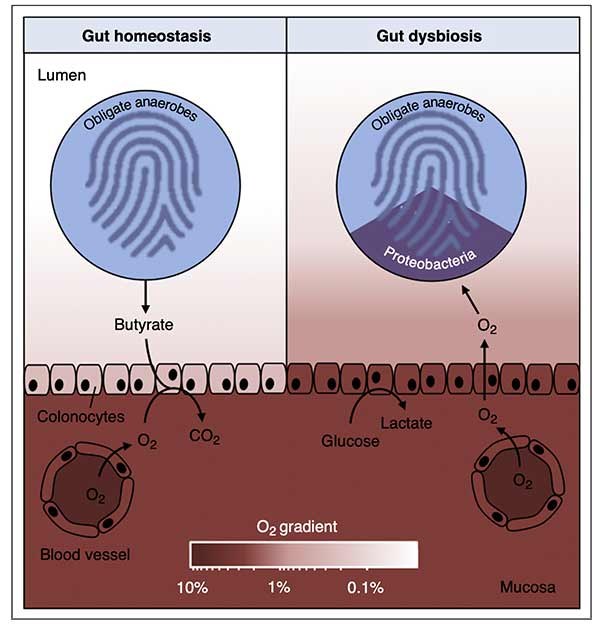 Image from
 So, maintaining a low oxygen and high CO2 environment helps keep the microbiome in check. The internal environment of our body impacts how our body functions.
5. CO2 improves calcium utilization6 — When CO2 exits the cell, it brings with it free water and calcium,7 lowering cellular bulk water. It is toxic to have persistent intracellular calcium, and you want as little free water as possible inside cells. In fact, some machines use the intracellular water level when looking for cancer.8
“The carbon dioxide can be changed into carbonic acid, by chemically combining with water. Carbonic acid is hydrophilic, and so it quickly leaves the cell, taking with it some of the oppositely charged ions, such as calcium and sodium.”9
6. CO2 protects the cell and mitochondria structure from damage, acting like an antioxidant and cell stabilizer — Since it improves oxygen delivery, it reduces free radical damage.10,11,12,13,14 It also protects against hypoxia and the negative effects of intracellular calcium and inflammation.15,16,17,18,19,20 Abundant CO2 inside and outside the cell protects lipids and proteins susceptible to oxidation.21,22 In fact, CO2 is part of our antioxidant defense system.23
“The suppression of mitochondrial respiration increases the production of toxic free radicals, and the decreased carbon dioxide makes the proteins more susceptible to attack by free radicals.” ~ Ray Peat, Ph.D.
“The failure to oxidize glucose to CO2 is oxidative stress.” ~ Ray Peat, Ph.D.
7. CO2 prevents accumulation of lactic acid in the cell, which we see in cancer, diabetes, and other chronic conditions24,25,26,27 — Lactic acid is a byproduct of inefficient carb metabolism that suppresses efficient oxidation of glucose and burdens the liver’s energy supply. Elevated lactic acid levels have a hypoxic effect and signals to the cell that it is under stress.
“The presence of lactic acid, which indicates stress or defective respiration, interferes with energy metabolism in ways that tend to be self-promoting. Harry Rubin’s experiments demonstrated that cells become cancerous before genetic changes appear. The mere presence of lactic acid can make cells more susceptible to the transformation into cancer cells. (Mothersill, et al., 1983.)
Diabetics typically have elevated lactate, which shows that glucose doesn’t have a problem getting into their cells, just getting oxidized.” ~ Ray Peat, Ph.D.
More CO2 improves oxidation and thus prevents accumulation of lactic acid since full oxidative phosphorylation (proper carb metabolism) can occur.
“Lactic acid and carbon dioxide have opposing effects.” ~ Ray Peat, Ph.D.
8. CO2 improves longevity — The higher you live in altitude (and thus the higher CO2 levels), the lower the cancer, heart disease and overall better health.28 Moreover, maximum lifespan of mammals is positively correlated with blood CO2.29
“People who live at very high altitudes live significantly longer; they have a lower incidence of cancer (Weinberg, et al., 1987) and heart disease (Mortimer, et al., 1977), and other degenerative conditions, than people who live near sea level.” ~ Ray Peat, Ph.D.
How Do We Achieve Higher CO2 Levels?
How we eat and breathe impacts how much CO2 we have in our body. You can increase the endogenous production (with proper carb burning), or reduce the outflow (with proper breathing).
CO2 is formed intracellularly during energy metabolism inside the mitochondria. Since carbs are richer in oxygen than fat, they consume less water in their metabolism and release 50% more CO230 (if we use them properly). The more carbs we efficiently burn for energy, the more CO2 we make.
“Higher CO2 has benefits, and a higher ratio of carbohydrates to fat being oxidized for fuel yields greater CO2.”31
The body’s primary source of CO2 is cellular metabolism — so properly burning carbs is the primary source of CO2. In fact, the Keto diet significantly reduces carbon dioxide stores.32 Even Dr. Lustig admits that ketosis reduces the amount of CO2 produced by the body in relation to the amount of oxygen it consumes.33
How we breathe also impacts the CO2 levels inside of our body, as we blow off a ton of CO2 with mouth breathing! Mouth breathing is, in a sense, self-suffocation and hyperventilation when taken to the extreme because we’re driving down CO2 levels to the point that we decrease oxygen availability to the cells. Overtime this can lead to degeneration, and a lot of mouth breathing is a sign of a stressed and lowered metabolism.
Nose breathing is a MUST, and utilizing mouth tape can help reduce levels of mouth breathing while sleeping. For extra CO2 work, try nose bag breathing with a brown paper bag to increase CO2 levels. This is very powerful to do before bed!
In summary, there are a number of health advantages of having elevated cellular CO2 levels. Proper breathing is very important for blood CO2 levels, but it does not change cellular CO2 levels — what you eat does! And being a good carb burner is one of the best ways to achieve elevated levels.
Save This Article for Later – Get the PDF Now
Transform Your Health — One Step at a Time


Ashley and her sister Sarah have put together a truly groundbreaking step-by-step course called “Rooted in Resilience.” They have compiled what clearly is the best application of Dr. Ray Peat’s work on Bioenergetic Medicine that I have ever seen.
It is so good that I am using the core of their program to teach the many Health Coaches that I am in the process of training for the new Mercola Health Clinics I am opening this fall. It took these women working nearly full-time on this project for a year to create it.
This has to be one of the absolute best values for health education I have ever seen. If you want to understand why you struggle with health problems and then have a clear program on how to reverse those challenges, then this is the course for you.
It is precisely the type of program I wish I would have had access to when I got out of medical school. I fumbled around for decades before I reached the conclusion they discuss in the course and share with you so you can restore your cellular energy production and recover your health.
| Select and eat the right foods to heal your metabolism and improve glucose utilization |
| Balance your hormones to help reduce anxiety, weight gain and sleep disturbances |
| Use reverse dieting to increase your calories without gaining weight and tanking your metabolism, all while improving your energy levels |
| Heal your gut for proper immune function, mood and weight management |
| Tweak your diet and lifestyle habits to improve your mindset and mental health |
| Crush your fitness goals with ease and get your life back on track |
| Master the most essential habits for health with bonus guides, including over 100 meal plans to take the stress out of meal time planning and shopping, and so much more! |
Learn more about Rooted in Resilience here.
About the Author
Ashley Armstrong is the cofounder of Angel Acres Egg Co., which specializes in low-PUFA (polyunsaturated fat) eggs that are shipped to all 50 states (join waitlist here), and Nourish Cooperative, which ships low-PUFA pork, beef, cheese, A2 dairy and traditional sourdough to all 50 states. Waitlists will reopen shortly.
- 1 Jpn J Physiol 1984;34(2):205-16
- 2 J Biol Chem 2011 Dec 30;286(52):44821-32
- 3 Stroke 1977;8:226–229
- 4 J Thorac Cardiovasc Surg. 2004 Sep;128(3):354-6
- 5 Nat Rev Microbiol 2018 Feb;16(2):103-110
- 6 Aviat Space Environ Med 1998 Mar;69(3):291-8
- 7 Pflugers Arch 2010 Nov;460(6):953-64
- 8 Structural Dynamics 7, 054701 (2020)
- 9 Ray Peat Water: swelling, tension, pain, fatigue, aging
- 10 Physiol Res 2002;51(4):335-9
- 11 Vopr Med Khim 1996 Jul-Sep;42(3):193-202
- 12 Izv Akad Nauk Ser Biol 1997 Mar-Apr:(2):204-17
- 13 Patol Fiziol Eksp Ter 1995 Jul-Sep:(3):34-40
- 14, 22 Vojnosanit Pregl 1996 Jul-Aug;53(4):261-74
- 15 Fiziol Zh SSSR Im I M Sechenova 1978 Oct;64(10):1456-62
- 16, 21, 23 Fiziol Zh Im I M Sechenova 1995 Feb;81(2):47-52
- 17 Stroke 1996;27:1634–1640
- 18 Acta Neurobiol Exp 2007;67(2):197-206
- 19 Biull Eksp Biol Med 1994 Oct;118(10):395-8
- 20 Biull Eksp Biol Med 1995 Jun;119(6):590-3
- 24 Clin Endocrinol 2011 Feb;74(2):191-6
- 25 Int J Epidemiol 2010 Dec;39(6):1647-55
- 26 Diabetes 1988;37(8):1020–1024
- 27 Ray Peat Lactate vs. CO2 in wounds, sickness, and aging; the other approach to cancer
- 28 Aging Dis 2014 Aug; 5(4): 274–280
- 29 Biogerontology 2013; 14: 687-691
- 30 ChrisMasterjohnphd.com
- 31 Journal of Evolution and Health An Ancestral Health Society Publication March 2017; 2(1)
- 32 Lung 2015 Dec;193(6):939-45
- 33 Harvard TH Chan Keto diet considered for Navy SEALS
Why Proper Breathing Is the Key to Optimal Health
Reproduced from original article:
https://articles.mercola.com/sites/articles/archive/2024/04/07/proper-breathing.aspx
Analysis by Dr. Joseph Mercola April 07, 2024
STORY AT-A-GLANCE
- Dysfunctional breathing habits are typically developed in response to some type of emotional trauma. The trauma gets embedded in your brain circuits, and when you encounter triggers, they activate specific breathing habits, some of which may significantly lower your carbon dioxide (CO2) concentration level
- The higher the CO2 concentration you can maintain while remaining within the biologically normal CO2 concentration range, the greater the likelihood that your breathing is supporting your health and performance
- Breathing techniques such as belly breathing, deep breathing and Buteyko breathing may not address breathing triggers or why you developed an inappropriate breathing habit in the first place
- When you overventilate you get numerous physiological changes. As a result, overbreathing can trigger a wide variety of physical and psychological changes, which can be reversed by implementing breathing behavior analysis learning techniques
- Breathing behavior analysts help you become conscious of your breathing habits, what’s triggering them and how to resolve them. This is important, as improper breathing habits can unconsciously sabotage your health
The interview above features Peter Litchfield, Ph.D., who is, in my view, one of the best breathing experts in the world. I’ve taken his breathing course, which gave me a deep appreciation for what he’s teaching. None of the breathing experts I’ve interviewed before compare to Litchfield when it comes to understanding respiratory physiology and its impact on your health.
Many of you who read this article may react in fear because the information may challenge your understanding of what others have told you to be true and you struggle trusting yourself to guide this new belief process. I strongly encourage you to watch the interview in its entirety. I believe it will alleviate most of these fears as Dr. Litchfield is an excellent teacher in helping people trust themselves. It would be easy to react negatively to this information and choose not view the interview, but I believe that would be a major mistake. I sincerely hope you avoid making that choice.
According to Litchfield — who has decades of clinical training in both respiratory physiology and behavioral psychology — dysfunctional breathing habits are typically developed in response to some type of emotional trauma. It gets embedded in your brain circuits, and when you encounter this trigger, it activates them and lowers your carbon dioxide (CO2) level.
You may have been getting a hint over the last few months that I really value CO2. It’s probably one of the most important molecules in your body. I’m going to go deep into this in the coming year, as strategies to increase your CO2 are probably some of the best things you can do to optimize your health.
The higher the level you can get within the biological normal optimal range, the better. Most of us are not even close to that. And, if you think you’re already breathing well because you’re belly breathing, deep breathing, or doing Buteyko breathing, you’re in for a surprise, because there’s a lot more to optimal breathing than learning to slow down, lessen or deepen your breathing.
Behavioral Physiology
Litchfield has a long and varied professional history, but his primary interest is behavioral physiology, a field in which physiology is viewed as a programmable system. As he explains, your physiology self-regulates:
“It learns, in essence. It does something and there’s a consequence, and based on that consequence it changes what it does. Physiology collects information, stores information. It uses information on all levels, not just on the level of the brain, but even on a cellular level. It’s collecting and using data. That’s what we call learning, ultimately; that is, physiology is behavioral, it’s psychology in action.
Physiology really is psychophysiological because it’s a learning system … One of the things that’s important in the work that we do in breathing behavior analysis, based on this, is that people need to learn to form a working partnership with their bodies …
The body is a learning, living system. The day the first cell came into existence, psychology was born. That is really such an important thing to understand. It’s not just ‘you’ who’s doing the breathing. Your body is doing the breathing. These aren’t just genetic or organic considerations. The body gets programmed constantly by virtue of what it does, and what results from what it does, and breathing is no exception.
Look at the habits we learn in our lives. Look at my hands. I’m moving my hands right now. Look at my head and how I move it. I learned this unconsciously. I’m a whole collection of amazing habits, thousands of habits that come into play at just precisely the right place and time.
So, the right thing happens at the right time, and I don’t even have to think about it. That’s the nature of a habit. But they don’t always go well, they can go very wrong.”
Habits Serve a Purpose
As explained by Litchfield, habits always serve a purpose. You don’t engage in a habit unless it serves you or your physiology in some way. This is why it’s so important to form a partnership with your body, to explore your habits, and how or why you learned them in the first place.
In a sense, you could say that your physiological system is part of your unconscious or subconscious mind, or an expression thereof. The task is to become conscious of what’s going on because your breathing habits may be unconsciously sabotaging your health.
“So, what we’re really focused on in our work is observing and learning about breathing as a behavior,” Litchfield says. “We’re not using breathing as a technique where you manipulate breathing so you can relax, or you manipulate breathing to achieve some otherworldly experience where you dissociate.
There are all kinds of reasons that people implement breathing techniques for presumed positive outcomes … Our work isn’t about breathing techniques.
Another thing that’s very important, is that there is a trigger for every habit. Triggers are not there all the time. They show up at specific times. For example, in the statistics pointing the larger cities of the United States, like New York City, Chicago, Los Angeles, where surveys suggest that about 60% of the ambulance runs are a result of symptoms brought on by dysfunctional breathing.
And it’s not as if this person is breathing dysfunctionally all the time. It’s that at that particular moment, they breathe this way, that then precipitates these symptoms.
They don’t understand where these symptoms and deficits are coming from. They don’t think of their breathing. They call 911, if you’re in the United States, and they end up in [the] emergency [room] … A lot of what our work is about is identifying these habits.”
Save This Article for Later – Get the PDF Now
What Is a Breathing Habit?
So, how do you identify a breathing habit? There are many components to look at, including the following:
• Motivation — Behavior is motivated by something. There’s motivation behind all habits, and any one of them can be tied up with your breathing.
• Behaviors — You need to identify the exact behavior involved. For example, you may be aborting the breath, meaning you inhale before you’ve fully exhaled.
In most cases, it’s rooted in a subconscious fear about not getting enough air. Whatever the cause, there’s motivation embedded in the behavior. Aborting the breath and inhaling early may serve the breather by reducing worry or anxiety about not getting enough air.
However, when you inhale too soon, air hunger sets in — a feeling like you can’t get enough air — and that can trigger the very anxiety the habit is trying to avoid.
“It’s nothing to do with oxygen,” Litchfield says. “It’s about claustrophobia. So, this person then develops a kind of claustrophobia that’s now embedded in the breath.
You’ll find some people constantly reaching, trying to get that one good breath. They may suffer with air hunger for an extended period of time. As they breathe out, they abort [the breath] constantly, trying to get a satisfying breath as soon as possible.”
• Outcomes — What are the outcomes of your learned breathing behavior, and how are those outcomes serving you? For example, when you start taking larger breaths, you may think you’re going to get more air.
You may feel like you’re in charge and in control, and that keeps you going. But what happens is you lose CO2 without realizing it. You may experience symptoms that you and your healthcare providers may misinterpret and attribute to unrelated causes.
In reality, you need far less air than you think. For every liter of blood you can move through your lungs, you can move 20 liters of air. But you only need 1 liter of air. So optimal breathing is usually not about getting enough oxygen. It’s about regulating the CO2 concentrations in your extracellular body fluids, like blood plasma.
What Deep Breathing Does to Your Body
Contrary to popular belief, deep breathing does not improve oxygenation. When you’re deep breathing, blood flow to your brain actually decreases as a result of a tightening of the blood vessels (vasoconstriction) in the brain.
Additionally, the cytoplasm in your red blood cells can become too alkaline and the hemoglobin carried by the red blood cells can become unfriendly, that is, less willing to give up the oxygen it carries to the tissues that need it. So, deep breathing actually contributes to an oxygen deficit already in progress as a result of vasoconstriction.
The vasoconstriction occurs because the primary vascular purpose of CO2 is vasodilation. When you have sufficient CO2 in your system, it will open your blood vessels much more effectively than nitric oxide, because nitric oxide has a dark side. It binds to Complex IV in your mitochondria and shuts down the electron transport chain. So, ideally, you want the vasodilation to be done by CO2 rather than nitric oxide.
So, the outcome of overbreathing is loss of blood in the brain, loss of oxygen, loss of glucose and electrolyte changes in the brain that then lead to setting the stage for lactic acidosis in neurons (brain cells). “Most people, lay or professional, have no idea that this is going on,” Litchfield says.
These brain changes, in turn, tend to trigger disinhibition where emotions — oftentimes anger or fear — are discharged. This release of emotions can serve you by allowing you to cope with a challenging situation or environment. Overbreathing (breathing that results in a CO2 deficit) leads to an outcome (a reinforcement) that serves you and is thus a “solution” to a perceived problem, a successful coping mechanism.
“Maybe they’ve come from a very traumatic kind of a background, and the only way they could really cope with it is to get angry,” Litchfield says. “But usually there is fear operating in the background …
There are things like this that, when you overbreathe, you get a symptom, a physiological change, and people have learned to respond to that change in their own unique ways. Some people, for example, when they get dizzy because they lose oxygen in the brain, when they overventilate, feel like they’re losing control and freak out. They can’t understand what’s going on.
They can’t focus. They don’t remember what’s happening. They feel unable to function. They’re on the verge of a panic attack. The next person goes, ‘Hey, this is kind of cool. I really like this.’ They have a whole different response to it. So, one of the things we’re always looking at are how people relate to the physiological changes brought on by breathing.”
Automatic Reflexes Regulate Your CO2 Level
As explained by Litchfield, your CO2 level is regulated by automatic reflexes. There are receptors in the brain and in the arterial system that are sensitive to CO2 concentration and to the pH of various extracellular fluids, such as blood plasma and interstitial fluids (surrounding cells). There are receptor sites in the arterial system which are sensitive to oxygen concentration but, surprisingly, not in the brain.
This system wasn’t designed to get out of whack just because you get stressed. Provided you haven’t learned bad breathing habits, your breathing optimizes respiration regardless of most circumstances., e.g., while talking.
As explained by Litchfield, breathing regulates acid-based physiology1 in extracellular body fluids. Your body must have the capacity to change your pH rapidly, almost immediately, because if it didn’t, you would be in serious trouble and in could even die. Although bad breathing habits can quickly bring on fainting, for example, there are safety mechanisms that protect us.
“There’s a simple little equation … that addresses how blood pH is regulated by the relationship of carbon dioxide concentration with bicarbonate concentration; ‘together they regulate acid-based balance from breath to breath.’
The carbon dioxide is controlled by the way you breathe. So as soon as you start to take over breathing, you take the control away from the reflexes, the result of which can be determined by doing a breathing behavior analysis.
You might be OK because in the background breathing and respiration are being coordinated properly, but maybe not, like when I’m eating and talking, I’m breathing. They have to be coordinated and linked. This is behavior. They get linked.
Sometimes they get out of sync and then people are really in trouble. They’re struggling whenever they eat. Their breathing is all wrong. When they’re talking, the breathing goes wrong.
They get real lightheaded when they’re talking because they’re overventilating. They’re constantly trying to take another breath while they’re talking to people … What’s happening is that they’re losing carbon dioxide. They’re getting completely disoriented, can’t function …”
Do You Overbreathe?
Symptoms of low CO2 (hypocapnia), caused by overbreathing, include but are not limited to:
| Headache | Nausea and vomiting |
| Abdominal symptoms and bloating | Fatigue |
| Muscle pain and weakness, tetany, hyperreflexia, spasm, tingling in the hands and lips, numbness, trembling and difficulty swallowing | Cardiovascular changes like palpitations, tachycardia, arrhythmias, angina, ECG abnormalities |
| Cognitive changes, including attention deficit, difficulty learning, poor memory and brain fog | Symptoms involving consciousness, such as dissociation, disconnecting from your environment, disconnecting from people, fainting and hallucinations |
| Emotional changes associated with the reduction of blood flow in the brain | Personality and self-esteem changes |
If you frequently suffer any of these symptoms, it is possible that you may be struggling with hypocapnia, meaning low CO2 levels, and the No. 1 reason for hypocapnia is a poor breathing habit in response to all kinds of habit triggers, such as stress. The solution in this case is to identify the faulty habitual breathing behaviors and then correct them.
Optimizing Your CO2 by Relearning Better Breathing Habits
You can very accurately measure your CO2 concentration with a tool called a capnometer, the wellness-educational version of it known as a CapnoTrainer:
“Being able to measure carbon dioxide is obviously the best of all worlds. There are ways you can look at overbreathing without a capnometer, but it’s quite limited. It may be that you’re not aware of how you’re being influenced, so it’s very difficult without a capnometer or CapnoTrainer.
But ultimately, the idea is not to need technology. The idea is you understand that you’ve learned habits and that you identify what those habits are, their components, their motivation, their outcomes, your belief systems and all kinds of things around it so that you can learn about who you are from a breathing perspective.
It’s not about a breathing technique. This is about learning techniques, about how you become a different being when it comes to the way that you breathe, and your habits optimize respiration, your habits optimize acid-based physiology.
If you want to have your CO2 looked at from a perspective of habits that you may have learned, you can rent a device, which makes it affordable for many people. A CapnoTrainer is different in a certain way than a capnometer. A capnometer technically is used in medicine, in surgery and in critical care, emergency medicine and so on.
But a CapnoTrainer is used to learn about your breathing. How are you breathing? How is it affecting you? What habits do you have? How can you learn new habits? That kind of thing. So you can rent these devices and you can also buy them. There are different versions of them.
There are professional, basic and personal versions of them. They’re all software-based, and you can operate these instruments on your cell phone and on tablets and Apple computers, PC computers, whatever, and really get to know your breathing in detail …
What breathing behavior analysts do is they help you do that. Now, however, you can learn to do it on your own. We have a book out that can walk you through that … The idea is to try to help you optimize your functioning. So many people just don’t realize that they’re breathing dysfunctionally and they attribute their symptoms to all kinds of other sources completely unrelated to breathing.
And so do the health care professionals because they don’t know about it either. They’re trying to figure out where these symptoms are coming from, but they don’t think about the breathing …
The breathing techniques out there generally don’t address habits. They may, by accident, address a habit and then give credit to the technique rather than understanding it’s about some kind of embedded learning that has occurred in the process — that fear was addressed, for example.
But they may think, well, it’s the slowness of breathing. Breathing slow is really good. And so it’s [about the] parasympathetic nervous system, and that’s why it worked, when in reality what it was about was that you lost your fear associated with the end of the exhale, for example, because of the technique they were using.
But people aren’t focusing on it that way … They aren’t looking at the experiential side of it, which is key to understanding breathing behavior.”
Trust Your Body
Again, your body knows how to breathe. The only time you get into problems is when you unconsciously override it with a learned breathing habit that throws the system out of whack. So, trust your body.
“That’s totally fundamental,” Litchfield says. “That’s what we work on — helping people build trust in that system. And that’s what I was talking about at the very beginning about partnering with your body. That partnership is vital.
You’re not a victim of your body. You’re in the body. This is who you are. You own this. You own your breathing. You’re not a victim of your breathing. And that’s often a problem. People think they’re a victim of all of this.”
Why Most Breathing Techniques Don’t Address Your Health Problems
While we’ve already mentioned this, it bears repeating. What Litchfield is talking about is not learning a specific set of breathing techniques. It’s not about the technique per se. It’s about understanding why your breath gets dysregulated and how new habits can be learned. In regard to the Buteyko technique, for example, he comments:
“Most issues around breathing, when it comes to hypocapnia, are acute. It isn’t chronic. Buteyko [breathing] is really limited to [chronic overbreathing]. Secondly, you have to ask yourself, where did that hypocapnia come from in the first place? Why is this person breathing like that, that you now have to train them to habituate to a higher level of CO2? How did that happen? What’s the history of that?
And if the history is that this is a way I can control my wife, if you’re overventilating so you can get angry to control your environment, what good is Buteyko [breathing] going to do? That person isn’t going to raise their CO2 level. They want it down so they can get angry.
So you have to address the motivation behind the behavior and what the outcomes are that sustain it. Just because you can habituate to a higher level of CO2 doesn’t mean you’ve addressed the problem. The problem is the habit. You want to identify the habit, help the person through it, help them understand where it came from and what they can do about it.
And that may have a significant philosophical impact on them as well, their belief system about their physiology, the trust in their system and so on. So the [Buteyko breathing technique is] limited because you’re not addressing history of the breathing. You’re not addressing any of these various factors that we’ve been talking about. You’re just looking at the CO2 level — ‘My god, it’s too low. We need to raise it.’
Another problem with Buteyko is that they don’t measure it. Some do, but it’s not part of their curriculum. We have a lot of people who graduated from our program who are Buteyko workers and they measure it. When you think you’ve been successful with your client, you need to see that the CO2 actually went up.
If it didn’t go up, you weren’t successful. So it’s very important to be able to assess it right from the start because Buteyko, when they do their assessment, they’re looking at correlational findings …
On the other hand, they really do a great job because when people get … comfortable with allowing the breath to sit out there for long periods of time, they can build trust, and they may find the reflex in it. Identifying the reflex is what ultimately builds trust because you can feel it kick in.
If you can find that reflex, then you’ve won a significant part of the battle. And there’s a good chance that can happen because of what the Buteyko people do. Desensitization to the transition time eliminates anxiety and air hunger during the transition time by doing Buteyko, so that’s helpful.”
The Breathing Behavior Analysis Procedure
In the course I took with Litchfield, he provided many impressive practical examples. One was of a young woman, about 19 years old, whose CO2 level dramatically decreased when they began her breathing interview. Among the symptoms she’d indicated on the checklist was that she would get dizzy a lot, and when she gets these dizzy spells, she’d become frightened.
“So, we’re talking and I see her CO2 level go down. I say, ‘Are you feeling dizzy right now?’ And she says, ‘Yeah, as a matter of fact, this is exactly how I feel in these kinds of situations.’ ‘Well, look at your CO2 level. Look what happened here.’
This is what we call transactional psychophysiology. We’re interacting with the person around their physiology, and they’re seeing what’s happening while they’re behaving in the way they are. So, we explore that together. And then we do all kinds of testing together depending on who the person is and what the issues are.
A good example might be, we’ll have them overbreathe on purpose. Now, this isn’t as simple as it sounds. You need to do it the right way. There’s a real right way to do it, and there are wrong ways to do it. We have someone overventilate on purpose. And what happens when you do that, they start to get symptoms, and they start to get deficits, and they’re there and they’re focusing on their experience.
They’re not talking. I’m the one who’s doing the talking. I’m asking them questions to think about the answers, not to interact with me, but just to think about the answers to the questions.
I’ll ask questions like, ‘Are there any emotions coming up right now? Are there any memories that are being triggered right now? Does this remind you of anything in your current life circumstances? Does this remind you of something that happened to you in the past?’
And I have a lot of information before I do this. I have this form. So they’re not just random questions. They’re really specific. They’re about that person and their lives and what we’ve uncovered together. And then what often happens is, they’re trapped. They can’t get out. They’re breathing that way and the CO2 level simply does not come up no matter what they do. And this is what happens in their real life situation when they get trapped …
As I work with them, I use certain kinds of experiential paradigms that I implement so they can raise the CO2 level. The symptoms go away and they’re amazed. Someone will say something like … ‘My God, it seemed like I wasn’t even breathing. I feel so much better and I was hardly breathing at all. How can that be?’
It’s because their belief system was that they weren’t getting enough oxygen and couldn’t possibly be OK breathing with these very small kinds of breaths.
In fact, this is what allowed the trap to break open so they could allow those reflexes to operate, to trust the system so they get to where they need to be from a respiratory point of view. And this may all happen in one short session, if you know what you’re doing.”
A Quick Rescue Method
A good test that can tell you if your symptoms are due to a CO2 deficiency is to breathe into a paper bag. If the symptoms disappear, you know hypocapnia and hence overbreathing is the problem. Never use a plastic bag, as it can cause suffocation. Always use a paper bag, about 6 inches by 15 inches. If it’s too small or too large, it won’t work.
Place the paper bag over your nose and mouth and hold it in place with your hands as you breathe into it. The CO2 will accumulate in the bag, thereby raising your CO2 level as you breathe it in.
“I remember a woman we met in Georgia, in the United States, my partner Sandra and I. She had this irritable bowel syndrome kind of problem with major anxiety around it, so she wanted some advice. There wasn’t much I could offer her, but one of them was a paper bag.
About four months later she wrote back and said her whole life had completely changed. She no longer had to suffer with these episodes. She hadn’t had any for months, and she couldn’t believe it. But of course, she was dependent on the bag. She wasn’t learning a new habit. She just grabbed the bag when she needed it, unfortunately.”
Negative Practice
Another simple technique, which is part of the core of Litchfield’s program, is something called “negative practice.” Litchfield explains:
“What you do is you become an expert at performing the bad habit. So you’re not a victim of the bad habit. You own it. You take ownership of it because you can do it whenever you want to. And if you can do it whenever you want to, you can disengage it.
So you learn to do it, disengage it, do it, disengage it. And there are specific ways of doing this. We use biofeedback in this whole process. That’s an important part of it. So, then you’re not afraid anymore of the symptoms because you can turn them on, you can turn them off, you don’t really care. It’s not a big deal.
In that process, you get highly reinforced. Again, that’s how physiology works. The outcome of what it does determines what it can do within the potential it has. The idea is that there’s a positive outcome for restoring good respiration.
On the other hand, it can be much more challenging because if someone is overbreathing to get angry at their husband, that’s a more complex issue. You have to address that. So it can be very simple or it can be quite complex, but nevertheless, it works wonders for people.”
More Information
To learn more, visit:
- Better Physiology Ltd. at betterphysiology.com for information about and purchase of CapnoTrainer instrumentation for personal and professional applications
- RespiMatters at www.CapnoLearning.org for information regarding online breathing behavior analysis services available worldwide
- Professional School of Behavioral Health Sciences at www.bp.edu and www.e-campus.bp.edu for information regarding professional training in breathing behavior analysis
- Breathing Science Inc., a nonprofit publisher, at www.theBSJ.org, where you can purchase the book “CapnoLearning: An Introductory Guide
Six ways astaxanthin targets cancer cells for destruction
Reproduced from original article:
https://www.naturalhealth365.com/astaxanthin-cancer-cells-2669.html
by: January 1, 2024
 (NaturalHealth365) The American Cancer Society (ACS) estimates 1,958,310 new cancer cases in 2023 in the United States. It’s a disturbing statistic that gives a compelling sense of urgency to the ongoing search for better prevention methods. Although, one thing is certain, don’t expect the ACS to tell you why astaxanthin should be considered a smart way to avoid cancer cell growth.
In fact, based on new studies, astaxanthin (a natural plant compound) can target cancer cells by interfering with, disrupting, and even destroying them at every stage of development – while leaving normal cells unharmed. But the question remains: how does this natural compound work? Let’s take a closer look.
What exactly is astaxanthin?
Astaxanthin is a fat-soluble natural pigment, or carotenoid, responsible for the pinkish-orange hue of salmon, krill, and Arctic shrimp. Technically speaking, only plants produce it, but animals can acquire it through the foods they eat – as in the case of flamingos, which obtain their eye-catching coloration from their menu of shrimp (which feed on astaxanthin-rich algae.)
However, this substance does a lot more than provide accents of color and beauty to the natural world. Like other carotenoids (such as beta-carotene), astaxanthin has potent disease-fighting powers.
Scientists say that the health benefits include anti-diabetic, anti-obesity, anti-inflammatory, anti-aging, and immune system-enhancing properties, and natural healers may advise it to improve vision, ease joint pain, enhance heart health, and even minimize facial wrinkles.
The sworn enemy of chronic inflammation
Let’s not forget: inflammation – which scientists say is at the root of chronic diseases such as diabetes, cardiovascular disease, arthritis, and cancer – is implicated in promoting cancer cell growth and survival.
Animal studies have shown that when you consume this natural compound, you can help to reduce inflammation in mucosal ulcers – thereby helping to prevent adenocarcinoma.
In a study involving human lymphoma cells, astaxanthin interfered with the production of pro-inflammatory cytokines such as tumor necrosis factor-alpha – a substantial benefit.
How to naturally defeat oxidative stress
Researchers have found that oxidative stress – caused by potentially toxic free radicals – promotes the growth and spread of some cancers. A cell study of human lymphoma cancer cells revealed that astaxanthin halted the production of harmful reactive oxygen species and protected against oxidative stress.
Scientists have estimated the outstanding antioxidant capacity of astaxanthin to be 6,000 times more powerful than vitamin C, 800 times more powerful than the enzyme CoQ10, and 150 times more powerful than anthocyanins, the beneficial bluish-purple pigments found in blueberries.
A great way to improve cellular communication
Individual cells in organs and tissues communicate with each other by way of gap-junction channels between cells, an important function for maintaining health. In fact, disruption in this communication can set the stage for inflammation, cellular damage – and cancer.
Astaxanthin enhances gap-junction channels and improves the vital ability of healthy cells to communicate with each other – an essential function in inhibiting cancer development.
Encourage the death of malignant cancer cells
Apoptosis is the programmed destruction of damaged or dysfunctional cells. However, cancer can elude this beneficial process – meaning that its cells can survive and multiply unaffected by apoptosis.
Reinstating the mechanism for apoptosis is a valuable technique for fighting cancer – and it’s one that astaxanthin can help with. Studies have shown that astaxanthin promotes apoptosis in both oral and liver cancer cells.
In one study involving human hepatocellular carcinoma cells (liver cancer tumor cells), researchers found that astaxanthin induced a high level of cell death – causing them to identify it as a potential therapy for liver cancer.
This research is especially encouraging in light of the fact that liver cancer is notoriously difficult to treat and features a high recurrence rate.
Halt the spread of cancer cells and reduce tumor size
Studies support the ability of astaxanthin to selectively stop the proliferation – or multiplication – of cancer cells.
In animal studies, scientists noted that the plant pigment seemed to decrease the proliferation of liver, breast, and lung cancer cells – while leaving normal, healthy cells unharmed.
Of several cancer-fighting carotenoids tested – including beta-carotene and capsanthin – astaxanthin was found to be the most effective at preventing the reproduction of human leukemia cells.
In a study published in Marine Drugs, researchers studied astaxanthin’s effects on tumor initiation and progression.
After 31 days, researchers found that tumor volume and weight in the high-dose astaxanthin group decreased by roughly 40 percent – an impressive result.
Significantly, the group that received no astaxanthin experienced no shrinkage in tumors. Benefits weren’t seen in the low-dose astaxanthin group either – highlighting the importance of sufficient dosages of astaxanthin.
Limit cancer formation, progression, and invasion
Metastasis, the invasion of cancer cells into organs, tissues, and bones, is an important (unwanted) step in cancer progression – and this potentially deadly process is helped along by enzymes known as matrix metalloproteinases, or MMPs.
But – almost as if saying, “Not on my watch!” – astaxanthin battles the production of MMPs, inhibiting it at every turn.
And it doesn’t stop there. Researchers found that astaxanthin also reduces angiogenesis – the ability of tumors to create new blood vessels to obtain essential oxygen and nutrients.
In addition, a study showed that the signaling pathways involved in the growth and spread of oral cancer were significantly inhibited by astaxanthin.
There is also evidence that astaxanthin can make conventional cancer drugs work more effectively. In a study of lung cancer cells, a combination of astaxanthin and pemetrexed, a chemotherapy drug, was more effective in inhibiting cancer cell growth than pemetrexed alone.
Important dietary suggestions
You can increase dietary amounts of astaxanthin by eating wild-caught Pacific sockeye salmon, which delivers 3.2 mg of astaxanthin per 3-ounce serving.
Red trout and Coho salmon are also high in astaxanthin, while other good sources include lobster, shrimp, crayfish, crabs, and salmon roe. However, experts advise limiting your seafood and shellfish consumption – due to possible mercury contamination, especially with regard to seafood deep below or at the bottom of the ocean.
Astaxanthin – derived from microalgae – is available in supplementary form and may be a better bet. To avoid the possibility of heavy metal contamination, opt for reputable, high-quality brands like Nutrex Hawaii.
Before supplementing with astaxanthin, consult with a trusted holistic healthcare provider – especially if you have a serious health condition.
It turns out that astaxanthin may have more to offer than just its visually pleasing color. As cell and animal studies seem to indicate, pinkish-orange astaxanthin could very well take its place in the pantheon of natural anticancer therapies – and become synonymous with the color of healing.
Sources for this article include:
NIH.gov
Wiley.com
LifeExtension.com
PLOS.org
NIH.gov
NIH.gov