Infection
now browsing by category
Judy Mikovits Suggests Retroviruses Play a Role in COVID-19
Reproduced from original article:
https://articles.mercola.com/sites/articles/archive/2022/09/04/is-the-new-coronavirus-created-in-a-lab.aspx
The original Mercola article may not remain on the original site, but I will endeavor to keep it on this site as long as I deem it to be appropriate, and will not be bullied into removing it.
Analysis by Dr. Joseph Mercola Fact Checked September 04, 2022
STORY AT-A-GLANCE
- Cellular and molecular biologist Judy Mikovits, Ph.D., believes COVID-19 — the disease — is not caused by SARS-CoV-2 alone, but rather that it’s the result of a combination of SARS-CoV-2 and XMRVs (human gammaretroviruses)
- SARS-CoV-2 also appears to have been manipulated to include components of HIV that destroys immune function along with XMRVs
- Those already infected with XMRVs may end up getting serious COVID-19 infection and/or die from the disease. Mikovits’ research suggests more than 30 million Americans carry XMRVs and other gammaretroviruses in their bodies from contaminated vaccines and blood supply
- Mikovits believes 40 years of data suggest Type 1 interferon at a very low dose would be an ideal treatment for COVID-19
- RT-PCR (reverse transcription polymerase chain reaction) testing, currently used to diagnose active infection by detecting the presence of SARS-CoV-2 genetic material, overestimates infection rates. For an accurate account of COVID-19 prevalence, we need to test for antibodies
Judy Mikovits, Ph.D. is a cellular and molecular biologist,1 researcher and founding research director of the Whittemore Peterson Institute that researches and treats chronic fatigue syndrome (CFS) in Reno, Nevada.
She is likely one of the most qualified scientists in the world to comment on this disease because of her groundbreaking research in molecular biology and virology. Mikovits is absolutely brilliant but, like many gifted researchers, her complex discussions on science are quite challenging for the average lay person to follow.
For this reason, I present her interview in a different format, cutting and splicing pieces together to present a more cohesive and coherent presentation of her many important points. I would encourage you to watch the initial, very short, videos first, so you will be well-grounded, and if you are motivated, watch the entire interview at the bottom of this article.
Because there were so many surprising and important revelations in this interview I will present part 2 next week along with an interview with Bobby Kennedy Jr. which will revolve more on the vaccine issue.
Mikovits Doesn’t Believe SARS-CoV-2 Is the Cause of COVID-19
One of the most shocking revelations Mikovits reveals is that she doesn’t believe SARS-CoV-2 is the cause of COVID-19 but merely serves to activate or wake up a dormant XMRV infection. To support her assertion, she states that COVID-19 patients have the same cytokine signature as the gammaretrovirus XMRV, which she published many years ago.
XMRV stands for “xenotropic murine leukemia virus-related virus.” Xenotropic refers to viruses that only replicate in cells other than those of the host species. So, XMRVs are viruses that infect human cells yet are not human viruses.2
The XMRV retrovirus is actually the virus that has the same cytokine storm signature as COVID-19, not coronaviruses, which are far more benign. (I delve into what retroviruses are in another section further below.)
Additionally, there may be other infections that also are contributing to the infection, such as Borrelia and Babesia or parasites, which may be why some of the antiparasite drugs like Ivermectin and hydroxychloroquine are working.
Vaccine Gammaretroviruses Have Adapted and Are Aerosolized
Getting back to the issue of gammaretroviruses, Mikovits’ research showed that many of our vaccines are contaminated with them. How did this happen? In short, vaccine viruses were replicated and grown in animal cell cultures that were already contaminated with retroviruses. In other words, the root of the problem stems from the use of contaminated cell culture lines.
Vaccine manufacturing frequently involves the use of animal tissues and many vaccines are grown in animal culture cell lines. As noted in the 2010 paper, “Of Mice and Men: On the Origin of XMRV,” published in Frontiers in Microbiology (which Mikovits did not work on):3
“The novel human retrovirus xenotropic murine leukemia virus-related virus (XMRV) is arguably the most controversial virus of this moment. After its original discovery in prostate cancer tissue from North American patients, it was subsequently detected in individuals with chronic fatigue syndrome from the same continent …
The detection of integrated XMRV proviruses in prostate cancer tissue proves it to be a genuine virus that replicates in human cells, leaving the question: how did XMRV enter the human population?
We will discuss two possible routes: either via direct virus transmission from mouse to human … or via the use of mouse-related products by humans, including vaccines. We hypothesize that mouse cells or human cell lines used for vaccine production could have been contaminated with a replicating variant of the XMRV precursors encoded by the mouse genome.”
Mikovits goes even further, explaining that, “It became clear in 2011 that these [gammaretro]viruses had adapted to become aerosolized.” This is a rather shocking finding, and this, Mikovits says, is what allows the gammaretroviruses to spread in laboratories from one cell line to another.
This could be related to research catalyzed by Charles Lieber, the former head of Harvard’s chemistry department, who is a nanoscience expert and was arrested by federal authorities in January 2020 for working with the Wuhan Virology Institute.
Lab workers may also be inadvertently spreading them as they are using cell lines contaminated with retroviruses in vaccine production that could result in the spread of these retroviruses via the finished vaccine. Mikovits suspects COVID-19 may in fact be a type of vaccine-derived or vaccine-induced retroviral infection.
“I don’t believe [COVID-19] is infection from without,” she says. “I believe the spread across [210] countries4 is from injection, and there’s enough evidence to support that.”
SARS-CoV-2 — A Combination of SARS, Gammaretroviruses and HIV
Another of her theories is that SARS-CoV-2 is unlikely to have had a zoonotic origin but is likely synthetically produced. She believes it originated in and escaped or leaked from a biosafety laboratory. Mikovits believes both scenarios might be at play, where a lab-created virus, SARS-CoV-2, is causing serious infection and/or death only in those who have underlying retroviruses in their bodies.
Mikovits suspects that people who do not have retroviral infections, SARS-CoV-2 causes no or only mild symptoms. Another possibility is that the SARS-CoV-2 virus is the result of growing coronaviruses in retrovirus-contaminated cell lines, producing a gammaretrovirus-carrying virus.
According to Mikovits, her 2009 through 2011 work suggested 25 million to 30 million Americans were carriers of XMRVs and other gammaretroviruses. That estimate is over a decade old now so the number is likely far higher.
“There is a family of gammaretroviruses, most likely [in] contaminated blood supply and vaccines that are still to this day, almost 10 years later, being injected,” she says.
“We don’t need an infectious virus if you inject the blueprint, if you inject the provirus. And … there are a lot of data to support COVID-19 is not SARS-CoV-2 alone, that it’s SARS-CoV-2 and XMRVs (human gammaretroviruses) and HIV.”
Might Wearing a Mask Worsen Your Odds of Illness?
Mikovits is also highly critical of the recommendation (and in some places mandate) to wear a face mask or fabric cover such as a bandana around your face. She believes:
“Wearing a mask is going to cause more secretions and give more cells a home and amplify any viruses. [Wearing a mask is] immune suppressive; it’s going to limit your body’s ability to produce Type 1 interferon.
You’re driving the infection in yourself and you’re not preventing the spread. [Instead], you’re amplifying [replication of] not just [SARS-CoV-2] but also many other [viruses], including your XMRVs, influenza or other dormant viruses.
What keeps those dormant viruses dormant? Your natural killer (NK) cells, your mast cells, your macrophages. That’s where you’re getting the inflammatory signature.
So, every virus you amplify is driving the inflammatory signature, and you’re going to get sick. [The resulting illness] doesn’t have to be SARS-CoV-2 at all. You’re making yourself sick [by bringing dormant viruses out of dormancy]. It’s insanity.”
Wearing a face mask after getting a live flu vaccine may further worsen your odds, she says. Why? Because you’re injecting three or more live flu virus strains into your body, which lowers your immune function. You’re also going to shed the viruses contained in the vaccine. If you wear a mask, Mikovits says, you’ll shed those viruses into the mask, which could encourage illness.
On the other hand, not wearing one might jeopardize the health of others. “If you’re shedding [the viruses] into the air, you’re going to make somebody else get another upper respiratory infection that’s going to allow [SARS-CoV-2] to make them sicker,” she warns.
Why PCR Testing Is a Bad Idea
We’re also being lied to about the prevalence of infection. At the height of the pandemic, we saw inflated case numbers for the simple reason that the Centers for Disease Control and Prevention stopped requiring doctors to do testing in order to confirm that a patient is in fact infected with SARS-CoV-2 or died from COVID-19. The numbers now include “suspected” and “assumed” cases.
Naturally, without widespread and accurate testing, there’s no way to get a clear idea of how prevalent the infection is, and how many actually get sick and die from it. The initial emphasis on PCR testing resulted in massive false positives and greatly inflated numbers of those infected.
As noted by Mikovits, confirming each case through testing matters greatly, as there are hundreds, if not thousands, of microbes that can cause upper respiratory infections, including seasonal influenza viruses. None of those should be lumped in with COVID-19 if we want to understand the true nature and danger of this disease.
What’s more, the initial decision to use RT-PCR (reverse transcription polymerase chain reaction) testing instead of antibody testing was an unwise one, as it virtually guaranteed an overestimation of the problem. RT-PCR is now being used to diagnose an active infection by detecting the presence of SARS-CoV-2 genetic material.5 However, by doing that, you end up with high rates of false positives. Mikovits explains how the RT-PCR test works:
“We’re taking a swab and scraping some epithelial cells [from the back of the sinuses or throat] because that’s what coronaviruses infect … We get a little RNA — because it’s an RNA virus — we reverse-transcribe that, meaning write it backwards with enzymes in the lab, and then we amplify it [through a] polymerase chain reaction …
We’re only taking a piece of the virus, we’re not taking the whole virus … The first thing about [the PCR] test is, it was admitted by the U.S. Food and Drug Administration and the CDC that the tests put out by the CDC were contaminated.
And when you amplify something a million times, or 10 million times — whatever they do in the 30 cycles or so — it’s logarithmic that RNA then is way overestimated … [But] no [viral] particle was identified or isolated from your saliva or from your nasal passages. Nobody took the secretions from your nose or your mouth and isolated the [actual] viruses.
[When I isolated] HIV in 1983, I isolated it from saliva. What you do is you take the virus and grow it in any human cell, in an appropriate cell line, and you make many copies. [Viral replication] means you have [a positive test for] that virus. Then you sequence the whole virus.
A PCR [test, on the other hand] can give you a lot of false positives [by amplifying RNA fragments].
We [also] showed the people that had [HIV] infection had antibodies; that they had been fully exposed and it was not a piece of nucleic acid in a biopsy or in their throat or in their nose. [A piece of nucleic acid] is not a virus. And it’s certainly not infectious.
If RNA is there and in the tiniest amount, I’m not going to cough it on somebody, especially if I’m not coughing. I’m not going to breathe that [out and infect] somebody because there’s no evidence of an infectious virus.”
Better Testing Strategy: Antibodies
Rather than using PCR testing, “what should have been done is test for antibodies,” Mikovits says. This is what was done in South Korea. An antibody test will tell you whether you had the infection at some point, and have developed a strong immune response or immunological memory that will allow you to fight the infection should you encounter it again.
“Epidemiology is not done with PCR. In fact, Kary Mullis who invented PCR, Nobel Laureate, and others, said PCR was never intended for diagnostic testing. So that puts that to bed.
It takes nothing to develop a really good serology [i.e., antibody] test … [It takes] a few weeks. It’s pretty easy because the people who have recovered have antibodies. So, you isolate those antibodies, you take their plasma, you purify the antibodies, and then you can grow them.
Then you develop the tests… It’s usually ELISA or Western Blot [which check for] the protein and the antibody binds. You form an immune complex, and you detect it with a dye. You can do that test with a finger stick … and it takes 15 minutes to get the answer, almost like a pregnancy test.”
My belief is that the use of PCR instead of a proper antibody test was intentional, as it inflates the case numbers. Mikovits agrees, saying “I wouldn’t get any tests right now. I’d simply wash my hands and drink hot lemon water as I always do for any flu season.”
Evidence SARS-CoV-2 May Be a Lab-Created Virus
In the Epoch Times documentary, “Tracking Down the Origin of the Wuhan Coronavirus,”6 Mikovits details some of the evidence supporting the view that SARS-CoV-2 is not a naturally-evolved virus, but rather a laboratory concoction.
One piece of evidence is that the virus contains a protein envelope from the HIV virus. It’s also very similar to SARS which, according to bioweapons expert Francis Boyle, is an engineered bioweapon.
As explained by Mikovits, an Indian paper7,8 detailed the presence of Gp120, a protein envelope from the HIV virus. That paper was quickly retracted due to political pressure. However, Mikovits colleague, Luc Montagnier, made a similar discovery, finding Gp41 in the SARS-CoV-2 virus, which is the transmembrane domain of the HIV virus.
“The folks from India also had GAG. That’s structural proteins. That gives you a clue that it wasn’t a CRISPR technique or a pseudotyping where the envelope was expressed in a gene therapy-type of way. If it were CRISPR, you wouldn’t put the GAG sequences in there.
What was done is, the virus was acquired as they grew SARS-CoV-2 in Vero-E6 cells — the monkey kidney cells where you get HIV.
Simian immune deficiency virus was the origin, and we were told all the way back in the 80s that somebody forgot to cook their food in Africa and a few promiscuous men spread this [HIV] virus around the world. So, you can see again the patterns of the lies and of what people end up believing.”
The addition of this envelope protein from HIV gives SARS-CoV-2 the ability to impair the immune system. It also contributes to its pathogenicity. Mikovits continues her explanation:
“The first thing is, you must grow a virus to make a lot of it. So, you grow it in cell lines. They didn’t take [SARS-CoV-2] from the bat and it jumped into a human. It normally goes through another cell [from] a monkey or a smaller animal. The cell line that supports the growth and expansion [of viruses] are monkey kidney cells.
Maybe [SARS-CoV-2] is not engineered at all … but the end result is, now it not only infects the epithelial cells of the lungs, it infects the white blood cells, it infects the immune cells. We see the splenomegaly in large spleens, we’re seeing penias, cytopenias. We’re losing cells like HIV-killing T-cells …
So, it’s got not only an expanded host range, but also disease symptoms that make no sense for a coronavirus.
Hence, we’re killing people because they’re treating an upper respiratory infection, and you’re getting that inflammatory disease signature because you’re infecting the very innate immune response, the macrophages, the monocytes, the natural killer cells, the T cells. And it’s primarily the T-cells in the macrophages because those are the cells HIV 120 and Gp41 infect through CCR5 in the CD4 receptor.
So now you’re going to lose your adaptive immune response, you’re going to drive the inflammation. And it’s the fire [of inflammation] that does the tissue damage.”
Another piece that hints at SARS-CoV-2 being a manufactured virus is the construction of its spike proteins, which bind to ACE2 receptors to gain access into the cell. This appears to be an engineering feature. According to Mikovits, it’s quite clear that the spike proteins came from the original SARS virus, which also infects through ACE receptors.
There are also “single point mutations there that make it far more infectious, easier to spread,” she says, “and how those were acquired, nobody really can say.” At least not yet. Nanotechnology may also have been used to aerosolize it for ease of transmission.
“The nano[size] further increases the host range. So now you can go into every cell. Now you can go across the blood brain barrier. That’s nano. Now you don’t need a receptor. You can breathe it, it can go into every cell of the body. You don’t need the gatekeeper. You don’t need the receptor. You don’t need the lock and key.”
Contaminated Cell Line Shared With Wuhan Biolab
According to Mikovits, one contaminated cell line is the Vero monkey kidney cell line called Vero E6, which was given by Fort Detrick — a U.S. Army Medical Command installation that hosts many of our national biological defense programs and houses the National Cancer Institute laboratory where she used to work — to the biosafety 4 laboratory (BSL-4) in Wuhan, China. This cell line is what the Wuhan lab used to grow and study coronaviruses, she says.
The Vero cell line is listed in the 2015 paper,9 “A SARS-like Cluster of Circulating Bat Coronaviruses Shows Potential for Human Emergence,” co-written by University of North Carolina researchers and Dr. Shi Zhengli, a Chinese virologist at the Wuhan lab who in 2010 published a paper10 discussing the weaponization of the SARS virus.
The contaminated Vero monkey kidney cells were also used in the production of polio vaccines, Mikovits notes. The original polio vaccines were passed through mice brains, as we didn’t have cell lines in the 1930s when that vaccine was originally developed. According to Mikovits, the spread of this Vero retrovirus has occurred through laboratory workers and hospital caretakers for decades.
“That’s why the family studies we did were so important,” she says, referring to studies in which retroviral transmission was tracked to determine how it spread between family members.11
Alas, whenever patterns were detected, she was always directed to cover them up. Her refusal to hide the information from the public was what led to her firing in 2011. According to Mikovits, we’re seeing the same pattern of sweeping evidence under the rug now during the COVID-19 pandemic.
“The patterns are the same as far as the science goes, and the patterns are the same as far as the political corruption, the plague of corruption, in covering up data,” she says.
Mikovits Pioneering Research in XMRV
In 2009, Mikovits got embroiled in controversy when she wrote a paper reporting that a retrovirus known as xenotropic murine leukemia virus-related virus may play a causal role in CFS and other diseases, including autism.
Her career background and past troubles also involved Fauci who, according to Mikovits, is guilty of scientific fraud. She details this in her book, “Plague of Corruption: Restoring Faith in the Promise of Science.”
According to Mikovits, Fauci does not appear to have changed his stripes, and is still misleading the public and hiding the truth about SARS-CoV-2, just like he did with the HIV virus and retroviral-associated diseases.
“I think the way to think about the background of what’s going on right now is to go back to my first interactions with Dr. Tony Fauci when I was a 25-year-old lab technician in the National Cancer Institute. At that time, we had isolated — from blood and saliva — the lymphadenopathy virus.
[Lymphadenopathy-associated virus (LAV)] was the name given to it by Luc Montagnier, the Nobel Laureate, [who] first isolated and discovered that virus and its association with HIV/AIDS.12
In that situation, Fauci delayed the serology testing [to find out] who was exposed [to HIV]. It was politicized such that the only people that were [said to be] susceptible to getting infected with HIV was gay men [and] IV drug users.
The country was told not to worry about it. It was only spread through blood and body fluids and shouldn’t be a problem for most other people. So, the testing that could have been done wasn’t done because of political reasons, and the treatments weren’t done because Fauci had patents, and — we didn’t know this at the time — the wrong type of treatment was used. That led to the spread and [death] of millions worldwide …”
The Discovery of Human Gammaretroviruses
Ultimately, Mikovits and her colleagues discovered that the HIV virus was spread through a contaminated blood supply. After that, they proceeded to look into other “clearly retroviral-associated diseases,” such as CFS,13 certain kinds of autism, cancers, leukemias and lymphomas.
Gammaretroviruses14 are viruses that can cause cancer, leukemia and immune deficiencies in various animals. Examples include murine leukemia virus, feline leukemia virus and mink focus forming virus. As explained in a 2011 paper on gamma retroviruses:15
“Retroviruses are evolutionary optimized gene carriers that have naturally adapted to their hosts to efficiently deliver their nucleic acids into the target cell chromatin, thereby overcoming natural cellular barriers …
Retroviral vectors are fascinating and efficient delivery tools for the transfer of nucleic acids. As a hallmark, all retroviruses are capable of reverse transcribing their single stranded RNA genome into double stranded DNA, which will be stably integrated into the host cell genome.
As highly evolved parasites they act in concert with cellular host factors to deliver their nucleic acid into the nucleus, where they exploit the host cell’s machinery for their own replication and long-term expression occurs.”
The key take-home here is that retroviruses are “integrated into the host cell genome,” and infection can result in “long-term expression.” In other words, once they’re in your body, they can remain dormant, only to reactivate when conditions are favorable. In this regard, they’re quite different from your average virus that, when you’re exposed, invades your cells, replicates and causes symptoms, and is eventually eliminated from your body through your immune response.
In 2009, Mikovits and her team discovered and isolated the first human gammaretrovirus family of retroviruses, known then as XMRVs. As mentioned earlier, XMRV stands for “xenotropic murine leukemia virus-related virus.” Xenotropic refers to viruses that only replicate in cells other than those of the host species. So, XMRVs are viruses that infect human cells yet are not human viruses.16
My Entire Interview With Judy Mikovits
To reiterate some of the key take-home messages Mikovits delivers in this interview:
• She believes COVID-19 — the disease — is not caused by SARS-CoV-2 alone, but rather that it’s the result of a combination of SARS-CoV-2 (which appears to have been manipulated to include components of HIV that destroys immune function). Previous XMRV (human gammaretroviruses) infection may facilitate SARS-CoV-2 to express the COVID-19 illness.
Put another way, COVID-19 may be initiated by SARS-CoV-2 but dependent upon a preexisting infection with and awakening of other viruses such as XMRV, gamma retroviruses, possibly Lyme and other coinfections, including parasites, and this is why anti-parasitic medications like hydroxychloroquine and Ivermectin help.
• Blood products and vaccines are contaminated with XMRVs that can damage your immune system and cause CFS, cancer and other chronic diseases. The viruses spread within laboratories as they have adapted to become aerosolized, and contaminate cell lines used in vaccine production and other viral research, including research on coronaviruses.
• Flu vaccines have spread a host of dangerous viruses around the world, which can then interact with SARS COV-2.
• It is possible to develop safer oral vaccines, and interferon alpha could be a valuable treatment alternative against COVID-19. Aside from interferons, other treatment strategies discussed in our interview include hyperbaric oxygen therapy, cannabinoids (CBD), peptide T and antioxidant support.
• SARS-CoV-2 is more dangerous and virulent than typical coronaviruses because it includes sequences of HIV, SARS and another virus, which enable it to infect more than just your respiratory epithelium. It can also infect blood cells and hematopoietic organs such as the spleen.
Last but not least, if this topic intrigues you, be sure to pick up a copy of her new book, “Plague of Corruption: Restoring Faith in the Promise of Science.” You can also find more information on her website, plaguethebook.com.
– Sources and References
- 1 MJforMDs.org Judy Mikovits Bio
- 2, 16 Emerging Microbes & Infections 2014 Apr; 3(4): e
- 3 Frontiers in Microbiology 2010; 1: 147
- 4 Worldometer COVID-19
- 5 IAEAO.org March 27, 2020
- 6 YouTube April 7, 2020
- 7 Biorxiv Preprints February 2, 2020 DOI: 10.1101/2020.01.30.927871 (Withdrawn)
- 8 Biorxiv Preprints February 2, 2020 DOI: 10.1101/2020.01.30.927871 (PDF, withdrawn full article)
- 9 Nat Med. 2015; 21(12): 1508–1513
- 10 Archives of Virology 2010; 155: 1563–1569
- 11 Scientific American October 8, 2009
- 12 Lindau Nobel Laureate Meetings, Luc Montagnier
- 13 Virulence 2010 Sep-Oct; 1(5): 386–390
- 14 Viral Zone, Gammaretrovirus
- 15 Viruses 2011 Jun; 3(6): 677–713
Open Letter regarding covid vaccines for 0-4 yrs
Reproduced from original article:
https://www.hartgroup.org/open-letter-regarding-covid-vaccines-for-0-4-yrs/
July 7, 2022

Further call to halt covid-19 vaccine roll-out in children
To:
Dr June Raine, CEO MHRA
Professor Lim Wei Shen, Chairman JCVI COVID-19 vaccines sub-committee
Professor Chris Whitty, Chief Medical Officer
Dr Jenny Harries, CEO, UKHSA
Hon. Sajid Javid, MP, Secretary of State for Health & Social Care
30th June 2022
Dear Dr Raine,
Re: Covid-19 vaccines for 6 months to 4 years age group
We are writing to you urgently concerning the announcement that the FDA has granted an Emergency Use Authorisation for both Pfizer and Moderna Covid-19 vaccines in preschool children.
We would urge you to consider very carefully the move to vaccinate ever younger and younger children against SARS-CoV-2, despite the gradual but significant reducing virulence of successive variants, the increasing evidence of rapidly waning vaccine efficacy, the increasing concerns over long-term vaccine harms, and the knowledge that the vast majority of this young age group have already been exposed to SARS-CoV-2 repeatedly and have demonstrably effective immunity. Thus, the balance of benefit and risk which supported the rollout of mRNA vaccines to the elderly and vulnerable in 2021, is totally inappropriate for small children in 2022.
We also strongly challenge the addition of Covid-19 vaccination into the routine child immunisation programme,[1] despite no demonstrated clinical need, known and unknown risks (see below) and the fact that these vaccines still have only conditional marketing authorisation.
It is noteworthy that the Pfizer documentation[2] presented to the FDA has huge gaps in the evidence provided:
- The protocol was changed mid-trial. The original 2-dose schedule exhibited poor immunogenicity with efficacy far below the required standard. A third dose was added by which time many of the original placebo recipients had been vaccinated.
- There was no statistically significant difference between the placebo and vaccinated groups in either the 6–23-month age group or the 2-4-year-olds even after the third dose. Astonishingly the results were based on just three participants in the younger age group (1 vaccinated and 2 placebo) and just seven participants in the older 2–4-year-olds (2 vaccinated and 5 placebo). Indeed, for the younger age the confidence intervals ranged from minus 367% to plus 99%. The manufacturer stated that the numbers were too low to draw any confident conclusions. Moreover, these limited numbers come only from children infected more than 7 days after the third dose.
- Over the whole time period from the first dose onwards (see page 39 Tables 19 & 20), there were a total of 225 infected children in the vaccinated arm and 150 in the placebo arm, giving a calculated vaccine efficacy of only 25% (14% for the 6-23 months, and 33% for 2-4s).
- The additional immunogenicity studies against Omicron, requested by the FDA, only involved a total of 66 children tested one month after the third dose (see page 35).
It is incomprehensible that the FDA considered that this represents sufficient evidence on which to base a decision to vaccinate healthy children. When it comes to safety, the data is even thinner: only 1057 children, some already unblinded, were followed for just 2 months. It is noteworthy that Sweden and Norway are not recommending the vaccine for 5-11s and Holland is not recommending it for children who have already had Covid-19. The director of the Danish Health and Medicines Authority stated recently that with what is now known, the decision to vaccinate children was a mistake.[3]
We summarise below the overwhelming arguments against this vaccination.
A. Extremely low risk from Covid-19 to young children
- In the whole of 2020 and 2021, not a single child aged 1-9 died where Covid-19 was the sole diagnosis on the death certificate, according to ONS data.[4]
- A detailed study in England from 1st March 2020 to 1st March 2021 found only 6 children under 18 years died with no comorbidities. There were no deaths aged 1-4 years.[5]
- Children clear the virus more easily than adults.[6]
- Children mount effective, robust, and sustained immune responses.[7]
- Since the arrival of the Omicron variant, infections have been generally much milder. That is also true for unvaccinated under 5s.[8]
- By June 2022 it is now estimated that 89% of 1-4-year-olds had already had SARS-CoV-2 infection.[9]
- Recent data from Israel shows excellent long-lasting immunity following infection in children, especially in 5-11s.[10]
B. Poor vaccine efficacy
- In adults it has become apparent that vaccine efficacy wanes steadily over time, necessitating boosters at regular intervals. Specifically, vaccine efficacy has waned more rapidly against the latest Omicron variants.
- In children vaccine efficacy has waned more rapidly in 5-11s than in 12-17s, possibly related to the lower dose used in the paediatric formulation. One study from New York showed efficacy against Omicron falling to only 12% by 4-5 weeks and to negative values by 5-6 weeks post second dose.[11]
- In the Pfizer 0-4s trial,1 the efficacy after two doses fell to negative values, necessitating a change to the trial protocol. After a third dose there was a suggestion of efficacy from 7-30 days but there is no data beyond 30 days to see how quickly this will wane.
C. Potential harms of Covid-19 vaccines for children
- There has been great concern about myocarditis in adolescents and young adults, especially in males after the second dose, estimated at 1/2600 in active post marketing surveillance in Hong Kong.[12] The emerging evidence of persistent cardiac abnormalities[13] in adolescents with post mRNA vaccine myopericarditis, as demonstrated by cardiac MRI at 3-8 months follow up, suggests this is far from ‘mild and shot-lived’. The potential for longer term effects requires further study and calls for the strictest application of the precautionary principle in respect of the youngest and most vulnerable children.
- Although post-vaccination myocarditis appears to be less common in 5-11-year-olds than older children, it is, none-the-less, increased over baseline.[14]
- In the Pfizer study 50% of vaccinated children had systemic adverse events, including irritability and fever. Diagnosis of myocarditis is much more difficult in younger children.[15] No troponin levels or ECG studies were documented. Even a vaccinated child in the trial, hospitalised with fever, calf pain and a raised CPK, had no report of D-dimers, antiplatelet antibodies or troponin levels.
- In Pfizer’s 5-11s post-authorisation conditions, they are required to conduct studies looking for myocarditis and are not due to report results until 2027.
- Of equal concern are, as yet unknown, negative effects on the immune system. In the 0-4s trial, only 7 children were described as having ‘severe’ Covid-19 – 6 vaccinated and 1 given placebo. Similarly, for the 12 children with recurrent episodes of infection, 10 were vaccinated against only 2 who received placebo. These are all tiny figures and much too small to rule out any adverse impact such as antibody dependant enhancement (ADE)[16] and other impacts on the immune system.
- Also unanswered is the question of Original Antigenic Sin.[17] It is of note that in a large Israeli study, those infected after vaccination had poorer cover than those vaccinated after infection.[18] In the Moderna trial, N antibodies were seen in only 40% of those infected after vaccination, compared to 93% of those infected after placebo.[19]
- There is evidence of vaccine-induced disruption of both innate and adaptive[20][21]immune responses. The possibility of developing an impaired immune function would be disastrous for children, who have the most competent innate immunity, which by now has been effectively trained by the circulating virus.
- Totally unknown is whether there will be any adverse effect on T-cell function leading to an increase in cancers.[22]
- Also, in terms of reproductive function, limited animal biodistribution studies showed lipid nanoparticles concentrate in ovaries and testes.[23] Adult sperm donors have showed a reduction in sperm counts particularly of motile sperm, falling by 3 months post-vaccination and remaining depressed at 4-5 months.[24]
- Even for adults, concerns are rising that serious adverse events are in excess of hospitalisations from Covid-19.[25]
D. Informed consent
- For 5-11s, the JCVI, in recommending a ‘non-urgent offer’ of vaccination, specifically noted the importance of fully informed consent with no coercion.[26]
- With the low uptake in this age group, the presence of ‘therapy dogs’,[27] advertisements including superhero images[28] and information about child vaccination protecting friends and family, all clearly run contrary to the concept of consent, fully informed and freely given.[29]
- The complete omission of information explaining to the public the different and novel technology used in Covid-19 vaccines compared to standard vaccines, and the failure to inform of the lack of any long-term safety data, borders on misinformation.[30]
E. Effect on public confidence
- Vaccines against much more serious diseases, such as polio and measles, need to be prioritised.[31] Pushing an unnecessary and novel, gene-based vaccine onto young children risks seriously undermining parental confidence in the whole immunisation programme.
- The poor quality of the data presented by Pfizer risks bringing the pharmaceutical industry into disrepute and the regulators if this product is authorised.
In summary, young healthy children are at minimal risk from Covid-19, especially since the arrival of the Omicron variant. Most have been repeatedly exposed to SARS-CoV-2 virus, yet have remained well, or have had short, mild illness. As detailed above, the vaccines are of brief efficacy, have known short- to medium-term risks and unknown long-term safety. Data for clinically useful efficacy in small children are scant or absent. In older children, for whom they are already licensed, they have been promoted via ethically dubious schemes to the potential detriment of other, and vital, parts of the childhood vaccination programme.
For a tiny minority of children for whom the potential for benefit clearly and unequivocally outweighed the potential for harm, vaccination could have been facilitated by restrictive licences. Whether following the precautionary principle or the instruction to First Do No Harm, such vaccines have no place in a routine childhood immunisation programme.
From:
- Professor Angus Dalgleish, MD, FRCP, FRACP, FRCPath, FMed Sci, Principal, Institute for Cancer Vaccines & Immunotherapy (ICVI)
- Professor Anthony J Brookes, Professor of Genomics and Health Data Science, University of Leicester
- Prof Anthony Fryer, PhD, FRCPath, Professor of Clinical Biochemistry, Keele University
- Professor David Livermore, BSc, PhD, Retired Professor of Medical Microbiology, UEA
- Professor John Fairclough FRCS FFSEM retired Honorary Consultant Surgeon
- Lord Moonie, MBChB, MRCPsych, MFCM, MSc, House of Lords, former parliamentary under-secretary of state 2001-2003, former consultant in Public Health Medicine
- Dr Abby Astle, MBBChir, BA(Cantab),DCH, DGM, MRCGP, GP Principal, GP Trainer, GP Examiner
- Dr Michael D Bell, MBChB, MRCGP, retired General Practitioner
- Dr Alan Black, MBBS, MSc, DipPharmMed, Retired Pharmaceutical Physician
- Dr David Bramble, MBChB, MRCPsych, MD, Consultant Psychiatrist
- Dr Emma Brierly, MBBS, MRCGP, General Practitioner
- Dr David Cartland, MBChB, BMedSci, General practitioner
- Dr Peter Chan, BM, MRCS, MRCGP, NLP, General Practitioner, Functional medicine practitioner
- Michael Cockayne, MSc, PGDip, SCPHNOH, BA, RN, Occupational Health Practitioner
- Dr Julie Coffey, MBChB, General Practitioner
- John Collis, RN, Specialist Nurse Practitioner, retired
- Mr Ian F Comaish, MA, BM BCh, FRCOphth, FRANZCO, Consultant Ophthalmologist
- James Cook, NHS Registered Nurse, Bachelor of Nursing (Hons), Master of Public Health
- Dr Clare Craig, BMBCh, FRCPath, Pathologist
- Dr David Critchley, BSc, PhD in Pharmacology, 32 years’ experience in Pharmaceutical R&D
- Dr Jonathan Engler, MBChB, LlB (hons), DipPharmMed
- Dr Elizabeth Evans, MA(Cantab), MBBS, DRCOG, Retired Doctor
- Dr John Flack, BPharm, PhD, retired Director of Safety Evaluation at Beecham Pharmaceuticals and retired Senior Vice-president for Drug Discovery SmithKline Beecham
- Dr Simon Fox, BSc, BMBCh, FRCP, Consultant in Infectious Diseases and Internal Medicine
- Dr Ali Haggett, Mental health community work, 3rd sector, former lecturer in the history of medicine
- David Halpin, MB BS FRCS, Orthopaedic and trauma surgeon (retired)
- Dr Renée Hoenderkampf, General Practitioner
- Dr Andrew Isaac, MB BCh, Physician, retired
- Dr Steve James, Consultant Intensive Care
- Dr Keith Johnson, BA, DPhil (Oxon), IP Consultant for Diagnostic Testing
- Dr Rosamond Jones, MBBS, MD, FRCPCH, retired consultant paediatrician
- Dr Tanya Klymenko, PhD, FHEA, FIBMS, Senior Lecturer in Biomedical Sciences
- Dr Charles Lane, MA, DPhil, Molecular Biologist
- Dr Branko Latinkic, BSc, PhD, Molecular Biologist
- Dr Theresa Lawrie, MBBCh, PhD, Director, Evidence-Based Medicine Consultancy Ltd, Bath
- Dr Felicity Lillingstone, IMD DHS PhD ANP, Doctor, Urgent Care, Research Fellow
- Katherine MacGilchrist, BSc (Hons), MSc, CEO/Systematic Review Director, Epidemica Ltd.
- Dr Geoffrey Maidment, MBBS, MD, FRCP, Consultant physician, retired
- Ahmad K Malik FRCS (Tr & Orth) Dip Med Sport, Consultant Trauma & Orthopaedic Surgeon
- Dr Kulvinder Singh Manik, MBBS, General Practitioner
- Dr Fiona Martindale, MBChB, MRCGP, General Practitioner
- Dr S McBride, BSc(Hons) Medical Microbiology & Immunobiology, MBBCh BAO, MSc in Clinical
- Gerontology, MRCP(UK), FRCEM, FRCP(Edinburgh). NHS Emergency Medicine & geriatrics
- Mr Ian McDermott, MBBS, MS, FRCS(Tr&Orth), FFSEM(UK), Consultant Orthopaedic Surgeon
- Dr Franziska Meuschel, MD, ND, PhD, LFHom, BSEM, Nutritional, Environmental and Integrated Medicine
- Dr Scott Mitchell, MBChB, MRCS, Emergency Medicine Physician
- Dr Alan Mordue, MBChB, FFPH. Retired Consultant in Public Health Medicine & Epidemiology
- Dr David Morris, MBChB, MRCP(UK), General Practitioner
- Margaret Moss, MA (Cantab), CBiol, MRSB, Director, The Nutrition and Allergy Clinic, Cheshire
- Dr Alice Murkies, MD, FRACGP, MBBS, General Practitioner
- Dr Greta Mushet, MBChB, MRCPsych, retired Consultant Psychiatrist in Psychotherapy
- Dr Sarah Myhill, MBBS, retired GP and Naturopathic Physician
- Dr Rachel Nicholl, PhD, Medical researcher
- Sue Parker Hall, certified transactional analyst (CTA, psychotherapy); MSc (Counselling & Supervision) MBACP (senior accredited practitioner); EMDR practitioner, Psychotherapist
- Dr Christina Peers, MBBS, DRCOG, DFSRH, FFSRH, Menopause specialist
- Rev Dr William J U Philip MB ChB, MRCP, BD, Senior Minister The Tron Church, Glasgow, formerly physician specialising in cardiology
- Dr Angharad Powell, MBChB, BSc (hons), DFRSH, DCP (Ireland), DRCOG, DipOccMed, MRCGP, General Practitioner
- Dr Gerry Quinn, PhD. Postdoctoral researcher in microbiology and immunology
- Dr Johanna Reilly, MBBS, General Practitioner
- Jessica Righart, MSc, MIBMS, Senior Critical Care Scientist
- Mr Angus Robertson, BSc, MB ChB, FRCSEd (Tr & Orth), Consultant Orthopaedic Surgeon
- Dr Jessica Robinson, BSc(Hons), MBBS, MRCPsych, MFHom, Psychiatrist and Integrative Medicine Doctor
- Dr Jon Rogers, MB ChB (Bristol), Retired General Practitioner
- Mr James Royle, MBChB, FRCS, MMedEd, Colorectal surgeon
- Dr Roland Salmon, MB BS, MRCGP, FFPH, Former Director, Communicable Disease Surveillance Centre Wales
- Sorrel Scott, Grad Dip Phys, Specialist Physiotherapist in Neurology, 30 years in NHS
- Dr Rohaan Seth, BSc (hons), MBChB (hons), MRCGP, Retired General Practitioner
- Dr Gary Sidley, retired NHS Consultant Clinical Psychologist
- Dr Annabel Smart, MBBS, retired General Practitioner
- Natalie Stephenson, BSc (Hons) Paediatric Audiologist
- Dr Zenobia Storah,MA (Oxon), Dip Psych, DClinPsy, Senior Clinical Psychologist (Child and Adolescent)
- Dr Noel Thomas, MA, MBChB, DCH, DObsRCOG, DTM&H, MFHom, retired doctor
- Dr Stephen Ting, MB CHB, MRCP, PhD, Consultant Physician
- Dr Julian Tompkinson, MBChB MRCGP, General Practitioner GP trainer PCME
- Dr Livia Tossici-Bolt, PhD, Clinical Scientist
- Dr Helen Westwood MBChB MRCGP DCH DRCOG, General Practitioner
- Dr Carmen Wheatley, DPhil, Orthomolecular Oncology
- Mr Lasantha Wijesinghe, FRCS, Consultant Vascular Surgeon
- Dr Damian Wilde, PhD, (Chartered) Specialist Clinical Psychologist
- Dr Ruth Wilde, MB BCh, MRCEM, AFMCP, Integrative & Functional Medicine Doctor
and others …..
References
- NHS vaccinations and when to have them. https://www.nhs.uk/conditions/vaccinations/nhs-vaccinations-and-when-to-have-them/
- EUA amendment request for Pfizer-BioNTech COVID-19 Vaccine for use in children 6 months through 4 years of age. Submitted to the FDA 15/06/2022. https://www.fda.gov/media/159195/download
- Denmark admits – in retrospect we didn’t get much out of vaccinating the children. Report from a press conference 27-06-2022. https://europe-cities.com/2022/06/27/denmark-admits-in-retrospect-we-did-not-get-much-out-of-vaccinating-the-children/
- COVID-19 Deaths and Autopsies Feb 2020 to Dec 2021, Table 1: Number of Deaths Where COVID-19 Was the Only Cause Mentioned on the Death Certificate, 1 February 2020 to 31 December 2021, by Sex and Age Group, England and Wales, Jan. 17, 2022, Office for National Statistics. https://www.ons.gov.uk/aboutus/transparencyandgovernance/freedomofinformationfoi/covid19deathsandautopsiesfeb2020todec2021
- Smith C, Odd D, Harwood R et al. Deaths in Children and Young People in England following SARS-CoV-2 infection during the first pandemic year: a national study using linked mandatory child death reporting data. Nature Medicine 28 (2022): 185–192, https://www.nature.com/articles/s41591-021-01578-1.pdf
- Kevin J. Selva, Carolien E. van de Sandt, Melissa M. Lemke, et al., Systems Serology Detects Functionally Distinct Coronavirus Antibody Features in Children and Elderly, Nature Communications 12, no. 2037 (2021), https://doi.org/10.1038/s41467-021-22236-7.
- Alexander C. Dowell, Megan S. Butler, Elizabeth Jinks, et al., “Children Develop Robust and Sustained Cross-Reactive Spike-Specific Immune Responses to SARS-CoV-2 Infection,” Nat Immunol 23 (2022): 40–49, https://doi.org/10.1038/s41590-021-01089-8
- Wang L, Berger NA, Kaelber DC, Davis PB, Volkow ND, Xu R. COVID infection severity in children under 5 years old before and after Omicron emergence in the US. Preprint. https://www.medrxiv.org/content/10.1101/2022.01.12.22269179v1.full.pdf
- MRC Biostatistics Unit. Report on Nowcasting and Forecasting – 23rd June 2022. https://www.mrc-bsu.cam.ac.uk/now-casting/nowcasting-and-forecasting-23rd-June-2022/
- Patalon T & Maccabi KS. Naturally-acquired Immunity Dynamics against SARS-CoV-2 in Children and Adolescents. Preprint 21/06/2022. https://www.medrxiv.org/content/10.1101/2022.06.20.22276650v1
- Dorabawila V, Hoefer D, Bauer UE et al. Effectiveness of the BNT162b2 vaccine among children 5-11 and 12-17 years in New York after the Emergence of the Omicron Variant. Preprint 28/02/2022. https://www.medrxiv.org/content/10.1101/2022.02.25.22271454v1.full-text
- Chua GT, KWan MYW, Chui CSL et al. Epidemiology of Acute Myocarditis/Pericarditis in Hong Kong Adolescents Following Comirnaty Vaccination. N Engl J Med 2022; 386: 394-396. https://www.ncbi.nlm.nih.gov/labs/pmc/articles/PMC8767823/
- Schauer J, Buddhe S, Gulhabe A et al. Persistent Cardiac Magnetic Resonance Imaging Findings in a Cohort of Adolescents with Post-Coronavirus Disease 2019 mRNA Vaccine Myopericarditis. J Pediatr 2022; 245: 233-7. https://doi.org/10.1016/j.jpeds.2022.03.032
- Su JR. COVID-19 vaccine safety updates: Primary series in children and adolescents ages 5–11 and 12–15 years, and booster doses in adolescents ages 16–24 years. ACIP meeting 05-01-2022. https://www.cdc.gov/vaccines/acip/meetings/downloads/slides-2022-01-05/02-COVID-Su-508.pdf
- Cincinnati Children’s Hospital, Health Library. Myocarditis in Children. Myocarditis in Children | Symptoms, Causes, Treatment & Prognosis (cincinnatichildrens.org)
- Yahi N, Chahinian H, Fantini J. Infection-enhancing anti-SARS-CoV-2 antibodies recognize both the original Wuhan/D614G strain and Delta variants. A potential risk for mass vaccination?. J Infect. 2021;83(5):607-635. https://www.ncbi.nlm.nih.gov/pmc/articles/PMC8351274/
- Brown EL, Essigmann HT. Original Antigenic Sin: the Downside of Immunological Memory and Implications for COVID-19. mSphere 2021; 6(2): e00056-21. ttps://www.ncbi.nlm.nih.gov/pmc/articles/PMC8546681/
- Goldberg Y, Mandel M, Bar-On YM et al. Protection and waning of natural and hybrid COVID-19 immunity. N Engl J Med 2022; 386: 2201-12. https://www.nejm.org/doi/pdf/10.1056/NEJMoa2118946?articleTools=true
- Follmann D, Janes HE, Buhule OD et al. Anti-nucleocapsid antibodies following SARS-CoV-2 infection in the blinded phase of the mRNA-1273 Covid-19 vaccine efficacy clinical trial. Preprint 19-04-2022. https://www.medrxiv.org/content/10.1101/2022.04.18.22271936v1.full
- Föhse FK, Geckin B, Overheul GJ et al. The BNT162b2 mRNA vaccine against SARS-CoV-2 reprograms both adaptive and 2 innate immune responses. Preprint 06-05-2021. https://doi.org/10.1101/2021.05.03.21256520
- Seneff S, Nigh G, Kyriakopoulos AM, McCullough PA. Innate immune suppression by SARS-CoV-2 mRNA vaccinations: The role of G-quadruplexes, exosomes, and MicroRNAs. Food and Chemical Toxicology 2022; 164:113008. https://doi.org/10.1016/j.fct.2022.113008
- Singh N, Bharara Singh A. S2 subunit of SARS-nCoV-2 interacts with tumor suppressor protein p53 and BRCA: an in silico study. Transl Oncol. 2020;13(10):100814. https://www.ncbi.nlm.nih.gov/labs/pmc/articles/PMC7324311/
- Pfizer-bio-distribution-confidential-document-translated-to-english.pdf. https://www.naturalnews.com/files/Pfizer-bio-distribution-confidential-document-translated-to-english.pdf
- Gat I,Kedem A, Dviri M et al. Covid-19 Vaccination BNT162b2 Temporarily Impairs Semen Concentration and Total Motile Count among Semen Donors. Andrology 2022;1–7. https://onlinelibrary.wiley.com/doi/epdf/10.1111/andr.13209
- Fraiman J, Erviti J, Jones M, Greenland S, Whelan P, Kaplan RM, Doshi P. Serious Adverse Events of Special Interest Following mRNA Vaccination in Randomized Trials. Preprint 23-06-2022. https://ssrn.com/abstract=4125239
- JCVI statement on vaccination of children aged 5 to 11 years old. 16-02-2022. https://www.gov.uk/government/publications/jcvi-update-on-advice-for-covid-19-vaccination-of-children-aged-5-to-11/jcvi-statement-on-vaccination-of-children-aged-5-to-11-years-old
- Therapy dogs comfort children during Covid jabs. BBC News. 27-02-2022. https://www.bbc.co.uk/news/uk-england-wiltshire-60529628
- Evans E. “Calling All Superhero Kids”: The Unethical Targeting of Young Children by the NHS with COVID-19 Vaccine Adverts. The Daily Sceptic 19-06-2022. https://dailysceptic.org/archive/calling-all-superhero-kids-the-unethical-targeting-of-young-children-by-the-nhs-with-covid-19-vaccine-adverts/
- NHS South East London Clinical Commissioning Group. FAQs – Vaccinating 5 to 11 year olds. https://selondonccg.nhs.uk/what-we-do/covid-19/covid-19-vaccine/faqs/faqs-vaccinating-5-to-11-year-olds/
- What is in the vaccine and how does it work? | NHS. 30-04-2021. https://www.youtube.com/watch?v=zgtWpwkS9u4&list=PLnhASgDToTktp2HIjdyeo2fsI6Agcn1ul&index=6
- Boyd C. Polio may be spreading in Britain for first time in 40 YEARS. Mail Online 23-06-2022. https://www.dailymail.co.uk/health/article-10938639/Polio-spreading-UK-time-40-years-Evolved-version-virus-London-sewage.html
Latest survey shows the COVID vaccines are a disaster: ~750,000 dead in US
Reproduced from original article:
https://stevekirsch.substack.com/p/latest-survey-shows-the-covid-vaccines
In US, ~5M people who got the vaccine are now unable to work and ~750,000 are dead. The rate of heart issues is 6.6%, far more than they claimed. No wonder our government isn’t doing these surveys!

Steve Kirsch
Jun 26 2022

Executive summary
Our latest poll is devastating for the official narrative:
- a 6.6% rate of heart injury (>10M Americans)
- 2.7% are unable to work after being vaccinated (>5M Americans),
- 6.3% had to be hospitalized (>10M Americans)
- you were more likely to die from COVID if you’ve taken the vaccine.
- Almost as many (77.4%) households lost someone from the vaccines as from COVID. If you believe that 1M people in the US have died from COVID, then this survey indicates that ~750,000 people died from the vaccine (10.18/13.15*1M) with a 95% confidence of at least 600,000 deaths.
The error bar computation on each question is here.
We will be re-running this with a 5,000 sample size soon which will have smaller error bars. But the key point is that even if we choose the most conservative data points, the survey results are inconsistent with the “safe and effective” narrative.
For example, the CDC hasn’t found anyone who has died from the mRNA vaccines and our survey shows at least 600,000 people have died. That’s a big gap. Someone isn’t telling you the truth. Why do we get such a high number every time we run our poll to a different audience?
Anyone can run our poll for $500 if you don’t believe us. I predict nobody in mainstream media will touch this because they don’t want to know the truth.
This is a poll that nobody who is pro-vaccine wants you to see.
The poll will be ignored by the mainstream media, even when we rerun it with 8,000 people and get the same results. You can bank on that.
Introduction
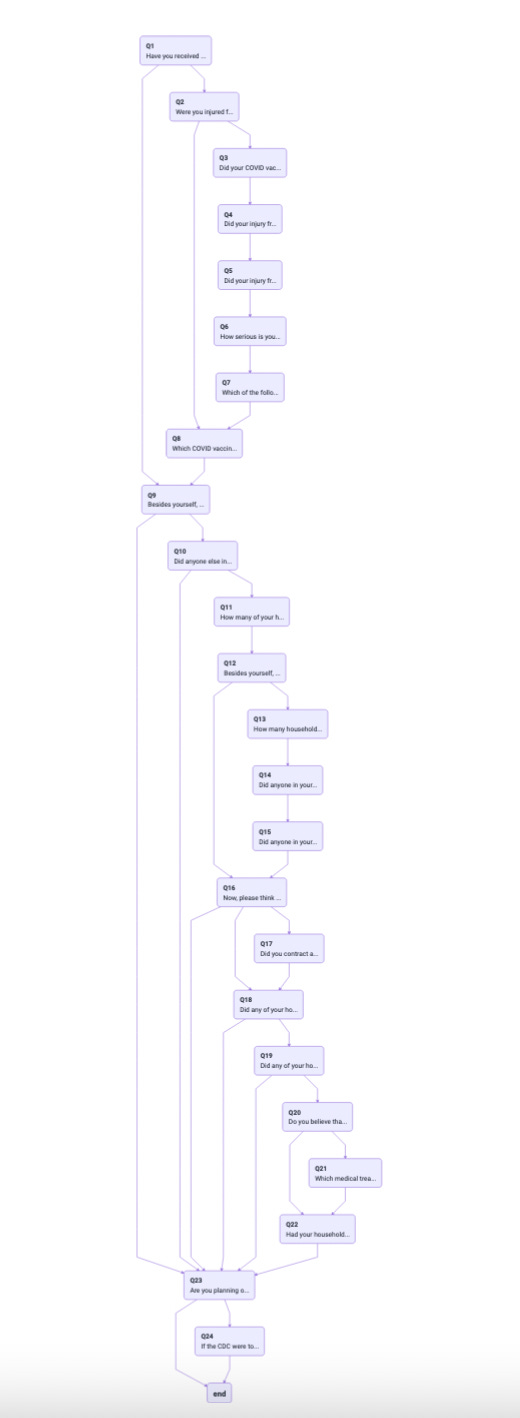
We used a professional to draft most of the survey questions and skip logic for our Jun 25 survey.
Here are the key takeaways from the Jun 25 survey. We use “stratified counts” throughout since these are “normalized” based on the US demographics:
- 380 of the 500 people who took the poll were vaccinated after normalization [Q1]
- Only 34% of Americans are drinking the Kool-Aid and getting >2 doses [Q1]
- 2.63% of the households (13.15/500) had someone who died from the COVID virus [Q19]
- 2.03% [1.7%-2.4%] of the households (10.18[8.6-11.8]/500) reported a death from the vaccine in their household [Q15]. This is stunning because it shows that the vaccine has killed almost as many people as the COVID virus has. The authorities say that COVID has killed over 1M people in the US so this suggests that 774,000 people were killed by the vaccine (10.18[8.6-11.8]/13.15[12.3-14.0]=77.4% [64.2%-90.5%]). How can that be a “safe” vaccine? The 95% confidence intervals say over 600,000 Americans have been killed by the vaccine. Even if this is overestimated by a factor of 10X, this is devastating for the vaccine narrative. There is simply no way to spin this. This is why the “fact checkers” and mainstream media will avoid this survey.
- 2.7% of the people who took the vaccine (10.43/380) are so injured they are unable to work [Q7A2]. This is a disaster. So this is 2.7% of the 200M vaccinated people ages 18 and older: >5M severely injured people who can’t work. I don’t know how they will spin this as a positive.
- 16.7% (63.7/380) of the people who took the vaccine consider themselves vaccine injured [Q2]. So that’s >30M vaccine injured. I don’t know how they will spin this as a positive.
- The survey shows a 6.6% rate of heart injury post-vaccine according to the poll (24.97/380 [Q3]). This is stunning because these are of the people taking the survey reporting their own injury. Nobody could know this better than the survey taker. This is 1,000X higher than the CDC told us. Per Gavi, “The CDC researchers estimated there might be a maximum of 70 cases of myocarditis out of a million second doses given to boys ages 12 to 17.” How could the CDC underestimate this severe adverse event by 3 orders of magnitude?!!? There is something seriously wrong here. Our survey is well within 1 order of magnitude with other rates we’ve been told. This represents 13.3M million people who are seriously injured, probably for life.
- 9.2% (35/380) of the people who took the vaccine had to seek medical help for their injury. [Q4]. That’s 18M doctor visits.
- 6.3% (23.83/380) of the people who took the vaccine had to be hospitalized for their vaccine injury [Q5] That’s over 12M hospitalizations.
- 3.7% (18.83/500) of the households had a person with a heart condition due to the vaccine [Q14]. Since there are 123M households, this is 4.5M new heart conditions. This is a lower estimate than the direct injury above suggesting that people answering this question were answering it for people other than themselves (since otherwise the rate would be higher than the 6.6% direct rate above). So this is another estimate on the number of new heart conditions.
- If you got a COVID infection, it’s 17% (36.4/30.98) [Q17] more likely that you were vaccinated, suggesting the vaccine could be making things worse.
- If you died from COVID, it was 72% more likely you died after getting the vaccine (6.81/3.95) [Q22]. We were told the opposite by the government.
- 46% are planning on getting more vaccines [Q23]. A total of 24.6% of all people are sheep, i.e., even if they are told the vaccine has a good chance of disabling them for life, they will do what the government recommends. These percentages are approximately what is predicted by mass formation theory.
- Most people (65%) believed that the hospital treatments for COVID may be responsible for killing people that they lost to COVID, not COVID [Q20]
The survey and underlying data
Latest survey
Here is the skip logic
Earlier survey
Error bars on the numbers
See this Google sheet for the error bar computations.
I put the numbers in for the number of people who died. It’s a disaster even if you are on the low end of the error bars: at least 600,000 deaths from the vaccines.
Even if we are off by 10X, the vaccines are a disaster.
Methodology
See my earlier article. No change. It was done by a professional polling organization. If you start the first question, you’re counted. You can’t tell anything about the survey from the first question.
The poll size is only 500 since these are test runs. Therefore, the numbers for the final results could be off by a factor of 5 in the worst case. But even if all numbers are a factor of 5 lower, this vaccine is still a complete disaster and should be immediately halted.
Fact checkers welcome
We’ll happily do an interactive session where we show you all the data and the poll results so you can verify they weren’t tampered with. You can even reach out to Pollfish to verify the survey results are legit. We have nothing to hide.
We’ll give you the data files so you can run the poll yourself.
But nobody’s going to fact check this because it would just draw attention to it. So they will have to ignore this and pretend it didn’t happen. That’s what fact checkers do when the facts don’t support the narrative they are paid to support.
Next step
We’ll adjust some of the questions again and re-run the survey with another 500.
Then we’ll increase the size to 5,000 people to reduce the error bars from around 4% to 1%.
We’ll have the final results soon, but we already know the results are devastating.
Summary
The bottom line is this: the mainstream media, the medical community, public health officials, members of Congress, CDC, the “fact checkers,” or anyone else who is pro-vaccine will never run a poll like this to find out the truth.
They don’t want to know the truth and, more importantly, they don’t want you to know the truth either.
Please share this with all your friends.
Why the Covid Vaccines Were Never Likely to Be Effective
Reproduced from original article:
https://amidwesterndoctor.substack.com/p/why-the-covid-vaccines-were-never

A Midwestern Doctor
6th June 2022
I have successfully been fighting a drawn out battle with multiple employers to avoid getting vaccinated (as have a few people I am very close to). Over the last few weeks, staffing shortages and customer absences have occurred at our employment sites due to everyone getting ill from COVID. This is particularly unusual given that this wave is happening during the summer (which is typically the time when respiratory viruses are at their lowest levels, something most likely linked to seasonal variations in vitamin D levels).
We have all noticed that most of the individuals who have gotten ill were vaccinated and had received their boosters. One of the predictions we regretfully made before the COVID vaccines entered the market was that the vaccination program would prevent the population from developing herd immunity to COVID-19 and thus indefinitely prolong the pandemic. A somewhat related parallel was the chicken pox vaccine (which had no real justification for being created) resulting in a permanent sustained increase of Shingles (a disease much worse than chickenpox) because the vaccinated populations lost their herd immunity to varicella zoster.
For those who remember, at the start of the pandemic, everyone predicted the virus would follow three waves like other famous respiratory viruses such as the 1918 Influenza. Presently we are experiencing a sixth wave of COVID-19, and private documents leaked to me by a colleague who works for the WHO suggest the WHO is planning for this pandemic to continue for years (that is the most I can share in order to protect the identity of the leaker).
Due to these events, I was requested to write an article on why the vaccines were unlikely to be effective. Typically with pharmaceutical products, I prefer to focus on their dangers rather than their ineffectiveness because being ineffective is typically less impactful than being toxic. This is a common thought process and has held true with the COVID vaccinations, where questions of their safety are discussed more often than questions of their efficacy. I believe shortcomings in their efficacy is critically important to discuss for two reasons:
• The basis for the mandates is predicated upon the vaccines being effective, particularly in the prevention of transmission.
• The refusal to consider other means for addressing the pandemic were based upon “increasing vaccination uptake“ being the best approach or addressing the pandemic.
Overview:
Robert Mendelsohn made an excellent case that Western medicine has effectively usurped the role that the Church used to play in society (this is best detailed within Confessions of a Medical Heretic). There are many religious parallels, for example the ever present white coats serve the same role a priest’s robes held in the past. Vaccines likewise have assumed the role of a holy water or sacrament each convert of the religion must be baptized by and must never question (this was why within a recent article on medical gaslighting, I highlighted religiously orientated song lyrics that coincidentally described the experience of someone committing blasphemy by suggesting a medication could be harmful).
Because vaccines have assumed the role of a holy sacrament, when you attempt to discuss any issue with an injection, most doctors will default to “I believe vaccines were the most beneficial medical innovation ever discovered“ and in varying degrees turn hostile towards the injured patient attempting to bring a vaccination side effect to their attention. The blind faith given to immunizations makes it extremely easy to market highly dubious or unproven claims about these products, because regardless of their absurdity, they are taken up as gospel by the medical profession. What has happened with the COVID vaccines is particular egregious, but all of it was based upon a century of blind faith in these injections (for those wishing to learn more on this topic in the immediate future, Suzanne Humphries MD has done the an excellent job exposing it here).
At the time when the COVID vaccines were first being proposed, there were two major issues nearly everyone studying the issue was aware of:
• Despite decades of work, the Chinese government (and Western programs working in conjunction with the Chinese government) had not been able to develop a safe or effective vaccination for SARS. This is because SARS is a very difficult pathogen to make a safe and effective vaccination for.
• It typically takes years to develop a new vaccination, and months to manufacturer it once a formulation has been decided upon.
On many levels, I think operation Warp Speed was a monumental achievement, and the clever design of it (best described by Peter Navarro) pulled off a variety of things many had thought were impossible. However, the individuals who ran Operation Warp Speed only appeared to understand the business aspect of the pharmaceutical development and not the medical aspect.
Typically elected officials defer questions of science to scientific experts within their administration. The only noteworthy exception I know of was Ron DeSantis, who (as detailed in Scott Atlas’s book) independently looked at the data and came up with a radically different (and highly successful) approach to addressing the pandemic. In my opinion, the lack of medical knowledge on vaccination to a large extent invalidated Operation Warp Speed because at the end of the day there was no getting around the fact it was impossible for a somewhat safe and effective vaccine to be made in the short timeframe given to do so.
From having studied these industries (pharmaceutical, chemical, etc.) over the years, I have observed that whenever a somewhat safe or effective product is brought to market, industry will bridge the gap in safety or efficacy through corrupt scientific studies, lobbying, lawsuits, marketing and public relations. This situation is analogous to one trying to fit a square peg through a circular hole, and opting to pound peg into the hole with a hammer rather than round off its corners when resistance to the product is encountered. I would argue this is also what happened with the COVID-19 vaccines.
When potential vaccinations were being evaluated, a variety of vaccination platforms were considered. Because the mRNA platform was best able to meet the needs of industry, it was the one that was ultimately settled upon (with recombinant adenovirus vaccine is being the second choice). There were however numerous serious issues in their design that scientists such as Mike Yeadon and Stephanie Seneff pointed out well before the vaccines entered the market. The predicted consequences of these design flaws have since proven themselves, so it is almost certain the manufacturers were also aware of these issues.
I was able to identify a few potential explanations for why badly designed vaccines were chosen:
• The chosen design represented the only possible way to get a product that could be approved onto the market in the short window of time before the pandemic ended. On a related note, one reason Fauci has been pushing for mRNA vaccines was because they allow a much shorter turn around time from identifying a targeted antigen sequence to creating a mass produced vaccine for that sequence, something necessary for a rapidly changing virus like influenza.
• Bringing mRNA technology to the forefront had the potential to rescue the pharmaceutical industry from the existential threat it was facing over its inability to develop new pharmaceutical drugs. There are so many applications of mRNA technology that it likely represents a multi-trillion dollar industry. To many this presumably justified taking advantage of the “emergency situation” to conduct the large-scale experiments necessary to develop the technology.
• Having a vaccine which promoted the creation of variants (that the original vaccine did not work against) was a long-term business strategy to sell future vaccinations designed for those variants.
• Something more nefarious was in the works.
Once it became clear to me how bad the mRNA vaccines were going to be, I investigated what approaches were being pursued by countries outside the Western sphere of influence. Russia chose an adenovirus vaccination platform (like Johnson and Johnson and AstraZeneca), which could have either been due to safety concerns over the mRNA technology, nationalistic pride or an inability to produce the mRNA technology.
China however, despite receiving many solicitations for an mRNA vaccine, chose to avoid these newer spike protein production factories entirely, and instead went for a live attenuated SARS-CoV-2 viral vaccine. While rarely publicized, China’s vaccine, which is used around the world has subsequently proven itself to be the most effective vaccination on the market.
This has often led me to wonder if the SARS-CoV-2 virus was deliberately designed by the Chinese military so that:
• It was a dangerous virus that was not be deadly enough to expose the Chinese government to an existential risk by releasing it
• The most likely vaccination to be developed in response to the virus (and expected to be mandated upon Western populations) would be highly dangerous.
Meeting both of these conditions in turn facilitated the creation of a stealth weapon to disable China’s adversaries. Given that a vaccination that rapidly produced SARS-CoV-2’s novel spike proteins in the blood is highly dangerous and (once you understand the vaccine technology available) was the most likely method of vaccination to be developed to a novel SARS virus, it is an interesting question to ponder.
Vaccination Trials
Educated professionals are taught a very specific way to interpret published research. This methodology results in it being very easy to trick these professionals because research papers can be crafted to emphasize the positive scientific qualities they are taught to look for and omit mentioning the critically important pieces of information they are not taught to look for. While this fundamental scientific literacy is never taught in medical schools, a variety of authors such as Drs. Malcolm Kendrick and Peter Gøtzsche have made this education available for those who seek it.
When the NEJM trial was published on 12/30/2020, much fanfare was made of the vaccination being “95% effective.“ This resulted in almost every physician I spoke with (both in person and an online groups) stating “well we knew the vaccination would be effective, but we never dreamed it would be this effective” (which in effect meant: “this is a modern day miracle and our salvation that will end the pandemic”). As a result, it was quite difficult to have critical discussions of Pfizer’s study when discussing it with colleagues.
My spouse and I in turn had a variety of unsuccessful arguments with administrators over the Pfizer’s vaccination trial once it was published as we knew a mandate was coming. Our central arguments (most of which have since been proven true) were:
• The high-risk groups likely to have complications from the vaccine were mostly excluded from the study (ie. the elderly and those with pre-existing autoimmune conditions).
• The trials did not test if the vaccines would reduce transmission or the asymptomatic spread of COVID.
• The reported rates of adverse events were 4-5 times greater than those reported for the influenza vaccination (59% verses 12-15%), which is highly unusual for a vaccination.
• The absolute benefit for the vaccination was very small; you had to vaccinate 119 individuals to prevent one minor case of COVID (verses 59% of recipients experience adverse reactions from the vaccine), 2711 to prevent one hospitalization, and well over 20000 to prevent one death (approximately 20,000 trial participants received the vaccination, which was too few to detect a reduction in mortality). This meant there was no proven mortality benefit from the vaccine.
• Critical long term follow-up to determine the risk benefit ratio for these immunizations was not available and the Pfizer has refused to release their raw data for outside review until at least 2025.
Given the tendency of pharmaceutical companies to fudge and distort data, and my knowledge that numerous severe adverse reactions I had seen reported in Facebook groups by trial participants did not appear within Pfizer’s paper, I was relatively certain the vaccine would be unsafe and ineffective. Some of this analysis was possible due to pre-existing knowledge regarding the common issues with vaccination, and it is my belief that had physicians not been anchored to the “95% effective!” claim, most of the objections are mentioned above would have been self-evident from a critical evaluation of Pfizer’s paper.
I was never formally taught how to detect research fraud. Rather, it is a skill I picked up over the years by thinking critically about research papers I read in my free time. As such, I do not consider myself to be an expert in this regard.
Fortunately, Peter Doshi PhD is. Doshi serves as the senior editor of one of the five most prestigious medical journals in the world (the British Medical Journal) and was willing to break from the pack to discuss critical issues with the COVID vaccination trials. Doshi in turn did a deep dive on the available data and in a series of BMJ editorials, Doshi pointed out numerous red flags that were never discussed or addressed by the medical community.
On 10/21/2020 from analyzing the available trial protocols, long before the NEJM publication was available, Doshi accurately described how the design of these trials fundamentally could not fulfill the public promise the vaccines were being thoroughly evaluated for safety and efficacy. At the time, Doshi raised many of the same objections that jumped out to me once I read Pfizer’s NEJM publication:
• Serious safety issues have occurred in the past with vaccinations that were inappropriately rushed to market for “pandemic” situations.
• The vaccine trials were only designed to assess for an improvement in minor disease related symptoms, not clinically meaningful outcomes like hospitalizations or deaths.
• The trials were not designed to assess for the ability of the vaccinations to stop transmission.
• The elderly and minorities, both groups who were expected to face significant pressure to be vaccinated, have significantly different risk benefit profiles from vaccination than the general population but were not being sufficiently enrolled in the studies.
On 1/4/2021, Doshi posted a follow-up editorial that cited information made available in the FDA’s report on Pfizer’s vaccination trial which noted the following:
• While much fanfare has been given to the fact the placebo group developed 162 cases of PCR confirmed COVID and the vaccine group developed 8 cases (resulting in a “95% efficacy” for the vaccine), there were also “3410 total cases of suspected, but unconfirmed COVID-19 in the overall study population, 1594 of which occurred in the vaccine group vs. 1816 in the placebo group.” This was only possible to later discover from the FDA’s report and was never mentioned by the NEJM.
• More participants were excluded from the study for undisclosed reasons than were used to make the case for “95% vaccine efficacy.” 371 individuals were excluded from Pfizer’s efficacy analysis for “important protocol deviations on or prior to 7 days after Dose 2,” of which 311 were from the vaccine group vs and 60 from placebo.
• Both of these raise major concerns on the actual efficacy for the vaccine. For example, when the unconfirmed cases were included, Doshi calculated the vaccine was likely between 19% to 29% effective and hence failed to meet the minimum standards (a 50% efficacy) for approval. Unfortunately, the top 5 medical journals (with the exception of the BMJ) have abjectly failed in their responsibility to inform the public of this critical information. The fact that the NEJM failed to disclose any of this is a testament to how corrupt the scientific publication industry has become.
• The higher use of fever medications in the vaccine arm suggested the trial was not blinded and the minor COVID-19 symptoms being assessed for (such as fevers) may have been concealed with these medications.
• These data irregularities have made it critical for Pfizer and Moderna to make their trial data available to the public, which they so far have adamantly refused to do.
On 5/18/2021, Doshi made the case that insufficient data was available for a regulatory approval: the necessary long-term follow up studies were ether not being conducted or were years from completion and no bio-distribution data for the vaccines were available. At this time, the BMJ asked the vaccine manufacturers how they would reconcile these critical gaps in knowledge with seeking a formal drug approval. Each company was evasive and refused to answer if they were seeking FDA approval, but three months later on 8/23/21, Pfizer received an FDA approval for their vaccine.
In a clever act of legal subterfuge, Pfizer’s vaccine was then transformed to Schrödinger’s cat. By being approved but never being made available in the USA, it received the legal weight of an FDA approval without the reciprocal liability for an FDA approved product, allowing Schrödinger’s vaccine to be FDA approved when convenient and only emergency use authorized when convenient. This approval forced numerous friends in the military who did not want the vaccine to be forced to receive it, some of whom are now disabled but have no recourse for their injury because the product they received was not FDA approved.
On 8/23/21 immediately preceding the approval of Pfizer’s vaccine, Doshi used the now available data from the approval to highlight serious issues with the a potential FDA approval:
• The FDA was refusing to provide transparency in their approval process or hold an open hearing on Pfizer’s vaccine prior to approving it.
• Data after 6 months of follow-up was being deliberately withheld by Pfizer.
• There were now numerous data sets showing that the efficacy of Pfizer’s vaccine significantly declines over time. For example, by early July, Israel had reported Pfizer’s vaccine efficacy had dropped from 95% to 64%, and by late July and fallen into 39% (there by missing the 50% efficacy mark).
• There is good reason to suspect Pfizer terminated their trial early to conceal the waning immunity that was occurring.
• At six months, only 7% of those who are enrolled in the trial remain blinded. This once again cast serious doubts on the validity of Pfizer’s data.
• As the vaccines were failing in their initial promises, the goal posts were moved to preventing serious injury and death (which as discussed Doshi’s initial editorial was something the trials were never designed to test for, despite individuals such as Scott Gottleib trying to revise history by claiming the trials did).
Note: moving goal posts is very common in vaccination campaigns once the unrealistic promises sold to the public to get them behind the campaign fail to materialize.
• In their final publication while Pfizer and Moderna claimed to have demonstrated vaccine efficacy against “severe disease”, neither gave the information necessary to substantiate what constituted “severe disease.” Fortunately, they did provide information indicating the classification was being used inappropriately.
-Pfizer did not disclose the number of COVID-19 hospitalizations that occurred, but did disclose 0 COVID-19 deaths occurred.
-Moderna admitted only 9 of their 30 cases of “severe” COVID-19 were even hospitalized. Withdn Moderna’s trial, 3 COVID-19 related deaths occurred; one in the vaccine group and 2 placebo (which is technically 100% efficacy because 1 is 100% more than 2, which goes to show how arbitrary and misleading these numbers often are). Additionally 15 of those vaccinated died, while 14 who were unvaccinated died.
Note: I personally believe the claims of the vaccination being 100% effective for preventing all hospitalizations and deaths are false as I know numerous vaccinated individuals who were hospitalized for COVID-19 and I know of an anti-mandate group that filed charges against a county health department for claiming the county’s severe COVID cases were arising in the unvaccinated despite verified evidence proving otherwise.
On 11/2/21 an investigative journalist working for the BMJ published an article corroborating a Texas whistleblower’s accusations of data fraud in Pfizer’s vaccine trials. Some of these accusations were later confirmed at another major trial site for Pfizer in Argentina. There are a few key points relative to Doshi’s editorials that were confirmed by the whistleblower testimony:
• The trial was effectively unblinded, meaning the minuscule benefit detected from Pfizer’s vaccination could likely be attributed either to the placebo effect or biased investigators choosing not to diagnose COVID-19 in the vaccinated test subjects.
• Many significant adverse events in those vaccinated were not followed up on or recorded.
• This single whistleblower over her two weeks of employment witnessed numerous instances of individuals with COVID-19 like symptoms not being tested for COVID-19 (the testing site in fact lacked the capacity to conduct sufficient PCR testing). Given that Pfizer’s 95% efficacy was based upon “162 cases of PCR confirmed COVID in the placebo group while the vaccine group developed 8 cases” it is entirely possible this whistleblower alone (had she not been fired) would have witnessed enough cases of COVID-19 developing in the vaccinated cohort to bring the efficacy of Pfizer’s vaccine below 50% .
• Other employees at the trial site report at similar concerns, but for fear of losing future job prospects (this is what always happens to whistleblowers in the pharmaceutical industry), they only spoke to the BMJ on the condition of anonymity. One for example described an environment at the trial side unlike any she had experienced in her 20 year career as a clinical researcher.
• The whistleblower repeatedly tried to bring attention to her superiors regarding the serious data integrity breaches occurring at the site. They repeatedly refused to address the issue, so she complained to the FDA. The FDA likewise did not address the issue but rather informed her superiors, who promptly fired her. This initially appears unbelievable, but as detailed in the previous article discussing 30 years of the FDA working diligently to cover up significant harms from anti-depressants, there is a past precedent for this malfeasance.
Within hours of the BMJ publishing this article, Facebook moved to censor it. Giving the prestige and credibility of the BMJ, even by the current rules of “authoritative sources,“ this was excessive, and before the day was over, the BMJ had published an open editorial to Mark Zuckerberg chastizing his company’s behavior.
On 12/23/21 Doshi penned an editorial that noted that while a variety of additional research trials were legally required in return for receiving an EUA (Pfizer agreed to do 13 and Moderna 8), many had not been done, and basic pieces of information such as the study protocols were only available for 5 of Pfizer’s studies and 5 for Moderna. Most of the protocols that were available were only available because to the European Medical Agency legally required them to be visible, something the FDA does not require a pharmaceutical companies to do.
On 1/19/22, Doshi published an editorial once again emphasizing the critical importance of raw data being made available to the public and noted Moderna, Pfizer and AstraZeneca were all refusing to release the raw data for their EUA vaccines (as was Regeneron for their monoclonal antibody therapy). The FDA likewise refused to make this information available, but fortunately lost in court and was forced to disclose Pfizer’s vaccine data, which has resulted in the Pfizer papers that are now being brought to the attention of the public.
My heart goes out to Peter Doshi. I can only begin to imagine how frustrating this entire process has been for him.
Surrogate Markers:
Frequently in research, it takes a significant amount of resources to quantify the meaningful physiologic changes that occur in research subjects. One solution the pharmaceutical industry has found to this problem is using “surrogate markers.”
The idea behind surrogate markers is that if it is known that something is “good” for you, such as lowering blood pressure, then it can be assumed that if a pharmaceutical is observed to create that “good” effect, it can also be assumed that the pharmaceutical will improve the health of the participants. This idea often does not hold up, and pharmaceuticals that are proven to improve a surrogate marker often end up having negative rather than positive affect on recipients. For those interested in learning more about the problems with surrogate markers, Malcolm Kendrick has extensively detailed in Doctoring Data how surrogate markers ruin clinical research.
With vaccinations, their primary surrogate marker is the production of antibodies to the target antigen. Because of this, vaccination designers often develop tunnel vision towards ensuring sufficient production of the necessary antibody. In certain cases, this becomes highly problematic. For example, with the HPV vaccine, Merck discovered that it was quite difficult to produce sufficient antibodies there, so to solve the problem, they used a very strong adjuvant that also has a side effect of creating a variety of autoimmune conditions and has resulted in their vaccine being much more likely to harm than benefit the recipients.
Many of the doctors I spoke to about the COVID-19 vaccinations would not budge on their position that the vaccination reducing symptoms meant that it would also reduce the transmission of COVID-19. This has since been proven false and illustrates the incorrect application of a surrogate marker (reduction of minor PCR confirmed symptoms) to a meaningful clinical outcome (reduced transmission of COVID-19).
The Covid vaccinations were designed to maximize the production of antibodies to the virus, and from what I have been able to piece together from reading the literature, antibodies to the spike proteins were found to be the easiest to produce which likely influenced spike protein producing vaccines being decided upon. Unfortunately, there are many components to the immune system beyond antibodies to a specific antigen, and in many cases when production of a specific antibody is prioritized, the net result is impaired rather than improved immunity.
Immune Changes from Vaccination
Immunology is often referred to as the last frontier of medicine because so much remains unknown about the immune system. I personally believe the discipline of immunology has been heavily distorted by the desire to develop vaccinations (and other immune therapies), which has resulted in the immune system being viewed through a pharmaceutical production lens rather than a broad view of the entire system.
One of the largest shortfalls of this approach is that when we attempt to artificially alter the immune system with vaccinations without first understanding how the immune system actually works, there are often a large number of unintended consequences. For those interested in understanding the subject further, Miller’s Critical Review of Vaccination Studies is the best compilation I have come across of literature demonstrating common side effects resulting from immune dysregulation due to vaccination.
Efficacy was continually chosen over safety when designing the mRNA vaccines (as there was a very limited window to get them to market). Two things done to make sure the vaccines would “work“ were to add pseudouridine to the mRNA so that it resisted being broken down (thereby making it able to produce proteins for a longer period of time), and codon optimization, which was done to increase the translation and synthesis of the synthetic mRNA.
These created many potential issues, including a very long half-life for the synthetic mRNA. Not surprisingly, data on the persistence of the mRNA was never made available to the public. A few months ago, a study was published showing the mRNA persists for at least 60 days, and another was published a year ago which showed the mRNA vaccine produces a prolonged robust humoral response.
An introductory principle in immunology is that there is a constant balance between the Th1 (cell mediated or cytotoxic) immune response and the Th2 (humoral or antibody) immune response as the Th1 response releases IFN-γ which effectively suppresses the Th2 response, and the Th2 response releases IL-4 and and IL-13, both of which effectively suppress the Th1 response. The Th1 response tends to be excellent at dealing with intercellular pathogens and cancers, while the Th2 response tends to be excellent at dealing with pathogenic substances such as toxoids, parasites and encapsulated bacteria that are outside cells or on their surfaces. The balance between Th1 and Th2 is frequently discussed within the hygiene hypothesis, which posits many of our chronic diseases arise from an imbalance between these two systems due to modern sterile living conditions.
Classical vaccinations (those with an antigen and adjuvant such as aluminum) tend to excessively increase the Th2 response. Likewise, there are a variety of effective conventional and alternative medical therapies that elevate the Th1 response and suppress the Th2 response which are often used to treat complications from vaccinations, cancers or viral infections.
It is clear the vaccines are producing significant alternations in the immune response, although conflicting evidence exists regarding the nature of that alteration. One subject of debate amongst my colleagues (including very smart immunologists) is if the mRNA vaccines are excessively increasing the Th2 response and reciprocally weakening the Th1 response. This is in line with previous vaccinations and would explain many of the effects seen with the vaccinations, but since there is ample evidence that supports this hypothesis and ample evidence that refutes it, I cannot take a position on it.
Senef for example shows that while natural COVID infections stimulate a Type 1 and Type 2 INF response (IFN-γ), the COVID vaccinations appear to suppress both of these responses, which potentially explains the increased susceptibility to viruses experienced in vaccine recipients (shingles is a common side effect of the mRNA vaccines). Senef hypothesizes this may be partly due to pseudouridine being incorporated into the mRNA vaccines, which was done to suppress the innate immune response to the synthetic mRNA and hence protect the mRNA product from being broken down. This may also have the unintended consequence of creating prolonged suppression of the immune system that goes far beyond inhibiting the breakdown of foreign mRNA.
I have also read verified reports of individuals developing AIDS defining illnesses of immunosuppression immediately following vaccination, which also happened to the uncle of a good friend of mine. While severe immune suppression can sometimes occur from the vaccinations, but typically the immune suppression is more subtle and difficult to recognize.
The specific immune alterations that occur from mRNA vaccination is a lengthy topic beyond the scope of this article. For those interested, this is one of the most detailed papers I have read so far discussing the alterations in the immune response created by the mRNA vaccinations. Regardless of the mechanism however, my current hypothesis is that these pathologic alternations in immune response are likely a consequence of the prolonged immune response to persistent mRNA products within the body.
Original Antigenic Sin
I have looked at many models to explain the immune changes witnessed from mRNA vaccination (such as antibody dependent enhancement). So far the best model I have come across to explain the changes is known as Original Antigenic Sin (OAS). OAS postulates that the immune system has a finite ability to adapt to pathogens, and as a result, if an immune response is developed to one pathogen, the adaptive immune system’s ability to respond to other pathogens or variants of the original pathogen decreases. To this point, data has now emerged showing mRNA vaccination impairs the ability of the immune system to develop immunity to new COVID variants as multiple components of the immune response necessary to mount this response appear to show impairment.
Because of OAS, more vaccines are not always better, and there have been multiple instances, such as in veterans immediately before the Gulf War, where simultaneous injection of multiple vaccinations was ultimately immunosuppressive for them. Unfortunately, due to the blind faith given to vaccinations, the potential issue with the simultaneous administration of multiple vaccinations is never considered, and physicians who advocate deviating from the CDC schedule by spacing out vaccinations are met with open hostility (or worse) from the medical community. This is a shame because spacing out immunizations often significantly decreases the likelihood of a significant adverse event from vaccination.
Most of the evidence documenting the occurrence of OAS has been done with influenza vaccinations, as these typically increase your likelihood of developing a variety of other viral respiratory infections including coronaviruses and with strains of influenza differing from that contained within that year’s influenza vaccination. This effect is frequently observed the year following vaccination, and it is always ignored by flu vaccination advocates who believe the solution to all the world’s problems is to vaccinate as many people as possible. For those of you who would like to know more about the evidence for OAS, this article by the Children’s Health Defense Fund contains numerous studies that confirm the occurrence of OAS from influenza vaccination.
During the Italian COVID-19 outbreak I was informed by doctors in the area that patients who had received that years influenza vaccination were both more susceptible to COVID-19 and harder to treat. At this point in time, beyond the data mentioned in the preceding paragraph, I have not been able to locate data proving or disproving this assertion, and as a result, I do not know the degree to which OAS from an influenza vaccination affects immunity to COVID-19.
Promotion of Variants
Anytime something is introduced to eliminate pathogens, its introduction will inevitably create a selective pressure for the pathogen to evolve a resistance to the intervention. While I have never heard it described in this manner, this is how I make sense of the concept:
• The most difficult to evolve form of resistance is the synthesis of a new protein or enzyme created to neutralize the antimicrobial agent. Bacteria synthesizing an enzyme to prevent penicillin from destroying their cell wall is one such example.
• The second most difficult form of resistance to evolve is changing an enzyme’s receptor site so that an antimicrobial agent no longer affects it, while doing so in a way that also maintains the critical function of the receptor site.
• The easiest form of resistance to evolve is slightly changing the proteins sequence of an antigen (which continually occurs during replication of pathogens) to one that differs from the sequence the vaccination was designed to recognize. RNA viruses, such as SARS-CoV-2 are particularly prone to developing this type of resistance due to how rapidly they change during replication cycles.
It is commonly recognized that antibiotics promote the development of antibiotic resistant bacteria, but it is much less recognized that vaccinations produce the development of vaccination resistant variants. In my own assessment, some vaccinations are effective while many others are not. Typically, the vaccinations that are effective tend to promote a selective pressure that soon results in the vaccine no longer being effective. An excellent (but not the only) example of this concept is the pneumococcal vaccination, which over the years has continually needed to be updated with more and more antigenic sequences being included in the vaccine because Streptococcus pneumoniae developed resistance to many of the original vaccine antigens.
Another frequently under appreciated aspect of this process is the variants produced through a selective pressure tend to be more pathogenic than the original variants. This has been repeatedly demonstrated with both antibiotics and vaccinations (Miller’s references numerous published studies showing this occurs from a variety of vaccinations).
In order to prevent the creation of variants, two things are necessary:
• The vaccine must be effective enough to provide sterilizing immunity (this differs from immunity that improve symptoms but allows you to remain infected with the pathogen, which overtime can then evolve immunity to the vaccine).
• The vaccination must contain numerous antigenic sequences, as this makes it much more difficult for a pathogen to evolve resistance to the vaccination because even if one or two of its antigens spontaneously mutate a resistance to the vaccination, the pathogen will still be eliminated due to its remaining antigens being susceptible to the vaccination produced immunity. Ideally some of these antigens should be on conservative regions of the pathogen which are less likely to mutate (this was another failure of the spike protein approach).
Most vaccinations tend to have a limited number of antigens because each antigen is expensive and costly to produce. The one exception are live attenuated vaccinations (which, with the exception of tuberculosis, are all viral vaccines), as by being pseudo-clones of the pathogen also contain the wide range of antigens found on the target pathogen.
In summary, this all leads to the unfortunate situation where vaccinations often promote the evolution of a variant that through OAS, the immune system partially loses its ability to respond to.
The spike protein-based vaccinations have resulted in numerous variants forming with different spike proteins that are resistant to vaccination induced immunity. This is particularly problematic because the prolonged immune response created by the sustained production of spike protein “locks“ the immune system into targeting the no-longer present original variant. Conversely, the Chinese vaccine does not suffer from this issue as it targets so many different antigens (including parts of the virus that are less likely to mutate) the virus has been unable to evolve a resistance to the immunity from that vaccine.
It is hence understandable why many doctors and scientists have publicly questioned the wisdom of mandating a vaccination for a virus that no longer exists. What I personally find perplexing was the FDA viewing the fact that the monoclonal antibodies that target a no longer existing spike protein as justification for pulling them from the market, but this same issue has not resulted in even an inkling of them changing their current vaccination recommendations.
Influenza Vaccinations
In my own medical career, I have noticed that every single patient I have ever seen who ended up in the ICU for influenza had been vaccinated that same year. I have asked colleagues this question, and those who are open to vaccinations being harmful have reported the same observation. When I have looked at literature attempting to answer this question, I have found that influenza vaccinations do not appear to have any effect on hospitalizations from influenza (which argues against the value of these injections but also suggests my observations overestimate this phenomena).
When the topic of influenza vaccination and hospitalizations is discussed, I often observe the incorrect application of surrogate markers. Doctors will typically assert individuals being in the hospital for influenza is proof everyone needs to be vaccinated, and whenever it is mentioned that the hospitalized patient was vaccinated, this glaring contradiction is rationalized as “well the infection would have been much worse if they had not been vaccinated.“
Similarly, as far as I know, in every year where I’ve paid attention to it, we picked the “wrong” flu vaccine strain for the annual vaccination campaign. In bad influenza years with increased influenza hospitalizations, the surge is attributed to the wrong vaccination strain being chosen, but at the same time (because people always want to have their cake and eat it), it is always argued that the vaccine greatly mitigated the disease, and had we not vaccinated everyone, things would have been even worse, so it is therefore imperative everyone vaccinate against the flu.
Honestly resolving situations like this is why evidence based medicine is so important. Unfortunately, because medicine is also a political institution, evidence that challenges existing dogmas is often not considered when evaluating critically important medical policies.
Alex Berenson recently published an article that perfectly encapsulates my experience working with influenza patients. Briefly, in 1980 approximately 12 million influenza vaccinations were given annually within the United States. Come 2020, nearly 200 million influenza vaccinations were given. Despite this, there has been no impact on mortality from influenza. None at all.

I am hence quite worried that a similar situation to that show in this graph will arise with the Covid vaccinations unless the American people collectively put their foot down on all of this.
There are many metaphors that have been used throughout history to describe the tendency to fanatically cling to something that is clearly not working. I have used many of these in the past, and at this point I view situations like the fixation with annual influenza vaccination as examples of collective karma manifesting themselves throughout a society.
Regions of Immunity:
As we conclude this article, we should also consider the potential impacts of vaccination on transmission (this has been the primary ethical argument for why it is necessary to violate individuals free well to vaccinate). As you may remember, it was initially claimed that the mRNA vaccines would prevent transmission (even though there was no clinical evidence showing the vaccines did this), and like many other lies, it has now been clearly proven that the vaccines do not prevent transmission. Like many other immunological concepts discussed in this article, this was entirely predictable from the design of the vaccinations.
The route of exposure to a pathogen has a significant influence on the eventual type of immunity which is developed to the pathogen (this is a frequently discussed topic in holistic medical systems that often advocate against bypassing the normal routes of exposure to a disease). Mucosal immunity for example (which is mediated by a different type of antibody than that found in the bloodstream) is produced when a pathogen contacts the nasal mucosa, but is not produced if an antigen bypasses the respiratory tract through a direct injection into the bloodstream.
This is why intranasal influenza vaccines produce a different immunity than intramuscularly injected influenza injections. This is also why Bill Gates, seeking to address the transmission issue, has been actively discussing making an intranasal COVID vaccination.
One rarely appreciated aspect of COVID-19 (particularly for the newer variants) is that the virus replicates in the nose, sinuses, and throat for a prolonged period of time and then eventually makes it to the lungs where it transforms into a serious infection. For this reason, if you administer a disinfecting agent to these areas early in the course of the disease, that is often sufficient to fully resolve the illness (I have tried this, it works).
The primary benefit of the COVID-19 vaccination being introduced to the bloodstream is that it reduces the likelihood you will develop symptoms from the virus being within your bloodstream. As those symptoms can be fatal, there is an understandable justification for wanting to develop immunity to them. However, since the virus initially replicates within and spreads from your upper airway, the present form of vaccination is unlikely to affect your tendency to transmit, and you run the risk of becoming an asymptomatic transmitter of the virus since your symptoms have been reduced by the vaccination.
To some extent, there is a past precedent with all of this from the pertussis vaccination (also discussed in Miller’s). This vaccination does not produce immunity to the bacteria, rather it produces immunity to the toxin the bacteria produces which causes whooping cough. As a result, many individuals infected with pertussis become asymptomatic spreaders of pertussis, and while it is not reported in the media, pertussis outbreaks often occur within vaccinated populations.
Conclusion
In my own opinion, one of the largest issues with “Science” in the current era is the very few people actually take the time to read scientific papers and think through what they mean. Instead, they depend upon the judgment of a “trusted expert” to analyze the paper for them. In many cases, these experts erroneously evaluate the literature.
One of the most frequent and disheartening examples of this phenomenon is how commonly the results within a scientific paper directly contradict the paper summary and conclusion. This is disheartening because most individuals who appraise scientific articles only read the introduction and conclusion, commonly leading them to reach an erroneous interpretation of the paper (in most cases a paper’s conclusions are more biased than the data contained within it towards supporting the existing scientific orthodoxy).
It will hence be interesting to see how long the questionable policies we are following will prolong the pandemic and how future medical journals will evaluate the approach we took. In this article without going too deeply into the immunology, I have attempted to illustrate why I believe the current wave of COVID-19 we are seeing in the vaccinated is a direct result of chronic immune suppression from repeated mRNA vaccination. Like many, I am worried many of these individuals will eventually end up on a treadmill of indefinite vaccinations in an attempt to compensate for their diminished immune function.
Lastly, in the spirit of considering hypothesis alternative to my own, I will also note that some of my colleagues believe the current wave of COVID-19 is at least partly due to two antivirals were recently introduced to the market, Paxlovid and Lagevrio (both were FDA approved in late of 2021). The evidence for this theory is tentative at best, and may simply be a result of boosted individuals being more likely to request these medications.
Briefly, we have noticed patients taking Pfizer’s Paxlovid appears to have greater illness from this variant, which may be a consequence of the drug having a similar profile to HIV medications that are already known to cause immune suppression. Merck’s drug is less frequently used (hence our clinical observations are quite limited), but it has a potentially harmful mechanism of action. To quote Wikipedia: “Molnupiravir inhibits viral reproduction by promoting widespread mutations in the replication of viral RNA by RNA-directed RNA polymerase.“
There have been widespread concerns this mutagenic process could result in either birth defects, cancers or the production of harmful variants or human cancers. Given that there are already affordable and effective antiviral therapies for COVID-19 such as Ivermectin which do not have these safety issues, the current generation of “approved” COVID treatments again highlights the issue with a drug approval system that prioritizes profitable pharmaceuticals.
Thank you again for taking the time to read this and your support in sharing this content with individuals you believe can benefit from it.
Antibiotics Linked to Inflammatory Bowel Disease
Reproduced from original article:
https://articles.mercola.com/sites/articles/archive/2022/06/01/antibiotics-linked-to-ibd.aspx
The original Mercola article may not remain on the original site, but I will endeavor to keep it on this site as long as I deem it to be appropriate, and will not be bullied into removing it.
Analysis by Dr. Joseph Mercola Fact Checked June 01, 2022
STORY AT-A-GLANCE
- People over 60 who have used antibiotics may be at increased risk of developing inflammatory bowel disease (IBD)
- Use of antibiotics was associated with a 64% increased risk of developing IBD, and the risk increased with additional doses
- Compared with those who had taken no antibiotics in the previous five years, risk of IBD in those who received five or more antibiotics prescriptions increased by 236%
- All classes of antibiotics were associated with increased IBD risk, but fluoroquinolones had the most notable association
- Antibiotics have also been linked to an increased risk of bowel cancer, heart attack and stroke
People over 60 who have used antibiotics may be at increased risk of developing inflammatory bowel disease (IBD), a condition characterized by chronic inflammation of the gastrointestinal (GI) tract.1 The finding, which was presented at the Digestive Disease Week conference held in San Diego, California, in May 2022, may explain the rising rates of IBD occurring among older adults.
“It’s quite important to really understand what’s driving this,” lead study author Dr. Adam Faye, of New York University Langone School of Medicine, said in a news release. “There’s clearly something in the environment that’s driving this new onset of older-onset IBD.”2
An estimated 3 million (or 1.3%) of U.S. adults suffer from IBD, which includes Crohn’s disease and ulcerative colitis.3 A CDC study revealed that from 2001 to 2018, the prevalence of IBD among 25.1 million Medicare beneficiaries aged 67 years or older increased among all racial/ethnic groups.4
Environmental factors are a likely culprit, with the CDC researchers finding that living in urban areas was associated with an increased risk of IBD. As such they stated that factors that influence the microbiome, such as pollution, diet and lifestyle, could be involved.5
Antibiotics also have a significant effect on the microbiome and represent another environmental factor that may be driving up IBD rates in older adults. Faye said:6
“In older adults, we think that environmental factors are more important than genetics. When you look at younger patients with new diagnoses of Crohn’s disease and ulcerative colitis, there’s generally a strong family history. But that is not the case in older adults, so it’s really something in the environment that is triggering it.”
IBD Risk Increases by 64% With Antibiotics Use
Faye and colleagues analyzed records from more than 2.3 million adults aged 60 to 90 who were part of the Danish National Patient Register and the Danish National Prescription Register from 2000 to 2018. Patients newly diagnosed with IBD were identified and compared with antibiotic use.
Use of antibiotics was associated with a 64% increased risk of developing IBD, and the risk increased with additional doses.7 Compared with those who had taken no antibiotics in the previous five years:8
- One prescription for antibiotics was associated with a 27% increased risk of IBD
- Two prescriptions increased risk by 55%
- Three prescriptions increased risk by 67%
- Four prescriptions increased risk by 96%
- Five or more prescriptions increased risk by 236%
Adults who had been prescribed antibiotics one to two years prior to IBD diagnosis had the highest risk, but those who took the drugs two to five years prior also had an elevated risk. All classes of antibiotics were associated with increased IBD risk, though fluoroquinolones, which include brand names Cipro and Levaquin, had the most notable association.9
This is the same class of drugs that may harm your heart by causing an increased risk of ruptures or tears in the aorta blood vessel. The aorta is the main artery in your body supplying oxygenated blood to your circulatory system.
In December 2018, the U.S. Food and Drug Administration warned that fluoroquinolones taken by mouth or via injection could lead to these aortic dissections or ruptures of an aortic aneurysm that could lead to serious bleeding or death.10 The risks of these and other antibiotics must be carefully weighed against the benefits prior to use.
“We think of antibiotic stewardship not only to prevent the development of multidrug-resistant organisms, but in this case now we should be thinking about it to prevent the development of inflammatory bowel disease,” Faye said,11 pointing out that antibiotics’ disruption to the gut microbiome could be contributing to the development of IBD.
“Maybe there’s something in the microbiome that antibiotics are doing that’s priming an individual to then later develop inflammatory bowel disease, and this really needs to be looked at further,” he said.12
Antibiotics Linked to Bowel Cancer
While antibiotics can be lifesaving, at least 30% of outpatient antibiotic prescriptions are unnecessary, according to CDC estimates.13 Taking antibiotics when unnecessary exposes you to increased risk for no benefit, and the risks include serious disease aside from IBD — even cancer.
In 2014, researchers linked antibiotics use to a slightly increased risk (8% to 11%) of developing colorectal cancer, also known as bowel cancer, possibly because of alterations to the gut microbiome.14 Likewise, past research has also shown that people with less bacterial diversity in their gastrointestinal tracts are more likely to develop colon cancer.15
Separate research found that women who had used antibiotics for two months or more were at an increased risk of developing colon polyps, which can be a precursor to colorectal cancer.16 Those who used the drugs for a total of at least two months in their 20s and 30s had a 36% increased risk of polyps compared to those who did not.
Even taking antibiotics for 15 days or more, at any age range, was associated with an increased risk of polyps. In 2016, another study also found increasing use of antibiotics was associated with an increasing risk of colorectal cancer, especially when used frequently.17
Antibiotics May Increase Risk of Stroke, Heart Attack
Even one course of antibiotics negatively alters your microbiome for up to a year,18 which is precisely why it’s crucial to only use antibiotics when absolutely necessary. When used for longer periods, they also can cause considerable damage, including to your heart.
A study published in the European Heart Journal found that women aged 60 and older who used antibiotics for two months or longer — often for respiratory infections, urinary tract infections and dental problems — were 32% more likely to develop cardiovascular disease than women who did not use such drugs.19
Overall, among women in late adulthood who take antibiotics for two months or more, 6 per 1,000 would develop cardiovascular disease, compared to 3 per 1,000 for women who did not. Women in middle age (40 to 59 years) who used antibiotics for longer than two months also had a 28% increased risk of cardiovascular disease. Again, alterations in gut microbiota were highlighted as playing a detrimental part in antibiotics’ adverse effects to the heart.
“Antibiotic use is the most critical factor in altering the balance of microorganisms in the gut. Previous studies have shown a link between alterations in the microbiotic environment of the gut and inflammation and narrowing of the blood vessels, stroke and heart disease,” study author Lu Qi, director of the Tulane University Obesity Research Center in New Orleans, stated in a news release.20
Taking antibiotics for at least two months also increases the risk of death from all causes by 27% among women in late adulthood, compared to women who did not take the drugs.21 The women taking long-term antibiotics also had a 58% higher risk of death due to heart problems.
Millions Suffer From Antibiotic-Resistant Infections
Due to the widespread misuse and overuse of antibiotics — including by industrial agriculture for purposes of growth promotion22,23 and preventing diseases in animals — many types of bacteria have developed resistance to antibiotics. As a result, more than 2.8 million antibiotic-resistant infections occur in the U.S. annually, with more than 35,000 people dying as a result.24
When Clostridioides difficile infections, which are associated with antibiotics use, are added in to these figures, more than 3 million infections and 48,000 deaths attributed to antibiotics use or antibiotic-resistant infections occur every year in the U.S.
This public health emergency underscores the fact that when you take antibiotics, there are both short- and long-term risks, the latter of which, such as antibiotic-resistant infections or IBD, may not become evident until long after you’ve stopped taking the drugs.
Natural Options for IBD
If you must take antibiotics, add more traditionally fermented and cultured foods to your diet to optimize your gut flora, and consider the use of spore-based probiotics, or sporebiotics, which are part of a group of derivatives of the microbe called Bacillus, have been shown to dramatically increase your immune tolerance.
I also recommend taking the beneficial yeast Saccharomyces boulardii after you’ve finished your antibiotics to prevent secondary complications of antibiotic treatment, such as diarrhea. If you’ve been diagnosed with ulcerative colitis, one of the forms of IBD, be aware that natural treatment options may help.
Ulcerative colitis symptoms range from mild to severe, and while most people have periods of remission when symptoms disappear, it can be debilitating when symptoms flare up, causing frequent, urgent bowel movements, fatigue, nausea, weight loss, fever and anemia. In about 10% of cases, ulcerative colitis is severe and may lead to bloody bowel movements and severe abdominal cramping.25
Up to one-third of patients even undergo surgery to remove the colon and rectum,26 but ginger, which has a range of biological activities, including antioxidant, anti-inflammatory and cytotoxic (potential anti-carcinogenic) effects,27 has been shown to reduce disease activity in this condition.28
In one study, ginger was found to reduce malondialdehyde (MDA), a biomarker of oxidative stress, in patients with ulcerative colitis significantly after six and 12 weeks. Ginger also led to reductions in severity of disease activity and increased patients’ quality of life significantly after 12 weeks.29
IBD can be challenging to treat, so work with a knowledgeable natural health care practitioner who can develop a comprehensive treatment protocol. However, in addition to ginger the following natural options may also provide some relief:
- Probiotics — People with inflammatory conditions such as ulcerative colitis who took the probiotic bacteria Bifidobacterium infantis for eight weeks had lower levels of inflammation than those taking a placebo.30
- Curcumin — The turmeric compound curcumin may help to induce and maintain remission in ulcerative colitis patients without serious side effects.31
- Omega-3 fats — The animal-based omega-3 fats in krill oil, EPA and DHA, have immune-boosting qualities along with anti-inflammatory properties proven to benefit disorders of the gut, including ulcerative colitis.32
- Optimizing vitamin D levels — In vitamin-D-deficient patients with ulcerative colitis, vitamin D supplementation was associated with reduced intestinal inflammation in one study.33
- 1, 2, 7, 9, 11, 12 University of Minnesota, Center for Infectious Disease Research and Policy May 13, 2022
- 3 U.S. CDC, Prevalence of IBD
- 4, 5 MMWR May 14, 2021, 70(19);698–701
- 6, 8 EurekAlert! May 13, 2022
- 10 U.S. FDA December 20, 2018
- 13 University of Minnesota, Center for Infectious Disease Research and Policy, Overuse and overprescribing of antibiotics
- 14 Live Science June 3, 2014
- 15 J Natl Cancer Inst. 2013 Dec 18;105(24):1907-11
- 16 Gut April 4, 2017
- 17 Dig Dis Sci. 2016 Jan;61(1):255-64
- 18 MBio November 10, 2015
- 19 European Heart Journal April 24, 2019
- 20 Tulane University April 26, 2019
- 21 Medical News Today March 26, 2018
- 22 World Health Organization November 7, 2017
- 23 The Bureau of Investigative Journalism September 19, 2018
- 24 U.S. CDC, Antibiotic Resistance, About Antibiotic Resistance
- 25 National Institute of Diabetes and Digestive and Kidney Diseases, Ulcerative Colitis
- 26 Crohn’s & Colitis Foundation of America, IBD Factbook, Surgery
- 27 J Ethnopharmacol. 2008 Aug 13;118(3):367-72. doi: 10.1016/j.jep.2008.04.026. Epub 2008 May 15
- 28, 29 Complementary Therapies in Medicine April 2019, Volume 43, Pages 1-6
- 30 EurekAlert! October 31, 2011
- 31 Acta Med Indones. 2017 Oct;49(4):363-368
- 32 Journal American College Nutrition December 2002; 21(6):495-505
- 33 J Crohns Colitis. 2018 Jul 30;12(8):963-972. doi: 10.1093/ecco-jcc/jjy052
Monkeypox Infection To Fear or Not to Fear?
Reproduced from original OMNS article (OrthoMolecular News Service):
http://orthomolecular.org
Subscribe to the free Orthomolecular Newsletter: http://orthomolecular.org/subscribe.html
Go to the OMNS Archive: http://orthomolecular.org/resources/omns/index.shtml
Commentary by Thomas E. Levy, MD, JD
OMNS (June 1, 2022) As of the writing of this article, multiple news reports have recently addressed the occurrence of monkeypox virus infections in humans. In the current setting of the entire planet dealing with the COVID pandemic over the last two and a half years, fear is readily stoked that another pandemic with a virus that comes from the same family of viruses as smallpox could be poised to inflict widespread suffering and death. This article will present the significant scientific data and literature surrounding monkeypox infection in humans, which clearly demonstrates that the monkeypox virus presents NO threat of a pandemic or even a large epidemic.
Monkeypox Characteristics
Although many have never heard of it until recently, monkeypox infection is not the result of the emergence of a new virus. Rather, it was first identified in captive cynomolgus monkeys in Denmark in 1958. [1] The first documented human infection was reported in 1970 in a 9-month-old in the Congo. After clinically recovering from the infection and its associated rash over a month-long period, this baby then contracted the measles and died six days later. [2] While not found exclusively in remote populations in Central and West Africa, limited monkeypox outbreaks appear to have occurred most commonly in such areas of the world, where advanced malnutrition can potentially make some otherwise benign infections life-threatening. [3] This initial case also serves to highlight the fact that underlying chronic malnutrition with moderate to severely depleted vitamin and mineral stores in those living in such remote areas of Africa literally sets the stage for contracting any infectious disease. Quickly contracting measles upon the resolution of the monkeypox virus is the logical result of such an advanced depletion of nutrients in the body. The typical mild to moderate clinical presentation of the measles can easily evolve into a fatal infection when a chronic state of nutrient depletion is still further depleted by a month-long bout with the monkeypox virus.
Monkeypox cases have only occurred as very limited outbreaks, never as an epidemic or a pandemic. Such an outbreak is a cluster of cases in a given area from a pathogen with a limited contagion risk. An epidemic/pandemic requires a pathogen that is very easily spread. This is not the case with the monkeypox virus. The United States has already had an outbreak of monkeypox infection in 2003, involving 47 human cases felt to be secondary to the importation of infected wild rodents from Ghana. No secondary larger outbreak or epidemic resulted, however. Furthermore, no human-to-human transmission was documented. [4] Typically, while human-to-human transmission is certainly possible, it is the exposure to and/or the consumption of infected animals, as well as their consumption of each other, that both spreads this virus and serves as a reservoir for it. This is an additional reason for its primary presence in Africa, in addition to the overall poor nutrition on much of this continent. [5,6]
Monkeypox is characterized as a zoonotic infection, meaning it can transmit from animal to human, or vice-versa. [7] Asymptomatic monkeypox infections are very common, as over half of the healthy persons in an area of Ghana, which actually had no reported clinical human cases of monkeypox at the time of this study, had positive immunoglobulin G (IgG) antibodies against the monkeypox virus genus. [8] A similarly large percentage of the healthy residents in a region of the Congo had circulating antibodies as well. [9] Another study in Cameroon found these antibodies in slightly over a third of the subjects tested. [10] This indicates that monkeypox is not typically severe in its clinical course, much less fatal, in any human population. And this would especially be the case in the United States or in a comparable country with a relatively high-quality level of nutrition as well as a relatively widespread intake of vitamin and mineral supplementation.
Ebola, another virus that has been largely limited to African countries, resulted in a substantial outbreak in West Africa from 2014 to 2016, but it never approached pandemic or even significant epidemic proportions. Nevertheless, in the nutrition-depleted populations in which it emerged, death resulted in those individuals demonstrating clinical infection between 25% and 90% of the time, enough to generate a great deal of fear that it could spread and kill easily throughout the world. [11] And even though Ebola killed many who became infected, a substantial number of those individuals exposed developed natural immunity (IgG antibody) response without ever becoming clinically ill. Depending on the location of the African community and the conditions of the testing protocol itself, up to 50% of exposed individuals, including those living with clinically infected individuals, showed the development of natural antibodies to Ebola without ever becoming ill. [12-18] And in spite of the initial fear that was generated, no pandemic, epidemic, or even minor outbreak of Ebola ever occurred in the United States, even though international airline travel reliably introduced infected individuals into the country. [19,20]
Most of the fear currently seen with the potential spread of the monkeypox virus is due to the fact that both monkeypox and smallpox comes from the same genus of DNA viruses. [21] Smallpox has been estimated to have killed between 300 and 500 million people in the 20th century. [22] Understandably, then, anything that is remotely related to smallpox can be expected to generate a great deal of concern.
While the smallpox vaccine is credited for the effective eradication of smallpox, it is also believed by some that waning vaccine immunity is currently leaving over 70% of the world’s population unprotected against smallpox, as this vaccine has not been routinely administered since 1980. [23] Some estimates indicate that the smallpox vaccination has offered roughly an 85% protection against monkeypox infection. [24] And since the vaccine immunity against smallpox is felt to be waning, the associated cross-immunity against related viruses like monkeypox is felt to be fading as well. [25]
However, monkeypox is simply not smallpox. The evidence presented above indicates that many asymptomatic infections occur with monkeypox, and that it is far less contagious than smallpox, with human-to-human transmission being decidedly uncommon. Concurrent epidemics or outbreaks of smallpox and monkeypox have not been reported, and smallpox is not a zoonotic infection like monkeypox, but infects humans only. [26]
Finally, in the more well-fed and healthy populations in the world, monkeypox is simply not a killer virus once contracted. The typical clinical course of monkeypox in such populations much more resembles chickenpox than smallpox. Even if the presumed waning protection of the old smallpox vaccinations results in some increase in human monkeypox cases, it will not turn monkeypox into the highly contagious and deadly killer that is smallpox.
Easily Prevented, Readily Resolved
While some viruses are much more contagious and much more capable of causing severe illness and even death than others, they all share therapeutic susceptibilities. As devastating as Ebola has been to many of the individuals in Africa who have contracted it, bio-oxidative treatment readily resolves it as well as any other virus that is treated before too much advanced organ damage has already taken place. At the height of the Ebola scare in 2014, Drs. Robert Rowen and Howard Robins were so convinced of their ability to cure Ebola infections that they put themselves directly in harm’s way by traveling to Sierra Leone, a West African epicenter of Ebola infection at that time. Of note, many physicians and other healthcare providers in this area of Africa were dying from the infection at that time.
The primary therapy they used to treat the Ebola patients was ozone. And even though great local resistance was met in gaining access to patients, four individuals were successfully treated with ozone therapy. The cornerstone ozone application was direct intravenous ozone gas injection. Supplemental oral vitamin C therapy was administered as well to address its infection-induced deficiency, to bolster immune function, and to minimize the impact of any possible pro-oxidant Herxheimer-like rapid virus kill-off reactions. All four patients improved immediately after the first treatment and complete resolution of their infections was seen between two to five days. Furthermore, no progression of any Ebola-related symptoms was seen after the first ozone treatments were administered. [27]
Other acute viral syndromes that have initially had much of the world on edge in recent years have also been proven to be readily curable, although not with any known prescription drugs. In 2014, Chikungunya virus received a lot of attention, and some outbreaks with this virus were sizeable, although never really reaching epidemic proportions. This viral infection typically left those infected with debilitating symptoms, often resulting in severe pain in many of the joints in the body. The most immunocompetent individuals would often resolve their most severe symptoms in about a week, but in some the joint pain would become chronic and last as long as five years. Separate one-time intravenous infusions with two bio-oxidative agents (vitamin C and hydrogen peroxide) in 56 patients were highly effective in both completely resolving this viral infection, as well as in immediately alleviating much of the chronic pain that remained long after the acute phase of the infection. [28] Treatment with just high-dose vitamin C intravenously (as much as 100 grams daily) in the acute stage of viral infection with Chikungunya, influenza, Zika, and dengue has also been reported to be similarly curative. [29-32]
In a nutshell, unless the patient has advanced organ damage and is very near death, intravenous vitamin C, in sufficient doses, can always be expected to save the patient from succumbing to an advanced infection, especially viral. As the primary electron-donating nutrient in the body, enough vitamin C must be administered to both neutralize the new, ongoing infection-derived pro-oxidants (toxins) while restoring (reducing) the physiological function of those biomolecules that have already been oxidized. A sizeable number of integrative medicine practitioners who appreciate the therapeutic value of IV vitamin C remain needlessly wary of 50- to 100-gram infusions of vitamin C. This unnecessary caution too often results in a total daily dose of vitamin C of 25 grams or less that proves insufficient to save the patient with severe and widespread oxidative damage secondary to an advanced infection. Nevertheless, even such lower doses can oftentimes suffice, just not as reliably so.
The experience at the Riordan Clinic alone in Wichita, Kansas clearly establishes the safety (and efficacy) of even the highest dosing regimens of vitamin C on a routine basis. Over the past 32 years, over 150,000 intravenous infusions of vitamin C have been administered at Riordan campuses. Doses have varied from 7.5 to 250 grams daily, with 50 grams being the most common dose administered. NO significant adverse side effects have occurred, and NO kidney stones have resulted. For more information on the vitamin C-related research and results of the Riordan Clinic, see: https://riordanclinic.org/journal-articles/.
The primary bio-oxidative therapies (vitamin C, hydrogen peroxide, ozone, ultraviolet blood irradiation, and hyperbaric oxygen) have all been shown to eradicate any viral infections for which they have been properly administered. As noted above, intravenous ozone can promptly resolve even an advanced viral infection whenever access to it is available. Properly-dosed intravenous hydrogen peroxide is comparably effective, and as long as the healthcare practitioner is willing to use it, its expense is nominal and it is available literally everywhere. Vitamin C, ultraviolet blood irradiation, and hyperbaric oxygen therapy are incredibly effective as well, but less available and anywhere from slightly to substantially more expensive to apply than the hydrogen peroxide and/or the ozone therapies. These therapies, along with other supportive antipathogenic measures, are discussed in greater detail elsewhere. [33]
Another great option for dealing with any virus once contracted is a combination vitamin C-cortisol approach, especially when the intravenous administration of bio-oxidative agents is not readily available, if at all. A sizeable oral dose of vitamin C (3 to 5 grams, liposome-encapsulated or as sodium ascorbate powder) along with 20 mg of cortisol (hydrocortisone) is dramatically effective in its clinical impact, often resulting in a prompt cessation of infection evolution followed shortly thereafter by complete resolution. As a very general guideline, the vitamin C/cortisol should be taken three times daily until baseline health is restored. Complete clinical resolution is typically seen in 12 to 36 hours. A more prolonged treatment plan is only required when the pathogen has had a longer time to replicate and clinical illness is more pronounced when therapy is initiated. [34,35]
Recap
Monkeypox virus should never be confused with smallpox, even though the viruses have some common family roots. Smallpox is a human infection, and monkeypox is primarily limited to infections in susceptible animal populations. When monkeypox does infect a human, its clinical course is little more than that of a typical case of chickenpox, as long as the infected individual is not grossly malnourished. And even in populations with significant nutrient depletion, monkeypox is very often a completely asymptomatic infection, as high levels of protective antibodies to monkeypox have been documented in significant percentages of these populations. Also, unlike smallpox, monkeypox has both a very low level of contagion and only rarely results in a fatal outcome, even in the most susceptible of populations.
A good level of nutrition, along with judicious supplementation with vitamins and minerals, will almost completely prevent the transmission of monkeypox, from either an infected animal or human. And when it is contracted, the application of any of a number of bio-oxidative and other therapies will give a rapid resolution to this infection. This ease of prevention and susceptibility to rapid cure should be kept in mind before deciding to proceed directly with any monkeypox vaccinations that end up being offered to the public.
References
1. Magnus P, Andersen E, Petersen K, Birch-Andersen A (1959) A pox-like disease in cynomolgus monkeys. Acta Pathologica, Microbiologica, et Immunologica Scandinavica 46:156-176.
2. Ladnyj I, Ziegler P, Kima E (1972) A human infection caused by monkeypox virus in Basankusu Territory, Democratic Republic of the Congo. Bulletin of the World Health Organization 46:593-597. PMID: https://pubmed.ncbi.nlm.nih.gov/4340218
3. Beer E, Rao V (2019) A systematic review of the epidemiology of human monkeypox outbreaks and implications for outbreak strategy. PLoS Neglected Tropical Diseases 13:e0007791. PMID: https://pubmed.ncbi.nlm.nih.gov/31618206
4. Reynolds M, Davidson W, Curns A et al. (2007) Spectrum of infection and risk factors for human monkeypox, United States, 2003. Emerging Infectious Diseases 13:1332-1339. PMID: https://pubmed.ncbi.nlm.nih.gov/18252104
5. Ye F, Song J, Zhao L et al. (2019) Molecular evidence of human monkeypox virus infection, Sierra Leone. Emerging Infectious Diseases 25:1220-1222. PMID: https://pubmed.ncbi.nlm.nih.gov/30900976
6. Patrono L, Pleh K, Samuni L et al. (2020) Monkeypox virus emergence in wild chimpanzees reveals distinct clinical outcomes and viral diversity. Nature Microbiology 5:955-965. PMID: https://pubmed.ncbi.nlm.nih.gov/32341480
7. Eltvedt A, Christiansen M, Poulsen A (2020) A case report of monkeypox in a 4-year-old boy from the DR Congo: challenges of diagnosis and management. Case Reports in Pediatrics 2020:8572596. PMID: https://pubmed.ncbi.nlm.nih.gov/32328334
8. Reynolds M, Carroll D, Olson V et al. (2010) A silent enzootic of an orthopoxvirus in Ghana, West Africa: evidence for multi-species involvement in the absence of widespread human disease. The American Journal of Tropical Medicine and Hygiene 82:746-754. PMID: https://pubmed.ncbi.nlm.nih.gov/20348530
9. Lederman E, Reynolds M, Karem K et al. (2007) Prevalence of antibodies against orthopoxviruses among residents of Likouala region, Republic of Congo: evidence for monkeypox virus exposure. The American Journal of Tropical Medicine and Hygiene 77:1150-1156. PMID: https://pubmed.ncbi.nlm.nih.gov/18165539
10. Guagliardo S, Monroe B, Moundjoa C et al. (2020) Asymptomatic orthopoxvirus circulation in humans in the wake of a monkeypox outbreak among chimpanzees in Cameroon. The American Journal of Tropical Medicine and Hygiene 102:206-212. PMID: https://pubmed.ncbi.nlm.nih.gov/31769389
11. Nyakarahuka L, Kankya C, Krontveit R et al. (2016) How severe and prevalent are Ebola and Marburg viruses? A systematic review and meta-analysis of the case fatality rates and seroprevalence. BMC Infectious Diseases 16:708. PMID: https://pubmed.ncbi.nlm.nih.gov/27887599
12. Baxter A (2000) Symptomless infection with Ebola virus. The Lancet 355:2178-2179. PMID: https://pubmed.ncbi.nlm.nih.gov/10881884
13. Mulangu S, Borchert M, Paweska J et al. (2016) High prevalence of IgG antibodies to Ebola virus in the Efe’ pygmy population in the Watsa region, Democratic Republic of the Congo. BMC Infectious Diseases 16:263. PMID: https://pubmed.ncbi.nlm.nih.gov/27286990
14. Mafopa N, Russo G, Wadoum R et al. (2017) Seroprevalence of Ebola virus infection in Bombali District, Sierra Leone. Journal of Public Health in Africa 8:732. PMID: https://pubmed.ncbi.nlm.nih.gov/29456826
15. Mbala P, Baguelin M, Ngay I et al. (2017) Evaluating the frequency of asymptomatic Ebola virus infection. Philosophical Transactions of the Royal Society of London. Series B, Biological Sciences 372:20160303. PMID: https://pubmed.ncbi.nlm.nih.gov/28396474
16. Timothy J, Hall Y, Akoi-Bore J et al. (2019) Early transmission and case fatality of Ebola virus at the index site of the 2013-2016 West African Ebola outbreak: a cross-sectional seroprevalence survey. The Lancet. Infectious Diseases 19:429-438. PMID: https://pubmed.ncbi.nlm.nih.gov/30799252
17. Bratcher A, Hoff N, Doshi R et al. (2021) Zoonotic risk factors associated with seroprevalence of Ebola virus GP antibodies in the absence of diagnosed Ebola virus disease in the Democratic Republic of Congo. PLoS Neglected Tropical Diseases 15:e0009566. PMID: https://pubmed.ncbi.nlm.nih.gov/34383755
18. Manno D, Ayieko P, Ishola D et al. (2022) Ebola virus glycoprotein IgG seroprevalence in community previously affected by Ebola, Sierra Leone. Emerging Infectious Diseases 28:734-738. PMID: https://pubmed.ncbi.nlm.nih.gov/35202536
19. Fairley J, Kozarsky P, Kraft C et al. (2016) Ebola or not? Evaluating the ill traveler from Ebola-affected countries in West Africa. Open Forum Infectious Diseases 3:ofw005. PMID: https://pubmed.ncbi.nlm.nih.gov/26925428
20. Rauch S, Jasny E, Schmidt K, Petsch B (2018) New vaccine technologies to combat outbreak situations. Frontiers in Immunology 9:1963. PMID: https://pubmed.ncbi.nlm.nih.gov/30283434
21. Babkin I, Babkina I, Tikunova N (2022) An update of orthopoxvirus molecular evolution. Viruses 14:388. PMID: https://pubmed.ncbi.nlm.nih.gov/35215981
22. Muhlemann B, Vinner L, Margaryan A et al. (2020) Diverse variola virus (smallpox) strains were widespread in northern Europe in the Viking Age. Science 369:eaaw8977. PMID: https://pubmed.ncbi.nlm.nih.gov/32703849
23. Rao A, Schulte J, Chen T et al. (2022) Monkeypox in a traveler returning from Nigeria-Dallas, Texas, July 2021. MMWR. Morbidity and Mortality Weekly Report 71:509-516. PMID: https://pubmed.ncbi.nlm.nih.gov/35389974
24. Fine P, Jezek Z, Grab B, Dixon H (1988) The transmission potential of monkeypox virus in human populations. International Journal of Epidemiology 17:643-650. PMID: https://pubmed.ncbi.nlm.nih.gov/2850277
25. Simpson K, Heymann D, Brown C et al. (2020) Human monkeypox-after 40 years, an unintended consequence of smallpox eradication. Vaccine 38:5077-5081. PMID: https://pubmed.ncbi.nlm.nih.gov/32417140
26. Grant R, Nguyen L, Breban R (2020) Modelling human-to-human transmission of monkeypox. Bulletin of the World Health Organization 98:638-640. PMID: https://pubmed.ncbi.nlm.nih.gov/33012864
27. Rowen R, Robins H, Carew K et al. (2016) Rapid resolution of hemorrhagic fever (Ebola) in Sierra Leone with ozone therapy. African Journal of Infectious Diseases 10:49-54. https://www.ajol.info/index.php/ajid/article/view/126773
28. Marcial-Vega V, Gonzalez-Terron G, Levy T (2015) Intravenous ascorbic acid and hydrogen peroxide in the management of patients with Chikungunya. Boletin de la Asociacion Medica de Puerto Rico 107:20-24. PMID: https://pubmed.ncbi.nlm.nih.gov/26035980
29. Gonzalez M, Miranda-Massari J, Berdiel M et al. (2014) High dose intravenous vitamin C and Chikungunya fever: a case report. Journal of Orthomolecular Medicine volume 29. https://isom.ca/wp-content/uploads/High-Dose-Intraveneous-Vitamin-C-and-Chikungunya-Fever-A-Case-Report-29.4.pdf
30. Gonzalez M, Berdiel M, Miranda-Massari J et al. (2016) High dose intravenous vitamin C treatment for Zika fever. Journal of Orthomolecular Medicine volume 31. https://isom.ca/wp-content/uploads/High-Dose-Intravenous-Vitamin-C-Treatment-for-Zika-Fever-31.1.pdf
31. Gonzalez M, Berdiel M, Duconje J et al. (2018) High dose intravenous vitamin C and influenza: a case report. Journal of Orthomolecular Medicine volume 33. https://isom.ca/article/high-dose-vitamin-c-influenza-case-report/
32. Miranda-Massari J, Toro A, Loh D et al. (2021) The effects of vitamin C on the multiple pathophysiological stages of COVID-19. Life 11:1341. PMID: https://pubmed.ncbi.nlm.nih.gov/34947872/
33. Levy T (2021) Rapid Virus Recovery: No need to live in fear! Chapter 10. Henderson, NV: MedFox Publishing. Free download available here: https://www.rvr.medfoxpub.com/
34. Levy T (2021) http://orthomolecular.org/resources/omns/v17n28.shtml
35. Levy T (2022) http://orthomolecular.org/resources/omns/v18n06.shtml
The views presented in this article are the author’s and not necessarily those of all members of the Orthomolecular Medicine News Service Editorial Review Board.
Nutritional Medicine is Orthomolecular Medicine
Orthomolecular medicine uses safe, effective nutritional therapy to fight illness. For more information: http://www.orthomolecular.org
Find a Doctor
To locate an orthomolecular physician near you: http://orthomolecular.org/resources/omns/v06n09.shtml
The peer-reviewed Orthomolecular Medicine News Service is a non-profit and non-commercial informational resource.
Editorial Review Board:
Albert G. B. Amoa, MB.Ch.B, Ph.D. (Ghana)
Seth Ayettey, M.B., Ch.B., Ph.D. (Ghana)
Ilyès Baghli, M.D. (Algeria)
Ian Brighthope, MBBS, FACNEM (Australia)
Gilbert Henri Crussol, D.M.D. (Spain)
Carolyn Dean, M.D., N.D. (USA)
Ian Dettman, Ph.D. (Australia)
Susan R. Downs, M.D., M.P.H. (USA)
Ron Ehrlich, B.D.S. (Australia)
Hugo Galindo, M.D. (Colombia)
Martin P. Gallagher, M.D., D.C. (USA)
Michael J. Gonzalez, N.M.D., D.Sc., Ph.D. (Puerto Rico)
William B. Grant, Ph.D. (USA)
Claus Hancke, MD, FACAM (Denmark)
Tonya S. Heyman, M.D. (USA)
Patrick Holford, BSc (United Kingdom)
Suzanne Humphries, M.D. (USA)
Ron Hunninghake, M.D. (USA)
Bo H. Jonsson, M.D., Ph.D. (Sweden)
Dwight Kalita, Ph.D. (USA)
Felix I. D. Konotey-Ahulu, MD, FRCP, DTMH (Ghana)
Jeffrey J. Kotulski, D.O. (USA)
Peter H. Lauda, M.D. (Austria)
Alan Lien, Ph.D. (Taiwan)
Homer Lim, M.D. (Philippines)
Stuart Lindsey, Pharm.D. (USA)
Pedro Gonzalez Lombana, MD, MsC, PhD (Colombia)
Victor A. Marcial-Vega, M.D. (Puerto Rico)
Juan Manuel Martinez, M.D. (Colombia)
Mignonne Mary, M.D. (USA)
Jun Matsuyama, M.D., Ph.D. (Japan)
Joseph Mercola, D.O. (USA)
Jorge R. Miranda-Massari, Pharm.D. (Puerto Rico)
Karin Munsterhjelm-Ahumada, M.D. (Finland)
Tahar Naili, M.D. (Algeria)
W. Todd Penberthy, Ph.D. (USA)
Zhiyong Peng, M.D. (China)
Isabella Akyinbah Quakyi, Ph.D. (Ghana)
Selvam Rengasamy, MBBS, FRCOG (Malaysia)
Jeffrey A. Ruterbusch, D.O. (USA)
Gert E. Schuitemaker, Ph.D. (Netherlands)
Han Ping Shi, M.D., Ph.D. (China)
T.E. Gabriel Stewart, M.B.B.CH. (Ireland)
Thomas L. Taxman, M.D. (USA)
Jagan Nathan Vamanan, M.D. (India)
Garry Vickar, M.D. (USA)
Ken Walker, M.D. (Canada)
Anne Zauderer, D.C. (USA)
Andrew W. Saul, Ph.D. (USA), Editor-In-Chief
Associate Editor: Robert G. Smith, Ph.D. (USA)
Editor, Japanese Edition: Atsuo Yanagisawa, M.D., Ph.D. (Japan)
Editor, Chinese Edition: Richard Cheng, M.D., Ph.D. (USA)
Editor, French Edition: Vladimir Arianoff, M.D. (Belgium)
Editor, Norwegian Edition: Dag Viljen Poleszynski, Ph.D. (Norway)
Editor, Arabic Edition: Moustafa Kamel, R.Ph, P.G.C.M (Egypt)
Editor, Korean Edition: Hyoungjoo Shin, M.D. (South Korea)
Editor, Spanish Edition: Sonia Rita Rial, PhD (Argentina)
Contributing Editor: Thomas E. Levy, M.D., J.D. (USA)
Contributing Editor: Damien Downing, M.B.B.S., M.R.S.B. (United Kingdom)
Assistant Editor: Helen Saul Case, M.S. (USA)
Technology Editor: Michael S. Stewart, B.Sc.C.S. (USA)
Associate Technology Editor: Robert C. Kennedy, M.S. (USA)
Legal Consultant: Jason M. Saul, JD (USA)
Comments and media contact: drsaul@doctoryourself.com OMNS welcomes but is unable to respond to individual reader emails. Reader comments become the property of OMNS and may or may not be used for publication.
Riordan Clinic | Orthomolecular.org
3100 N Hillside Ave
Wichita, Kansas 67219
United States
Is COVID jab-induced AIDS behind the ALARMING increase in cancer rates?
Reproduced from original article:
www.naturalhealth365.com/is-covid-jab-induced-aids-behind-the-alarming-increase-in-cancer-rates.html
by: | May 27, 2022
 (NaturalHealth365) Between a suspicious surge in “monkeypox” cases popping up around the world, an unusual outbreak of liver inflammation among children, and the alarming number of heart attacks, heart inflammation, strokes, and other cardiovascular-related issues, we certainly seem to be witnessing an unprecedented number of health problems. Could the golden-child drugs of the pandemic – the mRNA jabs from Pfizer and Moderna – play a role in any of this?
Insofar as these shots may impair a vaxxed person’s immune system, the answer could be yes. More time and data are needed, of course, but the Daily Expose recently rounded up some official evidence that suggests these drugs could be inducing a form of acquired immunodeficiency syndrome (AIDS) and predisposing people to a wide range of immune-related ailments.
Are COVID shot-related immune problems causing an uptick in infections and cancer?
Traditionally, Acquired Immunodeficiency Syndrome (AIDS) is caused by infection with the human immunodeficiency virus (HIV).
However, as the Daily Expose writes, immunodeficiency disorders of varying kinds can also be caused by other factors, including malnutrition, radiation, chemotherapy, and other drugs.
Could this be why official data from the U.S., U.K., and Canada have indicated that vaxxed individuals may be more likely to get infected with SARS-CoV-2, at least for a certain period? (Example: official data showed that triple vaccinated people from nearly all age groups had the highest case rates per 100,000 of COVID-19 between week 51 of 2021 and week 12 of 2022 in England.)
Could it be that in some individuals, these shots are interfering with their immune systems so much that they are more susceptible to illness?
Perhaps this jab-induced “AIDS” phenomenon could also help explain why VAERS data from the CDC showed that:
- The average number of cancers associated with AIDS (e.g., aggressive B-cell non-Hodgkin lymphoma, Kaposi sarcoma, cervical cancer) “being reported as adverse reactions to any vaccine between the years 2000 and 2020 equates to 21.3,” according to an analysis from The Daily Expose.
- “The total number of common cancers associated with AIDS reported as adverse reactions in 2021 was 430. This represents a 1919% increase,” the Expose adds.
The Daily Expose also found that the total number of immune-related disorders reported to VAERS as adverse reactions increased in 2021 by an astronomical 1145 percent compared to the prior two decades.
And we must remember, of course, that adverse reactions to vaccines and other drugs are likely grossly underreported to VAERS.
This seriously could be only the tip of the iceberg when it comes to unexpected adverse effects of the COVID shot.
Cautious hypothesis or predictive programming?
In June of last year, Fortune published an article on their website with this headline: “Health experts fear rise in HIV infections as COVID halted progress on treatment, prevention.”
You’re invited to read the article and reflect for yourself on the information presented. Do you think it’s likely a fair assessment of what’s going on? Or are articles like this more accurately described as preemptive gaslighting?
It’s hard to feel trust in the news you hear. We encourage readers not to drown out their own intuition. Instead, seek out the information you need, and keep an open yet critical mind as we all continue to navigate these unprecedented times.
Sources for this article include:
Fortune.com
WHO.int
Expose-news.com
Mike Whitney: “I’m going to go out on a limb here and say there is zero chance that this new monkeypox occurred naturally”
Reproduced from original The Exposé article:
https://expose-news.com/2022/05/25/zero-chance-monkeypox-occurred-naturally/
By: on May 25, 2022
What do you think the chances are that an oddball affliction, like monkeypox, could spontaneously break out in 10 different locations around the world – where it had never appeared before – at the exact same time?
How about “zero” chance? Is that too high?
What if monkeypox is not, in fact, a naturally occurring virus but merely the next phase of a relentless war on individual freedom and the basic institutions of modern civilization?
The Exposé reports the facts the mainstream refuse to. Let’s not lose touch, subscribe today to receive the latest news from The Exposé in your inbox…
Follow The Exposé on Telegram
Join The Exposé’s Telegram Discussion Group
By Mike Whitney
Bill Gates’ prediction that the world would face an unexpected smallpox outbreak is miraculously unfolding. Should we be surprised?
I know I’m not. Here’s the money quote that was delivered by Gates 6 months before the first case was recorded.
“It’ll take probably about a billion a year for a pandemic Task Force at the WHO level, which is doing the surveillance and actually doing what I call ‘germ games’ where you practice… You say, OK, what if a bioterrorist brought smallpox to 10 airports? You know, how would the world respond to that?”
Bill Gates, Sky News, 6 November 2021
One can only marvel at Gates’ extraordinary powers of perception. He’s like some kind of Software Soothsayer able to divine the future from the entrails of animals. Is that it, or does he have a crystal ball tucked away somewhere in the bowels of his Lake Washington mansion? Whatever it is, it’s truly astonishing. Here’s more from the World Socialist Web Site:
An unprecedented outbreak of monkeypox virus has officially spread to 10 countries outside of Africa, with 107 confirmed or suspected cases reported as of this writing, in the United Kingdom (9 cases), Portugal (34), Spain (32), France (1), Belgium (2), Sweden (1), Italy (3), Canada (22), the United States (2), and Australia (1).
Much remains unknown about what is causing the outbreak, which is the most geographically dispersed and rapidly spreading monkeypox outbreak since the virus was first discovered in 1958. In the coming days and weeks, more data and scientific understanding will emerge, but already there is profound concern within the scientific community and among the public, which has found wide expression on social media.
Over 100 monkeypox infections detected in 10 countries as unprecedented outbreak spreads globally, World Socialist Web Site, 19 May 2022
Repeat: The most “rapidly spreading monkeypox outbreak since the virus was first discovered in 1958.”
I wonder if that “rapidly spreading” part has something to do with the way that researchers have been tweaking the gain-of-function of these unique pathogens in order to make them more contagious and more lethal? Is that what’s going on?
We’ll probably never know.
And, is it fair to ask whether monkeypox might be another lab-generated virus that was concocted in the 300-or-so Pentagon-funded secret labs sprinkled around the world that are presently conducting a massive war on humanity to further the ambitions of billionaire elites who are committed to reducing the global population while imposing strict, police state surveillance on every sentient being on planet earth?
We probably won’t get an answer to that one either.
In the interest of fairness, though, we should mention that “reputable” media outlets, like Newsweek magazine, have refuted the claim that Gates made the prediction that we allude to above. Here’s Newsweek’s explanation:
“While Gates has talked about the possibility of bioterrorist smallpox attacks in the past, his comments have been drawn slightly out of context and don’t mention monkeypox.”
Fact Check: Did Bill Gates Predict the Monkeypox Outbreak? Newsweek, 19 May 2022
“Slightly out of context?” You mean, Gates did NOT draw attention to a particular infectious disease (smallpox) that magically re-emerged from extinction just months later? What “context” is the author talking about? We’d like to know.
Strictly speaking, it doesn’t matter what Newsweek says or doesn’t say, after all, Gates has become the embodiment of everything that’s wrong with today’s Public Health Gestapo, which is why he’s become a magnet for criticism. And, whether he’s been treated fairly or not, a sizable number of people believe quite strongly, that Gates is the mastermind behind a plan to use lab-generated infectious diseases to subjugate the global population in order to establish a tyrannical New Order controlled by voracious elites like himself. And the WHO’s new sovereignty-eviscerating treaty further underscores this point, in fact, it seems to suggest that Gates and his fellow travellers believe their lifelong ambition to rule the world is now within their grasp. Check it out:

In researching this article, I stumbled across a number of tidbits that readers might find interesting. For example, I discovered that there had been a tabletop exercise simulating a global pandemic involving an unusual strain of #monkeypox” that took place in March 2021. It’s astonishing how many of these ‘preparatory drills’ seem to take place just prior to some particularly horrific event. Can we dismiss them all as mere coincidences? Check out this blurb from the Brownstone Institute:
… media outlets around the world are on red alert over the world’s first-ever global outbreak of monkeypox in mid-May 2022—just one year after an international biosecurity conference in Munich held a simulation of a “global pandemic involving an unusual strain of monkeypox” beginning in mid-May 2022.
Monkeypox was first identified in 1958, but there’s never been a global monkeypox outbreak outside of Africa until now—in the exact week of the exact month predicted by the biosecurity folks in their pandemic simulation. Take these guys to Vegas!
The global monkeypox outbreak—occurring on the exact timeline predicted by a biosecurity simulation of a global monkeypox outbreak a year prior—bears a striking resemblance to the outbreak of Covid-19 just months after Event 201, a simulation of a coronavirus pandemic almost exactly like Covid-19.
Monkeypox Was a Table-Top Simulation Only Last Year”, Brownstone Institute
And here’s a minute and a half video that helps to explain the excerpt above. (Video) You may notice that the anchor reporting the (simulated) outbreak says, “Scientists have decided that this monkeypox virus was engineered.”
Uh huh. And, further along, one of the analysts offers these prescient words of advice: “We’re seeing far fewer cases where governments’ took early and decisive action”
What do you think that means? Could it mean that we’d better prepare ourselves for another round of experimental clot shots? Is that what it means?
So, here’s your Pandemic Quiz for the Day: What do you think the chances are that an oddball affliction, like Monkeypox, could spontaneously break out in 10 different locations around the world (where it had never appeared before) at the exact same time?
How about “zero” chance? Is that too high?
I’m going to go out-on-a-limb here and say there is zero chance that this new disease occurred “naturally”. The only rational assumption one can make, is that monkeypox, like Covid, is a lab-generated pathogen spread by covert agents that are prosecuting a bio-war on the global population.
The above is extracted from Mike Whitney’s full article Monkeypox: “Fool Me Twice, Shame on Me“, read the full article on Global Research HERE.
About the Author
Michael Whitney is a renowned geopolitical and social analyst based in Washington State. He initiated his career as an independent citizen-journalist in 2002 with a commitment to honest journalism, social justice and World peace.
He is a Research Associate of the Centre for Research on Globalization (CRG).
You can find more articles by Mike Whitney on The Unz Review.

Study links COVID-19 infection to excessive hair loss
Reproduced from original article:
https://www.naturalhealth365.com/study-links-covid-19-infection-to-excessive-hair-loss.html
by: April 30, 2022
 (NaturalHealth365) As the COVID-19 virus swept the globe, people got sick, then they got better, and then … they started losing their hair. That was a delayed aftereffect that no one saw coming. Stress levels were already running high with the lockdowns, illness, crazy mandates, medications, rushed vaxxes, and unrelenting controversy surrounding the pandemic. Add to that, the stress on the body from the virus itself, and you have a recipe for serious stress-related responses.
A study published in the Irish Journal of Medical Science in late August 2021 found a distinct link between acute telogen effluvium – a form of temporary hair loss – and COVID-19. Researchers wanted to examine the virus’s possible effects on the human hair growth cycle and establish a relationship between this condition and COVID.
Post COVID-19 infection associated with excessive hair loss, according to new study
The insanity of the COVID-19 pandemic has taken over our lives. Reports of overcrowded hospitals, deaths, job losses, closed businesses, and resource shortages have stressed the already fearful masses. Mainstream media did a fantastic job keeping the fear-mongering going, scaring people with news about newer variants, the ever-increasing death toll, etc.
So, when reports started coming in about people losing their hair months after having COVID, it was a symptom that no one saw coming.
Authors confirm relationship between COVID-19 infection and telogen effluvium
Researchers assembled 39 patients ranging from 22 to 67 years old. All of the patients had been diagnosed with COVID. Most only had mild and moderate symptoms, and none required hospitalization during their illness.
Two to three months after the illness, all patients in the trial began to experience excessive hair loss. In the study, the authors confirmed the link between COVID-19 infection and acute telogen effluvium. Furthermore, the drugs used to treat the virus were excluded as a cause of hair loss.
Therefore, the researchers believe it is specifically due to the so-called virus itself. But, now, let’s shift our focus to helping those in need.
Support hair growth with these nutrients
In addition to optimal nutrition, good hydration, and good quality sleep, several supplements can support natural hair growth.
Some of the top supplements include:
- Vitamin D: boosts immunity and combats vitamin D deficiency which can contribute to hair loss
- Vitamin E: a powerful antioxidant that is found in many hair growth oral supplements
- Biotin: vitamin B7 is a popular vitamin for hair growth and health
- B12: helps heal the central nervous system and helps the body better handle stress and increases blood flow
- Zinc: powerful promoter of hair follicle recovery
- Vitamin A: an essential vitamin needed by every part of the body
Some natural herbal supplements have also shown success:
- Saw Palmetto
- Curcuma aeruginosa
- Reishi Mushroom
- Pumpkin
- Red clover
- Panax ginseng
- Fish oil (or flaxseed oil)
- Gotu Kola
Finding the right combination for you may take some trial and error, but it is possible to regrow your hair after COVID.
Sources for this article include:
NIH.gov
The Atlantic
NIH.gov
NIH.gov
NIH.gov
Medical News Today
NIH.gov
General Principles to Consider When Treating Chronic Illness
Reproduced from original article:
https://articles.mercola.com/sites/articles/archive/2022/05/01/david-minkoff-optimal-health.aspx
The original Mercola article may not remain on the original site, but I will endeavor to keep it on this site as long as I deem it to be appropriate, and will not be bullied into removing it.
Analysis by Dr. Joseph Mercola Fact Checked May 01, 2022
STORY AT-A-GLANCE
- Chronic illness is typically caused by some underlying cellular dysfunction, and two of the primary reasons for that are toxicity and/or poor gut health
- Infected root canals and cavitations are also common causes of chronic health problems
- Oxygen therapy stimulates your body to heal itself. You can stimulate joint cartilage to grow, strengthen your immune system, kill off pathogens, keep viral infections at bay and much more
- Alternative treatment modalities that can help facilitate healing where conventional medicine fails include prolotherapy, ozone therapy, prolozone (a combination of prolotherapy and ozone), hyperbarics, chelation, UVBI (ultraviolet blood irradiation), EBOO (extracorporeal blood oxygenation), photobiomodulation and more
Dr. David Minkoff is a pioneer in natural medicine with an active practice in Clearwater, Florida. In this interview, we dive deep into some of his best strategies to optimize your health and resolve common health challenges that conventional medicine is incapable of resolving.
Like me, he’s passionate about exercise and has been an avid athlete since his youth. So far, he’s participated in 43 Ironman competitions and will be doing another in September 2022.
“Most of my practice is chronically ill people, but I have worked with some very high-end athletes, and I can really help them because I understand what kind of metabolism you need to do to be able to perform consistently at a high level,” he says. “I’ve sort of been in the laboratory myself, and that’s been very helpful.”
Minkoff’s Journey
Minkoff has had a rather eclectic medical training, including adult and pediatric infectious disease. In 1995, his wife, a registered nurse, took him to a series of Jeffrey Bland lectures, a pioneer in nutritional biochemistry, and the rest, as they say, is history.
“My lights just went on,” Minkoff says. “It was just like, ‘Holy smokes, this guy is smart, and it makes sense, and I want to learn this.’ So, I started going to courses. I went to ACAM [American College for Advancement in Medicine] and learned how to do chelation.”
After that, he trained with Dr. Dietrich Klinghardt, a biological dentist and Lyme disease specialist; Dr. Yoshiaki Omura, a general practitioner, cardiologist and president of the International College of Acupuncture and Electro-Therapeutics; and Dr. Thomas Rau, a Swiss doctor specializing in biological medicine.
“As I got into it, I just sought out the best people that I could find to help me learn how I could do this better,” Minkoff says. “That’s been 25 years. So, I left the emergency room in 2002, and we’ve been going gang busters since then.
We have a very big practice now, and it’s so much fun because there are so many new ways to help people get better that actually solve the problem with their bodies.
… If you have a chronic illness — high blood pressure, high cholesterol, rheumatoid arthritis, Parkinson’s disease — the repertoire of standard medicine is not very good. They might help you with symptoms, which is fine for a while, but you are headed toward an endpoint, which isn’t going to be what you want.
We have seven hyperbaric chambers. We’ve been doing it for years. It’s a wonderful treatment … We’ve been doing methylene blue for about five years … Then, I learned about intranasal NAD — fascinating. The field is exploding with amazing people who are coming up with things that help people and have practically zero downside.”
Two Key Root Causes
Chronic illness is typically caused by some underlying cellular dysfunction, and two of the primary reasons for that are toxicity and/or poor gut health. Minkoff explains:
“Half the problem is things in the body that shouldn’t be there, and the other half is things missing from the body that should be there. In some cases, there’s mechanical stuff.
We need chiropractors, acupuncturists, massage therapists or things like this because there’s a joint out of place, or their cervical vertebrae are out of place. Sometimes they might even need surgical intervention.
But the big two are, you’re toxic and you’re depleted. My approach to people then is: What are those things, and then, what is the priority or the order of dealing with those things?”
When it comes to detoxification, many things can go wrong, so it needs to be done under the supervision of a skilled practitioner. The use of DMPS, for example, can be very rough on your kidneys, and if your body is not capable of excreting the toxins, releasing them from the tissues where they’re trapped will make you far worse rather than better.
Making a Diagnosis
When Minkoff sees a new patient, he has them fill out an extensive and detailed medical history, including dental history. Then, he performs a detailed physical exam, followed by autonomic response testing, which allows him to identify various triggers, such as toxins and infections.
“The body is so sophisticated that it will give you a sort of readout of ‘Here’s my priority levels. Do the root canals first. Handle the cavitations. Oh, yes, there’s a parasite there. There’s autoimmune there. I’ve got chronic Epstein Barr virus or herpes Type 6,’” Minkoff explains.
Autonomic response testing will also identify specific pathogens that are causing problems. In the interview, Minkoff gives a number of examples of patients whose health problems were resolved once the specific pathogen was identified and treated.
With oxygen, you can stimulate a body to heal. You can stimulate a joint cartilage to grow. You can stimulate a tendon to strengthen and you can stimulate an immune system to get stronger. You can kill off bugs, Lyme, and put viruses at bay. It’s just a massive game changer. ~ Dr. David Minkoff
Oftentimes, an infected root canal is found to be the offender. Minkoff has a biological dentist nearby. If a dental problem is suspected, he’ll send the patient there for a three-dimensional cone beam CT scan, which can clearly identify any problem areas that aren’t visible using a two-dimensional X-ray. Another really helpful diagnostic is darkfield blood analysis (aka, live-cell microscopy), which Minkoff learned to use under Rau.
“I find that it’s very helpful because sick people have bad-looking blood,” he says. “Their physical examination is often fine, their reflexes are fine, their heart sounds fine and their liver and kidney are fine [but they feel terrible] … We throw the blood up on there and look at it and we’re like, ‘Holy smokes.’ There are bio-films all over, there’s fibrin deposits and there’s organisms …
Two months later, ‘Hey, look at this blood. This blood’s looking better.’ And two months later, ‘This blood is really looking normal’ … That’s a complete picture where we are restoring healthy physiology to this person and that’s what health is.”
Available Treatment Modalities
When it comes to treatment, Minkoff has a number of interesting modalities at his disposal, including prolotherapy, ozone therapy, prolozone (a combination of prolotherapy and ozone), hyperbarics, chelation, UVBI (ultraviolet blood irradiation), EBOO (extracorporeal blood oxygenation), photobiomodulation and much more.
Minkoff also offers VSELs [very small embryonic like] stem cell treatment, and it too has potent effects. Minkoff uses it himself and attributes gaining 7 pounds of lean body mass without change in his training to VSELs. He was trained in the use of VSELs by Dr. Todd Ovokaitys in San Diego.
Dr. Frank Shallenberger is the physician who trained him in ozone administration. Interestingly, Minkoff and I are both scheduled to speak during Shallenberger’s 2022 ozone certification course at the Peppermill Resort and Casino in Denver, Colorado.
The course is for medical professionals only, not for lay people. If you know any clinicians who are interested in this important modality, please encourage them to attend. Minkoff and I would look forward to connecting with them.
Benefits of Extra Corporeal Oxygen and Ozone (EBOO) Therapy
EBOO is the newest and most potent way to administer ozone. It is even more effective than 10 pass ozone, but most people have to start slowly and work their way up to it. I became fascinated with this treatment last year and encouraged Tom Lowe to make the units available commercially in the U.S. Minkoff explains:
“EBOO is a way to deliver oxygen and ozone to the body in a setup that’s like dialysis. One IV goes into one arm, it goes through a machine that has a pump, so it can pull the blood out of the body. It goes through a system where the blood is exposed to oxygen in very high concentrations and ozone in low concentrations, and then it’s recycled back to the body.
Some of the new machines also expose the blood to ultraviolet light. For about an hour, the blood circulates through this machine and is highly oxygenated. It isn’t really filtered like dialysis would be, but it’s exposed to this high oxygen concentration.
And — I don’t exactly understand how it happens — but there is a runoff container where if you are really sick and toxic, you get a lot of this runoff collected in this container. Sometimes it’s foamy and yellow. Our record is 2,000 CCs of this foamy liquid in a really sick person …”
Sauna therapy is another excellent intervention with powerful therapeutic benefits. We didn’t get a chance to dive deep into sauna treatment but I should have an incredibly extensive and detailed deep dive on saunas in the next week that provides specific recommendations on how to identify and/or build one of the best saunas in the world. This is one of my favorite therapies and I believe most can benefit from them, so stay tuned for this important article.
How to Raise NAD Naturally
If you don’t have access to IV NAD treatment or can’t afford it, there are three ways to raise your NAD level naturally: calorie restriction (or time-restricted eating, which achieves the same thing, but is safer), aggressive exercise and sauna therapy.
If you do those three things, you’ll activate NAMPT, which is a precursor to NAD. You could then use low-dose niacinamide (not niacin). An ideal dose is around 50 mg, three times a day. This will give you the raw material your body needs to produce NAMPT. I did an excellent interview with molecular biologist Nichola Conlon earlier this year which you can find on my Substack.
“I put a lot of people with mitochondrial issues on [niacinamide], and I found that it’s helpful,” Minkoff says. Niacinamide is also extremely cost-effective. It’ll run you about 25 cents a month, whereas other NAD precursors such as NMN can cost you $100 a month or more.
Plasmalogen and Iron Testing
Minkoff also uses a lipid test developed by lipid biochemist Dayan Goodenowe, author of “Breaking Alzheimer’s.” “I’ve learned a ton from him, and we do his test on everybody,” Minkoff says.
“He’s got a lab now that can measure levels of plasmalogens. They’re very integral pieces of cell membranes, and he’s got some very nice data about people with APOE4 on a track of memory loss.”
Patients with low plasmalogen levels can be given supplements such as fossil lipids to prevent further deterioration of their neurological function. Minkoff also measures ferritin and iron binding on all patients, and if their hemoglobin is high, he prescribes blood donation to lower their stored iron. Stored iron is incredibly destructive, as it causes oxidative stress, and is a commonly overlooked factor in deteriorating health.
Basic Health Guidance
While getting a full workup is the best way forward if you have a chronic health problem, three basic recommendations that can improve your health include:
• Cleaning up your diet — Focus on whole organic foods, and avoid any and all processed foods, including restaurant fare. Minkoff typically starts patients out on some blend of an autoimmune, paleo or keto diet.
This means no grains or dairy (butter is OK), beans or nitrate vegetables. Typically, most gut problems will resolve in about six weeks and energy will improve when eating a diet of meat, fish, eggs, fruits, vegetables, nuts, and seeds. (Carbohydrates from fruit will be based on their metabolic health.)
• Optimize your sleep — A sleep tracker can be very useful to ensure you’re getting good sleep.
• Getting regular exercise — While cardio is important, strength training should be at the top of your list, especially as you get older, as having muscle mass optimizes you for longevity and reduces your risk of insulin resistance and diabetes.