Virus
now browsing by category
Bioweapon Labs Get More NIH Funding for Deadly ‘Research’
Reproduced from original article:
https://articles.mercola.com/sites/articles/archive/2020/09/29/bioweapon-labs-nih-funding-for-deadly-research.aspx
Analysis by Dr. Joseph Mercola Fact Checked September 29, 2020
STORY AT-A-GLANCE
- EcoHealth Alliance collaborated with the Wuhan Institute of Virology for years, collecting coronavirus samples from bats and manipulating it to jump to humans
- The dangerous gain-of-function research was carried out via a grant awarded by the National Institutes of Health (NIH)
- The grant was cut off in April 2020 as the COVID-19 pandemic gained steam, and U.S. intelligence agencies started to look into whether the coronavirus that started it all escaped from a biological laboratory in Wuhan, China
- In August 2020, however, the NIH pivoted, granting a new $7.5-million grant to EcoHealth Alliance — part of an $82-million award being split among 11 research teams looking into the origins of viruses and how they infect people
- The controversial move means that EcoHealth Alliance’s work will continue, this time targeting Southeast Asia instead of China
EcoHealth Alliance, a corporate-funded nonprofit organization that seeks to uncover novel viruses in the environment, has been working in China for decades, trapping bats and looking for previously unknown coronaviruses that could lead to a global pandemic.1
This may come as a surprise to many, but even more surprising is the fact that the research was carried out via a grant awarded by the National Institutes of Health (NIH).2
While the grant was initially supposed to continue through 2024, it was cut off in April 2020 as the COVID-19 pandemic gained steam, and U.S. intelligence agencies started to look into whether the coronavirus that started it all escaped from a biological laboratory in Wuhan, China.3
EcoHealth Alliance collaborated with the Wuhan Institute of Virology for years, collecting coronavirus samples from bats and investigating whether they could jump to humans,4 and the NIH told the nonprofit that the project “no longer fit with NIH goals and priorities.”5
In August 2020, however, the NIH pivoted, granting a new $7.5 million grant to EcoHealth Alliance — part of an $82 million award being split among 11 research teams looking into the origins of viruses and how they infect people. The controversial move means that EcoHealth Alliance’s work will continue, this time targeting Southeast Asia instead of China.6
EcoHealth Alliance’s Controversial Gain-of-Function Research
Gain-of-function (GOF) research refers to studies that have the potential to enhance the ability of pathogens to cause disease, including enhancing either their pathogenicity or transmissibility.7 Such research is by its very nature controversial, since there are clear risks should the information be misused or the pathogens escape (or are maliciously released).
Further, Jonathan Latham, Ph.D., a molecular biologist and virologist and Allison Wilson, Ph.D., a geneticist, believe gain-of-function research performed at the Wuhan Institute of Virology played “an essential causative role in the pandemic.”8 Peter Daszak, EcoHealth Alliance president, however, said that the funding cut to their China bat research project would pose a threat to the U.S. public health.
“Once this pandemic is over, we know of hundreds of other coronaviruses that we’ve found evidence of in China that are waiting to emerge,” Daszak said in an interview with NPR. “We are now going to be unable to know about the risk of that, which puts us completely at risk of the next pandemic.”9
Dr. Anthony Fauci, director of the National Institute of Allergy and Infectious Diseases (NIAID), which is part of the NIH, has also long backed dangerous GOF coronavirus research, including that conducted by EcoHealth Alliance. According to Newsweek:10
“Just last year [2019], the National Institute for Allergy and Infectious Diseases [NIAID], the organization led by Dr. Fauci, funded scientists at the Wuhan Institute of Virology and other institutions for work on gain-of-function research on bat coronaviruses.
In 2019, with the backing of NIAID, the National Institutes of Health committed $3.7 million over six years for research that included some gain-of-function work. The program followed another $3.7 million, 5-year project for collecting and studying bat coronaviruses, which ended in 2019, bringing the total to $7.4 million.
Many scientists have criticized gain of function research, which involves manipulating viruses in the lab to explore their potential for infecting humans, because it creates a risk of starting a pandemic from accidental release.”

Daszak to Lead COVID-19 Task Force
Outrageously, Daszak has also been appointed to lead a task force examining whether COVID-19 may have leaked from a lab, as part of the Lancet Covid-19 Commission, which is looking into a variety of issues surrounding the pandemic and offering practical solutions.11 Part of the commission’s goal is to investigate the origins of COVID-19 and avert future zoonotic pandemics.
While Daszak said he would head the investigation with an open mind, critics such as Filippa Lentzos, an expert on biological threats at King’s College London, wrote on Twitter, “Goodness. I can’t imagine a lead investigator with more vested interests!”12,13
Not only has Daszak been widely criticized for spreading misinformation surrounding the origins of COVID-19 previously, but his longtime collaboration with the Wuhan Institute of Virology, which has been identified as the most probable source of a laboratory leak, is a glaring conflict of interest. If it’s found that COVID-19 did, in fact, leak from a lab, the work of Daszak’s EcoHealth Alliance could come under fire, and future funding could be put in jeopardy.
As reported in GM Watch, “… if more scientists fail to speak out against his appointment as the Lancet Commission’s lead investigator, it will reflect the success of a censorship strategy that has not just allowed Daszak to evade serious scrutiny but to be put in charge of investigating himself and his associates.”14
Hundreds of Scientists Called for End of GOF Research in 2014
In 2014, a series of accidents at laboratories led to more than 300 scientists to launch a petition calling for an end to gain-of-function research.15 The U.S. issued a temporary pause as a result16 but, according to Ronnie Cummins, co-founder of the Organic Consumers Association (OCA) and Alexis Baden-Mayer, OCA’s political director:
“Exemptions to this ‘pause,’ eventually reviewed by a secret government panel, were nonetheless allowed to go forward. The ban was lifted in 2017. Yet between 2014 and 2016, the NIH and Fauci-led NIAID continued funding gain-of-function research overseas at the Wuhan lab, via Daszak’s EcoHealth Alliance.
Not surprisingly both Fauci and Daszak have been staunch defenders of the official Chinese government story that the virus that causes COVID-19 (SARS-CoV-2) ‘naturally’ evolved from bats and/or other host species to infect humans.”
In the NPR interview, Daszak said he really doesn’t understand the rationale behind the funding cut from NIH,17 as they were only researching how coronaviruses may spread from bats to people. But as Cummins and Baden-Mayer explained in my interview with them (linked above):
“Daszak and his collaborators at the Wuhan Institute of Virology18 weren’t just studying how coronavirus spread from bats to humans, they were actually making coronavirus capable of spreading from bats to humans. They were the first to create19 a bat coronavirus capable of directly infecting humans (rather than first needing to evolve in an intermediate animal host).
EcoHealth Alliance has since funded additional gain-of-function research that Daszak has championed — without acknowledging his connection.”
Bat Virus Made Capable of Infecting Human Airway Cells
In 2015, the University of North Carolina collaborated with the Wuhan Institute of Virology, performing gain-of-function research in which bat viruses were manipulated to create a chimeric virus capable of binding to human upper airway cells. That particular virus was called SHC014-MA15.20
EcoHealth Alliance had funded the research with a U.S. grant,21 but this wasn’t mentioned by Nature, which quoted Daszak as saying the findings “move this virus from a candidate emerging pathogen to a clear and present danger.”22 Cummins and Baden-Mayer pointed out the irony of this statement:
“Daszak’s statement is odd, as it seems obvious that it was the research itself that made the virus a clear and present danger, and that couldn’t be what he meant.
… Even the creators of the coronavirus-SARS chimaera questioned the wisdom of tinkering with viruses to make them more dangerous to humans. As Nature reported, in their paper the study authors conceded that funders may think twice about allowing such experiments in the future.”23
In my previously linked article, they added:
“‘Scientific review panels may deem similar studies building chimeric viruses based on circulating strains too risky to pursue,’ they write, adding that discussion is needed as to ‘whether these types of chimeric virus studies warrant further investigation versus the inherent risks involved.’”
NIH Conditions for Restoring Prior Grant Go Unmet
EcoHealth Alliance’s new grant is distinct from the previous grant that funded the Chinese bat research. The new grant is intended to fund the creation of the Centers for Research in Emerging Infectious Diseases, or CREID, a network of centers focusing on different geographical regions.
EcoHealth Alliance will be conducting research on coronaviruses and other pathogens that may emerge from bats, rodents and primates in Singapore, Thailand and Malaysia.24 As for their earlier grant, the NIH notified EcoHealth Alliance that they may restore its funding for the Chinese research if they meet certain conditions, including the following:25
- Obtain a sample of the SARS-COV-2 virus that the Wuhan lab used to determine its genetic sequence
- Have independent scientists examine the Wuhan lab to determine if it had possession of SARS-COV-2 prior to December 2019
- Determine the whereabouts of a Wuhan lab scientist whose photo was mysteriously removed from its website
According to NPR, “The scientist has been the focus of internet conspiracy theories suggesting she was in fact ‘patient zero’ for the coronavirus. The Wuhan Institute of Virology has previously said that the scientist in question was a graduate student who had finished her master’s degree and moved on to other work.”26
EcoHealth Alliance has not met the conditions for the funding to be restored, with Daszak calling them “preposterous” and telling NPR, “I’m not trained as a private detective. It’s not really my job to do that.”27 The conditions do seem unusual, particularly for a U.S. government agency to be requesting of a nonprofit organization — unless, perhaps, they believe the organization knows something they don’t.
NIH Investigation Reveals Rampant Undisclosed Ties to China
The U.S. NIH is investigating 189 scientists from 87 institutions for undisclosed ties to foreign institutions, with 54 being fired or forced to resign as a result.28
Among them, 93% received undisclosed support from China, and many had active NIH grants while accepting foreign grants that were not disclosed. About 75% of those being investigated had received active NIH grants, and close to half had at least two of them. In all, 285 active grants totaling $164 million were counted among those being investigated.
Such ties are rampant, and 133, or 70%, of the researchers being investigated did not disclose to the NIH that they had received foreign grants. More than half (54%) also did not disclose their participation in a foreign talent program, while 9% hid ties to a foreign company and 4% did not disclose a foreign patent.29,30
The investigation is part of larger efforts to limit threats to the U.S. economy and national security, as cutting-edge technologies and other information at the forefront of new industries that is being supported by federally funded research could be flowing into the wrong hands.
A broader investigation is also ongoing, with NIH highlighting 399 scientists “of possible concern,” 121 of which the Federal Bureau of Investigation is also investigating.
According to Dr. Michael Lauer, NIH’s deputy director for extramural research, after the NIH looked into the scientists “of possible concern,” 63% of the investigations came back positive, revealing the true scope of the underhanded dealings.31
Meanwhile, Fauci, who also supported GOF research on bird flu viruses 10 years ago,32 continues to support EcoHealth Alliance and their research into novel diseases, noting in a statement about the latest grants, “The CREID network will enable early warnings of emerging diseases wherever they occur, which will be critical to rapid responses.”33
In reality, should further GOF research be allowed to continue, it’s possible that it could “seed” another pandemic.34 Admittedly, it’s quite a coincidence that the very viruses undergoing gain-of-function research turned out to be the ones causing pandemics.
- 1, 9, 17 NPR April 29, 2020
- 2, 5, 33 STAT News August 27, 2020
- 3 The Wall Street Journal April 16, 2020
- 4, 6, 24, 25, 26, 27 NPR August 29, 2020
- 7 National Institutes of Health, Gain of Function Research
- 8 Independent Science News July 15, 2020
- 10, 32 Newsweek April 28, 2020
- 11 Lancet COVID-19 Commission Statement September 14, 2020
- 12 Twitter September 17, 2020
- 13, 14 GM Watch September 23, 2020
- 15 The Cambridge Working Group July 14, 2014
- 16 U.S. National Institutes of Health October 16, 2014
- 18 Nature October 20, 2013
- 19, 22, 23 Nature November 12, 2015
- 20 Nature April 6, 2016
- 21 Nature April 6, 2016, A SARS-like cluster of circulating bat coronaviruses shows potential for human emergence
- 28, 30, 31 Science June 12, 2020
- 29 NIH June 12, 2020
- 34 The New York Times December 19, 2017
EcoHealth Alliance Gets Big Bucks for Risky Virus Research
Reproduced from original article:
https://articles.mercola.com/sites/articles/archive/2020/09/17/gain-of-function-research.aspx
Analysis by Alexis Baden-Mayer September 17, 2020

STORY AT-A-GLANCE
- Gain-of-function research to alter coronaviruses for the infection of humans goes back to 1999 or earlier, years before the first novel coronavirus outbreak
- Peter Daszak, President of EcoHealth Alliance, is a top scientific collaborator, grant writer and spokesperson for virus hunters and gain-of-function/dual-use researchers, in labs both military and civilian
- On behalf of the U.S. government, often the military, Daszak scours the globe for animal pathogens and brings them back to the lab to be catalogued, investigated and manipulated
- To learn that the closest known relative to SARS-CoV-2 has been in the care of the gain-of-function researchers at the Wuhan Institute of Virology (WIV) for seven years does nothing to allay suspicions that the virus infected humans only after being tinkered with in a lab
- The National Institute of Allergy and Infectious Diseases announced a five-year, $82-million investment in a new global network of Centers for Research in Emerging Infectious Diseases, including gain-of-function experiments to “determine what genetic or other changes make [animal] pathogens capable of infecting humans”
Peter Daszak, President of EcoHealth Alliance, is a top scientific collaborator, grant writer and spokesperson for virus hunters and gain-of-function/dual-use researchers, in labs both military and civilian.
Daszak works with dozens of high-containment laboratories around the world that collect pathogens and use genetic engineering and synthetic biology to make them more infectious, contagious, lethal or drug-resistant. These include labs controlled by the U.S. Department of Defense, in countries in the former Soviet Union, the Middle East, South East Asia and Africa.
Many of these labs are staffed by former biological weapons scientists. (See Arms Watch’s reports.1) Before the Biological Weapons Convention was ratified, this research was called what it is: biological weapons research. Now, it’s euphemistically called gain-of-function or dual-use research.
Gain-of-function research to alter coronaviruses for the infection of humans2 goes back to 1999 or earlier,3 years before the first novel coronavirus outbreak. On behalf of the U.S. government, often the military, Daszak scours the globe for animal pathogens and brings them back to the lab to be catalogued, investigated and manipulated.
Daszak and others justify their research this way: If/When an outbreak of a new virus occurs, they can compare it to the ones in their labs, and maybe glean how the novel virus emerged. A recent Wired magazine article4 quoting Daszak described how a virus collected in 2012 was found to be a 96% match to SARS-CoV-2 in 2020:
“The search for the source of SARS – which killed more than 770 people two decades ago – has given us a headstart for the current hunt.
Wearing hazmat suits and equipped with mist nets, a team from the Wuhan Institute of Virology, together with the ecologist and president of EcoHealth Alliance Peter Daszak, ventured into limestone caves to collect faeces and blood samples from thousands of roosting bats before testing them for novel coronaviruses in the lab.
‘At the time, we were looking for SARS-related viruses, and this one was 20 percent different,’ says Daszak. ‘We thought it’s interesting, but not high-risk. So we didn’t do anything about it and put it in the freezer.’
The group has found around 500 bat-borne viruses in China over the last 16 years, but only flagged those that most resembled SARS to the authorities – a lack of funding meant they couldn’t further investigate the virus strain now known to be 96 percent genetically similar to the virus that causes Covid-19.”
Interesting though that story is, it fails to explain how SARS-CoV-2 evolved. Some scientists say it would take 50 years5 for RaTG13 to turn into SARS-CoV-2. Others propose theories6 on how the virus might have evolved so quickly, yet still suspect that it escaped from the Wuhan lab.
Certainly, to learn that the closest known relative to SARS-CoV-2 has been in the care of the gain-of-function researchers at the Wuhan Institute of Virology (WIV) for seven years does nothing to allay suspicions that the virus infected humans only after being tinkered with in a lab.7
Still, the National Institute of Allergy and Infectious Diseases is going all-in on virus hunting. The institute just announced a five-year, $82-million8 investment in a new global network of Centers for Research in Emerging Infectious Diseases, including gain-of-function experiments to “determine what genetic or other changes make [animal] pathogens capable of infecting humans.”
Daszak’s EcoHealth Alliance will receive $7.5 million9 from this grant. This is on top of $100.9 million10 that EcoHealth Alliance has received in government grants and contracts since 2003. (What was that Daszak said about how “a lack of funding meant they couldn’t further investigate the virus strain now known to be 96-percent genetically similar to the virus that causes Covid-19”11)?
Critics12 of virus hunting say scientists like Daszak could make a greater contribution to human health by going after the viruses that commonly infect humans, not the ones that never have. According to a 2018 Smithsonian Magazine report:13
“Not everyone thinks that discovering viruses and their hotspots is the best way to prevent pandemics. Dr. Robert B. Tesh, a virologist at the University of Texas Medical Branch, says we don’t understand enough about zoonotic viruses to create predictive models. ‘A lot of the stuff they produce is hype. … It’s more PR than science.'”
Daszak’s research might be more hype14 and public relations than science, but the Department of Homeland Security’s National Biosurveillance Integration Center (NBIC) has chosen to rely on it. NBIC gave Daszak’s EcoHealth Alliance a $2.2-million15 contract (2016-2019) to create a “Ground Truth Network”16 of “subject matter experts” who could provide “contextual information pertaining to biological events.”
The context17 Daszak invariably provides is a compelling one. Destruction of forests and other encroachments on wildlife habitats, especially the hunting of wild animals and the sale of live animals in wet markets, is forcing humans and animals into uncomfortable proximity. This is bad for vulnerable and endangered species, as well as for humans who are at increasing risk for contracting novel zoonotic diseases.
Who isn’t shocked and appalled to learn that people eat bats, or that marvelously strange and adorable animals you’ve never heard of ― pangolins, civet cats ― have had their habitats destroyed and are now being sold for meat at live animal markets? Daszak’s framing of the issue ― what has come to be known as the One Health approach ― has been heartily embraced by the U.S. military.
But what if the stories being spun by Daszak and his fellow government-supported subject matter experts aren’t supported by the evidence? Let’s look at EcoHealth Alliance’s story about Ebola and bushmeat.

False Narrative, Tragic Outcomes
From 2011 to 2014, Ecohealth Alliance had a $164,480 purchase order contract from the Centers for Disease Control in Pittsburgh for “Bushmeat.” No more information than that is available on that contract (HHSD2002011M41641P18), but the money likely funded a paper Daszak and his colleagues published in 2012.
The 2012 paper,19 “Zoonotic Viruses Associated with Illegally Imported Wildlife Products,” was used in August 2014, at the height of the West African Ebola pandemic, as the basis for a Newsweek article titled, “Smuggled Bushmeat Is Ebola’s Back Door to America.”20
The article, which quoted an EcoHealth Alliance spokesperson, spread a false (not to mention racist and xenophobic) narrative, one that subsequently would be thoroughly debunked,21 that bushmeat smuggled to the U.S. from Africa could transmit Ebola to Americans.
In January 2015, a meeting of the UK Bushmeat Working Group convened. The group countered Daszak’s misinformation with the facts, in an article titled, “Ebola and Bushmeat: Myth and Reality.”22 The article stated:
“As the Ebola virus can remain viable in untreated carcasses for up to 3-4 days, there is a risk of transporting it to bushmeat markets (although there is no evidence of this to date).
However, the risk of transmitting Ebola in bushmeat overseas to Europe or the USA is extremely low, given the total travel time and the fact that these carcasses are usually smoked (which probably inactivates the virus). The risk of spread to new areas lies with the movement of infected people, not infected meat.”
Tragically, the misinformation about bushmeat as a primary cause of Ebola transmission had already been communicated to West Africans in the midst of the crisis, through international health organizations, including Daszak’s funder,23 the U.S. Centers for Disease Control and Prevention (CDC).
Daszak’s misinformation campaign overshadowed the truth — that the only way Ebola was actually being transmitted during the pandemic was via contact with the bodily fluids of people sick with Ebola, or with their corpses.
Perpetuating Mythical Theories
The SARS pandemic is another instance where Daszak’s theories didn’t pan out. It is commonly accepted that the SARS pandemic began in 2002,24 when humans caught a bat virus from civet cats at a wet market in Guangdong, China. But Daszak and his collaborators admit they have no evidence to explain how the virus leapt from bats to civets to humans.
SARS-CoV was found in civets at the Guangdong wet market, but civets aren’t the natural reservoir of this virus. Bats are. Only the civets at the market — and no farm-raised or wild civets — carried the virus. None of the animal traders handling the civets at the market had SARS.
When Daszak and his collaborators at the WIV25 searched the cave in Yunnan for strains of coronavirus similar to human versions, no single bat actually had SARS. Genetic pieces of the various strains would have to be recombined to make up the human version. Adding to the confusion, Yunnan is about 1,000 kilometers from Guangdong.
So, how did viruses from bats in Yunnan combine to become deadly to humans, and then travel to civets and people in Guangdong, without causing any illnesses along the way during this 1,000 kilometer trip? No one knows. Just like no one knows how SARS-CoV-2, the virus that causes COVID-19, leapt from bats to pangolins to humans.
(The most recent study, “Broad host range of SARS-CoV-2 predicted by comparative and structural analysis of ACE2 in vertebrates”26 in the Proceedings of the National Academy of Sciences,27 showed that the SARS-CoV-2, which infects human cells through binding of the viral Spike protein to ACE2, has a “very high” binding affinity to ACE2 in “Old World” monkeys apes, and humans.
But in bats, the binding affinity is “low” and in pangolins it is “very low.” The authors also noted that “neither experimental infection nor in vitro infection with SARS-CoV-2 has been reported for pangolins.”)
Daszak continues to tell his bat-origin story,28 but the science doesn’t back it up. That ― along with the fact that dozens of labs conduct “gain-of-function”29 research on bat coronaviruses and there are troubling safety issues30 at these labs ― is why the National Institutes of Health (NIH) is investigating the possibility that SARS-CoV-2 escaped from a lab.
Inquiring Minds at the NIH Want to Know
On July 8, the NIH sent a letter31 to Daszak asking EcoHealth Alliance to arrange for an inspection of the WIV by an outside team that would examine the facility’s lab and records “with specific attention to addressing the question of whether WIV staff had SARS-CoV-2 in their possession prior to December 2019.”
The WIV and the Wuhan University School of Public Health are listed as subcontractors for EcoHealth Alliance under a $3.7-million NIH grant32 titled, “Understanding the Risk of Bat Coronavirus Emergence.”
The two institutions also worked as collaborators under another $2.6-million grant,33 “Risk of Viral Emergence from Bats,” and under EcoHealth Alliance’s largest single source of funding, a $44.2 million sub-grant34 from the University of California at Davis for the PREDICT project (2015-2020).
It’s the $44.2-million PREDICT grant that EcoHealth Alliance used to fund35 the gain-of-function experiment by WIV scientist Zhengli Shi and the University of North Carolina at Chapel Hill’s Ralph Baric.36
Shi and Baric used genetic engineering and synthetic biology to create a “new bat SARS-like virus … that can jump directly from its bat hosts to humans.” Daszak described the work being done by Shi and Baric in a 2019 interview:37
“You can manipulate them [coronaviruses] in the lab pretty easily. Spike protein drives a lot of what happens with the coronavirus, zoonotic risk. So, you can get the sequence, you can build the protein, and we work with Ralph Baric at UNC to do this. Insert it into a backbone of another virus, and do some work in the lab.”
The work, “A SARS-like cluster of circulating bat coronaviruses shows potential for human emergence,”38 published in Nature in 2015 during the NIH’s moratorium39 on gain-of-function research, was grandfathered in because it was initiated before the moratorium (officially called the U.S. Government Deliberative Process Research Funding Pause on Selected Gain-of-Function Research Involving Influenza, MERS and SARS Viruses), and because the request by Shi and Baric to continue their research during the moratorium was approved by the NIH.
As a condition of publication, Nature, like most scientific journals, requires40 authors to submit new DNA and RNA sequences to GenBank, the U.S. National Center for Biotechnology Information Database. Yet the new SARS-like virus Shi and Baric created wasn’t deposited41 in GenBank until May 2020.
Why Stop With Wuhan?
NIH is right to require that the WIV’s lab and records be opened to outside inspectors. But why is the government focusing on just one of EcoHealth Alliance’s projects, when the organization has received $100.9 million42 in grants, primarily from the Department of Defense, to sample, store and study bat coronaviruses at labs around the world?
Coronaviruses, both those that have been collected from animals and those that have been created through genetic engineering and synthetic biology, at all of these labs should be compared with SARS-CoV-2.
Daszak’s collaborators working under contracts with the Department of Health and Human Services (HHS) aren’t allowed to conduct gain-of-function research unless specifically approved to do so by the Potential Pandemic Pathogen Care and Oversight (P3CO) committee. This committee was set up as a condition for lifting43 the 2014-2017 moratorium on gain-of-function research.
The P3CO committee operates in secret. Not even a membership list has been released. The only information provided to the public is that Assistant Secretary for Preparedness and Response Robert Kadlec44 appointed HHS Senior Science Advisor Christian Hassell45 as its chair.
It’s time to open the records of the PC3O committee’s deliberations and decisions to examine all gain-of-function research on coronaviruses. And every lab manipulating these viruses should have their coronaviruses compared to SARS-CoV-2.
The Pentagon’s Defense Threat Reduction Agency (DTRA) for its Cooperative Biological Engagement Program (now called the Biological Threat Reduction Program) isn’t supposed to fund gain-of-function (what they call “dual-use”46) research at all.
It’s time to determine whether this prohibition on “dual-use” funding has been adhered to, especially in light of the investments the Pentagon is making across the globe in the construction of new laboratories for the “consolidation and securing of pathogens.” DTRA’s mission was to dismantle the biological weapons programs of hostile or destabilized countries.
Instead it is being used to develop new biological weapons programs in dozens of countries around the world.
Even if these programs are purely defensive, they proliferate, around the globe, pathogens with pandemic potential, even though it’s been difficult to keep these dangerous germs under control here in the U.S. (See “The Global Proliferation of High-Containment Biological Laboratories: Understanding the Phenomenon and Its Implications,”47 and the Government Accountability Office’s reports, “Biological Select Agents and Toxins: Actions Needed to Improve Management of DOD’s Biosafety and Biosecurity Program,”48 and “High-containment Laboratories: Comprehensive and Up-to-Date Policies and Stronger Oversight Mechanisms Needed to Improve Safety”49).
EcoHealth’s Tentacles Reach Far and Wide
EcoHealth Alliance is very much involved in the Pentagon’s proliferation of high-containment biological laboratories. It is conducting DTRA-funded work in the following countries, which are all participants in the Pentagon’s Biological Threat Reduction Program.50
•Tanzania — In Tanzania, a country that is considered only “partly free,”51 which has a history of foreign medical experimentation52 and which didn’t ratify the Biological Weapons Convention53 until 2019, EcoHealth Alliance has a $5-million Pentagon contract,54 “Crimean-Congo Hemorrhagic Fever: Reducing an Emerging Health Threat in Tanzania.”
Crimean-Congo Hemorrhagic Fever (CCHF)55 is a tick-borne disease, originally only infecting animals, that was discovered by Ottis and Calista Causey while working for the Rockefeller Foundation in Nigeria. There was only ever one case56 of CCHF in Tanzania, and that was in 1986.
Gain-of-function research57 on CCHF is being conducted at the U.S. Department of Agriculture’s National Bio and Agro-Defense Facility (NBAF) to determine the “mechanisms of CCHF transmission including development of CCHF tick and animal infection methods and CCHF tick-animal transmission models.” (The National Bio and Agro Defense Facility will take over the mission of the Plum Island Animal Disease Center and become the lead facility for Foreign Animal Disease research.)
The National Bio and Agro Defense Facility Biosafety Level 4 (BSL4) Zoonotic and Emerging Infectious Disease team’s CCHF Virus Surveillance Project58 is investigating “the interface between tick vectors, livestock and pastoralist and resource-poor farming communities in Tanzania” as well as the disease’s “molecular pathogenesis.”
Tanzania is the origin of chikungunya,59 a mosquito-borne virus that the U.S. has long cultivated60 as a potential biological weapon. according to a patent61 held by the University of Texas for a “chimeric” chikungunya virus created through genetic engineering and synthetic biology:
“The 39 documented laboratory infections reported by HHS in 1981 strongly suggest that Chikungunya virus is infectious via aerosol route. Chikungunya virus was being weaponized by the U.S. Army army when the offensive program was terminated.”
Tanzania is one62 of the countries where bat coronaviruses were collected for the PREDICT63 project. Tanzania has one Biosafety Level 3 (BSL3) laboratory, the privately owned Ifakara Health Institute,64 which is partnering with PREDICT65 to launch “concurrent surveillance of wildlife and people in at-risk areas for viral spillover and spread.”
•South Africa — In South Africa, which had a notorious apartheid-era biological weapons program,66 EcoHealth Alliance has a $5-million Pentagon contract67 (2019-2024), “Reducing the Threat of Rift Valley Fever Through Ecology, Epidemiology and Socio-economics.” This is on top of a $4.9-million grant68 (2014-2019), “Understanding Rift Valley Fever in the Republic of South Africa.”
The last human outbreak69 of Rift Valley Fever in South Africa occurred in 2010, when the government reported 237 confirmed cases, including 26 deaths from nine provinces. But there were also a few cases70 in 2018 among farmworkers who slaughtered infected animals during an outbreak in livestock. The fever can spread from animals to humans if they come into contact with the blood and other body fluids of an infected animal.
The U.S. military has conducted offensive biological weapons research71 on Rift Valley Fever. South Africa’s biological weapons program72 included the weaponization of Rift Valley Fever virus obtained from the U.S. government.
Known as Project Coast, South Africa’s biological weapons program murdered anti-apartheid activists with narcotics and poisons, and attempted a genocide of the black majority by spreading AIDS73 and by developing pathogens and vaccines74 that would selectively attack black people with illness, death and infertility.
Dr. Wouter Basson,75 the project’s top scientist, told Pretoria High Court in South Africa that the U.S. Central Intelligence Agency threatened him with death, presumably to prevent him from revealing the deep connections between Project Coast and the U.S., which had forced President F. W. de Klerk to shut down the project and destroy its records.
Basson named the U.S. Centers for Disease Control as his source of eight shipments76 of Ebola, Marburg and Rift Valley viruses, but claimed that he had obtained the viruses by posing as a medical researcher and hiding his affiliation with the South African Defense Forces.
Surveys of bats in South Africa found no evidence77 of bats being natural carriers of Rift Valley Fever virus, but experiments have shown that bats can be infected78 with it in a laboratory setting.
A bat coronavirus collected79 in South Africa in 2011 was thought to be the closest known relative of the MERS-CoV virus that emerged in Saudi Arabia in 2012, until a 100-percent match for MERS-CoV was detected by Daszak and his colleagues in viral RNA fragments from an Egyptian tomb bat80 found near the home of one of the first MERS victims in Saudi Arabia.
•Liberia — In Liberia, which didn’t ratify the Biological Weapons Convention until 2016,81 EcoHealth Alliance has a $4.91-million82 Pentagon contract,83 “Reducing the Threat from High-risk Pathogens Causing Febrile Illness in Liberia.” Febrile illnesses include Ebola, which has been the subject of some of the most controversial dual-use research.84
While the U.S. has a sordid history of biological weapons experimentation on its own people — with conscientious objectors,85 military “volunteers,”86 and the general public87 as frequent subjects — there were some biological weapons tests88 the Department of Defense considered too unethical to perform within the continental U.S. Those tests were conducted in other countries, including Liberia.89
Likewise, mirroring medical experimentation90 on African Americans, there is a history of colonial medical experimentation in Liberia going back to 1926 when the Firestone91 tire company financed surveys of local diseases they feared could curtail the profitability of their rubber plantations.
More recently, a failed Pentagon-funded Ebola drug trial92 caused many Liberians to suspect that the subsequent Ebola outbreak was the fault of Tekmira, the pharmaceutical company that created TKM-100802. Doubt surrounded the official story, promoted93 by Daszak, that the West African Ebola outbreak happened because bats flew in with the Ebola Zaire virus from 2,500 miles away.
In January 2014, the Phase I trial94 for TKM-100802 was launched, but put on clinical hold by the U.S. Food & Drug Administration due to high cytokine release in participants. In a dose-escalation, healthy volunteer study, one (of two) participants dosed at the highest level of 0·5 mg/kg experienced cytokine release syndrome.95
Cytokine release syndrome96 is a pro-inflammatory reaction that occurs when activated lymphocytes and/or myeloid cells release soluble immune mediators following administration of certain therapeutic agents, especially monoclonal antibodies. Onset can be rapid (within hours of administration) and can be life-threatening.
Ultimately, TKM-100802 proved useless97 for Ebola patients, but the Pentagon’s $140-million98 investment, and the boost99 Tekmira’s stock experienced on speculation that Ebola would soon spawn the next $1-billion drug,100 made many investors rich.
Suspicions were raised because the TKM-100802 Phase I trial on healthy volunteers began in January 2014, before101 the first cases of the Ebola outbreak in March 2014.
Later, the World Health Organization’s Pierre Formenty traced the first case102 back to late December 2013, in Meliandou, Guinea. There, 50 meters from the home of patient zero, another researcher, Fabian Leendertz,103 found DNA fragments that matched the Angolan free-tailed bat, a species known to survive experimental infections with Ebola.
Then, Daszak’s EcoHealth team found viral RNA fragments104 of Ebola Zaire in a greater long-fingered bat, captured in 2016 in Liberia’s Sanniquellie-Mahn District, which borders Guinea. There was a 1982 article105 in Annals of Virology in which a trio of Germans reported finding Ebola antibodies in 26 of 433 Liberians (6%). Bats aren’t the only place to look for Ebola.
There’s a BSL-4 lab that was handling Zaire Ebola before the pandemic in Kenema, Sierra Leone. This is where international law attorney Francis Boyle,106 a drafter of the U.S. Biological Weapons and Anti-Terrorism Act passed into law in 1981, believes the pandemic originated.
There’s also Liberia’s Monkey Island. As the Washington Post reported,107 that’s where 66 chimpanzees have been since 2004, when they were abandoned by the American scientists at the Liberian labs of the New York Blood Center. From 1974 to 2004, the New York Blood Center captured wild chimps, engaged them in medical experimentation and then released them back into the jungle in a project known as Vilab II108 (Virology Lab II), which maintained a colony of 200 chimps.
Vilab II was built from the remnants of the Liberian Institute of Tropical Medicine. Built by Firestone in 1946, the Liberian Institute of Tropical Medicine had once employed 60 scientists, but by 1974, medical doctor Earl Reber109 was there alone with eight chimps. The roots of the Liberian Institute of Tropical Medicine go back to the research begun in 1926 by Harvard Department of Tropical Medicine chief Richard Pearson Strong.
Virus hunters like Daszak should have a keen interest in a population of chimpanzees that, for nearly 100 years, has been caught, injected with viruses and then released back into the wild, especially considering the work of the researchers who handled the chimps.
The New York Blood Center is at the center of a theory110 on the origin of HIV/AIDS, that it came from a contaminated Hepatitis B vaccine the center distributed to gay men from 1978-1981. The New York Blood Center also tested111 its vaccine on Liberians.
Richard Pearson Strong112 is infamous for killing 13 men when he infected a group of 24 inmates of Manila’s Bilibid Prison with plague through a contaminated cholera vaccine. That was prior to his work113 in Liberia, which is only now being explored, and also involved experiments with humans as well as chimpanzees.
•Georgia — EcoHealth Alliance has a $6.5-million Pentagon grant114 for “Understanding the Risk of Bat-borne Zoonotic Disease Emergence In Western Asia” (2017-2022).
Arms Watch115 reports that this grant involves genetic studies on coronaviruses in 5,000 bats collected in Georgia, Armenia, Azerbaijan, Turkey and Jordan. The studies were conducted at the Lugar Center, a $161-million Pentagon-funded biolaboratory in Georgia’s capital, Tbilisi. Russia claims116 the Georgia lab is the site of a U.S. biological weapons program.
According to USASpending.gov,117 EcoHealth Alliance has received $2.88 million in grants for work in Georgia. The Lugar Center is one of the labs that hosts EcoHealth Alliance’s Western Asia Bat Research Network.118
•Malaysia — In Malaysia, which is only now in the process of creating a legislative framework119 for enforcing the Biological Weapons Convention, EcoHealth Alliance had a $1.6-million Pentagon grant120 (2017-2019) for “Serological Biosurveillance for Spillover of Henipaviruses and Filoviruses at Agricultural and Hunting Human Animal Interfaces in Peninsular Malaysia.”
There are no known cases of filovirus infections in humans in Malaysia. But Malaysia is the origin of the Nipah virus,121 first recognized in 1999, during an outbreak among farmers and farmworkers in factory farms and slaughterhouses producing pork.
The virus spread to Singapore. In all, there were 265 cases of acute encephalitis with 105 deaths, and the billion-dollar pig-farming industry nearly collapsed. No new outbreaks have been reported in Malaysia since 1999.
Nipah virus, a zoonotic pathogen for which no treatments exist, is the inspiration for the film “Contagion.”122 The virus can only be experimented on in BSL-4 laboratories. The National Bio and Agro-Defence Facility in Kansas will be the first biocontainment facility123 in the U.S. where research on Nipah and Ebola (a filovirus) can be conducted on livestock.
In 2019, Nipah Malaysia was among the deadly virus strains shipped124 from Canada’s National Microbiology Lab to the WIV. Henipaviruses,125 in the paramyxovirus family, were the first emerging diseases linked to bats.
In June 2012, in the same Chinese cave126 (actually an old copper mine where workers doing cleanup had become sick and died) in which Daszak’s WIV colleagues found SARS-CoV-2’s most closely related coronavirus, another frequent collaborator of Daszak’s, Zhiqiang Wu of the Chinese Academy of Medical Sciences, found a new henipavirus-like pathogen in a rat, naming it the “Mojiang paramyxovirus,”127 after the county in Yunnan province where it was found.
Malaysia was the planned site of a BSL-4 laboratory run by the pharmaceutical company Emergent Biosolutions128 for the production of a halal version of the BioThrax vaccine. But that project failed.129
In addition to the Pentagon funding, Dazsak obtained $1.7 million in grants130 (2002-2005) from NIH’s Fogarty International Center for “Anthropogenic Change & Emerging Zoonotic Paramyxoviruses.” In 2012-2014, Daszak had a $569,700 grant from the National Fish and Wildlife Service for “Development of a Great Ape Health Unit in Sabah, Malaysia.”
Daszak has a new National Institute of Allergy and Infectious Diseases grant,131 “Understanding Risk of Zoonotic Virus Emergence in EID Hotspots of Southeast Asia,” for $1.5 million (2020). The grant is for an “Emerging Infectious Diseases – South East Asia Research Collaboration Hub (EID-SEARCH)” that “brings leaders in emerging disease research from the U.S., Thailand, Singapore and the three major Malaysian administrative regions together to build an early warning system to safeguard against pandemic disease threats. This team will identify novel viruses from Southeast Asian wildlife [and] characterize their capacity to infect and cause illness in people …”
Other Pentagon Contracts
EcoHealth Alliance had a $1-million Pentagon contract132 (2017-2019) for an Inbound Bio-event Information System (IBIS), “a web-based application and early warning system for global infectious disease bio-events that threaten the U.S. via international transportation networks.”
EcoHealth Alliance also had another $4.5-million Pentagon contract (HDTRA115C0041133) for 2015-2017. No other information is available on this contract other than that it is for “Applied Research/Exploratory Development” in the “Physical, Engineering, and Life Sciences (except Biotechnology).”
•Department of Homeland Security Contracts — EcoHealth Alliance has a $566,300 contract (2019-2021) with the Department of Homeland Security for the Rapid Evaluation of Pathogens to Prevent Epidemics in Livestock (REPEL) project134 “to apply biological-based, pathogen agnostic medical countermeasure vaccine and diagnostic platforms to develop foreign animal and emerging zoonotic livestock disease vaccines.”
•Department of Health and Human Services Funding — Daszak obtained a $300,000-grant135 in 2012 from NIH’s Fogarty International Center for research on “Comparative Spillover Dynamics of Avian Influenza In Endemic Countries.” While most of the research listed in the “results” section of the grant are flu-related, it also includes the WIV’s paper,136 “Isolation and Characterization of a Bat SARS-like Coronavirus that Uses the ACE2 Receptor.”137
Daszak was given $3.7 million in grants138 (2002-2012) from NIH’s Fogarty International Center for “The Ecology, Emergence And Pandemic Potential of Nipah Virus in Bangladesh.”
The grants Daszak used to support the work of the WIV were a $3.7-million grant139 (2014-2020) “Understanding the Risk of Bat Coronavirus Emergence,” and a $2.6-million grant140 (2008-2012) “Risk of Viral Emergence From Bats,” each from the National Institute of Allergy and Infectious Diseases.
•U.S. Agency for International Development (USAID) Funding
In Thailand, EcoHealth Alliance has a $647,200-grant141 for “One Health Workforce – Next Generation” (2019-2020).
Alexis Baden-Mayer is political director for the Organic Consumers Association (OCA). www.organicconsumers.org To keep up with OCA’s news and alerts, sign up here.
Will New COVID Vaccine Make You Transhuman?
Reproduced from original article:
https://articles.mercola.com/sites/articles/archive/2020/09/12/coronavirus-vaccine-transhumanism.aspx
Analysis by Dr. Joseph Mercola Fact Checked September 12, 2020
STORY AT-A-GLANCE
- The goal of the transhumanist movement, or “Human 2.0,” is to transcend biology into technology, to meld human biology with technology and artificial intelligence
- Right now, today, we may be standing at the literal crossroads of transhumanism, thanks to the fast approaching release of one or more mRNA COVID-19 vaccines
- COVID-19 mRNA vaccines are designed to instruct your cells to make the SARS-CoV-2 spike protein. It does this through a process called transfection, which is also used to create genetically engineered organisms
- Transfection can have either temporary or permanent effects on the genome, and it is unclear how the COVID-19 vaccines may affect the human genome long-term
- In 2019, researchers discovered the 2009 pandemic swine flu vaccine Pandemrix caused narcolepsy by affecting a non-coding RNA gene that regulates the production of glial cell line-derived neurotrophic factor, a protein that plays an important role in neuronal survival. If a conventional vaccine can have genetic effects, the risk of mRNA vaccines having genetic effects is bound to be even greater
Two years ago, in October 2018, Forbes contributor Neil Sahota, a United Nations artificial intelligence adviser and UC Irvine professor, warned that transhumanism is fast approaching — likely faster than you think.1
“In the past few years, there has been considerable discussion around the idea we are slowly merging with our technology, that we are becoming transhuman, with updated abilities, including enhanced intelligence, strength, and awareness,” Sahota writes.
The goal of the transhumanist movement, or “Human 2.0,” is to transcend biology into technology. Or, as Dr. Carrie Madej explains in the video above, to meld human biology with technology and artificial intelligence.
Two visible proponents of transhumanism are Ray Kurzweil (director of engineering at Google since 2012) and Elon Musk (founder of SpaceX, Tesla and Neuralink).
Standing at the Crossroads of Transhumanism
According to Madej, right now, today, we may be standing at the literal crossroads of transhumanism, thanks to the fast approaching release of one or more mRNA COVID-19 vaccines.
Many of the COVID-19 vaccines currently being fast-tracked are not conventional vaccines. Their design is aimed at manipulating your very biology, and therefore have the potential to alter the biology of the entire human race.
Conventional vaccines train your body to recognize and respond to the proteins of a particular virus by injecting a small amount of the actual viral protein into your body, thereby triggering an immune response and the development of antibodies.
This is not what happens with an mRNA vaccine. The theory behind these vaccines is that when you inject the mRNA into your cells, it will stimulate your cells to manufacture their own viral protein.2 The mRNA COVID-19 vaccine will be the first of its kind. No mRNA vaccine has ever been licensed before. And, to add insult to injury, they’re forgoing all animal safety testing.
Madej reviews some of the background of certain individuals participating in the race for a COVID-19 vaccine, which include Moderna co-founder Derrick Rossi, a Harvard researcher who successfully reprogrammed stem cells using modified RNA, thus changing the function of the stem cells. Moderna was founded on this concept of being able to modify human biological function through genetic engineering, Madej says.
Side Effects Should Be Expected
As mentioned, the mRNA vaccines are designed to instruct your cells to make the SARS-CoV-2 spike protein, the glycoprotein that attaches to the ACE2 receptor of the cell. This is the first stage of the two-stage process viruses use to gain entry into cells.
The idea is that by creating the SARS-CoV-2 spike protein, your immune system will mount a response to it and begin producing antibodies to the virus. However, as reported by The Vaccine Reaction, researchers have pointed out potential weaknesses:3
“According to researchers at University of Pennsylvania and Duke University, mRNA vaccines have potential safety issues, including local and systemic inflammation and stimulation of auto-reactive antibodies and autoimmunity, as well as development of edema (swelling) and blood clots.4”
Systemic inflammation, auto-reactive antibodies and autoimmune problems are not insignificant concerns. In fact, these are in large part why previous attempts to create a coronavirus vaccine have ALL failed.
Over the past 20 years, coronavirus vaccine research has been plagued by one consistent adverse outcome in particular, namely paradoxical immune enhancement. This is caused by the fact that coronaviruses produce two different types of antibodies — neutralizing antibodies5 that fight the infection, and binding antibodies6 (also known as nonneutralizing antibodies) that cannot prevent viral infection.
Incapable of preventing viral infection, binding antibodies can instead trigger paradoxical immune enhancement. What that means is that it looks good until you get the disease, and then it makes the disease far worse than it would have been otherwise. As detailed in my interview with Robert F. Kennedy Jr., in one coronavirus vaccine trial using ferrets, all the vaccinated animals died when exposed to the actual virus.
According to Madej, animal studies have also found the type of mRNA technology introduced with this vaccine can increase the risk of cancer and mutagenesis (gene mutations).
What You Need to Know About the Delivery System
Madej goes on to discuss how this mRNA vaccine is going to be administered. Rather than a conventional injection, the vaccine will be administered using a microneedle platform. Not only can it be mass produced quickly, but it can also be administered by anyone. It’s as simple at attaching an adhesive bandage to your arm.
The adhesive side of the bandage has rows of tiny microneedles and a hydrogel base that contains luciferase enzyme and the vaccine itself. Because of their tiny size, the microneedles are said to be nearly painless when pressed into the skin.
The idea is that the microneedles will puncture the skin, delivering the modified synthetic RNA into the nucleus of your cells. RNA is essentially coding material that your body uses. In this case, as mentioned, the instructions are to produce the SARS-CoV-2 viral protein.
The problem with all of this, Madej notes, is that they’re using a process called transfection — a process used to create genetically modified organisms. She points out that research has confirmed GMO foods are not as healthy as conventional unmodified foods. The question is, might we also become less healthy?
“Vaccine manufacturers have stated that this will not alter our DNA, our genome,” Madej says. “I say that is not true. Because if we use this process to make a genetically modified organism, why would it not do the same thing to a human? I don’t know why they’re saying that.
If you look at the definition of transfection, it will tell you that it can be a temporary change in the cell. And I think that is what the vaccine manufacturers are banking on.
Or, it’s a possibility for it to become stable, to be taken up into the genome, and to be so stable that it will start replicating when the genome replicates. Meaning it is now a permanent part of your genome. That’s a chance that we’re taking. It could be temporary, or it could be permanent.”
Patentable DNA, Luciferase and Nanotechnology
Naturally, we won’t find out the truth about whether the vaccine causes a temporary or permanent change for many years after the experimental vaccine is introduced, and that’s an important piece of information.
Why? Because synthetic genes can be patented. So, if inserting a synthetic RNA ends up creating permanent changes in the genome, humans will contain patentable genes. What will that mean for us, seeing how patents have owners, and owners have patent rights?
Another part of the delivery system that raises its own set of questions is the use of the enzyme luciferase, which has bioluminescent qualities. While invisible under normal conditions, using a cellphone app or special device, you will be able to see a glowing vaccination mark.
As described in the journal RSC Advances7 in 2015, luciferase gene-loaded quantum dots “can efficiently deliver genes into cells.” The abstract discusses their use as “self-illuminating probes for hepatoma imaging,” but the fact that quantum dots can deliver genetic material is interesting in itself.
The hydrogel, meanwhile, is a DARPA invention that involves nanotechnology and nanobots. This “bioelectronic interface” is part of how the vaccination mark will be able to connect to your smartphone, Madej says, providing information about blood sugar, heart rate and any number of other biological data.
“It has the potential to see almost anything that goes on in your body,” Madej says. This will have immediate ramifications for our privacy, yet no one has yet addressed where this information will be going. Who will collect and have access to all this data? Who will be responsible for protecting it? How will it be used?
Also, if your cellphone can receive information from your body, what information can your body receive from it, or other sources? Could transmissions affect our mood? Our behavior? Our physical function? Our thoughts or memories?
Stepping Into Transhumanist Territory
In his Forbes article,8 Sahota quotes Kurzweil’s book “The Singularity Is Near: When Humans Transcend Biology,” in which Kurzweil states:
“The Singularity will represent the culmination of the merger of our biological thinking and existence with our technology, resulting in a world that is still human but that transcends our biological roots.”
If Madej turns out to be correct, and the mRNA vaccine ushers in the ability to alter not only our genes but also opens the door for nanotechnology-driven interfacing between our bodies and programmable technology, aren’t we in fact stepping over the line into transhuman territory?
The Truthstream Media video above discusses the larger issues of transhumanism and the race to merge man with machine and artificial intelligence. There are even ongoing attempts to upload the human mind into the cloud, ultimately creating a form of “digital hive mind” where everyone communicates via “Wi-Fi telepathy.” This, despite the fact we still do not fully understand what “the mind” actually is, or where it’s located.
Neuralink — A Psychiatric Disaster in the Making?
Another transhumanist that has recently brought us to a brand-new precipice is Elon Musk, with his latest venture, Neuralink, described in the video presentation given in late August, above. Neuralink is a transcranial implant that uses direct current stimulation. For now, the device is aimed at helping people with brain or spinal injuries.
Ultimately, the goal is to merge the human brain with computers. I have strong reservations about this. There’s tremendous room for unintended psychological and psychiatric consequences. In an interview that I did with psychiatrist Dr. Peter Breggin that has not yet been published, he discussed his concerns with this technology, saying:
“What’s interesting to me is that while Musk is so brilliant, he’s stupid about the brain. That’s probably because the neurosurgeons and psychiatrists he consults are stupid about the brain. I mean they’re just stupid.
He wants to put in multiple threadlike electrodes into the brain, into webs of neurons, and put in low voltage stimulation. This is insane. The brain can’t tolerate this. He hopes to [be able to] communicate but there’s not going to be any communication.
The brain isn’t going to talk to these electrodes. That’s not how the brain works. The brain talks to itself. It’s not going to talk to Elon Musk [or anyone else] and he’s going to disrupt the brain talking to itself. It’s a terrible thing to do.
I wish somebody who knows Elon Musk would say, ‘You ought to talk to Peter Breggin. He says your consultants are stupid.’ He’s already planning to try to get FDA approval for some neurological disorders and that’ll be the beginning of the onslaught.”
Is Transhumanism Inevitable?
Getting back to the mRNA vaccines, time will tell just how hazardous they end up being. Clearly, if the changes end up being permanent, the chance of long-term side effects is much greater than if they end up being temporary.
In a worst-case scenario, whatever changes occur could even be generational. The problem is these issues won’t be readily apparent any time soon. In my view, this vaccine could easily turn into a global catastrophe the likes of which we’ve never experienced before.
We really should not be quick to dismiss the idea that these vaccines may cause permanent genetic changes, because we now have proof that even conventional vaccines have the ability to do that, and they don’t involve the insertion of synthetic RNA.
Fast-Tracked Swine Flu Vaccine Caused Genetic Alterations
After the H1N1 swine flu of 2009, the ASO3-adjuvanted swine flu vaccine Pandemrix (a fast-tracked vaccine used in Europe but not in the U.S. during 2009-2010) was causally linked9 to childhood narcolepsy, which abruptly skyrocketed in several countries.10,11
Children and teens in Finland,12 the U.K.13 and Sweden14 were among the hardest hit. Further analyses discerned a rise in narcolepsy among adults who received the vaccine as well, although the link wasn’t as obvious as that in children and adolescents.15
A 2019 study16 reported finding a “novel association between Pandemrix-associated narcolepsy and the non-coding RNA gene GDNF-AS1” — a gene thought to regulate the production of glial cell line-derived neurotrophic factor or GDNF, a protein that plays an important role in neuronal survival.
They also confirmed a strong association between vaccine-induced narcolepsy and a certain haplotype, suggesting “variation in genes related to immunity and neuronal survival may interact to increase the susceptibility to Pandemrix-induced narcolepsy in certain individuals.”
In addition to that, there’s the research17 showing that the H1N1 swine flu vaccine was one of five inactivated vaccines that increased overall mortality, especially among girls. A swine flu article I wrote 11 years ago, in 2009, turned out to have a rather prophetic warning at the end:
“The swine flu vaccine has not been tested for safety or efficacy, but we DO know it will contain harmful additives. The choice, to me, is obvious. And in the future, anytime a new ‘pandemic’ appears and officials urge you to rush out and get a shot, please remember this article and ask yourself if it’s really you who stands to benefit from their advice.”
The Swine Flu Fraud of 1976
We can also learn from the swine flu fiasco of 1976, detailed in this 1979 “60 Minutes” episode. Fearing a repeat of the 1918 Spanish flu pandemic, “the government propaganda machine cranked into action,” “60 Minutes” says, telling all Americans to get vaccinated.
According to “60 Minutes,” 46 million Americans were vaccinated against the swine flu at that time. Over the next few years, thousands of Americans filed vaccine damage claims with the federal government.18 As reported by Smithsonian Magazine in 2017:19
“In the spring of 1976, it looked like that year’s flu was the real thing. Spoiler alert: it wasn’t, and rushed response led to a medical debacle that hasn’t gone away.
‘Some of the American public’s hesitance to embrace vaccines — the flu vaccine in particular — can be attributed to the long-lasting effects of a failed 1976 campaign to mass-vaccinate the public against a strain of the swine flu virus,’ writes Rebecca Kreston for Discover.
‘This government-led campaign was widely viewed as a debacle and put an irreparable dent in future public health initiative, as well as negatively influenced the public’s perception of both the flu and the flu shot in this country.’”
A 1981 report by the U.S. General Accounting Office to Sen. John Durkin, D-N.H., reads, in part:20
“Before the swine flu program there were comparatively few vaccine-related claims made against the Government. Since 1963, Public Health Service records showed that only 27 non-swine flu claims were filed.
However, as of December 31, 1979, we found that 3,839 claims and 988 lawsuits had been filed against the Government alleging injury, death, or other damage resulting from the 45 million swine flu immunizations given under the program.
A Justice official told us that as of October 2, 1980, 3,965 claims and 1,384 lawsuits had been filed. Of the 3,965 claims filed, the Justice official said 316 claims had been settled for about $12.3 million …”
The devastating side effects of the Pandemrix vaccine should be instructive. No one anticipated a flu vaccine to have genetic consequences, yet it did. Now they’re proposing injecting mRNA to make every single cell in your body produce the SARS-CoV-2 spike protein.
It seems outright foolish not to assume there will be significant consequences. Perhaps even transhumanistic ones? The 1976 swine flu hoax is equally instructive, in that it demonstrates the long history of mass vaccination campaigns causing far more harm than good.
- 1, 8 Forbes October 1, 2018
- 2 Horizon Magazine April 1, 2020
- 3 The Vaccine Reaction May 25, 2020
- 4 Nature Reviews Drug Discovery 2018; 17: 261-279
- 5 Science Direct Neutralizing Antibody
- 6 Science Direct Binding Antibody
- 7 RSC Advances 2015; 37
- 9, 14 Eurosurveillance June 30, 2011; 16(26)
- 10 European Centre for Disease Prevention and Control September 20, 2012
- 11, 15 CIDRAP January 30, 2013
- 12 PLoS One. 2012;7(3):e33536
- 13 BMJ 2013;346:f794
- 16 EBioMedicine. 2019 Feb; 40: 595–604
- 17 Science News DK December 27, 2019
- 18, 20 GAO.gov, Report to US Senator Durkin, January 14, 1981 (PDF)
- 19 Smithsonian Magazine February 6, 2017
Studies Question Transmission of 1918 Spanish Flu
[c] 8th September 2020 GreenMedInfo LLC. This work is reproduced and distributed with the permission of GreenMedInfo LLC. Want to learn more from GreenMedInfo? Sign up for the newsletter here www.greenmedinfo.com/greenmed/newsletter
Reproduced from original article:
www.greenmedinfo.com/blog/studies-question-transmission-1918-spanish-flu
Posted on: Tuesday, September 8th 2020 at 10:45 am
Written By: GreenMedInfo Research Group
This article is copyrighted by GreenMedInfo LLC, 2020

The 1918 Spanish flu is said to have been one of the most highly virulent, contagious diseases of all time, but when researchers attempted to spread it from person to person — by directly spraying “infectious” secretions into people’s noses, eyes and throats — no one got sick
The 1918 flu pandemic, also known as the Spanish flu, is considered to be one of the most severe pandemics in history. Said to have been caused by an H1N1 virus that originated in birds, it spread around the globe from 1918 to 1919, infecting about 500 million people, or one-third of the world’s population at that time. An estimated 50 million people were said to have died due to the 1918 flu pandemic, 675,000 of them in the U.S.[i]
To this day, there remain many questions about this pandemic and the virus that is said to have caused it. “While the 1918 H1N1 virus has been synthesized and evaluated, the properties that made it so devastating are not well understood,” the U.S. Centers for Disease Control and Prevention (CDC) admits.[ii]
Although the 1918 H1N1 virus was said to be highly virulent and spread via human contact, what is even more curious is that laboratory experiments were never able to confirm this. In fact, when researchers took every measure they could think of to infect people with the virus, they were unsuccessful, calling into question whether it was, in fact, spread from person to person.
Scientists Fail to Infect Other Humans With 1918 Spanish Flu
Infecting humans with a flu virus for the sake of medical research is no longer deemed ethical, but this wasn’t the case during the 1918 to 1919 pandemic, when Dr. Milton Rosenau, an infectious disease expert, conducted human experiments on U.S. Navy sailors in cooperation with the Public Health Service and the U.S. Navy.[iii]
Volunteers from the U.S. Naval Training Station in Deer Island, Boston, who “appeared to be in excellent physical condition,” took part in the study,[iv] which consisted of the scientists attempting to infect the healthy volunteers with the flu. To do this, they collected various secretions from people sick with the flu — nasal secretions, mucous from their throats and even direct coughing in the face — and exposed the volunteers.
The donors were said to be early in the disease, within the first, second or third day, to ensure they would still be contagious. The infectious substances were then sprayed into the volunteers’ nostrils, throat and eyes, and then the researchers waited 10 days for them to become ill — but “none of them took sick in any way.”[v] Writing in the journal Public Health Reports, John Eyler, Ph. D., of the University of Minnesota, explained:
“[Volunteers] … were inoculated with mixtures of other organisms isolated from the throats and noses of influenza patients. Next, some volunteers received injections of blood from influenza patients. Finally, 13 of the volunteers were taken into an influenza ward and exposed to 10 influenza patients each.
Each volunteer was to shake hands with each patient, to talk with him at close range, and to permit him to cough directly into his face. None of the volunteers in these experiments developed influenza.”[vi]
Other research has also failed to show human-to-human transmission of influenza, with one 2013 review conducted by U.S. CDC scientists and colleagues concluding, “Our review found no human experimental studies published in the English-language literature delineating person-to-person transmission of influenza.”[vii]
Edwin Jordan, a public health scientist who conducted some of the most well-known research into the 1918 Spanish flu pandemic,[viii] also reported in 1927 that five studies failed to demonstrate sick-to-well transmission of influenza.
“Jordan reports that all five studies failed to support sick-to-well transmission, in spite of having numerous acutely ill influenza patients, in various stages of their illness, carefully cough, spit, and breathe on a combined total of >150 well patients,” according to a review published in Virology in 2008.[ix] Rosenau’s study was the largest among them.
Scientists Caution Against Concluding the Obvious
Even after failing to infect people with the flu despite multiple direct exposures, Rosenau stated, “We must be very careful not to draw any positive conclusions from the negative results of this kind.”[x] At the same time, he acknowledged:
“We entered the outbreak with a notion that we knew the cause of the disease, and were quite sure we knew how it was transmitted from person to person. Perhaps, if we have learned anything, it is that we are not quite sure what we know about the disease.”[xi]
Their report documented eight other studies that also failed to identify how the Spanish flu was spread, but said perhaps other factors were involved relating to how the virus was discharged from or entered the body. Perhaps, some suggested, the volunteers were already immune. But some of the volunteers were specifically included because they had no prior exposure to influenza.
Others suggested that the virus donors may have no longer been infectious, but the patients were said to have been within their first three days of illness, when viral shedding should be at its peak.[xii] “It seemed that what was acknowledged to be one of the most contagious of communicable diseases could not be transferred under experimental conditions,” Eyler wrote.[xiii]
Their study effectively showed that the 1918 Spanish flu was not a contagious disease, but they still theorized that perhaps if they had been more aggressive in exposing the volunteers (more aggressive than directly spraying “infectious” nasal secretions up someone’s nose?), they would have gotten a different result.
It’s even been suggested that perhaps the donors didn’t actually have the flu at all, but it’s believed that physicians were highly capable of diagnosing influenza in 1918, and all the donors were symptomatic, making this highly unlikely. “Obviously, another explanation is that sick-to-well transmission is not the usual mode of contagion,” the Virology Journal review added.[xiv]
Indeed, the real disease here appears to be in researchers believing what they want to believe — in this case that the Spanish flu was easily transmitted from person to person — even if the science clearly says otherwise.
References
[i] U.S. CDC, 1918 Pandemic (H1N1 virus) https://www.cdc.gov/flu/pandemic-resources/1918-pandemic-h1n1.html
[ii] U.S. CDC, 1918 Pandemic (H1N1 virus) https://www.cdc.gov/flu/pandemic-resources/1918-pandemic-h1n1.html
[iii] Public Health Rep. 2010; 125(Suppl 3): 27-36. https://www.ncbi.nlm.nih.gov/pmc/articles/PMC2862332/
[iv] Experiments Upon Volunteers to Determine the Cause and Mode of Spread of Influenza, Boston, November and December 1918, Page 7 https://hdl.handle.net/2027/spo.3750flu.0016.573
[v] Virology Journal volume 5, Article number: 29 (2008) https://link.springer.com/article/10.1186/1743-422X-5-29
[vi] Public Health Rep. 2010; 125(Suppl 3): 27-36. https://www.ncbi.nlm.nih.gov/pmc/articles/PMC2862332/
[vii] Clinical Infectious Diseases, Volume 37, Issue 8, 15 October 2003, Pages 1094-1101, https://doi.org/10.1086/378292 https://academic.oup.com/cid/article/37/8/1094/2013282
[viii] Epidemic Influenza. A Survey. 1927 pp.599 pp. https://www.cabdirect.org/cabdirect/abstract/19292700266
[ix] Virology Journal volume 5, Article number: 29 (2008) https://link.springer.com/article/10.1186/1743-422X-5-29
[x] Medium June 1, 2020 https://medium.com/microbial-instincts/spread-of-spanish-flu-was-never-experimentally-confirmed-9f91b37c4dd8
[xi] Public Health Rep. 2010; 125(Suppl 3): 27-36. https://www.ncbi.nlm.nih.gov/pmc/articles/PMC2862332/
[xii] Medium June 1, 2020 https://medium.com/microbial-instincts/spread-of-spanish-flu-was-never-experimentally-confirmed-9f91b37c4dd8
[xiii] Public Health Rep. 2010; 125(Suppl 3): 27-36. https://www.ncbi.nlm.nih.gov/pmc/articles/PMC2862332/
[xiv] Virology Journal volume 5, Article number: 29 (2008) https://link.springer.com/article/10.1186/1743-422X-5-29

Quercetin and Vitamin C: Synergistic Therapy for COVID-19
Reproduced from original article:
https://articles.mercola.com/sites/articles/archive/2020/08/24/quercetin-and-vitamin-c-synergistic-effect.aspx
Analysis by Dr. Joseph Mercola Fact Checked August 24, 2020
STORY AT-A-GLANCE
- Vitamin C and quercetin have synergistic effects that make them useful in the prevention and early at-home treatment of COVID-19. Both are part of the MATH+ protocol developed by the Front Line COVID-19 Critical Care Working Group (FLCCC)
- For COVID-19 prophylaxis, the FLCCC recommends vitamin C, quercetin, zinc, melatonin and vitamin D3
- The at-home treatment for mildly symptomatic patients is very similar to the prophylactic regimen, but adds several optional drugs, including aspirin, famotidine (an antacid) and ivermectin (a heartworm medication that has been shown to inhibit SARS-CoV-2 replication in vitro)
- The in-hospital MATH+ protocol calls for intravenous methylprednisone, high-dose ascorbic acid (vitamin C), thiamine and heparin. Optional additions include melatonin, zinc, vitamin D3, atorvastatin, famotidine and magnesium
- There are two distinct phases or stages of COVID-19 — the viral replication stage and the immune dysfunction stage — and the treatment must be appropriate for the stage you’re in. Equally crucial is starting aggressive treatment as early as possible
Quercetin was initially found to provide broad-spectrum protection against SARS coronavirus in the aftermath of the SARS epidemic that broke out across 26 countries in 2003.1,2,3 Now, some doctors are advocating its use against SARS-CoV-2, in combination with vitamin C, noting that the two have synergistic effects.
Incidentally, ascorbic acid (vitamin C) and the bioflavonoid quercetin (originally labeled vitamin P) were both discovered by the same scientist — Nobel prize winner Albert Szent-Györgyi.4,5 Quercetin’s antiviral capacity has been attributed to five main mechanisms of action:
- Inhibiting the virus’ ability to infect cells by transporting zinc across cellular membranes
- Inhibiting replication of already infected cells
- Reducing infected cells’ resistance to treatment with antiviral medication
- Inhibiting platelet aggregation — and many COVID-19 patients suffer abnormal blood clotting
- Promoting SIRT2, thereby inhibiting the NLRP3 inflammasome assembly involved with COVID-19 infection
Similarly, vitamin C at extremely high doses also acts as an antiviral drug, effectively inactivating viruses. During the 2003 SARS pandemic, a Finnish researcher called6 for an investigation into the use of vitamin C after research showed it not only protected broiler chicks against avian coronavirus, but also cut the duration and severity of common cold in humans and significantly lowered susceptibility to pneumonia.
The MATH+ Protocol
While high-dose vitamin C is new for COVID-19 treatment, it’s been used as a treatment for sepsis since about 2017. The vitamin C-based sepsis treatment was developed by Dr. Paul Marik, a critical care doctor at Sentara Norfolk General Hospital in East Virginia, which has since adopted it as standard of care for sepsis.
In the interview above, Marik explains how the COVID-19 critical care protocol grew out of his sepsis treatment, as he and other doctors noticed there were many similarities between sepsis and severe COVID-19 infection, in particular the out-of-control inflammatory cascade.
To address the differences between the two conditions, a group of doctors, including Marik, founded the Front Line COVID-19 Critical Care Working Group7 (FLCCC), and began developing a modified protocol specifically for COVID-19.
The original protocol for COVID-19 is detailed in “COVID-19 Critical Care.” Known as the MATH+ protocol,8,9 it involves the use of three key medicines, all of which need to be started within six hours of hospital admission:
- Intravenous methylprednisolone, to suppress the immune system and prevent organ damage from cytokine storms
- Intravenous ascorbic acid (vitamin C), to control inflammation and prevent the development of leaky blood vessels in the lungs
- Subcutaneous heparin (enoxaparin), to thin the blood and prevent blood clots
MATH+ Prophylactic and At-Home Treatment Protocol
The initial MATH+ protocol10 was released in April 2020. In early July and August, it was updated11,12 to include quercetin and a number of optional nutrients and drugs, not only for critical care but also for prophylaxis and mild disease being treated at home.
There is evidence that vitamin C and quercetin co-administration exerts a synergistic antiviral action due to overlapping antiviral and immunomodulatory properties and the capacity of ascorbate to recycle quercetin, increasing its efficacy.
For prophylaxis, the FLCCC recommends:13
- Vitamin C — 500 mg
- Quercetin — 250 mg to 500 mg
- Zinc — 75-100 mg/day (acetate, gluconate or picolinate). Zinc lozenges are preferred. After one month, reduce the dose to 30 mg to 50 mg per day
- Melatonin (slow release) — Begin with 0.3 mg and increase as tolerated to 2 mg at night
- Vitamin D3 — 1,000 to 4,000 IUs per day
The at-home treatment for mildly symptomatic patients is very similar, but adds several optional drugs, including aspirin (ASA), famotidine (an antacid), ivermectin (a heartworm medication that has been shown to inhibit SARS-CoV-2 replication in vitro14). (For dosages, see the Critical Care Management Protocol15 summary, available on the Easter Virginia Medical School’s site.)
They also recommend monitoring your oxygen saturation with a pulse oximeter and to go to the hospital if you get below 94%. The medical evidence to support each drug and nutrient can be found under “Medical Evidence”16 on the FLCCC’s website.

MATH+ Critical Care In-Hospital Protocol
In July, the in-hospital protocol was revised17 again to include thiamine (which is also a key ingredient in Marik’s sepsis protocol). As of the last revision, the in-hospital MATH+ protocol18 calls for:
- IV methylprednisone
- High-dose ascorbic acid (vitamin C)
- Thiamine
- Heparin
- Optional: melatonin, zinc, vitamin D3, atorvastatin, famotidine and magnesium
According to the FLCCC, “By initiating the protocol soon after a patient meets criteria for oxygen supplementation, the need for mechanical ventilators and ICU beds will decrease dramatically.” While heparin is an important part of the protocol due to the clotting complications in the microvasculature of the lung, it is likely that N-acetyl cysteine (NAC) is likely a far better choice as it is far safer and likely as effective.
The Two Phases of Disease Require Different Treatments
This is a key point: There are two distinct phases or stages of COVID-19 — the viral replication stage and the immune dysfunction stage — and the treatment must be appropriate for the stage you’re in. Equally crucial is starting aggressive treatment as early as possible. The graphic below details the two stages of disease, and the FLCCC’s suggested treatment focus for each.
Peak viral replication takes place at the earliest signs of symptoms, which include cold/flu-like symptoms, loss of taste and smell, myalgia (muscle pain) and general malaise.
From the time of symptom onset to the time that immune dysregulation starts to set in (accompanied by worsening symptoms) is about five or six days. During this time, you need to aggressively treat, whether you’re at home (see the at-home treatment for symptomatic patients) or in the hospital.
The key remedies in this phase are antivirals (which is what vitamin C, quercetin and zinc are). Anti-inflammatories should be avoided in this phase, Marik warns. Again, if treating at home, be sure to monitor your oxygen saturation with a pulse oximeter. If your oxygen drops to 94% or below when sitting or walking, it’s time to go to the hospital.
If your immune system is unable to successfully combat the virus, then five to six days after first symptoms, early pulmonary dysfunction can set in. At this point, anti-inflammatories — i.e., corticosteroids — and immune suppressive therapeutics are required.
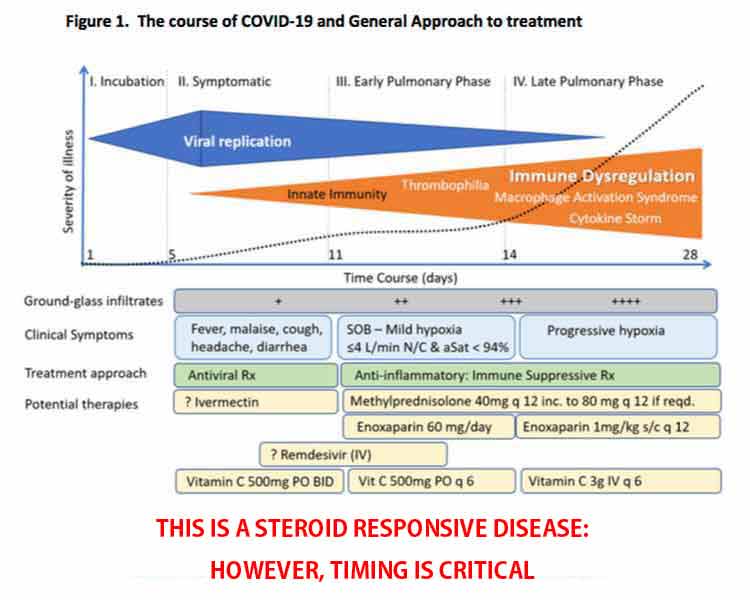
Viral Load Declines as Inflammation Rises
Another important concept explained by Marik in the featured interview is that the inflammatory response rises as the viral load decreases. They do not rise together.
“So, it’s really not the virus that is causing cytopathic effects,” he says. By the time you enter the pulmonary phase of the disease, your viral load has actually significantly decreased, but for some reason the inflammatory response then starts to run amok.
Your oxygen saturation is “the key indicator of pulmonary involvement,” Marik says. Once your oxygen saturation starts to decline, you are entering the early pulmonary phase where inflammation is rapidly increasing.
This is why it’s so important to make sure you’re measuring your oxygen saturation. Do not try to treat at home if your oxygen is dropping. Go to the hospital. Again, early treatment is crucial. Hopefully, your doctor will be willing to implement the MATH+ protocol.
Corticosteroids Are a Crucial Component
In a short essay19 co-written by the entire FLCCC team, they express their conviction that the MATH+ protocol is one of the best, most effective, critical care protocols for COVID-19 to date.
“Months ago, early on in COVID19, the FLCCC created the MATH+ protocol based on our physicians’ insights into COVID19 as a steroid-responsive disease.
This treatment recommendation went against all the major national and international health care societies that had misinterpreted the medical literature, a body of published evidence which, upon careful and deep review, actually supported the use of corticosteroids in prior pandemics …
Thousands of patients who became critically ill with Covid19 and who were suffering from massive inflammation may have been saved if this safe and powerful anti-inflammatory medicine had been provided.”
The essay20 stresses the importance of corticosteroids in the treatment of COVID-19, and cites results from the RECOVERY trial,21,22,23 a large, randomized controlled COVID-19 study by the University of Oxford, that validates their recommendation to use corticosteroids as soon as the patient is hospitalized.
In that study, the corticosteroid dexamethasone improved survival by one-third in ventilated patients and one-fifth in those requiring oxygen. However, the FLCCC believes another type of corticosteroid, methylprednisolone, is a better, more effective, choice.
First, because it reaches higher concentrations in lung tissue, and secondly, because it most closely matches the inflammatory gene activation patterns induced by SARS-CoV-2. They also believe the dexamethasone dose used in the RECOVERY trial was too low, especially for severe cases.
“In the hospitals of two of our FLCCC physicians — each having treated over 100 hospitalized patients with MATH+ often early on in the hospitalization, the hospital mortality rate to date is 7% in one hospital (Dr. Paul Marik, Norfolk, Va.) and less than 1% in the other (Dr. Joseph Varon, Houston, Texas),” the essay states.24
Vitamin C and Quercetin Work Synergistically
June 19, 2020, Marik published the paper,25 “Quercetin and Vitamin C: An Experimental, Synergistic Therapy for the Prevention and Treatment of SARS-CoV-2 Related Disease (COVID-19)” in the journal Frontiers in Immunology, which notes:
“Ascorbic acid is a crucial vitamin necessary for the correct functioning of the immune system. It plays a role in stress response and has shown promising results when administered to the critically ill. Quercetin is a well-known flavonoid whose antiviral properties have been investigated in numerous studies.
There is evidence that vitamin C and quercetin co-administration exerts a synergistic antiviral action due to overlapping antiviral and immunomodulatory properties and the capacity of ascorbate to recycle quercetin, increasing its efficacy.
Safe, cheap interventions which have a sound biological rationale should be prioritized for experimental use in the current context of a global health pandemic.”
The paper presents evidence for the use of vitamin C and quercetin — based on their biological actions and pharmacokinetics profiles — both as prophylaxis in high-risk populations, and as an adjunct to drugs such as Remdesivir or convalescent plasma in the treatment of hospitalized COVID-19 patients.
Post-COVID Syndrome
In the interview, Marik also addresses the issue of “post-COVID syndrome,” which he says is very similar to that of post-sepsis syndrome. In some cases, COVID-19 patients have recovered from the infection, only to die due to pulmonary embolism (blood clots in the lungs) or other organ dysfunction.
Marik suspects this is because the inflammatory response is still overactive. Many sepsis patients will have very high cytokine levels even a year after their recovery. He believes steroids are one key to downregulating the inflammatory response, which would prevent this problem.
A good way to screen for this, Marik says, is to measure CRP, which appear to be a good marker for ongoing inflammation. If CRP is high after recovering from COVID-19, Marik suggests doing a short course of corticosteroids to downregulate the inflammatory response. Aspirin may also be helpful if D-dimer is high. These should be used under medical supervision.
I believe this information needs to be shared far and wide, if we are to prevent more people from dying unnecessarily. More and more, as doctors are starting to speak openly about their clinical findings, we see there are quite a few different ways to tackle this illness without novel antivirals or vaccines, using older, inexpensive and readily available medications and nutrients that are already known to be safe.
- 1 Journal of Virology Sep 2004, 78 (20) 11334-11339, Antiviral activity of an analog of luteolin
- 2 Bioorg Med Chem. 2006 Dec 15;14(24):8295-306
- 3 Maclean’s February 24, 2020
- 4 ACS.org Albert Szent-Gyorgyi’s discovery of vitamin C
- 5, 25 Frontiers in Immunology June 19, 2020 DOI: 10.3389/fimmu.2020.01451
- 6 Journal of Antimicrobial Chemotherapy December 2003; 52(6): 1049-1050
- 7 covid19criticalcare.com
- 8, 10 MATH+ Protocol (PDF)
- 9 COVID-19 Management Protocol (MATH+) (PDF)
- 11 COVID-19 Management Protocol (MATH+) Updated July 9, 2020 (PDF)
- 12, 13 EVMS Critical Care COVID-19 Management Protocol August 1, 2020
- 14 Antiviral Research June 2020; 178: 104787
- 15 EVMS Critical Care COVID-19 Management Protocol June 17, 2020
- 16 FLCCC.net Medical Evidence
- 17, 18 MATH+ Hospital Treatment Protocol for COVID-19 July 14, 2020 (PDF)
- 19, 20, 24 Medium June 16, 2020
- 21 Recovery Trial
- 22 BMJ 2020;369:m1626
- 23 Science Translational Medicine June 5, 2020
Vaccine Debate — Kennedy Jr. vs Dershowitz
Reproduced from original article:
Analysis by Dr. Joseph Mercola Fact Checked August 22, 2020
STORY AT-A-GLANCE
- According to Alan Dershowitz’s interpretation of Constitutional law, you only have the right to refuse to be vaccinated against a disease that would affect only you. You do not have the right to refuse a contagious disease that might spread to others
- As the basis and justification for his legal orientation on this issue, Dershowitz relies on a 1905 Supreme Court ruling in the matter of Jacobson v. Massachusetts
- According to Robert F. Kennedy, there is a “big Constitutional chasm” between this 1905 case and today’s vaccine mandates. Jacobson sued to avoid the vaccine and the fine for refusing the vaccine, which was $5. When he lost, he paid the fine. There’s a big difference between paying a small fine, and being forcibly injected with a potentially hazardous vaccine, against your will
- According to a recent poll, about half of Americans say they want to get the COVID-19 vaccine; 27% say they will “definitely” refuse and another 12% say they will “probably” refuse it
- 1 in 40 people — not 1 in 1 million — are injured by vaccines, and a clinician who administers vaccines will have an average of 1.3 adverse vaccine events per month
The video above features a recent vaccine debate between Robert F. Kennedy Jr., chairman of the World Mercury Project and founder/chief legal counsel for Children’s Health Defense, and Alan Dershowitz, a lawyer and legal scholar. Patrick Bet-David, founder of Valuetainment, moderated the event.
Dershowitz may seem like an odd choice for this discussion, but according to Kennedy, no health official has ever agreed to debate him on the issue of vaccine safety.
Bet-David also notes that every doctor invited to discuss the COVID-19 vaccine on his show declined the invitation. So, here, we get the perspectives of two prominent attorneys instead. The discussion initially grew out of a comment made by Dershowitz in another interview, where he said:
“You have no constitutional right to endanger the public and spread the disease. Even if you disagree, you have no right not to be vaccinated. You have no right not to wear a mask. You have no right to open up your business. And if you refuse to be vaccinated, the state has the power to, literally, take you to a doctor’s office and plunge a needle into your arm.”
Should You Have the Right to Decide Your Medical Treatment?
According to Dershowitz’s interpretation of Constitutional law, you only have the right to refuse to be vaccinated against a disease that would affect only you. You do not have the right to refuse a contagious disease that might spread to others.
As far as COVID-19 vaccines are concerned, he does not foresee mandatory vaccinations being an immediate concern, for the simple reason that there won’t be enough vaccines to vaccinate everyone.
Listening to the likes of Bill Gates and others, however, this probably would not be a problem for long, as vaccine manufacturers are fully prepared to go into large-scale manufacturing once a vaccine gets green-lighted by the U.S. Food and Drug Administration.
Interpretation of 1905 Court Ruling Is Not Cut and Dry
As the basis and justification for his legal orientation on this issue, Dershowitz relies on a 1905 Supreme Court ruling in the matter of Jacobson v. Massachusetts. In “Don’t Relinquish Civil Liberties for False Sense of Security,” Barbara Loe Fisher, co-founder and president of the National Vaccine Information Center, explained:
“Dershowitz … was quite reckless in the language he used. He basically said that the Supreme Court in 1905 (Jacobson v. Massachusetts), [gives] the right of state governments to come in and forcibly inject you with a vaccine. That’s not really what Jacobson v. Massachusetts said …
In that case, it was smallpox, because that was the only vaccine they had in 1905, but you have to read the Supreme Court decision very carefully to understand everything that the justices said.
They basically concluded — and I think wrongly so, because utilitarianism … is based on a mathematical equation that some can be inconvenienced or sacrificed for the greater good of a majority of people — that people [who] opposed smallpox vaccination could be required to be vaccinated during epidemics.
Even religious objections could be overridden. But there’s also language in that decision that says that the court is not to be interpreted as meaning that if an individual was at risk for being harmed by the vaccination, they were not meant to [have concluded] that ‘cruel and inhuman to the last degree’ would be the standard that would be used.
I think Dershowitz overstated the opinion, although it is a utilitarian opinion. It gives authority to the states to mandate vaccines because anything that is not defined in the Constitution as a federal activity is reserved for the states.
Public health laws, by and large in this country, are written by the states, and the federal authority is requiring vaccination for people crossing territorial borders of the United States [and the federal government] could mandate vaccines for interstate travel, crossing state borders.
But most public health laws that legislatures make are for the residents of the states, which is why we have a patchwork of [vaccine] laws in this country …
I’m very worried that some attorney is going to try to challenge the Jacobson [ruling] in the 21st century. I think that, probably, in any court right now, you’re going to get that ruling upheld and you’re going to get it strengthened. I would advise against [challenging] that one in the Supreme Court.”
Then vs Now
Kennedy, in turn, points out there is a “big Constitutional chasm” between this 1905 case and today’s vaccine mandates. The difference is indeed rather significant. Jacobson, who had been injured by a previous vaccine, took the case to the Supreme Court in an effort to avoid the vaccine — and the fine for refusing the vaccine, which at the time was $5.
When he lost, he paid the $5 fine, which Kennedy equates to a traffic ticket by today’s standards. There’s a big difference between paying a small fine, and being forcibly injected with a potentially hazardous vaccine, against your will. As noted by Fisher above, the judge in that 1905 case did not claim government had the right to go into someone’s home and forcibly vaccinate them, Kennedy says.
Dershowitz, in turn, agrees that the 1905 ruling “is not binding on the issue of whether or not you can compel someone to get the vaccine,” but that “the logic of the opinion … strongly suggests that the courts today would allow some form of compulsion if the conditions that we talked about were met: [the vaccines are] safe, effective, [and] exemptions [given] in appropriate cases.”
Will You Get the COVID-19 Vaccine?
Kennedy and Dershowitz were able to agree that the COVID-19 vaccine should remain voluntary, and only be mandated if the public health threat is truly extreme. One of the problems the vaccine industry has nowadays is that the trust in them has significantly eroded.
According to a recent poll1,2 cited by Kennedy, about half of Americans say they want the COVID-19 vaccine; 27% say they will “definitely” refuse and another 12% say they will “probably” refuse it.
“Why do so many Americans no longer trust our regulatory officials and [distrust] this process?” Kennedy asks. “One of the reasons is … vaccines are a very different kind of medical prerogative.
It is a medical intervention that is being given to perfectly healthy people, to prevent somebody else from getting sick. And it’s the only medicine given to healthy people.
So, you would expect that we would want that particular intervention to have particularly great guarantees that it’s safe. Because we’re saying to an individual, we are going to make you make this sacrifice for the greater good … Our side of the bargain should be, we want this to be completely safe. But, in fact, what we know about vaccines … is that they’re unavoidably unsafe.”
1 in 40 Are Injured by Vaccines
We often hear that vaccine injuries occur at a rate of 1 in 1 million. This, however, is a gross underestimation. Kennedy discusses an investigation by the U.S. Department of Health and Human Services Agency for Healthcare Research Quality (AHRQ).
They conducted a machine cluster analysis of health data collected from 376,452 individuals who received a total of 1.4 million doses of 45 vaccines. Of these doses, 35,570 vaccine reactions were identified, which means a more accurate estimate of vaccine damage would be 2.6% of all vaccinations.
This means 1 in 40 people — not 1 in 1 million — are injured by vaccines, and a clinician who administers vaccines will have an average of 1.3 adverse vaccine events per month. In other words, we are asking 1 in 40 people to sacrifice their health in order to protect “hypothetical people from catching that particular disease,” Kennedy says.
Importantly, “it’s not hypothetical that vaccines cause injuries,” Kennedy says. The U.S. Vaccine Court has paid out $4 billion to patients permanently damaged or killed by vaccines, and that’s just a small portion of all the cases filed. According to Kennedy, less than 1% of people who are injured ever get to court, due to the high bar set for proving causation.
Vaccine Makers Have No Liability
Vaccine makers also have no liability for injuries. This worsens risks, as they have no real incentive to make sure their products are safe, not only in the short run, but also long-term.
And, as noted by Kennedy, the reason vaccine manufacturers were given immunity in the first place was because they admitted vaccines are unavoidably unsafe and there’s no way to make them 100% safe.
They were getting sued for injuries to the point they said they could not continue to manufacture vaccines, which is why the U.S. government in 1986 agreed to indemnify them against lawsuits under the National Childhood Vaccine Injury Act of 1986, and set up a government-run Vaccine Court instead.
So, when you sue for a vaccine injury, you’re actually suing the U.S. government, and payouts are paid for by the U.S. public via a small fee tacked on to each vaccine sold.
100% of Moderna Vaccine Participants Suffered Side Effects
Kennedy goes on to discuss some of the disturbing preliminary results emerging from current COVID-19 trials. In the case of Moderna, its mRNA vaccine (mRNA-1273) was found to cause systemic side effects in 80% of Phase 1 participants receiving the 100 microgram (mcg) dose.3,4
Side effects ranged from fatigue (80%), chills (80%), headache (60%) and myalgia or muscle pain (53%). After the second dose, 100% of participants in the 100-mcg group experienced side effects. This is important to note as, unlike the flu vaccine, the coronavirus vaccine will be a two-dose regimen and most likely recommended to be repeated annually, just like the flu vaccine.
The 45 volunteers were divided into three dosage groups — 25 mcg, 100 mcg and 250 mcg — with 15 participants in each. Even in the low-dose group, one participant got so sick he required emergency medical care. “That’s 6%,” Kennedy says.
In the high-dose (250 mcg) group, 100% of participants suffered side effects after both the first and second doses, and three of the participants suffered “one or more severe events.”
Keep in mind, the participants in Moderna’s Phase 1 trial were healthy individuals between the ages of 18 and 55.5 Kennedy recites some of the exclusionary criteria of these trials, such as you cannot be overweight, you must be a lifelong nonsmoker, you cannot have a family history of respiratory problems or seizures, you cannot have asthma, diabetes, rheumatoid arthritis or other autoimmune disease.
“These are the people they’re testing the vaccine on, but that’s not who they’re going to give the vaccine to,” Kennedy says. Indeed, over 90% of Americans are metabolically unhealthy and struggle with chronic health conditions that can make them more prone to vaccine complications, yet these, and frail elderly, are most vulnerable to COVID-19 and would theoretically stand to benefit from the vaccine most.
If the vaccine causes severe side effects in young, healthy individuals, what will the results be in those who are old, frail and/or have underlying conditions or compromised immune systems?
“You’re going to see a lot of people dropping dead,” Kennedy predicts. “The problem is, Anthony Fauci put $500 million of our [tax] dollars into that vaccine. He owns half the patents. He has five guys working for him [who are] entitled to collect royalties.
So, you have a corrupt system, and now they’ve got a vaccine that is too big to fail. They’re not saying this was a terrible, terrible mistake. They’re saying, ‘We’re going to order 2 million doses of this [vaccine]’ … And, they have no liability … No medical product in the world would be able to go forward with a [safety] profile like Moderna has.”
Trust Is Earned
Admittedly, the interview is a rather long one — an hour and 20 minutes — but if you have the time, I encourage you to listen to it in its entirety, as Kennedy and Dershowitz cover far more than some of the key highlights I’ve summarized here. You could speed it up to 1.5 to 2 times, which is my approach for most videos now as there is so much video content to consume.
I would not be surprised if Kennedy’s prediction that the COVID-19 vaccine or vaccines will cause severe harm to a great number of people. I also disagree with Dershowitz’s position that anyone involved in medical manufacturing “obviously” has a keen interest in not hurting people.
Kennedy correctly points out that’s clearly not the case, seeing how drug companies have repeatedly been found to knowingly commit fraud in the name of profit. The opioid epidemic is but one glaring example where company executives knew they were causing harm and chose to do it anyway. Trust is earned, and the drug industry has, as Kennedy points out, eroded the public’s trust by their own malfeasance.
The drug industry and government health officials expect us to simply trust that a safe and effective COVID-19 vaccine will be produced in record time. From my perspective, such trust would be misplaced. Their history simply doesn’t warrant it.
I’ve reviewed the historical failures of coronavirus vaccines in previous articles, as well as the potential hazards associated with mRNA vaccines. Importantly, we do not yet know what injecting mRNA to reprogram our DNA might actually do in the long run, since no mRNA vaccine has ever been licensed, but there’s reason to suspect it won’t be entirely beneficial.
The good news is that we probably will not even need a vaccine against COVID-19. As I have previously reviewed, there are loads of strategies to improve your immune system.
Other treatments like nebulized peroxide are really effective if you are already sick. And, as a foundational prophylactic, remember to optimize your vitamin D level, as vitamin D appears to significantly lower your risk, both of contracting the infection and developing severe symptoms, as reviewed in “Vitamin D in the Prevention of COVID-19.”
US Paying Billions for Free COVID-19 Vaccines
Reproduced from original article:
https://articles.mercola.com/sites/articles/archive/2020/08/18/covid-19-vaccine.aspx
Analysis by Dr. Joseph Mercola Fact Checked August 18, 2020
STORY AT-A-GLANCE
- July 22, 2020, Pfizer struck a $1.95 billion deal with the U.S. government to provide Americans with 100 million doses of its COVID-19 vaccine, for free, with an option for 500 million additional doses
- Pfizer/BioNTech have also inked a deal with the U.K. government for 30 million initial doses
- Pfizer’s vaccine, currently known only as BNT162, requires two doses, which means the initial batch for the U.S. would cover 50 million people. The deal hinges on the vaccine clearing Phase 3 human trials
- The company expects seeking a regulatory review by the FDA in October 2020, which would allow them to manufacture the 100 million doses by the end of the year. The FDA has stated a COVID-19 vaccine must be at least 50% effective to qualify for approval
- Dr. Scott Gottlieb, who served as commissioner of the FDA from May 2017 to April 2019, was elected to Pfizer’s board of directors at the end of June 2019
July 22, 2020, Pfizer struck a $1.95 billion deal with the U.S. Department of Health and Human Services and the Department of Defense to provide Americans with 100 million doses of its COVID-19 vaccine, for free, with an option for 500 million additional doses.1 The agreement is part of Operation Warp Speed.
Pfizer/BioNTech have also inked a deal with the U.K. government for 30 million initial doses.2 The vaccine, currently known only as BNT162, developed in partnership with the German company BioNTech, requires two doses, which means the initial batch for the U.S. would cover 50 million people. The deal hinges on the vaccine clearing Phase 3 human trials.
According to a July 22, 2020, press release,3 Phase 2b/3 safety and efficacy trials were expected to begin at the end of July. The company expects seeking a regulatory review by the U.S. Food and Drug Administration in October 2020, which would allow them to manufacture the 100 million doses by the end of the year.
The FDA has stated a COVID-19 vaccine must be at least 50% effective to qualify for approval.4 In other words, the standards aren’t particularly high, despite the concern COVID-19 supposedly poses.
The BNT162 vaccine is based on BioNTech’s proprietary mRNA technology. BioNTech is the market authorization holder for the mRNA technology worldwide, and will own all the trademarks for the vaccine.5 According to Pfizer’s press release:6
“The Pfizer/BioNTech vaccine development program is evaluating at least four experimental vaccines, each of which represents a unique combination of messenger RNA (mRNA) format and target antigen. On July 1st, Pfizer and BioNTech announced preliminary data7 from BNT162b1, the most advanced of the four mRNA formulations.
The data demonstrates that BNT162b1 is able to produce neutralizing antibodies in humans at or above the levels observed in the plasma from patients who have recovered from COVID-19 … Local reactions and systemic events were dose-dependent, generally mild to moderate, and transient. No serious adverse events were reported.”
Former FDA Commissioner Is Now on Pfizer Board of Directors
Interestingly enough, Dr. Scott Gottlieb, who served as commissioner of the FDA from May 2017 to April 2019,8 just so happened to be elected to Pfizer’s board of directors at the end of June 2019. At the time, Ian Read, executive chairman of Pfizer’s board of directors stated:9
“We are fortunate to have Dr. Gottlieb join Pfizer’s Board of Directors. Scott’s expertise in health care, public policy and the industry will be an asset to our company and enable our shareholders to continue to benefit from a Board representing a balance of experience, competencies and perspectives.”
Well, there can be little doubt that a former FDA commissioner on your board might be an asset when you’re trying to secure a nearly $2 billion contract with the U.S. government for a novel vaccine that has never been approved by the FDA for human use.
As discussed in “Why Most Health Commissioners End Up in Bed With Big Pharma,” Gottlieb is far from alone in having walked through that revolving door. After leaving the top leadership position at the FDA, nine of the last 10 commissioners have gone on to work for pharmaceutical companies.
While none of these moves of past FDA commissioners to pharmaceutical companies is illegal, the pattern creates the suspicion there might be an unstated agreement between the pharmaceutical industry and those who are charged with regulating the approval of their products.
Another egregious example was Julie Gerberding, who served as the director of the CDC from 2002 to 2009. Immediately after leaving the CDC, she became president of Merck’s vaccine division, for which she received tens of millions of dollars a year — far more than her CDC salary.
mRNA Vaccines May Produce Serious Side Effects
As detailed in the preliminary study10 results, posted on the preprint server medRxiv July 20, 2020, BNT162b1 is a lipid nanoparticle (LNP) formulated nucleoside-modified mRNA that encodes the receptor binding domain (RBD) of the SARS-CoV-2 spike protein.
mRNA vaccines have never before been licensed for use in humans. Inside your cells, mRNA activate DNA instructions, and act as a template to build a specific protein.
mRNA vaccines have potential safety issues, including local and systemic inflammation and stimulation of auto-reactive antibodies and autoimmunity, as well as development of edema (swelling) and blood clots.
The theory behind mRNA vaccines is that when you inject the mRNA (encapsulated within lipid nanoparticles), the mRNA will stimulate your cells to manufacture their own viral proteins.11 In this case, those proteins would mimic the proteins found in SARS-CoV-2.
Conventional vaccines train your body to recognize and respond to the proteins of a particular virus by injecting a small amount of the actual viral protein into your body, thereby triggering an immune response and the development of antibodies.
No previous vaccines have had your own cells produce the viral proteins responsible for producing immunity. mRNA vaccines are designed to make your body produce its own viral protein, which your immune system would then mount a response to. If you suspect a whole lot could go wrong here, you’d probably be right. As reported by The Vaccine Reaction:12
“According to researchers at University of Pennsylvania and Duke University, mRNA vaccines have potential safety issues, including local and systemic inflammation and stimulation of auto-reactive antibodies and autoimmunity, as well as development of edema (swelling) and blood clots.”13
Systemic inflammation, auto-reactive antibodies and autoimmune problems are no small matters. In fact, these are in large part why previous attempts to create a coronavirus vaccine have failed.
As explained by Robert F. Kennedy, Jr., in my interview with him, coronavirus vaccines are notorious for creating paradoxical immune enhancement. Even though the vaccines create a robust antibody response, the subjects end up sicker than normal when they’re exposed to the wild virus. In one ferret study, all the vaccinated animals died.
Time will tell just how hazardous the COVID-19 vaccines turn out to be. Since they work on the genetic level, there could be long-term, perhaps even generational, issues that won’t be readily apparent anytime soon, as these vaccines could be integrated into your DNA.
Be Wary of the PR Propaganda Spin
A July 21, 2020, Wired article urges researchers and media to be upfront and transparent about the vaccines’ side effects right now, “before it ends up as fodder for the skeptics”:14
“Neither the mainstream media nor the medical press has given much attention to the two vaccines’ potential downsides — in particular, their risk of nasty adverse effects, even if they’re not life-threatening. This sort of puffery doesn’t only help to build a false impression; it may also dry the tinder for the future spread of vaccine fearmongering.”
Wired points out that some trials are not using an inert placebo but rather injected meningococcal vaccine, which might hide certain symptoms or harms. Another example: The University of Oxford added study arms in which subjects are given acetaminophen every six hours for the first 24 hours after inoculation.
Is the pain and fever reducer given to mask and downplay certain symptoms and side effects, such as pain, fever, headache or general malaise? It very well could be. Wired notes:15
“The press release for … results from the Oxford vaccine trials described an increased frequency of ‘minor side effects’ among participants. A look at the actual paper, though, reveals this to be a marketing spin …
Yes, mild reactions were far more common than worse ones. But moderate or severe harms — defined as being bad enough to interfere with daily life or needing medical care — were common too.
Around one-third of people vaccinated with the COVID-19 vaccine without acetaminophen experienced moderate or severe chills, fatigue, headache, malaise, and/or feverishness.
Close to 10 percent had a fever of at least 100.4 degrees, and just over one-fourth developed moderate or severe muscle aches. That’s a lot, in a young and healthy group of people — and the acetaminophen didn’t help much for most of those problems.”
Experts Worry Vaccine Uptake May Be Low
Indeed, medical experts have already expressed concerns that COVID-19 vaccine uptake might end up being low. As reported by Newsday June 21, 2020:16
“A recent national Washington Post/ABC poll, and a poll of Long Islanders and New York City residents by Mount Sinai South Nassau hospital in Oceanside, each found that only 45% or fewer of respondents said they would get a coronavirus vaccine if one is developed. About a quarter in each poll said they would not, and the rest said they weren’t sure or wouldn’t answer.”
That Newsday article also inadvertently provides clues as to why most states are now, months into the pandemic, which has long since been “flattened,” issuing mandatory mask mandates, even though the science clearly tell us masks cannot protect against or prevent the spread of viruses.
I believe the forced mask wearing is a way to manipulate us into taking the vaccine, once it becomes available, and that is exactly what Noel Brewer alludes to in the Newsday article:17
“A return to pre-COVID-19 life could be possible if significantly more than half of Americans — the percentage is unknown — get a vaccine, the number of new infections is low and those who already contracted the virus are immune from getting sick again …
That enticement of normal life could lead some who now are leery about a coronavirus vaccine to get one once it is available, said Noel Brewer, a professor of health behavior at the University of North Carolina who sits on World Health Organization committees on vaccine behavior and safety.
‘If a vaccine allows you to no longer wear a mask at work, or to visit your grandmother in a nursing home, or to shake hands with business colleagues, that could be very motivating,’ he said.”
- 1, 3, 5, 6 Pfizer July 22, 2020
- 2 Diazhub July 20, 2020
- 4 KMX1070.radio.com July 22, 2020
- 7, 10 medRxiv July 20, 2020 DOI: 10.1101/2020.07.17020140533 (PDF)
- 8 FDA.gov Scott Gottlieb
- 9 Pfizer June 27, 2019
- 11 Horizon Magazine April 1, 2020
- 12 The Vaccine Reaction May 25, 2020
- 13 Nature Reviews Drug Discovery 2018; 17: 261-279
- 14, 15 Wired July 21, 2020
- 16, 17 Newsday June 21, 2020
Flu Vaccination Associated With Increased Viral Shedding
Reproduced from original article:
https://articles.mercola.com/sites/articles/archive/2020/08/11/flu-vaccination-associated-with-increased-viral-shedding.aspx
Analysis by Dr. Joseph Mercola Fact Checked August 11, 2020

STORY AT-A-GLANCE
- University of Maryland researchers revealed that repeated vaccination increases the amount of influenza virus exhaled into the air
- Researchers observed 6.3 times more aerosol shedding among cases with vaccination in the current and previous season compared with having no vaccination in those two seasons
- The CDC states that shedding of the live attenuated vaccine virus is “common” after receipt of live attenuated influenza vaccine
- There’s no way to know for sure how often vaccine-strain live virus shedding and disease transmission actually occurs, since it’s not being actively monitored or tested for
- In June 2020, biotechnology company Meissa Vaccines announced that it has initiated preclinical studies and manufacturing of a live attenuated COVID-19 vaccine
When your body is infected with a disease-causing virus such as influenza, the virus is “shed” into the environment, via your saliva and other bodily fluids and skin lesions. If someone comes in contact with that shed virus, it’s possible that they, too, will become infected with the virus.
There’s still a lot of unknowns when it comes to viral shedding. How long a person sheds a virus, when shedding occurs and whether it occurs at the onset of symptoms or prior to symptoms, varies by virus and are influenced by a person’s age, health status and even weight.1
That viruses are shed from their hosts is common knowledge. However, the topic of viral shedding isn’t one you’ll hear about often when it comes to live attenuated viral vaccines, examples of which include measles, mumps, rubella (MMR), vaccinia (smallpox), varicella, zoster (which contains the same virus as varicella vaccine but in much higher amount), yellow fever, rotavirus and influenza (intranasal).2
Live viral vaccines use a weakened (or attenuated) version of the virus, which is typically passed through a living cell culture or other host, such as chicken embryo, many times over until it becomes weakened to a point that it’s not likely to make you sick when it’s injected, swallowed or inhaled.
That being said, it’s still a live vaccine-strain virus — one that can be shed like any virus — and research suggests that vaccination may increase viral shedding in the case of influenza.3
Flu Vaccine Recipients Shed 6.3 Times More Virus Into the Air
In a study published in PNAS, University of Maryland researchers revealed not only that influenza virus may be spread via simple breathing (i.e., no sneezing or coughing required) but also that repeated vaccination increases the amount of influenza virus released into the air.4
“Little is known about the amount and infectiousness of influenza virus shed into exhaled breath. This contributes to uncertainty about the importance of airborne influenza transmission,” the researchers noted. “We show that sneezing is rare and not important for — and that coughing is not required for — influenza virus aerosolization.”5
This is important, as it means that even someone who’s not actively sneezing or coughing can still potentially transmit the influenza virus to others.
Further, someone who’s recently received the live attenuated influenza vaccine (LAIV) may also potentially actively shed and transmit the virus. According to the study, in fact, people who were vaccinated for influenza shed more than six times more virus into the air than those who were not:6
“Self-reported vaccination for the current season was associated with a trend toward higher viral shedding in fine-aerosol samples; vaccination with both the current and previous year’s seasonal vaccines, however, was significantly associated with greater fine-aerosol shedding in unadjusted and adjusted models.
In adjusted models, we observed 6.3 times more aerosol shedding among cases with vaccination in the current and previous season compared with having no vaccination in those two seasons.”

Annual Vaccination May Actually Reduce Your Protection
Receiving a flu vaccination to prevent type A or B influenza is not nearly as cut-and-dry as health officials would have you believe. There are many unanswered questions that deserve further research, like the possibility that getting repeated annual flu shots may increase your susceptibility to influenza. In a 2013 study, it was found that those who received the influenza vaccine two years in a row got no significant protection during the current flu season.7,8
Another finding revealed by the study was that vaccination failed to prevent household transmission once influenza was introduced, with adults being particularly at risk despite vaccination.9 Again in 2019, researchers found that vaccine effectiveness was lower against certain types of flu (H3N2 and B) for those vaccinated during two consecutive flu seasons compared to those vaccinated in the current season only.10
The possibility that repeated vaccination may reduce effectiveness, and that annual vaccination may increase aerosol viral shedding, demands more investigation. According to the featured study researchers:11
“The association of current and prior year vaccination with increased shedding of influenza A might lead one to speculate that certain types of prior immunity promote lung inflammation, airway closure, and aerosol generation. This first observation of the phenomenon needs confirmation.
If confirmed, this observation, together with recent literature suggesting reduced protection with annual vaccination, would have implications for influenza vaccination recommendations and policies.”
It’s possible, for instance, that after vaccination, you may become a contagious silent carrier of disease. A person with influenza who fully expresses symptoms of fever, body aches, cough and other signs of respiratory illness would likely stay at home.
However, a vaccinated individual, who is silently contagious, would go to work and into stores and other public places and be unaware they are spreading infection, which can be done even via regular breathing.
This is an especially important fact for vaccinated health care workers, who move freely among patients in hospitals and other medical facilities because everyone assumes vaccinated medical personnel are “immune” to influenza if they get a flu shot every year, even though they could potentially be transmitting influenza to hospital patients, including those in the ICU.
CDC: Virus Shedding ‘Common’ After Receipt of LAIV
Although you may be surprised to learn that virus shedding occurs after certain vaccinations, even the U.S. Centers for Disease Control and Prevention (CDC), in their “Safety of Influenza Vaccines” report for professionals,12 states that shedding of the live attenuated vaccine virus is “common” after receipt of LAIV. They cite numerous studies confirming as such, including:
- Among 345 LAIV3 recipients, 29% had detectable virus in their nasal secretions, with maximal shedding occurring within two days of vaccination13
- In a study of 200 children aged 6 months through 59 months, 79% shed at least one vaccine virus; shedding was most common among younger children, with 89% of 6- to 23-month-olds shedding at least one vaccine virus14
The live influenza vaccine is FluMist, which is approved for nonpregnant women as well as anyone aged 2 to 49 years. It’s administered in the form of a nasal spray.
While the CDC states that the live type A and B vaccine strain influenza viruses in FluMist are too weak to actually give recipients influenza, according to the CDC, “transmission of shed LAIV vaccine viruses from vaccine recipients to unvaccinated persons has been documented …”15
MedImmune, the company that developed FluMist, is also aware that the vaccine sheds vaccine-strain virus. In its prescribing information, they describe a study on the transmission of vaccine-strain influenza viruses from vaccinated children to nonvaccinated children in a day care setting.
In 80% of the FluMist recipients, at least one vaccine-strain influenza virus was isolated anywhere from one to 21 days following vaccination. They further noted, “One placebo subject had mild symptomatic Type B virus infection confirmed as a transmitted vaccine virus by a FluMist recipient in the same playgroup.”16
How Often Does Vaccine Virus Transmission Occur?
According to the CDC, “The estimated probability of transmission of vaccine virus within a contact group with a single LAIV recipient in this population [a child care center] was 0.58%,” however in a child care setting it’s likely that multiple children would have received LAIV at any given time.17
However, there’s no way to know for sure how often vaccine-strain live virus shedding and disease transmission actually occurs, since it’s not being actively monitored or tested for.
Barbara Loe Fisher, co-founder and president of the National Vaccine Information Center (NVIC), wrote a special report, “The Emerging Risks of Live Virus and Viral Vectored Vaccines: Vaccine Strain Virus Infection, Shedding and Transmission,” which contains over 200 references and delves into virus shedding and vaccine virus shedding. She noted:18
“There is no active surveillance and testing for evidence of vaccine strain live virus shedding, transmission and infection among populations routinely being given multiple doses of live virus vaccines, including measles vaccine. Therefore, it is unknown exactly how many vaccinated children and adults in the U.S. or other countries are shedding and transmitting vaccine strain live viruses.
Whether or not vaccine strain live virus shedding, transmission and infection is causing undiagnosed or misdiagnosed health problems, especially among people with severe immune deficiencies or autoimmune and other immune system disorders, is an open question.”
A Live Attenuated COVID-19 Vaccine Is Being Produced
The featured study has implications for COVID-19, which is still a mystery in terms of transmission and treatment. It’s unknown, for instance, if Sars-CoV-2, the virus that causes COVID-19, has airborne transmission potential in addition to being spread by more direct contact or droplets.
Airborne transmission appears likely,19 however, raising even more concerns considering the development of a live attenuated COVID-19 vaccine has begun.
In June 2020, biotechnology company Meissa Vaccines announced that it has initiated preclinical studies and manufacturing of a live attenuated COVID-19 vaccine,20 which was derived by modifying the company’s live attenuated RSV vaccine candidate.
Whether a live attenuated COVID-19 vaccine will end up causing recipients to shed vaccine-strain virus into the air remains to be seen, but there are inherent risks. Even Martin Moore, Ph.D., co-founder and CEO of Meissa Vaccines, told BioSpace about the potential for virus shedding. BioSpace reported:21
“Moore explained that if a virus is attenuated based on one or two gene mutations, the virus could revert to being infectious in the vaccine recipient and they can shed live virus, spreading it to others. This is the worst-case scenario and why there are such strict safety standards for vaccines, especially LAVs [live attenuated vaccines].
‘Safety is critical, there are no cutting corners with safety,’ explained Moore. ‘Coronaviruses, in particular, are prone to genetic recombination, so using a live attenuated coronavirus in a vaccine would run the risk of becoming infectious again.’”
In terms of both influenza and any novel COVID-19 vaccines licensed by the Food and Drug Administration (FDA) and recommended by the CDC, it’s important to be aware of the differences between attenuated live virus vaccines and inactivated vaccines, especially if you’re in a vulnerable population, such as very young children, the elderly, pregnant and breastfeeding women and people with acute or chronic health problems or a compromised immune system.
There remain many unanswered questions regarding live virus vaccines and their ultimate impact on public health.
- 1 The Journal of Infectious Diseases, Volume 218, Issue 9, 1 November 2018, Pages 1378–1382
- 2 CDC, Immunology and Vaccine-Preventable Diseases
- 3, 4, 5, 6 PNAS January 30, 2018 115 (5) 1081-1086
- 7 University of Minnesota, CIDRAP March 1, 2013
- 8, 9 Clinical Infectious Diseases, Volume 56, Issue 10, 15 May 2013, Pages 1363–1369
- 10 BMC Medicine volume 17, Article number: 9 (2019)
- 11 PNAS January 30, 2018 115 (5) 1081-1086 Discussion
- 12, 15, 17 U.S. CDC, Safety of Influenza Vaccines
- 13 Vaccine. 2008 Sep 8;26(38):4940-6
- 14 Vaccine. 2011 Jun 10;29(26):4322-7
- 16, 18 NVIC, The Emerging Risks of Live Virus & Virus Vectored Vaccines
- 19 Scientific Reports volume 10, Article number: 12732 (2020)
- 20 Meissa Vaccines June 30, 2020
- 21 BioSpace July 20, 2020
Vit D, Magnesium and B12 Significantly Improve COVID Outcomes
Reproduced from original article:
https://articles.mercola.com/sites/articles/archive/2020/08/11/vitamin-d-magnesium-b12-improve-covid-outcomes.aspx
Analysis by Dr. Joseph Mercola Fact Checked August 11, 2020
STORY AT-A-GLANCE
- StopCOVIDCold is now LIVE and ready for you to find out your COVID-19 risk and help spread the word about vitamin D
- Researchers with the Singapore General Hospital and Duke-NUS Medical School set out to determine if a combination of vitamin D, magnesium and vitamin B12 would improve outcomes among COVID-19 patients aged 50 and older
- Seventeen of the patients received oral vitamin D3 (1,000 IU), magnesium (150 milligrams (mg)) and vitamin B12 (500 mcg) — together known as DMB — upon admission for a median of five days while 26 patients who did not receive DMB served as the control group
- Significant benefits were seen among the DMB group, with only 17.6% requiring initiation of oxygen therapy during their hospitalization, compared to 61.5% of those in the control group
- Vitamin D, magnesium and vitamin B12 may present a unique three-pronged approach for tackling COVID-19 by modulating the hyper-inflammation often seen in the disease
You know I have been passionate about how useful optimal levels of vitamin D can be in lowering your COVID-19 risk. For the last few months I have been working on a campaign that I really need your help on. The new site is StopCOVIDCold and you can reach it by clicking the button below.
New Campaign to Spread the Word About Vitamin D

Once you are on the site, there is a quiz you can take that will help you determine your risk for getting COVID-19 by answering a few questions that will only take you a few minutes. There is also an opportunity to upload a Facebook frame to your Facebook profile picture to help spread the word.
The media has failed miserably in educating the public on how to improve their immune system and has instead relied on the false hope of drugs, vaccines, social distancing and masks, all of which do nothing to improve your immune system.
We need your help in sharing this information with the elderly, and Blacks, who are most at risk of vitamin D deficiency.
The goal is to get this information out to tens, if not hundreds of millions of people. I simply can’t do it without your help. We plan on launching this information to 50-100 sites and I am giving readers of this site the first opportunity to participate in this process. I would deeply appreciate it if you could provide your feedback in the comment section below.
Vitamin D Deficiency Linked to More Severe COVID-19
Vitamin D, in particular, has emerged as an essential nutrient in the fight against COVID-19. In a letter to the editor published by Clinical Endocrinology, Dr. Grigorios Panagiotou, a clinical fellow in endocrinology and diabetes at the U.K.’s Newcastle upon Tyne Hospitals, found that COVID-19 patients admitted to intensive treatment units (ITUs) were more likely to be vitamin D deficient than those who were managed in medical wards.
Specifically, “only 19% of the ITU COVID-19 patients had 25(OH)D (vitamin D) levels greater than 50 nmol/L (20 ng/mL) versus 39.1% of non-ITU patients.”1
“Vitamin D receptors are highly expressed in B- and T-lymphocytes, suggesting a role in modulating innate and adaptive immune responses,” Panagiotou said in a news release. “[Vitamin D] levels reach their nadir at the end of winter, and low levels are associated with increased risk of acute respiratory tract infections during winter [and are] mitigated by vitamin D supplementation.”2
While this study did not find an association between vitamin D and COVID-19 fatality, it could be due to the small sample size and quick diagnosis and treatment of vitamin D deficiency.3 In fact, other research has linked vitamin D to increased death rates.
Researchers in Indonesia, who looked at data from 780 COVID-19 patients, found those with a vitamin D level between 21 ng/mL (52.5 nmol/L) and 29 ng/mL (72.5 nmol/L) had a 12.55 times higher risk of death than those with a level above 30 ng/mL.4 Having a level below 20 ng/mL was associated with a 19.12 times higher risk of death.
Even the French National Academy of Medicine released a press release in May 2020 detailing the importance of vitamin D for COVID-19.5 For COVID-19 patients over 60, they recommend vitamin D testing and if deficiency is found, a bolus dose of 50,000 to 100,000 IU. For anyone under the age of 60 who receives a positive COVID-19 test, they advise taking 800 IUs to 1,000 IUs of vitamin D per day.
A vitamin D review paper published in the journal Nutrients in April 2020 recommends higher amounts, stating:6
“To reduce the risk of infection, it is recommended that people at risk of influenza and/or COVID-19 consider taking 10,000 IU/d of vitamin D3 for a few weeks to rapidly raise 25(OH)D concentrations, followed by 5000 IU/d.
The goal should be to raise 25(OH)D concentrations above 40–60 ng/mL (100–150 nmol/L). For treatment of people who become infected with COVID-19, higher vitamin D3 doses might be useful.”
The best way to know how much vitamin D you need is to have your levels tested. Data from GrassrootsHealth’s D*Action studies suggest the optimal level for health and disease prevention is between 60 ng/mL and 80 ng/mL, while the cutoff for sufficiency appears to be around 40 ng/mL. In Europe, the measurements you’re looking for are 150 to 200 nmol/L and 100 nmol/L respectively.
I recently published a comprehensive vitamin D report in which I detail vitamin D’s mechanisms of action and how to ensure optimal levels. I recommend downloading and sharing that report with everyone you know, as the time to optimize your vitamin D level is now — before the fall and winter.
Additional Nutrient Strategies to Combat COVID-19
As with many viral infections, COVID-19 appears to have a nutritional component, by which you may lower your risk of severe outcomes by using vitamins and minerals therapeutically. Considering that current COVID-19 treatments are few and far between, and even “standard” therapies like mechanical ventilation appear to be backfiring,7 the use of natural solutions has caught the eye of numerous researchers.
Among them are researchers with the Singapore General Hospital and Duke-NUS Medical School, who set out to determine if a combination of vitamin D, magnesium and vitamin B12 would improve outcomes among COVID-19 patients aged 50 and older. Their basis was to attack the inflammatory component of the infection, noting:8
“A broad theme of immune hyper-inflammation has emerged as a key determinant of patient outcome with uncontrolled immune response postulated as a pathophysiologic factor in disease severity. Intuitively, immunomodulation becomes an attractive potential treatment strategy.”
Vitamin D, Magnesium, B12 Combo Improves COVID Outcomes
The cohort study involved 43 COVID-19 patents who were admitted to the Singapore General Hospital between January 15, 2020, and April 15, 2020. Seventeen of the patients received oral vitamin D3 (1,000 IU), magnesium (150 milligrams (mg)) and vitamin B12 (500 mcg) — together known as DMB — upon admission for a median of five days while 26 patients who did not receive DMB served as the control group.9
Significant benefits were seen among the DMB group, with only 17.6% requiring initiation of oxygen therapy during their hospitalization, compared to 61.5% of those in the control group. The requirement for oxygen is associated with an increased risk of needing intensive care, and the DMB group also benefited in this area.
Among those in the DMB group who required supplemental oxygen (three out of the 17 patients), two required ICU admission while one did not. Among the control group, all of those who needed supplemental oxygen required further ICU support. Nine of the DMB patients were given the combination within the first week of the onset of symptoms, and only one among them required oxygen therapy.
Overall, only three of the DMB patients deteriorated, two of whom deteriorated within 24 hours and may not have had enough time for the combo to work. The third case was started on DMB after seven days from onset of symptoms, and the researchers believe starting earlier in the course of the infection may be important.10
Further, DMB was protective even after accounting for other risk factors, including age and high blood pressure:11
“On univariate analysis, increasing age and hypertension demonstrated significantly higher odds ratio for oxygen therapy, while exposure to DMB therapy was associated with a significantly improved odds ratio. Multivariate analysis showed that DMB remained a significant protective factor against clinical deterioration after adjusting for age or hypertension separately.”
Combo Targets the Inflammatory Response
The researchers noted that many current therapeutics are focused on viral elimination instead of modulating the hyper-inflammation often seen in the disease. In fact, uncontrolled immune response has been suggested as a factor in disease severing, making immunomodulation “an attractive potential treatment strategy.”12
For example, cytokines are a group of proteins that your body uses to control inflammation. If you have an infection, your body will release cytokines to help combat inflammation, but sometimes it releases more than it should.
If the cytokine release spirals out of control, the resulting “cytokine storm” becomes dangerous and is closely tied to sepsis, which may be an important contributor to the death of COVID-19 patients.13
“COVID-19 is therefore a multi-organ phenomenon and it is becoming evident that appropriate systemic inflammatory control is necessary for overall survival benefit,” the researchers explained, writing how vitamin D, magnesium and vitamin B12 present a unique three-pronged approach for tackling COVID-19:14
“Vitamin D, through its effect on NFkB and other pathways, can attenuate various proinflammatory cytokine mediating the uncontrolled cytokine storm seen in severe COVID-19 with deficiency associated with severe COVID-19.
Magnesium is critical in the synthesis and activation of vitamin D, acting as a cofactor in many of the enzymes involved in vitamin D metabolism. Vitamin B12 is essential in supporting a healthy gut microbiome which has an important role in the development and function of both innate and adaptive immune systems.
This could be pivotal in preventing excessive immune reaction especially in COVID-19 patients with microbiota dysbiosis which were associated with severe disease.”
No side effects or adverse events occurred after DMB administration, which also provides an inexpensive, readily available solution that could be easily administered in doctor’s offices at the first onset of symptoms or even taken prophylactically among high-risk populations during outbreaks. There may even be benefit against other viral infections:15
“As all agents in this combination are readily available, safe and inexpensive, DMB can benefit a large swath of the world population especially in economically-challenged countries with limited or late access to vaccines and other therapies. DMB may also exhibit a generic efficacy against other viral infections with similar pathological mechanism.”
Magnesium Works in Concert With Vitamin D
Magnesium, which is required for the conversion of vitamin D into its active form, is important to ensure you’re properly utilizing the vitamin D you’re taking.
Research by GrassrootsHealth, based on data from nearly 3,000 individuals, reveals you need 244% more oral vitamin D if you’re not also taking magnesium and vitamin K2, which also works synergistically with vitamin D and helps prevent complications associated with excessive calcification in your arteries.16
What this means in practical terms is that if you take all three supplements in combination, you need far less oral vitamin D in order to achieve a healthy vitamin D level. This is also part of the success of the featured study’s DMB combination, which combines vitamin D with magnesium.
Importantly, a study published in October 2019 in the online issue of Diabetes Research and Clinical Practice also linked to low magnesium levels with both diabetes and high blood pressure, both of which are risk factors for severe COVID-19 outcomes.17
Dark green leafy vegetables are a good source of magnesium, and juicing your greens is an excellent way to boost your intake, although supplementation may also be necessary for some people.
If your magnesium intake from food is lacking, it would certainly be wise to supplement, either orally or topically. For oral supplementation, my personal preference is magnesium threonate, as it appears to be the most efficient at penetrating cell membranes, including your mitochondria and blood-brain barrier.
As a general rule, I recommend starting out on a dose of 200 mg of oral magnesium citrate per day, gradually increasing your dose until you develop slightly loose stools. To use this method, you need to use magnesium citrate, as it’s known for having a laxative effect. Once you know your cutoff, you can switch to other forms if you like. These include:
- Magnesium glycinate, a powder with low solubility. Glycine is an important amino acid and precursor for glutathione.
- Ionic magnesium found in molecular hydrogen tablets. Each water-soluble tablet has about 80 mg of highly bioavailable unbound magnesium ions, which is about 20% of the recommended daily allowance.
- Magnesium threonate is another excellent choice as it seems it can efficiently penetrate the blood-brain barrier.
- Magnesium malate, which dissolves very well in water. Malate is an intermediary in the Krebs cycle, so it likely contributes to ATP production.
- Magnesium bisglycinate, which has high bioavailability.
As for vitamin B12, the third component of DMB, increasing B12-rich foods, such as grass fed beef liver, wild rainbow trout and wild sockeye salmon, in your diet can help, but for more serious deficiency you may need weekly shots of vitamin B12 or daily high-dose B12 supplements.
It’s encouraging, however, that simple and readily available nutrients such as these are showing such significant promise against COVID-19, and highlights the importance of optimizing your nutrient intake year-round to stay healthy and help ward off infectious disease.
- 1 Clinical Endocrinology July 3, 2020
- 2, 3 Healio July 24, 2020
- 4 Emerginnova.com (PDF) June 4, 2020
- 5 French National Academy of Medicine May 22, 2020 (PDF)
- 6 Nutrients April 2, 2020; 12(4): 988
- 7 The American Journal of Tropical Medicine and Hygiene June 3, 2020
- 8, 9, 10, 11, 12, 14, 15 medRxiv June 10, 2020
- 13 Lancet. 2020 May 9;395(10235):1517-1520. doi: 10.1016/S0140-6736(20)30920-X. Epub 2020 Apr 17
- 16 GrassrootsHealth Magnesium and Vitamin K2 Combined Important for Vitamin D Levels
- 17 Diabetes Research and Clinical Practice October 31, 2019 [Epub ahead of print]
Common Cold May Trigger Positive COVID-19 Antibody Test
Reproduced from original article:
https://articles.mercola.com/sites/articles/archive/2020/07/30/coronavirus-antibody-test-common-cold.aspx
Analysis by Dr. Joseph Mercola Fact Checked
July 30, 2020

STORY AT-A-GLANCE
- There are three types of COVID-19 tests: molecular, antigen and antibody. Molecular and antigen tests detect active infections, whereas the antibody test will tell you if you’ve developed antibodies in response to a previous SARS-CoV-2 infection
- There are seven different coronaviruses known to cause respiratory illness in humans. The antibodies created by these different coronaviruses appear very similar, and recovering from the common cold may trigger a positive antibody test for COVID-19, even if you were never infected with SARS-CoV-2 specifically
- While experts at the Mayo Clinic claim cross-reactive antibody tests were an early problem that has been corrected and eliminated, the CDC has not confirmed this
- A Singaporean study found common colds caused by the betacoronaviruses OC43 and HKU1 appear to make you more resistant to SARS-CoV-2 infection, and that the resulting immunity might last as long as 17 years
- Other studies suggest immunity after COVID-19 infection may only last between two and 12 months
Right now, there are three types of COVID-19 tests:1
- Molecular — Also known as a PCR (polymerase chain reaction) test, this test detects whether genetic material of the virus is present in the sample collected from your throat or sputum (the back of your sinuses)
- Antigen — This test, sometimes referred to as “rapid test,” detects viral proteins
- Antibody — Also known as a serology test, it detects the presence of antibodies in your blood
The first two, molecular and antigen, are so-called “viral tests” that detect active infections, whereas the antibody test will tell you if you’ve developed antibodies in response to a previous coronavirus infection. It typically takes your body one to three weeks after an infection clears to start making antibodies against the virus in question.
Common Cold Can Trigger Positive COVID-19 Antibody Test
Each of these COVID-19 tests have their issues and controversies. The problem with antibody testing is that there are seven different coronaviruses known to cause respiratory illness in humans.2 Four of them cause symptoms associated with the common cold:
- 229E
- NL63
- OC43
- HKU1
In addition to the common cold, OC43 and HKU1 — two of the most commonly encountered betacoronaviruses3 — are also known to cause bronchitis, acute exacerbation of chronic obstructive pulmonary disease and pneumonia in all age groups.4 The other three human coronaviruses — which are capable of causing more serious respiratory illness — are:
- SARS-CoV
- MERS-CoV
- SARS-CoV-2
The tricky part is that the antibodies created by these different coronaviruses appear very similar, and the U.S. Centers for Disease Control and Prevention admits recovering from the common cold can trigger a positive antibody test for COVID-19, even if you were never infected with SARS-CoV-2 specifically. As explained on the CDC’s “Test for Past Infection” web page:5
“Antibody tests check your blood by looking for antibodies, which may tell you if you had a past infection with the virus that causes COVID-19. Antibodies are proteins that help fight off infections and can provide protection against getting that disease again (immunity). Antibodies are disease specific …
A positive test result shows you may have antibodies from an infection with the virus that causes COVID-19. However, there is a chance a positive result means that you have antibodies from an infection with a virus from the same family of viruses (called coronaviruses), such as the one that causes the common cold.”
Unclear if Cross-Reactive Antibody Tests Are Still Being Used
In a July 10, 2020, interview with KTTC news, Mayo Clinic chair of clinical microbiology, Dr. Bobbi Pritt, said:6
“Early on we had labs using tests that have not received that [U.S. Food and Drug Administration] review and some of those tests … may have given you a false positive and detected the normal coronavirus that circulates and causes the common cold. I would say the vast majority have been extensively tested to show that they do not cross react and give you false positives due to the common cold [anymore].”
While experts at the Mayo Clinic claim these cross-reactive antibody tests were an early problem that has since been corrected and eliminated, the CDC does not confirm or deny the accuracy of this statement on its “Test for Past Infection” web page.7
So, it’s unclear whether the antibody tests manufactured and used today are still capable of delivering a positive result if you were recently exposed and recovered from the common cold virus.
Back on April 29, 2020, infectious disease specialist and CNN medical analyst Dr. Kent Sepkowitz noted that “deciphering between the common cold antibody and the COVID-19 antibody is a real challenge scientifically,”8 but that doesn’t mean it cannot or hasn’t been done.
On a side note, labs are now reporting a shortage of chemicals and disposable pipette tips required to perform COVID-19 tests, which means longer wait times — again. As Scott Shone, director of the North Carolina State Laboratory of Public Health, told The New York Times,9,10 July 23, 2020, “It’s like Groundhog Day. I feel like I lived this day four or five months ago,” referring back to the early days of the pandemic when test supplies were in short supply.
Some Coronaviruses May Impart Resilience Against COVID-19
While the CDC warns it’s still uncertain whether COVID-19 antibodies prevents reinfection, or if it does, for how long, researchers in Singapore have presented evidence11,12,13 suggesting the immunity is likely to be long-lasting.
They discovered common colds caused by the betacoronaviruses OC43 and HKU1 appear to make you more resistant to SARS-CoV-2 infection, and that the resulting immunity might last as long as 17 years.
The authors suggest that if you’ve beat a common cold caused by a OC43 or HKU1 betacoronavirus in the past, you may have a 50/50 chance of having defensive T-cells that can recognize and help defend against SARS-CoV-2. As reported by the Daily Mail:14
“Scientists have found evidence that some immunity may be present for many years due to the body’s ‘memory’ T-cells from attacks by previous viruses with a similar genetic make-up — even among people who have had no known exposure to Covid-19 or SARS …
Blood was taken from 24 patients who had recovered from COVID-19, 23 who had become ill from SARS and 18 who had never been exposed to either SARS or COVID-19 …
Half of patients in the group with no exposure to either Covid-19 or SARS possessed T-cells which showed immune response to the animal betacoronaviruses, COVID-19 and SARS. This suggested patients’ immunity developed after exposure to common colds caused by betacoronavirus or possibly from other as yet unknown pathogens.”
According to the researchers, their findings demonstrate that:15
“Virus-specific memory T-cells induced by betacoronavirus infection are long-lasting, which supports the notion that COVID-19 patients would develop long-term T-cell immunity. Our findings also raise the intriguing possibility that infection with related viruses can also protect from or modify the pathology caused by SARS-Cov-2.”
Added support for these conclusions were published May 14, 2020, in the journal Cell. This study16 found that not only did 70% of samples obtained from recovered COVID-19 patients have resistance to SARS-CoV-2 on the T-cell level but so did 40% to 60% of people who had not been exposed to the virus. According to the authors, this suggests there’s “cross-reactive T cell recognition between circulating ‘common cold’ coronaviruses and SARS-CoV-2.”
Other Researchers Report Low Immunity Post-Recovery
The immunity issue isn’t entirely cut and dry, though. Other research, which looked at antibody levels in recovered COVID-19 patients in Germany, found they lost their antibodies after two to three months.
“Clemens Wendtner, a chief physician at the hospital, tested COVID-19 patients for immunity after they had been treated for the disease at the end of January 2020. The tests showed a significant decrease in the number of antibodies,” DW reported in a July 14, 2020, article.17
“Wendtner says ‘neutralizing’ antibodies, which stop a viral attack, fell in four out of nine of the patients who were tested, within two to three months. Those findings coincide with a similar investigation done in China.
That study also found that antibodies in COVID-19 patients do not persist in the blood. Further research is still required. But these initial findings suggest that a second infection is possible …”
However, it is important to realize that loss of the ability to determine antibody levels may not necessarily reflect lack of immune protection, as there may be innate cell mediated immunity that provides protection that is not being measured by the humoral antibody production.
Will COVID-19 Behave Like the Common Cold?
If reinfection is possible, then COVID-19 would behave much like the common cold and seasonal influenza, which can strike more than once — if not in a single season, then certainly in any given year. If that’s the case, then “immunity passports” and most other COVID-19 interventions, such as school closings and business shutdowns, become even more questionable than they already are.
“If the novel coronavirus behaves like common cold viruses, then talk of “immunity passports” and herd immunization is pointless.”
If SARS-CoV-2 ends up behaving like other human coronaviruses that cause the common cold, immunity may only last six to 12 months, a European study18 says. Here, they did not look at SARS-CoV-2 antibodies but, rather, antibodies against the other four coronaviruses that cause the common cold, none of which were long-lasting. According to BGR, which reported the findings:19
“‘Frequent reinfections at 12 months post-infection and substantial reduction in antibody levels as soon as 6 months post-infection’ were observed for those viruses.
If the novel coronavirus behaves the same way, then talk of ‘immunity passports’ and herd immunization is pointless. A person who recovered from COVID-19 could get it again in six to 12 months without another vaccine shot …
The researchers note that the human coronaviruses are ‘biologically dissimilar’ and ‘have little in common, apart from causing the common cold.’ But SARS-CoV-2 doesn’t have to be similar to any of them to follow the same immunity pattern.”
Is Herd Immunity Against COVID-19 Possible?
The issue of reinfection also raises questions about whether herd immunity is ever going to be possible. Studies cited by The Daily Mail20 claim herd immunity against COVID-19 could be achieved if just 10% to 43% of people develop lasting immunity.
This is a far cry from the percentages typically required for vaccine-induced “herd immunity” (which is really a misnomer, as vaccine-induced immunity doesn’t work like natural immunity, and herd immunity is really only achieved when enough people recover from the illness in question). According to The Daily Mail:21
“The concept of herd immunity hinges on people only being affected once, so that when a certain number of people have been infected with the virus already it can’t spread any more.
It remains a mystery as to whether this is the case for COVID-19 but, if it is, then herd immunity could offer some protection during a second wave of the disease …
Researchers now say it could work to some extent if only one or two out of 10 people have been infected naturally and become immune to the disease … Another study has taken a similar line and suggested herd immunity could develop at around 43 percent of the population getting infected … Immunity among the most socially active people, scientists say, could protect those who come into contact with fewer others.”
Optimizing Vitamin D May Be Your Best Bet
Considering the many questions surrounding the possibility of reinfection and herd immunity, I believe one of your best bets is to address an underlying weakness that can have a significant impact on your COVID-19 risk, namely vitamin D insufficiency.
Rather than waiting for a likely harmful vaccine, get proactive and start optimizing your vitamin D level. You can learn more about this in “The Most Important Paper Dr. Mercola Has Ever Written” and “How to Fix the COVID-19 Crisis in 30 Days.” Also start working on reversing any underlying comorbidities such as insulin resistance and obesity.
When Should You Get Tested?
As for testing, I do not recommend getting a viral test (which checks for active infection) unless you have COVID-19 symptoms and need it to guide your treatment. Swabbing the back of your nasal cavity has its risks, and can actually introduce an infection or, some speculate, even some more nefarious agents.
Getting tested just for the heck of it doesn’t really make sense. Even if you test negative, you can get infected at any point after leaving the test site. If you have to get tested in order to travel or return to work, an antibody test may be more appropriate. Even if your antibodies wane with time, you’re still going to be immune for a while.
The best test are your clinical symptoms. If you have symptoms suggestive of coronavirus infection, then my best recommendation is to start nebulizing food grade hydrogen peroxide at 0.1% as suggested in the video below and discussed in my article on the topic.
I would also make sure that your vitamin D levels are adequate, as discussed in my paper on the topic. If you don’t know your vitamin D level and have not been in the sun or taken over 5,000 units of vitamin D a day, it would likely help to take one bolus dose of 100,000 units, and make sure you are taking plenty of magnesium, which helps convert the vitamin D to its active immune modulating form.
Another great option that is less expensive, easier to get and likely more effective than hydroxychloroquine, would be quercetin with zinc as discussed in my recent article on the subject.
- 1 KHOU11 June 30, 2020
- 2 CDC.gov Human Coronavirus Types
- 3, 4 J Infect Dis. 2013 Nov 15; 208(10): 1634–1642
- 5, 7 CDC.gov Test for Past Infection, Updated June 30, 2020
- 6 KTTC July 10, 2020
- 8 CNN April 29, 2020
- 9 New York Times July 23, 2020
- 10 New York Times July 23, 2020 (Archived)
- 11 Biorxiv preprint DOI: 10.1101/2020.05.26.115832 (PDF)
- 12, 14, 15 Daily Mail June 12, 2020
- 13 Science Times June 12, 2020
- 16 Cell May 14, 2020 DOI: 10.1016/j.cell.2020.05.015
- 17 DW July 14, 2020
- 18 Researchgate preprint May 2020 DOI: 10.1101/2020.05.11.20086439
- 19 BGR May 26, 2020
- 20, 21 Daily Mail July 14, 2020